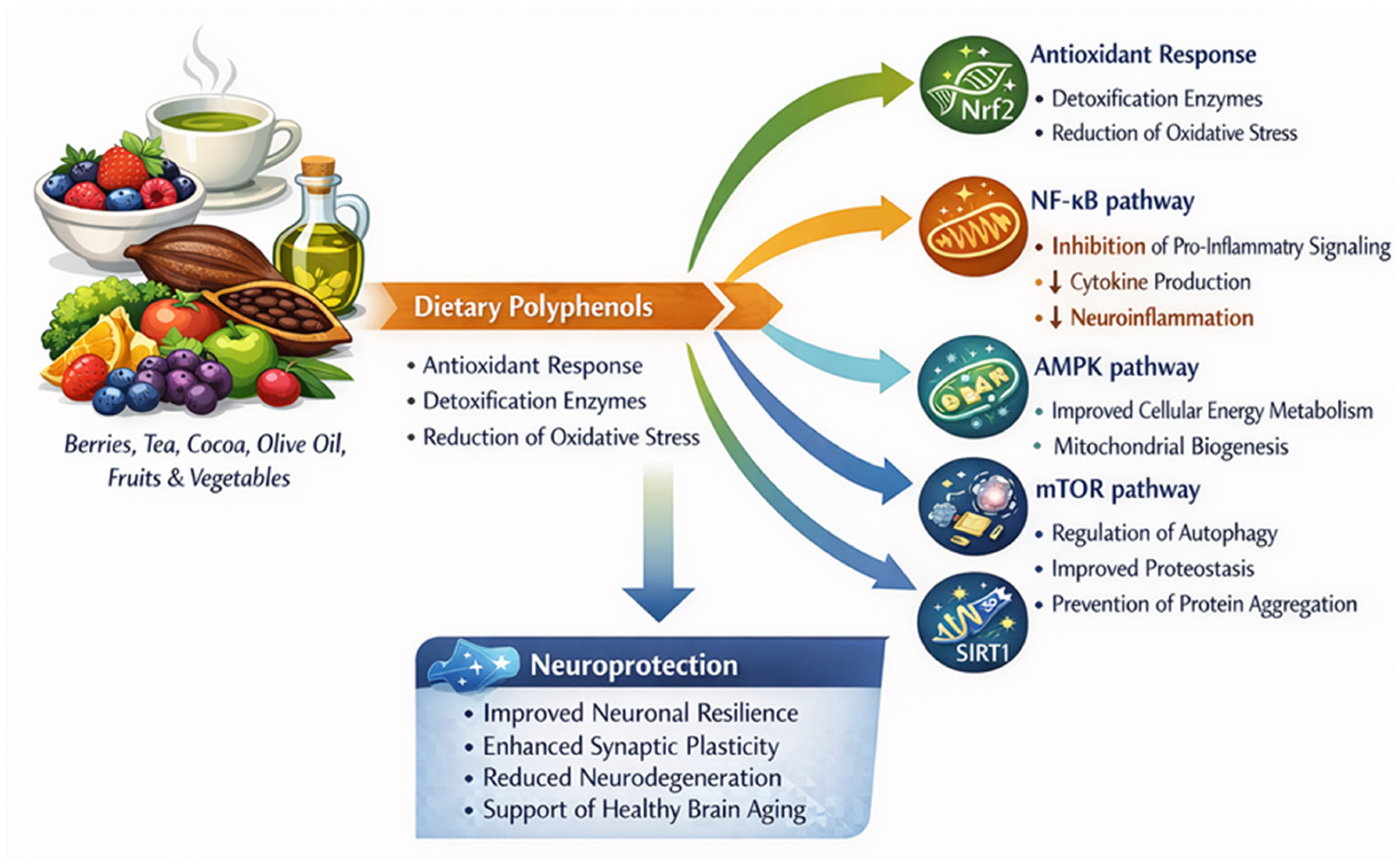
Dietary Polyphenols in Brain Aging: Molecular Mechanisms and Implications for Neurodegeneration
 ,
,  , , , , , , and
Abstract
1. Introduction
2. Methods
3. Geroscience Framework: Biological Hallmarks of Brain Aging
3.1. Oxidative Stress and Redox Imbalance
3.2. Chronic Inflammation and Inflammaging
3.3. Mitochondrial Dysfunction
3.4. Cellular Senescence
3.5. Impaired Proteostasis
3.6. Dysregulation of Nutrient-Sensing Signaling Pathways
4. Dietary Polyphenols as Food-Derived Bioactive Compounds
4.1. Classification of Polyphenols
4.1.1. Flavonoids
4.1.2. Phenolic Acids
4.1.3. Stilbenes
4.1.4. Lignans
4.2. Major Dietary Sources of Polyphenols
4.3. Polyphenol-Rich Dietary Patterns
5. Bioavailability and Metabolism of Polyphenols
5.1. Gastrointestinal Absorption
5.2. Phase II Metabolism
5.2.1. Glucuronidation
5.2.2. Sulfation
5.2.3. Methylation
5.3. Role of the Gut Microbiota
5.4. Transport Across the Blood–Brain Barrier
5.5. Determinants of Bioavailability
5.5.1. Food Matrix
5.5.2. Genetic Factors
5.5.3. Microbiome Composition
6. Molecular Mechanisms of Polyphenol-Mediated Neuroprotection
6.1. Antioxidant Signaling Pathways
6.2. Anti-Inflammatory Mechanisms
6.3. Mitochondrial Protection and Energy Metabolism
6.4. Regulation of Autophagy and Proteostasis
6.5. Synaptic Plasticity and Neurotrophic Signaling
6.6. Epigenetic Regulation
7. Polyphenols and Neurodegenerative Diseases
7.1. Alzheimer’s Disease
7.1.1. Amyloid-β Aggregation
7.1.2. Tau Hyperphosphorylation
7.1.3. Neuroinflammation
7.2. Parkinson’s Disease
7.2.1. α-Synuclein Aggregation
7.2.2. Degeneration of Dopaminergic Neurons
7.3. Cognitive Aging and Mild Cognitive Impairment
8. Evidence from Epidemiological and Clinical Studies
8.1. Prospective Cohort Studies
8.2. Dietary Pattern Studies
8.3. Clinical Intervention Trials
8.4. Cognitive Outcomes
9. Gut–Brain Axis and Microbiome Interactions
9.1. Polyphenol–Microbiota Interactions
9.2. Microbial Metabolites
9.3. Modulation of Neuroinflammation
9.4. Microbiome-Mediated Neuroprotective Effects
10. Challenges and Research Gaps
10.1. Bioavailability and Dose–Response Considerations
- Habitual dietary intake, reflecting polyphenol consumption from whole foods within typical dietary patterns;
- Enhanced dietary intake, achievable through targeted dietary modification;
- Pharmacological or supplemental exposure, often involving concentrated extracts or purified compounds.
10.2. Heterogeneity of Polyphenol Intake
10.3. Lack of Large-Scale Clinical Trials
10.4. Interindividual Variability
10.5. Limitations in Measuring Dietary Intake
10.6. Timing and Duration of Polyphenol Intake
10.7. Safety and Toxicity Considerations
11. Future Perspectives
11.1. Precision Nutrition
11.2. Nutrigenomics
11.3. Metabolomics-Based Approaches
11.4. Microbiome-Targeted Strategies
11.5. Integrative Multi-Omics Approaches
12. Conclusions
Author Contributions
Funding
Institutional Review Board Statement
Informed Consent Statement
Data Availability Statement
Conflicts of Interest
Abbreviations
| AD | Alzheimer’s disease |
| PD | Parkinson’s disease |
| ROS | Reactive oxygen species |
| RNS | Reactive nitrogen species |
| Nrf2 | Nuclear factor erythroid 2–related factor 2 |
| NF-κB | Nuclear factor kappa B |
| AMPK | AMP-activated protein kinase |
| mTOR | Mechanistic target of rapamycin |
| SIRT1 | Sirtuin 1 |
| BDNF | Brain-derived neurotrophic factor |
| CREB | cAMP response element-binding protein |
| BBB | Blood–brain barrier |
| CNS | Central nervous system |
| IL-6 | Interleukin-6 |
| TNF-α | Tumor necrosis factor alpha |
| CRP | C-reactive protein |
| ATP | Adenosine triphosphate |
| mtDNA | Mitochondrial DNA |
| SASP | Senescence-associated secretory phenotype |
| EGCG | Epigallocatechin gallate |
| MCI | Mild cognitive impairment |
| APP | Amyloid precursor protein |
| Aβ | Amyloid-beta |
| GSK-3β | Glycogen synthase kinase 3 beta |
| LPS | Lipopolysaccharide |
| PGC-1α | Peroxisome proliferator-activated receptor gamma coactivator 1-alpha |
| UGT | UDP-glucuronosyltransferase |
| SULT | Sulfotransferase |
| COMT | Catechol-O-methyltransferase |
References
- Soraci, L.; Corsonello, A.; Paparazzo, E.; Montesanto, A.; Piacenza, F.; Olivieri, F.; Gambuzza, M.E.; Savedra, E.V.; Marino, S.; Lattanzio, F. Neuroinflammaging: A tight line between normal aging and age-related neurodegenerative disorders. Aging Dis. 2024, 15, 1726. [Google Scholar] [CrossRef]
- Jane Osareme, O.; Muonde, M.; Maduka, C.P.; Olorunsogo, T.O.; Omotayo, O. Demographic shifts and healthcare: A review of aging populations and systemic challenges. Int. J. Sci. Res. Arch. 2024, 11, 383–395. [Google Scholar] [CrossRef]
- Toader, C.; Dobrin, N.; Brehar, F.-M.; Popa, C.; Covache-Busuioc, R.-A.; Glavan, L.A.; Costin, H.P.; Bratu, B.-G.; Corlatescu, A.D.; Popa, A.A. From recognition to remedy: The significance of biomarkers in neurodegenerative disease pathology. Int. J. Mol. Sci. 2023, 24, 16119. [Google Scholar] [CrossRef]
- Wang, S.; Jiang, Y.; Yang, A.; Meng, F.; Zhang, J. The expanding burden of neurodegenerative diseases: An unmet medical and social need. Aging Dis. 2024, 16, 2937. [Google Scholar] [CrossRef]
- Fekete, M.; Major, D.; Feher, A.; Fazekas-Pongor, V.; Lehoczki, A. Geroscience and pathology: A new frontier in understanding age-related diseases. Pathol. Oncol. Res. 2024, 30, 1611623. [Google Scholar] [CrossRef]
- Andonian, B.J.; Hippensteel, J.A.; Abuabara, K.; Boyle, E.M.; Colbert, J.F.; Devinney, M.J.; Faye, A.S.; Kochar, B.; Lee, J.; Litke, R. Inflammation and aging-related disease: A transdisciplinary inflammaging framework. Geroscience 2025, 47, 515–542. [Google Scholar] [CrossRef]
- Khalaf, F.; Barayan, D.; Saldanha, S.; Jeschke, M.G. Metabolaging: A new geroscience perspective linking aging pathologies and metabolic dysfunction. Metabolism 2025, 166, 156158. [Google Scholar] [CrossRef]
- Calabrese, V.; Cornelius, C.; Stella, A.M.G.; Calabrese, E.J. Cellular stress responses, mitostress and carnitine insufficiencies as critical determinants in aging and neurodegenerative disorders: Role of hormesis and vitagenes. Neurochem. Res. 2010, 35, 1880–1915. [Google Scholar] [CrossRef]
- Azam, S.; Haque, M.E.; Balakrishnan, R.; Kim, I.-S.; Choi, D.-K. The ageing brain: Molecular and cellular basis of neurodegeneration. Front. Cell Dev. Biol. 2021, 9, 683459. [Google Scholar] [CrossRef]
- Jurcau, M.C.; Jurcau, A.; Cristian, A.; Hogea, V.O.; Diaconu, R.G.; Nunkoo, V.S. Inflammaging and brain aging. Int. J. Mol. Sci. 2024, 25, 10535. [Google Scholar] [CrossRef]
- Fekete, M.; Szarvas, Z.; Fazekas-Pongor, V.; Feher, A.; Csipo, T.; Forrai, J.; Dosa, N.; Peterfi, A.; Lehoczki, A.; Tarantini, S. Nutrition strategies promoting healthy aging: From improvement of cardiovascular and brain health to prevention of age-associated diseases. Nutrients 2022, 15, 47. [Google Scholar] [CrossRef]
- Fekete, M.; Lehoczki, A.; Kryczyk-Poprawa, A.; Zábó, V.; Varga, J.T.; Bálint, M.; Fazekas-Pongor, V.; Csípő, T.; Rząsa-Duran, E.; Varga, P. Functional Foods in Modern Nutrition Science: Mechanisms, Evidence, and Public Health Implications. Nutrients 2025, 17, 2153. [Google Scholar] [CrossRef]
- Fekete, M.; Lehoczki, A.; Tarantini, S.; Fazekas-Pongor, V.; Csípő, T.; Csizmadia, Z.; Varga, J.T. Improving cognitive function with nutritional supplements in aging: A comprehensive narrative review of clinical studies investigating the effects of vitamins, minerals, antioxidants, and other dietary supplements. Nutrients 2023, 15, 5116. [Google Scholar] [CrossRef]
- Fekete, M.; Varga, P.; Ungvari, Z.; Fekete, J.T.; Buda, A.; Szappanos, Á.; Lehoczki, A.; Mózes, N.; Grosso, G.; Godos, J.; et al. The role of the Mediterranean diet in reducing the risk of cognitive impairement, dementia, and Alzheimer’s disease: A meta-analysis. Geroscience 2025, 47, 3111–3130. [Google Scholar] [CrossRef]
- Molnar, T.; Lehoczki, A.; Fekete, M.; Varnai, R.; Zavori, L.; Erdo-Bonyar, S.; Simon, D.; Berki, T.; Csecsei, P.; Ezer, E. Mitochondrial dysfunction in long COVID: Mechanisms, consequences, and potential therapeutic approaches. Geroscience 2024, 46, 5267–5286. [Google Scholar] [CrossRef]
- Jiang, S.; Liu, H.; Li, C. Dietary regulation of oxidative stress in chronic metabolic diseases. Foods 2021, 10, 1854. [Google Scholar] [CrossRef]
- Hernandez, D.F.; Cervantes, E.L.; Luna-Vital, D.A.; Mojica, L. Food-derived bioactive compounds with anti-aging potential for nutricosmetic and cosmeceutical products. Crit. Rev. Food Sci. Nutr. 2021, 61, 3740–3755. [Google Scholar] [CrossRef]
- Lehoczki, A.; Fekete, M.; Jarecsny, T.; Zábó, V.; Szappanos, Á.; Csípő, T.; Lipécz, Á.; Major, D.; Fazekas-Pongor, V.; Varga, P. The Neuroprotective Role of Curcumin: From Molecular Pathways to Clinical Translation—A Narrative Review. Nutrients 2025, 17, 2884. [Google Scholar] [CrossRef]
- Fekete, M.; Lehoczki, A.; Major, D.; Fazekas-Pongor, V.; Csípő, T.; Tarantini, S.; Csizmadia, Z.; Varga, J.T. Exploring the influence of gut–brain axis modulation on cognitive health: A comprehensive review of prebiotics, probiotics, and symbiotics. Nutrients 2024, 16, 789. [Google Scholar] [CrossRef]
- Fekete, M.; Lehoczki, A.; Szappanos, Á.; Zábó, V.; Kaposvári, C.; Horváth, A.; Farkas, Á.; Fazekas-Pongor, V.; Major, D.; Lipécz, Á. Vitamin D and colorectal cancer prevention: Immunological mechanisms, inflammatory pathways, and nutritional implications. Nutrients 2025, 17, 1351. [Google Scholar] [CrossRef]
- Fekete, M.; Jarecsny, T.; Lehoczki, A.; Major, D.; Fazekas-Pongor, V.; Csípő, T.; Lipécz, Á.; Szappanos, Á.; Pázmándi, E.M.; Varga, P. Mediterranean Diet, Polyphenols, and Neuroprotection: Mechanistic Insights into Resveratrol and Oleuropein. Nutrients 2025, 17, 3929. [Google Scholar] [CrossRef]
- Fazekas-Pongor, V.; Major, D.; Varga, J.T.; Lehoczki, A.; Varga, P.; Jarecsny, T.; Lipécz, Á.; Csípő, T.; Szappanos, Á.; Matiscsák, A. Physiological and Recovery Responses to Dietary Polyphenols in the Context of Exercise: Relevance for Muscle Aging and Sarcopenia. Nutrients 2026, 18, 788. [Google Scholar] [CrossRef]
- Câmara, J.S.; Albuquerque, B.R.; Aguiar, J.; Corrêa, R.C.; Gonçalves, J.L.; Granato, D.; Pereira, J.A.; Barros, L.; Ferreira, I.C. Food bioactive compounds and emerging techniques for their extraction: Polyphenols as a case study. Foods 2020, 10, 37. [Google Scholar] [CrossRef]
- Issaoui, M.; Delgado, A.M.; Iommi, C.; Chammem, N. Dietary intakes of polyphenols in selected vegetables and fruits. In Polyphenols and the Mediterranean Diet; Springer: Berlin/Heidelberg, Germany, 2020; pp. 33–54. [Google Scholar]
- Oluwole, O.; Fernando, W.B.; Lumanlan, J.; Ademuyiwa, O.; Jayasena, V. Role of phenolic acid, tannins, stilbenes, lignans and flavonoids in human health—A review. Int. J. Food Sci. Technol. 2022, 57, 6326–6335. [Google Scholar] [CrossRef]
- Zhang, Y.; Cai, P.; Cheng, G.; Zhang, Y. A brief review of phenolic compounds identified from plants: Their extraction, analysis, and biological activity. Nat. Prod. Commun. 2022, 17, 1934578X211069721. [Google Scholar] [CrossRef]
- Godos, J.; Micek, A.; Mena, P.; Del Rio, D.; Galvano, F.; Castellano, S.; Grosso, G. Dietary (Poly) phenols and Cognitive Decline: A Systematic Review and Meta-Analysis of Observational Studies. Mol. Nutr. Food Res. 2024, 68, 2300472. [Google Scholar] [CrossRef]
- Batarseh, N.; Abdulla, F.A. Mediterranean-DASH Intervention for Neurodegenerative Delay (MIND) diet and brain health: A systematic review. Nutr. Neurosci. 2026, 1–26. [Google Scholar] [CrossRef]
- Cherian, L.; Wang, Y.; Fakuda, K.; Leurgans, S.; Aggarwal, N.; Morris, M. Mediterranean-Dash Intervention for Neurodegenerative Delay (MIND) Diet Slows Cognitive Decline After Stroke. J. Prev. Alzheimer’s Dis. 2019, 6, 267–273. [Google Scholar] [CrossRef]
- Luo, J.; Si, H.; Jia, Z.; Liu, D. Dietary anti-aging polyphenols and potential mechanisms. Antioxidants 2021, 10, 283. [Google Scholar] [CrossRef]
- Zhou, Y.; Jiang, Z.; Lu, H.; Xu, Z.; Tong, R.; Shi, J.; Jia, G. Recent advances of natural polyphenols activators for Keap1-Nrf2 signaling pathway. Chem. Biodivers. 2019, 16, e1900400. [Google Scholar] [CrossRef]
- Karunaweera, N.; Raju, R.; Gyengesi, E.; Münch, G. Plant polyphenols as inhibitors of NF-κB induced cytokine production—A potential anti-inflammatory treatment for Alzheimer’s disease? Front. Mol. Neurosci. 2015, 8, 24. [Google Scholar]
- Yahfoufi, N.; Alsadi, N.; Jambi, M.; Matar, C. The immunomodulatory and anti-inflammatory role of polyphenols. Nutrients 2018, 10, 1618. [Google Scholar] [CrossRef]
- Jalouli, M.; Harrath, A.H.; Al-Zharani, M.; Rahman, M.A. Mechanistic Modulation of Autophagy by Bioactive Natural Products: Implications for Human Aging and Longevity. Nutrients 2026, 18, 863. [Google Scholar] [CrossRef]
- Zhang, Y.; Lv, C.; Zhao, G. Ways to enhance the bioavailability of polyphenols in the brain: A journey through the blood-brain barrier. Food Rev. Int. 2022, 38, 812–828. [Google Scholar] [CrossRef]
- Filosa, S.; Di Meo, F.; Crispi, S. Polyphenols-gut microbiota interplay and brain neuromodulation. Neural Regen. Res. 2018, 13, 2055–2059. [Google Scholar] [CrossRef]
- Matsumura, Y.; Kitabatake, M.; Kayano, S.-I.; Ito, T. Dietary phenolic compounds: Their health benefits and association with the gut microbiota. Antioxidants 2023, 12, 880. [Google Scholar] [CrossRef]
- Fried, L.P.; Ferrucci, L. Etiological role of aging in chronic diseases: From epidemiological evidence to the new Geroscience. In Advances in Geroscience; Springer: Berlin/Heidelberg, Germany, 2016; pp. 37–51. [Google Scholar]
- Bhatiya, M.; Duttaroy, A.K.; Pathak, S.; Banerjee, A. Cellular Aging: An Introduction, Principle, Hallmarks, and Aging-Associated Diseases. In Evidence-Based Functional Foods for Prevention of Age-Related Diseases; Springer: Berlin/Heidelberg, Germany, 2023; pp. 1–18. [Google Scholar]
- Ungvari, A.; Nyúl-Tóth, Á.; Patai, R.; Csik, B.; Gulej, R.; Nagy, D.; Shanmugarama, S.; Benyó, Z.; Kiss, T.; Ungvari, Z. Cerebromicrovascular senescence in vascular cognitive impairment: Does accelerated microvascular aging accompany atherosclerosis? Geroscience 2025, 47, 5511–5524. [Google Scholar] [CrossRef]
- Toth, P.; Tarantini, S.; Csiszar, A.; Ungvari, Z. Functional vascular contributions to cognitive impairment and dementia: Mechanisms and consequences of cerebral autoregulatory dysfunction, endothelial impairment, and neurovascular uncoupling in aging. Am. J. Physiol. Heart Circ. Physiol. 2017, 312, H1–H20. [Google Scholar] [CrossRef]
- Ungvari, A.; Kállai, A.; Stankovics, L.; Lendvai-Emmert, D.; Gulej, R.; Pal, E.; Patai, R.; Csik, B.; Fekete, M.; Lipecz, Á.; et al. Age-Related Alterations of Cerebral Autoregulation. Life 2025, 15, 1669. [Google Scholar] [CrossRef]
- Mattson, M.P.; Magnus, T. Ageing and neuronal vulnerability. Nat. Rev. Neurosci. 2006, 7, 278–294. [Google Scholar] [CrossRef]
- Ungvári, Z.; Menyhart, O.; Ocana, A.; Fekete, M.; Lehoczki, A.; Győrffy, B. Senescence-associated gene signatures predict survival in lung cancer: A multi-cohort analysis. GeroScience 2025, 48, 577–590. [Google Scholar] [CrossRef]
- Tenchov, R.; Sasso, J.M.; Wang, X.; Zhou, Q.A. Aging hallmarks and progression and age-related diseases: A landscape view of research advancement. ACS Chem. Neurosci. 2023, 15, 1–30. [Google Scholar] [CrossRef]
- Kallai, A.; Ungvari, A.; Csaban, D.; Orfi, Z.; Lehoczki, A.; Harasztdombi, J.; Yabluchanskiy, A.; Benyó, Z.; Szappanos, Á.; Tarantini, S. Clonal hematopoiesis of indeterminate potential (CHIP) in cerebromicrovascular aging: Implications for vascular contributions to cognitive impairment and dementia (VCID). GeroScience 2025, 47, 2739–2775. [Google Scholar] [CrossRef]
- Ungvari, A.; Gulej, R.; Csik, B.; Mukli, P.; Negri, S.; Tarantini, S.; Yabluchanskiy, A.; Benyo, Z.; Csiszar, A.; Ungvari, Z. The Role of Methionine-Rich Diet in Unhealthy Cerebrovascular and Brain Aging: Mechanisms and Implications for Cognitive Impairment. Nutrients 2023, 15, 4662. [Google Scholar] [CrossRef]
- Varga, P.; Lehoczki, A.; Fekete, M.; Jarecsny, T.; Kryczyk-Poprawa, A.; Zábó, V.; Major, D.; Fazekas-Pongor, V.; Csípő, T.; Varga, J.T. The Role of Magnesium in Depression, Migraine, Alzheimer’s Disease, and Cognitive Health: A Comprehensive Review. Nutrients 2025, 17, 2216. [Google Scholar] [CrossRef]
- Santisteban, M.M.; Iadecola, C. The pathobiology of neurovascular aging. Neuron 2025, 113, 49–70. [Google Scholar] [CrossRef]
- Fekete, M.; Lehoczki, A.; Szappanos, Á.; Toth, A.; Mahdi, M.; Sótonyi, P.; Benyó, Z.; Yabluchanskiy, A.; Tarantini, S.; Ungvari, Z. Cerebromicrovascular mechanisms contributing to long COVID: Implications for neurocognitive health. Geroscience 2025, 47, 745–779. [Google Scholar] [CrossRef]
- Pál, É.; Ungvári, Z.; Várbíró, S.; Bereczki, D.; Benyó, Z. A D-vitamin-hiány mint a cerebrovascularis betegségek kockázati tényezője. Orvosi Hetil. 2024, 165, 1958–1968. [Google Scholar] [CrossRef]
- Manful, C.F.; Fordjour, E.; Subramaniam, D.; Sey, A.A.; Abbey, L.; Thomas, R. Antioxidants and reactive oxygen species: Shaping human health and disease outcomes. Int. J. Mol. Sci. 2025, 26, 7520. [Google Scholar] [CrossRef]
- Jomova, K.; Raptova, R.; Alomar, S.Y.; Alwasel, S.H.; Nepovimova, E.; Kuca, K.; Valko, M. Reactive oxygen species, toxicity, oxidative stress, and antioxidants: Chronic diseases and aging. Arch. Toxicol. 2023, 97, 2499–2574. [Google Scholar] [CrossRef]
- Cobley, J.N.; Fiorello, M.L.; Bailey, D.M. 13 reasons why the brain is susceptible to oxidative stress. Redox Biol. 2018, 15, 490–503. [Google Scholar] [CrossRef]
- Friedman, J. Why is the nervous system vulnerable to oxidative stress? In Oxidative STRESS and Free Radical Damage in Neurology; Springer: Berlin/Heidelberg, Germany, 2010; pp. 19–27. [Google Scholar]
- Shichiri, M. The role of lipid peroxidation in neurological disorders. J. Clin. Biochem. Nutr. 2014, 54, 151–160. [Google Scholar] [CrossRef]
- Kruchinin, A.A.; Kamzeeva, P.N.; Zharkov, D.O.; Aralov, A.V.; Makarova, A.V. 8-Oxoadenine: A «New» player of the oxidative stress in mammals? Int. J. Mol. Sci. 2024, 25, 1342. [Google Scholar] [CrossRef]
- Uddin, T. Oxidative genomic or genotoxic stress in neurodegeneration: Mechanisms and therapeutic avenues. AIMS Neurosci. 2025, 12, 369. [Google Scholar] [CrossRef]
- Franceschi, C.; Campisi, J. Chronic inflammation (inflammaging) and its potential contribution to age-associated diseases. J. Gerontol. Ser. A Biomed. Sci. Med. Sci. 2014, 69, S4–S9. [Google Scholar] [CrossRef]
- Bleve, A.; Motta, F.; Durante, B.; Pandolfo, C.; Selmi, C.; Sica, A. Immunosenescence, inflammaging, and frailty: Role of myeloid cells in age-related diseases. Clin. Rev. Allergy Immunol. 2023, 64, 123–144. [Google Scholar] [CrossRef]
- Baechle, J.J.; Chen, N.; Makhijani, P.; Winer, S.; Furman, D.; Winer, D.A. Chronic inflammation and the hallmarks of aging. Mol. Metab. 2023, 74, 101755. [Google Scholar] [CrossRef]
- Wake, H.; Moorhouse, A.J.; Nabekura, J. Functions of microglia in the central nervous system–beyond the immune response. Neuron Glia Biol. 2011, 7, 47–53. [Google Scholar] [CrossRef]
- Borst, K.; Dumas, A.A.; Prinz, M. Microglia: Immune and non-immune functions. Immunity 2021, 54, 2194–2208. [Google Scholar] [CrossRef]
- Wendimu, M.Y.; Hooks, S.B. Microglia phenotypes in aging and neurodegenerative diseases. Cells 2022, 11, 2091. [Google Scholar] [CrossRef]
- Beltran-Velasco, A.I.; Clemente-Suárez, V.J. Impact of peripheral inflammation on blood–brain barrier dysfunction and its role in neurodegenerative diseases. Int. J. Mol. Sci. 2025, 26, 2440. [Google Scholar] [CrossRef]
- Mahundi, P.; Manwa, L. Energy nutrient metabolism: The inter-conversions and the chain reaction leading to oxidative-phosphorilation and production of adenosine tri-phosphate (ATP). J. Emerg. Trends Educ. Res. Policy Stud. 2015, 6, 383–390. [Google Scholar]
- Haas, R.H. Mitochondrial dysfunction in aging and diseases of aging. Biology 2019, 8, 48. [Google Scholar] [CrossRef]
- Ungvari, Z.; Tarantini, S.; Donato, A.J.; Galvan, V.; Csiszar, A. Mechanisms of Vascular Aging. Circ. Res. 2018, 123, 849–867. [Google Scholar] [CrossRef]
- Pandics, T.; Major, D.; Fazekas-Pongor, V.; Szarvas, Z.; Peterfi, A.; Mukli, P.; Gulej, R.; Ungvari, A.; Fekete, M.; Tompa, A.; et al. Exposome and unhealthy aging: Environmental drivers from air pollution to occupational exposures. Geroscience 2023, 45, 3381–3408. [Google Scholar] [CrossRef]
- Pinto, M.; Moraes, C.T. Mechanisms linking mtDNA damage and aging. Free Radic. Biol. Med. 2015, 85, 250–258. [Google Scholar] [CrossRef]
- Kowalska, M.; Piekut, T.; Prendecki, M.; Sodel, A.; Kozubski, W.; Dorszewska, J. Mitochondrial and nuclear DNA oxidative damage in physiological and pathological aging. DNA Cell Biol. 2020, 39, 1410–1420. [Google Scholar] [CrossRef]
- Zhang, X.; Gao, Y.; Zhang, S.; Wang, Y.; Pei, X.; Chen, Y.; Zhang, J.; Zhang, Y.; Du, Y.; Hao, S. Mitochondrial dysfunction in the regulation of aging and aging-related diseases. Cell Commun. Signal. 2025, 23, 290. [Google Scholar] [CrossRef]
- Jia, G.; Aroor, A.R.; Jia, C.; Sowers, J.R. Endothelial cell senescence in aging-related vascular dysfunction. Biochim. Biophys. Acta Mol. Basis Dis. 2019, 1865, 1802–1809. [Google Scholar] [CrossRef]
- Abo Qoura, L.; Churov, A.V.; Maltseva, O.N.; Arbatskiy, M.S.; Tkacheva, O.N. The aging interactome: From cellular dysregulation to therapeutic frontiers in age-related diseases. Biochim. Biophys. Acta Mol. Basis Dis. 2026, 1872, 168060. [Google Scholar] [CrossRef]
- Trigo, D.; Avelar, C.; Fernandes, M.; Sá, J.; da Cruz e Silva, O. Mitochondria, energy, and metabolism in neuronal health and disease. FEBS Lett. 2022, 596, 1095–1110. [Google Scholar] [CrossRef]
- Mattson, M.P.; Arumugam, T.V. Hallmarks of Brain Aging: Adaptive and Pathological Modification by Metabolic States. Cell Metab. 2018, 27, 1176–1199. [Google Scholar] [CrossRef]
- Gogvadze, V.; Orrenius, S.; Zhivotovsky, B. Multiple pathways of cytochrome c release from mitochondria in apoptosis. Biochim. Biophys. Acta (BBA)-Bioenerg. 2006, 1757, 639–647. [Google Scholar] [CrossRef]
- Wang, C.; Youle, R.J. The role of mitochondria in apoptosis. Annu. Rev. Genet. 2009, 43, 95–118. [Google Scholar] [CrossRef]
- Pole, A.; Dimri, M.; Dimri, G.P. Oxidative stress, cellular senescence and ageing. AIMS Mol. Sci. 2016, 3, 300–324. [Google Scholar] [CrossRef]
- Qin, Y.; Liu, H.; Wu, H. Cellular senescence in health, disease, and lens aging. Pharmaceuticals 2025, 18, 244. [Google Scholar] [CrossRef]
- Cuollo, L.; Antonangeli, F.; Santoni, A.; Soriani, A. The senescence-associated secretory phenotype (SASP) in the challenging future of cancer therapy and age-related diseases. Biology 2020, 9, 485. [Google Scholar] [CrossRef]
- Giroud, J.; Bouriez, I.; Paulus, H.; Pourtier, A.; Debacq-Chainiaux, F.; Pluquet, O. Exploring the communication of the SASP: Dynamic, interactive, and adaptive effects on the microenvironment. Int. J. Mol. Sci. 2023, 24, 10788. [Google Scholar] [CrossRef]
- Mishra, R. Cellular Senescence in the Aging Brain. In Cellular Senescence and Brain Aging: Mechanisms, Therapeutic Strategies, and Implications for Neurodegenerative Diseases; Springer: Berlin/Heidelberg, Germany, 2025; pp. 55–78. [Google Scholar]
- Kaushik, S.; Cuervo, A.M. Proteostasis and aging. Nat. Med. 2015, 21, 1406–1415. [Google Scholar] [CrossRef]
- López-Otín, C.; Blasco, M.A.; Partridge, L.; Serrano, M.; Kroemer, G. The hallmarks of aging. Cell 2013, 153, 1194–1217. [Google Scholar] [CrossRef]
- Shukla, M.; Narayan, M. Proteostasis and its role in disease development. Cell Biochem. Biophys. 2025, 83, 1725–1741. [Google Scholar] [CrossRef]
- Li, Y.; Li, S.; Wu, H. Ubiquitination-proteasome system (UPS) and autophagy two main protein degradation machineries in response to cell stress. Cells 2022, 11, 851. [Google Scholar] [CrossRef]
- Sajjad, R.; Arif, R.; Shah, A.; Manzoor, I.; Mustafa, G. Pathogenesis of Alzheimer’s Disease: Role of Amyloid-β and Hyperphosphorylated Tau Protein. Indian J. Pharm. Sci. 2018, 80, 581–591. [Google Scholar] [CrossRef]
- Srinivasan, E.; Chandrasekhar, G.; Chandrasekar, P.; Anbarasu, K.; Vickram, A.; Karunakaran, R.; Rajasekaran, R.; Srikumar, P. Alpha-synuclein aggregation in Parkinson’s disease. Front. Med. 2021, 8, 736978. [Google Scholar] [CrossRef]
- Bettedi, L.; Foukas, L.C. Growth factor, energy and nutrient sensing signalling pathways in metabolic ageing. Biogerontology 2017, 18, 913–929. [Google Scholar] [CrossRef]
- Fu, W.; Wu, G. Targeting mTOR for anti-aging and anti-cancer therapy. Molecules 2023, 28, 3157. [Google Scholar] [CrossRef]
- Raghuvanshi, K.; Raghuvanshi, D.; Kumar, D.; Nepovimova, E.; Valko, M.; Kuca, K.; Verma, R. Exploring the role of mTOR pathway in aging and age-related disorders. EXCLI J. 2025, 24, 992. [Google Scholar]
- Hardie, D.G. AMP-activated protein kinase—An energy sensor that regulates all aspects of cell function. Genes Dev. 2011, 25, 1895–1908. [Google Scholar] [CrossRef]
- He, Y.; Liu, Y.; Zhang, M. The beneficial effects of curcumin on aging and age-related diseases: From oxidative stress to antioxidant mechanisms, brain health and apoptosis. Front. Aging Neurosci. 2025, 17, 1533963. [Google Scholar] [CrossRef]
- Wang, Q.-L.; Guo, S.-J. Sirtuins function as the modulators in aging-related diseases in common or respectively. Chin. Med. J. 2015, 128, 1671–1678. [Google Scholar] [CrossRef]
- Srivastava, S. Emerging therapeutic roles for NAD+ metabolism in mitochondrial and age-related disorders. Clin. Transl. Med. 2016, 5, 25. [Google Scholar] [CrossRef]
- Hall, J.A.; Dominy, J.E.; Lee, Y.; Puigserver, P. The sirtuin family’s role in aging and age-associated pathologies. J. Clin. Investig. 2013, 123, 973–979. [Google Scholar] [CrossRef]
- Verdin, E. NAD+ in aging, metabolism, and neurodegeneration. Science 2015, 350, 1208–1213. [Google Scholar] [CrossRef]
- Samtiya, M.; Aluko, R.E.; Dhewa, T.; Moreno-Rojas, J.M. Potential Health Benefits of Plant Food-Derived Bioactive Components: An Overview. Foods 2021, 10, 839. [Google Scholar] [CrossRef]
- Rudrapal, M.; Khairnar, S.J.; Khan, J.; Dukhyil, A.B.; Ansari, M.A.; Alomary, M.N.; Alshabrmi, F.M.; Palai, S.; Deb, P.K.; Devi, R. Dietary polyphenols and their role in oxidative stress-induced human diseases: Insights into protective effects, antioxidant potentials and mechanism(s) of action. Front. Pharmacol. 2022, 13, 806470. [Google Scholar] [CrossRef]
- Maniglia, B.C.; Rebelatto, E.A.; Andrade, K.S.; Zielinski, A.; de Andrade, C.J. Polyphenols. In Food Bioactives and Health; Springer: Berlin/Heidelberg, Germany, 2021; pp. 1–39. [Google Scholar]
- Eseberri, I.; Trepiana, J.; Léniz, A.; Gómez-García, I.; Carr-Ugarte, H.; González, M.; Portillo, M.P. Variability in the beneficial effects of phenolic compounds: A review. Nutrients 2022, 14, 1925. [Google Scholar] [CrossRef]
- Grabska-Kobyłecka, I.; Szpakowski, P.; Król, A.; Książek-Winiarek, D.; Kobyłecki, A.; Głąbiński, A.; Nowak, D. Polyphenols and their impact on the prevention of neurodegenerative diseases and development. Nutrients 2023, 15, 3454. [Google Scholar] [CrossRef]
- Prabhu, S.; Molath, A.; Choksi, H.; Kumar, S.; Mehra, R. Classifications of polyphenols and their potential application in human health and diseases. Int. J. Physiol. Nutr. Phys. Educ. 2021, 6, 293–301. [Google Scholar] [CrossRef]
- Sharma, A.; Singh Tuli, H.; Sharma, A.K. Chemistry and synthetic overview of flavonoids. Curr. Asp. Flavonoids Their Role Cancer Treat. 2019, 23–38. [Google Scholar] [CrossRef]
- Brodowska, K.M. Natural flavonoids: Classification, potential role, and application of flavonoid analogues. Eur. J. Biol. Res. 2017, 7, 108–123. [Google Scholar] [CrossRef]
- Glover, B.J.; Martin, C. Anthocyanins. Curr. Biol. 2012, 22, R147–R150. [Google Scholar] [CrossRef]
- Bellavite, P. Neuroprotective potentials of flavonoids: Experimental studies and mechanisms of action. Antioxidants 2023, 12, 280. [Google Scholar] [CrossRef]
- Santos-Buelga, C.; González-Paramás, A.M.; González-Manzano, S. Phenolic acids and derivatives: Description, sources, properties, and applications. In Natural Secondary Metabolites: From Nature, Through Science, to Industry; Springer: Berlin/Heidelberg, Germany, 2023; pp. 37–72. [Google Scholar]
- Van Hung, P. Phenolic compounds of cereals and their antioxidant capacity. Crit. Rev. Food Sci. Nutr. 2016, 56, 25–35. [Google Scholar] [CrossRef]
- Ciupei, D.; Colişar, A.; Leopold, L.; Stănilă, A.; Diaconeasa, Z.M. Polyphenols: From classification to therapeutic potential and bioavailability. Foods 2024, 13, 4131. [Google Scholar] [CrossRef]
- Wiciński, M.; Domanowska, A.; Wódkiewicz, E.; Malinowski, B. Neuroprotective properties of resveratrol and its derivatives—Influence on potential mechanisms leading to the development of Alzheimer’s disease. Int. J. Mol. Sci. 2020, 21, 2749. [Google Scholar] [CrossRef]
- Kasiotis, K.M.; Pratsinis, H.; Kletsas, D.; Haroutounian, S.A. Resveratrol and related stilbenes: Their anti-aging and anti-angiogenic properties. Food Chem. Toxicol. 2013, 61, 112–120. [Google Scholar] [CrossRef]
- Ražná, K.; Nôžková, J.; Vargaová, A.; Harenčár, Ľ.; Bjelková, M. Biological functions of lignans in plants. Agriculture 2021, 67, 155–165. [Google Scholar] [CrossRef]
- Burgberger, M.; Mierziak, J.; Augustyniak, B.; Wojtasik, W.; Kulma, A. The Power of Lignans: Plant Compounds with Multifaceted Health-Promoting Effects. Metabolites 2025, 15, 589. [Google Scholar] [CrossRef]
- Arfaoui, L. Dietary Plant Polyphenols: Effects of Food Processing on Their Content and Bioavailability. Molecules 2021, 26, 2959. [Google Scholar] [CrossRef]
- Zagoskina, N.V.; Zubova, M.Y.; Nechaeva, T.L.; Kazantseva, V.V.; Goncharuk, E.A.; Katanskaya, V.M.; Baranova, E.N.; Aksenova, M.A. Polyphenols in Plants: Structure, Biosynthesis, Abiotic Stress Regulation, and Practical Applications (Review). Int. J. Mol. Sci. 2023, 24, 13874. [Google Scholar] [CrossRef]
- Agarwal, P.; Leurgans, S.E.; Agrawal, S.; Aggarwal, N.T.; Cherian, L.J.; James, B.D.; Dhana, K.; Barnes, L.L.; Bennett, D.A.; Schneider, J.A. Association of Mediterranean-DASH Intervention for Neurodegenerative Delay and Mediterranean Diets with Alzheimer Disease Pathology. Neurology 2023, 100, e2259–e2268. [Google Scholar] [CrossRef]
- Gundogdu, A.; Nalbantoglu, O.U. The role of the Mediterranean diet in modulating the gut microbiome: A review of current evidence. Nutrition 2023, 114, 112118. [Google Scholar] [CrossRef]
- Zábó, V.; Lehoczki, A.; Fekete, M.; Szappanos, Á.; Varga, P.; Moizs, M.; Giovannetti, G.; Loscalzo, Y.; Giannini, M.; Polidori, M.C.; et al. The role of purpose in life in healthy aging: Implications for the Semmelweis Study and the Semmelweis-EUniWell Workplace Health Promotion Model Program. Geroscience 2025, 47, 2817–2833. [Google Scholar] [CrossRef]
- Ungvari, Z.; Fekete, M.; Varga, P.; Fekete, J.T.; Buda, A.; Szappanos, Á.; Lehoczki, A.; Mózes, N.; Grosso, G.; Menyhart, O. Impact of adherence to the Mediterranean diet on stroke risk. GeroScience 2025, 47, 3565–3581. [Google Scholar] [CrossRef]
- Petersson, S.D.; Philippou, E. Mediterranean diet, cognitive function, and dementia: A systematic review of the evidence. Adv. Nutr. 2016, 7, 889–904. [Google Scholar] [CrossRef]
- Barnes, L.L.; Dhana, K.; Liu, X.; Carey, V.J.; Ventrelle, J.; Johnson, K.; Hollings, C.S.; Bishop, L.; Laranjo, N.; Stubbs, B.J. Trial of the MIND diet for prevention of cognitive decline in older persons. N. Engl. J. Med. 2023, 389, 602–611. [Google Scholar] [CrossRef]
- Lehoczki, A.; Csípő, T.; Lipécz, Á.; Major, D.; Fazekas-Pongor, V.; Csík, B.; Mózes, N.; Fehér, Á.; Dósa, N.; Árva, D.; et al. Western Diet and Cognitive Decline: A Hungarian Perspective-Implications for the Design of the Semmelweis Study. Nutrients 2025, 17, 2446. [Google Scholar] [CrossRef]
- Vince, F.-P.; Zoltán, U.; Mónika, F. Táplálkozási stratégiák az egészséges öregedésért: Krónikus, életkorral összefüggő betegségek. Sci. J. Hung. Assoc. Gerontol. Geriatr. 2024, 9, 4–12. [Google Scholar]
- Madarász, B.; Fazekas-Pongor, V.; Szarvas, Z.; Fekete, M.; Varga, J.T.; Tarantini, S.; Csiszar, A.; Lionetti, V.; Tabák, A.G.; Ungvari, Z. Survival and longevity of European rulers: Geographical influences and exploring potential factors, including the Mediterranean diet—A historical analysis from 1354 to the twentieth century. GeroScience 2024, 46, 3801–3818. [Google Scholar] [CrossRef]
- Scott, M.B.; Styring, A.K.; McCullagh, J.S.O. Polyphenols: Bioavailability, Microbiome Interactions and Cellular Effects on Health in Humans and Animals. Pathogens 2022, 11, 770. [Google Scholar] [CrossRef]
- Teng, H.; Chen, L. Polyphenols and bioavailability: An update. Crit. Rev. Food Sci. Nutr. 2019, 59, 2040–2051. [Google Scholar] [CrossRef]
- Del Rio, D.; Rodriguez-Mateos, A.; Spencer, J.P.; Tognolini, M.; Borges, G.; Crozier, A. Dietary (poly)phenolics in human health: Structures, bioavailability, and evidence of protective effects against chronic diseases. Antioxid. Redox Signal 2013, 18, 1818–1892. [Google Scholar] [CrossRef]
- Mosele, J.I.; Macià, A.; Motilva, M.J. Metabolic and Microbial Modulation of the Large Intestine Ecosystem by Non-Absorbed Diet Phenolic Compounds: A Review. Molecules 2015, 20, 17429–17468. [Google Scholar] [CrossRef]
- Galmés, S.; Reynés, B.; Palou, M.; Palou-March, A.; Palou, A. Absorption, Distribution, Metabolism, and Excretion of the Main Olive Tree Phenols and Polyphenols: A Literature Review. J. Agric. Food Chem. 2021, 69, 5281–5296. [Google Scholar] [CrossRef]
- Liu, Z.; Hu, M. Natural polyphenol disposition via coupled metabolic pathways. Expert. Opin. Drug Metab. Toxicol. 2007, 3, 389–406. [Google Scholar] [CrossRef]
- Tsiara, I.; Hervás Povo, B.; Alotaibi, W.; Young Tie Yang, P.; Rodriguez-Mateos, A.; Globisch, D. Characterizing the Sulfated and Glucuronidated (Poly)phenol Metabolome for Dietary Biomarker Discovery. J. Agric. Food Chem. 2025, 73, 6702–6710. [Google Scholar] [CrossRef]
- Kadayifci, F.Z.; Zheng, S.; Pan, Y.X. Molecular Mechanisms Underlying the Link between Diet and DNA Methylation. Int. J. Mol. Sci. 2018, 19, 4055. [Google Scholar] [CrossRef]
- Lippolis, T.; Cofano, M.; Caponio, G.R.; De Nunzio, V.; Notarnicola, M. Bioaccessibility and bioavailability of diet polyphenols and their modulation of gut microbiota. Int. J. Mol. Sci. 2023, 24, 3813. [Google Scholar] [CrossRef]
- Flint, H.J.; Duncan, S.H.; Scott, K.P.; Louis, P. Links between diet, gut microbiota composition and gut metabolism. Proc. Nutr. Soc. 2015, 74, 13–22. [Google Scholar] [CrossRef]
- Li, H.; Gao, J.; Peng, W.; Sun, X.; Qi, W.; Wang, Y. Dietary Polyphenols-Gut Microbiota Interactions: Intervention Strategies and Metabolic Regulation for Intestinal Diseases. Biology 2025, 14, 1705. [Google Scholar] [CrossRef]
- Wu, D.; Chen, Q.; Chen, X.; Han, F.; Chen, Z.; Wang, Y. The blood-brain barrier: Structure, regulation, and drug delivery. Signal Transduct. Target. Ther. 2023, 8, 217. [Google Scholar] [CrossRef]
- Tanaka, M.; Araujo, A.C.; Valenti, V.E.; Guiguer, E.L.; Catharin, V.C.S.; Gualhardi, C.M.; de Souza Bastos Mazuqueli Pereira, E.; de Alvares Goulart, R.; de Argolo Haber, R.S.; de Carvalho, A.C.A.; et al. From Polyphenols to Prodrugs: Bridging the Blood-Brain Barrier with Nanomedicine and Neurotherapeutics. Int. J. Mol. Sci. 2026, 27, 2370. [Google Scholar] [CrossRef]
- Carecho, R.; Carregosa, D.; Dos Santos, C.N. Low Molecular Weight (poly)Phenol Metabolites Across the Blood-Brain Barrier: The Underexplored Journey. Brain Plast. 2021, 6, 193–214. [Google Scholar] [CrossRef]
- Vauzour, D. Dietary polyphenols as modulators of brain functions: Biological actions and molecular mechanisms underpinning their beneficial effects. Oxidative Med. Cell. Longev. 2012, 2012, 914273. [Google Scholar] [CrossRef]
- Kaluza, M.; Ksiazek-Winiarek, D.; Szpakowski, P.; Czpakowska, J.; Fijalkowska, J.; Glabinski, A. Polyphenols in the Central Nervous System: Cellular Effects and Liposomal Delivery Approaches. Int. J. Mol. Sci. 2025, 26, 6477. [Google Scholar] [CrossRef]
- Bohn, T. Dietary factors affecting polyphenol bioavailability. Nutr. Rev. 2014, 72, 429–452. [Google Scholar] [CrossRef]
- Bento-Silva, A.; Koistinen, V.M.; Mena, P.; Bronze, M.R.; Hanhineva, K.; Sahlstrøm, S.; Kitrytė, V.; Moco, S.; Aura, A.M. Factors affecting intake, metabolism and health benefits of phenolic acids: Do we understand individual variability? Eur. J. Nutr. 2020, 59, 1275–1293. [Google Scholar] [CrossRef]
- Parkar, S.G.; Trower, T.M.; Stevenson, D.E. Fecal microbial metabolism of polyphenols and its effects on human gut microbiota. Anaerobe 2013, 23, 12–19. [Google Scholar] [CrossRef]
- Bas, T.G. Dietary Polyphenols (Flavonoids) Derived from Plants for Use in Therapeutic Health: Antioxidant Performance, ROS, Molecular Mechanisms, and Bioavailability Limitations. Int. J. Mol. Sci. 2026, 27, 1404. [Google Scholar] [CrossRef]
- Arias-Sánchez, R.A.; Torner, L.; Fenton Navarro, B. Polyphenols and Neurodegenerative Diseases: Potential Effects and Mechanisms of Neuroprotection. Molecules 2023, 28, 5415. [Google Scholar] [CrossRef]
- Caruso, G.; Godos, J.; Privitera, A.; Lanza, G.; Castellano, S.; Chillemi, A.; Bruni, O.; Ferri, R.; Caraci, F.; Grosso, G. Phenolic Acids and Prevention of Cognitive Decline: Polyphenols with a Neuroprotective Role in Cognitive Disorders and Alzheimer’s Disease. Nutrients 2022, 14, 819. [Google Scholar] [CrossRef]
- Hussain, G.; Zhang, L.; Rasul, A.; Anwar, H.; Sohail, M.U.; Razzaq, A.; Aziz, N.; Shabbir, A.; Ali, M.; Sun, T. Role of Plant-Derived Flavonoids and Their Mechanism in Attenuation of Alzheimer’s and Parkinson’s Diseases: An Update of Recent Data. Molecules 2018, 23, 814. [Google Scholar] [CrossRef]
- Liguori, I.; Russo, G.; Curcio, F.; Bulli, G.; Aran, L.; Della-Morte, D.; Gargiulo, G.; Testa, G.; Cacciatore, F.; Bonaduce, D. Oxidative stress, aging, and diseases. Clin. Interv. Aging 2018, 757–772. [Google Scholar] [CrossRef]
- Shaw, P.X.; Werstuck, G.; Chen, Y. Oxidative stress and aging diseases. Oxid. Med. Cell Longev. 2014, 2014, 569146. [Google Scholar] [CrossRef]
- Kim, J.; Cha, Y.N.; Surh, Y.J. A protective role of nuclear factor-erythroid 2-related factor-2 (Nrf2) in inflammatory disorders. Mutat. Res. 2010, 690, 12–23. [Google Scholar] [CrossRef]
- Xiao, J.L.; Liu, H.Y.; Sun, C.C.; Tang, C.F. Regulation of Keap1-Nrf2 signaling in health and diseases. Mol. Biol. Rep. 2024, 51, 809. [Google Scholar] [CrossRef]
- Ohtsuji, M.; Katsuoka, F.; Kobayashi, A.; Aburatani, H.; Hayes, J.D.; Yamamoto, M. Nrf1 and Nrf2 play distinct roles in activation of antioxidant response element-dependent genes. J. Biol. Chem. 2008, 283, 33554–33562. [Google Scholar] [CrossRef]
- Rodrigo, R.; Gil-Becerra, D. Implications of polyphenols on endogenous antioxidant defense systems in human diseases. In Polyphenols in Human Health and Disease; Elsevier: Amsterdam, The Netherlands, 2014; pp. 201–217. [Google Scholar]
- Adamu, A.; Li, S.; Gao, F.; Xue, G. The role of neuroinflammation in neurodegenerative diseases: Current understanding and future therapeutic targets. Front Aging Neurosci. 2024, 16, 1347987. [Google Scholar] [CrossRef]
- Khan, H.; Ullah, H.; Castilho, P.C.M.F.; Gomila, A.S.; D’Onofrio, G.; Filosa, R.; Wang, F.; Nabavi, S.M.; Daglia, M.; Silva, A.S. Targeting NF-κB signaling pathway in cancer by dietary polyphenols. Crit. Rev. Food Sci. Nutr. 2020, 60, 2790–2800. [Google Scholar] [CrossRef]
- Vishwakarma, S.; Singh, S.; Singh, T.G. Pharmacological modulation of cytokines correlating neuroinflammatory cascades in epileptogenesis. Mol. Biol. Rep. 2022, 49, 1437–1452. [Google Scholar] [CrossRef]
- Bartman, S.; Coppotelli, G.; Ross, J.M. Mitochondrial dysfunction: A key player in brain aging and diseases. Curr. Issues Mol. Biol. 2024, 46, 1987–2026. [Google Scholar] [CrossRef]
- Ventura-Clapier, R.; Garnier, A.; Veksler, V. Transcriptional control of mitochondrial biogenesis: The central role of PGC-1α. Cardiovasc. Res. 2008, 79, 208–217. [Google Scholar] [CrossRef]
- Xu, W.; Luo, Y.; Yin, J.; Huang, M.; Luo, F. Targeting AMPK signaling by polyphenols: A novel strategy for tackling aging. Food Funct. 2023, 14, 56–73. [Google Scholar] [CrossRef]
- Pohl, C.; Dikic, I. Cellular quality control by the ubiquitin-proteasome system and autophagy. Science 2019, 366, 818–822. [Google Scholar] [CrossRef]
- Zerdka, J.; Brasse, P.; Piszka, M.; Kwapien, E.; Kubicka, M.; Bartkowski, J.; Banach, J.; Dacyl, H.; Owczarska, A. The Mechanistic Target of Rapamycin (mTOR) Pathway as a Target of Anti-aging Therapies: The Role of Rapamycin and Its Analogs in the Regulation of Cellular Processes and Their Impact on Longevity. Cureus 2025, 17. [Google Scholar] [CrossRef]
- Fiore, M.; Terracina, S.; Ferraguti, G. Brain neurotrophins and plant polyphenols: A powerful connection. Molecules 2025, 30, 2657. [Google Scholar] [CrossRef]
- Harun, Z.Z.; Azhar, A.A.; Kim, Y.-J.; Ibrahim, F.W.; Ng, M.-H.; Tan, J.-K.; Lokanathan, Y. Modulation of BDNF/TrkB Signalling Pathway in Alzheimer’s Disease: Mechanistic Insights and the Role of Stem Cell Therapy. Biomedicines 2025, 13, 2931. [Google Scholar] [CrossRef]
- Chen, Y.; Liang, R.; Li, Y.; Jiang, L.; Ma, D.; Luo, Q.; Song, G. Chromatin accessibility: Biological functions, molecular mechanisms and therapeutic application. Signal Transduct. Target. Ther. 2024, 9, 340. [Google Scholar] [CrossRef]
- Faggi, L.; Porrini, V.; Lanzillotta, A.; Benarese, M.; Mota, M.; Tsoukalas, D.; Parrella, E.; Pizzi, M. A polyphenol-enriched supplement exerts potent epigenetic-protective activity in a cell-based model of brain ischemia. Nutrients 2019, 11, 345. [Google Scholar] [CrossRef]
- Fang, M.; Chen, D.; Yang, C.S. Dietary polyphenols may affect DNA methylation. J. Nutr. 2007, 137, 223S–228S. [Google Scholar] [CrossRef]
- Pop, S.; Enciu, A.M.; Tarcomnicu, I.; Gille, E.; Tanase, C. Phytochemicals in cancer prevention: Modulating epigenetic alterations of DNA methylation. Phytochem. Rev. 2019, 18, 1005–1024. [Google Scholar] [CrossRef]
- Di Meo, F.; Valentino, A.; Petillo, O.; Peluso, G.; Filosa, S.; Crispi, S. Bioactive polyphenols and neuromodulation: Molecular mechanisms in neurodegeneration. Int. J. Mol. Sci. 2020, 21, 2564. [Google Scholar] [CrossRef]
- La Rosa, G.; Lonardo, M.S.; Cacciapuoti, N.; Muscariello, E.; Guida, B.; Faraonio, R.; Santillo, M.; Damiano, S. Dietary polyphenols, microbiome, and multiple sclerosis: From molecular anti-inflammatory and neuroprotective mechanisms to clinical evidence. Int. J. Mol. Sci. 2023, 24, 7247. [Google Scholar] [CrossRef]
- Godos, J.; Carota, G.; Caruso, G.; Micek, A.; Frias-Toral, E.; Giampieri, F.; Brito-Ballester, J.; Velasco, C.L.R.; Quiles, J.L.; Battino, M. Molecular mechanisms underlying the neuroprotective effects of polyphenols: Implications for cognitive function. EXCLI J. 2025, 24, 1262. [Google Scholar]
- Tahami Monfared, A.A.; Byrnes, M.J.; White, L.A.; Zhang, Q. Alzheimer’s disease: Epidemiology and clinical progression. Neurol. Ther. 2022, 11, 553–569. [Google Scholar] [CrossRef]
- Tenchov, R.; Sasso, J.M.; Zhou, Q.A. Alzheimer’s disease: Exploring the landscape of cognitive decline. ACS Chem. Neurosci. 2024, 15, 3800–3827. [Google Scholar] [CrossRef]
- Orobets, K.S.; Karamyshev, A.L. Amyloid precursor protein and Alzheimer’s disease. Int. J. Mol. Sci. 2023, 24, 14794. [Google Scholar] [CrossRef]
- Ruan, C.; Kong, J.; He, X.; Hu, B.; Zeng, X. Interaction between polyphenols and amyloids: From the view of prevention of protein misfolding disorders related diseases. Food Mater. Res. 2022, 2, 2. [Google Scholar] [CrossRef]
- Pagano, K.; Tomaselli, S.; Molinari, H.; Ragona, L. Natural compounds as inhibitors of Aβ peptide aggregation: Chemical requirements and molecular mechanisms. Front. Neurosci. 2020, 14, 619667. [Google Scholar] [CrossRef]
- Chandrasekaran, V.; Hediyal, T.A.; Anand, N.; Kendaganna, P.H.; Gorantla, V.R.; Mahalakshmi, A.M.; Ghanekar, R.K.; Yang, J.; Sakharkar, M.K.; Chidambaram, S.B. Polyphenols, autophagy and neurodegenerative diseases: A review. Biomolecules 2023, 13, 1196. [Google Scholar] [CrossRef]
- Rawat, P.; Sehar, U.; Bisht, J.; Selman, A.; Culberson, J.; Reddy, P.H. Phosphorylated tau in Alzheimer’s disease and other tauopathies. Int. J. Mol. Sci. 2022, 23, 12841. [Google Scholar] [CrossRef]
- Pandya, K.; Roul, K.; Tripathi, A.; Belemkar, S.; Sinha, A.; Erol, M.; Kumar, D. Alzheimer’s disease: A review of molecular mechanisms and therapeutic implications by targeting sirtuins, caspases, and GSK-3. ACS Chem. Neurosci. 2025, 16, 2178–2195. [Google Scholar] [CrossRef]
- Yadav, E.; Yadav, P.; Khan, M.M.U.; Singh, H.; Verma, A. Resveratrol: A potential therapeutic natural polyphenol for neurodegenerative diseases associated with mitochondrial dysfunction. Front. Pharmacol. 2022, 13, 922232. [Google Scholar] [CrossRef]
- Wang, W.-Y.; Tan, M.-S.; Yu, J.-T.; Tan, L. Role of pro-inflammatory cytokines released from microglia in Alzheimer’s disease. Ann. Transl. Med. 2015, 3, 136. [Google Scholar]
- Guo, S.; Wang, H.; Yin, Y. Microglia polarization from M1 to M2 in neurodegenerative diseases. Front. Aging Neurosci. 2022, 14, 815347. [Google Scholar] [CrossRef]
- Latif, S.; Jahangeer, M.; Razia, D.M.; Ashiq, M.; Ghaffar, A.; Akram, M.; El Allam, A.; Bouyahya, A.; Garipova, L.; Shariati, M.A. Dopamine in Parkinson’s disease. Clin. Chim. Acta 2021, 522, 114–126. [Google Scholar] [CrossRef]
- Jankovic, J. Parkinson’s disease: Clinical features and diagnosis. J. Neurol. Neurosurg. Psychiatry 2008, 79, 368–376. [Google Scholar] [CrossRef]
- Tofaris, G.K. Initiation and progression of α-synuclein pathology in Parkinson’s disease. Cell. Mol. Life Sci. 2022, 79, 210. [Google Scholar] [CrossRef]
- Martins, G.; Nascimento, C.; Galamba, N. Mechanistic insights into polyphenols’ aggregation inhibition of α-synuclein and related peptides. ACS Chem. Neurosci. 2023, 14, 1905–1920. [Google Scholar] [CrossRef]
- Caradonna, E.; Nemni, R.; Bifone, A.; Gandolfo, P.; Costantino, L.; Giordano, L.; Mormone, E.; Macula, A.; Cuomo, M.; Difruscolo, R. The brain–gut axis, an important player in Alzheimer and Parkinson disease: A narrative review. J. Clin. Med. 2024, 13, 4130. [Google Scholar] [CrossRef]
- Onyango, I.G. Mitochondrial dysfunction and oxidative stress in Parkinson’s disease. Neurochem. Res. 2008, 33, 589–597. [Google Scholar] [CrossRef]
- Kim, T.Y.; Leem, E.; Lee, J.M.; Kim, S.R. Control of reactive oxygen species for the prevention of Parkinson’s disease: The possible application of flavonoids. Antioxidants 2020, 9, 583. [Google Scholar] [CrossRef]
- Sharma, N.; Saini, D.; Kesharwani, R.K.; Gupta, P.C.; Keservani, R.K. Advances in Flavonoids for Human Health and Prevention of Diseases; CRC Press: Boca Raton, FL, USA, 2024. [Google Scholar]
- Howes, M.J.R.; Perry, N.S.; Vásquez-Londoño, C.; Perry, E.K. Role of phytochemicals as nutraceuticals for cognitive functions affected in ageing. Br. J. Pharmacol. 2020, 177, 1294–1315. [Google Scholar] [CrossRef]
- Davis, M.; O’Connell, T.; Johnson, S.; Cline, S.; Merikle, E.; Martenyi, F.; Simpson, K. Estimating Alzheimer’s disease progression rates from normal cognition through mild cognitive impairment and stages of dementia. Curr. Alzheimer Res. 2018, 15, 777–788. [Google Scholar] [CrossRef]
- Ammar, A.; Trabelsi, K.; Boukhris, O.; Bouaziz, B.; Mueller, P.; M Glenn, J.; Bott, N.T.; Mueller, N.; Chtourou, H.; Driss, T. Effects of polyphenol-rich interventions on cognition and brain health in healthy young and middle-aged adults: Systematic review and meta-analysis. J. Clin. Med. 2020, 9, 1598. [Google Scholar] [CrossRef]
- Gardener, S.L.; Rainey-Smith, S.R.; Weinborn, M.; Bondonno, C.P.; Martins, R.N. Intake of products containing anthocyanins, flavanols, and flavanones, and cognitive function: A narrative review. Front. Aging Neurosci. 2021, 13, 640381. [Google Scholar] [CrossRef]
- de Vries, K.; Medawar, E.; Korosi, A.; Witte, A.V. The effect of polyphenols on working and episodic memory in non-pathological and pathological aging: A systematic review and meta-analysis. Front. Nutr. 2022, 8, 720756. [Google Scholar] [CrossRef]
- Zamora-Ros, R.; Forouhi, N.G.; Sharp, S.J.; González, C.A.; Buijsse, B.; Guevara, M.; van der Schouw, Y.T.; Amiano, P.; Boeing, H.; Bredsdorff, L.; et al. Dietary intakes of individual flavanols and flavonols are inversely associated with incident type 2 diabetes in European populations. J. Nutr. 2014, 144, 335–343. [Google Scholar] [CrossRef]
- Vogiatzoglou, A.; Mulligan, A.A.; Bhaniani, A.; Lentjes, M.A.H.; McTaggart, A.; Luben, R.N.; Heiss, C.; Kelm, M.; Merx, M.W.; Spencer, J.P.E.; et al. Associations between flavan-3-ol intake and CVD risk in the Norfolk cohort of the European Prospective Investigation into Cancer (EPIC-Norfolk). Free Radic. Biol. Med. 2015, 84, 1–10. [Google Scholar] [CrossRef]
- Zamora-Ros, R.; Rabassa, M.; Cherubini, A.; Urpi-Sarda, M.; Bandinelli, S.; Ferrucci, L.; Andres-Lacueva, C. High concentrations of a urinary biomarker of polyphenol intake are associated with decreased mortality in older adults. J. Nutr. 2013, 143, 1445–1450. [Google Scholar] [CrossRef]
- Jennings, A.; Thompson, A.S.; Tresserra-Rimbau, A.; O’Neill, J.K.; Hill, C.; Bondonno, N.P.; Kühn, T.; Cassidy, A. Flavonoid-rich foods, dementia risk, and interactions with genetic risk, hypertension, and depression. JAMA Netw. Open 2024, 7, e2434136. [Google Scholar] [CrossRef]
- Shishtar, E.; Rogers, G.T.; Blumberg, J.B.; Au, R.; Jacques, P.F. Long-term dietary flavonoid intake and change in cognitive function in the Framingham Offspring cohort. Public Health Nutr. 2020, 23, 1576–1588. [Google Scholar] [CrossRef]
- Chatzispyrellis, S.; Fragopoulou, E.; Mamalaki, E.; Ntanasi, E.; Maraki, M.I.; Charisis, S.; Mourtzinos, I.; Kosmidis, M.H.; Dardiotis, E.; Hadjigeorgiou, G.M. Polyphenol intake and risk of dementia and cognitive decline in older adults: Principal component analysis approach. J. Nutr. 2025, 155, 2089–2099. [Google Scholar] [CrossRef]
- Goni, L.; Fernández-Matarrubia, M.; Romanos-Nanclares, A.; Razquin, C.; Ruiz-Canela, M.; Martínez-González, M.Á.; Toledo, E. Polyphenol intake and cognitive decline in the Seguimiento Universidad de Navarra (SUN) Project. Br. J. Nutr. 2021, 126, 43–52. [Google Scholar] [CrossRef]
- Lyu, C.; Jacques, P.; Doraiswamy, P.; Young, B.; Gurnani, A.; Au, R.; Hwang, P.H. Flavonoid-Rich fruit intake in midlife and Late-Life and associations with risk of dementia: The Framingham heart study. J. Prev. Alzheimer’s Dis. 2024, 11, 1270–1279. [Google Scholar] [CrossRef]
- Shishtar, E.; Rogers, G.T.; Blumberg, J.B.; Au, R.; Jacques, P.F. Long-term dietary flavonoid intake and risk of Alzheimer disease and related dementias in the Framingham Offspring Cohort. Am. J. Clin. Nutr. 2020, 112, 343–353. [Google Scholar] [CrossRef]
- Küçük, N.; Urak, F.; Bilgic, A.; Florkowski, W.J.; Kiani, A.K.; Özdemir, F.N. Fruit and vegetable consumption across population segments: Evidence from a national household survey. J. Health Popul. Nutr. 2023, 42, 54. [Google Scholar] [CrossRef]
- Wu, L.; Sun, D. Adherence to Mediterranean diet and risk of developing cognitive disorders: An updated systematic review and meta-analysis of prospective cohort studies. Sci. Rep. 2017, 7, 41317. [Google Scholar] [CrossRef]
- Aderinto, N.; Olatunji, G.; Abdulbasit, M.; Olajide, T.N.; Kokori, E. Examining the efficacy of the Mediterranean-DASH diet intervention for neurodegenerative delay in mitigating cognitive decline. Egypt. J. Neurol. Psychiatry Neurosurg. 2023, 59, 145. [Google Scholar] [CrossRef]
- Soveid, N.; Barkhidarian, B.; Moradi, S.; Gholami, F.; Rasaei, N.; Himmerich, H.; Mirzaei, K. The potential effect of blueberry on cognitive health and mood state based on human intervention studies: Systematic review and mini meta-analysis. CNS Neurol. Disord.-Drug Targets-CNS Neurol. Disord. 2023, 22, 1090–1101. [Google Scholar] [CrossRef]
- Travica, N.; D’Cunha, N.M.; Naumovski, N.; Kent, K.; Mellor, D.D.; Firth, J.; Georgousopoulou, E.N.; Dean, O.M.; Loughman, A.; Jacka, F.; et al. The effect of blueberry interventions on cognitive performance and mood: A systematic review of randomized controlled trials. Brain Behav. Immun. 2020, 85, 96–105. [Google Scholar] [CrossRef]
- Whyte, A.R.; Cheng, N.; Butler, L.T.; Lamport, D.J.; Williams, C.M. Flavonoid-Rich Mixed Berries Maintain and Improve Cognitive Function Over a 6 h Period in Young Healthy Adults. Nutrients 2019, 11, 2685. [Google Scholar] [CrossRef]
- Mastroiacovo, D.; Kwik-Uribe, C.; Grassi, D.; Necozione, S.; Raffaele, A.; Pistacchio, L.; Righetti, R.; Bocale, R.; Lechiara, M.C.; Marini, C. Cocoa flavanol consumption improves cognitive function, blood pressure control, and metabolic profile in elderly subjects: The Cocoa, Cognition, and Aging (CoCoA) Study—A randomized controlled trial. Am. J. Clin. Nutr. 2015, 101, 538–548. [Google Scholar] [CrossRef]
- Desideri, G.; Kwik-Uribe, C.; Grassi, D.; Necozione, S.; Ghiadoni, L.; Mastroiacovo, D.; Raffaele, A.; Ferri, L.; Bocale, R.; Lechiara, M.C.; et al. Benefits in cognitive function, blood pressure, and insulin resistance through cocoa flavanol consumption in elderly subjects with mild cognitive impairment: The Cocoa, Cognition, and Aging (CoCoA) study. Hypertension 2012, 60, 794–801. [Google Scholar] [CrossRef]
- Sloan, R.P.; Wall, M.; Yeung, L.-K.; Feng, T.; Feng, X.; Provenzano, F.; Schroeter, H.; Lauriola, V.; Brickman, A.M.; Small, S.A. Insights into the role of diet and dietary flavanols in cognitive aging: Results of a randomized controlled trial. Sci. Rep. 2021, 11, 3837. [Google Scholar] [CrossRef]
- Brickman, A.M.; Khan, U.A.; Provenzano, F.A.; Yeung, L.K.; Suzuki, W.; Schroeter, H.; Wall, M.; Sloan, R.P.; Small, S.A. Enhancing dentate gyrus function with dietary flavanols improves cognition in older adults. Nat. Neurosci. 2014, 17, 1798–1803. [Google Scholar] [CrossRef]
- Altinok, A.; Moruzzi, M.; Akyürek, E.G. Acute effects of cocoa flavanols on cognitive control and response inhibition. Nutrition 2025, 139, 112860. [Google Scholar] [CrossRef]
- Cheng, P.F.; Chen, J.J.; Zhou, X.Y.; Ren, Y.F.; Huang, W.; Zhou, J.J.; Xie, P. Do soy isoflavones improve cognitive function in postmenopausal women? A meta-analysis. Menopause 2015, 22, 198–206. [Google Scholar] [CrossRef]
- Kennedy, D.O.; Jackson, P.A.; Forster, J.; Khan, J.; Grothe, T.; Perrinjaquet-Moccetti, T.; Haskell-Ramsay, C.F. Acute effects of a wild green-oat (Avena sativa) extract on cognitive function in middle-aged adults: A double-blind, placebo-controlled, within-subjects trial. Nutr. Neurosci. 2017, 20, 135–151. [Google Scholar] [CrossRef]
- Carrillo, J.Á.; Arcusa, R.; Xandri-Martínez, R.; Cerdá, B.; Zafrilla, P.; Marhuenda, J. Impact of polyphenol-rich nutraceuticals on cognitive function and neuroprotective biomarkers: A randomized, double-blind, placebo-controlled clinical trial. Nutrients 2025, 17, 601. [Google Scholar] [CrossRef]
- Ammar, A.; Trabelsi, K.; Mueller, P.; Bouaziz, B.; Boukhris, O.; Glenn, J.M.; Bott, N.; Driss, T.; Chtourou, H.; Müller, N. The effect of (poly) phenol-rich interventions on cognitive functions and neuroprotective measures in healthy aging adults: A systematic review and meta-analysis. J. Clin. Med. 2020, 9, 835. [Google Scholar] [CrossRef]
- Micek, A.; Godos, J.; Giampieri, F.; Battino, M.; Quiles, J.L.; Del Rio, D.; Mena, P.; Caruso, G.; Frias-Toral, E.; Azpíroz, I.D. The effect of anthocyanins and anthocyanin-rich foods on cognitive function: A meta-analysis of randomized controlled trials. GeroScience 2025, 1–35. [Google Scholar] [CrossRef]
- Cheng, N.; Bell, L.; Lamport, D.J.; Williams, C.M. Dietary flavonoids and human cognition: A meta-analysis. Mol. Nutr. Food Res. 2022, 66, 2100976. [Google Scholar] [CrossRef]
- Szulc, A.; Wiśniewska, K.; Żabińska, M.; Gaffke, L.; Szota, M.; Olendzka, Z.; Węgrzyn, G.; Pierzynowska, K. Effectiveness of flavonoid-rich diet in alleviating symptoms of neurodegenerative diseases. Foods 2024, 13, 1931. [Google Scholar] [CrossRef]
- Farag, S.; Tsang, C.; Al-Dujaili, E.A.; Murphy, P.N. Effect of polyphenol supplementation on memory functioning in overweight and obese adults: A systematic review and Meta-Analysis. Nutrients 2024, 16, 474. [Google Scholar] [CrossRef]
- Colletti, A.; Cravotto, G.; De Meo, A.; Pellizzato, M.; Riccardi, E.L.; Marchetti, M. Health benefits of (poly) phenols from cherries: A review of clinical trials. Nutraceuticals 2025, 5, 12. [Google Scholar] [CrossRef]
- Chen, X.; Walton, K.; Brodaty, H.; Chalton, K. Polyphenols and diets as current and potential nutrition senotherapeutics in alzheimer’s disease: Findings from clinical trials. J. Alzheimer’s Dis. 2024, 101, S479–S501. [Google Scholar] [CrossRef]
- Carabotti, M.; Scirocco, A.; Maselli, M.A.; Severi, C. The gut-brain axis: Interactions between enteric microbiota, central and enteric nervous systems. Ann. Gastroenterol. Q. Publ. Hell. Soc. Gastroenterol. 2015, 28, 203. [Google Scholar]
- Serra, D.; Almeida, L.M.; Dinis, T.C. Dietary polyphenols: A novel strategy to modulate microbiota-gut-brain axis. Trends Food Sci. Technol. 2018, 78, 224–233. [Google Scholar] [CrossRef]
- Yarahmadi, A.; Afkhami, H.; Javadi, A.; Kashfi, M. Understanding the complex function of gut microbiota: Its impact on the pathogenesis of obesity and beyond: A comprehensive review. Diabetol. Metab. Syndr. 2024, 16, 308. [Google Scholar] [CrossRef]
- Rudrapal, M.; de Oliveira, A.M.; Singh, R.P. Dietary polyphenols maintain human health through modulation of gut microbiota. Front. Pharmacol. 2025, 16, 1710088. [Google Scholar] [CrossRef]
- Bešlo, D.; Golubić, N.; Rastija, V.; Agić, D.; Karnaš, M.; Šubarić, D.; Lučić, B. Antioxidant activity, metabolism, and bioavailability of polyphenols in the diet of animals. Antioxidants 2023, 12, 1141. [Google Scholar] [CrossRef]
- Plamada, D.; Vodnar, D.C. Polyphenols—Gut microbiota interrelationship: A transition to a new generation of prebiotics. Nutrients 2021, 14, 137. [Google Scholar] [CrossRef]
- Toderescu, C.D.; Parveen, M.; Trifunschi, S.; Oancea, A.; Cresneac, I.G.; Munteanu, M.F.; Ciopanoiu, I.; Boru, C.; Pogurschi, E.N.; Ionite, C. Dietary Polyphenols as Modulators of Bifidobacterium in the Human Gut Microbiota. Nutrients 2026, 18, 782. [Google Scholar] [CrossRef]
- Nazzaro, F.; Coppola, F.; Fratianni, F.; Abdalrazeq, M.; Ombra, M.N.; De Giulio, B.; Coppola, R.; Zengin, G. Polyphenols bioactive metabolites, and their anti-biofilm and neuroprotective potential. Foods 2025, 14, 3976. [Google Scholar] [CrossRef]
- Wu, X.; Mu, B.; Li, G.; Du, R.; Park, S. Gut Microbial Composition, Oxidative Stress, and Immunity in Metabolic Disease: Toward Personalized Interventions. Antioxidants 2026, 15, 175. [Google Scholar] [CrossRef]
- Wojciechowska, O.; Kujawska, M. Urolithin a in health and diseases: Prospects for parkinson’s disease management. Antioxidants 2023, 12, 1479. [Google Scholar] [CrossRef]
- Behl, T.; Upadhyay, T.; Singh, S.; Chigurupati, S.; Alsubayiel, A.M.; Mani, V.; Vargas-De-La-Cruz, C.; Uivarosan, D.; Bustea, C.; Sava, C. Polyphenols targeting MAPK mediated oxidative stress and inflammation in rheumatoid arthritis. Molecules 2021, 26, 6570. [Google Scholar] [CrossRef]
- Shakoor, H.; Feehan, J.; Apostolopoulos, V.; Platat, C.; Al Dhaheri, A.S.; Ali, H.I.; Ismail, L.C.; Bosevski, M.; Stojanovska, L. Immunomodulatory effects of dietary polyphenols. Nutrients 2021, 13, 728. [Google Scholar] [CrossRef]
- Di Vincenzo, F.; Del Gaudio, A.; Petito, V.; Lopetuso, L.R.; Scaldaferri, F. Gut microbiota, intestinal permeability, and systemic inflammation: A narrative review. Intern. Emerg. Med. 2024, 19, 275–293. [Google Scholar] [CrossRef]
- Pellegrini, C.; Fornai, M.; D’Antongiovanni, V.; Antonioli, L.; Bernardini, N.; Derkinderen, P. The intestinal barrier in disorders of the central nervous system. Lancet Gastroenterol. Hepatol. 2023, 8, 66–80. [Google Scholar] [CrossRef]
- Kern, L.; Mastandrea, I.; Melekhova, A.; Elinav, E. Mechanisms by which microbiome-derived metabolites exert their impacts on neurodegeneration. Cell Chem. Biol. 2025, 32, 25–45. [Google Scholar] [CrossRef]
- Silva, Y.P.; Bernardi, A.; Frozza, R.L. The role of short-chain fatty acids from gut microbiota in gut-brain communication. Front. Endocrinol. 2020, 11, 508738. [Google Scholar] [CrossRef]
- Al Noman, A.; Alhudhaibi, A.M.; Afroza, M.; Tonni, S.D.; Shehab, H.M.; Jahan Iba, N.; Taha, T.H.; Abdallah, E.M. Neuroplasticity and the microbiome: How microorganisms influence brain change. Front. Microbiol. 2025, 16, 1629349. [Google Scholar] [CrossRef]
- Tuigunov, D.; Sinyavskiy, Y.; Nurgozhin, T.; Zholdassova, Z.; Smagul, G.; Omarov, Y.; Dolmatova, O.; Yeshmanova, A.; Omarova, I. Precision Nutrition and Gut–Brain Axis Modulation in the Prevention of Neurodegenerative Diseases. Nutrients 2025, 17, 3068. [Google Scholar] [CrossRef]
- Stromsnes, K.; Lagzdina, R.; Olaso-Gonzalez, G.; Gimeno-Mallench, L.; Gambini, J. Pharmacological properties of polyphenols: Bioavailability, mechanisms of action, and biological effects in in vitro studies, animal models, and humans. Biomedicines 2021, 9, 1074. [Google Scholar] [CrossRef]
- Fraga, C.G.; Croft, K.D.; Kennedy, D.O.; Tomás-Barberán, F.A. The effects of polyphenols and other bioactives on human health. Food Funct. 2019, 10, 514–528. [Google Scholar] [CrossRef]
- Del Bo, C.; Bernardi, S.; Marino, M.; Porrini, M.; Tucci, M.; Guglielmetti, S.; Cherubini, A.; Carrieri, B.; Kirkup, B.; Kroon, P.; et al. Systematic Review on Polyphenol Intake and Health Outcomes: Is there Sufficient Evidence to Define a Health-Promoting Polyphenol-Rich Dietary Pattern? Nutrients 2019, 11, 1355. [Google Scholar] [CrossRef]
- Ramírez-Garza, S.L.; Laveriano-Santos, E.P.; Marhuenda-Muñoz, M.; Storniolo, C.E.; Tresserra-Rimbau, A.; Vallverdú-Queralt, A.; Lamuela-Raventós, R.M. Health effects of resveratrol: Results from human intervention trials. Nutrients 2018, 10, 1892. [Google Scholar] [CrossRef]
- Christenson, J.; Whitby, S.J.; Mellor, D.; Thomas, J.; McKune, A.; Roach, P.D.; Naumovski, N. The effects of resveratrol supplementation in overweight and obese humans: A systematic review of randomized trials. Metab. Syndr. Relat. Disord. 2016, 14, 323–333. [Google Scholar] [CrossRef]
- Manach, C.; Scalbert, A.; Morand, C.; Rémésy, C.; Jiménez, L. Polyphenols: Food sources and bioavailability. Am. J. Clin. Nutr. 2004, 79, 727–747. [Google Scholar] [CrossRef]
- Scalbert, A.; Manach, C.; Morand, C.; Rémésy, C.; Jiménez, L. Dietary polyphenols and the prevention of diseases. Crit. Rev. Food Sci. Nutr. 2005, 45, 287–306. [Google Scholar] [CrossRef]
- Quesada-Vázquez, S.; Eseberri, I.; Les, F.; Pérez-Matute, P.; Herranz-López, M.; Atgié, C.; Lopez-Yus, M.; Aranaz, P.; A Oteo, J.; Escoté, X.; et al. Polyphenols and metabolism: From present knowledge to future challenges. J. Physiol. Biochem. 2024, 80, 603–625. [Google Scholar] [CrossRef]
- Williamson, G.; Clifford, M.N. Colonic metabolites of berry polyphenols: The missing link to biological activity? Br. J. Nutr. 2010, 104, S48–S66. [Google Scholar] [CrossRef]
- Smoliga, J.M.; Baur, J.A.; Hausenblas, H.A. Resveratrol and health—A comprehensive review of human clinical trials. Mol. Nutr. Food Res. 2011, 55, 1129–1141. [Google Scholar] [CrossRef]
- Williamson, G. The role of polyphenols in modern nutrition. Nutr. Bull. 2017, 42, 226–235. [Google Scholar] [CrossRef]
- Cory, H.; Passarelli, S.; Szeto, J.; Tamez, M.; Mattei, J. The role of polyphenols in human health and food systems: A mini-review. Front. Nutr. 2018, 5, 370438. [Google Scholar] [CrossRef]
- Heimler, D.; Romani, A.; Ieri, F. Plant polyphenol content, soil fertilization and agricultural management: A review. Eur. Food Res. Technol. 2017, 243, 1107–1115. [Google Scholar] [CrossRef]
- ElGamal, R.; Song, C.; Rayan, A.M.; Liu, C.; Al-Rejaie, S.; ElMasry, G. Thermal degradation of bioactive compounds during drying process of horticultural and agronomic products: A comprehensive overview. Agronomy 2023, 13, 1580. [Google Scholar] [CrossRef]
- Ruggiero, E.; Di Castelnuovo, A.; Costanzo, S.; Esposito, S.; Di Costanzo, G.; De Curtis, A.; Magnacca, S.; Cerletti, C.; Donati, M.B.; de Gaetano, G.; et al. Low polyphenol content is on the pathway between ultra-processed food consumption and low-grade inflammation: Cross-sectional analyses from the Moli-sani Study. Nutr. Metab. Cardiovasc. Dis. 2026, 36, 104578. [Google Scholar] [CrossRef]
- Naomi, R.; Yazid, M.D.; Teoh, S.H.; Balan, S.S.; Shariff, H.; Kumar, J.; Bahari, H.; Embong, H. Dietary polyphenols as a protection against cognitive decline: Evidence from animal experiments; mechanisms and limitations. Antioxidants 2023, 12, 1054. [Google Scholar] [CrossRef]
- Papadopoulou, P.; Polissidis, A.; Kythreoti, G.; Sagnou, M.; Stefanatou, A.; Theoharides, T.C. Anti-inflammatory and neuroprotective polyphenols derived from the European olive tree, Olea europaea L., in long COVID and other conditions involving cognitive impairment. Int. J. Mol. Sci. 2024, 25, 11040. [Google Scholar] [CrossRef]
- Tresserra-Rimbau, A.; Lamuela-Raventos, R.M.; Moreno, J.J. Polyphenols, food and pharma. Current knowledge and directions for future research. Biochem. Pharmacol. 2018, 156, 186–195. [Google Scholar] [CrossRef]
- Morand, C. How to better consider and understand interindividual variability in response to polyphenols in clinical trials. Front. Nutr. 2024, 11, 1522516. [Google Scholar] [CrossRef]
- Pérez-Jiménez, J.; Hubert, J.; Hooper, L.; Cassidy, A.; Manach, C.; Williamson, G.; Scalbert, A. Urinary metabolites as biomarkers of polyphenol intake in humans: A systematic review. Am. J. Clin. Nutr. 2010, 92, 801–809. [Google Scholar] [CrossRef]
- Xu, Y.; Le Sayec, M.; Roberts, C.; Hein, S.; Rodriguez-Mateos, A.; Gibson, R. Dietary assessment methods to estimate (poly) phenol intake in epidemiological studies: A systematic review. Adv. Nutr. 2021, 12, 1781–1801. [Google Scholar] [CrossRef]
- Mennen, L.I.; Walker, R.; Bennetau-Pelissero, C.; Scalbert, A. Risks and safety of polyphenol consumption. Am. J. Clin. Nutr. 2005, 81, 326S–329S. [Google Scholar] [CrossRef]
- Quetglas-Llabrés, M.M.; Monserrat-Mesquida, M.; Bouzas, C.; García, S.; Mateos, D.; Ugarriza, L.; Gómez, C.; Sureda, A.; Tur, J.A. Long-Term Impact of Nutritional Intervention with Increased Polyphenol Intake and Physical Activity Promotion on Oxidative and Inflammatory Profiles in Patients with Metabolic Syndrome. Nutrients 2024, 16, 2121. [Google Scholar] [CrossRef]
- Delimont, N.M.; Haub, M.D.; Lindshield, B.L. The Impact of Tannin Consumption on Iron Bioavailability and Status: A Narrative Review. Curr. Dev. Nutr. 2017, 1, 1–12. [Google Scholar] [CrossRef]
- Basheer, L.; Kerem, Z. Interactions between CYP3A4 and Dietary Polyphenols. Oxidative Med. Cell. Longev. 2015, 2015, 854015. [Google Scholar] [CrossRef]


| Polyphenol Class | Representative Compounds | Major Dietary Sources | Bioavailability | Evidence Level | Biological Relevance to Brain Aging |
|---|---|---|---|---|---|
| Flavonoids | Quercetin, catechin, epicatechin, anthocyanins | Berries, apples, onions, tea, cocoa | Low–moderate (structure-dependent) | Human and preclinical | Antioxidant and anti-inflammatory effects; modulation of neuronal signaling and synaptic plasticity |
| Phenolic acids | Caffeic acid, ferulic acid, chlorogenic acid | Coffee, fruits, vegetables, cereals | Moderate | Human and preclinical | Regulation of redox homeostasis; attenuation of oxidative stress and inflammation |
| Stilbenes | Resveratrol | Grapes, red wine, berries | Low (rapid metabolism) | Human and preclinical | Activation of SIRT1; mitochondrial function and metabolic regulation |
| Lignans | Secoisolariciresinol, matairesinol | Flaxseed, sesame seeds, whole grains | Low–moderate (microbiota-dependent) | Preclinical and limited human | Gut microbiota-derived metabolites; antioxidant and hormone-like effects |
| Polyphenol | Major Dietary Sources | Molecular Target | Signaling Pathway | BBB Permeability | Evidence Level | Reported Neuroprotective Effects |
|---|---|---|---|---|---|---|
| Resveratrol | Grapes, red wine, berries | SIRT1 activation | SIRT1–AMPK axis | Yes (limited bioavailability) | Human + animal | Mitochondrial biogenesis, reduced oxidative stress, improved cognitive performance (small RCTs) |
| Epigallocatechin gallate (EGCG) | Green tea | Nrf2 activation | Nrf2–ARE pathway | Limited | Mostly preclinical | Enhanced antioxidant defense, reduced neuronal oxidative damage |
| Quercetin | Apples, onions, tea | NF-κB inhibition | NF-κB signaling | Low–moderate | Preclinical + limited human | Anti-inflammatory effects, attenuation of neuroinflammation |
| Curcumin | Turmeric | mTOR inhibition | mTOR–autophagy pathway | Low (poor bioavailability) | Human + animal (heterogeneous) | Enhanced autophagy, reduced protein aggregation, mixed cognitive outcomes |
| Anthocyanins | Berries | BDNF modulation | CREB–BDNF pathway | Moderate (metabolite-dependent) | Human + animal | Improved synaptic plasticity, memory, and cognitive function |
| Microbial Metabolite | Polyphenol Precursors | Major Microbial Transformation | Reported Biological Effects |
|---|---|---|---|
| Phenolic acids (e.g., phenylpropionic and phenylacetic acids) | Flavonoids, phenolic acids | Ring cleavage and reduction | Antioxidant activity, modulation of redox homeostasis |
| Phenyl-γ-valerolactones | Flavan-3-ols (catechins, epicatechins) | Microbial degradation in the colon | Anti-inflammatory effects, vascular and neuronal protection |
| Urolithins | Ellagitannins (pomegranate, berries, nuts) | Microbial conversion of ellagic acid | Activation of mitophagy, improved mitochondrial function |
| Dihydroresveratrol | Resveratrol | Microbial reduction | Anti-inflammatory activity and metabolic regulation |
| Enterolignans (enterolactone, enterodiol) | Dietary lignans (flaxseed, sesame) | Microbial dehydroxylation and demethylation | Hormone-like activity and antioxidant effects |
| Exposure Level | Typical Dose Range | Source | Bioavailability Characteristics | Relevance for Dose–Response Interpretation |
|---|---|---|---|---|
| Habitual dietary intake | ~100–1000 mg/day (total polyphenols) | Fruits, vegetables, tea, coffee, wine | Low, variable; strong matrix and microbiome influence | Reflects real-life exposure; effects modest but physiologically relevant |
| Enhanced dietary intake | ~500–2000 mg/day | Polyphenol-rich diets (e.g., Mediterranean diet, berries, cocoa) | Still food-matrix dependent; moderate increase in metabolites | Allows evaluation of diet-based interventions |
| Supplemental intake | ~100–1000 mg/day (single compounds, e.g., resveratrol, EGCG) | Dietary supplements, extracts | Higher systemic exposure; altered metabolism | May exceed physiological range; relevance to diet unclear |
| Pharmacological/experimental doses | Often >> 1000 mg/day (or high µM in vitro) | Preclinical models | Not representative of human exposure | Limits translational relevance |
| Research Domain | Key Limitation | Priority for Future Research | Translational Relevance |
|---|---|---|---|
| Bioavailability | Low and variable systemic exposure | Development of novel delivery systems (e.g., encapsulation, nanoformulations) | Improve clinical efficacy |
| Dose–response relationships | Poorly defined, non-linear effects | Standardized dose–response studies across dietary and supplemental ranges | Establish evidence-based recommendations |
| Clinical trials | Small sample sizes, short duration, heterogeneity | Large-scale, long-term randomized controlled trials with standardized endpoints | Strengthen causal inference |
| Interindividual variability | Microbiome, genetics, metabolism differences | Precision nutrition and stratified intervention approaches | Identify responders vs. non-responders |
| Polyphenol interactions | Limited data on synergistic or additive effects | Investigation of combinations with other bioactive compounds | Optimize therapeutic potential |
| Safety and toxicity | Limited long-term human data, especially for supplements | Dose-dependent safety assessment and toxicological profiling | Ensure safe clinical application |
| Biomarkers | Lack of validated exposure and response markers | Integration of metabolomics-based biomarkers | Improve exposure assessment |
| Gut–brain axis | Mechanistic pathways not fully validated in humans | Human studies on microbiota-derived metabolites | Enhance mechanistic understanding |
Disclaimer/Publisher’s Note: The statements, opinions and data contained in all publications are solely those of the individual author(s) and contributor(s) and not of MDPI and/or the editor(s). MDPI and/or the editor(s) disclaim responsibility for any injury to people or property resulting from any ideas, methods, instructions or products referred to in the content. |
© 2026 by the authors. Licensee MDPI, Basel, Switzerland. This article is an open access article distributed under the terms and conditions of the Creative Commons Attribution (CC BY) license.
Share and Cite
Mózes, N.; Varga, J.T.; Szwajgier, D.; Kryczyk-Poprawa, A.; Zábó, V.; Lehoczki, A.; Lipécz, Á.; Csípő, T.; Fazekas-Pongor, V.; Major, D.; et al. Dietary Polyphenols in Brain Aging: Molecular Mechanisms and Implications for Neurodegeneration. Nutrients 2026, 18, 1470. https://doi.org/10.3390/nu18091470
Mózes N, Varga JT, Szwajgier D, Kryczyk-Poprawa A, Zábó V, Lehoczki A, Lipécz Á, Csípő T, Fazekas-Pongor V, Major D, et al. Dietary Polyphenols in Brain Aging: Molecular Mechanisms and Implications for Neurodegeneration. Nutrients. 2026; 18(9):1470. https://doi.org/10.3390/nu18091470
Chicago/Turabian StyleMózes, Noémi, János Tamás Varga, Dominik Szwajgier, Agata Kryczyk-Poprawa, Virág Zábó, Andrea Lehoczki, Ágnes Lipécz, Tamás Csípő, Vince Fazekas-Pongor, Dávid Major, and et al. 2026. "Dietary Polyphenols in Brain Aging: Molecular Mechanisms and Implications for Neurodegeneration" Nutrients 18, no. 9: 1470. https://doi.org/10.3390/nu18091470
APA StyleMózes, N., Varga, J. T., Szwajgier, D., Kryczyk-Poprawa, A., Zábó, V., Lehoczki, A., Lipécz, Á., Csípő, T., Fazekas-Pongor, V., Major, D., Varga, P., Matiscsák, A., & Fekete, M. (2026). Dietary Polyphenols in Brain Aging: Molecular Mechanisms and Implications for Neurodegeneration. Nutrients, 18(9), 1470. https://doi.org/10.3390/nu18091470