

Article

Lowered Maternal and Paternal Plasma Concentrations of Choline Are Associated with the Severity of Congenital Heart Defects in the Offspring


1
Department of Clinical Chemistry and Laboratory Medicine, Saarland University Hospital, Kirrberg Street, Building 57, D-66421 Homburg, Germany
2
Department of Pediatric Hematology and Oncology, Saarland University Hospital, Kirrberg Street, Building 9, D-66421 Homburg, Germany
3
Department of Pediatric Cardiology, Saarland University and University Hospital, Building 9, D-66424 Homburg, Germany
*
Author to whom correspondence should be addressed.
Nutrients 2026, 18(9), 1455; https://doi.org/10.3390/nu18091455
Submission received: 17 February 2026 / Revised: 28 April 2026 / Accepted: 30 April 2026 / Published: 1 May 2026

Abstract

Background/Objectives: Congenital heart defects (CHDs) are associated with disruptions in one-carbon metabolism. In a family-based trio design, we investigated whether plasma concentrations of choline, betaine, and folate are associated with CHD severity. Methods: The study included 72 children with CHD, 69 of their mothers and 64 of the fathers. CHD clinical severity was classified according to the European network of population-based registries for the epidemiological surveillance of congenital anomalies (EUROCAT) system and the German PAN study (Prevalence of Congenital Heart Defects in Newborns). Concentrations of choline, betaine, and folates were quantified in plasma and urine samples from a subgroup of the participants. Results: The children [mean (SD) age 3.1 (3.2) years, 59.7% males] presented with varying CHD severities according to EUROCAT (62.5% severe and 37.5% mild) and PAN classifications (45.8% severe, 30.6% moderate and 23.6% mild). The means (SD) of plasma concentrations of choline were 14.0 (10.0) µmol/L in the children, 9.5 (5.1) µmol/L in the mothers and 10.3 (5.4) µmol/L in the fathers. Plasma choline concentrations < 10 µmol/L were observed in 38 mothers (66.7%) and were associated with having a child with severe CHD [adjusted odds ratio (aOR) 3.7; 95% confidence intervals (95%CIs) = 1.1, 12.2] compared to mothers with choline ≥ 10 µmol/L. Lowered plasma choline concentrations were detected in 27 fathers (62.8%) and were also associated with severe CHD (aOR 7.4; 95%CIs = 1.7, 31.5). Child concentrations of choline, betaine and folate and parents’ concentrations of betaine and folate were not associated with disease severity. Conclusions: Lower plasma choline in the parents detectable several years after conception was related to having a child with severe CHD compared to families of children with higher plasma choline. Maternal and paternal choline metabolism may have a role in modulating CHD severity. Etiological studies aiming at the prevention of congenital anomalies should focus on maternal and paternal risk factors in the preconception and early pregnancy.

1. Introduction

Congenital heart defects (CHDs) occur in approximately 1 in 100 live births and represent structural abnormalities of the heart walls, valves, or major blood vessels [1,2]. Although many defects can be treated with surgical or medical procedures, even mild to moderate forms of CHD are associated with increased morbidity and mortality [2]. Maternal risk factors for CHDs are poorly understood, while paternal risk factors are not well investigated.
Pregnancy, spermatogenesis and fetal development are characterized by markedly increased demands for folate and other nutrients involved in one-carbon (C1) metabolism. Observational studies have shown that the risk of having a child with CHDs was lower in women who used folic acid-containing supplements during pregnancy compared to non-supplemented women [3,4,5,6,7,8]. In addition, substantial evidence indicates that paternal risk factors can affect pregnancy outcomes. The father contributes not only 50% of the DNA of the fetus, but also molecular imprints such as genomic methylation patterns [9]. Massive genome DNA-hypomethylation and histone modifications take place during spermatogenesis which affect genomic imprinting [10], suggesting paternal-transmitted effects on birth outcomes. For example, parental folate status has been shown to affect fetal development in a rat model [11].
Folate provides purine and pyrimidine nucleotides and methyl groups for DNA synthesis and methylation reactions [12,13]. The choline/betaine pathway also contributes to cellular methylation, particularly under conditions of limited folate availability [14,15]. Choline is irreversibly oxidized to betaine (trimethylglycine), which donates methyl groups needed to convert homocysteine to methionine and dimethylglycine [15]. Homocysteine remethylation via betaine–homocysteine methyltransferases (BHMT and BHMT2) relies on methyl groups derived from choline/betaine (via BHMT) or folate pathways (via BHMT2 that utilizes S-adenosylmethionine) [16]. Choline has additional and distinct biological functions such as serving as a precursor for the neurotransmitter acetylcholine and as a structural component of membrane phospholipids.
Disturbances in choline metabolism have been linked to CHD in both clinical and experimental studies [17,18,19,20,21]. For instance, altered biosynthesis of phosphatidylcholine and phosphatidylethanolamine were detected in maternal urine samples collected between 14 and 37 weeks of gestation from women who later delivered children with CHD [19]. Furthermore, low first-trimester serum concentrations of phosphatidylcholine derivatives such as lysophosphatidylcholine and sphingomyelin may predict CHD in the offspring [22]. Mothers of children with CHD exhibit marked dysregulation of plasma choline-derived phospholipids not only during pregnancy, but also after birth [17,18,19]. Higher plasma concentrations of betaine and choline have also been reported in children affected with CHDs [mean (SD) age = 3.3 (0.2) years] compared with children of a similar age but without CHD [23]. Collectively, alterations in choline metabolism have been reported in women and their children at different developmental stages even outside the etiological time window of CHD (i.e., early pregnancy).
CHDs also exhibit high heritability estimates, ranging from 0.5 to 0.9 [24,25]. In line with this, maternal genetic variants affecting choline or folate metabolism have been linked to an increased risk of having a child with CHD [26,27,28]. Moreover, our previous study showed that both children with CHD [mean (SD) of age 15.9 (12.3) months] and their mothers had elevated concentrations of dimethylglycine, the demethylation product of betaine, compared with control children and their mothers, respectively [29]. Together, these observations support the hypothesis that familial metabolic programming may be transmitted from the parents to the child and contribute to CHD etiology.
The present study tested the following hypotheses: (1) low plasma concentrations of choline- or folate-related markers in the child are associated with CHD severity; and (2) low plasma concentrations of choline- or folate-related markers in the parents are associated with CHD severity in the child. Additionally, we aimed to examine if plasma folate concentrations in the children are associated with plasma choline and betaine and study determinates of urinary concentrations of choline metabolites in children with CHD.

2. Materials and Methods

2.1. Subjects

This study was conducted within the framework of the National Registers for Congenital Heart Defects, a nationwide genetic research initiative designed to collect biospecimens from children with CHD and their parents (trio samples). Parents and their children with CHD were recruited at the Department of Pediatric Cardiology, Saarland University Hospital, Germany, between January 2021 and May 2022. Consecutive children (age < 10 y) suffering from CHD of any severity were eligible for inclusion. Children with syndromic conditions were eligible. Parents were enrolled if they were present at the hospital and agreed to participate. Exclusion criteria were children conceived by in vitro fertilization, those affected with congenital metabolic disorders, and children after surgical procedures or acute illnesses. The children were recruited during a scheduled hospital admission prior to any invasive surgical or catheter-based intervention. A standardized questionnaire was completed by the parents and collected demographic data, obstetric history, smoking, alcohol consumption, medication use, and vitamin supplementation. Additional information was obtained on the timing of CHD diagnosis, birth weight, and pregnancy-related risk factors and complications. Information on parent’s dietary patterns (e.g., vegetarian) and frequency (per week) of consumption of meat, fish, dairy products, fruits and vegetables were also collected. CHD severity was classified according to the EUROCAT (European network of population-based registries for the epidemiological surveillance of congenital anomalies) system [30] and the German PAN study (Prevalence of Congenital Heart Defects in the Newborns or Prävalenz angeborener Herzfehler bei Neugeborenen) [1].
The study protocol was reviewed and approved by the ethic committee of Saarland (Ärztekammer des Saarlandes; approval number: 54/20, approval date 16 March 2020). The study was conducted in accordance with the ethical principles of the World Medical Association (Declaration of Helsinki) and the International Council for Harmonisation Good Clinical Practice (ICH-GCP) guidelines.

2.2. Blood Collection and Laboratory Analyses

Blood was collected from the children and their parents into EDTA-K+-containing tubes. Additionally, samples of spontaneous urine were collected from the children into dry tubes. The blood was centrifuged and the EDTA plasma was collected into clean Eppendorf tubes. All samples were stored at −80 °C until analyses of the biomarkers. The remaining EDTA blood samples were forwarded to the biobank of the Competence Network for Congenital Heart Defects in Berlin, Germany. Blood samples were missing from 17 children due to either technical difficulties during blood collection or a limited amount of blood and the need to prioritize the routine blood analyses. Blood samples were missing from 14 of the 64 fathers and 4 of the 69 mothers who participated in the study. The reasons for missing parents’ samples were unwillingness to provide a blood sample to the study or not attending the hospital visit.
Concentrations of plasma folate forms and plasma and urine choline and betaine were measured at the Department of Clinical Chemistry and Laboratory Medicine, Saarland University Hospital, Homburg, Germany. The concentrations of choline and betaine in plasma and urine were measured by using ultra performance liquid chromatography tandem mass spectrometry (UPLC-MS/MS) and isotope labelled d9-choline and d9-betaine chloride as internal standards as described elsewhere [31,32]. Urine samples were diluted 1:5 in water (20 µL urine and 80 µL water) before adding the acetonitrile–internal standards solution. EDTA plasma (100 µL) or diluted urine (100 µL) samples were mixed with 300 µL of acetonitrile containing the internal standards. After centrifugation at 10,000× g for 10 min at ambient temperature, the supernatant was collected into a clean vial and measured on the UPLC-MS/MS system. Samples from the children and the parents were measured in the same batch to minimize analytical variations. Acquity Ultra Performance LC system coupled with a MicroMass Quattro Premier XE tandem quadrupole mass spectrometer (Waters Corporation, Milford, MA, USA) was used for the measurements. Each sample preparation batch included three quality control samples to capture the day-to-day variations. The between-day coefficients of variation for the choline and betaine assay were <7%. The concentrations of creatinine in urine samples were measured by using the COBAS INTEGRA system (Roche Diagnostics, Mannheim, Germany). Concentrations of choline and betaine in urine were expressed as mmol/mol creatinine.
The individual folate forms were measured in EDTA plasma using a validated UPLC-MS/MS method as described elsewhere [31,33]. The method relies on isotope labelled folate forms and quantifies 5 different forms: (6S)-5-methyltetrahydrofolate (5-MTHF), (6S)-tetrahydrofolate, (6S)-5-formyltetrahydrofolate, folic acid, and (6R)-5,10-methelynetetrahydrofolate. Plasma total folate was calculated by summing of the individual forms. The none-methylfolate was the sum of all forms except 5-MTHF. The between-day CVs were 2% for 5-methyltetrahydrofolate and up to 11.2% for the minor folate forms.

2.3. Statistical Analyses

The One-Sample Kolmogorov–Smirnov test with Lilliefors Significance Correction and Q–Q plots were used to study the data distribution. The concentrations of all biomarkers were not normally distributed (p-values < 0.01), except those of plasma betaine in the children and the mothers and plasma 5-MTHF in the fathers. All variables (including those with normal distribution) were log-transformed. The distribution was improved after log transformation and the log-transformed values were used for statistical tests that assume normal distribution of the data.
One-way analysis of variance (ANOVA) test was used to compare the log-transformed variables between more than two groups. The post hoc Tamhane T2 test was used to correct for multiple comparisons when ANOVA test showed an overall p-value ≤ 0.05 and the population variance was not homogenous (p < 0.05 from Levene statistics). Mann–Whitney test was used to compare continuous variables between two independent groups. Chi-square test was used to investigate differences in the distribution of categorical variables between two groups.
Logistic regression analyses were used to compute the odds ratio (OR) of the child to have a severe form of CHD when one of the parents had plasma choline < 10 µmol/L. Moreover, Generalized Linear Models (GLM) were used to study the association between having a severe form of CHD and the child or parents’ plasma concentrations of choline, betaine, the sum of choline and betaine or folate that were used as continuous exposure variables to investigate whether associations may exist over the whole concentration range of these biomarkers.
The GLM regression that tested child exposures (i.e., choline, betaine, the sum of choline and betaine or folate) was adjusted for the age of the child. When studying maternal exposures, we adjusted for child age, mother age and smoking habits in the mother (yes or no). Alternatively, when studying paternal exposures the GLM regression was adjusted for child age and father age. We decided not to adjust for additional self-reported variables, especially those related to the index pregnancy because of potential reporting bias due to the time distance. Each GLM regression model included one exposure variable (i.e., biomarker) or the same biomarker plus the above defined covariates. The EUROCAT system was used to classify the clinical severity of CHD and study the association with the biomarkers. The PAN classification was used in sensitivity analyses. Receiver Operating Characteristic (ROC) curve analyses were performed to illustrate the performance of parents’ plasma concentrations of choline in discriminating between clinically severe and mild CHD cases. The area under the curve (AUC) and its 95%CIs and the sensitivity and specificity of the optimal cutoff value are reported.
Additional sensitivity analysis included only families with non-syndromic CHD after excluding 14 cases with syndromic CHD [triosomy 21 (n = 8), with n = 1 case of each syndrome: Williams–Beuren syndrome (Chr7), Turner syndrome, microdillion 22q11, Ivemark’s syndrome, Heterotaxy syndrome, and CHARGE syndrome].
Multivariate linear regression analysis was used to explore determinants of urinary betaine concentrations in the child (outcome variable). We investigated whether child age, plasma folate, plasma choline, or severity of the CHD lesion were significant predictors of urinary betaine. Multicolinearity in linear regression analysis was studied by calculating the Variance Inflation Factor (VIF) that was below 1.3 for all variables in this model, thus indicating no colinearity.
We used version 31 of IBM® SPSS® Statistics package (SPSS Inc., Chicago, IL, USA). p-values ≤ 0.05 were considered statistically significant.

3. Results

3.1. Characteristics of the Study Population

Seventy-five children fulfilled the inclusion criteria and none of the exclusion criteria. Parents’ consent was available from 72 children. Among the patents, 69 mothers and 64 fathers agreed to fill the study questionnaire. Blood samples were available from 59 children, 57 mothers and 43 fathers. In total, 30 families contributed to the study with blood samples from children and both parents.
The mean (SD) age of the children was 3.1 (3.2) years (59.7% were boys). According to the EUROCAT classification, 45 children (62.5%) were diagnosed with severe CHD lesions. Based on the PAN study classification, 17 children (23.6%) had mild CHD, 22 (30.5%) had moderate CHD and 33 (45.8%) had severe CHD (Table 1). The mean (SD) maternal age was 32.1 (4.3) years at the birth of the index child and 35.0 (4.4) years at study recruitment. Seventeen mothers (24.6%) reported current smoking and only one woman reported drinking alcohol during pregnancy. The mean (SD) paternal age at recruitment was 37.8 (6.5) years. Additional characteristics of the parents are reported in Table S1.
Table 2 summarizes the distribution of specific CHD diagnoses and their categorization according to the EUROCAT and PAN classifications.

3.2. Concentrations of Choline, Betaine and Folate in Relation to CHD Severity

Plasma concentrations of choline and folate biomarkers in the children did not differ according to CHD severity (Table 3). In addition, plasma concentrations of choline, betaine, and folate did not differ between boys and girls. Urinary betaine concentrations were significantly higher in children with moderate and severe CHD compared with those with mild CHD, based on the PAN classifications (Table S2).
Maternal plasma concentrations of choline, betaine, and folate did not differ according to disease severity in the child, although choline concentrations tended to be lower in mothers of children with severe CHD (Table 3 and Table S2). Paternal plasma choline concentrations were significantly lower in fathers of children with severe CHD compared with fathers of children with mild CHD, according to EUROCAT and PAN classifications (Table 3 and Table S2). Plasma choline concentrations below 10 µmol/L in adults may indicate low choline intake [34,35]. A higher proportion of mothers (77% vs. 50%, p = 0.046 Chi-square test) and fathers (81% vs. 35%, p = 0.004 Chi-square test) had plasma choline concentrations below 10 µmol/L in the group with severe CHD compared to that with mild CHD (Table 3).
We further examined the associations between parental plasma biomarkers and CHD severity in the children (Table 4 and Table S3). Maternal plasma choline concentrations below 10 µmol/L were associated with a 3.7-fold higher risk of severe CHD in the child compared with concentrations ≥10 µmol/L [adjusted OR (95%CIs): 3.7 (1.1, 12.2) for severe CHD according to EUROCAT; 3.3 (1.0, 11.0) according to the PAN classification]. Similarly, low paternal plasma choline were associated with an increased risk of severe CHD in the child [adjusted OR (95%CIs): 7.4 (1.7, 31.5) for severe CHD according to EUROCAT (Table 4) and 4.0 (0.9, 17.4) according to the PAN classification] (Table S3).
The cutoff for plasma choline (i.e., 10 µmol/L) is not based on strong evidence; neither aims to draw conclusions on choline sufficiency. Therefore, we analyzed the association between CHD severity and plasma choline as a continuous variable. Parental plasma choline concentrations showed significant associations with CHD severity in the child, suggesting that the association is present across the range of plasma choline (Table 4). After excluding 14 cases with different syndromes, lower plasma choline concentrations were also observed in fathers of children with more severe CHD compared to those with mild CHD [median (IQR) = 6.0 (3.6) vs. 14.0 (8.3), p = 0.003 Mann–Whitney test] (Table S4). Maternal choline concentrations were slightly lower in the severe CHD group compared to the mild CHD group, but the difference was not significant.
Plasma concentrations of choline were available from 37 mother–father pairs. In 19 families, both parents had low plasma choline concentrations; among these, 16 children had severe CHD (EUROCAT classification). In contrast, among the 18 families in which only one parent had low choline concentrations or both parents had normal levels, only six children had severe CHD.
ROC curve analyses showed a slightly higher AUC for paternal plasma choline [0.752 (0.593–0.910)] compared to maternal plasma choline [0.689 (0.509–0.870)]. A paternal plasma choline cut-off value of 10.1 µmol/L provided 67% sensitivity and 82% specificity in distinguishing between severe and mild CHD according to EUROCAT classification. The same threshold value for maternal plasma choline would offer 60% sensitivity and 82% specificity (Figure 1).
No associations were observed between plasma betaine or folate concentrations (either in the children or in the parents) and CHD severity. Five mothers and two fathers reported adhering to a vegetarian diet and 17 mothers and six fathers were low meat eaters. No associations were found between the frequency of consuming meat, fish, and dairy products (per week) in the parents and plasma concentrations of choline or the severity of CHD in the child.

3.3. Interaction Between Choline and Folate Markers in the Children

Plasma choline and urinary metabolite concentrations in the children were analyzed according to tertiles of plasma folate. Higher concentrations of plasma folate were associated with higher concentrations of choline in plasma and betaine in urine (Table S5). In contrast, concentrations of plasma betaine were not associated with plasma folate (Table S4). In multivariable linear regression analyses, higher urinary betaine concentrations were predicted by CHD severity and higher concentrations of folate and choline. The child’s age was not a significant determinant of urinary betaine levels (Table S6).

4. Discussion

The present study examined biomarkers of choline and folate in blood samples from children with CHD and their parents in relation to CHD severity. We found that lower plasma choline concentrations in the parents, but not in the children were associated with severe CHD in the offspring. Notably, the likelihood of severe CHD appeared to be highest when both parents had plasma choline concentrations below 10 µmol/L, compared to families in which choline levels were normal in both parents or lowered in only one parent. The findings suggest additive effects of maternal and paternal risk factors and a dose–response relationship between low parental plasma choline concentrations and CHD severity.
The lack of associations between child plasma choline levels and CHD severity at age of 3 years may be explained by a generally high plasma choline in child age [36], excess choline oxidation to betaine and betaine excretion in urine. In contrast, the associations between lower choline concentrations in the parents and CHD severity in the child were detectable several years after conceiving the child, thus questioning whether these associations may reflect a familial pattern of disturbed choline metabolism [27,28]. In addition, dietary patterns in affected families may be stable over time and may increase the risk of severe CHD through interactions with genetic predispositions, but this has not been investigated in relation to CHD.
Choline is an essential nutrient involved in liver function, lipid metabolism, and homocysteine remethylation. The European Food Safety Authority (EFSA) recommends a daily choline intake of 400 mg for non-pregnant women and men and 480 mg for pregnant women [37]. The U.S. National Academy of Medicine recommends 550 mg/day for adults [37], with slightly lower requirements for young non-pregnant women due to estrogen-stimulated endogenous choline synthesis [38]. However, epidemiological studies indicate that dietary choline intake is on average 100–200 mg/day below these recommendations [39,40]. A recent observational study from China reported that higher choline intake during pregnancy was associated with a lower risk of CHD [41]. In that study, median total choline intake was low (190 mg/day in CHD cases and 247 mg/day in the controls). In addition, each 50 mg/day increase in choline intake was associated with 15% lower CHD risk [41]. Currently, most prenatal supplements do not contain choline, and there are no formal recommendations regarding paternal choline supplementation during preconception. Our findings, together with previous genetic and nutritional studies [27,28], support further investigation into whether optimizing parental choline status before and during pregnancy could reduce the risk of severe CHD. Moreover, whether increasing choline intake from foods or food supplements can influence different stages of cardiac development remains to be clarified.
Prevention of first occurrence and recurrent CHD and identification of risk factors in prospective parents are not well established. Wide-scale genetic testing is not cost effective. However, disorders in the BHMT pathway can be detected by measuring homocysteine after oral methionine load (e.g., 5.6 g to 7.5 g methionine for a 75 kg person), even when fasting plasma homocysteine is normal [42,43,44]. Post-methionine load hyperhomocysteinemia is a sensitive marker of insufficient choline intake [45,46,47] and it holds potential as a screening test that enables better targeting of C1 metabolism in high-risk couples. Future studies may explore whether increasing folate and choline intakes may lower the risk of severe CHD.
An additional novel finding of this study was the association between higher urinary betaine excretion and higher plasma folate concentrations in children with CHD. One possible explanation is a shift in the homocysteine remethylation pathway depending on folate availability. Under conditions of high folate status, increased activity of the folate-dependent remethylation pathway via methionine synthase may spare dietary choline and betaine, resulting in greater urinary excretion of betaine. This hypothesis requires further mechanistic investigation.
Although the present study cannot establish causality due to the time point of measuring circulating choline, experimental evidence supports a role for sufficient choline intake in normal cardiac development. Accordingly, choline deficiency in mice fed a choline-deficient diet for 6 weeks before mating [20] has been shown to cause heart defects including ventricular septal defects and impair normal cardiac development compared to animals on a standard diet [20]. In mouse models with impaired folate metabolism due to knockout of the methylenetetrahydrofolate reductase (MTHFR) gene, adequate maternal choline intake has been shown to partially rescue cardiac development [20]. Furthermore, choline derivatives and betaine have shown cardioprotective effects under conditions of prenatal stress or injury [48]. In a model of prenatal alcohol exposure, betaine supplementation (a product of choline oxidation) has been shown to contribute to normal development of great vessel diameters, interventricular septum thickness, and atrioventricular leaflet volumes [21], thus showing analogy to a possible role of choline in normal heart development. Collectively, these findings support a biologically plausible role for choline in embryonic heart development.
The present study has some limitations. First, plasma concentrations of choline were measured several years after birth and they may therefore not represent choline metabolism during pregnancy. Second, the classifications of CHD severity according to the EUROCAT or PAN study are designed to facilitate treatment, but they do not consider etiological factors or stages of fetal heart development. Third, the small sample size may cause incorrect inference due to Type 1 error (i.e., finding an association that does not exist). Finally, we do not have data on the dietary intake of choline or genetic polymorphisms [49] that may increase the demands of choline. However, on the one hand, the direction and magnitude of the association of maternal and paternal plasma choline and CHD severity are consistent. On the other hand, the dose–response relationship between disease severity and parents’ choline concentrations is unlikely to be due to chance, diet or lifestyles.

5. Conclusions

In conclusion, low parental plasma choline concentrations were associated with an increased risk of severe CHD in the offspring, with the highest risk observed when both parents had low choline levels. In contrast, the child’s own plasma choline concentrations were not related to lesion severity. Future studies integrating metabolic profiling with genetic analyses at early pregnancy may help identify modifiable risk factors and clarify the potential role of insufficient parental choline status in the development of severe CHD. Etiological studies aiming at the prevention of prevalent congenital anomalies should focus on maternal and paternal risk factors during pregnancy planning and early pregnancy.

Supplementary Materials

The following supporting information can be downloaded at: https://www.mdpi.com/article/10.3390/nu18091455/s1, Table S1: Description of parents’ health and lifestyle factors according to severity of CHD in the child. Table S2: Plasma concentrations of choline and folate markers in children with congenital heart defect (CHD) and their parents. The data are shown for the whole group and by severity of CHD according to the PAN study classification. Table S3: Associations of maternal and paternal biomarker concentrations with severity of CHD in the child classified according to the PAN study. Table S4: Concentrations of choline and folate in families with mild or severe CHD (EUROCAT classification) in the subgroup of participants without syndromic CHD. Table S5: Plasma and urinary betaine and choline concentrations in children with CHD according to tertiles of plasma folate in the children. Table S6: Multivariate linear regression analyses to predict urinary concentrations of betaine in children with congenital heart defect (as an outcome variable).

Author Contributions

R.O., design, acquisition of funding, conduct of laboratory analyses, statistical analysis and wrote the first draft of the manuscript. A.W., recruited patients and their families, data acquisition and critical input to the manuscript. C.L., measured plasma folate. J.G., general supervision and critical input to the final draft of the manuscript. H.A.-K., design, acquisition of funding, supervision and writing parts of the manuscript. All authors have read and agreed to the published version of the manuscript.

Funding

The study was funded by kinderherzen Fördergemeinschaft Deutsche Kinderherzzentren e.V. Elsa-Brändström-Str. 21, 53225, Bonn, Germany.

Institutional Review Board Statement

The study protocol was reviewed and approved by the local ethics committee of Saarland (Ärztekammer des Saarlandes; approval number: 54/20, approval date 16 March 2020). The study was conducted in accordance with the ethical principles of the World Medical Association (Declaration of Helsinki) and the International Council for Harmonisation Good Clinical Practice (ICH-GCP) guidelines.

Informed Consent Statement

Written informed consent was obtained from the parents and on behalf of their children.

Data Availability Statement

Data can be provided in aggregate form to scientists upon reasonable request to the corresponding author.

Acknowledgments

We would like to thank Thomas Pickardt from the German National Registers for Congenital Heart Defects for guidance and support in the planning stage of this study. We thank the nurses and staff members of the Department of Pediatric Cardiology for support during the recruitment phase.

Conflicts of Interest

The authors declare no conflicts of interest. The funders had no role in the design of the study; in the collection, analyses, or interpretation of data; in the writing of the manuscript; or in the decision to publish the results.

Abbreviations

The following abbreviations are used in this manuscript:
BHMTbetaine-homocysteine methyltransferase
CHDcongenital heart defect
EFSAEuropean Food Safety Authority
EUROCATEuropean network of population-based registries for the epidemiological surveillance of congenital anomalies
5-MTHF5-methyltetrahydrofolate
MTHFRmethylenetetrahydrofolate reductase
PANPraevalenz angeborener Herzfehler bei Neugeborenen

References

  1. Lindinger, A.; Schwedler, G.; Hense, H.W. Prevalence of congenital heart defects in newborns in Germany: Results of the first registration year of the PAN Study (July 2006 to June 2007). Klin. Padiatr. 2010, 222, 321–326. [Google Scholar] [CrossRef]
  2. Liu, Y.; Chen, S.; Zuhlke, L.; Black, G.C.; Choy, M.K.; Li, N.; Keavney, B.D. Global birth prevalence of congenital heart defects 1970–2017: Updated systematic review and meta-analysis of 260 studies. Int. J. Epidemiol. 2019, 48, 455–463. [Google Scholar] [CrossRef]
  3. Czeizel, A.E.; Vereczkey, A.; Szabo, I. Folic acid in pregnant women associated with reduced prevalence of severe congenital heart defects in their children: A national population-based case-control study. Eur. J. Obstet. Gynecol. Reprod. Biol. 2015, 193, 34–39. [Google Scholar] [CrossRef]
  4. Botto, L.D.; Mulinare, J.; Erickson, J.D. Occurrence of congenital heart defects in relation to maternal mulitivitamin use. Am. J. Epidemiol. 2000, 151, 878–884. [Google Scholar] [CrossRef]
  5. Czeizel, A.E. Reduction of urinary tract and cardiovascular defects by periconceptional multivitamin supplementation. Am. J. Med. Genet. 1996, 62, 179–183. [Google Scholar] [CrossRef]
  6. van Beynum, I.; Kapusta, L.; Bakker, M.K.; den Heijer, M.; Blom, H.J.; de Walle, H.E. Protective effect of periconceptional folic acid supplements on the risk of congenital heart defects: A registry-based case-control study in the northern Netherlands. Eur. Heart J. 2010, 31, 464–471. [Google Scholar] [CrossRef] [PubMed]
  7. Li, X.; Li, S.; Mu, D.; Liu, Z.; Li, Y.; Lin, Y.; Chen, X.; You, F.; Li, N.; Deng, K.; et al. The association between periconceptional folic acid supplementation and congenital heart defects: A case-control study in China. Prev. Med. 2013, 56, 385–389. [Google Scholar] [CrossRef] [PubMed]
  8. Feng, Y.; Wang, S.; Chen, R.; Tong, X.; Wu, Z.; Mo, X. Maternal folic acid supplementation and the risk of congenital heart defects in offspring: A meta-analysis of epidemiological observational studies. Sci. Rep. 2015, 5, 8506. [Google Scholar] [CrossRef]
  9. Li, E.; Beard, C.; Jaenisch, R. Role for DNA methylation in genomic imprinting. Nature 1993, 366, 362–365. [Google Scholar] [CrossRef] [PubMed]
  10. Delaval, K.; Feil, R. Epigenetic regulation of mammalian genomic imprinting. Curr. Opin. Genet. Dev. 2004, 14, 188–195. [Google Scholar] [CrossRef]
  11. Ren, Q.; Zhang, G.; Dong, C.; Li, Z.; Zhou, D.; Huang, L.; Li, W.; Huang, G.; Yan, J. Parental Folate Deficiency Inhibits Proliferation and Increases Apoptosis of Neural Stem Cells in Rat Offspring: Aggravating Telomere Attrition as a Potential Mechanism. Nutrients 2023, 15, 2843. [Google Scholar] [CrossRef]
  12. Finkelstein, J.D.; Martin, J.J. Methionine metabolism in mammals. Distribution of homocysteine between competing pathways. J. Biol. Chem. 1984, 259, 9508–9513. [Google Scholar] [CrossRef] [PubMed]
  13. Finkelstein, J.D. Methionine metabolism in mammals. J. Nutr. Biochem. 1990, 1, 228–237. [Google Scholar] [CrossRef]
  14. Niculescu, M.D.; Zeisel, S.H. Diet, methyl donors and DNA methylation: Interactions between dietary folate, methionine and choline. J. Nutr. 2002, 132, 2333S–2335S. [Google Scholar] [CrossRef]
  15. Teng, Y.W.; Mehedint, M.G.; Garrow, T.A.; Zeisel, S.H. Deletion of betaine-homocysteine S-methyltransferase in mice perturbs choline and 1-carbon metabolism, resulting in fatty liver and hepatocellular carcinomas. J. Biol. Chem. 2011, 286, 36258–36267. [Google Scholar] [CrossRef]
  16. Szegedi, S.S.; Castro, C.C.; Koutmos, M.; Garrow, T.A. Betaine-homocysteine S-methyltransferase-2 is an S-methylmethionine-homocysteine methyltransferase. J. Biol. Chem. 2008, 283, 8939–8945. [Google Scholar] [CrossRef] [PubMed]
  17. Mires, S.; Reddy, S.; Skerritt, C.; Caputo, M.; Eastwood, K.A. Maternal metabolomic profiling and congenital heart disease risk in offspring: A systematic review of observational studies. Prenat. Diagn. 2023, 43, 647–660. [Google Scholar] [CrossRef]
  18. Hsu, P.C.; Maity, S.; Patel, J.; Lupo, P.J.; Nembhard, W.N. Metabolomics Signatures and Subsequent Maternal Health among Mothers with a Congenital Heart Defect-Affected Pregnancy. Metabolites 2022, 12, 100. [Google Scholar] [CrossRef]
  19. Friedman, P.; Yilmaz, A.; Ugur, Z.; Jafar, F.; Whitten, A.; Ustun, I.; Turkoglu, O.; Graham, S.; Bahado Singh, R. Urine metabolomic biomarkers for prediction of isolated fetal congenital heart defect. J. Matern. Fetal Neonatal Med. 2022, 35, 6380–6387. [Google Scholar] [CrossRef] [PubMed]
  20. Chan, J.; Deng, L.; Mikael, L.G.; Yan, J.; Pickell, L.; Wu, Q.; Caudill, M.A.; Rozen, R. Low dietary choline and low dietary riboflavin during pregnancy influence reproductive outcomes and heart development in mice. Am. J. Clin. Nutr. 2010, 91, 1035–1043. [Google Scholar] [CrossRef]
  21. Karunamuni, G.; Sheehan, M.M.; Doughman, Y.Q.; Gu, S.; Sun, J.; Li, Y.; Strainic, J.P.; Rollins, A.M.; Jenkins, M.W.; Watanabe, M. Supplementation with the Methyl Donor Betaine Prevents Congenital Defects Induced by Prenatal Alcohol Exposure. Alcohol. Clin. Exp. Res. 2017, 41, 1917–1927. [Google Scholar] [CrossRef] [PubMed]
  22. Bahado-Singh, R.O.; Ertl, R.; Mandal, R.; Bjorndahl, T.C.; Syngelaki, A.; Han, B.; Dong, E.; Liu, P.B.; Alpay-Savasan, Z.; Wishart, D.S.; et al. Metabolomic prediction of fetal congenital heart defect in the first trimester. Am. J. Obstet. Gynecol. 2014, 211, 240.e1–240.e14. [Google Scholar] [CrossRef] [PubMed]
  23. Yu, M.; Sun, S.; Yu, J.; Du, F.; Zhang, S.; Yang, W.; Xiao, J.; Xie, B. Discovery and Validation of Potential Serum Biomarkers for Pediatric Patients with Congenital Heart Diseases by Metabolomics. J. Proteome Res. 2018, 17, 3517–3525. [Google Scholar] [CrossRef]
  24. Cripe, L.; Andelfinger, G.; Martin, L.J.; Shooner, K.; Benson, D.W. Bicuspid aortic valve is heritable. J. Am. Coll. Cardiol. 2004, 44, 138–143. [Google Scholar] [CrossRef]
  25. Kuo, C.F.; Lin, Y.S.; Chang, S.H.; Chou, I.J.; Luo, S.F.; See, L.C.; Yu, K.H.; Huang, L.S.; Chu, P.H. Familial Aggregation and Heritability of Congenital Heart Defects. Circ. J. 2017, 82, 232–238. [Google Scholar] [CrossRef]
  26. Kuželički, N.K.; Smid, A.; Vidmar, G.M.; Kek, T.; Eberlinc, A.; Gersak, B.; Mazic, U.; Mlinaric-Rascan, I.; Gersak, K. Higher Incidence of Common Polymorphisms in the Genes of Folate and Methionine Cycles in Children with Orofacial Clefs and Congenital Heart Defects Compared to their Unaffected Siblings. Birth Defects Res. 2024, 116, e2408. [Google Scholar] [CrossRef]
  27. Karas Kuželički, N.; Doljak, B. Congenital Heart Disease and Genetic Changes in Folate/Methionine Cycles. Genes 2024, 15, 872. [Google Scholar] [CrossRef]
  28. Luo, M.; Wang, T.; Huang, P.; Zhang, S.; Song, X.; Sun, M.; Liu, Y.; Wei, J.; Shu, J.; Zhong, T.; et al. Association and Interaction Effect of BHMT Gene Polymorphisms and Maternal Dietary Habits with Ventricular Septal Defect in Offspring. Nutrients 2022, 14, 3094. [Google Scholar] [CrossRef] [PubMed]
  29. Alsayed, R.; Quobaili, F.A.; Srour, S.; Geisel, J.; Obeid, R. Elevated dimethylglycine in blood of children with congenital heart defects and their mothers. Metabolism 2013, 62, 1074–1080. [Google Scholar] [CrossRef]
  30. Dolk, H.; Loane, M.; Garne, E.; European Surveillance of Congenital Anomalies (EUROCAT) Working Group. Congenital heart defects in Europe: Prevalence and perinatal mortality, 2000 to 2005. Circulation 2011, 123, 841–849. [Google Scholar] [CrossRef]
  31. Kirsch, S.H.; Knapp, J.P.; Herrmann, W.; Obeid, R. Quantification of key folate forms in serum using stable-isotope dilution ultra performance liquid chromatography-tandem mass spectrometry. J. Chromatogr. B 2010, 878, 68–75. [Google Scholar] [CrossRef]
  32. Kirsch, S.H.; Herrmann, W.; Rabagny, Y.; Obeid, R. Quantification of acetylcholine, choline, betaine, and dimethylglycine in human plasma and urine using stable-isotope dilution ultra performance liquid chromatography-tandem mass spectrometry. J. Chromatogr. B Anal. Technol. Biomed. Life Sci. 2010, 878, 3338–3344. [Google Scholar] [CrossRef]
  33. Pfeiffer, C.M.; Fazili, Z.; McCoy, L.; Zhang, M.; Gunter, E.W. Determination of folate vitamers in human serum by stable-isotope-dilution tandem mass spectrometry and comparison with radioassay and microbiologic assay. Clin. Chem. 2004, 50, 423–432. [Google Scholar] [CrossRef] [PubMed]
  34. Veenema, K.; Solis, C.; Li, R.; Wang, W.; Maletz, C.V.; Abratte, C.M.; Caudill, M.A. Adequate Intake levels of choline are sufficient for preventing elevations in serum markers of liver dysfunction in Mexican American men but are not optimal for minimizing plasma total homocysteine increases after a methionine load. Am. J. Clin. Nutr. 2008, 88, 685–692. [Google Scholar] [CrossRef]
  35. Zeisel, S.H.; da Costa, K.A.; Franklin, P.D.; Alexander, E.A.; Lamont, J.T.; Sheard, N.F.; Beiser, A. Choline, an essential nutrient for humans. FASEB J. 1991, 5, 2093–2098. [Google Scholar] [CrossRef]
  36. Zeisel, S.H.; Epstein, M.F.; Wurtman, R.J. Elevated choline concentration in neonatal plasma. Life Sci. 1980, 26, 1827–1831. [Google Scholar] [CrossRef]
  37. EFSA Panel on Dietetic Products, Nutrition and Allergies NDA. Dietary reference values for choline. EFSA J. 2016, 14, 4484. [Google Scholar] [CrossRef]
  38. Fischer, L.M.; da Costa, K.A.; Kwock, L.; Galanko, J.; Zeisel, S.H. Dietary choline requirements of women: Effects of estrogen and genetic variation. Am. J. Clin. Nutr. 2010, 92, 1113–1119. [Google Scholar] [CrossRef]
  39. Bidulescu, A.; Chambless, L.E.; Siega-Riz, A.M.; Zeisel, S.H.; Heiss, G. Usual choline and betaine dietary intake and incident coronary heart disease: The Atherosclerosis Risk in Communities (ARIC) study. BMC Cardiovasc. Disord. 2007, 7, 20. [Google Scholar] [CrossRef] [PubMed]
  40. Cho, E.; Zeisel, S.H.; Jacques, P.; Selhub, J.; Dougherty, L.; Colditz, G.A.; Willett, W.C. Dietary choline and betaine assessed by food-frequency questionnaire in relation to plasma total homocysteine concentration in the Framingham Offspring Study. Am. J. Clin. Nutr. 2006, 83, 905–911. [Google Scholar] [CrossRef] [PubMed]
  41. Li, Y.H.; Xiao, Z.; Guo, R.; Rekemubieke, B.; Hu, W.; Liu, X.; Yang, J. Dietary Choline Intake During Pregnancy and Congenital Heart Defects in a Chinese Population. Nutrients 2025, 18, 126. [Google Scholar] [CrossRef]
  42. van der Griend, R.; Haas, F.J.; Duran, M.; Biesma, D.H.; Meuwissen, O.J.; Banga, J.D. Methionine loading test is necessary for detection of hyperhomocysteinemia. J. Lab. Clin. Med. 1998, 132, 67–72. [Google Scholar] [CrossRef]
  43. van der Griend, R.; Biesma, D.H.; Banga, J.D. Postmethionine-load homocysteine determination for the diagnosis hyperhomocysteinaemia and efficacy of homocysteine lowering treatment regimens. Vasc. Med. 2002, 7, 29–33. [Google Scholar] [CrossRef]
  44. Bostom, A.G.; Jacques, P.F.; Nadeau, M.R.; Williams, R.R.; Ellison, R.C.; Selhub, J. Post-methionine load hyperhomocysteinemia in persons with normal fasting total plasma homocysteine: Initial results from the NHLBI Family Heart Study. Atherosclerosis 1995, 116, 147–151. [Google Scholar] [CrossRef]
  45. Atkinson, W.; Elmslie, J.; Lever, M.; Chambers, S.T.; George, P.M. Dietary and supplementary betaine: Acute effects on plasma betaine and homocysteine concentrations under standard and postmethionine load conditions in healthy male subjects. Am. J. Clin. Nutr. 2008, 87, 577–585. [Google Scholar] [CrossRef] [PubMed]
  46. Lee, J.E.; Jacques, P.F.; Dougherty, L.; Selhub, J.; Giovannucci, E.; Zeisel, S.H.; Cho, E. Are dietary choline and betaine intakes determinants of total homocysteine concentration? Am. J. Clin. Nutr. 2010, 91, 1303–1310. [Google Scholar] [CrossRef] [PubMed]
  47. da Costa, K.A.; Gaffney, C.E.; Fischer, L.M.; Zeisel, S.H. Choline deficiency in mice and humans is associated with increased plasma homocysteine concentration after a methionine load. Am. J. Clin. Nutr. 2005, 81, 440–444. [Google Scholar] [CrossRef] [PubMed]
  48. Gonzalez-Pacheco, H.; Mendez-Dominguez, A.; Hernandez, S.; Lopez-Marure, R.; Vazquez-Mellado, M.J.; Aguilar, C.; Rocha-Zavaleta, L. Pre-conditioning with CDP-choline attenuates oxidative stress-induced cardiac myocyte death in a hypoxia/reperfusion model. Sci. World J. 2014, 2014, 187071. [Google Scholar] [CrossRef]
  49. Chmurzynska, A.; Seremak-Mrozikiewicz, A.; Malinowska, A.M.; Rozycka, A.; Radziejewska, A.; KurzawiŃska, G.; Barlik, M.; Wolski, H.; Drews, K. Associations between folate and choline intake, homocysteine metabolism, and genetic polymorphism of MTHFR, BHMT and PEMT in healthy pregnant Polish women. Nutr. Diet. 2020, 77, 368–372. [Google Scholar] [CrossRef]
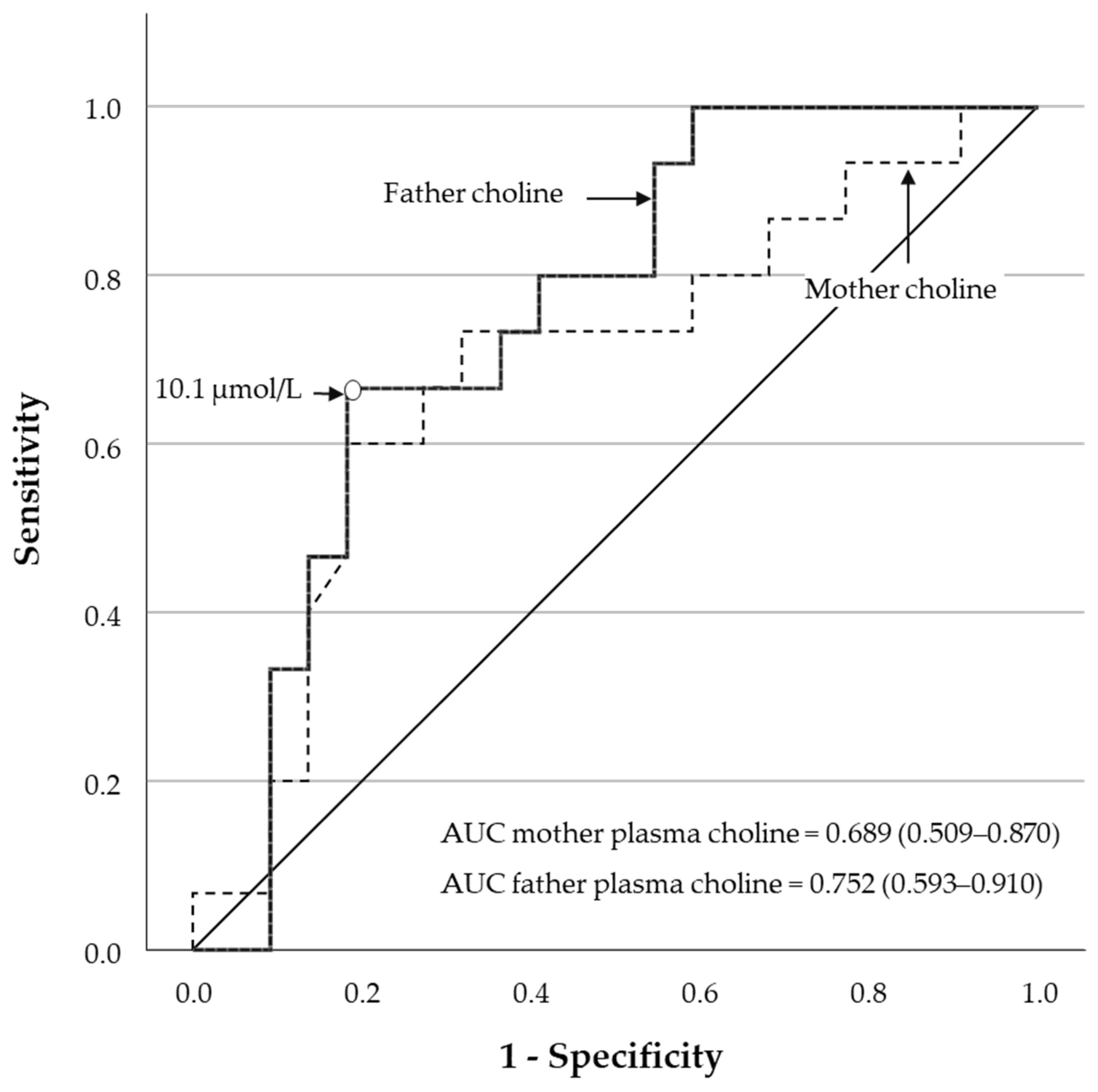
Figure 1. Receiver Operating Characteristics (ROC) curve analyses for using parents’ plasma concentrations of choline to discriminate between clinically severe and mild CHD cases according to EUROCAT classification. The area under the curve (AUC) and 95%CIs are slightly higher for paternal plasma choline. The optimal cut-off value for highest sensitivity and specificity in the present dataset was 10.1 µmol/L.
Nutrients 18 01455 g001
Table 1. Main characteristics of children with CHD and their parents.
CharacteristicsAll
Child age, years (n = 72)3.1 (3.2)
Boys, n (%)43 (59.7%)
Child height, cm (n = 66)84 (27)
Child body weight, kg (n = 69)12 (8)
Severity of CHD (EUROCAT classification), n (%)
          Mild 27 (37.5%)
          Severe 45 (62.5%)
Severity of CHD (PAN study Classification) 1, n (%)
          Mild 17 (23.6%)
          Moderate 22 (30.6%)
          Severe33 (45.8%)
CHD with any syndrome 2, n (%)14 (19.4%)
CHD with Down syndrome8 (11.1%)
Mother age at birth of the index child, years (n = 66)32.1 (4.3)
Mother age at enrollment, years (n = 69)35.0 (4.4)
Mother BMI at enrollment, kg/m2 (n = 65)26.9 (6.8)
Mother currently smoker, n (%)17 (24.6%)
Parity, n (%)
          126 (37.7%)
          225 (36.2%)
          ≥3 18 (26.1%)
Father age at enrollment, years (n = 64)37.8 (6.5)
Father BMI at enrollment, kg/m2 (n = 57)27.4 (3.9)
Data are shown as mean (SD), unless otherwise specified. 1 PAN study classification as published before [1]. BMI, body mass index; CHD, congenital heart defects; EUROCAT, European network of population-based registries for the epidemiological surveillance of congenital anomalies. n, number of subjects. 2 Children with syndromes other than triosomy 21 were [1 case each: Williams–Beuren syndrome (Chr7), Turner syndrome, microdillion 22q11, Ivemark’s syndrome, Heterotaxy syndrome, and CHARGE syndrome].
Table 2. Diagnosis of CHD and clinical severity according to EUROCAT and the PAN Study.
CHD Type N CasesCHD Severity
EUROCAT Classification [30] PAN Study Classification [1]
Atrial septal defect (ASD II), sinus venosus atrial septal defect (SVASD)11mildmild
Ventricular septal defect (VSD)11mildmild (when small or muscular VSD); moderate (for all other VSD)
Single ventricle 8severesevere
Complex CHD, not classifiable6severesevere
Tetralogy of Fallot (TOF)6severesevere
Atrioventricular septal defect (AVSD) 5severemoderate
Transposition of the great arteries (TGA)5severesevere
Coarctation of the aorta (CoA)6severemoderate
Aortic stenosis (AS)3severemoderate
Anomalous pulmonary venous return (APVR)2severemoderate (partial anomalous pulmonary venous return, PAPVC); severe (total anomalous pulmonary venous return, TAPVC)
Pulmonary atresia (PA)2severesevere
Tricuspid atresia (TA)2severesevere
Patent ductus arteriosus (PDA)3mildmild
Truncus arteriosus communis (TAC) 1severesevere
Hypoplastic left heart syndrome (HLHS)1severesevere
Table 3. Concentrations of choline and folate markers shown as mean (SD); median [IQR] in children with congenital heart defect (CHD) and their parents in total and according to EUROCAT classification of CHD severity.
AllMild CHDSevere CHDp 1
Child variables
Age, weeks 3.1 (3.2); 2.1 [4.0]2.7 (2.5); 1.7 [3.6]3.3 (3.5); 3.4 [4.2]0.972
Boys, n (%)43 (59.7%)13 (48.1%)30 (66.7%)0.142
p-choline, µmol/L (n = 56)14.0 (10.0); 11.4 [8.9]16.1 (12.8); 14.1 [9.4]13.0 (8.4); 12.3 [8.5]0.261
p-choline < 10 µmol/L, n/total20/564/1816/380.233 2
p-betaine, µmol/L (n = 57)52.7 (17.5); 51.8 [27.9]53.4 (16.5); 54.9 [21.2]52.4 (18.2); 50.3 [31.1]0.520
Sum of p-choline and betaine, µmol/L (n = 56)66.8 (22.4); 60.8 [31.0]69.8 (24.6); 69.0 [34.8]65.4 (21.4); 59.6 [29.9]0.405
Urine choline, mmol/mol creatinine (n = 57)1.54 (2.44); 0.7 [1.2]2.0 (3.4); 0.8 [1.8]1.2 (1.6); 0.7 [1.0]0.589
Urine betaine, mmol/mol creatinine (n = 58)68.1 (100.1); 9.0 [104.2]72.0 (123.9); 7.3 [110.9]65.7 (84.3); 30.9 [105.9]0.423
p-total folate, nmol/L (n = 59)12.6 (11.3); 10.2 [12.5]12.5 (13.5); 6.7 [12.1]12.6 (10.1); 11.1 [12.6]0.442
p-5-MTHF, nmol/L (n = 59)10.8 (9.4); 7.2 [11.4]11.1 (11.7); 5.7 [11.3]10.6 (8.1); 8.8 [11.8]0.608
p-non-methyl-THF, nmol/L (n = 59)1.8 (5.6); 0.5 [1.0]1.4 (2.6); 0.8 [1.3]2.0 (6.7); 0.4 [0.7]0.586
Mother plasma biomarkers
Choline, µmol/L (n = 57)9.5 (5.1); 7.7 [5.5]10.5 (4.7); 9.9 [7.9]8.8 (5.2); 7.4 [3.9]0.096
Choline < 10 µmol/L, n/total38/5711/2227/350.046 2
Betaine, µmol/L (n = 57)36.0 (12.6); 34.8 [17.0]36.4 (13.2); 37.4 [15.4]35.8 (12.4); 33.3 [15.6]0.682
Sum of choline and betaine, µmol/L (n = 57)45.5 (14.8); 46.3 [16.6]47.0 (13.9); 47.5 [15.1]44.6 (15.5); 41.9 [19.4]0.517
Total folate, nmol/L (n = 65)7.4 (7.2); 4.9 [5.5]5.1 (3.9); 3.7 [3.1]8.8 (8.3); 5.3 [10.8]0.126
5-MTHF, nmol/L (n = 65)6.2 (5.8); 4.2 [4.2]4.3 (3.8); 3.1 [3.0]7.3 (6.5); 4.9 [8.8]0.087
Non-methyl-THF, nmol/L (n = 65)1.2 (3.2); 0.3 [0.7]0.7 (1.3); 0.2 [0.9]1.6 (3.9); 0.3 [0.7]0.780
Father plasma biomarkers
Choline, µmol/L (n = 43)10.3 (5.4); 8.1 [9.2]12.2 (4.5); 10.7 [8.5]9.1 (5.7); 7.1 [4.0]0.008
Choline < 10 µmol/L, n/total 27/436/1721/260.004 2
Betaine, µmol/L (n = 44)41.5 (10.8); 38.1 [10.2]40.5 (9.4); 37.1 [9.3]42.2 (11.8); 39.7 [12.4]0.772
Sum of choline and betaine, µmol/L (n = 43)51.9 (12.7); 48.7 [16.3]52.8 (11.9); 49.8 [16.7]51.3 (13.4); 48.6 [15.3]0.494
Total folate, nmol/L (n = 50)3.8 (3.0); 3.4 [2.0]2.9 (1.4); 2.5 [2.2]4.4 (3.5); 3.6 [2.4]0.050
5-MTHF, nmol/L (n = 50)3.1 (1.7); 2.8 [2.0]2.5 (1.2); 2.4 [2.0]3.5 (1.9); 3.4 [2.1]0.069
Non-methyl-THF, nmol/L (n = 50)0.7 (2.6); 0.1 [0.4]0.3 (0.3); 0.3 [0.5]0.9 (3.3); 0.1 [0.3]0.161
Results are shown as mean (standard deviation, SD); median [interquartile, IQR] unless otherwise specified. 1 p-values from the Mann–Whitney U Test. 2 Chi-square test was used to compare categorical variables. CHD, congenital heart defect EUROCAT, European network of population-based registries for the epidemiological surveillance of congenital anomalies; n, number of observations; 5-MTHF, 5-methyltetrahydrofolate; p-choline, plasma choline.
Table 4. Associations of child, maternal and paternal biomarker concentrations with severity of CHD according to EUROCAT classification.
Logistic Regression (Exposure p-Choline < 10 µmol/L) Number Mild/Severe CHDCrude OR (95%CIs)Adjusted OR (95%CIs) 1,2
Mother p-choline ≥ 10 µmol/L (n = 19 of 57 mothers)11/8 OR = 1
Mother p-choline < 10 µmol/L (n = 38 of 57 mothers)11/273.7 (1.2, 11.9)3.7 (1.1, 12.2)
Father p-choline ≥ 10 µmol/L (n = 16 of 43 fathers)11/5OR = 1
Father p-choline < 10 µmol/L (n = 27 of 43 fathers)6/217.7 (1.9, 31.0)7.4 (1.7, 31.5)
Mother and/or father’s p-choline ≥ 10 µmol/L, n = 1812/6OR = 1
Both mother and father’s p-choline < 10 µmol/L, n = 193/1610.7 (2.2, 51.5)11.1 (2.1, 59.3)
Generalized Linear Models
(exposure: log-transformed biomarkers)
β-coefficient (95%CIs)Adjusted β-coefficient (95%CIs) 1,2
Mother p-choline −0.53 (−1.12, 0.07)−0.61 (−1.20, −0.02) 3
Mother p-betaine 0.04 (−0.67, 0.75)−0.06 (−0.77, 0.65)
Mother p-folate 0.23 (−0.04, 0.62)0.32 (−0.02, 0.65)
Father p-choline −0.85 (−0.49, −0.20)−0.87 (−1.58, −0.16) 3
Father p-betaine 0.31 (−1.13, 1.76)0.21 (−1.23, 1.65)
Father p-folate 0.54 (0.07, 1.01)0.50 (0.01, 0.99)
Child p-choline −0.30 (−0.77, 0.17)−0.317 (−0.80, 0.17)
Child p-betaine −0.06 (−0.85, 0.73)−0.04 (−0.88, 0.80)
Child p-folate 0.11 (−0.20, 0.41)0.16 (−0.17, 0.49)
1 The regression models of maternal exposures are adjusted for age of the mother, age of the child and maternal smoking (yes or no). 2 The regression models of paternal exposures are adjusted for age of the father and age of the child. 3 The GLM regression shows an inverse association between choline concentrations and CHD severity. Thus, lower choline concentrations were associated with severe CHD (CHD forms were coded as 1 (for mild CHD) and 2 (for severe CHD) according to EUROCAT classification). OR and (95%CIs) were computed by running logistic regression analyses with the severity of the CHD entered in the model as an outcome variable (1 = mild; 2 = severe). The exposure variable (plasma choline in the mother or the father < 10 µmol/L vs. ≥10 µmol/L) and the model-specific covariates were entered as independent variables. The beta coefficient (β) and 95%CIs were computed from a Generalized Linear Model (GLM) using the severity of the CHD as an outcome variable and one exposure variable (e.g., log-transformed plasma choline in the mother or the father) or the same exposure factor plus the covariates as predictor variables. Results in bold are statistically significant. CHD, congenital heart defect; EUROCAT, European network of population-based registries for the epidemiological surveillance of congenital anomalies; n, number of subjects; p-choline (betaine or folate), plasma choline (betaine or folate).
Disclaimer/Publisher’s Note: The statements, opinions and data contained in all publications are solely those of the individual author(s) and contributor(s) and not of MDPI and/or the editor(s). MDPI and/or the editor(s) disclaim responsibility for any injury to people or property resulting from any ideas, methods, instructions or products referred to in the content.



