Effects of LC n-3 PUFA Supplementation on Muscle Pain, Function, and Damage Markers in Healthy Young to Middle-Aged Adults Following Acute or Chronic Exercise: A Systematic Review and Meta-Analysis of Randomized Controlled Trials
 , ,
, ,  , , and
Abstract
1. Introduction
2. Methods
2.1. Study Overview Component
2.2. Literature Search and Study Selection
2.3. Inclusion and Exclusion Criteria
2.4. Assessment of Study Quality
2.5. Data Extraction for Systematic Review
2.6. Data Extraction for Meta-Analysis
2.7. Data Synthesis
3. Results
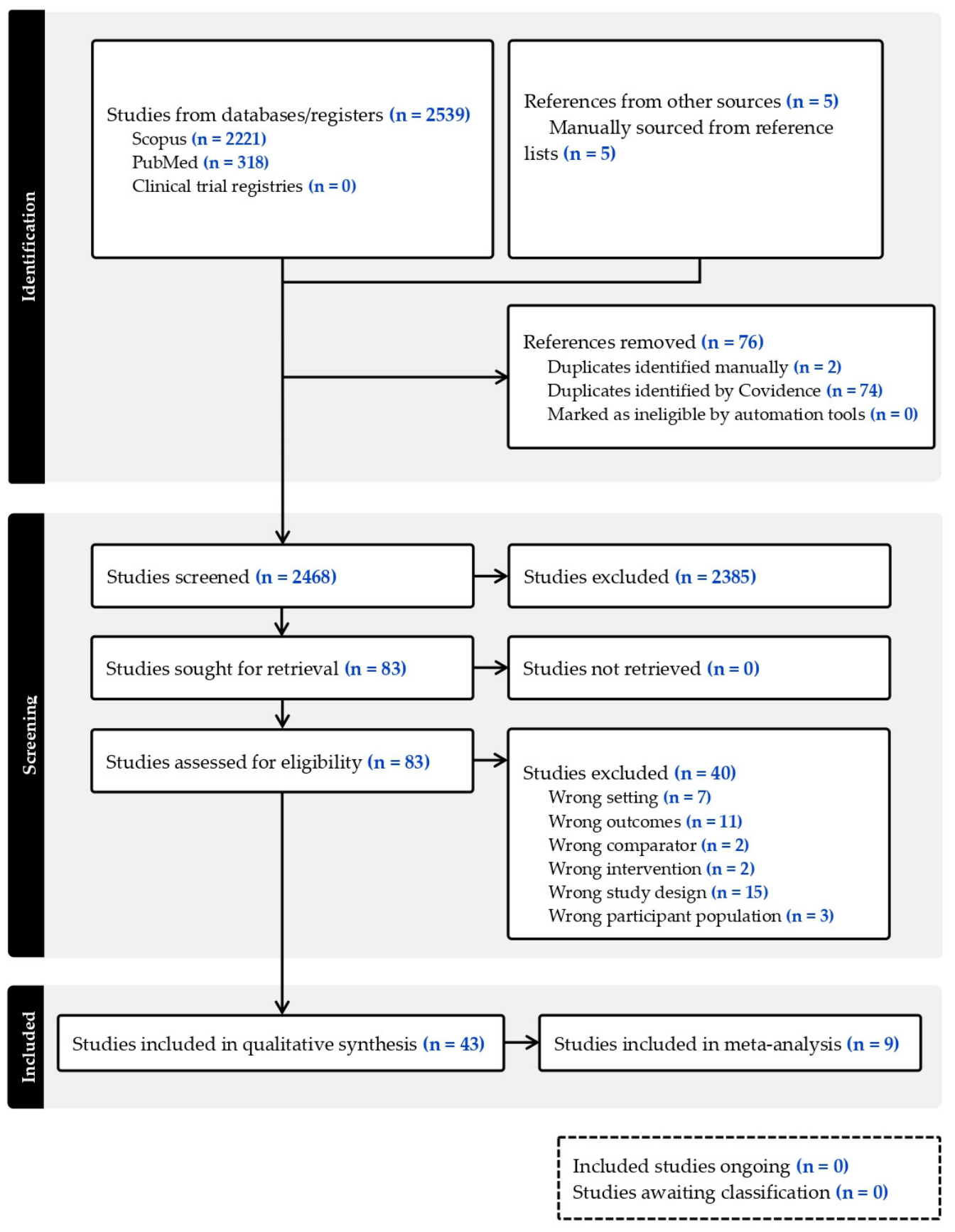
3.1. Studies Selected
3.2. Risk of Bias Assessment
3.3. Characterization of Methodological Approaches Across the Included Studies
3.3.1. Summary LC n-3 PUFA Supplementation Protocols
3.3.2. Assessment of Participant Characteristics
3.3.3. Assessment of Exercise Models
3.4. Assessment of Muscle Damage Recovery Outcomes
3.4.1. DOMS
3.4.2. Muscle Damage Biomarkers
3.5. Assessment of Muscle Function
3.6. Assessment of Inflammatory and Oxidative Stress Markers
3.6.1. Inflammatory Markers
3.6.2. Oxidative Stress Markers
3.6.3. Direct Measure of Swelling
3.7. Meta-Analysis Results for DOMS, Muscle Strength, ROM, CK, and Swelling
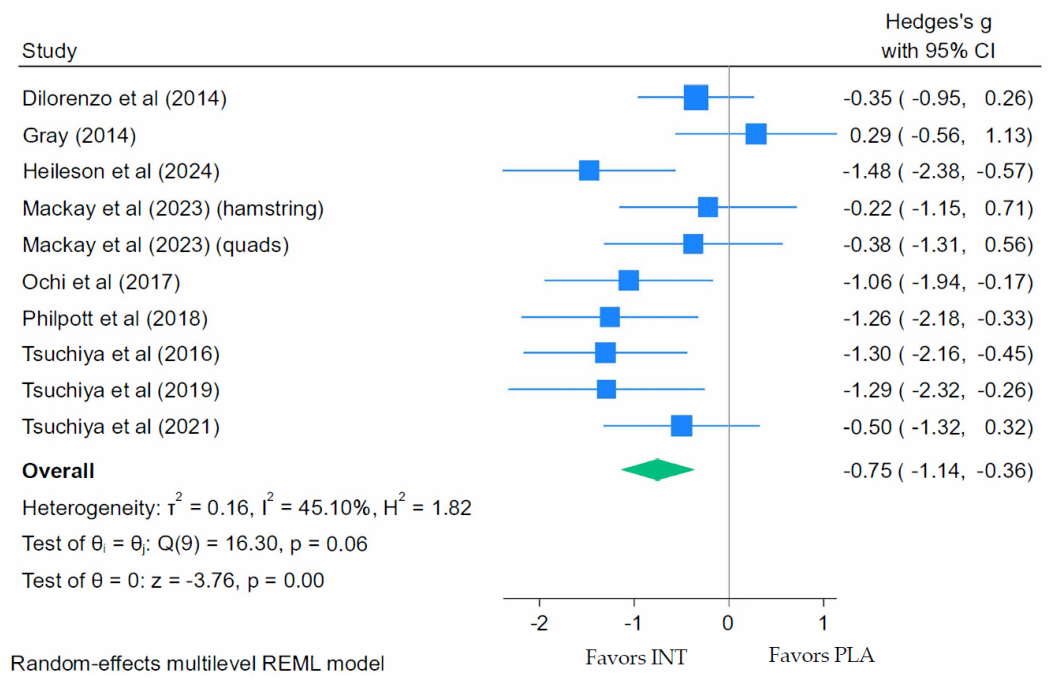
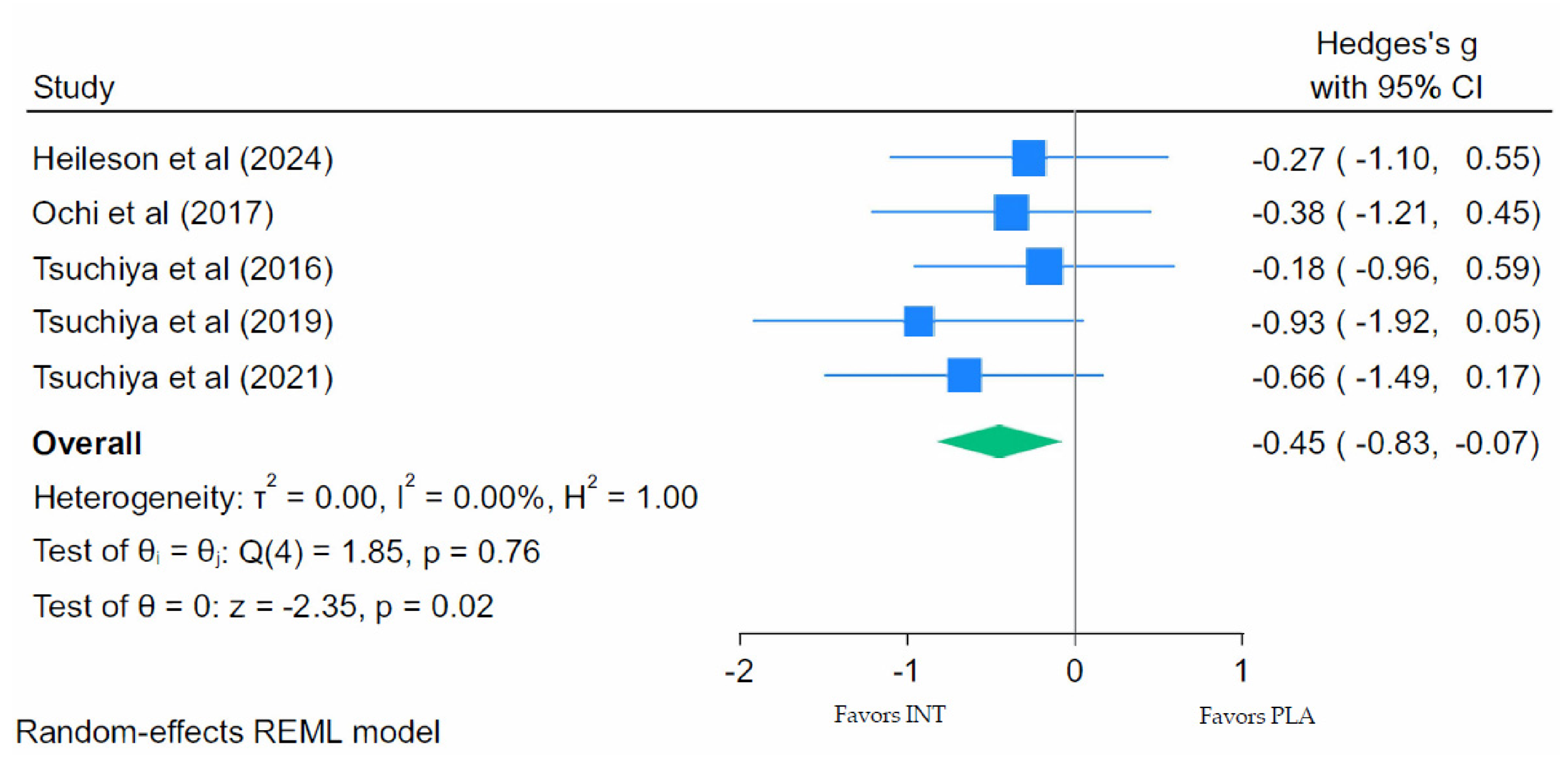
3.7.1. DOMS Meta-Analysis
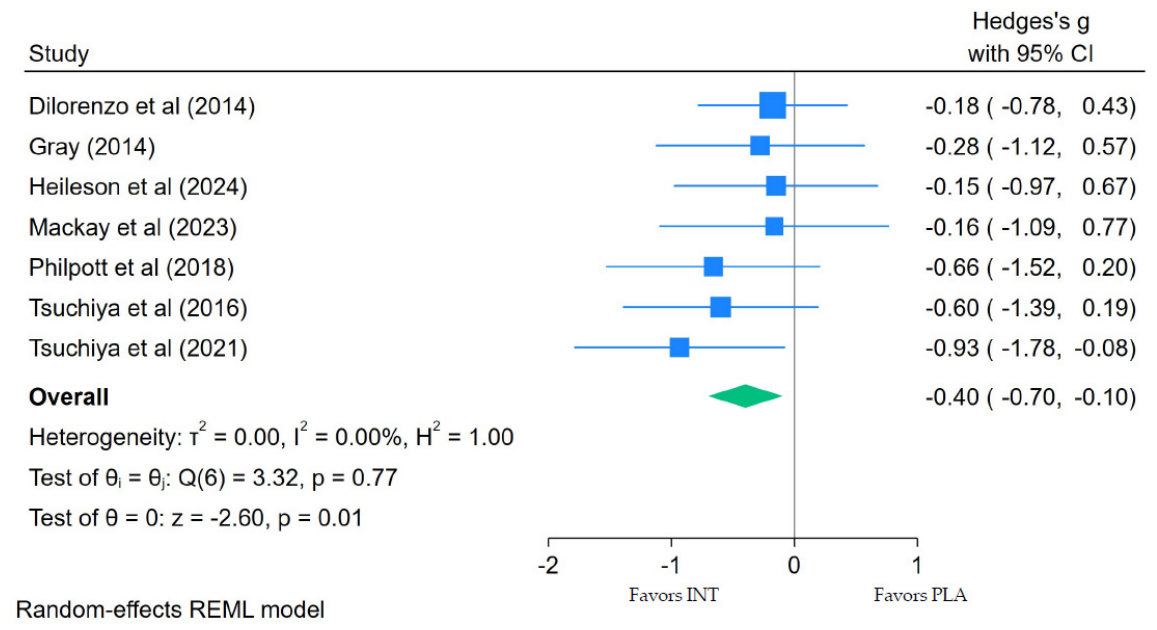
3.7.2. CK Meta-Analysis
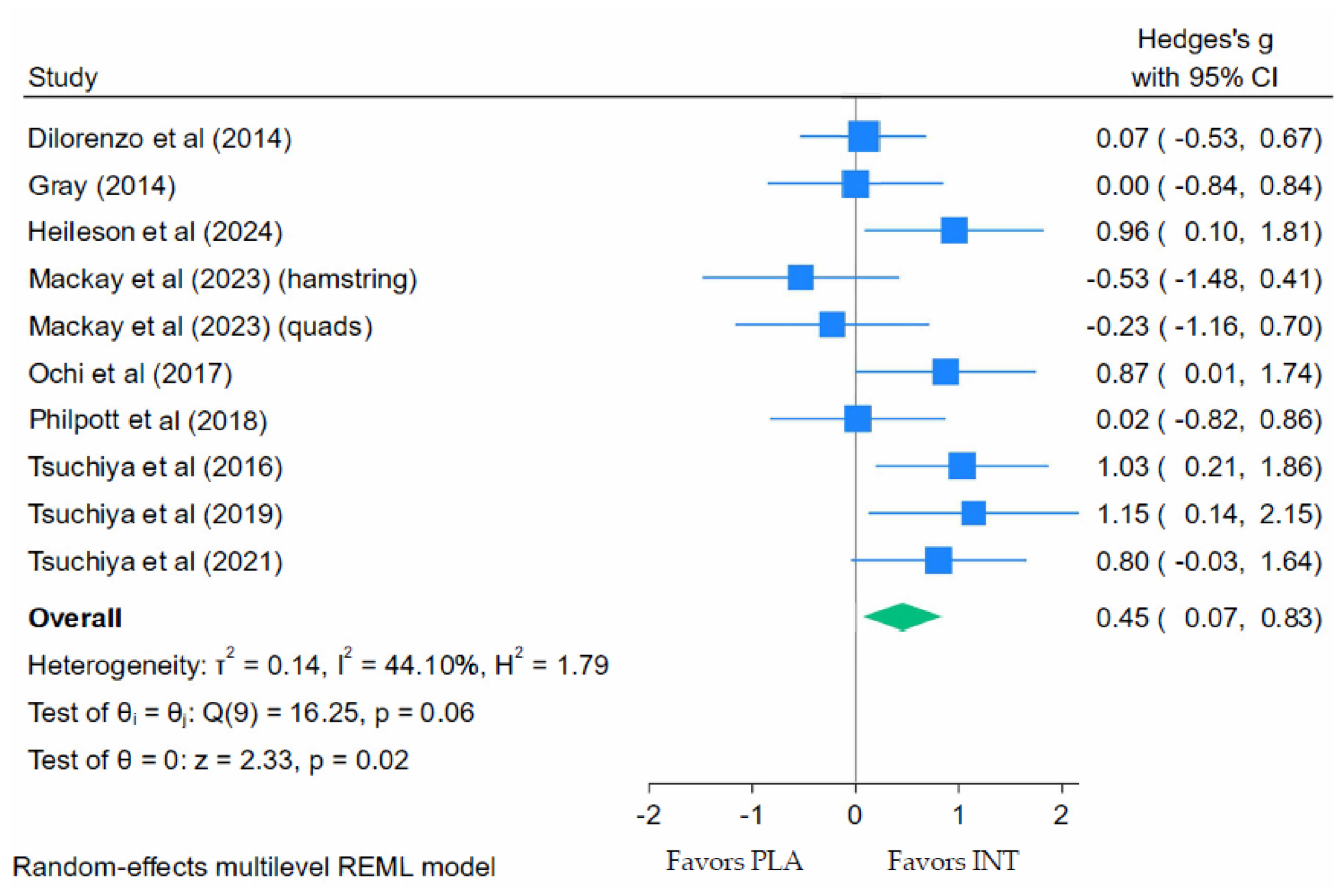
3.7.3. Muscle Strength Meta-Analysis
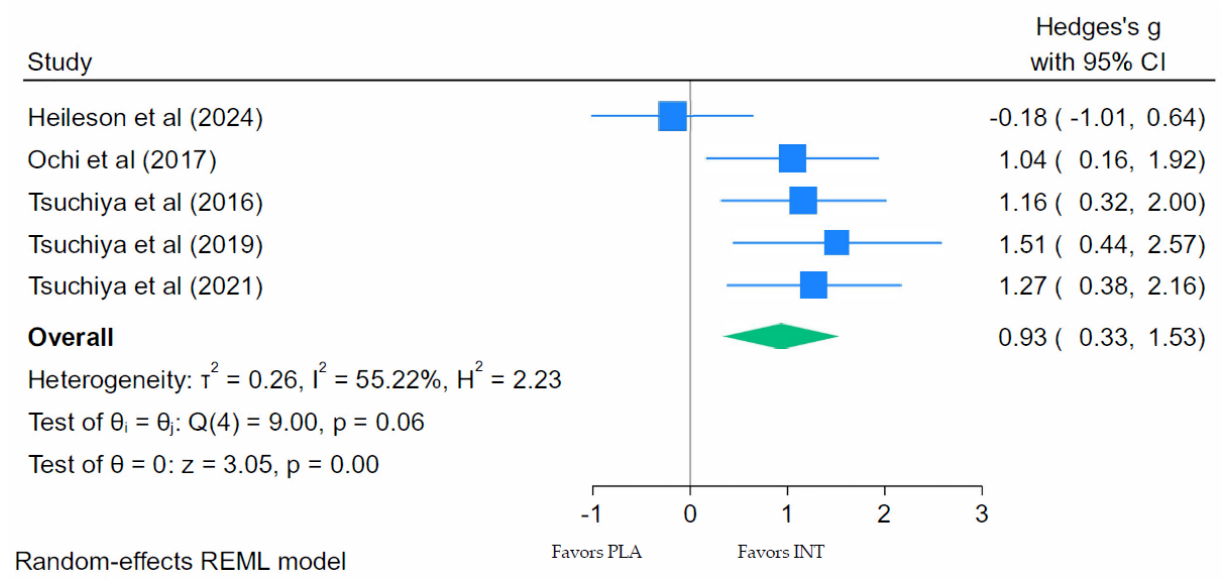
3.7.4. ROM Meta-Analysis
3.7.5. Muscle Swelling Meta-Analysis
4. Discussion
4.1. LC n-3 PUFA Supplementation Design Issues
4.2. Effects of LC n-3 PUFAs on DOMS
4.3. Effects of LC n-3 PUFAs on Muscle Damage Biomarkers
4.4. Effects of LC n-3 PUFAs on Muscle Function
4.5. Effects of LC n-3 PUFAs on Inflammation and Oxidative Stress
5. Limitations
6. Future Perspectives
7. Conclusions
Supplementary Materials
Author Contributions
Funding
Data Availability Statement
Conflicts of Interest
Abbreviations
| BMI | Body mass index |
| CAT | Catalase |
| CK | Creatine kinase |
| CON | Control |
| CRP | C-reactive protein |
| DHA | Docosahexaenoic acid |
| DOMS | Delayed onset muscle soreness |
| DPA | Docosapentaenoic acid |
| ECC | Eccentric |
| EIMD | Exercise-induced muscle damage |
| EPA | Eicosapentaenoic acid |
| GPx | Glutathione peroxidase |
| IL-1ra | Interleukin-1 receptor antagonist |
| IL-1β | Interleukin-1β |
| IL-2 | Interleukin-2 |
| IL-4 | Interleukin-4 |
| IL-6 | Interleukin-6 |
| IL-8 | Interleukin-8 |
| INT | Intervention |
| LC n-3 PUFA | Long-chain omega-3 polyunsaturated fatty acid |
| LDH | Lactate dehydrogenase |
| Mb | Myoglobin |
| MDA | Malondialdehyde |
| MDS | Muscle damage stimulus |
| MVC | Maximal voluntary contraction |
| NSAIDs | Non-steroidal anti-inflammatory drugs |
| O3I | Omega-3 index |
| PLA | Placebo |
| RBC | Red blood cell |
| RCT | Randomized controlled trial |
| ROM | Range of motion |
| SOD | Superoxide dismutase |
| T-AOC | Total antioxidant capacity |
| TBARS | Thiobarbituric acid reactive substances |
| TNF-α | Tumor necrosis factor-α |
| UAC | Upper arm circumference |
| VAS | Visual analog scale |
References
- Owens, D.J.; Twist, C.; Cobley, J.N.; Howatson, G.; Close, G.L. Exercise-induced muscle damage: What is it, what causes it and what are the nutritional solutions? Eur. J. Sport Sci. 2019, 19, 71–85. [Google Scholar] [CrossRef] [Scilit]
- McKune, A.; Semple, S.; Peters-Futre, E. Acute exercise-induced muscle injury. Biol. Sport 2012, 29, 3–10. [Google Scholar] [CrossRef] [Scilit]
- Warren, G.L.; Lowe, D.A.; Armstrong, R.B. Measurement Tools Used in the Study of Eccentric Contraction???Induced Injury. Sports Med. 1999, 27, 43–59. [Google Scholar] [CrossRef] [Scilit] [PubMed]
- Guilhem, G.; Cornu, C.; Guével, A. Neuromuscular and muscle-tendon system adaptations to isotonic and isokinetic eccentric exercise. Ann. Phys. Rehabil. Med. 2010, 53, 319–341. [Google Scholar] [CrossRef] [Scilit]
- Peake, J.M.; Neubauer, O.; Della Gatta, P.A.; Nosaka, K. Muscle damage and inflammation during recovery from exercise. J. Appl. Physiol. 2017, 122, 559–570. [Google Scholar] [CrossRef] [Scilit]
- Langston, P.K.; Mathis, D. Immunological regulation of skeletal muscle adaptation to exercise. Cell Metab. 2024, 36, 1175–1183. [Google Scholar] [CrossRef] [Scilit]
- Cheung, K.; Hume, P.; Maxwell, L. Delayed onset muscle soreness: Treatment strategies and performance factors. Sports Med. 2003, 33, 145–164. [Google Scholar] [CrossRef] [Scilit]
- Gulick, D.T.; Kimura, I.F. Delayed Onset Muscle Soreness: What Is It and How Do We Treat It? J. Sport Rehabil. 1996, 5, 234–243. [Google Scholar] [CrossRef] [Scilit]
- Lilja, M.; Mandić, M.; Apró, W.; Melin, M.; Olsson, K.; Rosenborg, S.; Gustafsson, T.; Lundberg, T.R. High doses of anti-inflammatory drugs compromise muscle strength and hypertrophic adaptations to resistance training in young adults. Acta Physiol. 2017, 222, e12948. [Google Scholar] [CrossRef] [Scilit]
- Lundberg, T.R.; Howatson, G. Analgesic and anti-inflammatory drugs in sports: Implications for exercise performance and training adaptations. Scand. J. Med. Sci. Sports 2018, 28, 2252–2262. [Google Scholar] [CrossRef] [Scilit]
- McGlory, C.; Galloway, S.D.; Hamilton, D.L.; McClintock, C.; Breen, L.; Dick, J.R.; Bell, J.G.; Tipton, K.D. Temporal changes in human skeletal muscle and blood lipid composition with fish oil supplementation. Prostaglandins Leukot. Essent. Fat. Acids 2014, 90, 199–206. [Google Scholar] [CrossRef] [Scilit]
- Naderi, A.; Rothschild, J.A.; Santos, H.O.; Hamidvand, A.; Koozehchian, M.S.; Ghazzagh, A.; Berjisian, E.; Podlogar, T. Nutritional Strategies to Improve Post-exercise Recovery and Subsequent Exercise Performance: A Narrative Review. Sports Med. 2025, 55, 1559–1577. [Google Scholar] [CrossRef] [Scilit] [PubMed]
- Ruggiero, M.; Motti, M.L.; Meccariello, R.; Mazzeo, F. Resveratrol and Physical Activity: A Successful Combination for the Maintenance of Health and Wellbeing? Nutrients 2025, 17, 837. [Google Scholar] [CrossRef] [Scilit] [PubMed]
- Kapoor, B.; Kapoor, D.; Gautam, S.; Singh, R.; Bhardwaj, S. Dietary Polyunsaturated Fatty Acids (PUFAs): Uses and Potential Health Benefits. Curr. Nutr. Rep. 2021, 10, 232–242. [Google Scholar] [CrossRef] [Scilit]
- Goldberg, R.J.; Katz, J. A meta-analysis of the analgesic effects of omega-3 polyunsaturated fatty acid supplementation for inflammatory joint pain. Pain 2007, 129, 210–223. [Google Scholar] [CrossRef] [Scilit] [PubMed]
- Callan, N.; Hanes, D.; Bradley, R. Early evidence of efficacy for orally administered SPM-enriched marine lipid fraction on quality of life and pain in a sample of adults with chronic pain. J. Transl. Med. 2020, 18, 401. [Google Scholar] [CrossRef] [Scilit]
- Ko, G.D.; Nowacki, N.B.; Arseneau, L.; Eitel, M.; Hum, A. Omega-3 fatty acids for neuropathic pain: Case series. Clin. J. Pain 2010, 26, 168–172. [Google Scholar] [CrossRef] [Scilit]
- Philpott, J.D.; Witard, O.C.; Galloway, S.D. Applications of omega-3 polyunsaturated fatty acid supplementation for sport performance. Res. Sports Med. 2018, 27, 219–237. [Google Scholar] [CrossRef] [Scilit]
- Calder, P.C. Omega-3 fatty acids and inflammatory processes: From molecules to man. Biochem. Soc. Trans. 2017, 45, 1105–1115. [Google Scholar] [CrossRef] [Scilit]
- Fernández-Lázaro, D.; Arribalzaga, S.; Gutiérrez-Abejón, E.; Azarbayjani, M.A.; Mielgo-Ayuso, J.; Roche, E. Omega-3 Fatty Acid Supplementation on Post-Exercise Inflammation, Muscle Damage, Oxidative Response, and Sports Performance in Physically Healthy Adults—A Systematic Review of Randomized Controlled Trials. Nutrients 2024, 16, 2044. [Google Scholar] [CrossRef] [Scilit]
- Heileson, J.L.; Funderburk, L.K. The effect of fish oil supplementation on the promotion and preservation of lean body mass, strength, and recovery from physiological stress in young, healthy adults: A systematic review. Nutr. Rev. 2020, 78, 1001–1014. [Google Scholar] [CrossRef] [Scilit] [PubMed]
- Lv, Z.-T.; Zhang, J.-M.; Zhu, W.-T. Omega-3 Polyunsaturated Fatty Acid Supplementation for Reducing Muscle Soreness after Eccentric Exercise: A Systematic Review and Meta-Analysis of Randomized Controlled Trials. BioMed Res. Int. 2020, 2020, 8062017. [Google Scholar] [CrossRef] [Scilit]
- Xin, G.; Eshaghi, H. Effect of omega-3 fatty acids supplementation on indirect blood markers of exercise-induced muscle damage: Systematic review and meta-analysis of randomized controlled trials. Food Sci. Nutr. 2021, 9, 6429–6442. [Google Scholar] [CrossRef] [Scilit]
- Cumpston, M.; Li, T.; Page, M.; Chandler, J.; Welch, V.; Higgins, J.P.; Thomas, J. Updated guidance for trusted systematic reviews: A new edition of the Cochrane Handbook for Systematic Reviews of Interventions. Cochrane Database Syst. Rev. 2019, 10, ED000142. [Google Scholar] [CrossRef] [Scilit]
- Law, M.; Stewart, D.; Letts, L.; Pollock, N.; Bosch, J.; Westmorland, M. Guidelines for Critical Review of Qualitative Studies; McMaster University Occupational Therapy Evidence-Based Practice Research Group: Hamilton, OH, Canada, 1998; p. 1. [Google Scholar]
- Moseley, A.M.; Elkins, M.R.; Van der Wees, P.J.; Pinheiro, M.B. Using research to guide practice: The Physiotherapy Evidence Database (PEDro). Braz. J. Phys. Ther. 2020, 24, 384–391. [Google Scholar] [CrossRef] [Scilit] [PubMed]
- McKay, A.K.A.; Stellingwerff, T.; Smith, E.S.; Martin, D.T.; Mujika, I.; Goosey-Tolfrey, V.L.; Sheppard, J.; Burke, L.M. Defining Training and Performance Caliber: A Participant Classification Framework. Int. J. Sports Physiol. Perform. 2022, 17, 317–331. [Google Scholar] [CrossRef] [Scilit]
- Toft, A.D.; Thorn, M.; Ostrowski, K.; Asp, S.; Møller, K.; Iversen, S.; Hermann, C.; Søndergaard, S.R.; Pedersen, B.K. N-3 polyunsaturated fatty acids do not affect cytokine response to strenuous exercise. J. Appl. Physiol. 2000, 89, 2401–2406. [Google Scholar] [CrossRef] [Scilit] [PubMed]
- Lenn, J.; Uhl, T.; Mattacola, C.; Boissonneault, G.; Yates, J.; Ibrahim, W.; Bruckner, G. The effects of fish oil and isoflavones on delayed onset muscle soreness. Med. Sci. Sports Exerc. 2002, 34, 1605–1613. [Google Scholar] [CrossRef] [Scilit]
- Phillips, T.; Childs, A.C.; Dreon, D.M.; Phinney, S.; Leeuwenburgh, C. A Dietary Supplement Attenuates IL-6 and CRP after Eccentric Exercise in Untrained Males. Med. Sci. Sports Exerc. 2003, 35, 2032–2037. [Google Scholar] [CrossRef] [Scilit]
- Bloomer, R.J.; E Larson, D.; Fisher-Wellman, K.H.; Galpin, A.J.; Schilling, B.K. Effect of eicosapentaenoic and docosahexaenoic acid on resting and exercise-induced inflammatory and oxidative stress biomarkers: A randomized, placebo controlled, cross-over study. Lipids Health Dis. 2009, 8, 36. [Google Scholar] [CrossRef] [Scilit]
- Nieman, D.C.; Henson, D.A.; McAnulty, S.R.; Jin, F.; Maxwell, K.R. n-3 Polyunsaturated Fatty Acids Do Not Alter Immune and Inflammation Measures in Endurance Athletes. Int. J. Sport Nutr. Exerc. Metab. 2009, 19, 536–546. [Google Scholar] [CrossRef] [Scilit] [PubMed]
- Poprzecki, S.; Zajac, A.; Chalimoniuk, M.; Waskiewicz, Z.; Langfort, J. Modification of blood antioxidant status and lipid profile in response to high-intensity endurance exercise after low doses of ω-3 polyunsaturated fatty acids supplementation in healthy volunteers. Int. J. Food Sci. Nutr. 2009, 60, 67–79. [Google Scholar] [CrossRef] [Scilit]
- Tartibian, B.; Maleki, B.H.; Abbasi, A. The Effects of Ingestion of Omega-3 Fatty Acids on Perceived Pain and External Symptoms of Delayed Onset Muscle Soreness in Untrained Men. Clin. J. Sport Med. 2009, 19, 115–119. [Google Scholar] [CrossRef] [Scilit]
- Jouris, K.B.; McDaniel, J.L.; Weiss, E.P. The Effect of Omega-3 Fatty Acid Supplementation on the Inflammatory Response to eccentric strength exercise. J. Sports Sci. Med. 2011, 10, 432–438. [Google Scholar]
- Tartibian, B.; Maleki, B.H.; Abbasi, A. Omega-3 Fatty Acids Supplementation Attenuates Inflammatory Markers After Eccentric Exercise in Untrained Men. Clin. J. Sport Med. 2011, 21, 131–137. [Google Scholar] [CrossRef] [Scilit]
- Houghton, D.; Onambele, G.L. Can a standard dose of eicosapentaenoic acid (EPA) supplementation reduce the symptoms of delayed onset of muscle soreness? J. Int. Soc. Sports Nutr. 2012, 9, 2. [Google Scholar] [CrossRef] [Scilit]
- Atashak, S.; Sharafi, H.; Azarbayjani, M.A.; Stannard, S.R.; Goli, M.A.; Haghighi, M.M. Effect of omega-3 supplementation on the blood levels of oxidative stress, muscle damage and inflammation markers after acute resistance exercise in young athletes. Kinesiology 2013, 45, 22–29. [Google Scholar]
- Rajabi, A.; Lotfi, N.; Abdolmaleki, A.; Rashid-Amiri, S. The effects of omega-3 intake on delayed onset muscle sorness in non-athlet men. Pedagog. Psychol. Med.-Biol. Probl. Phys. Train. 2013, 1, 91–95. [Google Scholar] [CrossRef] [Scilit]
- DiLorenzo, F.M.; Drager, C.J.; Rankin, J.W. Docosahexaenoic Acid Affects Markers of Inflammation and Muscle Damage After Eccentric Exercise. J. Strength Cond. Res. 2014, 28, 2768–2774. [Google Scholar] [CrossRef] [Scilit] [PubMed]
- Gray, P.; Chappell, A.; Jenkinson, A.M.; Thies, F.; Gray, S.R. Fish Oil Supplementation Reduces Markers of Oxidative Stress But Not Muscle Soreness After Eccentric Exercise. Int. J. Sport Nutr. Exerc. Metab. 2014, 24, 206–214. [Google Scholar] [CrossRef] [Scilit]
- Lembke, P.; Capodice, J.; Hebert, K.; Swenson, T. Influence of omega-3 (n3) index on performance and wellbeing in young adults after heavy eccentric exercise. J. Sports Sci. Med. 2014, 13, 151–156. [Google Scholar] [PubMed]
- Marques, C.G.; Santos, V.C.; Levada-Pires, A.C.; Jacintho, T.M.; Gorjão, R.; Pithon-Curi, T.C.; Cury-Boaventura, M.F. Effects of DHA-rich fish oil supplementation on the lipid profile, markers of muscle damage, and neutrophil function in wheelchair basketball athletes before and after acute exercise. Appl. Physiol. Nutr. Metab. 2015, 40, 596–604. [Google Scholar] [CrossRef] [Scilit] [PubMed]
- Mickleborough, T.D.; A Sinex, J.; Platt, D.; Chapman, R.F.; Hirt, M. The effects PCSO-524®, a patented marine oil lipid and omega-3 PUFA blend derived from the New Zealand green lipped mussel (Perna canaliculus), on indirect markers of muscle damage and inflammation after muscle damaging exercise in untrained men: A randomized, placebo controlled trial. J. Int. Soc. Sports Nutr. 2015, 12, 10. [Google Scholar] [CrossRef] [Scilit] [PubMed]
- Corder, K.E.; Newsham, K.R.; McDaniel, J.L.; Ezekiel, U.R.; Weiss, E.P. Effects of Short-Term Docosahexaenoic Acid Supplementation on Markers of Inflammation after Eccentric Strength Exercise in Women. J. Sports Sci. Med. 2016, 15, 176–183. [Google Scholar]
- Tinsley, G.M.; Gann, J.J.; Huber, S.R.; Andre, T.L.; La Bounty, P.M.; Bowden, R.G.; Gordon, P.M.; Grandjean, P.W. Effects of Fish Oil Supplementation on Postresistance Exercise Muscle Soreness. J. Diet. Suppl. 2016, 14, 89–100. [Google Scholar] [CrossRef] [Scilit]
- Tsuchiya, Y.; Yanagimoto, K.; Nakazato, K.; Hayamizu, K.; Ochi, E. Eicosapentaenoic and docosahexaenoic acids-rich fish oil supplementation attenuates strength loss and limited joint range of motion after eccentric contractions: A randomized, double-blind, placebo-controlled, parallel-group trial. Eur. J. Appl. Physiol. 2016, 116, 1179–1188. [Google Scholar] [CrossRef] [Scilit]
- Jakeman, J.R.; Lambrick, D.M.; Wooley, B.; Babraj, J.A.; Faulkner, J.A. Effect of an acute dose of omega-3 fish oil following exercise-induced muscle damage. Eur. J. Appl. Physiol. 2017, 117, 575–582. [Google Scholar] [CrossRef] [Scilit]
- McKinley-Barnard, S.K.; Andre, T.L.; Gann, J.J.; Hwang, P.S.; Willoughby, D.S. Effectiveness of Fish Oil Supplementation in Attenuating Exercise-Induced Muscle Damage in Women During Midfollicular and Midluteal Menstrual Phases. J. Strength Cond. Res. 2018, 32, 1601–1612. [Google Scholar] [CrossRef] [Scilit]
- Ochi, E.; Tsuchiya, Y.; Yanagimoto, K. Effect of eicosapentaenoic acids-rich fish oil supplementation on motor nerve function after eccentric contractions. J. Int. Soc. Sports Nutr. 2017, 14, 23. [Google Scholar] [CrossRef] [Scilit]
- Black, K.E.; Witard, O.C.; Baker, D.; Healey, P.; Lewis, V.; Tavares, F.; Christensen, S.; Pease, T.; Smith, B. Adding omega-3 fatty acids to a protein-based supplement during pre-season training results in reduced muscle soreness and the better maintenance of explosive power in professional Rugby Union players. Eur. J. Sport Sci. 2018, 18, 1357–1367. [Google Scholar] [CrossRef] [Scilit] [PubMed]
- Philpott, J.D.; Donnelly, C.; Walshe, I.H.; MacKinley, E.E.; Dick, J.; Galloway, S.D.; Tipton, K.D.; Witard, O.C. Adding Fish Oil to Whey Protein, Leucine, and Carbohydrate Over a Six-Week Supplementation Period Attenuates Muscle Soreness Following Eccentric Exercise in Competitive Soccer Players. Int. J. Sport Nutr. Exerc. Metab. 2018, 28, 26–36. [Google Scholar] [CrossRef] [Scilit]
- Tsuchiya, Y.; Yanagimoto, K.; Ueda, H.; Ochi, E. Supplementation of eicosapentaenoic acid-rich fish oil attenuates muscle stiffness after eccentric contractions of human elbow flexors. J. Int. Soc. Sports Nutr. 2019, 16, 19. [Google Scholar] [CrossRef] [Scilit] [PubMed]
- Barenie, M.J.; Freemas, J.A.; Baranauskas, M.N.; Goss, C.S.; Freeman, K.L.; Chen, X.; Dickinson, S.L.; Fly, A.D.; Kawata, K.; Chapman, R.F. Effectiveness of a combined New Zealand green-lipped mussel and Antarctic krill oil supplement on markers of exercise-induced muscle damage and inflammation in untrained men. J. Diet. Suppl. 2022, 19, 184–211. [Google Scholar] [CrossRef] [Scilit]
- Buonocore, D.; Verri, M.; Giolitto, A.; Doria, E.; Ghitti, M.; Dossena, M. Effect of 8-week n-3 fatty-acid supplementation on oxidative stress and inflammation in middle- and long-distance running athletes: A pilot study. J. Int. Soc. Sports Nutr. 2020, 17, 55. [Google Scholar] [CrossRef] [Scilit]
- Morishima, T.; Tsuchiya, Y.; Ueda, H.; Ochi, E. Muscular endurance and muscle metabolic responses to 8 weeks of omega-3 polyunsaturated fatty acids supplementation. Physiol. Rep. 2020, 8, e14546. [Google Scholar] [CrossRef] [Scilit] [PubMed]
- Ramos-Campo, D.J.; Ávila-Gandía, V.; López-Román, F.J.; Miñarro, J.; Contreras, C.; Soto-Méndez, F.; Pedrol, J.C.D.; Luque-Rubia, A.J. Supplementation of Re-Esterified Docosahexaenoic and Eicosapentaenoic Acids Reduce Inflammatory and Muscle Damage Markers after Exercise in Endurance Athletes: A Randomized, Controlled Crossover Trial. Nutrients 2020, 12, 719. [Google Scholar] [CrossRef] [Scilit]
- VanDusseldorp, T.A.; Escobar, K.A.; Johnson, K.E.; Stratton, M.T.; Moriarty, T.; Kerksick, C.M.; Mangine, G.T.; Holmes, A.J.; Lee, M.; Endito, M.R.; et al. Impact of Varying Dosages of Fish Oil on Recovery and Soreness Following Eccentric Exercise. Nutrients 2020, 12, 2246. [Google Scholar] [CrossRef] [Scilit]
- Kyriakidou, Y.; Wood, C.; Ferrier, C.; Dolci, A.; Elliott, B. The effect of Omega-3 polyunsaturated fatty acid supplementation on exercise-induced muscle damage. J. Int. Soc. Sports Nutr. 2021, 18, 9. [Google Scholar] [CrossRef] [Scilit]
- Loss, L.C.; Benini, D.; de Lima-E-Silva, F.X.; Möller, G.B.; Friedrich, L.R.; Meyer, E.; Baroni, B.M.; Schneider, C.D. Effects of omega-3 supplementation on muscle damage after resistance exercise in young women: A randomized placebo-controlled trial. Nutr. Health 2021, 28, 425–432. [Google Scholar] [CrossRef] [Scilit]
- Tsuchiya, Y.; Ueda, H.; Yanagimoto, K.; Kato, A.; Ochi, E. 4-week eicosapentaenoic acid-rich fish oil supplementation partially protects muscular damage following eccentric contractions. J. Int. Soc. Sports Nutr. 2021, 18, 18. [Google Scholar] [CrossRef] [Scilit] [PubMed]
- Visconti, L.M.; Cotter, J.A.; Schick, E.E.; Daniels, N.; Viray, F.E.; Purcell, C.A.; Brotman, C.B.; Ruhman, K.E.; Escobar, K.A. Impact of varying doses of omega-3 supplementation on muscle damage and recovery after eccentric resistance exercise. Metab. Open 2021, 12, 100133. [Google Scholar] [CrossRef] [Scilit] [PubMed]
- Ayubi, N.; Purwanto, B.; Rejeki, P.S.; Kusnanik, N.W.; Herawati, L.; Komaini, A.; Mutohir, T.C.; Nurhasan, N.; Al Ardha, M.A.; Firmansyah, A. Effect of acute omega 3 supplementation reduces serum tumor necrosis factor-alpha (TNF-a) levels, pain intensity, and maintains muscle strength after high-intensity weight training. Retos 2022, 46, 677–682. [Google Scholar] [CrossRef] [Scilit]
- Asjodi, F.; Rasekhi, H.; Mousavi, S.E.; Iravani, O.M.; Khazaei, Y. The Combined Effect of Taurine and Omega-3 Supplementation on Delayed Onset Muscle Soreness in High-Intensity Eccentric Exercise. J. Iran. Med. Counc. 2023, 6, 504–513. [Google Scholar] [CrossRef] [Scilit]
- Barquilha, G.; Dos Santos, C.M.M.; Caçula, K.G.; Santos, V.C.; Polotow, T.G.; Vasconcellos, C.V.; Gomes-Santos, J.A.F.; Rodrigues, L.E.; Lambertucci, R.H.; Serdan, T.D.A.; et al. Fish Oil Supplementation Improves the Repeated-Bout Effect and Redox Balance in 20–30-Year-Old Men Submitted to Strength Training. Nutrients 2023, 15, 1708. [Google Scholar] [CrossRef] [Scilit]
- Mackay, J.; Bowles, E.; Macgregor, L.J.; Prokopidis, K.; Campbell, C.; Barber, E.; Galloway, S.D.R.; Witard, O.C. Fish oil supplementation fails to modulate indices of muscle damage and muscle repair during acute recovery from eccentric exercise in trained young males. Eur. J. Sport Sci. 2023, 23, 1666–1676. [Google Scholar] [CrossRef] [Scilit]
- Yang, S.; He, Q.; Shi, L.; Wu, Y. Impact of Antarctic krill oil supplementation on skeletal muscle injury recovery after resistance exercise. Eur. J. Nutr. 2022, 62, 1345–1356. [Google Scholar] [CrossRef] [Scilit]
- Heileson, J.L.; Harris, D.R.; Tomek, S.; Ritz, P.P.; Rockwell, M.S.; Barringer, N.D.; Forsse, J.S.; Funderburk, L.K. Long-Chain Omega-3 Fatty Acid Supplementation and Exercise-Induced Muscle Damage: EPA or DHA? Med. Sci. Sports Exerc. 2023, 56, 476–485. [Google Scholar] [CrossRef] [Scilit]
- Posnakidis, G.; Giannaki, C.D.; Mougios, V.; Pantzaris, M.; Patrikios, I.; Calder, P.C.; Sari, D.K.; Bogdanis, G.C.; Aphamis, G. Effects of Supplementation with Omega-3 and Omega-6 Polyunsaturated Fatty Acids and Antioxidant Vitamins, Combined with High-Intensity Functional Training, on Exercise Performance and Body Composition: A Randomized, Double-Blind, Placebo-Controlled Trial. Nutrients 2024, 16, 2914. [Google Scholar] [CrossRef] [Scilit] [PubMed]
- Makaje, N.; Ruangthai, R.; Sae-Tan, S. Effects of Omega-3 Supplementation on the Delayed Onset Muscle Soreness after Cycling High Intensity Interval Training in Overweight or Obese Males. J. Sports Sci. Med. 2024, 23, 317–325. [Google Scholar] [CrossRef] [Scilit]
- Rohatgi, A. WebPlotDigitizer, V.3.11; WebPlotDigitizer: Austin, TX, USA, 2017.
- Choosing effect measures and computing estimates of effect. In Cochrane Handbook for Systematic Reviews of Interventions; Higgins, J.P., Chandler, J., Cumpston, M., Li, T., Page, M.J., Welch, V.A., Eds.; John Wiley & Sons: Chichester, UK, 2023. [Google Scholar]
- Cohen, J. A power primer. Psychol. Bull. 1992, 112, 155–159. [Google Scholar] [CrossRef] [PubMed]
- Higgins, J.P.T.; Thompson, S.G. Quantifying heterogeneity in a meta-analysis. Stat. Med. 2002, 21, 1539–1558. [Google Scholar] [CrossRef] [Scilit]
- Anthony, R.; Macartney, M.J.; Peoples, G.E. The Influence of Long-Chain Omega-3 Fatty Acids on Eccentric Exercise-Induced Delayed Muscle Soreness: Reported Outcomes Are Compromised by Study Design Issues. Int. J. Sport Nutr. Exerc. Metab. 2021, 31, 143–153. [Google Scholar] [CrossRef] [Scilit]
- Anthony, R.; Macartney, M.J.; Heileson, J.L.; McLennan, P.L.; Peoples, G.E. A review and evaluation of study design considerations for omega-3 fatty acid supplementation trials in physically trained participants. Nutr. Res. Rev. 2023, 37, 1–13. [Google Scholar] [CrossRef] [Scilit]
- López-Seoane, J.; Martinez-Ferran, M.; Romero-Morales, C.; Pareja-Galeano, H. N-3 PUFA as an ergogenic supplement modulating muscle hypertrophy and strength: A systematic review. Crit. Rev. Food Sci. Nutr. 2021, 62, 9000–9020. [Google Scholar] [CrossRef] [Scilit] [PubMed]
- Harris, W.S.; Von Schacky, C. The Omega-3 Index: A new risk factor for death from coronary heart disease? Prev. Med. 2004, 39, 212–220. [Google Scholar] [CrossRef] [Scilit] [PubMed]
- Paulsen, G.; Mikkelsen, U.R.; Raastad, T.; Peake, J.M. Leucocytes, cytokines and satellite cells: What role do they play in muscle damage and regeneration following eccentric exercise? Exerc. Immunol. Rev. 2012, 18, 42–97. [Google Scholar]
- Miotto, P.M.; Mcglory, C.; Bahniwal, R.; Kamal, M.; Phillips, S.M.; Holloway, G.P. Supplementation with dietary ω-3 mitigates immobilization-induced reductions in skeletal muscle mitochondrial respiration in young women. FASEB J. 2019, 33, 8232–8240. [Google Scholar] [CrossRef] [Scilit] [PubMed]
- Calder, P.C. Omega-3 Fatty Acids and Inflammatory Processes. Nutrients 2010, 2, 355–374. [Google Scholar] [CrossRef] [Scilit]
- Peoples, G.E.; McLennan, P.L. Dietary fish oil reduces skeletal muscle oxygen consumption, provides fatigue resistance and improves contractile recovery in the rat in vivo hindlimb. Br. J. Nutr. 2010, 104, 1771–1779. [Google Scholar] [CrossRef] [Scilit]
- Slee, E.L.; McLennan, P.L.; Owen, A.J.; Theiss, M.L. Low dietary fish-oil threshold for myocardial membrane n-3 PUFA enrichment independent of n-6 PUFA intake in rats. J. Lipid Res. 2010, 51, 1841–1848. [Google Scholar] [CrossRef] [Scilit]
- Macartney, M.; Peoples, G.; Treweek, T.; McLennan, P. Docosahexaenoic acid varies in rat skeletal muscle membranes according to fibre type and provision of dietary fish oil. Prostaglandins Leukot. Essent. Fat. Acids 2019, 151, 37–44. [Google Scholar] [CrossRef] [Scilit]
- Hawker, G.A.; Mian, S.; Kendzerska, T.; French, M. Measures of adult pain: Visual Analog Scale for Pain (VAS Pain), Numeric Rating Scale for Pain (NRS Pain), McGill Pain Questionnaire (MPQ), Short-Form McGill Pain Questionnaire (SF-MPQ), Chronic Pain Grade Scale (CPGS), Short Form-36 Bodily Pain Scale (SF-36 BPS), and Measure of Intermittent and Constant Osteoarthritis Pain (ICOAP). Arthr. Care Res. 2011, 63, S240–S252. [Google Scholar] [CrossRef] [Scilit]
- Brancaccio, P.; Maffulli, N.; Limongelli, F.M. Creatine kinase monitoring in sport medicine. Br. Med. Bull. 2007, 81–82, 209–230. [Google Scholar] [CrossRef] [Scilit] [PubMed]
- Nikolaidis, M.G.; Kyparos, A.; Spanou, C.; Paschalis, V.; Theodorou, A.A.; Vrabas, I.S. Redox biology of exercise: An integrative and comparative consideration of some overlooked issues. J. Exp. Biol. 2012, 215, 1615–1625. [Google Scholar] [CrossRef] [Scilit] [PubMed]



| Authors (Year) | Participant Details | Supplement Details | Compliance Method | Muscle Damage Model/Mode of Exercise | Outcome Measures | Pain Level | LC n-3 PUFA Change | Primary Findings | Effect |
|---|---|---|---|---|---|---|---|---|---|
| Toft et al. (2000) [28] | Trained runners Tier 2 Males (n = 20) Age (Mean ± SD): INT: 29 ± 6.25; CON: 28 ± 4.75 years INT: n = 10 CON: n = 10 | Mass of oil (mg): 6000 EPA + DHA + DPA (mg): 3600 Brand: Pikasol, Lube Placebo: No data Supplement period (days): 42 | No data | The Copenhagen Marathon 1998 | CK IL-6 IL-1ra TNF-α | No data | Blood EPA and DHA significantly increased in INT group; no changes in control group | All outcomes measures: No significant change | No effect |
| Lenn et al. (2002) [29] | Untrained Tier 0 Males/Females (n = 16) Age (Mean ± SD): M: 22.7 ± 3.92); F: 24.5 ± 5.47 years INT: n = 5 PLA: n = 5 | Mass of oil (mg): 1800 EPA + DHA + DPA (mg): 714.6 Brand: No data Placebo: Western fat blend and/or wheat flour Supplement period (days): 37 | No data | 50 maximal effort eccentric contractions of the non-dominant arm at 90 °/s | DOMS ROM CK MDA IL-6 TNF-α UAC | Mild pain | Serum content of EPA and DHA increased by approximately 4-fold in INT group; no changes in control groups | ROM: Significant reduction (INT at 48 h & 96 h post damage) All other outcomes measures: No significant change | −ve (ROM) |
| Phillips et al. (2003) [30] | Untrained Tier 0 Males (n = 35) Age (Mean ± SD): 22.1 ± 3.9 years INT: n = 16 PLA: n = 19 | Mass of oil (mg):1400 EPA + DHA + DPA (mg): 800 Brand: Martek Biosciences, USA Placebo: Sunflower oil Supplement period (days): 14 | Pill counting | 3 sets of 10 at 80% of eccentric 1RM on non-dominant arm; each repetition lasted 6 s; 2 min rest between sets | DOMS ROM LDH CK IL-6 CRP | Mild pain | No data | IL-6 and CRP: Significant reduction (INT at 72 h post damage) All other outcomes measures: No significant change | +ve (IL-6, CRP) |
| Bloomer et al. (2009) [31] | Recreationally active Tier 1 Males (n = 14) Age (Mean ± SD): 25.5 ± 4.8 years INT: n = 14 PLA: n = 14 | Mass of oil (mg): No data EPA + DHA + DPA (mg): 4432 Brand: Minami Nutrition, Belgium Placebo: Soybean Supplement period (days): 42 | Pill counting | Walking on a treadmill while carrying a weighted backpack (weight equal to 25% of body mass) for 60 min; the treadmill speed and grade were altered every five mins | DOMS CK CRP TNF-α MDA | Mild pain | Blood EPA and DHA significantly increased in INT group | CRP and TNF-α: Significant reduction (INT at rest post damage) All other outcomes measures: No significant change | +ve (CRP, TNF-α) |
| Nieman et al. (2009) [32] | Trained cyclists Tier 2 Males/Females (n = 23) Age (Mean ± SD): INT: 24.1 ± 2.4; PLA: 26.9 ± 2.8 years INT: n = 11 PLA: n = 12 | Mass of oil (mg): No data EPA + DHA + DPA (mg): 2400 Brand: The Cooper Aerobics Center, USA Placebo: Same as supplement without fish oil Supplement period (days): 45 | No data | Cycling for 3 h/d for 3 days at -57% m Wmax, with 10 km time trials inserted during the final 15 min of each 3 h bout | CK CRP IL-1ra IL-6 IL-8 | No data | Plasma EPA (311%) and DHA (40%) significantly increased in INT group; no changes in control group | All outcomes measures: No significant change | No effect |
| Poprzecki et al. (2009) [33] | Recreationally active Tier 1 Males (n = 24) Age (Mean ± SD): INT: 21.0 ± 90.9; PLA: 20.7 ± 91.1 years INT: n = 12 PLA: n = 12 | Mass of oil (mg): 1300 EPA + DHA + DPA (mg): 650 Brand: Rybasol Pronova Biocare A/S, Norway Placebo: Gelatin Supplement period (days): 42 | No data | 1 h cycloergometer test with a constant workload corresponding to 60% of VO2max and various pedaling rates: steady over the first 45 min (60 rev/min) and maximum over the last 15 min | CK MDA SOD CAT GPx | No data | No data | CAT: Significant increase (INT at 1 h post damage) SOD: Significant increase (INT immediately post damage) All other outcomes measures: No significant change | +ve (CAT, SOD) |
| Tartibian et al. (2009) [34] | Untrained Tier 0 Males (n = 27) Age (Mean ± SD): 33.4 ± 4.2 years INT: n = 9 PLA: n = 9 CON: n = 9 | Mass of oil (mg): No data EPA + DHA + DPA (mg): 540 Brand: Viva Pharmaceutical, Inc., Canada Placebo: No data Supplement period (days): 32 | No data | 40 min of bench stepping, with 5 min stepping and 1 min rest between stepping periods | ROM | No data | No data | ROM: Significant reduction (INT at 48 h post damage) | −ve (ROM only) |
| Jouris et al. (2011) [35] | Untrained Tier 0 Males/Females (n = 11) Age (Mean ± SD): 35 ± 10 years Design: Within-subject crossover CON (14 days, low n-3 diet): EIMD protocol INT (7 days, n-3 supplement): EIMD protocol | Mass of oil (mg): No data EPA + DHA + DPA (mg): 3000 Brand: Natural Factors, USA Placebo: Not Applicable Supplement period (days): 7 | Pill counting | Using 120% of the subject’s 1RM, 2 sets of eccentric biceps curls with 60 s of rest between sets | DOMS UAC | Moderate-to- severe pain | No data | DOMS: Significant reduction (INT at 48 h post damage) All other outcomes measures: No significant change | +ve (DOMS only) |
| Tartibian et al. (2011) [36] | Untrained Tier 0 Males (n = 45) Age (Mean ± SD): 29.7 ± 6.6 years INT: n = 15 PLA: n = 15 CON: n = 15 | Mass of oil (mg): 1800 EPA + DHA + DPA (mg): 540 Brand: Viva Pharmaceutical, Inc., Canada Placebo: Soybean/corn oil mix Supplement period (days): 32 | No data | 50 cm stepping for 5 min with 1 min rest for 40 min, alternating leg every 10 min | LDH CK TNF-α Mb | No data | Neutrophil EPH and DHA content increased significantly in INT group; percentage not reported | TNF-α and LDH: Significant reduction (INT immediately and at 24 h & 48 h post damage) IL-6, CK, and Mb: Significant reduction (INT at 24 h & 48 h post damage) | +ve (TNF-α, CK, LDH, IL-6, Mb) |
| Houghton & Onambele (2012) [37] | Untrained Tier 0 Females (n = 17) Age (Mean ± SD): 20.4 ± 2.1 years INT: n = 7 PLA: n = 10 | Mass of oil (mg): 2000 EPA + DHA + DPA (mg): 360 Brand: MyProtein, UK Placebo: Lecithin Supplement period (days): 21 | No data | 3 sets of 10 reps at 70% of 1RM of 4 exercises (leg extension, flexion, straight leg dead lifts, and walking lunges) over 45 min | IL-6 DOMS Muscle strength | No data | No data | IL-6: Significant increase (INT by the third set of eccentric workouts) All other outcomes measures: No significant change | −ve (IL-6 only) |
| Atashak et al. (2013) [38] | Handball players Tier 2 Males (n = 20) Age (Mean ± SD): INT: 20.24 ± 1.87; PLA: 21.55 ± 2.34 years INT: n = 10 PLA: n = 10 | Mass of oil (mg): 3000 EPA + DHA + DPA (mg): 900 Brand: Pty Ltd., Brookvale, Australia Placebo: Matched placebo capsule Supplement period (days): 7 | Self-reported | Resistance exercises: 3 leg exercises, including leg press, leg extension, and leg curls at 120% of the participants’ predicted 1RM for each exercise; The participants completed 40 reps (4 sets × 10, with 3 min rest between sets) of each exercise | CK LDH CRP MDA | No data | No data | CRP, CK, and MDA: Significant reduction (INT at 24 h post damage) All other outcomes measures: No significant change | +ve (CRP, CK, MDA) |
| Rajabi et al. (2013) [39] | Untrained Tier 0 Males (n = 20) Age (Mean ± SD): 20.5 ± 1.8 years INT: n = 10 PLA: n = 10 | Mass of oil (mg): 2000 EPA + DHA + DPA (mg): No data Brand: Viva n-3 Fish Oil, Canada Placebo: No data Supplement period (days): 32 | No data | 4 sets of 20 reps of eccentric quadricep contractions at 75% 1RM using leg press machine | DOMS ROM MVC LDH CK | Moderate pain | No data | DOMS: Significant reduction (INT at 24 h, 48 h, & 72 h post damage) MVC: Significant increase (INT immediately and at 48 h & 72 h post damage) ROM: Significant increase (INT at 48 h & 72 h post damage) CK and LDH: Significant reduction (INT at 48 h & 72 h post damage) | +ve (DOMS, MVC, ROM, CK, LDH) |
| DiLorenzo et al. (2014) [40] | Untrained Tier 0 Males (n = 41) Age (Mean ± SD): 21.8 ± 2.7 years INT: n = 21 PLA: n = 20 | Mass of oil (mg): No data EPA + DHA + DPA (mg): 2000 Brand: Martek Biosciences Corporation, USA Placebo: Corn oil Supplement period (days): 28 | Pill counting | 6 sets of 10 ECC bicep curls to failure at 140% of 1RM with 2 min rest between sets, followed by 5 gym sessions including 3–4 sets of 8 repetitions of each exercise | DOMS ROM IL-6 IL-1ra CRP CK | Mild pain | Serum levels of DHA increased 380% in INT group; no changes in control group | CK: Significant reduction (INT at 96 h post damage) All other outcomes measures: No significant change | +ve (CK only) |
| Gray et al. (2014) [41] | Untrained Tier 0 Males (n = 20) Age (Mean ± SD): 23 ± 2.3 years INT: n = 10 PLA: n = 10 | Mass of oil (mg): 3000 EPA + DHA + DPA (mg): 1600 Brand: Nordic Naturals Placebo: Olive oil Supplement period (days): 42 | No data | 20 sets of 10 ECCs (knee flexion/extension) with 2 min rest between sets | DOMS MVC CK TBARS | Mild pain | Plasma concentration of EPA changed approximately 2.3 fold from baseline; DHA did not change from baseline in INT group; no changes in control group | TBARS: Significant increase (INT at 48 h & 72 h post damage) All other outcomes measures: No significant change | −ve (TBARS only) |
| Lembke et al. (2014) [42] | Untrained Tier 0 Males/Females (n = 64) Age (Mean ± SD): INT: 18.6 ± 1.2; PLA: 18.9 ± 1.1 years INT: n = 42 PLA: n = 22 | Mass of oil (mg): No data EPA + DHA + DPA (mg): 2700 Brand: KD Pharma, Bexbach, Germany Placebo: Sunflower oil Supplement period (days): 30 | No data | Multiple sets of maximum eccentric forearm extensions performed with the non-dominant arm; each group did two sets of 30 reps | DOMS ROM CK CRP | Moderate pain | No data | DOMS: Significant reduction (INT at 72 h & 96 h post damage) CRP: Significant reduction (INT at 24 h post damage) All other outcomes measures: No significant change | +ve (DOMS, CRP) |
| Marques et al. (2015) [43] | Wheelchair basketball players Tier 3 Males (n = 8) Age (Mean ± SD): 33.8 ± 8.3 years INT: n = 8 PLA: n = 0 | Mass of oil (mg): 3000 EPA + DHA + DPA (mg): 1800 Brand: Naturalis, Brazil Placebo: Not placebo controlled Supplement period (days): 30 | No data | Training performed 4 times/week for 4 h/session; the training intensity of the acute exercise was estimated according to the peak heart rate and average heart rate during 60 min of basketball play | CK LDH CRP IL-6 IL-1ra TNF-α IL-8 IL-1b IL-4 | No data | No data | LDH, IL-1ra, and IL-6: Significant reduction in INT IL-8: Significant increase in INT All other outcomes measures: No significant change | +ve (LDH, IL-1ra, IL-6) −ve (IL-8) |
| Mickleborough et al. (2015) [44] | Untrained Tier 0 Males (n = 32) Age (Mean ± SD): 22.0 ± 2 years INT: n = 16 PLA: n = 16 | Mass of oil (mg): 1200 EPA + DHA + DPA (mg): 400 Brand: Pharmalink International Ltd., Hong Kong Placebo: Olive oil Supplement period (days): 30 | Pill counting | 20 min downhill running at −16% gradient and 70% of VO2max | DOMS MVC ROM Mb TNF-α CK | Mild pain | No data | Mb and TNF-α: Significant reduction (INT at 24 h, 48 h, 72 h, & 96 h post damage) DOMS: Significant reduction (INT at 72 h & 96 h post damage) ROM: Significant increase (INT at 96 h post damage) All other outcomes measures: No significant change | +ve (Mb, TNF-α, ROM, DOMS) |
| Corder et al. (2016) [45] | Untrained Tier 0 Females (n = 27) Age (Mean ± SD): 33 ± 2 years INT: n = 14 PLA: n = 13 | Mass of oil (mg): No data EPA + DHA + DPA (mg): 3000 Brand: DSM Nutritional Products, USA Placebo: Corn oil & soy oil without n-3 Supplement period (days): 9 | Pill counting | 4 sets of eccentric bicep curls to failure at 120% of 1RM; each eccentric phase lasted 4 s, with 3 min rest between sets | DOMS CRP UAC Stiffness | Moderate pain | No data | DOMS: Significant reduction (INT at 48 h post damage) All other outcomes measures: No significant change | +ve (DOMS only) |
| Tinsley et al. (2017) [46] | Untrained Tier 0 Females (n = 17) Age (Mean ± SD): INT: 22.5 ± 1.8; PLA: 24.7 ± 1.6 years INT: n = 8 PLA: n = 9 | Mass of oil (mg): 6000 EPA + DHA + DPA (mg): 3600 Brand: Cooper Institute, USA Placebo: Corn/soy oil Supplement period (days): 14 | Self-reported by supplement compliance form | 10 sets to failure on elbow flexion and leg extension machines at 50% of the 1RM determined during the first visit; participants were instructed to keep a cadence of one second for the concentric portion of the movement and four seconds for the eccentric portion with 2 min rest between sets | DOMS | Severe pain | No data | All outcomes measures: No significant change | No effect |
| Tsuchiya et al. (2016) [47] | Untrained Tier 0 Males (n = 24) Age (Mean ± SD):19.5 ± 0.8 years INT: n = 12 PLA: n = 12 | Mass of oil (mg): 2400 EPA + DHA + DPA (mg): 860 Brand: Nippon Suisan Kaisha Ltd., Japan Placebo: Corn oil Supplement period (days): 62 | No data | 5 sets of 6 maximal ECCs (elbow flexor contractions) of the bicep muscles −30 °/s from 90 deg to full extension; 3 s passive recovery between contractions | DOMS MVC ROM IL-6 Mb TNF-α CK UAC | Mild pain | Serum levels of DHA did not change but EPA increased in INT group; percentage not reported | MVC: Significant increase (INT at 24 h, 48 h, & 120 h post damage) ROM: Significant increase (INT immediately and at 24 h, 48 h, & 72 h post damage) DOMS and IL-6: Significant reduction (INT at 72 h post damage) All other outcomes measures: No significant change | +ve (MVC, ROM, DOMS, IL-6) |
| Jakeman et al. (2017) [48] | Recreationally active Tier 1 Males (n = 30) Age (Mean ± SD): 26 ±4 years INTs: High EPA: n = 9; low EPA: n = 9 PLA: n = 9 | Mass of oil (mg): 8000 EPA + DHA + DPA (mg): 6400, 2000 Brand: Take n-3 Placebo: Filler oil, flavor masker and gelatine Supplement period (days): 0 | No data | 10 sets of 10 plyometric drop jumps | DOMS CK IL-6 Jump performance | Mild pain | No data | Jump Performance: Significant increase (INTs at 24 h, 48 h, 72 h, & 96 h post damage) All other outcomes measures: No significant change | +ve (Jump performance only) |
| McKinley-Barnard et al. (2018) [49] | Recreationally active Tier 1 Females (n = 22) Age (Mean ± SD): 20.9 ± 1.4 years INT: n = 11 PLA: n = 11 | Mass of oil (mg): 6000 EPA + DHA + DPA (mg): 4200 Brand: MusclePharm, USA Placebo: Safflower oil Supplement period (days): 21 | Self-reported by supplement compliance form | 10 sets of 10 reps of knee extensors with 3 min of rest between sets at an isokinetic 10 speed of 30 °/s | DOMS SOD TNF-α Mb | Mild pain | No data | DOMS: Significant increase (INT post damage) SOD: Significant increase (INT post damage) Mb: significant increase (INT post damage) All other outcomes measures: No significant change | +ve (SOD only) −ve (DOMS, Mb) |
| Ochi et al. (2017) [50] | Untrained Tier 0 Males (n = 21) Age (Mean ± SD): 21.0 ± 0.8 years INT: n = 10 PLA: n = 11 | Mass of oil (mg): 2400 EPA + DHA + DPA (mg): 860 Brand: Nippon Suisan Kaisha Ltd., Japan Placebo: Corn oil Supplement period (days): 62 | Pill counting | 6 sets of 10 maximal ECCs of elbow flexors with 2 min rest between sets; reps performed at 30 °/s | DOMS MVC ROM UAC | Moderate pain | Blood EPA increased significantly but DHA did not change in INT group; percentage not reported; no changes in control group | DOMS: Significant reduction (INT at 24 h & 48 h post damage) MVC: Significant increase (INT at 24 h post damage) ROM: Significant increase (INT immediately & at 48 h post damage) All other outcomes measures: No significant change | +ve (DOMS, MVC, ROM) |
| Black et al. (2018) [51] | Rugby union players Tier 4 Males (n = 20) Age (Mean ± SD): 22.7± 2.11 years INT: n = 9 PLA: n = 11 | Mass of oil (mg): 1546 EPA + DHA + DPA (mg): 1102 Brand: Smartfish, Germany Placebo: Same as supplement without fish oil Supplement period (days): 35 | Self-reported | Training 5 days per week: sessions included strength and conditioning, match skills/simulated match play and flexibility on 4 days; one recovery day consisted of light training | DOMS Jump performance | No data | Blood PUFA concentration increased by 2.69% in INT group; no changes in control group | DOMS and Jump performance: Significant reduction (INT following post supplementation) | +ve (DOMS only) −ve (Jump performance) |
| Philpott et al. (2018) [52] | Soccer players Tier 2 Males (n = 30) Age (Mean ± SD): 23 ±1 years INT: n = 10 PLAs: Protein beverage: n = 10; CHO beverage: n = 10 | Mass of oil (mg): No data EPA + DHA + DPA (mg): 2200 Brand: Smartfish Sports Nutrition Ltd. Placebo: Protein beverage, CHO beverage Supplement period (days): 42 | Blood sample | 3 sets of 30 reps of knee flexion/extension with 1 min rest between sets-hamstrings | DOMS MVC CK CRP | Severe pain | Blood LC n-3 PUFAs/total PUFAs composition increased by 58% from baseline in INT group; no changes in control groups | DOMS: Significant reduction (INT at 24 h, 48 h & 72 h post damage) CK: Significant reduction (INT at 72 h post damage) All other outcomes measures: No significant change | +ve (DOMS, CK) |
| Tsuchiya et al. (2019) [53] | Untrained Tier 0 Males (n = 16) Age (Mean ± SD): INT: 20.9 ± 0.4; PLA: 21.9 ± 1.4 years INT: n = 8 PLA: n = 8 | Mass of oil (mg): 2400 EPA + DHA + DPA (mg): 860 Brand: Nippon Suisan Kaisha Ltd., Japan Placebo: Corn oil Supplement period (days): 62 | Pill counting | 6 sets of 10 maximal voluntary ECCs of elbow flexors with a rest period of 90 s between each set | DOMS MVC ROM UAC Stiffness | Moderate pain | Serum levels of EPA and DHA significantly increased in INT group; percentage not reported | MVC: Significant increase (INT immediately & at 24 h post damage) ROM: Significant increase (INT immediately and at 24 h, 48 h, & 120 h post damage) DOMS: Significant reduction (INT at 120 h post damage) UAC: Significant reduction (INT at 48 h & 120 h post damage) Stiffness: Significant reduction (INT immediately & at 48 h post damage) | +ve (MVC, ROM, DOMS, UAC, Stiffness) |
| Barenie et al. (2022) [54] | Untrained Tier 0 Males (n = 49) Age (Mean ± SD): 21.7 ± 2.4 years INTs: ESPO572: n = 26; PSCO524: n = 23 PLA: n = 16 (from previous work Mickleborough 2015 [44]) | Mass of oil (mg): PCSO524 = 200; ESPO572 = 200 EPA + DHA + DPA (mg): PCSO524 = 64; ESPO572 = 18.8 Brand: Pharma link International Ltd., Hong Kong Placebo: Olive oil Supplement period (days): 29 | Blood sample | Downhill running speed eliciting 70% of heart rate at VO2 peak for 20 min at16% gradient | DOMS MVC ROM CK IL-6 TNF-α Peak power | Mild pain | No significant change in O3I | DOMS, CK, and TNF-α: Significant reduction (INTs at 24 h, 48 h & 72 h post damage) ROM and MVC: Significant increase (INTs at 24 h, 48 h & 72 h post damage) | +ve (DOMS, CK, TNF-α, ROM, MVC) |
| Buonocore et al. (2020) [55] | Untrained and trained runners Tier 0 Tier 2 Males/Females (n = 39) Age (Mean ± SD): 23.80 ± 5.88 years INTs: n = 39 PLA: n = 0 | Mass of oil (mg): 3800 EPA + DHA + DPA (mg): 2400 Brand: EthicSport, Italy Placebo: No data Supplement period (days): 56 | Pill counting | Participating in national and international running competitions vs performing physical activity no more than twice a week, for a maximum of one hour each time | CK SOD TNF-α LDH MDA GPx CAT | No data | No data | TNF-α and MDA: Significant reduction (trained group) GPx and CAT: Significant increase (trained & untrained groups) All other outcomes measures: No significant change | +ve (TNF-α, MDA, GPx, CAT) |
| Morishima et al. (2020) [56] | Untrained Tier 0 Males (n = 19) Age (Mean ± SD): 20.8 ± 1.5 years INT: n = 10 PLA: n = 9 | Mass of oil (mg): 2400 EPA + DHA + DPA (mg): 860 Brand: Nippon Suisan Kaisha Ltd., Japan Placebo: Corn oil Supplement period (days): 57 | Pill counting/blood sample | Knee extensor load with weights equal to 40% of body weight for 4 sets in total; resting between sets of 20, 30, and 40 s, respectively | MVC | No data | Serum EPA and DHA significantly increased in INT group; no changes in control group | All outcomes measures: No significant change | No effect |
| Ramos-Campo et al. (2020) [57] | Recreationally active/endurance trained Tier 1 Males (n = 15) Age (Mean ± SD): 36.0 ± 8.1 years INT: n = 15 PLA: n = 15 | Mass of oil (mg): 3000 EPA + DHA + DPA (mg): 2430 Brand: Brudy Plus, Brudytechnology, Spain Placebo: Olive oil Supplement period (days): 70 | Pill counting | 8 sets of 6 reps of half-squats at 110% of 1RM with 2 min rest between sets | DOMS CK LDH IL1β IL-6 IL8 TNF-α CRP | Moderate pain | No data | DOMS, LDH, and IL1β: Significant reduction (INT immediately and at 24 h & 48 h post damage) IL-6: Significant reduction (INT immediately & at 24 h post damage) CK: Significant reduction (INT at 24 h post damage) All other outcomes measures: No significant change | +ve (DOMS, CK, LDH, IL1β, IL-6) |
| VanDusseldorp et al. (2020) [58] | Recreationally active/strength trained Tier 1 Males/Females (n = 32) Age (Mean ± SD): M: 23.8 ± 2.7; F: 23.4 ± 3.1 years INTs: 6 g: n = 8; 4 g: n = 8; 2 g: n = 8 PLA: n = 8 | Mass of oil (mg): 6000, 4000, 2000 EPA + DHA + DPA (mg): 4200, 2800, 1400 Brand: Muscle Pharm, USA Placebo: Safflower oil Supplement period (days): 52 | Pill counting | 10 sets of 8 reps of eccentric squats (4 s lowering phase and 1 s upward phase) at 70% of 1RM with 3 min rest between sets; then, 5 sets of 20 split squat jumps with 2 min rest between sets | DOMS MVC VJ CK LDH | Severe-to-moderate pain | No data | DOMS, MVC, CK, and LDH: Significant reduction (INTs at 24 h, 48 h & 72 h post damage) All other outcomes measures: No significant change | +ve (DOMS, CK, LDH) −ve (MVC) |
| Kyriakidou et al. (2021) [59] | Recreationally active Tier 1 Males (n = 14) Age (Mean ± SD): 24.5 ± 3.9 years INT: n = 7 PLA: n = 7 | Mass of oil (mg): 3900 EPA + DHA + DPA (mg): 3003 Brand: Natures Best, UK Placebo: Collagen Supplement period (days): 28 | Pill counting | Downhill running-60 min, 65% VO2max, 10% gradient | DOMS MVC CK IL-6 TNF-α Peak power | Moderate pain | No data | DOMS: Significant reduction (INT at 24 h post damage) All other outcomes measures: No significant change | +ve (DOMS only) |
| Loss et al. (2022) [60] | Recreationally active Tier 1 Females (n = 30) Age (Mean ± SD): 22.2 ± 3.3 years INT: n = 15 PLA: n = 15 | Mass of oil (mg): No data EPA + DHA + DPA (mg): 3200 Brand: Vital Atman, Brazil Placebo: Olive oil Supplement period (days): 4 | Self-reported by food record form | 10 sets of 10 unilateral eccentric repetitions at 100% of 1RM test with 1 min rest between sets; keep a cadence of one second during the concentric phase of the movement (performed with both legs) and four seconds during the eccentric portion (performed only with the right leg) | DOMS MVC | Mild pain | No data | All outcomes measures: No significant change | No effect |
| Tsuchiya et al. (2021) [61] | Untrained Tier 0 Males (n = 22) Age (Mean ± SD): INT: 20.4 ± 0.4; PLA: 19.8 ± 1.5 years INT: n = 11 PLA: n = 11 | Mass of oil (mg): 2400 EPA + DHA + DPA (mg): 860 Brand: Nippon Suisan Kaisha Ltd., Japan Placebo: Corn oil Supplement period (days): 33 | Pill counting | 6 sets of 10 maximal voluntary ECCs of elbow flexors with a rest period of 90 s between each set | DOMS MVC ROM UAC IL-6 CK Thickness | Moderate pain | Blood EPA concentration increased, with no significant change in DHA in INT group; percentage not reported | ROM: Significant increase (INT immediately post damage) CK: Significant reduction (INT at 72 h post damage) All other outcomes measures: No significant change | +ve (ROM, CK) |
| Visconti et al. (2021) [62] | Resistance trained Tier 1 Males (n = 26) Age (Mean ± SD): 23 ± 4 years INTs: 8 g: n = 7; 6 g: n = 10 PLA: n = 9 | Mass of oil (mg): 6000, 8000 EPA + DHA + DPA (mg): 1800, 2400 Brand: Beast Sports Nutrition, USA Placebo: CLA Supplement period (days): 33 | Self-reported | 10 sets of 8 barbell back squats at 70% 1RM with 3 min rest between sets, followed by split squat jumps | DOMS ROM VJH CK | Moderate pain | No data | All outcomes measures: No significant change | No effect |
| Ayubi et al. (2022) [63] | Untrained Tier 0 Males (n = 20) Age (Mean ± SD): INT: 27.30 ± 8.21; PLA: 23.10 ± 6.13 years INT: n = 10 PLA: n = 10 | Mass of oil (mg): 1000 EPA + DHA + DPA (mg): 900 Brand: No data Placebo: No data Supplement period (days): 1 | No data | High-intensity weight training | DOMS TNF-α | Moderate pain | No data | DOMS and TNF-α: Significant reduction (INT post damage) | +ve (DOMS, TNF-α) |
| Asjodi et al. (2023) [64] | Untrained Tier 0 Males (n = 48) Age (Mean ± SD): INT: 22.16 ± 2.28; PLA: 22.41 ± 1.88 years INT: n = 12 PLA: n = 12 | Mass of oil (mg): No data EPA + DHA + DPA (mg): 1500 Brand: Karen Pharmaceutical Co, Iran Placebo: Maltodextrin Supplement period (days): 28 | No data | 3 sets of 15 repetitions of eccentric knee extensions at 70% 1RM | CK LDH DOMS | No data | No data | CK: Significant reduction (INT at 48 h post damage) LDH: Significant reduction (INT at 24 h post damage) DOMS: Significant reduction (INT at 24 h & 48 h post damage) | +ve (CK, LDH, DOMS) |
| Barquilha et al. (2023) [65] | Untrained Tier 0 Males (n = 16) Age (Mean ± SD): No data INT: n = 8 PLA: n = 8 | Mass of oil (mg): No data EPA + DHA + DPA (mg): 1386 Brand: Naturalis Nutricao & Farma LTDA, Brazil Placebo: No data Supplement period (days): 42 | Pill counting | Strength training protocol: weeks 1, 3, and 6 (hypertrophy)—6 series of 10 repetitions with a 1 min interval (6 × 10 with 1 min interval); weeks 2 and 4 (strength)—5 × 5 with a 3 min interval; week 5 (resistance)—2 × 20 with a 1 min interval | CK LDH CRP IL-6 IL-1b TNF-α | No data | No data | CK, LDH, CRP, and IL-6: Significant reduction (INT immediately and at 24 h & 48 h post damage) All other outcomes measures: No significant change | +ve (CK, LDH, CRP, IL-6) |
| Mackay et al. (2023) [66] | Recreationally active Tier 1 Males (n = 16) Age (Mean ± SD): INT: 19.3 ± 1.5; PLA: 21.3 ± 2.7 years INT: n = 8 PLA: n = 8 | Mass of oil (mg): 5000 EPA + DHA + DPA (mg): 2367 Brand: Select Supplement Inc. Placebo: Soybean Supplement period (days): 32 | Pill counting/blood sample | 12 sets of isokinetic knee extensions and 12 sets of isokinetic knee flexions with the non-dominant leg; minimum of 60 s rest between sets; each set consisted of a pre-set workload based on 120% of peak isokinetic torque performed 10 times/set for 12 sets | DOMS CK Peak torque | Moderate pain | Blood LC n-3 PUFAs/total PUFAs increased by 14.9 percentage points in INT group; no changes in control group | All outcomes measures: No significant change | No effect |
| Yang et al. (2023) [67] | Recreationally active/resistance trained Tier 1 Males (n = 30) Age (Mean ± SD): 20.4 ± 0.92 years INT: n = 15 PLA: n = 15 | Mass of oil (mg): 3000 EPA + DHA + DPA (mg): 570 Brand: Aker Marine biology, SUPERBA, Norway Placebo: Soybean oil Supplement period (days): 6 | No data | 10 sets of 8 repetitions of eccentric squats (3 s lowering phase and 1 s upward phase) at 70% of 1RM with 3 min of rest between sets; after completing, participants performed 5 sets of 20 consecutive bodyweight split jump squats, resting 3 min between sets | CK LDH SOD MDA IL-2 IL-6 TNF-α T-AOC Peak torque | No data | No data | CK: Significant reduction (INT at 24 h & 48 h post damage) MDA: Significant reduction (INT at 6 h post damage) SOD: Significant increase (INT immediately and at 6 h & 24 h post damage) T-AOC: Significant increase (INT immediately and at 6 h & 72 h post damage) Peak torque: Significant increase (INT at 24 h & 48 h post damage) All other outcomes measures: No significant change | +ve (CK, MDA, SOD, T-AOC, Peak torque) |
| Heileson et al. (2024) [68] | Recreationally active Tier 1 Males (n = 30) Age (Mean ± SD): INTs: EPA + DHA: 20.5 ± 2.6; EPA: 22.6 ± 4.7; DHA: 19.1 ± 1.2 PLA: 24.1 ± 7.0 years INTs: EPA + DHA: n = 8; EPA: n = 8; DHA: n = 7 PLA: n = 7 | Mass of oil (mg): No data EPA + DHA + DPA (mg): 4000 Brand: Carlson Labs, Arlington Heights, USA Placebo: Coconut oil Supplement period (days): 52 | Pill counting/blood sample | Two separate protocols: downhill at a grade of 16%, 20 min at 70% VO2max; followed by resting for 2 min, then the plyometric section consisted of 5 sets of 20 jumping lunges with a 2 min rest between each set | DOMS ROM CK CRP Jump performance Peak power Lower body strength | Moderate pain | O3I significantly increased in all INT groups; no changes in control group | DOMS: Significant reduction (INTs at 48 h post damage) Jump performance: Significant increase (INTs at 1 h & 48 h post damage) Lower body strength: Significant increase (INTs at 24 h & 72 h post damage) Peak power: Significant increase (INTs at 48 h post damage) All other outcomes measures: No significant change | +ve (DOMS, Jump performance, Strength, Peak power) |
| Posnakidis et al. (2024) [69] | Untrained Tier 0 Males/Females (n = 19) Age (Mean ± SD): INT: 29 ± 6; PLA: 30 ± 3 years INT: n = 10 PLA: n = 9 | Mass of oil (mg): No data EPA + DHA (mg): 6300 Brand: Palupa Medical, Nicosia, Cyprus Placebo: Extra virgin olive oil Supplement period (days): 56 | Blood sample | High-intensity functional training included squats, medicine ball crunches (3–4 kg), clean and presses, box jumps, TRX chest presses, wall ball throws, burpees, sledgehammers, and 10 m sprints, at 60% 1RM for weight-bearing exercises | VJ CK CRP | No data | No data | All outcomes measures: No significant change | No effect |
| Makaje et al. (2024) [70] | Untrained Tier 0 Males (n = 24) Age (Mean ± SD): INT: 21.17 ± 3.33; PLA: 21.17 ± 4.17 years INT: n = 12 PLA: n = 12 | Mass of oil (mg): 4000 EPA + DHA (mg): 2800 Brand Pronova Pure, Newtrition, BASF, Singapore Placebo: Soybean oil Supplement period (days): 30 | Pill counting/blood sample | High-intensity interval training cycling sessions consisted of 8 s of high-intensity cycling followed by 12 s of slow cycling continuously throughout a 20 min session | DOMS CK CRP | No data | O3I significantly increased in INT group (52.51%); no changes in control group | DOMS: Significant reduction (INT post damage) CK: Significant reduction (INT at 48 h post damage) All other outcomes measures: No significant change | +ve (DOMS, CK) |
| Supplement Type | Number of Studies (%) |
|---|---|
| EPA + DHA combination | 41 (95%) |
| EPA dominant | 32 (78%) |
| DHA dominant | 4 (9.7%) |
| Equal ratio | 2 (4.8%) |
| Unspecified | 3 (7.3%) |
| Isolated EPA | |
| Unspecified | 1 (2.3%) |
| Isolated DHA | |
| Methyl ester | 1 (2.3%) |
| Category | Number of Studies (%) |
|---|---|
| Administration methods | |
| Capsule | 36 (83.7%) |
| Beverage | 3 (7.0%) |
| Not specified | 4 (9.3%) |
| Sources of LC n-3 PUFAs | |
| Fish derived | 26 (60.4%) |
| Algae oil | 1 (2.3%) |
| Krill oil | 1 (2.3%) |
| Green-lipped mussel | 1 (2.3%) |
| Green-lipped mussel + krill oil | 1 (2.3%) |
| Not specified | 13 (30.2%) |
| Brand reporting | |
| Brand specified | 41 (95%) |
| Placebo types | |
| Reported | 35 (81.4%) |
| Oil-based placebo (within reported) | 23 (65.7%) |
| Not specified | 8 (18.6%) |
| Assessment Type | Number of Studies (%) |
|---|---|
| Biological assessment | (% of 18) |
| Whole blood (venous) | 7 (38.8%) |
| Plasma | 2 (11.1%) |
| Serum | 5 (27.7%) |
| Neutrophil membranes | 1 (5.5%) |
| Direct assessment of O3I | 1 (5.5%) |
| Indirect assessment of O3I | 2 (11.1%) |
| Compliance assessment | (% of 27) |
| At least one method reported | 27 (100%) |
| Pill counting | 15 (55.6%) |
| Self-reporting only | 6 (22.2%) |
| Other/not specified | 6 (22.2%) |
| Category | Number of Studies (%) |
|---|---|
| Gender distribution | |
| Male only | 31 (72.0%) |
| Female only | 5 (11.6%) |
| Both male and female | 7 (16.3%) |
| Power calculation | |
| Reported | 15 (34.8%) |
| Not reported | 28 (65.2%) |
| Category | Number of Studies (%) |
|---|---|
| Non-EIMD studies | 3 (7%) |
| EIMD studies | |
| Resistance exercise | 29 (72.5%) |
| Eccentric only, machine based | 11 (38% resistance) |
| Eccentric only, no machines | 4 (14% resistance) |
| Combined eccentric + concentric | 12 (41% resistance) |
| Not specified | 2 (7% resistance) |
| Endurance exercise | 9 studies (23%) |
| Combined endurance + resistance | 2 studies (5%) |
| Muscle groups (resistance) | |
| Lower body (hamstrings/quadriceps) | 15 (53.5%) |
| Upper body (elbow flexors) | 10 (37.5%) |
| Both upper and lower | 1 (3.5%) |
| Not specified | 2 (7%) |
| Category | Number of Studies (%) |
|---|---|
| DOMS | |
| Reported | 32 (74.4%) |
| Assessment methods | |
| 100 mm VAS | 27 (62.7%) |
| Other scales | 5 (11.6%) |
| Effect of LC n-3 PUFAs | |
| Reduced DOMS severity | 19 (59.0% of DOMS studies) |
| Increased DOMS severity | 1 (3.0% of DOMS studies) |
| No effect | 12 (37.5% of DOMS studies) |
| Muscle damage biomarkers | |
| Reported | 32 (74.4%) |
| Markers measured | |
| CK only | 18 (56.2% of biomarker studies) |
| Mb only | 1 (3.1% of biomarker studies) |
| CK + LDH + Mb | 13 (40.6% of biomarker studies) |
| Effect of LC n-3 PUFAs | |
| Reduced biomarkers | 15 (46.8% of biomarker studies) |
| Increased biomarkers | 1 (3.1% of biomarker studies) |
| No effect | 16 (50.0% of biomarker studies) |
| Category | Number of Studies (%) |
|---|---|
| ROM | |
| Reported | 14 (56%) |
| Effect of LC n-3 PUFAs | |
| Improved ROM | 7 (50% of ROM studies) |
| Reduced ROM | 4 (28% of ROM studies) |
| No effect | 3 (21% of ROM studies) |
| MVC | |
| Reported | 13 (52%) |
| Effect of LC n-3 PUFAs | |
| Improved MVC | 5 (38% of MVC studies) |
| Reduced MVC | 1 (8% of MVC studies) |
| No effect | 7 (54% of MVC studies) |
| Jump performance (JP) | |
| Reported | 6 (24%) |
| Effect of LC n-3 PUFAs | |
| Improved JP | 2 (33% of JP studies) |
| Reduced JP | 1 (17% of JP studies) |
| No effect | 3 (50% of JP studies) |
| Peak power | |
| Reported | 3 (12%) |
| Effect of LC n-3 PUFAs | |
| Improved peak power | 1 (33% of peak power studies) |
| No effect | 2 (67% of peak power studies) |
| Peak torque | |
| Reported | 2 (8%) |
| Effect of LC n-3 PUFAs | |
| Improved peak torque | 1 (50% of peak torque studies) |
| No effect | 1 (50% of peak torque studies) |
| Category | Number of Studies (%) |
|---|---|
| IL-6 | |
| Reported | 15 (55.5%) |
| Effect of LC n-3 PUFAs | |
| Reduced IL-6 | 5 (33.3% of IL-6 studies) |
| Increased IL-6 | 1 (6.7% of IL-6 studies) |
| No effect | 9 (60% of IL-6 studies) |
| TNF-α | |
| Reported | 15 (55.5%) |
| Effect of LC n-3 PUFAs | |
| Reduced TNF-α | 6 (40% of TNF-α studies) |
| No effect | 9 (60% of TNF-α studies) |
| CRP | |
| Reported | 14 (51.8%) |
| Effect of LC n-3 PUFAs | |
| Reduced CRP | 5 (35.7% of CRP studies) |
| No effect | 9 (64.2% of CRP studies) |
| IL-1ra | |
| Reported | 4 (14.8%) |
| Effect of LC n-3 PUFAs | |
| Reduced IL-1ra | 1 (25% of IL-1ra studies) |
| No effect | 3 (75% of IL-1ra studies) |
| IL-1β | |
| Reported | 3 (11%) |
| Effect of LC n-3 PUFAs | |
| Reduced IL-1β | 1 (33.3% of IL-1β studies) |
| No effect | 2 (66.7% of IL-1β studies) |
| IL-8 | |
| Reported | 3 (11%) |
| Effect of LC n-3 PUFAs | |
| Increased IL-8 | 1 (33.3% of IL-8 studies) |
| No effect | 2 (66.7% of IL-8 studies) |
| IL-2 | |
| Reported | 1 (3.7%) |
| Effect of LC n-3 PUFAs | |
| No effect | 1 (100% of IL-2 studies) |
| IL-4 | |
| Reported | 1 (3.7%) |
| Effect of LC n-3 PUFAs | |
| No effect | 1 (100% of IL-4 studies) |
| Category | Number of Studies (%) |
|---|---|
| MDA | |
| Reported | 6 (75%) |
| Effect of LC n-3 PUFAs | |
| Reduced MDA | 3 (50% of MDA studies) |
| No effect | 3 (50% of MDA studies) |
| SOD | |
| Reported | 4 (50%) |
| Effect of LC n-3 PUFAs | |
| Increased SOD | 3 (75% of SOD studies) |
| No effect | 1 (25% of SOD studies) |
| CAT | |
| Reported | 2 (25%) |
| Effect of LC n-3 PUFAs | |
| Increased CAT | 2 (100% of CAT studies) |
| GPx | |
| Reported | 2 (25%) |
| Effect of LC n-3 PUFAs | |
| Increased GPx | 1 (50% of GPx studies) |
| No effect | 1 (50% of GPx studies) |
| T-AOC | |
| Reported | 1 (12.5%) |
| Effect of LC n-3 PUFAs | |
| Increased T-AOC | 1 (100% of T-AOC studies) |
| TBARS | |
| Reported | 1 (3.7%) |
| Effect of LC n-3 PUFAs | |
| Increased TBARS | 1 (100% of TBARS studies) |
| Category | Number of Studies (%) |
|---|---|
| UAC | |
| Reported | 7 (23%) |
| Effect of LC n-3 PUFAs | |
| Reduced UAC | 1 (14.2% of UAC studies) |
| No effect | 6 (86% of UAC studies) |
| Muscle Stiffness | |
| Reported | 2 (6.7%) |
| Effect of LC n-3 PUFAs | |
| Reduced Stiffness | 1 (50% of stiffness studies) |
| No effect | 1 (50% of stiffness studies) |
| Muscle Thickness | |
| Reported | 1 (3.3%) |
| Effect of LC n-3 PUFAs | |
| No effect | 1 (100% of thickness studies) |
Disclaimer/Publisher’s Note: The statements, opinions and data contained in all publications are solely those of the individual author(s) and contributor(s) and not of MDPI and/or the editor(s). MDPI and/or the editor(s) disclaim responsibility for any injury to people or property resulting from any ideas, methods, instructions or products referred to in the content. |
© 2026 by the authors. Licensee MDPI, Basel, Switzerland. This article is an open access article distributed under the terms and conditions of the Creative Commons Attribution (CC BY) license.
Share and Cite
Yaghoobi, E.; Pashaei, F.; Allsopp, G.L.; Retallack, M.; Charalambous, N.; Snipe, R.M.J.; Shaw, C.S.; Kowalski, G.M.; Bruce, C.R.; Hunter, A.M.; et al. Effects of LC n-3 PUFA Supplementation on Muscle Pain, Function, and Damage Markers in Healthy Young to Middle-Aged Adults Following Acute or Chronic Exercise: A Systematic Review and Meta-Analysis of Randomized Controlled Trials. Nutrients 2026, 18, 1447. https://doi.org/10.3390/nu18091447
Yaghoobi E, Pashaei F, Allsopp GL, Retallack M, Charalambous N, Snipe RMJ, Shaw CS, Kowalski GM, Bruce CR, Hunter AM, et al. Effects of LC n-3 PUFA Supplementation on Muscle Pain, Function, and Damage Markers in Healthy Young to Middle-Aged Adults Following Acute or Chronic Exercise: A Systematic Review and Meta-Analysis of Randomized Controlled Trials. Nutrients. 2026; 18(9):1447. https://doi.org/10.3390/nu18091447
Chicago/Turabian StyleYaghoobi, Elham, Fereshteh Pashaei, Giselle L. Allsopp, Matthew Retallack, Nicholas Charalambous, Rhiannon M. J. Snipe, Christopher S. Shaw, Greg M. Kowalski, Clinton R. Bruce, Angus M. Hunter, and et al. 2026. "Effects of LC n-3 PUFA Supplementation on Muscle Pain, Function, and Damage Markers in Healthy Young to Middle-Aged Adults Following Acute or Chronic Exercise: A Systematic Review and Meta-Analysis of Randomized Controlled Trials" Nutrients 18, no. 9: 1447. https://doi.org/10.3390/nu18091447
APA StyleYaghoobi, E., Pashaei, F., Allsopp, G. L., Retallack, M., Charalambous, N., Snipe, R. M. J., Shaw, C. S., Kowalski, G. M., Bruce, C. R., Hunter, A. M., Refalo, M. C., Kaur, G., Abbott, G., & Hamilton, D. L. (2026). Effects of LC n-3 PUFA Supplementation on Muscle Pain, Function, and Damage Markers in Healthy Young to Middle-Aged Adults Following Acute or Chronic Exercise: A Systematic Review and Meta-Analysis of Randomized Controlled Trials. Nutrients, 18(9), 1447. https://doi.org/10.3390/nu18091447