The Role of Hydrolysed Rice Formula in the Dietary Management of Infants with Cow’s Milk Allergy: A UK Healthcare Perspective
 , , , ,
  and
and
Abstract
1. Introduction
2. Background: UK Expert Meetings
- To discuss current clinical practice and UK guidelines in the context of international guidelines and decision-making around the nutritional management of CMA and other circumstances in which HRF is clinically indicated.
- To discuss the evidence-based science supporting the clinical benefits of using HRF in the management of CMA.
- To explore HCPs’ perceptions, barriers, and awareness of current CMA guidelines, with reference to clinical practice in the use of HRF.
- To explore the increased number of choices of infant food(s) for special medical purposes categories that are now available for infants with CMA and the potential benefits of HRF vs. the current standard of care.
- To develop an HRF decision tree for clinical care to support clinicians during the diagnosis and dietary management of CMA in the UK.
- To identify any additional needs, from an HCP perspective, to ensure the HRF decision tree is comprehensive and reflects clinical practice in the UK.
3. Summary of Expert Meetings
4. Development of HRF Decision Tree
5. Conclusions
Author Contributions
Funding
Institutional Review Board Statement
Informed Consent Statement
Data Availability Statement
Acknowledgments
Conflicts of Interest
References
- World Health Organization. Infant and Young Child feeding. Available online: https://www.who.int/news-room/fact-sheets/detail/infant-and-young-child-feeding (accessed on 12 September 2025).
- Australian Society of Clinical Immunology and Allergy. Cow’s Milk (Dairy) Allergy. 2019. Available online: https://www.allergy.org.au/patients/food-allergy/cows-milk-dairy-allergy (accessed on 12 September 2025).
- Terracciano, L.; Bouygue, G.R.; Sarratud, T.; Veglia, F.; Martelli, A.; Fiocchi, A. Impact of dietary regimen on the duration of cow’s milk allergy: A random allocation study. Clin. Exp. Allergy 2010, 40, 637–642. [Google Scholar] [CrossRef]
- Dupont, C.; Bocquet, A.; Tome, D.; Bernard, M.; Campeotto, F.; Dumond, P.; Essex, A.; Frelut, M.L.; Guenard-Bilbault, L.; Lack, G.; et al. Hydrolyzed rice protein-based formulas, a vegetal alternative in cow’s milk allergy. Nutrients 2020, 12, 2654. [Google Scholar] [CrossRef] [PubMed]
- Meyer, R.; Groetch, M.; Venter, C. When should infants with cow’s milk protein allergy use an amino acid formula? A practical guide. J. Allergy Clin. Immunol. Pract. 2018, 6, 383–399. [Google Scholar] [CrossRef] [PubMed]
- Venter, C.; Brown, T.; Meyer, R.; Walsh, J.; Shah, N.; Nowak-Wegrzyn, A.; Chen, T.X.; Fleischer, D.M.; Heine, R.G.; Levin, M.; et al. Better recognition, diagnosis and management of non-IgE-mediated cow’s milk allergy in infancy: iMAP-an international interpretation of the MAP (Milk Allergy in Primary Care) guideline. Clin. Transl. Allergy 2017, 7, 26. [Google Scholar] [CrossRef]
- Turner, P.J.; Baseggio Conrado, A.; Kallis, C.; O’Rourke, E.; Haider, S.; Ullah, A.; Custovic, D.; Custovic, A.; Quint, J.K. Time trends in the epidemiology of food allergy in England: An observational analysis of Clinical Practice Research Datalink data. Lancet Public Health 2024, 9, e664–e673. [Google Scholar] [CrossRef] [PubMed]
- Bajerova, K.; Salvatore, S.; Dupont, C.; Eigenmann, P.; Kuitunen, M.; Meyer, R.; Ribes-Koninckx, C.; Shamir, R.; Szajewska, H.; Vandenplas, Y. The cow’s milk-related symptom score (comiss(TM)): A useful awareness tool. Nutrients 2022, 14, 2059. [Google Scholar] [CrossRef]
- Meyer, R.; Vandenplas, Y.; Reese, I.; Vieira, M.C.; Ortiz-Piedrahita, C.; Walsh, J.; Nowak-Wegrzyn, A.; Chebar Lozinsky, A.; Fox, A.; Chakravarti, V.; et al. The role of online symptom questionnaires to support the diagnosis of cow’s milk allergy in children for healthcare professionals—A Delphi consensus study. Pediatr. Allergy Immunol. 2023, 34, e13975. [Google Scholar] [CrossRef]
- Vandenplas, Y.; De Greef, E.; Hauser, B.; Paradice Study Group. Safety and tolerance of a new extensively hydrolyzed rice protein-based formula in the management of infants with cow’s milk protein allergy. Eur. J. Pediatr. 2014, 173, 1209–1216. [Google Scholar] [CrossRef]
- Durban, R.; Groetch, M.; Meyer, R.; Coleman Collins, S.; Elverson, W.; Friebert, A.; Kabourek, J.; Marchand, S.M.; McWilliam, V.; Netting, M.; et al. Dietary management of food allergy. Immunol. Allergy Clin. N. Am. 2021, 41, 233–270. [Google Scholar] [CrossRef]
- World Health Organization. Breastfeeding. Available online: https://www.who.int/health-topics/breastfeeding#tab=tab_1 (accessed on 12 September 2025).
- Bognanni, A.; Fiocchi, A.; Arasi, S.; Chu, D.K.; Ansotegui, I.; Assa’ad, A.H.; Bahna, S.L.; Berni Canani, R.; Bozzola, M.; Dahdah, L.; et al. World Allergy Organization (WAO) Diagnosis and Rationale for Action against Cow’s Milk Allergy (DRACMA) guideline update—XII—Recommendations on milk formula supplements with and without probiotics for infants and toddlers with CMA. World Allergy Organ. J. 2024, 17, 100888. [Google Scholar] [CrossRef]
- Vandenplas, Y.; Broekaert, I.; Domellof, M.; Indrio, F.; Lapillonne, A.; Pienar, C.; Ribes-Koninckx, C.; Shamir, R.; Szajewska, H.; Thapar, N.; et al. An ESPGHAN position paper on the diagnosis, management, and prevention of cow’s milk allergy. J. Pediatr. Gastroenterol. Nutr. 2024, 78, 386–413. [Google Scholar] [CrossRef]
- Vandenplas, Y.; Meyer, R.; Nowak-Wegrzyn, A.; Salvatore, S.; Venter, C.; Vieira, M.C. The remaining challenge to diagnose and manage cow’s milk allergy: An opinion paper to daily clinical practice. Nutrients 2023, 15, 4762. [Google Scholar] [CrossRef]
- Ribes-Koninckx, C.; Amil-Dias, J.; Espin, B.; Molina, M.; Segarra, O.; Diaz-Martin, J.J. The use of amino acid formulas in pediatric patients with allergy to cow’s milk proteins: Recommendations from a group of experts. Front. Pediatr. 2023, 11, 1110380. [Google Scholar] [CrossRef] [PubMed]
- Australian Society of Clinical Immunology and Allergy. Guide for Milk Substitutes in Cow’s Milk Allergy. Available online: https://www.allergy.org.au/images/stories/pospapers/ASCIA_HP_Guide_CMA_Milk_Substitutes_2024.pdf (accessed on 12 September 2025).
- Luyt, D.; Ball, H.; Makwana, N.; Green, M.R.; Bravin, K.; Nasser, S.M.; Clark, A.T.; Standards of Care Committee (SOCC) of the British Society for Allergy and Clinical Immunology (BSACI). BSACI guideline for the diagnosis and management of cow’s milk allergy. Clin. Exp. Allergy 2014, 44, 642–672. [Google Scholar] [CrossRef]
- McWilliam, V.; Netting, M.J.; Volders, E.; Palmer, D.J.; WAO DRACMA Guideline Group. World Allergy Organization (WAO) Diagnosis and Rationale for Action against Cow’s Milk Allergy (DRACMA) guidelines update—X—Breastfeeding a baby with cow’s milk allergy. World Allergy Organ. J. 2023, 16, 100830. [Google Scholar] [CrossRef] [PubMed]
- Meyer, R.; Chebar Lozinsky, A.; Fleischer, D.M.; Vieira, M.C.; Du Toit, G.; Vandenplas, Y.; Dupont, C.; Knibb, R.; Uysal, P.; Cavkaytar, O.; et al. Diagnosis and management of Non-IgE gastrointestinal allergies in breastfed infants-An EAACI Position Paper. Allergy 2020, 75, 14–32. [Google Scholar] [CrossRef] [PubMed]
- Vandenplas, Y.; Dupont, C.; Al-Dekhail, W.; Hashmi, H.A.A.; Khalil, A.F.; El-Hodhod, M.A.; Husain, K.; Singh, A. Exploring the advantages of a hydrolyzed rice formula in the dietary management of infants with cow’s milk allergy in the middle east, north africa, and pakistan region. Nutrients 2021, 13, 3429. [Google Scholar] [CrossRef]
- Venter, C.; Meyer, R.; Groetch, M.; Nowak-Wegrzyn, A.; Mennini, M.; Pawankar, R.; Kamenwa, R.; Assa’ad, A.; Amara, S.; Fiocchi, A.; et al. World Allergy Organization (WAO) Diagnosis and Rationale for Action against Cow’s Milk Allergy (DRACMA) guidelines update—XVI—Nutritional management of cow’s milk allergy. World Allergy Organ. J. 2024, 17, 100931. [Google Scholar] [CrossRef]
- Toca, M.C.; Morais, M.B.; Vazquez-Frias, R.; Becker-Cuevas, D.J.; Boggio-Marzet, C.G.; Delgado-Carbajal, L.; Higuera-Carrillo, M.M.; Ladino, L.; Marchisone, S.; Messere, G.C.; et al. Consensus on the diagnosis and treatment of cow’s milk protein allergy of the Latin American Society for Pediatric Gastroenterology, Hepatology and Nutrition. Rev. Gastroenterol. Mex. (Engl. Ed.) 2022, 87, 235–250. [Google Scholar] [CrossRef]
- Vandenplas, Y.; Brough, H.A.; Fiocchi, A.; Miqdady, M.; Munasir, Z.; Salvatore, S.; Thapar, N.; Venter, C.; Vieira, M.C.; Meyer, R. Current guidelines and future strategies for the management of cow’s milk allergy. J. Asthma Allergy 2021, 14, 1243–1256. [Google Scholar] [CrossRef]
- Venter, C.; Groetch, M.; Netting, M.; Meyer, R. A patient-specific approach to develop an exclusion diet to manage food allergy in infants and children. Clin. Exp. Allergy 2018, 48, 121–137. [Google Scholar] [CrossRef] [PubMed]
- Fiocchi, A.; Barrio-Torres, J.; Dupont, C.; Howells, H.E.; Shamir, R.; Venter, C.; Meyer, R. Hydrolyzed rice formula for dietary management of infants with cow’s milk allergy. World Allergy Organ. J. 2022, 15, 100717. [Google Scholar] [CrossRef] [PubMed]
- Ramirez-Farias, C.; Oliver, J.S.; Schlezinger, J.; Stutts, J.T. Tolerance of infants fed a hydrolyzed rice infant formula with 2’-fucosyllactose (2’-FL) human milk oligosaccharide (HMO). Nutrients 2024, 16, 1863. [Google Scholar] [CrossRef] [PubMed]
- National Institute for Health and Clinical Excellence. Faltering Growth: Recognition and Management of Faltering Growth in Children. NICE Guideline. Reference Number: NG75. 2017. Available online: https://www.nice.org.uk/guidance/ng75/resources/faltering-growth-recognition-and-management-of-faltering-growth-in-children-pdf-1837635907525 (accessed on 12 September 2025).


| Key Considerations | Notes |
|---|---|
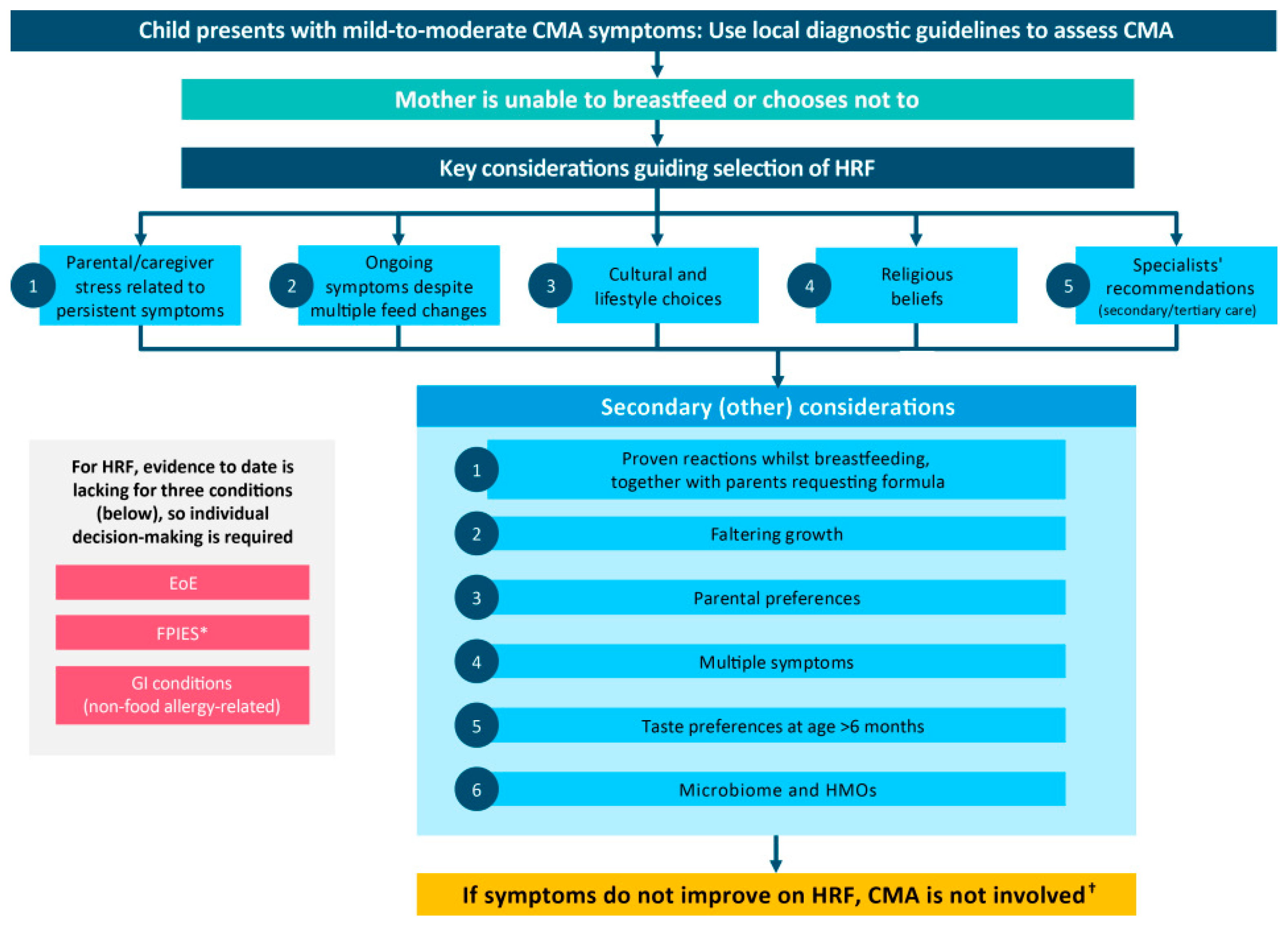
| 1. Parental/caregiver stress related to persistent symptoms | Parents or caregivers may be overwhelmed by persistent symptoms of CMA. Ongoing symptoms not only impact the quality of life of the infant and family but may also lead to feeding difficulties and affect growth and nutritional status [22]. After multiple unsuccessful formula trials, parents might seek a formula that excludes cow’s milk protein entirely, such as an HRF. |
| 2. Ongoing symptoms despite multiple feed changes | If an infant continues to experience symptoms such as GI discomfort (diarrhoea, blood in stool, abdominal pain) or skin issues, where multiple feed changes (standard infant formulas, comfort formulas, eHF for 2–4 weeks) have occurred, an HRF might be considered because it eliminates residual cow’s milk protein entirely, potentially leading to better symptom resolution. |
| 3. Cultural and lifestyle choices | HCPs are increasingly encountering families whose cultural or lifestyle values prohibit or discourage the consumption of cow’s milk formula. Families adhering to an animal protein-free lifestyle may prefer HRF because of its plant-based * origin, which aligns with their dietary values and ethical considerations [13,23]. |
| 4. Religious beliefs | Religious beliefs influence the nutritional choices parents make for their children [24]. HRFs are suitable for families with specific religious dietary requirements. Certification is product-specific, so it is essential to check with the infant formula manufacturer before use [21,25]. |
| 5. Specialists’ recommendations | HCPs across the spectrum of primary to tertiary care should be engaged in the decision-making process when introducing a new formula; however, significant challenges remain in translating guidance into clinical practice [26]. Managing parental expectations can be difficult for HCPs and may influence decisions around formula switching [26]. |
| Secondary Considerations | Notes |
|---|---|
| 1. Proven symptoms whilst breastfed and parental request for formula | Infants who are no longer breastfed or who require top-up formula—and in whom there is a proven reaction, through elimination and reintroduction, to low levels of beta lactoglobulin in breast milk * due to maternal consumption of cow’s milk—may benefit from HRF, which is entirely free of cow’s milk protein without traces of beta lactoglobulin. |
| 2. Faltering growth | If an infant meets the NICE criteria for faltering growth, and this is considered possibly related to an intolerance of the residual peptides in eHF, an HRF may be trialled, with growth monitoring at intervals recommended by NICE NG75. † It should be noted that, for non-breastfed infants with CMA and faltering growth, most guidelines suggest an AAF as a first-line choice. |
| 3. Parental preferences | Parents with prior experience managing CMA may have unique, valuable insights into what was effective for their other children. If HRF was effective previously, they may prefer to use it again. |
| 4. Multiple symptoms | In infants with complex presentations involving multiple organs (i.e., skin, gastrointestinal, and respiratory manifestations), HRF may be considered when exclusion of cow’s milk protein is clinically warranted. |
| 5. Taste preferences in infants older than 6 months | Older infants may reject the taste of eHF or AAF. Due to the hydrolysis of cow’s milk proteins and the presence of free amino acids, these formulas can exhibit distinct smell, texture, taste, and aftertaste profiles that may have a potential long-term influence on patient preferences [12,20,24]. HRF may be offered as a different taste option, which may be better accepted by some infants. |
| 6. The microbiome and HMOs | Infant formulas may differ in the inclusion of cow’s milk protein-free lactose, prebiotics, HMOs, probiotics, and synbiotics, which are all designed to support the developing microbiome in a manner more closely resembling that of breastfed infants and to promote immune tolerance [14,22]. Emerging data suggest that HRF supplemented with HMOs or prebiotics may influence the microbiome; longer-term studies are needed to assess the clinical relevance of such findings [27]. |
Disclaimer/Publisher’s Note: The statements, opinions and data contained in all publications are solely those of the individual author(s) and contributor(s) and not of MDPI and/or the editor(s). MDPI and/or the editor(s) disclaim responsibility for any injury to people or property resulting from any ideas, methods, instructions or products referred to in the content. |
© 2026 by the authors. Licensee MDPI, Basel, Switzerland. This article is an open access article distributed under the terms and conditions of the Creative Commons Attribution (CC BY) license.
Share and Cite
Makwana, N.; Arpe, L.; Ivanova, A.; Evans-Howells, H.; Trigg, C.; Van de Bor, B.; Walsh, J.; Weaver, A.; Wood, R.; Venter, C.; et al. The Role of Hydrolysed Rice Formula in the Dietary Management of Infants with Cow’s Milk Allergy: A UK Healthcare Perspective. Nutrients 2026, 18, 1225. https://doi.org/10.3390/nu18081225
Makwana N, Arpe L, Ivanova A, Evans-Howells H, Trigg C, Van de Bor B, Walsh J, Weaver A, Wood R, Venter C, et al. The Role of Hydrolysed Rice Formula in the Dietary Management of Infants with Cow’s Milk Allergy: A UK Healthcare Perspective. Nutrients. 2026; 18(8):1225. https://doi.org/10.3390/nu18081225
Chicago/Turabian StyleMakwana, Nick, Lauren Arpe, Aneta Ivanova, Helen Evans-Howells, Claire Trigg, Bahee Van de Bor, Joanne Walsh, Annette Weaver, Rachel Wood, Carina Venter, and et al. 2026. "The Role of Hydrolysed Rice Formula in the Dietary Management of Infants with Cow’s Milk Allergy: A UK Healthcare Perspective" Nutrients 18, no. 8: 1225. https://doi.org/10.3390/nu18081225
APA StyleMakwana, N., Arpe, L., Ivanova, A., Evans-Howells, H., Trigg, C., Van de Bor, B., Walsh, J., Weaver, A., Wood, R., Venter, C., Vandenplas, Y., & Meyer, R. (2026). The Role of Hydrolysed Rice Formula in the Dietary Management of Infants with Cow’s Milk Allergy: A UK Healthcare Perspective. Nutrients, 18(8), 1225. https://doi.org/10.3390/nu18081225