Vitamin K as an Endocrine Modulator: Mechanistic Links to Glucose Metabolism and Beyond
 ,
,  , and
, and
Abstract
1. Introduction
2. Materials and Methods
3. Vitamin K Forms and Cellular Mechanisms of Action
3.1. VK Vitamers: Sources, Metabolism, and Tissue Availability
3.2. Cellular Actions of VK: γ-Carboxylation, Signaling, and Radical Scavenging
4. Vitamin K Status and Its Measurement
4.1. VK Status Markers, Their Use, and Limitations
4.2. Genetic Determinants of VK Status

| Gene(s) | Encoded Protein(s) | SNP(s) | Effect on VK Status | Ref. |
|---|---|---|---|---|
| CYP4F2 | CYP4F2 (VK1 oxidase) | rs2108622 | ↑ plasma VK1 and MK-4 | [94] |
| VKORC1 | VKOR | rs8050894 | ↑ plasma VK1 | [95] |
| GGCX | GGCX | rs10187424, rs7568458 | ↑ %ucOCN | [95] |
| APOA1/C3/A4/A5 cluster | apolipoproteins | rs964184 | ↑ plasma VK1 | [90] |
| CTNNA2 | α-2-catenin | rs2192574, rs4852146 | ↑ plasma VK1 | [90] |
| CDO1 | cysteine dioxidase 1 | rs4122275, rs686207, rs6862909 | ↓ plasma VK1 | [90] |
| COL22A1 | collagen | rs2199565, rs4645543, rs7018214 | ↓ plasma VK1 | [90] |
4.3. Baseline VK Status and Responsiveness to Supplementation
5. Vitamin K and Glucose Metabolism: Mechanistic Plausibility and Clinical Evidence from Human Studies
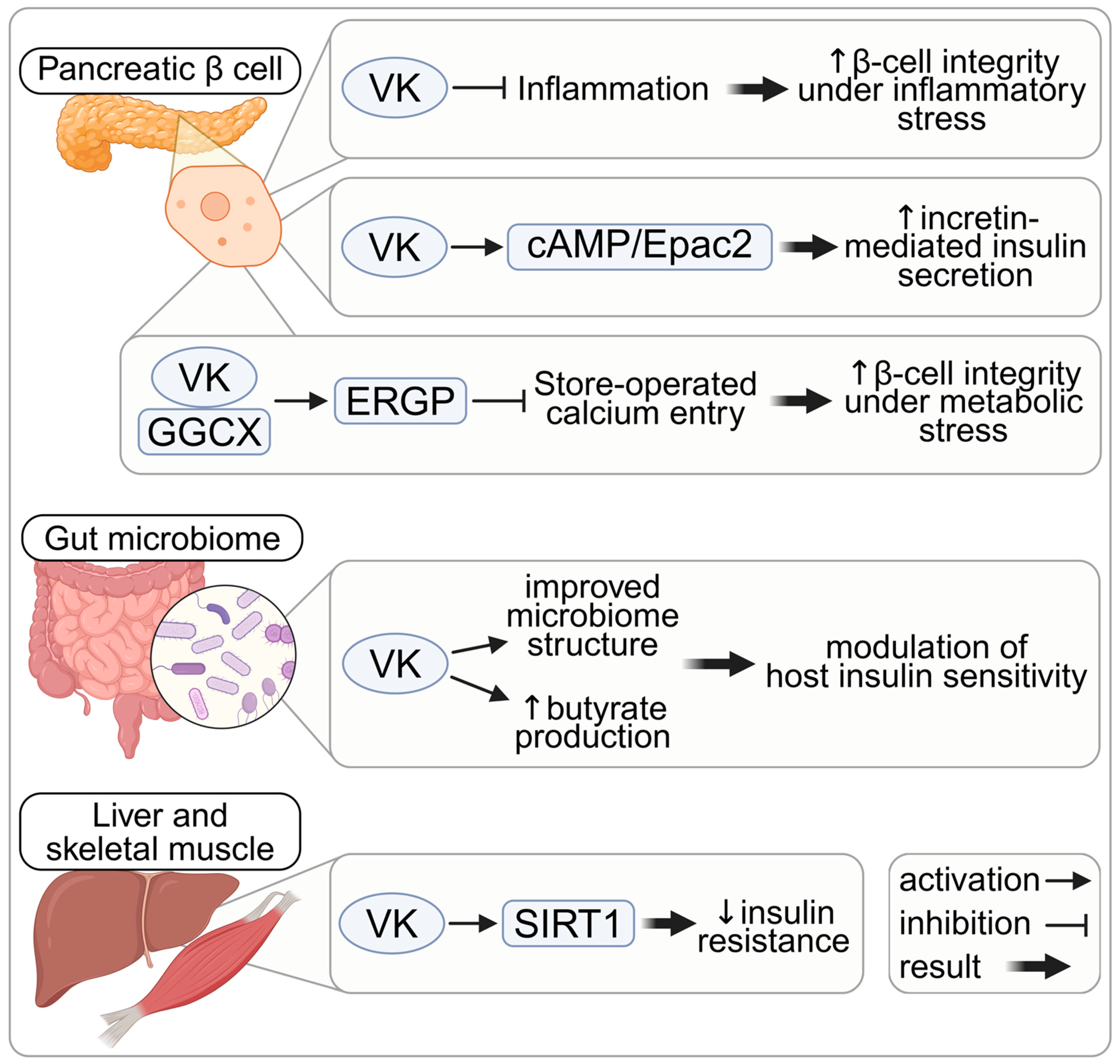
5.1. VK and β-Cell Function: ER Calcium Handling, cAMP Signaling, and Inflammatory Stress
5.2. VK and Insulin Resistance: Direct and Indirect Links
5.3. Osteocalcin and Glucose Metabolism: Mediator, Marker, or Confounder?
5.4. VK Status and Risk of T2D: Observational Evidence
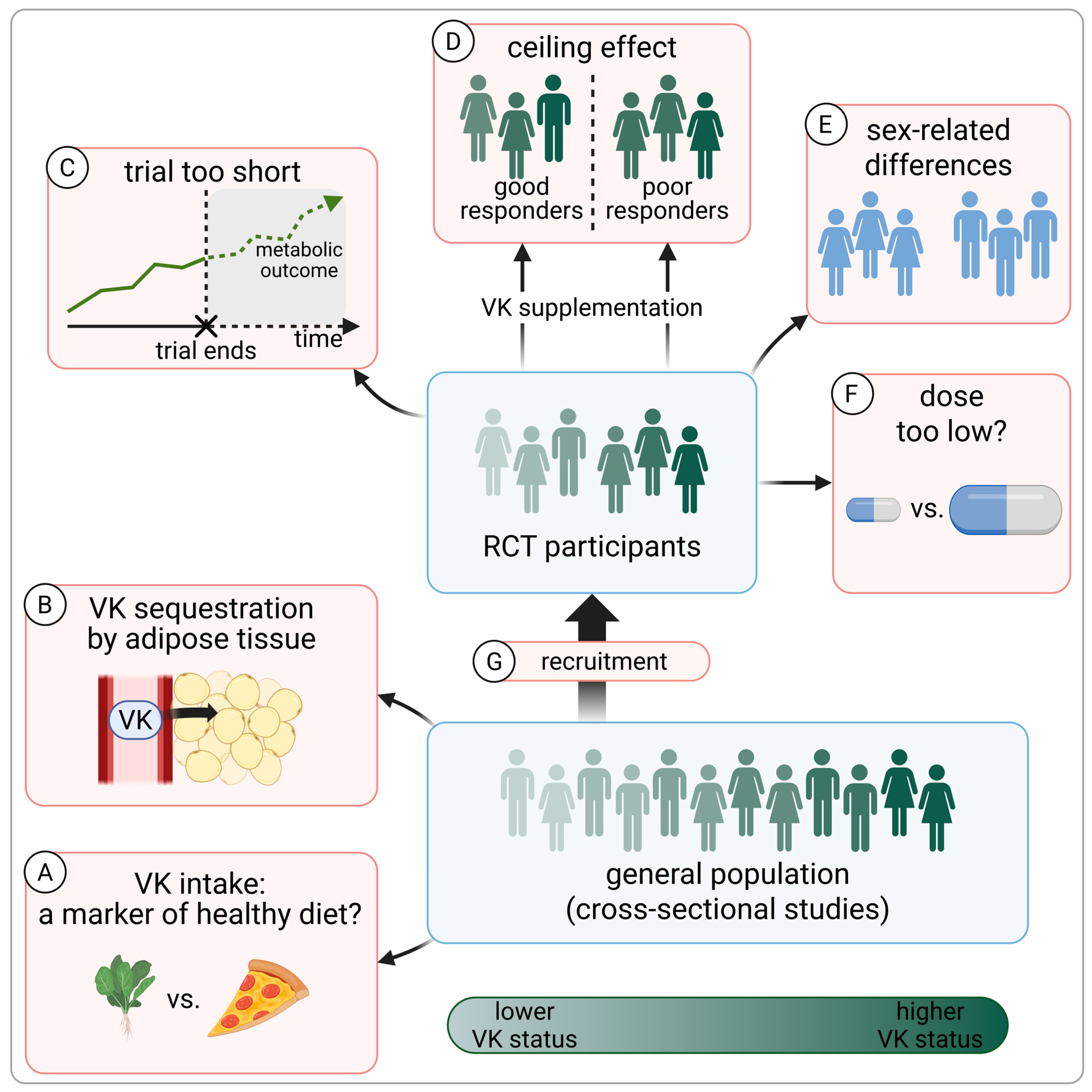
5.5. VK and Glucose Metabolism: Effects Depend on Baseline Metabolic Status and Outcome Measures
| Study | Year | Subjects (N) | VK Dose/VK Status | Period | Outcome |
|---|---|---|---|---|---|
| (a) observational studies | |||||
| Santos et al. [17] | 2020 | Adult men (136) and women (192) | Usual dietary intake | Cross-sectional study | in women: (Higher VK intake) ↓ fasting PG, ↓ fasting PI, ↓ HOMA-IR, ↑ QUICKI; ↔ in men |
| Zwakenberg et al. [20] | 2019 | Pooled from: the EPIC cohort study, the DIAGRAM meta-analysis, and the UK Biobank cohort (total of 69,647 adults with T2D) | Usual dietary intake | EPIC cohort: 1997–2007; UK Biobank cohort: 2006–2010; DIAGRAM meta-analysis: data from 23 studies | (Higher genetically predicted circulating VK1) ↓ T2D risk |
| Dihingia et al. [19] | 2018 | Adult men and women with T2D (25) and healthy controls (20) | Usual dietary intake | Cross-sectional study | ↓ circulating VK1 in T2D vs. controls (Higher circulating VK1) ↓ fasting PG, ↓ HOMA-IR among T2D patients |
| Ibarrola-Jurado et al. [18] | 2012 | Elderly men (861) and women (1062) with high CV risk | Usual dietary intake | 5.5 years (median follow-up) | (Higher VK1 intake) ↓ T2D risk |
| Beulens et al. [170] | 2010 | Adult men (9740) and women (28,354) | Usual dietary intake | 10.3 years | (Higher VK intake) ↓ T2D risk |
| Pan and Jackson [16] | 2009 | Adult men (2867) and women (2933) | Usual dietary intake | Cross-sectional study | (Higher VK intake) ↔ fasting PG and fasting PI |
| Yoshida et al. [178] | 2008 | Adult men (1247) and women (1472) | Usual dietary intake | 1 year | (Higher VK intake) ↓ OGTT PG, ↑ ISI(0,120) ↔ fasting PG, HbA1c, PI, and HOMA-IR |
| Sakamoto et al. [184] | 1999 | Healthy young men (16) | Usual dietary intake | 1 week food checklist, acute insulin response | (Higher VK intake) ↓ OGTT PG, ↑ insulin response ↔ fasting PG |
| (b) interventional studies | |||||
| Zhang et al. [26] | 2023 | Adult men (29) and women (31) with T2D | With or without 90 μg/day MK-7 | 6 months | ↓ fasting PG, ↓ fasting PI, ↓ HbA1c, ↓HOMA-IR |
| Ali et al. [27] | 2023 | Adult men (10) and women (80) with T2D | With or without 1000 μg/day K4 | 6 months | ↓ fasting PI, ↓ HOMA-IR; ↓ treatment intensification, ↑ dose reduction of antidiabetic drugs; ↔ fasting PG and OGTT PG |
| Adeli et al. [28] | 2023 | Adult men and women with T2D (45) | With or without 200 μg/day MK-7 | 3 months | ↓ fasting PG, ↓ fasting PI; ↓ plasma leptin |
| Rahimi Sakak et al. [29] | 2021 | Adult men and women with T2D (63) | With or without 360 μg/day MK-7 | 3 months | ↓ fasting PG, ↓ HbA1c; ↔ fasting PI, HOMA-IR, QUICKI |
| Karamzad et al. [31] | 2020 | Adult men (31) and premenopausal women (14) with T2D | With or without 200 μg/day MK-7 | 3 months | ↓ fasting PG and HbA1c; ↔ fasting PI, HOMA-IR |
| Tarkesh et al. [30] | 2020 | Women with PCOS (79) | With or without 90 μg/day MK-7 | 2 months | ↓ HOMA-IR, ↓ PI, ↑ QUICKI ↔ fasting PG |
| Karamali et al. [182] | 2017 | Women with PCOS (55) | With or without 180 μg MK-7, 10 μg vitamin D and 1 g Ca/day | 2 months | ↓ PI, ↓ HOMA-IR, ↑ QUICKI ↔ fasting PG |
| Asemi et al. [183] | 2016 | Adult men (35) and women (31) with T2D and coronary heart disease | With or without 180 μg MK-7, 10 μg vitamin D and 1 g Ca/day | 3 months | ↓ PI, ↓ HOMA-IR, ↑ QUICKI ↔ fasting PG |
| Knapen et al. [176] | 2015 | Healthy postmenopausal women (244) | With or without 180 μg/day MK-7 | 3 years | ↔ fasting PG |
| Centi et al. [174] | 2015 | Healthy adult men and women (42) | 500 μg/day VK1 | 1 month | ↔ on HOMA-IR |
| Rasekhi et al. [181] | 2015 | Premenopausal prediabetic women (82) | With or without 1000 μg/day VK1 | 1 month | ↓ OGTT PG, ↓ OGTT plasma insulin, ↑ ISI(0,120); ↔ on fasting PG, fasting PI, and HOMA-IR |
| Choi et al. [179] | 2011 | Healthy young men (33) | With or without 30,000 µg/day MK-4 | 1 month | ↑ ISI(0,120); ↔ on fasting PG |
| Kumar et al. [175] | 2010 | Healthy postmenopausal women (42) | With or without 1000 μg/day VK1 | 1 year | ↔ fasting PG, fasting PI, and HOMA-IR |
| Yoshida et al. [178] | 2008 | Elderly nondiabetic men (124) and women (165) | With or without 500 μg/day VK1 | 3 years | ↓ fasting PI and ↓ HOMA-IR in men; ↔ in women; ↔ fasting PG in both sexes |
| Sakamoto et al. [180] | 2000 | Healthy young men with low (4) medium (4) and high (4) DP levels | 90,000 µg/day MK-4 | 1 week | ↑ ISI(0,120) in men with high DP levels; ↔ on ISI in other subjects; ↔ on all other measured parameters |
5.6. Other Cardiometabolic Domains Linked to VK Status
6. Vitamin K Collaborates with PTH and Calcitriol to Ensure Proper Calcium Distribution
6.1. VK Facilitates Safe Calcium Mobilization by Parathormone and Calcitriol
6.2. VK Amplifies Skeletal Responses to Calcitriol and Parathormone
7. Vitamin K and Other Endocrine Axes
7.1. Reproductive Axes: Evidence for Testosterone Synthesis and Limited Data on Estrogen
7.2. Thyroid Hormones and Other Endocrine Axes: Indirect and Uncertain Interactions with VK
8. Discussion
8.1. Key Findings
8.2. Unresolved Mechanistic Questions
8.3. Quality and Interpretation of Clinical Evidence
8.4. Practical Implications and Future Directions
8.5. Strengths and Limitations
9. Conclusions
Supplementary Materials
Author Contributions
Funding
Data Availability Statement
Conflicts of Interest
References
- Khatapoush, S.; Mohit, M.; Mansouri Shirazi, F.; Moazen, M.; Ebrahimzadeh, A.; Hejazi, N. The Effect of Vitamin K Supplementation on Glycemic Indices in Adults: A Systematic Review and Meta—Analysis of Clinical Trials. Int. J. Nutr. Sci. 2025, 10, 186–198. [Google Scholar] [CrossRef]
- Varsamis, N.A.; Christou, G.A.; Kiortsis, D.N. A Critical Review of the Effects of Vitamin K on Glucose and Lipid Homeostasis: Its Potential Role in the Prevention and Management of Type 2 Diabetes. Hormones 2021, 20, 415–422. [Google Scholar] [CrossRef]
- Akbari, S.; Rasouli-Ghahroudi, A.A. Vitamin K and Bone Metabolism: A Review of the Latest Evidence in Preclinical Studies. BioMed Res. Int. 2018, 2018, 4629383. [Google Scholar] [CrossRef] [PubMed]
- Fusaro, M.; Cianciolo, G.; Brandi, M.L.; Ferrari, S.; Nickolas, T.L.; Tripepi, G.; Plebani, M.; Zaninotto, M.; Iervasi, G.; La Manna, G.; et al. Vitamin K and Osteoporosis. Nutrients 2020, 12, 3625. [Google Scholar] [CrossRef]
- Luo, W.; Ye, D.; Zhao, K.; Zhou, L.; Wu, Y.; Ge, Q. Associations between Vitamin K and Systemic Immune and Inflammation Biomarkers: A Population-Based Study from the NHANES (2007–2020). Front. Nutr. 2025, 12, 1625209. [Google Scholar] [CrossRef] [PubMed]
- Xie, Y.; Li, S.; Wu, D.; Wang, Y.; Chen, J.; Duan, L.; Li, S.; Li, Y. Vitamin K: Infection, Inflammation, and Auto-Immunity. J. Inflamm. Res. 2024, 17, 1147–1160. [Google Scholar] [CrossRef] [PubMed]
- Shioi, A.; Morioka, T.; Shoji, T.; Emoto, M. The Inhibitory Roles of Vitamin K in Progression of Vascular Calcification. Nutrients 2020, 12, 583. [Google Scholar] [CrossRef]
- Lees, J.S.; Chapman, F.A.; Witham, M.D.; Jardine, A.G.; Mark, P.B. Vitamin K Status, Supplementation and Vascular Disease: A Systematic Review and Meta-Analysis. Heart 2019, 105, 938–945. [Google Scholar] [CrossRef]
- McCann, J.C.; Ames, B.N. Vitamin K, an Example of Triage Theory: Is Micronutrient Inadequacy Linked to Diseases of Aging? Am. J. Clin. Nutr. 2009, 90, 889–907. [Google Scholar] [CrossRef]
- Vermeer, C.V. Vitamin K: The Effect on Health beyond Coagulation – an Overview. Food Nutr. Res. 2012, 56, 5329. [Google Scholar] [CrossRef]
- Kaźmierczak-Barańska, J.; Karwowski, B.T. Vitamin K Contribution to DNA Damage—Advantage or Disadvantage? A Human Health Response. Nutrients 2022, 14, 4219. [Google Scholar] [CrossRef]
- Lee, S.E.; Schulze, K.J.; Cole, R.N.; Wu, L.S.F.; Yager, J.D.; Groopman, J.; Christian, P.; West, K.P. Biological Systems of Vitamin K: A Plasma Nutriproteomics Study of Subclinical Vitamin K Deficiency in 500 Nepalese Children. OMICS 2016, 20, 214–223. [Google Scholar] [CrossRef]
- Ng, E.; Loewy, A.D. Guidelines for Vitamin K Prophylaxis in Newborns. Paediatr. Child Health 2018, 23, 394–397. [Google Scholar] [CrossRef]
- Sankar, M.J.; Chandrasekaran, A.; Kumar, P.; Thukral, A.; Agarwal, R.; Paul, V.K. Vitamin K Prophylaxis for Prevention of Vitamin K Deficiency Bleeding: A Systematic Review. J. Perinatol. 2016, 36, S29–S35. [Google Scholar] [CrossRef] [PubMed]
- Koitaya, N.; Sekiguchi, M.; Tousen, Y.; Nishide, Y.; Morita, A.; Yamauchi, J.; Gando, Y.; Miyachi, M.; Aoki, M.; Komatsu, M.; et al. Low-Dose Vitamin K2 (MK-4) Supplementation for 12 Months Improves Bone Metabolism and Prevents Forearm Bone Loss in Postmenopausal Japanese Women. J. BONE Miner. Metab. 2014, 32, 142–150. [Google Scholar] [CrossRef]
- Pan, Y.; Jackson, R.T. Dietary Phylloquinone Intakes and Metabolic Syndrome in US Young Adults. J. Am. Coll. Nutr. 2009, 28, 369–379. [Google Scholar] [CrossRef]
- Santos, E.A.D.; Giudici, K.V.; França, N.A.G.D.; Peters, B.S.E.; Fisberg, R.M.; Martini, L.A. Correlations among Vitamin K Intake, Body Fat, Lipid Profile and Glucose Homeostasis in Adults and the Elderly. Arch. Endocrinol. Metab. 2020, 64, 436–444. [Google Scholar] [CrossRef] [PubMed]
- Ibarrola-Jurado, N.; Salas-Salvadó, J.; Martínez-González, M.A.; Bulló, M. Dietary Phylloquinone Intake and Risk of Type 2 Diabetes in Elderly Subjects at High Risk of Cardiovascular Disease. Am. J. Clin. Nutr. 2012, 96, 1113–1118. [Google Scholar] [CrossRef] [PubMed]
- Dihingia, A.; Ozah, D.; Ghosh, S.; Sarkar, A.; Baruah, P.K.; Kalita, J.; Sil, P.C.; Manna, P. Vitamin K1 Inversely Correlates with Glycemia and Insulin Resistance in Patients with Type 2 Diabetes (T2D) and Positively Regulates SIRT1/AMPK Pathway of Glucose Metabolism in Liver of T2D Mice and Hepatocytes Cultured in High Glucose. J. Nutr. Biochem. 2018, 52, 103–114. [Google Scholar] [CrossRef]
- Zwakenberg, S.R.; Remmelzwaal, S.; Beulens, J.W.J.; Booth, S.L.; Burgess, S.; Dashti, H.S.; Imamura, F.; Feskens, E.J.M.; Van Der Schouw, Y.T.; Sluijs, I. Circulating Phylloquinone Concentrations and Risk of Type 2 Diabetes: A Mendelian Randomization Study. Diabetes 2019, 68, 220–225. [Google Scholar] [CrossRef]
- Nikpayam, O.; Jafari, A.; Faghfouri, A.; Pasand, M.; Noura, P.; Najafi, M.; Sohrab, G. Effect of Menaquinone-7 (MK-7) Supplementation on Anthropometric Measurements, Glycemic Indices, and Lipid Profiles: A Systematic Review and Meta-Analysis of Randomized Controlled Trials. Prostaglandins Other Lipid Mediat. 2025, 177, 106970. [Google Scholar] [CrossRef]
- Lacombe, J.; Guo, K.; Bonneau, J.; Faubert, D.; Gioanni, F.; Vivoli, A.; Muir, S.M.; Hezzaz, S.; Poitout, V.; Ferron, M. Vitamin K-Dependent Carboxylation Regulates Ca2+ Flux and Adaptation to Metabolic Stress in β Cells. Cell Rep. 2023, 42, 112500. [Google Scholar] [CrossRef] [PubMed]
- Ho, H.-J.; Shirakawa, H.; Hirahara, K.; Sone, H.; Kamiyama, S.; Komai, M. Menaquinone-4 Amplified Glucose-Stimulated Insulin Secretion in Isolated Mouse Pancreatic Islets and INS-1 Rat Insulinoma Cells. Int. J. Mol. Sci. 2019, 20, 1995. [Google Scholar] [CrossRef] [PubMed]
- Su, X.; Wang, W.; Fang, C.; Ni, C.; Zhou, J.; Wang, X.; Zhang, L.; Xu, X.; Cao, R.; Lang, H.; et al. Vitamin K2 Alleviates Insulin Resistance in Skeletal Muscle by Improving Mitochondrial Function via SIRT1 Signaling. Antioxid. Redox Signal. 2021, 34, 99–117. [Google Scholar] [CrossRef]
- Mishima, E.; Ito, J.; Wu, Z.; Nakamura, T.; Wahida, A.; Doll, S.; Tonnus, W.; Nepachalovich, P.; Eggenhofer, E.; Aldrovandi, M.; et al. A Non-Canonical Vitamin K Cycle Is a Potent Ferroptosis Suppressor. Nature 2022, 608, 778–783. [Google Scholar] [CrossRef] [PubMed]
- Zhang, Y.; Liu, L.; Wei, C.; Wang, X.; Li, R.; Xu, X.; Zhang, Y.; Geng, G.; Dang, K.; Ming, Z.; et al. Vitamin K2 Supplementation Improves Impaired Glycemic Homeostasis and Insulin Sensitivity for Type 2 Diabetes through Gut Microbiome and Fecal Metabolites. BMC Med. 2023, 21, 174. [Google Scholar] [CrossRef]
- Ali, A.M.; Abbassi, M.M.; Sabry, N.A.; Fawzi, M.; Mousa, S. The Effect of Vitamin K4 Supplementation on Insulin Resistance in Individuals with Type 2 Diabetes: A Double-Blind Randomised Placebo-Controlled Clinical Trial. Eur. J. Nutr. 2023, 62, 3241–3249. [Google Scholar] [CrossRef]
- Adeli, S.; Pourghassem Gargari, B.; Karamzad, N. The Effects of Vitamin K2 (Menaquinone-7) on the Leptin and Adiponectin Levels in Overweight/Obese Type 2 Diabetes Patients: A Randomized Clinical Trial. Pharm. Sci. 2023, 29, 346–354. [Google Scholar] [CrossRef]
- Rahimi Sakak, F.; Moslehi, N.; Niroomand, M.; Mirmiran, P. Glycemic Control Improvement in Individuals with Type 2 Diabetes with Vitamin K2 Supplementation: A Randomized Controlled Trial. Eur. J. Nutr. 2021, 60, 2495–2506. [Google Scholar] [CrossRef]
- Tarkesh, F.; Namavar Jahromi, B.; Hejazi, N.; Tabatabaee, H. Beneficial Health Effects of Menaquinone-7 on Body Composition, Glycemic Indices, Lipid Profile, and Endocrine Markers in Polycystic Ovary Syndrome Patients. Food Sci. Nutr. 2020, 8, 5612–5621. [Google Scholar] [CrossRef]
- Karamzad, N.; Faraji, E.; Adeli, S.; Carson-Chahhoud, K.; Azizi, S.; Pourghassem Gargari, B. Effects of MK-7 Supplementation on Glycemic Status, Anthropometric Indices and Lipid Profile in Patients with Type 2 Diabetes: A Randomized Controlled Trial. Diabetes Metab. Syndr. Obes. Targets Ther. 2020, 13, 2239–2249. [Google Scholar] [CrossRef]
- Manna, P.; Kalita, J. Beneficial Role of Vitamin K Supplementation on Insulin Sensitivity, Glucose Metabolism, and the Reduced Risk of Type 2 Diabetes: A Review. Nutrition 2016, 32, 732–739. [Google Scholar] [CrossRef]
- Ho, H.-J.; Komai, M.; Shirakawa, H. Beneficial Effects of Vitamin K Status on Glycemic Regulation and Diabetes Mellitus: A Mini-Review. Nutrients 2020, 12, 2485. [Google Scholar] [CrossRef]
- Aaseth, J.O.; Finnes, T.E.; Askim, M.; Alexander, J. The Importance of Vitamin K and the Combination of Vitamins K and D for Calcium Metabolism and Bone Health: A Review. Nutrients 2024, 16, 2420. [Google Scholar] [CrossRef] [PubMed]
- Mladěnka, P.; Macáková, K.; Kujovská Krčmová, L.; Javorská, L.; Mrštná, K.; Carazo, A.; Protti, M.; Remião, F.; Nováková, L. the OEMONOM researchers and collaborators. Vitamin K—Sources, Physiological Role, Kinetics, Deficiency, Detection, Therapeutic Use, and Toxicity. Nutr. Rev. 2022, 80, 677–698. [Google Scholar] [CrossRef] [PubMed]
- Halder, M.; Petsophonsakul, P.; Akbulut, A.C.; Pavlic, A.; Bohan, F.; Anderson, E.; Maresz, K.; Kramann, R.; Schurgers, L. Vitamin K: Double Bonds beyond Coagulation Insights into Differences between Vitamin K1 and K2 in Health and Disease. Int. J. Mol. Sci. 2019, 20, 896. [Google Scholar] [CrossRef] [PubMed]
- Akbulut, A.C.; Pavlic, A.; Petsophonsakul, P.; Halder, M.; Maresz, K.; Kramann, R.; Schurgers, L. Vitamin K2 Needs an RDI Separate from Vitamin K1. Nutrients 2020, 12, 1852. [Google Scholar] [CrossRef]
- Shea, M.K.; Berkner, K.L.; Ferland, G.; Fu, X.; Holden, R.M.; Booth, S.L. Perspective: Evidence before Enthusiasm—A Critical Review of the Potential Cardiovascular Benefits of Vitamin K. Adv. Nutr. 2021, 12, 632–646. [Google Scholar] [CrossRef]
- Simes, D.C.; Viegas, C.S.B.; Araújo, N.; Marreiros, C. Vitamin K as a Diet Supplement with Impact in Human Health: Current Evidence in Age-Related Diseases. Nutrients 2020, 12, 138. [Google Scholar] [CrossRef]
- Schurgers, L.J.; Vermeer, C. Determination of Phylloquinone and Menaquinones in Food. Pathophysiol. Haemost. Thromb. 2000, 30, 298–307. [Google Scholar] [CrossRef]
- Shearer, M.J.; Newman, P. Metabolism and Cell Biology of Vitamin K. Thromb. Haemost. 2008, 100, 530–547. [Google Scholar]
- Ferland, G.; Doucet, I.; Mainville, D. Phylloquinone and Menaquinone-4 Tissue Distribution at Different Life Stages in Male and Female Sprague–Dawley Rats Fed Different VK Levels Since Weaning or Subjected to a 40% Calorie Restriction since Adulthood. Nutrients 2016, 8, 141. [Google Scholar] [CrossRef] [PubMed]
- Loor, G.; Kondapalli, J.; Schriewer, J.M.; Chandel, N.S.; Vanden Hoek, T.L.; Schumacker, P.T. Menadione Triggers Cell Death through ROS-Dependent Mechanisms Involving PARP Activation without Requiring Apoptosis. Free Radic. Biol. Med. 2010, 49, 1925–1936. [Google Scholar] [CrossRef]
- Munday, R.; Smith, B.L.; Munday, C.M. Toxicity of 2,3-Dialkyl-1,4-Naphthoquinones in Rats: Comparison with Cytotoxicity in Vitro. Free Radic. Biol. Med. 1995, 19, 759–765. [Google Scholar] [CrossRef]
- Girolami, A.; Ferrari, S.; Cosi, E.; Santarossa, C.; Randi, M.L. Vitamin K-Dependent Coagulation Factors That May Be Responsible for Both Bleeding and Thrombosis (FII, FVII, and FIX). Clin. Appl. Thromb. 2018, 24, 42S–47S. [Google Scholar] [CrossRef]
- Muller, M.P.; Wang, Y.; Morrissey, J.H.; Tajkhorshid, E. Lipid Specificity of the Membrane Binding Domain of Coagulation Factor X. J. Thromb. Haemost. 2017, 15, 2005–2016. [Google Scholar] [CrossRef] [PubMed]
- Ten Kate, M.K.; Van Der Meer, J. Protein S Deficiency: A Clinical Perspective. Haemophilia 2008, 14, 1222–1228. [Google Scholar] [CrossRef] [PubMed]
- Esmon, C.T. The Protein C Pathway. Chest 2003, 124, 26S–32S. [Google Scholar] [CrossRef]
- Broze, G. Protein Z-Dependent Regulation of Coagulation. Thromb. Haemost. 2001, 86, 08–13. [Google Scholar] [CrossRef]
- Karsenty, G. Osteocalcin: A Multifaceted Bone-Derived Hormone. Annu. Rev. Nutr. 2023, 43, 55–71. [Google Scholar] [CrossRef]
- Zhu, S.; Barbe, M.F.; Liu, C.; Hadjiargyrou, M.; Popoff, S.N.; Rani, S.; Safadi, F.F.; Litvin, J. Periostin-like-factor in Osteogenesis. J. Cell. Physiol. 2009, 218, 584–592. [Google Scholar] [CrossRef]
- Duchamp De Lageneste, O.; Julien, A.; Abou-Khalil, R.; Frangi, G.; Carvalho, C.; Cagnard, N.; Cordier, C.; Conway, S.J.; Colnot, C. Periosteum Contains Skeletal Stem Cells with High Bone Regenerative Potential Controlled by Periostin. Nat. Commun. 2018, 9, 773. [Google Scholar] [CrossRef] [PubMed]
- Chang, L.-C.; Lin, H.-S.; Chen, W.-C. The Reappraisal of Nephrocalcin—Its Role in the Inhibition of Calcium Oxalate Crystal Growth and Interaction with Divalent Metal Ions. Urol. Res. 2001, 29, 89–93. [Google Scholar] [CrossRef] [PubMed]
- El Asmar, M.; Naoum, J.; Arbid, E. Vitamin K Dependent Proteins and the Role of Vitamin K2 in the Modulation of Vascular Calcification: A Review. Oman Med. J. 2014, 29, 172–177. [Google Scholar] [CrossRef]
- Viegas, C.S.; Simes, D.C. Gla-Rich Protein (GRP): A New Player In The Burden Of Vascular Calcification. J. Cardiovasc. Dis. Diagn. 2016, 4, 2. [Google Scholar] [CrossRef]
- Zhuo, L.; Kimata, K. Structure and Function of Inter-α-Trypsin Inhibitor Heavy Chains. Connect. Tissue Res. 2008, 49, 311–320. [Google Scholar] [CrossRef] [PubMed]
- Qiu, C.; Zheng, H.; Tao, H.; Yu, W.; Jiang, X.; Li, A.; Jin, H.; Lv, A.; Li, H. Vitamin K2 Inhibits Rat Vascular Smooth Muscle Cell Calcification by Restoring the Gas6/Axl/Akt Anti-Apoptotic Pathway. Mol. Cell. Biochem. 2017, 433, 149–159. [Google Scholar] [CrossRef]
- Kulman, J.D.; Harris, J.E.; Xie, L.; Davie, E.W. Proline-Rich Gla Protein 2 Is a Cell-Surface Vitamin K-Dependent Protein That Binds to the Transcriptional Coactivator Yes-Associated Protein. Proc. Natl. Acad. Sci. USA 2007, 104, 8767–8772. [Google Scholar] [CrossRef]
- Kulman, J.D.; Harris, J.E.; Haldeman, B.A.; Davie, E.W. Primary Structure and Tissue Distribution of Two Novel Proline-Rich γ-Carboxyglutamic Acid Proteins. Proc. Natl. Acad. Sci. USA 1997, 94, 9058–9062. [Google Scholar] [CrossRef]
- Kulman, J.D.; Harris, J.E.; Xie, L.; Davie, E.W. Identification of Two Novel Transmembrane γ-Carboxyglutamic Acid Proteins Expressed Broadly in Fetal and Adult Tissues. Proc. Natl. Acad. Sci. USA 2001, 98, 1370–1375. [Google Scholar] [CrossRef]
- Ho, H.-J.; Shirakawa, H.; Komai, M. Menaquinone-4 Enhances Steroidogenesis in Testis Derived Tumor Cells Via the Elevation of cAMP Level. In Vitamin K2—Vital for Health and Wellbeing; Gordeladze, J.O., Ed.; InTech: London, UK, 2017; Available online: http://www.intechopen.com/books/vitamin-k2-vital-for-health-and-wellbeing/menaquinone-4-enhances-steroidogenesis-in-testis-derived-tumor-cells-via-the-elevation-of-camp-level (accessed on 2 July 2025).
- Ichikawa, T.; Horie-Inoue, K.; Ikeda, K.; Blumberg, B.; Inoue, S. Vitamin K2 Induces Phosphorylation of Protein Kinase A and Expression of Novel Target Genes in Osteoblastic Cells. J. Mol. Endocrinol. 2007, 39, 239–247. [Google Scholar] [CrossRef]
- Ito, A.; Shirakawa, H.; Takumi, N.; Minegishi, Y.; Ohashi, A.; Howlader, Z.H.; Ohsaki, Y.; Sato, T.; Goto, T.; Komai, M. Menaquinone-4 Enhances Testosterone Production in Rats and Testis-Derived Tumor Cells. Lipids Health Dis. 2011, 10, 158. [Google Scholar] [CrossRef] [PubMed]
- Otsuka, M.; Kato, N.; Shao, R.-X.; Hoshida, Y.; Ijichi, H.; Koike, Y.; Taniguchi, H.; Moriyama, M.; Shiratori, Y.; Kawabe, T.; et al. Vitamin K2 Inhibits the Growth and Invasiveness of Hepatocellular Carcinoma Cells via Protein Kinase A Activation. Hepatology 2004, 40, 243–251. [Google Scholar] [CrossRef]
- Tsang, C.K.; Kamei, Y. Novel Effect of Vitamin K1 (Phylloquinone) and Vitamin K2 (Menaquinone) on Promoting Nerve Growth Factor-Mediated Neurite Outgrowth from PC12D Cells. Neurosci. Lett. 2002, 323, 9–12. [Google Scholar] [CrossRef]
- Staudinger, J.L.; Mahroke, A.; Patel, G.; Dattel, C.; Reddy, S. Pregnane X Receptor Signaling Pathway and Vitamin K: Molecular Mechanisms and Clinical Relevance in Human Health. Cells 2024, 13, 681. [Google Scholar] [CrossRef]
- Azuma, K.; Inoue, S. Multiple Modes of Vitamin K Actions in Aging-Related Musculoskeletal Disorders. Int. J. Mol. Sci. 2019, 20, 2844. [Google Scholar] [CrossRef]
- Welsh, J.; Bak, M.J.; Narvaez, C.J. New Insights into Vitamin K Biology with Relevance to Cancer. Trends Mol. Med. 2022, 28, 864–881. [Google Scholar] [CrossRef]
- Maniwa, Y.; Kasukabe, T.; Kumakura, S. Vitamin K2 and Cotylenin A Synergistically Induce Monocytic Differentiation and Growth Arrest along with the Suppression of C-MYC Expression and Induction of Cyclin G2 Expression in Human Leukemia HL-60 Cells. Int. J. Oncol. 2015, 47, 473–480. [Google Scholar] [CrossRef]
- Yamamoto, T.; Nakamura, H.; Liu, W.; Cao, K.; Yoshikawa, S.; Enomoto, H.; Iwata, Y.; Koh, N.; Saito, M.; Imanishi, H.; et al. Involvement of Hepatoma-Derived Growth Factor in the Growth Inhibition of Hepatocellular Carcinoma Cells by Vitamin K(2). J. Gastroenterol. 2009, 44, 228–235. [Google Scholar] [CrossRef]
- Duan, F.; Yu, Y.; Guan, R.; Xu, Z.; Liang, H.; Hong, L. Vitamin K2 Induces Mitochondria-Related Apoptosis in Human Bladder Cancer Cells via ROS and JNK/P38 MAPK Signal Pathways. PLoS ONE 2016, 11, e0161886. [Google Scholar] [CrossRef]
- Popa, D.-S.; Bigman, G.; Rusu, M.E. The Role of Vitamin K in Humans: Implication in Aging and Age-Associated Diseases. Antioxidants 2021, 10, 566. [Google Scholar] [CrossRef]
- Xv, F.; Chen, J.; Duan, L.; Li, S. Research Progress on the Anticancer Effects of Vitamin K2 (Review). Oncol. Lett. 2018, 15, 8926–8934. Available online: http://www.spandidos-publications.com/10.3892/ol.2018.8502 (accessed on 28 July 2025). [CrossRef]
- Wu, J.; Shi, Y.; Zhou, M.; Chen, M.; Ji, S.; Liu, X.; Zhou, M.; Xia, R.; Zheng, X.; Wang, W. Nutrient Vitamins Enabled Metabolic Regulation of Ferroptosis via Reactive Oxygen Species Biology. Front. Pharmacol. 2024, 15, 1434088. [Google Scholar] [CrossRef]
- Kolbrink, B.; Von Samson-Himmelstjerna, F.A.; Messtorff, M.L.; Riebeling, T.; Nische, R.; Schmitz, J.; Bräsen, J.H.; Kunzendorf, U.; Krautwald, S. Vitamin K1 Inhibits Ferroptosis and Counteracts a Detrimental Effect of Phenprocoumon in Experimental Acute Kidney Injury. Cell. Mol. Life Sci. 2022, 79, 387. [Google Scholar] [CrossRef]
- Tsugawa, N.; Shiraki, M. Vitamin K Nutrition and Bone Health. Nutrients 2020, 12, 1909. [Google Scholar] [CrossRef]
- Willett, W.C. Nutritional Epidemiology, 3rd ed.; Monographs in Epidemiology and Biostatistics; Oxford University Press: Oxford, UK, 2013; 1p. [Google Scholar]
- Shea, M.; Booth, S. Concepts and Controversies in Evaluating Vitamin K Status in Population-Based Studies. Nutrients 2016, 8, 8. [Google Scholar] [CrossRef] [PubMed]
- Braam, L.; McKeown, N.; Jacques, P.; Lichtenstein, A.; Vermeer, C.; Wilson, P.; Booth, S. Dietary Phylloquinone Intake as a Potential Marker for a Heart-Healthy Dietary Pattern in the Framingham Offspring Cohort. J. Am. Diet. Assoc. 2004, 104, 1410–1414. [Google Scholar] [CrossRef] [PubMed]
- Westerterp, K.R.; Goris, A.H.C. Validity of the Assessment of Dietary Intake: Problems of Misreporting. Curr. Opin. Clin. Nutr. Metab. Care 2002, 5, 489–493. [Google Scholar] [CrossRef]
- Gundberg, C.M.; Lian, J.B.; Booth, S.L. Vitamin K-Dependent Carboxylation of Osteocalcin: Friend or Foe? Adv. Nutr. 2012, 3, 149–157. [Google Scholar] [CrossRef] [PubMed]
- Booth, S.L.; Centi, A.; Smith, S.R.; Gundberg, C. The Role of Osteocalcin in Human Glucose Metabolism: Marker or Mediator? Nat. Rev. Endocrinol. 2013, 9, 43–55. [Google Scholar] [CrossRef]
- Bernhard, M.; Okorie, O.; Tseng, W.-J.; Chen, M.; Danon, J.; Cui, M.; Lashbrooks, E.; Yang, Y.; Wang, B. Metabolic Shifts in Ratio of ucOcn to cOcn toward Bone Resorption Contribute to Age-Dependent Bone Loss in Male Mice. Am. J. Physiol.-Endocrinol. Metab. 2024, 327, E711–E722. [Google Scholar] [CrossRef]
- Nowicki, J.K.; Jakubowska-Pietkiewicz, E. Osteocalcin: Beyond Bones. Endocrinol. Metab. 2024, 39, 399–406. [Google Scholar] [CrossRef]
- O’Donnell, C.J.; Shea, M.K.; Price, P.A.; Gagnon, D.R.; Wilson, P.W.F.; Larson, M.G.; Kiel, D.P.; Hoffmann, U.; Ferencik, M.; Clouse, M.E.; et al. Matrix Gla Protein Is Associated With Risk Factors for Atherosclerosis but Not With Coronary Artery Calcification. Arterioscler. Thromb. Vasc. Biol. 2006, 26, 2769–2774. [Google Scholar] [CrossRef]
- Booth, S.L.; Rajabi, A.A. Determinants of Vitamin K Status in Humans. In Vitamins & Hormones; Elsevier: Amsterdam, The Netherlands, 2008; pp. 1–22. Available online: https://linkinghub.elsevier.com/retrieve/pii/S0083672907000015 (accessed on 8 August 2025).
- Delanaye, P.; Dubois, B.E.; Lukas, P.; Peters, P.; Krzesinski, J.-M.; Pottel, H.; Cavalier, E. Impact of Stopping Vitamin K Antagonist Therapy on Concentrations of Dephospho-Uncarboxylated Matrix Gla Protein. Clin. Chem. Lab. Med. 2015, 53, e191–e193. [Google Scholar] [CrossRef]
- Truong, J.T.; Fu, X.; Saltzman, E.; Al Rajabi, A.; Dallal, G.E.; Gundberg, C.M.; Booth, S.L. Age Group and Sex Do Not Influence Responses of Vitamin K Biomarkers to Changes in Dietary Vitamin K. J. Nutr. 2012, 142, 936–941. [Google Scholar] [CrossRef] [PubMed]
- Dupuy, M.; Bondonno, N.P.; Pokharel, P.; Linneberg, A.; Levinger, I.; Schultz, C.; Hodgson, J.M.; Sim, M. Vitamin K: Metabolism, Genetic Influences, and Chronic Disease Outcomes. Food Sci. Nutr. 2025, 13, e70431. [Google Scholar] [CrossRef] [PubMed]
- Dashti, H.S.; Shea, M.K.; Smith, C.E.; Tanaka, T.; Hruby, A.; Richardson, K.; Wang, T.J.; Nalls, M.A.; Guo, X.; Liu, Y.; et al. Meta-Analysis of Genome-Wide Association Studies for Circulating Phylloquinone Concentrations. Am. J. Clin. Nutr. 2014, 100, 1462–1469. [Google Scholar] [CrossRef]
- Tie, J.K.; Stafford, D.W. Structural and Functional Insights into Enzymes of the Vitamin K Cycle. J. Thromb. Haemost. 2016, 14, 236–247. [Google Scholar] [CrossRef]
- Edson, K.Z.; Prasad, B.; Unadkat, J.D.; Suhara, Y.; Okano, T.; Guengerich, F.P.; Rettie, A.E. Cytochrome P450-Dependent Catabolism of Vitamin K: ω-Hydroxylation Catalyzed by Human CYP4F2 and CYP4F11. Biochemistry 2013, 52, 8276–8285. [Google Scholar] [CrossRef] [PubMed]
- Shea, M.K.; Booth, S.L.; Nettleton, J.A.; Burke, G.L.; Chen, H.; Kritchevsky, S.B. Circulating Phylloquinone Concentrations of Adults in the United States Differ According to Race and Ethnicity. J. Nutr. 2012, 142, 1060–1066. [Google Scholar] [CrossRef]
- Hirai, K.; Yamada, Y.; Hayashi, H.; Tanaka, M.; Izumiya, K.; Suzuki, M.; Yoshizawa, M.; Moriwaki, H.; Akimoto, T.; Tsuji, D.; et al. Plasma Vitamin K Concentrations Depend on CYP4F2 Polymorphism and Influence on Anticoagulation in Japanese Patients with Warfarin Therapy. Thromb. Res. 2015, 135, 861–866. [Google Scholar] [CrossRef]
- Crosier, M.D.; Peter, I.; Booth, S.L.; Bennett, G.; Dawson-Hughes, B.; Ordovas, J.M. Association of Sequence Variations in Vitamin K Epoxide Reductase and γ-Glutamyl Carboxylase Genes with Biochemical Measures of Vitamin K Status. J. Nutr. Sci. Vitaminol. 2009, 55, 112–119. [Google Scholar] [CrossRef] [PubMed]
- Zhou, Z.; Zhang, N.; Lin, T.; Song, Y.; Liu, L.; Wang, Z.; Wei, Y.; Li, J.; Zhang, Y.; Huo, Y.; et al. Plasma 25-Hydroxyvitamin D3 Concentrations and Incident Risk of Ischemic Stroke in Rural Chinese Adults: New Insight on Ceiling Effect. Nutrition 2022, 99–100, 111627. [Google Scholar] [CrossRef]
- Bouillon, R.; Manousaki, D.; Rosen, C.; Trajanoska, K.; Rivadeneira, F.; Richards, J.B. The Health Effects of Vitamin D Supplementation: Evidence from Human Studies. Nat. Rev. Endocrinol. 2022, 18, 96–110. [Google Scholar] [CrossRef] [PubMed]
- Morris, M.C.; Tangney, C.C. A Potential Design Flaw of Randomized Trials of Vitamin Supplements. JAMA 2011, 305, 1348. [Google Scholar] [CrossRef] [PubMed]
- Levy-Schousboe, K.; Frimodt-Møller, M.; Hansen, D.; Peters, C.D.; Kjærgaard, K.D.; Jensen, J.D.; Strandhave, C.; Elming, H.; Larsen, C.T.; Sandstrøm, H.; et al. Vitamin K Supplementation and Arterial Calcification in Dialysis: Results of the Double-Blind, Randomized, Placebo-Controlled RenaKvit Trial. Clin. Kidney J. 2021, 14, 2114–2123. [Google Scholar] [CrossRef]
- Aoun, M.; Makki, M.; Azar, H.; Matta, H.; Chelala, D.N. High Dephosphorylated-Uncarboxylated MGP in Hemodialysis Patients: Risk Factors and Response to Vitamin K2, A Pre-Post Intervention Clinical Trial. BMC Nephrol. 2017, 18, 191. [Google Scholar] [CrossRef]
- O’Connor, E.M.; Grealy, G.; McCarthy, J.; Desmond, A.; Craig, O.; Shanahan, F.; Cashman, K.D. Effect of Phylloquinone (Vitamin K1) Supplementation for 12 Months on the Indices of Vitamin K Status and Bone Health in Adult Patients with Crohn’s Disease. Br. J. Nutr. 2014, 112, 1163–1174. [Google Scholar] [CrossRef]
- Vermeer, C.; Vik, H. Effect of Menaquinone-7 (Vitamin K2) on Vascular Elasticity in Healthy Subjects: Results from a One-Year Study. Vasc. Dis. Ther. 2020, 5, 1–4. Available online: https://www.oatext.com/effect-of-menaquinone-7-vitamin-k2-on-vascular-elasticity-in-healthy-subjects-results-from-a-one-year-study.php (accessed on 14 August 2025). [CrossRef]
- Knapen, M.H.J.; Jardon, K.M.; Vermeer, C. Vitamin K-Induced Effects on Body Fat and Weight: Results from a 3-Year Vitamin K2 Intervention Study. Eur. J. Clin. Nutr. 2017, 72, 136–141. [Google Scholar] [CrossRef] [PubMed]
- Neogi, T.; Felson, D.T.; Sarno, R.; Booth, S.L. Vitamin K in Hand Osteoarthritis: Results from a Randomised Clinical Trial. Ann. Rheum. Dis. 2008, 67, 1570–1573. [Google Scholar] [CrossRef] [PubMed]
- Ikari, Y.; Torii, S.; Shioi, A.; Okano, T. Impact of Menaquinone-4 Supplementation on Coronary Artery Calcification and Arterial Stiffness: An Open Label Single Arm Study. Nutr. J. 2015, 15, 53. [Google Scholar] [CrossRef]
- Sabatini, P.V.; Speckmann, T.; Lynn, F.C. Friend and Foe: β-Cell Ca2+ Signaling and the Development of Diabetes. Mol. Metab. 2019, 21, 1–12. [Google Scholar] [CrossRef]
- Gilon, P.; Chae, H.-Y.; Rutter, G.A.; Ravier, M.A. Calcium Signaling in Pancreatic β-Cells in Health and in Type 2 Diabetes. Cell Calcium 2014, 56, 340–361. [Google Scholar] [CrossRef] [PubMed]
- Zhang, I.X.; Raghavan, M.; Satin, L.S. The Endoplasmic Reticulum and Calcium Homeostasis in Pancreatic Beta Cells. Endocrinology 2020, 161, bqz028. [Google Scholar] [CrossRef]
- Kono, T.; Tong, X.; Taleb, S.; Bone, R.N.; Iida, H.; Lee, C.-C.; Sohn, P.; Gilon, P.; Roe, M.W.; Evans-Molina, C. Impaired Store-Operated Calcium Entry and STIM1 Loss Lead to Reduced Insulin Secretion and Increased Endoplasmic Reticulum Stress in the Diabetic β-Cell. Diabetes 2018, 67, 2293–2304. [Google Scholar] [CrossRef] [PubMed]
- Sabourin, J.; Le Gal, L.; Saurwein, L.; Haefliger, J.-A.; Raddatz, E.; Allagnat, F. Store-Operated Ca2+ Entry Mediated by Orai1 and TRPC1 Participates to Insulin Secretion in Rat β-Cells. J. Biol. Chem. 2015, 290, 30530–30539. [Google Scholar] [CrossRef]
- Marmugi, A.; Parnis, J.; Chen, X.; Carmichael, L.; Hardy, J.; Mannan, N.; Marchetti, P.; Piemonti, L.; Bosco, D.; Johnson, P.; et al. Sorcin Links Pancreatic β-Cell Lipotoxicity to ER Ca2+ Stores. Diabetes 2016, 65, 1009–1021. [Google Scholar] [CrossRef] [PubMed]
- Zhang, I.X.; Ren, J.; Vadrevu, S.; Raghavan, M.; Satin, L.S. ER Stress Increases Store-Operated Ca2+ Entry (SOCE) and Augments Basal Insulin Secretion in Pancreatic Beta Cells. J. Biol. Chem. 2020, 295, 5685–5700. [Google Scholar] [CrossRef]
- Mittendorfer, B.; Patterson, B.W.; Smith, G.I.; Yoshino, M.; Klein, S. β Cell Function and Plasma Insulin Clearance in People with Obesity and Different Glycemic Status. J. Clin. Invest. 2022, 132, e154068. [Google Scholar] [CrossRef] [PubMed]
- Hudish, L.I.; Reusch, J.E.B.; Sussel, L. β Cell Dysfunction during Progression of Metabolic Syndrome to Type 2 Diabetes. J. Clin. Investig. 2019, 129, 4001–4008. [Google Scholar] [CrossRef]
- Stožer, A.; Paradiž Leitgeb, E.; Pohorec, V.; Dolenšek, J.; Križančić Bombek, L.; Gosak, M.; Skelin Klemen, M. The Role of cAMP in Beta Cell Stimulus–Secretion and Intercellular Coupling. Cells 2021, 10, 1658. [Google Scholar] [CrossRef]
- Song, W.-J.; Mondal, P.; Li, Y.; Lee, S.E.; Hussain, M.A. Pancreatic β-Cell Response to Increased Metabolic Demand and to Pharmacologic Secretagogues Requires EPAC2A. Diabetes 2013, 62, 2796–2807. [Google Scholar] [CrossRef]
- Holz, G.G. Epac: A New cAMP-Binding Protein in Support of Glucagon-like Peptide-1 Receptor-Mediated Signal Transduction in the Pancreatic Beta-Cell. Diabetes 2004, 53, 5–13. [Google Scholar] [CrossRef]
- Kashima, Y.; Miki, T.; Shibasaki, T.; Ozaki, N.; Miyazaki, M.; Yano, H.; Seino, S. Critical Role of cAMP-GEFII·Rim2 Complex in Incretin-Potentiated Insulin Secretion. J. Biol. Chem. 2001, 276, 46046–46053. [Google Scholar] [CrossRef] [PubMed]
- Nauck, M.A.; Meier, J.J. The Incretin Effect in Healthy Individuals and Those with Type 2 Diabetes: Physiology, Pathophysiology, and Response to Therapeutic Interventions. Lancet Diabetes Endocrinol. 2016, 4, 525–536. [Google Scholar] [CrossRef] [PubMed]
- Bagger, J.I.; Knop, F.K.; Lund, A.; Vestergaard, H.; Holst, J.J.; Vilsbøll, T. Impaired Regulation of the Incretin Effect in Patients with Type 2 Diabetes. J. Clin. Endocrinol. Metab. 2011, 96, 737–745. [Google Scholar] [CrossRef]
- Dihingia, A.; Ozah, D.; Baruah, P.K.; Kalita, J.; Manna, P. Prophylactic Role of Vitamin K Supplementation on Vascular Inflammation in Type 2 Diabetes by Regulating the NF-κB/Nrf2 Pathway via Activating Gla Proteins. Food Funct. 2018, 9, 450–462. [Google Scholar] [CrossRef]
- Garbuzova, V.Y.; Ataman, A.V. Matrix Gla-Protein and Its Role in Vascular Calcification. Int. J. Physiol. Pathophysiol. 2012, 3, 79–99. [Google Scholar] [CrossRef]
- Bjørklund, G.; Svanberg, E.; Dadar, M.; Card, D.J.; Chirumbolo, S.; Harrington, D.J.; Aaseth, J. The Role of Matrix Gla Protein (MGP) in Vascular Calcification. Curr. Med. Chem. 2020, 27, 1647–1660. [Google Scholar] [CrossRef]
- Evrard, S.; Delanaye, P.; Kamel, S.; Cristol, J.-P.; Cavalier, E.; Arnaud, J.; Zaoui, P.; Carlier, M.C.; Laville, M.; Fouque, D.; et al. Vascular Calcification: From Pathophysiology to Biomarkers. Clin. Chim. Acta 2015, 438, 401–414. [Google Scholar] [CrossRef]
- Barrett, H.; O’Keeffe, M.; Kavanagh, E.; Walsh, M.; O’Connor, E. Is Matrix Gla Protein Associated with Vascular Calcification? A Systematic Review. Nutrients 2018, 10, 415. [Google Scholar] [CrossRef] [PubMed]
- Shearer, M.J.; Okano, T. Key Pathways and Regulators of Vitamin K Function and Intermediary Metabolism. Annu. Rev. Nutr. 2018, 38, 127–151. [Google Scholar] [CrossRef] [PubMed]
- Rothlin, C.V.; Carrera-Silva, E.A.; Bosurgi, L.; Ghosh, S. TAM Receptor Signaling in Immune Homeostasis. Annu. Rev. Immunol. 2015, 33, 355–391. [Google Scholar] [CrossRef]
- Van Der Meer, J.H.M.; Van Der Poll, T.; Van ‘T Veer, C. TAM Receptors, Gas6, and Protein S: Roles in Inflammation and Hemostasis. Blood 2014, 123, 2460–2469. [Google Scholar] [CrossRef]
- Mukherjee, S.K.; Wilhelm, A.; Antoniades, C.G. TAM Receptor Tyrosine Kinase Function and the Immunopathology of Liver Disease. Am. J. Physiol.-Gastrointest. Liver Physiol. 2016, 310, G899–G905. [Google Scholar] [CrossRef]
- Gilchrist, S.E.; Goudarzi, S.; Hafizi, S. Gas6 Inhibits Toll-Like Receptor-Mediated Inflammatory Pathways in Mouse Microglia via Axl and Mer. Front. Cell. Neurosci. 2020, 14, 576650. Available online: https://www.frontiersin.org/article/10.3389/fncel.2020.576650/full (accessed on 14 July 2025). [CrossRef] [PubMed]
- Rizzi, M.; Tonello, S.; D’Onghia, D.; Sainaghi, P.P. Gas6/TAM Axis Involvement in Modulating Inflammation and Fibrosis in COVID-19 Patients. Int. J. Mol. Sci. 2023, 24, 951. [Google Scholar] [CrossRef]
- Nassar, M.; Tabib, Y.; Capucha, T.; Mizraji, G.; Nir, T.; Saba, F.; Salameh, R.; Eli-Berchoer, L.; Wilensky, A.; Burstyn-Cohen, T.; et al. Multiple Regulatory Levels of Growth Arrest-Specific 6 in Mucosal Immunity Against an Oral Pathogen. Front. Immunol. 2018, 9, 1374. Available online: https://www.frontiersin.org/article/10.3389/fimmu.2018.01374/full (accessed on 14 July 2025). [CrossRef]
- Ohsaki, Y.; Shirakawa, H.; Miura, A.; Giriwono, P.E.; Sato, S.; Ohashi, A.; Iribe, M.; Goto, T.; Komai, M. Vitamin K Suppresses the Lipopolysaccharide-Induced Expression of Inflammatory Cytokines in Cultured Macrophage-like Cells via the Inhibition of the Activation of Nuclear Factor κB through the Repression of IKKα/β Phosphorylation. J. Nutr. Biochem. 2010, 21, 1120–1126. [Google Scholar] [CrossRef]
- Ozaki, I.; Zhang, H.; Mizuta, T.; Ide, Y.; Eguchi, Y.; Yasutake, T.; Sakamaki, T.; Pestell, R.G.; Yamamoto, K. Menatetrenone, a Vitamin K2 Analogue, Inhibits Hepatocellular Carcinoma Cell Growth by Suppressing Cyclin D1 Expression through Inhibition of Nuclear Factor κB Activation. Clin. Cancer Res. 2007, 13, 2236–2245. [Google Scholar] [CrossRef]
- Kieronska-Rudek, A.; Kij, A.; Kaczara, P.; Tworzydlo, A.; Napiorkowski, M.; Sidoryk, K.; Chlopicki, S. Exogenous Vitamins K Exert Anti-Inflammatory Effects Dissociated from Their Role as Substrates for Synthesis of Endogenous MK-4 in Murine Macrophages Cell Line. Cells 2021, 10, 1571. [Google Scholar] [CrossRef]
- Li, J.; Wang, H.; Rosenberg, P.A. Vitamin K Prevents Oxidative Cell Death by Inhibiting Activation of 12-lipoxygenase in Developing Oligodendrocytes. J. Neurosci. Res. 2009, 87, 1997–2005. [Google Scholar] [CrossRef]
- El-Sherbiny, M.; Atef, H.; Helal, G.M.; Al-Serwi, R.H.; Elkattawy, H.A.; Shaker, G.A.; Said, E.; Abulfaraj, M.; Albalawi, M.A.; Elsherbiny, N.M. Vitamin K2 (MK-7) Intercepts Keap-1/Nrf-2/HO-1 Pathway and Hinders Inflammatory/Apoptotic Signaling and Liver Aging in Naturally Aging Rat. Antioxidants 2022, 11, 2150. [Google Scholar] [CrossRef]
- Aloufi, A.M.; Aldobikhi, Y.A.; Binhudayb, N.A.; AlTorkai, R.H.A.; El-Sherbiny, M.; Elkattawy, H.A.; Eladl, M.A.; El-Shafey, M.; Hadhod, S.; Elsherbiny, N. Vitamin K2 (MK-7) Modulated Nrf2/NLRP3/Caspase-1 Axis to Protect against Age-related Structural and Cognitive Deterioration in Naturally Aged Rats. FASEB J. 2022, 36. Available online: https://faseb.onlinelibrary.wiley.com/doi/10.1096/fasebj.2022.36.S1.R3319 (accessed on 23 July 2025). [CrossRef]
- Zheng, X.; Hou, Y.; He, H.; Chen, Y.; Zhou, R.; Wang, X.; Gong, T.; Jiang, W. Synthetic Vitamin K Analogs Inhibit Inflammation by Targeting the NLRP3 Inflammasome. Cell. Mol. Immunol. 2021, 18, 2422–2430. [Google Scholar] [CrossRef]
- Varsha, M.K.N.S.; Thiagarajan, R.; Manikandan, R.; Dhanasekaran, G. Vitamin K1 Alleviates Streptozotocin-Induced Type 1 Diabetes by Mitigating Free Radical Stress, as Well as Inhibiting NF-κB Activation and iNOS Expression in Rat Pancreas. Nutrition 2015, 31, 214–222. [Google Scholar] [CrossRef] [PubMed]
- Lai, Y.; Masatoshi, H.; Ma, Y.; Guo, Y.; Zhang, B. Role of Vitamin K in Intestinal Health. Front. Immunol. 2022, 12, 791565. [Google Scholar] [CrossRef] [PubMed]
- Quarta, G.; Kim, S.; Cho, I.; Blaser, M. Mo1817 Warfarin Induces Intestinal Dysbiosis Involving Vitamin K-Expressing Bacteria. Gastroenterology 2015, 148, S-718. [Google Scholar] [CrossRef]
- Ellis, J.L.; Karl, J.P.; Oliverio, A.M.; Fu, X.; Soares, J.W.; Wolfe, B.E.; Hernandez, C.J.; Mason, J.B.; Booth, S.L. Dietary Vitamin K Is Remodeled by Gut Microbiota and Influences Community Composition. Gut Microbes 2021, 13, 1887721. [Google Scholar] [CrossRef]
- Mathers, J.C.; Fernandez, F.; Hill, M.J.; McCarthy, P.T.; Shearer, M.J.; Oxley, A. Dietary Modification of Potential Vitamin K Supply from Enteric Bacterial Menaquinones in Rats. Br. J. Nutr. 1990, 63, 639–652. [Google Scholar] [CrossRef]
- Cui, J.; Ramesh, G.; Wu, M.; Jensen, E.T.; Crago, O.; Bertoni, A.G.; Gao, C.; Hoffman, K.L.; Sheridan, P.A.; Wong, K.E.; et al. Butyrate-Producing Bacteria and Insulin Homeostasis: The Microbiome and Insulin Longitudinal Evaluation Study (MILES). Diabetes 2022, 71, 2438–2446. [Google Scholar] [CrossRef] [PubMed]
- Zhang, L.; Liu, C.; Jiang, Q.; Yin, Y. Butyrate in Energy Metabolism: There Is Still More to Learn. Trends Endocrinol. Metab. 2021, 32, 159–169. [Google Scholar] [CrossRef] [PubMed]
- Bielka, W.; Przezak, A.; Pawlik, A. The Role of the Gut Microbiota in the Pathogenesis of Diabetes. Int. J. Mol. Sci. 2022, 23, 480. [Google Scholar] [CrossRef]
- Portincasa, P.; Bonfrate, L.; Vacca, M.; De Angelis, M.; Farella, I.; Lanza, E.; Khalil, M.; Wang, D.Q.-H.; Sperandio, M.; Di Ciaula, A. Gut Microbiota and Short Chain Fatty Acids: Implications in Glucose Homeostasis. Int. J. Mol. Sci. 2022, 23, 1105. [Google Scholar] [CrossRef]
- Arora, T.; Tremaroli, V. Therapeutic Potential of Butyrate for Treatment of Type 2 Diabetes. Front. Endocrinol. 2021, 12, 761834. [Google Scholar] [CrossRef]
- Qin, J.; Li, Y.; Cai, Z.; Li, S.; Zhu, J.; Zhang, F.; Liang, S.; Zhang, W.; Guan, Y.; Shen, D.; et al. A Metagenome-Wide Association Study of Gut Microbiota in Type 2 Diabetes. Nature 2012, 490, 55–60. [Google Scholar] [CrossRef]
- Moser, S.C.; Van Der Eerden, B.C.J. Osteocalcin—A Versatile Bone-Derived Hormone. Front. Endocrinol. 2019, 9, 794. [Google Scholar] [CrossRef]
- Kanazawa, I. Osteocalcin as a Hormone Regulating Glucose Metabolism. World J. Diabetes 2015, 6, 1345. [Google Scholar] [CrossRef] [PubMed]
- Kunutsor, S.K.; Apekey, T.A.; Laukkanen, J.A. Association of Serum Total Osteocalcin with Type 2 Diabetes and Intermediate Metabolic Phenotypes: Systematic Review and Meta-Analysis of Observational Evidence. Eur. J. Epidemiol. 2015, 30, 599–614. [Google Scholar] [CrossRef]
- Ferron, M.; Lacombe, J. Regulation of Energy Metabolism by the Skeleton: Osteocalcin and Beyond. Arch. Biochem. Biophys. 2014, 561, 137–146. [Google Scholar] [CrossRef] [PubMed]
- Liu, X.; Liu, Y.; Mathers, J.; Cameron, M.; Levinger, I.; Yeap, B.B.; Lewis, J.R.; Brock, K.E.; Brennan-Speranza, T.C. Osteocalcin and Measures of Adiposity: A Systematic Review and Meta-Analysis of Observational Studies. Arch. Osteoporos. 2020, 15, 145. [Google Scholar] [CrossRef] [PubMed]
- Liu, D.-M.; Guo, X.-Z.; Tong, H.-J.; Tao, B.; Sun, L.-H.; Zhao, H.-Y.; Ning, G.; Liu, J.-M. Association between Osteocalcin and Glucose Metabolism: A Meta-Analysis. Osteoporos. Int. 2015, 26, 2823–2833. [Google Scholar] [CrossRef]
- Shea, M.K.; Gundberg, C.M.; Meigs, J.B.; Dallal, G.E.; Saltzman, E.; Yoshida, M.; Jacques, P.F.; Booth, S.L. γ-Carboxylation of Osteocalcin and Insulin Resistance in Older Men and Women. Am. J. Clin. Nutr. 2009, 90, 1230–1235. [Google Scholar] [CrossRef] [PubMed]
- Hwang, Y.; Jeong, I.; Ahn, K.J.; Chung, H.Y. The Uncarboxylated Form of Osteocalcin Is Associated with Improved Glucose Tolerance and Enhanced Β-cell Function in Middle-aged Male Subjects. Diabetes Metab. Res. Rev. 2009, 25, 768–772. [Google Scholar] [CrossRef]
- Diamanti-Kandarakis, E.; Livadas, S.; Katsikis, I.; Piperi, C.; Aimilia, M.; Papavassiliou, A.G.; Panidis, D. Serum Concentrations of Carboxylated Osteocalcin Are Increased and Associated with Several Components of the Polycystic Ovarian Syndrome. J. Bone Miner. Metab. 2011, 29, 201–206. [Google Scholar] [CrossRef]
- Díaz-López, A.; Bulló, M.; Juanola-Falgarona, M.; Martínez-González, M.A.; Estruch, R.; Covas, M.-I.; Arós, F.; Salas-Salvadó, J. Reduced Serum Concentrations of Carboxylated and Undercarboxylated Osteocalcin Are Associated With Risk of Developing Type 2 Diabetes Mellitus in a High Cardiovascular Risk Population: A Nested Case-Control Study. J. Clin. Endocrinol. Metab. 2013, 98, 4524–4531. [Google Scholar] [CrossRef]
- Schwetz, V.; Lerchbaum, E.; Schweighofer, N.; Hacker, N.; Trummer, O.; Borel, O.; Pieber, T.R.; Chapurlat, R.; Obermayer-Pietsch, B. Osteocalcin Levels on Oral Glucose Load in Women Being Investigated for Polycystic Ovary Syndrome. Endocr. Pract. 2014, 20, 5–14. [Google Scholar] [CrossRef]
- Pollock, N.K.; Bernard, P.J.; Gower, B.A.; Gundberg, C.M.; Wenger, K.; Misra, S.; Bassali, R.W.; Davis, C.L. Lower Uncarboxylated Osteocalcin Concentrations in Children with Prediabetes Is Associated with β-Cell Function. J. Clin. Endocrinol. Metab. 2011, 96, E1092–E1099. [Google Scholar] [CrossRef]
- Knapen, M.H.J.; Schurgers, L.J.; Shearer, M.J.; Newman, P.; Theuwissen, E.; Vermeer, C. Association of Vitamin K Status with Adiponectin and Body Composition in Healthy Subjects: Uncarboxylated Osteocalcin Is Not Associated with Fat Mass and Body Weight. Br. J. Nutr. 2012, 108, 1017–1024. [Google Scholar] [CrossRef]
- Polgreen, L.E.; Jacobs, D.R.; Nathan, B.M.; Steinberger, J.; Moran, A.; Sinaiko, A.R. Association of Osteocalcin With Obesity, Insulin Resistance, and Cardiovascular Risk Factors in Young Adults. Obesity 2012, 20, 2194–2201. [Google Scholar] [CrossRef] [PubMed]
- Martiniakova, M.; Biro, R.; Kovacova, V.; Babikova, M.; Zemanova, N.; Mondockova, V.; Omelka, R. Current Knowledge of Bone-Derived Factor Osteocalcin: Its Role in the Management and Treatment of Diabetes Mellitus, Osteoporosis, Osteopetrosis and Inflammatory Joint Diseases. J. Mol. Med. 2024, 102, 435–452. [Google Scholar] [CrossRef]
- Napoli, N.; Chandran, M.; Pierroz, D.D.; Abrahamsen, B.; Schwartz, A.V.; Ferrari, S.L.; On behalf of the IOF Bone and Diabetes Working Group. Mechanisms of Diabetes Mellitus-Induced Bone Fragility. Nat. Rev. Endocrinol. 2017, 13, 208–219. [Google Scholar] [CrossRef] [PubMed]
- Hygum, K.; Starup-Linde, J.; Harsløf, T.; Vestergaard, P.; Langdahl, B.L. Mechanisms in Endocrinology: Diabetes Mellitus, a State of Low Bone Turnover—A Systematic Review and Meta-Analysis. Eur. J. Endocrinol. 2017, 176, R137–R157. [Google Scholar] [CrossRef]
- O’Connor, E.M.; Durack, E. Osteocalcin: The Extra-Skeletal Role of a Vitamin K-Dependent Protein in Glucose Metabolism. J. Nutr. Intermed. Metab. 2017, 7, 8–13. [Google Scholar] [CrossRef]
- Xie, C.; Gong, J.; Zheng, C.; Zhang, J.; Gao, J.; Tian, C.; Guo, X.; Dai, S.; Gao, T. Effects of Vitamin K Supplementation on Bone Mineral Density at Different Sites and Bone Metabolism in the Middle-Aged and Elderly Population. Bone Jt. Res. 2024, 13, 750–763. [Google Scholar] [CrossRef]
- Beulens, J.W.J.; Van Der A, D.L.; Grobbee, D.E.; Sluijs, I.; Spijkerman, A.M.W.; Van Der Schouw, Y.T. Dietary Phylloquinone and Menaquinones Intakes and Risk of Type 2 Diabetes. Diabetes Care 2010, 33, 1699–1705. [Google Scholar] [CrossRef]
- Cheung, C.-L.; Sing, C.-W.; Lau, W.C.Y.; Li, G.H.Y.; Lip, G.Y.H.; Tan, K.C.B.; Cheung, B.M.Y.; Chan, E.W.Y.; Wong, I.C.K. Treatment with Direct Oral Anticoagulants or Warfarin and the Risk for Incident Diabetes among Patients with Atrial Fibrillation: A Population-based Cohort Study. Cardiovasc. Diabetol. 2021, 20, 71. [Google Scholar] [CrossRef]
- Liu, X.; Feng, S.; Chen, Z.; Zhou, Y.; Yin, K.; Xue, Z.; Zhu, W. Is the Risk of Diabetes Lower in Patients With Atrial Fibrillation Treated With Direct Oral Anticoagulant Compared to Warfarin? Front. Cardiovasc. Med. 2022, 9, 874795. [Google Scholar] [CrossRef]
- Shahdadian, F.; Mohammadi, H.; Rouhani, M. Effect of Vitamin K Supplementation on Glycemic Control: A Systematic Review and Meta-Analysis of Clinical Trials. Horm. Metab. Res. 2018, 50, 227–235. [Google Scholar] [CrossRef] [PubMed]
- Centi, A.J. Association of Vitamin K with Insulin Resistance and Body Composition. Ph.D. Thesis, Tufts University, Medford, MA, USA, 2015. [Google Scholar]
- Kumar, R.; Binkley, N.; Vella, A. Effect of Phylloquinone Supplementation on Glucose Homeostasis in Humans. Am. J. Clin. Nutr. 2010, 92, 1528–1532. [Google Scholar] [CrossRef] [PubMed]
- Knapen, M.H.J.; Braam, L.A.J.L.M.; Drummen, N.E.; Bekers, O.; Hoeks, A.P.G.; Vermeer, C. Menaquinone-7 Supplementation Improves Arterial Stiffness in Healthy Postmenopausal Women: A Double-Blind Randomised Clinical Trial. Thromb. Haemost. 2015, 113, 1135–1144. [Google Scholar] [CrossRef]
- Suksomboon, N.; Poolsup, N.; Darli Ko Ko, H. Effect of Vitamin K Supplementation on Insulin Sensitivity: A Meta-Analysis. Diabetes Metab. Syndr. Obes. Targets Ther. 2017, 10, 169–177. [Google Scholar] [CrossRef]
- Yoshida, M.; Booth, S.L.; Meigs, J.B.; Saltzman, E.; Jacques, P.F. Phylloquinone Intake, Insulin Sensitivity, and Glycemic Status in Men and Women. Am. J. Clin. Nutr. 2008, 88, 210–215. [Google Scholar] [CrossRef]
- Choi, H.J.; Yu, J.; Choi, H.; An, J.H.; Kim, S.W.; Park, K.S.; Jang, H.C.; Kim, S.Y.; Shin, C.S. Vitamin K2 Supplementation Improves Insulin Sensitivity via Osteocalcin Metabolism: A Placebo-Controlled Trial. Diabetes Care 2011, 34, e147. [Google Scholar] [CrossRef]
- Sakamoto, N.; Nishiike, T.; Iguchi, H.; Sakamoto, K. Possible Effects of One Week Vitamin K (Menaquinone-4) Tablets Intake on Glucose Tolerance in Healthy Young Male Volunteers with Different Descarboxy Prothrombin Levels. Clin. Nutr. 2000, 19, 259–263. [Google Scholar] [CrossRef]
- Rasekhi, H.; Karandish, M.; Jalali, M.T.; Mohammad-shahi, M.; Zarei, M.; Saki, A.; Shahbazian, H. The Effect of Vitamin K1 Supplementation on Sensitivity and Insulin Resistance via Osteocalcin in Prediabetic Women: A Double-Blind Randomized Controlled Clinical Trial. Eur. J. Clin. Nutr. 2015, 69, 891–895. [Google Scholar] [CrossRef]
- Karamali, M.; Ashrafi, M.; Razavi, M.; Jamilian, M.; Akbari, M.; Asemi, Z. The Effects of Calcium, Vitamins D and K Co-Supplementation on Markers of Insulin Metabolism and Lipid Profiles in Vitamin D-Deficient Women with Polycystic Ovary Syndrome. Exp. Clin. Endocrinol. Diabetes 2017, 125, 316–321. [Google Scholar] [CrossRef]
- Asemi, Z.; Raygan, F.; Bahmani, F.; Rezavandi, Z.; Talari, H.R.; Rafiee, M.; Poladchang, S.; Darooghegi Mofrad, M.; Taheri, S.; Mohammadi, A.A.; et al. The Effects of Vitamin D, K and Calcium Co-Supplementation on Carotid Intima-Media Thickness and Metabolic Status in Overweight Type 2 Diabetic Patients with CHD. Br. J. Nutr. 2016, 116, 286–293. [Google Scholar] [CrossRef] [PubMed]
- Sakamoto, N.; Nishiike, T.; Iguchi, H.; Sakamoto, K. Relationship between Acute Insulin Response and Vitamin K Intake in Healthy Young Male Volunteers. Diabetes Nutr. Metab. 1999, 12, 37–41. [Google Scholar] [PubMed]
- Gutch, M.; Kumar, S.; Razi, S.; Gupta, K.; Gupta, A. Assessment of Insulin Sensitivity/Resistance. Indian J. Endocrinol. Metab. 2015, 19, 160. [Google Scholar] [CrossRef]
- Rutter, M.K.; Meigs, J.B.; Sullivan, L.M.; D’Agostino, R.B.; Wilson, P.W. Insulin Resistance, the Metabolic Syndrome, and Incident Cardiovascular Events in the Framingham Offspring Study. Diabetes 2005, 54, 3252–3257. [Google Scholar] [CrossRef]
- Shea, M.K.; Booth, S.L.; Gundberg, C.M.; Peterson, J.W.; Waddell, C.; Dawson-Hughes, B.; Saltzman, E. Adulthood Obesity Is Positively Associated with Adipose Tissue Concentrations of Vitamin K and Inversely Associated with Circulating Indicators of Vitamin K Status in Men and Women. J. Nutr. 2010, 140, 1029–1034. [Google Scholar] [CrossRef]
- Ravera, M.; Nickolas, T.; Plebani, M.; Iervasi, G.; Aghi, A.; Khairallah, P.; Gallieni, M.; Mereu, M.C.; Giannini, S.; Sella, S.; et al. Overweight-Obesity Is Associated with Decreased Vitamin K2 Levels in Hemodialysis Patients. Clin. Chem. Lab. Med. 2021, 59, 581–589. [Google Scholar] [CrossRef]
- Dam, V.; Dalmeijer, G.W.; Vermeer, C.; Drummen, N.E.; Knapen, M.H.; Van Der Schouw, Y.T.; Beulens, J.W. Association Between Vitamin K and the Metabolic Syndrome: A 10-Year Follow-Up Study in Adults. J. Clin. Endocrinol. Metab. 2015, 100, 2472–2479. [Google Scholar] [CrossRef] [PubMed]
- Shea, M.K.; Booth, S.L.; Massaro, J.M.; Jacques, P.F.; D’Agostino, R.B.; Dawson-Hughes, B.; Ordovas, J.M.; O’Donnell, C.J.; Kathiresan, S.; Keaney, J.F.; et al. Vitamin K and Vitamin D Status: Associations with Inflammatory Markers in the Framingham Offspring Study. Am. J. Epidemiol. 2008, 167, 313–320. [Google Scholar] [CrossRef] [PubMed]
- Shea, S.; O’Donnell, H.J.; Vermeer, C.; Magdeleyns, E.J.P.; Crosier, M.D.; Gundberg, C.M.; Ordovas, J.M.; Kritchevsky, S.B.; Booth, B. Circulating Uncarboxylated Matrix Gla Protein Is Associated with Vitamin K Nutritional Status, but Not Coronary Artery Calcium, in Older Adults. J. Nutr. 2011, 141, 1529–1534. [Google Scholar] [CrossRef] [PubMed]
- Brnic, D.; Martinovic, D.; Zivkovic, P.M.; Tokic, D.; Vilovic, M.; Rusic, D.; Hadjina, I.T.; Libers, C.; Glumac, S.; Supe-Domic, D.; et al. Inactive Matrix Gla Protein Is Elevated in Patients with Inflammatory Bowel Disease. World J. Gastroenterol. 2020, 26, 4866–4877. [Google Scholar] [CrossRef]
- Roumeliotis, S.; Roumeliotis, A.; Stamou, A.; Leivaditis, K.; Kantartzi, K.; Panagoutsos, S.; Liakopoulos, V. The Association of Dp-ucMGP with Cardiovascular Morbidity and Decreased Renal Function in Diabetic Chronic Kidney Disease. Int. J. Mol. Sci. 2020, 21, 6035. [Google Scholar] [CrossRef]
- Schweighofer, N.; Colantonio, C.; Haudum, C.W.; Hutz, B.; Kolesnik, E.; Schmidt, A.; Zirlik, A.; Pieber, T.R.; Verheyen, N.; Obermayer-Pietsch, B. Is MGP an Inflammatory Marker? In Endocrine Abstracts; Bioscientifica: Bristol, UK, 2022; Available online: http://www.endocrine-abstracts.org/ea/0081/ea0081EP368.htm (accessed on 25 July 2025).
- Wang, F.; Sun, M.; Guo, R.; Wu, Z.; Wang, X.; Yang, Y.; Liu, Y.; Dong, Y.; Wang, S.; Yan, S.; et al. The Association between Vitamin K Intake and Dyslipidemia in US Adults: The Mediating Effect of Insulin Resistance. Food Funct. 2024, 15, 2974–2981. [Google Scholar] [CrossRef]
- Bar, A.; Kus, K.; Manterys, A.; Proniewski, B.; Sternak, M.; Przyborowski, K.; Moorlag, M.; Sitek, B.; Marczyk, B.; Jasztal, A.; et al. Vitamin K2-MK-7 Improves Nitric Oxide-Dependent Endothelial Function in ApoE/LDLR−/− Mice. Vascul. Pharmacol. 2019, 122–123, 106581. [Google Scholar] [CrossRef]
- Kij, A.; Kieronska-Rudek, A.; Bar, A.; Czyzynska-Cichon, I.; Strus, M.; Kozien, L.; Wiecek, G.; Zeber-Lubecka, N.; Kulecka, M.; Kwiatkowski, G.; et al. Low Phylloquinone Intake Deteriorates Endothelial Function in Normolipidemic and Dyslipidaemic Mice. J. Nutr. Biochem. 2025, 140, 109867. [Google Scholar] [CrossRef]
- Kieronska-Rudek, A.; Kij, A.; Bar, A.; Kurpinska, A.; Mohaissen, T.; Grosicki, M.; Stojak, M.; Sternak, M.; Buczek, E.; Proniewski, B.; et al. Phylloquinone Improves Endothelial Function, Inhibits Cellular Senescence, and Vascular Inflammation. GeroScience 2024, 46, 4909–4935. [Google Scholar] [CrossRef]
- Jamka, M.; Walach, H.; Hołubiec, M.; Wasiewicz, M.; Walkowiak, J. Effect of Vitamin K Supplementation on Anthropometric Parameters and Adipokine Levels – a Systematic Review: Vitamin K and Anthropometric Parameters. J. Med. Sci. 2019, 88, 244–255. [Google Scholar] [CrossRef]
- Karamzad, N.; Faraji, E.; Adeli, S.; Sullman, M.J.M.; Pourghassem Gargari, B. The Effect of Menaquinone-7 Supplementation on Dp-ucMGP, PIVKAII, Inflammatory Markers, and Body Composition in Type 2 Diabetes Patients: A Randomized Clinical Trial. Nutr. Diabetes 2022, 12, 15. [Google Scholar] [CrossRef]
- Goltzman, D. Physiology of Parathyroid Hormone. Endocrinol. Metab. Clin. N. Am. 2018, 47, 743–758. [Google Scholar] [CrossRef]
- Bikle, D.D. Vitamin D and Bone. Curr. Osteoporos. Rep. 2012, 10, 151–159. [Google Scholar] [CrossRef] [PubMed]
- Carlberg, C. Vitamin D and Its Target Genes. Nutrients 2022, 14, 1354. [Google Scholar] [CrossRef] [PubMed]
- Goltzman, D.; Mannstadt, M.; Marcocci, C. Physiology of the Calcium-Parathyroid Hormone-Vitamin D Axis. In Frontiers of Hormone Research; Giustina, A., Bilezikian, J.P., Eds.; S. Karger AG: Basel, Switzerland, 2018; pp. 1–13. [Google Scholar] [CrossRef]
- Farzaneh-Far, A.; Weissberg, P.L.; Proudfoot, D.; Shanahan, C.M. Transcriptional Regulation of Matrix Gla Protein. Z. Für Kardiol. 2001, 90, 38–42. [Google Scholar] [CrossRef] [PubMed]
- Ozono, K.; Liao, J.; Kerner, S.A.; Scott, R.A.; Pike, J.W. The Vitamin D-Responsive Element in the Human Osteocalcin Gene. Association with a Nuclear Proto-Oncogene Enhancer. J. Biol. Chem. 1990, 265, 21881–21888. [Google Scholar] [CrossRef]
- van de Peppel, J.; van Leeuwen, J.P. Vitamin D and Gene Networks in Human Osteoblasts. Front. Physiol. 2014, 5, 137. [Google Scholar] [CrossRef]
- Suttamanatwong, S.; Jensen, E.D.; Shilling, J.; Franceschi, R.T.; Carlson, A.E.; Mansky, K.C.; Gopalakrishnan, R. SP Proteins and RUNX2 Mediate Regulation of Matrix Gla Protein (MGP) Expression by Parathyroid Hormone. J. Cell. Biochem. 2009, 107, 284–292. [Google Scholar] [CrossRef] [PubMed]
- Suttamanatwong, S.; Franceschi, R.T.; Carlson, A.E.; Gopalakrishnan, R. Regulation of Matrix Gla Protein by Parathyroid Hormone in MC3T3-E1 Osteoblast-like Cells Involves Protein Kinase A and Extracellular Signal-regulated Kinase Pathways. J. Cell. Biochem. 2007, 102, 496–505. [Google Scholar] [CrossRef] [PubMed]
- Yu, S.; Franceschi, R.T.; Luo, M.; Zhang, X.; Jiang, D.; Lai, Y.; Jiang, Y.; Zhang, J.; Xiao, G. Parathyroid Hormone Increases Activating Transcription Factor 4 Expression and Activity in Osteoblasts: Requirement for Osteocalcin Gene Expression. Endocrinology 2008, 149, 1960–1968. [Google Scholar] [CrossRef] [PubMed]
- Komori, T. What Is the Function of Osteocalcin? J. Oral Biosci. 2020, 62, 223–227. [Google Scholar] [CrossRef]
- Moriishi, T.; Ozasa, R.; Ishimoto, T.; Nakano, T.; Hasegawa, T.; Miyazaki, T.; Liu, W.; Fukuyama, R.; Wang, Y.; Komori, H.; et al. Osteocalcin Is Necessary for the Alignment of Apatite Crystallites, but Not Glucose Metabolism, Testosterone Synthesis, or Muscle Mass. PLoS Genet. 2020, 16, e1008586. [Google Scholar] [CrossRef]
- Koshihara, Y.; Hoshi, K.; Okawara, R.; Ishibashi, H.; Yamamoto, S. Vitamin K Stimulates Osteoblastogenesis and Inhibits Osteoclastogenesis in Human Bone Marrow Cell Culture. J. Endocrinol. 2003, 176, 339–348. [Google Scholar] [CrossRef]
- Muszyńska, M.; Ambrożewicz, E.; Gęgotek, A.; Grynkiewicz, G.; Skrzydlewska, E. Protective Effects of Vitamin K Compounds on the Proteomic Profile of Osteoblasts under Oxidative Stress Conditions. Molecules 2020, 25, 1990. [Google Scholar] [CrossRef]
- Mott, A.; Bradley, T.; Wright, K.; Cockayne, E.S.; Shearer, M.J.; Adamson, J.; Lanham-New, S.A.; Torgerson, D.J. Effect of Vitamin K on Bone Mineral Density and Fractures in Adults: An Updated Systematic Review and Meta-Analysis of Randomised Controlled Trials. Osteoporos. Int. 2019, 30, 1543–1559. [Google Scholar] [CrossRef]
- Booth, S.L.; Tucker, K.L.; Chen, H.; Hannan, M.T.; Gagnon, D.R.; Cupples, L.A.; Wilson, P.W.; Ordovas, J.; Schaefer, E.J.; Dawson-Hughes, B.; et al. Dietary Vitamin K Intakes Are Associated with Hip Fracture but Not with Bone Mineral Density in Elderly Men and Women. Am. J. Clin. Nutr. 2000, 71, 1201–1208. [Google Scholar] [CrossRef]
- Yao, P.; Bennett, D.; Mafham, M.; Lin, X.; Chen, Z.; Armitage, J.; Clarke, R. Vitamin D and Calcium for the Prevention of Fracture: A Systematic Review and Meta-Analysis. JAMA Netw. Open 2019, 2, e1917789. [Google Scholar] [CrossRef]
- Kazemian, E.; Pourali, A.; Sedaghat, F.; Karimi, M.; Basirat, V.; Sajadi Hezaveh, Z.; Davoodi, S.H.; Holick, M.F. Effect of Supplemental Vitamin D3 on Bone Mineral Density: A Systematic Review and Meta-Analysis. Nutr. Rev. 2023, 81, 511–530. [Google Scholar] [CrossRef]
- Burt, L.A.; Billington, E.O.; Rose, M.S.; Raymond, D.A.; Hanley, D.A.; Boyd, S.K. Effect of High-Dose Vitamin D Supplementation on Volumetric Bone Density and Bone Strength: A Randomized Clinical Trial. JAMA 2019, 322, 736. [Google Scholar] [CrossRef]
- Kong, S.H.; Jang, H.N.; Kim, J.H.; Kim, S.W.; Shin, C.S. Effect of Vitamin D Supplementation on Risk of Fractures and Falls According to Dosage and Interval: A Meta-Analysis. Endocrinol. Metab. 2022, 37, 344–358. [Google Scholar] [CrossRef]
- Kuang, X.; Liu, C.; Guo, X.; Li, K.; Deng, Q.; Li, D. The Combination Effect of Vitamin K and Vitamin D on Human Bone Quality: A Meta-Analysis of Randomized Controlled Trials. Food Funct. 2020, 11, 3280–3297. [Google Scholar] [CrossRef]
- Rusu, M.E.; Bigman, G.; Ryan, A.S.; Popa, D.-S. Investigating the Effects and Mechanisms of Combined Vitamin D and K Supplementation in Postmenopausal Women: An Up-to-Date Comprehensive Review of Clinical Studies. Nutrients 2024, 16, 2356. [Google Scholar] [CrossRef]
- Zhang, Z.; Xia, K.; Gong, W.; Mai, R.; Liu, P.; Lu, Z. Efficacy of Recombinant Human Parathyroid Hormone 1–34 and Vitamin K2 Combination Therapy in Postmenopausal Osteoporosis. Horm. Metab. Res. 2025, 57, 33–38. [Google Scholar] [CrossRef] [PubMed]
- Shimizu, T.; Takahata, M.; Kameda, Y.; Hamano, H.; Ito, T.; Kimura-Suda, H.; Todoh, M.; Tadano, S.; Iwasaki, N. Vitamin K-Dependent Carboxylation of Osteocalcin Affects the Efficacy of Teriparatide (PTH1–34) for Skeletal Repair. Bone 2014, 64, 95–101. [Google Scholar] [CrossRef] [PubMed]
- Nagura, N.; Komatsu, J.; Iwase, H.; Hosoda, H.; Ohbayashi, O.; Nagaoka, I.; Kaneko, K. Effects of the Combination of Vitamin K and Teriparatide on the Bone Metabolism in Ovariectomized Rats. Biomed. Rep. 2015, 3, 295–300. [Google Scholar] [CrossRef] [PubMed][Green Version]
- Lei, T.; Yang, Y.; Yang, W.-X. Luteinizing Hormone Regulates Testosterone Production, Leydig Cell Proliferation, Differentiation, and Circadian Rhythm During Spermatogenesis. Int. J. Mol. Sci. 2025, 26, 3548. [Google Scholar] [CrossRef]
- Stocco, D.M.; Wang, X.; Jo, Y.; Manna, P.R. Multiple Signaling Pathways Regulating Steroidogenesis and Steroidogenic Acute Regulatory Protein Expression: More Complicated than We Thought. Mol. Endocrinol. 2005, 19, 2647–2659. [Google Scholar] [CrossRef]
- Shirakawa, H.; Ohsaki, Y.; Minegishi, Y.; Takumi, N.; Ohinata, K.; Furukawa, Y.; Mizutani, T.; Komai, M. Vitamin K Deficiency Reduces Testosterone Production in the Testis through Down-Regulation of the Cyp11a a Cholesterol Side Chain Cleavage Enzyme in Rats. Biochim. Biophys. Acta —Gen. Subj. 2006, 1760, 1482–1488. [Google Scholar] [CrossRef]
- Murakami, R.; Ohsaki, Y.; Ito, H.; Ho, H.-J.; Agista, A.Z.; Chiang, Y.-F.; Chen, Y.-L.; Maekawa, M.; Hirose, T.; Hara, K.; et al. Effect of Vitamin K Supplementation on Testosterone Production in a Rat Model of Late-Onset Hypogonadism. Foods 2026, 15, 1070. [Google Scholar] [CrossRef]
- Takumi, N.; Shirakawa, H.; Ohsaki, Y.; Ito, A.; Watanabe, T.; Giriwono, P.E.; Sato, T.; Komai, M. Dietary Vitamin K Alleviates the Reduction in Testosterone Production Induced by Lipopolysaccharide Administration in Rat Testis. Food Funct. 2011, 2, 406. [Google Scholar] [CrossRef] [PubMed]
- Schwetz, V.; Gumpold, R.; Graupp, M.; Hacker, N.; Schweighofer, N.; Trummer, O.; Pieber, T.R.; Ballon, M.; Lerchbaum, E.; Obermayer-Pietsch, B. Osteocalcin Is Not a Strong Determinant of Serum Testosterone and Sperm Count in Men from Infertile Couples. Andrology 2013, 1, 590–594. [Google Scholar] [CrossRef] [PubMed]
- Kanazawa, I.; Tanaka, K.; Ogawa, N.; Yamauchi, M.; Yamaguchi, T.; Sugimoto, T. Undercarboxylated Osteocalcin Is Positively Associated with Free Testosterone in Male Patients with Type 2 Diabetes Mellitus. Osteoporos. Int. 2013, 24, 1115–1119. [Google Scholar] [CrossRef] [PubMed]
- Wang, Q.; Chen, P.; Guo, J.; Wang, S.; Bao, Y.; Zhang, Y.; Yu, K. Dietary Vitamin K Intake in Relation to Skeletal Muscle Mass and Strength among Adults: A Cross-Sectional Study Based on NHANES. Front. Nutr. 2024, 11, 1378853. [Google Scholar] [CrossRef]
- Buday, B.; Pach, F.P.; Literati-Nagy, B.; Vitai, M.; Vecsei, Z.; Koranyi, L. Serum Osteocalcin Is Associated with Improved Metabolic State via Adiponectin in Females versus Testosterone in Males. Gender Specific Nature of the Bone–Energy Homeostasis Axis. Bone 2013, 57, 98–104. [Google Scholar] [CrossRef]
- Liao, M.; Guo, X.; Yu, X.; Pang, G.; Zhang, S.; Li, J.; Tan, A.; Gao, Y.; Yang, X.; Zhang, H.; et al. Role of Metabolic Factors in the Association Between Osteocalcin and Testosterone in Chinese Men. J. Clin. Endocrinol. Metab. 2013, 98, 3463–3469. [Google Scholar] [CrossRef]
- Zhong, N.; Xu, B.; Cui, R.; Xu, M.; Su, J.; Zhang, Z.; Liu, Y.; Li, L.; Sheng, C.; Sheng, H.; et al. Positive Correlation between Serum Osteocalcin and Testosterone in Male Hyperthyroidism Patients with High Bone Turnover. Exp. Clin. Endocrinol. Diabetes 2016, 124, 452–456. [Google Scholar] [CrossRef]
- Hannemann, A.; Breer, S.; Wallaschofski, H.; Nauck, M.; Baumeister, S.E.; Barvencik, F.; Amling, M.; Schinke, T.; Haring, R.; Keller, J. Osteocalcin Is Associated with Testosterone in the General Population and Selected Patients with Bone Disorders. Andrology 2013, 1, 469–474. [Google Scholar] [CrossRef] [PubMed]
- Cui, R.; Su, B.; Sheng, C.; Cheng, X.; Yang, P.; Bu, L.; Li, H.; Wang, J.; Sheng, H.; Qu, S. Total Osteocalcin in Serum Predicts Testosterone Level in Male Type 2 Diabetes Mellitus. Int. J. Clin. Exp. Med. 2014, 7, 1145–1149. [Google Scholar]
- Oury, F.; Sumara, G.; Sumara, O.; Ferron, M.; Chang, H.; Smith, C.E.; Hermo, L.; Suarez, S.; Roth, B.L.; Ducy, P.; et al. Endocrine Regulation of Male Fertility by the Skeleton. Cell 2011, 144, 796–809. [Google Scholar] [CrossRef]
- Coskun, G.; Sencar, L.; Tuli, A.; Saker, D.; Alparslan, M.M.; Polat, S. Effects of Osteocalcin on Synthesis of Testosterone and INSL3 during Adult Leydig Cell Differentiation. Int. J. Endocrinol. 2019, 2019, 1041760. [Google Scholar] [CrossRef]
- Caspers, M.; Czogalla, K.J.; Liphardt, K.; Müller, J.; Westhofen, P.; Watzka, M.; Oldenburg, J. Two Enzymes Catalyze Vitamin K 2,3-Epoxide Reductase Activity in Mouse: VKORC1 Is Highly Expressed in Exocrine Tissues While VKORC1L1 Is Highly Expressed in Brain. Thromb. Res. 2015, 135, 977–983. [Google Scholar] [CrossRef] [PubMed]
- Rodriguez Esquivel, M.; Hayes, E.; Lakomy, O.; Hassan, M.; Foretz, M.; Stocco, C. Salt-Inducible Kinases Regulate Androgen Synthesis in Theca Cells by Enhancing CREB Signaling. Mol. Cell. Endocrinol. 2023, 577, 112030. [Google Scholar] [CrossRef]
- Hunzicker-Dunn, M.E.; Lopez-Biladeau, B.; Law, N.C.; Fiedler, S.E.; Carr, D.W.; Maizels, E.T. PKA and GAB2 Play Central Roles in the FSH Signaling Pathway to PI3K and AKT in Ovarian Granulosa Cells. Proc. Natl. Acad. Sci. USA 2012, 109, E2979–E2988. [Google Scholar] [CrossRef]
- Przygrodzka, E.; Hou, X.; Zhang, P.; Plewes, M.R.; Franco, R.; Davis, J.S. PKA and AMPK Signaling Pathways Differentially Regulate Luteal Steroidogenesis. Endocrinology 2021, 162, bqab015. [Google Scholar] [CrossRef]
- Yasui, T.; Uemura, H.; Tomita, J.; Miyatani, Y.; Yamada, M.; Miura, M.; Irahara, M. Association of Serum Undercarboxylated Osteocalcin with Serum Estradiol in Pre-, Peri- and Early Post-Menopausal Women. J. Endocrinol. Investig. 2006, 29, 913–918. [Google Scholar] [CrossRef] [PubMed]
- Booth, S.L.; Broe, K.E.; Peterson, J.W.; Cheng, D.M.; Dawson-Hughes, B.; Gundberg, C.M.; Cupples, L.A.; Wilson, P.W.F.; Kiel, D.P. Associations between Vitamin K Biochemical Measures and Bone Mineral Density in Men and Women. J. Clin. Endocrinol. Metab. 2004, 89, 4904–4909. [Google Scholar] [CrossRef]
- Lukacs, J.L.; Reame, N.E. Concentrations of Follicle-Stimulating Hormone Correlate with Alkaline Phosphatase and a Marker for Vitamin K Status in the Perimenopause. J. Womens Health Gend. Based Med. 2000, 9, 731–739. [Google Scholar] [CrossRef]
- Yasui, T.; Uemura, H.; Umino, Y.; Yamada, M.; Kuwahara, A.; Matsuzaki, T.; Maegawa, M.; Furumoto, H.; Miura, M.; Irahara, M. Undercarboxylated Osteocalcin Concentration in Postmenopausal Women Receiving Hormone Therapy Daily and on Alternate Days. Menopause 2006, 13, 314–322. [Google Scholar] [CrossRef]
- Otsuka, M.; Kato, N.; Ichimura, T.; Abe, S.; Tanaka, Y.; Taniguchi, H.; Hoshida, Y.; Moriyama, M.; Wang, Y.; Shao, R.-X.; et al. Vitamin K2 Binds 17β-Hydroxysteroid Dehydrogenase 4 and Modulates Estrogen Metabolism. Life Sci. 2005, 76, 2473–2482. [Google Scholar] [CrossRef]
- Mizokami, A.; Mukai, S.; Gao, J.; Kawakubo-Yasukochi, T.; Otani, T.; Takeuchi, H.; Jimi, E.; Hirata, M. GLP-1 Signaling Is Required for Improvement of Glucose Tolerance by Osteocalcin. J. Endocrinol. 2020, 244, 285–296. [Google Scholar] [CrossRef]
- Negrev, N.; Tashev, R.; Radev, R.; Anogeianaki, A.; Ivanova, M. Hormones of Hypothalamic-Pituitary-Thyroid Axis Are Significant Regulators of Synthesis and Secretion of Vitamin K-Dependent Plasma Coagulation Factors. J. Biol. Regul. Homeost. Agents 2011, 25, 21–26. [Google Scholar]
- Negrev, N.N.; Radev, R.Z.; Velikova, M.S.; Anogeianaki, A. Effects of the Hormones of the Thyroid Axis on the Vitamin K-Dependent Plasma Factors of Blood Coagulation (II, VII, IX and X). Int. J. Immunopathol. Pharmacol. 2008, 21, 221–226. [Google Scholar] [CrossRef] [PubMed]
- Kellett, H.A.; Sawers, J.S.; Boulton, F.E.; Cholerton, S.; Park, B.K.; Toft, A.D. Problems of Anticoagulation with Warfarin in Hyperthyroidism. Q. J. Med. 1986, 58, 43–51. [Google Scholar]
- Ansell, J.; Hirsh, J.; Hylek, E.; Jacobson, A.; Crowther, M.; Palareti, G. Pharmacology and Management of the Vitamin K Antagonists. Chest 2008, 133, 160S–198S. [Google Scholar] [CrossRef]
- Stephens, M.A.; Self, T.H.; Lancaster, D.; Nash, T. Hypothyroidism: Effect on Warfarin Anticoagulation. S. Med. J. 1989, 82, 1585–1586. [Google Scholar] [CrossRef]
- Howard-Thompson, A.; Luckey, A.; George, C.; Choby, B.A.; Self, T.H. Graves’ Disease and Treatment Effects on Warfarin Anticoagulation. Case Rep. Med. 2014, 2014, 292468. [Google Scholar] [CrossRef] [PubMed]
- Ducy, P.; Desbois, C.; Boyce, B.; Pinero, G.; Story, B.; Dunstan, C.; Smith, E.; Bonadio, J.; Goldstein, S.; Gundberg, C.; et al. Increased Bone Formation in Osteocalcin-Deficient Mice. Nature 1996, 382, 448–452. [Google Scholar] [CrossRef] [PubMed]
- Diegel, C.R.; Hann, S.; Ayturk, U.M.; Hu, J.C.W.; Lim, K.; Droscha, C.J.; Madaj, Z.B.; Foxa, G.E.; Izaguirre, I.; Transgenics Core, V.V.A.; et al. An Osteocalcin-Deficient Mouse Strain without Endocrine Abnormalities. PLoS Genet. 2020, 16, e1008361. [Google Scholar] [CrossRef]
- Mera, P.; Ferron, M.; Mosialou, I. Regulation of Energy Metabolism by Bone-Derived Hormones. Cold Spring Harb. Perspect. Med. 2018, 8, a031666. [Google Scholar] [CrossRef]
- Lee, N.K.; Sowa, H.; Hinoi, E.; Ferron, M.; Ahn, J.D.; Confavreux, C.; Dacquin, R.; Mee, P.J.; McKee, M.D.; Jung, D.Y.; et al. Endocrine Regulation of Energy Metabolism by the Skeleton. Cell 2007, 130, 456–469. [Google Scholar] [CrossRef] [PubMed]
- Ferron, M.; Lacombe, J.; Germain, A.; Oury, F.; Karsenty, G. GGCX and VKORC1 Inhibit Osteocalcin Endocrine Functions. J. Cell Biol. 2015, 208, 761–776. [Google Scholar] [CrossRef] [PubMed]
- Ferron, M.; Hinoi, E.; Karsenty, G.; Ducy, P. Osteocalcin Differentially Regulates β Cell and Adipocyte Gene Expression and Affects the Development of Metabolic Diseases in Wild-Type Mice. Proc. Natl. Acad. Sci. USA 2008, 105, 5266–5270. [Google Scholar] [CrossRef] [PubMed]
- Dihingia, A.; Ozah, D.; Borah, T.; Kalita, J.; Manna, P. Gamma-Glutamyl-Carboxylated Gas6 Mediates Positive Role of Vitamin K on Lowering Hyperglycemia in Type 2 Diabetes. Ann. N. Y. Acad. Sci. 2020, 1462, 104–117. [Google Scholar] [CrossRef]
- Shiba, S.; Ikeda, K.; Horie-Inoue, K.; Azuma, K.; Hasegawa, T.; Amizuka, N.; Tanaka, T.; Takeiwa, T.; Shibata, Y.; Koji, T.; et al. Vitamin K-Dependent γ-Glutamyl Carboxylase in Sertoli Cells Is Essential for Male Fertility in Mice. Mol. Cell. Biol. 2021, 41, e00404-20. [Google Scholar] [CrossRef]
- Deng, H.; Chen, Y.; Xing, J.; Zhang, N.; Xu, L. Systematic Low-Grade Chronic Inflammation and Intrinsic Mechanisms in Polycystic Ovary Syndrome. Front. Immunol. 2024, 15, 1470283. [Google Scholar] [CrossRef]
- Orisaka, M.; Mizutani, T.; Miyazaki, Y.; Shirafuji, A.; Tamamura, C.; Fujita, M.; Tsuyoshi, H.; Yoshida, Y. Chronic Low-Grade Inflammation and Ovarian Dysfunction in Women with Polycystic Ovarian Syndrome, Endometriosis, and Aging. Front. Endocrinol. 2023, 14, 1324429. [Google Scholar] [CrossRef]
- Ragusa, F.; Fallahi, P.; Elia, G.; Gonnella, D.; Paparo, S.R.; Giusti, C.; Churilov, L.P.; Ferrari, S.M.; Antonelli, A. Hashimotos’ Thyroiditis: Epidemiology, Pathogenesis, Clinic and Therapy. Best Pract. Res. Clin. Endocrinol. Metab. 2019, 33, 101367. [Google Scholar] [CrossRef] [PubMed]
- McGrogan, A.; Seaman, H.E.; Wright, J.W.; De Vries, C.S. The Incidence of Autoimmune Thyroid Disease: A Systematic Review of the Literature. Clin. Endocrinol. 2008, 69, 687–696. [Google Scholar] [CrossRef]
- Landrier, J.-F.; Marcotorchino, J.; Tourniaire, F. Lipophilic Micronutrients and Adipose Tissue Biology. Nutrients 2012, 4, 1622–1649. [Google Scholar] [CrossRef] [PubMed]
- Tilg, H.; Ianiro, G.; Gasbarrini, A.; Adolph, T.E. Adipokines: Masterminds of Metabolic Inflammation. Nat. Rev. Immunol. 2025, 25, 250–265. [Google Scholar] [CrossRef]
- Shea, M.K.; Booth, S.L. Update on the Role of Vitamin K in Skeletal Health: Nutrition Reviews. Nutr. Rev. 2008, 66, 549–557. [Google Scholar] [CrossRef]
- AlBlooshi, S. Vitamin K and Women’s Health: A Review. Front. Glob. Womens Health 2025, 6, 1590414. [Google Scholar] [CrossRef]
- Villa, T.H.C.; Ruiz-Vivanco, G.; Porchia, L.M.; Torres-Rasgado, E.; López-Bayghen, E.; Gonzalez-Mejia, M.E. Dietary Vitamins A and K Are Inversely Associated with Visceral Adiposity in US Adults: NHANES 2011–2018. Nutr. Res. 2025, 146, 26–39. [Google Scholar] [CrossRef] [PubMed]
- Harshman, S.G.; Finnan, E.G.; Barger, K.J.; Bailey, R.L.; Haytowitz, D.B.; Gilhooly, C.H.; Booth, S.L. Vegetables and Mixed Dishes Are Top Contributors to Phylloquinone Intake in US Adults: Data from the 2011–2012 NHANES. J. Nutr. 2017, 147, 1308–1313. [Google Scholar] [CrossRef]
- Shea, M.K.; Booth, S.L. Vitamin K. Adv. Nutr. 2022, 13, 350–351. [Google Scholar] [CrossRef]
- Shea, M.K.; Dawson-Hughes, B.; Gundberg, C.M.; Booth, S.L. Reducing Undercarboxylated Osteocalcin With Vitamin K Supplementation Does Not Promote Lean Tissue Loss or Fat Gain Over 3 Years in Older Women and Men: A Randomized Controlled Trial. J. Bone Miner. Res. 2017, 32, 243–249. [Google Scholar] [CrossRef]
- Koitaya, N.; Ezaki, J.; Nishimuta, M.; Yamauchi, J.; Hashizume, E.; Morishita, K.; Miyachi, M.; Sasaki, S.; Ishimi, Y. Effect of Low Dose Vitamin K2 (MK-4) Supplementation on Bio-Indices in Postmenopausal Japanese Women. J. Nutr. Sci. Vitaminol. 2009, 55, 15–21. [Google Scholar] [CrossRef] [PubMed]
- Rønn, S.H.; Harsløf, T.; Pedersen, S.B.; Langdahl, B.L. Vitamin K2 (Menaquinone-7) Increases Plasma Adiponectin but Does Not Affect Insulin Sensitivity in Postmenopausal Women: A Randomized Controlled Trial. Eur. J. Clin. Nutr. 2021, 75, 1661–1667. [Google Scholar] [CrossRef]
- Dalmeijer, G.; van der Schouw, Y.; Magdeleyns, E.; Ahmed, N.; Vermeer, C.; Beulens, J. The Effect of Menaquinone-7 Supplementation on Circulating Species of Matrix Gla Protein. Atherosclerosis 2012, 225, 397–402. [Google Scholar] [CrossRef]
- Zhao, Q.-Y.; Li, Q.; Hasan Rashedi, M.; Sohouli, M.; Rohani, P.; Velu, P. The Effect of Vitamin K Supplementation on Cardiovascular Risk Factors: A Systematic Review and Meta-Analysis. J. Nutr. Sci. 2024, 13, e3. [Google Scholar] [CrossRef]
- Kristensen, M.; Kudsk, J.; Bügel, S. Six Weeks Phylloquinone Supplementation Produces Undesirable Effects on Blood Lipids with No Changes in Inflammatory and Fibrinolytic Markers in Postmenopausal Women. Eur. J. Nutr. 2008, 47, 375–379. [Google Scholar] [CrossRef]
- Yoshida, M.; Jacques, P.F.; Meigs, J.B.; Saltzman, E.; Shea, M.K.; Gundberg, C.; Dawson-Hughes, B.; Dallal, G.; Booth, S.L. Effect of Vitamin K Supplementation on Insulin Resistance in Older Men and Women. Diabetes Care 2008, 31, 2092–2096. [Google Scholar] [CrossRef]
- Grossmann, M. Hypogonadism and Male Obesity: Focus on Unresolved Questions. Clin. Endocrinol. 2018, 89, 11–21. [Google Scholar] [CrossRef] [PubMed]
- Thirumalai, A.; Anawalt, B.D. Epidemiology of Male Hypogonadism. Endocrinol. Metab. Clin. N. Am. 2022, 51, 1–27. [Google Scholar] [CrossRef]
- Seftel, A.D. Male Hypogonadism. Part I: Epidemiology of Hypogonadism. Int. J. Impot. Res. 2006, 18, 115–120. [Google Scholar] [CrossRef] [PubMed]
- Forouhi, N.G.; Wareham, N.J. Epidemiology of Diabetes. Medicine 2019, 47, 22–27. [Google Scholar] [CrossRef]
- Clynes, M.A.; Harvey, N.C.; Curtis, E.M.; Fuggle, N.R.; Dennison, E.M.; Cooper, C. The Epidemiology of Osteoporosis. Br. Med. Bull. 2020, 133, 105–117. [Google Scholar] [CrossRef] [PubMed]
- Lee, S.J.; Lee, I.-K.; Jeon, J.-H. Vascular Calcification—New Insights into Its Mechanism. Int. J. Mol. Sci. 2020, 21, 2685. [Google Scholar] [CrossRef] [PubMed]
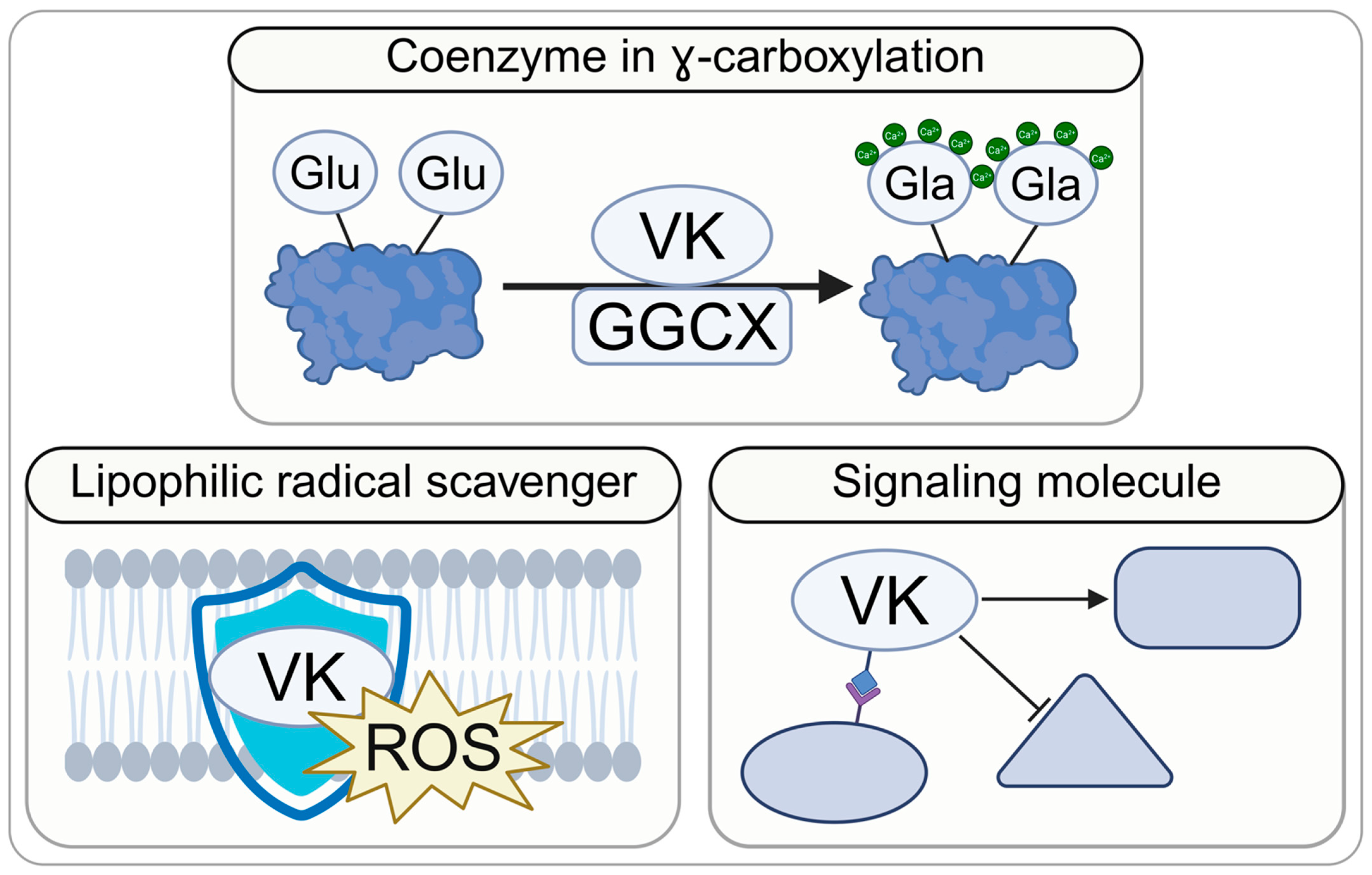


Disclaimer/Publisher’s Note: The statements, opinions and data contained in all publications are solely those of the individual author(s) and contributor(s) and not of MDPI and/or the editor(s). MDPI and/or the editor(s) disclaim responsibility for any injury to people or property resulting from any ideas, methods, instructions or products referred to in the content. |
© 2026 by the authors. Licensee MDPI, Basel, Switzerland. This article is an open access article distributed under the terms and conditions of the Creative Commons Attribution (CC BY) license.
Share and Cite
Matuszewski, W.; Madeksza, M.; Szklarz, M.; Rutkiewicz, A.; Rutkowska, J.; Harazny, J.M. Vitamin K as an Endocrine Modulator: Mechanistic Links to Glucose Metabolism and Beyond. Nutrients 2026, 18, 1183. https://doi.org/10.3390/nu18081183
Matuszewski W, Madeksza M, Szklarz M, Rutkiewicz A, Rutkowska J, Harazny JM. Vitamin K as an Endocrine Modulator: Mechanistic Links to Glucose Metabolism and Beyond. Nutrients. 2026; 18(8):1183. https://doi.org/10.3390/nu18081183
Chicago/Turabian StyleMatuszewski, Wojciech, Mikołaj Madeksza, Michał Szklarz, Aleksandra Rutkiewicz, Joanna Rutkowska, and Joanna Maria Harazny. 2026. "Vitamin K as an Endocrine Modulator: Mechanistic Links to Glucose Metabolism and Beyond" Nutrients 18, no. 8: 1183. https://doi.org/10.3390/nu18081183
APA StyleMatuszewski, W., Madeksza, M., Szklarz, M., Rutkiewicz, A., Rutkowska, J., & Harazny, J. M. (2026). Vitamin K as an Endocrine Modulator: Mechanistic Links to Glucose Metabolism and Beyond. Nutrients, 18(8), 1183. https://doi.org/10.3390/nu18081183