Article

Ketoanalogue-Supplemented Low-Protein Diet in Patients with Stage 4+ Chronic Kidney Disease in Italy: A Cost–Utility Analysis


1
Nephrologic Unit, Department of Advanced Medical and Surgical Sciences, Università della Campania Luigi Vanvitelli, 80138 Naples, Italy
2
Struttura Complessa di Nefrologia e Dialisi, Fondazione Casa Sollievo della Sofferenza, IRCCS, 71013 San Giovanni Rotondo, Italy
3
UOC Nefrologia e Dialisi, Ospedale VITO FAZZI, 73100 Lecce, Italy
4
Nephrology, Dialysis and Transplantation Unit, Department of Medical and Surgical Sciences, University of Foggia, 71122 Foggia, Italy
5
AdRes, 10155 Turin, Italy
6
Unit of Nephrology, Dialysis and Transplantation, Department of Precision and Regenerative Medicine and Ionian Area (DiMePRe-J), University of Bari “Aldo Moro”, 70124 Bari, Italy
*
Author to whom correspondence should be addressed.
Nutrients 2026, 18(7), 1142; https://doi.org/10.3390/nu18071142
Submission received: 18 February 2026 / Revised: 18 March 2026 / Accepted: 31 March 2026 / Published: 2 April 2026
(This article belongs to the Special Issue Protein Intake and Kidney Disease)

Abstract

Background/Objectives: Chronic kidney disease (CKD) is associated with substantial clinical and economic burden, largely driven by progression to dialysis. Nutritional interventions have shown potential in delaying disease progression, yet evidence on their cost-effectiveness remains limited. This study evaluated the long-term cost–utility profile of a low-protein diet supplemented with ketoanalogues (s-LPD) versus a standard low-protein diet (LPD) in patients with stage 4+ CKD from both the Italian National Health System (NHS) and societal perspectives. Methods: A Markov model with monthly cycles simulated disease progression from pre-dialysis to dialysis or death. Clinical inputs were derived from the published literature, while costs reflected 2024 Italian tariffs. Three effectiveness scenarios (optimistic, conservative, and pessimistic) were explored to account for uncertainty in the treatment effect. Outcomes included costs, life-years, quality-adjusted life-years (QALYs), and incremental cost–utility ratios. Deterministic and probabilistic sensitivity analyses assessed model robustness. Results: Across all scenarios, s-LPD improved survival (up to +0.59 life-years), increased QALYs (up to +0.48), and delayed dialysis initiation (up to +2.88 years) compared with LPD. From the NHS perspective, s-LPD was dominant in the optimistic scenario and cost-effective in both conservative and pessimistic scenarios, with cost savings or only a marginal cost that increases under extreme assumptions. Probabilistic sensitivity analyses confirmed a high probability of cost-effectiveness across scenarios. Results remained robust in additional scenario analyses, including the societal perspective. Conclusions: This first Italian cost–utility analysis of s-LPD highlights that s-LPD is a cost-effective strategy for patients with advanced CKD, offering clinically meaningful benefits while reducing or containing healthcare costs. These findings support the adoption of s-LPD as part of conservative management strategies aimed at safely delaying dialysis initiation.

1. Introduction

With the rising incidence of kidney failure, chronic kidney disease (CKD) has become the fifth leading cause of death in the World, and its prevalence is predicted to grow by 2040 [1,2,3]. CKD progression imposes substantial economic costs on the healthcare system, largely driven by dialysis treatment in patients who progress to kidney failure [2,4]. The disease burden also derails the quality of life (QoL) of patients, their relatives, and caregivers [3,5]. Thus, measures that delay CKD advancement do benefit patients, as well as the healthcare system and society with regard to CKD-related spending [5].
Over the years, a substantial number of CKD patients have been treated by a low-protein diet (LPD) due to the kidneys’ inability to metabolize protein, which causes toxin build-up in the blood as a result of low glomerular filtration rate (GFR) and increased uremic concentration [4,6]. A very-low-protein diet (VLPD: 0.3–0.4 g/kg/day), with or without ketoanalogues (KAs), has also been proposed for patients with more severe disease [7,8]. However, VLPD may be difficult to sustain in clinical practice, particularly in older CKD patients who have demonstrated low adherence to the regimen by failing to meet their daily protein intake, exposing themselves to malnutrition and sarcopenia [7,8,9].
Today, the Kidney Disease Outcome Quality Initiative (KDOQI) Clinical Practice Guideline for Nutrition in CKD suggests that metabolically stable CKD patients (stages 3–5) not on dialysis be kept on a low-protein diet (LPD: 0.6–0.8 g/kg/day) that will ensure sufficient intake of daily protein without compromising kidney function [7]. These recommendations are aimed at delaying renal failure, reducing mortality, and improving QoL. To achieve even better protein intake and outcomes, a KA-supplemented LPD (s-LPD) is considered. Indeed, KAs do not contain nitrogenous compounds, allowing for their conversion into essential amino acids that support protein synthesis, ensuring protein requirements are met without excreting toxic nitrogen waste into the blood [10]. The most recent Kidney Disease Improving Global Outcomes (KDIGO) Clinical Practice Guidelines also support LPD with targeted supplementation [11].
Several studies have established the clinical impact of s-LPD on pre-dialysis CKD patients. A 2018 randomized controlled trial (RCT) on non-diabetic CKD patients (stage 3b–4) followed for 14 months showed that s-LPD (LPD: 0.6 g/kg/day; KA: 1 tablet/5 kg/day) corrected the fibroblast growth factor 23 (FGF-23) and serum Klotho, which are vital in regulating mineral metabolism to inhibit cardiovascular risk and kidney dysfunction in patients [12]. In another 2024 uncontrolled interventional study, diabetic kidney disease (DKD) patients on s-LPD (LPD: 0.6 g/kg/day; KA: 1 tablet/10 kg/day) demonstrated a 3- and 5-times reduction from baseline in proteinuria and eGFR, respectively, delaying dialysis initiation [13]. Two observational studies on CKD stage 4 patients have also shown the effects of s-LPD, with one study [14] (LPD: 0.6 g/kg/day + KA) demonstrating a 6.8% decline in new cases of end-stage kidney disease (ESKD) needing dialysis initiation, and the other study [15] (LPD: 0.6–0.8 g/kg/day + KA) reported a significantly lower risk of kidney dysfunction (hazard ratio [HR]: 0.13; 95% confidence interval [CI]: 0.09–0.19; p < 0.001) and dialysis initiation (HR: 0.24; 95% CI: 0.12–0.49; p < 0.001). Similarly, a recent s-LPD meta-analysis revealed a significant delay in CKD progression (p = 0.008), particularly in patients with an eGFR > 18 mL/min/1.73 m2 (p < 0.0001) [16]. The meta-analysis further highlighted no difference in the eGFR of CKD patients on supplemented very LPD (s-VLPD) and s-LPD (p = 0.10).
Finally, regarding nutritional status, a recent 2025 cohort study that analyzed 21 elderly patients (90+ years) who were prescribed an s-LPD (LPD: 0.6 g/kg/day; KA: 1 tablet/10 kg/day) as a conservative treatment and followed for 12 months reported no change in the nutritional status of their well-nourished (Subjective Global Assessment score A) patients from baseline, aside from the positive impact on kidney preservation [9].
Previous analyses showed that s-VLPD is a cost-effective alternative to LPD in CKD stage 4+ patients in Italy, Thailand, and Taiwan [17,18,19]. However, evidence on the economic value of s-LPD remains limited. Therefore, this study aimed to evaluate the long-term clinical and economic consequences of supplementing a low-protein diet with ketoanalogues. We conducted a cost–utility analysis comparing KA-supplemented LPD with standard LPD in patients with CKD stage 4+ in Italy.

2. Materials and Methods

A Markov model, previously developed to simulate the disease evolution of patients treated with s-VLPD [17], was adapted for the present analysis. The model was updated to evaluate the clinical and cost effects of s-LPD compared with standard LPD given to stage 4+ CKD patients in Italy. LPD was defined as 0.6 g protein/kg ideal body weight/day, while for KA supplementation, a posology of 1 tablet/10 kg ideal body weight/day was assumed according to the study of Piccoli et al. [20]. The monthly cycle model simulated patients at the pre-dialysis phase (estimated glomerular filtration rate—eGFR: <30 mL/min/1.73 m2), modeling their outcomes as they advanced to different health states (stayed in pre-dialysis, moved to dialysis, or died). Transition probabilities and costs differed between treatment strategies, while the model structure remained the same as previously described [17].
The analysis was developed from the Italian National Health System (NHS) perspective, accounting for the direct cost of medication, dietary monitoring, and dialysis. A recommended 3% discounting rate was used to model future costs and health outcomes [21]. As scenario analysis, the societal perspective was also considered, by including the indirect costs incurred during illness (productivity loss and the cost of caregivers).
The two alternatives were compared by calculating the incremental cost–utility ratio (ICUR), defined as the ratio between incremental cost (difference between total cost in the s-LPD arm and the total cost in the LPD arm) and the incremental quality of life (difference between total quality-adjusted life years [QALY] in the s-LPD arm and the total QALY in the LPD arm).

2.1. Patient Baseline Characteristics

Baseline age and sex reflected the values observed in a cohort of approximately 100,000 CKD patients identified in Italy’s Lazio Region [22]. About 56% of the population evaluated were males, with a mean age of 70 years, whereas the remainder were females with a mean age of 72 years. The average weight input was 74.5 kg, derived from Martino 2024 [8].

2.2. Clinical Input

The annual progression from pre-dialysis to dialysis, in patients treated with LPD, was estimated at 24.42% (2.31% monthly) from Garneata 2019 [23]. This value was derived from the 93% cumulative incidence of renal replacement therapy (RRT) over a median follow-up of 114 months reported in the study, assuming a constant hazard over time. For both strategies, the annual mortality risk in pre-dialysis was taken from a prospective study that enrolled 449 patients who followed a moderately restricted LPD in 2007–2015 in the Nephrology Unit of the San Luigi Hospital of Turin [20]. Over a total of 847 person-years of observation, 100 deaths were observed, corresponding to an annual mortality risk of 11.1% (0.98% monthly). The progression from dialysis to death was estimated at 13.8%, resulting from an Italian retrospective observational study from 2008 to 2014 at the Nephrology Unit of Santa Chiara Hospital in Trento, which enrolled 487 patients followed until September 2015 [24].
The treatment effect of s-LPD in delaying dialysis onset was estimated using the adjusted findings (to lower the risk of bias) of two observational studies that explored the impact of LPD supplemented with KA in postponing dialysis. Ariyanopparut 2023 [15] reported a 76% (hazard ratio [HR]: 0.24; 95% confidence interval [CI]: 0.12–0.49) reduction in the risk of dialysis after a median follow-up of 32.9 months. On the other hand, Yen 2022 [14] demonstrated a 38% (HR: 0.62; 95% CI: 0.41–0.94) reduction in the risk of dialysis in year one of treatment. However, the benefit observed in the first year decreased in the long term over the total follow-up of 12 years (HR: 0.91; 95% CI: 0.72–1.14).
Due to the slight inconsistency between the two observational studies, three scenario analyses were performed to confirm the possible benefit despite the selected source of effectiveness. An optimistic scenario was developed using the findings of Ariyanopparut 2023 [15] (HR = 0.24). For the conservative scenario, the HR estimates of Yen 2022 [14] were used (HR = 0.62 in the first 12 months, and HR = 0.91 in the whole follow-up period for the rest of the simulation). The pessimistic scenario was estimated using the same source in the first 12 months (HR = 0.62) and thereafter, no benefit of KA was assumed (i.e., HR was set equal to 1).

2.3. Utilities

Specific utility scores were assigned to different health states. Based on the review performed in the previous analysis [17], of the four studies deemed suitable, the utility values of Wyld 2012 [25] were picked as references for the base case since it had utility scores for all the dialysis modes.

2.4. Cost Inputs

According to the Italian NHS perspective, only direct healthcare costs were considered in the analysis: drug supplementation (KA and others), dietary monitoring, and dialysis; these costs were sourced from locally available data (2024 ex-factory prices) [26]. The cost of KA (€40.23 per 100-tablet box of Ketosteril) was determined considering a posology of 1 tablet/10 kg of body weight/day derived from Piccoli 2016 [20]. Additional supplements considered were sodium bicarbonate (€39 per 1000-tablet box), vitamin D (€6.32 per 4-tablet box), and calcium (€4.52 per 30-tablet box). Posology and proportion of patients taking each supplementation reflected what was observed in the Garneata [23] trial: sodium bicarbonate in 51% of patients (6.4 tabs/day), vitamin D in 54% (1 tab/week), and calcium in 50% (6.9 tabs/day), for both strategies. Erythropoietin supplementation was not included in the analysis as not reported in the Garneata [23] trial. Diet monitoring cost (€22 per consultation), assumed every two months for each strategy, was estimated from the 2024 Italian outpatient services tariff. For dialysis, the cost per session was estimated by type: hemodialysis (HD) €159.31, continuous ambulatory peritoneal dialysis (CAPD) €55.83, and automatic peritoneal dialysis (APD) €68.25, including yearly catheter maintenance cost (€46.20) and the one-off cost for catheter placement (€179.60) only for peritoneal dialysis (PD) patients. Costs were sourced from the 2024 Italian outpatient services tariff [27]. Using the 2019 Italian census findings of Neri 2022 [28], the proportion of patients on HD and PD was estimated at 83.8% and 16.2% (CAPD 7.7% and APD 8.5%), respectively.

2.5. Sensitivity Analyses

A deterministic sensitivity analysis (DSA) was performed to assess the effect of uncertainty in input variables on the outcomes. All variables were varied one at a time while keeping the rest constant. The variation for the costs and dialysis parameters was ±20% of the reference case. The clinical effectiveness and quality of life (QoL) measures were confined within their 95% CIs. The cost-effectiveness was determined by the incremental net monetary benefit (INMB), calculated as the incremental QALYs (QALYs-LPD − QALYLPD) multiplied by a pre-specified willingness-to-pay (WTP) threshold, minus the incremental costs (Costs-LPD − CostLPD). The WTP threshold was assumed equal to €33,000 per QALY as the average ICUR estimated in a recent publication based on 48 positive company submissions to the Italian Medicines Agency (AIFA) [29]. The DSA findings are shown on a tornado diagram, with the large bars at the top representing parameters that contribute the most to the variability of the outcome, hence the point of focus for decision makers.
A probabilistic sensitivity analysis (PSA) was also performed to ascertain the confidence in the findings despite the uncertainty in the input parameters. Samples of input parameters were randomly selected from predetermined distributions used to run the model a thousand times. The results are assessed on a cost-effectiveness plane to get the distribution of outcomes.

2.6. Scenario Analyses

Scenario analyses were carried out (for optimistic, conservative and pessimistic scenarios) for the mortality in dialysis, the long-term benefit of KA on mortality, mortality correction for population aging, dialysis starting rule, and the societal perspective.
For mortality in dialysis, an alternative scenario considered 0.290 cases per person-year (annual mortality risk of 25.2%) estimated using the average between the HR = 2.6 for mortality of patients on HD versus those not on dialysis (stage 4+ CKD), and HR = 1.7 for mortality of patients on PD versus those not on dialysis (stage 4+ CKD), which are from findings of a Swedish study [30] conducted on 3040 stage 4+ CKD, 1791 HD, and 725 PD patients.
A long-term benefit of KA on mortality was simulated based on the results of a retrospective study [31] conducted from 2001 to 2013 on patients who received more than 3 months of LPD supplemented with KA in the year preceding the start of dialysis. The study found an all-cause mortality reduction (HR: 0.77, 95% CI: 0.70–0.84) among supplemented patients compared with those on LPD. The evidence of a possible long-term survival benefit of s-LPD is limited and conflicting, but according to the same authors, the benefit expressed seems plausible. Since the mean follow-up was 3.1 years (up to 14 years), the scenario analysis assumed the mortality reduction lasted until death.
The mortality correction for population aging was not performed on mortality in the base case, since the mean age of the modeled cohort was 71 years. However, in the scenario analysis, mortality in each health state was adjusted by a relative risk function depending on the age of patients at each cycle of simulation, estimated from the general population mortality in Italy [32].
The societal perspective was accomplished as an alternative scenario, different from the base case, to account for the indirect costs incurred by the patients and their caregivers due to illness. The cost of the time lost on dialysis was determined by multiplying the monthly paid and unpaid work (household, volunteering, and caring) distributed according to gender and age [33] with the proportion of weekly time lost for each dialysis type: 50% for HD, 30% for CAPD, and 20% for APD, as stated by expert opinion. Caregiver expenses were assigned following the past month’s paid and unpaid work, considering that 63.3% of the caregivers were employed [34], 58% were male, and the mean age was 51.7 years [35]. For each dialysis type, 24.5% of the patients were estimated to require care which would take 2 (PD—assumed to require less support since it is done at night) to 12 (HD—assumed that patients would require 3 hospital visits each week) hours weekly, values obtained from Neri 2022 [28], who reported for PD, and the same value was assumed for HD.
All input data are available in Table A1, Appendix A.

3. Results

3.1. Cost-Effectiveness Results

In the base case analyses, the optimistic, conservative, and pessimistic scenarios showed that s-LPD led to +0.59, +0.07, and +0.05 enhanced years of survival; +0.48, +0.07, and +0.04 improved QALYs; and approximately €41,000, €3200, and €1200 cost savings, respectively, declaring the treatment dominant over LPD as displayed in Table 1. In addition, s-LPD contributed to +2.88 (optimistic), +0.36 (conservative), and +0.23 (pessimistic) years of delayed dialysis start, offering both clinical and economic benefits over the comparator.
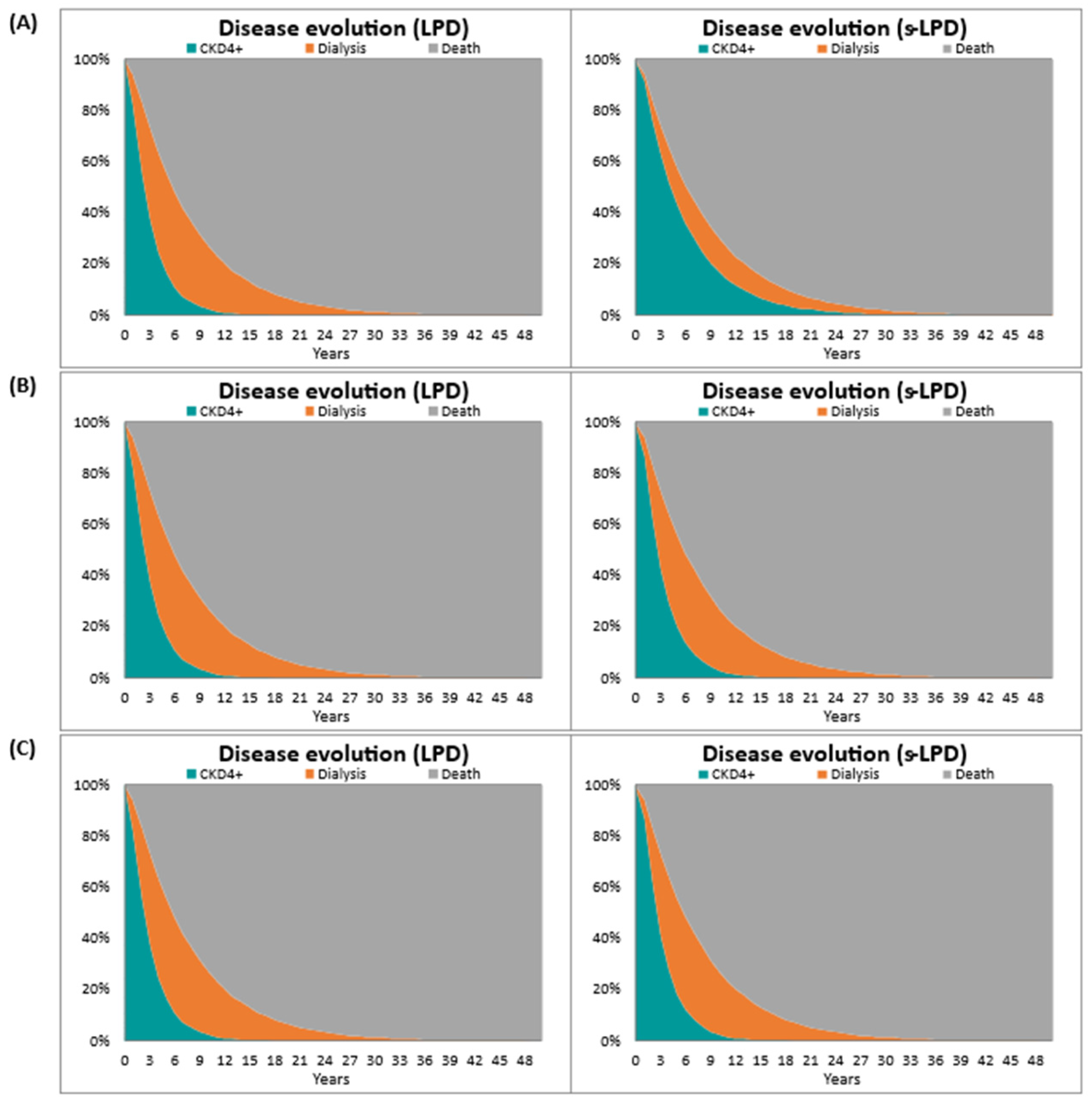
Results of the CKD evolution are shown in Figure A1, Appendix A.

3.2. Deterministic Sensitivity Analyses

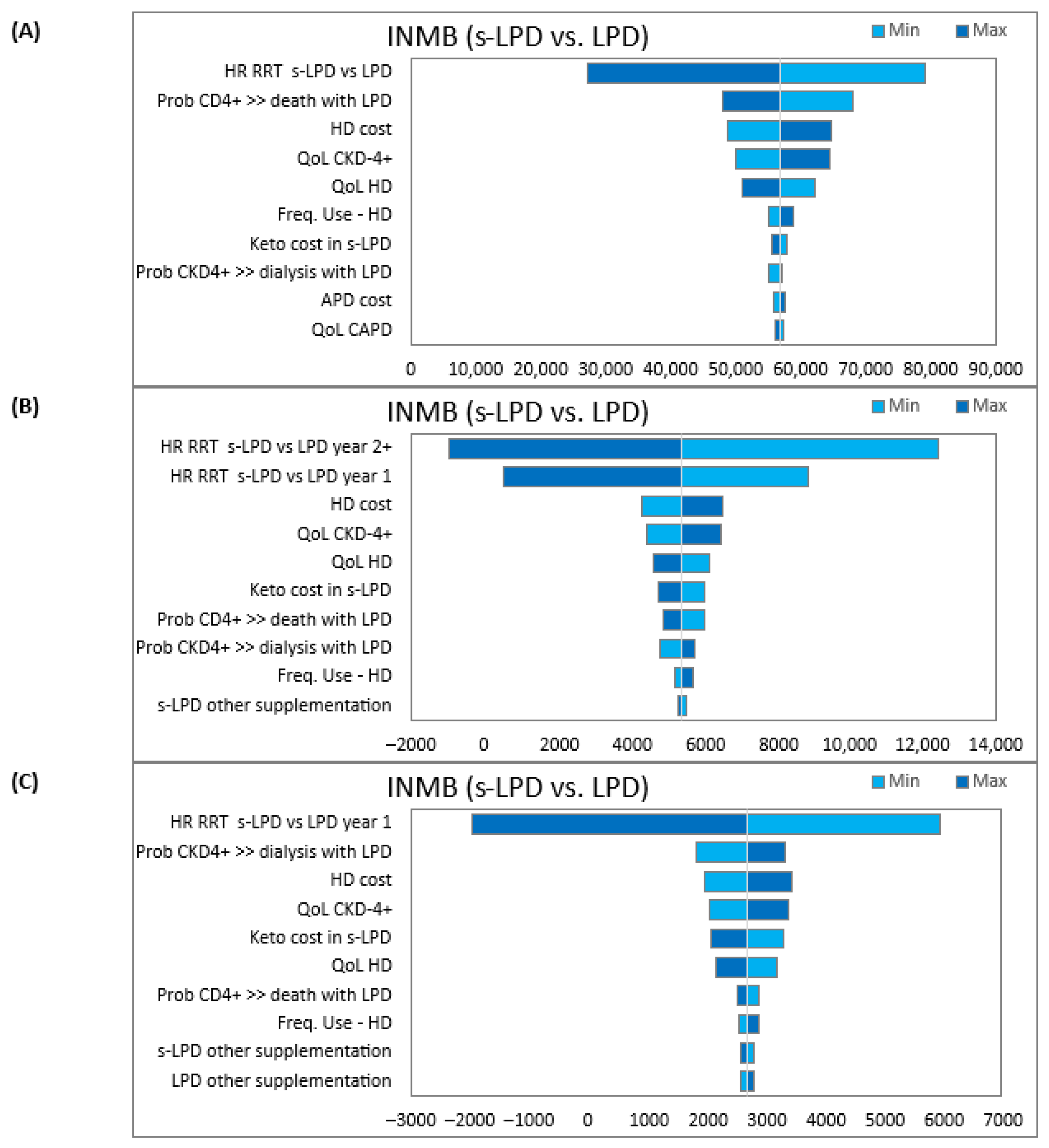
In the optimistic scenario, despite applying the most conservative estimates, s-LPD emerged dominant in all simulations (positive INMB), demonstrating cost-effectiveness over LPD (Figure 1A).
For the conservative scenario, the s-LPD strategy was cost-effective for many parameters (Figure 1B). For an extremely high HR of starting dialysis (for subsequent years), the INMB is negative, indicating that s-LPD is not a cost-effective strategy with respect to LPD. However, in this case, s-LPD is also more effective than LPD, with a lifetime cost increase of less than €1500.
The pessimistic scenario exhibited positive INMB for almost all its variables, implying s-LPD’s cost-effectiveness over LPD (Figure 1C). For an extremely high HR of starting dialysis (in year 1), the INMB is negative, indicating that s-LPD is not a cost-effective strategy with respect to LPD. However, in this case, s-LPD is also more effective than LPD with a lifetime cost increase of less than €2200.

3.3. Probabilistic Sensitivity Analysis

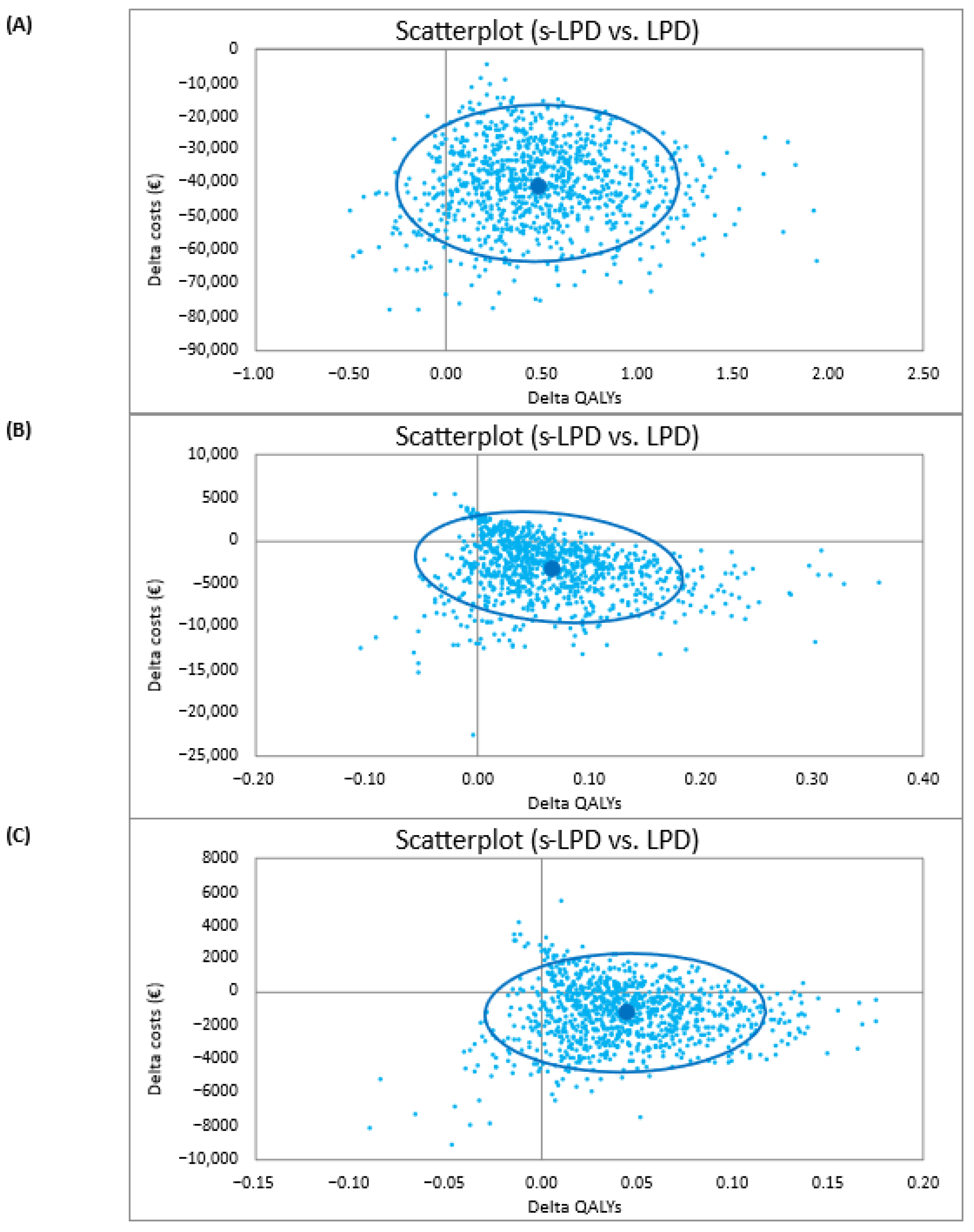
The PSA findings (shown on scatterplots for 1000 simulations) for the optimistic, conservative, and pessimistic scenarios confirmed the conclusions of the reference case.
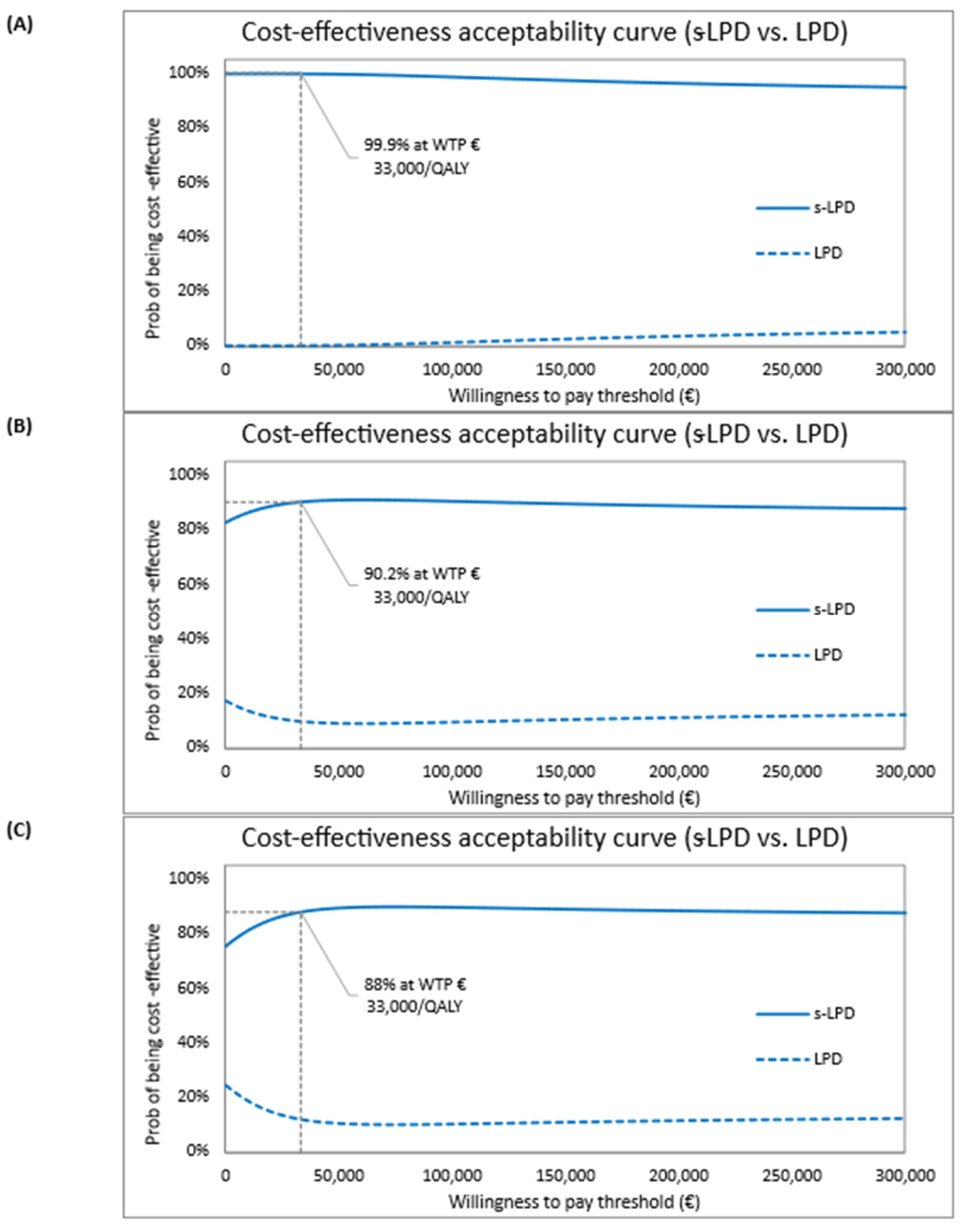
Figure 2A shows the optimistic scenario results, indicating that s-LPD amassed €16,000 to €65,000 savings with a QALY gain of −0.26 to 1.21. The ellipse defines nearly a quarter of the area of dominance as 95% probability that CUA is ‘true’. Likewise, the cost-effectiveness acceptability curve (CEAC) shows that s-LPD has almost 100% probability of being cost-effective compared with LPD (Figure 3A).
Figure 2B illustrates the conservative scenario, which shows that s-LPD led to cost savings of −€9400 to €3400 with a QALY gain of 0.06 to 0.19. The ellipse outlines that 95% probability that CUA is ‘true’ falls mostly in the south-eastern area of dominance. The CEAC also confirms that s-LPD has more than 90% probability of being cost-effective compared to LPD (Figure 3B).
Figure 2C displays the pessimistic scenario, which designates −€4800 to €2300 savings with KA use, and a QALY gain of −0.03 to 0.11. In the ellipse, the 95% probability that CUA is ‘true’ falls almost entirely in the north-eastern quadrant of cost-effectiveness and the south-eastern quadrant of dominance. Equally, the CEAC shows that s-LPD has up to 88% probability of demonstrating cost-effectiveness when compared with LPD (Figure 3C).

3.4. Further Scenario Analyses

s-LPD was dominant or cost-effective compared to LPD in all scenario analyses in the optimistic, conservative, and pessimistic settings (Table 2).

4. Discussion

This analysis investigated the cost-effectiveness of s-LPD vs. LPD among stage 4+ CKD patients in Italy, evaluating for the first time three scenarios (optimistic, conservative, and pessimistic) in the NHS and societal perspectives in Italy. In the absence of large, long-term randomized trials directly comparing s-LPD and LPD, observational evidence currently represents the best available source. Extensive scenario analyses were therefore designed to bracket plausible effect sizes.
The main findings are that s-LPD versus the comparator improved survival and quality of life, delayed dialysis initiation, and reduced the economic impact according to both NHS and societal perspectives.
The sensitivity analyses (DSA and PSA) confirmed the dominance of s-LPD versus LPD in the optimistic scenario, generating savings despite the study using extremely conservative values. For the conservative and pessimistic scenarios, s-LPD was cost-effective for almost all parameters with a negligible increase in lifetime costs only for extremely (maybe unrealistic) values of HR.
Further scenario analyses, including the societal perspective, also established the clinical and cost effectiveness of s-LPD versus LPD.
In general, the present study highlights the potential of s-LPD in terms of clinical and cost benefits. The s-LPD demonstrated the ability to delay the start of dialysis (range: +0.23 to +2.88 years), improve QALYs (range: +0.04 to +0.48), and extend survival (range: +0.05 to +0.59 years). Although s-LPD incurred higher costs for therapy and diet monitoring, these expenses were offset by savings on dialysis in all scenarios. Moreover, the cost-effectiveness profile of s-LPD was qualitatively comparable to that estimated for s-VLPD in the previous analysis [17], suggesting that in more fragile patients or in those unlikely to adhere to a VLPD, an s-LPD strategy may provide similar benefits.
A key strength of the present analysis lies in the comprehensive exploration of uncertainty surrounding the effectiveness of s-LPD through the evaluation of three distinct scenarios—optimistic, conservative, and pessimistic—reflecting a wide range of plausible real-world outcomes. This approach was specifically designed to address the limitations inherent to the available observational evidence and to avoid over-reliance on a single set of assumptions. Notably, across all three scenarios, s-LPD consistently emerged as a cost-effective strategy compared with standard LPD, demonstrating the robustness of the findings even under highly conservative or unfavorable assumptions. This consistency substantially strengthens the credibility and generalizability of the results, supporting the conclusion that s-LPD represents a valuable intervention in advanced CKD irrespective of the magnitude of its clinical benefit. Furthermore, to the best of our knowledge, this study represents the first cost–utility analysis conducted in Italy to specifically assess the long-term clinical and economic impact of s-LPD in stage 4+ CKD patients. By integrating locally relevant cost data with international clinical evidence, the analysis provides novel and context-specific insights for Italian healthcare decision-makers, filling an important gap in the current health economic literature on nutritional interventions in advanced CKD.
The current study findings align with those reported in other settings, including Kazakhstan, Taiwan, and Hungary, which confirmed improved QALYs and savings with s-LPD versus LPD [19,39,40]. The results also indicate the supplement’s potential to delay dialysis in stage 4+ CKD patients, a verdict supported by Chang et al. [41,42], who both concluded that s-LPD delayed CKD progression without affecting the nutritional status of patients. Wu et al. further admitted that an appropriate KA dosage may lessen the risks of ESKD and mortality in anemic advanced CKD patients by slowing the progression of the disease [43]. A 2024 meta-analysis on stage 3–5 CKD patients established the supplement’s ability to postpone dialysis, improve GFR and calcium–phosphate homeostasis without impacting nutritional status and survival [44]. Additionally, Annunziata et al. [9] elaborated that s-LPD was a safe and effective conservative therapy for older patients aged 90+ years with advanced CKD, based on the reduced risk of renal death and kidney failure, improved GFR and azotemia with no influence on the nutritional status. These outcomes, together, reflect the role s-LPD plays in the healthcare system to improve the clinical and economic impact, leading to the sustained well-being of patients. Finally, a recent meta-analysis by Bellizzi et al. [45] has suggested that supplementation of LPD or VLPD with KA may confer renal, metabolic, and nutritional benefits in patients with diabetic kidney disease. Nevertheless, the clinical impact of s-VLPD appears to be influenced by adherence to dietary prescription. Indeed, while substantial benefits of s-VLPD have been demonstrated in the previous randomized trial by Garneata et al. [46], similar effects were not observed in a subsequent long-term pragmatic trial conducted in a broader CKD population [47], in which adherence to both LPD and VLPD was suboptimal (0.83 and 0.6 g/kg/d, respectively). In this context, s-VLPD was safe but did not result in additional benefits compared with a standard LPD, underscoring dietary adherence as a key determinant of its effectiveness in clinical practice.
Nevertheless, some limitations should be considered when interpreting the findings of our study. First, the value used to estimate the mortality of pre-dialysis stage 4+ CKD patients was from an observational study conducted in Italy’s Nephrology Unit of San Luigi Hospital in Turin between 2007 and 2015. The patients studied followed a moderately restricted LPD; not all were at stage 4+. At baseline, the patients’ eGFR was 20 mL/min/1.73 m2, with the mortality rate of those with eGFR <15 or <10 mL/min/1.73 m2 slightly over that of the entire patient base. All in all, the results show that s-LPD can mitigate disease evolution among patients with more progressed CKD without increasing the mortality risk.
Second, the absence of local clinical data should be considered a limitation. Dialysis onset in LPD patients was estimated using the results of a 15-month RCT (follow-up of 120 months) conducted in a Romanian nephrology center [13]. The population studied was assumed to reflect the Italian situation.
Last, the direct costs (NHS perspective) were largely related to medication, including KA and other supplements (sodium bicarbonate, vitamin D, and calcium), diet monitoring, and dialysis. Indirect costs (societal perspective) accounted for the patient’s productivity loss, transportation, dialysis-related complications, medical supplies, home changes, and caregiver expenses, leaving out unquantifiable aspects. A comprehensive approach to include all costs will shed more light on the cost-effectiveness of s-LPD, demonstrating its capability to lessen costs and the practical burden on patients and their relatives.
Overall, the adoption of healthcare policies for safely delaying dialysis initiation is essential to mitigate the rising prevalence of ESKD and substantially reduce associated costs for patients and the healthcare system.

5. Conclusions

This study supports the utility of s-LPD in improving clinical and economic outcomes. The 1000 simulation models, using locally available cost data and clinical data from the available literature, suggest the dominance of s-LPD over LPD, and its ability to provide enhanced clinical outcomes at low cost.

Author Contributions

Conceptualization, M.P.; methodology, M.P.; software, M.P.; validation, L.D.N., F.A., A.D.P., G.S., R.G., C.R., M.S.R., D.T. and L.G.; formal analysis, M.P.; writing—original draft preparation, L.A.O.; writing—review and editing, all the authors; visualization, M.P.; supervision, L.D.N. and L.G. All authors have read and agreed to the published version of the manuscript.

Funding

This research was funded by an unrestricted grant from Fresenius Kabi.

Institutional Review Board Statement

Not applicable.

Informed Consent Statement

Not applicable.

Data Availability Statement

All data generated or analyzed during this study are included in this published article.

Conflicts of Interest

Massimiliano Povero and Linet A. Odonde are employees of AdRes who received project funding from Fresenius Kabi. All other authors declare no conflicts of interest outside the sponsorship related to this manuscript.

Abbreviations

The following abbreviations are used in this manuscript:
AIFAItalian Medicine Agency
APDAutomatic peritoneal dialysis
CAPDContinuous ambulatory peritoneal dialysis
CEACCost-effectiveness acceptability curve
CIConfidence interval
CKDChronic kidney disease
CUACost–utility analysis
DKDDiabetic kidney disease
DSADeterministic sensitivity analysis
eGFREstimated glomerular filtration rate
ESKDEnd-stage kidney disease
FGFFibroblast growth factor
GFRGlomerular filtration rate
HDHemodialysis
HRHazard ratio
ICURIncremental cost–utility ratio
INMBIncremental net monetary benefit
KAKetoanalogue
KDIGOKidney Disease Improving Global Outcomes
KDOQIKidney Disease Outcome Quality Initiative
LPDLow-protein diet
NHSNational Health System
PDPeritoneal dialysis
PSAProbabilistic sensitivity analysis
QALYQuality-adjusted life-years
QoLQuality of life
RCTRandomized controlled trials
s-LPDLow-protein diet supplemented with ketoanalogues
VLPDVery-low-protein diet
WTPWillingness to pay

Appendix A

Table A1. Model variable inputs.
VariableBase ValueSE/95% CIDistribution Used in PSASource
Baseline characteristics
Age (years)70.9SE = 10% of meanNormal[22]
Gender (% female)44.2%SE = 10% of meanNormal *[22]
Weight (kg)74.5SE = 10% of meanNormal[8]
Clinical input
HD freq. of use (HD over HD + PD)83.8%SE = 10% of meanNormal *[28]
PD freq. of use (PD over HD + PD)=1 − HD freq.use
CAPD freq. of use (CAPD over CAPD + APD)47.3%SE = 10% of meanNormal *[28]
APD freq. of use (APD over APD + CAPD)=1 − CAPD freq.use
Annual dialysis onset (LPD)24.4%SE = 10% of meanNormal *[23]
Annual mortality pre-dialysis11.1%SE = 10% of meanNormal *[20]
Annual mortality in dialysis13.8%SE = 10% of meanNormal *[24]
HR dialysis onset: optimistic scenario (s-LPD vs. LPD)0.240.12 to 0.49Lognormal[15]
HR dialysis onset: yr1 conservative scenario (s-LPD vs. LPD)0.620.41 to 0.94Lognormal[14]
HR dialysis onset: yr2+ conservative scenario (s-LPD vs. LPD)0.910.72 to 1.14Lognormal[14]
HR dialysis onset: yr1 pessimistic scenario (s-LPD vs. LPD)0.620.41 to 0.94Lognormal[14]
HR dialysis onset: yr2+ pessimistic scenario (s-LPD vs. LPD)0.910.72 to 1.14Lognormal[14]
Utility
QoL CKD stage 4+0.7900.70 to 0.89Normal[25]
QoL HD0.6900.59 to 0.80Normal[25]
QoL CAPD0.7200.60 to 0.85Normal[25]
QoL APD0.8000.69 to 0.91Normal[25]
Cost input
KA (monthly cost)€97.96SE = 10% of meanNormal[26]
Other supplementation (monthly cost)€19.53SE = 10% of meanNormal[26]
Diet monitoring (monthly cost)€11.00SE = 10% of meanNormal[27]
HD (cost per session)€159.31SE = 10% of meanNormal[27]
CAPD (cost per session) **€55.83SE = 10% of meanNormal[27]
APD (cost per session) **€68.25SE = 10% of meanNormal[27]
Catheter placement (one-time cost)€179.60SE = 10% of meanNormal[27]
Productivity lost (65+ years)€484.12SE = 10% of meanNormal[33]
Caregiver expenses€605.49SE = 10% of meanNormal[33]
Abbreviations: APD, automatic peritoneal dialysis; CAPD, continuous ambulatory peritoneal dialysis; CI, confidence interval; CKD, chronic kidney disease; HD, hemodialysis; HR, hazard ratio; PD, peritoneal dialysis; PSA, probabilistic sensitivity analysis; QoL, quality of life; LPD, low-protein diet; s-LPD, supplemented low-protein diet; SE, standard error; freq., frequency, %, percentage; KA, ketoanalogue; yr, year. Notes: * In the PSA, the proportion p was normalized using the logit transformation, i.e., logit(p) = log(p/(1 − p)) and then the values of logit(p) were sampled from a normal distribution; sampled values were then re-converted into probabilities using the inverse sigmoid function s(x) = exp(x)/(1 + exp(x)). ** Annual catheter maintenance added to the tariff.
Figure A1. Disease evolution in patients treated with LPD and s-LPD: (A) Optimistic scenario; (B) conservative scenario; (C) pessimistic scenario. Abbreviations: s-LPD, supplemented low-protein diet; LPD, low-protein diet.
Nutrients 18 01142 g0a1

References

  1. Borg, R.; Carlson, N.; Søndergaard, J.; Persson, F. The Growing Challenge of Chronic Kidney Disease: An Overview of Current Knowledge. Int. J. Nephrol. 2023, 2023, 9609266. [Google Scholar] [CrossRef]
  2. Freeman, C.; Giles, L.; Field, P.; Sörstadius, E.; van Haalen, H. Humanistic burden and economic impact of chronic kidney disease: A systematic literature review. F1000Research 2019, 8, 2142. [Google Scholar] [CrossRef]
  3. Tonelli, M.; Nkunu, V.; Varghese, C.; Abu-Alfa, A.K.; Alrukhaimi, M.N.; Bernieh, B.; Fox, L.; Gill, J.; Harris, D.C.; Hou, F.F.; et al. Framework for establishing integrated kidney care programs in low- and middle-income countries. Kidney Int. Suppl. 2020, 10, e19–e23. [Google Scholar] [CrossRef]
  4. Kovesdy, C.P. Epidemiology of chronic kidney disease: An update 2022. Kidney Int. Suppl. 2022, 12, 7–11. [Google Scholar] [CrossRef]
  5. Elshahat, S.; Cockwell, P.; Maxwell, A.P.; Griffin, M.; O’Brien, T.; O’Neill, C. The impact of chronic kidney disease on developed countries from a health economics perspective: A systematic scoping review. PLoS ONE 2020, 15, e0230512. [Google Scholar] [CrossRef]
  6. Kalantar-Zadeh, K.; Fouque, D. Nutritional Management of Chronic Kidney Disease. N. Engl. J. Med. 2017, 377, 1765–1776. [Google Scholar] [CrossRef]
  7. Ikizler, T.A.; Burrowes, J.D.; Byham-Gray, L.D.; Campbell, K.L.; Carrero, J.J.; Chan, W.; Fouque, D.; Friedman, A.N.; Ghaddar, S.; Goldstein-Fuchs, D.J.; et al. KDOQI Clinical Practice Guideline for Nutrition in CKD: 2020 Update. Am. J. Kidney Dis. Off. J. Natl. Kidney Found 2020, 76, S1–S107. [Google Scholar] [CrossRef]
  8. Martino, F.K.; Zattarin, A.; Cinquini, C.; Toniazzo, S.; Francini Pesenti, F.; Stefanelli, L.F.; Cacciapuoti, M.; Bettin, E.; Calò, L.A.; Spinella, P. Low-Protein Diet in Elderly Patients with Chronic Kidney Disease Stage 4 and 5 in Conservative Management: Focus on Sarcopenia Development. Nutrients 2024, 16, 1498. [Google Scholar] [CrossRef]
  9. Annunziata, G.; Marinelli, T.; Melfitano, A.; Aucella, F.; Nardella, M.; Camajani, E.; Muscogiuri, G.; Caprio, M.; Aucella, F.; Barrea, L. Effects of low protein diet supplemented with ketoanalogues on kidney function and nutritional outcomes in a nonagenarian population with advanced chronic kidney disease: A pilot study. Minerva Endocrinol. 2025, 50, 360–370. [Google Scholar] [CrossRef]
  10. Khan, I.A.; Nasiruddin, M.; Haque, S.F.; Khan, R.A. Comparative evaluation of efficacy and safety profile of rhubarb and α-keto analogs of essential amino acids supplementation in patients with diabetic nephropathy. Saudi J. Kidney Dis. Transplant. 2016, 27, 710–716. [Google Scholar] [CrossRef]
  11. KDIGO 2024 Clinical Practice Guideline for the Evaluation and Management of Chronic Kidney Disease. Available online: https://kdigo.org/wp-content/uploads/2024/03/KDIGO-2024-CKD-Guideline.pdf (accessed on 11 June 2025).
  12. Milovanova, L.; Fomin, V.; Moiseev, S.; Taranova, M.; Milovanov, Y.; Lysenko, L.; Kozlov, V.; Kozevnikova, E.; Milovanova, S.; Lebedeva, M.; et al. Effect of essential amino acid кetoanalogues and protein restriction diet on morphogenetic proteins (FGF-23 and Klotho) in 3b-4 stages chronic кidney disease patients: A randomized pilot study. Clin. Exp. Nephrol. 2018, 22, 1351–1359. [Google Scholar] [CrossRef]
  13. Garneata, L.; Mocanu, C.A.; Simionescu, T.P.; Mocanu, A.E.; Dragomir, D.R.; Mircescu, G. Low Protein Diet Reduces Proteinuria and Decline in Glomerular Filtration Rate in Advanced, Heavy Proteinuric Diabetic Kidney Disease. Nutrients 2024, 16, 1687. [Google Scholar] [CrossRef]
  14. Yen, C.L.; Fan, P.C.; Chen, J.J.; Kuo, G.; Hsiao, C.C.; Chen, C.Y.; Tu, Y.R.; Hsu, H.H.; Chen, Y.C.; Chang, C.H. Ketoanalogues Supplemental Low Protein Diet Safely Decreases Short-Term Risk of Dialysis among CKD Stage 4 Patients. Nutrients 2022, 14, 4020. [Google Scholar] [CrossRef]
  15. Ariyanopparut, S.; Metta, K.; Avihingsanon, Y.; Eiam-Ong, S.; Kittiskulnam, P. The role of a low protein diet supplemented with ketoanalogues on kidney progression in pre-dialysis chronic kidney disease patients. Sci. Rep. 2023, 13, 15459. [Google Scholar] [CrossRef]
  16. Li, A.; Lee, H.Y.; Lin, Y.C. The Effect of Ketoanalogues on Chronic Kidney Disease Deterioration: A Meta-Analysis. Nutrients 2019, 11, 957. [Google Scholar] [CrossRef]
  17. Povero, M.; Simion, T.; Pradelli, L. Cost-effectiveness of a ketoanalogue-supplemented very low-protein diet in CKD. Nephrol. Dial. Transplant. 2025, 40, 2372–2378. [Google Scholar] [CrossRef]
  18. Praditpornsilpa, K.; Garneata, L.; Lin, Y.C.; Povero, M.; Pradelli, L.; Susantitaphong, P.; Wu, C.H. Economic Analysis of a Ketoanalogue-Supplemented Very Low-Protein Diet in Patients with Chronic Kidney Disease in Taiwan and Thailand. J. Ren. Nutr. 2023, 33, 269–277. [Google Scholar] [CrossRef]
  19. You, J.H.S.; Ming, W.K.; Lin, W.A.; Tarn, Y.H. Early supplemented low-protein diet restriction for chronic kidney disease patients in Taiwan—A cost-effectiveness analysis. Clin. Nephrol. 2015, 84, 189–196. [Google Scholar] [CrossRef]
  20. Piccoli, G.B.; Nazha, M.; Capizzi, I.; Vigotti, F.N.; Mongilardi, E.; Bilocati, M.; Avagnina, P.; Versino, E. Patient Survival and Costs on Moderately Restricted Low-Protein Diets in Advanced CKD: Equivalent Survival at Lower Costs? Nutrients 2016, 8, 758. [Google Scholar] [CrossRef]
  21. Italian Medicine Agency. Guidelines for the Compilation of the Dossier to Support the Application for Reimbursement and Pricing of a Medicine. Available online: https://www.aifa.gov.it/documents/20142/1283800/Linee_guida_dossier_domanda_rimborsabilita.pdf (accessed on 10 December 2025).
  22. Marino, C.; Ferraro, P.M.; Bargagli, M.; Cascini, S.; Agabiti, N.; Gambaro, G.; Davoli, M. Prevalence of chronic kidney disease in the Lazio region, Italy: A classification algorithm based on health information systems. BMC Nephrol. 2020, 21, 23. [Google Scholar] [CrossRef]
  23. Garneata, L.; Mocanu, C.A.; Mocanu, A.E.; Simionescu, T.P.; Firta, A.M.; Jafal, M.; Mircescu, G. Fo012 Vegetarian Severe Hypoproteic Diet Supplemented with Keto-Analogues for Predialysis Chronic Kidney Disease Patients: The Influence on Long Term Prognosis. Nephrol. Dial. Transplant. 2019, 34, gfz096-FO012. [Google Scholar] [CrossRef]
  24. Rigoni, M.; Torri, E.; Nollo, G.; Zarantonello, D.; Laudon, A.; Sottini, L.; Guarrera, G.M.; Brunori, G. Survival and time-to-transplantation of peritoneal dialysis versus hemodialysis for end-stage renal disease patients: Competing-risks regression model in a single Italian center experience. J. Nephrol. 2017, 30, 441–447. [Google Scholar] [CrossRef] [PubMed]
  25. Wyld, M.; Morton, R.L.; Hayen, A.; Howard, K.; Webster, A.C. A systematic review and meta-analysis of utility-based quality of life in chronic kidney disease treatments. PLoS Med. 2012, 9, e1001307. [Google Scholar] [CrossRef] [PubMed]
  26. Codifa—L’Informatore Farmaceutico. Available online: https://www.codifa.it/ (accessed on 22 April 2024).
  27. Ministero della Salute. Definizione delle Tariffe Relative All’assistenza Specialistica Ambulatoriale e Protesica; Decreto 11/2024 pubblicato in GU Serie Generale n.302 del 27-12-2024; Ministero della Salute: Rome, Italy, 2024.
  28. Neri, L.; Viglino, G.; Vizzardi, V.; Russo, R. Peritoneal Dialysis in Italy: The 7th GSDP-SIN census 2019. G Ital. Nefrol. 2022, 39, 2022-vol3. [Google Scholar]
  29. Russo, P.; Zanuzzi, M.; Carletto, A.; Sammarco, A.; Romano, F.; Manca, A. Role of Economic Evaluations on Pricing of Medicines Reimbursed by the Italian National Health Service. Pharmacoeconomics 2023, 41, 107–117. [Google Scholar] [CrossRef]
  30. Neovius, M.; Jacobson, S.H.; Eriksson, J.K.; Elinder, C.G.; Hylander, B. Mortality in chronic kidney disease and renal replacement therapy: A population-based cohort study. BMJ Open 2014, 4, e004251. [Google Scholar] [CrossRef]
  31. Yen, C.L.; Tu, K.H.; Lin, M.S.; Chang, S.W.; Fan, P.C.; Hsiao, C.C.; Chen, C.Y.; Hsu, H.H.; Tian, Y.C.; Chang, C.H. Does a Supplemental Low-Protein Diet Decrease Mortality and Adverse Events After Commencing Dialysis? A Nationwide Cohort Study. Nutrients 2018, 10, 1035. [Google Scholar] [CrossRef]
  32. National Institute of Statistics (ISTAT). 2024 Life Tables of the Resident Population by Geographical Area, Province and Region of Residence. 2024. Available online: https://demo.istat.it/app/?i=TVM&a=2024&l=en (accessed on 27 November 2025).
  33. Pradelli, L.; Ghetti, G. A general model for the estimation of societal costs of lost production and informal care in Italy. Farmeconomia Health Econ. Ther. Pathw. 2017, 18, A365. [Google Scholar] [CrossRef][Green Version]
  34. ISTAT 2023: Employment and Unemployment (Provisional Estimates). November 2023. Available online: https://www.istat.it/it/files//2024/01/Employment-and-unemployment-202311.pdf (accessed on 14 May 2025).
  35. Filippi, M.; Grimaldi, L.; Conte, A.; Totaro, R.; Valente, M.R.; Malucchi, S.; Granella, F.; Cordioli, C.; Brescia Morra, V.; Zanetta, C.; et al. Intravenous or subcutaneous natalizumab in patients with relapsing–remitting multiple sclerosis: Investigation on efficiency and savings—The EASIER study. J. Neurol. 2024, 271, 340–354. [Google Scholar] [CrossRef]
  36. Fletcher, B.R.; Damery, S.; Aiyegbusi, O.L.; Anderson, N.; Calvert, M.; Cockwell, P.; Ferguson, J.; Horton, M.; Paap, M.C.; Sidey-Gibbons, C.; et al. Symptom burden and health-related quality of life in chronic kidney disease: A global systematic review and meta-analysis. PLoS Med. 2022, 19, e1003954. [Google Scholar] [CrossRef]
  37. Gorodetskaya, I.; Zenios, S.; McCulloch, C.E.; Bostrom, A.; Hsu, C.Y.; Bindman, A.B.; Go, A.S.; Chertow, G.M. Health-related quality of life and estimates of utility in chronic kidney disease. Kidney Int. 2005, 68, 2801–2808. [Google Scholar] [CrossRef]
  38. Sekercioglu, N.; Curtis, B.; Murphy, S.; Blackhouse, G.; Barrett, B. Estimates of health utility scores in chronic kidney disease. Int. Urol. Nephrol. 2017, 49, 2043–2049. [Google Scholar] [CrossRef] [PubMed]
  39. Avdeyev, A.; Gulyaev, A.; Akhmedullin, R. EE115 Cost-Effectiveness Analysis of Using Ketoanalogues of Essential Aminoacids in Patients with Chronic Kidney Disease in Kazakhstan. Value Health 2023, 26, S73. [Google Scholar] [CrossRef]
  40. Tóth, E.; Bacskai, M.; Nagy, B.; Lang, Z. PUK16 Cost-Effectiveness of Ketosteril Treatment in Stage 3–4 CKD Patients. Value Health 2012, 15, A458. [Google Scholar] [CrossRef]
  41. Chang, J.H.; Kim, D.K.; Park, J.T.; Kang, E.W.; Yoo, T.H.; Kim, B.S.; Choi, K.H.; Lee, H.Y.; Han, D.S.; Shin, S.K. Influence of ketoanalogs supplementation on the progression in chronic kidney disease patients who had training on low-protein diet. Nephrology 2009, 14, 750–757. [Google Scholar] [CrossRef]
  42. Chang, G.; Shih, H.M.; Pan, C.F.; Wu, C.J.; Lin, C.J. Effect of Low Protein Diet Supplemented with Ketoanalogs on Endothelial Function and Protein-Bound Uremic Toxins in Patients with Chronic Kidney Disease. Biomedicines 2023, 11, 1312. [Google Scholar] [CrossRef]
  43. Wu, C.H.; Yang, Y.W.; Hung, S.C.; Kuo, K.L.; Wu, K.D.; Wu, V.C.; Hsieh, T.C.; National Taiwan University Study Group on Acute Renal Failure (NSARF). Ketoanalogues supplementation decreases dialysis and mortality risk in patients with anemic advanced chronic kidney disease. PLoS ONE 2017, 12, e0176847. [Google Scholar] [CrossRef]
  44. Chen, C.H.; Tsai, P.H.; Tsai, W.C.; Ko, M.J.; Hsu, L.Y.; Chien, K.L.; Hung, K.Y.; Wu, H.Y. Efficacy and safety of ketoanalogue supplementation combined with protein-restricted diets in advanced chronic kidney disease: A systematic review and meta-analysis. J. Nephrol. 2024, 37, 2113–2125. [Google Scholar] [CrossRef]
  45. Bellizzi, V.; Garofalo, C.; Ferrara, C.; Calella, P. Ketoanalogue Supplementation in Patients with Non-Dialysis Diabetic Kidney Disease: A Systematic Review and Meta-Analysis. Nutrients 2022, 14, 441. [Google Scholar] [CrossRef]
  46. Garneata, L.; Stancu, A.; Dragomir, D.; Stefan, G.; Mircescu, G. Ketoanalogue-Supplemented Vegetarian Very Low–Protein Diet and CKD Progression. J. Am. Soc. Nephrol. 2016, 27, 2164. [Google Scholar] [CrossRef]
  47. Bellizzi, V.; Signoriello, S.; Minutolo, R.; Di Iorio, B.; Nazzaro, P.; Garofalo, C.; Calella, P.; Chiodini, P.; De Nicola, L. No additional benefit of prescribing a very low-protein diet in patients with advanced chronic kidney disease under regular nephrology care: A pragmatic, randomized, controlled trial. Am. J. Clin. Nutr. 2022, 115, 1404–1417. [Google Scholar] [CrossRef]
Figure 1. Tornado diagram of incremental costs resulting from DSA: (A) Optimistic scenario; (B) conservative scenario; (C) pessimistic scenario. Abbreviations: DSA, deterministic sensitivity analysis; INMB, incremental net monetary benefit; s-LPD, supplemented low-protein diet; LPD, low-protein diet; HR, hazard ratio; RRT, renal replacement therapy; CKD, chronic kidney disease; HD, hemodialysis; APD, automatic peritoneal dialysis; QoL, quality of life.
Nutrients 18 01142 g001
Figure 2. Results of PSA: incremental cost-effectiveness plane: (A) Optimistic scenario; (B) conservative scenario; (C) pessimistic scenario. Abbreviations: PSA, probabilistic sensitivity analysis; s-LPD, supplemented low-protein diet; LPD, low-protein diet; QALYs, quality adjusted life years.
Nutrients 18 01142 g002
Figure 3. Cost-effectiveness acceptability curve: (A) Optimistic scenario; (B) Conservative scenario; (C) Pessimistic scenario. Abbreviations: s-LPD, supplemented low-protein diet; LPD, low-protein diet; QALYs, quality adjusted life year; WTP, willingness to pay.
Nutrients 18 01142 g003
Table 1. Base case results.
Optimistic ScenarioConservative ScenarioPessimistic Scenario
VariableLPDs-LPDΔs-LPD vs. LPDs-LPDΔs-LPD vs. LPDs-LPDΔs-LPD vs. LPD
Survival (years)7.277.870.597.350.077.320.05
Time pre-RRT2.545.422.882.900.362.770.23
Time in dialysis4.742.45−2.294.45−0.284.55−0.18
Number of dialysis sessions902466−436847−54867−35
Number of monitoring visits153317172171
QALYs4.454.940.484.520.074.500.04
Total costs (€)91,487.9550,699.95−40,829.7188,265.80−3222.1590,252.68−1235.27
Keto analogous (€)0.005504.635504.633155.943155.943031.653031.65
Diet monitoring (€)354.84702.41305.85402.7147.86386.8532.00
Dialysis (€)90,578.7143,395.49−47,183.2284,077.98−6500.7386,229.78−4348.92
Other supplementation (€)554.401097.43543.02629.1874.78604.4050.00
Abbreviations: s-LPD: supplemented low-protein diet; LPD: low-protein diet; QALYs: quality-adjusted life years; RRT: renal replacement therapy.
Table 2. Scenario results.
ScenarioOptimistic ScenarioConservative ScenarioPessimistic Scenario
ΔQALYΔCost (€)ICUR (€/QALY)ΔQALYΔCost (€)ICUR (€/QALY)ΔQALYΔCost (€)ICUR (€/QALY)
Base case0.484−40,788Dominant0.067−3222Dominant0.045−1235Dominant
Mortality on dialysis from Neovius 2014 [30]1.073−20,146Dominant0.148−380Dominant0.0996656727
Long-term benefit of s-LPD on mortality0.774−30,641Dominant0.63016,49926,2090.62218,99330,541
Aging correction on mortality0.289−27,781Dominant0.050−2835Dominant0.035−1287Dominant
Dialysis starting rule: after 5 years0.209−16,301Dominant0.049−1947Dominant0.038−971Dominant
Dialysis starting rule: after 10 years0.378−16,301Dominant0.063−1947Dominant0.044−971Dominant
Dialysis starting rule: after 15 years0.447−16,301Dominant0.066−1947Dominant0.045−971Dominant
Daily dose KA: 10 tablets0.484−39,412Dominant0.067−2433Dominant0.045−477Dominant
Daily dose KA: 12 tablets0.484−38,036Dominant0.067−1644Dominant0.0452816289
Societal perspective0.484−65,766Dominant0.067−6661Dominant0.045−3535Dominant
Alternative utilities’ source: from Fletcher 2022 [36]0.559−40,788Dominant0.077−3222Dominant0.051−1235Dominant
Alternative utilities’ source: from Gorodetskaya 2005 [37]0.588−40,788Dominant0.081−3222Dominant0.054−1235Dominant
Alternative utilities’ source: from Sekercioglu 2017 [38]0.429−40,788Dominant0.059−3222Dominant0.040−1235Dominant
Abbreviations: s-LPD, supplemented low-protein diet; LPD, low-protein diet; QALY, quality-adjusted life year; KA, ketoanalogues; ICUR, incremental cost–utility ratio.
Disclaimer/Publisher’s Note: The statements, opinions and data contained in all publications are solely those of the individual author(s) and contributor(s) and not of MDPI and/or the editor(s). MDPI and/or the editor(s) disclaim responsibility for any injury to people or property resulting from any ideas, methods, instructions or products referred to in the content.