Extract from Syringa vulgaris L. Flowers—A Special Emphasis on Its Biological Activity: Evaluation of Antioxidant Properties and Modulation of Coagulation Process in Human Plasma In Vitro
 ,
,  , , and
Abstract
1. Introduction
2. Materials and Methods
2.1. Chemicals
2.2. Plant Material
2.3. Preparation of S. vulgaris Extract
2.4. Phytochemical Analysis of the Plant Extracts
2.5. Preparation of Stock Solutions of the Plant Extracts and Ascorbic Acid for Bioassays
2.6. Blood Samples
2.7. Lipid Peroxidation Measurement
2.8. Protein Carbonylation Measurement
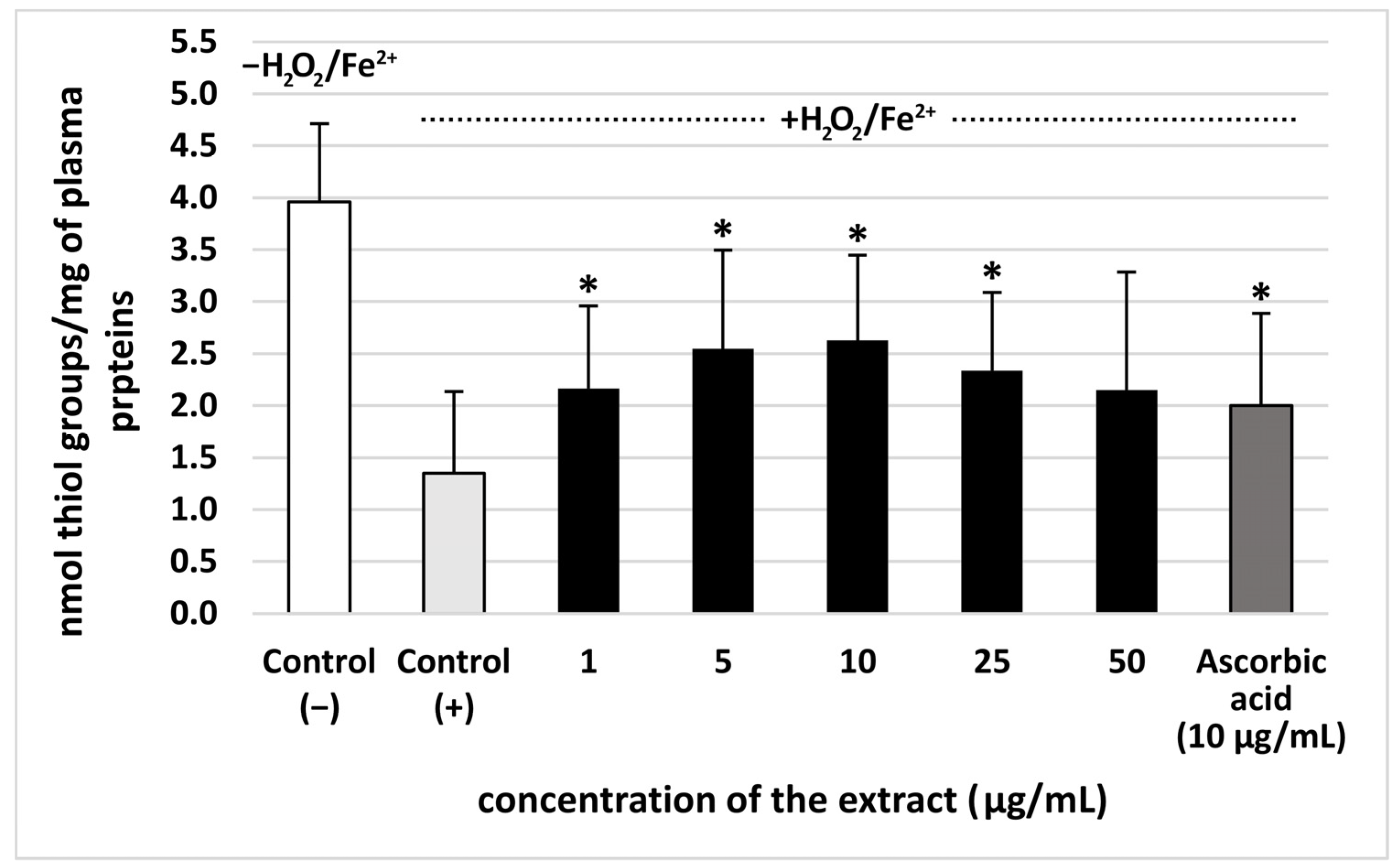
2.9. Thiol Group Oxidation Measurement
2.10. Measurement of Prothrombin Time
2.11. Measurement of Thrombin Time
2.12. Measurement of Activated Partial Thromboplastin Time
2.13. Statistical Analysis
3. Results
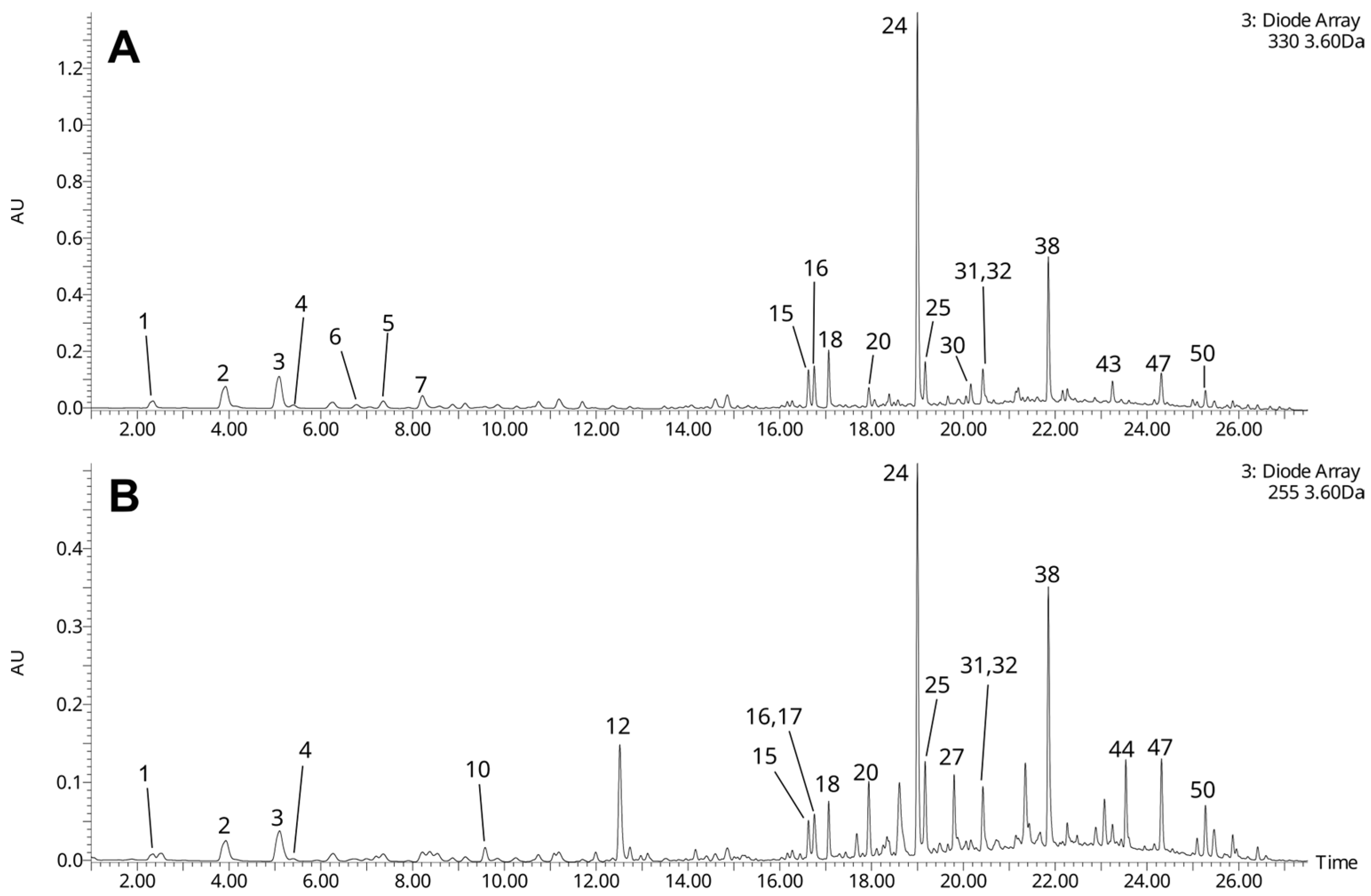
3.1. Chemical Characteristic of the Plant Extract
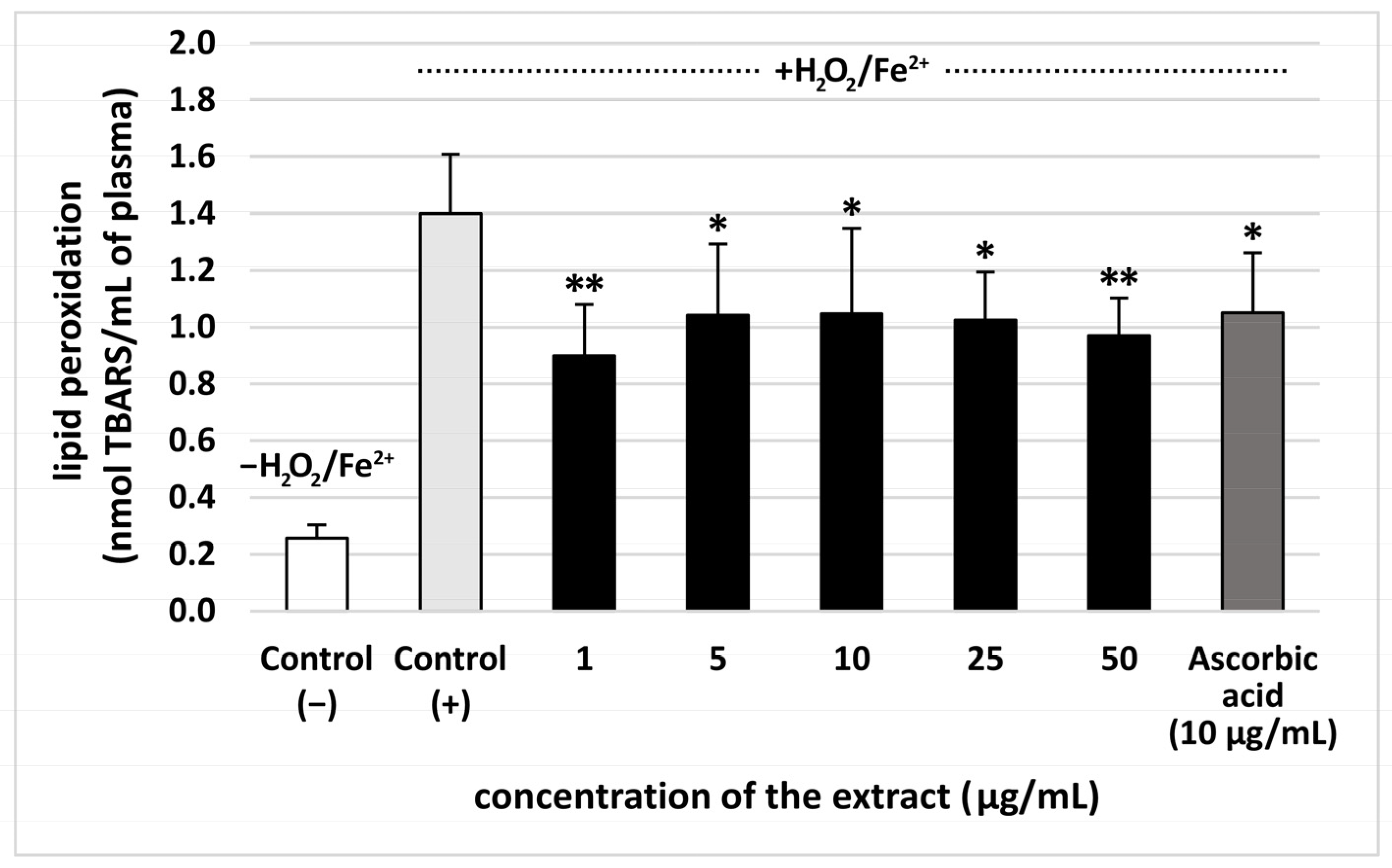
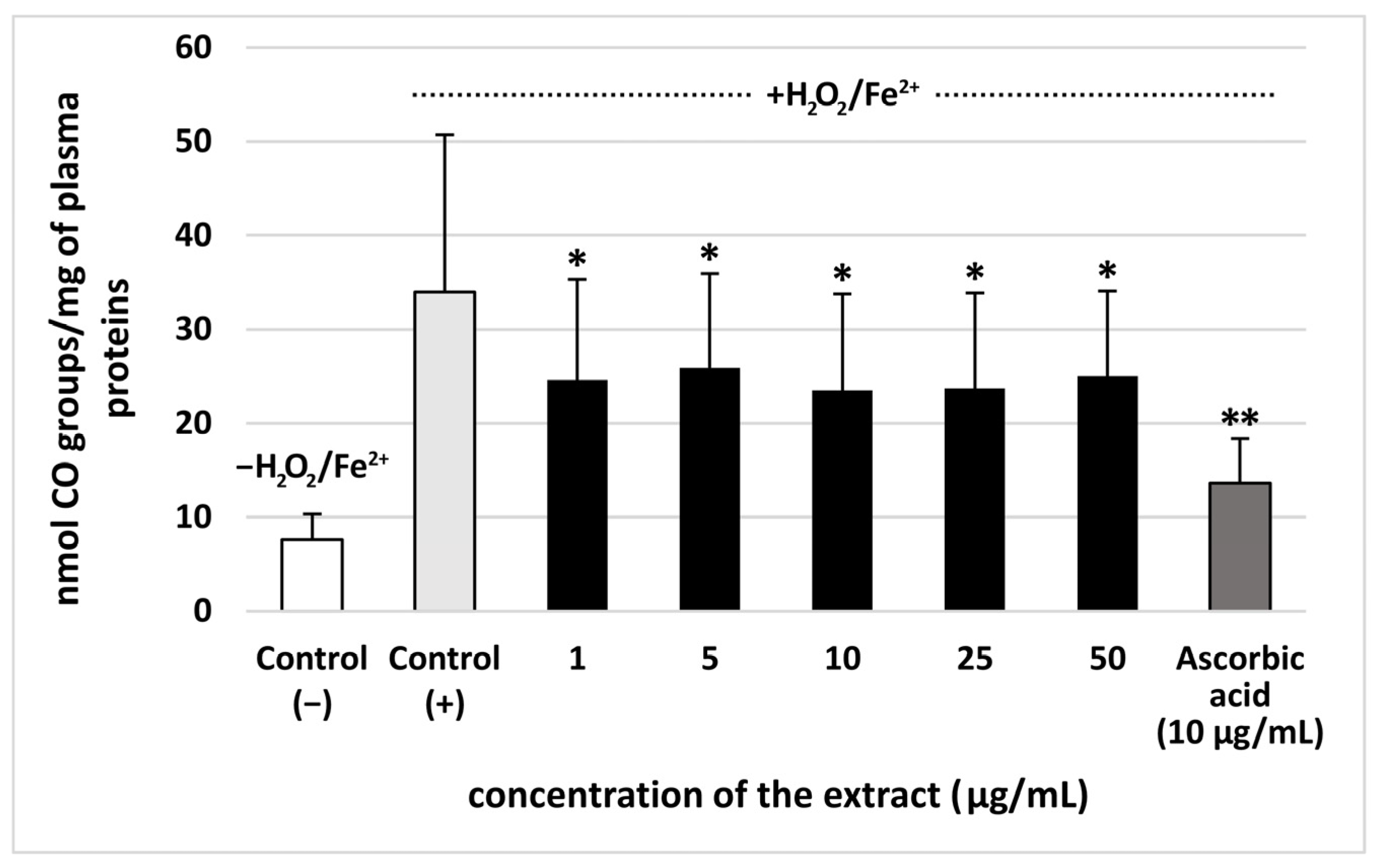
3.2. Biomarkers of Oxidative Stress in Plasma
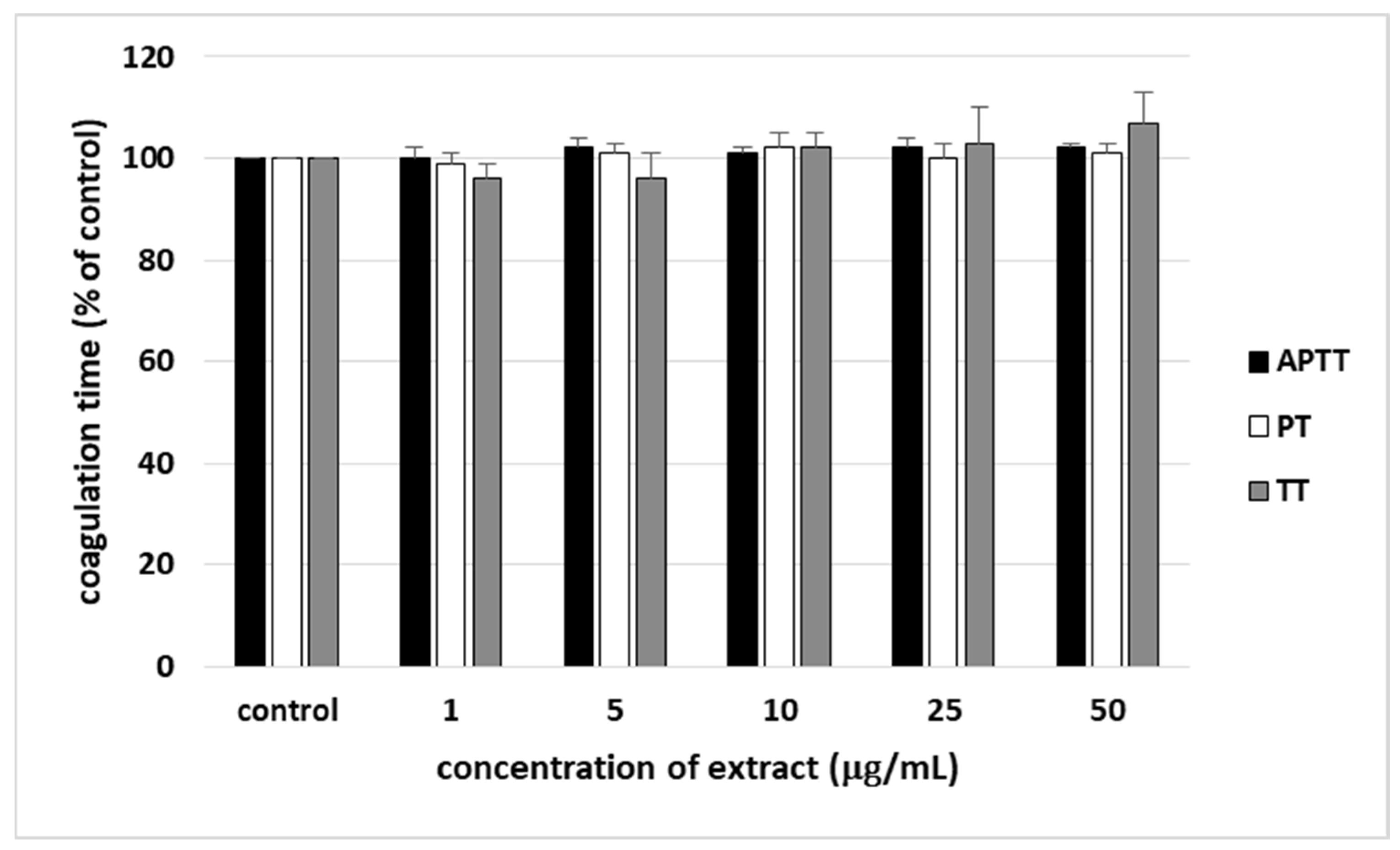
3.3. Coagulation Times (PT, TT, and APTT)
4. Discussion
5. Conclusions
Author Contributions
Funding
Institutional Review Board Statement
Informed Consent Statement
Data Availability Statement
Acknowledgments
Conflicts of Interest
Abbreviations
| APTT | activated partial thromboplastin time |
| CUPRAC | cupric ion reducing antioxidant capacity |
| CVDs | cardiovascular diseases |
| DPPH• | 2,2-diphenyl-picrylhydrazyl |
| FRAP | ferric-reducing antioxidant power |
| IC50 | half maximal inhibitory concentration |
| MAP | mitogen-activated protein kinase |
| PT | prothrombin time |
| ROS | radical oxygen species |
| TBARS | thiobarbituric acid reactive substances |
| TT | thrombin time |
References
- Bachmair, E.M.; Ostertag, L.M.; Zhang, X.; de Roos, B. Dietary manipulation of platelet function. Pharmacol. Ther. 2014, 144, 97–113. [Google Scholar] [CrossRef] [Scilit]
- Dudek, M.K.; Michalak, B.; Woźniak, M.; Czerwińska, M.E.; Filipek, A.; Granica, S.; Kiss, A.K. Hydroxycinnamoyl derivatives and secoiridoid glycoside derivatives from Syringa vulgaris flowers and their effects on the pro-inflammatory responses of human neutrophils. Fitoterapia 2017, 121, 194–205. [Google Scholar] [CrossRef] [Scilit] [PubMed]
- Hanganu, D.; Niculae, M.; Ielciu, I.; Olah, N.K.; Munteanu, M.; Burtescu, R.; Ștefan, R.; Olar, L.; Pall, E.; Andrei, S.; et al. Chemical profile, cytotoxic activity and oxidative stress reduction of different Syringa vulgaris L. Extracts. Molecules 2021, 26, 3104. [Google Scholar] [CrossRef] [Scilit] [PubMed]
- Jakubczyk, K.; Koprowska, K.; Gottschling, A.; Janda-Milczarek, K. Edible Flowers as a Source of Dietary Fibre (Total, Insoluble and Soluble) as a Potential Athlete’s Dietary Supplement. Nutrients 2022, 14, 2470. [Google Scholar] [CrossRef] [Scilit] [PubMed]
- Woźniak, M.; Michalak, B.; Wyszomierska, J.; Dudek, M.K.; Kiss, A.K. Effects of Phytochemically Characterized Extracts From Syringa vulgaris and Isolated Secoiridoids on Mediators of Inflammation in a Human Neutrophil Model. Front. Pharmacol. 2018, 9, 349. [Google Scholar] [CrossRef] [Scilit]
- Olas, B. New Perspectives on the Effect of Dandelion, Its Food Products and Other Preparations on the Cardiovascular System and Its Diseases. Nutrients 2022, 14, 1350. [Google Scholar] [CrossRef] [Scilit]
- Jędrejek, D.; Kontek, B.; Lis, B.; Stochmal, A.; Olas, B. Evaluation of antioxidant activity of phenolic fractions from the leaves and petals of dandelion in human plasma treated with H2O2 and H2O2/Fe. Chem. Biol. Interact. 2017, 262, 29–37. [Google Scholar] [CrossRef] [Scilit]
- Majewski, M.; Lis, B.; Juśkiewicz, J.; Ognik, K.; Jedrejek, D.; Stochmal, A.; Olas, B. The composition and vascular/antioxidant properties of Taraxacum officinale flower water syrup in a normal-fat diet using an obese rat model. J. Ethnopharmacol. 2021, 265, 113393. [Google Scholar] [CrossRef] [Scilit]
- Bartosz, G. Druga Twarz Tlenu; PWN: Warszawa, Poland, 2008. [Google Scholar]
- Levine, R.L.; Garland, D.; Oliver, C.N.; Amici, A.; Climent, I.; Lenz, A.G.; Ahn, B.W.; Shaltiel, S.; Stadtman, E.R. Determination of carbonyl content in oxidatively modified proteins. Methods Enzymol. 1990, 186, 464–478. [Google Scholar] [CrossRef] [Scilit]
- Sławińska, N.; Żuchowski, J.; Stochmal, A.; Olas, B. Extract from Sea Buckthorn Seeds—A Phytochemical, Antioxidant, and Hemostasis Study; Effect of Thermal Processing on Its Chemical Content and Biological Activity In Vitro. Nutrients 2023, 15, 686. [Google Scholar] [CrossRef] [Scilit]
- Huang, Y.-L.; Oppong, M.B.; Guo, Y.; Wang, L.-Z.; Fang, S.-M.; Deng, Y.-R.; Gao, X.-M. The Oleaceae family: A source of secoiridoids with multiple biological activities. Fitoterapia 2019, 136, 104155. [Google Scholar] [CrossRef] [Scilit]
- Jensen, S.; Franzyk, H.; Wallander, E. Chemotaxonomy of the Oleaceae: Iridoids as taxonomic markers. Phytochemistry 2002, 60, 213–231. [Google Scholar] [CrossRef] [Scilit]
- Tóth, G.; Barabás, C.; Tóth, A.; Kéry, Á.; Béni, S.; Boldizsár, I.; Varga, E.; Noszál, B. Characterization of antioxidant phenolics in Syringa vulgaris L. flowers and fruits by HPLC-DAD-ESI-MS. Biomed. Chromatogr. 2016, 30, 923–932. [Google Scholar] [CrossRef] [Scilit] [PubMed]
- Ahmad, M.; Salama, O. Flavonoids from violet flowers of Syringa vulgaris. Pak. J. Sci. Ind. Res. 1987, 30, 150–151. [Google Scholar]
- Czerwińska, M.; Granica, S.; Kiss, A. Effects of an Aqueous Extract from Leaves of Ligustrum vulgare on Mediators of Inflammation in a Human Neutrophils Model. Planta Med. 2013, 79, 924–932. [Google Scholar] [CrossRef] [Scilit] [PubMed]
- Kiss, A.K.; Michalak, B.; Patyra, A.; Majdan, M. UHPLC-DAD-ESI-MS/MS and HPTLC profiling of ash leaf samples from different commercial and natural sources and their in vitro effects on mediators of inflammation. Phytochem. Anal. 2020, 31, 57–67. [Google Scholar] [CrossRef] [Scilit]
- Kurkin, V.A. Phenylpropanoids from medicinal plants: Distribution, classification, structural analysis, and biological activity. Chem. Nat. Compd. 2003, 39, 123–153. [Google Scholar] [CrossRef] [Scilit]
- Varga, E.; Barabás, C.; Tóth, A.; Boldizsár, I.; Noszál, B.; Tóth, G. Phenolic composition, antioxidant and antinociceptive activities of Syringa vulgaris L. bark and leaf extracts. Nat. Prod. Res. 2019, 33, 1664–1669. [Google Scholar] [CrossRef] [Scilit]
- Gulcin, I. Antioxidants: A comprehensive review. Arch. Toxicol. 2025, 99, 1893–1997. [Google Scholar] [CrossRef] [Scilit]
- Gąsecka, M.; Krzymińska-Bródka, A.; Magdziak, Z.; Czuchaj, P.; Bykowska, J. Phenolic Compounds and Organic Acid Composition of Syringa vulgaris L. Flowers and Infusions. Molecules 2023, 28, 5159. [Google Scholar] [CrossRef] [Scilit]
- Gianazza, E.; Brioschi, M.; Martinez Fernandez, A.; Casalnuovo, F.; Altomare, A.; Aldini, G.; Banfi, C. Lipid Peroxidation in Atherosclerotic Cardiovascular Diseases. Antioxid. Redox Signal. 2021, 34, 49–98. [Google Scholar] [CrossRef] [Scilit] [PubMed]
- Peng, Z.; He, J.; Cheng, Y.; Xu, J.; Zhang, W. Biologically active secoiridoids: A comprehensive update. Med. Res. Rev. 2023, 43, 1201–1252. [Google Scholar] [CrossRef] [Scilit] [PubMed]
- Olas, B.; Wachowicz, B. Role of reactive nitrogen species in blood platelet functions. Platelets 2007, 18, 555–565. [Google Scholar] [CrossRef] [Scilit] [PubMed]
- Gao, L.; Liu, X.; Li, C.; Wang, Z.; Guo, T. A Rare Secoiridoid Dimer Derivative from Ligustri lucidi fructus. Rec. Nat. Prod. 2015, 9, 323–328. [Google Scholar]
- Pérez-Bonilla, M.; Salido, S.; van Beek, T.A.; Waard Pde Linares-Palomino, P.J.; Sánchez, A.; Altarejos, J. Isolation of antioxidative secoiridoids from olive wood (Olea europaea L.) guided by on-line HPLC–DAD–radical scavenging detection. Food Chem. 2011, 124, 36–41. [Google Scholar] [CrossRef] [Scilit]
- Wang, L.; Li, L.; Wang, H.; Liu, J. Study on the influence of oxidative stress on the fibrillization of fibrinogen. Biochem. J. 2016, 473, 4373–4384. [Google Scholar] [CrossRef] [Scilit]
- Kolodziejczyk-Czepas, J.; Czepas, J. Plant-Derived Compounds and Extracts as Modulators of Plasmin Activity—A Review. Molecules 2023, 28, 1677. [Google Scholar] [CrossRef] [Scilit]
- Liudvytska, O.; Ponczek, M.B.; Krzyżanowska-Kowalczyk, J.; Kowalczyk, M.; Balcerczyk, A.; Kolodziejczyk-Czepas, J. Effects of Rheum rhaponticum and Rheum rhabarbarum extracts on haemostatic activity of blood plasma components and endothelial cells in vitro. J. Ethnopharmacol. 2023, 315, 116562. [Google Scholar] [CrossRef] [Scilit]
- Manach, C.; Williamson, G.; Morand, C.; Scalbert, A.; Rémésy, C. Bioavailability and bioefficacy of polyphenols in humans. I. Review of 97 bioavailability studies. Am. J. Clin. Nutr. 2005, 81, 230S–242S. [Google Scholar] [CrossRef] [Scilit]
- Leong, X.Y.; Thanikachalam, P.V.; Pandey, M.; Ramamurthy, S. A systematic review of the protective role of swertiamarin in cardiac and metabolic diseases. Biomed. Pharmacother. 2016, 84, 1051–1060. [Google Scholar] [CrossRef] [Scilit]
- Lim, T.K. Edible Medicinal and Non Medicinal Plants; Springer: Dordrecht, The Netherlands, 2014. [Google Scholar] [CrossRef] [Scilit]




| tR | Type | m/z | Major Fragment Ions (m/z) | Error (ppm) | mSigma | Formula | Tentative Identification | |
|---|---|---|---|---|---|---|---|---|
| 1 | 1.85 | [M-H]− | 371.0625 | 209.0303 (100), 191.0211 (15), 179.0341 (8) | −1.4 | 24.7 | C15H16O11 | caffeoylhexaric acid/isomer |
| 2 | 2.39 | [M-H]− | 371.0617 | 209.0305 (100), 191.0188 (14), 179.0337 (2) | 0.8 | 2.2 | C15H16O11 | caffeoylhexaric acid/isomer |
| 3 | 2.55 | [M-H]− | 371.0626 | 209.0305 (100), 191.0197 (13), 179.0393 (2) | −1.7 | 7.1 | C15H16O11 | caffeoylhexaric acid/isomer |
| 4 | 2.71 | [M-H]− | 355.0673 | 209.0307 (59), 191.0176 (100), 147.0281 (27) | −0.7 | 1.8 | C15H16O10 | coumaroylhexaric acid/isomer |
| 5 | 3.36 | [M-H]− | 371.0614 | 209.0308 (100), 191.0198 (13) | 1.6 | 5.1 | C15H16O11 | caffeoylhexaric acid/isomer |
| 6 | 3.80 | [M-H]− | 355.0665 | 355.0671 (4), 209.0303 (99), 191.0203 (100), 163.0392 (9) | 1.6 | 4.8 | C15H16O10 | coumaroylhexaric acid/isomer |
| 7 | 4.26 | [M-H]− | 355.0665 | 209.0300 (100), 191.0202 (300) | 1.5 | 8.6 | C15H16O10 | coumaroylhexaric acid/isomer |
| 8 | 4.62 | [M+NH4]+ | 332.1343 | 332.1346 (100), 315.1084 (2), 279.0868 (4), 219.0651 (5), 180.0871 (11), 163.0607 (2), 153.0546 (4), 157.0499 (7), 127.0399 (3) | −1.1 | 11.0 | C14H18O8 | unidentified hexoside |
| 9 | 4.78 | [M-H]− | 315.1091 | 315.1088 (100), 135.0435 (2) | −1.9 | 9.3 | C14H20O8 | hydroxytyrosol-Hex/isomer |
| [M+NH4]+ | 334.1501 | 334.1501 (100), 317.1241 (29), 281.1022 (14), 263.0917 (18), 221.0811 (7), 155.0704 (24), 137.0598 (31) | −1.4 | 12.0 | ||||
| 10 | 6.32 | [M+FA-H]− | 345.1194 | 345.1184 (4), 299.1135 (100), 179.0567 (6) | −0.8 | 7.7 | C14H20O7 | tyrosol-Hex/isomer |
| 11 | 8.20 | [M-H]− | 403.1253 | 371.0950 (11), 241.0721 (52), 223.0606 (49), 197.9821 (80), 179.0712 (83) | −1.7 | 23.3 | C17H24O11 | oleoside 11-methyl ester hexoside/isomer |
| 12 | 8.20 | [M+FA-H]− | 417.1400 | 209.0820 (100) | −0.5 | 10.8 | C17H24O9 | syryngin/isomer |
| [M+NH4]+ | 390.1762 | 211.0965 (30), 193.0858 (100), 180.0867 (6), 161.0598 (45) | −1.0 | 10.5 | ||||
| 13 | 8.45 | [M+FA-H]− | 315.1089 | 315.1081 (38), 269.1028 (100) | −1.3 | 13.2 | C13H18O6 | unidentified |
| [M+NH4]+ | 288.1439 | 288.1442 (9), 271.1178 (28), 253.1059 (100), 235.0955 (25), 217.0858 (25), 180.0865 (20), 161.0444 (17), 145.0496 (19), 127.0400 (6) | 0.9 | 5.1 | ||||
| 14 | 10.00 | [M+FA-H]− | 447.1504 | 401.1453 (100), 269.1029 69), 161.0447 (2) | 1.0 | 10.0 | C18H26O10 | unidentified |
| 15 | 12.23 | [M-H]− | 639.1925 | 639.1931 (100), 621.1823 (38), 529.1546 (8), 487.1446 (8), 477.1606 (5), 179.0353 (13), 161.0243 (28) | 0.9 | 9.6 | C29H36O16 | hydroxyverbascoside/iosomer |
| 16 | 12.39 | [M-H]− | 639.1915 | 639.1931 (100), 621.1829 (74), 529.1533 (6), 487.1461 912), 477.1601 (5), 459.1500 (13), 179.0349 (19), 161.0242 (38), 151.0384 (6), 133.0282 (12) | 2.5 | 24.8 | C29H36O16 | hydroxyverbascoside/isomer |
| 17 | 12.44 | [M+FA-H]− | 461.1662 | 415.1604 (100), 311.0980 (4), 283.1187 (6), 251.0766 (7), 221.0669 (3), 191.0561 (7), 179.0561 (7), 161.0443 (1), 149.0449 (15), 131.0329 (2) | 0.5 | 3.6 | C19H28O10 | unidentified |
| 18 | 12.95 | [M-H]− | 785.2503 | 785.2514 (100), 623.2197 (24), 179.0349 (1), 161.0235 (26), 133.0275 (8) | 0.8 | 22.9 | C35H46O20 | verbascoside-Hex (echinacoside)/isomer |
| [M+NH4]+ | 804.2924 | 625.2123 (4), 479.1553 (13), 471.1503 (15), 325.0925 (100), 309.0975 (3), 163.0394 (49) | −0.4 | 3.2 | ||||
| 19 | 13.14 | [M+NH4]+ | 350.2178 | 350.2174 (4), 333.1913 (10), 315.1807 (26), 297.1706 (15), 279.1599 (7), 163.0604 (4), 153.1278 (58), 135.1171 (100) | −1.3 | 11.8 | C16H28O7 | monoterpenoid hexoside (lilac alcohol hexoside ?) |
| 20 | 13.87 | [M-H]− | 609.1459 | 609.1453 (90), 300.0270 (69), 271.0240 (100), 255.0295 (39), 243.0294 (21) | 0.4 | 10.1 | C27H30O16 | quercetin-3-O-Hex-dHex (rutin ?)/isomer |
| 21 | 14.48 | [M-H]− | 593.1506 | 593.1516 (50), 284.0326 (90), 255.0290 (100), 227.0345 (42) | 1.0 | 12.9 | C27H30O15 | kaempferol-3-O-Hex-dHex/isomer |
| 22 | 14.54 | [M-H]− | 521.2014 | 359.1496 (17), 329.1391 (100) | 2.8 | 13.7 | C26H34O11 | lariciresinol-Hex |
| 23 | 14.80 | [M-H]− | 755.2390 | 755.2398 (100), 593.2086 (18), 161.0239 (20), 133.0286 (8) | 1.9 | 13.1 | C34H44O19 | forsythoside B/isomer |
| [M+NH4]+ | 774.2824 | 774.2819 (14), 625.2130 (4), 479.1557 (11), 471.1508 (19), 457.1353 (1), 325.0929 (100), 309.0982 (4), 181.0505 (2), 163.0396 (54) | −1.1 | 10.2 | ||||
| 24 | 15.55 | [M-H]− | 623.1973 | 623.1974 (100), 461.1659 (10), 161.0239 (21), 133.0287 (7) | 1.4 | 2.6 | C29H36O15 | verbascoside/isomer |
| 25 | 15.71 | [M+H]+ | 595.1657 | 595.1656 (3), 449.1081 (14), 287.0553 (100) | 0.0 | 13.1 | C27H32O15 | kaempferol-3-O-Hex-dHex/isomer |
| 26 | 16.66 | [M+FA-H]− | 377.1811 | 377.1815 (53), 331.1752 (100), 161.0450 (2) | 1.5 | 1.4 | C16H28O7 | monoterpenoid hexoside (lilac alcohol hexoside ?) |
| 27 | 16.82 | [M+FA-H]− | 731.2403 | 685.2343 (25), 523.1818 (100), 453.1396 (95), 421.1500 (52), 299.1135 32), 223.0608 (18), 153.0188 (4) | 0.1 | 9.8 | C31H42O17 | nuezhenide/isomer |
| [M+NH4]+ | 704.2764 | 704.2763 (27), 525.1973 (15), 507.1867 (51), 387.1291 (42), 369.1184 (55), 295.0815 (18), 193.0496 (47), 165.0547 (100), 151.0391 (26) | −0.5 | 10.3 | ||||
| 28 | 16.55 | [M-H]− | 623.1968 | 623.1974 (100), 461.1650 (10), 179.0338 (3), 161.0232 (19), 133.0283 (5) | 2.2 | 8.7 | C29H36O15 | verbascoside isomer |
| 29 | 17.28 | [M+NH4]+ | 350.2173 | 333.1909 (36), 171.1379 (100), 153.1273 (5), 135.1167 (8) | 0.2 | 7.3 | C16H28O7 | monoterpenoid hexoside (lilac alcohol hexoside ?) |
| 30 | 17.28 | [M-H]− | 607.2025 | 607.2022 (100), 461.1658 (47), 443.1581 (2), 315.1075 (2), 163.0386 (3), 145.0285 (23), 117.0337 (7) | 1.2 | 5.4 | C29H36O14 | deoxyverbascoside |
| 31 | 17.95 | [M+NH4]+ | 1044.355 | 1044.3541 (7), 847.2651 (5), 829.2542 (10), 677.2074 (14), 587.1760 (8), 505.1706 (14), 477.1394 (31), 371.1339 (21), 325.0920 (100), 225.0756 (24), 193.0495 (17), 165.0546 (56), 163.0390 (62) | 0.4 | 18 | C46H58O26 | hydroxyoleoacteoside |
| 32 | 18.08 | [M+NH4]+ | 1190.4100 | 1190.4109 (14), 993.3212 (4), 831.2690 (12), 677.2068 (14), 589.1909 (4), 479.1545 (17), 371.1332 (15), 353.1228 (19), 325.0918 (100), 225.0755 (21), 193.0494 (13), 165.0544 (46), 163.0389 (56) | 2.8 | 23.4 | C52H68O30 | oleoechinacoside/isomer |
| 33 | 18.36 | [M+NH4]+ | 436.2177 | 436.2175 (8), 419.1908 (68), 401.1803 (4), 383.1707 (1), 249.0604 (2), 231.0498 (6), 171.1378 (100), 153.1273 (8), 135.1166 (11) | 0.0 | 4.5 | C19H30O10 | monoterpenoid hexoside-MaA/isomer |
| [2M-H]− | 835.3594 | 373.1853 (25), 331.1747 (100) | 1.3 | 8.9 | ||||
| 34 | 18.92 | [M+NH4]+ | 436.2178 | 436.2175 (10), 419.1911 (89), 401.1806 (4), 383.1700 (2), 249.0603 (2), 231.0498 (5), 171.1378 (100), 153.1272 (7), 135.1166 (10) | −0.2 | 13.0 | C19H30O10 | monoterpenoid hexoside-MaA/isomer |
| 35 | 19.19 | [M-H]− | 539.1756 | 403.1248 (27), 377.1226 (69), 345.0974 (23), 307.0809 (100), 275.0913 (76), 223.0615 (24), 179.0561 (8), 149.0234 (8) | 2.7 | 7.8 | C25H32O13 | oleuropein/isomer |
| [M+NH4]+ | 558.2184 | 541.1920 (2), 379.1388 (54), 361.1282 (100), 347.1126 (16), 287.0916 (7), 225.0759 (8), 165.0547 (15), 137.0596 (69) | −0.4 | 5.3 | ||||
| 36 | 19.45 | [M+NH4]+ | 436.2178 | 419.1912 (68), 401.1806 (2), 383.1700 (2), 339.1803 (2), 249.0604 (1), 231.0499 (3), 171.1378 (100), 153.1274 (5), 135.1166 (8) | −0.2 | 18.6 | C19H30O10 | monoterpenoid hexoside-MaA/isomer |
| 37 | 19.77 | [M-H]− | 677.2074 | 633.2170 (100), 591.2060 (1), 487.1784 (5), 445.1683 (2), 163.0388 (3), 145.0279 (29), 117.0340 (10) | 2.0 | 17.4 | C32H38O16 | coumaric acid derivative |
| [M+NH4]+ | 696.2493 | 969.2494 (7), 679.2225 (1), 541.1550 (13), 533.1653 (20), 395.0972 (100), 377.0863 (4), 291.0862 (3), 165.0546 (4), 147.0440 (21) | 0.7 | 1.0 | ||||
| 38 | 20.25 | [M-H]− | 1009.3158 | 847.2812 (10), 745.2316 (8), 665.2068 (13), 623.1964 (21), 461.1651 (14), 315.1078 (4), 297.0971 (2), 179.0343 (3), 161.0235 (49), 133.0282 (15) | 3.6 | 3.0 | C46H58O25 | oleoacteoside/isomer |
| [M+NH4]+ | 1028.3606 | 1028.3592 (13), 831.2699 (8), 695.2179 (4), 677.2072 (17), 507.1863 (6), 479.1549 (15), 371.1338 (15), 325.0921 (100), 275.0915 (15), 225.0758 (19), 193.0496 (14), 163.0391 (50), 151.0392 (9) | 0.0 | 8.8 | ||||
| 39 | 20.72 | [M+NH4]+ | 460.1820 | 460.1816 (58), 443.1552 (16), 425.1446 (6), 303.1234 (6), 266.0871 (10), 231.0501 (19), 195.1018 (100), 163.0757 (10) | −1.5 | 10.7 | C20H26O11 | unidentified |
| 40 | 20.93 | [M+NH4]+ | 1028.3595 | 1028.3591 (9), 831.2704 (6), 704.2258 (5), 685.2124 (74), 549.1604(57), 531.1497 (74), 307.0819 (35), 225.00758 (29), 193.0497 (33), 165.0458 (100), 163.0392 (97) | 1.0 | 10.3 | C46H58O25 | oleoacteoside/isomer |
| [M-H]− | 1009.3170 | 1009.3166 (100), 873.2647 (11), 847.2780 (9), 745.2338 (13), 665.2057 (15), 623.1995 (14), 461.1639 (13), 403.1244 (4), 315.1065 (1), 297.1005 (4), 179.0343 (31), 161.0238 (66) | 2.5 | 16.5 | ||||
| 41 | 21.46 | [M-H]− | 523.1812 | 361.1276 (42), 291.0865 (100), 259.0965 (23) | 1.8 | 17.3 | C25H32O12 | ligstroside/isomer |
| [M+NH4]+ | 542.2241 | 525.1962 (2), 363.1442 (71), 345.1336 (100), 331.1180 (18), 225,225.0760 (7), 193.0499 (5), 165.0549 (9), 121.0650 (76) | −1.7 | 3.4 | ||||
| 42 | 21.46 | [M-H]− | 601.2122 | 601.2116 (8), 403.1241 (7), 223.0600 (4), 197.0813 (100), 179.560 (1), 153.0910 (24) | 2.6 | 7.0 | C27H38O15 | 2″-epi-frameroside/isomer |
| [M+NH4]+ | 620.2547 | 441.1762 (39), 423.1654 (82), 391.1392 (25), 373.1291 (13), 331.1182 (100), 225.0762 (28), 199.0970 (37), 193.0499 (24), 165.0549 (50) | 0.3 | 32.7 | ||||
| 43 | 22.07 | [M+NH4]+ | 610.2504 | 593.2243 (1), 471.1508 (23), 447.1658 (7), 325.0927 (100), 309.0979 (7), 181.0.500 (3), 163.0394 (52) | −1.7 | 11.4 | C29H36O13 | caffeic acid derivative |
| 44 | 22.89 | [M-H]− | 1071.3541 | 909.3030 (10), 839.2599 (42), 807.2696 (19), 685.2338 (63), 523.1813 (100), 453.1397 (49), 421.1494 (29), 403.1245 (28), 299.1135 (24), 223.0604 (35), 179.0558 (6) | 2 | 8.8 | C48H64O27 | oleonuezhenide/isomer |
| 45 | 23.04 | [M+NH4]+ | 476.2498 | 476.2500 (37), 459.2234 (99), 271.0817 (100), 253.0711 (17), 171.1383 (58), 145.0499 (17), 127.0401 (15) | −1.6 | 9.3 | C22H34O10 | unidentified |
| 46 | 23.46 | [M+NH4]+ | 476.2496 | 476.2499 (19), 459.2233 (100), 271.0819 (91), 253.0714 (17), 171.1385 (91), 145.0499 (16), 127.0403 (14) | −1.2 | 6.9 | C22H34O10 | unidentified |
| 47 | 23.73 | [M+NH4]+ | 622.2498 | 587.2126 (5), 471.1506 (17), 441.1552 (12), 325.0927 (100), 309.0979 (10), 279.1023 (9), 181.1119 (1), 163.0394 (58), 117.0700 (16) | −0.5 | 4.4 | C30H36O13 | caffeic acid derivative |
| 48 | 23.73 | [M+NH4]+ | 594.2546 | 577.2293 (1), 455.1556 (25), 431.1711 (8), 309.0980 (100), 165.0551 (2), 147.0446 (29) | −0.2 | 11.5 | C29H36O12 | coumaric acid derivative |
| 49 | 24.15 | [M+NH4]+ | 680.2553 | 680.2553 (8), 541.1561 (13), 517.1714 (21), 395.0981 (100), 377.0878 (4), 165.0551 (4), 147.0445 (19) | −1.1 | 7.3 | C32H38O15 | coumaric acid derivative |
| 50 | 25.10 | [M-H]− | 587.2124 | 587.2120 (100), 441.1748 (6), 307.1035 (7), 163.0391 (4), 145.0287 (44), 117.0342 (15) | 1.7 | 13.8 | C30H36O12 | coumaric acid derivative |
| The Extract from S. vulgaris Flowers | The Extract from T. officinalis Flowers | |
|---|---|---|
| % of inhibition of lipid peroxidation | 26.0 ± 15.1 (p < 0.05) | 18.6 ± 7.9 (p < 0.05) |
| % of inhibition of protein carbonylation | 27.7 ± 9.3 (p < 0.01) | 28.9 ± 10.1 (p < 0.05) |
Disclaimer/Publisher’s Note: The statements, opinions and data contained in all publications are solely those of the individual author(s) and contributor(s) and not of MDPI and/or the editor(s). MDPI and/or the editor(s) disclaim responsibility for any injury to people or property resulting from any ideas, methods, instructions or products referred to in the content. |
© 2026 by the authors. Licensee MDPI, Basel, Switzerland. This article is an open access article distributed under the terms and conditions of the Creative Commons Attribution (CC BY) license.
Share and Cite
Sławińska, N.; Żuchowski, J.; Moniuszko-Szajwaj, B.; Skalski, B.; Olas, B. Extract from Syringa vulgaris L. Flowers—A Special Emphasis on Its Biological Activity: Evaluation of Antioxidant Properties and Modulation of Coagulation Process in Human Plasma In Vitro. Nutrients 2026, 18, 1022. https://doi.org/10.3390/nu18071022
Sławińska N, Żuchowski J, Moniuszko-Szajwaj B, Skalski B, Olas B. Extract from Syringa vulgaris L. Flowers—A Special Emphasis on Its Biological Activity: Evaluation of Antioxidant Properties and Modulation of Coagulation Process in Human Plasma In Vitro. Nutrients. 2026; 18(7):1022. https://doi.org/10.3390/nu18071022
Chicago/Turabian StyleSławińska, Natalia, Jerzy Żuchowski, Barbara Moniuszko-Szajwaj, Bartosz Skalski, and Beata Olas. 2026. "Extract from Syringa vulgaris L. Flowers—A Special Emphasis on Its Biological Activity: Evaluation of Antioxidant Properties and Modulation of Coagulation Process in Human Plasma In Vitro" Nutrients 18, no. 7: 1022. https://doi.org/10.3390/nu18071022
APA StyleSławińska, N., Żuchowski, J., Moniuszko-Szajwaj, B., Skalski, B., & Olas, B. (2026). Extract from Syringa vulgaris L. Flowers—A Special Emphasis on Its Biological Activity: Evaluation of Antioxidant Properties and Modulation of Coagulation Process in Human Plasma In Vitro. Nutrients, 18(7), 1022. https://doi.org/10.3390/nu18071022