Retinoic Acid Alleviates TGEV-Induced Ferroptosis by Activating the p62-NRF2-GPX4/HO-1 Pathway and Iron Metabolism in Intestinal Epithelial Cells
 ,
, 
Abstract
1. Introduction
2. Materials and Methods
2.1. Study Design
2.2. Measurement of Serum Iron Indicators
2.3. Cell Culture
2.4. Virus Infection and Retinoic Acid Treatment
2.5. Transmission Electron Microscopy (TEM)
2.6. Western Blotting Analysis
2.7. Flow Cytometry Analysis of TGEV Infection
2.8. Immunofluorescence Staining for TGEV Infection
2.9. Cell Viability Assay
2.10. Measurement of Intracellular ROS and Lipid Peroxidation
2.11. Determination of the Labile Iron Pool (LIP)
2.12. Measurement of Glutathione (GSH) and Malondialdehyde (MDA)
2.13. Statistical Analysis
3. Results
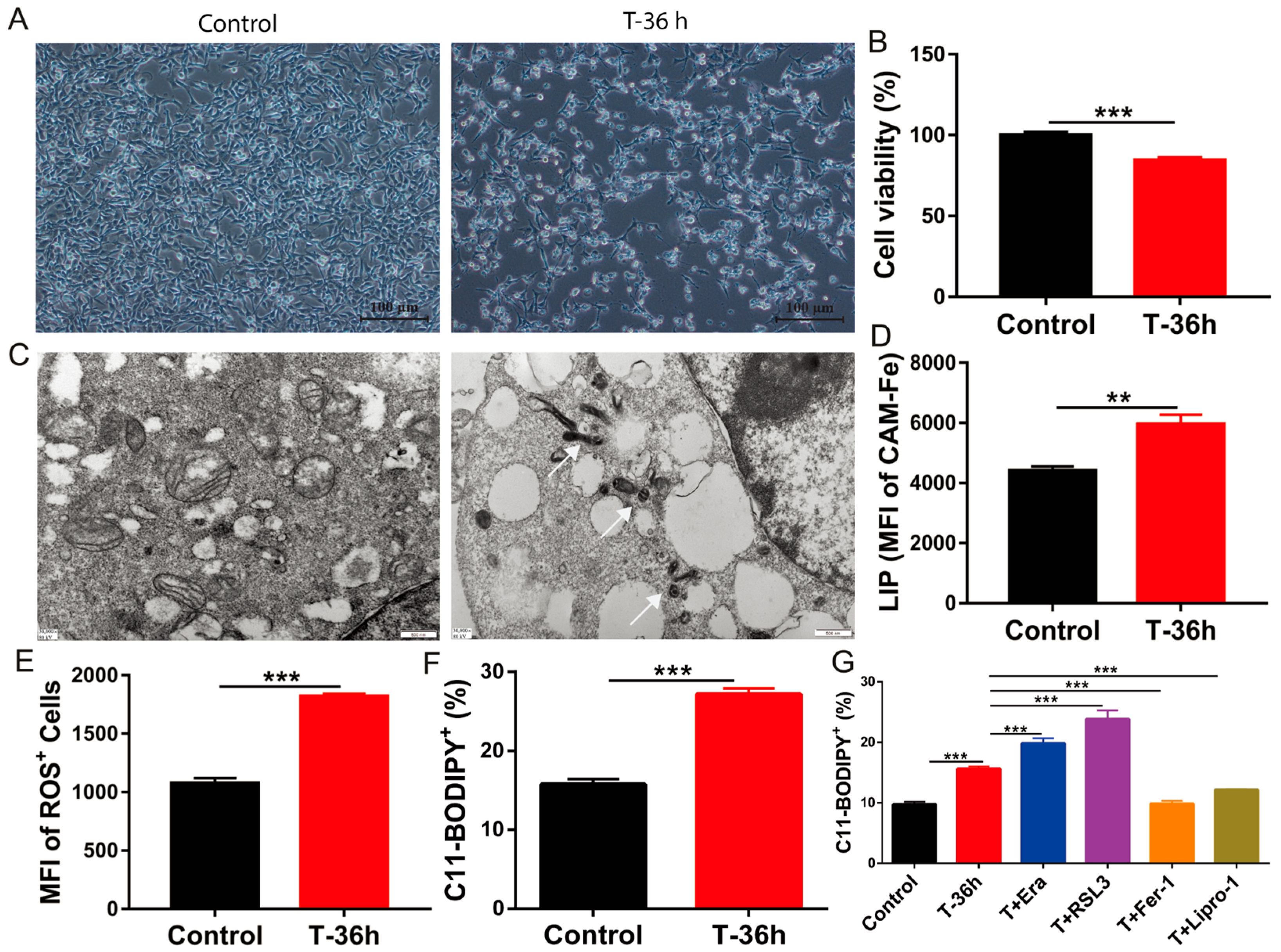
3.1. TGEV Infection Induces Ferroptosis in IPEC-J2 Cells
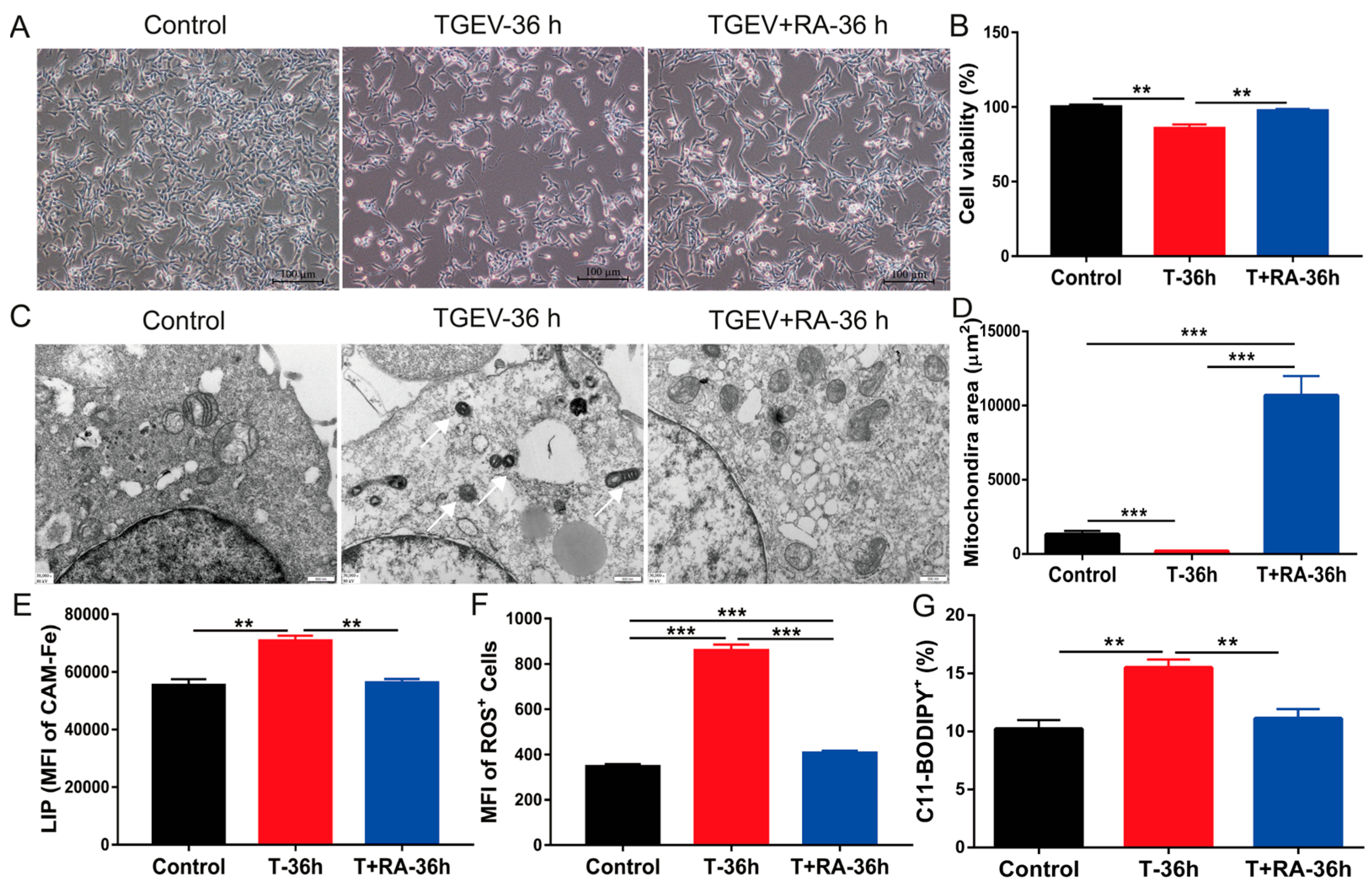
3.2. RA Addition Alleviates TGEV-Induced IPEC-J2 Cell Damage by Suppressing Ferroptosis
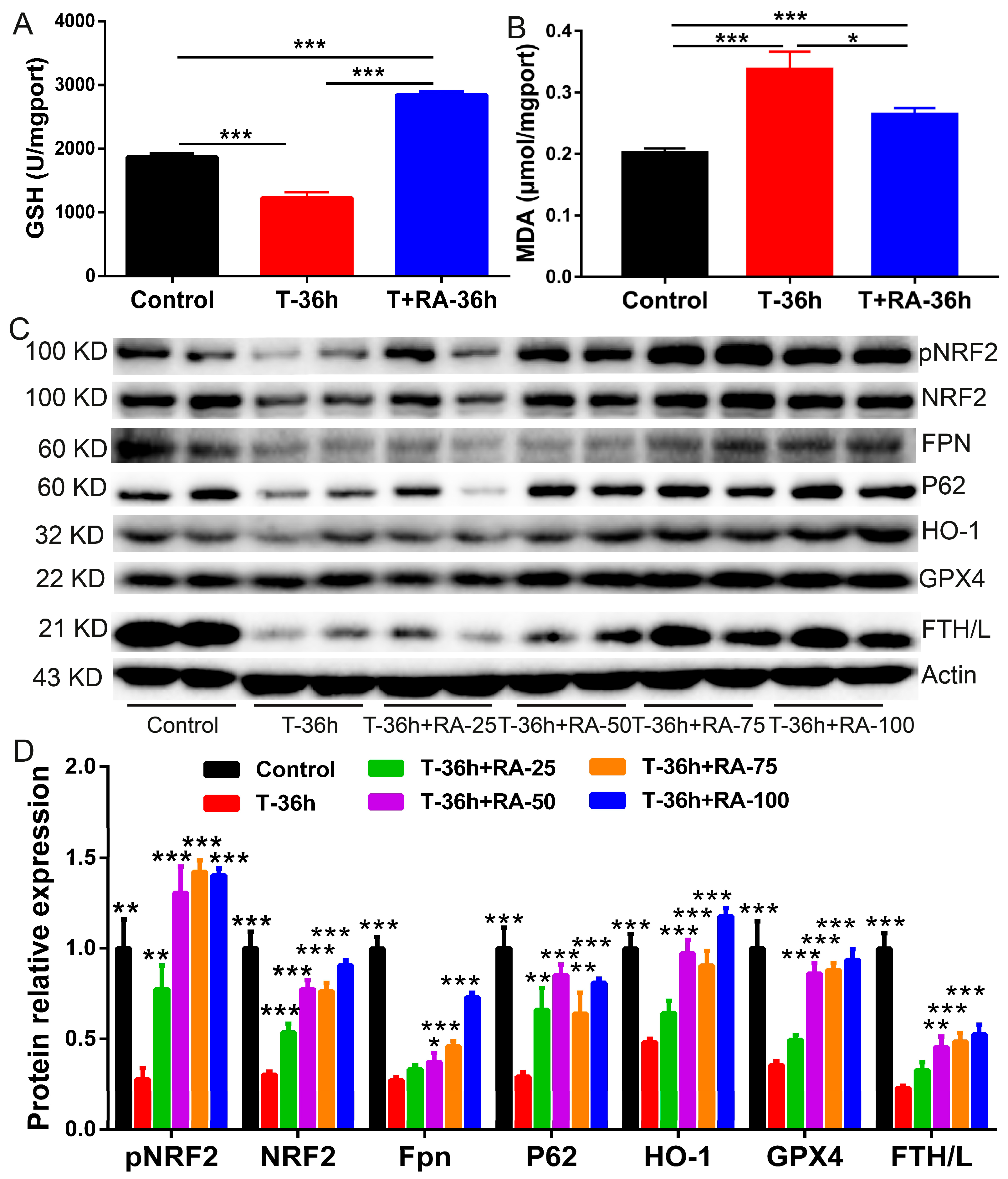
3.3. RA Addition Decreases TGEV-Induced Ferroptosis by Activating the p62-NRF2-GPX4/HO-1 Pathway and Iron Metabolism in IPEC-J2 Cells
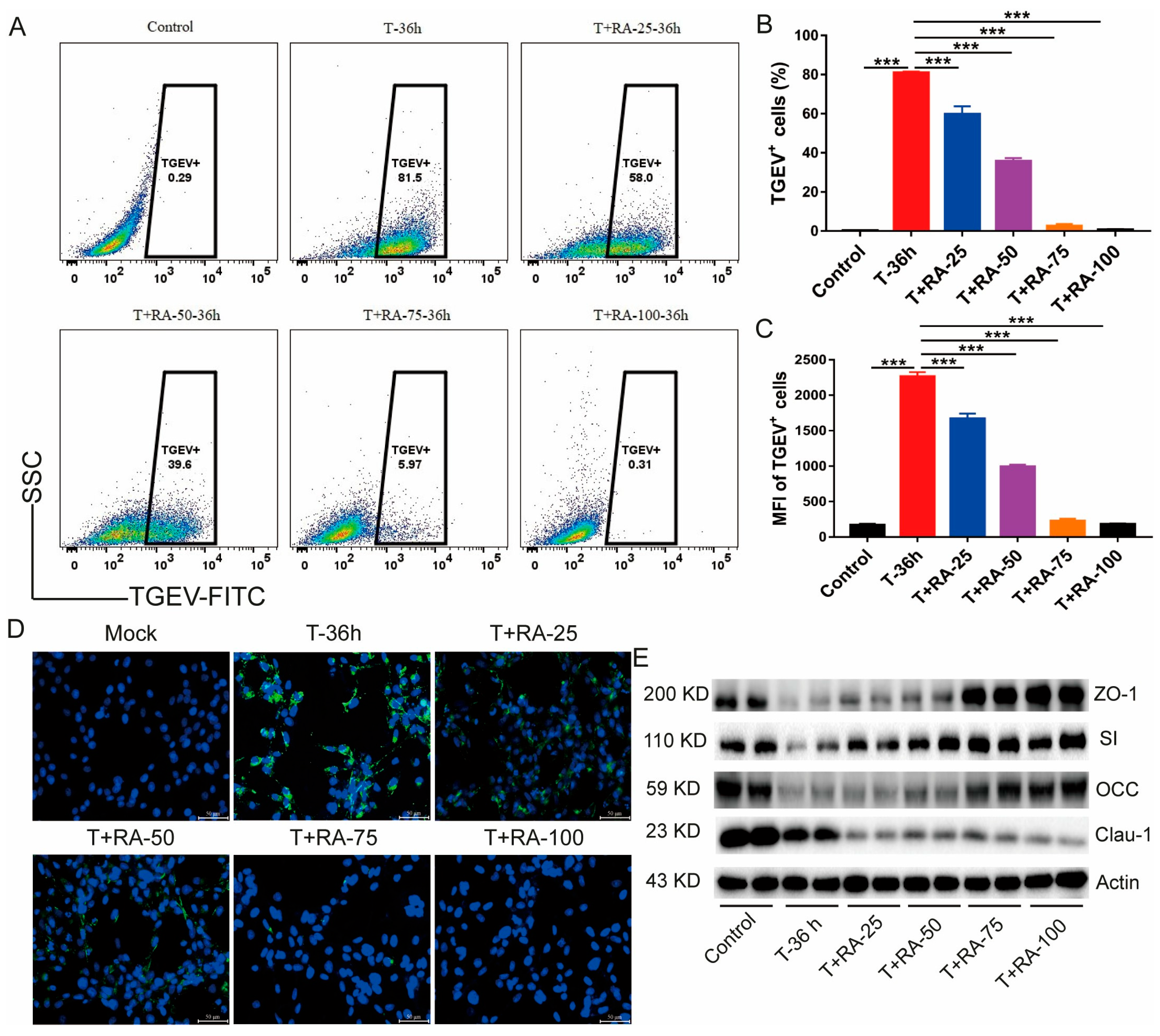
3.4. RA Addition Inhibits TGEV Infection and Proliferation in IPEC-J2 Cells
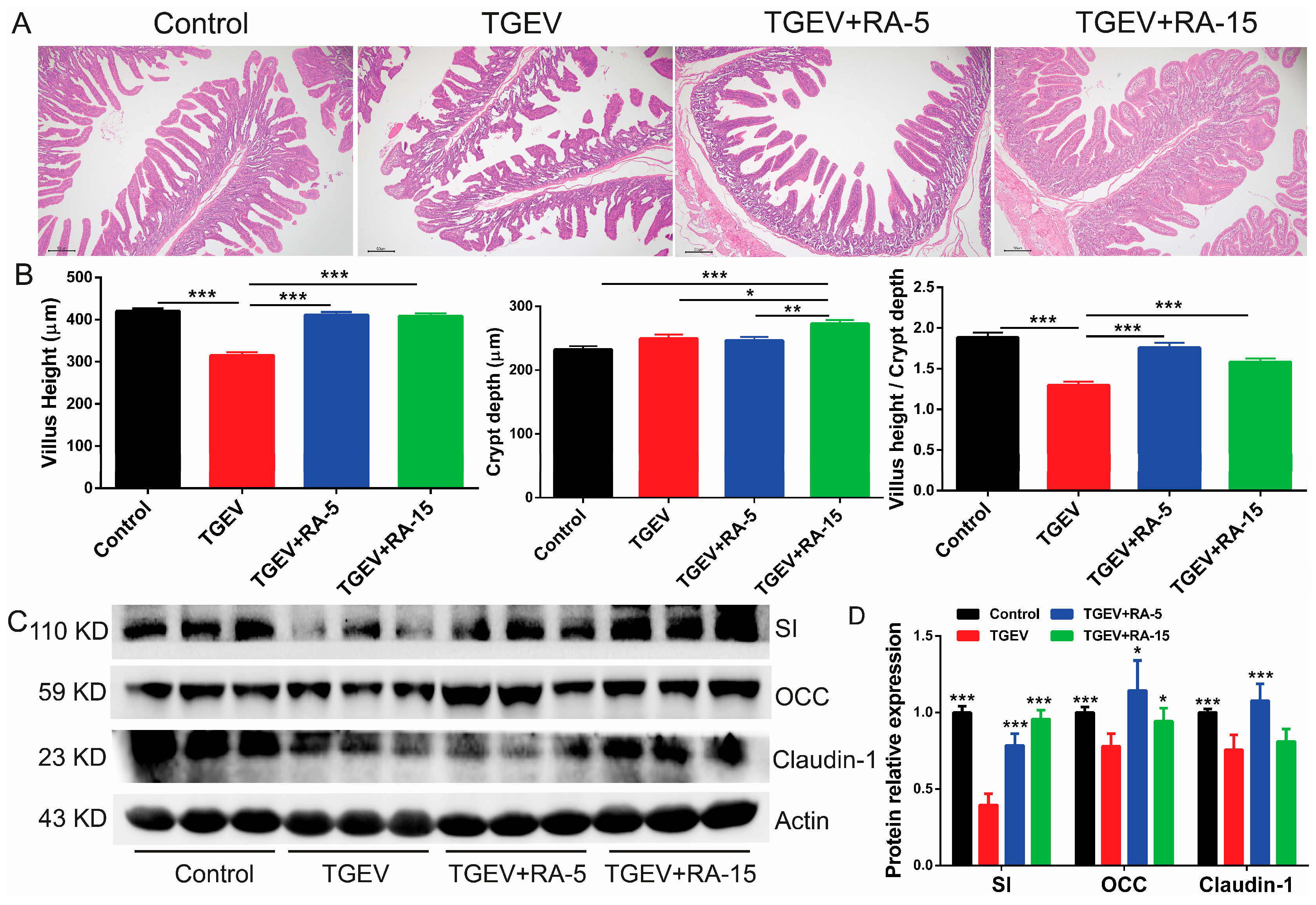
3.5. RA Addition Attenuates TGEV-Induced Intestinal Damage in Vivo
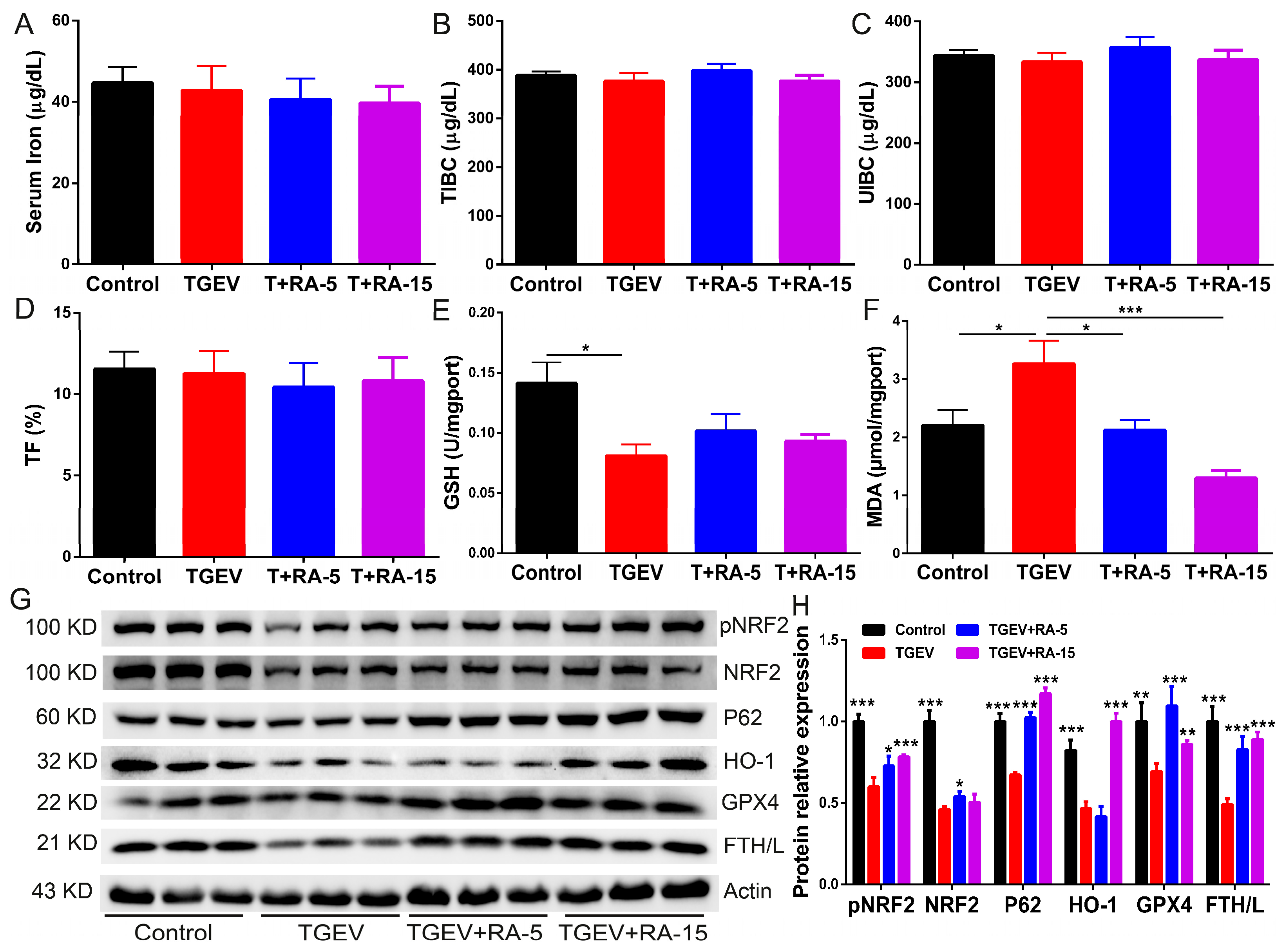
3.6. RA Addition Significantly Alleviates TGEV-Associated Oxidative Injury and Activates NRF2-Dependent Cytoprotective Responses In Vivo
4. Discussion
5. Conclusions
Author Contributions
Funding
Institutional Review Board Statement
Informed Consent Statement
Data Availability Statement
Conflicts of Interest
Abbreviations
| p62 | Sequestosome 1 |
| NRF2 | Nuclear factor erythroid 2–related factor 2 |
| pNRF2 | Phosphorylated NRF2 |
| GPX4 | Glutathione peroxidase 4 |
| HO-1 | Heme oxygenase 1 |
| FPN | Ferroportin |
| FTH/L | Ferritin heavy/light chain |
| ROS | Reactive oxygen species |
| FSP1 | Ferroptosis suppressor protein 1 |
| TFR1 | Transferrin receptor 1 |
| p53 | Tumor protein p53 |
| SLC7A11 | Solute carrier family 7 member 11 |
| SLC3A2 | Solute carrier family 3 member 2 |
| LPS | Lipopolysaccharide |
| HJV | Hemojuvelin |
| TFR2 | Transferrin receptor 2 |
| IPEC-J2 | Intestinal porcine epithelial cell line J2 |
| GSH | Glutathione |
| MDA | Malondialdehyde |
| ZO-1 | Zonula occludens-1 |
| OCC | Occludin |
| Claudin-1 | Claudin-1 |
| SI | Sucrase-isomaltase |
| TIBC | Total iron-binding capacity |
| UIBC | Unsaturated iron-binding capacity |
| TF | Transferrin |
| IL-6 | Interleukin-6 |
| IL-1β | Interleukin-1 beta |
| TNF-α | Tumor necrosis factor-alpha |
| Keap1 | Kelch-like ECH-associated protein 1 |
| RBC | Red blood cell count |
| HGB | Hemoglobin |
| HCT | Hematocrit |
| MCV | Mean corpuscular volume |
| MCH | Mean corpuscular hemoglobin |
| MCHC | Mean corpuscular hemoglobin concentration |
References
- Zhao, X.; Bai, X.; Guan, L.; Li, J.; Song, X.; Ma, X.; Guo, J.; Zhang, Z.; Du, Q.; Huang, Y.; et al. microRNA-4331 Promotes Transmissible Gastroenteritis Virus (TGEV)-induced Mitochondrial Damage Via Targeting RB1, Upregulating Interleukin-1 Receptor Accessory Protein (IL1RAP), and Activating p38 MAPK Pathway In Vitro. Mol. Cell Proteom. 2018, 17, 190–204. [Google Scholar] [CrossRef]
- Xia, L.; Yang, Y.; Wang, J.; Jing, Y.; Yang, Q. Impact of TGEV infection on the pig small intestine. Virol. J. 2018, 15, 102. [Google Scholar] [CrossRef]
- Zhou, Y.; Wu, W.; Xie, L.; Wang, D.; Ke, Q.; Hou, Z.; Wu, X.; Fang, Y.; Chen, H.; Xiao, S.; et al. Cellular RNA Helicase DDX1 Is Involved in Transmissible Gastroenteritis Virus nsp14-Induced Interferon-Beta Production. Front. Immunol. 2017, 8, 940. [Google Scholar] [CrossRef] [PubMed]
- Xue, M.; Zhao, J.; Ying, L.; Fu, F.; Li, L.; Ma, Y.; Shi, H.; Zhang, J.; Feng, L.; Liu, P. IL-22 suppresses the infection of porcine enteric coronaviruses and rotavirus by activating STAT3 signal pathway. Antivir. Res. 2017, 142, 68–75. [Google Scholar] [CrossRef] [PubMed]
- Guo, R.; Fan, B.; Chang, X.; Zhou, J.; Zhao, Y.; Shi, D.; Yu, Z.; He, K.; Li, B. Characterization and evaluation of the pathogenicity of a natural recombinant transmissible gastroenteritis virus in China. Virology 2020, 545, 24–32. [Google Scholar] [CrossRef]
- Xu, K.; Zhou, Y.; Mu, Y.; Liu, Z.; Hou, S.; Xiong, Y.; Fang, L.; Ge, C.; Wei, Y.; Zhang, X.; et al. CD163 and pAPN double-knockout pigs are resistant to PRRSV and TGEV and exhibit decreased susceptibility to PDCoV while maintaining normal production performance. eLife 2020, 9, e57132. [Google Scholar] [CrossRef]
- Xu, X.Q.; Xu, T.; Ji, W.; Wang, C.; Ren, Y.; Xiong, X.; Zhou, X.; Lin, S.H.; Xu, Y.; Qiu, Y. Herpes Simplex Virus 1-Induced Ferroptosis Contributes to Viral Encephalitis. mBio 2023, 14, e0237022. [Google Scholar] [CrossRef]
- Liu, C.; Wu, X.; Bing, X.; Qi, W.; Zhu, F.; Guo, N.; Li, C.; Gao, X.; Cao, X.; Zhao, M.; et al. H1N1 influenza virus infection through NRF2-KEAP1-GCLC pathway induces ferroptosis in nasal mucosal epithelial cells. Free Radic. Biol. Med. 2023, 204, 226–242. [Google Scholar] [CrossRef]
- Stockwell, B.R.; Friedmann Angeli, J.P.; Bayir, H.; Bush, A.I.; Conrad, M.; Dixon, S.J.; Fulda, S.; Gascón, S.; Hatzios, S.K.; Kagan, V.E.; et al. Ferroptosis: A Regulated Cell Death Nexus Linking Metabolism, Redox Biology, and Disease. Cell 2017, 171, 273–285. [Google Scholar] [CrossRef] [PubMed]
- Wu, A.; Zhang, T.; Chen, D. Ferroptosis in viral infections: Overview and regulation by nutritional interventions. Anim. Nutr. 2025, 2, 1–27. [Google Scholar] [CrossRef]
- Yang, W.S.; SriRamaratnam, R.; Welsch, M.E.; Shimada, K.; Skouta, R.; Viswanathan, V.S.; Cheah, J.H.; Clemons, P.A.; Shamji, A.F.; Clish, C.B.; et al. Regulation of Ferroptotic Cancer Cell Death by GPX4. Cell 2014, 156, 317–331. [Google Scholar] [CrossRef] [PubMed]
- Bersuker, K.; Hendricks, J.M.; Li, Z.; Magtanong, L.; Ford, B.; Tang, P.H.; Roberts, M.A.; Tong, B.; Maimone, T.J.; Zoncu, R.; et al. The CoQ oxidoreductase FSP1 acts parallel to GPX4 to inhibit ferroptosis. Nature 2019, 575, 688–692. [Google Scholar] [CrossRef]
- Doll, S.; Freitas, F.P.; Shah, R.; Aldrovandi, M.; da Silva, M.C.; Ingold, I.; Goya Grocin, A.; Xavier da Silva, T.N.; Panzilius, E.; Scheel, C.H.; et al. FSP1 is a glutathione-independent ferroptosis suppressor. Nature 2019, 575, 693–698. [Google Scholar] [CrossRef]
- Dodson, M.; Castro-Portuguez, R.; Zhang, D.D. NRF2 plays a critical role in mitigating lipid peroxidation and ferroptosis. Redox Biol. 2019, 23, 101107. [Google Scholar] [CrossRef]
- Jiang, L.; Kon, N.; Li, T.; Wang, S.J.; Su, T.; Hibshoosh, H.; Baer, R.; Gu, W. Ferroptosis as a p53-mediated activity during tumour suppression. Nature 2015, 520, 57–62. [Google Scholar] [CrossRef]
- Tsurusaki, S.; Tsuchiya, Y.; Koumura, T.; Nakasone, M.; Sakamoto, T.; Matsuoka, M.; Imai, H.; Yuet-Yin Kok, C.; Okochi, H.; Nakano, H.; et al. Hepatic ferroptosis plays an important role as the trigger for initiating inflammation in nonalcoholic steatohepatitis. Cell Death Dis. 2019, 10, 449. [Google Scholar] [CrossRef]
- Li, J.; Cao, F.; Yin, H.L.; Huang, Z.J.; Lin, Z.T.; Mao, N.; Sun, B.; Wang, G. Ferroptosis: Past, present and future. Cell Death Dis. 2020, 11, 88. [Google Scholar] [CrossRef]
- Olagnier, D.; Farahani, E.; Thyrsted, J.; Blay-Cadanet, J.; Herengt, A.; Idorn, M.; Hait, A.; Hernaez, B.; Knudsen, A.; Iversen, M.B.; et al. SARS-CoV2-mediated suppression of NRF2-signaling reveals potent antiviral and anti-inflammatory activity of 4-octyl-itaconate and dimethyl fumarate. Nat. Commun. 2020, 11, 4938. [Google Scholar] [CrossRef] [PubMed]
- Pan, C.; Kong, X.; Wu, Z.; Fei, Q. The role of hepatitis B virus surface protein in inducing Sertoli cell ferroptosis. Andrology 2024, 12, 643–654. [Google Scholar] [CrossRef]
- Han, L.; Liu, Y.; Lu, M.; Wang, H.; Tang, F. Retinoic acid modulates iron metabolism imbalance in anemia of inflammation induced by LPS via reversely regulating hepcidin and ferroportin expression. Biochem. Biophys. Res. Commun. 2018, 507, 280–285. [Google Scholar] [CrossRef] [PubMed]
- Wang, X.; Kong, N.; Wang, C.; Qin, W.; Yang, X.; Yu, H.; Tong, W.; Tong, G.; Li, L.; Zheng, H.; et al. Japanese encephalitis virus NS3 captures the protein translation element by interacting with HNRNPH1 to promote viral replication. Int. J. Biol. Macromol. 2025, 289, 138826, Correction in Int. J. Biol. Macromol. 2025, 330, 148540. https://doi.org/10.1016/j.ijbiomac.2025.148540. [Google Scholar] [CrossRef] [PubMed]
- Jiang, P.; Liu, K.; Cui, Y.; Liu, P.; Wang, X.; Hou, Z.; Cui, J.; Chen, N.; Fan, J.; Li, J.; et al. Naringenin Inhibits Enterotoxigenic Escherichia coli-Induced Ferroptosis via Targeting HSP90 in IPEC-J2 Cells. Antioxidants 2025, 14, 914. [Google Scholar] [CrossRef]
- Dixon, S.J.; Lemberg, K.M.; Lamprecht, M.R.; Skouta, R.; Zaitsev, E.M.; Gleason, C.E.; Patel, D.N.; Bauer, A.J.; Cantley, A.M.; Yang, W.S.; et al. Ferroptosis: An iron-dependent form of nonapoptotic cell death. Cell 2012, 149, 1060–1072. [Google Scholar] [CrossRef] [PubMed]
- Gao, M.; Monian, P.; Quadri, N.; Ramasamy, R.; Jiang, X. Glutaminolysis and Transferrin Regulate Ferroptosis. Mol. Cell 2015, 59, 298–308. [Google Scholar] [CrossRef]
- Sato, H.; Tamba, M.; Ishii, T.; Bannai, S. Cloning and expression of a plasma membrane cystine/glutamate exchange transporter composed of two distinct proteins. J. Biol. Chem. 1999, 274, 11455–11458. [Google Scholar] [CrossRef]
- Park, S.Y.; Park, D.J.; Kim, Y.H.; Kim, Y.; Kim, S.G.; Shon, K.J.; Choi, Y.W.; Lee, S.J. Upregulation of heme oxygenase-1 via PI3K/Akt and Nrf-2 signaling pathways mediates the anti-inflammatory activity of Schisandrin in Porphyromonas gingivalis LPS-stimulated macrophages. Immunol. Lett. 2011, 139, 93–101. [Google Scholar] [CrossRef]
- Chang, L.C.; Chiang, S.K.; Chen, S.E.; Yu, Y.L.; Chou, R.H.; Chang, W.C. Heme oxygenase-1 mediates BAY 11-7085 induced ferroptosis. Cancer Lett. 2018, 416, 124–137. [Google Scholar] [CrossRef]
- Valko, M.; Jomova, K.; Rhodes, C.J.; Kuca, K.; Musilek, K. Redox- and non-redox-metal-induced formation of free radicals and their role in human disease. Arch. Toxicol. 2016, 90, 1–37. [Google Scholar] [CrossRef]
- Cheng, J.; Tao, J.; Li, B.; Shi, Y.; Liu, H. Swine influenza virus triggers ferroptosis in A549 cells to enhance virus replication. Virol. J. 2022, 19, 104. [Google Scholar] [CrossRef]
- Li, Z.; Zhao, B.; Zhang, Y.; Fan, W.; Xue, Q.; Chen, X.; Wang, J.; Qi, X. Mitochondria-mediated ferroptosis contributes to the inflammatory responses of bovine viral diarrhea virus (BVDV) in vitro. J. Virol. 2024, 98, e0188023. [Google Scholar] [CrossRef] [PubMed]
- Xia, H.; Zhang, Z.; You, F. Inhibiting ACSL1-Related Ferroptosis Restrains Murine Coronavirus Infection. Viruses 2021, 13, 2383. [Google Scholar] [CrossRef]
- Hou, W.; Xie, Y.; Song, X.; Sun, X.; Lotze, M.T.; Zeh, H.J., 3rd; Kang, R.; Tang, D. Autophagy promotes ferroptosis by degradation of ferritin. Autophagy 2016, 12, 1425–1428. [Google Scholar] [CrossRef] [PubMed]
- Ma, Q. Role of nrf2 in oxidative stress and toxicity. Annu. Rev. Pharmacol. Toxicol. 2013, 53, 401–426. [Google Scholar] [CrossRef] [PubMed]
- Iturralde, M.; Vass, J.K.; Oria, R.; Brock, J.H. Effect of iron and retinoic acid on the control of transferrin receptor and ferritin in the human promonocytic cell line U937. Biochim. Biophys. Acta BBA Mol. Cell Res. 1992, 1133, 241–246. [Google Scholar] [CrossRef] [PubMed]
- Fang, X.; Wang, H.; Han, D.; Xie, E.; Yang, X.; Wei, J.; Gu, S.; Gao, F.; Zhu, N.; Yin, X.; et al. Ferroptosis as a target for protection against cardiomyopathy. Proc. Natl. Acad. Sci. USA 2019, 116, 2672–2680. [Google Scholar] [CrossRef]
- Gammella, E.; Correnti, M.; Cairo, G.; Recalcati, S. Iron Availability in Tissue Microenvironment: The Key Role of Ferroportin. Int. J. Mol. Sci. 2021, 22, 2968. [Google Scholar] [CrossRef]
- Balmer, J.E.; Blomhoff, R. Gene expression regulation by retinoic acid. J. Lipid Res. 2002, 43, 1773–1808. [Google Scholar] [CrossRef]
- Lai, X.; Wu, A.; Yu, B.; Yan, H.; Luo, J.; Zheng, P.; Yu, J.; Chen, D. Retinoic acid alleviates rotavirus-induced intestinal damage by regulating redox homeostasis and autophagic flux in piglets. Anim. Nutr. 2024, 16, 409–421. [Google Scholar] [CrossRef]


Disclaimer/Publisher’s Note: The statements, opinions and data contained in all publications are solely those of the individual author(s) and contributor(s) and not of MDPI and/or the editor(s). MDPI and/or the editor(s) disclaim responsibility for any injury to people or property resulting from any ideas, methods, instructions or products referred to in the content. |
© 2026 by the authors. Licensee MDPI, Basel, Switzerland. This article is an open access article distributed under the terms and conditions of the Creative Commons Attribution (CC BY) license.
Share and Cite
Yin, C.; Lai, X.; Pu, J.; Liu, C.; Luo, Y.; He, J.; Yu, B.; Che, L.; Wang, Q.; Wang, H.; et al. Retinoic Acid Alleviates TGEV-Induced Ferroptosis by Activating the p62-NRF2-GPX4/HO-1 Pathway and Iron Metabolism in Intestinal Epithelial Cells. Nutrients 2026, 18, 994. https://doi.org/10.3390/nu18060994
Yin C, Lai X, Pu J, Liu C, Luo Y, He J, Yu B, Che L, Wang Q, Wang H, et al. Retinoic Acid Alleviates TGEV-Induced Ferroptosis by Activating the p62-NRF2-GPX4/HO-1 Pathway and Iron Metabolism in Intestinal Epithelial Cells. Nutrients. 2026; 18(6):994. https://doi.org/10.3390/nu18060994
Chicago/Turabian StyleYin, Conghui, Xin Lai, Junning Pu, Chen Liu, Yuheng Luo, Jun He, Bing Yu, Lianqiang Che, Quyuan Wang, Huifen Wang, and et al. 2026. "Retinoic Acid Alleviates TGEV-Induced Ferroptosis by Activating the p62-NRF2-GPX4/HO-1 Pathway and Iron Metabolism in Intestinal Epithelial Cells" Nutrients 18, no. 6: 994. https://doi.org/10.3390/nu18060994
APA StyleYin, C., Lai, X., Pu, J., Liu, C., Luo, Y., He, J., Yu, B., Che, L., Wang, Q., Wang, H., Chen, D., & Wu, A. (2026). Retinoic Acid Alleviates TGEV-Induced Ferroptosis by Activating the p62-NRF2-GPX4/HO-1 Pathway and Iron Metabolism in Intestinal Epithelial Cells. Nutrients, 18(6), 994. https://doi.org/10.3390/nu18060994