Gut Microbiota Profile and the Impact of Probiotic Supplementation in Competitive Cyclists: A Scoping Review

 ,
,  ,
,  , , ,
, , ,  , , ,
, , ,  ,
,  and
and 
Abstract
1. Introduction
2. Materials and Methods
2.1. Data Sources and Search Strategy
2.2. Eligibility Criteria
2.3. Study Selection Process and Data Extraction
3. Results
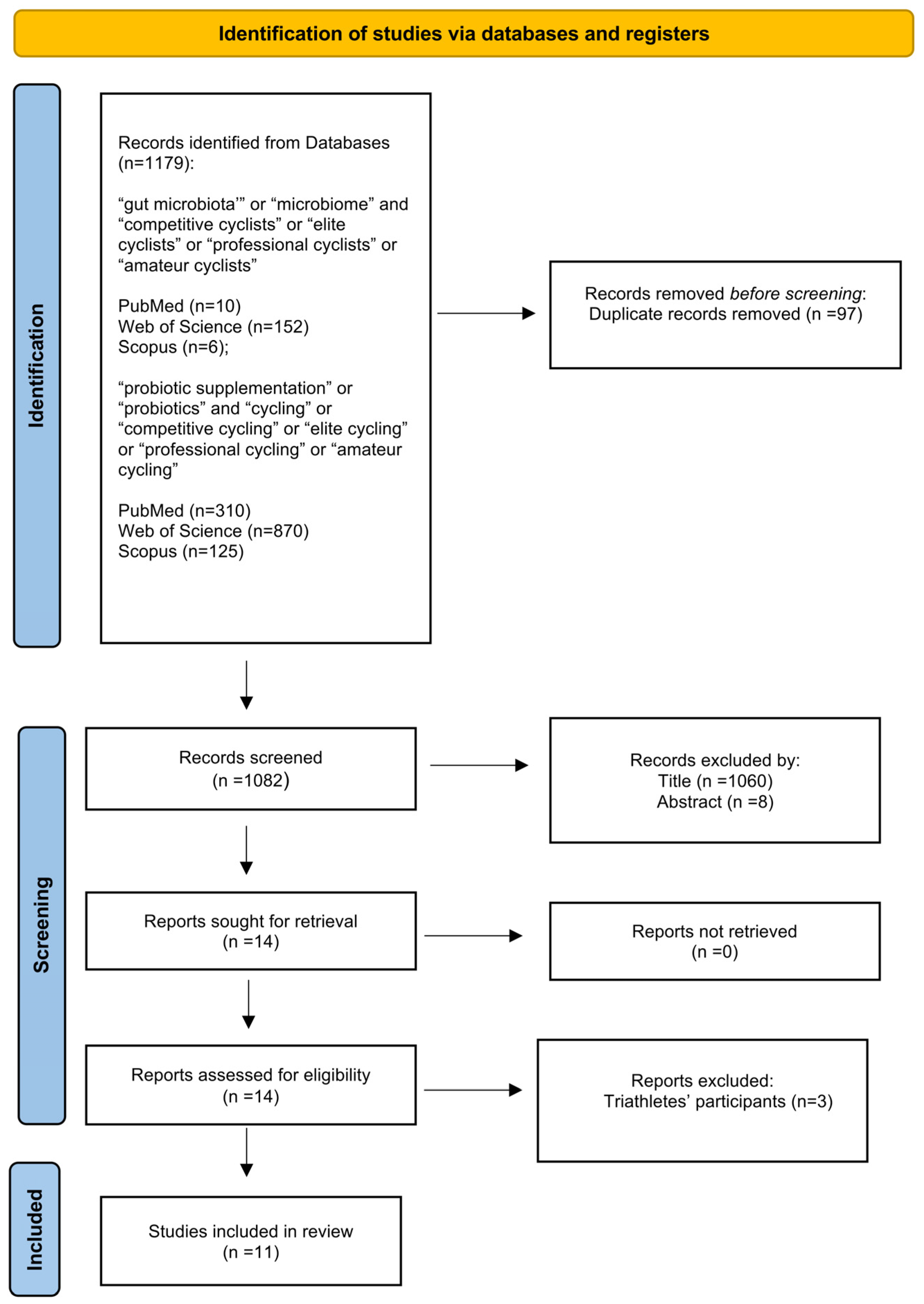
3.1. Studies’ Identification
3.2. Study Characteristics
3.3. Gut Microbiota Assessment
3.4. Probiotics Supplementation
4. Discussion
4.1. Gut Microbiota Composition
4.2. Probiotics Effects
4.2.1. Gastrointestinal and Respiratory Symptoms
4.2.2. Intestinal Permeability
4.2.3. Anti-Inflammatory Role
4.2.4. Cycling Performance
4.3. Limitations and Future Studies
5. Conclusions
Supplementary Materials
Author Contributions
Funding
Institutional Review Board Statement
Informed Consent Statement
Data Availability Statement
Conflicts of Interest
References
- Shreiner, A.B.; Kao, J.Y.; Young, V.B. The gut microbiome in health and in disease. Curr. Opin. Gastroenterol. 2015, 31, 69–75. [Google Scholar] [CrossRef]
- Iqbal, S.; Quigley, E.M. Progress in Our Understanding of the Gut Microbiome: Implications for the Clinician. Curr. Gastroenterol. Rep. 2016, 18, 49. [Google Scholar] [CrossRef]
- Eckburg, P.B.; Bik, E.M.; Bernstein, C.N.; Purdom, E.; Dethlefsen, L.; Sargent, M.; Gill, S.R.; Nelson, K.E.; Relman, D.A. Diversity of the human intestinal microbial flora. Science 2005, 308, 1635–1638. [Google Scholar] [CrossRef]
- Cronin, O.; Molloy, M.G.; Shanahan, F. Exercise, fitness, and the gut. Curr. Opin. Gastroenterol. 2016, 32, 67–73. [Google Scholar] [CrossRef]
- Rinninella, E.; Cintoni, M.; Raoul, P.; Lopetuso, L.R.; Scaldaferri, F.; Pulcini, G.; Miggiano, G.A.D.; Gasbarrini, A.; Mele, M.C. Food components and dietary habits: Keys for a healthy gut microbiota composition. Nutrients 2019, 11, 2393. [Google Scholar] [CrossRef]
- Ghaffar, T.; Ubaldi, F.; Volpini, V.; Valeriani, F.; Romano Spica, V. The Role of Gut Microbiota in Different Types of Physical Activity and Their Intensity: Systematic Review and Meta-Analysis. Sports 2024, 12, 221. [Google Scholar] [CrossRef]
- Palladina, O. Microbiome of athletes: Its features and diversity: A literature review. Int. J. Med. Med. Res. 2024, 10, 56–63. [Google Scholar] [CrossRef]
- Mailing, L.J.; Allen, J.M.; Buford, T.W.; Fields, C.J.; Woods, J.A. Exercise and the Gut Microbiome: A Review of the Evidence, Potential Mechanisms, and Implications for Human Health. Exerc. Sport Sci. Rev. 2019, 47, 75–85. [Google Scholar] [CrossRef]
- Belmonte, G.; Rossi, C.; Vicari, D.S.S.; Canzone, A.; Drid, P.; Giustino, V.; Patti, A.; Bianco, A. Frequency of Overuse Injuries and Associated Risk Factors in Competitive Road and Off-road Cyclists: A Narrative Review. J. Sci. Sport Exerc. 2025, 1–7. [Google Scholar] [CrossRef]
- Lucia, A.; Hoyos, J.; Chicharro, J.L. Physiology of professional road cycling. Sports Med. 2001, 31, 325–337. [Google Scholar] [CrossRef]
- Carlone, J.; Rossi, C.; Bianco, A.; Drid, P.; Parisi, A.; Fasano, A. Exploring the Gut Microbiome in Combat Sports: A Systematic Scoping Review. Sports 2026, 14, 19. [Google Scholar] [CrossRef]
- Backhed, F.; Ley, R.E.; Sonnenburg, J.L.; Peterson, D.A.; Gordon, J.I. Host-bacterial mutualism in the human intestine. Science 2005, 307, 1915–1920. [Google Scholar] [CrossRef]
- Barton, W.; Penney, N.C.; Cronin, O.; Garcia-Perez, I.; Molloy, M.G.; Holmes, E.; Shanahan, F.; Cotter, P.D.; O’Sullivan, O. The microbiome of professional athletes differs from that of more sedentary subjects in composition and particularly at the functional metabolic level. Gut 2018, 67, 625–633. [Google Scholar] [CrossRef]
- Xu, L.; Li, W.; Ling, L.; Zhang, Z.; Cui, Z.; Ge, J.; Wang, Y.; Meng, Q.; Wang, Y.; Liu, K.; et al. A Sedentary Lifestyle Changes the Composition and Predicted Functions of the Gut Bacterial and Fungal Microbiota of Subjects from the Same Company. Curr. Microbiol. 2023, 80, 368. [Google Scholar] [CrossRef]
- Mohr, A.E.; Jager, R.; Carpenter, K.C.; Kerksick, C.M.; Purpura, M.; Townsend, J.R.; West, N.P.; Black, K.; Gleeson, M.; Pyne, D.B.; et al. The athletic gut microbiota. J. Int. Soc. Sports Nutr. 2020, 17, 24. [Google Scholar] [CrossRef]
- Dziewiecka, H.; Buttar, H.S.; Kasperska, A.; Ostapiuk-Karolczuk, J.; Domagalska, M.; Cichon, J.; Skarpanska-Stejnborn, A. Physical activity induced alterations of gut microbiota in humans: A systematic review. BMC Sports Sci. Med. Rehabil. 2022, 14, 122. [Google Scholar] [CrossRef]
- Clark, A.; Mach, N. Exercise-induced stress behavior, gut-microbiota-brain axis and diet: A systematic review for athletes. J. Int. Soc. Sports Nutr. 2016, 13, 43. [Google Scholar] [CrossRef]
- Monda, V.; Villano, I.; Messina, A.; Valenzano, A.; Esposito, T.; Moscatelli, F.; Viggiano, A.; Cibelli, G.; Chieffi, S.; Monda, M.; et al. Exercise Modifies the Gut Microbiota with Positive Health Effects. Oxid. Med. Cell Longev. 2017, 2017, 3831972. [Google Scholar] [CrossRef]
- Gisolfi, C.V. Is the GI System Built for Exercise? News Physiol. Sci. 2000, 15, 114–119. [Google Scholar] [CrossRef]
- Wasserfurth, P.; Palmowski, J.; Hahn, A.; Kruger, K. Reasons for and Consequences of Low Energy Availability in Female and Male Athletes: Social Environment, Adaptations, and Prevention. Sports Med. Open 2020, 6, 44. [Google Scholar] [CrossRef]
- Burke, L.M. Nutritional practices of male and female endurance cyclists. Sports Med. 2001, 31, 521–532. [Google Scholar] [CrossRef]
- Maughan, R.J.; Burke, L.M.; Dvorak, J.; Larson-Meyer, D.E.; Peeling, P.; Phillips, S.M.; Rawson, E.S.; Walsh, N.P.; Garthe, I.; Geyer, H.; et al. IOC consensus statement: Dietary supplements and the high-performance athlete. Br. J. Sports Med. 2018, 52, 439–455. [Google Scholar] [CrossRef]
- Pegreffi, F.; Donati Zeppa, S.; Gervasi, M.; Fernández-Peña, E.; Annibalini, G.; Bartolacci, A.; Formiglio, E.; Agostini, D.; Barbato, C.; Sestili, P.; et al. A Snapshot of Vitamin D Status, Performance, Blood Markers, and Dietary Habits in Runners and Non-Runners. Nutrients 2024, 16, 3912. [Google Scholar] [CrossRef]
- Garcia-Duran, J.; Romero-Garcia, D.; Martinez-Sanz, J.M.; Gonzalez-Jurado, J.A.; Sanchez-Oliver, A.J. Sports Supplement Use in Road Cycling: A Comparative Analysis by Sex and Competitive Category. Sports 2025, 13, 122. [Google Scholar] [CrossRef]
- Aykut, M.N.; Erdogan, E.N.; Celik, M.N.; Gurbuz, M. An Updated View of the Effect of Probiotic Supplement on Sports Performance: A Detailed Review. Curr. Nutr. Rep. 2024, 13, 251–263. [Google Scholar] [CrossRef]
- Jarrett, H.; Medlin, S.; Morehen, J.C. The Role of the Gut Microbiome and Probiotics in Sports Performance: A Narrative Review Update. Nutrients 2025, 17, 690. [Google Scholar] [CrossRef]
- Huang, W.C.; Wei, C.C.; Huang, C.C.; Chen, W.L.; Huang, H.Y. The Beneficial Effects of Lactobacillus plantarum PS128 on High-Intensity, Exercise-Induced Oxidative Stress, Inflammation, and Performance in Triathletes. Nutrients 2019, 11, 353. [Google Scholar] [CrossRef]
- Wang, L.; Meng, F.-J.; Jin, Y.-H.; Wu, L.-Q.; Tang, R.-Y.; Xu, K.-H.; Guo, Y.; Mao, J.-J.; Ding, J.-P.; Li, J. Effects of probiotic supplementation on 12 min run performance, mood management, body composition and gut microbiota in amateur marathon runners: A double-blind controlled trial. J. Exerc. Sci. Fit. 2024, 22, 297–304. [Google Scholar] [CrossRef]
- Peters, H.P.; De Vries, W.R.; Vanberge-Henegouwen, G.P.; Akkermans, L.M. Potential benefits and hazards of physical activity and exercise on the gastrointestinal tract. Gut 2001, 48, 435–439. [Google Scholar] [CrossRef]
- Zeng, Q.; Lin, P.; Wu, H.; Zhuang, Y.; Zhang, Y.; Asemani, S.; Jamilian, P.; Jamali, M.; Yu, H. Correction: Probiotics and gastrointestinal disorders: An umbrella meta-analysis of therapeutic efficacy. Eur. J. Med. Res. 2025, 30, 646. [Google Scholar] [CrossRef]
- Jeukendrup, A.; Vet-Joop, K.; Sturk, A.; Stegen, J.; Senden, J.; Saris, W.; Wagenmakers, A. Relationship between gastro-intestinal complaints and endotoxaemia, cytokine release and the acute-phase reaction during and after a long-distance triathlon in highly trained men. Clin. Sci. 2000, 98, 47–55. [Google Scholar]
- Peters, H.P.; Bos, M.; Seebregts, L.; Akkermans, L.M.; van Berge Henegouwen, G.P.; Bol, E.; Mosterd, W.L.; de Vries, W.R. Gastrointestinal symptoms in long-distance runners, cyclists, and triathletes: Prevalence, medication, and etiology. Am. J. Gastroenterol. 1999, 94, 1570–1581. [Google Scholar] [CrossRef]
- de Oliveira, E.P.; Burini, R.C.; Jeukendrup, A. Gastrointestinal complaints during exercise: Prevalence, etiology, and nutritional recommendations. Sports Med. 2014, 44, S79–S85. [Google Scholar] [CrossRef]
- Martinez, P.; Martinez, S.; Mingorance, J.A.; Riera-Sampol, A.; Aguilo, A.; Tauler, P. Gastrointestinal symptoms and nutritional intake among participants in a non-professional cycling event. Eur. J. Appl. Physiol. 2025, 125, 37–48. [Google Scholar] [CrossRef]
- Huang, W.C.; Pan, C.H.; Wei, C.C.; Huang, H.Y. Lactobacillus plantarum PS128 Improves Physiological Adaptation and Performance in Triathletes through Gut Microbiota Modulation. Nutrients 2020, 12, 2315. [Google Scholar] [CrossRef] [PubMed]
- Roberts, J.D.; Suckling, C.A.; Peedle, G.Y.; Murphy, J.A.; Dawkins, T.G.; Roberts, M.G. An Exploratory Investigation of Endotoxin Levels in Novice Long Distance Triathletes, and the Effects of a Multi-Strain Probiotic/Prebiotic, Antioxidant Intervention. Nutrients 2016, 8, 733. [Google Scholar] [CrossRef]
- Tricco, A.C.; Lillie, E.; Zarin, W.; O’Brien, K.K.; Colquhoun, H.; Levac, D.; Moher, D.; Peters, M.D.J.; Horsley, T.; Weeks, L.; et al. PRISMA Extension for Scoping Reviews (PRISMA-ScR): Checklist and Explanation. Ann. Intern. Med. 2018, 169, 467–473. [Google Scholar] [CrossRef] [PubMed]
- Page, M.J.; McKenzie, J.E.; Bossuyt, P.M.; Boutron, I.; Hoffmann, T.C.; Mulrow, C.D.; Shamseer, L.; Tetzlaff, J.M.; Akl, E.A.; Brennan, S.E.; et al. The PRISMA 2020 statement: An updated guideline for reporting systematic reviews. BMJ 2021, 372, n71. [Google Scholar] [CrossRef]
- Petersen, L.M.; Bautista, E.J.; Nguyen, H.; Hanson, B.M.; Chen, L.; Lek, S.H.; Sodergren, E.; Weinstock, G.M. Community characteristics of the gut microbiomes of competitive cyclists. Microbiome 2017, 5, 98. [Google Scholar] [CrossRef] [PubMed]
- Wiącek, J.; Szurkowska, J.; Kryściak, J.; Galecka, M.; Karolkiewicz, J. No changes in the abundance of selected fecal bacteria during increased carbohydrates consumption period associated with the racing season in amateur road cyclists. PeerJ 2023, 11, e14594. [Google Scholar] [CrossRef]
- Aya, J.V.; Vega, L.C.; Muñoz, E.; Muñoz, M.; López, D.F.; Guzmán, M.P.; Martínez, D.F.; Cruz-Saavedra, L.B.; Castillo, A.K.; Quintero, K.J.; et al. Divergent Gut Microbiota: Archaeal and Bacterial Signatures Unveil Unique Patterns in Colombian Cyclists Compared to Weightlifters and Non-Athletes. Adv. Biol. 2024, 8, e2400069. [Google Scholar] [CrossRef]
- Fernandez-Sanjurjo, M.; Fernandez, J.; Martinez-Camblor, P.; Rodriguez-Alonso, M.; Ortolano-Rios, R.; Pinto-Hernandez, P.; Castilla-Silgado, J.; Coto-Vilcapoma, A.; Ruiz, L.; Villar, C.J.; et al. Dynamics of Gut Microbiota and Short-Chain Fatty Acids during a Cycling Grand Tour Are Related to Exercise Performance and Modulated by Dietary Intake. Nutrients 2024, 16, 661. [Google Scholar] [CrossRef]
- Ampe, T.; Decroix, L.; De Pauw, K.; Meeusen, R.; Demuyser, T.; Roelands, B. Nutritional and Physiological Demands Shape the Gut Microbiome of Female World Tour Cyclists. Microorganisms 2025, 13, 2345. [Google Scholar] [CrossRef]
- Shalmon, G.; Ibrahim, R.; Israel-Elgali, I.; Grad, M.; Shlayem, R.; Shapira, G.; Shomron, N.; Youngster, I.; Scheinowitz, M. Differential Gut Microbiome Profiles in Long-Distance Endurance Cyclists and Runners. Life 2024, 14, 1703. [Google Scholar] [CrossRef]
- Aya, V.; Pardo-Rodriguez, D.; Vega, L.C.; Cala, M.P.; Ramirez, J.D. Integrating metagenomics and metabolomics to study the gut microbiome and host relationships in sports across different energy systems. Sci. Rep. 2025, 15, 15356. [Google Scholar] [CrossRef]
- West, N.P.; Pyne, D.B.; Cripps, A.W.; Hopkins, W.G.; Eskesen, D.C.; Jairath, A.; Christophersen, C.T.; Conlon, M.A.; Fricker, P.A. Lactobacillus fermentum (PCC) supplementation and gastrointestinal and respiratory-tract illness symptoms: A randomised control trial in athletes. Nutr. J. 2011, 10, 30. [Google Scholar] [CrossRef] [PubMed]
- Pugh, J.N.; Wagenmakers, A.J.M.; Doran, D.A.; Fleming, S.C.; Fielding, B.A.; Morton, J.P.; Close, G.L. Probiotic supplementation increases carbohydrate metabolism in trained male cyclists: A randomized, double-blind, placebo-controlled crossover trial. Am. J. Physiol. Endocrinol. Metab. 2020, 318, E504–E513. [Google Scholar] [CrossRef]
- Schreiber, C.; Tamir, S.; Golan, R.; Weinstein, A.; Weinstein, Y. The effect of probiotic supplementation on performance, inflammatory markers and gastro-intestinal symptoms in elite road cyclists. J. Int. Soc. Sports Nutr. 2021, 18, 36. [Google Scholar] [CrossRef] [PubMed]
- Mazur-Kurach, P.; Frączek, B.; Klimek, A.T. Does Multi-Strain Probiotic Supplementation Impact the Effort Capacity of Competitive Road Cyclists? Int. J. Environ. Res. Public Health 2022, 19, 12205. [Google Scholar] [CrossRef]
- Sitko, S.; Cirer-Sastre, R.; Garatachea, N.; López-Laval, I. Anthropometric Characteristics of Road Cyclists of Different Performance Levels. Appl. Sci. 2023, 13, 224. [Google Scholar]
- Wiacek, J.; Karolkiewicz, J. Different Approaches to Ergogenic, Pre-, and Probiotic Supplementation in Sports with Different Metabolism Characteristics: A Mini Review. Nutrients 2023, 15, 1541. [Google Scholar] [CrossRef] [PubMed]


| First Author and Year | Participants | Type of Outcomes/Variables Studied | Main Results |
|---|---|---|---|
| Petersen et al. 2017 [39] | n = 33 competitive cyclists (11 females, 22 males) divided into professional and category 1 | Competitive cyclists’ microbiota using whole genome shotgun and metatranscriptomic sequencing | Cyclists clustered into three distinct enterotypes dominated by Prevotella, Bacteroides, or a mixed community (Eubacterium, Ruminococcus, Akkermansia). High Prevotella abundance (>2.5%) positively correlated with weekly exercise duration and the upregulation of carbohydrate and branched-chain amino acid (BCAA) metabolic pathways. Professional cyclists exhibited higher M. smithii transcriptional activity compared to amateurs, with upregulated methane synthesis genes. M. smithii presence suggests enhanced gut metabolic efficiency in elite athletes through synergistic cross-feeding mechanisms. |
| Wiącek et al. 2023 [40] | n = 25 active men (14 amateur cyclists and 11 control group | Assessment of the fecal pH and the abundances of Bifidobacterium spp., Bacteroides spp., Akkermansia muciniphila, and Faecalibacterium prausnitzii | Pre-competition gut bacterial abundance and fecal pH remained stable despite variations in diet and endurance. Increased carbohydrate intake during the racing season did not alter these parameters. |
| Aya et al. 2024 [41] | n = 44 Colombian participants (25 men and 19 women), 16 were weightlifters, 13 were professional road cyclists, and 15 were not athletes. | Two weeks before the national competitions, participants gave fecal samples during their pre-competitive phase. Questionnaire responses were gathered, and GraPhlAn, Pavian, and MicrobiomeAnalyst 2.0 were used to examine the microbial composition and find differences between groups. | Differentially numerous species are revealed by ANCOM-BC2. Road cyclists have higher abundances of Archaea and lower levels of Bacteria. Planctomycetes, Acidobacteria, and Proteobacteria were among the phylum-level variants, although Bacteroidetes were the most common. The Bacteroidaceae, Muribaculaceae, and Selnomonadaceae are important families that affect gut microbiota. Weightlifters have distinct relationships with the viral and archaeal communities, whereas cyclists have specialized microbial interactions driven by endurance training. |
| Fernandez-Sanjurjo et al. 2024 [42] | n = 16 professional cyclists competing in “La Vuelta 2019” | The fecal microbiota populations and SCFA content were analyzed using 16S rRNA sequencing and gas chromatography, respectively. | Strong predictive value for Bifidobacteriaceae, Coriobacteriaceae, Erysipelotrichaceae, and Sutterellaceae dynamics (r = 0.83 for ranking; r = 0.81 for accumulated time). Positive correlations between Coriobacteriaceae and acetate (r = 0.530)/isovalerate (r = 0.664), and Bifidobacteriaceae with isobutyrate (r = 0.682). No correlation between SCFA levels and performance. Pre-competition complex carbohydrate intake was positively linked to baseline Erysipelotrichaceae (r = 0.956); intra-competition simple carbohydrate supplementation negatively impacted Bifidobacteriaceae (r = −0.650). Ecological modeling outperformed single-taxon analysis in characterizing microbiota-performance links. |
| Ampe et al. 2025 [43] | n = 27 (14 elite female cyclists and 13 non-athlete female controls) | 16S rRNA gene sequencing and SCFA quantification of fecal samples collected during the off-season (reduced training period). | Significant enrichment of Bacteroidota and reduction in Firmicutes in cyclists vs. controls. Lower microbial diversity in cyclists (Shannon index, p < 0.05). Depletion of fiber-degrading families (Lachnospiraceae, Ruminococcaceae) associated with high-carbohydrate/low-fiber intake. Fecal SCFA concentrations remained stable, suggesting functional compensation. |
| Shalmon et al. 2024 [44] | n = 58: 18 amateur cyclists (9 males), 22 runners (13 males), and 18 control subjects (9 males) | Fecal samples were analyzed using 16S rRNA sequencing to characterize species composition, and both alpha and beta diversity metrics were used to evaluate differences between groups. Participants also underwent a VO2max test and a time-to-exhaustion trial performed at 85% of their VO2max, during which blood lactate was sampled every five minutes. | Alpha diversity differed significantly between cyclists and runners (p-adj < 0.001), with male cyclists exhibiting markedly lower diversity than male runners (p-adj < 0.001). Comparative taxonomic profiling across cyclists, runners, and controls revealed shifts in the abundance of fifteen bacterial taxa. Several microbial features were linked to performance metrics: six taxa in cyclists and eight in runners showed significant positive correlations with training volume, time-to-exhaustion, VO2max, or blood lactate concentrations. |
| Aya 2025 [45] | n = 29 Colombian athletes: 16 elite weightlifters and 13 professional cyclists | Fecal and plasma samples obtained one month prior to the international competition were analyzed using metagenomic, metabolomic, and lipidomic approaches. | Key metabolic pathways—including those related to aromatic amino acid synthesis, arginine production, and folate metabolism—were enriched in both athlete groups. Plasma metabolomic and lipidomic data showed clear distinctions between the groups. The results emphasize the interplay between gut microbiota features and systemic metabolic responses shaped by sport-specific requirements. |
| First Author and Year | Participants | Probiotic Dose Intake/ Intervention Length | Type of Outcomes/Variables Studied | Main Results |
| West et al. 2011 [46] | n = 99 amateur cyclists (64 M and 35 F) divided into: - Probiotic group n = 47 (29 M; 35.2 ± 10.3 years and 18 F; 36.5 ± 8.6 years) - Placebo group n = 50 (33 M; 36.4 ± 8.9 years and 17 F; 35.6 ± 10.2 years) | 1 × 10⁹ Probiotic supplement: Lactobacillus fermentum (PCC) per day for 11 weeks | - The self-reported number, duration, severity and combined load of gastrointestinal symptoms illness (GI). - The self-reported number, duration, severity and combined load of upper respiratory tract symptoms illness (URTI) and lower respiratory illness. - Stool Lactobacillus fermentum counts. - Serum cytokine marker analysis: interleukin (IL)-1RA, IL-6, IL-8, IL-10, tumor necrosis factor (TNF)-a and interferon gamma (INF-g). | Gastrointestinal assessments revealed a two-fold increase in the incidence and duration of mild symptoms across both sexes; however, probiotic-supplemented males reported a severity score 0.7 points lower than the placebo group, an effect that intensified alongside higher training loads. Regarding respiratory health, while the impact on URTIs remained inconclusive, probiotic use was associated with a roughly 50% reduction in the number, duration, and severity of lower respiratory symptoms in males. Conversely, female cyclists experienced a two-fold increase in the frequency of lower respiratory symptoms, although their overall severity was reduced. These clinical outcomes were mirrored by shifts in microbiota composition, where total Lactobacillus counts saw a moderate 330% increase in the male probiotic group compared to a 44% decrease in the placebo group, while differences among females remained minimal. |
| Pugh et al. 2020 [47] | n = 7 trained cyclists (M); 23 ± 4 years divided into Probiotic group or Placebo group | 1 × 10¹⁰ multi-strain Pro (commercially available probiotic). The Probiotic supplement contained the active strains: Lactobacillus acidophilus (CUL60), Lactobacillus acidophilus (CUL21), Bifidobacterium bifidum (CUL20), and Bifidobacterium animalis subsp. lactis (CUL34) per day for 4 weeks, separated by a 2-week washout period | - Lipid and carbohydrate oxidation after an oral dose of maltodextrin during a trial of 120 min of cycling at 55% maximal aerobic power output, followed by a 100 kJ time trial. - Blood parameters: Plasma glucose, lactate, nonesterified fatty acids (NEFAs), and glycerol. - Gastrointestinal permeability: lactulose and rhamnose ratio (LR) through blood samples. - Subjective symptoms of discomfort | Probiotic supplementation significantly influenced metabolic substrate utilization during exercise, characterized by slightly higher peak oxidation rates of ingested maltodextrin (p = 0.016) and increased mean carbohydrate oxidation (p = 0.038), alongside a mild decrease in fat oxidation (p = 0.021). These metabolic shifts were supported by small but significant increases in glucose absorption, plasma glucose, and insulin concentrations, coupled with a reduction in non-esterified fatty acids and glycerol within the probiotic group. Despite these physiological changes, the intervention yielded no significant impact on time-trial performance, gastrointestinal damage, or intestinal permeability (p > 0.05). |
| Schreiber et al. 2021 [48] | n = 27 (M); ranked elite or category 1 level competitions divided into: - Experimental group n = 11; 25.9 ± 4.6 years - Control group n = 16; 29.5 ± 6.2 years | 1 × 10¹⁰ multi-strain Probiotic supplement with five strains: at least (≥) 4.3 × 10⁹ CFU Lactobacillus helveticus Lafti L10 (28.6%), ≥4.3 × 10⁹ CFU Bifidobacterium animalis ssp. lactis Lafti B94 (28.6%), ≥3.9 × 10⁹ CFU Enterococcus faecium R0026 (25.7%), ≥2.1 × 10⁹ CFU Bifidobacterium longum R0175 (14.3%) and ≥0.4 × 10⁹ CFU Bacillus subtilis R0179 (2.8%) per day for 12 weeks | - Personal and GI symptoms questionnaire. - VO2max test. - Time to fatigue (TTF) test. - Inflammatory Blood markers analysis: IL-6, TNFα and CRP | A lower incidence of GI symptoms during training sessions in the experimental group compared to the control group was registered (p = 0.04). Especially the incidence of nausea (p = 0.01), belching (p = 0.04), and vomiting (p = 0.04). No significant effects in the VO2max test and TTF test in terms of physiological variables were found. Only RPE (rate of perceived exertion) scores during the TTF test were found to have changed between groups (p = 0.04). Not all inflammatory markers were significantly changed. |
| Mazur-Kurach et al. 2022 [49] | n = 26 (M) amateur road cyclists assigned to: - Probiotic group n = 13; 23.25 years - Control group n = 13; 21.28 years | 1 × 10¹¹ multi-strain Probiotic supplement, which contained: Lactobacillus plantarum, Lactobacillus casei, Lactobacillus rhamnosus, Bifidobacterium breve, Lactobacillus acidophilus, Bifidobacterium longum, Bifidobacterium bifidum, Bifidobacterium infantis, Lactobacillus helveticus, Lactobacillus fermentum, Lactobacillus bulgaricus, Lactococcus lactis, and Streptococcus thermophilus per day for 16 weeks. The follow-up measurements were the baseline, after 4 weeks, after 12 weeks, and the final measurement after 16 weeks. | - Aerobic Performance (Incremental Test): Maximal oxygen uptake (VO2max), exercise duration, maximum power (Pmax), maximal heart rate (HRmax), and perceived exertion (Borg-20 scale). - Anaerobic test (Modified Wingate Test): Maximal anaerobic power, level of total work, average power per revolution, mean time to achieve maximal anaerobic power and time to maintain maximal anaerobic power. - Anthropometry: Body mass (BM), fat mass (FM), and lean body mass (LBM) - Blood lactate levels in Aerobic and Anaerobic Tests: Pre-exercise, after 3 min, 10 min and 20 min of exercise - Blood Biochemistry: Serial monitoring (pre-exercise, 3, 10, and 20 min post) of lactate levels, inflammatory cytokines (IL-1β, IL-6, IL-8, IL-10, TNF-α), IgA, and oxidative stress markers (TOS, TAS). - Intestinal Permeability: Fecal concentration of zonulin and α1-atitrypsin | Following 16 weeks of probiotic supplementation, significant improvements were observed in aerobic performance, characterized by increased VO2max and time to exhaustion, alongside a reduction in maximal heart rate (p < 0.05). Metabolic recovery was enhanced, with blood lactate concentrations post-aerobic testing significantly lower at 10 and 20 min compared to baseline (p < 0.01); notably, the probiotic group also reported lower perceived physical fatigue (p = 0.0026). While anaerobic capacity remained unaffected, a slight but significant increase in muscle mass was noted (p = 0.02). Furthermore, the intervention strengthened intestinal barrier function, evidenced by reduced zonulin levels (p = 0.0035), and bolstered mucosal immunity via increased IgA (p = 0.01). These changes were accompanied by a systemic reduction in inflammatory and oxidative stress markers, including TNF-alpha, IL-6, IL-10, and TOS (p < 0.01). |
Disclaimer/Publisher’s Note: The statements, opinions and data contained in all publications are solely those of the individual author(s) and contributor(s) and not of MDPI and/or the editor(s). MDPI and/or the editor(s) disclaim responsibility for any injury to people or property resulting from any ideas, methods, instructions or products referred to in the content. |
© 2026 by the authors. Licensee MDPI, Basel, Switzerland. This article is an open access article distributed under the terms and conditions of the Creative Commons Attribution (CC BY) license.
Share and Cite
Belmonte, G.; Gervasi, M.; Agostini, D.; Donati Zeppa, S.; Formiglio, E.; Di Mitri, I.R.; Fernández-Peña, E.; Bartolacci, A.; Stocchi, V.; Paoli, A.; et al. Gut Microbiota Profile and the Impact of Probiotic Supplementation in Competitive Cyclists: A Scoping Review. Nutrients 2026, 18, 991. https://doi.org/10.3390/nu18060991
Belmonte G, Gervasi M, Agostini D, Donati Zeppa S, Formiglio E, Di Mitri IR, Fernández-Peña E, Bartolacci A, Stocchi V, Paoli A, et al. Gut Microbiota Profile and the Impact of Probiotic Supplementation in Competitive Cyclists: A Scoping Review. Nutrients. 2026; 18(6):991. https://doi.org/10.3390/nu18060991
Chicago/Turabian StyleBelmonte, Giacomo, Marco Gervasi, Deborah Agostini, Sabrina Donati Zeppa, Eugenio Formiglio, Irene Rosa Di Mitri, Eneko Fernández-Peña, Alessia Bartolacci, Vilberto Stocchi, Antonio Paoli, and et al. 2026. "Gut Microbiota Profile and the Impact of Probiotic Supplementation in Competitive Cyclists: A Scoping Review" Nutrients 18, no. 6: 991. https://doi.org/10.3390/nu18060991
APA StyleBelmonte, G., Gervasi, M., Agostini, D., Donati Zeppa, S., Formiglio, E., Di Mitri, I. R., Fernández-Peña, E., Bartolacci, A., Stocchi, V., Paoli, A., Bianco, A., & Patti, A. (2026). Gut Microbiota Profile and the Impact of Probiotic Supplementation in Competitive Cyclists: A Scoping Review. Nutrients, 18(6), 991. https://doi.org/10.3390/nu18060991