New Drugs on the Block: Dietary Management and Nutritional Considerations During the Use of Anti-Obesity Medication

 , , , ,
  and
and
Abstract
1. Introduction
2. Materials and Methods
3. Nutritional Adverse Events
3.1. Gastrointestinal Adverse Events and Underlying Causes
3.2. Discontinuation Due to Adverse Events
3.3. Nutritional Status and Body Composition
3.3.1. Lean Body Mass
3.3.2. Osteoporosis
4. Nutritional Strategies Implemented in Major GLP-1/GIP Trials
Dealing with Adverse Events
5. Boosting Endogenous GLP-1 and GIP Secretion
6. Real-World Data on the Dietary Intake of PwO on GLP-1/GIP RA Therapy
7. Dietary Strategies for the Prevention of Gastrointestinal Adverse Events
8. Future Research
Limitations of the Present Review
9. Conclusions
Author Contributions
Funding
Institutional Review Board Statement
Informed Consent Statement
Data Availability Statement
Conflicts of Interest
Abbreviations
| αLA | α-linolenic acid |
| AEs | Adverse events |
| AP/NTS | Area postrema and nucleus tractus solitarius |
| BIA | Bioelectrical impedance analysis |
| BMD | Bone mineral density |
| BMI | Body Mass Index |
| BRAT | Bananas, rice, applesauce, and toast |
| CS | CagriSema |
| DHA | Docosahexaenoic acid |
| DUL | Dulaglutide |
| DEXA | Dual-energy X-ray absorptiometry |
| EPA | Eicosapentaenoic acid |
| FFQ | Food frequency questionnaire |
| FODMAP | Fermentable oligosaccharides, disaccharides, monosaccharides, and polyols |
| HEI | Healthy eating index |
| GERD | Gastroesophageal reflux disease |
| GI | Gastrointestinal |
| GIP | Glucose-dependent insulinotropic polypeptide |
| GLP-1 RAs | Glucagon-like peptide-1 analogs and receptor agonists |
| IBD | Inflammatory bowel disease |
| LCPUFAs | Long-chain polyunsaturated fatty acids |
| LIR | Liraglutide |
| MNT | Medical nutrition therapy |
| PwO | People with obesity |
| RCT | Randomized controlled trials |
| RDN | Registered dietitian/nutritionist |
| SEM | Semaglutide |
| SIBO | Small intestinal bacterial overgrowth |
| T2DM | Type 2 diabetes mellitus |
| TZP | Tirzepatide |
| WHO | World Health Organization |
References
- Moiz, A.; Filion, K.B.; Toutounchi, H.; Tsoukas, M.A.; Yu, O.H.Y.; Peters, T.M.; Eisenberg, M.J. Efficacy and Safety of Glucagon-Like Peptide-1 Receptor Agonists for Weight Loss Among Adults Without Diabetes. Ann. Intern. Med. 2025, 178, 199–217. [Google Scholar] [CrossRef] [PubMed]
- U.S. Food and Drug Administration (FDA); Center for Drug Evaluation and Research (CDER). Wegovy® (Semaglutide) Injection, for Subcutaneous Use. Available online: https://www.accessdata.fda.gov/drugsatfda_docs/label/2023/215256s007lbl.pdf (accessed on 11 February 2026).
- Eli Lilly and Company Zepbound® (Tirzepatide) Injection, for Subcutaneous Use: Prescribing Information. Available online: https://uspl.lilly.com/zepbound/zepbound.html#pi (accessed on 15 February 2026).
- Novo Nordisk Saxenda® (Liraglutide) Injection 3 Mg: Prescribing Information. Available online: https://www.accessdata.fda.gov/drugsatfda_docs/label/2024/206321s019lbl.pdf (accessed on 16 February 2026).
- Novo Nordisk Ozempic® (Semaglutide) Injection, for Subcutaneous Use: Prescribing Information. Available online: https://www.accessdata.fda.gov/drugsatfda_docs/label/2017/209637lbl.pdf (accessed on 16 February 2026).
- Eli Lilly and Company Mounjaro® (Tirzepatide) Injection, for Subcutaneous Use: Prescribing Information. Available online: https://pi.lilly.com/us/mounjaro-uspi.pdf (accessed on 16 February 2026).
- Wilding, J.P.H.; Batterham, R.L.; Calanna, S.; Davies, M.; Van Gaal, L.F.; Lingvay, I.; McGowan, B.M.; Rosenstock, J.; Tran, M.T.D.; Wadden, T.A.; et al. Once-Weekly Semaglutide in Adults with Overweight or Obesity. N. Engl. J. Med. 2021, 384, 989–1002. [Google Scholar] [CrossRef] [PubMed]
- Jastreboff, A.M.; Aronne, L.J.; Ahmad, N.N.; Wharton, S.; Connery, L.; Alves, B.; Kiyosue, A.; Zhang, S.; Liu, B.; Bunck, M.C.; et al. Tirzepatide Once Weekly for the Treatment of Obesity. N. Engl. J. Med. 2022, 387, 205–216. [Google Scholar] [CrossRef] [PubMed]
- Pi-Sunyer, X.; Astrup, A.; Fujioka, K.; Greenway, F.; Halpern, A.; Krempf, M.; Lau, D.C.W.; le Roux, C.W.; Violante Ortiz, R.; Jensen, C.B.; et al. A Randomized, Controlled Trial of 3.0 Mg of Liraglutide in Weight Management. N. Engl. J. Med. 2015, 373, 11–22. [Google Scholar] [CrossRef]
- Jastreboff, A.M.; Kaplan, L.M.; Frías, J.P.; Wu, Q.; Du, Y.; Gurbuz, S.; Coskun, T.; Haupt, A.; Milicevic, Z.; Hartman, M.L.; et al. Triple-Hormone-Receptor Agonist Retatrutide for Obesity—A Phase 2 Trial. N. Engl. J. Med. 2023, 389, 514–526. [Google Scholar] [CrossRef]
- Davies, M.J.; Bajaj, H.S.; Broholm, C.; Eliasen, A.; Garvey, W.T.; le Roux, C.W.; Lingvay, I.; Lyndgaard, C.B.; Rosenstock, J.; Pedersen, S.D. Cagrilintide–Semaglutide in Adults with Overweight or Obesity and Type 2 Diabetes. N. Engl. J. Med. 2025, 393, 648–659. [Google Scholar] [CrossRef]
- Garvey, W.T.; Blüher, M.; Osorto Contreras, C.K.; Davies, M.J.; Winning Lehmann, E.; Pietiläinen, K.H.; Rubino, D.; Sbraccia, P.; Wadden, T.; Zeuthen, N.; et al. Coadministered Cagrilintide and Semaglutide in Adults with Overweight or Obesity. N. Engl. J. Med. 2025, 393, 635–647. [Google Scholar] [CrossRef]
- Secher, A.; Lutz, T.A.; Raun, K. The Story of Amylin: From Physiology to Therapy. Nat. Metab. 2026, 8, 299–312. [Google Scholar] [CrossRef]
- Ismaiel, A.; Scarlata, G.G.M.; Boitos, I.; Leucuta, D.-C.; Popa, S.-L.; Al Srouji, N.; Abenavoli, L.; Dumitrascu, D.L. Gastrointestinal Adverse Events Associated with GLP-1 RA in Non-Diabetic Patients with Overweight or Obesity: A Systematic Review and Network Meta-Analysis. Int. J. Obes. 2025, 49, 1946–1957. [Google Scholar] [CrossRef]
- Rodriguez, P.J.; Zhang, V.; Gratzl, S.; Do, D.; Goodwin Cartwright, B.; Baker, C.; Gluckman, T.J.; Stucky, N.; Emanuel, E.J. Discontinuation and Reinitiation of Dual-Labeled GLP-1 Receptor Agonists Among US Adults With Overweight or Obesity. JAMA Netw. Open 2025, 8, e2457349. [Google Scholar] [CrossRef]
- Gleason, P.P.; Urick, B.Y.; Marshall, L.Z.; Friedlander, N.; Qiu, Y.; Leslie, R.S. Real-World Persistence and Adherence to Glucagon-like Peptide-1 Receptor Agonists among Obese Commercially Insured Adults without Diabetes. J. Manag. Care Spec. Pharm. 2024, 30, 860–867. [Google Scholar] [CrossRef]
- Do, D.; Lee, T.; Peasah, S.K.; Good, C.B.; Inneh, A.; Patel, U. GLP-1 Receptor Agonist Discontinuation Among Patients With Obesity and/or Type 2 Diabetes. JAMA Netw. Open 2024, 7, e2413172. [Google Scholar] [CrossRef]
- Sinha, B.; Ghosal, S. Efficacy and Safety of GLP-1 Receptor Agonists, Dual Agonists, and Retatrutide for Weight Loss in Adults With Overweight or Obesity: A Bayesian NMA. Obesity 2025, 33, 2046–2054. [Google Scholar] [CrossRef]
- Kim, D.D.; Hwang, J.H.; Fendrick, A.M. Balancing Innovation and Affordability in Anti-Obesity Medications: The Role of an Alternative Weight-Maintenance Program. Health Aff. Sch. 2024, 2, qxae055. [Google Scholar] [CrossRef] [PubMed]
- Canva Pty Ltd., Sydney, Australia. Canva. Available online: https://www.canva.com/ (accessed on 22 January 2026).
- Zheng, Z.; Zong, Y.; Ma, Y.; Tian, Y.; Pang, Y.; Zhang, C.; Gao, J. Glucagon-like Peptide-1 Receptor: Mechanisms and Advances in Therapy. Signal Transduct. Target. Ther. 2024, 9, 234. [Google Scholar] [CrossRef] [PubMed]
- Baggio, L.L.; Drucker, D.J. Glucagon-like Peptide-1 Receptors in the Brain: Controlling Food Intake and Body Weight. J. Clin. Investig. 2014, 124, 4223–4226. [Google Scholar] [CrossRef] [PubMed]
- Jalleh, R.J.; Rayner, C.K.; Hausken, T.; Jones, K.L.; Camilleri, M.; Horowitz, M. Gastrointestinal Effects of GLP-1 Receptor Agonists: Mechanisms, Management, and Future Directions. Lancet Gastroenterol. Hepatol. 2024, 9, 957–964. [Google Scholar] [CrossRef]
- Phillips, L.K.; Deane, A.M.; Jones, K.L.; Rayner, C.K.; Horowitz, M. Gastric Emptying and Glycaemia in Health and Diabetes Mellitus. Nat. Rev. Endocrinol. 2015, 11, 112–128. [Google Scholar] [CrossRef]
- Delgado-Aros, S.; Vella, A.; Camilleri, M.; Low, P.A.; Burton, D.D.; Thomforde, G.M.; Stephens, D. Effects of Glucagon-like Peptide-1 and Feeding on Gastric Volumes in Diabetes Mellitus with Cardio-vagal Dysfunction. Neurogastroenterol. Motil. 2003, 15, 435–443. [Google Scholar] [CrossRef]
- Jalleh, R.J.; Jones, K.L.; Rayner, C.K.; Marathe, C.S.; Wu, T.; Horowitz, M. Normal and Disordered Gastric Emptying in Diabetes: Recent Insights into (Patho)Physiology, Management and Impact on Glycaemic Control. Diabetologia 2022, 65, 1981–1993. [Google Scholar] [CrossRef]
- Acosta, A.; Camilleri, M.; Shin, A.; Vazquez-Roque, M.I.; Iturrino, J.; Burton, D.; O’Neill, J.; Eckert, D.; Zinsmeister, A.R. Quantitative Gastrointestinal and Psychological Traits Associated With Obesity and Response to Weight-Loss Therapy. Gastroenterology 2015, 148, 537–546.e4. [Google Scholar] [CrossRef]
- Borner, T.; Geisler, C.E.; Fortin, S.M.; Cosgrove, R.; Alsina-Fernandez, J.; Dogra, M.; Doebley, S.; Sanchez-Navarro, M.J.; Leon, R.M.; Gaisinsky, J.; et al. GIP Receptor Agonism Attenuates GLP-1 Receptor Agonist–Induced Nausea and Emesis in Preclinical Models. Diabetes 2021, 70, 2545. [Google Scholar] [CrossRef] [PubMed]
- Kanoski, S.E.; Rupprecht, L.E.; Fortin, S.M.; De Jonghe, B.C.; Hayes, M.R. The Role of Nausea in Food Intake and Body Weight Suppression by Peripheral GLP-1 Receptor Agonists, Exendin-4 and Liraglutide. Neuropharmacology 2012, 62, 1916–1927. [Google Scholar] [CrossRef] [PubMed]
- Garvey, W.T.; Frias, J.P.; Jastreboff, A.M.; le Roux, C.W.; Sattar, N.; Aizenberg, D.; Mao, H.; Zhang, S.; Ahmad, N.N.; Bunck, M.C.; et al. Tirzepatide Once Weekly for the Treatment of Obesity in People with Type 2 Diabetes (SURMOUNT-2): A Double-Blind, Randomised, Multicentre, Placebo-Controlled, Phase 3 Trial. Lancet 2023, 402, 613–626. [Google Scholar] [CrossRef] [PubMed]
- Garvey, W.T.; Batterham, R.L.; Bhatta, M.; Buscemi, S.; Christensen, L.N.; Frias, J.P.; Jódar, E.; Kandler, K.; Rigas, G.; Wadden, T.A.; et al. Two-Year Effects of Semaglutide in Adults with Overweight or Obesity: The STEP 5 Trial. Nat. Med. 2022, 28, 2083–2091. [Google Scholar] [CrossRef]
- Gorgojo-Martínez, J.J.; Mezquita-Raya, P.; Carretero-Gómez, J.; Castro, A.; Cebrián-Cuenca, A.; de Torres-Sánchez, A.; García-de-Lucas, M.D.; Núñez, J.; Obaya, J.C.; Soler, M.J.; et al. Clinical Recommendations to Manage Gastrointestinal Adverse Events in Patients Treated with Glp-1 Receptor Agonists: A Multidisciplinary Expert Consensus. J. Clin. Med. 2022, 12, 145. [Google Scholar] [CrossRef]
- Xie, X.; Yang, S.; Deng, S.; Liu, Y.; Xu, Z.; He, B. Comparative Gastrointestinal Adverse Effects of GLP-1 Receptor Agonists and Multi-Target Analogs in Type 2 Diabetes: A Bayesian Network Meta-Analysis. Front. Pharmacol. 2025, 16, 1613610. [Google Scholar] [CrossRef]
- Nauck, M.A.; Kemmeries, G.; Holst, J.J.; Meier, J.J. Rapid Tachyphylaxis of the Glucagon-Like Peptide 1–Induced Deceleration of Gastric Emptying in Humans. Diabetes 2011, 60, 1561–1565. [Google Scholar] [CrossRef]
- Jastreboff, A.M.; Ryan, D.H.; Bays, H.E.; Ebeling, P.R.; Mackowski, M.G.; Philipose, N.; Ross, L.; Liu, Y.; Burns, C.E.; Abbasi, S.A.; et al. Once-Monthly Maridebart Cafraglutide for the Treatment of Obesity—A Phase 2 Trial. N. Engl. J. Med. 2025, 393, 843–857. [Google Scholar] [CrossRef]
- Dutta, D.; Nagendra, L.; Harish, B.; Sharma, M.; Joshi, A.; Hathur, B.; Kamrul-Hasan, A. Efficacy and Safety of Cagrilintide Alone and in Combination with Semaglutide (Cagrisema) as Anti-Obesity Medications: A Systematic Review and Meta-Analysis. Indian J. Endocrinol. Metab. 2024, 28, 436–444. [Google Scholar] [CrossRef]
- Sun, F.; Chai, S.; Yu, K.; Quan, X.; Yang, Z.; Wu, S.; Zhang, Y.; Ji, L.; Wang, J.; Shi, L. Gastrointestinal Adverse Events of Glucagon-Like Peptide-1 Receptor Agonists in Patients with Type 2 Diabetes: A Systematic Review and Network Meta-Analysis. Diabetes Technol. Ther. 2015, 17, 35–42. [Google Scholar] [CrossRef]
- Sodhi, M.; Rezaeianzadeh, R.; Kezouh, A.; Etminan, M. Risk of Gastrointestinal Adverse Events Associated With Glucagon-Like Peptide-1 Receptor Agonists for Weight Loss. JAMA 2023, 330, 1795. [Google Scholar] [CrossRef]
- Nielsen, J.; Friedman, S.; Nørgård, B.M.; Knudsen, T.; Kjeldsen, J.; Wod, M. Glucagon-Like Peptide 1 Receptor Agonists Are Not Associated with an Increased Risk of Ileus or Intestinal Obstruction in Patients with Inflammatory Bowel Disease—A Danish Nationwide Cohort Study. Inflamm. Bowel Dis. 2025, 31, 1961–1965. [Google Scholar] [CrossRef]
- Maracle, B.; Quan, S.; Hamilton, P.; Shaikh, A.; Hazra, D.; Lorenzetti, D.L.; Gold, S.L.; Raman, M.; St-Pierre, J. Systematic Review: Efficacy, Safety and Metabolic Outcomes of GLP-1 Receptor Agonists in Inflammatory Bowel Disease. Aliment. Pharmacol. Ther. 2026, 63, 17–39. [Google Scholar] [CrossRef] [PubMed]
- Liu, L.; Chen, J.; Wang, L.; Chen, C.; Chen, L. Association between Different GLP-1 Receptor Agonists and Gastrointestinal Adverse Reactions: A Real-World Disproportionality Study Based on FDA Adverse Event Reporting System Database. Front. Endocrinol. 2022, 13, 1043789. [Google Scholar] [CrossRef] [PubMed]
- Chiang, C.-H.; Jaroenlapnopparat, A.; Colak, S.C.; Yu, C.-C.; Xanthavanij, N.; Wang, T.-H.; See, X.Y.; Lo, S.-W.; Ko, A.; Chang, Y.-C.; et al. Glucagon-Like Peptide-1 Receptor Agonists and Gastrointestinal Adverse Events: A Systematic Review and Meta-Analysis. Gastroenterology 2025, 169, 1268–1281. [Google Scholar] [CrossRef] [PubMed]
- Stokes, C.S.; Lammert, F. Excess Body Weight and Gallstone Disease. Visc. Med. 2021, 37, 254–260. [Google Scholar] [CrossRef]
- Storgaard, H.; Cold, F.; Gluud, L.L.; Vilsbøll, T.; Knop, F.K. Glucagon-like Peptide-1 Receptor Agonists and Risk of Acute Pancreatitis in Patients with Type 2 Diabetes. Diabetes Obes. Metab. 2017, 19, 906–908. [Google Scholar] [CrossRef]
- Patel, H.; Khunti, K.; Rodbard, H.W.; Bajaj, H.S.; Bray, R.; Kindracki, Z.; Rodríguez, Á. Gastrointestinal Adverse Events and Weight Reduction in People with Type 2 Diabetes Treated with Tirzepatide in the SURPASS Clinical Trials. Diabetes Obes. Metab. 2024, 26, 473–481. [Google Scholar] [CrossRef]
- Wadden, T.A.; Chao, A.M.; Machineni, S.; Kushner, R.; Ard, J.; Srivastava, G.; Halpern, B.; Zhang, S.; Chen, J.; Bunck, M.C.; et al. Tirzepatide after Intensive Lifestyle Intervention in Adults with Overweight or Obesity: The SURMOUNT-3 Phase 3 Trial. Nat. Med. 2023, 29, 2909–2918. [Google Scholar] [CrossRef]
- Rosenstock, J.; Wysham, C.; Frías, J.P.; Kaneko, S.; Lee, C.J.; Fernández Landó, L.; Mao, H.; Cui, X.; Karanikas, C.A.; Thieu, V.T. Efficacy and Safety of a Novel Dual GIP and GLP-1 Receptor Agonist Tirzepatide in Patients with Type 2 Diabetes (SURPASS-1): A Double-Blind, Randomised, Phase 3 Trial. Lancet 2021, 398, 143–155. [Google Scholar] [CrossRef] [PubMed]
- Frías, J.P.; Davies, M.J.; Rosenstock, J.; Pérez Manghi, F.C.; Fernández Landó, L.; Bergman, B.K.; Liu, B.; Cui, X.; Brown, K. Tirzepatide versus Semaglutide Once Weekly in Patients with Type 2 Diabetes. N. Engl. J. Med. 2021, 385, 503–515. [Google Scholar] [CrossRef] [PubMed]
- Ludvik, B.; Giorgino, F.; Jódar, E.; Frias, J.P.; Fernández Landó, L.; Brown, K.; Bray, R.; Rodríguez, Á. Once-Weekly Tirzepatide versus Once-Daily Insulin Degludec as Add-on to Metformin with or without SGLT2 Inhibitors in Patients with Type 2 Diabetes (SURPASS-3): A Randomised, Open-Label, Parallel-Group, Phase 3 Trial. Lancet 2021, 398, 583–598. [Google Scholar] [CrossRef] [PubMed]
- Del Prato, S.; Kahn, S.E.; Pavo, I.; Weerakkody, G.J.; Yang, Z.; Doupis, J.; Aizenberg, D.; Wynne, A.G.; Riesmeyer, J.S.; Heine, R.J.; et al. Tirzepatide versus Insulin Glargine in Type 2 Diabetes and Increased Cardiovascular Risk (SURPASS-4): A Randomised, Open-Label, Parallel-Group, Multicentre, Phase 3 Trial. Lancet 2021, 398, 1811–1824. [Google Scholar] [CrossRef]
- Dahl, D.; Onishi, Y.; Norwood, P.; Huh, R.; Bray, R.; Patel, H.; Rodríguez, Á. Effect of Subcutaneous Tirzepatide vs Placebo Added to Titrated Insulin Glargine on Glycemic Control in Patients With Type 2 Diabetes. JAMA 2022, 327, 534. [Google Scholar] [CrossRef]
- Rosenstock, J.; Frías, J.P.; Rodbard, H.W.; Tofé, S.; Sears, E.; Huh, R.; Fernández Landó, L.; Patel, H. Tirzepatide vs Insulin Lispro Added to Basal Insulin in Type 2 Diabetes. JAMA 2023, 330, 1631. [Google Scholar] [CrossRef]
- Aronne, L.J.; Sattar, N.; Horn, D.B.; Bays, H.E.; Wharton, S.; Lin, W.-Y.; Ahmad, N.N.; Zhang, S.; Liao, R.; Bunck, M.C.; et al. Continued Treatment With Tirzepatide for Maintenance of Weight Reduction in Adults With Obesity. JAMA 2024, 331, 38. [Google Scholar] [CrossRef]
- Mishra, R.; Raj, R.; Elshimy, G.; Zapata, I.; Kannan, L.; Majety, P.; Edem, D.; Correa, R. Adverse Events Related to Tirzepatide. J. Endocr. Soc. 2023, 7, bvad016. [Google Scholar] [CrossRef]
- Davies, M.; Færch, L.; Jeppesen, O.K.; Pakseresht, A.; Pedersen, S.D.; Perreault, L.; Rosenstock, J.; Shimomura, I.; Viljoen, A.; Wadden, T.A.; et al. Semaglutide 2·4 Mg Once a Week in Adults with Overweight or Obesity, and Type 2 Diabetes (STEP 2): A Randomised, Double-Blind, Double-Dummy, Placebo-Controlled, Phase 3 Trial. Lancet 2021, 397, 971–984. [Google Scholar] [CrossRef]
- Wadden, T.A.; Bailey, T.S.; Billings, L.K.; Davies, M.; Frias, J.P.; Koroleva, A.; Lingvay, I.; O’Neil, P.M.; Rubino, D.M.; Skovgaard, D.; et al. Effect of Subcutaneous Semaglutide vs Placebo as an Adjunct to Intensive Behavioral Therapy on Body Weight in Adults with Overweight or Obesity. JAMA 2021, 325, 1403. [Google Scholar] [CrossRef]
- Rubino, D.; Abrahamsson, N.; Davies, M.; Hesse, D.; Greenway, F.L.; Jensen, C.; Lingvay, I.; Mosenzon, O.; Rosenstock, J.; Rubio, M.A.; et al. Effect of Continued Weekly Subcutaneous Semaglutide vs Placebo on Weight Loss Maintenance in Adults with Overweight or Obesity. JAMA 2021, 325, 1414. [Google Scholar] [CrossRef] [PubMed]
- Kim, K.; Song, B.; Kim, D.; Kim, D.H.; Lee, H.J.; Kim, G. Effect of Leash Walking on Weight Loss and Assessment of Hair Cortisol in Overweight Dogs. Comp. Exerc. Physiol. 2024, 20, 283–291. [Google Scholar] [CrossRef]
- Kadowaki, T.; Isendahl, J.; Khalid, U.; Lee, S.Y.; Nishida, T.; Ogawa, W.; Tobe, K.; Yamauchi, T.; Lim, S. Semaglutide Once a Week in Adults with Overweight or Obesity, with or without Type 2 Diabetes in an East Asian Population (STEP 6): A Randomised, Double-Blind, Double-Dummy, Placebo-Controlled, Phase 3a Trial. Lancet Diabetes Endocrinol. 2022, 10, 193–206. [Google Scholar] [CrossRef] [PubMed]
- Mu, Y.; Bao, X.; Eliaschewitz, F.G.; Hansen, M.R.; Kim, B.T.; Koroleva, A.; Ma, R.C.W.; Yang, T.; Zu, N.; Liu, M. Efficacy and Safety of Once Weekly Semaglutide 2·4 Mg for Weight Management in a Predominantly East Asian Population with Overweight or Obesity (STEP 7): A Double-Blind, Multicentre, Randomised Controlled Trial. Lancet Diabetes Endocrinol. 2024, 12, 184–195. [Google Scholar] [CrossRef]
- Rubino, D.M.; Greenway, F.L.; Khalid, U.; O’Neil, P.M.; Rosenstock, J.; Sørrig, R.; Wadden, T.A.; Wizert, A.; Garvey, W.T.; Arauz-Pacheco, C.; et al. Effect of Weekly Subcutaneous Semaglutide vs Daily Liraglutide on Body Weight in Adults with Overweight or Obesity Without Diabetes. JAMA 2022, 327, 138. [Google Scholar] [CrossRef]
- Davies, M.J.; Bergenstal, R.; Bode, B.; Kushner, R.F.; Lewin, A.; Skjøth, T.V.; Andreasen, A.H.; Jensen, C.B.; DeFronzo, R.A. Efficacy of Liraglutide for Weight Loss Among Patients With Type 2 Diabetes. JAMA 2015, 314, 687. [Google Scholar] [CrossRef]
- Karagiannis, T.; Malandris, K.; Avgerinos, I.; Stamati, A.; Kakotrichi, P.; Liakos, A.; Vasilakou, D.; Kakaletsis, N.; Tsapas, A.; Bekiari, E. Subcutaneously Administered Tirzepatide vs Semaglutide for Adults with Type 2 Diabetes: A Systematic Review and Network Meta-Analysis of Randomised Controlled Trials. Diabetologia 2024, 67, 1206–1222. [Google Scholar] [CrossRef]
- Neeland, I.J.; Marso, S.P.; Ayers, C.R.; Lewis, B.; Oslica, R.; Francis, W.; Rodder, S.; Pandey, A.; Joshi, P.H. Effects of Liraglutide on Visceral and Ectopic Fat in Adults with Overweight and Obesity at High Cardiovascular Risk: A Randomised, Double-Blind, Placebo-Controlled, Clinical Trial. Lancet Diabetes Endocrinol. 2021, 9, 595–605. [Google Scholar] [CrossRef]
- Memel, Z.; Gold, S.L.; Pearlman, M.; Muratore, A.; Martindale, R. Impact of GLP- 1 Receptor Agonist Therapy in Patients High Risk for Sarcopenia. Curr. Nutr. Rep. 2025, 14, 63. [Google Scholar] [CrossRef]
- Rossi, G.; Bucciarelli, L.; Mananguite, C.-L.; Giovarelli, M.; Fiorina, P. Muscle Loss and GLP-1R Agonists Use. Acta Diabetol. 2025, 63, 1–10. [Google Scholar] [CrossRef]
- McCrimmon, R.J.; Catarig, A.-M.; Frias, J.P.; Lausvig, N.L.; le Roux, C.W.; Thielke, D.; Lingvay, I. Effects of Once-Weekly Semaglutide vs Once-Daily Canagliflozin on Body Composition in Type 2 Diabetes: A Substudy of the SUSTAIN 8 Randomised Controlled Clinical Trial. Diabetologia 2020, 63, 473–485. [Google Scholar] [CrossRef] [PubMed]
- Heymsfield, S.B.; Yang, S.; McCarthy, C.; Brown, J.B.; Martin, C.K.; Redman, L.M.; Ravussin, E.; Shen, W.; Müller, M.J.; Bosy-Westphal, A. Proportion of Caloric Restriction-induced Weight Loss as Skeletal Muscle. Obesity 2024, 32, 32–40. [Google Scholar] [CrossRef] [PubMed]
- Stenholm, S.; Harris, T.B.; Rantanen, T.; Visser, M.; Kritchevsky, S.B.; Ferrucci, L. Sarcopenic Obesity: Definition, Cause and Consequences. Curr. Opin. Clin. Nutr. Metab. Care 2008, 11, 693–700. [Google Scholar] [CrossRef] [PubMed]
- Caturano, A.; Amaro, A.; Berra, C.C.; Conte, C. Sarcopenic Obesity and Weight Loss-Induced Muscle Mass Loss. Curr. Opin. Clin. Nutr. Metab. Care 2025, 28, 339–350. [Google Scholar] [CrossRef]
- Ceasovschih, A.; Asaftei, A.; Lupo, M.G.; Kotlyarov, S.; Bartušková, H.; Balta, A.; Sorodoc, V.; Sorodoc, L.; Banach, M. Glucagon-like Peptide-1 Receptor Agonists and Muscle Mass Effects. Pharmacol. Res. 2025, 220, 107927. [Google Scholar] [CrossRef]
- Villareal, D.T.; Chode, S.; Parimi, N.; Sinacore, D.R.; Hilton, T.; Armamento-Villareal, R.; Napoli, N.; Qualls, C.; Shah, K. Weight Loss, Exercise, or Both and Physical Function in Obese Older Adults. N. Engl. J. Med. 2011, 364, 1218–1229. [Google Scholar] [CrossRef]
- Liu, Y.; Walzer, D.; Schmitz, S.; Shukla, A.; Kashyap, S.R.; D’Angelo, D. MON-817 Association of Semaglutide and Tirzepatide Use on Bone Density and Fracture Risk in Obese Patients with and without Diabetes. J. Endocr. Soc. 2025, 9, bvaf149.558. [Google Scholar] [CrossRef]
- Hsu, Y.-H.; Liang, Y.-C.; Chan, K.-C.; Chou, Y.-H.; Wu, H.-T.; Ou, H.-Y. Association of Tirzepatide Use with Risk of Osteoporosis Compared with Other GLP-1 Receptor Agonists: A Retrospective Cohort Study Using the TriNetX Database. Diabetes Res. Clin. Pract. 2025, 230, 112995. [Google Scholar] [CrossRef]
- Hansen, M.S.; Wölfel, E.M.; Jeromdesella, S.; Møller, J.-J.K.; Ejersted, C.; Jørgensen, N.R.; Eastell, R.; Hansen, S.G.; Frost, M. Once-Weekly Semaglutide versus Placebo in Adults with Increased Fracture Risk: A Randomised, Double-Blinded, Two-Centre, Phase 2 Trial. eClinicalMedicine 2024, 72, 102624. [Google Scholar] [CrossRef]
- Frias, J.P.; Nauck, M.A.; Van, J.; Kutner, M.E.; Cui, X.; Benson, C.; Urva, S.; Gimeno, R.E.; Milicevic, Z.; Robins, D.; et al. Efficacy and Safety of LY3298176, a Novel Dual GIP and GLP-1 Receptor Agonist, in Patients with Type 2 Diabetes: A Randomised, Placebo-Controlled and Active Comparator-Controlled Phase 2 Trial. Lancet 2018, 392, 2180–2193. [Google Scholar] [CrossRef]
- Frias, J.P.; Nauck, M.A.; Van, J.; Benson, C.; Bray, R.; Cui, X.; Milicevic, Z.; Urva, S.; Haupt, A.; Robins, D.A. Efficacy and tolerability of tirzepatide, a dual glucose-dependent insulinotropic peptide and glucagon-like peptide-1 receptor agonist in patients with type 2 diabetes: A 12-week, randomized, double-blind, placebo-controlled study to evaluate different dose-escalation regimens. Diabetes Obes. Metab. 2020, 22, 938–946. [Google Scholar] [CrossRef] [PubMed]
- McGowan, B.M.; Bruun, J.M.; Capehorn, M.; Pedersen, S.D.; Pietiläinen, K.H.; Muniraju, H.A.K.; Quiroga, M.; Varbo, A.; Lau, D.C.W. Efficacy and Safety of Once-Weekly Semaglutide 2·4 Mg versus Placebo in People with Obesity and Prediabetes (STEP 10): A Randomised, Double-Blind, Placebo-Controlled, Multicentre Phase 3 Trial. Lancet Diabetes Endocrinol. 2024, 12, 631–642. [Google Scholar] [CrossRef] [PubMed]
- Anyiam, O.; Phillips, B.; Quinn, K.; Wilkinson, D.; Smith, K.; Atherton, P.; Idris, I. Metabolic Effects of Very-Low Calorie Diet, Semaglutide, or Combination of the Two, in Individuals with Type 2 Diabetes Mellitus. Clin. Nutr. 2024, 43, 1907–1913. [Google Scholar] [CrossRef] [PubMed]
- Wadden, T.A.; Tronieri, J.S.; Sugimoto, D.; Lund, M.T.; Auerbach, P.; Jensen, C.; Rubino, D. Liraglutide 3.0 Mg and Intensive Behavioral Therapy (IBT) for Obesity in Primary Care: The SCALE IBT Randomized Controlled Trial. Obesity 2020, 28, 529–536. [Google Scholar] [CrossRef]
- Halawi, H.; Khemani, D.; Eckert, D.; O’Neill, J.; Kadouh, H.; Grothe, K.; Clark, M.M.; Burton, D.D.; Vella, A.; Acosta, A.; et al. Effects of Liraglutide on Weight, Satiation, and Gastric Functions in Obesity: A Randomised, Placebo-Controlled Pilot Trial. Lancet Gastroenterol. Hepatol. 2017, 2, 890–899. [Google Scholar] [CrossRef]
- Weghuber, D.; Barrett, T.; Barrientos-Pérez, M.; Gies, I.; Hesse, D.; Jeppesen, O.K.; Kelly, A.S.; Mastrandrea, L.D.; Sørrig, R.; Arslanian, S. Once-Weekly Semaglutide in Adolescents with Obesity. N. Engl. J. Med. 2022, 387, 2245–2257. [Google Scholar] [CrossRef]
- Schiavo, L.; Santella, B.; Mingo, M.; Rossetti, G.; Orio, M.; Cobellis, L.; Maurano, A.; Iannelli, A.; Pilone, V. Preliminary Evidence Suggests That a 12-Week Treatment with Tirzepatide Plus Low-Energy Ketogenic Therapy Is More Effective than Its Combination with a Low-Calorie Diet in Preserving Fat-Free Mass, Muscle Strength, and Resting Metabolic Rate in Patients with Obesity. Nutrients 2025, 17, 1216. [Google Scholar] [CrossRef]
- Wang, F.; Yoder, S.M.; Yang, Q.; Kohan, A.B.; Kindel, T.L.; Wang, J.; Tso, P. Chronic High-Fat Feeding Increases GIP and GLP-1 Secretion without Altering Body Weight. Am. J. Physiol. Liver Physiol. 2015, 309, G807–G815. [Google Scholar] [CrossRef]
- Christiansen, E.; Watterson, K.R.; Stocker, C.J.; Sokol, E.; Jenkins, L.; Simon, K.; Grundmann, M.; Petersen, R.K.; Wargent, E.T.; Hudson, B.D.; et al. Activity of Dietary Fatty Acids on FFA1 and FFA4 and Characterisation of Pinolenic Acid as a Dual FFA1/FFA4 Agonist with Potential Effect against Metabolic Diseases. Br. J. Nutr. 2015, 113, 1677–1688. [Google Scholar] [CrossRef]
- Akindehin, S.; Liskiewicz, A.; Liskiewicz, D.; Bernecker, M.; Garcia-Caceres, C.; Drucker, D.J.; Finan, B.; Grandl, G.; Gutgesell, R.; Hofmann, S.M.; et al. Loss of GIPR in LEPR Cells Impairs Glucose Control by GIP and GIP:GLP-1 Co-Agonism without Affecting Body Weight and Food Intake in Mice. Mol. Metab. 2024, 83, 101915. [Google Scholar] [CrossRef]
- Geisler, C.E.; Antonellis, M.P.; Trumbauer, W.; Martin, J.A.; Coskun, T.; Samms, R.J.; Hayes, M.R. Tirzepatide Suppresses Palatable Food Intake by Selectively Reducing Preference for Fat in Rodents. Diabetes Obes. Metab. 2023, 25, 56–67. [Google Scholar] [CrossRef] [PubMed]
- Hira, T.; Sekishita, M.; Hara, H. Blood Sampling From Rat Ileal Mesenteric Vein Revealed a Major Role of Dietary Protein in Meal-Induced GLP-1 Response. Front. Endocrinol. 2021, 12, 689685. [Google Scholar] [CrossRef] [PubMed]
- Jacobsen, J.M.; Halling, J.F.; Blom, I.; Moreno Martinez, J.; Hald, B.; Pedersen, K.; Fels, J.J.; Snitker, S.; Secher, A.; Lundh, S.; et al. CagriSema Drives Weight Loss in Rats by Reducing Energy Intake and Preserving Energy Expenditure. Nat. Metab. 2025, 7, 1322–1329. [Google Scholar] [CrossRef] [PubMed]
- Ravussin, E.; Sanchez-Delgado, G.; Martin, C.K.; Beyl, R.A.; Greenway, F.L.; O’Farrell, L.S.; Roell, W.C.; Qian, H.-R.; Li, J.; Nishiyama, H.; et al. Tirzepatide Did Not Impact Metabolic Adaptation in People with Obesity, but Increased Fat Oxidation. Cell Metab. 2025, 37, 1060–1074.e4. [Google Scholar] [CrossRef]
- Zhang, Q.; Delessa, C.T.; Augustin, R.; Bakhti, M.; Colldén, G.; Drucker, D.J.; Feuchtinger, A.; Caceres, C.G.; Grandl, G.; Harger, A.; et al. The Glucose-Dependent Insulinotropic Polypeptide (GIP) Regulates Body Weight and Food Intake via CNS-GIPR Signaling. Cell Metab. 2021, 33, 833–844.e5. [Google Scholar] [CrossRef]
- Tolhurst, G.; Heffron, H.; Lam, Y.S.; Parker, H.E.; Habib, A.M.; Diakogiannaki, E.; Cameron, J.; Grosse, J.; Reimann, F.; Gribble, F.M. Short-Chain Fatty Acids Stimulate Glucagon-Like Peptide-1 Secretion via the G-Protein–Coupled Receptor FFAR2. Diabetes 2012, 61, 364–371. [Google Scholar] [CrossRef]
- Cohen, L.J.; Esterhazy, D.; Kim, S.-H.; Lemetre, C.; Aguilar, R.R.; Gordon, E.A.; Pickard, A.J.; Cross, J.R.; Emiliano, A.B.; Han, S.M.; et al. Commensal Bacteria Make GPCR Ligands That Mimic Human Signalling Molecules. Nature 2017, 549, 48–53. [Google Scholar] [CrossRef]
- Huber, H.; Schieren, A.; Holst, J.J.; Simon, M.-C. Dietary Impact on Fasting and Stimulated GLP-1 Secretion in Different Metabolic Conditions—A Narrative Review. Am. J. Clin. Nutr. 2024, 119, 599–627. [Google Scholar] [CrossRef]
- Koh, A.; De Vadder, F.; Kovatcheva-Datchary, P.; Bäckhed, F. From Dietary Fiber to Host Physiology: Short-Chain Fatty Acids as Key Bacterial Metabolites. Cell 2016, 165, 1332–1345. [Google Scholar] [CrossRef]
- Shimizu, Y.; Hara, H.; Hira, T. Glucagon-like Peptide-1 Response to Whey Protein Is Less Diminished by Dipeptidyl Peptidase-4 in Comparison with Responses to Dextrin, a Lipid and Casein in Rats. Br. J. Nutr. 2021, 125, 398–407. [Google Scholar] [CrossRef]
- Smedegaard, S.; Kampmann, U.; Ovesen, P.G.; Støvring, H.; Rittig, N. Whey Protein Premeal Lowers Postprandial Glucose Concentrations in Adults Compared with Water—The Effect of Timing, Dose, and Metabolic Status: A Systematic Review and Meta-Analysis. Am. J. Clin. Nutr. 2023, 118, 391–405. [Google Scholar] [CrossRef] [PubMed]
- van der Klaauw, A.A.; Keogh, J.M.; Henning, E.; Trowse, V.M.; Dhillo, W.S.; Ghatei, M.A.; Farooqi, I.S. High Protein Intake Stimulates Postprandial GLP1 and PYY Release. Obesity 2013, 21, 1602–1607. [Google Scholar] [CrossRef] [PubMed]
- Tarini, J.; Wolever, T.M.S. The Fermentable Fibre Inulin Increases Postprandial Serum Short-Chain Fatty Acids and Reduces Free-Fatty Acids and Ghrelin in Healthy Subjects. Appl. Physiol. Nutr. Metab. 2010, 35, 9–16. [Google Scholar] [CrossRef] [PubMed]
- Freeland, K.R.; Wilson, C.; Wolever, T.M.S. Adaptation of Colonic Fermentation and Glucagon-like Peptide-1 Secretion with Increased Wheat Fibre Intake for 1 Year in Hyperinsulinaemic Human Subjects. Br. J. Nutr. 2010, 103, 82–90. [Google Scholar] [CrossRef]
- Roshanravan, N.; Mahdavi, R.; Alizadeh, E.; Jafarabadi, M.; Hedayati, M.; Ghavami, A.; Alipour, S.; Alamdari, N.; Barati, M.; Ostadrahimi, A. Effect of Butyrate and Inulin Supplementation on Glycemic Status, Lipid Profile and Glucagon-Like Peptide 1 Level in Patients with Type 2 Diabetes: A Randomized Double-Blind, Placebo-Controlled Trial. Horm. Metab. Res. 2017, 49, 886–891. [Google Scholar] [CrossRef]
- Neacsu, M.; Vaughan, N.J.; Multari, S.; Haljas, E.; Scobbie, L.; Duncan, G.J.; Cantlay, L.; Fyfe, C.; Anderson, S.; Horgan, G.; et al. Hemp and Buckwheat Are Valuable Sources of Dietary Amino Acids, Beneficially Modulating Gastrointestinal Hormones and Promoting Satiety in Healthy Volunteers. Eur. J. Nutr. 2022, 61, 1057–1072. [Google Scholar] [CrossRef]
- Hajipoor, S.; Hekmatdoost, A.; Pasdar, Y.; Mohammadi, R.; Alipour, M.; Rezaie, M.; Nachvak, S.M.; Balthazar, C.F.; Sobhiyeh, M.R.; Mortazavian, A.M.; et al. Consumption of Probiotic Yogurt and Vitamin D-fortified Yogurt Increases Fasting Level of GLP-1 in Obese Adults Undergoing Low-calorie Diet: A Double-blind Randomized Controlled Trial. Food Sci. Nutr. 2022, 10, 3259. [Google Scholar] [CrossRef]
- Tani, T.; Nishikawa, S.; Kato, M.; Tsuda, T. Delphinidin 3-rutinoside-rich Blackcurrant Extract Ameliorates Glucose Tolerance by Increasing the Release of Glucagon-like Peptide-1 Secretion. Food Sci. Nutr. 2017, 5, 929–933. [Google Scholar] [CrossRef]
- Kato, M.; Tani, T.; Terahara, N.; Tsuda, T. The Anthocyanin Delphinidin 3-Rutinoside Stimulates Glucagon-Like Peptide-1 Secretion in Murine GLUTag Cell Line via the Ca2+/Calmodulin-Dependent Kinase II Pathway. PLoS ONE 2015, 10, e0126157. [Google Scholar] [CrossRef]
- Kato, M.; Nishikawa, S.; Ikehata, A.; Dochi, K.; Tani, T.; Takahashi, T.; Imaizumi, A.; Tsuda, T. Curcumin Improves Glucose Tolerance via Stimulation of Glucagon-like Peptide-1 Secretion. Mol. Nutr. Food Res. 2017, 61, 1600471. [Google Scholar] [CrossRef]
- Nagamine, R.; Ueno, S.; Tsubata, M.; Yamaguchi, K.; Takagaki, K.; Hira, T.; Hara, H.; Tsuda, T. Dietary Sweet Potato (Ipomoea batatas L.) Leaf Extract Attenuates Hyperglycaemia by Enhancing the Secretion of Glucagon-like Peptide-1 (GLP-1). Food Funct. 2014, 5, 2309. [Google Scholar] [CrossRef] [PubMed]
- Yang, W.-L.; Zhang, C.-Y.; Ji, W.-Y.; Zhao, L.-L.; Yang, F.-Y.; Zhang, L.; Cao, X. Berberine Metabolites Stimulate GLP-1 Secretion by Alleviating Oxidative Stress and Mitochondrial Dysfunction. Am. J. Chin. Med. 2024, 52, 253–274. [Google Scholar] [CrossRef] [PubMed]
- Dao, T.-M.A.; Waget, A.; Klopp, P.; Serino, M.; Vachoux, C.; Pechere, L.; Drucker, D.J.; Champion, S.; Barthélemy, S.; Barra, Y.; et al. Resveratrol Increases Glucose Induced GLP-1 Secretion in Mice: A Mechanism Which Contributes to the Glycemic Control. PLoS ONE 2011, 6, e20700. [Google Scholar] [CrossRef] [PubMed]
- Haldar, S.; Chia, S.C.; Henry, C.J. Polyphenol-Rich Curry Made with Mixed Spices and Vegetables Increases Postprandial Plasma GLP-1 Concentration in a Dose-Dependent Manner. Eur. J. Clin. Nutr. 2018, 72, 297–300. [Google Scholar] [CrossRef]
- Hristakeva, S.; Liaukonytė, J.; Feler, L. EXPRESS: The No-Hunger Games: How GLP-1 Medication Adoption Is Changing Consumer Food Demand. J. Mark. Res. 2025. [Google Scholar] [CrossRef]
- Sørensen, K.K.; Møller, F.T.; Yazdanfard, P.D.W.; Hasselbalch, R.; Kragholm, K.H.; Andersen, M.P.; Torp-Pedersen, C. Consumer Food Purchases After Glucagon-Like Peptide-1 Receptor Agonist Initiation. JAMA Netw. Open 2026, 9, e2555449. [Google Scholar] [CrossRef]
- Johnson, B.V.B.; Milstead, M.; Green, L.; Kreider, R.; Jones, R. Diet Quality and Nutrient Distribution While Using Glucagon-like-Peptide-1 Receptor Agonist: A Secondary Cross-Sectional Analysis. Obes. Pillars 2025, 16, 100195. [Google Scholar] [CrossRef]
- Christensen, S.; Robinson, K.; Thomas, S.; Williams, D.R. Dietary Intake by Patients Taking GLP-1 and Dual GIP/GLP-1 Receptor Agonists: A Narrative Review and Discussion of Research Needs. Obes. Pillars 2024, 11, 100121. [Google Scholar] [CrossRef]
- Miller, E.; Hershey, S.; Gorang, S. Weight-Loss Drugs Aren’t Just Changing Waistlines. Available online: https://www.bain.com/insights/weight-loss-drugs-arent-just-changing-waistlines-snap-chart/ (accessed on 8 February 2026).
- Johnson, B.; Milstead, M.; Thomas, O.; McGlasson, T.; Green, L.; Kreider, R.; Jones, R. Investigating Nutrient Intake during Use of Glucagon-like Peptide-1 Receptor Agonist: A Cross-Sectional Study. Front. Nutr. 2025, 12, 1566498. [Google Scholar] [CrossRef]
- Urbina, J.; Salinas-Ruiz, L.E.; Valenciano, C.; Clapp, B. Micronutrient and Nutritional Deficiencies Associated With GLP-1 Receptor Agonist Therapy: A Narrative Review. Clin. Obes. 2026, 16, e70070. [Google Scholar] [CrossRef]
- Almandoz, J.P.; Pickett-Blakely, O.; Tewksbury, C.; Stefanski, A.; Gonsahn-Bollie, S.; Dimitriadis, G.K.; Murro, A.L.; Cao, D.; Meng, Q.; Neff, L.M. Nutritional Status with Tirzepatide in Obesity: A Post Hoc Analysis of the SURMOUNT-1-4 Randomized Clinical Trials. Obes. Pillars 2026, 17, 100248. [Google Scholar] [CrossRef] [PubMed]
- Mozaffarian, D.; Agarwal, M.; Aggarwal, M.; Alexander, L.; Apovian, C.M.; Bindlish, S.; Bonnet, J.; Butsch, W.S.; Christensen, S.; Gianos, E.; et al. Nutritional Priorities to Support GLP-1 Therapy for Obesity: A Joint Advisory from the American College of Lifestyle Medicine, the American Society for Nutrition, the Obesity Medicine Association, and The Obesity Society. Am. J. Clin. Nutr. 2025, 122, 344–367. [Google Scholar] [CrossRef] [PubMed]
- Gigliotti, L.; Warshaw, H.; Evert, A.; Dawkins, C.; Schwartz, J.; Susie, C.; Kushner, R.; Subramanian, S.; Handu, D.; Rozga, M. Incretin-Based Therapies and Lifestyle Interventions: The Evolving Role of Registered Dietitian Nutritionists in Obesity Care. J. Acad. Nutr. Diet. 2025, 125, 408–421. [Google Scholar] [CrossRef] [PubMed]
- Wadden, T.A.; Chao, A.M.; Moore, M.; Tronieri, J.S.; Gilden, A.; Amaro, A.; Leonard, S.; Jakicic, J.M. The Role of Lifestyle Modification with Second-Generation Anti-Obesity Medications: Comparisons, Questions, and Clinical Opportunities. Curr. Obes. Rep. 2023, 12, 453–473. [Google Scholar] [CrossRef]
- Wharton, S.; Davies, M.; Dicker, D.; Lingvay, I.; Mosenzon, O.; Rubino, D.M.; Pedersen, S.D. Managing the Gastrointestinal Side Effects of GLP-1 Receptor Agonists in Obesity: Recommendations for Clinical Practice. Postgrad. Med. 2022, 134, 14–19. [Google Scholar] [CrossRef]
- Mechanick, J.I.; Apovian, C.; Brethauer, S.; Garvey, W.T.; Joffe, A.M.; Kim, J.; Kushner, R.F.; Lindquist, R.; Pessah-Pollack, R.; Seger, J.; et al. Clinical Practice Guidelines for the Perioperative Nutrition, Metabolic, and Nonsurgical Support of Patients Undergoing Bariatric Procedures—2019 Update: Cosponsored by American Association of Clinical Endocrinologists/American College of Endocrinology. Surg. Obes. Relat. Dis. 2020, 16, 175–247. [Google Scholar] [CrossRef]
- Mehrtash, F.; Dushay, J.; Manson, J.E. Integrating Diet and Physical Activity When Prescribing GLP-1s—Lifestyle Factors Remain Crucial. JAMA Intern. Med. 2025, 185, 1151. [Google Scholar] [CrossRef]
- Ikizler, T.A.; Burrowes, J.D.; Byham-Gray, L.D.; Campbell, K.L.; Carrero, J.-J.; Chan, W.; Fouque, D.; Friedman, A.N.; Ghaddar, S.; Goldstein-Fuchs, D.J.; et al. KDOQI Clinical Practice Guideline for Nutrition in CKD: 2020 Update. Am. J. Kidney Dis. 2020, 76, S1–S107. [Google Scholar] [CrossRef]
- Stephen, A.M.; Champ, M.M.J.; Cloran, S.J.; Fleith, M.; Van Lieshout, L.; Mejborn, H.; Burley, V.J. Dietary Fibre in Europe: Current State of Knowledge on Definitions, Sources, Recommendations, Intakes and Relationships to Health. Nutr. Res. Rev. 2017, 30, 149–190. [Google Scholar] [CrossRef]
- Grammatikopoulou, M.G.; Goulis, D.G.; Gkiouras, K.; Nigdelis, M.P.; Papageorgiou, S.T.; Papamitsou, T.; Forbes, A.; Bogdanos, D.P. Low FODMAP Diet for Functional Gastrointestinal Symptoms in Quiescent Inflammatory Bowel Disease: A Systematic Review of Randomized Controlled Trials. Nutrients 2020, 12, 3648. [Google Scholar] [CrossRef]
- Marsh, A.; Eslick, E.M.; Eslick, G.D. Does a Diet Low in FODMAPs Reduce Symptoms Associated with Functional Gastrointestinal Disorders? A Comprehensive Systematic Review and Meta-Analysis. Eur. J. Nutr. 2016, 55, 897–906. [Google Scholar] [CrossRef] [PubMed]
- Dimidi, E.; van der Schoot, A.; Barrett, K.; Farmer, A.D.; Lomer, M.C.; Scott, S.M.; Whelan, K. British Dietetic Association Guidelines for the Dietary Management of Chronic Constipation in Adults. J. Hum. Nutr. Diet. 2025, 38, e70133. [Google Scholar] [CrossRef] [PubMed]
- Cui, J.; Xie, F.; Yue, H.; Xie, C.; Ma, J.; Han, H.; Fang, M.; Yao, F. Physical Activity and Constipation: A Systematic Review of Cohort Studies. J. Glob. Health 2024, 14, 04197. [Google Scholar] [CrossRef] [PubMed]
- Di Ciaula, A.; Garruti, G.; Frühbeck, G.; De Angelis, M.; de Bari, O.; Wang, D.Q.-H.; Lammert, F.; Portincasa, P. The Role of Diet in the Pathogenesis of Cholesterol Gallstones. Curr. Med. Chem. 2019, 26, 3620–3638. [Google Scholar] [CrossRef]
- Bernaola Aponte, G.; Bada Mancilla, C.A.; Carreazo, N.Y.; Rojas Galarza, R.A. Probiotics for Treating Persistent Diarrhoea in Children. Cochrane Database Syst. Rev. 2013, 2013, CD007401. [Google Scholar] [CrossRef]
- Guo, Q.; Goldenberg, J.Z.; Humphrey, C.; El Dib, R.; Johnston, B.C. Probiotics for the Prevention of Pediatric Antibiotic-Associated Diarrhea. Cochrane Database Syst. Rev. 2019, 4, CD004827. [Google Scholar] [CrossRef]
- Huang, R.; Xing, H.-Y.; Liu, H.-J.; Chen, Z.-F.; Tang, B.-B. Efficacy of Probiotics in the Treatment of Acute Diarrhea in Children: A Systematic Review and Meta-Analysis of Clinical Trials. Transl. Pediatr. 2021, 10, 3248–3260. [Google Scholar] [CrossRef]
- Wan, J.; Ferrari, C.; Tadros, M. GLP-1RA Essentials in Gastroenterology: Side Effect Management, Precautions for Endoscopy and Applications for Gastrointestinal Disease Treatment. Gastroenterol. Insights 2024, 15, 191–212. [Google Scholar] [CrossRef]
- Moshiree, B.; Drossman, D.; Shaukat, A. AGA Clinical Practice Update on Evaluation and Management of Belching, Abdominal Bloating, and Distention: Expert Review. Gastroenterology 2023, 165, 791–800.e3. [Google Scholar] [CrossRef]
- Fox, M.; Gyawali, C.P. Dietary Factors Involved in GERD Management. Best Pract. Res. Clin. Gastroenterol. 2023, 62–63, 101826. [Google Scholar] [CrossRef]
- Al-Najim, W.; Raposo, A.; BinMowyna, M.N.; le Roux, C.W. Unintended Consequences of Obesity Pharmacotherapy: A Nutritional Approach to Ensuring Better Patient Outcomes. Nutrients 2025, 17, 1934. [Google Scholar] [CrossRef] [PubMed]
- Daley, S.F.; Sharma, S. Therapeutic Diets for the Management of Gastrointestinal Conditions and Preoperative and Postoperative Care; Routledge: Oxfordshire, UK, 2025. [Google Scholar]
- Ahuja, N.K. Nutritional Approaches to Chronic Nausea and Vomiting. Pract. Gastroenterol. 2017, 41, 42–50. [Google Scholar]
- Khorasani, F.; Aryan, H.; Sobhi, A.; Aryan, R.; Abavi-Sani, A.; Ghazanfarpour, M.; Saeidi, M.; Rajab Dizavandi, F. A Systematic Review of the Efficacy of Alternative Medicine in the Treatment of Nausea and Vomiting of Pregnancy. J. Obstet. Gynaecol. 2020, 40, 10–19. [Google Scholar] [CrossRef] [PubMed]
- Hardi, H.; Estuworo, G.K.; Louisa, M. Effectivity of Oral Ginger Supplementation for Chemotherapy Induced Nausea and Vomiting (CINV) in Children: A Systematic Review of Clinical Trials. J. Ayurveda Integr. Med. 2024, 15, 100957. [Google Scholar] [CrossRef] [PubMed]
- Pashaei, S.; Akyüz, N.; Ersoy, Y.E. The Effect of Ginger and Mint on Postoperative Nausea and Vomiting in Patients Undergoing Total Thyroidectomy. J. PeriAnesthesia Nurs. 2025, 40, 1451–1459. [Google Scholar] [CrossRef]
- Homko, C.J.; Duffy, F.; Friedenberg, F.K.; Boden, G.; Parkman, H.P. Effect of Dietary Fat and Food Consistency on Gastroparesis Symptoms in Patients with Gastroparesis. Neurogastroenterol. Motil. 2015, 27, 501–508. [Google Scholar] [CrossRef]
- Bai, J.; Huang, W.; Yan, R.; Du, X. Effects of Combined Exercise and Calcium/Vitamin D Supplementation on Bone Mineral Density in Postmenopausal Women: A Systematic Review and Meta-Analysis. Nutrients 2025, 17, 3866. [Google Scholar] [CrossRef]
- Kokura, Y.; Ueshima, J.; Saino, Y.; Maeda, K. Enhanced Protein Intake on Maintaining Muscle Mass, Strength, and Physical Function in Adults with Overweight/Obesity: A Systematic Review and Meta-Analysis. Clin. Nutr. ESPEN 2024, 63, 417–426. [Google Scholar] [CrossRef]
- Nunes, E.A.; Colenso-Semple, L.; McKellar, S.R.; Yau, T.; Ali, M.U.; Fitzpatrick-Lewis, D.; Sherifali, D.; Gaudichon, C.; Tomé, D.; Atherton, P.J.; et al. Systematic Review and Meta-analysis of Protein Intake to Support Muscle Mass and Function in Healthy Adults. J. Cachexia. Sarcopenia Muscle 2022, 13, 795–810. [Google Scholar] [CrossRef]
- Nickles, M.A.; Hasan, A.; Shakhbazova, A.; Wright, S.; Chambers, C.J.; Sivamani, R.K. Alternative Treatment Approaches to Small Intestinal Bacterial Overgrowth: A Systematic Review. J. Altern. Complement. Med. 2021, 27, 108–119. [Google Scholar] [CrossRef]
- Weir, S.-B.S.; Akhondi, H. Bland Diet. In Eating Positive; Routledge: Oxfordshire, UK, 2013; pp. 65–74. [Google Scholar]
- Lin, C.-Y.; Huang, S.-H.; Tam, K.-W.; Huang, T.-W.; Gautama, M.S.N. Efficacy and Safety of Ginger on Chemotherapy-Induced Nausea and Vomiting. Cancer Nurs. 2025, 48, 455–466. [Google Scholar] [CrossRef] [PubMed]
- Ha, N.-Y.; Park, M.-J.; Ko, S.-J.; Park, J.-W.; Kim, J. Effect of Herbal Medicine on Postoperative Nausea and Vomiting after Laparoscopic Surgery: A Systematic Review and Meta-Analysis. Medicine 2024, 103, e38334. [Google Scholar] [CrossRef] [PubMed]
- Braga, V.L.; Rocha, L.P.d.S.; Bernardo, D.D.; Cruz, C.d.O.; Riera, R. What Do Cochrane Systematic Reviews Say about Probiotics as Preventive Interventions? Sao Paulo Med. J. 2017, 135, 578–586. [Google Scholar] [CrossRef] [PubMed]
- Goodman, C.; Keating, G.; Georgousopoulou, E.; Hespe, C.; Levett, K. Probiotics for the Prevention of Antibiotic-Associated Diarrhoea: A Systematic Review and Meta-Analysis. BMJ Open 2021, 11, e043054. [Google Scholar] [CrossRef]
- Velasco-Aburto, S.; Llama-Palacios, A.; Sánchez, M.C.; Ciudad, M.J.; Collado, L. Nutritional Approach to Small Intestinal Bacterial Overgrowth: A Narrative Review. Nutrients 2025, 17, 1410. [Google Scholar] [CrossRef]
- Kobylińska, M.; Antosik, K.; Decyk, A.; Kurowska, K. Malnutrition in Obesity: Is It Possible? Obes. Facts 2022, 15, 19–25. [Google Scholar] [CrossRef]
- Celletti, F.; Farrar, J.; De Regil, L. World Health Organization Guideline on the Use and Indications of Glucagon-Like Peptide-1 Therapies for the Treatment of Obesity in Adults. JAMA 2026, 335, 434. [Google Scholar] [CrossRef]
- Mulcahy, J.; DeLaRosby, A.; Norwood, T. Transforming Care: Implications of Glucagon Like Peptide-1 Receptor Agonists on Physical Therapist Practice. Phys. Ther. 2025, 105, 61. [Google Scholar] [CrossRef]
- Sandsdal, R.M.; Juhl, C.R.; Jensen, S.B.K.; Lundgren, J.R.; Janus, C.; Blond, M.B.; Rosenkilde, M.; Bogh, A.F.; Gliemann, L.; Jensen, J.-E.B.; et al. Combination of Exercise and GLP-1 Receptor Agonist Treatment Reduces Severity of Metabolic Syndrome, Abdominal Obesity, and Inflammation: A Randomized Controlled Trial. Cardiovasc. Diabetol. 2023, 22, 41. [Google Scholar] [CrossRef]
- Piercy, K.L.; Troiano, R.P. Physical Activity Guidelines for Americans From the US Department of Health and Human Services. Circ. Cardiovasc. Qual. Outcomes 2018, 11, e005263. [Google Scholar] [CrossRef]
- Dawed, A.Y.; Mari, A.; Brown, A.; McDonald, T.J.; Li, L.; Wang, S.; Hong, M.-G.; Sharma, S.; Robertson, N.R.; Mahajan, A.; et al. Pharmacogenomics of GLP-1 Receptor Agonists: A Genome-Wide Analysis of Observational Data and Large Randomised Controlled Trials. Lancet Diabetes Endocrinol. 2023, 11, 33–41. [Google Scholar] [CrossRef] [PubMed]
- Angelini, G.; Russo, S.; Mingrone, G. Incretin Hormones, Obesity and Gut Microbiota. Peptides 2024, 178, 171216. [Google Scholar] [CrossRef]
- Dong, C.; Zhou, B.; Zhao, B.; Lin, K.; Tian, Y.; Zhang, R.; Xie, D.; Wu, S.; Yang, L. GLP-1RAs Attenuated Obesity and Reversed Leptin Resistance Partly via Activating the Microbiome-Derived Inosine/A2A Pathway. Acta Pharm. Sin. B 2025, 15, 1023–1038. [Google Scholar] [CrossRef]
- Wang, Q.; Lin, H.; Shen, C.; Zhang, M.; Wang, X.; Yuan, M.; Yuan, M.; Jia, S.; Cao, Z.; Wu, C.; et al. Gut Microbiota Regulates Postprandial GLP-1 Response via Ileal Bile Acid-TGR5 Signaling. Gut Microbes 2023, 15, 2274124. [Google Scholar] [CrossRef] [PubMed]
- ClinicalTrials.gov. NCT06131437 | A Research Study to See How Well CagriSema Compared to Tirzepatide Helps People with Obesity Lose Weight. Available online: https://clinicaltrials.gov/study/NCT06131437?intr=NCT06131437&rank=1 (accessed on 11 March 2026).
- ClinicalTrials.gov. NCT07163624 | UBT251 Injection Phase II (Type 2 Diabetes Mellitus) Study. Available online: https://clinicaltrials.gov/study/NCT07163624 (accessed on 11 March 2026).
- ClinicalTrials.gov. NCT07177469 | UBT251 Injection Phase II Study (Overweight or Obesity). Available online: https://clinicaltrials.gov/study/NCT07177469 (accessed on 11 March 2026).
- Jalleh, R.J.; Jones, K.L.; Nauck, M.; Horowitz, M. Accurate Measurements of Gastric Emptying and Gastrointestinal Symptoms in the Evaluation of Glucagon-like Peptide-1 Receptor Agonists. Ann. Intern. Med. 2023, 176, 1542–1543. [Google Scholar] [CrossRef] [PubMed]


| Study Name | Author | Design, Blinding | Origin | Duration | Treatment | Patients | BW Related-Outcomes | Lifestyle Management | Discontinuations Due to AEs (Mainly Gastrointestinal) |
|---|---|---|---|---|---|---|---|---|---|
| SURMOUNT-1 | Jastreboff [8] | phase 3 RCT, Double-blind | 119 sites (9 countries) | 72 wks | (i) TZP (5/10/15 mg); (ii) placebo. | N = 2539 adults with BMI ≥ 30 kg/m2 or BMI = 27 kg/m2 plus a BW-related complication (not T2DM) | Δ% mean BW loss over 72 wk, with dose response | Lifestyle counseling by HCPs to increase adherence to a “healthy” 500 kcal/d deficit diet and ≥150 min of PA/wk | TZP 5 mg: 4.3%; 10 mg: 7.1%; 15 mg: 6.2% (vs. 2.6% placebo) |
| SURMOUNT-2 | Garvey [30] | phase 3 RCT, Double-blind | 7 countries | 72 wks | (i) TZP (10/15 mg); (ii) placebo. | N = 938 adults with obesity and T2DM | Δ% mean BW loss | Lifestyle counseling by HCPs to increase adherence to a “healthy” 500 kcal/d deficit diet and ≥150 min of PA/wk | 4–7% pooled (per general TZP safety) |
| SURMOUNT-3 | Wadden [46] | phase 3 RCT, Double-blind | 62 sites (Argentina, Brazil, USA) | 2 wk screening; 12 wk lead-in period; 72 wks on treatment | (i) TZP (5/10/15 mg); (ii) placebo. | N = 806 adults with BMI ≥ 30 kg/m2 or BMI = 27 kg/m2 plus a BW-related complication (not T2DM) | Δ% total mean BW loss after 12 wk lifestyle + 72 wk TZP | 12 wk intensive lifestyle intervention (low-calorie diet, PA, counseling) before randomization | TZP 10.5% vs. 2.1% placebo |
| SURMOUNT-4 | Aronne [53] | phase 3 withdrawal RCT, Open-label Double-blind | 70 sites (4 countries) | 36 wks | (i) TZP (MTD 10/15 mg). | N = 630 adults with BMI ≥ 30 kg/m2 or BMI = 27 kg/m2 plus a BW-related complication (not T2DM) | mean Δ% in BW from wk 36, % of participants at wk 88 who maintained >80% of the BW loss | Lifestyle counseling by HCPs to increase adherence to a “healthy” 500 kcal/d deficit diet and ≥150 min of PA/wk | Lead-in AE discontinuation 7.0%; post-randomization 1.8% (TZP) vs. 0.9% placebo |
| 52 wks | (i) TZP (MTD 10/15 mg); (ii) placebo. | ||||||||
| Frias [76] | phase 2b RCT, Double-blind | 47 sites (4 countries) | 12 wks | (i) TZP (1/5/10/15 mg); (ii) DUL; (iii) placebo. | N = 318 adults with T2DM for >6 mo, not controlled with diet and PA alone | Δ in mean BW and WC | No dietary plan mentioned | 4% overall | |
| Frias [77] | RCT, Double-blind | 13 sites (USA) | 12 wks | (i) TZP; (ii) placebo. | N = 111 adults with T2DM for >6 mo, not controlled with diet and PA alone | Δ in mean BW and WC | No dietary plan mentioned | 3 patients discontinued (1 on placebo, 1 on 12 mg, 1 on 15 mg) | |
| SURPASS-1 | Rosenstock [47] | phase 3 RCT, Double-blind | 52 sites (India, Japan, Mexico, USA) | 40 wks | (i) TZP (5/10/15 mg); (ii) placebo. | N = 1428 adults with T2DM | Δ in mean BW and WC | No dietary advice mentioned | TZP 5 mg: 3%; 10 mg: 5%; 15 mg: 7% (vs. 3% placebo) |
| SURPASS-2 | Frías [48] | phase 3 RCT, Open-label | 128 sites (8 countries) | 40 wks | (i) TZP (5/10/15 mg); (ii) SEM 1 mg. | N = 1879 adults with BMI ≥ 25 kg/m2 and T2DM | Δ in mean BW | No dietary plan mentioned | TZP 5 mg: 4.1%; 10 mg: 4.6%; 15 mg: 9.3% vs. 4.1% on SEM |
| SURPASS-3 | Ludvik [49] | phase 3 RCT, Open-label | 122 sites (13 countries) | 52 wks | (i) TZP (5/10/15 mg); (ii) insulin degludec. | N = 1437 adults with BMI ≥ 25 kg/m2 and T2DM | Δ in BW | No dietary plan mentioned | TZP 5 mg: 7%; 10 mg: 10%; 15 mg: 11% vs. 1% on insulin degludec |
| SURPASS-4 | Del Prato [50] | phase 3 RCT, Open-label | 187 sites (14 countries) | 52 wks | (i) TZP (5/10/15 mg); (ii) insulin glargine. | N = 1995 adults with BMI ≥ 25 kg/m2 and T2DM | Δ in BW | No dietary plan mentioned | TZP 5 mg: 11%; 10 mg: 9%; 15 mg: 11% vs. 5% on insulin glargine |
| SURPASS-5 | Dahl [51] | phase 3 RCT, Double-blind | 45 sites (8 countries) | 40 wks | (i) TZP (5/10/15 mg); (ii) insulin glargine. | N = 475 adults with BMI ≥ 23 kg/m2 and T2DM | Δ in BW | No dietary plan mentioned | TZP 5 mg: 6%; 10 mg: 8.4%; 15 mg: 10.8% vs. 2.5% on insulin glargine |
| SURPASS-6 | Rosenstock [52] | RCT, Double-blind | 135 sites (15 countries) | 52 wks | (i) TZP (5/10/15 mg); (ii) insulin lispro. | N = 1428 adults with T2DM on insulin glargine | Δ in BW | No dietary plan mentioned | TZP 5 mg: 6%; 10 mg: 8.5%; 15 mg: 8.5% (vs. 2.4% insulin lispro) |
| STEP-1 | Wilding [7] | RCT, Double-blind | 129 sites (16 countries) | 68 wks | (i) SEM 2.4 mg; (ii) placebo. | N = 1961 adults with BMI ≥ 30 kg/m2 or BMI = 27 kg/m2 plus a BW-related complication (not DM) | Δ in mean BW, WC, absolute lean mass (kg) | Counselling each 4 wk to increase adherence to a 500 kcal/d deficit diet and ≥150 min of PA/wk | SEM: 7% vs. 3.1% on placebo |
| STEP-2 | Davies [55] | phase 3b RCT, Double-blind, double-dummy | 149 sites (12 countries) | 68 wks | (i) SEM (1/2.4 mg); (ii) placebo. | N = 1210 adults with BMI ≥ 27 kg/m2 and T2DM | Δ in mean BW and WC | Lifestyle counseling by HCPs every 4 wk to increase adherence to a 500 kcal/d deficit diet and ≥150 min of PA/wk | SEM 1 mg: 5%; 2.8 mg 6.2% vs. 3.5% on placebo |
| STEP-3 | Wadden [56] | phase 3a RCT, Double-blind | 41 sites (US) | 68 wks | (i) SEM 2.4 mg; (ii) placebo. | N = 611 adults with BMI ≥ 30 kg/m2 or BMI = 27 kg/m2 plus a BW-related complication (not T2DM) | Δ% in mean BW and mean WC | Meal-replacement LCD for 8 wk followed by hypocaloric diet; prescribed PA titrated from 100 to 200 min/wk; structured IBT with 30 RDN visits | SEM 2.4 mg: 5.9% vs. placebo 2.9% |
| STEP-4 | Rubino [57] | phase 3a withdrawal RCT, Double-blind | 73 sites (10 countries) | 68 wks | (i) SEM 2.4 mg; (ii) placebo. | N = 803 adults with BMI ≥ 30 kg/m2 or BMI = 27 kg/m2 plus a BW-related complication (not Τ2DM) | Δ% in mean BW and mean WC | Lifestyle counseling by HCPs each 4 wk to increase adherence to a 500 kcal/d deficit diet and ≥150 min of PA/wk | SEM 2.4 mg: 2.4% vs. placebo 2.2% |
| STEP-5 | Garvey [58] | phase 3 RCT, Double-blind | 41 sites (5 countries) | 104 wks | (i) SEM 2.4 mg; (ii) placebo. | N = 304 adults with BMI ≥ 30 kg/m2 or BMI = 27 kg/m2 plus a BW-related complication (not Τ2DM) | Δ% in mean BW and mean WC | Lifestyle counseling by HCPs each 4 wk to increase adherence to a 500 kcal/d deficit diet and ≥150 min of PA/wk | SEM 2.4 mg: 3.9% vs. placebo 0.7% |
| STEP-6 | Kadowaki [59] | phase 3a RCT, Double-blind, double-dummy | 28 sites (2 countries) | 68 wks | (i) SEM (1.7/2.4 mg); (ii) placebo. | N = 180 adults with BMI ≥ 27.0 kg/m2 with ≥2 BW-related comorbidities, or BMI ≥ 35 kg/m2 with ≥1 BW-related comorbidity | Δ% in mean BW and mean WC | Lifestyle counseling by HCPs each 4 wk to increase adherence to a 500 kcal/d deficit diet and ≥150 min of PA/wk | SEM 1.7 mg: 3%; 2.4 mg: 3% vs. placebo 1% |
| STEP-7 | Mu [60] | phase 3a RCT, Double-blind | 23 sites (4 countries) | 44 wks | (i) SEM 2.4 mg; (ii) placebo. | N = 375 adults with BMI ≥ 30 kg/m2 or BMI = 27 kg/m2 plus a BW-related complication (not T2DM) | Δ% in mean BW and mean WC | Lifestyle counseling by HCPs each 4 wk to promote adherence to a 500 kcal/d deficit diet and ≥150 min of PA/wk | SEM 2.4 mg: 1% vs. placebo 0% |
| STEP-8 | Rubino [61] | phase 3b RCT, Open-label | 19 sites (USA) | 68 wks | (i) SEM 2.4 mg; (ii) LIR 3.0 mg/d; (iii) placebo. | N = 319 adults with BMI ≥ 30 kg/m2 or BMI = 27 kg/m2 plus a BW-related complication (not T2DM) | Δ in mean BW and WC | Lifestyle counseling by HCPs each 4 wk to encourage adherence to a 500 kcal/d deficit diet and ≥150 min of PA/wk | SEM 2.4 mg: 0.8% vs. LIR 3 mg/d 6.3% vs. placebo 2.2% |
| STEP-10 | McGowan [78] | phase 3, RCT, Double-blind | 30 sites (5 countries) | 52 wks | (i) SEM 2.4 mg; (ii) placebo. | N = 207 adults with BMI ≥ 30 kg/m2 plus prediabetes | Δ% in mean BW | Lifestyle counseling (HCPs) every 4 wk to encourage adherence to a 500 kcal/d deficit diet and ≥150 min of PA/wk. After wk 5 w, patients received healthy lifestyle counseling per standard care for 28 wk off-treatment | SEM 2.4 mg: 6% vs. placebo 1% |
| Anyiam [79] | RCT, Open-label | Centre of Metabolism, Ageing, and Physiology, University of Nottingham, UK | 12 wks | (i) SEM 0.25 mg escalated to 1 mg; (ii) VLCD of 800 kcal/d; (iii) SEM plus VLCD. | N = 30 adults with BMI = 27 kg/m2 plus T2DM | Δ in BW and body composition | In VLCD groups: received 5 food portions/d of 600 kcal plus 200 kcal of vegetables plus RDN guidance | None | |
| SCALE | Pi-Sunyer [9] | RCT, Double-blind | 191 sites (27 countries) | 56 wks | (i) LIR 3 mg; (ii) placebo. | N = 2487 adults with a BMI ≥ 30 kg/m2 or BMI = 27 kg/m2 plus a BW-related complication (not T2DM) | Δ in BW and WC | 500 kcal/d deficit diet and increased PA | LIR 3 mg: 9.9%; 3.8% on placebo |
| SCALE IBT | Wadden [80] | phase 3b RCT, Double-blind | 17 sites (USA) | 56 wks | (i) LIR 3 mg; (ii) placebo. | N = 282 adults with a BMI ≥ 30 kg/m2 (not T2DM) | Δ % in BW | Structured counseling visits; caloric deficit (1200–1800 kcal/d) with 15–20% protein, 20–35% fat, remainder CHO; PA start at 100 min/wk moderate intensity; increase every 4 wk toward 250 min/wk | LIR 3 mg: 8.5%; 4.3% on placebo |
| SCALE Diabetes | Davies [62] | RCT, Double-blind | 126 sites (9 countries) | 56 wks | (i) LIR (1.8 or 3 mg); (ii) placebo. | N = 846 adults with BMI ≥ 30 kg/m2 and T2DM on MET, thiazolidinedione, or sulfonylurea | Δ in BW and WC | Dietary advice: 30% fat, 20% protein, 50% CHO, with a 500 kcal/d deficit and ≥150 min of PA/wk. | LIR 1.8 mg: 8.6%; 3 mg: 9.2% vs. 3.3% on placebo |
| Neeland [64] | RCT, Double-blind | University of Texas Southwestern Medical Center | 40 wks | (i) LIR 3 mg; (ii) placebo. | N = 185 adults with BMI ≥ 30 kg/m2 or BMI = 27 kg/m2 plus a BW-related complication (not T2DM) | Δ in VAT, subcutaneous adipose tissue volume, fat-free tissue, WC | Dietary advice: 30% fat, 20% protein, 50% CHO, with a 500 kcal/d deficit and ≥150 min of PA/wk | 0% in LIR; 4.3% in placebo | |
| Halawi [81] | RCT, Double-blind | Mayo Clinic, Rochester, MN, USA | 16 wks | (i) LIR 3 mg; (ii) placebo. | N = 40 adults with BMI ≥ 30 kg/m2 or BMI = 27 kg/m2 plus a BW-related complication | Δ in BW | Dietetic and behavioral advice | none | |
| Jastreboff [10] | phase 2 RCT, Double-blind | 28 sites (USA) | 48 wks | (i) RTT (1/4/8/12 mg with initial doses of 2/4 in >1 mg); (ii) placebo. | N = 338 adults with BMI ≥ 30 kg/m2 or BMI = 27 kg/m2 plus a BW-related complication (not T2DM) | Δ % in mean BW | Lifestyle intervention by RDN/HCP for a healthy diet and PA | RTT 1 mg: 7%; 4 mg (ID, 2 mg): 6%; 4 mg (ID, 4 mg): 9%; 8 mg (ID, 2 mg): 14%; 8 mg (ID, 4 mg): 6%; 12 mg (ID, 2 mg): 16%; placebo 0%. | |
| Jastreboff [35] | Phase 2 RCT, Double-blind | Multicenter (78 sites) | 52 wks | (i) MariTide: (a) 140 mg; (b) 280 mg; (c) 420 mg each 4 wks no escalation; (d) 420 mg each 8 wks no escalation; (e) 420 mg each 4 wks, 4 wk escalation; (f) 420 mg each 4 wks, 12 wk escalation; (ii) placebo. | N = 592 PwO with/without T2DM | Δ % in BW | No dietary plan mentioned | MariTide 140 mg: 13%; MariTide 280 mg: 12%; MariTide 420 mg each 4 wks no escalation: 16%; MariTide 420 mg each 8 wks no escalation: 27%; MariTide 420 mg each 4 wks, 4 wk escalation: 8%; MariTide 420 mg each 4 wks, 12 wk escalation: 8%; vs. 1% on placebo. | |
| REDEFINE-1 | Garvey [12] | phase 3a, RCT, Double-blind | Multicenter (22 countries) | 68 wks | (i) CS 2.4/2.4 mg; (ii) SEM 2.4 mg; (iii) cagrilintide 2.4 mg; (iv) placebo. | N = 2108 adults with BMI ≥ 30 kg/m2 or BMI = 27 kg/m2 plus a BW-related complication (not T2DM) | Δ % in BW, n achieving ≥5% weight loss | Lifestyle intervention with a caloric reduction of 500–750 kcal/d | CS 2.4 mg/2.4 mg 3.6%; SEM 2.4 mg: 1.3%; cagrilintide 2.4 mg: 1.3%; placebo: 0.6%. |
| REDEFINE-2 | Davies [11] | phase 3a, RCT, Double-blind | Multicenter (12 countries) | 68 wks | (i) CS 2.4/2.4 mg; (ii) placebo. | N = 846 adults with BMI ≥ 27 kg/m2 and T2DM (HbA1c 7–10%) | Δ % in BW, n achieving ≥5% BW loss | Lifestyle intervention with a caloric reduction of 500–750 kcal/d | CS 2.4 mg/2.4 mg 4.8%; placebo: 0.7%. |
| Interventions | ||||
|---|---|---|---|---|
| First Author | Animal Models | Pharmaco-logical | Dietary | Results |
| Akinde-hin [86] | KO mice | individual or dual GIPR and GLP-1R agonists | ad libitum intake of a “normal” or HF diet | Single-cell and single-nucleus RNA-seq analyses showed that Gipr and Lepr are minimally co-expressed in the hypothalamus and hindbrain, whereas substantial co-expression occurs in the embryonic pancreatic endocrine compartment, including α- and β-cells. Accordingly, Lepr-specific Gipr deletion preserved hypothalamic Gipr expression but markedly reduced pancreatic Gipr expression. Although GIPR agonism activated cFos in a small subset of POMC neurons, Lepr-Gipr KO animals displayed normal BW, body composition, food intake, and energy expenditure under chow and high-fat diet conditions. In contrast, these mice showed improved insulin sensitivity, lower fasting insulin and HbA1c levels, and impaired GIP-stimulated insulin secretion despite unchanged glucose tolerance, indicating a pancreatic contribution to glycemic control. Pharmacologically, acyl-GIP and a GIPR:GLP-1R co-agonist retained BW-lowering efficacy, but the superior glucose-lowering effect of dual agonism was lost in Lepr-Gipr KO mice, demonstrating that GIPR signaling in Lepr-expressing cells is dispensable for BW regulation but is required for full glycemic benefits in diet-induced obesity. |
| Geisler [87] | KO mice and rats | individual or dual GIPR and GLP-1R agonists | several choice diet paradigms of chow and a palatable food option | In mice, TZP suppressed TEI while promoting the intake of chow over a high-fat/sucrose diet. GIPR agonism alone did not affect the food choice. The food intake shift observed with TZP was absent in GLP-1R KO mice, suggesting that GIPR signalling does not regulate food preference. TZP also selectively suppressed the intake of palatable food but not chow in a rat two-diet choice model. This suppression was specific to lipids, as GLP-1 RA agonist and dual agonist treatment in rats on a choice paradigm assessing individual palatable macronutrients robustly inhibited the intake of Crisco (lipid) without decreasing the intake of a sucrose (CHO) solution. |
| Hira [88] | rats | none | standard AIN-93G diet (casein 20–25% wt/wt) or protein-free diet, 10 g/kg | The rats were catheterized in the PV or ILMV. Postprandial glucose levels were higher in the PV group than in the ILMV group, reflecting proximal small intestinal absorption. Active and total GLP-1 levels increased sharply in the ILMV after a protein-containing diet but not after a protein-free diet, suggesting that ileal L cells mediate GLP-1 release. Total GIP levels increased primarily in the PV, consistent with K cell localization in the proximal small intestine. PYY patterns mirrored those of GLP-1. The results validate the use of PV versus ILMV cannulation to distinguish proximal from distal intestinal responses. |
| Jacobsen [89] | male DIO rats | CagriSema | Ad libitum intake of HF-diet | CagriSema induced a 12% BW loss in rats during the experiment Animals treated with the drug ate about 39% less food compared with controls. This indicates that the treatment strongly suppresses appetite. Normally during BW loss, the body reduces EE, making further BW loss harder to achieve. CagriSema blunted this metabolic adaptation, retaining high EE. |
| Ravussin [90] | mice | TZP | 50% calorie restriction | TZP in mice partially prevented the typical reduction in EE that occurs with BW loss, indicating that the drug attenuated metabolic adaptation compared to both vehicle-treated and pair-fed controls. In addition, the respiratory exchange ratio was lower in TZP-treated mice, indicating a shift toward increased fat oxidation relative to CHO use, which likely contributed to the greater BW loss in these animals. |
| Wang [84] | rats | none | LF diet (4 g of fat/100 g of diet) ad libitum for 3 or 13 wk vs. a HF diet (20 g of fat/100 g of diet) in a pair-fed group as control | Chronic HF feeding increased postprandial incretin secretion, independent of obesity. In both the 13-wk and 3-wk studies, HF-fed rats consumed more energy than LF but there was no difference in BW, and only modest differences in body fat, allowing assessment of diet effects without obesity as a confounder. Despite similar BW, HF feeding significantly enhanced the lymphatic GIP and GLP-1 responses to a mixed-meal challenge. Pair-feeding experiments demonstrated that greater GIP secretion was driven primarily by dietary fat content, as HF pair-fed animals showed GIP responses comparable to ad libitum HF animals despite a matched energy intake with LF controls. In contrast, elevated GLP-1 secretion required excess caloric intake, as GLP-1 responses in HF-fed animals resembled those of LF control animals. These changes occurred without alterations in fasting glucose, insulin, leptin, DPP-IV activity, and intestinal GIP content, indicating that HF feeding alters incretin secretion through enhanced secretory responsiveness rather than through obesity-associated metabolic disturbances. |
| Zhang [91] | mice | Acyl-GIP (central i.c.v. and peripheral s.c.), GLP-1/GIP dual agonist, GLP-1 RA | HF diet-induced obesity; chow controls | CNS-Gipr KO mice were protected from DIO and glucose intolerance, showing reduced BW and food intake without changes in their energy expenditure. Acute and chronic acyl-GIP administration reduced body weight and food intake and increased cFOS activation in hypothalamic feeding centers. These anorectic and weight-lowering effects were absent or blunted in CNS-Gipr KO mice, demonstrating their dependence on central GIPR signaling. Peripheral acyl-GIP partially retains its weight-lowering effects via non-CNS mechanisms (reduced metabolizable energy). Importantly, GLP-1/GIP dual agonism lost its superior efficacy over GLP-1 alone in CNS-Gipr KO mice, indicating that central GIPR signaling mediates the enhanced metabolic potency of the dual agonists. |
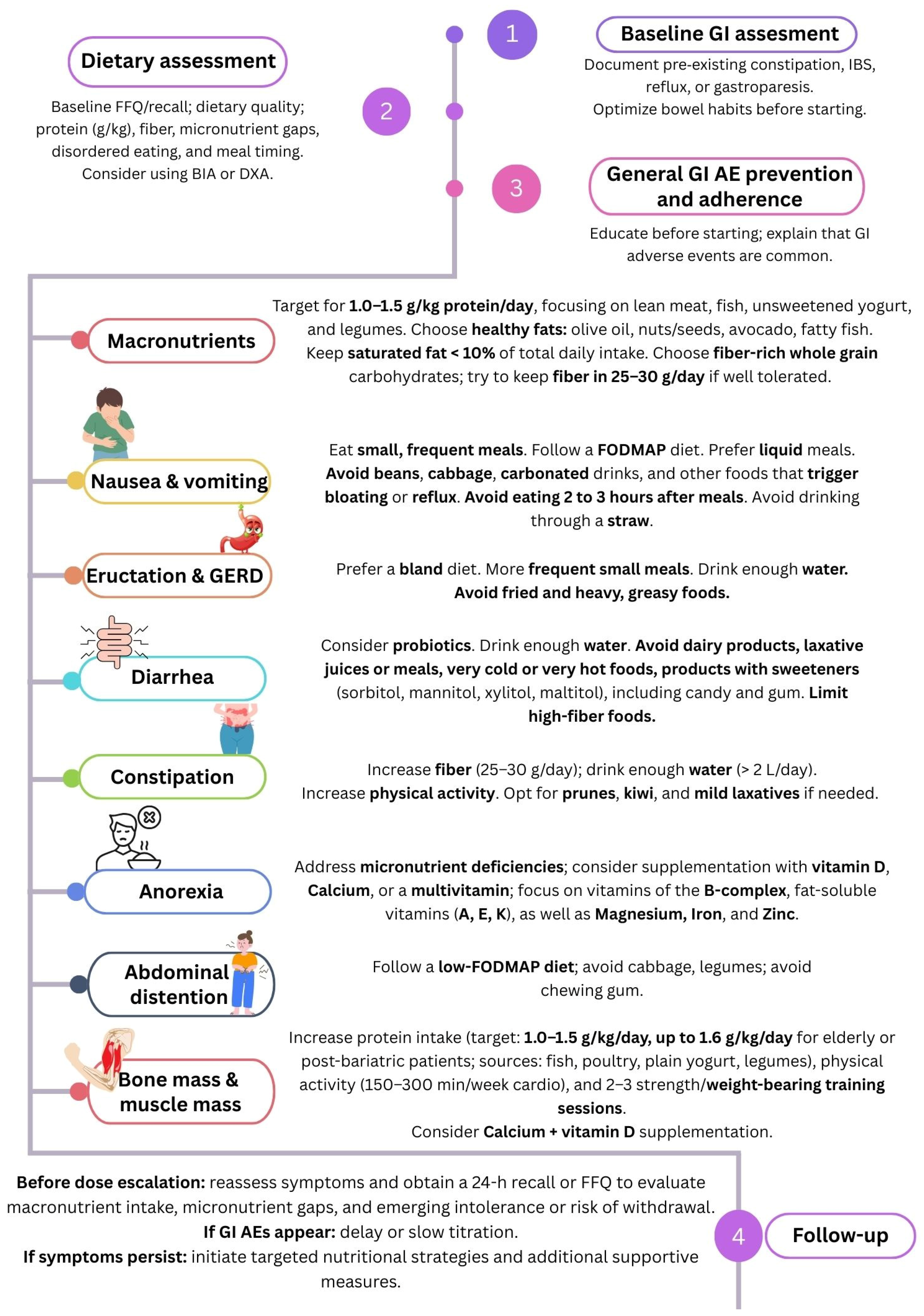
| Baseline GI assessment |
|
| Dietary assessment | |
| General GI AE prevention |
|
| Dose escalation and switching |
|
| Macronutrient intake |
|
| Micronutrient intake |
|
| Abdominal distention and pain |
|
| Anorexia |
|
| Constipation | |
| Cholelithiasis |
|
| Diarrhea |
|
| Dyspepsia |
|
| Eructation | |
| GERD |
|
| Hydration |
|
| Hypoglycemia |
|
| Ketosis risk |
|
| Nausea & vomiting |
|
| Osteoporosis | |
| Sarcopenia, cachexia |
|
| SIBO |
Disclaimer/Publisher’s Note: The statements, opinions and data contained in all publications are solely those of the individual author(s) and contributor(s) and not of MDPI and/or the editor(s). MDPI and/or the editor(s) disclaim responsibility for any injury to people or property resulting from any ideas, methods, instructions or products referred to in the content. |
© 2026 by the authors. Licensee MDPI, Basel, Switzerland. This article is an open access article distributed under the terms and conditions of the Creative Commons Attribution (CC BY) license.
Share and Cite
Pardali, E.C.; Gkouskou, K.K.; Cholevas, C.; Poulimeneas, D.; Tsiroukidou, K.; Goulis, D.G.; Grammatikopoulou, M.G. New Drugs on the Block: Dietary Management and Nutritional Considerations During the Use of Anti-Obesity Medication. Nutrients 2026, 18, 962. https://doi.org/10.3390/nu18060962
Pardali EC, Gkouskou KK, Cholevas C, Poulimeneas D, Tsiroukidou K, Goulis DG, Grammatikopoulou MG. New Drugs on the Block: Dietary Management and Nutritional Considerations During the Use of Anti-Obesity Medication. Nutrients. 2026; 18(6):962. https://doi.org/10.3390/nu18060962
Chicago/Turabian StylePardali, Eleni C., Kalliopi K. Gkouskou, Christos Cholevas, Dimitrios Poulimeneas, Kyriaki Tsiroukidou, Dimitrios G. Goulis, and Maria G. Grammatikopoulou. 2026. "New Drugs on the Block: Dietary Management and Nutritional Considerations During the Use of Anti-Obesity Medication" Nutrients 18, no. 6: 962. https://doi.org/10.3390/nu18060962
APA StylePardali, E. C., Gkouskou, K. K., Cholevas, C., Poulimeneas, D., Tsiroukidou, K., Goulis, D. G., & Grammatikopoulou, M. G. (2026). New Drugs on the Block: Dietary Management and Nutritional Considerations During the Use of Anti-Obesity Medication. Nutrients, 18(6), 962. https://doi.org/10.3390/nu18060962