Acute and Prolonged Effects of Sweeteners and Sweetness Enhancers on Postprandial Appetite Sensations, Palatability, and Ad Libitum Energy Intake in Humans: A SWEET Sub-Study
 ,
,  , ,
, , 
Abstract
1. Introduction
2. Materials and Methods
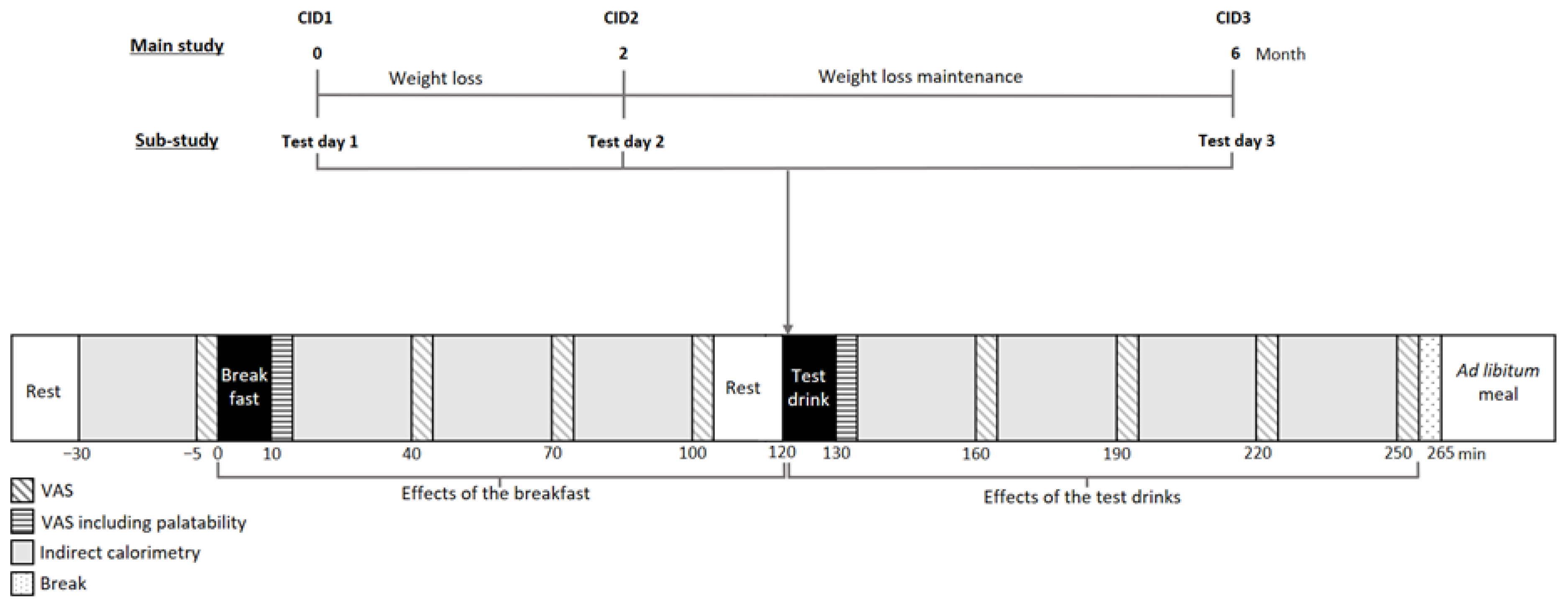
2.1. Study Design and Participants
2.2. Test Meals
2.3. Statistical Analysis
3. Results
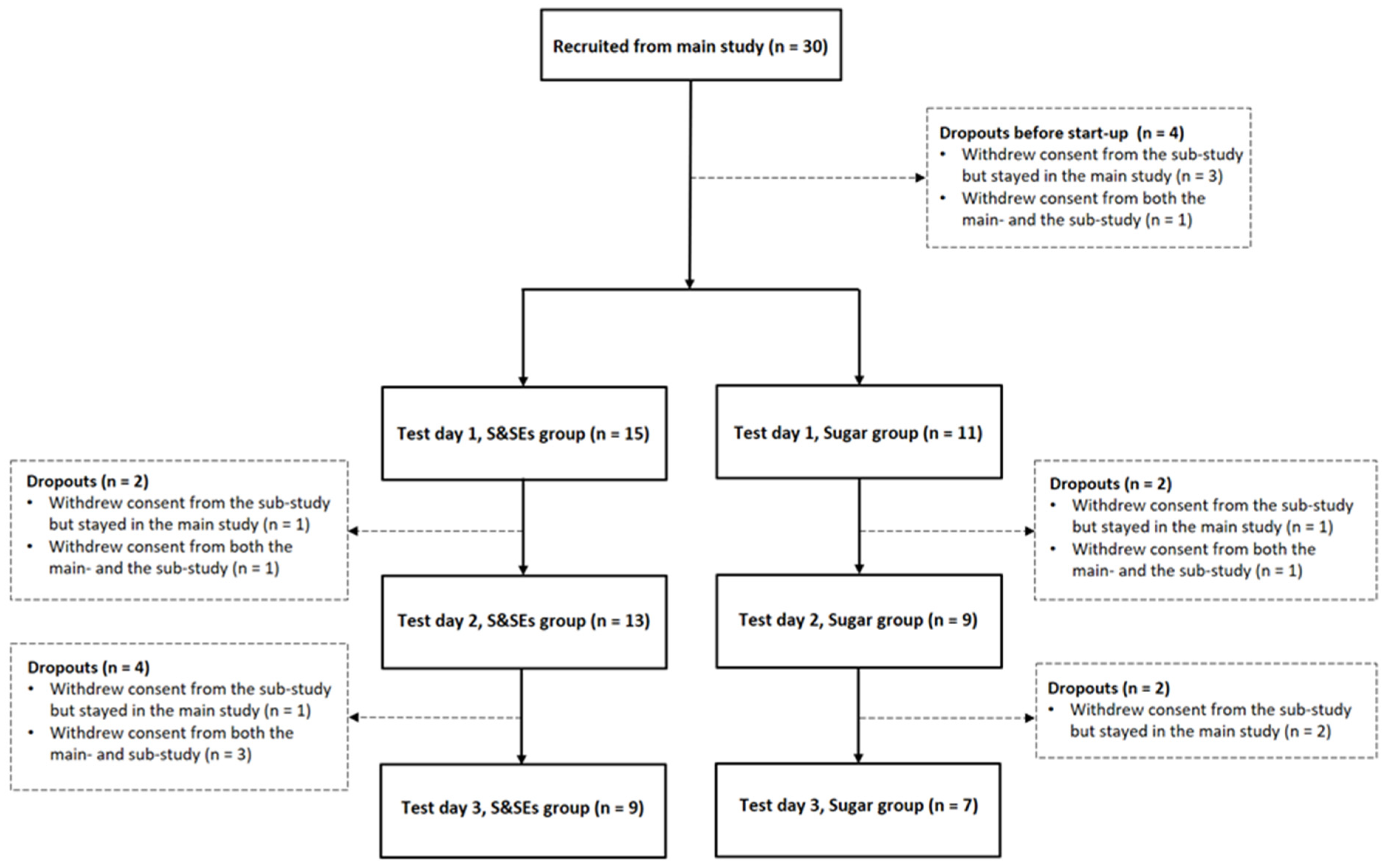
3.1. Study Flow
3.2. Baseline Characteristics
3.3. Fasting Measurements
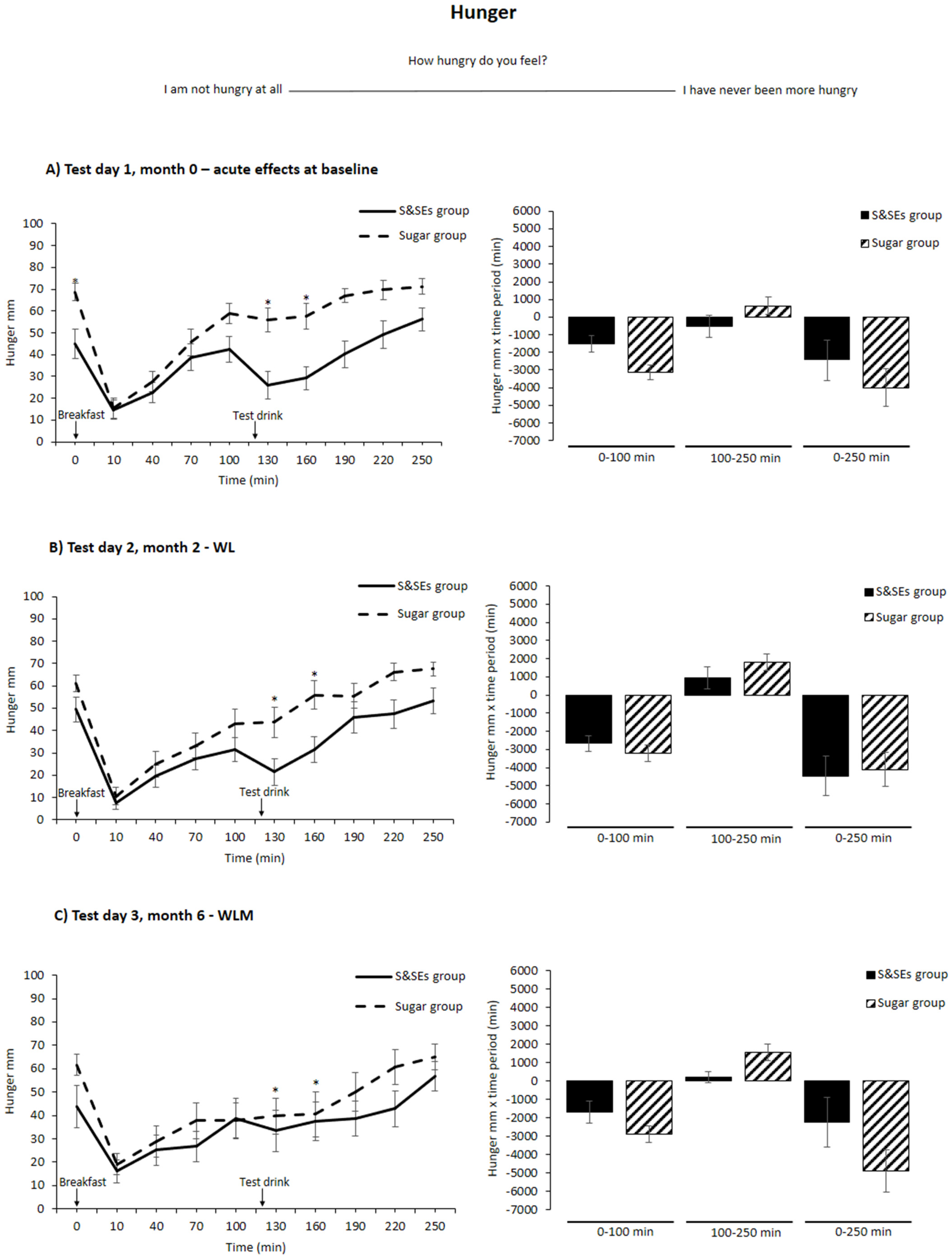
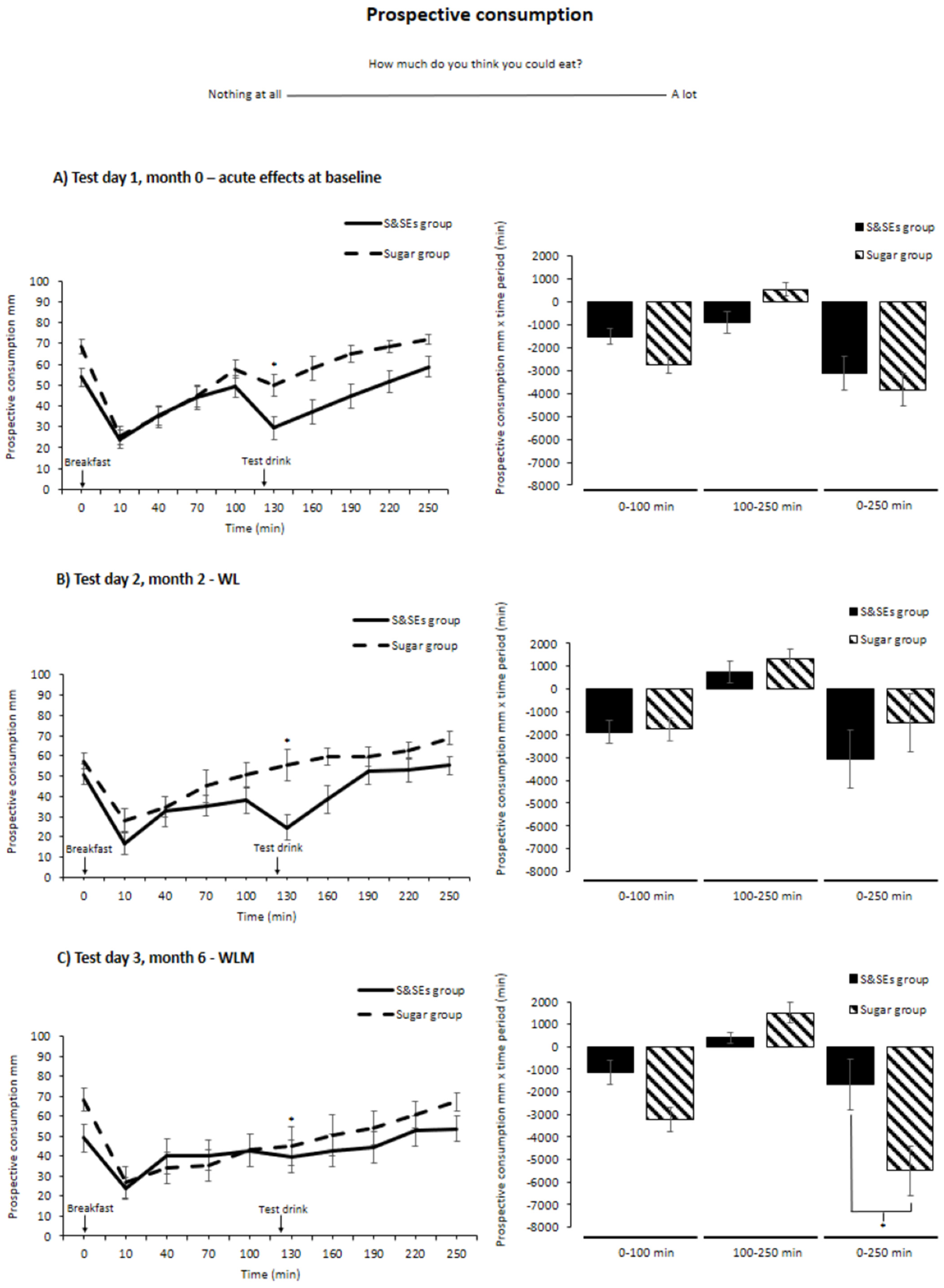
3.4. Subjective Appetite Sensations
3.5. Palatability Scores, Wellbeing, and Ad Libitum Energy Intake
4. Discussion
4.1. Summary of Findings
4.2. Appetite Sensations and Energy Intake
4.3. Strengths and Limitations
5. Conclusions
Author Contributions
Funding
Institutional Review Board Statement
Informed Consent Statement
Data Availability Statement
Acknowledgments
Conflicts of Interest
References
- Chattopadhyay, S.; Raychaudhuri, U.; Chakraborty, R. Artificial sweeteners—A review. J. Food Sci. Technol. 2014, 51, 611–621. [Google Scholar] [CrossRef] [Scilit]
- Magnuson, B.A.; Carakostas, M.C.; Moore, N.H.; Poulos, S.P.; Renwick, A.G. Biological fate of low-calorie sweeteners. Nutr. Rev. 2016, 74, 670–689. [Google Scholar] [CrossRef] [Scilit] [PubMed]
- Grembecka, M. Sugar alcohols-their role in the modern world of sweeteners: A review. Eur. Food Res. Technol. 2015, 241, 1–14. [Google Scholar] [CrossRef] [Scilit]
- Rice, T.; Zannini, E.; Arendt, E.K.; Coffey, A. A review of polyols–biotechnological production, food applications, regulation, labeling and health effects. Crit. Rev. Food Sci. Nutr. 2020, 60, 2034–2051. [Google Scholar] [CrossRef] [Scilit]
- Livesey, G. Health potential of polyols as sugar replacers, with emphasis on low glycaemic properties. Nutr. Res. Rev. 2003, 16, 163–191. [Google Scholar] [CrossRef] [Scilit]
- Martí, N.; Funes, L.L.; Saura, D.; Micol, V. An update on alternative sweeteners. Int. Sugar J. 2008, 110, 425–429. [Google Scholar]
- Msomi, N.Z.; Erukainure, O.L.; Islam, M.S. Suitability of sugar alcohols as antidiabetic supplements: A review. J. Food Drug Anal. 2021, 29, 1. [Google Scholar] [CrossRef] [Scilit] [PubMed]
- Burke, M.V.; Small, D.M. Physiological mechanisms by which non-nutritive sweeteners may impact body weight and metabolism. Physiol. Behav. 2015, 30, 1289–1303. [Google Scholar] [CrossRef] [Scilit]
- Mattes, R.D.; Popkin, B.M. Nonnutritive sweetener consumption in humans: Effects on appetite and food intake and their putative mechanisms. Am. J. Clin. Nutr. 2009, 89, 1–14. [Google Scholar] [CrossRef] [Scilit]
- Nettleton, J.E.; Reimer, R.A.; Shearer, J. Reshaping the gut microbiota: Impact of low calorie sweeteners and the link to insulin resistance? Physiol. Behav. 2016, 164, 488–493. [Google Scholar] [CrossRef] [Scilit]
- O’Connor, D.; Pang, M.; Castelnuovo, G.; Finlayson, G.; Blaak, E.; Gibbons, C.; Navas-Carretero, S.; Almiron-Roig, E.; Harrold, J.; Raben, A.; et al. A rational review on the effects of sweeteners and sweetness enhancers on appetite, food reward and metabolic/adiposity outcomes in adults. Food Funct. 2021, 12, 442–465. [Google Scholar] [CrossRef] [Scilit]
- Pang, M.D.; Goossens, G.H.; Blaak, E.E. The Impact of Artificial Sweeteners on Body Weight Control and Glucose Homeostasis. Front. Nutr. 2021, 7, 598340. [Google Scholar] [CrossRef] [Scilit]
- Payne, A.N.; Chassard, C.; Lacroix, C. Gut microbial adaptation to dietary consumption of fructose, artificial sweeteners and sugar alcohols: Implications for host-microbe interactions contributing to obesity. Obes. Rev. 2012, 13, 799–809. [Google Scholar] [CrossRef] [Scilit]
- Pearlman, M.; Obert, J.; Casey, L. The Association Between Artificial Sweeteners and Obesity. Curr. Gastroenterol. Rep. 2017, 19, 64. [Google Scholar] [CrossRef] [Scilit] [PubMed]
- World Health Organization (WHO). Use of Non-Sugar Sweeteners: WHO Guideline; World Health Organization: Geneva, Switzerland, 2023. [Google Scholar]
- World Health Organization (WHO). Health Effects of the Use of Non-Sugar Sweeteners: A Systematic Review and Meta-Analysis; World Health Organization: Geneva, Switzerland, 2022; Available online: https://www.who.int/publications/i/item/9789240046429 (accessed on 1 August 2024).
- Ashwell, M.; Gibson, S.; Bellisle, F.; Buttriss, J.; Drewnowski, A.; Fantino, M.; Gallagher, A.M.; de Graaf, K.; Goscinny, S.; Hardman, C.A.; et al. Expert consensus on low-calorie sweeteners: Facts, research gaps and suggested actions. Nutr. Res. Rev. 2020, 33, 145–154. [Google Scholar] [CrossRef] [Scilit]
- Normand, M.; Ritz, C.; Mela, D.; Raben, A. Low-energy sweeteners and body weight: A citation network analysis. BMJ Nutr. Prev. Health 2021, 4, 319–332. [Google Scholar] [CrossRef] [Scilit] [PubMed]
- Ludwig, D.S. Artificially Sweetened Beverages Cause for Concern. JAMA 2009, 302, 2477–2478. [Google Scholar] [CrossRef] [Scilit]
- Andersen, S.S.H.; Zhu, R.; Kjølbæk, L.; Raben, A. Effect of Non- and Low-Caloric Sweeteners on Substrate Oxidation, Energy Expenditure, and Catecholamines in Humans—A Systematic Review. Nutrients 2023, 15, 2711. [Google Scholar] [CrossRef] [Scilit]
- Ludwig, D.S. The Glycemic Index. JAMA 2002, 287, 2414. [Google Scholar] [CrossRef] [Scilit]
- Jordan, S.D.; Könner, A.C.; Brüning, J.C. Sensing the fuels: Glucose and lipid signaling in the CNS controlling energy homeostasis. Cell. Mol. Life Sci. 2010, 67, 3255–3273. [Google Scholar] [CrossRef] [Scilit] [PubMed]
- Levin, B.E. Metabolic sensing neurons and the control of energy homeostasis. Physiol. Behav. 2006, 89, 486–489. [Google Scholar] [CrossRef] [Scilit]
- Rogers, P.J. The role of low-calorie sweeteners in the prevention and management of overweight and obesity: Evidence v. conjecture. Proc. Nutr. Soc. 2018, 77, 230–238. [Google Scholar] [CrossRef] [Scilit] [PubMed]
- Rogers, P.J.; Hogenkamp, P.S.; De Graaf, C.; Higgs, S.; Lluch, A.; Ness, A.R.; Penfold, C.; Perry, R.; Putz, P.; Yeomans, M.R.; et al. Does low-energy sweetener consumption affect energy intake and body weight? A systematic review, including meta-analyses, of the evidence from human and animal studies. Int. J. Obes. 2016, 40, 381–394. [Google Scholar] [CrossRef] [Scilit]
- Rogers, P.J.; Appleton, K.M. The effects of low-calorie sweeteners on energy intake and body weight: A systematic review and meta-analyses of sustained intervention studies. Int. J. Obes. 2021, 45, 464–478. [Google Scholar] [CrossRef] [Scilit] [PubMed]
- Appleton, K.M.; Tuorila, H.; Bertenshaw, E.; De Graaf, C.; Mela, D. Sweet taste exposure and the subsequent acceptance and preference for sweet taste in the diet: Systematic review of the published literature. Am. J. Clin. Nutr. 2018, 107, 405–419. [Google Scholar] [CrossRef] [Scilit] [PubMed]
- Kjølbæk, L.; Manios, Y.; Blaak, E.E.; Martínez, J.A.; Feskens, E.J.M.; Finlayson, G.; Andersen, S.S.H.; Reppas, K.; Navas-Carretero, S.; Adam, T.C.; et al. Protocol for a multicentre, parallel, randomised, controlled trial on the effect of sweeteners and sweetness enhancers on health, obesity and safety in overweight adults and children: The SWEET project. BMJ Open 2022, 12, e061075. [Google Scholar] [CrossRef] [Scilit]
- Pang, M.D.; Kjølbæk, L.; Bastings, J.J.A.J.; Andersen, S.S.H.; Umanets, A.; Sost, M.M.; Navas-Carretero, S.; Reppas, K.; Finlayson, G.; Hodgkins, C.E.; et al. Effect of sweeteners and sweetness enhancers on weight management and gut microbiota composition in individuals with overweight or obesity: The SWEET study. Nat. Metab. 2025, 7, 2083–2098. [Google Scholar] [CrossRef] [Scilit]
- Flint, A.; Raben, A.; Blundell, J.; Astrup, A. Reproducibility, power and validity of visual analogue scales in assessment of appetite sensations in single test meal studies. Int. J. Obes. 2000, 24, 38–48. [Google Scholar] [CrossRef] [Scilit]
- Laugesen, J.L. 2017; Evascale© (Build: February 28, 2018). Jakob@sensory.dk.
- Klingenberg, L.; Nyby, S.; Kristensen, M.B.; Raben, A. Visual analogue scales to assess appetite sensation- good agreement between 100 mm pen and paper vs tablet-based scores. Obes. Facts 2015, 8, 101. [Google Scholar]
- Rogers, P.J.; Carlyle, J.A.; Hill, A.J.; Blundell, J.E. Uncoupling sweet taste and calories: Comparison of the effects of glucose and three intense sweeteners on hunger and food intake. Physiol. Behav. 1988, 43, 547–552. [Google Scholar] [CrossRef] [Scilit] [PubMed]
- Bellisle, F.; Drewnowski, A. Intense sweeteners, energy intake and the control of body weight. Eur. J. Clin. Nutr. 2007, 61, 691–700. [Google Scholar] [CrossRef] [Scilit]
- Chern, C.; Tan, S.-Y. Energy Expenditure, Carbohydrate Oxidation and Appetitive Responses to Sucrose or Sucralose in Humans: A Pilot Study. Nutrients 2019, 11, 1782. [Google Scholar] [CrossRef] [Scilit] [PubMed]
- Fantino, M.; Fantino, A.; Matray, M.; Mistretta, F. Beverages containing low energy sweeteners do not differ from water in their effects on appetite, energy intake and food choices in healthy, non-obese French adults. Appetite 2018, 125, 557–565. [Google Scholar] [CrossRef] [Scilit]
- Ford, H.E.; Peters, V.; Martin, N.M.; Sleeth, M.L.; Ghatei, M.A.; Frost, G.S.; Bloom, S.R. Effects of oral ingestion of sucralose on gut hormone response and appetite in healthy normal-weight subjects. Eur. J. Clin. Nutr. 2011, 65, 508–513. [Google Scholar] [CrossRef] [Scilit] [PubMed]
- Pearson, R.C.; Green, E.S.; Olenick, A.A.; Jenkins, N.T. Comparison of aspartame- and sugar-sweetened soft drinks on postprandial metabolism. Nutr. Health 2021, 29, 115–128. [Google Scholar] [CrossRef] [Scilit]
- Higgins, K.A.; Considine, R.V.; Mattes, R.D. Aspartame consumption for 12 weeks does not affect glycemia, appetite, or body weight of healthy, lean adults in a randomized controlled trial. J. Nutr. 2018, 148, 650–657. [Google Scholar] [CrossRef] [Scilit]
- Higgins, K.A.; Mattes, R.D. A randomized controlled trial contrasting the effects of 4 low-calorie sweeteners and sucrose on body weight in adults with overweight or obesity. Am. J. Clin. Nutr. 2019, 109, 1288–1301. [Google Scholar] [CrossRef] [Scilit]
- Sørensen, L.B.; Vasilaras, T.H.; Astrup, A.; Raben, A. Sucrose compared with artificial sweeteners: A clinical intervention study of effects on energy intake, appetite, and energy expenditure after 10 wk of supplementation in overweight subjects. Am. J. Clin. Nutr. 2014, 100, 36–45. [Google Scholar] [CrossRef] [Scilit] [PubMed]
- Van Wymelbeke, V.; Béridot-Thérond, M.E.; de La Guéronnière, V.; Fantino, M. Influence of repeated consumption of beverages containing sucrose or intense sweeteners on food intake. Eur. J. Clin. Nutr. 2004, 58, 154–161. [Google Scholar] [CrossRef] [Scilit]
- Almiron-Roig, E.; Navas-Carretero, S.; Castelnuovo, G.; Kjølbæk, L.; Romo-Hualde, A.; Normand, M.; Maloney, N.; Hardman, C.A.; Hodgkins, C.E.; Moshoyiannis, H.; et al. Impact of acute consumption of beverages containing plant-based or alternative sweetener blends on postprandial appetite, food intake, metabolism, and gastro-intestinal symptoms: Results of the SWEET beverages trial. Appetite 2023, 184, 106515. [Google Scholar] [CrossRef] [Scilit] [PubMed]
- Rogers, P.J.; Ferriday, D.; Irani, B.; Hei Hoi, J.K.; England, C.Y.; Bajwa, K.K.; Gough, T. Sweet satiation: Acute effects of consumption of sweet drinks on appetite for and intake of sweet and non-sweet foods. Appetite 2020, 149, 104631. [Google Scholar] [CrossRef] [Scilit] [PubMed]
- Appleton, K.M.; Rajska, J.; Warwick, S.M.; Rogers, P.J. No effects of sweet taste exposure at breakfast for 3 weeks on pleasantness, desire for, sweetness or intake of other sweet foods: A randomised controlled trial. Br. J. Nutr. 2022, 127, 1428–1438. [Google Scholar] [CrossRef] [Scilit] [PubMed]
- Čad, E.M.; Mars, M.; Pretorius, L.; van der Kruijssen, M.; Tang, C.S.; de Jong, H.B.; Balvers, M.; Appleton, K.M.; de Graaf, K. The Sweet Tooth Trial: A Parallel Randomized Controlled Trial Investigating the Effects of A 6-Month Low, Regular, or High Dietary Sweet Taste Exposure on Sweet Taste Liking, and Various Outcomes Related to Food Intake and Weight Status. Am. J. Clin. Nutr. 2026, 123, 101073. [Google Scholar] [CrossRef] [Scilit]
- Popkin, B.M.; Wang, X.; Piernas, C.; Tate, D.F. Does diet-beverage intake affect dietary consumption patterns? Results from the Choose Healthy Options Consciously Everyday (CHOICE) randomized clinical trial1-3. Am. J. Clin. Nutr. 2013, 97, 604–611. [Google Scholar] [CrossRef] [Scilit]
- Flad, E.; Altstädt, A.; Beglinger, C.; Rehfeld, J.F.; Van Oudenhove, L.; Wölnerhanssen, B.K.; Meyer-Gerspach, A.C. Effects of Oral Xylitol, Sucrose, and Acesulfame Potassium on Total Energy Intake During a Subsequent ad libitum Test Meal: A Randomized, Controlled, Crossover Trial in Healthy Humans. Nutrients 2025, 17, 484. [Google Scholar] [CrossRef] [Scilit]
- Gregersen, N.T.; Flint, A.; Bitz, C.; Blundell, J.E.; Raben, A.; Astrup, A. Reproducibility and power of ad libitum energy intake assessed by repeated single meals. Am. J. Clin. Nutr. 2008, 87, 1277–1281. [Google Scholar] [CrossRef] [Scilit]
- Blundell, J.; De Graaf, C.; Hulshof, T.; Jebb, S.; Livingstone, B.; Lluch, A.; Mela, D.; Salah, S.; Schuring, E.; Van Der Knaap, H.; et al. Appetite control: Methodological aspects of the evaluation of foods. Obes. Rev. 2010, 11, 251–270. [Google Scholar] [CrossRef] [Scilit] [PubMed]



| Standardized Breakfast | Test Drinks | Ad Libitum Meal | |||
|---|---|---|---|---|---|
| Served to | All Participants | S&SEs Group | Sugar Group | All Participants | |
| Males | Females | ||||
| Product | Arla Cultura® with Oat and Cranberries 1 | Atwell®0-Calories® with Ace-K/Cyc | - | Ristorante Pizza Mozzarella | Ristorante Pizza Mozzarella |
| Amount (g) | 340 | 5 | 1110 | 740 | |
| Energy (kJ) | 1476 | 10,665 | 7110 | ||
Fat (g)
| 8.8 3.7 | 00 | 117.0 54.0 | 78.0 36.0 | |
Carbohydrates (g)
| 40.8 24.8 | 00 | 246.0 22.8 | 164.0 15.2 | |
| Fiber (g) | 13.6 | 0 | 13.8 | 9.2 | |
| Protein (g) | 18.0 | 0 | 117.0 | 78.0 | |
| Salt (g) | 0.34 | 0 | 10.8 | 7.2 | |
| Water (g) | 250 | 400 | 405 | 250 | 250 |
| S&SEs Group (n = 15) | Sugar Group (n = 11) | Total (n = 26) | p-Value | |
|---|---|---|---|---|
| Sex | ||||
| Female (n (%)) | 11 (73) | 8 (73) | 19 (73) | 0.97 |
| Male (n (%)) | 4 (27) | 3 (27) | 7 (27) | |
| Age (y) | 48 ± 11 | 52 ± 8 | 49 ± 10 | 0.27 |
| Height (cm) | 172.3 ± 7.3 | 167.4 ± 8.0 | 170.2 ± 7.9 | 0.12 |
| Weight (kg) | 97.6 ± 14.1 | 89.7 ± 11.4 | 94.2 ± 13.4 | 0.13 |
| BMI (kg/m2) | 33.0 ± 5.0 | 32.0 ± 3.4 | 32.6 ± 4.3 | 0.56 |
| Smoking status | ||||
| Non-smoker (n (%)) | 12 (80) | 9 (82) | 21 (81) | |
| Occasional smoker (n (%)) | 1 (7) | 1 (9) | 2 (8) | |
| Daily smoker (n (%)) | 2 (13) | 1 (9) | 3 (11) | 0.93 |
Disclaimer/Publisher’s Note: The statements, opinions and data contained in all publications are solely those of the individual author(s) and contributor(s) and not of MDPI and/or the editor(s). MDPI and/or the editor(s) disclaim responsibility for any injury to people or property resulting from any ideas, methods, instructions or products referred to in the content. |
© 2026 by the authors. Licensee MDPI, Basel, Switzerland. This article is an open access article distributed under the terms and conditions of the Creative Commons Attribution (CC BY) license.
Share and Cite
Andersen, S.S.H.; Kjølbæk, L.; Halford, J.C.G.; Harrold, J.A.; Raben, A. Acute and Prolonged Effects of Sweeteners and Sweetness Enhancers on Postprandial Appetite Sensations, Palatability, and Ad Libitum Energy Intake in Humans: A SWEET Sub-Study. Nutrients 2026, 18, 948. https://doi.org/10.3390/nu18060948
Andersen SSH, Kjølbæk L, Halford JCG, Harrold JA, Raben A. Acute and Prolonged Effects of Sweeteners and Sweetness Enhancers on Postprandial Appetite Sensations, Palatability, and Ad Libitum Energy Intake in Humans: A SWEET Sub-Study. Nutrients. 2026; 18(6):948. https://doi.org/10.3390/nu18060948
Chicago/Turabian StyleAndersen, Sabina S. H., Louise Kjølbæk, Jason C. G. Halford, Joanne A. Harrold, and Anne Raben. 2026. "Acute and Prolonged Effects of Sweeteners and Sweetness Enhancers on Postprandial Appetite Sensations, Palatability, and Ad Libitum Energy Intake in Humans: A SWEET Sub-Study" Nutrients 18, no. 6: 948. https://doi.org/10.3390/nu18060948
APA StyleAndersen, S. S. H., Kjølbæk, L., Halford, J. C. G., Harrold, J. A., & Raben, A. (2026). Acute and Prolonged Effects of Sweeteners and Sweetness Enhancers on Postprandial Appetite Sensations, Palatability, and Ad Libitum Energy Intake in Humans: A SWEET Sub-Study. Nutrients, 18(6), 948. https://doi.org/10.3390/nu18060948