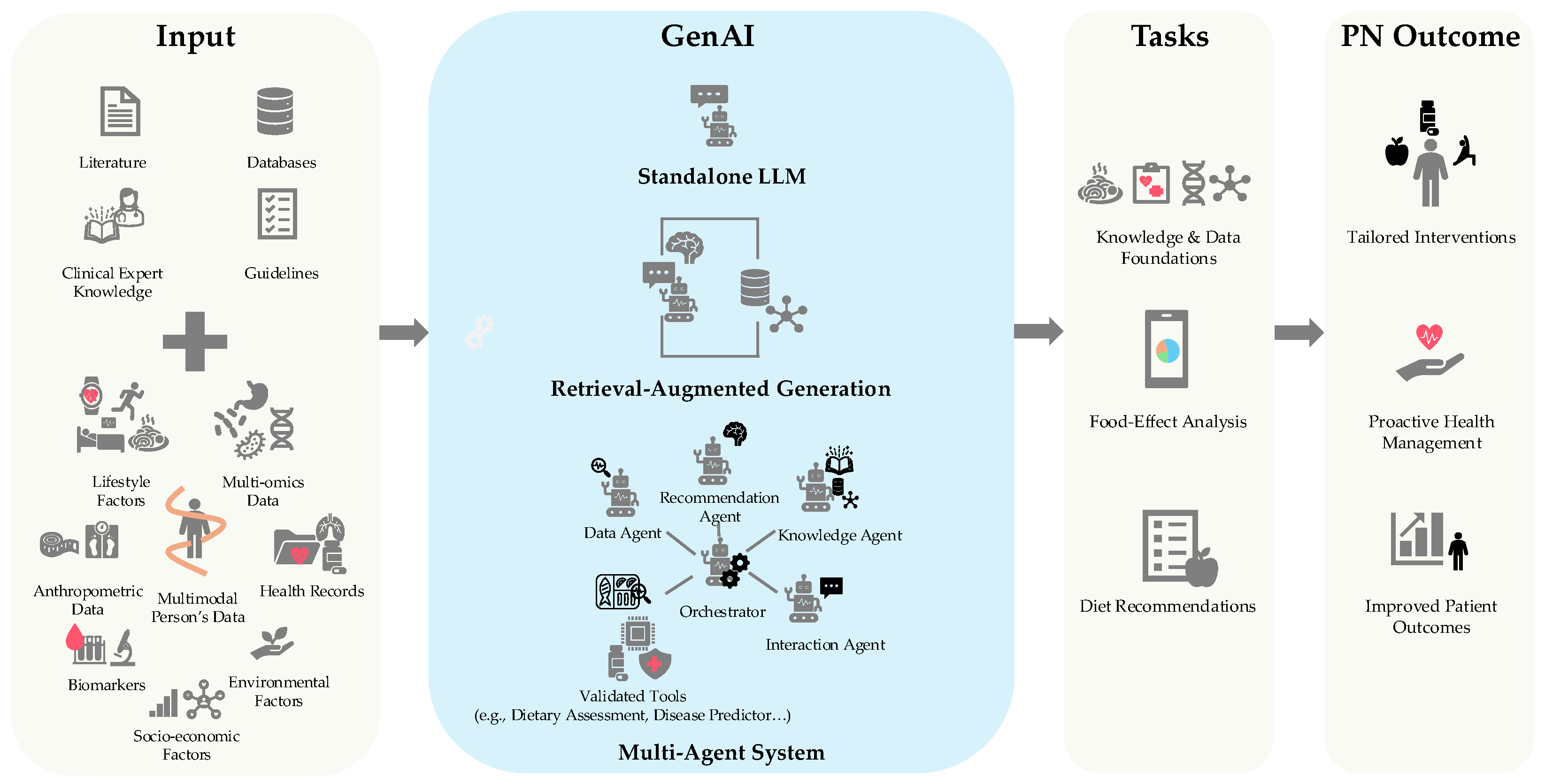
Generative AI in Precision Nutrition: A Review of Current Developments and Future Directions

 , , , , , and
Abstract
1. Introduction
2. Materials and Methods
2.1. Search Strategy
| (“generative AI” OR “GenAI” OR “large language model” OR “LLM” OR “multi-agent system” OR “conversational AI” OR “variational autoencoder” OR “VAE” OR “generative adversarial network” OR “GAN” OR “diffusion model” OR “RAG” OR “ChatGPT” OR “Chatbot”) AND (“precision nutrition” OR “personalized nutrition” OR “individualized nutrition” OR “nutrigenomic” OR “nutritional genomic” OR “nutrigenetic”) |
2.2. Inclusion Criteria
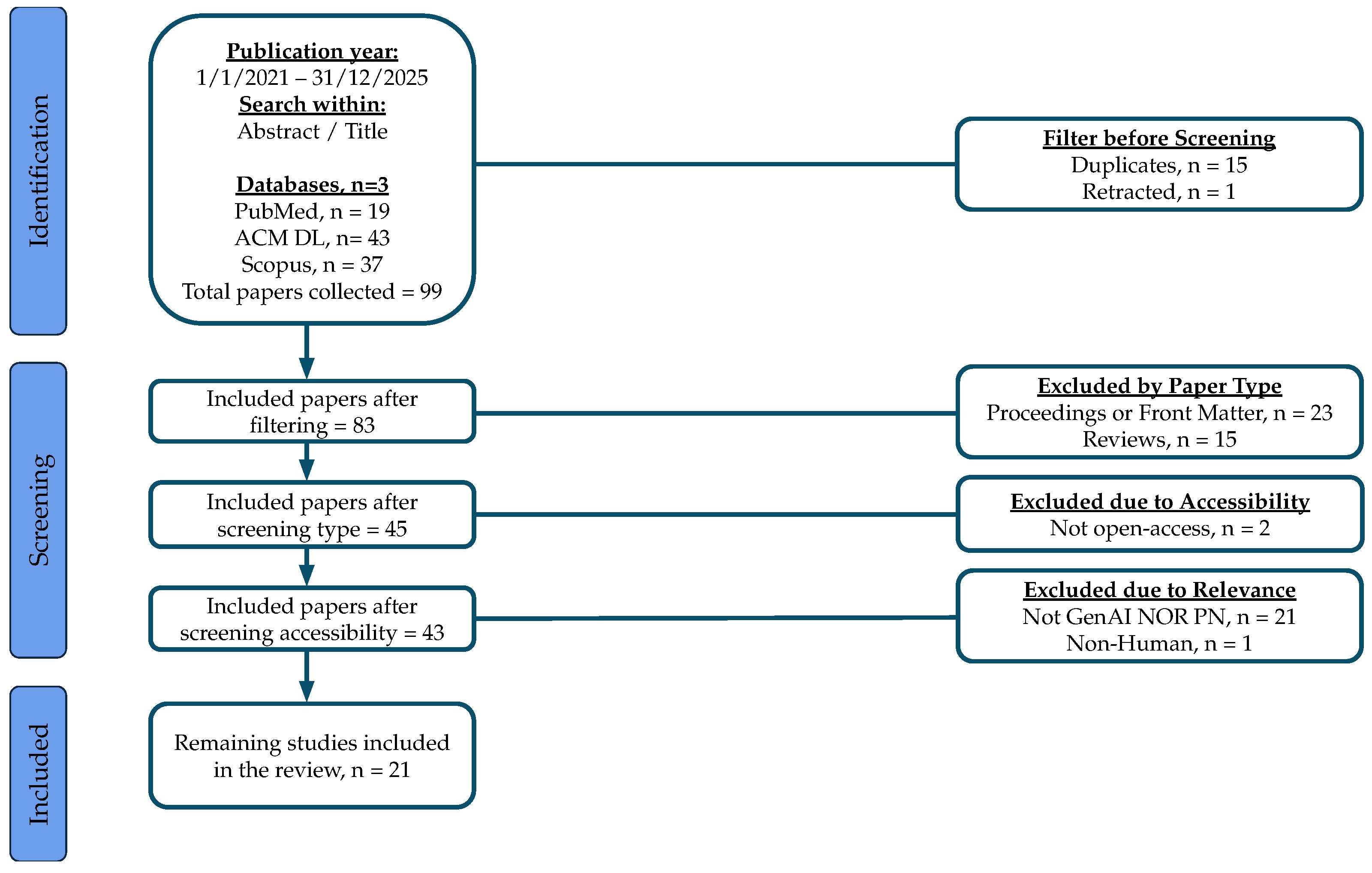
- Original research: experimental, computational, or methodological using GenAI methods.
- Applied GenAI methods directly to precision or personalized nutrition. To map the full landscape of current GenAI applications, we did not differentiate between varying degrees of personalization (e.g., mechanistic and biologically driven versus preference- or contextual-driven) during the inclusion process.
- Published between 2021 and 2025.
2.3. Exclusion Criteria
- Used non-GenAI computational methods only.
- Applied solely to nutrition or addressed nutrition, but lacked PN-specific components.
- Lack of proof and explanation demonstrating substantial PN and GenAI contributions.
- Involved non-human subjects.
- Reviews, proceedings, or font matter.
- Not open access, not even with institutional access.
- Had been retracted.
- Were duplicates among PubMed, Scopus, and the ACM Digital Library.
2.4. Quality Assessment
3. Results
3.1. Included Works
3.2. Reviewed Works
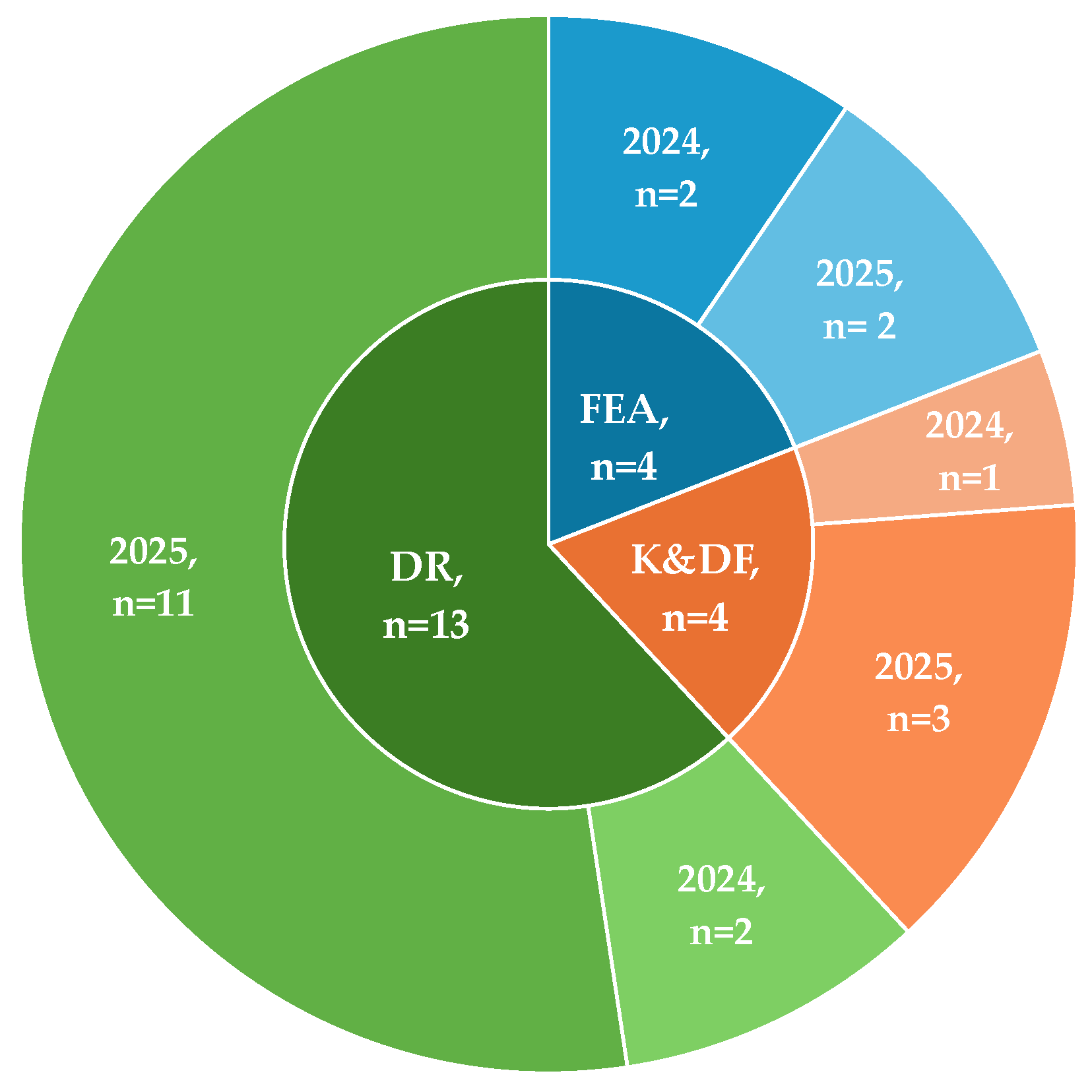
3.2.1. GenAI for Knowledge and Data Foundation
3.2.2. GenAI for Personalized Food-Effect Analysis
3.2.3. GenAI for Personalized Diet Recommendations
4. Discussion
5. Conclusions
Author Contributions
Funding
Institutional Review Board Statement
Informed Consent Statement
Data Availability Statement
Acknowledgments
Conflicts of Interest
Abbreviations
| AI | Artificial Intelligence |
| AR | Augmented Reality |
| CKD | Chronic Kidney Disease |
| CNN | Convolutional Neural Network |
| DB | Database |
| DR | Diet Recommendation |
| DT | Data Type |
| FCDB | Food Composition Database |
| FEA | Food–Effect Analysis |
| GAN | Generative Adversarial Network |
| GenAI | Generative Artificial Intelligence |
| H | High |
| HCP | Healthcare Professional |
| K&DF | Knowledge and Data Foundations |
| KG | Knowledge Graph |
| L | Low |
| LLM | Large Language Model |
| LoTR | Lack of transparency |
| M | Moderate |
| MAS | Multi-Agentic Systems |
| OCR | Optical Character Recognition |
| PN | Precision Nutrition |
| RAG | Retrieval-Augmented Generation |
| RoB | Risk of Bias |
| SPC | Security and Privacy Concerns |
| T2D | Type 2 Diabetes |
| SHAP | Shapley Additive Explanations |
| USDA | United States Department of Agriculture |
| VAE | Variational Autoencoder |
| VS | Validation Source |
| WGAN-GP | Wasserstein GAN with Gradient Penalty |
References
- WHO. Noncommunicable Diseases; WHO: Geneva, Switzerland, 2025.
- WHO. Food Systems: A Powerful Tool to Prevent Noncommunicable Diseases; WHO: Geneva, Switzerland, 2018.
- Adams, S.H.; Anthony, J.C.; Carvajal, R.; Chae, L.; Khoo, C.S.H.; Latulippe, M.E.; Matusheski, N.V.; McClung, H.L.; Rozga, M.; Schmid, C.H.; et al. Perspective: Guiding Principles for the Implementation of Personalized Nutrition Approaches That Benefit Health and Function. Adv. Nutr. 2020, 11, 25–34. [Google Scholar] [CrossRef]
- Ordovas, J.M.; Ferguson, L.R.; Tai, E.S.; Mathers, J.C. Personalised nutrition and health. BMJ 2018, 361, bmj.k2173. [Google Scholar] [CrossRef]
- Lachowicz-Wiśniewska, S.; Kotowska, A. Precision Nutrition for Public Health. Nutrients 2025, 17, 3004. [Google Scholar] [CrossRef]
- Celis-Morales, C.; Livingstone, K.M.; Marsaux, C.F.; Macready, A.L.; Fallaize, R.; O’Donovan, C.B.; Woolhead, C.; Forster, H.; Walsh, M.C.; Navas-Carretero, S.; et al. Effect of personalized nutrition on health-related behaviour change: Evidence from the Food4Me European randomized controlled trial. Int. J. Epidemiol. 2017, 46, 578–588. [Google Scholar] [CrossRef]
- Tena-Sempere, M.; Koutsouris, D.D.; Dedoussis, G.; Lakerveld, J.; Wagner, K.H.; Tueros, I.; Froguel, P.; Bohn, T.; Oliveira, P.J. OBEClust: Joining forces to prevent obesity. Nat. Rev. Endocrinol. 2025, 22, 129–130. [Google Scholar] [CrossRef]
- Bermingham, K.M.; Linenberg, I.; Polidori, L.; Asnicar, F.; Arrè, A.; Wolf, J.; Badri, F.; Bernard, H.; Capdevila, J.; Bulsiewicz, W.J.; et al. Effects of a personalized nutrition program on cardiometabolic health: A randomized controlled trial. Nat. Med. 2024, 30, 1888–1897. [Google Scholar] [CrossRef] [PubMed]
- Kafyra, M.; Kalafati, I.P.; Bruins, S.; Episkopou, C.; Gryspeerdt, D.; Heggie, L.; Kaltenbrunner, S.; Kampshoff, S.; Karaglani, E.; Prändl, H.Ö.; et al. Advancing Personalized Strategies for Obesity Prevention Through Biologically and Behaviorally Tailored Interventions: The Strategic Framework for the BETTER4U Initiative. Obes. Rev. 2026, 27, e70083. [Google Scholar] [CrossRef] [PubMed]
- Arshad, M.T.; Ali, M.K.M.; Maqsood, S.; Ikram, A.; Ahmed, F.; Aljameel, A.I.; AL-Farga, A.; Hossain, M.S. Personalized Nutrition in the Era of Digital Health: A New Frontier for Managing Diabetes and Obesity. Food Sci. Nutr. 2025, 13, e71006. [Google Scholar] [CrossRef] [PubMed]
- Höchsmann, C.; Yang, S.; Ordovás, J.M.; Dorling, J.L.; Champagne, C.M.; Apolzan, J.W.; Greenway, F.L.; Cardel, M.I.; Foster, G.D.; Martin, C.K. The Personalized Nutrition Study (POINTS): Evaluation of a genetically informed weight loss approach, a Randomized Clinical Trial. Nat. Commun. 2023, 14, 6321. [Google Scholar] [CrossRef] [PubMed]
- Park, S.H.; Choi, H.K.; Park, J.H.; Hwang, J.T. Current insights into genome-based personalized nutrition technology: A patent review. Front. Nutr. 2024, 11, 1346144. [Google Scholar] [CrossRef]
- Kipnis, V.; Subar, A.F.; Midthune, D.; Freedman, L.S.; Ballard-Barbash, R.; Troiano, R.P.; Bingham, S.; Schoeller, D.A.; Schatzkin, A.; Carroll, R.J. Structure of Dietary Measurement Error: Results of the OPEN Biomarker Study. Am. J. Epidemiol. 2003, 158, 14–21. [Google Scholar] [CrossRef]
- Ottaviani, J.I.; Sagi-Kiss, V.; Schroeter, H.; Kuhnle, G.G. Reliance on self-reports and estimated food composition data in nutrition research introduces significant bias that can only be addressed with biomarkers. eLife 2024, 13, RP92941. [Google Scholar] [CrossRef]
- Sosa-Holwerda, A.; Park, O.H.; Albracht-Schulte, K.; Niraula, S.; Thompson, L.; Oldewage-Theron, W. The Role of Artificial Intelligence in Nutrition Research: A Scoping Review. Nutrients 2024, 16, 2066. [Google Scholar] [CrossRef]
- Okamoto, K.; Yanai, K. An Automatic Calorie Estimation System of Food Images on a Smartphone. In MADiMa ’16: Proceedings of the 2nd International Workshop on Multimedia Assisted Dietary Management, Amsterdam, The Netherlands, 16 October 2016; Association for Computing Machinery: New York, NY, USA, 2016; pp. 63–70. [Google Scholar] [CrossRef]
- Papathanail, I.; Rahman, L.A.; Brigato, L.; Bez, N.S.; Vasiloglou, M.F.; Horst, K.v.d.; Mougiakakou, S. The Nutritional Content of Meal Images in Free-Living Conditions—Automatic Assessment with goFOODTM. Nutrients 2023, 15, 3835. [Google Scholar] [CrossRef]
- Shonkoff, E.; Cara, K.C.; Pei, X.A.; Chung, M.; Kamath, S.; Panetta, K.; Hennessy, E. AI-based digital image dietary assessment methods compared to humans and ground truth: A systematic review. Ann. Med. 2023, 55, 2273497. [Google Scholar] [CrossRef] [PubMed]
- Lu, Y.; Stathopoulou, T.; Vasiloglou, M.F.; Pinault, L.F.; Kiley, C.; Spanakis, E.K.; Mougiakakou, S. goFOODTM: An Artificial Intelligence System for Dietary Assessment. Sensors 2020, 20, 4283. [Google Scholar] [CrossRef] [PubMed]
- Lo, F.P.W.; Qiu, J.; Jobarteh, M.L.; Sun, Y.; Wang, Z.; Jiang, S.; Baranowski, T.; Anderson, A.K.; McCrory, M.A.; Sazonov, E.; et al. AI-enabled wearable cameras for assisting dietary assessment in African populations. NPJ Digit. Med. 2024, 7, 356. [Google Scholar] [CrossRef] [PubMed]
- Abdur Rahman, L.; Papathanail, I.; Brigato, L.; Mougiakakou, S. Benchmarking Post-Hoc Unknown-Category Detection in Food Recognition. In Proceedings of the Pattern Recognition. ICPR 2024 International Workshops and Challenges, Kolkata, India, 1 December 2024; Proceedings, Part IV; Springer: Berlin/Heidelberg, Germany, 2025; pp. 3–18. [Google Scholar] [CrossRef]
- Asbroeck, S.V.; Matthys, C. Use of Different Food Image Recognition Platforms in Dietary Assessment: Comparison Study. JMIR Form. Res. 2020, 4, e15602. [Google Scholar] [CrossRef]
- Abdur Rahman, L.; Papathanail, I.; Brigato, L.; Spanakis, E.K.; Mougiakakou, S. Food Recognition and Nutritional Apps. In Diabetes Digital Health, Telehealth, and Artificial Intelligence; Academic Press: Cambridge, MA, USA, 2024; pp. 73–83. [Google Scholar] [CrossRef]
- Fridolfsson, J.; Sjöberg, E.; Thiwång, M.; Pettersson, S. Performance Evaluation of 3 Large Language Models for Nutritional Content Estimation from Food Images. Curr. Dev. Nutr. 2025, 9, 107556. [Google Scholar] [CrossRef]
- Quan, W.; Zhou, J.; Wang, J.; Huang, J.; Du, L. Machine Learning-Driven Precision Nutrition: A Paradigm Evolution in Dietary Assessment and Intervention. Nutrients 2025, 18, 45. [Google Scholar] [CrossRef]
- Feuerriegel, S.; Hartmann, J.; Janiesch, C.; Zschech, P. Generative AI, 2023. Available online: https://ssrn.com/abstract=4443189 (accessed on 20 January 2026).
- Kingma, P.D.; Welling, M. An Introduction to Variational Autoencoders. Found. Trends Mach. Learn. 2019, 12, 307–392. [Google Scholar] [CrossRef]
- Goodfellow, I.; Pouget-Abadie, J.; Mirza, M.; Xu, B.; Warde-Farley, D.; Ozair, S.; Courville, A.; Bengio, Y. Generative adversarial networks. Commun. ACM 2020, 63, 139–144. [Google Scholar] [CrossRef]
- Sohl-Dickstein, J.; Weiss, E.; Maheswaranathan, N.; Ganguli, S. Deep Unsupervised Learning using Nonequilibrium Thermodynamics. In Proceedings of the 32nd International Conference on Machine Learning, PMLR, Lille, France, 7–9 July 2015; pp. 2256–2265. [Google Scholar]
- Kaplan, J.; McCandlish, S.; Henighan, T.; Brown, T.B.; Chess, B.; Child, R.; Gray, S.; Radford, A.; Wu, J.; Amodei, D. Scaling laws for neural language models. arXiv 2020, arXiv:2001.08361. [Google Scholar] [CrossRef]
- Zhang, Y.; Huang, S.; Hong, M.; Yang, D. Learning the Difference of Few-Shot Food Data Using Multivariate Knowledge-Guided Variational Autoencoder. IEEE J. Biomed. Health Inform. 2025, 29, 5168–5180. [Google Scholar] [CrossRef]
- Jeyanthi, P.; Durga, R. Children Food Intake Level Based on Deep Learning Using Variational Autoencoder-Gated Recurrent Neural Network (Vae-Grn2). In Proceedings of the Trends in Sustainable Computing and Machine Intelligence; Lanka, S., Cabezuelo, A.S., Tugui, A., Eds.; Springer: Cham, Switzerland, 2026; pp. 544–559. [Google Scholar] [CrossRef]
- Fang, S.; Shao, Z.; Mao, R.; Fu, C.; Delp, E.J.; Zhu, F.; Kerr, D.A.; Boushey, C.J. Single-View Food Portion Estimation: Learning Image-to-Energy Mappings Using Generative Adversarial Networks. In Proceedings of the 2018 25th IEEE International Conference on Image Processing (ICIP), Athens, Greece, 7–10 October 2018; IEEE: Piscataway, NJ, USA, 2018; pp. 251–255. [Google Scholar] [CrossRef]
- Han, Y.; He, J.; Gupta, M.; Delp, E.J.; Zhu, F. Diffusion Model with Clustering-based Conditioning for Food Image Generation. In MADiMa ’23, Proceedings of the 8th International Workshop on Multimedia Assisted Dietary Management, Ottawa, ON, Canada, 29 October 2023; Association for Computing Machinery: New York, NY, USA, 2023; pp. 61–69. [Google Scholar] [CrossRef]
- Roy, R.; Marakkar, S.; Vayalil, M.P.; Shahanaz, A.; Anil, A.P.; Kunnathpeedikayil, S.; Rawal, I.; Shetty, K.; Shameer, Z.; Sathees, S.; et al. Drug-food Interactions in the Era of Molecular Big Data, Machine Intelligence, and Personalized Health. Recent Adv. Food Nutr. Agric. 2022, 13, 27–50. [Google Scholar] [CrossRef]
- Papastratis, I.; Konstantinidis, D.; Daras, P.; Dimitropoulos, K. AI nutrition recommendation using a deep generative model and ChatGPT. Sci. Rep. 2024, 14, 14620. [Google Scholar] [CrossRef]
- Abbasian, M.; Azimi, I.; Rahmani, A.M.; Jain, R. Conversational health agents: A personalized large language model-powered agent framework. JAMIA Open 2025, 8, ooaf067. [Google Scholar] [CrossRef]
- Azimi, I.; Qi, M.; Wang, L.; Rahmani, A.M.; Li, Y. Evaluation of LLMs accuracy and consistency in the registered dietitian exam through prompt engineering and knowledge retrieval. Sci. Rep. 2025, 15, 1506. [Google Scholar] [CrossRef]
- Li, C.; Zhao, Y.; Bai, Y.; Zhao, B.; Tola, Y.O.; Chan, C.W.; Zhang, M.; Fu, X. Unveiling the Potential of Large Language Models in Transforming Chronic Disease Management: Mixed Methods Systematic Review. J. Med. Internet Res. 2025, 27, e70535. [Google Scholar] [CrossRef]
- Kopitar, L.; Bedrač, L.; Strath, L.J.; Bian, J.; Stiglic, G. Improving Personalized Meal Planning with Large Language Models: Identifying and Decomposing Compound Ingredients. Nutrients 2025, 17, 1492. [Google Scholar] [CrossRef]
- Perrotta, A.; Mondillo, G.; Masino, M.; Colosimo, S.; Frattolillo, V.; Ciccarelli, A.S.; Indolfi, C.; Giudice, M.M.d. An intelligent analysis of food allergens through computer vision and generative models. Ital. J. Pediatr. Allergy Immunol. 2025, 39, 30–33. [Google Scholar]
- Huang, Z.; Berry, M.P.; Chwyl, C.; Hsieh, G.; Wei, J.; Forman, E.M. Comparing Large Language Model AI and Human-Generated Coaching Messages for Behavioral Weight Loss. J. Technol. Behav. Sci. 2025, 10, 749–760. [Google Scholar] [CrossRef]
- Omar, M.; Sorin, V.; Collins, J.D.; Reich, D.; Freeman, R.; Gavin, N.; Charney, A.; Stump, L.; Bragazzi, N.L.; Nadkarni, G.N.; et al. Multi-model assurance analysis showing large language models are highly vulnerable to adversarial hallucination attacks during clinical decision support. Commun. Med. 2025, 5, 330. [Google Scholar] [CrossRef]
- Kim, Y.; Jeong, H.; Chen, S.; Li, S.S.; Park, C.; Lu, M.; Alhamoud, K.; Mun, J.; Grau, C.; Jung, M.; et al. Medical Hallucinations in Foundation Models and Their Impact on Healthcare. arXiv 2025, arXiv:2503.05777. [Google Scholar] [CrossRef]
- Niszczota, P.; Rybicka, I. The credibility of dietary advice formulated by ChatGPT: Robo-diets for people with food allergies. Nutrition 2023, 112, 112076. [Google Scholar] [CrossRef] [PubMed]
- Li, K.J.H.; Balloccu, S.; Dusek, O.; Reiter, E. When LLMs Can’t Help: Real-World Evaluation of LLMs in Nutrition. In Proceedings of the 18th International Natural Language Generation Conference; Flek, L., Narayan, S., Phuong, L.H., Pei, J., Eds.; Association for Computational Linguistics: Hanoi, Vietnam, 2025; pp. 753–779. [Google Scholar]
- Lewis, P.; Perez, E.; Piktus, A.; Petroni, F.; Karpukhin, V.; Goyal, N.; Küttler, H.; Lewis, M.; Yih, W.t.; Rocktäschel, T.; et al. Retrieval-Augmented Generation for Knowledge-Intensive NLP Tasks. In Proceedings of the Advances in Neural Information Processing Systems; Curran Associates, Inc.: Red Hook, NY, USA, 2020; Volume 33, pp. 9459–9474. [Google Scholar]
- Walsh, B.; Mohamed, S.K.; Nováček, V. BioKG: A Knowledge Graph for Relational Learning On Biological Data. In CIKM ’20: Proceedings of the 29th ACM International Conference on Information & Knowledge Management, Virtual Event Ireland, 19–23 October 2020; Association for Computing Machinery: New York, NY, USA, 2020; pp. 3173–3180. [Google Scholar] [CrossRef]
- Abdur Rahman, L.; Papathanail, I.; Mougiakakou, S. Introducing the Swiss Food Knowledge Graph: AI for Context-Aware Nutrition Recommendation. In MMFood ’25: Proceedings of the 1st International Workshop on Multi-Modal Food Computing; Association for Computing Machinery: New York, NY, USA, 2025; pp. 27–36. [Google Scholar] [CrossRef]
- Gupta, S.K.; Dey, L.; Das, P.P.; Trilok-Kumar, G.; Jain, R. Enhancing FKG.in: Automating Indian Food Composition Analysis. In Proceedings of the Pattern Recognition. ICPR 2024 International Workshops and Challenges; Palaiahnakote, S., Schuckers, S., Ogier, J.M., Bhattacharya, P., Pal, U., Bhattacharya, S., Eds.; Springer: Cham, Switzerland, 2025; pp. 76–90. [Google Scholar] [CrossRef]
- Yang, R.; Wong, M.Y.H.; Li, H.; Li, X.; Zhu, W.; Liao, J.; Yu, K.; Liew, J.C.K.; Xuan, W.; Chen, Y.; et al. Retrieval-Augmented Generation in Medicine: A Scoping Review of Technical Implementations, Clinical Applications, and Ethical Considerations. arXiv 2025, arXiv:2511.05901. [Google Scholar] [CrossRef]
- Miao, Y.; Zhao, Y.; Luo, Y.; Wang, H.; Wu, Y. Improving Large Language Model Applications in the Medical and Nursing Domains with Retrieval-Augmented Generation: Scoping Review. J. Med. Internet Res. 2025, 27, e80557. [Google Scholar] [CrossRef] [PubMed]
- Roustan, D.; Bastardot, F. The Clinicians’ Guide to Large Language Models: A General Perspective with a Focus on Hallucinations. Interact. J. Med. Res. 2025, 14, e59823. [Google Scholar] [CrossRef] [PubMed]
- Heydari, A.A.; Gu, K.; Srinivas, V.; Yu, H.; Zhang, Z.; Zhang, Y.; Paruchuri, A.; He, Q.; Palangi, H.; Hammerquist, N.; et al. The Anatomy of a Personal Health Agent. arXiv 2025, arXiv:2508.20148. [Google Scholar] [CrossRef]
- Sorka, M.; Gorenshtein, A.; Aran, D.; Shelly, S. A multi-agent approach to neurological clinical reasoning. PLoS Digit. Health 2025, 4, e0001106. [Google Scholar] [CrossRef]
- Zhang, P.; Song, Y.; Lyu, C.; Wang, Z.; Rahmani, A.M. FoodAgent: A Multi-Modal Mixture of Experts Reasoning Agent for Divide-and-Conquer Food Nutrition Estimation. In Proceedings of the 2025 IEEE 21st International Conference on Body Sensor Networks (BSN), Los Angeles, CA, USA, 3–5 November 2025; IEEE: Piscataway, NJ, USA, 2025; pp. 1–4. [Google Scholar] [CrossRef]
- Yang, E.; Garcia, T.; Williams, H.G.; Kumar, B.; Ramé, M.; Rivera, E.; Ma, Y.; Amar, J.; Catalani, C.; Jia, Y. A Behavioral Science-Informed Agentic Workflow for Personalized Nutrition Coaching: Development and Validation Study. JMIR Form. Res. 2025, 9, e75421. [Google Scholar] [CrossRef]
- Xu, M. A Closed-Loop Multi-Agent System Driven by LLMs for Meal-Level Personalized Nutrition Management. arXiv 2026, arXiv:2601.04491. [Google Scholar] [CrossRef]
- Kassem, H.; Beevi, A.A.; Basheer, S.; Lutfi, G.; Ismail, L.C.; Papandreou, D. Investigation and Assessment of AI’s Role in Nutrition—An Updated Narrative Review of the Evidence. Nutrients 2025, 17, 190. [Google Scholar] [CrossRef]
- Agrawal, K.; Goktas, P.; Kumar, N.; Leung, M.F. Artificial intelligence in personalized nutrition and food manufacturing: A comprehensive review of methods, applications, and future directions. Front. Nutr. 2025, 12, 1636980. [Google Scholar] [CrossRef] [PubMed]
- Cofre, S.; Sanchez, C.; Quezada-Figueroa, G.; López-Cortés, X.A. Validity and accuracy of artificial intelligence-based dietary intake assessment methods: A systematic review. Br. J. Nutr. 2025, 133, 1241–1253. [Google Scholar] [CrossRef]
- Phalle, A.; Gokhale, D. Navigating next-gen nutrition care using artificial intelligence-assisted dietary assessment tools—A scoping review of potential applications. Front. Nutr. 2025, 12, 1518466. [Google Scholar] [CrossRef] [PubMed]
- Belkhouribchia, J.; Pen, J.J. Large language models in clinical nutrition: An overview of its applications, capabilities, limitations, and potential future prospects. Front. Nutr. 2025, 12, 1635682. [Google Scholar] [CrossRef] [PubMed]
- O’Hara, C.; Kent, G.; Leydon, C.L.; Walsh, N.M.; Gibney, E.R.; Skoutas, D.; Flynn, A.C.; Timon, C.M. Language models in nutrition and dietetics: A scoping review. Am. J. Clin. Nutr. 2026, 123, 101127. [Google Scholar] [CrossRef]
- Wu, X.; Oniani, D.; Shao, Z.; Arciero, P.; Sivarajkumar, S.; Hilsman, J.; Mohr, A.E.; Ibe, S.; Moharir, M.; Li, L.J.; et al. A Scoping Review of Artificial Intelligence for Precision Nutrition. Adv. Nutr. 2025, 16, 100398. [Google Scholar] [CrossRef]
- Liu, X.; Rivera, S.C.; Moher, D.; Calvert, M.J.; Denniston, A.K.; Ashrafian, H.; Beam, A.L.; Chan, A.W.; Collins, G.S.; Deeks, A.D.J.; et al. Reporting guidelines for clinical trial reports for interventions involving artificial intelligence: The CONSORT-AI extension. Lancet Digit. Health 2020, 2, e537–e548. [Google Scholar] [CrossRef]
- Collins, G.S.; Moons, K.G.; Dhiman, P.; Riley, R.D.; Beam, A.L.; Van Calster, B.; Ghassemi, M.; Liu, X.; Reitsma, J.B.; Van Smeden, M.; et al. TRIPOD+ AI statement: Updated guidance for reporting clinical prediction models that use regression or machine learning methods. BMJ 2024, 385, e078378. [Google Scholar] [CrossRef]
- Moons, K.G.; Damen, J.A.; Kaul, T.; Hooft, L.; Navarro, C.A.; Dhiman, P.; Beam, A.L.; Van Calster, B.; Celi, L.A.; Denaxas, S.; et al. PROBAST+ AI: An updated quality, risk of bias, and applicability assessment tool for prediction models using regression or artificial intelligence methods. BMJ 2025, 388, e082505. [Google Scholar] [CrossRef]
- Wang, X.; Wu, H. Data-augmented machine learning for personalized carbohydrate-protein supplement recommendation for endurance. Sci. Rep. 2025, 15, 40181. [Google Scholar] [CrossRef]
- Hong, G.; Hindle, V.; Veasley, N.M.; Holscher, H.D.; Kilicoglu, H. DiMB-RE: Mining the scientific literature for diet-microbiome associations. J. Am. Med. Inform. Assoc. 2025, 32, 998–1006. [Google Scholar] [CrossRef]
- Jackson, D.; Groth, P.; Harmouch, H. BASIL DB: Bioactive semantic integration and linking database. J. Biomed. Semant. 2025, 16, 14. [Google Scholar] [CrossRef]
- Shekhawat, D.; Kapil, A.; Borade, A.; Shukla, G.; Chandravanshi, K.; Mahajan, G. Food Label Analyzer:LLM-Driven Personalized Health Risk Insights. In Proceedings of the 2025 World Skills Conference on Universal Data Analytics and Sciences (WorldSUAS), Indore, India, 22–23 August 2025; IEEE: Piscataway, NJ, USA, 2025; pp. 1–6. [Google Scholar] [CrossRef]
- Szymanski, A.; Wimer, B.L.; Anuyah, O.; Eicher-Miller, H.A.; Metoyer, R.A. Integrating Expertise in LLMs: Crafting a Customized Nutrition Assistant with Refined Template Instructions. In CHI ’24: Proceedings of the 2024 CHI Conference on Human Factors in Computing Systems, Honolulu, HI, USA, 11–16 May 2024; Association for Computing Machinery: New York, NY, USA, 2024; pp. 1–22. [Google Scholar] [CrossRef]
- Yang, Z.; Khatibi, E.; Nagesh, N.; Abbasian, M.; Azimi, I.; Jain, R.; Rahmani, A.M. ChatDiet: Empowering personalized nutrition-oriented food recommender chatbots through an LLM-augmented framework. Smart Health 2024, 32, 100465. [Google Scholar] [CrossRef]
- Agne, I.; Gedrich, K. Personalized dietary recommendations for obese individuals—A comparison of ChatGPT and the Food4Me algorithm. Clin. Nutr. Open Sci. 2024, 56, 192–201. [Google Scholar] [CrossRef]
- Liu, L.; Zhang, S.; Chen, M.; Shi, X.; Li, G. KG-DietNet: A Personalized Dietary Recommendation System Based on Knowledge Graphs and Large Language Models. In Proceedings of the 2025 IEEE 12th Joint International Information Technology and Artificial Intelligence Conference (ITAIC), Chongqing, China, 23–25 May 2025; IEEE: Piscataway, NJ, USA, 2025; Volume 12, pp. 833–837. [Google Scholar] [CrossRef]
- Gavai, A.K.; van Hillegersberg, J. AI-driven personalized nutrition: RAG-based digital health solution for obesity and type 2 diabetes. PLoS Digit. Health 2025, 4, e0000758. [Google Scholar] [CrossRef]
- Benfenati, D.; De Filippis, G.M.; Rinaldi, A.M.; Russo, C.; Tommasino, C. A Retrieval-augmented Generation application for Question-Answering in Nutrigenetics Domain. Procedia Comput. Sci. 2024, 246, 586–595. [Google Scholar] [CrossRef]
- Khamesian, S.; Arefeen, A.; Carpenter, S.M.; Ghasemzadeh, H. NutriGen: Personalized Meal Plan Generator Leveraging Large Language Models to Enhance Dietary and Nutritional Adherence. In Proceedings of the 2025 47th Annual International Conference of the IEEE Engineering in Medicine and Biology Society (EMBC), Copenhagen, Denmark, 14–18 July 2025; IEEE: Piscataway, NJ, USA, 2025; pp. 1–7. [Google Scholar] [CrossRef]
- Aydın, S.K.; Ali, R.H.; Faiz, S.; Khan, T.A. An Integrated AI Framework for Personalized Nutrition Using Machine Learning and Natural Language Processing for Dietary Recommendations. Appl. Sci. 2025, 15, 9283. [Google Scholar] [CrossRef]
- Dhote, D.; Bhoyar, M.; Mange, K.; Dhote, A.; Keswani, V. Nutri Flow: Guiding your Nutritional Journey. Grenze Int. J. Eng. Technol. 2024, 10, 2678. [Google Scholar]
- N, H.; S, K.; G, S.P.; G, S. NUTRIC AI: An AI-Assisted Personalized Nutrition Recommendation System. In Proceedings of the 2025 11th International Conference on Communication and Signal Processing (ICCSP), Melmaruvathur, India, 5–7 June 2025; IEEE: Piscataway, NJ, USA, 2025; pp. 891–895. [Google Scholar] [CrossRef]
- Hakim, M.A.; Ifty, R.A.; Delowar, K.E.; Chowdhury, S.H.; Rashid, I.; Shakib, M. Nutriguard: LLM-Driven Nutritional Assessment for Chronic Disease Prevention. In Proceedings of the 2025 International Conference on Quantum Photonics, Artificial Intelligence, and Networking (QPAIN), Rangpur, Bangladesh, 31 July–2 August 2025; IEEE: Piscataway, NJ, USA, 2025; pp. 1–6. [Google Scholar] [CrossRef]
- Logan, J.A.; Sadhu, S.; Hazlewood, C.; Denton, M.; Burke, S.E.; Simone-Soule, C.A.; Black, C.; Ciaverelli, C.; Stulb, J.; Nourzadeh, H.; et al. Bridging Gaps in Cancer Care: Utilizing Large Language Models for Accessible Dietary Recommendations. Nutrients 2025, 17, 1176. [Google Scholar] [CrossRef] [PubMed]
- Ben Lafqih, M.; Ait Lahbib, F.; Boutahar, K.; Azargui, H.; Elfatimy, R.; Motaib, I. Assessing the quality and guideline-concordance of AI-powered chatbots in nutritional management of diabetes. Diabetes Metab. Syndr. Clin. Res. Rev. 2025, 19, 103355. [Google Scholar] [CrossRef]
- Onay, T.; Bekar, D.; Çoban, E.; Doğan, N.; Günşen, U. Artificial Intelligence in Clinical Nutrition: A Descriptive Comparison of ChatGPT- and Dietitian-Planned Diets for Chronic Disease Scenarios. J. Hum. Nutr. Diet. 2025, 38, e70135. [Google Scholar] [CrossRef]
- Adilmetova, G.; Nassyrov, R.; Meyerbekova, A.; Karabay, A.; Varol, H.A.; Chan, M.Y. Evaluating ChatGPT’s Multilingual Performance in Clinical Nutrition Advice Using Synthetic Medical Text: Insights from Central Asia. J. Nutr. 2025, 155, 729–735. [Google Scholar] [CrossRef]
- Lee, J.; Yoon, W.; Kim, S.; Kim, D.; Kim, S.; So, C.H.; Kang, J. BioBERT: A pre-trained biomedical language representation model for biomedical text mining. Bioinformatics 2020, 36, 1234–1240. [Google Scholar] [CrossRef]
- OpenAI; Hurst, A.; Lerer, A.; Goucher, A.P.; Perelman, A.; Ramesh, A.; Clark, A.; Ostrow, A.J.; Welihinda, A.; Hayes, A.; et al. GPT-4o System Card. arXiv 2024, arXiv:2410.21276. [Google Scholar] [CrossRef]
- Abdin, M.; Aneja, J.; Behl, H.; Bubeck, S.; Eldan, R.; Gunasekar, S.; Harrison, M.; Hewett, R.J.; Javaheripi, M.; Kauffmann, P.; et al. Phi-4 Technical Report. arXiv 2024, arXiv:2412.08905. [Google Scholar] [CrossRef]
- OpenAI; Achiam, J.; Adler, S.; Agarwal, S.; Ahmad, L.; Akkaya, I.; Aleman, F.L.; Almeida, D.; Altenschmidt, J.; Altman, S.; et al. GPT-4 Technical Report. arXiv 2024, arXiv:2303.08774. [Google Scholar] [CrossRef]
- Brown, T.; Mann, B.; Ryder, N.; Subbiah, M.; Kaplan, J.D.; Dhariwal, P.; Neelakantan, A.; Shyam, P.; Sastry, G.; Askell, A.; et al. Language Models are Few-Shot Learners. Adv. Neural Inf. Process. Syst. 2020, 33, 1877–1901. [Google Scholar]
- Georgiev, P.; Lei, V.I.; Burnell, R.; Bai, L.; Gulati, A.; Tanzer, G.; Vincent, D.; Pan, Z.; Wang, S.; Mariooryad, S.; et al. Gemini 1.5: Unlocking multimodal understanding across millions of tokens of context. arXiv 2024, arXiv:2403.05530. [Google Scholar] [CrossRef]
- Hepburn, F. The USDA National Nutrient Data Bank. Am. J. Clin. Nutr. 1982, 35, 1297–1301. [Google Scholar] [CrossRef]
- Agapito, G.; Simeoni, M.; Calabrese, B.; Caré, I.; Lamprinoudi, T.; Guzzi, P.H.; Pujia, A.; Fuiano, G.; Cannataro, M. DIETOS: A dietary recommender system for chronic diseases monitoring and management. Comput. Methods Programs Biomed. 2018, 153, 93–104. [Google Scholar] [CrossRef] [PubMed]
- Jiang, A.Q.; Sablayrolles, A.; Mensch, A.; Bamford, C.; Chaplot, D.S.; Casas, D.d.l.; Bressand, F.; Lengyel, G.; Lample, G.; Saulnier, L.; et al. Mistral 7B. arXiv 2023, arXiv:2310.06825. [Google Scholar] [CrossRef]
- Guo, D.; Yang, D.; Zhang, H.; Song, J.; Wang, P.; Zhu, Q.; Xu, R.; Zhang, R.; Ma, S.; Bi, X.; et al. DeepSeek-R1: Incentivizing Reasoning Capability in LLMs via Reinforcement Learning. Nature 2025, 645, 633–638. [Google Scholar] [CrossRef] [PubMed]
- Grattafiori, A.; Dubey, A.; Jauhri, A.; Pandey, A.; Kadian, A.; Al-Dahle, A.; Letman, A.; Mathur, A.; Schelten, A.; Vaughan, A.; et al. The Llama 3 Herd of Models. arXiv 2024, arXiv:2407.21783. [Google Scholar] [CrossRef]
- Yoon, D.; Han, C.; Kim, D.W.; Kim, S.; Bae, S.; Ryu, J.A.; Choi, Y. Redefining Health Care Data Interoperability: Empirical Exploration of Large Language Models in Information Exchange. J. Med. Internet Res. 2024, 26, e56614. [Google Scholar] [CrossRef]
- Dooley, D.M.; Griffiths, E.J.; Gosal, G.S.; Buttigieg, P.L.; Hoehndorf, R.; Lange, M.C.; Schriml, L.M.; Brinkman, F.S.; Hsiao, W.W. FoodOn: A harmonized food ontology to increase global food traceability, quality control and data integration. npj Sci. Food 2018, 2, 23. [Google Scholar] [CrossRef]
- FHIR Foundation. Implementation Guide Registry. Available online: https://www.fhir.org/guides/registry/ (accessed on 23 February 2026).
- Hercberg, S.; Touvier, M.; Salas-Salvado, J. The nutri-score nutrition label. Int. J. Vitam. Nutr. Res. 2021, 92, 147–157. [Google Scholar] [CrossRef]
- Khasentino, J.; Belyaeva, A.; Liu, X.; Yang, Z.; Furlotte, N.A.; Lee, C.; Schenck, E.; Patel, Y.; Cui, J.; Schneider, L.D.; et al. A personal health large language model for sleep and fitness coaching. Nat. Med. 2025, 31, 3394–3403. [Google Scholar] [CrossRef]
- Jörke, M.; Genç, D.; Teutschbein, V.; Sapkota, S.; Chung, S.; Schmiedmayer, P.; Campero, M.I.; King, A.C.; Brunskill, E.; Landay, J.A. Bloom: Designing for LLM-augmented behavior change interactions. arXiv 2025, arXiv:2510.05449. [Google Scholar] [CrossRef]
- Woo, B.F.Y.; Cato, K.; Cho, H.; You, S.B.; Song, J. The use of large language models in clinical documentation: A scoping review. Int. J. Nurs. Stud. 2025, 176, 105322. [Google Scholar] [CrossRef] [PubMed]
- Kafyra, M.; Kalafati, I.P.; Katsareli, E.A.; Lambrinou, S.; Varlamis, I.; Kaliora, A.C.; Dedoussis, G.V. The iMPROVE study; design, dietary patterns, and development of a lifestyle index in overweight and obese Greek adults. Nutrients 2021, 13, 3495. [Google Scholar] [CrossRef] [PubMed]
- Prentice, R.L. Intake biomarkers for nutrition and health: Review and discussion of methodology issues. Metabolites 2024, 14, 276. [Google Scholar] [CrossRef] [PubMed]



| Assessment Criteria | Low | Moderate | High |
|---|---|---|---|
| LoTR | Study clearly reported core methodological elements with sufficient detail to understand and reasonably reproduce the setup. | Main approach and outcomes were reported, but key implementation or evaluation details were incomplete. | Indicated insufficient methodological detail to verify and/or reproduce the reported claims. |
| RoB | Limited concerns in the data source, methodology, and/or evaluation design. | Identifiable concerns (e.g., small samples, simulated cases, subjective scoring, or narrow scope), but still interpretable findings. | Substantial concerns likely to weaken the validity or inflate performance estimates. |
| SPC | Minimal privacy or security concerns; avoids unnecessary exposure, minimizes external dependencies, and specifies safeguards. | Some concerns; includes external components or incomplete controls. Risks are contained by mitigation strategies. | Substantial concerns; relies entirely on external components processing for user-specific contexts without mitigations mentioned. |
| Study | Keywords | DT/VS | Summary | LoTR | RoB | SPC |
|---|---|---|---|---|---|---|
| Knowledge and Data Foundations | ||||||
| Xiangyu and Hao (2025) [69] | “GAN”, “generative adversarial network”/ “personalized nutrition” | Real-world + Synthetic/ Automated | Used a Wasserstein GAN with Gradient Penalty (WGAN-GP) to augment small datasets with realistic synthetic performance and supplementation-response samples, improving prediction accuracy for carbohydrate-protein recommendations in data-scarce endurance settings. | L | H | L |
| Hong et al. (2025) [70] | “large language model”/ “personalized nutrition” | Real-world/ Automated | Introduced a manually annotated corpus for diet–microbiome association mining and benchmarked fine-tuned BioBERT against large language model (LLM)-based zero-shot extraction, finding fine-tuned models outperformed LLMs for detailed relation mapping. | L | M | L |
| Jackson et al. (2025) [71] | “LLM”, “large language model”/ “personalized nutrition” | Real-world + Synthetic/ Expert | Built a semantic Knowledge Graph (KG) integrating bioactives, food sources, and health outcomes extracted from biomedical literature using natural language processing tools, including LLMs; reported coverage of 433 compounds to support grounded reasoning. | L | M | L |
| Gupta et al. (2024) [50] | “LLM”, “personalized nutrition” | Real-world/ Automated | Proposed an Indian cuisine food KG and agentic pipeline using a nutrition aggregation agent plus an LLM to normalize and harmonize unstructured recipes; scaled to over 25,000 recipes to enable coherent composition analysis and downstream recommendations. | L | M | L |
| Food-Effect Analysis | ||||||
| Shekhawat et al. (2025) [72] | “LLM”, “large language model”/“personalized nutrition” | Real-world/ Automated | Combined Optical Character Recognition (OCR), Augmented Reality (AR), and a fine-tuned LLM to extract label text, interpret ingredient-level risks for user conditions (e.g., diabetes, hypertension, pregnancy), and presented actionable guidance via an AR overlay; reported strong ingredient-level accuracy on a custom dataset. | M | M | M |
| Szymanski et al. (2024) [73] | “LLM”, “large language model”/“personalized nutrition” | Real-world/Expert | Evaluated Generative Pre-trained Transformer (GPT)-4-generated food product explanations under increasing prompt specificity and found higher perceived usefulness for nutrition- and user-specific prompts, but noted misinformation and clinical misalignment, motivating expert-in-the-loop prompt/template refinements. | L | H | L |
| Yang et al. (2024) [74] | “LLM”, “large language model”/“personalized nutrition” | Real-world + Synthetic/ Automated | Separated population-level food composition knowledge from individualized causal modeling over longitudinal records; used an LLM as a constrained synthesis layer to analyze the effects of nutrition on physical health indicators, which can be further used for targeted recommendations. | M | H | H |
| Yang et al. (2025) [57] | “LLM”, “large language model”/ “personalized nutrition” | Real-world + Synthetic/ Automated + Expert + User | Multi-agent LLM coaching identified barrier types behind dietary lapses and delivered tailored behavior-change tactics; validated in user studies and clinician review with strong barrier identification accuracy and expert preference over a single-agent baseline. | L | H | M |
| Diet Recommendations | ||||||
| Agne & Gedrich (2024) [75] | “ChatGPT”/“personalized nutrition” | Real-world/ Automated, Human annotator | Compared ChatGPT with the structured Food4Me algorithm using obese participant profiles; found occasional alignment but frequent inconsistencies, weak numerical handling, and variable reproducibility, indicating risks without expert oversight. | L | M | H |
| Liu et al. (2025) [76] | “large language model”/“personalized nutrition” | Real-world + Synthetic/ Automated + User | Grounded LLM synthesis in a KG built from the United States Department of Agriculture (USDA) Food Composition Database (FCDB) within a Retrieval-Augmented Generation (RAG) pipeline, refining representations with graph learning; reports improved nutrition alignment and reduced calorie estimation error versus LLM-centric baselines. | M | M | M |
| Gavai & van Hillegersberg (2025) [77] | “RAG”/ “personalized nutrition”, “precision nutrition” | Real-world + Synthetic/ Automated | Used retrieval and rule-checking to generate guideline-aware recipes with a locally hosted LLM; integrated dietary guidelines and FCDB sources and reports 80.1% adherence across generated recipes while identifying typical failure modes (e.g., high-sugar fruits). | L | M | L |
| Benfenati et al. (2025) [78] | “RAG”, “large language model”/ “personalized nutrition”, ”nutrigenetic” | Real-world/ Expert | Employed a RAG pipeline grounded in a verified nutrigenetics knowledge base to answer gene-diet questions; expert evaluation shows improved accuracy and evidence support for both smaller and proprietary LLMs compared with non-augmented baselines. | M | M | L |
| Diet Recommendations | ||||||
| Khamesian et al. (2025) [79] | “LLM”, “large language model”/ “personalized nutrition” | Synthetic/ Automated | Generated meal plans under explicit energy and nutrition constraints using a verified USDA-based FCDB and structured prompting; evaluation across multiple LLMs reports low energy-target error for top-performing models but substantial model-dependent variability. | L | M | H |
| Aydin et al. (2025) [80] | “LLM”/ “personalized nutrition” | Real-world/ Automated + User | Used a classic machine learning model for energy estimation and an LLM as a natural-language mediator to convert user requests into structured constraints for FCDB filtering; reports high constraint-extraction accuracy but reduced performance on multi-intent or ambiguous queries. | M | H | L |
| Dhote et al. (2024) [81] | “ChatGPT”/ “personalized nutrition” | Real-world/ Automated | User-facing chatbot system that generated personalized diet plans from user demographics and health inputs and includes lifestyle modules (e.g., hydration, exercise); reports improved health outcomes but provides limited quantitative substantiation. | H | H | H |
| Harish et al. (2025) [82] | “chatbot”/ “personalized nutrition” | Real World/ Automated + User | Multimodal pipeline combining food-image analysis (CNN/OCR), health-history forecasting, and hybrid recommendation methods; added Shapley additive explanations and reported high recommendation accuracy and strong user satisfaction. | H | H | H |
| Hakim et al. (2025) [83] | “LLM”/ “personalized nutrition” | Real-world/ Expert + User | Multimodal system combining OCR, deep-learning food classification, and a guideline-tuned LLM to assess suitability, propose substitutions, and provide recommendations; reported high clinical appropriateness and accurate disease-relevant food detection. | L | M | M |
| Logan et al. (2025) [84] | “LLM”, “large language model”, “ChatGPT”/ “personalized nutrition” | Synthetic/ Automated + Expert | Compared LLM-generated cancer meal plans with oncology dietitians; found good adaptation to culture/budget/location but weaker tailoring for disease stage and comorbidities. Highlighted that expert oversight remains essential. | L | M | L |
| Lafqih et al. (2025) [85] | “chatbot”, “ChatGPT”/ “personalized nutrition” | Synthetic/Expert | Benchmarked GPT-4 and Gemini chatbots across simulated diabetes scenarios; Gemini shows higher guideline concordance, especially in complex cases. Both models sometimes provide impractical suggestions, reinforcing the need for clinical oversight. | L | M | M |
| Onay et al. (2025) [86] | “ChatGPT”/ “personalized nutrition” | Synthetic/Human annotator | GPT-4 avoided contraindicated foods consistently but failed quantitative nutrient and calorie targets in all chronic-disease scenarios; demonstrated safe exclusions but poor quantitative precision without grounding. | L | H | M |
| Adilmetova et al. (2025) [87] | “ChatGPT”, “large language model”/ “personalized nutrition” | Synthetic/Human annotator | Evaluated GPT-4 recommendations across English, Russian, and Kazakh. Performance was moderate in English/Russian but very poor in Kazakh, with hallucinations and impractical outputs, showing the need for localized multilingual models. | L | M | M |
| Failure Mode | Risk/Impact | Mitigation Strategy |
|---|---|---|
| Level: Data Grounding & Curation—What is the input of the model? | ||
| Unverified Knowledge Extraction | Hallucinations or incorrect relations embedded in generated corpora or KGs. | Include provenance metadata and confidence scores for extracted relations; apply human-in-the-loop verification. |
| Reductionism | Loss of nutritional fidelity due to oversimplified representations. | Use granular nutritional profiling; use high-dimensional data. |
| Standardization | Inconsistent schemas hinder reuse, comparison, and reproducibility. | Use expert-accepted schemas; publish relation definitions and mapping rules; enforce conformance checks. |
| Level: Data Grounding & Curation—What is the input of the model? | ||
| Data Bias | Reduced equity and generalizability across diets, regions, and languages. | Broaden coverage of mixed dishes and region-specific foods; perform stratified evaluation by cuisine, language, and context; document coverage limitations. |
| Scientific Uncertainty | Overconfident recommendations despite conflicting or weak evidence. | Apply uncertainty-aware mechanism; surface disagreements; use retrieval credibility metrics (study type, peer-review status, recency, citations). |
| Level: System and Architecture—Why do models fail? | ||
| Computational Imprecision | Numeric inaccuracies undermining dietary constraints and safety guarantees. | Delegate quantitative tasks to validated calculators or rule-based components using MAS architectures. |
| Data Privacy | Exposure or misuse of sensitive genetic and clinical information. | Prefer models hosted locally; apply encryption; define explicit data-access and processing boundaries. |
| Interoperability | Fragmentation of data prevents holistic and longitudinal PN profiling. | Define standardized PN profile schemas and interfaces; explicitly declare required fields and supported data sources. |
| Opacity Risks | Limited auditability of recommendation logic and evidence use. | Provide audit logs (retrieved evidence, applied constraints, rule checks); expose intermediate structured representations. |
| Static Processing | Failure to adapt recommendations to dynamic physiological or metabolic states. | Treat static assumptions as limitations; evaluate iterative update cycles using real measurements and observed outcomes. |
| Level: Clinical & User Utilization—What happens in the real world? | ||
| Evaluation Validity | Inflated performance estimates with unclear real-world safety and effectiveness. | Conduct longitudinal studies involving real patient cohorts. |
| Superficial Personalization | Systems function as preference engines rather than biologically grounded precision tools. | Integrate multi-omic signatures as evidence-weighted drivers of recommendations. |
Disclaimer/Publisher’s Note: The statements, opinions and data contained in all publications are solely those of the individual author(s) and contributor(s) and not of MDPI and/or the editor(s). MDPI and/or the editor(s) disclaim responsibility for any injury to people or property resulting from any ideas, methods, instructions or products referred to in the content. |
© 2026 by the authors. Licensee MDPI, Basel, Switzerland. This article is an open access article distributed under the terms and conditions of the Creative Commons Attribution (CC BY) license.
Share and Cite
Abdur Rahman, L.; Dedousis, V.; Papathanail, I.; Poursoleymani, R.; Kafyra, M.; Kalafati, I.P.; Mougiakakou, S.G. Generative AI in Precision Nutrition: A Review of Current Developments and Future Directions. Nutrients 2026, 18, 938. https://doi.org/10.3390/nu18060938
Abdur Rahman L, Dedousis V, Papathanail I, Poursoleymani R, Kafyra M, Kalafati IP, Mougiakakou SG. Generative AI in Precision Nutrition: A Review of Current Developments and Future Directions. Nutrients. 2026; 18(6):938. https://doi.org/10.3390/nu18060938
Chicago/Turabian StyleAbdur Rahman, Lubnaa, Vasileios Dedousis, Ioannis Papathanail, Rooholla Poursoleymani, Maria Kafyra, Ioanna Panagiota Kalafati, and Stavroula Georgia Mougiakakou. 2026. "Generative AI in Precision Nutrition: A Review of Current Developments and Future Directions" Nutrients 18, no. 6: 938. https://doi.org/10.3390/nu18060938
APA StyleAbdur Rahman, L., Dedousis, V., Papathanail, I., Poursoleymani, R., Kafyra, M., Kalafati, I. P., & Mougiakakou, S. G. (2026). Generative AI in Precision Nutrition: A Review of Current Developments and Future Directions. Nutrients, 18(6), 938. https://doi.org/10.3390/nu18060938