Impact of Salt Reduction on Medical Expenditure for Hypertension in Japan: National and Subnational Simulation Models
 , , , , and
Abstract
1. Introduction
2. Materials and Methods
2.1. Development of a National Model
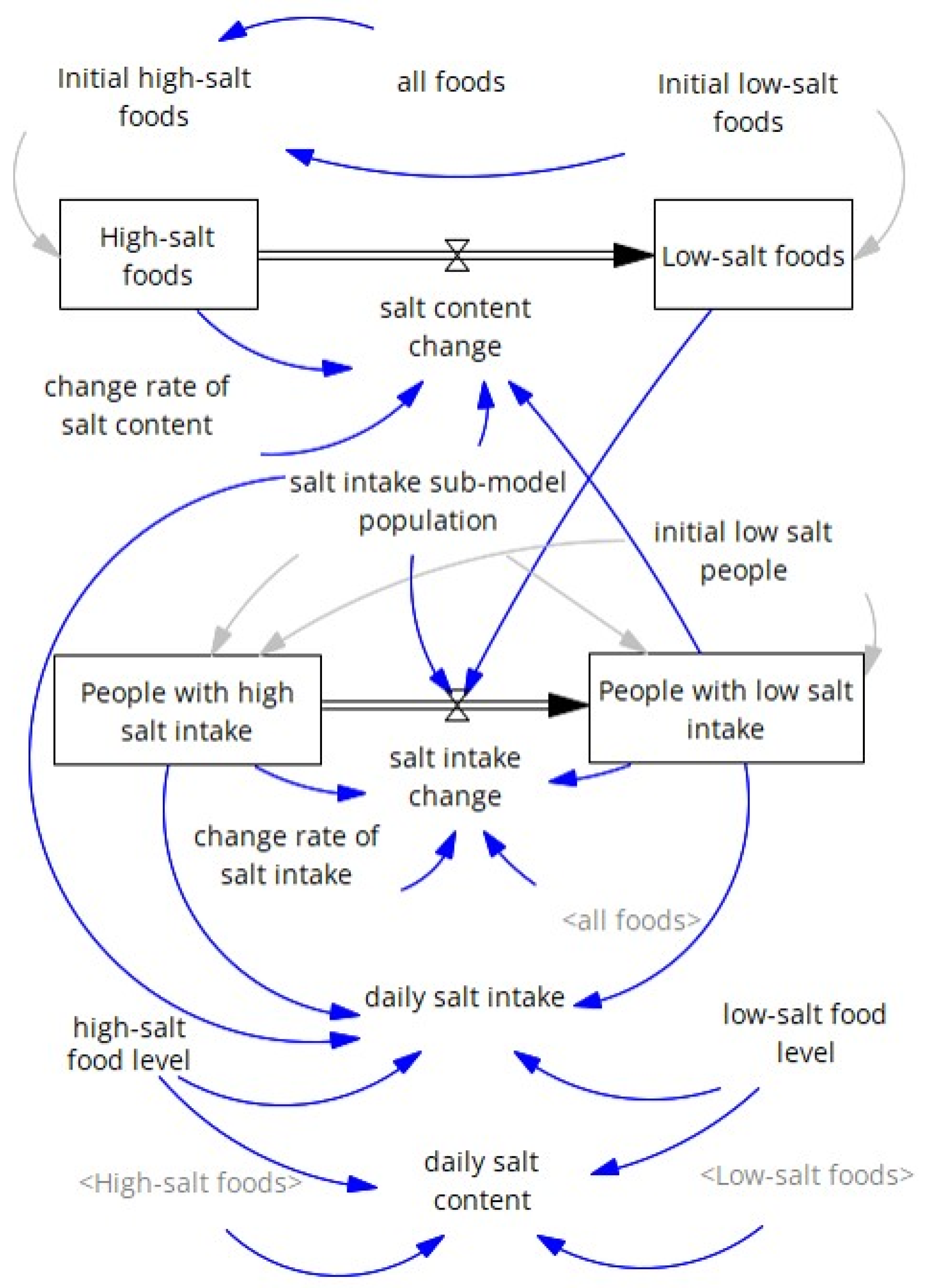
2.1.1. Salt Intake Sub-Model
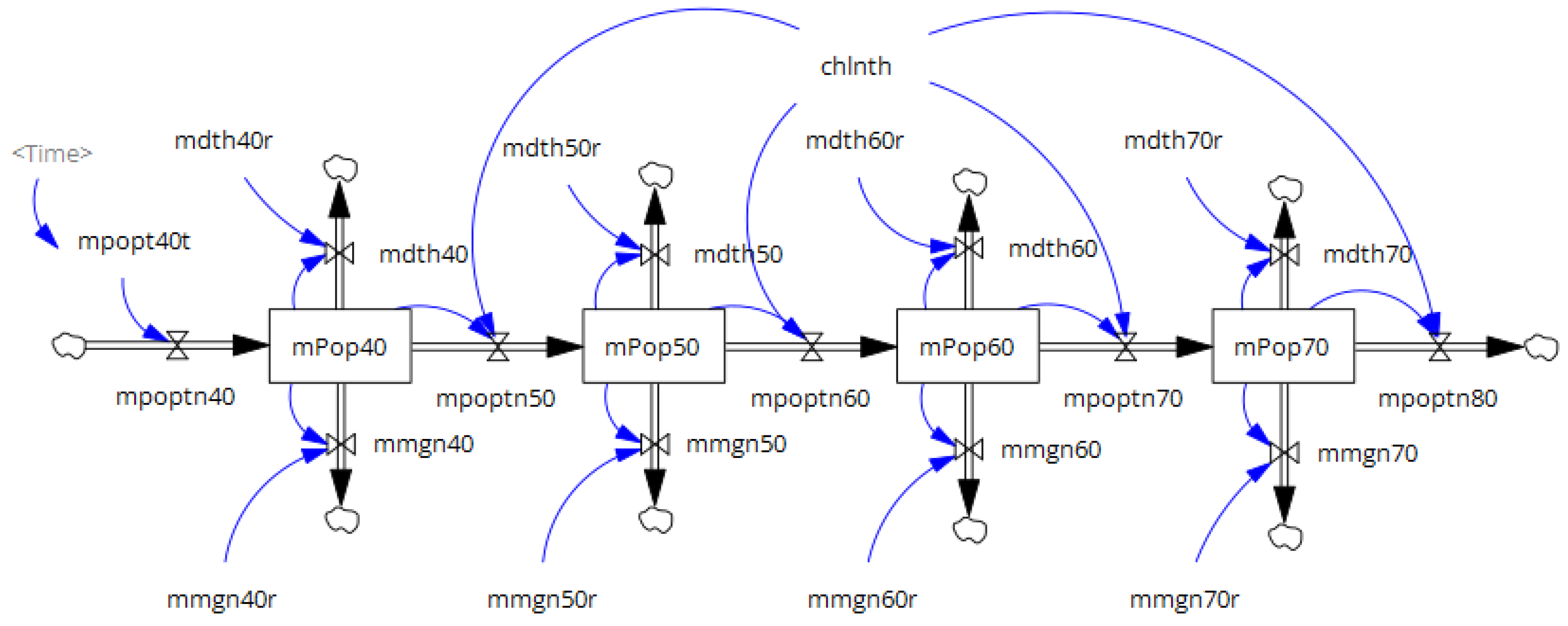
2.1.2. Population Sub-Model
2.1.3. Hypertension Sub-Model
2.1.4. Treatment Cost Sub-Model
2.2. Development of Subnational Models
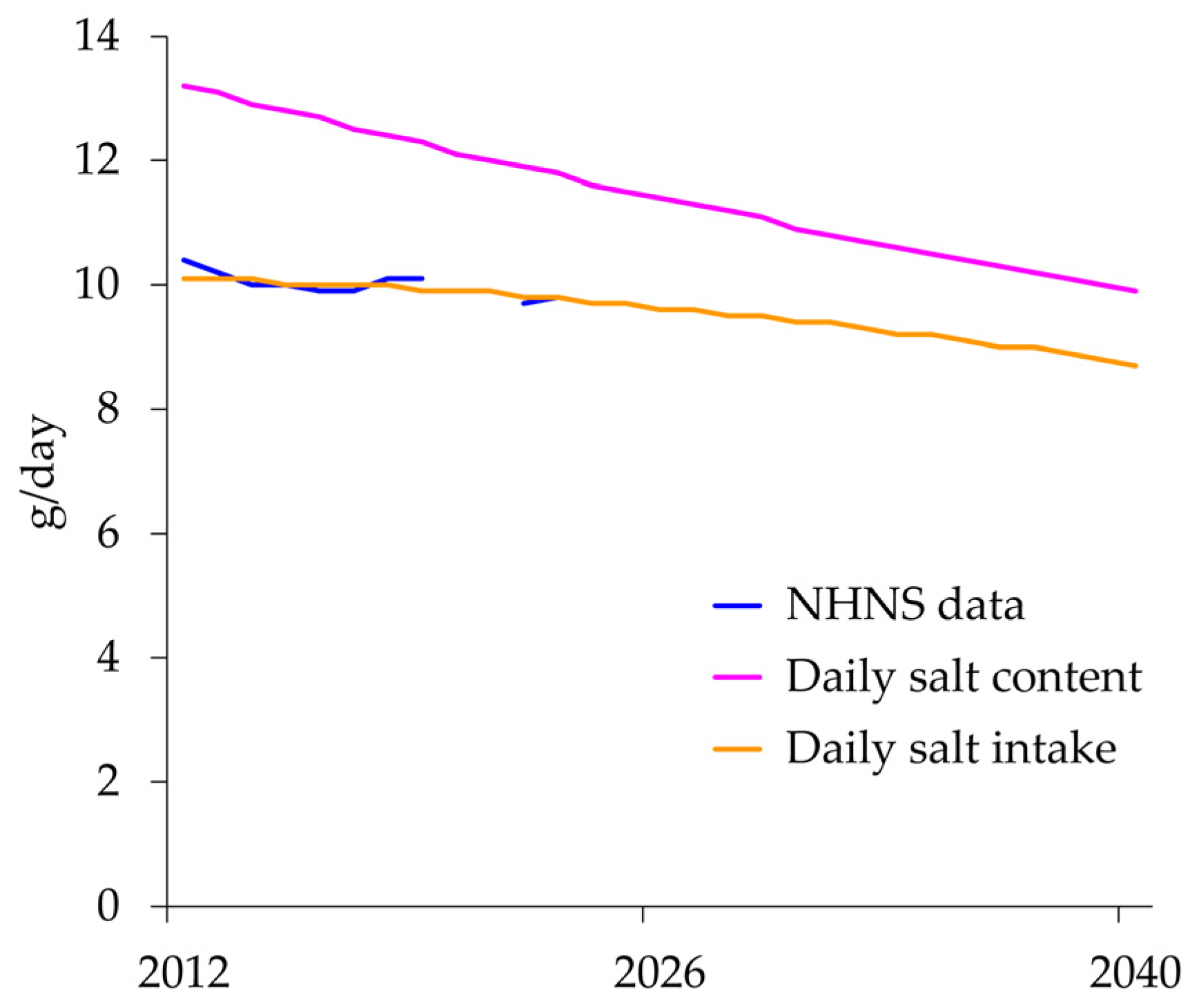
2.3. Model Validation
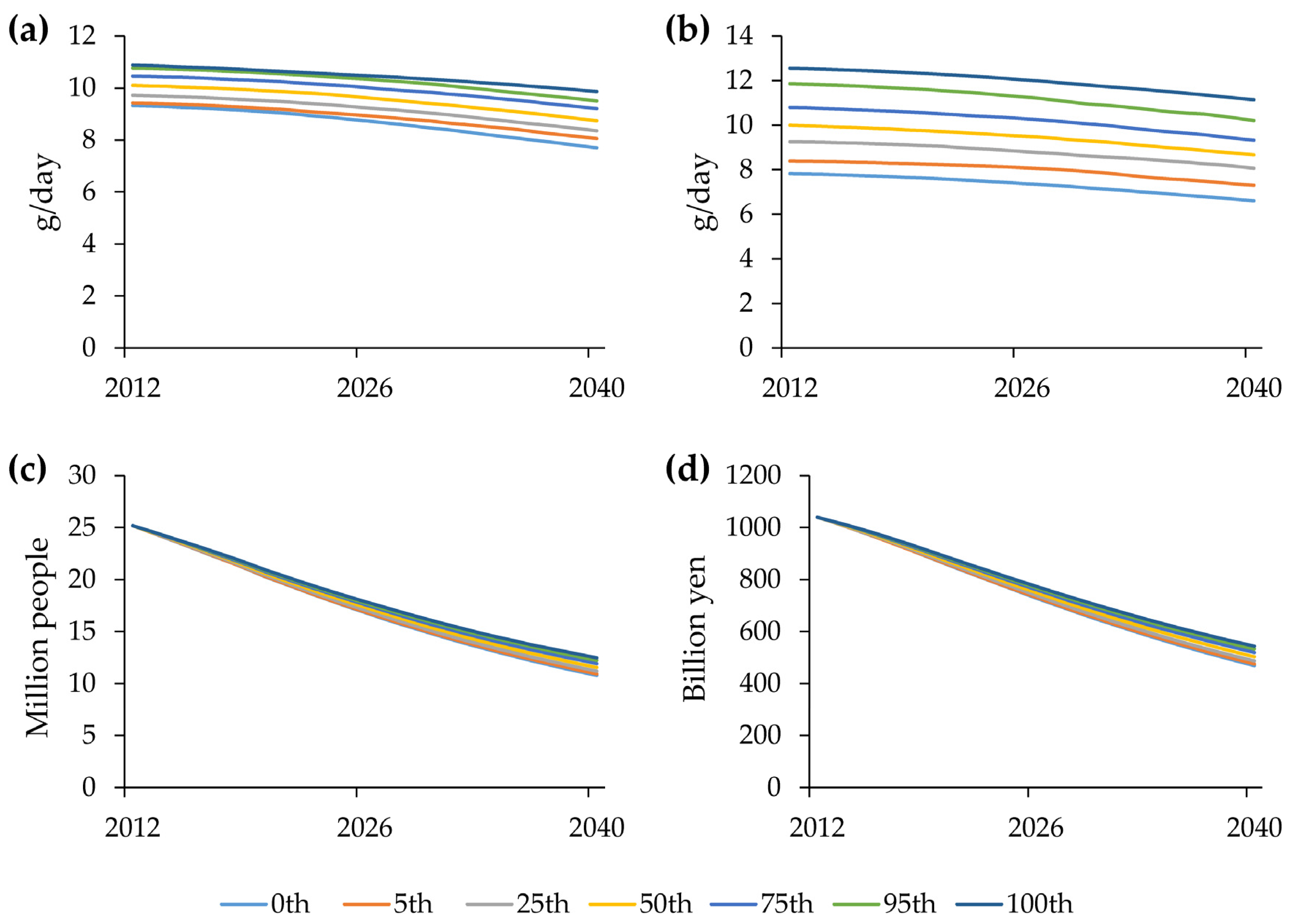
2.4. Sensitivity Analysis
2.5. Scenarios
- Scenario 1: The change rate of the foods multiplied by three.
- Scenario 2: The change rate of the people multiplied by three.
- Scenario 3: The change rates of both foods and people multiplied by three.
3. Results
3.1. Model Validation
3.2. Sensitivity Analysis
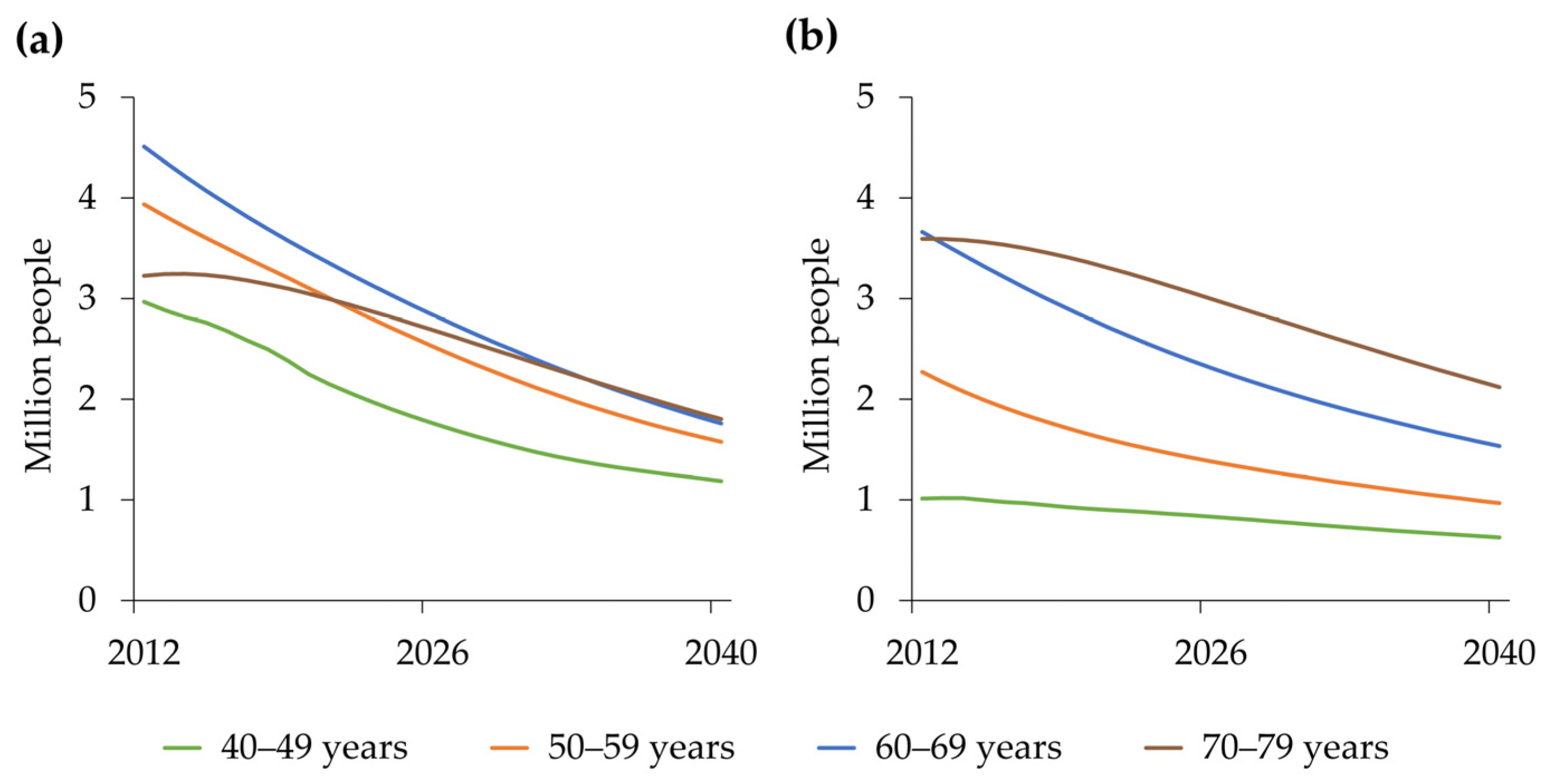
3.3. Simulated Results of the National Model as Base Run
3.4. Simulated Results of the National Model by Scenario
3.5. Simulated Results of Subnational Models
4. Discussion
5. Conclusions
Author Contributions
Funding
Institutional Review Board Statement
Informed Consent Statement
Data Availability Statement
Conflicts of Interest
Abbreviations
| MAPE | mean absolute percentage error |
| MHLW | Ministry of Health, Labor and Welfare |
| NHNS | National Health and Nutrition Survey |
| PwH | people with hypertension |
References
- Saito, A.; Imai, S.; Htun, N.C.; Okada, E.; Yoshita, K.; Yoshiike, N.; Takimoto, H. The trends in total energy, macronutrients and sodium intake among Japanese: Findings from the 1995–2016 National Health and Nutrition Survey. Br. J. Nutr. 2018, 120, 424–434. [Google Scholar] [CrossRef] [Scilit] [PubMed]
- Matsumoto, M.; Tajima, R.; Fujiwara, A.; Yuan, X.; Okada, E.; Takimoto, H. Trends in dietary salt sources in Japanese adults: Data from the 2007–2019 National Health and Nutrition Survey. Br. J. Nutr. 2022, 129, 690–703. [Google Scholar] [CrossRef] [Scilit] [PubMed]
- The National Health and Nutrition Survey. Tokyo. 2025. Available online: https://www.mhlw.go.jp/content/001435384.pdf (accessed on 2 February 2026).
- World Health Organization (WHO). Guideline: Sodium Intake for Adults and Children. 2012. Available online: https://www.who.int/publications/i/item/9789241504836 (accessed on 2 February 2026).
- Ministry of Health, Labour and Welfare. Dietary Reference Intakes for Japanese. 2025. Available online: https://www.mhlw.go.jp/content/10904750/001316585.pdf (accessed on 2 February 2026).
- Ministry of Health, Labour and Welfare. Strategic Initiative for a Healthy and Sustainable Food Environment (HSFE). 2022. Available online: https://sustainable-nutrition.mhlw.go.jp/en (accessed on 2 February 2026).
- Ministry of Health, Labour and Welfare. Health Japan 21 (the Third Term). 2023. Available online: https://www.mhlw.go.jp/stf/seisakunitsuite/bunya/kenkou_iryou/kenkou/kenkounippon21_00006.html (accessed on 2 February 2026).
- Ikeda, N.; Yamaguchi, M.; Kashino, I.; Sugiyama, T.; Miura, K.; Nishi, N. Evaluation of public health and economic impacts of dietary salt reduction initiatives on social security expenditures for cardiovascular disease control in Japan. Hypertens. Res. 2025, 48, 1265–1273. [Google Scholar] [CrossRef] [Scilit] [PubMed]
- Ohya, Y.; Sakima, A.; Arima, H.; Fukami, A.; Furuhashi, M.; Ishida, M.; Ishimitsu, T.; Kai, H.; Matsumura, K.; Miura, K.; et al. Key highlights of the Japanese Society of Hypertension Guidelines for the management of elevated blood pressure and hypertension 2025 (JSH2025). Hypertens. Res. 2025, 48, 2500–2511. [Google Scholar] [CrossRef] [Scilit] [PubMed]
- Hisamatsu, T.; Miura, K. Epidemiology and control of hypertension in Japan: A comparison with Western countries. J. Hum. Hypertens. 2021, 38, 469–476. [Google Scholar] [CrossRef] [Scilit] [PubMed]
- Ministry of Health, Labour and Welfare. Summary Report of Patient Survey 2023. 2024. Available online: https://www.mhlw.go.jp/english/database/db-hss/sps_2023.html (accessed on 2 February 2026).
- Ministry of Health, Labour and Welfare. Overviwew of National Medical Care Expenditure 2022. 2024. Available online: https://www.mhlw.go.jp/toukei/saikin/hw/k-iryohi/22/index.html (accessed on 2 February 2026).
- Smith, B.T.; Smith, P.M.; Harper, S.; Manuel, D.G.; A Mustard, C. Reducing social inequalities in health: The role of simulation modelling in chronic disease epidemiology to evaluate the impact of population health interventions. J. Epidemiol. Community Health 2013, 68, 384–389. [Google Scholar] [CrossRef] [Scilit] [PubMed]
- Wang, Y.; Hu, B.; Zhao, Y.; Kuang, G.; Zhao, Y.; Liu, Q.; Zhu, X. Applications of System Dynamics Models in Chronic Disease Prevention: A Systematic Review. Prev. Chronic Dis. 2021, 18, E103. [Google Scholar] [CrossRef] [Scilit] [PubMed]
- Orenstein, D.R.; Homer, J.; Milstein, B.; Wile, K.; Pratibhu, P.; Farris, R. Modeling the local dynamics of cardiovascular health: Risk factors, context, and capacity. Prev. Chronic Dis. 2008, 5, A63. [Google Scholar]
- Hirsch, G.; Homer, J.; Trogdon, J.; Wile, K.; Orenstein, D. Using Simulation to Compare 4 Categories of Intervention for Reducing Cardiovascular Disease Risks. Am. J. Public Health 2014, 104, 1187–1195. [Google Scholar] [CrossRef] [Scilit] [PubMed]
- Sugiyama, T.; Goryoda, S.; Inoue, K.; Sugiyama-Ihana, N.; Nishi, N. Construction of a simulation model and evaluation of the effect of potential interventions on the incidence of diabetes and initiation of dialysis due to diabetic nephropathy in Japan. BMC Health Serv. Res. 2017, 17, 833. [Google Scholar] [CrossRef] [Scilit] [PubMed]
- Hassan, F.A.; Nishi, N.; Minato, N.; Sugiyama, T.; Ikeda, N. Health and Economic Effects of Salt Reduction Interventions for Preventing Noncommunicable Diseases in Japan: A System Dynamics Simulation Study. Systems 2024, 12, 478. [Google Scholar] [CrossRef] [Scilit]
- Ventana Systems, Inc. Vensim Professional 10.2.0. Available online: https://vensim.com/software/ (accessed on 2 February 2026).
- Sterman, J.D. Business Dynamics: Systems Thinking and Modeling for a Complex World; Irwin McGraw Hill: New York, NY, USA, 2000. [Google Scholar]
- Ministry of Health Labour and Welfare. National Health and Nutrition Survey. Available online: https://www.mhlw.go.jp/bunya/kenkou/kenkou_eiyou_chousa.html (accessed on 2 February 2026).
- User Guide—Vensim Introduction & Tutorials. Available online: https://vensim.com/documentation/users_guide.html (accessed on 3 March 2026).
- Statistics Bureau of Japan; Ministry of Internal Affairs and Communications. Population Estimates. Available online: https://www.stat.go.jp/english/data/jinsui/index.html (accessed on 2 February 2026).
- Statistics Bureau of Japan; Ministry of Internal Affairs and Communications. General Mortality, Vital Statistics. Available online: https://www.e-stat.go.jp/en/stat-search/files?page=1&toukei=00450011&tstat=000001028897 (accessed on 2 February 2026).
- Lida, M.; Ueda, K.; Okayama, A.; Kodama, K.; Sawai, K.; Shibata, S.; Tanaka, S.; Keijnkai, T.; Horibe, H.; Minowa, M.; et al. Impact of elevated blood pressure on mortality from all causes, cardiovascular diseases, heart disease and stroke among Japanese: 14 year follow-up of randomly selected population from Japanese—Nippon data 80. J. Hum. Hypertens. 2003, 17, 851–857. [Google Scholar] [PubMed]
- Ministry of Health Labour and Welfare. Medical Insurance Benefits Survey. Available online: https://www.mhlw.go.jp/stf/seisakunitsuite/bunya/iryouhoken/database/zenpan/iryoukyufu.html (accessed on 2 February 2026).
- ISEE Systems, Inc. Stella Architect (Version 4.0). Available online: https://www.iseesystems.com/store/products/stella-architect.aspx (accessed on 2 February 2026).



| Men (Age, Years) | Women (Age, Years) | |||||||
|---|---|---|---|---|---|---|---|---|
| 40–49 | 50–59 | 60–69 | 70–79 | 40–49 | 50–59 | 60–69 | 70–79 | |
| Population sub-model | ||||||||
| Population | 2.0 | 1.3 | 2.8 | 2.6 | 3.9 | 1.4 | 2.7 | 2.5 |
| Deaths | 7.7 | 4.0 | 3.3 | 2.5 | 2.8 | 5.5 | 2.9 | 2.4 |
| Hypertension sub-model | ||||||||
| PwH | 23.9 | 7.0 | 13.0 | 8.4 | 19.2 | 8.9 | 15.7 | 5.7 |
| Treatment cost sub-model | ||||||||
| Treatment cost | 6.7 | 4.5 | 3.0 | 2.8 | 2.6 | 2.2 | 4.5 | 2.5 |
| 2012 | 2026 | 2040 | Difference from 2012 to 2040 (%) | |
|---|---|---|---|---|
| Salt intake sub-model | ||||
| Number of high-salt foods | 900 | 676 | 483 | −46.3 |
| Number of People with high salt intake | 51,313 | 45,415 | 34,322 | −33.1 |
| Daily salt intake, g/day | 10.1 | 9.6 | 8.7 | −13.9 |
| Population sub-model | ||||
| Number of men, million | 31.6 | 30.8 | 27.7 | −12.3 |
| Number of women, million | 33.2 | 30.8 | 26.5 | −20.2 |
| Hypertension sub-model | ||||
| Number of PwH men, million | 14.6 | 9.8 | 6.3 | −56.8 |
| Number of PwH women, million | 10.5 | 7.5 | 5.2 | −50.5 |
| Treatment cost sub-model | ||||
| Treatment cost for men, billion yen | 531.9 | 377.5 | 244.3 | −54.1 |
| Treatment cost for women, billion yen | 507.8 | 373.8 | 259.8 | −48.8 |
| Simulated Results in 2040 | Difference from Base Run in 2040, % | ||||||
|---|---|---|---|---|---|---|---|
| Base Run | Scenario 1 | Scenario 2 | Scenario 3 | Scenario 1 | Scenario 2 | Scenario 3 | |
| Salt intake sub-model | |||||||
| Number of high-salt foods | 483 | 242 | 459 | 201 | −50.0 | −5.1 | −58.5 |
| Number of people with high salt intake | 34,322 | 30,793 | 16,652 | 10,639 | −10.3 | −51.5 | −69.0 |
| Daily salt intake, g/day | 8.7 | 8.5 | 7.3 | 6.9 | −3.2 | −16.2 | −21.7 |
| Hypertension sub-model | |||||||
| Number of PwH men, million | 6.3 | 6.3 | 6.2 | 6.2 | −0.3 | −1.7 | −2.3 |
| Number of PwH women, million | 5.2 | 5.2 | 4.9 | 4.8 | −1.0 | −6.6 | −8.8 |
| Treatment cost sub-model | |||||||
| Treatment cost for men, billion yen | 244.3 | 243.7 | 240.6 | 239.3 | −0.2 | −1.5 | −2.0 |
| Treatment cost for women, billion yen | 259.8 | 257.4 | 243.7 | 238.3 | −0.9 | −6.2 | −8.3 |
| 2012 | 2026 | 2040 | Prefecture | |
|---|---|---|---|---|
| Minimum (2012) | ||||
| Daily salt intake, g/day | 8.3 | 7.8 | 6.9 | Okinawa |
| Population, million | 0.30 | 0.28 | 0.23 | Tottori |
| Number of PwH, million | 0.14 | 0.09 | 0.06 | Tottori |
| Treatment cost, billion yen | 5.8 | 4.0 | 2.5 | Tottori |
| Maximum (2012) | ||||
| Daily salt intake, g/day | 11.7 | 11.2 | 10.3 | Iwate |
| Population, million | 6.58 | 6.47 | 5.98 | Tokyo |
| Number of PwH, million | 1.82 | 1.41 | 1.06 | Tokyo |
| Treatment cost, billion yen | 72.3 | 58.4 | 44.3 | Tokyo |
Disclaimer/Publisher’s Note: The statements, opinions and data contained in all publications are solely those of the individual author(s) and contributor(s) and not of MDPI and/or the editor(s). MDPI and/or the editor(s) disclaim responsibility for any injury to people or property resulting from any ideas, methods, instructions or products referred to in the content. |
© 2026 by the authors. Licensee MDPI, Basel, Switzerland. This article is an open access article distributed under the terms and conditions of the Creative Commons Attribution (CC BY) license.
Share and Cite
Nishi, N.; Sugiyama, T.; Goryoda, S.; Takahashi, Y.; Miura, K.; Ikeda, N. Impact of Salt Reduction on Medical Expenditure for Hypertension in Japan: National and Subnational Simulation Models. Nutrients 2026, 18, 933. https://doi.org/10.3390/nu18060933
Nishi N, Sugiyama T, Goryoda S, Takahashi Y, Miura K, Ikeda N. Impact of Salt Reduction on Medical Expenditure for Hypertension in Japan: National and Subnational Simulation Models. Nutrients. 2026; 18(6):933. https://doi.org/10.3390/nu18060933
Chicago/Turabian StyleNishi, Nobuo, Takehiro Sugiyama, Sayuri Goryoda, Yutaka Takahashi, Katsuyuki Miura, and Nayu Ikeda. 2026. "Impact of Salt Reduction on Medical Expenditure for Hypertension in Japan: National and Subnational Simulation Models" Nutrients 18, no. 6: 933. https://doi.org/10.3390/nu18060933
APA StyleNishi, N., Sugiyama, T., Goryoda, S., Takahashi, Y., Miura, K., & Ikeda, N. (2026). Impact of Salt Reduction on Medical Expenditure for Hypertension in Japan: National and Subnational Simulation Models. Nutrients, 18(6), 933. https://doi.org/10.3390/nu18060933