From Phytochemical Characterization to Energy Metabolism-Driven Molecular Responses: The Anticancer Potential of Lactarius deliciosus (L.) Gray in Breast Cancer Cells

 , , , and
Abstract
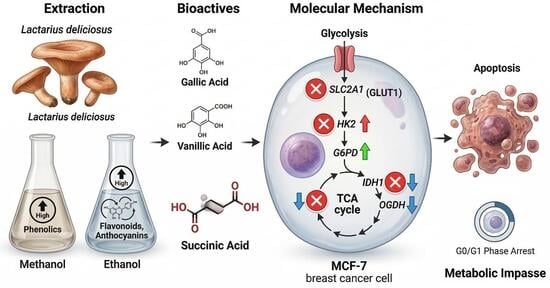
1. Introduction
2. Materials and Methods
2.1. Biological Material and Extract Preparation
Mushroom Source, Cultivation Conditions, and Extraction Approach
2.2. Chemical Composition and Antioxidant Characterization
2.2.1. Quantification of Total Bioactive Constituents
Determination of Total Phenolics, Flavonoids, and Anthocyanins
2.2.2. Determination of Macronutrient Content
Soluble Proteins and Total Carbohydrates Assays
2.2.3. Antioxidant Capacity Assessment
DPPH, ABTS, FRAP, and CUPRAC Methods
2.3. Targeted Phytochemical Profiling in L. deliciosus
HPLC-Based Phenolic Profiling
2.4. Volatile Metabolite Analysis
SPME–GC–MS-Based Aroma Characterization
2.5. Cell-Based Bioactivity Assessment
Cell Culture Conditions
2.6. Flow Cytometry-Based Cellular Responses
2.6.1. Cell Cycle Distribution Analysis
2.6.2. Apoptosis Detection (Annexin V-FITC/PI Staining)
2.7. Gene Expression and Metabolic Pathway Analysis
RT-qPCR-Based Profiling and Reactome Analysis
2.8. Statistical Analysis
3. Results
3.1. Quantification of Total Bioactive Constituents
Total Phenolics, Flavonoids, and Anthocyanins
3.2. Macronutrient Profiling
Soluble Proteins and Total Carbohydrates
3.3. Antioxidant Capacity of L. Deliciosus
DPPH, ABTS, FRAP, and CUPRAC Activities
3.4. Targeted Phytochemicals by HPLC and GC-MS
Phenolics Diversity in L. deliciosus Extracts
3.5. VOCs in L. deliciosuss
3.6. In Vitro Cell-Based Bioactivity Influenced by L. deliciosus Treatment
3.7. Flow Cytometry-Based Cellular Responses
3.7.1. Cell Cycle Changes in Response to L. deliciosus Treatment
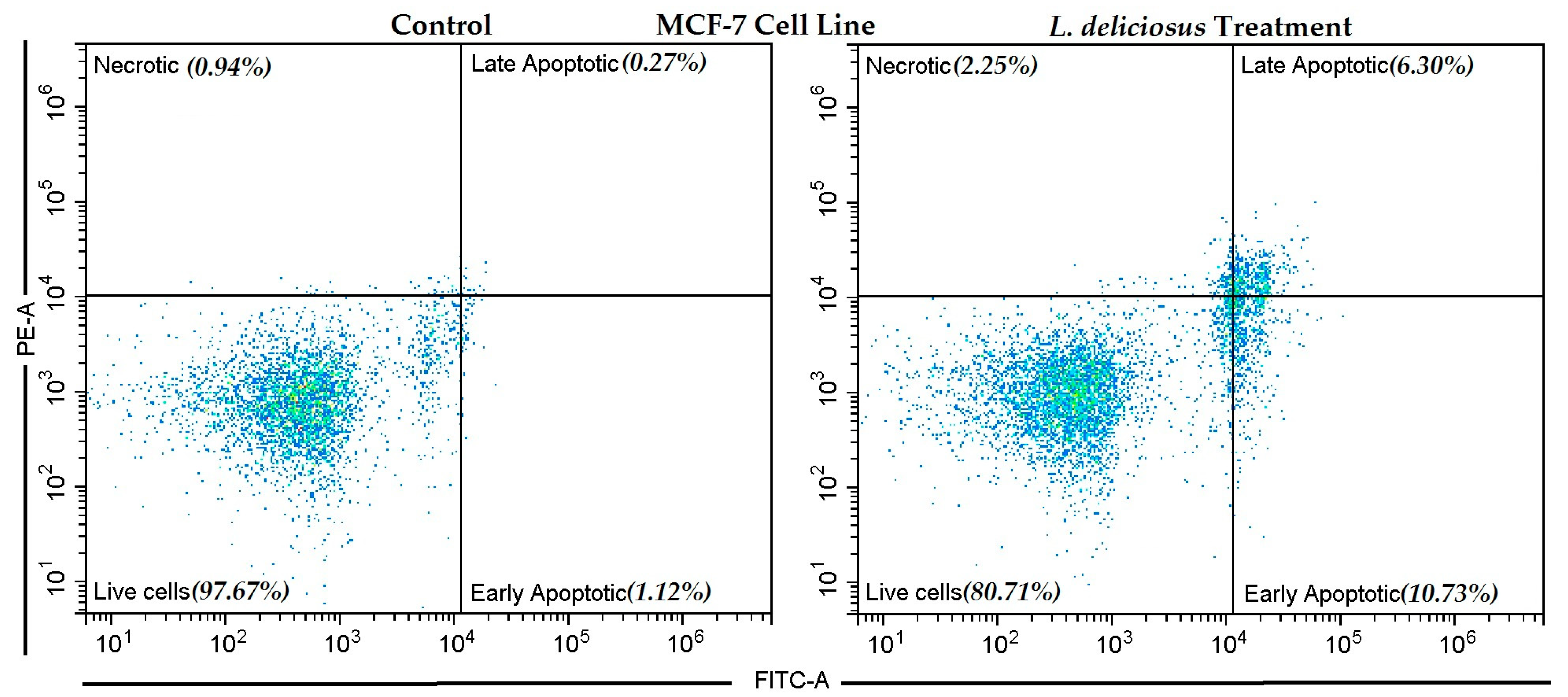
3.7.2. Apoptosis Induction by L. deliciosus
3.8. Genetic Modification and Regulation of Metabolic Pathwas
3.8.1. RT-qPCR-Based Profiling and Reactome Analysis
3.8.2. Metabolic Pathway Enrichment Analysis Findings
4. Discussion
5. Conclusions
Supplementary Materials
Author Contributions
Funding
Institutional Review Board Statement
Informed Consent Statement
Data Availability Statement
Acknowledgments
Conflicts of Interest
Abbreviations
| L. deliciosus | Lactarius deliciosus (L. ex Fr.) Gray |
| NADPH | Nikotinamid Adenin Dinükleotid Fosfat |
| FRAP | Ferric reducing antioxidant power |
| CUPRAC | Cupric reducing antioxidant capacity |
| ABTS | 2,2′-azino-bis(3ethylbenzothiazoline-6-sulfonic acid |
| DPPH | 2,2-diphenyl-1-picrylhydrazyl |
| HPLC | High-performance liquid chromatography |
| GC–MS | Gas chromatography–mass spectrometry |
| MTT | [3-(4,5-dimethylthiazol-2-yl)-2,5-diphenyltetrazolium bromide] |
| PCR | Polymerase chain reaction |
| DMEM | Dulbecco’s modified eagle medium |
| EDTA | Ethylenediaminetetraacetic acid |
| DMSO | Dimethyl sulfoxide |
| LDG-A | L. deliciosus polysaccharide |
| ATCC | American type culture collection |
References
- Truong, T.T.; Singh, A.A.; Tak, S.; Na, S.; Choi, J.; Oh, J.; Mondal, S. Plant-Derived Antioxidants as Modulators of Redox Signaling and Epigenetic Reprogramming in Cancer. Cells 2025, 14, 1948. [Google Scholar] [CrossRef] [PubMed]
- Ali, S.; Khalil, A.A.K.; Akhtar, M.S.; Amin, A.; Zaman, W. Comprehensive Insights into Natural Bioactive Compounds: From Chemical Diversity and Mechanisms to Biotechnological Innovations and Applications. ChemistryOpen 2025, 14, e202500469. [Google Scholar] [CrossRef] [PubMed]
- Olayiwola, Y.; Gollahon, L.S. Chlorogenic Acid and Cinnamaldehyde in Combination Inhibit Metastatic Traits and Induce Apoptosis via Akt Downregulation in Breast Cancer Cells. Int. J. Mol. Sci. 2024, 25, 6417. [Google Scholar] [CrossRef]
- Pan, Y.; Mary Peter, R.; Chou, P.; Dave, P.D.; Xu, J.; Shanner, A.; Kong, A.N. Cancer-Specific Regulation of Metabolic and Epigenetic Pathways by Dietary Phytochemicals. Pharm. Res. 2025, 42, 1443–1457. [Google Scholar] [CrossRef]
- George, B.P.; Chandran, R.; Abrahamse, H. Role of Phytochemicals in Cancer Chemoprevention: Insights. Antioxidants 2021, 10, 1455. [Google Scholar] [CrossRef]
- Arullappan, S.; Rajamanickam, P.; Thevar, N.; Kodimani, C.C. In Vitro Screening of Cytotoxic, Antimicrobial and Antioxidant Activities of Clinacanthus nutans (Acanthaceae) Leaf Extracts. Trop. J. Pharm. Res. 2014, 13, 1455–1461. [Google Scholar] [CrossRef]
- Bartmańska, A.; Tronina, T.; Popłoński, J.; Milczarek, M.; Filip-Psurska, B.; Wietrzyk, J. Highly Cancer Selective Antiproliferative Activity of Natural Prenylated Flavonoids. Molecules 2018, 23, 2922. [Google Scholar] [CrossRef]
- Shi, M.; Zhang, Z.; Yang, Y. Antioxidant and Immunoregulatory Activity of Ganoderma lucidum Polysaccharide (GLP). Carbohydr. Polym. 2013, 95, 200–206. [Google Scholar] [CrossRef]
- Maiti, J.; Joshi, A.; Shahi, S. A Review on Edible Mushrooms and Their Cancer Cure Properties. J. Adv. Zool. 2023, 44, 1353–1358. [Google Scholar] [CrossRef]
- Pogoń, K.; Jaworska, G.; Duda-Chodak, A.; Maciejaszek, I. Influence of the Culinary Treatment on the Quality of Lactarius deliciosus. Foods 2013, 2, 238–253. [Google Scholar] [CrossRef]
- Benítez, G.; Molero-Mesa, J.; Reyes-González-Tejero, M. Gathering an Edible Wild Plant: Food or Medicine? A Case Study on Wild Edibles and Functional Foods in Granada, Spain. Acta Sci. Pol. Hortorum Cultus 2017, 86, 3125. [Google Scholar] [CrossRef]
- Naim, M.J. A Review on Mushrooms as a Versatile Therapeutic Agent with Emphasis on Its Bioactive Constituents for Anticancer and Antioxidant Potential. Explor. Med. 2024, 5, 312–330. [Google Scholar] [CrossRef]
- Sánchez-Aragó, M.; Formentini, L.; Martínez-Reyes, I.; García-Bermudez, J.; Santacatterina, F.; Sánchez-Cenizo, L.; Cuezva, J.M. Expression, Regulation and Clinical Relevance of the ATPase Inhibitory Factor 1 in Human Cancers. Oncogenesis 2013, 2, e46. [Google Scholar] [CrossRef]
- Esparza-Moltó, P.B.; Cuezva, J.M. Reprogramming Oxidative Phosphorylation in Cancer: A Role for RNA-Binding Proteins. Antioxid. Redox Signal. 2020, 33, 927–945. [Google Scholar] [CrossRef]
- Seth Nanda, C.; Venkateswaran, S.V.; Patani, N.; Yuneva, M. Defining a Metabolic Landscape of Tumours: Genome Meets Metabolism. Br. J. Cancer 2020, 122, 136–149. [Google Scholar] [CrossRef]
- Ortiz, M.M.; Andrechek, E.R. Molecular Characterization and Landscape of Breast Cancer Models from a Multi-Omics Perspective. J. Mammary Gland Biol. Neoplasia 2023, 28, 12. [Google Scholar] [CrossRef]
- Braga, F.H.G.; Gómez-Mendoza, D.P.; Lemos, R.P.; Rodrigues-Ribeiro, L.; Raíssa-Oliveira, B.; Rodrigues, A.L.P.; Verano-Braga, T. Proteomic Analysis Reveals Stage-Specific Reprogramed Metabolism for the Primary Breast Cancer Cell Lines MGSO-3 and MACL-1. Proteomics 2022, 22, 2200095. [Google Scholar] [CrossRef]
- Li, D.; Chu, X.; Liu, W.; Ma, Y.; Tian, X.; Yang, Y. The Regulatory Roles of RNA-Binding Proteins in the Tumour Immune Microenvironment of Gastrointestinal Malignancies. RNA Biol. 2025, 22, 1–14. [Google Scholar] [CrossRef]
- Maan, M.; Jaiswal, N.; Liu, M.; Saavedra, H.I.; Chellappan, S.P.; Dutta, M. TBK1 Reprograms Metabolism in Breast Cancer: An Integrated Omics Approach. J. Proteome Res. 2024, 24, 121–133. [Google Scholar] [CrossRef]
- Kaushik, A.K.; DeBerardinis, R.J. Applications of Metabolomics to Study Cancer Metabolism. Biochim. Biophys. Acta Rev. Cancer 2018, 1870, 2–14. [Google Scholar] [CrossRef]
- Carnevali, F.; Forciniti, S.; Onesto, V.; Siciliano, A.C.; Iuele, H.; Grasso, G.; del Mercato, L.L. Advancements in Cancer Research: 3D Models, Single-Cell, and Live-Cell Techniques for Better Insights. Adv. Ther. 2024, 7, 2400351. [Google Scholar] [CrossRef]
- Kostić, M.; Ivanov, M.; Fernandes, Â.; Calhelha, R.C.; Glamočlija, J.; Barros, L.; Ćirić, A. A Comparative Study of Lactarius Mushrooms: Chemical Characterization, Antibacterial, Antibiofilm, Antioxidant and Cytotoxic Activity. J. Fungi 2023, 9, 70. [Google Scholar] [CrossRef] [PubMed]
- Gülüm, L.; Güler, E.; Zırhlı, Ç.B.; Çelik, A.B.; Tutar, Y. Phytochemical Profiling and Anticancer Potential of Pistachio Wastes Against MCF-7 Breast Cancer Cells: A Metabolic and Apoptotic Pathway Analysis. BMC Complement. Med. Ther. 2025, 25, 275. [Google Scholar] [CrossRef]
- Waterhouse, A.L. Determination of Total Phenolics. Curr. Protoc. Food Anal. Chem. 2002, 6, I1.1–I1.1.8. [Google Scholar] [CrossRef]
- Muradoğlu, F.; Batur, Ş.; Hasanov, M.; Güler, E. Putrescine Eases Saline Stress by Regulating Biochemicals, Antioxidative Enzymes, and Osmolyte Balance in Hydroponic Strawberries (cv. Albion). Physiol. Plant. 2025, 177, e70259. [Google Scholar] [CrossRef]
- Gülüm, L.; Güler, E.; Çapkınoğlu, E.; Çelik, A.B.; Tutar, Y. Evaluation of Anticancer Potential of Ganoderma lucidum on MCF-7 Breast Cancer Cells Through Genetic Transcription of Energy Metabolism. Antioxidants 2025, 14, 1471. [Google Scholar] [CrossRef]
- Gülüm, L.; Güler, E.; Aktaş, F.L.; Çelik, A.B.; Yılmaz, H.; Tutar, Y. In Vitro Effects of Rumex confertus Extracts on Cell Viability and Molecular Pathways in MCF-7 Breast Cancer Cells. Antioxidants 2025, 14, 879. [Google Scholar] [CrossRef]
- Von Gadow, A.; Joubert, E.; Hansmann, C.F. Comparison of the antioxidant activity of rooibos tea (Aspalathus linearis) with green, oolong and black tea. Food Chem. 1997, 60, 73–77. [Google Scholar] [CrossRef]
- Apak, R.; Güçlü, K.; Özyürek, M.; Çelik, S.E. Mechanism of antioxidant capacity assays and the CUPRAC (cupric ion reducing antioxidant capacity) assay. Microchim. Acta 2008, 160, 413–419. [Google Scholar] [CrossRef]
- Bulut, M.; Akpolat, H.; Tunçtürk, Y.; Alwazeer, D.; Türkhan, A. Determination of optimum ethanolic extraction conditions and phenolic profiles of thyme, mint, uckun, grape seeds and green tea waste fiber. Uluslararası Tarım Yaban Hayatı Bilim. Derg. 2020, 6, 605–614. [Google Scholar] [CrossRef]
- Benzie, I.F.; Devaki, M. The Ferric Reducing/Antioxidant Power (FRAP) Assay for Non-Enzymatic Antioxidant Capacity: Concepts, Procedures, Limitations and Applications. In Measurement of Antioxidant Activity & Capacity: Recent Trends and Applications; Apak, R., Ed.; Wiley: Hoboken, NJ, USA, 2018; pp. 77–106. [Google Scholar] [CrossRef]
- Rodríguez-Delgado, M.A.; Malovana, S.; Pérez, J.P.; Borges, T.; Montelongo, F.G. Separation of Phenolic Compounds by High-Performance Liquid Chromatography with Absorbance and Fluorimetric Detection. J. Chromatogr. A 2001, 912, 249–257. [Google Scholar] [CrossRef] [PubMed]
- Wang, S.; Li, X.; Jiang, M.; Wu, X.; Zhao, Y.; Liu, M.; Yang, W. Headspace Solid-Phase Microextraction Gas Chromatography/Mass Spectrometry (HS-SPME-GC/MS)-Based Untargeted Metabolomics Analysis for Comparing the Volatile Components from 12 Panax Herbal Medicines. Phyton 2022, 91, 1405–1420. [Google Scholar] [CrossRef]
- Çapan, İ.; Al, M.; Gümüş, M.; Açik, L.; Aydin, B.; Çelik, A.B.; Tutar, Y. Design, Synthesis, and Evaluation of Benzimidazole-Carbazole Hybrids Targeting Heat Shock Proteins-Mediated Apoptosis in Breast and Colon Cancer Cells. Drug Dev. Res. 2025, 86, e70092. [Google Scholar] [CrossRef] [PubMed]
- Çapan, İ.; Hawash, M.; Qaoud, M.T.; Gülüm, L.; Tunoglu, E.N.Y.; Çifci, K.U.; Tutar, Y. Synthesis of Novel Carbazole Hydrazine-Carbothioamide Scaffold as Potent Antioxidant, Anticancer and Antimicrobial Agents. BMC Chem. 2024, 18, 102. [Google Scholar] [CrossRef]
- Güven, G.K.; Okur, M.E.; Ayla, Ş.; Çalışkan, G.; Al, M.N.; Gülüm, L.; Değim, İ.T. Boron-Doped Carbon Quantum Dots: A Biocompatible Nanoplatform for Targeted Cancer Theranostics. Int. J. Pharm. 2025, 679, 125745. [Google Scholar] [CrossRef]
- Ayvaz, M.Ç. Phenolic Profile of Three Wild Edible Mushroom Extracts from Ordu, Turkey and Their Antioxidant Properties, Enzyme Inhibitory Activities. Br. Food J. 2019, 121, 1248–1260. [Google Scholar] [CrossRef]
- Xu, Z.; Fu, L.; Feng, S.; Yuan, M.; Huang, Y.; Liao, J.; Zhou, L.; Yang, H.; Ding, C. Chemical Composition, Antioxidant and Antihyperglycemic Activities of the Wild Lactarius deliciosus from China. Molecules 2019, 24, 1357. [Google Scholar] [CrossRef]
- Palacios, I.; Lozano, M.; Moro, C.; D’Arrigo, M.; Rostagno, M.A.; Martínez, J.A.; García-Lafuente, A.; Guillamón, E.; Villares, A. Antioxidant Properties of Phenolic Compounds Occurring in Edible Mushrooms. Food Chem. 2011, 128, 674–678. [Google Scholar] [CrossRef]
- Huang, Q.; Chen, L.; Song, H.; An, F.; Teng, H.; Xu, M. Effect of Different Drying Method on Volatile Flavor Compounds of Lactarius deliciosus. J. Food Process Technol. 2016, 7, 615. [Google Scholar] [CrossRef]
- Zhang, Y.; Li, F.; Huang, F.; Xie, G.; Wei, R.; Chen, T.; Liu, J.; Zhao, A.; Wang, J. Metabolomics Analysis Reveals Variation in Schisandra chinensis Metabolites from Different Origins. J. Sep. Sci. 2014, 37, 1281–1287. [Google Scholar] [CrossRef]
- Matsuda, F.; Nakabayashi, R.; Yang, Z.; Okazaki, Y.; Yonemaru, J.; Ebana, K.; Yano, M.; Saito, K. Metabolome-genome-wide association study dissects genetic architecture for generating natural variation in rice secondary metabolism. Plant J. 2014, 80, 999–1016. [Google Scholar] [CrossRef] [PubMed]
- Shinyuy, L.M.; Loé, G.E.; Jansen, O.; Ledoux, A.; Palmaerts, B.; Mamede, L.; Boussif, N.; Bonnet, O.; Enone, B.S.; Noukimi, S.F.; et al. Exploring the Phytochemical Diversity and Anti-Plasmodial Potential of Artemisia annua and Artemisia afra from Different Geographical Locations in Cameroon. Molecules 2025, 30, 596. [Google Scholar] [CrossRef] [PubMed]
- Xue, L.; Otieno, M.; Colson, K.L.; Neto, C. Influence of the Growing Region on the Phytochemical Composition and Antioxidant Properties of North American Cranberry Fruit (Vaccinium macrocarpon Aiton). Plants 2023, 12, 3595. [Google Scholar] [CrossRef] [PubMed]
- Yin, G.; Moore, G.G.; Bennett, J.W. Diversity and Functions of Fungal VOCs with Special Reference to the Multiple Bioactivities of the Mushroom Alcohol. Mycology 2025, 16, 1011–1022. [Google Scholar] [CrossRef]
- Fogarasi, M.; Socaci, S.A.; Dulf, F.V.; Diaconeasa, Z.M.; Fărcaş, A.C.; Tofană, M.; Semeniuc, C.A. Bioactive Compounds and Volatile Profiles of Five Transylvanian Wild Edible Mushrooms. Molecules 2018, 23, 3272. [Google Scholar] [CrossRef]
- Tsivinska, M.V.; Antonyuk, V.O.; Panchak, L.V.; Klyuchivska, O.Y.; Stoika, R.S. Biologically Active Substances of Methanol Extracts of Dried Lactarius quetus and Lactarius volemus Basidiomes Mushrooms: Identification and Potential Functions. Biotechnol. Acta 2015, 8, 58–70. [Google Scholar] [CrossRef][Green Version]
- Miyazawa, M.; Kawauchi, Y.; Matsuda, N. Character Impact Odorants from Wild Mushroom (Lactarius hatsudake) Used in Japanese Traditional Food. Flavour Fragr. J. 2010, 25, 154–158. [Google Scholar] [CrossRef]
- Chernyshov, V.V.; Popadyuk, I.I.; Yarovaya, O.I.; Salakhutdinov, N.F. Nitrogen-Containing Heterocyclic Compounds Obtained from Monoterpenes or Their Derivatives: Synthesis and Properties. Top. Curr. Chem. 2022, 380, 42. [Google Scholar] [CrossRef]
- Chua, L.Y.; Chong, C.H.; Chua, B.L.; Figiel, A. Influence of Drying Methods on the Antibacterial, Antioxidant and Essential Oil Volatile Composition of Herbs: A Review. Food Bioprocess Technol. 2019, 12, 450–476. [Google Scholar] [CrossRef]
- Liu, J.K. Secondary Metabolites from Higher Fungi in China and Their Biological Activity. Drug Discov. Ther. 2007, 1, 94–103. [Google Scholar]
- Belova, N.V.; Popov, E.S. Lactarius and Lactifluus (Russulaceae): Species Diversity and Ecological–Biochemical, Medicobiological, and Nutritional Aspects. Biol. Bull. Rev. 2025, 15, S115–S123. [Google Scholar] [CrossRef]
- Vaz, J.A.; Ferreira, I.C.F.R.; Tavares, C.; Almeida, G.M.; Martins, A.; Vasconcelos, M.H. Suillus collinitus Methanolic Extract Increases p53 Expression and Causes Cell Cycle Arrest and Apoptosis in a Breast Cancer Cell Line. Food Chem. 2012, 135, 596–602. [Google Scholar] [CrossRef]
- Reis, F.S.; Sousa, D.; Barros, L.; Martins, A.; Morales, P.; Ferreira, I.C.F.R.; Vasconcelos, M.H. Leccinum vulpinum Watling Induces DNA Damage, Decreases Cell Proliferation and Induces Apoptosis on the Human MCF-7 Breast Cancer Cell Line. Food Chem. Toxicol. 2016, 90, 45–54. [Google Scholar] [CrossRef] [PubMed]
- Rivas, V.; González-Muñoz, T.; Albitre, Á.; Lafarga, V.; Delgado-Arévalo, C.; Mayor, F., Jr.; Penela, P. GRK2-Mediated AKT Activation Controls Cell Cycle Progression and G2 Checkpoint in a p53-Dependent Manner. Cell Death Discov. 2024, 10, 385. [Google Scholar] [CrossRef] [PubMed]
- Larypoor, M. Investigation of HER-3 Gene Expression Under the Influence of Carbohydrate Biopolymers Extract of Shiitake and Reishi in MCF-7 Cell Line. Mol. Biol. Rep. 2022, 49, 6563–6572. [Google Scholar] [CrossRef]
- Hou, Y.; Liu, L.; Ding, X.; Zhao, D.; Hou, W. Structure Elucidation, Proliferation Effect on Macrophage and Its Mechanism of a New Heteropolysaccharide from Lactarius deliciosus Gray. Carbohydr. Polym. 2016, 152, 648–657. [Google Scholar] [CrossRef]
- Hou, Y.; Wang, M.; Zhao, D.; Liu, L.; Ding, X.; Hou, W. Effect on Macrophage Proliferation of a Novel Polysaccharide from Lactarius deliciosus (L. ex Fr.) Gray. Oncol. Lett. 2019, 17, 2507–2515. [Google Scholar] [CrossRef]
- Li, K.; Wang, L.; Hu, Y.; Zhu, Z. Structural Characterization and Protective Effect on PC12 Cells Against $H_{2}O_{2}$-Induced Oxidative Damage of a Polysaccharide Extracted from Mycelia of Lactarius deliciosus Gray. Int. J. Biol. Macromol. 2022, 209, 1815–1825. [Google Scholar] [CrossRef]
- Roszczenko, P.; Szewczyk-Roszczenko, O.K.; Gornowicz, A.; Iwańska, I.A.; Bielawski, K.; Wujec, M.; Bielawska, A. The Anticancer Potential of Edible Mushrooms: A Review of Selected Species from Roztocze, Poland. Nutrients 2024, 16, 2849. [Google Scholar] [CrossRef]
- Nowakowski, P.; Markiewicz-Żukowska, R.; Gromkowska-Kępka, K.; Naliwajko, S.K.; Moskwa, J.; Bielecka, J.; Grabia, M.; Borawska, M.; Socha, K. Mushrooms as Potential Therapeutic Agents in the Treatment of Cancer: Evaluation of Anti-Glioma Effects of Coprinus comatus, Cantharellus cibarius, Lycoperdon perlatum and Lactarius deliciosus Extracts. Biomed. Pharmacother. 2021, 133, 111090. [Google Scholar] [CrossRef]
- Volcão, L.M.; Halicki, P.C.B.; Christ-Ribeiro, A.; Ramos, D.F.; Badiale-Furlong, E.; Andreazza, R.; Bernardi, E.; Silva Júnior, F.M.R. Mushroom Extract of Lactarius deliciosus (L.) Sf. Gray as Biopesticide: Antifungal Activity and Toxicological Analysis. J. Toxicol. Environ. Health A 2022, 85, 43–55. [Google Scholar] [CrossRef]
- Zambrano, A.; Molt, M.; Uribe, E.; Salas, M. Glut 1 in Cancer Cells and the Inhibitory Action of Resveratrol as a Potential Therapeutic Strategy. Int. J. Mol. Sci. 2019, 20, 3374. [Google Scholar] [CrossRef]
- Choi, D.; Lee, J.G.; Heo, S.H.; Cho, M.K.; Nam, H.S.; Lee, S.H.; Lee, Y.J. Curcumin and Its Potential to Target the Glycolytic Behavior of Lactate-Acclimated Prostate Carcinoma Cells with Docetaxel. Nutrients 2024, 16, 4338. [Google Scholar] [CrossRef]
- Fernández-Hernando, C.; Suárez, Y.; Rayner, K.J.; Moore, K.J. MicroRNAs in Lipid Metabolism. Curr. Opin. Lipidol. 2011, 22, 86–92. [Google Scholar] [CrossRef]
- Kim, Y.; Byun, S.; Zhang, Y.; Seok, S.; Kemper, B.; Ma, J.; Kemper, J.K. Liver ChIP-seq Analysis in FGF19-Treated Mice Reveals SHP as a Global Transcriptional Partner of SREBP-2. Genome Biol. 2015, 16, 268. [Google Scholar] [CrossRef]
- Cheng, P.; Li, G.; Yang, S.S.; Liu, R.; Jin, G.; Zhou, X.Y.; Hu, X.G. Tumor suppressor Menin acts as a corepressor of LXRα to inhibit hepatic lipogenesis. FEBS Lett. 2015, 589, 3079–3084. [Google Scholar] [CrossRef]




| Solvent | TPC (mM) | TFC (mM) | Tant (mM) |
|---|---|---|---|
| Ethanol | 3.50 ± 0.15 b | 2.72 ± 0.11 a | 1021.80 ± 42.68 a |
| Methanol | 6.54 ± 0.27 a | 2.05 ± 0.09 b | 682.97 ± 28.53 b |
| Solvent | Protein (%) | Carbohydrates (%) |
|---|---|---|
| Ethanol | 9.67 ± 0.40 b | 34.45 ± 1.44 a |
| Methanol | 24.52 ± 1.02 a | 37.14 ± 1.55 a |
| Solvent | DPPH (mM) | CUPRAC (mM) | ABTS (mM) | FRAP (mM) |
|---|---|---|---|---|
| Ethanol | 1.29 ± 0.05 b | 7.42 ± 0.31 b | 15.95 ± 0.67 a | 14.40 ± 0.60 a |
| Methanol | 2.91 ± 0.12 a | 35.88 ± 1.50 a | 12.91 ± 0.54 b | 7.76 ± 0.32 b |
| Phenolic and Organic Acid Profiles | L. deliciosus Ethanol (µg/g) | L. deliciosus Methanol (µg/g) |
|---|---|---|
| Gallic Acid | 14.09 | 298.89 |
| 4-Aminobenzoic Acid | 3.80 | n.d. |
| Procatechin | 84.59 | 77.73 |
| Chlorogenic Acid | 59.79 | 87.30 |
| Syringic Acid | n.d. | 70.26 |
| 4-Hydroxybenzoic Acid | 32.55 | 24.21 |
| Syringin Hydrate | 145.46 | 95.64 |
| Caffeic Acid | 20.19 | 76.20 |
| Vanillic Acid | 209.19 | 191.98 |
| Ferulic Acid | 4.43 | n.d. |
| Synapic Acid | n.d. | n.d. |
| Coumaric Acid | n.d. | n.d. |
| Rutintrihydrate | n.d. | n.d. |
| Quercitrin | n.d. | 8.91 |
| (−)-Epicatechin | 561.30 | n.d. |
| (+)-Catechin | n.d. | n.d. |
| Salicylic Acid | n.d. | n.d. |
| Succinic Acid | 724.73 | 99.76 |
| Group | Compound Name | % Area | RI |
|---|---|---|---|
| 1. Organic Acids | Acetic acid (Ethylic acid) | 30.02 | 670 |
| Propanoic acid (Propionic acid) | 0.72 | 699 | |
| Capric acid (Decanoic acid) | 21.81 | 1837 | |
| Total | 52.55 | ||
| 2. Aldehydes | 3-Methylbutanal | 1.02 | 682 |
| 2-Methylbutanal | 1.41 | 685 | |
| Hexanal (n-Hexanal) | 1.74 | 779 | |
| Benzaldehyde | 1.61 | 1005 | |
| Benzeneacetaldehyde (Hyacinthin) | 1.18 | 1153 | |
| Hex-2-enal, 2-isopropyl-, 5-methyl | 1.46 | 1297 | |
| 5-Methyl-2-isopropyl-2-hexenal | 0.70 | 1319 | |
| 5-Methyl-2-phenyl-2-hexenal | 0.79 | 2126 | |
| Total | 9.91 | ||
| 3. Ketones | 6-Methyl-3,5-heptadien-2-one | 1.02 | 850 |
| 2-Heptanone | 1.73 | 903 | |
| 1-Octen-3-one (Vinyl amyl ketone) | 0.78 | 1040 | |
| (Z)-6-Octen-2-one | 0.73 | 1136 | |
| Total | 4.26 | ||
| 4. Alcohols | 1-Octen-3-ol | 10.00 | 1043 |
| 3-Octanol | 4.94 | 1070 | |
| Total | 14.94 | ||
| 5. Lactones | Dihydro-2(3H)-furanone (Butyrolactone) | 3.17 | 930 |
| 4-(1-Hydroxyethyl)-γ-butanolactone | 0.95 | 1496 | |
| 2-Methyl-tetrahydrofuran-3-one | 0.69 | 786 | |
| Total | 4.81 | ||
| 6. Furans | 2-Amylfuran | 2.00 | 1062 |
| Total | 2.00 | ||
| 7. Nitrogen-Containing Heterocyclic Compounds | Methylpyrazine | 1.02 | 805 |
| 2-Acetylpyrrole | 3.81 | 1196 | |
| Total | 4.83 | ||
| 8. Terpenes | L-Limonene | 3.92 | 1125 |
| Total | 3.92 | ||
| 9. Alkanes | Tetradecane | 1.20 | 1892 |
| Total | 1.20 | ||
| 10. Aromatic/Polycyclic Compounds | 6-Methoxy-2-(1-buten-3-yl)-naphthalene | 1.58 | 2640 |
| Total | 1.58 |
Disclaimer/Publisher’s Note: The statements, opinions and data contained in all publications are solely those of the individual author(s) and contributor(s) and not of MDPI and/or the editor(s). MDPI and/or the editor(s) disclaim responsibility for any injury to people or property resulting from any ideas, methods, instructions or products referred to in the content. |
© 2026 by the authors. Licensee MDPI, Basel, Switzerland. This article is an open access article distributed under the terms and conditions of the Creative Commons Attribution (CC BY) license.
Share and Cite
Gülüm, L.; Güler, E.; Çapkınoğlu, E.; Çelik, A.B.; Tutar, Y. From Phytochemical Characterization to Energy Metabolism-Driven Molecular Responses: The Anticancer Potential of Lactarius deliciosus (L.) Gray in Breast Cancer Cells. Nutrients 2026, 18, 1008. https://doi.org/10.3390/nu18061008
Gülüm L, Güler E, Çapkınoğlu E, Çelik AB, Tutar Y. From Phytochemical Characterization to Energy Metabolism-Driven Molecular Responses: The Anticancer Potential of Lactarius deliciosus (L.) Gray in Breast Cancer Cells. Nutrients. 2026; 18(6):1008. https://doi.org/10.3390/nu18061008
Chicago/Turabian StyleGülüm, Levent, Emrah Güler, Emir Çapkınoğlu, Ayşe Büşranur Çelik, and Yusuf Tutar. 2026. "From Phytochemical Characterization to Energy Metabolism-Driven Molecular Responses: The Anticancer Potential of Lactarius deliciosus (L.) Gray in Breast Cancer Cells" Nutrients 18, no. 6: 1008. https://doi.org/10.3390/nu18061008
APA StyleGülüm, L., Güler, E., Çapkınoğlu, E., Çelik, A. B., & Tutar, Y. (2026). From Phytochemical Characterization to Energy Metabolism-Driven Molecular Responses: The Anticancer Potential of Lactarius deliciosus (L.) Gray in Breast Cancer Cells. Nutrients, 18(6), 1008. https://doi.org/10.3390/nu18061008