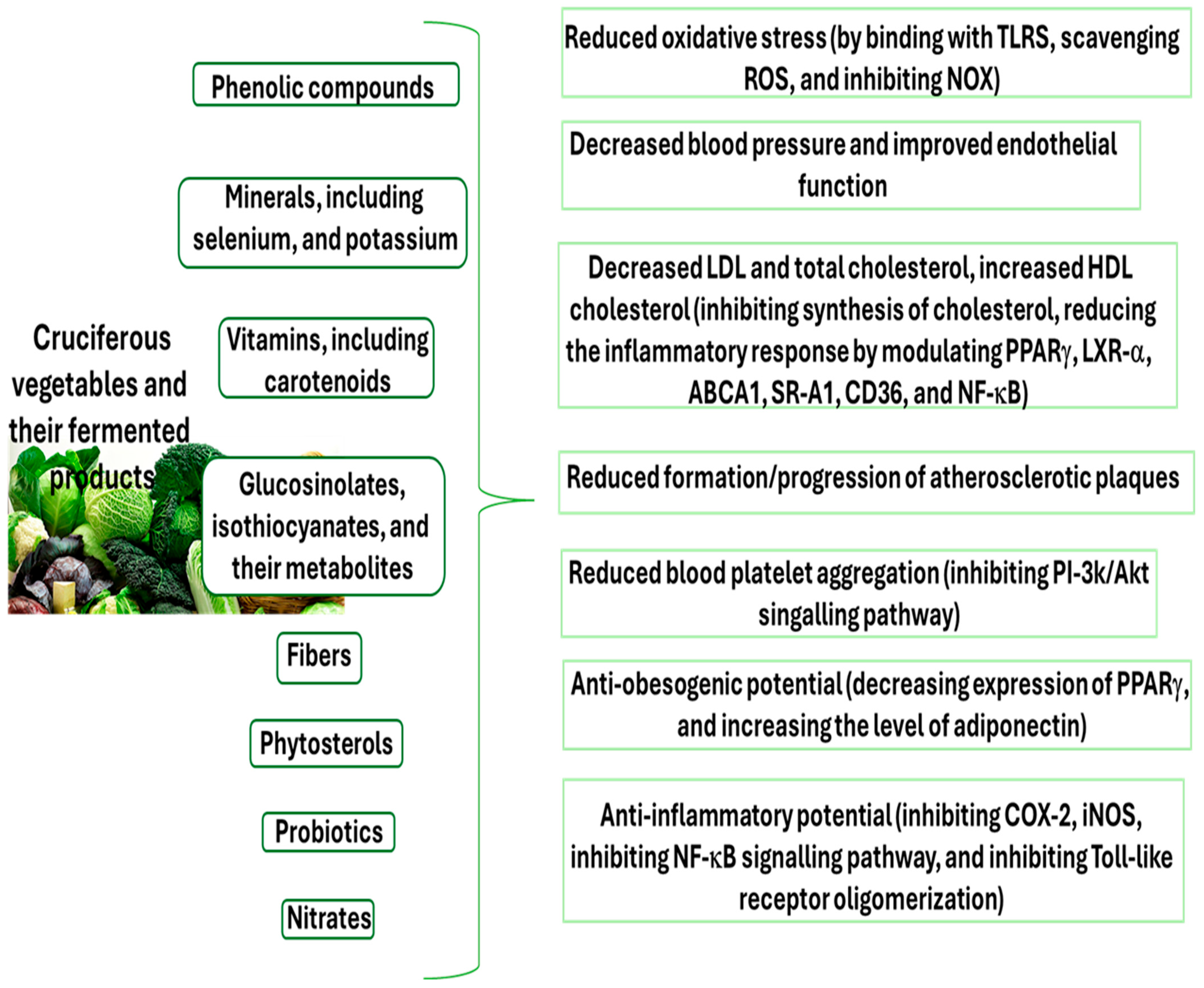
Bioactive Compounds from Cruciferous Vegetables as a Therapeutic Option for the Prevention and Treatment of Cardiovascular Diseases


Abstract
1. Introduction
2. Methodology for the Literature Search
3. Cardioprotective Potential of Bioactive Compounds from Cruciferous Vegetables
3.1. Phenolic Compounds
3.1.1. In Vitro Models
3.1.2. In Vivo Models
3.2. Glucosinolates
3.2.1. In Vitro Models
3.2.2. In Vivo Models
3.3. Other Components
4. Cardioprotective Mechanisms of the Main Components of Cruciferous Vegetables
5. Changes in the Content of Phenolic Compounds and Glucosinolates During Vegetable Processing
5.1. Phenolic Compounds
5.2. Glucosinolates
6. Conclusions
Funding
Data Availability Statement
Conflicts of Interest
Abbreviations
References
- Joshipura, K.J.; Ascherio, A.; Manson, J.E.; Stampfer, M.J.; Rimm, E.B.; Speizer, F.E.; Hennekens, C.H.; Spiegelman, D.; Willett, W.C. Fruit and vegetable intake in relation to risk of ischemic stroke. J. Am. Med. Assoc. 1999, 282, 1233–1239. [Google Scholar] [CrossRef]
- Buil-Cosiales, P.; Toledo, E.; Salas-Salvado, J.; Zazpe, M.; Farras, M.; Basterra-Gortari, F.J.; Diez-Espino, J.; Estruch, R.; Corella, D.; Ros, E.; et al. Association between dietary fiber intake and fruit, vegetable or whole-grain consumption and the risk of CVD: Results from the PREvention con Dieta MEDiterranea (PREDIMED) trial. Br. J. Nutr. 2016, 116, 534–546. [Google Scholar] [CrossRef]
- Afshin, A.; Sur, P.J.; Fay, K.A.; Cornaby, L.; Ferrara, G.; Salama, J.S.; Mullany, E.C.; Abate, K.H.; Abbafati, C.; Abebe, Z.; et al. Health effects of dietary risks in 195 countries, 1990–2017: A systematic analysis for the global burden of disease study 2017. Lancet 2019, 393, 1958–1972. [Google Scholar] [CrossRef]
- Verma, T.; Sinha, M.; Bansal, N.; Raj Yadav, S.; Shah, K.; Chauhan, N.G. Plants used as antihypertensive. Nat. Prod. Bioprospect. 2021, 11, 155–184. [Google Scholar] [CrossRef]
- Li, N.; Wu, X.; Zhuang, W.; Wu, C.; Rao, Z.; Du, L.; Zhou, Y. Cruciferous vegetable and isothiocyanate intake and multiple health outcomes. Food Chem. 2022, 375, 131816. [Google Scholar] [CrossRef]
- Rolnik, A.; Olas, B. Vegetables from Cucurbitaceae family and their products: Positive effect on human health. Nutrition 2020, 78, 110788. [Google Scholar] [CrossRef]
- Rolnik, A.; Olas, B. The plants of the Asteraceae family as agents in the protection of human health. Int. J. Mol. Sci. 2021, 22, 3009. [Google Scholar] [CrossRef]
- Madsen, H.; Sen, A.; Aune, D. Fruit and vegetable consumption and the risk of hypertension: A systematic review and meta-analysis of prospective studies. Eur. J. Nutr. 2023, 62, 1941–1955. [Google Scholar] [CrossRef] [PubMed]
- Olas, B. The cardioprotective role of nitrate-rich vegetables. Foods 2024, 13, 691. [Google Scholar] [CrossRef] [PubMed]
- Yilmaz, A.; Weech, M.; Bountziouka, V.; Jackson, K.G.; Lovegrove, J.A. Association between empirically driven dietary patterns and cardiometabolic disease risk factors: A cross-sectional analysis in disease-free adults. Nutr. Metab. 2025, 22, 73. [Google Scholar] [CrossRef] [PubMed]
- Wu, L.; Ashraf, H.N.; Facci, M.; Wang, R.; Paterson, P.G.; Ferrie, A.; Juurlink, B.H.J. Dietary approach to attenuate oxidative stress, hypertension, and inflammation in the cardiovascular system. Proc. Natl. Acad. Sci. USA 2004, 101, 7094–7099. [Google Scholar] [CrossRef]
- Zhang, X.; Shu, X.O.; Xiang, Y.B.; Yang, G.; Li, H.; Gao, J.; Cai, H.; Gao, Y.T.; Zheng, W. Cruciferous vegetable consumption is associated with a reduced risk of total and cardiovascular disease mortality. Am. J. Clin. Nutr. 2011, 94, 240–246. [Google Scholar] [CrossRef]
- Blekkenhorst, L.C.; Sim, M.; Bondonno, C.P.; Bondonno, N.P.; Ward, N.C.; Prince, R.L.; Devine, A.; Lewis, J.R.; Hodgson, J.M. Cardiovascular health benefits of specific vegetable types: A narrative review. Nutrients 2018, 10, 595. [Google Scholar] [CrossRef]
- Blekkenhorst, L.C.; Bondonno, C.P.; Lewis, J.R.; Devine, A.; Zhu, K.; Lim, W.H.; Woodman, R.J.; Beilin, L.J.; Prince, R.L.; Hodgson, J.M. Cruciferous and allium vegetable intakes are inversely associated with 15-year atherosclerotic vascular disease deaths in older adult women. J. Am. Heart Assoc. 2017, 6, e006558. [Google Scholar] [CrossRef] [PubMed]
- Blekkenhorst, L.C.; Bondonno, C.P.; Lewis, J.R.; Woodman, R.J.; Devine, A.; Bondonno, N.P.; Lim, W.H.; Zhu, K.; Beilin, L.J.; Thompson, P.L.; et al. Cruciferous and total vegetable intake are inversely associated with subclinical atherosclerosis in older adult women. J. Am. Heart Assoc. 2018, 7, e008391. [Google Scholar] [CrossRef] [PubMed]
- Samec, D.; Urlic, B.; Salopek-Sandi, B. Kale (Brassica oleracea var. acephala) as a superfood: Review of the scientific evidence behind the statement. Crit. Rev. Food Sci. Nutr. 2019, 59, 2411–2422. [Google Scholar] [CrossRef]
- Ruhee, R.T.; Arwyn Roberts, L.; Ma, S.; Suzuki, K. Organsulfur compounds: A review of their anti-inflammatory effects in human health. Front. Nutr. 2020, 7, 64. [Google Scholar] [CrossRef]
- Zurbau, A.; Au-Yeung, F.; Blanco Mejia, S.; Khan, T.A.; Vuksan, V.; Jovanovski, E.; Leiter, L.A.; Kendall, C.W.C.; Jenkins, D.J.A.; Sievenpiper, J.L. Relation of different fruit and vegetable sources with incident cardiovascular outcomes: A systematic review and meta-analysis of prospective cohort studies. J. Am. Heart Assoc. 2020, 9, e017728. [Google Scholar] [CrossRef] [PubMed]
- Murashima, M.; Watanabe, S.; Zhuo, X.G.; Uehara, M.; Kurashige, A. Phase 1 study of multiple biomarkers for metabolism and oxidative stress after one-week intake of broccoli sprouts. BioFactors 2004, 22, 271–275. [Google Scholar] [CrossRef]
- Petropoulos, S.; Di Gioia, F.; Ntatsi, G. Vegetable organsulfur compounds and their promoting effects. Curr. Pharm. Des. 2017, 19, 2850–2875. [Google Scholar] [CrossRef]
- Ruhee, R.T.; Suzuki, K. The integrative role of sulforaphane in preventing inflammation, oxidative stress and fatigue: A review of a potential protective phytochemical. Antioxidants 2020, 9, 521. [Google Scholar] [CrossRef]
- Ruhee, R.; Suzuki, K. The immunomodulatory effects of sulforaphane in exercise-induced inflammation and oxidative stress: A prospective nutraceutical. Int. J. Mol. Sci. 2024, 25, 1790. [Google Scholar] [CrossRef] [PubMed]
- Connolly, E.L.; Sim, M.; Travica, N.; Marx, W.; Beasy, G.; Lynch, G.S.; Bondonno, C.P.; Lewis, J.R.; Hodgson, J.M.; Blekkenhorst, L.C. Glucosinolates from cruciferous vegetables and their potential role in chronic disease: Investigating the preclinical and clinical evidence. Front. Pharmacol. 2021, 12, 767975. [Google Scholar] [CrossRef]
- Hill, C.R.; Liu, A.H.; McCahon, L.; Zhong, L.; Shafaei, A.; Balmer, L.; Lewis, J.R.; Hodgson, J.M.; Blekkenhorst, L.C. S-methyl cysteine sulfoxide and its potential role in human health: A scoping review. Crit. Rev. Food Sci. Nutr. 2025, 65, 87–100. [Google Scholar] [CrossRef]
- Li, Y.Z.; Yang, Z.Y.; Gong, T.T.; Liu, Y.S.; Liu, F.H.; Wen, Z.Y.; Li, X.Y.; Gao, C.; Luan, M.; Zhao, Y.H.; et al. Cruciferous vegetable consumption and multiple health outcomes: An umbrella review of 41 systematic reviews and meta-analysis of 303 observational studies. Food Funct. 2022, 13, 4247–4259. [Google Scholar] [CrossRef]
- Mirmiran, P.; Bohadoran, Z.; Golzarand, M.; Zojaji, H.; Azizi, F. A comparative study of broccoli sprouts powder and standard triple therapy on cardiovascular risk factors following H. pylori eradication: A randomized clinical trial in patients with type 2 diabetes. J. Diabetes Metab. Disord. 2014, 13, 64. [Google Scholar] [CrossRef]
- Chen, G.C.; Koh, W.P.; Yuan, J.M.; Qin, L.Q.; van Dam, R.M. Green leafy and cruciferous vegetable consumption and risk of type 2 diabetes: Results from the Singapore Chinese Health Study and meta-analysis. Br. J. Nutr. 2018, 119, 1057–1067. [Google Scholar] [CrossRef] [PubMed]
- Agagunduz, D.; Sahin, T.O.; Yilmaz, B.; Ekenci, K.D.; Ozer, S.D.; Capasso, R. Cruciferous vegetables and their bioactive metabolites: From prevention to novel therapies of colorectal cancer. Evid.-Based Complement. Altern. Med. 2022, 1, 1534083. [Google Scholar]
- Kakarla, R.; Karuturi, P.; Siakabinga, Q.; Viswanath, M.K.; Dumala, N.; Guntupalli, C.; Nalluri, B.N.; Venkateswarlu, K.; Prasanna, V.S.; Gutti, G.; et al. Current understanding and future directions of cruciferous vegetables and their phytochemicals to combat neurological diseases. Phytother. Res. 2024, 38, 1381–1399. [Google Scholar] [CrossRef]
- Hill, C.R.; Shafaei, A.; Balmer, L.; Lewis, J.R.; Hodgson, J.M.; Millar, A.H.; Blekkenhorst, L.C. Sulfur compounds: From plants to humans and their role in chronic disease prevention. Crit. Rev. Food Sci. Nutr. 2022, 1, 8616–8638. [Google Scholar] [CrossRef]
- Cartea, M.E.; Francisco, M.; Soengas, P.; Velasco, P. Phenolic compounds in Brassica vegetables. Molecules 2011, 16, 251–280. [Google Scholar] [CrossRef] [PubMed]
- Amron, N.A.; Konsue, N. Antioxidant capacity and nitrosation inhibition of cruciferous vegetable extracts. Food Chem. Toxicol. 2018, 25, 65–73. [Google Scholar]
- Choe, U.; Li, Y.; Gao, B.; Yu, L.; Wang, T.T.Y.; Sun, J.; Chen, P.; Lin, J.; Yu, L. Chemical compositions of cold-pressed broccoli, carrot, and cucumber seed flours and their in vitro gut microbiota modulatory, anti-inflammatory, and free radical scavenging properties. J. Agric. Food Chem. 2018, 66, 9309–9317. [Google Scholar] [CrossRef]
- Li, Z.; Lee, H.W.; Liang, X.; Liang, D.; Wang, Q.; Huang, D.; Ong, C.N. Profiling of phenolic compounds and antioxidant activity of 12 cruciferous vegetables. Molecules 2018, 23, 1139. [Google Scholar] [CrossRef]
- Li, Z.; Guo, H.; Li, J.; Ma, T.; Zhou, S.; Zhang, Z.; Miao, L.; Cai, L. Sulforaphane prevents type 2 diabetes-induced nephropathy via AMPK-mediated activation of lipid metabolic pathways and Nrf2 antioxidative function. Clin. Sci. 2020, 134, 2469–2487. [Google Scholar] [CrossRef]
- Ramirez, D.; Abellan-Victorio, A.; Beretta, V.; Camargo, A.; Moreno, D.A. Functional ingredients from Brassicaceae species: Overview and perspectives. Int. J. Mol. Sci. 2020, 21, 1998. [Google Scholar] [CrossRef]
- Zhang, X.; Jia, Q.; Jia, X.; Sun, X.; Min, L.; Liu, Z.; Ma, W.; Zhao, J. Brassica vegetables—An undervalued nutritional goldmine. Hortic. Res. 2025, 12, uhae302. [Google Scholar] [CrossRef]
- Lee, H.W.; Zhang, H.; Liang, X.; Ong, C.N. Simultaneous determination of carotenoids, tocopherols and phylloquinone in 12 Brassicaceae vegetables. LWT 2020, 130, 109649. [Google Scholar] [CrossRef]
- Lee, W.Y.; Hainida, K.I.E.; Maleyki, M.J.A.; Amin, I. Antioxidant capacity and phenolic content of selected commercially available cruciferous vegetables. Malays. J. Nutr. 2007, 13, 71–80. [Google Scholar]
- Kaur, C.; Kapoor, H.C. Anti-oxidant activity and total phenolic content of some Asian vegetables. Int. J. Food Sci. Technol. 2002, 37, 153–161. [Google Scholar] [CrossRef]
- Yeo, H.J.; Ki, W.Y.; Lee, S.; Kim, C.Y.; Kim, J.K.; Park, S.U.; Park, C.H. Metabolite profiles and biological activities of different phenotypes of Chinese cabbage (Brassica rapa ssp. Pekinensis). Food Res. Int. 2023, 174, 113619. [Google Scholar] [CrossRef]
- Zheng, R.; Park, J.W.; Oh, E.B.; Chang, T.S.; Chin, Y.W. Chemical constituents from the leaves of Eruca sativa (Rocket salad) exhibiting dual cardioprotective and antiplatelet activities. ACS Omega 2025, 10, 35241–35251. [Google Scholar] [CrossRef]
- Bhatt, S.; Singh, B.; Gupta, M. Antioxidant and prebiotic potential of Murraya koenigii and Brassica oleracea var. botrytis leaves as food ingredient. J. Agric. Food Res. 2020, 2, 100069. [Google Scholar] [CrossRef]
- Ayaz, F.A.; Haynhoglu-Ayaz, S.; Alpay-Karaoglu, S.; Gruz, J.; Valentova, K.; Ulrichova, J. Phenolic acid contents of kale (Brassica oleaceae L. var. acephala DC.) extracts and their antioxidant and antibacterial activities. Food Chem. 2008, 107, 19–25. [Google Scholar] [CrossRef]
- Saluk, J.; Bijak, M.; Posmyk, M.M.; Zbikowska, H.M. Red cabbage anthocyanins as inhibitors of lipopolysaccharide-induced oxidative stress in blood platelets. Int. J. Biol. Macromol. 2015, 80, 702–709. [Google Scholar] [CrossRef]
- Kolodziejczyk, J.; Saluk-Juszczak, J.; Posmyk, M.; Janas, K.; Wachowicz, B. Red cabbage anthocyanins may protect blood plasma proteins and lipids. Cent. Eur. J. Biol. 2011, 6, 565–574. [Google Scholar] [CrossRef]
- Saluk, J.; Bijak, M.; Kołodziejczyk-Czepas, J.; Posmyk, M.M.; Janas, K.M.; Wachowicz, B. Anthocyanins from red cabbage extract—Evidence of protective effects on blood platelets. Cent. Eur. J. Biol. 2012, 7, 655–663. [Google Scholar] [CrossRef]
- Sharma, I.; Aaradhya, M.; Kodikonda, M.; Naik, P.R. Antihyperglycemic, antihyperlipidemic and antioxidant activity of phenolic rich extract of Brassica oleraceae var gongylodes on streptozotocin induced Wistar rats. SprigerPlus 2015, 4, 212. [Google Scholar] [CrossRef]
- Salma, U.; Khan, T.; Shah, A.J. Antihypertensive effect of the methanolic extract from Eruca sative Mill. (Brassicaceae) in rats: Muscarinic receptor-linked vasorelaxant and cardiotonic effects. J. Ethnopharmacol. 2018, 224, 409–420. [Google Scholar] [CrossRef]
- Kim, B.; Choi, Y.E.; Kim, H.S. Eruca sativa and its flavonoid components, quercetin and isorhamnetin, improve skin barrier function by activation of peroxisome proliferator-activated receptor (PPAR)-α and suppression of inflammatory cytokines. Phytother. Res. 2014, 28, 1359–1366. [Google Scholar] [CrossRef]
- Fuentes, E.; Alarcon, M.; Fuentes, M.; Carrasco, G.; Palomo, I. A novel role of Eruca sativa Mill. (rocket) extract: Antiplatelet (NF-κB inhibition) and antithrombotic activities. Nutrients 2014, 6, 5839–5852. [Google Scholar] [CrossRef] [PubMed]
- Barba, F.J.; Nikmaram, N.; Roohinejad, S.; Khelfa, A.; Zhu, Z.; Koubaa, M. Bioavailability of glucosinolates and their breakdown products; impact of processing. Front. Nutr. 2016, 3, 24. [Google Scholar] [CrossRef] [PubMed]
- Favela-Gonzalez, K.M.; Hernandez-Almanza, A.Y.; De la Fuente-Salcido, N.M. The value of bioactive compounds of cruciferous vegetables (Brassica) as antimicrobials and antioxidants: A review. J. Food Biochem. 2020, 44, e13414. [Google Scholar] [CrossRef]
- Miękus, N.; Marszałek, K.; Podlacha, M.; Iqbal, A.; Puchalski, C.; Świergiel, A.H. Health benefits of plant-derived sulfur compounds, glucosinolates, and organosulfur compounds. Molecules 2020, 25, 3804. [Google Scholar] [CrossRef] [PubMed]
- Sivapalan, T.; Melchini, A.; Coode-Bate, J.; Needs, P.W.; Mithen, R.F.; Saha, S. An LC/MS/MS method to measure S-methyl-1-cysteine and S-methyl-1-cysteine sulfoxide in human specimens using isotope labelled internal standards. Molecules 2019, 24, 2427. [Google Scholar] [CrossRef]
- Maina, S.; Misinzo, G.; Bakari, G.; Kim, H.Y. Human, animal and plant health benefits of glucosinolates and strategies for enhanced bioactivity: A systematic review. Molecules 2020, 25, 3682. [Google Scholar] [CrossRef]
- Song, L.; Thornalley, P.J. Effect of storage, processing and cooking on glucosinolate content of Brassica vegetables. Food Chem. Toxicol. 2007, 45, 216–224. [Google Scholar] [CrossRef]
- Esteve, M. Mechanisms underlying biological effects of cruciferous glucosinolate-derived isothiocyanates/indoles: A focus on metabolic syndrome. Front. Nutr. 2020, 7, 111. [Google Scholar] [CrossRef]
- Casajus, V.; Demkura, P.; Civello, P.; Gomez Lobato, M.; Martinez, G. Harvesting at different time-points of day affects glucosinolate metabolism during postharvest storage of broccoli. Food Res. Int. 2020, 136, 109529. [Google Scholar] [CrossRef]
- Alves, I.; Araujo, E.M.Q.; Dalgaard, L.T.; Singh, S.; Borsheim, E.; Carvalho, E. Protective effects of sulforaphane preventing inflammation and oxidative stress to enhance metabolic health: A narrative review. Nutrients 2025, 17, 428. [Google Scholar] [CrossRef]
- Chen, X.L.; Dodd, G.; Kunsch, C. Sulforaphane inhibits TNF-alpha-induced activation of p38 MAP kinase and VCAM-1 and MCP-1 expression in endothelial cells. Inflamm. Res. 2009, 58, 513–521. [Google Scholar] [CrossRef]
- Huang, C.S.; Lin, A.H.; Liu, C.T.; Tsai, C.W.; Chang, I.S.; Chen, H.W.; Lii, C.K. Isothiocyanates protect against oxidized LDL-induced endothelial dysfunction by upregulating Nrf2-dependent antioxidant and suppressing NFκB activation. Mol. Nutr. Food Res. 2013, 57, 1918–1930. [Google Scholar] [CrossRef]
- Huang, H.; Jiang, X.; Xiao, Z.; Yu, L.; Pham, Q.; Sun, J.; Chen, P.; Yokoyama, W.; Yu, L.L.; Luo, Y.S.; et al. Red cabbage microgreens lower circulating low-density lipoprotein (LDL), liver cholesterol, and inflammatory cytokines in mice fed a high-fat diet. J. Agric. Food Chem. 2016, 64, 9161–9171. [Google Scholar] [CrossRef] [PubMed]
- Hung, C.N.; Huang, H.P.; Wang, C.J.; Liu, K.L.; Lii, C.K. Sulforaphane inhibits TNF-α-induced adhesion molecule expression through the Rho A/ROCK/NF-κB signaling pathway. J. Med. Food 2014, 17, 1095–1102. [Google Scholar] [CrossRef] [PubMed]
- Shehatou, G.S.G.; Suddek, G.M. Sulforaphane attenuates the development of atherosclerosis and improves endothelial dysfunction in hypercholesterolemic rabbits. Exp. Biol. Med. 2016, 241, 426–436. [Google Scholar] [CrossRef]
- Chuang, W.Y.; Kung, P.H.; Kuo, C.Y.; Wu, C.C. Sulforaphane prevents human platelet aggregation through inhibiting the phosphatidylinositol 3-kinase/Akt pathway. Thromb. Haemost. 2013, 109, 1120–1130. [Google Scholar] [CrossRef] [PubMed]
- Jayakumar, T.; Chen, W.F.; Lu, W.J.; Chou, D.S.; Hsiao, G.; Hsu, C.Y.; Sheu, J.R.; Hsieh, C.Y. A novel antithrombotic effect of sulforaphane via activation of platelet adenylate cyclase: Ex vivo and in vitro studies. J. Nutr. Biochem. 2013, 24, 1086–1095. [Google Scholar] [CrossRef]
- Cakir, I.; Pan, P.L.; Hadley, C.K.; El-Gamal, A.; Fadel, A.; Elsayegh, D.; Mohamed, O.; Rizk, N.M.; Ghamari-Langroudi, M. Sulforaphane reduces obesity by reversing leptin resistance. eLife 2022, 11, 4933–4946. [Google Scholar] [CrossRef]
- Du, K.; Fan, Y.; Li, D. Sulforaphane ameliorates lipid profile in rodents: An updated systematic review and meta-analysis. Sci. Rep. 2021, 11, 7804. [Google Scholar] [CrossRef]
- Shawky, N.M.; Pichavaram, P.; Shehatou, G.S.G.; Suddek, G.M.; Gameil, N.M.; Jun, J.Y.; Segar, L. Sulforaphane improves dysregulated metabolic profile and inhibits leptin-induced VSMC proliferation: Implications toward suppression of neointima formation after arterial injury in western diet-fed obese mice. J. Nutr. Biochem. 2016, 32, 73–84. [Google Scholar] [CrossRef]
- Armah, C.N.; Derdemezis, C.; Traka, M.H.; Dainty, J.R.; Doleman, J.F.; Saha, S.; Leung, W.; Potter, J.F.; Lovegrove, J.A.; Mithen, R.F. Diet rich in high glucoraphanin broccoli reduces plasma LDL cholesterol: Evidence from randomized controlled trials. Mol. Nutr. Food Res. 2015, 59, 918–926. [Google Scholar] [CrossRef] [PubMed]
- Melega, S.; Canistro, D.; De Nicola, G.R.; Lazzeri, L.; Sapone, A.; Paolini, M. Protective effect of Tuscan black cabbage sprout extract against serum lipid increases and perturbations of liver antioxidant and detoxifying enzymes in rats fed a high-fat diet. Br. J. Nutr. 2013, 110, 988–997. [Google Scholar] [CrossRef]
- Bahadoran, Z.; Mirmiran, P.; Hosseinpanah, F.; Hedayati, M.; Hosseinpour-Niazi, S.; Azizi, F. Broccoli sprouts reduce oxidative stress in type 2 diabetes: A randomized double-blind clinical trial. Eur. J. Clin. Nutr. 2011, 65, 972–977. [Google Scholar] [CrossRef] [PubMed]
- Langston-Cox, A.G.; Anderson, D.; Creek, D.J.; Palmer, K.R.; Marshall, S.A.; Wallace, E.M. Sulforaphane bioavailability and effects on blood pressure in women with pregnancy hypertension. Reprod. Sci. 2021, 28, 1489–1497. [Google Scholar] [CrossRef] [PubMed]
- Senanayake, G.V.K.; Banigesh, A.; Wu, L.; Lee, P.; Juurlink, B.H.J. The dietary phase 2 protein induce sulforaphane can normalize the kidney epigenome and improve blood pressure in hypertensive rats. Am. J. Hypertens. 2012, 25, 229–235. [Google Scholar] [CrossRef]
- Christiansen, B.; Muguerza, N.B.; Petersen, A.M.; Kveiborg, B.; Madsen, C.R.; Thomas, H.; Ihlemann, N.; Sorensen, J.C.; Kober, L.; Sorensen, H.; et al. Ingestion of broccoli sprouts does not improve endothelial function in humans with hypertension. PLoS ONE 2010, 8, e12461. [Google Scholar] [CrossRef]
- Gwon, M.H.; Im, Y.S.; Seo, A.R.; Kim, K.Y.; Monn, H.R.; Yun, J.M. Phenthyl isothiocyanate protects against high fat/cholesterol diet-induced obesity and atherosclerosis in C57BL/6 mice. Nutrients 2020, 12, 3657. [Google Scholar] [CrossRef]
- Connolly, E.L.; Bondonno, C.P.; Sim, M.; Radavelli-Bagatini, S.; Croft, K.D.; Boyce, M.C.; James, A.P.; Clark, K.; Anokye, R.; Bondonno, N.P.; et al. A randomized controlled crossover trial investigating the short-term effects of different types of vegetables on vascular and metabolic function in middle-aged and older adults with mildly elevated blood pressure: The VEgetableS for vascular HEaLth (VESSEL) study protocol. Nutr. J. 2020, 19, 41. [Google Scholar]
- Galgano, F.; Favati, F.; Caruso, M.; Pietrafesa, A.; Natella, S. The influence of processing and preservation on the retention of health-promoting compounds in broccoli. J. Food Sci. 2007, 72, S130–S135. [Google Scholar] [CrossRef]
- Kurilich, A.C.; Tsau, G.J.; Brown, A.; Klein, B.P.; Howard, L.; Jeffery, E.H.; Kushad, M.; Walling, M.A.; Juvik, J.A. Carotene, tocopherol, and ascorbate contents in subspecies of brassica oleracea. J. Agric. Food Chem. 1999, 47, 1576–1581. [Google Scholar] [CrossRef]
- Szutowska, J.; Gwiazdowska, D.; Rybicka, I.; Pawlak-Lemanska, K.; Bieganska-Marecik, R.; Gliszczynska-Swiglo, A. Controlled fermentation of curly kale juice with the use of autochthounous starter cultures. Food Res. Int. 2021, 149, 110674. [Google Scholar] [CrossRef] [PubMed]
- Odongo, G.A.; Scholtz, N.; Herz, C.; Hanschen, F.S.; Baldermann, S.; Neugart, S.; Lamy, E. The role of plant processing for the cancer preventive potential of Ethiopian kale (Brassica carinata). Food Nutr. Res. 2017, 61, 1271527. [Google Scholar] [CrossRef] [PubMed]
- Salic, A.; Samec, D. Changes in the content of glucosinolates, polyphenols, and carotenoids during lactic-acid fermentation of cruciferous vegetables: A mini review. Food Chem. X 2022, 16, 100457. [Google Scholar] [CrossRef]
- Wu, Y.; Pham, Q.; Wang, Y.; Huang, H.; Jiang, X.; Li, R.W.; Yu, L.; Luo, Y.; Wang, J.; Wang, T.T.Y. Red cabbage microgreen modulation of gut microbiota is associated with attenuation of diet-induced obesity risk factors in a mouse model. Food Funct. 2023, 14, 6654–6664. [Google Scholar] [CrossRef]
- Olas, B. Probiotics, prebiotics and synbiotics—A promising strategy in prevention and treatment of cardiovascular diseases? Int. J. Mol. Sci. 2020, 21, 9737. [Google Scholar] [CrossRef] [PubMed]
- Park, H.; Song, M. Leaves of Raphanus staivus L. shows anti-inflammatory activity in LPS-stimulated macrophages via suppression of COX-2 and iNOS expression. Prev. Nutr. Food Sci. 2017, 22, 50–55. [Google Scholar] [CrossRef]
- Kim, G.; Jang, M.; Hwang, I.; Cho, J.; Kim, S. Radish sprout alleviates DSS-induced colitis via regulation of NF-κB signaling pathway and modifying gut microbiota. Biomed. Pharmacother. 2021, 144, 112365. [Google Scholar] [CrossRef]
- Kim, H.Y.; Ediriweera, M.K.; Boo, K.H.; Kim, C.S.; Cho, S.K. Effects of cooking and processing methods on phenolic contents and antioxidant and anti-proliferative activities of broccoli florets. Antioxidants 2021, 10, 641. [Google Scholar] [CrossRef]
- Kang, J.; Choi, S.; Jang, J.; Ramalingam, P.; Ko, Y.T.; Kim, S.Y.; Oh, S.H. Wasabi japonica is a potential functional food to prevent colitis via inhibiting the NF-κB signaling pathway. Food Funct. 2017, 8, 2865–2874. [Google Scholar] [CrossRef]
- Cabrera-Fuentes, H.A.; Ruiz-Meana, M.; Barreto, G.; Serebruany, V.L.; Sánchez-Vega, J.T.; Pérez-Campos, E.; Kostin, S.; Böning, A.; González, E.E.J.; Al-Suhaimi, E.A.; et al. Extracellular RNA drives TNF-α/TNF-receptor-1 mediated cardiac ischemia/reperfusion injury: Mechanistic insights and therapeutic potential of RNase1. Pharm. Res. 2025, 221, 107944. [Google Scholar] [CrossRef]
- Cai, Y.X.; Wang, J.H.; McAuley, C.; Augustin, M.A.; Terefe, N.S. Fermentation for enhancing the bioconversion of glucoraphanin into sulforaphane and improve the functional attributes of broccoli puree. J. Funct. Foods 2019, 61, 103461. [Google Scholar] [CrossRef]
- Michalak, M.; Szwajgier, D.; Paduch, D.; Kukula-Koch, W.; Wasko, A.; Polak-Berecka, M. Fermented curly kale as a new source of genitisic and salicylic acids with antitumor potential. J. Funct. Foods 2020, 67, 103866. [Google Scholar] [CrossRef]
- Fang, Z.; Hu, Y.; Liu, D.; Chen, J.; Ye, X. Changes of phenolic acids and antioxidant activities during potherb mustard (Brasicca juncea, Coss.) pickling. Food Chem. 2008, 108, 811–817. [Google Scholar] [CrossRef]
- Harbaum, B.; Hubbermann, E.M.; Zhu, Z.; Schwarz, K. Impact of fermentation on phenolic compounds in leaves of Pak Choi (Brassica juncea Coss). J. Agric. Food Chem. 2008, 56, 148–157. [Google Scholar] [CrossRef]
- Wiczkowski, W.; Szawara-Nowak, D.; Topolska, J. Changes in the content and composition of anthocyanins in red cabbage and its antioxidant capacity during fermentation, storage and stewing. Food Chem. 2015, 167, 115–123. [Google Scholar] [CrossRef] [PubMed]
- Szutowska, J.; Rybicka, I.; Pawlak-Lemanska, K.; Gwiazdowska, D. Spontaneously fermented curly kale juice: Microbiological quality, nutritional composition, antioxidant, and antimicrobial properties. J. Food Sci. 2020, 85, 1248–1255. [Google Scholar] [CrossRef] [PubMed]
- Lopez-Hernandez, A.A.; Ortega-Villarreal, A.S.; Vazquez Rodriguez, J.A.; Lomeli, M.L.-C.; Gonzalez-Martinez, B.E. Application of different cooking methods to improve nutritional quality of broccoli (Brassica oleracea var italica) regarding its compounds content with antioxidant activity. Int. J. Gastron. Food Sci. 2022, 28, 100510. [Google Scholar] [CrossRef]
- Alaba, T.E.; Holman, J.M.; Ishaq, S.L.; Li, Y. Current knowledge on the preparation and benefits of cruciferous vegetables as relates to in vitro, in vivo, and clinical models of inflammatory bowel disease. Curr. Dev. Nutr. 2024, 8, 102160. [Google Scholar] [CrossRef]
- Uvaraj, D.; Alharbi, N.S.; Kadaikunnan, S.; Thiruvengadam, M.; Venkidasamy, B. Comprehensive study on the differential extraction and composition of bioactive health potential of the Broccoli (Brassica oleracea). Int. J. Med. Sci. 2024, 21, 593–600. [Google Scholar] [CrossRef]
- Wang, S.; Zhu, F.; Meckling, K.A.; Marcone, M.F. Antioxidant capacity of food mixtures is not correlated with their antiproliferative activity against MCF-7 breast cancer cells. J. Med. Food 2013, 16, 1138–1145. [Google Scholar] [CrossRef]
- Murador, D.C.; Mercadante, A.Z.; de Rosso, V.V. Cooking techniques improve the levels of bioactive compounds and antioxidant activity in kale and red cabbage. Food Chem. 2016, 196, 1101–1107. [Google Scholar] [CrossRef]
- Kamchen, C.M.; de Oliveira, F.L.; de Souza, T.R.; Vieira, B.S.; Telles, B.; Morzelle, M.C. Biofortification with selenium as an alternative to increase the total phenolic compounds in brassicas: A systematic review and meta-analysis. J. Sci. Food Agric. 2024, 104, 1234–1243. [Google Scholar] [CrossRef] [PubMed]
- Prieto, M.A.; Lopez, C.J.; Simal-Gandara, J. Glucosinolates: Molecular structure, breakdown, genetic, bioavailability, properties and healthy and adverse effects. Adv. Food Nutr. Res. 2019, 90, 305–350. [Google Scholar] [PubMed]
- Shakour, Z.T.; Shehab, N.G.; Gomaa, A.S.; Wessjohann, L.A.; Farag, M.A. Metabolic and biotransformation effects on dietary glucosinolates, their bioavailability, catabolism and biological effects in different organisms. Biotechnol. Adv. 2022, 54, 107784. [Google Scholar] [CrossRef] [PubMed]
- Aires, A.; Carvalho, R.; Rosa, E. Glucosinolate composition of brassica is affected by postharvest, food processing and myrosinase activity. J. Food Process. Preserv. 2012, 36, 214–224. [Google Scholar] [CrossRef]
- Raiola, A.; Errico, A.; Petruk, G.; Monti, D.M.; Barone, A.; Rigano, M.M. Bioactive compounds in Brassicaceae vegetables with a role in the prevention of chronic diseases. Molecules 2017, 23, 15. [Google Scholar] [CrossRef]
- Oliviero, T.; Verkerk, R.; Vermeulen, M.; Dekker, M. In vivo formation and bioavailability of isothiocyanates from glucosinolates in broccoli as affected by processing conditions. Mol. Nutr. Food Res. 2014, 58, 1447–1456. [Google Scholar] [CrossRef]
- Ciska, E.; Honke, J.; Drabinska, N. Changes in glucosinolates and their breakdown products during the fermentation of cabbage and prolonged storage of sauerkraut: Focus on sauerkraut juice. Food Chem. 2021, 365, 130498. [Google Scholar] [CrossRef]
- McNaughton, S.A.; Marks, G.C. Development of a food composition database for the estimation of dietary intakes of glucosinolates, the biologically active constituents of cruciferous vegetables. Br. J. Nutr. 2002, 90, 687–697. [Google Scholar] [CrossRef]
- Paliwal, P.; Chauhan, G.; Gautam, D.; Dash, D.; Patne, S.C.; Krishnamurthy, S. Indole-3-carbinol improves neurobehavioral symptoms in a cerebral ischemic stroke model. Naunyn-Schmiedeberg’s Arch. Pharmacol. 2018, 391, 613–625. [Google Scholar] [CrossRef]
- Ramkrishna, K.; Jain, S.K.; Krishnamurthy, S. Pharmacokinetic and pharmacodynamic properties of indole-3-carbinol in experimental focal ischemic injury. Eur. J. Drug Metab. Pharmacokinet. 2022, 47, 593–605. [Google Scholar] [CrossRef] [PubMed]
- Kempin, S.J. Warfarin resistance caused by broccoli. N. Engl. J. Med. 1983, 308, 1229–1230. [Google Scholar] [PubMed]
- He, Y.; Zhu, Y.; Shui, X.; Huang, Z.; Li, K.; Lei, W. Gut microbiome and metabolomic profiles reveal the atherosclerotic effect of indole-3-carbinol in high-choline-fed ApoE-/- mice. Phytomedicine 2024, 129, 155621. [Google Scholar] [CrossRef] [PubMed]


| Common Name of Cruciferous Vegetable | Part Used for Human Consumption |
|---|---|
| Broccoli | inflorescence |
| Cauliflower | inflorescence |
| Cabbage | leaves |
| Kale | leaves |
| Arugula | leaves |
| Cress | leaves |
| Brussels sprouts | buds |
| Turnip | root |
| Horseradish | root |
| Radish | root |
| Preparations of Cruciferous Vegetables and Their Bioactive Compounds | Biological Activity | References |
|---|---|---|
| In vitro models | ||
| Kaemperol glycosides (0.5–2 mM) isolated from methanolic extract of E. sativa leaves | Antioxidant potential—washed human blood platelets (5 × 10⁸/mL) | [42] |
| Cold-water extract (riches in flavonoids and polyphenolics) from cauliflower | Antioxidant potential | [43] |
| Caffeic acid and ferulic acid (isolated from kale). Total contents: 4269 and 4887 ng/g fresh weight, respectively | Antioxidant potential measured by DPPH scavenging capacity | [44] |
| Chloroform fraction from leaves of R. sativus (1–400 µg/mL) | Anti-inflammatory potential in LPS-stimulated RAW264.7 cells | [86] |
| Radish extract (10–100 µg/mL) | Anti-inflammatory potential in LPS-stimulated macrophages | [87] |
| Red cabbage anthocyanins (0.15–1.5 µg/mL) | Anti-platelet potential—washed human blood platelets | [47] |
| Red cabbage anthocyanins (0.15–1.5 µg/mL) | Antioxidant potential in human plasma and human blood platelets | [45,46] |
| Aqueous extract from E. sativa leaves (0.1–1 mg/mL) | Anti-platelet potential in human blood platelets | [51] |
| Glucoraphanin (1–4 µM) | Anti-inflammatory potential in endothelial cells | [61] |
| Glucoraphanin (1–10 µM) | Antioxidant potential in endothelial cells | [62] |
| Glucoraphanin (2.5–10 µM) | Anti-inflammatory potential in endothelial cells | [63] |
| Glucoraphanin (1.25 and 2.5 µM) | Anti-platelet potential in human blood platelets | [66] |
| Glucoraphanin (15–75 µM) | Anti-platelet potential in mouse blood platelets | [67] |
| Animal models | ||
| Phenolic-rich extract of cabbage (800 mg/kg/day, 8 days) | Antioxidant and antihyperlipidemic potential in Wistar rats (n = 5) | [48] |
| Methanolic extract from E. sativa leaves (1–30 mg/kg/day) | Antihypertensive potential in rats (n = 7) | [49] |
| Aqueous extract from E. sativa leaves (200 mg/kg/day) | Anti-platelet potential in murine model (n = 8) | [51] |
| Dry powder of red cabbage microgreens (1.09%, for 8 weeks). Anthocyanins and glucosinolates were major bioactive compounds | Hypolipidemic potential in mice fed a high-fat diet (n = 60) | [63] |
| Tuscan black cabbage sprout extract (enriched in glucosinolates) (15 mg/kg/day, for 21 days) | Hypolipidemic potential in rats fed a high-fat diet (n = 6) | [72] |
| Glucoraphanin (10 µmol/kg/day, 4 months) | Normalizing blood pressure in hypertensive rats (n = 6) | [75] |
| Glucoraphanin (0.25 mg/kg/day, for 4 weeks) | Hypolipidemic potential in a rabbit model of hypercholesterolemia | [65] |
| Glucoraphanin (0.25 mg/kg/day, for 4 weeks) | Antioxidant, anti-inflammatory and hypolipidemic potential in hypercholesterolemic rabbits (n = 5) | [65] |
| Glucoraphanin (0.125 and 0.250 mg/kg) | Anti-platelet potential in mice (n = 6) | [67] |
| Glucoraphanin (5 mg/kg/day, for 2 weeks) | Anti-obesity potential in obese mice (n = 8) | [68] |
| Phenethyl isothiocyanate (30 and 75 mg/kg/day, for 12 weeks) | Anti-inflammatory and hypolipidemic potential in C57BL/6 mice (n = 10) | [77] |
| Human models | ||
| Fresh broccoli sprouts (100 g/day, for one week) | Antioxidant and hypolipidemic potential in healthy human subjects (n = 6) | [19] |
| Broccoli (21.6 ± 1.6 µmol/dw glucoraphanin and 4.5 µmol/g dw glucoiberin) (400 g per week, for 12 weeks) | Hypolipidemic potential in healthy volunteers (n = 130) | [71] |
| Four capsules of the activated broccoli seed extract BroccoMax® (equivalent to 32 mg of glucoraphanin, per day, for 2 weeks) | Normalizing blood pressure in women with pregnancy hypertension (n = 12) | [74] |
| Dried broccoli sprouts (10 g/day, for 4 weeks). The sprouts had a glucoraphanin content of 25.9 ± 8.5 µmol/g dw, and a total glucosinolate content 48.5 ± 14.2 µmol/g dw) | No anti-inflammatory potential in humans with hypertension (n = 40) | [76] |
| Broccoli extract (enriched in glucosinolates) in tablets (5 and 10 g/day, for 4 weeks) | Antioxidant and hypolipidemic potential in patients with type 2 diabetes (n = 25) | [73] |
| Studied Material | Processing Method | Content of Phenolic Compounds | Content of Glucosinolates | References |
|---|---|---|---|---|
| Broccoli puree | Fermentation | Increase | No data | [91] |
| Curly kale leaves | Fermentation | Increase | No data | [92] |
| Potherb mustard | Fermentation | Increase | No data | [93] |
| Pak Choi and Chinese leaves mustard | Fermentation | Increase | No data | [94] |
| Curly kale juice | Fermentation | Increase | No data | [96] |
| Red cabbage | Fermentation | Decrease | No data | [95] |
| Ethiopian kale | Fermentation | Decrease | No data | [82] |
| Brussels sprouts | Boiling | Increase | No data | [97] |
| Cauliflower, cabbage, and broccoli | Boiling | No data | Decrease | [57] |
| Red cabbage | Steaming | Decrease | No data | [101] |
Disclaimer/Publisher’s Note: The statements, opinions and data contained in all publications are solely those of the individual author(s) and contributor(s) and not of MDPI and/or the editor(s). MDPI and/or the editor(s) disclaim responsibility for any injury to people or property resulting from any ideas, methods, instructions or products referred to in the content. |
© 2026 by the author. Licensee MDPI, Basel, Switzerland. This article is an open access article distributed under the terms and conditions of the Creative Commons Attribution (CC BY) license.
Share and Cite
Olas, B. Bioactive Compounds from Cruciferous Vegetables as a Therapeutic Option for the Prevention and Treatment of Cardiovascular Diseases. Nutrients 2026, 18, 810. https://doi.org/10.3390/nu18050810
Olas B. Bioactive Compounds from Cruciferous Vegetables as a Therapeutic Option for the Prevention and Treatment of Cardiovascular Diseases. Nutrients. 2026; 18(5):810. https://doi.org/10.3390/nu18050810
Chicago/Turabian StyleOlas, Beata. 2026. "Bioactive Compounds from Cruciferous Vegetables as a Therapeutic Option for the Prevention and Treatment of Cardiovascular Diseases" Nutrients 18, no. 5: 810. https://doi.org/10.3390/nu18050810
APA StyleOlas, B. (2026). Bioactive Compounds from Cruciferous Vegetables as a Therapeutic Option for the Prevention and Treatment of Cardiovascular Diseases. Nutrients, 18(5), 810. https://doi.org/10.3390/nu18050810