The Relationship Between Emotional Eating Behavior and Internet Addiction in Junior High School Students: A Cross-Sectional Study

 , and
, and
Abstract
1. Introduction
1.1. Direct Effect of Emotional Eating Behavior on Internet Addiction
1.2. Mediating Role of Sleep Quality
1.3. Mediating Role of Depression
1.4. Chain-Mediating Role of Sleep Quality and Depression
2. Materials and Methods
2.1. Data Sources
2.2. Measurements
2.2.1. Dependent Variables
2.2.2. Independent Variables
2.2.3. Mediating Variable
2.2.4. Control Variables
2.2.5. Analysis Strategies
3. Results
3.1. Descriptive Statistics
3.2. Common Method Bias Test
3.3. Correlation Analysis of Primary Variables
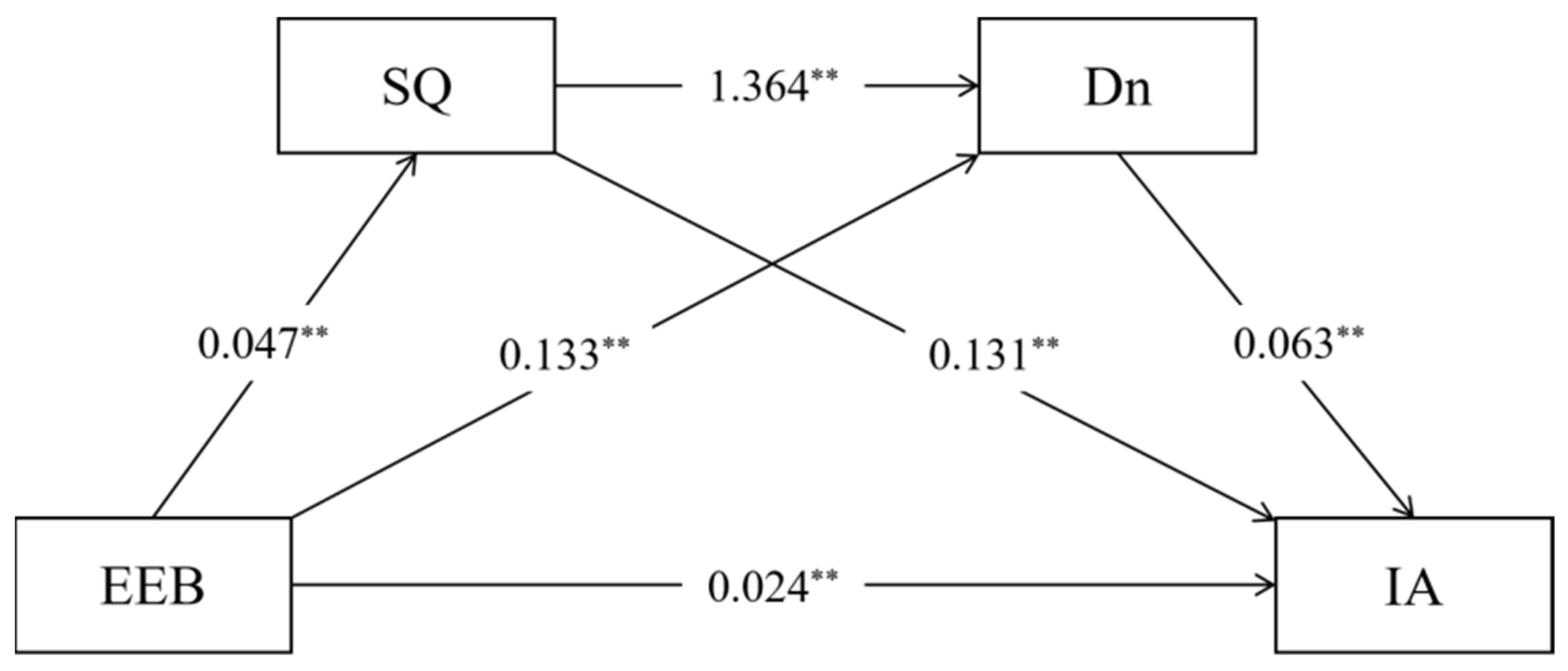
3.4. Chain Mediation Effect Analysis
3.5. Sensitivity Analyses
3.5.1. Controlling for School-Level Cluster Effects
3.5.2. Replacing the Benchmark Regression Model
4. Discussion
5. Conclusions
Supplementary Materials
Author Contributions
Funding
Institutional Review Board Statement
Informed Consent Statement
Data Availability Statement
Conflicts of Interest
References
- Zhou, Z.; Hu, X.; Zhang, Y.; Su, R.; Xin, S.; Sheng, L. The Relationship between Negative Life Events and Internet Addiction in Junior Middle School Students: The Roles of Social Anxiety and Boredom Proneness. Psychol. Dev. Educ. 2025, 41, 109–116. [Google Scholar]
- Chen, X.; Jiang, Y. Intervention in Adolescent Internet Addiction from the Perspective of Embodied Cognition: Return to the Integration of Mind and Body. Henan Soc. Sci. 2023, 31, 107–115. [Google Scholar]
- Arrivillaga, C.; Rey, L.; Extremera, N. Adolescents’ problematic internet and smartphone use is related to suicide ideation: Does emotional intelligence make a difference? Comput. Hum. Behav. 2020, 110, 106375. [Google Scholar] [CrossRef]
- Zhang, Y.; Hou, Z.; Wu, S.; Li, X.; Hao, M.; Wu, X. The relationship between internet addiction and aggressive behavior among adolescents during the COVID-19 pandemic: Anxiety as a mediator. Acta Psychol. 2022, 227, 103612. [Google Scholar] [CrossRef]
- Arnow, B.; Kenardy, J.; Agras, W.S. The Emotional Eating Scale: The development of a measure to assess coping with negative affect by eating. Int. J. Eat. Disord. 1995, 18, 79–90. [Google Scholar] [CrossRef]
- Lazarevich, I.; Camacho, M.E.I.; Velázquez-Alva, M.D.C.; Zepeda, M.Z. Relationship among obesity, depression, and emotional eating in young adults. Appetite 2016, 107, 639–644. [Google Scholar] [CrossRef]
- Bongers, P.; Jansen, A. Emotional Eating Is Not What You Think It Is and Emotional Eating Scales Do Not Measure What You Think They Measure. Front. Psychol. 2016, 7, 1932. [Google Scholar] [CrossRef] [PubMed]
- Kartal, F.T.; Ayhan, N.Y. Relationship between eating disorders and internet and smartphone addiction in college students. Eat. Weight Disord. EWD 2020, 26, 1853–1862. [Google Scholar] [CrossRef]
- Bozkurt, H.; Özer, S.; Şahin, S.; Sönmezgöz, E. Internet use patterns and Internet addiction in children and adolescents with obesity. Pediatr. Obes. 2018, 13, 301–306. [Google Scholar] [CrossRef] [PubMed]
- White, M.L.; Triplett, O.M.; Morales, N.; Dyk, T.R. Associations Among Sleep, Emotional Eating, and Body Dissatisfaction in Adolescents. Child Psychiatry Hum. Dev. 2024, 1–11. [Google Scholar] [CrossRef]
- Schreiber-Gregory, D.N.; Lavender, J.M.; Engel, S.G.; Wonderlich, S.A.; Crosby, R.D.; Peterson, C.B.; Simonich, H.; Crow, S.; Durkin, N.; Mitchell, J.E. Examining duration of binge eating episodes in binge eating disorder. Int. J. Eat. Disord. 2013, 46, 810–814. [Google Scholar] [CrossRef]
- Giráldez, C.M.; Colomer, M.C.; Brotons, E.B. Emotional eating, internet overuse, and alcohol intake among college students: A pilot study with virtual reality. Front. Nutr. 2024, 11, 1400815. [Google Scholar] [CrossRef]
- Ali, M.M.; Malihe, K.; Reza, B.; Ferns, G.A.; Marzieh, A. Structural equation modeling of direct and indirect associations of social media addiction with eating behavior in adolescents and young adults. Sci. Rep. 2023, 13, 3044. [Google Scholar] [CrossRef] [PubMed]
- Elkin, N.; Kütük, H.; Gürol, D.M.; Bilgen, Y.D. The relationship between emotional eating disorders and problematic internet use in university students: The mediating role of mukbang behavior. Rev. Assoc. Medica Bras. (1992) 2024, 70, e20240343. [Google Scholar] [CrossRef]
- Degasperi, G.; Meneo, D.; Curati, S.; Cardi, V.; Baglioni, C.; Cellini, N. Sleep quality in eating disorders: A systematic review and meta-analysis. Sleep Med. Rev. 2024, 77, 101969. [Google Scholar] [CrossRef] [PubMed]
- Kenny, T.E.; Van Wijk, M.; Singleton, C.; Carter, J.C. An examination of the relationship between binge eating disorder and insomnia symptoms. Eur. Eat. Disord. Rev. J. Eat. Disord. Assoc. 2018, 26, 186–196. [Google Scholar] [CrossRef] [PubMed]
- Gürbüz, M.; Bayram, H.M. The Bidirectional Association between Internet Use, Sleep Quality and Eating Behavior: A Cross-Sectional Study in Northwestern Thrace Region in Türkiye. J. Am. Nutr. Assoc. 2024, 44, 50–58. [Google Scholar] [CrossRef]
- Royette, T.; Teena, W. Sleep problems: Predictor or outcome of media use among emerging adults at university? J. Sleep Res. 2014, 23, 389–396. [Google Scholar] [CrossRef]
- Mani, B.P.; Dipika, N.; Shristi, R.; Kiran, T.; Raj, M.S.; Kumar, P.A. Sleep quality, internet addiction and depressive symptoms among undergraduate students in Nepal. BMC Psychiatry 2017, 17, 106. [Google Scholar] [CrossRef]
- Ali, A.M.; Kunugi, H. Royal Jelly as an Intelligent Anti-Aging Agent—A Focus on Cognitive Aging and Alzheimer’s Disease: A Review. Antioxidants 2020, 9, 937. [Google Scholar] [CrossRef]
- Ali, A.M.; Hori, H.; Kim, Y.; Kunugi, H. Predictors of Nutritional Status, Depression, Internet Addiction, Facebook Addiction, and Tobacco Smoking Among Women with Eating Disorders in Spain. Front. Psychiatry 2021, 12, 735109. [Google Scholar] [CrossRef]
- Zhou, H.; Dang, L.; Lam, L.W.; Xuan, Z.; Wu, A.M.S. A cross-lagged panel model for testing the bidirectional relationship between depression and smartphone addiction and the influences of maladaptive metacognition on them in Chinese adolescents. Addict. Behav. 2021, 120, 106978. [Google Scholar] [CrossRef]
- Lopes, L.S.; Valentini, J.P.; Monteiro, T.H.; Costacurta, M.C.F.; Soares, L.O.N.; Telfar-Barnard, L.; Nunes, P.V. Problematic Social Media Use and Its Relationship with Depression or Anxiety: A Systematic Review. Cyberpsychology Behav. Soc. Netw. 2022, 25, 691–702. [Google Scholar] [CrossRef]
- Dieris-Hirche, J.; Bottel, L.; Bielefeld, M.; Steinbüchel, T.; Kehyayan, A.; Dieris, B.; Wildt, B.T. Media use and Internet addiction in adult depression: A case-control study. Comput. Hum. Behav. 2017, 68, 96–103. [Google Scholar] [CrossRef]
- Akkuş, M.; Gelirgün, Ö.G.; Karataş, K.S.; Telatar, T.G.; Gökçen, O.; Dönmez, F. The Role of Anxiety and Depression in the Relationship Among Emotional Eating, Sleep Quality, and Impulsivity. J. Nerv. Ment. Dis. 2024, 212, 378–383. [Google Scholar] [CrossRef]
- Ren, J. Internet Addiction and Sleep Quality Among Adolescents: Mediating Effects of Depression and Moderating Effects of Social Support. Master’s Thesis, Anhui Medical University, Hefei, China, 2022. [Google Scholar]
- Xu, F.; Luan, W.; Jin, C.; Zuo, T.; Wang, R.; Yang, Y. Association between the degree of depression and internet use indepressed adolescents: The mediating role of sleep disorders. J. Jining Med. Univ. 2023, 46, 406–411. [Google Scholar]
- Huang, I.L.; Liu, C.Y.; Chung, M.H. Sleep quality and internet addiction among junior college students; The mediating role of depression: A cross-sectional study. Arch. Psychiatr. Nurs. 2023, 46, 1–7. [Google Scholar] [CrossRef] [PubMed]
- Bechtel, W. Circadian Rhythms and Mood Disorders: Are The Phenomena and Mechanisms Causally Related? Front. Psychiatry 2015, 6, 118. [Google Scholar] [CrossRef]
- Gold, A.K.; Sylvia, L.G. The role of sleep in bipolar disorder. Nat. Sci. Sleep 2016, 2016, 207–214. [Google Scholar] [CrossRef]
- Pandi-Perumal, S.R.; Monti, J.M.; Burman, D.; Karthikeyan, R.; BaHammam, A.S.; Spence, D.W.; Brown, G.M.; Narashimhan, M. Clarifying the role of sleep in depression: A narrative review. Psychiatry Res. 2020, 291, 113239. [Google Scholar] [CrossRef] [PubMed]
- Young, K.S. Internet Addiction: The Emergence of a New Clinical Disorder. Cyber Psychol. Behav. 1998, 1, 237–244. [Google Scholar] [CrossRef]
- Wang, S.; Cai, Y.; Zhu, R.; Li, S.; Liu, X.; Gong, R. Development of social network addiction tendency scale for adolescents and its reliability and validity. Chin. J. Gen. Pract. 2022, 20, 324–326. [Google Scholar]
- van Strien, T.; Oosterveld, P. The children’s DEBQ for assessment of restrained, emotional, and external eating in 7- to 12-year-old children. Int. J. Eat. Disord. 2008, 41, 72–81. [Google Scholar] [CrossRef]
- Wu, S.; Cai, T.; Luo, X. Validation of the Dutch Eating Behavior Questionnaire (DEBQ) in a sample of Chinese adolescents. Psychol. Health Med. 2017, 22, 282–288. [Google Scholar] [CrossRef]
- Buysse, D.J.; Reynolds, C.F., III; Monk, T.H.; Berman, S.R.; Kupfer, D.J. The Pittsburgh Sleep Quality Index: A new instrument for psychiatric practice and research. Psychiatry Res. 1989, 28, 193–213. [Google Scholar] [CrossRef]
- Liu, X.; Tang, M.; Hu, L.; Wang, A.; Wu, H.; Zhao, G.; Gao, C.; Li, W. Reliability and validity of the Pittsburgh sleep quality index. Chin. J. Psychiatry 1996, 2, 103–107. [Google Scholar]
- Shi, X.; Wang, S.; Li, Z.; Zhu, Y. Poor Sleep Quality Mediates the Relationship between Family Cohesion and Emotional Problems in Chinese Adolescents: A Three-year Follow-up Study. Chin. J. Clin. Psychol. 2021, 29, 789–793. [Google Scholar]
- Yang, S.; Wang, Z.; Chen, G.; Wan, X.; Li, X.; Peng, C.; Wang, H. Association of sleep quality with co-occurrence of non-suicidal self-injury behavior and depressive symptoms among junior high school students. Chin. J. Sch. Health 2025, 46, 1765–1770. [Google Scholar]
- Gong, X.; Xie, X.; Xu, R.; Luo, Y. Psychometric Properties of the Chinese Versions of DASS-21 in Chinese College Students. Chin. J. Clin. Psychol. 2010, 18, 443–446. [Google Scholar]
- Wu, C.; Luo, L.; Zhu, J.; Fu, L. Reliability and Validity of Chinese Version of the Behavioral Emotion Regulation Questionnaire in Chinese Adolescents. Chin. J. Clin. Psychol. 2021, 29, 1193–1197. [Google Scholar]
- Xiao, C.; Zhai, M.; Yan, Y.; Yu, B.; Yan, H.; Luo, J.; Zhao, G. The chain mediating effect of sleep quality and depressive symptomson the relationship between internet addiction and suicidal ideation inadolescents. J. Nurs. Sci. 2024, 39, 90–92+100. [Google Scholar]
- Gülbetekin, E.; Güven, E.; Sökmen, Ö. The effect of internet addiction on physical activity and dietary habits in high school students. J. Public Health 2023, 33, 925–932. [Google Scholar] [CrossRef]
- Li, X.; Li, Y.; Wang, Z.; Sun, Y. The effect of adolescent loneliness on social adaptation: The mediating role of coping style and internet addiction. Psychol. Mon. 2026, 21, 29–32. [Google Scholar]
- Ji, X.; Tomoko, K.; Wang, W.; Tang, Y.; Chen, Z.; Ding, X. Longitudinal Association Between Cyberbullying Victimization and Emotional Eating Among Vocational College Students: The Chain Mediating Role of Body Dissatisfaction and Self-Esteem. Stud. Psychol. Behav. 2023, 21, 224–230. [Google Scholar]
- Angel, L.L.; Fabio, G.; Jonathan, C.; Mario, A.; Arturo, V.; Carlos, R.J. Sleep loss and addiction. Neurosci. Biobehav. Rev. 2022, 141, 104832. [Google Scholar] [CrossRef] [PubMed]
- Zhang, J.; Zhang, X.; Zhang, K.; Lu, X.; Yuan, G.; Yang, H.; Guo, H.; Zhu, Z.; Wang, T.; Hao, J.; et al. An updated of meta-analysis on the relationship between mobile phone addiction and sleep disorder. J. Affect. Disord. 2022, 305, 94–101. [Google Scholar] [CrossRef] [PubMed]
- Jawarneh, M.A.; Chauhan, S.; Csölle, I.; Lohner, S. The Association of Unhealthy Eating Behaviors with Sleep Quality Outcomes Among University Students: A Cross-Sectional Study. Nutrients 2025, 17, 3580. [Google Scholar] [CrossRef]
- Mehr, J.B.; Mitchison, D.; Bowrey, H.E.; James, M.H. Sleep dysregulation in binge eating disorder and “food addiction”: The orexin (hypocretin) system as a potential neurobiological link. Neuropsychopharmacol. Off. Publ. Am. Coll. Neuropsychopharmacol. 2021, 46, 2051–2061. [Google Scholar] [CrossRef]
- Thottan, A.; Kuzik, N.; Saunders, T.; Christakis, D.; Blocker, K.; Tremblay, M.S. Cross-sectional examination of internet addiction and sleep outcomes in U.S. children and adolescents. Sleep Med. 2025, 133, 106657. [Google Scholar] [CrossRef]
- Hanna, K. Emotional eating and obesity in adults: The role of depression, sleep and genes. Proc. Nutr. Soc. 2020, 79, 283–289. [Google Scholar] [CrossRef] [PubMed]
- Paans, N.P.G.; Bot, M.; Strien, T.V.; Brouwer, I.A.; Visser, M.; Penninx, B.W.J.H. Eating styles in major depressive disorder: Results from a large-scale study. J. Psychiatr. Res. 2018, 97, 38–46. [Google Scholar] [CrossRef]
- Ye, X.L.; Zhang, W.; Zhao, F.F. Depression and internet addiction among adolescents: A meta-analysis. Psychiatry Res. 2023, 326, 115311. [Google Scholar] [CrossRef] [PubMed]
- Pan, Y.; Zhang, Y.; Ma, Z.; Wang, D.; Huang, S.; Fan, F. Prevalence, correlates and mental health outcomes of Internet addiction among Chinese adolescents across early, middle and late adolescence. J. Affect. Disord. 2025, 394, 120440. [Google Scholar] [CrossRef] [PubMed]
- Kafali, H.Y.; Uçaktürk, S.A.; Mengen, E.; Akpinar, S.; Demirtas, M.E. Emotion dysregulation and pediatric obesity: Investigating the role of Internet addiction and eating behaviors on this relationship in an adolescent sample. Eat. Weight. Disord. EWD 2020, 26, 1767–1779. [Google Scholar] [CrossRef] [PubMed]


| Variables | Variable Assignment | M (P25, P75)/ N (Percentage) | Internet Addiction | ||
|---|---|---|---|---|---|
| Z | H | p | |||
| Age | Continuous type | 13.90 (13.20, 14.60) | — | — | |
| Gender | 1 = Male | 1734 (53.44%) | −2.546 * | — | 0.011 |
| 2 = Female | 1511 (46.56%) | ||||
| Hukou | 0 = Non-local Hukou | 1985 (61.17%) | −1.427 | — | 0.153 |
| 1 = Local Hukou | 1260 (38.83%) | ||||
| Residential area | 1 = Community | 2506 (77.23%) | — | 1.387 | 0.500 |
| 2 = Urban village | 710 (21.88%) | ||||
| 3 = Other | 29 (0.89%) | ||||
| Ethnicity | 1 = Han | 3102 (95.59%) | −1.909 | — | 0.056 |
| 2 = Ethnic minority | 143 (4.41%) | ||||
| Only child status | 1 = Yes | 482 (14.85%) | −0.883 | — | 0.377 |
| 2 = No | 2763 (85.15%) | ||||
| Father’s education level | 1 = No schooling | 3 (0.09%) | — | 5.394 | 0.612 |
| 2 = Primary school | 129 (3.98%) | ||||
| 3 = Junior high school | 901 (27.77%) | ||||
| 4 = Vocational high school | 413 (12.73%) | ||||
| 5 = Senior high school | 525 (16.18%) | ||||
| 6 = Junior college | 516 (15.90%) | ||||
| 7 = Bachelor’s degree | 623 (19.20%) | ||||
| 8 = Master’s degree or above | 135 (4.16%) | ||||
| Mother’s education level | 1 = No schooling | 17 (0.52%) | — | 13.639 | 0.058 |
| 2 = Primary school | 216 (6.66%) | ||||
| 3 = Junior high school | 982 (30.26%) | ||||
| 4 = Vocational high school | 359 (11.06%) | ||||
| 5 = Senior high school | 507 (15.62%) | ||||
| 6 = Junior college | 517 (15.93%) | ||||
| 7 = Bachelor’s degree | 566 (17.44%) | ||||
| 8 = Master’s degree or above | 81 (2.50%) | ||||
| Parental relationship status | 1 = Very poor | 66 (2.03%) | — | 118.924 ** | <0.001 |
| 2 = Relatively poor | 136 (4.19%) | ||||
| 3 = Average | 578 (17.81%) | ||||
| 4 = Relatively good | 1222 (37.66%) | ||||
| 5 = Very good | 1243 (38.31%) | ||||
| Variables | M | SD | EEB | IA | SQ | Dn |
|---|---|---|---|---|---|---|
| EEB | 12.272 | 4.779 | 1.000 | |||
| IA | 1.864 | 2.351 | 0.066 ** | 1.000 | ||
| SQ | 4.982 | 3.003 | 0.092 ** | 0.342 ** | 1.000 | |
| Dn | 7.126 | 8.717 | 0.113 ** | 0.365 ** | 0.510 ** | 1.000 |
| Model Pathways | β | SE | 95%CI | Mediating Effect (%) | |
|---|---|---|---|---|---|
| LLCI | ULCI | ||||
| Total effect | 0.0427 | 0.0085 | 0.0261 | 0.0594 | 100.00 |
| Direct effect | |||||
| EEB → IA | 0.0240 | 0.0081 | 0.0082 | 0.0399 | 56.21 |
| Indirect effect | |||||
| EEB → IA | 0.0187 | 0.0032 | 0.0126 | 0.0252 | 43.79 |
| EEB → SQ → IA | 0.0062 | 0.0017 | 0.0033 | 0.0098 | 14.52 |
| EEB → Dn → IA | 0.0084 | 0.0020 | 0.0047 | 0.0125 | 19.67 |
| EEB → SQ → Dn → IA | 0.0041 | 0.0010 | 0.0022 | 0.0062 | 9.60 |
Disclaimer/Publisher’s Note: The statements, opinions and data contained in all publications are solely those of the individual author(s) and contributor(s) and not of MDPI and/or the editor(s). MDPI and/or the editor(s) disclaim responsibility for any injury to people or property resulting from any ideas, methods, instructions or products referred to in the content. |
© 2026 by the authors. Licensee MDPI, Basel, Switzerland. This article is an open access article distributed under the terms and conditions of the Creative Commons Attribution (CC BY) license.
Share and Cite
Li, X.; Xue, B.; Wu, H.; Luo, A.; Yang, L.; Xu, X.; Chen, Z.; Lin, H.; Zhang, C. The Relationship Between Emotional Eating Behavior and Internet Addiction in Junior High School Students: A Cross-Sectional Study. Nutrients 2026, 18, 800. https://doi.org/10.3390/nu18050800
Li X, Xue B, Wu H, Luo A, Yang L, Xu X, Chen Z, Lin H, Zhang C. The Relationship Between Emotional Eating Behavior and Internet Addiction in Junior High School Students: A Cross-Sectional Study. Nutrients. 2026; 18(5):800. https://doi.org/10.3390/nu18050800
Chicago/Turabian StyleLi, Xinru, Benli Xue, Haoran Wu, Anfei Luo, Lingli Yang, Xinyi Xu, Zhaodi Chen, Huang Lin, and Chichen Zhang. 2026. "The Relationship Between Emotional Eating Behavior and Internet Addiction in Junior High School Students: A Cross-Sectional Study" Nutrients 18, no. 5: 800. https://doi.org/10.3390/nu18050800
APA StyleLi, X., Xue, B., Wu, H., Luo, A., Yang, L., Xu, X., Chen, Z., Lin, H., & Zhang, C. (2026). The Relationship Between Emotional Eating Behavior and Internet Addiction in Junior High School Students: A Cross-Sectional Study. Nutrients, 18(5), 800. https://doi.org/10.3390/nu18050800