From Traits to Clusters: Emotional–Sensory–Regulatory Eating Profiles in Generation Z with Implications in Sustainable Food Behavior




Abstract
1. Introduction
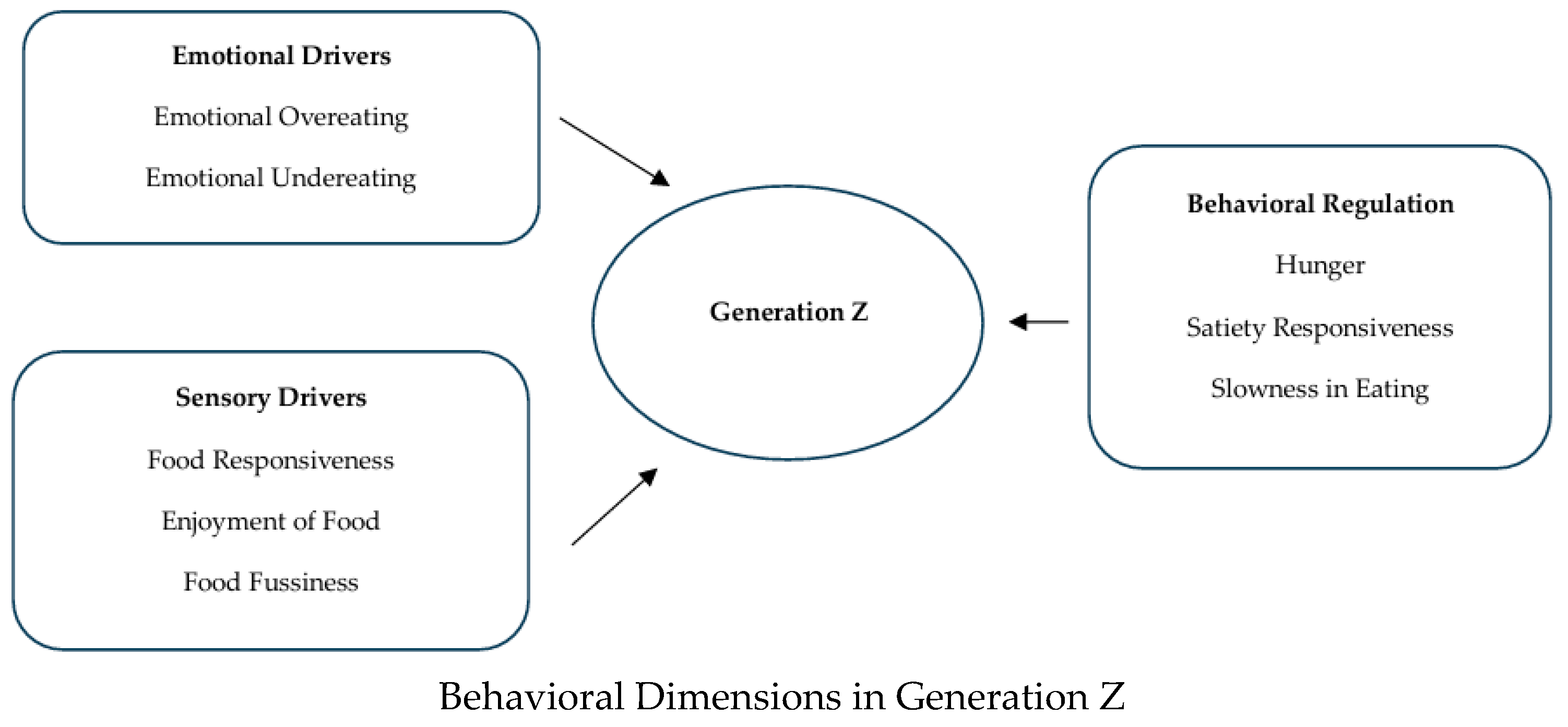
- Hunger, which is often perceived cognitively rather than physiologically, with stress and digital distraction influencing its recognition [1,12]. Recent studies show that academic pressure and time constraints can delay eating episodes, reframing hunger as a regulated rather than instinctive cue [13,14].
Research Gap & Contribution
2. Materials and Methods
2.1. Survey Methodology and Data Collection
2.2. Analytical Procedures
3. Results
3.1. Sociodemographic Characteristics
3.2. Descriptive Statistics of Eating-Behavior Dimensions
3.3. Principal Component Analysis
3.4. Cluster Analysis
3.5. Logistic Regression
4. Discussion
4.1. Interpretation of PCA Components
4.2. Interpretation of Cluster Profiles
4.3. Integration with the Dual Framework
4.4. Emerging Typology of Eating Behavior
4.5. Predictors of Cluster Membership
4.6. Broader Context and Implications
4.7. Limitations
5. Conclusions
Supplementary Materials
Author Contributions
Funding
Institutional Review Board Statement
Informed Consent Statement
Data Availability Statement
Acknowledgments
Conflicts of Interest
References
- Escrivá-Martínez, T.; Miragall, M.; Herrero, R.; Rodríguez-Arias, M.; Baños, R.M. Eating Behaviors, Eating Styles and Body Mass Index during COVID-19 Confinement in a College Sample: A Predictive Model. J. Eat. Disord. 2022, 10, 100. [Google Scholar] [CrossRef]
- De Pasquale, C.; Sciacca, F.; Conti, D.; Pistorio, M.L.; Hichy, Z.; Cardullo, R.L.; Di Nuovo, S. Relations Between Mood States and Eating Behavior During COVID-19 Pandemic in a Sample of Italian College Students. Front. Psychol. 2021, 12, 684195. [Google Scholar] [CrossRef]
- Loose, T.; Geoffroy, M.C.; Orri, M.; Chadi, N.; Scardera, S.; Booij, L.; Breton, E.; Tremblay, R.; Boivin, M.; Coté, S. Pathways of Association between Disordered Eating in Adolescence and Mental Health Outcomes in Young Adulthood during the COVID-19 Pandemic. Can. J. Public Health 2023, 114, 22–32. [Google Scholar] [CrossRef]
- Vandenbosch, L.; Fardouly, J.; Tiggemann, M. Social Media and Body Image: Recent Trends and Future Directions. Curr. Opin. Psychol. 2022, 45, 101289. [Google Scholar] [CrossRef]
- Faizah, N.; Purwandari, E. Emotional Eating and Stress in College Students: A Meta-Analysis Study. People Behav. Anal. 2025, 3, 66–81. [Google Scholar] [CrossRef]
- Ha, O.R.; Lim, S.L. The Role of Emotion in Eating Behavior and Decisions. Front. Psychol. 2023, 14, 1265074. [Google Scholar] [CrossRef]
- Zaharia, A.; Gonța, I. The Healthy Eating Movement on Social Media and Its Psychological Effects on Body Image. Front. Nutr. 2024, 11, 1474729. [Google Scholar] [CrossRef]
- Koliou, M.P.; Skalkos, D. Post-Pandemic Shifts in Sustainable Food Behavior: A Systematic Review of Emerging Consumer Trends. Nutrients 2025, 17, 3737. [Google Scholar] [CrossRef]
- Rodrigue, C.; Rodgers, R.F.; Carbonneau, N.; Bégin, C.; Dion, J. COVID-19-Related Distress, Body Image, and Eating Behaviors: A Cross-Sectional Explanatory Model. BMC Psychol. 2024, 12, 117. [Google Scholar] [CrossRef]
- De Pasquale, C.; Morando, M.; Platania, S.; Sciacca, F.; Hichy, Z.; Di Nuovo, S.; Quattropani, M.C. The Roles of Anxiety and Self-Esteem in the Risk of Eating Disorders and Compulsive Buying Behavior. Int. J. Environ. Res. Public Health 2022, 19, 16245. [Google Scholar] [CrossRef]
- Duralia, O. Food Consumption Behaviour-Influencing Factors and Trends. Stud. Bus. Econ. 2023, 18, 109–123. [Google Scholar] [CrossRef]
- Huseynov, S.; Palma, M.A. Food Decision-Making under Time Pressure. Food Qual. Prefer. 2021, 88, 104072. [Google Scholar] [CrossRef]
- Priporas, C.V.; Stylos, N.; Fotiadis, A.K. Generation Z Consumers’ Expectations of Interactions in Smart Retailing: A Future Agenda. Comput. Hum. Behav. 2017, 77, 374–381. [Google Scholar] [CrossRef]
- Waterhouse, P.; Samra, R. University Students’ Coping Strategies to Manage Stress: A Scoping Review. Educ. Rev. 2025, 1–42. [Google Scholar] [CrossRef]
- Forde, C.G.; de Graaf, K. Influence of Sensory Properties in Moderating Eating Behaviors and Food Intake. Front. Nutr. 2022, 9, 841444. [Google Scholar] [CrossRef]
- Halicka, E.; Kaczorowska, J.; Rejman, K.; Plichta, M. Investigating the Consumer Choices of Gen Z: A Sustainable Food System Perspective. Nutrients 2025, 17, 591. [Google Scholar] [CrossRef]
- Schrempft, S.; Jiménez-Sánchez, C.; Baysson, H.; Zaballa, M.E.; Lamour, J.; Stringhini, S.; Guessous, I.; Nehme, M. Pathways Linking BMI Trajectories and Mental Health in an Adult Population-Based Cohort: Role of Emotional Eating and Body Dissatisfaction: Epidemiology and Population Health. Int. J. Obes. 2025, 49, 1317–1326. [Google Scholar] [CrossRef]
- Metin, Z.E.; Bayrak, N.; Mengi Çelik, Ö.; Akkoca, M. The Relationship between Emotional Eating, Mindful Eating, and Depression in Young Adults. Food Sci. Nutr. 2025, 13, e4028. [Google Scholar] [CrossRef]
- Marinova, D.; Bogueva, D. Generation Z and Food Choices. In Food in a Planetary Emergency; Springer Nature: Singapore, 2022; pp. 209–229. [Google Scholar]
- Sun, X.; Liu, B.; Yuan, Y.; Rong, Y.; Pang, R.; Li, Q. Neural and Hormonal Mechanisms of Appetite Regulation during Eating. Front. Nutr. 2025, 12, 1484827. [Google Scholar] [CrossRef]
- Garutti, M.; Sirico, M.; Noto, C.; Foffano, L.; Hopkins, M.; Puglisi, F. Hallmarks of Appetite: A Comprehensive Review of Hunger, Appetite, Satiation, and Satiety. Curr. Obes. Rep. 2025, 14, 12. [Google Scholar] [CrossRef]
- Alexatou, O.; Papadopoulou, S.K.; Mentzelou, M.; Deligiannidou, G.E.; Dakanalis, A.; Giaginis, C. Exploring the Impact of Emotional Eating Among University Students: A Literature Review. Med. Sci. 2025, 13, 56. [Google Scholar] [CrossRef] [PubMed]
- Zaiser, C.; Pahlenkemper, M.; Brandt, G.; Ballero Reque, C.; Sabel, L.; Laskowski, N.M.; Paslakis, G. Feeding the Feelings: Gender Differences in Emotional Eating during COVID-19: A Systematic Review and Meta-Analysis. Front. Nutr. 2025, 12, 1680872. [Google Scholar] [CrossRef]
- Shan, Y.; Wang, H.; Wang, W. Food Neophobia: Psychological Dimensions of Consumer Perception and Emotional Sentiment in Social Media Discourse. Front. Nutr. 2025, 12, 1584409. [Google Scholar] [CrossRef]
- Al Sabbah, H.; Ajab, A.; Ismail, L.C.; Al Dhaheri, A.; Alblooshi, S.; Atari, S.; Polo, S.V.; Amro, M.; Qasrawi, R. The Association between Food Preferences, Eating Behavior, and Body Weight among Female University Students in the United Arab Emirates. Front. Public Health 2024, 12, 1395338. [Google Scholar] [CrossRef]
- Priede, L.; Beitane, I.; Beitane, L. A Study of Relationships Between Mental Well-Being, Sleep Quality, Eating Behavior, and BMI: A Cross-Sectional Study Among University Students. Int. J. Environ. Res. Public Health 2025, 22, 1465. [Google Scholar] [CrossRef]
- Wardle, J.; Guthrie, C.A.; Sanderson, S.; Rapoport, L. Development of the Children’s Eating Behaviour Questionnaire. J. Child Psychol. Psychiatry 2001, 42, 963–970. [Google Scholar] [CrossRef]
- Hunot, C.; Fildes, A.; Croker, H.; Llewellyn, C.H.; Wardle, J.; Beeken, R.J. Appetitive Traits and Relationships with BMI in Adults: Development of the Adult Eating Behaviour Questionnaire. Appetite 2016, 105, 356–363. [Google Scholar] [CrossRef]
- Hair, J.F.; Black, W.C.; Babin, B.J.; Anderson, R.E. Multivariate Data Analysis; Cengage Learning EMEA: Hampshire, UK, 2010; p. 816. Vectors. [Google Scholar]
- Field, A. Discovering Statistics Using IBM SPSS Statistics; SAGE Publications Ltd.: London, UK, 2013; Volume 58. [Google Scholar]
- Carifio, J.; Perla, R. Resolving the 50-Year Debate around Using and Misusing Likert Scales. Med. Educ. 2008, 42, 1150–1152. [Google Scholar] [CrossRef]
- Norman, G. Likert Scales, Levels of Measurement and the “Laws” of Statistics. Adv. Health Sci. Educ. 2010, 15, 625–632. [Google Scholar] [CrossRef]
- Sullivan, G.M.; Artino, A.R. Analyzing and Interpreting Data from Likert-Type Scales. J. Grad. Med. Educ. 2014, 5, 541–542. [Google Scholar] [CrossRef]
- Pallant, J. SPSS Survival Manual, 3rd ed.; Allen & Unwin: Crows Nest, Australia, 2005. [Google Scholar]
- Everitt, B. Cluster Analysis. Qual. Quant. 1980, 14, 75–100. [Google Scholar] [CrossRef]
- Scott, A.J.; Hosmer, D.W.; Lemeshow, S. Applied Logistic Regression. Biometrics 1991, 47, 1632. [Google Scholar] [CrossRef]
- Al-Musharaf, S. Prevalence Awend Predictors of Emotional Eating among Healthy Young Saudi Women during the COVID-19 Pandemic. Nutrients 2020, 12, 2923. [Google Scholar] [CrossRef]
- Filippone, L.; Shankland, R.; Hallez, Q. The Relationships between Social Media Exposure, Food Craving, Cognitive Impulsivity and Cognitive Restraint. J. Eat. Disord. 2022, 10, 184. [Google Scholar] [CrossRef]
- Schneider-Worthington, C.R.; Smith, K.E.; Roemmich, J.N.; Salvy, S.J. External Food Cue Responsiveness and Emotional Eating in Adolescents: A Multimethod Study. Appetite 2022, 168, 105789. [Google Scholar] [CrossRef] [PubMed]
- Maqsood, L.; Aslam, M.; Masood, F.J.; Asad, I.; Iqbal, M.; Sheikh, N.u.A.; Waqar, O.; Tahir, W.; Zafar, Z. Association between Academic Stress and Eating Patterns among University Students. DIET FACTOR (J. Nutr. Food Sci.) 2023, 4, 6–10. [Google Scholar] [CrossRef]
- Okumus, B.; Dedeoğlu, B.B.; Shi, F. Gender and Generation as Antecedents of Food Neophobia and Food Neophilia. Tour. Manag. Perspect. 2021, 37, 100773. [Google Scholar] [CrossRef]
- Vainik, U.; Neseliler, S.; Konstabel, K.; Fellows, L.K.; Dagher, A. Eating Traits Questionnaires as a Continuum of a Single Concept. Uncontrolled Eating. Appetite 2015, 90, 229–239. [Google Scholar] [CrossRef]
- Parker, J.; Kaur, S.; Medalla, J.M.; Imbert-Sanchez, A.; Bautista, J. Dietary Trends among Young Adults during the COVID-19 Lockdown: Socioeconomic and Gender Disparities. BMC Nutr. 2023, 9, 107. [Google Scholar] [CrossRef]
- Asioli, D.; Aschemann-Witzel, J.; Caputo, V.; Vecchio, R.; Annunziata, A.; Næs, T.; Varela, P. Making Sense of the “Clean Label” Trends: A Review of Consumer Food Choice Behavior and Discussion of Industry Implications. Food Res. Int. 2017, 99, 58–71. [Google Scholar] [CrossRef]


| Characteristics | N | Percentage |
|---|---|---|
| Gender | ||
| Male | 191 | 23.8 |
| Female | 591 | 73.6 |
| None of the Above | 20 | 2.5 |
| Age | ||
| 18–20 | 255 | 31.8 |
| 21–25 | 465 | 57.9 |
| 26–30 | 71 | 8.8 |
| Missing | 13 | 1.6 |
| Working or not | ||
| Exclusively Student | 545 | 67.9 |
| Working Student | 254 | 31.6 |
| Eating Behavior Dimension | Mean | SD |
|---|---|---|
| Hunger (H) | 2.58 | 1.07 |
| Food Responsiveness (FR) | 3.01 | 1.04 |
| Emotional Overeating (EOE) | 2.82 | 1.09 |
| Emotional Undereating (EUE) | 3.36 | 1.22 |
| Satiety Responsiveness (SR) | 3.39 | 1.06 |
| Enjoyment of Food (EF) | 3.86 | 0.86 |
| Slowness in Eating (SE) | 2.85 | 1.17 |
| Properties | Communalities | Fact 1 | Fact 2 | Fact 3 | Fact 4 | Fact 5 | Fact 6 | Fact 7 | Fact 8 | Fact 9 |
|---|---|---|---|---|---|---|---|---|---|---|
| Q4.3 I eat less when I’m anxious | 0.884 | 0.898 | ||||||||
| Q4.2 I eat less when I’m worried | 0.862 | 0.884 | ||||||||
| Q4.4 I eat less when I’m upset | 0.792 | 0.739 | 0.445 | |||||||
| Q6.2 I eat more when I’m worried | 0.838 | −0.738 | 0.494 | |||||||
| Q6.3 I eat more when I’m anxious | 0.845 | −0.734 | 0.513 | |||||||
| Q5.4 I enjoy tasting new foods | 0.807 | 0.884 | ||||||||
| Q5.2 I am interested in tasting new food I haven’t tasted before | 0.771 | 0.861 | ||||||||
| Q5.1 I refuse new foods at first | 0.746 | −0.849 | ||||||||
| Q5.3 I often decide that I don’t like a food, before tasting it | 0.639 | −0.76 | ||||||||
| Q5.5 I enjoy a wide variety of foods | 0.589 | 0.72 | ||||||||
| Q7.2 I love food | 0.763 | 0.826 | ||||||||
| Q7.1 I enjoy eating | 0.739 | 0.826 | ||||||||
| Q7.3 I look forward to mealtimes | 0.637 | 0.74 | ||||||||
| Q2.4 When I see or smell food that I like, it makes me want to eat | 0.407 | 0.475 | ||||||||
| Q2.3 I often feel hungry when I am with someone who is eating | 0.495 | 0.455 | ||||||||
| Q2.1 I am always thinking about food | 0.472 | 0.423 | ||||||||
| Q2.2 Given the choice, I would eat most of the time | 0.485 | |||||||||
| Q8.2 I am often last at finishing a meal | 0.843 | 0.893 | ||||||||
| Q8.1 I eat slowly | 0.820 | 0.888 | ||||||||
| Q8.3 I often finish my meals quickly | 0.800 | −0.869 | ||||||||
| Q8.4 I eat more and more slowly during the course of a meal | 0.495 | 0.631 | ||||||||
| Q6.5 I eat more when I’m angry | 0.874 | 0.866 | ||||||||
| Q6.4 I eat more when I’m annoyed | 0.895 | 0.863 | ||||||||
| Q6.1 I eat more when I’m upset | 0.764 | −0.596 | 0.609 | |||||||
| Q3.3 I often leave food on my plate at the end of a meal | 0.690 | 0.78 | ||||||||
| Q3.4 I often get full before my meal is finished | 0.643 | 0.75 | ||||||||
| Q3.1. I get full up easily | 0.555 | 0.659 | ||||||||
| Q3.2 I cannot eat a meal if I have had a snack just before | 0.438 | 0.606 | ||||||||
| Q1.1 I often notice my stomach rumbling | 0.673 | 0.81 | ||||||||
| Q1.3 I often feel hungry | 0.653 | 0.727 | ||||||||
| Q1.2 I often feel so hungry that I have to eat something right away | 0.612 | 0.702 | ||||||||
| Q4.1 I eat less when I’m annoyed | 0.789 | 0.759 | ||||||||
| Q4.5 I eat less when I’m angry | 0.787 | 0.745 | ||||||||
| Q1.5 If I miss a meal I get irritable | 0.659 | 0.791 | ||||||||
| Q1.4 If my meals are delayed I get light-headed | 0.633 | 0.744 | ||||||||
| Initial Eigenvalues | 7.85 | 3.926 | 3.216 | 2.744 | 1.747 | 1.431 | 1.296 | 1.128 | 1.057 | |
| Percentage of variance explained | 11.442 | 10.071 | 8.651 | 8.442 | 7.896 | 7.306 | 5.845 | 5.087 | 4.96 | |
| Cronbach’s a reliability test | 0.698 (35 items) | |||||||||
| Total variance % | 69.7% | |||||||||
| Question | Mean Value * | |
|---|---|---|
| Cluster 1 | Cluster 2 | |
| Q4 [3. I eat less when I am anxious] | 3.37 | 3.34 |
| Q5 [4. I enjoy tasting new foods] | 3.94 | 3.71 |
| Q7 [2. I love food] | 4.15 | 3.94 |
| Q8 [2. I am often last at finishing a meal] | 2.85 | 2.91 |
| Q6 [5. I eat more when I am angry] | 2.18 | 2.45 |
| Q3 [3. I often leave food on my plate at the end of a meal] | 2.47 | 2.69 |
| Q1 [1. I often notice my stomach rumbling] | 3.08 | 2.94 |
| Q4 [1. I eat less when I’m annoyed] | 3.10 | 2.98 |
| Q1 [5. If I miss a meal I get irritable] | 2.73 | 2.44 |
| Variables | Coefficient B (β) | S.E. | Wald Statistic | Wald Sig. | Exp(B) |
|---|---|---|---|---|---|
| Q3.4 I often get full before my meal is finished | −0.305 | 0.099 | 9.539 | 0.002 | 0.737 |
| Q1.3 I often feel hungry | −0.214 | 0.092 | 5.422 | 0.020 | 0.808 |
| Q1.4 If my meals are delayed, I get light-headed | −0.183 | 0.069 | 7.112 | 0.008 | 0.833 |
| Q2.3 I often feel hungry when I am with someone who is eating | −0.160 | 0.080 | 4.017 | 0.045 | 0.852 |
| Q3.3 I often leave food on my plate at the end of a meal | 0.287 | 0.087 | 10.819 | 0.001 | 1.333 |
| Q5.1 I refuse new foods at first | 0.181 | 0.077 | 5.473 | 0.019 | 1.199 |
| Q7.1 I enjoy eating | −0.249 | 0.106 | 5.559 | 0.018 | 0.780 |
| Constant | 0.359 | 0.084 | 18.445 | <0.001 | 1.432 |
Disclaimer/Publisher’s Note: The statements, opinions and data contained in all publications are solely those of the individual author(s) and contributor(s) and not of MDPI and/or the editor(s). MDPI and/or the editor(s) disclaim responsibility for any injury to people or property resulting from any ideas, methods, instructions or products referred to in the content. |
© 2026 by the authors. Licensee MDPI, Basel, Switzerland. This article is an open access article distributed under the terms and conditions of the Creative Commons Attribution (CC BY) license.
Share and Cite
Koliou, M.P.; Kouskoura, A.; Kontogeorgos, A.; Skalkos, D. From Traits to Clusters: Emotional–Sensory–Regulatory Eating Profiles in Generation Z with Implications in Sustainable Food Behavior. Nutrients 2026, 18, 758. https://doi.org/10.3390/nu18050758
Koliou MP, Kouskoura A, Kontogeorgos A, Skalkos D. From Traits to Clusters: Emotional–Sensory–Regulatory Eating Profiles in Generation Z with Implications in Sustainable Food Behavior. Nutrients. 2026; 18(5):758. https://doi.org/10.3390/nu18050758
Chicago/Turabian StyleKoliou, Maria P., Amalia Kouskoura, Achilleas Kontogeorgos, and Dimitris Skalkos. 2026. "From Traits to Clusters: Emotional–Sensory–Regulatory Eating Profiles in Generation Z with Implications in Sustainable Food Behavior" Nutrients 18, no. 5: 758. https://doi.org/10.3390/nu18050758
APA StyleKoliou, M. P., Kouskoura, A., Kontogeorgos, A., & Skalkos, D. (2026). From Traits to Clusters: Emotional–Sensory–Regulatory Eating Profiles in Generation Z with Implications in Sustainable Food Behavior. Nutrients, 18(5), 758. https://doi.org/10.3390/nu18050758