Review

Early Life Nutrition: The First 1000 Days and Healthy Aging in Cystic Fibrosis

by
Caitlin N. Miles
1,2,3,4,*,
Gillian M. Nixon
3,4,† and
Zoe E. Davidson
1,4,†
1
Department of Nutrition, Dietetics and Food, Monash University, Melbourne, VIC 3168, Australia
2
Nutrition and Dietetics, Monash Children’s Hospital, Melbourne, VIC 3168, Australia
3
Respiratory Medicine, Monash Children’s Hospital, Melbourne, VIC 3168, Australia
4
Department of Paediatrics, Monash University, Melbourne, VIC 3168, Australia
*
Author to whom correspondence should be addressed.
These authors contributed equally to this work.
Nutrients 2026, 18(5), 739; https://doi.org/10.3390/nu18050739
Submission received: 8 December 2025 / Revised: 4 February 2026 / Accepted: 22 February 2026 / Published: 25 February 2026
(This article belongs to the Special Issue Nutrition and Cystic Fibrosis in Children)

Abstract

Achievement of optimal nutritional status within the first 1000 days of life for a child with cystic fibrosis (CF) is of paramount importance, with an emphasis on favorable early life growth trajectories that best optimize pulmonary and extrapulmonary health. The ‘first 1000 days’ framework emphasizes that environmental, sociocultural and nutritional exposures during this period can have life-long consequences for physical, cognitive, social and emotional health and development. Optimal nutrition encompasses not just physical growth, but the provision of nutrients and optimal feeding throughout the preconception, pregnancy and first 1000-day period to ensure lifelong healthy development and aging. For children with CF (cwCF), the first 1000 days is marred by a myriad of complications, exposing a unique nutritional fragility within this critical developmental window. Conversely, as life expectancy increases for people with CF (pwCF), overnutrition is becoming increasingly prevalent and the widespread uptake of disease-modifying drugs challenges clinicians to take a nuanced and personalized approach to lifelong nutritional care. This review explores early disease manifestations of CF and their impact on early life growth and nutrition in the modern era of CF. This review also considers how we might theoretically view early life nutrition in CF from a lens which takes into consideration well-known frameworks such as ‘the first 1000 days’ and ‘developmental origins of health and disease’.

1. Introduction

Cystic fibrosis (CF) is an autosomal recessive genetic disorder affecting more than 160,000 people worldwide [1]. Once a life-limiting disease, CF is now broadly considered a ‘disease for life’ due to major advances in therapeutic care, notably the emergence of disease-modifying drugs. Children with CF (cwCF) are not only growing into adults with CF, but children born today are likely to live long enough to require targeted geriatric care [2,3]. Non-communicable diseases, previously uncommon in people with CF (pwCF), are now being documented at higher rates than the general population, including metabolic syndrome, cardiovascular disease (CVD) and cancer [3,4,5]. Overweight and obesity is now a concern for 22–43% of people living with CF [3,6,7].
Nutrition has been a key pillar of CF care since the disease was first pathologically described in the early 20th century [8], with optimal nutritional status strongly predictive of lung health and survival [9,10,11,12]. Nutritional interventions can be aggressive in the early months and years, with the primary goal to correct growth deficits, manage symptoms of exocrine pancreatic insufficiency (EPI) and limit early life lung disease. As a result of early disease manifestations, optimal infant nutrition and feeding development may be compromised and the early feeding journey marked with challenges [13,14,15,16].
There is an abundance of literature in the general population suggesting that physical and psychological development, health and wellbeing and later life chronic disease are associated with nutritional practices and behaviors seen during the first two years of life [17,18,19,20,21,22,23,24]; a period of time often referred to as ‘the first 1000 days’ [25,26]. Nutritional practices, such as prenatal nutrition, breastfeeding and the timely introduction of nutrient dense complementary foods, are known to shape a child’s future health and the avoidance or development of later life chronic disease [25]. Frameworks such as ‘the first 1000 days’ and ‘developmental origins of health and disease’ seek to explain these phenomena.
With early life commencement of disease-modifying drugs, alongside continued therapeutic advances in care and extended life span, it is of utmost importance that CF nutritional practices in infancy and early childhood are optimized to ensure developmental and health outcomes are comparable to that of children without CF. The aim of this narrative review is to summarize the literature on early life nutrition in CF with a focus on the first 1000 days of life. The impact of early CF disease expression on the attainment of optimal nutrition will be explored, alongside the pillars of prenatal nutrition, breastfeeding and nutrient dense complementary feeding. We hypothesize how these may influence developmental outcomes and lifelong healthy aging in the CF population. Any known or emerging influences of disease-modifying drugs on early life nutrition within the first 1000 days of life will be encompassed in this review.

2. Methodology

2.1. Reporting Checklist

The ‘Scale for the Assessment of Narrative Review Articles’ (SANRA) checklist [27] has been utilized in the preparation of this narrative review to ensure quality, transparency and consistency within the narrative review field.

2.2. Literature Search

MEDLINE (Ovid) and Google Scholar were utilized as key information sources for the preparation of this review. Studies were limited to full-text English-language studies; unpublished material including conference abstracts were excluded; however, grey literature produced by government or non-profit organizations, such as the World Health Organization (WHO) or the CF Foundation, were included. Literature searches were performed between October 2025 and January 2026 and there were no limitations placed on date. The Population-Concept-Context framework was used to design the search. Population was largely defined as an infant or cwCF, of any age, but also included adults with CF when there was insufficient evidence in the pediatric CF population, or any infant or child when referring to non-CF populations. Concepts were broad but included terms such as ‘the first 1000 days’, ‘prenatal nutrition’, ‘breastfeeding’, ‘infant formula’, ‘complementary solids’, ‘development’, ‘chronic disease’ and ‘developmental origins of health and disease’. Contexts included key terms such as ‘CFTR modulator’ with key time periods such as pre-CFTR modulator therapy (i.e., prior to 2012) and post-CFTR modulator therapy (i.e., post 2012). There were no limits or specifications on country or setting. A systematic quality appraisal of individual studies was not conducted; however, the principles of bias, validity, precision and applicability were considered by authors when assessing evidence for inclusion in this review.

2.3. Application of the ‘First 1000 Days’ and ‘Developmental Origins of Health and Disease’ Concepts

The ‘first 1000 days’ concept, introduced over three key Lancet series published in 2007, 2011 and 2017, highlights a significant body of evidence linking child developmental potential with key environmental, sociocultural and nutritional exposures occurring between conception and two years of age [28,29,30,31]. The framework was originally developed to focus on the millions of children living in low- and middle-income countries (LMICs) who were not meeting their developmental potential due to malnutrition and poverty and encompassed a broad umbrella of ‘nurturing care’ requirements: health, nutrition, security and safety, responsive caregiving and early learning [32]. Since these hallmark series, the ‘first 1000 days’ framework, or components of, have been applied across other vulnerable populations, including premature infants [33,34,35], low socioeconomic communities [36,37] and indigenous Australian children [38,39]. This narrative review will focus on the nutritional pillars of the framework and how these can be theoretically applied to the CF context: prenatal nutrition, breastfeeding and nutrient-dense complementary foods.
The ‘developmental origins of health and disease’ (DOHaD) framework is based on an abundance of literature demonstrating that early life environmental exposures, including nutrition, during critical windows of fetal and neonatal development, permanently program physiological and metabolic processes, influencing the development of later life cardiometabolic and noncommunicable diseases [24]. Also referred to as ‘fetal origins of adult disease’, the framework has evolved to include the body of evidence linking exposures during both prenatal and postnatal developmental windows. Longitudinal birth cohort studies from both developed and developing countries suggest that malnutrition in the first 1000 days of life, followed by accelerated growth in childhood and adolescence, predisposes children to an increased risk of cardiometabolic conditions [19,20,22,40,41,42,43]. DOHaD suggests that fetuses and infants adapt to limited nutrition by programming changes in their genetic expression, physiology and metabolism [24,44,45]. Then, when exposed to an abundance of nutrition later in childhood, these early metabolic and physiological adaptations, such as the ability to conserve energy and store fat efficiently, may become maladaptive, ultimately leading to an elevated risk of cardiometabolic and noncommunicable diseases as adults. Again, for the purpose of this review, only the nutritional elements of the DOHaD framework will be theoretically applied to the CF context. It is the intention of this review to elicit thought and discussion and to generate hypotheses within this rapidly changing field.

3. Cystic Fibrosis: An Evolving Multisystem Disease

3.1. Pathophysiology

CF is a genetic disorder resulting in defects in the cystic fibrosis transmembrane conductance regulator (CFTR) protein, a chloride ion channel, which primarily acts to regulate the transport of chloride ions across apical membranes of epithelial cells [46]. When abnormalities in the production, transport or function of the CFTR protein occur, fluid and electrolyte balance is disrupted. This disruption causes a cascade of physiological changes in the affected organs: epithelial cell surfaces become dehydrated with an accumulation of viscid mucus, bacteria proliferate in the lungs, ducts are blocked and widespread inflammatory and immune responses escalate. Ultimately, organ damage occurs to the lungs, pancreas, hepatobiliary system, gastrointestinal and reproductive tracts [46].

3.2. Diagnosis

The diagnosis of CF is a multistep process involving clinical history, sweat chloride test and gene mutation analysis [3,7]. The majority of infants with CF in countries such as the United States (US), Canada, the United Kingdom (UK) and Australia are initially identified via newborn screening, followed by a confirmatory gene mutation diagnosis and/or sweat chloride test [47,48]. Newborn screening and the early detection of CF allows for early intervention to prevent or minimize progressive and irreversible lung damage and to optimize nutrition. Newborn screening has contributed to the improved health outcomes and exponential survival curve seen in the last several decades of CF care [48]. The next most common diagnostic group is infants presenting with meconium ileus (MI) in the immediate postnatal period, accounting for up to 20% of new diagnoses. The remaining proportion are largely identified following clinical presentation with chronic respiratory or gastrointestinal symptoms, family history or through prenatal screening.

3.3. Clinical Characteristics

Given the multisystem progressive nature of the disease, the clinical characteristics of CF are extensive and range in severity, influenced by factors such as genotype and age. The most common clinical characteristics in the neonatal period are intestinal obstruction, EPI, faltering growth and recurrent respiratory infections [49,50]. As a child develops, respiratory morbidity can develop such as bronchiectasis and chronic pulmonary colonization by pathogens such as Pseudomonas aeruginosa (PsA) [51]; a pathogen strongly linked to accelerated lung disease and increased mortality in cwCF [49,52,53]. As pwCF age, other comorbidities related to CFTR dysfunction may arise alongside progressive lung disease, including CF-related diabetes and CF-related hepatobiliary disease, as well as an increased risk of noncommunicable diseases such as chronic kidney disease, CVD, overnutrition and gastrointestinal malignancies [2,4,5,21,54,55]. Phenotypic presentations of the disease are a direct result of pathophysiological processes related to the defective CFTR protein, combined with secondary complications due to the systemic effects of the underlying CFTR pathology, chronic inflammation, pharmacotoxicity and an ageing population [46,56]. The evolving nature of CF phenotypes is also due to the widespread uptake and expanding eligibility criteria of disease modifying drugs, known as CFTR modulators (CFTRm). The major cause of death for pwCF remains respiratory failure, although death from noncommunicable diseases is rising [3], highlighting the importance of preventative lifestyle interventions from an early age.

3.4. Nutrition and Lung Disease

Lung health is the major determinant of survival in pwCF [3,46,57]. Despite improvements in early life screening, therapeutic treatments and multidisciplinary care, nutrition continues to be an independent predictor of lung health and disease progression in children with CF [14,58,59,60]. Growth targets in the first 1000 days of life are centered around the achievement of a weight-for-length (WFL) at or above the 50th percentile; an outcome strongly predictive of optimal lung health [49,61,62,63,64,65]. These growth targets continue for children >2 years of age and persist into adulthood, where adults with CF continue to have a higher recommended BMI range than people without CF [61]. Although there is limited data on the upper limit of this range in terms of nutritional status and lung health in cwCF, there is some evidence to suggest that this benefit may exist only below the 85th percentile, above which point lung function begins to decline [60].

3.5. Evolving Treatments

CF care has evolved over the last decade from a largely downstream approach, where treatments focus on the consequences of CFTR dysfunction, to an increasingly upstream approach, where treatments such as CFTRm therapy target the production, intracellular processing or functionality of the defective CFTR protein. In recent years, the proportion of pwCF prescribed modulator therapies in the US, UK and Australia has surpassed 80% due to expanding variant and age eligibility [3,6,7]. The remaining proportion of pwCF who are ineligible are largely under the age of two years and this is due to ongoing clinical trials to establish safety and clinical efficacy to inform regulatory restrictions in this age group. This is an important point when examining early life nutrition and feeding in the first 1000 days of life, as evidence to date largely pertains to CFTRm naïve infants and children. CFTRm therapies have undeniably altered the trajectory of disease, contributing significantly to improved lung health, quality of life and a ten-fold increase in survival for pwCF [56,66,67]. However, there is also increasing evidence that they may be contributing directly or indirectly to the rising rates of overnutrition seen in modern day CF [68,69,70,71].
The evolving nature of therapeutic treatments, primary and secondary disease manifestations and a heterogenous population of CFTRm naïve and exposed children and adults, makes for a complicated picture when considering early life nutrition and feeding practices in the context of lifelong health and disease. The remaining sections of this narrative review will outline the key evidence relating to early life nutrition and feeding in the context of a rapidly evolving era of CF healthcare; generating hypotheses as to how the key nutritional components of the ‘first 1000 days’ framework may be applied to CF.

4. The Influence of Cystic Fibrosis on Growth and Nutrition During the First 1000 Days

For a cwCF, the first 1000 days of life can be marred by a myriad of complications, exposing them to further vulnerability within this critical developmental window [72,73,74,75]. Typical disease manifestations that present early in life for a cwCF and their influence on optimal growth and nutrition during the first 1000 days are outlined below.

4.1. Meconium Ileus

Meconium ileus (MI) is one of the earliest manifestations of CF, affecting up to 20% of infants with CF. Beginning in utero, MI is characterized by a build-up of viscid secretions within the terminal ileum, ultimately leading to small bowel obstruction. Simple MI, accounting for approximately 45–60% of cases, will present with a distended abdomen, bilious vomiting and dilated intestinal loops on imaging [76,77,78]. Complex MI reflects progression to volvulus, intestinal atresia, necrosis, peritonitis and/or perforation requiring surgical interventions including bowel resection and ileostomy placement [79]. Complications following surgery for MI are common, including sepsis and obstruction related to adhesions, and these can result in the need for subsequent surgeries, often leading to protracted hospitalizations [76,77,78,80]. Almost a quarter of infants born with MI are premature, further compounding neonatal complications [77,78].
Numerous studies within the last decade have demonstrated adverse medium to long-term health outcomes in infants diagnosed with MI compared to those diagnosed via newborn screening or clinical presentation, including reduced growth and lung function, higher and earlier rates of PsA acquisition and significantly higher mortality [77,81,82]. A retrospective multicenter Italian study by Padoan and colleagues [77] published in 2019 explored [77,78] the risk factors associated with poor 12-month clinical outcomes in 85 CF-MI infants. The authors found that 37% of the infants had poor outcomes at 12 months which included faltering growth and PsA infection [77]. Intensive care admission and cholestasis increased the likelihood of adverse events at 12 months of life [77]. A large retrospective registry study published by a Brazilian group in 2025 explored longitudinal clinical outcomes in 369 infants diagnosed with CF-MI and compared these to infants with non-MI CF [81]. The authors found that the CF-MI group had significantly lower weight-for-age and height-for-age z scores than the non-MI CF group and were more likely to be colonized with PsA in the first five years of life [81]. It is important to note that regional disparities in clinical care and access to timely diagnosis and key therapies was an acknowledged limitation of the study, potentially contributing to poorer outcomes in the CF-MI group [81]. Further, it is difficult to generalize findings from a LMIC, such as Brazil, where the quality of CF care is likely to be inferior to that of high-income countries, such as Australia, the UK and US. Although Tan and colleagues [82] in Australia also explored the outcomes of 161 matched infants with both CF-MI and non-MI CF and also found that the MI cohort had significantly lower BMI and lung function well into late childhood and early adulthood, but not PsA infection. Interestingly, earlier studies published between 2006 and 2010, which explored adverse outcomes in infants with CF-MI compared to infants with non-MI CF, did not show consistently poorer outcomes [83,84,85]. These findings may have been due to the non-MI groups being largely diagnosed via clinical presentation in the era before newborn screening was widely introduced; a time period associated with poorer outcomes [86], and should also be considered in the context of being conducted in high-income countries. The impact of MI on an infant’s cognitive, emotional or social development is unclear, with no known studies measuring neurodevelopmental or behavioral outcomes in this cohort.
With regards to feeding, there is very little evidence pertaining to breastfeeding rates in the CF-MI cohort. A small historical study published in 1991 by Holliday and colleagues [87] showed that infants with MI (n = 16) were less likely to breastfeed for at least three months, compared to their non-MI counterparts; 43.8% vs. 63.1%, respectively. Of the seven infants with MI who received breastmilk for at least three months, weight-for-age z scores at 12 and 24 months and length-for-age z scores at 24 months were significantly higher than the nine infants with MI who were predominately formula fed [87]. In the study by Padoan and colleagues [77], 54% of the CF-MI cohort (total n = 85) was breastfed for a median duration of 74 days, and there appeared to be a protective factor of breastfeeding against PsA infection and faltering growth at 12 months of life, although this result have been influenced by clinical complexity of the infant such as length of hospitalization and length of exclusive parenteral nutrition. For infants with complex MI requiring surgery, stoma formation, lengthy periods of exclusive parenteral nutrition and protracted hospitalization, breastfeeding may not be clinically appropriate, nor feasible from a maternal psychological or practical perspective, and as such, breastfeeding is unlikely to be the priority for these infants. Neonatal cholestasis, a further complication in these clinical scenarios, may also precipitate the need for specialized infant formula such as those with hydrolyzed proteins or high medium chain triglyceride (MCT) content [79].

4.2. Exocrine Pancreatic Insufficiency

The other major early extra-pulmonary manifestation of CF impacting early life nutrition is EPI, affecting more than 85% of infants and cwCF [46,88,89,90,91]. Extensive pancreatic damage occurs in utero resulting in destruction of the pancreatic acinar tissue [91] and symptoms of EPI, including growth faltering and feeding difficulties, can occur from as early as one month of age [49,90]. The cornerstone of treatment is pancreatic enzyme replacement therapy (PERT), typically porcine-derived enzyme preparations containing lipase, protease and amylase. PERT is provided to infants and young cwCF as enteric coated microsphere beads, typically fed to the child coated in a small volume of acidic puree. PERT is broadly speaking an effective treatment, although achieving optimal growth and symptom relief can be particularly challenging in the first year of life when growth requirements are at their highest and feeding patterns are changing frequently [90].
Despite improvements in the nutritional care of infants with EPI, pancreatic insufficiency remains strongly associated with adverse growth outcomes in infants with CF [14,15,92]. Recent observational studies in the US, UK and Europe show that infants with EPI are more likely to have lower birth weights [93,94] and reduced weight and linear growth in the first 1000 days of life [15,92,93], compared to infants with pancreatic sufficiency. The Baby Observational and Nutrition Study (BONUS) conducted in the US monitored the growth of 231 newly diagnosed infants with CF for the first 12 months of life and explored a host of clinical, gastrointestinal and pulmonary factors associated with growth outcomes [15,94,95,96]. Their findings show an increased risk ratio for low weight and low length in infants with EPI compared to infants with pancreatic sufficiency; 1.18 (95% CI 0.3; 4.64) and 2.25 (95% CI 0.59; 8.59), respectively [15]. EPI combined with MI increased this risk ratio for low weight and low length to 2.28 (95% CI 0.52; 10.07) and 3.42 (95% CI 0.83; 14.03), respectively [15]. Delayed linear growth has also been highlighted by Munck and colleagues [93], who demonstrated in their cohort of 99 newly diagnosed infants with CF that infants with EPI did not reach WHO median values for length-for-age until 24 months, compared to infants with pancreatic sufficiency who regained their small loss in length-for-age z scores by 6 months of age. Suboptimal linear growth is increasingly highlighted in the literature as a concern [95,97,98] and will be further discussed in subsequent sections of this review.
With regards to feeding, it might be reasonable to assume that infants with EPI are less likely to breastfeed due to early and pervasive gastrointestinal symptoms, particularly prior to establishing a therapeutic dose of PERT. However, there is conflicting evidence on this. In the BONUS and Munck cohort studies, as well as a recent cohort study of 172 newly diagnosed infants in the US known as the Feeding Infants Right from the Start (FIRST) study [14], infants with EPI were more likely to receive exclusive, predominate or partial breastmilk in the first six months of life than infants with pancreatic sufficiency [14,15,83]; contrasting to earlier studies showing the reverse [99,100]. This unexpected finding should be further explored in prospective newborn cohort studies and thought given to the design of qualitative studies which seek to understand parental experiences and attitudes to infant feeding in the first 12 months of life.
Whilst the consequences of EPI appear to act as a barrier to achieving optimal weight and linear growth within the first 1000 days of life for up to a quarter of infants and cwCF [92,93], the vast majority of infants successfully achieve catch up growth within this time period. Reassuringly, the impact of EPI on the ability to provide ‘any’ breastmilk may be less of a concern than historical data suggested, although rates remain well below those of typically developing children [13]. The evidence relating to the impact of EPI on other areas of development, outside of growth and nutrition, is limited.
With regards to the impact of CFTRm therapies on EPI, there is increasing evidence from clinical trials and short-term observational studies that pancreatic function may be restored, and EPI reversible in a subset of cwCF, although long term restoration or reversibility of EPI is unknown [101,102,103,104,105,106,107,108,109,110,111]. Greatest improvements are typically seen in infants with Rosenfeld et al. [109] showing EPI reversibility in 7 of 9 infants 12–23 months of age treated with ivacaftor for a period of 24 weeks with a mean (SD) improvement in faecal elastase of 164.7 (151.9) μg/g. Conversely, in the older age group, 2–5 years, Goralski et al. [103] showed only a 4% reversibility in their cohort of 75 children treated with elexacaftor/tezacaftor/ivacaftor for a period of 24 weeks with a mean (SD) improvement in faecal elastase of 39.5 (89.2) μg/g. Notably, these trial-based studies are short-term and longitudinal studies exploring sustained exocrine pancreatic restoration are required. Further, in vivo animal and human studies of fetuses with CF treated prenatally with CFTRm therapy have shown the preservation of pancreatic function at birth; however, again, we are unsure of what happens clinically beyond the neonatal period [112,113,114,115]. To date, it remains unclear as to the extent that factors such as genotype, CFTRm drug and age at commencement predict pancreatic restoration following modulator therapy. Further phase 3 clinical trial evidence and robust longitudinal observational data are required to provide definitive evidence of efficacy for CFTRm therapy on pancreatic restoration, either in utero or early in life. Until such evidence is available, EPI will continue to impact nutrition in most cwCF within the first 1000 days of life.

4.3. Other Gastrointestinal Manifestations

Gastrointestinal manifestations of CF are also complex and multifactorial in nature, relating in part to the altered pathophysiology of the defective CFTR gene and the resulting influence on intestinal acidity and luminal secretions, dysmotility and intestinal inflammation [116,117,118,119]. Widespread and pervasive gastrointestinal disorders appear prior to the onset of respiratory disease in infants and cwCF and those most likely to affect the younger population include gastroesophageal reflux (GOR), constipation and intestinal obstruction. Hepatobiliary complications, although less common, may also arise during infancy and childhood, further compromising growth and nutritional status.
Dysbiosis is also increasingly recognized as a significant disease burden for pwCF, beginning early in life with infants showing reduced levels of beneficial bacteria, increased opportunistic pathogens, decreased richness and diversity of intestinal microbiota and delayed maturation of the microbiome [95,120,121,122,123,124,125,126]. The dysbiotic gut of infants and cwCF is associated with poor outcomes such as local and systematic inflammation, compromised immunity, PsA infection and reduced linear growth [95,120,121,122,123,124,125,126]. Modulation of the gastrointestinal microbiome is influenced in part by diet; a heavily researched topic in the general population [127,128]. Evidence pertaining to dietary modification of the dysbiotic CF gut will be discussed in Section 5.4 of this review.
Reflux is seen in 46% of infants and cwCF, according to a 2020 systematic review of GOR in cwCF [129], with research indicating it may be associated with reduced lung function, earlier acquisition of PsA and poor growth, particularly if left untreated [130]. It is well recognized that many cwCF do not present with typical symptoms of GOR [130,131,132], such as heartburn and regurgitation, with children more commonly presenting with symptoms such as abdominal pain and chronic cough. Infants are even more difficult to diagnose, with a lack of overt symptoms [130,133].
Constipation is a chronically underdiagnosed and debilitating condition in cwCF with an estimated incidence of 47% in children [134]. In the BONUS study, infants were found to experience constipation, based on reported stool consistency, at a frequency of 10.8–12.9% in the first year of life [135]; however, rarely required hospitalization for management [96]. Distal intestinal obstruction syndrome (DIOS), whilst sharing some phenotypical characteristics with constipation [136,137], is a distinct condition unique to CF that is characterized by a build-up of inspissated mucus at the terminal ileum. DIOS can present as a partial or complete bowel obstruction and carries a higher risk of morbidity and protracted hospitalization than constipation [119,136,137]. DIOS is thought to occur in 7–8% of cwCF and is more likely to occur in children with certain genotypes, EPI, previous laparotomy and neonatal MI [119,136,137,138,139]. The incidence of DIOS across childhood appears to be evenly distributed [138] although there is limited evidence on the incidence or prevalence of DIOS in the first two years of life specifically. Growth outcomes in children with chronic constipation and recurrent DIOS are not well understood although both conditions can present with several risk factors for poor nutritional intake including abdominal pain, high doses of osmotic laxatives and hospitalization. The BONUS study recently demonstrated that gastrointestinal-related hospitalization within the first year of life had the greatest negative effect on weight and length, as compared to respiratory-related hospital admissions [96]. In their findings, 60% of gastrointestinal admissions were for malnutrition with the longest admissions related to reflux [96].
The long-term impact of early life gastrointestinal manifestations in CF such as dysbiosis, GOR, chronic constipation and DIOS are poorly understood. Evidence from non-CF populations tell us that the critical window of opportunity for establishing life-long microbial diversity is the first several years of life, and that disruptions to this process can have lasting health effects, including an increased risk of obesity, inflammatory and autoimmune conditions and cancers [140,141]. However, the recent literature suggests that the microbiome can continue to be diversified well into adulthood [142,143], providing opportunities for targeted interventions. Again, evidence from non-CF populations suggests the risk of gastrointestinal cancers is elevated in people with chronic reflux and intestinal inflammation [118,144,145]; conditions which infants and cwCF experience at higher rates than the healthy population. Opportunities to intervene early, or to modulate these risks with CF-specific evidence-based dietary therapies are, therefore, crucial. Unsurprisingly, gastrointestinal health is a top research priority for pwCF and treating clinicians due to the overwhelming impact on health outcomes and quality of life [146].
The impact of CFTRm therapies on gastrointestinal health and the prevalence of abdominal symptoms in pwCF is emerging. However, given the eligibility restrictions in children less than two years, there is limited evidence for the impact of CFTRm therapy on gastrointestinal health in this age group. In school-aged children and adolescents, ETI has been shown to improve appetite, constipation and abdominal pain [147], as well as increasing microbial diversity, the presence of beneficial intestinal species and reducing intestinal inflammation [148,149,150]; although longitudinal studies are lacking. With regards to the incidence of DIOS following CFTRm therapy, to the best of our knowledge, there is no data in the paediatric population, although there is some evidence that in adults, the incidence may be reduced [151]. Longitudinal observation of DIOS presentations in cwCF exposed to early life CFTRm therapy is important as there is the potential that early CFTRm treatment may confer a greater benefit on intestinal manifestations, compared to later life CFTRm exposure.

4.4. Compromised Nutrition

Compromised nutritional status is the result of these hallmark gastrointestinal and pancreatic features of CF. Whilst significant inroads have been made to reduce the prevalence of undernutrition in CF over the last several decades, reportedly falling by as much as 40% [152], undernutrition remains strongly associated with a higher risk of morbidity and mortality and a reduced quality of life for pwCF [9,10,46,61,75,153,154,155,156]. Infants and cwCF, due to their unique growth requirements and the host of factors predisposing them to suboptimal nutrition, are particularly vulnerable to the systemic effects of malnutrition [49,61,93,156].
Energy requirements for infants with CF may be as much as 120–150% above estimated requirements for typically developing infants, largely due to the metabolic demands of chronic inflammation and early life lung disease counterbalanced with an energy deficit from EPI-related malabsorption [49]. Increased energy requirements in infancy are typically achieved through breast milk fortification or infant formula supplementation and/or concentration [49,61]. In the BONUS study, 40% of infants who were exclusively formula fed received additional energy through concentrated formula preparation at 3 months of age, increasing to 52% at 6 months of age [15]. Similarly, 53% of infants in the FIRST study were receiving additional energy supplementation, through either breastmilk or infant formula fortification, by 3 months of age, increasing to 64% by 6 months of age [14]. The most recent European CF nutrition guidelines do not specifically recommend energy targets for infants with CF, instead taking a less prescriptive stance by recommending increased energy provision “only as necessary for the first year of life” [61]. There is no evidence to date on how CFTRm might alter energy requirements in infancy, but it would be reasonable to assume that the results would be highly variable, depending on the degree of lung impairment and exocrine pancreatic restoration.
Despite their nutritional vulnerability, recent registry data from countries such as Australia and the US, show that on the whole, cwCF are achieving optimal growth in first two years of life [3,7]. The 2023 Australian CF Data Registry Report indicates that the median WFL percentile for infants and children less than two years of age is the 54th percentile, whilst for children older than two years of age, the median BMI percentile is the 60th [7]. The 2024 US CF Data Registry Report shows similar median percentiles [3]. Whilst this is an indication of nutritional success for the majority of infants and cwCF, 11–15% of infants and cwCF remain undernourished at two years of age and as many as 24% stunted using definitions of weight-for-age and length-for-age less than the 10th percentile [3,6,7,15,92,93,157]. Head circumference, although not as widely described in the growth literature, was reported as normal at 3, 6 and 12 months of age in the BONUS study. Registry data, along with cohort studies such as BONUS and FIRST, highlight that growth in cwCF is still a concern within the first 1000 days of life, albeit for a smaller proportion of children, and that factors such as birth weight, EPI, MI and PsA infection are associated with suboptimal nutrition during this period [14,15,92,93].
Focusing specifically on reduced linear growth in infants and cwCF, there is increasing CF-specific evidence that stature is not wholly related to nutrition and genetic potential and that final adult height may be determined by factors such as linear growth within the first 1000 days of life, male sex, intestinal dysbiosis, pancreatic phenotype and genotypes associated with more severe disease [15,95,158,159,160]. Stunting in cwCF is strongly associated with reduced longitudinal pulmonary health and increased mortality [10,15,98,161,162,163,164]. Optimization of linear growth is therefore a priority in the first 1000 days of life and may serve as an important independent outcome when measuring success of early life CFTRm therapy. In children without CF, stunting in the first two years of life is associated with both short and long-term consequences including neurocognitive delays, increased susceptibility to infections, the accumulation of visceral fat and the development of noncommunicable diseases such as type 2 diabetes and CVD [165]. Similar to the non-CF population, studies in cwCF show that stunting often occurs despite normal WFL or BMI status [15,166]. In the BONUS study, 53% of infants who were stunted had normal weight-for-age z scores. Many studies do not report length or height-for-age as an independent marker of nutritional status, thereby failing to identify a cohort of children who may have suboptimal linear growth [166]. The continued emphasis on WFL and BMI equal to or greater than the 50th percentile may inadvertently contribute to clinicians overlooking inadequate linear growth and the influence that this might have on health outcomes such as lung health, despite clear recommendations in nutrition guidelines for the regular assessment and monitoring of linear growth [61]. Ultimately, comprehensive nutritional assessment in cwCF across the first 1000 days of life must include a range of anthropometric parameters, interpreted together and routinely assessed over time [61]. Furthermore, future nutrition-focused research in CFTRm naïve and exposed populations should consider assessment of linear growth as a primary endpoint, alongside WFL and BMI.
Optimization of lung health in the first 1000 days of life is inextricably linked to nutritional status with compromised nutrition adversely affecting early life pulmonary outcomes. Two recent large CF data registry studies from the US (n = 6809) and UK/Canada (n = 2765) confirmed the strong relationship between early life nutrition and lung health [58,59]. To summarize their combined findings, the children with the highest lung function at 6 years of age demonstrated a WFL or BMI consistently above the 50th percentile. Whereas children with the lowest lung function demonstrated a WFL or BMI below the 25th percentile or, a consistent deceleration in growth. The findings of these two recent and extensive registry studies are consistent with the previous literature, unquestionably showing the strong association between nutrition and lung health in cwCF and the influence that growth trajectories in the first 1000 days of life have on pulmonary outcomes in later childhood. Historical and current nutritional recommendations are built on this evidence, with the goal to achieve a WFL and BMI at or above the 50th percentile, with values less than the 25th percentile considered ‘nutritional risk’ [49,61].
Growth outcomes in infants and cwCF less than two years who are receiving CFTRm therapy demonstrate improvements in all growth parameters in phase 3 clinical trials, with the magnitude of absolute change in parameters depending on age. Infants 1–4 months, 4–12 months and 12–24 months treated with ivacaftor for 24 weeks showed improvements from baseline in weight, length and WFL z scores, most notably in the 1–4-month and 4–12 month age groups [102,105,109]. Of note, absolute change in length-for-age z scores after 24 weeks of therapy were 1.12, 0.37 and 0.28 for infants 1–4 months, 4–12 months and 12–24 months, respectively; representing clinically significant changes in linear growth for these children. The potential for early life modulator therapy to support linear growth within the first 1000 days of life is particularly exciting given many studies in older children receiving CFTRm therapy show no significant changes in height z scores compared to pre-modulator baseline values [103,107,167,168]. The first 1000 days could represent an important window for optimization of linear growth, particularly in the context of CFTRm therapy.
As a final note on compromised nutrition, it is important to also highlight the double burden of malnutrition that exists in CF; that is, the increasing prevalence of overweight and obesity in older children and adults with CF. The prevalence of overweight and obesity in cwCF has surpassed 15% in high-income countries [7,152], and the US has seen a 300% and 400% increase in the proportion of pwCF with overweight and obesity, respectively, during the period 2000 to 2019 [152]. This US CF data registry study reported key patient demographic and clinical variables associated with an increased risk of overweight and obesity, of which included having at least one copy of a mild CFTR mutation, older age, treatment with CFTRm therapy and living in an area with low median household income [152]. Environmental factors likely to be associated with the increasing prevalence of overweight and obesity in the CF population are a lifelong exposure to abundant energy and dietary fat intake; however, aside from geographical location, these were not assessed in this US registry study. Proposed mechanisms of CFTRm-associated weight changes include reduced resting energy expenditure, changes to body composition, most notably increased fat mass, and improvements in exocrine pancreatic function and intestinal inflammation [68,69,70,152,169]. Early life nutritional programming may also be a consideration: historically high rates of infant and early childhood malnutrition in CF, in combination with an emphasis on high energy diets may have contributed to the evolving picture of overweight, obesity and cardiometabolic conditions that we now see in the CF population, although this is purely speculative. Despite the unique physiological and metabolic milieu of CF, DOHaD may be a relevant framework to consider in modern day CF.

5. The Influence of Cystic Fibrosis on Early Life Feeding During the First 1000 Days

Early life feeding practices, including the establishment of breastfeeding, are crucial elements in a child’s growth and development and in the attainment of lifelong health and wellbeing, and in cwCF, are thought to be vastly different to that of typically developing children [13,14,15,16,170]. The foundational pillars of the ‘first 1000 days’ for optimal early life nutrition include quality prenatal nutrition, exclusive breastfeeding and nutrient-rich complementary feeding and are explored in the context of cwCF below [171].

5.1. Prenatal Nutrition

The lifelong programming of health and disease, particularly non-communicable diseases, begins prenatally; a concept well-described in the literature [17,44]. The importance of a mother’s preconception nutritional status and her diet during pregnancy is well-acknowledged with maternal undernutrition, overnutrition and diet quality influencing maternal and perinatal outcomes, early development and lifelong health and disease [44,172]. In the non-CF population, mothers who have overweight or obesity are more likely to experience complications during pregnancy and delivery and their babies are more likely to be low birth weight or suffer congenital abnormalities [44]. Mothers without CF who are undernourished are more likely to have babies who are premature, small for gestational age and who present with neonatal complications such as infection [17,44,173]. The importance of a diet rich in vitamins, minerals and trace elements during pregnancy and specially formulated prenatal micronutrient supplements is universally recognized, with key micronutrients such as folate, iodine, iron, choline, calcium, vitamin D and polyunsaturated fatty acids (PUFAs) essential for optimal fetal growth and development [174]. In the non-CF population, prenatal nutrition counselling has been shown to improve nutritional status and healthy eating of expectant mothers and may have an impact on maternal and neonatal health outcomes [175,176]. Likewise, prenatal breastfeeding education may have a positive impact on breastfeeding initiation, duration and exclusivity in the non-CF population [176,177]. Opportunities for preconception and pregnancy nutritional counselling in the broader population are limited by factors such as timely access to quality prenatal care, including access to appropriately trained nutrition experts.
When looking at the role of prenatal nutrition in CF, it is important to note that the number of infants diagnosed with CF prenatally is very low, approximately three percent [7,157], thereby limiting the scope to modify this key nutritional pillar within the first 1000 days of life. A prenatal diagnosis of CF is typically made following pre-pregnancy genetic carrier screening, prenatal testing or fetal ultrasound findings consistent with CF [178]. Within the context of CF and the first 1000 days of life, there are two key groups to consider when describing preconception nutritional status or opportunities for prenatal nutritional intervention: (1) women without CF whose infants are diagnosed with CF prenatally and (2) women with CF whose infants are diagnosed with CF prenatally; the latter being more nutritionally complex. For women without CF where the infant’s diagnosis is made early in the pregnancy, referral to a nutrition expert can be expedited, although in practice, this rarely occurs. Ideally, multidisciplinary team input from a specialized CF center would occur prenatally for these mothers, as soon as the diagnosis is confirmed, providing among other things, an opportunity for specialized pre and postnatal nutrition.
In practice, opportunities for personalized prenatal nutrition counselling and intervention are enhanced in women with CF as the mother should already be engaged with an appropriately skilled dietitian as part of her multidisciplinary CF care. CwCF born to mothers with CF are a particularly vulnerable group given the double burden of maternal and child malnutrition risk. Early intervention might be most beneficial in this cohort, where specialized dietary advice can be tailored to the mother, from preconception to pregnancy and breastfeeding; paying particular attention to the micronutrient needs of both the mother with CF and the unborn child with CF. Pre-existing maternal nutritional deficiencies, or micronutrient deficiencies carried throughout the pregnancy will impact the micronutrient status of the infant with CF, including the provision of key nutrients in breastmilk such as iron and PUFAs. Prenatal breastfeeding education for women with and without CF, and planning for early specialized lactation support may assist in breastfeeding exclusivity and duration for prenatally diagnosed infants with CF, where otherwise this opportunity would have been delayed. Finally, although the risk of malnutrition for pregnant women with CF is high [49,61], recent data shows us that the pre-pregnancy BMI status of women with CF who fall pregnant is typically healthy, with a median BMI in the range of 21–22 [179,180]. Optimized preconception nutritional status in CF is likely due in part to the substantial emphasis in recent decades within the CF healthcare system on pre-pregnancy nutritional optimization for improved maternal and neonatal CF outcomes [49,61].

5.2. Breastfeeding

Breastfeeding rates in the CF population are markedly reduced compared to the general population, with a 2021 systematic review and more recent observational cohort studies indicating that exclusive breastfeeding rates are at least half that of typically developing children at 3 and 6 months of life [13,14,15]. Early supplemental infant formula use is high, and by 3 months of age as many as 56–71% of infants are exclusively fed infant formula [15,93,94]. Knowledge of determinants of successful breastfeeding in CF is limited. The FIRST study reports that, similarly to the general population, higher levels of education and income positively influence breastfeeding duration in the CF population [14]. Conversely, maternal-reported stress, burden of care and inadequate specialized lactation support are thought to be contributing factors to early breastfeeding cessation in CF [181,182]. A small mixed methods study by Miller et al. explored the benefits of early lactation support integrated within the first several newly diagnosed CF appointments in a group of 17 mother-infant dyads and compared breastfeeding exclusivity and duration with a historical control group who did not have access to integrated and early lactation support [181]. Both breastfeeding exclusivity and duration were increased in the lactation support group, highlighting an important opportunity for early intervention. Whilst not described in the CF literature specifically, it is likely that the introduction of supplemental infant formula, beyond the neonatal phase, will have an impact on both maternal milk supply and breastfeeding duration given what we know from evidence in non-CF populations [183,184]. A 2021 systematic review on breastfeeding challenges in medically complex children revealed that there were a range of unique challenges with regards to the sustainability of breastfeeding in these infants: practicalities of the infant’s hospitalization, psychological parental distress, the impact of acute critical illness and surgeries, the impact of chronic illness and symptoms, the availability of specialized lactation support in the hospital setting and the breastfeeding attitudes of healthcare professionals caring for their infant [185]. All of these challenges described are applicable to the CF setting.
CF nutrition guidelines have long recommended exclusive breastfeeding for the first six months of life, aligning with WHO recommendations for all infants, with breastmilk to continue alongside the introduction of complementary foods for up to two years [49,61,63,65,186]. Caveats do exist in the guidelines, however, for the introduction of breastmilk fortification or supplementary infant formula for the prevention and treatment of suboptimal growth [49,61,63,64,65,186,187].
Studies as early as 1990 have demonstrated the potential benefits of breastfeeding on pulmonary health for cwCF [13,14,15,61,77,87,93,99,100,123,187,188], although their findings often limited by small sample size, retrospective data collection and failure to account for potential confounding variables. Recently, the FIRST study reported that proportionally, significantly fewer infants fed predominately fortified breastmilk had moderate and severe early lung disease, compared to infants fed predominately fortified infant formula or a combination of both (30% vs. 62% and 53%, respectively); after adjusting for factors such as pancreatic phenotype, CFTR genotype and CFTRm therapy [14]. Severity of lung disease in the FIRST study was assessed using a previously published scoring system [189], and included a combined assessment of respiratory symptoms, pulmonary exacerbations, hospitalizations and PsA infections [14]. However, as isolated outcomes, no significant differences were found in the number of pulmonary exacerbations or positive PsA infections in either the unfortified or fortified breastfed groups compared to formula fed groups [14]. Taken as a whole, it is likely that those infants with minimal lung disease by three years of age benefited most from the combined action of fortified feeds to ensure optimal growth, alongside the unique bioactive properties of breastmilk.
The mechanisms for proposed benefits of breastmilk on pulmonary and extrapulmonary health are thought to include the immune modulating properties of breastmilk on infection and inflammation, the influence of breastmilk on microbial diversity in the respiratory and gastrointestinal tract and the provision of essential fatty acids (EFAs) which have strong anti-inflammatory and immune-mediating properties and an important role in cell membrane fluidity and permeability [65,123,190,191]. With regards to the influence of breastmilk on microbial colonization of the respiratory and gastrointestinal tracts and clinical outcomes, a small prospective observational study of 13 newly diagnosed infants reported increased respiratory and gastrointestinal microbial diversity and delayed time to first respiratory exacerbation when infants were exposed to any breastmilk, as opposed to exclusive infant formula [123]. Whilst the application of the author’s findings is limited by the study’s small sample size, it nicely highlights future opportunities for larger studies to further explore breastmilk exposure, exclusivity and duration on clinical outcomes for the infant with CF, strengthening the evidence on pulmonary health and eliciting unexplored benefits on extrapulmonary health.
Growth outcomes in infants fed exclusive or predominate breastmilk compared to those fed exclusive infant formula are more difficult to interpret. The FIRST study reports significantly lower longitudinal BMI z scores from birth to 36 months for infants fed unfortified breastmilk, in comparison to those infants fed unfortified infant formula, or a combination of both [14]. However, it is important to note that by 12, 24 and 36 months, despite the breastfeeding group having lower BMI z scores than the infant formula group, values were still above the recommended 50th percentile. In addition, when fortified, the breastmilk group achieved similar BMI z scores at 6, 12, 24 and 36 months, as compared to the fortified infant formula group [14]; both groups achieving a BMI greater to or equal than the 50th percentile at all time points combined with superior pulmonary outcomes, as discussed above [14]. Further to this, three prospective longitudinal cohorts published in the last decade, including the BONUS study, have reported that mode of feeding has no predictive value on growth outcomes at 12 and 24 months [15,92,93]. BONUS infants fed exclusive breastmilk achieved a higher weight-for-age z score at 6 months than those fed exclusive infant formula; however, by 12 months, both groups were similar, approaching the 50th percentile [15]. What does appear to be consistent, at least in the BONUS and FIRST cohorts, is rate of weight gain in the first 12 months. The rate of weight gain for infants with CF fed exclusive infant formula appears to be higher than that of infants fed exclusive breastmilk [14,15]. A potential consideration when examining the association between formula feeding and weight trajectory is that infants requiring exclusive infant formula from birth may be clinically unwell, resulting in an initial decline in weight followed by significant catch-up growth aided by concentrated infant formula.
The universal benefits of breastmilk on an infant’s growth, development and later life health and disease are critical to consider in the context of CF, a disease of chronic infection and inflammation. The bioactive components of colostrum and breastmilk play a crucial immunological and anti-inflammatory role in the first few months of life [192], roles which may be critical for an infant with CF. Antibodies from breastmilk, predominately IgA, function primarily in the mucosal lining of the gastrointestinal and respiratory tracts, acting as an infant’s first line defense against infectious diarrhea, necrotizing enterocolitis and acute respiratory infections [192]. Lactoferrin, with its immune modulating and anti-infective properties is known to protect against common respiratory and gastrointestinal infections in non-CF children, as well as potentially influencing gut microbiome diversity [193]. An abundance of anti-inflammatory cytokines present in breastmilk, are important for the lifelong programming of the body’s immune system [192]. Human milk oligosaccharides (HMOs), resistant to enzymatic action in the upper gastrointestinal tract, pass through to the colon where they play a crucial role in the modulation of the gut microbiome [192,194,195]. In a disease characterized by dysbiosis and an abundance of pro-inflammatory-associated gut bacteria [196], the action of biological compounds such as HMOs and lactoferrin in breastmilk are likely to be important for early life modulation of the gut microbiome in CF [95,123,124]. Indeed, it is increasingly evident in the broader literature that breastfeeding is a key modifying factor of an infant’s developing microbiome structure, particularly with regards to the richness of health-promoting bacteria such as Bifidobacteria [197,198,199,200].
Children and adults with CF who carry genotypes associated with more severe disease are known to have low levels of circulating EFAs; specifically, linoleic acid, alpha linolenic acid and DHA [190,191,201,202,203,204,205]. EFA deficiencies in CF are thought to be directly related to CFTR dysfunction and the subsequent impact on cellular fatty acid metabolism and lipid homeostasis [201,202,206]. EFA are polyunsaturated fats which are unable to be synthesized by the body and must be obtained from dietary sources. PUFAs, present in large quantities in human milk, are required for cell membrane fluidity, integrity and function, particularly in the brain, retina and nervous system [207]. In addition, PUFAs serve as precursors for bioactive lipid mediators which regulate inflammatory and immune pathways; DHA being particularly important in the suppression of pro-inflammatory markers [206]. In cwCF, EFA deficiencies have been linked to poor growth and pulmonary health [208] and it is postulated that human milk PUFA content may help to supplement underlying EFA deficiencies in infants with CF [206].

5.3. Infant Formula

A large proportion of infants and cwCF receive infant formula, either supplementary to breastmilk, or as a breastmilk replacement. By the third month of life, when peak growth faltering is escalating, more than 50% of infants with CF are exclusively formula fed [14,15,93,94]. The decision to commence supplementary infant formula may come from the CF team in response to faltering growth or severe EPI, or may be a maternal-driven decision, as was recently described in Colborg et al.’s qualitative study on the barriers and facilitators to breastfeeding cwCF [182]. The type of infant formula will depend on the clinical characteristics of the infant with CF and the reason for commencing infant formula, as well as maternal preferences; however, in practice, most infants with CF will tolerate a standard cow’s milk based infant formula [49,61,65]. A smaller proportion may require extensively hydrolyzed, amino acid or high MCT formulas to assist with severe malabsorption or recovery from bowel surgery.
Colborg et al. interviewed mothers of cwCF about their recalled experiences breastfeeding their cwCF; key themes included mothers feeling that formula feeding was better for their infant due to the perceived benefit of “extra calories”, being able to measure intake for “peace of mind” and for relieving stress related to poor growth [182]. Conversely, some mothers also expressed immense disappointment, guilt and sadness when they were recommended to commence supplemental infant formula [182]. The authors concluded that clinicians should be cognizant of predetermined maternal feeding preferences, CF specific barriers to breastfeeding exclusivity and duration and to tailor nutritional interventions to maternal feeding preferences and goals, as well as to the infant’s clinical needs.
Evidence from large cohort studies and randomized trials in children without CF demonstrate that infants who are fed predominately infant formula, as opposed to breastmilk, reach a significantly higher weight-for-age and WFL at 12 months compared to their breastfed counterparts and are more likely to develop overweight and obesity by school age [209,210,211,212,213]. It is also evident in infants without CF that those with rapid weight gain, generally defined as a change in weight-for-age z score of >0.67 (>25 percentile points), are more likely to be overweight as children and adults [214,215,216]. These associations between early life nutritional exposure and growth patterns are examples of metabolic programming embedded in the DOHaD framework. As discussed in the CF literature, the BONUS study demonstrated that growth outcomes at 12 months of age in cwCF fed exclusive infant formula are largely similar to those fed exclusive breastmilk [15]; similar results in the FIRST study with the caveat of both groups being energy supplemented [14]. However, rate of weight gain in infants with CF fed exclusive infant formula appears to be more rapid in the first 12 months of life when compared to those fed exclusive breastmilk [14,15]. What is unknown and posed hypothetically, is if infants with CF who are fed exclusive or predominate infant formula, or who experience rapid weight gain in the first 1000 days of life, are more likely to be overweight or obese as adults. Given the known association between early life formula feeding and later life obesity risk in the non-CF population, alongside the high proportion of formula fed infants with CF and the increasing rates of obesity in children and adults with CF, this hypothetical association needs to be explored in the CF context. Whilst the physiological and metabolic underpinnings of CF complicate this question, longitudinal studies exploring associations between early life feeding practices and growth trajectories, and later life metabolic complications would be of great benefit to further refine early life nutritional recommendations.
Alterations to the macronutrient content of infant formula, such as reduced protein content which has been widespread in recent years, may alleviate some of this rapid weight gain risk in formula fed infants [209]; however, the physiological and behavioral mechanisms involved in breastfeeding compared to bottle feeding are likely to still play a significant role in feeding practices and intake between breastfed and formula fed infants [216]. Bottle feeding, regardless of whether it is expressed breastmilk or infant formula, is more likely to be associated with rapid weight gain in infancy than breastfeeding due to a number of proposed reasons such as impaired self-regulation and parental overfeeding [216]. It is quite plausible that in the CF population, parental overfeeding due to a hyperfocus on feeding schedule and volumes consumed, alongside either perceived or real growth concerns, puts infants with CF at a higher risk of overfeeding and rapid weight gain than infants who are breastfed.

5.4. Complementary Solids

The timely introduction of nutrient-dense complementary foods is a key component to the ‘first 1000 days’ concept. WHO recommends that infants should be introduced to nutrient dense, rather than energy dense foods, with the goal to learn to accept healthy foods and establish long-term optimal dietary patterns [217]. It is well established in non-CF populations that inappropriate complementary feeding, with excessive energy dense and nutrient poor foods, can result in later life overweight, obesity and chronic disease [214,218,219]. Furthermore, diet quality, the balance or variety of nutrient-dense eating patterns and foods, is recognized as an important modifiable risk factor for chronic disease and mortality [220]. Globally, only 28% of children under two years of age meet minimum dietary diversity standards and infants 6–11 months of age have the lowest dietary diversity compared to children in other age groups [221].
From a CF perspective, the most recent European nutrition guidelines recommend that complementary solids should be introduced to the infant with CF at the same time as other children; that is, greater than four months of age and not delayed beyond six months of age [61]. This has been consistent advice in CF since at least the early 2000s [62,63,65,222]. To date, however, very little guidance can be found on the composition of complementary foods for infants with CF, other than to ensure appropriate energy for normative growth. In practice, CF dietitians follow WHO and region-specific early feeding guidelines, adjusting macro- and micronutrient content during the complementary feeding period as clinically required.
Until recently, the ‘CF legacy diet’, high in energy, fat and salt, was recommended for all pwCF from the age of complementary solids, with recent guidelines advising energy and fat restriction only in the case of overweight or obesity [49]. It wasn’t until the publication of the 2020 US CF nutrition guidelines that high fat diets were discounted as a therapeutic diet beyond meeting energy targets [186]. Guidelines now recommend dietary fat intakes for pwCF in line with general population recommendations [61]. The quality and source of dietary fat intake however have been discussed in historical and recent guidelines, with an emphasis on the inclusion of unsaturated fat and EFAs [62,63,65,222]. As highlighted earlier in the review, EFA disturbances and deficiencies and their associated impacts on health outcomes for pwCF are an ongoing concern in the CF population; nutritional recommendations to increase dietary intake of EFAs aim to address this concern, although they do not explicitly recommend routine supplementation due to insufficient evidence [49,61]. In reality, the diets of pwCF continue to be dominated by high statured fat intake with excessive energy-dense and nutrient-poor food choices [49,203,223,224,225,226,227,228].
Diet quality is a concept that was lacking from nutrition guidelines until the 2017 Australasian CF nutrition guidelines [49]. More recently, the 2024 European CF nutrition guidelines alluded to the benefits of diet quality but did not feature it as a key concept [61]. The publication of recent systematic reviews, cross-sectional and interventional studies in children and adults with CF has placed diet quality firmly in focus, with the scientific and clinical community advocating for a high-quality diet from early childhood [226,227,229,230]. Furthermore, the CF legacy diet is now in the spotlight with regards to the contribution it may have had on the development of rising chronic and metabolic disease in pwCF [69,228,231]. The importance of diet diversity and quality in CF encompasses many aspects of emerging health concerns for pwCF, including the prevention of later life noncommunicable disease, modulation of inflammatory process and optimization of microbial diversity. Whilst individual micronutrients such as calcium, iron and zinc remain important to assess individually, a whole-food approach to the therapeutic CF diet is gaining traction, prioritizing the balance of essential nutrients and macro and micronutrient quality over macronutrient distribution [226,227,230,232]. Individualization of the diet is key, particularly for individuals who are malnourished, ineligible for CFTRm therapy or who have additional comorbidities such as CF-related hepatobiliary disease.
There are an increasing number of diet quality and diversity studies in both pediatric and adults CF populations, although limited evidence in infants with CF [122,226,227,228,229,230,233,234,235,236]. The GreeCF study looked at adherence to CF dietary guidelines and overall diet quality in a cohort of school aged cwCF in Greece and found that 75% of children had poor or moderate diet quality [236]. Key dietary quality themes included excess energy and saturated fat, low dietary fiber and low intakes of essential fatty acids and vitamin A [236]. Likewise, an Australian group looked at the dietary quality of cwCF 2–18 years and compared their intake to age and sex-matched healthy controls [234]. These authors found that after adjusting for energy intake, which was significantly higher in cwCF, micronutrient density in cwCF was significantly lower than healthy controls, with the exception of vitamin A, calcium, phosphorous and sodium [234]. An earlier cross-sectional study of dietary intake in cwCF 2–18 years by the same group of authors revealed that cwCF consumed significantly more energy-dense and nutrient-poor foods than their non-CF counterparts [235]. A recent prospective cross-sectional study, also from an Australian group, observed the dietary intake and quality of 41 cwCF 0–18 years compared to healthy counterparts, and in the CF group, explored associations with dietary intake and gastrointestinal and respiratory microbiota, intestinal inflammation and clinical outcomes [122]. Poor dietary quality was observed in the CF group, compared to healthy controls, and similar to previous studies, cwCF consumed more energy and total fat, less dietary fiber, less wholegrains and resistant starch and less dietary iron compared to healthy controls [122]. It is important to note that whilst infants and young children were eligible for inclusion, the median (IQR) age of participating children was 9.2 (5.7, 13.5) years; therefore, poorly representative of the 0–2 year age group. Overall, these studies reveal a consistent trend towards poor diet quality in cwCF, in addition to high energy and dietary fat intakes relative to children without CF. They also highlight the pronounced evidence gap that exists with regards to complementary food patterns and diet quality in the first 1000 days of life for cwCF.
The modifiable action of complementary foods on an infant’s gastrointestinal microbiota is limited in the CF literature, with most studies either describing microbiome diversity in infants and cwCF or looking at associations between the gastrointestinal microbiome and CF-related pulmonary and growth outcomes [95,121,123,124,125,237,238]. Conversely, there are an increasing number of observational studies in the general population which explore the influence of complementary solids, including type and diversity of solid foods introduced, on early life microbiota diversity and maturation and long-term health outcomes [198,200,239,240,241,242,243]. A single small observational study described the composition of fecal microbiota in six exclusively breastfed infants with CF and documented changes following the introduction of solids foods in three of these infants [239]. No definitive conclusions could be drawn from this study owing to small numbers and large heterogenicity of bacterial species between individual infants, but the authors suggest there would be benefit in further larger studies establishing the effects of individual foods and complementary feeding practices on health-promoting microbiota diversity and maturation in cwCF [239]. Such studies are particularly important in CF where dysbiosis is a significant gastrointestinal problem [121,122,123] and the optimization of nutrient dense complementary foods may prove an opportunity to modify microbiome diversity, maturation and functionality.

5.5. Parental Burden

Parents and caregivers of cwCF are known to experience high levels of mental health concerns, with up to 50% experiencing anxiety symptoms and up to 21% experiencing depressive symptoms [244,245]. Nutritional cares and the stress of feeding a cwCF contribute significantly to this burden [182,246,247,248,249]. A bidirectional relationship between child feeding behaviors and parental stress, coping strategies and parenting styles at feeding and mealtimes is evident in the literature [246,247,248,249,250,251]. Early life feeding practices, such as breastfeeding exclusivity, breastfeeding duration and the introduction of supplemental infant formula are likely influenced by non-clinical factors such as parental choice, and inevitably, the psychological and emotional wellbeing of the mother, the infant–mother dyad, and their support networks, although robust CF-specific evidence on maternal feeding experiences is limited [182,185]. Prospective, longitudinal qualitative or mixed methods studies which seek to explore parental attitudes and experiences throughout the infant feeding period are crucial to our holistic understanding of early life feeding practices and will assist in guiding targeted interventions for the optimization of infant feeding in the first 1000 days of life.

5.6. CFTR Modulator Therapies and Early Life Feeding

The potential for therapeutic modulation of CFTR dysfunction in the first 1000 days of life offers the very real possibility that early life feeding goals might parallel that of children without CF in the future. However, to date, there is no evidence on the impact of CFTRm therapy on breastfeeding, complementary feeding practices or dietary intake within the first 1000 days of life. It has been acknowledged in the literature that clinical trials of CFTRm therapy in infancy are challenging due to the vulnerability of this age group, potential for harm and a lack of well-established outcome measures [252]. It may be that early life feeding outcomes, such as breastfeeding duration, may strengthen the pool of relevant and meaningful outcome measures utilized in this unique age group and provide the evidence for the impact of CFTRm therapies on early life nutritional optimization.

6. Future Considerations: Early Life Feeding to Promote Healthy Aging in Cystic Fibrosis

This review has highlighted the substantial impact of early life CF disease on physical growth and optimal nutrition in cwCF during the first 1000 days of life. MI, EPI and other gastrointestinal manifestations influence a child’s growth trajectory and their exposure to exclusive and sustained breastmilk. In turn, growth trajectories within the first 1000 days influence lung health and disease progression. Early aggressive nutritional intervention, whilst critical to prevent undernutrition and any deleterious effects on lung health, may inadvertently contribute to rapid weight gain, beyond normative values or over and above a child’s genetic potential, and we do not yet understand what impact rapid weight gain in cwCF in the first 1000 days of life has on future cardiometabolic disease. Further research alongside considered thought and discussion as to what represents ‘healthy growth’ in the first 1000 days of life for a cwCF is warranted. The balance between sufficient early growth to optimize pulmonary and developmental outcomes, potentially at the expense of exclusive breastfeeding, with the hypothetical long-term effects of excessive catch-up growth on later life metabolic complications, represents a unique challenge in CF.
Optimal nutrition in the first 1000 days of life for cwCF is somewhat of a paradox. Breastfeeding rates continue to fall well short of those seen in typically developing children and yet there are amplified benefits, known and presumed, of the bioactive components of breastmilk on lung health, bacterial proliferation, inflammatory pathways and the microbiome. The barriers to breastfeeding exclusivity and duration in cwCF are thought to be numerous, encompassing disease-related factors, socio-environmental factors and maternal psychological and emotional wellbeing, although our knowledge in this area is still developing. Qualitative research exploring deeper insights into the barriers and enablers to successful breastfeeding in CF, both from a clinician perspective and caregiver perspective, is warranted. Supportive interventions designed to extend the duration of ‘any’ breastmilk, regardless of exclusivity, is warranted and may be particularly beneficial in children with early life lung disease. Finally, the impact of breastfeeding cwCF on systems beyond the lungs, including markers of inflammation and the microbiome, is a crucial area of research and will provide a key pillar of knowledge for driving advocacy and supportive interventions within CF centers aimed at increasing breastfeeding duration in this vulnerable population.
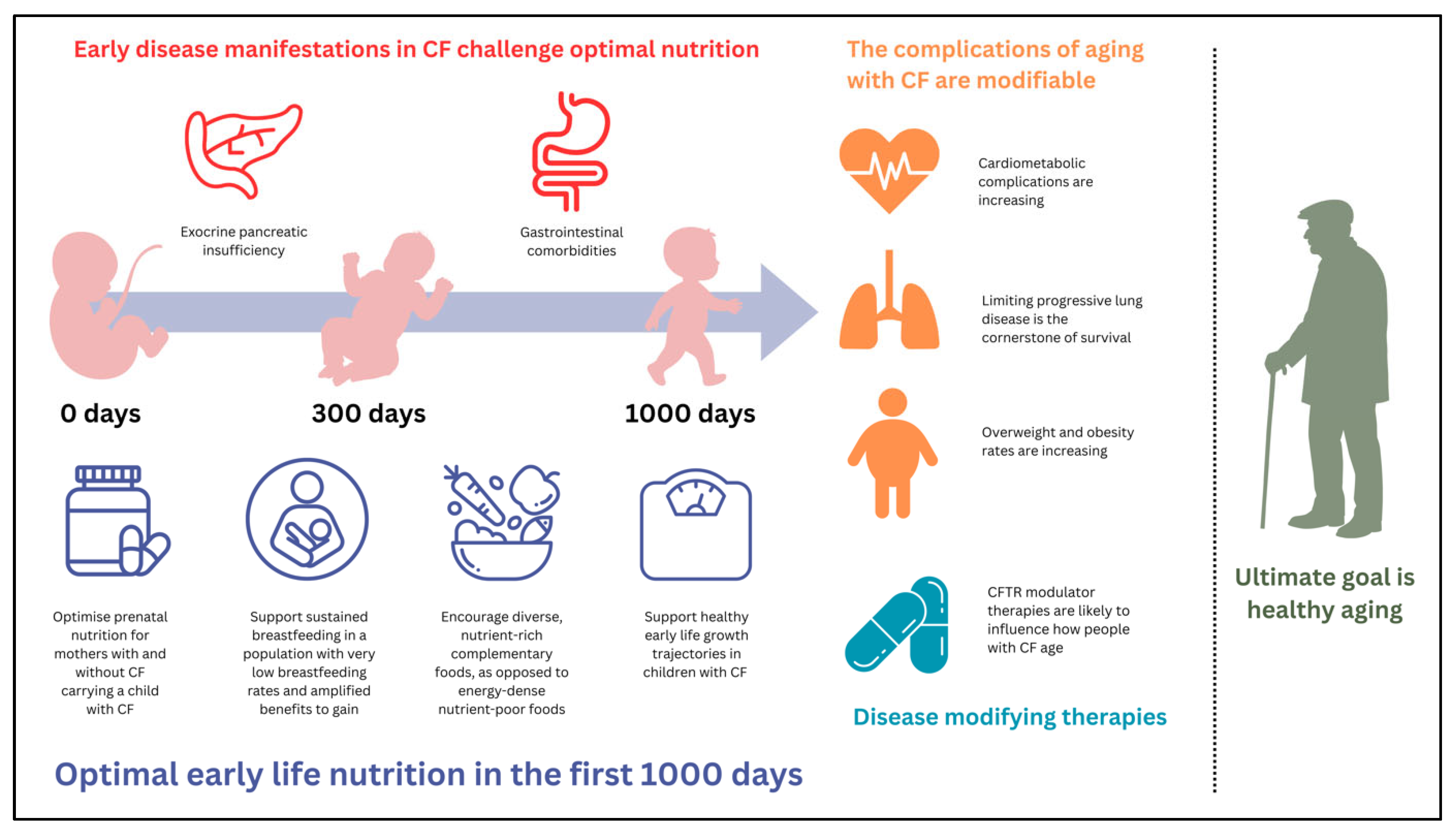
Similarly, diet quality in cwCF is suboptimal and yet the benefits of nutrient-dense foods for a condition which is characterized by poor nutrient absorption, reduced levels of circulating EFAs and dysbiosis are thought to be immense. The long-term benefits of a high-quality diet, rich in diversity, on outcomes such as chronic disease, obesity, inflammatory pathways, metabolic health, gut microbiome, cognitive function and longevity are important outcomes to consider in an aging CF population. Awareness amongst researchers and clinicians on the importance of diet quality in CF is increasing and, therefore, the continued monitoring of dietary balance in cwCF, including complementary ‘first’ foods, will be important in the future to ensure translation and uptake of evidence-based practice. Figure 1 provides a pictorial summary of the positive and negative influences on early life growth and nutrition in the first 1000 days of life, as summarized in this review, and how these may be hypothetically associated with lifelong healthy aging in pwCF.

7. Limitations

Due to several well-known concepts of nutritional programming being applied to the CF context, some key limitations must be highlighted. The first is that the ‘first 1000 days’ and ‘DOHaD’ concepts are heavily grounded on evidence from LMICs where malnutrition, poverty and unsafe and unsanitary environmental conditions are common. CwCF, particularly those living in high income countries, are exposed to developmental influences that are not only socio-economically different but physiologically and metabolically unique. Applying these constructs to the CF population is hypothetical and intended to generate questions in a rapidly evolving era of CF healthcare where the future goal should be to achieve optimal early life feeding, nutrition and growth outcomes in keeping with those of children without CF.
The second key limitation is that the evidence presented in this review on early life nutrition, growth and feeding is from a largely CFTRm naïve population which may not be directly transferable to the emerging CF population who are likely to be treated with disease-modifying drugs within the first two years of life. However, it is unlikely that infants under three-four months of age will be exposed to CFTRm on a large scale in the near future, and, therefore, understanding the barriers and facilitators to breastfeeding exclusivity and duration, alongside interventions to optimize breastfeeding rates in this vulnerable population will continue to be of relevance. Additionally, there is a stark absence of robust longitudinal studies in infants and young children treated with CFTRm therapies where nutrition and feeding outcomes are the primary endpoints.
Finally, a topic not within the scope of this review, but one that is equally important, are the socioeconomic disparities that exist globally in CF healthcare, raising the issue of applicability and generalizability of evidence presented within this review. With that being said, championing quality prenatal nutrition, breastfeeding duration, and nutrient-dense complementary foods, are not pillars of early life nutrition which should only apply to pwCF living in well-resourced settings and high-income countries. Indeed, these three pillars of early life nutrition are the bones of the ‘first 1000 days’ nutritional framework intended to support optimal development for children living in social, economic and environmental disadvantage.

8. Conclusions

The first 1000 days represent a critical window to optimize growth and nutrition in cwCF. Three priorities emerge from this review. First, we must establish evidence-based definitions of healthy growth trajectories specific to children living in the modern era of CF, considering not only optimization of pulmonary health but potential influences of early growth patterns on later life cardiometabolic outcomes. Second, sustained advocacy is needed to champion breastfeeding in cwCF, where clinically and psychologically appropriate, to at least match those of children without CF, recognizing breast milk as an underutilized nutritional advantage. Third, we must lead the way in investigating dietary diversity and quality in medically complex children—a research gap with far-reaching implications for both immediate outcomes and long-term healthy aging. Early life CFTRm therapies now offer a timely opportunity to fundamentally reshape nutritional management and outcomes in cwCF. Addressing these priorities will help to establish a stronger foundation for lifelong healthy aging in CF.

Author Contributions

All authors meet the ICJME guidelines and Nutrients authorship criteria. C.N.M.: Conceptualization, methodology and design, acquisition, analysis and interpretation of research data, research output and writing of final manuscript, G.M.N.: Research supervision, methodology and design, acquisition, analysis and interpretation of research data, research output and review of final manuscript, Z.E.D.: Research supervision, methodology and design, acquisition, analysis and interpretation of research data, research output and review of final manuscript. All authors have read and agreed to the published version of the manuscript.

Funding

Caitlin Miles receives a PhD Stipend from the Department of Nutrition, Dietetics and Food, School of Clinical Sciences, Faculty of Medicine, Nursing and Health Sciences, Monash University, Melbourne, Australia. She also received a research grant ‘65km for Cystic Fibrosis’ from Monash Health Foundation, Melbourne, Australia, to support completion of her PhD and associated projects. This narrative review will form part of Caitlin Miles’ post-doctoral thesis.

Institutional Review Board Statement

Not applicable.

Informed Consent Statement

Not applicable.

Data Availability Statement

No new data were created or analyzed in this study. Data sharing is not applicable to this article.

Conflicts of Interest

The authors declare no conflicts of interest.

References

  1. Guo, J.; Garratt, A.; Hill, A. Worldwide rates of diagnosis and effective treatment for cystic fibrosis. J. Cyst. Fibros. 2022, 21, 456–462. [Google Scholar] [CrossRef]
  2. Frost, F.J.; Peckham, D.G.; Felton, I.C.; Snowball, J.E.; Gray, R.D.; Jones, A.M.; Simmonds, N.J.; Lord, R.W.; Lip, G.Y.H.; Chandler, H.; et al. Managing an ageing cystic fibrosis population: Challenges and priorities. Eur. Respir. Rev. 2025, 34, 240261. [Google Scholar] [CrossRef]
  3. Cystic Fibrosis Foundation. 2024 Patient Registry Highlights; Cystic Fibrosis Foundation: Bethesda, MD, USA, 2025; Available online: https://www.cff.org/medical-professionals/2024-patient-registry-highlights (accessed on 20 February 2026).
  4. Arya, R.; Sharpe, I.; Cheng, S.Y.; Sykes, J.; Ma, X.; Stanojevic, S.; Rochon, P.A.; Li, P.; Quon, B.; Ordon, M.; et al. Elevated Rates and Earlier Onset of Non-Pulmonary Comorbidities in Adults with Cystic Fibrosis: A Population-Based Study. Ann. Am. Thorac. Soc. 2025. online ahead of print. [Google Scholar] [CrossRef] [PubMed]
  5. Frost, F.; Nazareth, D.; Fauchier, L.; Wat, D.; Shelley, J.; Austin, P.; Walshaw, M.J.; Lip, G.Y.H. Prevalence, risk factors and outcomes of cardiac disease in cystic fibrosis: A multinational retrospective cohort study. Eur. Respir. J. 2023, 62, 2300174. [Google Scholar] [CrossRef] [PubMed]
  6. UK Cystic Fibrosis Registry. 2024 Annual Data Report; Cystic Fibrosis Trust: London, UK, 2024. [Google Scholar]
  7. Ahern, S.; Pourghaderi, A.R.; Ruseckaite, R.; Caruso, M.; Liman, J.; Wark, P.; Schultz, A.; Armstrong, J. The ACFDR Registry Annual Report, 2023; Monash University: Melbourne, Australia, 2024. [Google Scholar]
  8. Andersen, D.H. Cystic Fibrosis of the Pancreas and its Relation to Celiac Diease. Am. J. Dis. Child 1938, 56, 344–399. [Google Scholar] [CrossRef]
  9. Ashkenazi, M.; Nathan, N.; Sarouk, I.; Aluma, B.E.B.; Dagan, A.; Bezalel, Y.; Keler, S.; Vilozni, D.; Efrati, O. Nutritional Status in Childhood as a Prognostic Factor in Patients with Cystic Fibrosis. Lung 2019, 197, 371–376. [Google Scholar] [CrossRef]
  10. Sanders, D.B.; Zhang, Z.; Farrell, P.M.; Lai, H.J.; Wisconsin, C.F.N.S.G. Early life growth patterns persist for 12 years and impact pulmonary outcomes in cystic fibrosis. J. Cyst. Fibros. 2018, 17, 528–535. [Google Scholar] [CrossRef]
  11. Kerem, E.; Reisman, J.; Corey, M.; Canny, G.J.; Levison, H. Prediction of mortality in patients with cystic fibrosis. N. Engl. J. Med. 1992, 326, 1187–1191. [Google Scholar] [CrossRef]
  12. Nir, M.; Lanng, S.; Johansen, H.K.; Koch, C. Long-term survival and nutritional data in patients with cystic fibrosis treated in a Danish centre. Thorax 1996, 51, 1023–1027. [Google Scholar] [CrossRef]
  13. Colombo, C.; Alicandro, G.; Dacco, V.; Consales, A.; Mosca, F.; Agostoni, C.; Gianni, M.L. Breastfeeding in Cystic Fibrosis: A Systematic Review on Prevalence and Potential Benefits. Nutrients 2021, 13, 3263. [Google Scholar] [CrossRef]
  14. Lai, H.J.; Bach, T.R.; Miller, T.; McDonald, C.M.; Maguiness, K.M.; Seffrood, E.E.; Leonard, J.B.; Farrell, P.M. Breastfeeding, growth, and lung disease in the first 3 years of life in children with cystic fibrosis. J. Cyst. Fibros. Off. J. Eur. Cyst. Fibros. Soc. 2024, 24, 507–515. [Google Scholar] [CrossRef]
  15. Leung, D.H.; Heltshe, S.L.; Borowitz, D.; Gelfond, D.; Kloster, M.; Heubi, J.E.; Stalvey, M.; Ramsey, B.W. Effects of Diagnosis by Newborn Screening for Cystic Fibrosis on Weight and Length in the First Year of Life. JAMA Pediatr. 2017, 171, 546–554. [Google Scholar] [CrossRef]
  16. Duck, S.A.; Jansen, E.; Papantoni, A.; Sheltry, A.; Koinis-Mitchell, D.; D’Sa, V.; Deoni, S.; Moran, T.H.; Findling, R.L.; Mogayzel, P.J., Jr.; et al. Parental perceptions of body weight and appetite in infants and toddlers with cystic fibrosis. Appetite 2024, 198, 107357. [Google Scholar] [CrossRef] [PubMed]
  17. Barker, D.J. The Wellcome Foundation Lecture, 1994. The fetal origins of adult disease. Proc. Biol. Sci. 1995, 262, 37–43. [Google Scholar] [CrossRef] [PubMed]
  18. Alves, J.G.B.; Alves, L.V. Early-life nutrition and adult-life outcomes. J. Pediatr. 2024, 100, S4–S9. [Google Scholar] [CrossRef] [PubMed]
  19. Barker, D.J.; Osmond, C. Infant mortality, childhood nutrition, and ischaemic heart disease in England and Wales. Lancet 1986, 1, 1077–1081. [Google Scholar] [CrossRef]
  20. Barker, D.J.; Winter, P.D.; Osmond, C.; Margetts, B.; Simmonds, S.J. Weight in infancy and death from ischaemic heart disease. Lancet 1989, 2, 577–580. [Google Scholar] [CrossRef]
  21. Wu, M.; Tian, H.; Guo, C.; Liu, Z.; Pan, Y.; Liu, F.; Liu, Y.; Yang, W.; Chen, H.; Hu, Z.; et al. Early-life undernutrition increases the risk of death from chronic diseases in adulthood: A population-based cohort study. Glob. Health Res. Policy 2025, 10, 28. [Google Scholar] [CrossRef]
  22. Stein, A.D.; Thompson, A.M.; Waters, A. Childhood growth and chronic disease: Evidence from countries undergoing the nutrition transition. Matern. Child Nutr. 2005, 1, 177–184. [Google Scholar] [CrossRef]
  23. Blake-Lamb, T.L.; Locks, L.M.; Perkins, M.E.; Woo Baidal, J.A.; Cheng, E.R.; Taveras, E.M. Interventions for Childhood Obesity in the First 1,000 Days A Systematic Review. Am. J. Prev. Med. 2016, 50, 780–789. [Google Scholar] [CrossRef]
  24. Hoffman, D.J.; Reynolds, R.M.; Hardy, D.B. Developmental origins of health and disease: Current knowledge and potential mechanisms. Nutr. Rev. 2017, 75, 951–970. [Google Scholar] [CrossRef] [PubMed]
  25. Victora, C.G.; Adair, L.; Fall, C.; Hallal, P.C.; Martorell, R.; Richter, L.; Sachdev, H.S.; Maternal and Child Undernutrition Study Group. Maternal and child undernutrition: Consequences for adult health and human capital. Lancet 2008, 371, 340–357. [Google Scholar] [CrossRef] [PubMed]
  26. Suri, S.; Verlato, G.; Ray, S. Editorial: The first 1000 days: Window of opportunity for child health and development. Front. Nutr. 2025, 12, 1673003. [Google Scholar] [CrossRef] [PubMed]
  27. Baethge, C.; Goldbeck-Wood, S.; Mertens, S. SANRA-a scale for the quality assessment of narrative review articles. Res. Integr. Peer Rev. 2019, 4, 5. [Google Scholar] [CrossRef]
  28. Walker, S.P.; Wachs, T.D.; Grantham-McGregor, S.; Black, M.M.; Nelson, C.A.; Huffman, S.L.; Baker-Henningham, H.; Chang, S.M.; Hamadani, J.D.; Lozoff, B.; et al. Inequality in early childhood: Risk and protective factors for early child development. Lancet 2011, 378, 1325–1338. [Google Scholar] [CrossRef]
  29. Walker, S.P.; Wachs, T.D.; Gardner, J.M.; Lozoff, B.; Wasserman, G.A.; Pollitt, E.; Carter, J.A.; International Child Development Steering Group. Child development: Risk factors for adverse outcomes in developing countries. Lancet 2007, 369, 145–157. [Google Scholar] [CrossRef]
  30. Black, M.M.; Walker, S.P.; Fernald, L.C.H.; Andersen, C.T.; DiGirolamo, A.M.; Lu, C.; McCoy, D.C.; Fink, G.; Shawar, Y.R.; Shiffman, J.; et al. Early childhood development coming of age: Science through the life course. Lancet 2017, 389, 77–90. [Google Scholar] [CrossRef]
  31. Grantham-McGregor, S.; Cheung, Y.B.; Cueto, S.; Glewwe, P.; Richter, L.; Strupp, B.; International Child Development Steering Group. Developmental potential in the first 5 years for children in developing countries. Lancet 2007, 369, 60–70. [Google Scholar] [CrossRef]
  32. Britto, P.R.; Lye, S.J.; Proulx, K.; Yousafzai, A.K.; Matthews, S.G.; Vaivada, T.; Perez-Escamilla, R.; Rao, N.; Ip, P.; Fernald, L.C.H.; et al. Nurturing care: Promoting early childhood development. Lancet 2017, 389, 91–102. [Google Scholar] [CrossRef]
  33. Tesser, F.; Meneghelli, M.; Martino, D.; Pegoraro, L.; Pelosi, M.S.; Sebellin, S.; Verlato, G. Early Optimal Parenteral Nutrition During NICU Stay and Neurodevelopmental Outcomes in Very Preterm Infants: State of the Art. Nutrients 2025, 17, 232. [Google Scholar] [CrossRef]
  34. Morris, E.E.; Miller, N.C.; Marka, N.A.; Super, J.L.; Nagel, E.M.; Gonzalez, J.D.; Demerath, E.W.; Ramel, S.E. Randomized Trial of Early Enhanced Parenteral Nutrition and Later Neurodevelopment in Preterm Infants. Nutrients 2022, 14, 3890. [Google Scholar] [CrossRef] [PubMed]
  35. Zeng, S.; Ying, J.; Li, S.; Qu, Y.; Mu, D.; Wang, S. First 1000 Days and Beyond After Birth: Gut Microbiota and Necrotizing Enterocolitis in Preterm Infants. Front. Microbiol. 2022, 13, 905380. [Google Scholar] [CrossRef] [PubMed]
  36. Woo, J.M.P.; Bookwalter, D.B.; Green, G.Y.; Sandler, D.P. Early life socioeconomic position contributes to adult obesity independent of adult socioeconomic factors: Findings from the sister study cohort. SSM-Popul. Health 2023, 24, 101556. [Google Scholar] [CrossRef] [PubMed]
  37. Del Bono, C.; Candela, E.; Parini, L.; Zama, D.; Pierantoni, L.; Bodini, C.F.; Dondi, A.; Lanari, M. The first 1000 days: The price of inequalities in high and middle-income countries. Pediatr. Res. 2025, 98, 80–89. [Google Scholar] [CrossRef]
  38. Onifade, O.; Kocanda, L.; Schumacher, T.; Rollo, M.; Rae, K.; Pringle, K.G. Effectiveness of interventions to optimise dietary intakes in the first 1000 d of life in Indigenous children: A systematic review. Public Health Nutr. 2022, 25, 450–463. [Google Scholar] [CrossRef]
  39. Ritte, R.; Panozzo, S.; Johnston, L.; Agerholm, J.; Kvernmo, S.E.; Rowley, K.; Arabena, K. An Australian model of the First 1000 Days: An Indigenous-led process to turn an international initiative into an early-life strategy benefiting indigenous families. Glob. Health Epidemiol. Genom. 2016, 1, e11. [Google Scholar] [CrossRef]
  40. Parsons, T.J.; Power, C.; Manor, O. Fetal and early life growth and body mass index from birth to early adulthood in 1958 British cohort: Longitudinal study. BMJ 2001, 323, 1331–1335. [Google Scholar] [CrossRef]
  41. Kuh, D.; Hardy, R.; Chaturvedi, N.; Wadsworth, M.E. Birth weight, childhood growth and abdominal obesity in adult life. Int. J. Obes. Relat. Metab. Disord. 2002, 26, 40–47. [Google Scholar] [CrossRef]
  42. Eriksson, J.G.; Forsen, T.; Tuomilehto, J.; Jaddoe, V.W.; Osmond, C.; Barker, D.J. Effects of size at birth and childhood growth on the insulin resistance syndrome in elderly individuals. Diabetologia 2002, 45, 342–348. [Google Scholar] [CrossRef]
  43. Curhan, G.C.; Chertow, G.M.; Willett, W.C.; Spiegelman, D.; Colditz, G.A.; Manson, J.E.; Speizer, F.E.; Stampfer, M.J. Birth weight and adult hypertension and obesity in women. Circulation 1996, 94, 1310–1315. [Google Scholar] [CrossRef]
  44. Stephenson, J.; Heslehurst, N.; Hall, J.; Schoenaker, D.; Hutchinson, J.; Cade, J.E.; Poston, L.; Barrett, G.; Crozier, S.R.; Barker, M.; et al. Before the beginning: Nutrition and lifestyle in the preconception period and its importance for future health. Lancet 2018, 391, 1830–1841. [Google Scholar] [CrossRef] [PubMed]
  45. Baird, J.; Jacob, C.; Barker, M.; Fall, C.H.; Hanson, M.; Harvey, N.C.; Inskip, H.M.; Kumaran, K.; Cooper, C. Developmental Origins of Health and Disease: A Lifecourse Approach to the Prevention of Non-Communicable Diseases. Healthcare 2017, 5, 14. [Google Scholar] [CrossRef] [PubMed]
  46. Shteinberg, M.; Haq, I.J.; Polineni, D.; Davies, J.C. Cystic fibrosis. Lancet 2021, 397, 2195–2211. [Google Scholar] [CrossRef]
  47. Scotet, V.; L’Hostis, C.; Ferec, C. The Changing Epidemiology of Cystic Fibrosis: Incidence, Survival and Impact of the CFTR Gene Discovery. Genes 2020, 11, 589. [Google Scholar] [CrossRef] [PubMed]
  48. Castellani, C.; Massie, J.; Sontag, M.; Southern, K.W. Newborn screening for cystic fibrosis. Lancet Respir. Med. 2016, 4, 653–661. [Google Scholar] [CrossRef]
  49. Saxby, N.; Painter, C.; Kench, A.; King, S.; Crowder, T.; van der Haak, N.; The Australian and New Zealand Cystic Fibrosis Nutrition Guideline Authorship Group. Nutrition Guidelines for Cystic Fibrosis in Australia and New Zealand; Thoracic Society of Australia and New Zealand: Sydney, Australia, 2017. [Google Scholar]
  50. Galante, G.; Freeman, A.J. Gastrointestinal, Pancreatic, and Hepatic Manifestations of Cystic Fibrosis in the Newborn. Neoreviews 2019, 20, e12–e24. [Google Scholar] [CrossRef]
  51. Nixon, G.M.; Armstrong, D.S.; Carzino, R.; Carlin, J.B.; Olinsky, A.; Robertson, C.F.; Grimwood, K. Clinical outcome after early Pseudomonas aeruginosa infection in cystic fibrosis. J. Pediatr. 2001, 138, 699–704. [Google Scholar] [CrossRef]
  52. Emerson, J.; Rosenfeld, M.; McNamara, S.; Ramsey, B.; Gibson, R.L. Pseudomonas aeruginosa and other predictors of mortality and morbidity in young children with cystic fibrosis. Pediatr. Pulmonol. 2002, 34, 91–100. [Google Scholar] [CrossRef]
  53. Rosenfeld, M.; Gibson, R.L.; McNamara, S.; Emerson, J.; Burns, J.L.; Castile, R.; Hiatt, P.; McCoy, K.; Wilson, C.B.; Inglis, A.; et al. Early pulmonary infection, inflammation, and clinical outcomes in infants with cystic fibrosis. Pediatr. Pulmonol. 2001, 32, 356–366. [Google Scholar] [CrossRef]
  54. Felipe Montiel, A.; Fernandez, A.A.; Amigo, M.C.; Traversi, L.; Clofent Alarcon, D.; Reyes, K.L.; Polverino, E. The ageing of people living with cystic fibrosis: What to expect now? Eur. Respir. Rev. 2024, 33, 240071. [Google Scholar] [CrossRef]
  55. Chan, A.; Frost, F.; Nazareth, D. Multimorbidity in the modulator era: Challenges of managing an ageing cystic fibrosis population. Expert. Rev. Respir. Med. 2025. online ahead of print. [Google Scholar] [CrossRef]
  56. Taylor-Cousar, J.L.; Robinson, P.D.; Shteinberg, M.; Downey, D.G. CFTR modulator therapy: Transforming the landscape of clinical care in cystic fibrosis. Lancet 2023, 402, 1171–1184. [Google Scholar] [CrossRef] [PubMed]
  57. Graeber, S.Y.; Mall, M.A. The future of cystic fibrosis treatment: From disease mechanisms to novel therapeutic approaches. Lancet 2023, 402, 1185–1198. [Google Scholar] [CrossRef]
  58. Psoter, K.J.; Dickinson, K.M.; Riekert, K.A.; Collaco, J.M. Early life growth trajectories in cystic fibrosis are associated with lung function at age six. J. Cyst. Fibros. 2023, 22, 395–401. [Google Scholar] [CrossRef] [PubMed]
  59. Macdougall, A.; Jarvis, D.; Keogh, R.H.; Bowerman, C.; Bilton, D.; Davies, G.; Carr, S.B.; Stanojevic, S. Trajectories of early growth and subsequent lung function in cystic fibrosis: An observational study using UK and Canadian registry data. J. Cyst. Fibros. 2023, 22, 388–394. [Google Scholar] [CrossRef]
  60. Madde, A.; Okoniewski, W.; Sanders, D.B.; Ren, C.L.; Weiner, D.J.; Forno, E. Nutritional status and lung function in children with pancreatic-sufficient cystic fibrosis. J. Cyst. Fibros. 2022, 21, 769–776. [Google Scholar] [CrossRef] [PubMed]
  61. Wilschanski, M.; Munck, A.; Carrion, E.; Cipolli, M.; Collins, S.; Colombo, C.; Declercq, D.; Hatziagorou, E.; Hulst, J.; Kalnins, D.; et al. ESPEN-ESPGHAN-ECFS guideline on nutrition care for cystic fibrosis. Clin. Nutr. 2024, 43, 413–445. [Google Scholar] [CrossRef]
  62. Stallings, V.A.; Stark, L.J.; Robinson, K.A.; Feranchak, A.P.; Quinton, H.; Clinical Practice Guidelines on Growth and Nutrition Subcommittee; Ad Hoc Working Group. Evidence-based practice recommendations for nutrition-related management of children and adults with cystic fibrosis and pancreatic insufficiency: Results of a systematic review. J. Am. Diet. Assoc. 2008, 108, 832–839. [Google Scholar] [CrossRef]
  63. Cystic Fibrosis, F.; Borowitz, D.; Robinson, K.A.; Rosenfeld, M.; Davis, S.D.; Sabadosa, K.A.; Spear, S.L.; Michel, S.H.; Parad, R.B.; White, T.B.; et al. Cystic Fibrosis Foundation evidence-based guidelines for management of infants with cystic fibrosis. J. Pediatr. 2009, 155, S73–S93. [Google Scholar] [CrossRef]
  64. Sermet-Gaudelus, I.; Mayell, S.J.; Southern, K.W. European Cystic Fibrosis Society (ECFS), Neonatal Screening Working Group Guidelines on the early management of infants diagnosed with cystic fibrosis following newborn screening. J. Cyst. Fibros. 2010, 9, 323–329. [Google Scholar] [CrossRef]
  65. Turck, D.; Braegger, C.P.; Colombo, C.; Declercq, D.; Morton, A.; Pancheva, R.; Robberecht, E.; Stern, M.; Strandvik, B.; Wolfe, S.; et al. ESPEN-ESPGHAN-ECFS guidelines on nutrition care for infants, children, and adults with cystic fibrosis. Clin. Nutr. 2016, 35, 557–577. [Google Scholar] [CrossRef] [PubMed]
  66. Rubin, J.L.; McKinnon, C.; Pedra, G.G.; Morgan, D.A.; Zweig, K.; Liou, T.G. Impact of CFTR Modulators on Longitudinal Cystic Fibrosis Survival and Mortality: Review and Secondary Analysis. Pulm. Ther. 2025, 11, 365–386. [Google Scholar] [CrossRef] [PubMed]
  67. Van Citters, A.D.; Aliaj, E.; Alvarez, J.A.; Brown, C.D.; Cary, J.; Cravens, R.; Frederick, C.A.; Georgiopoulos, A.M.; Goss, C.H.; Kazmerski, T.M.; et al. Wellness in the modulator era: An observational study of the impact of CFTR modulator therapy on the well-being of people with cystic fibrosis. J. Cyst. Fibros. 2025, 24, 642–651. [Google Scholar] [CrossRef] [PubMed]
  68. Bass, R.; Alvarez, J.A. Nutritional status in the era of highly effective CFTR modulators. Pediatr. Pulmonol. 2024, 59, S6–S16. [Google Scholar] [CrossRef]
  69. Leonard, A.; Bailey, J.; Bruce, A.; Jia, S.; Stein, A.; Fulton, J.; Helmick, M.; Litvin, M.; Patel, A.; Powers, K.E.; et al. Nutritional considerations for a new era: A CF foundation position paper. J. Cyst. Fibros. 2023, 22, 788–795. [Google Scholar] [CrossRef]
  70. Bailey, J.; Rozga, M.; McDonald, C.M.; Bowser, E.K.; Farnham, K.; Mangus, M.; Padula, L.; Porco, K.; Alvarez, J.A. Effect of CFTR Modulators on Anthropometric Parameters in Individuals with Cystic Fibrosis: An Evidence Analysis Center Systematic Review. J. Acad. Nutr. Diet. 2021, 121, 1364–1378 e1362. [Google Scholar] [CrossRef]
  71. Vavrina, K.; Griffin, T.B.; Jones, A.M.; Schindler, T.; Bui, T.N.; Sankararaman, S. Evolving nutrition therapy in cystic fibrosis: Adapting to the CFTR modulator era. Nutr. Clin. Pract. 2025, 40, 816–828. [Google Scholar] [CrossRef]
  72. Tekerlek, H.; Yardimci-Lokmanoglu, B.N.; Inal-Ince, D.; Ozcelik, U.; Mutlu, A. Developmental Functioning Outcomes in Infants With Cystic Fibrosis: A 24- to 36-Month Follow-Up Study. Phys. Ther. 2022, 102, pzac037. [Google Scholar] [CrossRef]
  73. Ernst, M.M.; Johnson, M.C.; Stark, L.J. Developmental and psychosocial issues in cystic fibrosis. Pediatr. Clin. N. Am. 2011, 58, 865–885. [Google Scholar] [CrossRef]
  74. Tekerlek, H.; Mutlu, A.; Inal-Ince, D.; Livanelioglu, A.; Kahraman, A.; Eryilmaz-Polat, S.; Karakaya, J.; Ozcelik, U. Motor repertoire is age-inadequate in infants with cystic fibrosis. Pediatr. Res. 2021, 89, 1291–1296. [Google Scholar] [CrossRef]
  75. Koscik, R.L.; Farrell, P.M.; Kosorok, M.R.; Zaremba, K.M.; Laxova, A.; Lai, H.C.; Douglas, J.A.; Rock, M.J.; Splaingard, M.L. Cognitive function of children with cystic fibrosis: Deleterious effect of early malnutrition. Pediatrics 2004, 113, 1549–1558. [Google Scholar] [CrossRef]
  76. Donos, M.A.; Ghiga, G.; Trandafir, L.M.; Cojocaru, E.; Tarca, V.; Butnariu, L.I.; Bernic, V.; Morosan, E.; Roca, I.C.; Mindru, D.E.; et al. Diagnosis and Management of Simple and Complicated Meconium Ileus in Cystic Fibrosis, a Systematic Review. Diagnostics 2024, 14, 1179. [Google Scholar] [CrossRef] [PubMed]
  77. Padoan, R.; Cirilli, N.; Falchetti, D.; Cesana, B.M. Risk factors for adverse outcome in infancy in meconium ileus cystic fibrosis infants: A multicentre Italian study. J. Cyst. Fibros. Off. J. Eur. Cyst. Fibros. Soc. 2019, 18, 863–868. [Google Scholar] [CrossRef] [PubMed]
  78. Long, A.M.; Jones, I.H.; Knight, M.; McNally, J.; Baps, C. Early management of meconium ileus in infants with cystic fibrosis: A prospective population cohort study. J. Pediatr. Surg. 2021, 56, 1287–1292. [Google Scholar] [CrossRef] [PubMed]
  79. Sathe, M.; Houwen, R. Meconium ileus in Cystic Fibrosis. J. Cyst. Fibros. 2017, 16, S32–S39. [Google Scholar] [CrossRef]
  80. Jessula, S.; Van Den Hof, M.; Mateos-Corral, D.; Mills, J.; Davies, D.; Romao, R.L. Predictors for surgical intervention and surgical outcomes in neonates with cystic fibrosis. J. Pediatr. Surg. 2018, 53, 2150–2154. [Google Scholar] [CrossRef]
  81. da Silva-Filho, L.; Belchior, G.; Paes, A.T.; Soriano Freire, N.C.; Steinhaus, C.; Epifanio, M.; Brazilian, C.F.R.C.T. The significant impact of meconium ileus on clinical outcomes among Brazilian individuals with cystic fibrosis-a retrospective analysis of a patient registry. Lancet Reg. Health Am. 2025, 46, 101099. [Google Scholar] [CrossRef]
  82. Tan, S.M.J.; Coffey, M.J.; Ooi, C.Y. Differences in clinical outcomes of paediatric cystic fibrosis patients with and without meconium ileus. J. Cyst. Fibros. 2019, 18, 857–862. [Google Scholar] [CrossRef]
  83. Munck, A.; Gerardin, M.; Alberti, C.; Ajzenman, C.; Lebourgeois, M.; Aigrain, Y.; Navarro, J. Clinical outcome of cystic fibrosis presenting with or without meconium ileus: A matched cohort study. J. Pediatr. Surg. 2006, 41, 1556–1560. [Google Scholar] [CrossRef]
  84. Efrati, O.; Nir, J.; Fraser, D.; Cohen-Cymberknoh, M.; Shoseyov, D.; Vilozni, D.; Modan-Moses, D.; Levy, R.; Szeinberg, A.; Kerem, E.; et al. Meconium ileus in patients with cystic fibrosis is not a risk factor for clinical deterioration and survival: The Israeli Multicenter Study. J. Pediatr. Gastroenterol. Nutr. 2010, 50, 173–178. [Google Scholar] [CrossRef]
  85. Johnson, J.A.; Bush, A.; Buchdahl, R. Does presenting with meconium ileus affect the prognosis of children with cystic fibrosis? Pediatr. Pulmonol. 2010, 45, 951–958. [Google Scholar] [CrossRef] [PubMed]
  86. Farrell, P.M. Reflections on 50 Years of Cystic Fibrosis Newborn Screening Experience with Critical Perspectives, Assessment of Current Status, and Predictions for Future Improvements. Int. J. Neonatal Screen. 2025, 11, 88. [Google Scholar] [CrossRef] [PubMed]
  87. Holliday, K.E.; Allen, J.R.; Waters, D.L.; Gruca, M.A.; Thompson, S.M.; Gaskin, K.J. Growth of human milk-fed and formula-fed infants with cystic fibrosis. J. Pediatr. 1991, 118, 77–79. [Google Scholar] [CrossRef] [PubMed]
  88. McKay, I.R.; Ooi, C.Y. The Exocrine Pancreas in Cystic Fibrosis in the Era of CFTR Modulation: A Mini Review. Front. Pediatr. 2022, 10, 914790. [Google Scholar] [CrossRef]
  89. Ramsey, M.L.; Li, S.S.; Lara, L.F.; Gokun, Y.; Akshintala, V.S.; Conwell, D.L.; Heintz, J.; Kirkby, S.E.; McCoy, K.S.; Papachristou, G.I.; et al. Cystic fibrosis transmembrane conductance regulator modulators and the exocrine pancreas: A scoping review. J. Cyst. Fibros. 2023, 22, 193–200. [Google Scholar] [CrossRef]
  90. Singh, V.K.; Schwarzenberg, S.J. Pancreatic insufficiency in Cystic Fibrosis. J. Cyst. Fibros. 2017, 16, S70–S78. [Google Scholar] [CrossRef]
  91. Sturgess, J.M. Structural and developmental abnormalities of the exocrine pancreas in cystic fibrosis. J. Pediatr. Gastroenterol. Nutr. 1984, 3, S55–66. [Google Scholar] [CrossRef]
  92. Patterson, K.D.; Kyriacou, T.; Desai, M.; Carroll, W.D.; Gilchrist, F.J. Factors affecting the growth of infants diagnosed with cystic fibrosis by newborn screening. BMC Pediatr. 2019, 19, 356. [Google Scholar] [CrossRef]
  93. Munck, A.; Boulkedid, R.; Weiss, L.; Foucaud, P.; Wizla-Derambure, N.; Reix, P.; Bremont, F.; Derelle, J.; Schroedt, J.; Alberti, C.; et al. Nutritional Status in the First 2 Years of Life in Cystic Fibrosis Diagnosed by Newborn Screening. J. Pediatr. Gastroenterol. Nutr. 2018, 67, 123–130. [Google Scholar] [CrossRef]
  94. Gelfond, D.; Heltshe, S.L.; Skalland, M.; Heubi, J.E.; Kloster, M.; Leung, D.H.; Ramsey, B.W.; Borowitz, D. Pancreatic Enzyme Replacement Therapy Use in Infants With Cystic Fibrosis Diagnosed by Newborn Screening. J. Pediatr. Gastroenterol. Nutr. 2018, 66, 657–663. [Google Scholar] [CrossRef]
  95. Hayden, H.S.; Eng, A.; Pope, C.E.; Brittnacher, M.J.; Vo, A.T.; Weiss, E.J.; Hager, K.R.; Martin, B.D.; Leung, D.H.; Heltshe, S.L.; et al. Fecal dysbiosis in infants with cystic fibrosis is associated with early linear growth failure. Nat. Med. 2020, 26, 215–221. [Google Scholar] [CrossRef]
  96. Sathe, M.; Huang, R.; Heltshe, S.; Eng, A.; Borenstein, E.; Miller, S.I.; Hoffman, L.; Gelfond, D.; Leung, D.H.; Borowitz, D.; et al. Gastrointestinal Factors Associated With Hospitalization in Infants With Cystic Fibrosis: Results From the Baby Observational and Nutrition Study. J. Pediatr. Gastroenterol. Nutr. 2021, 73, 395–402. [Google Scholar] [CrossRef] [PubMed]
  97. Gabel, M.E.; Gaudio, R.E.; Shaikhkhalil, A.K. Improving growth in infants with CF. Pediatr. Pulmonol. 2024, 59, S17–S26. [Google Scholar] [CrossRef] [PubMed]
  98. Sanders, D.B.; Slaven, J.E.; Maguiness, K.; Chmiel, J.F.; Ren, C.L. Early-Life Height Attainment in Cystic Fibrosis Is Associated with Pulmonary Function at Age 6 Years. Ann. Am. Thorac. Soc. 2021, 18, 1335–1342. [Google Scholar] [CrossRef] [PubMed]
  99. Jadin, S.A.; Wu, G.S.; Zhang, Z.; Shoff, S.M.; Tippets, B.M.; Farrell, P.M.; Miller, T.; Rock, M.J.; Levy, H.; Lai, H.J. Growth and pulmonary outcomes during the first 2 y of life of breastfed and formula-fed infants diagnosed with cystic fibrosis through the Wisconsin Routine Newborn Screening Program. Am. J. Clin. Nutr. 2011, 93, 1038–1047. [Google Scholar] [CrossRef]
  100. Colombo, C.; Costantini, D.; Zazzeron, L.; Faelli, N.; Russo, M.C.; Ghisleni, D.; Gatelli, I.; Giovannini, M.; Riva, E.; Zetterstrom, R.; et al. Benefits of breastfeeding in cystic fibrosis: A single-centre follow-up survey. Acta Paediatr. 2007, 96, 1228–1232. [Google Scholar] [CrossRef]
  101. Davies, J.C.; Cunningham, S.; Harris, W.T.; Lapey, A.; Regelmann, W.E.; Sawicki, G.S.; Southern, K.W.; Robertson, S.; Green, Y.; Cooke, J.; et al. Safety, pharmacokinetics, and pharmacodynamics of ivacaftor in patients aged 2-5 years with cystic fibrosis and a CFTR gating mutation (KIWI): An open-label, single-arm study. Lancet Respir. Med. 2016, 4, 107–115. [Google Scholar] [CrossRef]
  102. Davies, J.C.; Wainwright, C.E.; Sawicki, G.S.; Higgins, M.N.; Campbell, D.; Harris, C.; Panorchan, P.; Haseltine, E.; Tian, S.; Rosenfeld, M. Ivacaftor in Infants Aged 4 to <12 Months with Cystic Fibrosis and a Gating Mutation. Results of a Two-Part Phase 3 Clinical Trial. Am. J. Respir. Crit. Care Med. 2021, 203, 585–593. [Google Scholar] [CrossRef]
  103. Goralski, J.L.; Hoppe, J.E.; Mall, M.A.; McColley, S.A.; McKone, E.; Ramsey, B.; Rayment, J.H.; Robinson, P.; Stehling, F.; Taylor-Cousar, J.L.; et al. Phase 3 Open-Label Clinical Trial of Elexacaftor/Tezacaftor/Ivacaftor in Children Aged 2-5 Years with Cystic Fibrosis and at Least One F508del Allele. Am. J. Respir. Crit. Care Med. 2023, 208, 59–67. [Google Scholar] [CrossRef]
  104. Hutchinson, I.; McNally, P. Appearance of Pancreatic Sufficiency and Discontinuation of Pancreatic Enzyme Replacement Therapy in Children with Cystic Fibrosis on Ivacaftor. Ann. Am. Thorac. Soc. 2021, 18, 182–183. [Google Scholar] [CrossRef]
  105. McNally, P.; Singh, A.; McColley, S.A.; Davies, J.C.; Higgins, M.; Liu, M.; Lu, J.; Rodriguez-Romero, V.; Shih, J.L.; Rosenfeld, M.; et al. Safety and efficacy of ivacaftor in infants aged 1 to less than 4 months with cystic fibrosis. J. Cyst. Fibros. 2024, 23, 429–435. [Google Scholar] [CrossRef] [PubMed]
  106. Munce, D.; Lim, M.; Akong, K. Persistent recovery of pancreatic function in patients with cystic fibrosis after ivacaftor. Pediatr. Pulmonol. 2020, 55, 3381–3383. [Google Scholar] [CrossRef] [PubMed]
  107. Olivier, M.; Kavvalou, A.; Welsner, M.; Hirtz, R.; Strassburg, S.; Sutharsan, S.; Stehling, F.; Steindor, M. Real-life impact of highly effective CFTR modulator therapy in children with cystic fibrosis. Front. Pharmacol. 2023, 14, 1176815. [Google Scholar] [CrossRef] [PubMed]
  108. Rosenfeld, M.; Cunningham, S.; Harris, W.T.; Lapey, A.; Regelmann, W.E.; Sawicki, G.S.; Southern, K.W.; Chilvers, M.; Higgins, M.; Tian, S.; et al. An open-label extension study of ivacaftor in children with CF and a CFTR gating mutation initiating treatment at age 2-5 years (KLIMB). J. Cyst. Fibros. 2019, 18, 838–843. [Google Scholar] [CrossRef]
  109. Rosenfeld, M.; Wainwright, C.E.; Higgins, M.; Wang, L.T.; McKee, C.; Campbell, D.; Tian, S.; Schneider, J.; Cunningham, S.; Davies, J.C.; et al. Ivacaftor treatment of cystic fibrosis in children aged 12 to <24 months and with a CFTR gating mutation (ARRIVAL): A phase 3 single-arm study. Lancet Respir. Med. 2018, 6, 545–553. [Google Scholar] [CrossRef]
  110. Stephenson, K.G.; Lingle, A.J.; Baumberger, K.A.; Dellon, E.P.; Esther, C.R., Jr.; Meier, E.M.; Oermann, C.M.; Shenoy, V.K.; Smith, N.R.; Wimmer, N.S.; et al. Changes in fecal elastase-1 following initiation of CFTR modulator therapy in pediatric patients with cystic fibrosis. J. Cyst. Fibros. 2023, 22, 996–1001. [Google Scholar] [CrossRef]
  111. Schembri, L.; Jones, D.; Bentley, S.; Carr, S.; Balfour-Lynn, I. Real-world pancreatic function recovery and fluctuation in young children with cystic fibrosis on elexacaftor/tezacaftor/ivacaftor. J. Cyst. Fibros. 2025. online ahead of print. [Google Scholar] [CrossRef]
  112. Bonnel, A.S.; Bihouee, T.; Ribault, M.; Driessen, M.; Grevent, D.; Foissac, F.; Truong, N.H.; Benhamida, M.; Arnouat, B.; Borghese, R.; et al. First real-world study of fetal therapy with CFTR modulators in cystic fibrosis: Report from the MODUL-CF study. J. Cyst. Fibros. 2025, 24, 457–465. [Google Scholar] [CrossRef]
  113. Metcalf, A.; Martiniano, S.L.; Sagel, S.D.; Zaretsky, M.V.; Zemanick, E.T.; Hoppe, J.E. Outcomes of prenatal use of elexacaftor/tezacaftor/ivacaftor in carrier mothers to treat meconium ileus in fetuses with cystic fibrosis. J. Cyst. Fibros. 2024, 24, 466–468. [Google Scholar] [CrossRef]
  114. Szentpetery, S.; Foil, K.; Hendrix, S.; Gray, S.; Mingora, C.; Head, B.; Johnson, D.; Flume, P.A. A case report of CFTR modulator administration via carrier mother to treat meconium ileus in a F508del homozygous fetus. J. Cyst. Fibros. 2022, 21, 721–724. [Google Scholar] [CrossRef]
  115. Sun, X.; Yi, Y.; Yan, Z.; Rosen, B.H.; Liang, B.; Winter, M.C.; Evans, T.I.A.; Rotti, P.G.; Yang, Y.; Gray, J.S.; et al. In utero and postnatal VX-770 administration rescues multiorgan disease in a ferret model of cystic fibrosis. Sci. Transl. Med. 2019, 11, eaau7531. [Google Scholar] [CrossRef] [PubMed]
  116. Birimberg-Schwartz, L.; Wilschanski, M. Cystic Fibrosis Related Gastrointestinal Manifestations—Moving Forward. J. Cyst. Fibros. 2021, 20, 562–563. [Google Scholar] [CrossRef] [PubMed]
  117. Moshiree, B.; Freeman, A.J.; Vu, P.T.; Khan, U.; Ufret-Vincenty, C.; Heltshe, S.L.; Goss, C.H.; Schwarzenberg, S.J.; Freedman, S.D.; Borowitz, D.; et al. Multicenter prospective study showing a high gastrointestinal symptom burden in cystic fibrosis. J. Cyst. Fibros. 2023, 22, 266–274. [Google Scholar] [CrossRef] [PubMed]
  118. Burton, S.J.; Hachem, C.; Abraham, J.M. Luminal Gastrointestinal Manifestations of Cystic Fibrosis. Curr. Gastroenterol. Rep. 2021, 23, 4. [Google Scholar] [CrossRef]
  119. Tabori, H.; Arnold, C.; Jaudszus, A.; Mentzel, H.J.; Renz, D.M.; Reinsch, S.; Lorenz, M.; Michl, R.; Gerber, A.; Lehmann, T.; et al. Abdominal symptoms in cystic fibrosis and their relation to genotype, history, clinical and laboratory findings. PLoS ONE 2017, 12, e0174463. [Google Scholar] [CrossRef]
  120. Verster, A.J.; Salerno, P.; Valls, R.; Barrack, K.; Price, C.E.; McClure, E.A.; Madan, J.C.; O’Toole, G.A.; Sanville, J.L.; Ross, B.D. Persistent delay in maturation of the developing gut microbiota in infants with cystic fibrosis. mBio 2025, 16, e0342024. [Google Scholar] [CrossRef]
  121. Price, C.E.; Hampton, T.H.; Valls, R.A.; Barrack, K.E.; O’Toole, G.A.; Madan, J.C.; Coker, M.O. Development of the intestinal microbiome in cystic fibrosis in early life. mSphere 2023, 8, e0004623. [Google Scholar] [CrossRef]
  122. McKay, I.; van Dorst, J.; Katz, T.; Doumit, M.; Prentice, B.; Owens, L.; Belessis, Y.; Chuang, S.; Jaffe, A.; Thomas, T.; et al. Diet and the gut-lung axis in cystic fibrosis—Direct & indirect links. Gut Microbes 2023, 15, 2156254. [Google Scholar] [CrossRef]
  123. Hoen, A.G.; Li, J.; Moulton, L.A.; O’Toole, G.A.; Housman, M.L.; Koestler, D.C.; Guill, M.F.; Moore, J.H.; Hibberd, P.L.; Morrison, H.G.; et al. Associations between Gut Microbial Colonization in Early Life and Respiratory Outcomes in Cystic Fibrosis. J. Pediatr. 2015, 167, 138–147. [Google Scholar] [CrossRef]
  124. Deschamp, A.R.; Chen, Y.; Wang, W.F.; Rasic, M.; Hatch, J.; Sanders, D.B.; Ranganathan, S.C.; Ferkol, T.; Perkins, D.; Finn, P.; et al. The association between gut microbiome and growth in infants with cystic fibrosis. J. Cyst. Fibros. Off. J. Eur. Cyst. Fibros. Soc. 2023, 22, 1010–1016. [Google Scholar] [CrossRef]
  125. Coffey, M.J.; Nielsen, S.; Wemheuer, B.; Kaakoush, N.O.; Garg, M.; Needham, B.; Pickford, R.; Jaffe, A.; Thomas, T.; Ooi, C.Y. Gut Microbiota in Children With Cystic Fibrosis: A Taxonomic and Functional Dysbiosis. Sci. Rep. 2019, 9, 18593. [Google Scholar] [CrossRef] [PubMed]
  126. Testa, I.; Crescenzi, O.; Esposito, S. Gut Dysbiosis in Children with Cystic Fibrosis: Development, Features and the Role of Gut-Lung Axis on Disease Progression. Microorganisms 2022, 11, 9. [Google Scholar] [CrossRef]
  127. Frame, L.A.; Costa, E.; Jackson, S.A. Current explorations of nutrition and the gut microbiome: A comprehensive evaluation of the review literature. Nutr. Rev. 2020, 78, 798–812. [Google Scholar] [CrossRef] [PubMed]
  128. Ross, F.C.; Patangia, D.; Grimaud, G.; Lavelle, A.; Dempsey, E.M.; Ross, R.P.; Stanton, C. The interplay between diet and the gut microbiome: Implications for health and disease. Nat. Rev. Microbiol. 2024, 22, 671–686. [Google Scholar] [CrossRef] [PubMed]
  129. Ng, J.; Friedmacher, F.; Pao, C.; Charlesworth, P. Gastroesophageal Reflux Disease and Need for Antireflux Surgery in Children with Cystic Fibrosis: A Systematic Review on Incidence, Surgical Complications, and Postoperative Outcomes. Eur. J. Pediatr. Surg. 2021, 31, 106–114. [Google Scholar] [CrossRef]
  130. Bongiovanni, A.; Manti, S.; Parisi, G.F.; Papale, M.; Mule, E.; Rotolo, N.; Leonardi, S. Focus on gastroesophageal reflux disease in patients with cystic fibrosis. World J. Gastroenterol. 2020, 26, 6322–6334. [Google Scholar] [CrossRef]
  131. Dziekiewicz, M.A.; Banaszkiewicz, A.; Urzykowska, A.; Lisowska, A.; Rachel, M.; Sands, D.; Walkowiak, J.; Radzikowski, A.; Albrecht, P. Gastroesophageal Reflux Disease in Children with Cystic Fibrosis. Adv. Exp. Med. Biol. 2015, 873, 1–7. [Google Scholar] [CrossRef]
  132. Navarro, J.; Rainisio, M.; Harms, H.K.; Hodson, M.E.; Koch, C.; Mastella, G.; Strandvik, B.; McKenzie, S.G. Factors associated with poor pulmonary function: Cross-sectional analysis of data from the ERCF. European Epidemiologic Registry of Cystic Fibrosis. Eur. Respir. J. 2001, 18, 298–305. [Google Scholar] [CrossRef]
  133. Friedman, C.; Sarantos, G.; Katz, S.; Geisler, S. Understanding gastroesophageal reflux disease in children. JAAPA 2021, 34, 12–18. [Google Scholar] [CrossRef]
  134. van der Doef, H.P.; Kokke, F.T.; Beek, F.J.; Woestenenk, J.W.; Froeling, S.P.; Houwen, R.H. Constipation in pediatric cystic fibrosis patients: An underestimated medical condition. J. Cyst. Fibros. 2010, 9, 59–63. [Google Scholar] [CrossRef]
  135. Freeman, A.J.; Huang, R.; Heltshe, S.L.; Gelfond, D.; Leung, D.H.; Ramsey, B.R.; Borowitz, D.; Sathe, M.; Investigators, B.S. Association between stool consistency and clinical variables among infants with cystic fibrosis: Findings from the BONUS study. J. Cyst. Fibros. 2022, 21, 830–836. [Google Scholar] [CrossRef]
  136. Miles, C.; Ling, N.; Paul, E.; Armstrong, D. Presentation, characteristics and management of obstructive intestinal conditions in cystic fibrosis. Frontline Gastroenterol. 2024, 15, 222–227. [Google Scholar] [CrossRef] [PubMed]
  137. Houwen, R.H.; van der Doef, H.P.; Sermet, I.; Munck, A.; Hauser, B.; Walkowiak, J.; Robberecht, E.; Colombo, C.; Sinaasappel, M.; Wilschanski, M.; et al. Defining DIOS and constipation in cystic fibrosis with a multicentre study on the incidence, characteristics, and treatment of DIOS. J. Pediatr. Gastroenterol. Nutr. 2010, 50, 38–42. [Google Scholar] [CrossRef] [PubMed]
  138. Munck, A.; Alberti, C.; Colombo, C.; Kashirskaya, N.; Ellemunter, H.; Fotoulaki, M.; Houwen, R.; Robberecht, E.; Boizeau, P.; Wilschanski, M.; et al. International prospective study of distal intestinal obstruction syndrome in cystic fibrosis: Associated factors and outcome. J. Cyst. Fibros. 2016, 15, 531–539. [Google Scholar] [CrossRef] [PubMed]
  139. Lew, C.; Lin, C.; Lukies, M.; Wark, P.; Birks, S.; Vanguardia, M.K.; Warrier, S. A 20-year case-series of distal intestinal obstruction syndrome at a state-wide cystic fibrosis service. ANZ J. Surg. 2025, 95, 1446–1453. [Google Scholar] [CrossRef]
  140. Shen, Y.; Fan, N.; Ma, S.X.; Cheng, X.; Yang, X.; Wang, G. Gut Microbiota Dysbiosis: Pathogenesis, Diseases, Prevention, and Therapy. MedComm 2025, 6, e70168. [Google Scholar] [CrossRef]
  141. Tseng, C.H.; Wu, C.Y. From dysbiosis to longevity: A narrative review into the gut microbiome’s impact on aging. J. Biomed. Sci. 2025, 32, 93. [Google Scholar] [CrossRef]
  142. Bradley, E.; Haran, J. The human gut microbiome and aging. Gut Microbes 2024, 16, 2359677. [Google Scholar] [CrossRef]
  143. Li, R.; Kurilshikov, A.; Yang, S.; van Oortmerssen, J.A.E.; van Hilten, A.; Ahmadizar, F.; Roshchupkin, G.; Kraaij, R.; Duijts, L.; Fu, J.; et al. Association between gut microbiome profiles and host metabolic health across the life course: A population-based study. Lancet Reg. Health Eur. 2025, 50, 101195. [Google Scholar] [CrossRef]
  144. Sundboll, J.; Thygesen, S.K.; Veres, K.; Liao, D.; Zhao, J.; Gregersen, H.; Sorensen, H.T. Risk of cancer in patients with constipation. Clin. Epidemiol. 2019, 11, 299–310. [Google Scholar] [CrossRef]
  145. Hu, J.M.; Wu, J.J.; Hsu, C.H.; Chen, Y.C.; Tian, Y.F.; Chang, P.K.; Chen, C.Y.; Chou, Y.C.; Sun, C.A. Association between gastroesophageal reflux disease and colorectal cancer risk: A population-based cohort study. Int. J. Color. Dis. 2021, 36, 2411–2418. [Google Scholar] [CrossRef]
  146. Rowbotham, N.J.; Smith, S.; Elliott, Z.C.; Cupid, B.; Allen, L.J.; Cowan, K.; Allen, L.; Smyth, A.R. A refresh of the top 10 research priorities in cystic fibrosis. Thorax 2023, 78, 840–843. [Google Scholar] [CrossRef]
  147. Mainz, J.G.; Sadrieh, P.; Bechinger, L.; Duckstein, F.; Barucha, A.; Polte, L.; Naehrlich, L.; Eickmeier, O.; van Dullemen, S.; Graepler-Mainka, U.; et al. The novel CFAbd-Score.kid(©) reveals a significant decline of abdominal symptoms in children with Cystic fibrosis aged 6 through 11 years on Elexacaftor/Tezacaftor/Ivacaftor—First results. J. Cyst. Fibros. 2025, 24, 894–902. [Google Scholar] [CrossRef]
  148. Ooi, C.Y.; Syed, S.A.; Rossi, L.; Garg, M.; Needham, B.; Avolio, J.; Young, K.; Surette, M.G.; Gonska, T. Impact of CFTR modulation with Ivacaftor on Gut Microbiota and Intestinal Inflammation. Sci. Rep. 2018, 8, 17834. [Google Scholar] [CrossRef]
  149. Reasoner, S.A.; Bernard, R.; Waalkes, A.; Penewit, K.; Lewis, J.; Sokolow, A.G.; Brown, R.F.; Edwards, K.M.; Salipante, S.J.; Hadjifrangiskou, M.; et al. Longitudinal profiling of the intestinal microbiome in children with cystic fibrosis treated with elexacaftor-tezacaftor-ivacaftor. mBio 2024, 15, e0193523. [Google Scholar] [CrossRef] [PubMed]
  150. Cecchetti, M.; Scarallo, L.; Lionetti, P.; Ooi, C.Y.; Terlizzi, V. Impact of highly effective modulator therapy on gastrointestinal symptoms and features in people with cystic fibrosis. Paediatr. Respir. Rev. 2024, 54, 70–75. [Google Scholar] [CrossRef] [PubMed]
  151. Wongjarupong, N.; Delbrune, M.F.; Alp, J.; Moutsoglou, D.M.; Wiggen, T.; Benner, A.; Billings, J.L.; Dunitz, J.M.; Schwarzenberg, S.J.; Moshiree, B.; et al. Effect of cystic fibrosis transmembrane conductance regulator modulators and dedicated cystic fibrosis gastrointestinal clinic visits on the incidence of distal intestinal obstructive syndrome in persons with cystic fibrosis. PLoS ONE 2025, 20, e0328015. [Google Scholar] [CrossRef] [PubMed]
  152. Szentpetery, S.; Fernandez, G.S.; Schechter, M.S.; Jain, R.; Flume, P.A.; Fink, A.K. Obesity in Cystic fibrosis: Prevalence, trends and associated factors data from the US cystic fibrosis foundation patient registry. J. Cyst. Fibros. 2022, 21, 777–783. [Google Scholar] [CrossRef]
  153. Stephenson, A.L.; Tom, M.; Berthiaume, Y.; Singer, L.G.; Aaron, S.D.; Whitmore, G.A.; Stanojevic, S. A contemporary survival analysis of individuals with cystic fibrosis: A cohort study. Eur. Respir. J. 2015, 45, 670–679. [Google Scholar] [CrossRef]
  154. Zysman-Colman, Z.; Munsar, Z.; Sheikh, S.; Rubenstein, R.C.; Kelly, A. Infant Body Mass Index or Weight-for-Length and Risk of Undernutrition in Childhood Among Children with Cystic Fibrosis. J. Pediatr. 2022, 243, 116–121 e113. [Google Scholar] [CrossRef]
  155. Culhane, S.; George, C.; Pearo, B.; Spoede, E. Malnutrition in cystic fibrosis: A review. Nutr. Clin. Pract. 2013, 28, 676–683. [Google Scholar] [CrossRef] [PubMed]
  156. Fustik, S.; Jacovska, T.; Spirevska, L.; Koceva, S. Protein-energy malnutrition as the first manifestation of cystic fibrosis in infancy. Pediatr. Int. 2009, 51, 678–683. [Google Scholar] [CrossRef] [PubMed]
  157. Cystic Fibrosis Foundation. Patient Registry 2023 Annual Data Report; Cystic Fibrosis Foundation: Bethesda, MD, USA, 2024. [Google Scholar]
  158. Zysman-Colman, Z.N.; Kilberg, M.J.; Harrison, V.S.; Chesi, A.; Grant, S.F.A.; Mitchell, J.; Sheikh, S.; Hadjiliadis, D.; Rickels, M.R.; Rubenstein, R.C.; et al. Genetic potential and height velocity during childhood and adolescence do not fully account for shorter stature in cystic fibrosis. Pediatr. Res. 2021, 89, 653–659. [Google Scholar] [CrossRef] [PubMed]
  159. Zhang, Z.; Lindstrom, M.J.; Farrell, P.M.; Lai, H.J.; Wisconsin Cystic Fibrosis Neonatal Screening, G. Pubertal Height Growth and Adult Height in Cystic Fibrosis After Newborn Screening. Pediatrics 2016, 137, e20152907. [Google Scholar] [CrossRef]
  160. Patil, R.; Magaret, A.S.; Jain, R.; Taylor-Cousar, J.; Hughan, K.S.; Kazmerski, T.M. Factors associated with pubertal growth outcomes in cystic fibrosis: Early Growth and Puberty in CF. J. Cyst. Fibros. 2024, 23, 538–544. [Google Scholar] [CrossRef]
  161. Vieni, G.; Faraci, S.; Collura, M.; Lombardo, M.; Traverso, G.; Cristadoro, S.; Termini, L.; Lucanto, M.C.; Furnari, M.L.; Trimarchi, G.; et al. Stunting is an independent predictor of mortality in patients with cystic fibrosis. Clin. Nutr. 2013, 32, 382–385. [Google Scholar] [CrossRef]
  162. Marks, M.P.; Heltshe, S.L.; Baines, A.; Ramsey, B.W.; Hoffman, L.R.; Stalvey, M.S. Most Short Children with Cystic Fibrosis Do Not Catch Up by Adulthood. Nutrients 2021, 13, 4414. [Google Scholar] [CrossRef]
  163. Beker, L.T.; Russek-Cohen, E.; Fink, R.J. Stature as a prognostic factor in cystic fibrosis survival. J. Am. Diet. Assoc. 2001, 101, 438–442. [Google Scholar] [CrossRef]
  164. Aluma, B.B.E.; Atrakchi, D.; Dagan, A.; Modan, D. WS12.01Final height in cystic fibrosis: What are the predictive factors? J. Cyst. Fibros. 2025, 24, S23. [Google Scholar] [CrossRef]
  165. De Sanctis, V.; Soliman, A.; Alaaraj, N.; Ahmed, S.; Alyafei, F.; Hamed, N. Early and Long-term Consequences of Nutritional Stunting: From Childhood to Adulthood. Acta Biomed. 2021, 92, e2021168. [Google Scholar] [CrossRef]
  166. Konstan, M.W.; Pasta, D.J.; Wagener, J.S.; VanDevanter, D.R.; Morgan, W.J. BMI fails to identify poor nutritional status in stunted children with CF. J. Cyst. Fibros. 2017, 16, 158–160. [Google Scholar] [CrossRef] [PubMed]
  167. Wainwright, C.; McColley, S.A.; McNally, P.; Powers, M.; Ratjen, F.; Rayment, J.H.; Retsch-Bogart, G.; Roesch, E.; Ahluwalia, N.; Chin, A.; et al. Long-Term Safety and Efficacy of Elexacaftor/Tezacaftor/Ivacaftor in Children Aged ≥ 6 Years with Cystic Fibrosis and at Least One F508del Allele: A Phase 3, Open-Label Clinical Trial. Am. J. Respir. Crit. Care Med. 2023, 208, 68–78. [Google Scholar] [CrossRef] [PubMed]
  168. Boni, A.; d’Aniello, F.; Ubertini, G.; Cappa, M.; Ciciriello, F.; Majo, F.; Cristiani, L.; Alghisi, F.; Montemitro, E.; Bella, S.; et al. Height Velocity in Pediatric Cystic Fibrosis Under Triple CFTR Modulator Therapy: A Real-Life Monocentric Experience. J. Clin. Med. 2025, 14, 5259. [Google Scholar] [CrossRef] [PubMed]
  169. Bass, R.; Brownell, J.N.; Stallings, V.A. The Impact of Highly Effective CFTR Modulators on Growth and Nutrition Status. Nutrients 2021, 13, 2907. [Google Scholar] [CrossRef]
  170. Duff, A.J.; Wolfe, S.P.; Dickson, C.; Conway, S.P.; Brownlee, K.G. Feeding behavior problems in children with cystic fibrosis in the UK: Prevalence and comparison with healthy controls. J. Pediatr. Gastroenterol. Nutr. 2003, 36, 443–447. [Google Scholar] [CrossRef]
  171. Moore, T.G.; Arefadib, N.; Deery, A.; West, S. The First Thousand Days: An Evidence Paper; Centre for Community Child Health, Murdoch Children’s Research Institute: Parkville, Australia, 2017. [Google Scholar]
  172. Marshall, N.E.; Abrams, B.; Barbour, L.A.; Catalano, P.; Christian, P.; Friedman, J.E.; Hay, W.W., Jr.; Hernandez, T.L.; Krebs, N.F.; Oken, E.; et al. The importance of nutrition in pregnancy and lactation: Lifelong consequences. Am. J. Obs. Gynecol. 2022, 226, 607–632. [Google Scholar] [CrossRef]
  173. Lassi, Z.S.; Padhani, Z.A.; Rabbani, A.; Rind, F.; Salam, R.A.; Bhutta, Z.A. Effects of nutritional interventions during pregnancy on birth, child health and development outcomes: A systematic review of evidence from low- and middle-income countries. Campbell Syst. Rev. 2021, 17, e1150. [Google Scholar] [CrossRef]
  174. World Health Organization. WHO Recommendations on Antenatal Care for a Positive Pregnancy Experience; WHO: Geneva, Switzerland, 2016.
  175. O’Connor, H.; Meloncelli, N.; Wilkinson, S.A.; Scott, A.M.; Vincze, L.; Rushton, A.; Dawson, S.; Hollis, J.; Whiteoak, B.; Gauci, S.; et al. Effective dietary interventions during pregnancy: A systematic review and meta-analysis of behavior change techniques to promote healthy eating. BMC Pregnancy Childbirth 2025, 25, 112. [Google Scholar] [CrossRef]
  176. Dewidar, O.; John, J.; Baqar, A.; Madani, M.T.; Saad, A.; Riddle, A.; Ota, E.; Kung’u, J.K.; Arabi, M.; Raut, M.K.; et al. Effectiveness of nutrition counseling for pregnant women in low- and middle-income countries to improve maternal and infant behavioral, nutritional, and health outcomes: A systematic review. Campbell Syst. Rev. 2023, 19, e1361. [Google Scholar] [CrossRef]
  177. Kehinde, J.; O’Donnell, C.; Grealish, A. The effectiveness of prenatal breastfeeding education on breastfeeding uptake postpartum: A systematic review. Midwifery 2023, 118, 103579. [Google Scholar] [CrossRef]
  178. Kessels, S.J.M.; Carter, D.; Ellery, B.; Newton, S.; Merlin, T.L. Prenatal genetic testing for cystic fibrosis: A systematic review of clinical effectiveness and an ethics review. Genet. Med. 2020, 22, 258–267. [Google Scholar] [CrossRef] [PubMed]
  179. Davidson, S.J.; France, M.; Callaway, L.K.; Lust, K.; Chambers, D.; Hopkins, P.; Bell, S.C.; Burr, L.; Keating, R.; Barrett, H.L. Pregnancy in women with cystic fibrosis and diabetes: An audit of outcomes at two tertiary obstetric hospitals in Australia in the pre-cystic fibrosis transmembrane conductance regulator modulator era. Obstet. Med. 2023, 16, 217–221. [Google Scholar] [CrossRef] [PubMed]
  180. Esan, O.B.; Schluter, D.K.; Phillips, R.; Cosgriff, R.; Paranjothy, S.; Williams, D.; Norman, R.; Carr, S.B.; Duckers, J.; Taylor-Robinson, D. Pregnancy rates and outcomes in women with cystic fibrosis in the UK: Comparisons with the general population before and after the introduction of disease-modifying treatment, 2003–2017. BJOG 2022, 129, 743–751. [Google Scholar] [CrossRef] [PubMed]
  181. Miller, T.; Antos, N.J.; Brock, L.A.; Wade, T.; Goday, P.S. Lactation Consultation Sustains Breast Milk Intake in Infants With Cystic Fibrosis. J. Pediatr. Gastroenterol. Nutr. 2019, 69, 358–362. [Google Scholar] [CrossRef]
  182. Colborg, A.; Smith, B.M.; Green, D.M.; Nasr, S.; Sawicki, G.S.; Schechter, M.S.; Riekert, K.A.; Dickinson, K.M. “It’s Like You’re Feeding Your Child Twice”: Barriers and Facilitators to Human Milk Feeding Children With Cystic Fibrosis. Pediatr. Pulmonol. 2025, 60, e27497. [Google Scholar] [CrossRef]
  183. Flaherman, V.J.; McKean, M.; Braunreuther, E.; Kair, L.R.; Cabana, M.D. Minimizing the Relationship Between Early Formula Use and Breastfeeding Cessation by Limiting Formula Volume. Breastfeed. Med. 2019, 14, 533–537. [Google Scholar] [CrossRef]
  184. NHMRC (National Health and Medical Research Council). Infant Feeding Guidelines; National Health and Medical Research Council: Canberra, Australia, 2012.
  185. Hookway, L.; Lewis, J.; Brown, A. The challenges of medically complex breastfed children and their families: A systematic review. Matern. Child Nutr. 2021, 17, e13182. [Google Scholar] [CrossRef]
  186. McDonald, C.M.; Alvarez, J.A.; Bailey, J.; Bowser, E.K.; Farnham, K.; Mangus, M.; Padula, L.; Porco, K.; Rozga, M. Academy of Nutrition and Dietetics: 2020 Cystic Fibrosis Evidence Analysis Center Evidence-Based Nutrition Practice Guideline. J. Acad. Nutr. Diet. 2021, 121, 1591–1636 e1593. [Google Scholar] [CrossRef]
  187. Luder, E.; Kattan, M.; Tanzer-Torres, G.; Bonforte, R.J. Current recommendations for breast-feeding in cystic fibrosis centers. Am. J. Dis. Child 1990, 144, 1153–1156. [Google Scholar] [CrossRef]
  188. Parker, E.M.; O’Sullivan, B.P.; Shea, J.C.; Regan, M.M.; Freedman, S.D. Survey of breast-feeding practices and outcomes in the cystic fibrosis population. Pediatr. Pulmonol. 2004, 37, 362–367. [Google Scholar] [CrossRef]
  189. Huang, L.; Lai, H.J.; Antos, N.; Rock, M.J.; Asfour, F.; Howenstine, M.; Gaffin, J.M.; Farrell, P.M. Defining and identifying early-onset lung disease in cystic fibrosis with cumulative clinical characteristics. Pediatr. Pulmonol. 2022, 57, 2363–2373. [Google Scholar] [CrossRef]
  190. Ayats-Vidal, R.; Bosque-Garcia, M.; Cordobilla, B.; Asensio-De la Cruz, O.; Garcia-Gonzalez, M.; Castro-Marrero, J.; Lopez-Rico, I.; Domingo, J.C. Changes of Erythrocyte Fatty Acids after Supplementation with Highly Concentrated Docosahexaenoic Acid (DHA) in Pediatric Cystic Fibrosis: A Randomized Double-Blind Controlled Trial. J. Clin. Med. 2023, 12, 3704. [Google Scholar] [CrossRef] [PubMed]
  191. Shrestha, N.; McCarron, A.; Rout-Pitt, N.; Donnelley, M.; Parsons, D.W.; Hryciw, D.H. Essential Fatty Acid Deficiency in Cystic Fibrosis Disease Progression: Role of Genotype and Sex. Nutrients 2022, 14, 4666. [Google Scholar] [CrossRef] [PubMed]
  192. Szyller, H.; Antosz, K.; Batko, J.; Mytych, A.; Dziedziak, M.; Wrzesniewska, M.; Braksator, J.; Pytrus, T. Bioactive Components of Human Milk and Their Impact on Child’s Health and Development, Literature Review. Nutrients 2024, 16, 1487. [Google Scholar] [CrossRef] [PubMed]
  193. Manzoni, P. Clinical Benefits of Lactoferrin for Infants and Children. J. Pediatr. 2016, 173, S43–S52. [Google Scholar] [CrossRef]
  194. Dinleyici, M.; Barbieur, J.; Dinleyici, E.C.; Vandenplas, Y. Functional effects of human milk oligosaccharides (HMOs). Gut Microbes 2023, 15, 2186115. [Google Scholar] [CrossRef]
  195. Falsaperla, R.; Sortino, V.; Gambilonghi, F.; Vitaliti, G.; Striano, P. Human Milk Oligosaccharides and Their Pivotal Role in Gut-Brain Axis Modulation and Neurologic Development: A Narrative Review to Decipher the Multifaceted Interplay. Nutrients 2024, 16, 3009. [Google Scholar] [CrossRef]
  196. Caley, L.R.; White, H.; de Goffau, M.C.; Floto, R.A.; Parkhill, J.; Marsland, B.; Peckham, D.G. Cystic Fibrosis-Related Gut Dysbiosis: A Systematic Review. Dig. Dis. Sci. 2023, 68, 1797–1814. [Google Scholar] [CrossRef]
  197. Stewart, C.J.; Ajami, N.J.; O’Brien, J.L.; Hutchinson, D.S.; Smith, D.P.; Wong, M.C.; Ross, M.C.; Lloyd, R.E.; Doddapaneni, H.; Metcalf, G.A.; et al. Temporal development of the gut microbiome in early childhood from the TEDDY study. Nature 2018, 562, 583–588. [Google Scholar] [CrossRef]
  198. Nunez, H.; Nieto, P.A.; Mars, R.A.; Ghavami, M.; Sew Hoy, C.; Sukhum, K. Early life gut microbiome and its impact on childhood health and chronic conditions. Gut Microbes 2025, 17, 2463567. [Google Scholar] [CrossRef]
  199. Davis, E.C.; Castagna, V.P.; Sela, D.A.; Hillard, M.A.; Lindberg, S.; Mantis, N.J.; Seppo, A.E.; Jarvinen, K.M. Gut microbiome and breast-feeding: Implications for early immune development. J. Allergy Clin. Immunol. 2022, 150, 523–534. [Google Scholar] [CrossRef] [PubMed]
  200. Catassi, G.; Aloi, M.; Giorgio, V.; Gasbarrini, A.; Cammarota, G.; Ianiro, G. The Role of Diet and Nutritional Interventions for the Infant Gut Microbiome. Nutrients 2024, 16, 400. [Google Scholar] [CrossRef] [PubMed]
  201. Yuzyuk, T.; McDonald, C.M.; Balogun, K.; Zuromski, L.M.; De Biase, I.; Williams, N.; Meihls, S.; Asfour, F. Persistent plasma and RBC fatty acid abnormalities in children and adolescents with cystic fibrosis on highly effective CFTR modulators. J. Cyst. Fibros. 2025, 25, 38–46. [Google Scholar] [CrossRef] [PubMed]
  202. Freedman, S.D.; Blanco, P.G.; Zaman, M.M.; Shea, J.C.; Ollero, M.; Hopper, I.K.; Weed, D.A.; Gelrud, A.; Regan, M.M.; Laposata, M.; et al. Association of cystic fibrosis with abnormalities in fatty acid metabolism. N. Engl. J. Med. 2004, 350, 560–569. [Google Scholar] [CrossRef]
  203. Smith, C.; Winn, A.; Seddon, P.; Ranganathan, S. A fat lot of good: Balance and trends in fat intake in children with cystic fibrosis. J. Cyst. Fibros. 2012, 11, 154–157. [Google Scholar] [CrossRef]
  204. Strandvik, B.; Gronowitz, E.; Enlund, F.; Martinsson, T.; Wahlstrom, J. Essential fatty acid deficiency in relation to genotype in patients with cystic fibrosis. J. Pediatr. 2001, 139, 650–655. [Google Scholar] [CrossRef]
  205. Van Biervliet, S.; Vanbillemont, G.; Van Biervliet, J.P.; Declercq, D.; Robberecht, E.; Christophe, A. Relation between fatty acid composition and clinical status or genotype in cystic fibrosis patients. Ann. Nutr. Metab. 2007, 51, 541–549. [Google Scholar] [CrossRef]
  206. Freedman, S.D. Breast Milk Fats and Lipids: Expanding Benefits to Fragile Infant Populations. Breastfeed. Med. 2018, 13, S26–S27. [Google Scholar] [CrossRef]
  207. Purkiewicz, A.; Regin, K.J.; Mumtaz, W.; Pietrzak-Fiecko, R. Breastfeeding: The Multifaceted Impact on Child Development and Maternal Well-Being. Nutrients 2025, 17, 1326. [Google Scholar] [CrossRef]
  208. Simon, M.; Dalle Molle, R.; Silva, F.M.; Rodrigues, T.W.; Feldmann, M.; Forte, G.C.; Marostica, P.J.C. Antioxidant Micronutrients and Essential Fatty Acids Supplementation on Cystic Fibrosis Outcomes: A Systematic Review. J. Acad. Nutr. Diet. 2020, 120, 1016–1033 e1011. [Google Scholar] [CrossRef]
  209. Koletzko, B.; von Kries, R.; Closa, R.; Escribano, J.; Scaglioni, S.; Giovannini, M.; Beyer, J.; Demmelmair, H.; Anton, B.; Gruszfeld, D.; et al. Can infant feeding choices modulate later obesity risk? Am. J. Clin. Nutr. 2009, 89, 1502S–1508S. [Google Scholar] [CrossRef]
  210. Dewey, K.G. Growth characteristics of breast-fed compared to formula-fed infants. Biol. Neonate 1998, 74, 94–105. [Google Scholar] [CrossRef] [PubMed]
  211. Kramer, M.S.; Guo, T.; Platt, R.W.; Vanilovich, I.; Sevkovskaya, Z.; Dzikovich, I.; Michaelsen, K.F.; Dewey, K.; Promotion of Breastfeeding Intervention Trials Study, G. Feeding effects on growth during infancy. J. Pediatr. 2004, 145, 600–605. [Google Scholar] [CrossRef]
  212. Leth-Moller, M.; Kampmann, U.; Hede, S.; Ovesen, P.G.; Hulman, A.; Knorr, S. Breastfeeding and infant growth in relation to childhood overweight—A longitudinal cohort study. Am. J. Clin. Nutr. 2025, 121, 835–842. [Google Scholar] [CrossRef] [PubMed]
  213. Dewey, K.G.; Gungor, D.; Donovan, S.M.; Madan, E.M.; Venkatramanan, S.; Davis, T.A.; Kleinman, R.E.; Taveras, E.M.; Bailey, R.L.; Novotny, R.; et al. Breastfeeding and risk of overweight in childhood and beyond: A systematic review with emphasis on sibling-pair and intervention studies. Am. J. Clin. Nutr. 2021, 114, 1774–1790. [Google Scholar] [CrossRef] [PubMed]
  214. Ong, K.K.; Loos, R.J. Rapid infancy weight gain and subsequent obesity: Systematic reviews and hopeful suggestions. Acta Paediatr. 2006, 95, 904–908. [Google Scholar] [CrossRef]
  215. Woo Baidal, J.A.; Locks, L.M.; Cheng, E.R.; Blake-Lamb, T.L.; Perkins, M.E.; Taveras, E.M. Risk Factors for Childhood Obesity in the First 1,000 Days: A Systematic Review. Am. J. Prev. Med. 2016, 50, 761–779. [Google Scholar] [CrossRef]
  216. Appleton, J.; Russell, C.G.; Laws, R.; Fowler, C.; Campbell, K.; Denney-Wilson, E. Infant formula feeding practices associated with rapid weight gain: A systematic review. Matern. Child Nutr. 2018, 14, e12602. [Google Scholar] [CrossRef]
  217. World Health Organization. WHO Guideline for Complementary Feeding of Infants and Young Children 6–23 Months of Age; WHO: Geneva, Switzerland, 2023.
  218. Lutter, C.K.; Grummer-Strawn, L.; Rogers, L. Complementary feeding of infants and young children 6 to 23 months of age. Nutr. Rev. 2021, 79, 825–846. [Google Scholar] [CrossRef]
  219. Monteiro, P.O.; Victora, C.G. Rapid growth in infancy and childhood and obesity in later life--a systematic review. Obes. Rev. 2005, 6, 143–154. [Google Scholar] [CrossRef]
  220. Collaborators, G.B.D.R.F. Global, regional, and national comparative risk assessment of 84 behavioural, environmental and occupational, and metabolic risks or clusters of risks for 195 countries and territories, 1990-2017: A systematic analysis for the Global Burden of Disease Study 2017. Lancet 2018, 392, 1923–1994. [CrossRef]
  221. Martin-Rodriguez, A.; Bustamante-Sanchez, A.; Martinez-Guardado, I.; Navarro-Jimenez, E.; Plata-SanJuan, E.; Tornero-Aguilera, J.F.; Clemente-Suarez, V.J. Infancy Dietary Patterns, Development, and Health: An Extensive Narrative Review. Children 2022, 9, 1072. [Google Scholar] [CrossRef] [PubMed]
  222. Borowitz, D.; Baker, R.D.; Stallings, V. Consensus report on nutrition for pediatric patients with cystic fibrosis. J. Pediatr. Gastroenterol. Nutr. 2002, 35, 246–259. [Google Scholar] [PubMed]
  223. Corey, M.; McLaughlin, F.J.; Williams, M.; Levison, H. A comparison of survival, growth, and pulmonary function in patients with cystic fibrosis in Boston and Toronto. J. Clin. Epidemiol. 1988, 41, 583–591. [Google Scholar] [CrossRef]
  224. Woestenenk, J.W.; Schulkes, D.A.; Schipper, H.S.; van der Ent, C.K.; Houwen, R.H.J. Dietary intake and lipid profile in children and adolescents with cystic fibrosis. J. Cyst. Fibros. 2017, 16, 410–417. [Google Scholar] [CrossRef]
  225. Bass, R.M.; Tindall, A.; Sheikh, S. Utilization of the Healthy Eating Index in Cystic Fibrosis. Nutrients 2022, 14, 834. [Google Scholar] [CrossRef]
  226. Greaney, C.; McCarthy, E.; O’Brien, L.; Tecklenborg, S.; Howlett, C.; Cronin, K.; Landers, C.; Connolly, M.; O’Sullivan, D.; Whiston, A.; et al. Dietary intakes and quality of Irish adults with cystic fibrosis: Comparisons to nutrition guidelines and HEI-2020. J. Cyst. Fibros. 2025. online ahead of print. [Google Scholar] [CrossRef]
  227. Thornton, R.R.; Linke, I.V.; Utter, J.; van Geelen, K. Dietary intake and quality among adults with cystic fibrosis: A systematic review. Nutr. Diet. 2024, 81, 384–400. [Google Scholar] [CrossRef]
  228. Greaney, C.; Doyle, A.; Drummond, N.; King, S.; Hollander-Kraaijeveld, F.; Robinson, K.; Tierney, A. What do people with cystic fibrosis eat? Diet quality, macronutrient and micronutrient intakes (compared to recommended guidelines) in adults with cystic fibrosis-A systematic review. J. Cyst. Fibros. 2023, 22, 1036–1047. [Google Scholar] [CrossRef]
  229. Pehlivan, M.; Baysoy, G. Improving diet quality and nutrient intake in pediatric cystic fibrosis patients: The role of nutrition education. Nutrition 2025, 133, 112694. [Google Scholar] [CrossRef]
  230. Greaney, C.; McCarthy, E.; O’Brien, L.; Tecklenborg, S.; Howlett, C.; Cronin, K.; Landers, C.; Connolly, M.; O’Sullivan, D.; Whiston, A.; et al. Interrelationships between diet quality and health-related quality of life in Irish adults living with cystic fibrosis. Eur. J. Nutr. 2025, 64, 248. [Google Scholar] [CrossRef]
  231. Petersen, M.C.; Begnel, L.; Wallendorf, M.; Litvin, M. Effect of elexacaftor-tezacaftor-ivacaftor on body weight and metabolic parameters in adults with cystic fibrosis. J. Cyst. Fibros. 2022, 21, 265–271. [Google Scholar] [CrossRef] [PubMed]
  232. Green, N.; Miller, C.; Suskind, D.; Brown, M.; Pope, C.; Hayden, H.; McNamara, S.; Kanter, A.; Nay, L.; Hoffman, L.; et al. The impact of a whole foods dietary intervention on gastrointestinal symptoms, inflammation, and fecal microbiota in pediatric patients with cystic fibrosis: A pilot study. Clin. Nutr. 2024, 43, 156–163. [Google Scholar] [CrossRef] [PubMed]
  233. Morgan, P.T.; Ellis, T.J.; Smeuninx, B.; Breen, L.; Kinsey, L.; Tomlinson, O.W.; White, H.; Caley, L.R.; Peckham, D.G. Dietary protein intake and overall diet quality in adults with cystic fibrosis following elexacaftor/tezacaftor/ivacaftor therapy. Br. J. Nutr. 2025, 133, 1497–1505. [Google Scholar] [CrossRef]
  234. Tham, A.; Katz, T.E.; Sutherland, R.E.; Garg, M.; Liu, V.; Tong, C.W.; Brunner, R.; Quintano, J.; Collins, C.; Ooi, C.Y. Micronutrient intake in children with cystic fibrosis in Sydney, Australia. J. Cyst. Fibros. 2020, 19, 146–152. [Google Scholar] [CrossRef] [PubMed]
  235. Sutherland, R.; Katz, T.; Liu, V.; Quintano, J.; Brunner, R.; Tong, C.W.; Collins, C.E.; Ooi, C.Y. Dietary intake of energy-dense, nutrient-poor and nutrient-dense food sources in children with cystic fibrosis. J. Cyst. Fibros. 2018, 17, 804–810. [Google Scholar] [CrossRef]
  236. Poulimeneas, D.; Grammatikopoulou, M.G.; Devetzi, P.; Petrocheilou, A.; Kaditis, A.G.; Papamitsou, T.; Doudounakis, S.E.; Vassilakou, T. Adherence to Dietary Recommendations, Nutrient Intake Adequacy and Diet Quality among Pediatric Cystic Fibrosis Patients: Results from the GreeCF Study. Nutrients 2020, 12, 3126. [Google Scholar] [CrossRef]
  237. Eng, A.; Hayden, H.S.; Pope, C.E.; Brittnacher, M.J.; Vo, A.T.; Weiss, E.J.; Hager, K.R.; Leung, D.H.; Heltshe, S.L.; Raftery, D.; et al. Infants with cystic fibrosis have altered fecal functional capacities with potential clinical and metabolic consequences. BMC Microbiol. 2021, 21, 247. [Google Scholar] [CrossRef]
  238. Madan, J.C.; Koestler, D.C.; Stanton, B.A.; Davidson, L.; Moulton, L.A.; Housman, M.L.; Moore, J.H.; Guill, M.F.; Morrison, H.G.; Sogin, M.L.; et al. Serial analysis of the gut and respiratory microbiome in cystic fibrosis in infancy: Interaction between intestinal and respiratory tracts and impact of nutritional exposures. mBio 2012, 3, e00251-12. [Google Scholar] [CrossRef]
  239. Asensio-Grau, A.; Garriga, M.; Vicente, S.; Andres, A.; Ribes-Koninckx, C.; Calvo-Lerma, J. The Impact of Complementary Feeding on Fecal Microbiota in Exclusively Breast-Fed Infants with Cystic Fibrosis (A Descriptive Study). Nutrients 2024, 16, 4071. [Google Scholar] [CrossRef]
  240. Pannaraj, P.S.; Li, F.; Cerini, C.; Bender, J.M.; Yang, S.; Rollie, A.; Adisetiyo, H.; Zabih, S.; Lincez, P.J.; Bittinger, K.; et al. Association Between Breast Milk Bacterial Communities and Establishment and Development of the Infant Gut Microbiome. JAMA Pediatr. 2017, 171, 647–654. [Google Scholar] [CrossRef]
  241. Gunther, A.L.; Buyken, A.E.; Kroke, A. Protein intake during the period of complementary feeding and early childhood and the association with body mass index and percentage body fat at 7 y of age. Am. J. Clin. Nutr. 2007, 85, 1626–1633. [Google Scholar] [CrossRef] [PubMed]
  242. McKeen, S.; Roy, N.C.; Mullaney, J.A.; Eriksen, H.; Lovell, A.; Kussman, M.; Young, W.; Fraser, K.; Wall, C.R.; McNabb, W.C. Adaptation of the infant gut microbiome during the complementary feeding transition. PLoS ONE 2022, 17, e0270213. [Google Scholar] [CrossRef] [PubMed]
  243. Laursen, M.F.; Andersen, L.B.; Michaelsen, K.F.; Molgaard, C.; Trolle, E.; Bahl, M.I.; Licht, T.R. Infant Gut Microbiota Development Is Driven by Transition to Family Foods Independent of Maternal Obesity. mSphere 2016, 1, e00069-15. [Google Scholar] [CrossRef] [PubMed]
  244. Cronly, J.; Horgan, M.A.; Lehane, E.; Howe, B.; Duff, J.A.; Riekert, A.K.; Perry, J.I.; Fitzgerald, P.A.; Chroinin, N.M.; Savage, E. Anxiety and Depression in Parent Caregivers of Children with Cystic Fibrosis. J. Child Fam. Stud. 2019, 28, 1304–1312. [Google Scholar] [CrossRef]
  245. Kimball, H.; Douglas, T.; Sanders, M.; Cobham, V.E. Anxiety in Children with Cystic Fibrosis and Their Parents: A Systematic Review. Clin. Child Fam. Psychol. Rev. 2021, 24, 370–390. [Google Scholar] [CrossRef]
  246. Maliszewski, G.; High, R.; Lee, J.; Deschamp, A. Parental Feeding Style, Parenting Stress, and Child Mealtime Behaviors in Cystic Fibrosis. J. Pediatr. Psychol. 2024, 49, 56–65. [Google Scholar] [CrossRef]
  247. Driscoll, K.A.; Modi, A.C.; Filigno, S.S.; Brannon, E.E.; Chamberlin, L.A.; Stark, L.J.; Powers, S.W. Quality of life in children with CF: Psychometrics and relations with stress and mealtime behaviors. Pediatr. Pulmonol. 2015, 50, 560–567. [Google Scholar] [CrossRef]
  248. Filigno, S.S.; Brannon, E.E.; Chamberlin, L.A.; Sullivan, S.M.; Barnett, K.A.; Powers, S.W. Qualitative analysis of parent experiences with achieving cystic fibrosis nutrition recommendations. J. Cyst. Fibros. Off. J. Eur. Cyst. Fibros. Soc. 2012, 11, 125–130. [Google Scholar] [CrossRef]
  249. Dickinson, K.M.; Smith, B.M.; Green, D.M.; Nasr, S.; Sawicki, G.S.; Schechter, M.S.; Riekert, K.A. An emotional journey: Caregiver experiences with gastrostomy tube decision-making for children with cystic fibrosis. J. Cyst. Fibros. 2024, 23, 1000–1006. [Google Scholar] [CrossRef]
  250. Sheehan, J.; Hiscock, H.; Massie, J.; Jaffe, A.; Hay, M. Caregiver coping, mental health and child problem behaviours in cystic fibrosis: A cross-sectional study. Int. J. Behav. Med. 2014, 21, 211–220. [Google Scholar] [CrossRef]
  251. Ward, C.; Massie, J.; Glazner, J.; Sheehan, J.; Canterford, L.; Armstrong, D.; Jaffe, A.; Hiscock, H. Problem behaviours and parenting in preschool children with cystic fibrosis. Arch. Dis. Child 2009, 94, 341–347. [Google Scholar] [CrossRef]
  252. Wainwright, C.E. A New Era for Cystic Fibrosis and Cystic Fibrosis Transmembrane Conductance Regulator Modulator Trials in Infants. Am. J. Respir. Crit. Care Med. 2022, 206, 1193–1195. [Google Scholar] [CrossRef]
Figure 1. Early life nutrition: the first 1000 days and healthy aging in cystic fibrosis.
Nutrients 18 00739 g001
Disclaimer/Publisher’s Note: The statements, opinions and data contained in all publications are solely those of the individual author(s) and contributor(s) and not of MDPI and/or the editor(s). MDPI and/or the editor(s) disclaim responsibility for any injury to people or property resulting from any ideas, methods, instructions or products referred to in the content.