Effectiveness of Whey Protein Supplementation in Weight Loss Interventions for Patients with Obesity: A Systematic Review
 ,
,  and
and 
Abstract
1. Introduction
2. Materials and Methods
2.1. Study Design
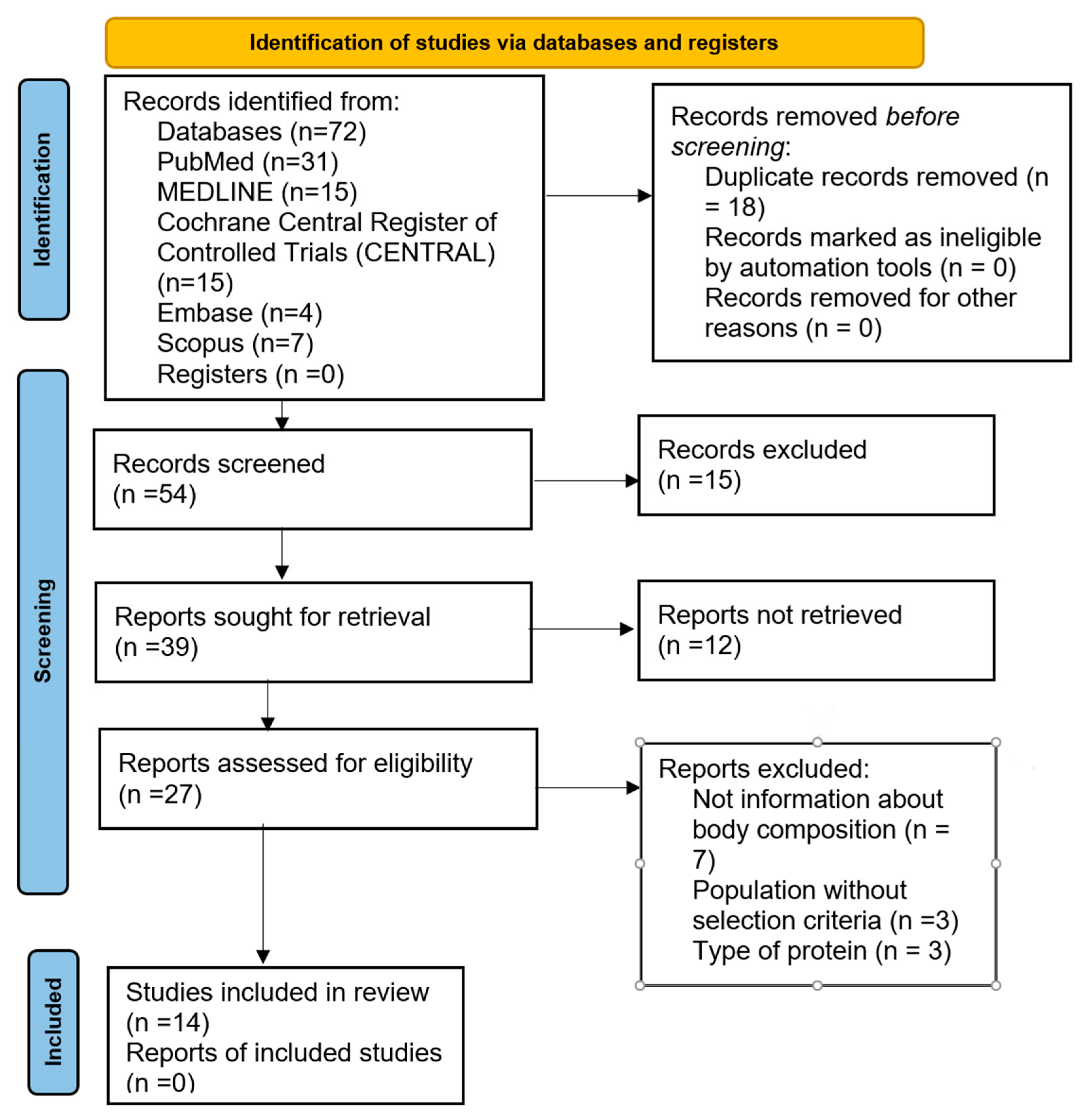
2.2. Search Strategy
2.3. Review Process
3. Results
3.1. Study Population
3.2. Type of Protein
3.3. Intervention
3.4. Fat-Free Mass
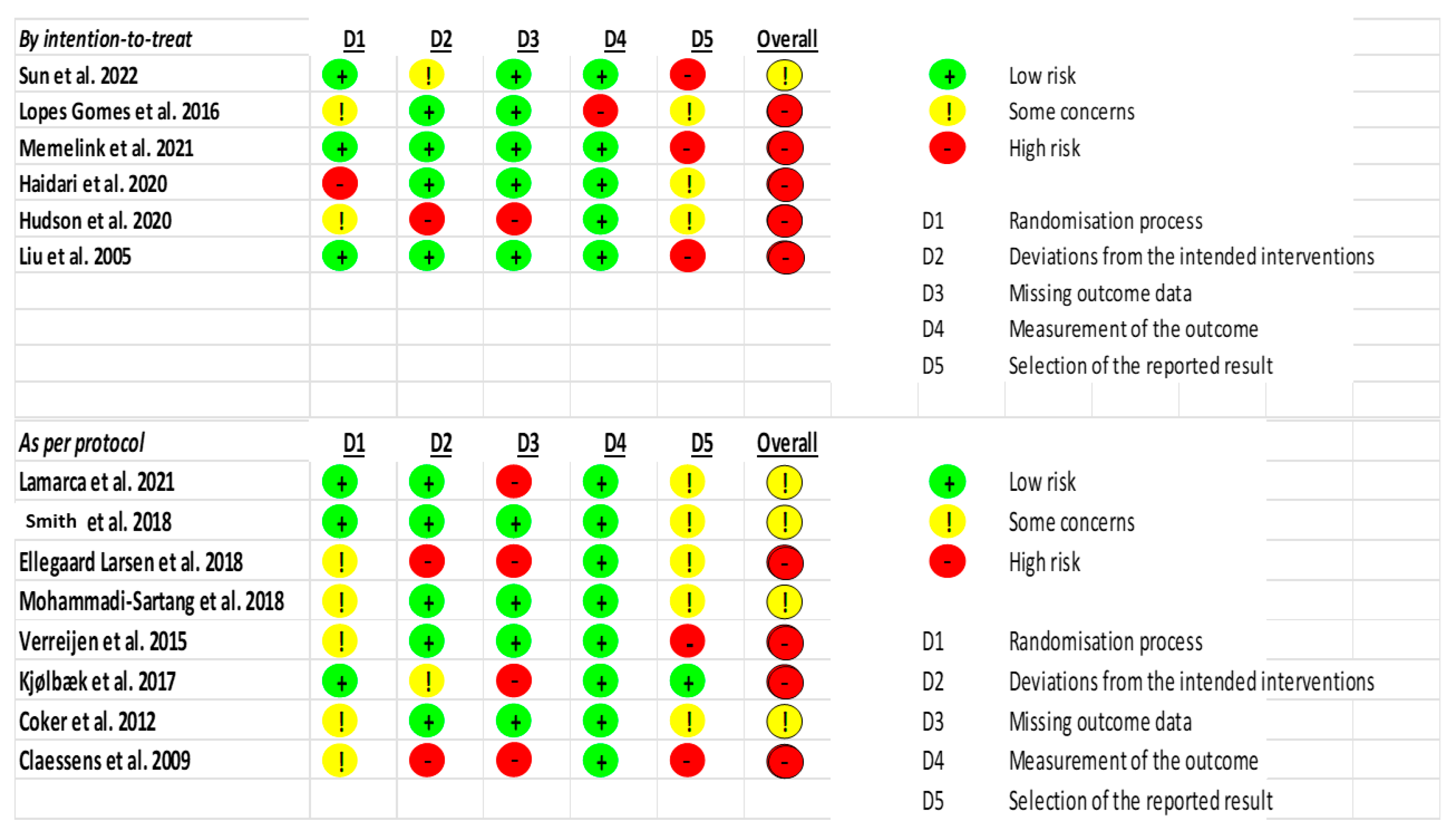
3.5. Risk of Bias Assessment
3.6. Certainty of Evidence
4. Discussion
5. Conclusions
Supplementary Materials
Author Contributions
Funding
Institutional Review Board Statement
Informed Consent Statement
Data Availability Statement
Conflicts of Interest
References
- Lingvay, I.; Cohen, R.V.; Roux, C.W.L.; Sumithran, P. Obesity in adults. Lancet 2024, 404, 972–987. [Google Scholar] [CrossRef] [PubMed]
- Elmaleh-Sachs, A.; Schwartz, J.L.; Bramante, C.T.; Nicklas, J.M.; Gudzune, K.A.; Jay, M. Obesity Management in Adults: A Review. JAMA 2023, 330, 2000–2015. [Google Scholar] [CrossRef]
- Hegazi, R.; Halpern, B. Looking beyond fat in obesity: The frequently overlooked importance of muscle mass. Rev. Endocr. Metab. Disord. 2025, 26, 719–721. [Google Scholar] [CrossRef]
- Donini, L.M.; Busetto, L.; Bischoff, S.C.; Cederholm, T.; Ballesteros-Pomar, M.D.; Batsis, J.A.; Bauer, J.M.; Boirie, Y.; Cruz-Jentoft, A.J.; Dicker, D.; et al. Definition and diagnostic criteria for sarcopenic obesity: ESPEN and EASO consensus statement. Clin. Nutr. 2022, 41, 990–1000. [Google Scholar] [CrossRef]
- Mesinovic, J.; Hurst, C.; Leung, G.K.W.; Ryan, J.R.; Daly, R.M.; Scott, D. Exercise and dietary recommendations to preserve musculoskeletal health during weight loss in adults with obesity: A practical guide. Rev. Endocr. Metab. Disord. 2025, 26, 785–803. [Google Scholar] [CrossRef]
- Ryan, D.H. New drugs for the treatment of obesity: Do we need approaches to preserve muscle mass? Rev. Endocr. Metab. Disord. 2025, 26, 805–813. [Google Scholar] [CrossRef]
- Cannataro, R.; Carbone, L.; Petro, J.L.; Cione, E.; Vargas, S.; Angulo, H.; Forero, D.A.; Odriozola-Martínez, A.; Kreider, R.B.; Bonilla, D.A. Sarcopenia: Etiology, Nutritional Approaches, and miRNAs. Int. J. Mol. Sci. 2021, 22, 9724. [Google Scholar] [CrossRef] [PubMed]
- Wasir, A.S.; Doad, J.S.; Wasir, J.S.; Bansal, M.; Joshi, A.R. Sarcopenia and sarcopenic obesity in type 2 diabetes mellitus and cardiovascular disease: Current perspective and narrative review. Endocr. Regul. 2025, 59, 199–205. [Google Scholar] [CrossRef] [PubMed]
- Li, C.; Yu, K.; Shyh-Chang, N.; Jiang, Z.; Liu, T.; Ma, S.; Luo, L.; Guang, L.; Liang, K.; Ma, W.; et al. Pathogenesis of sarcopenia and the relationship with fat mass: Descriptive review. J. Cachexia Sarcopenia Muscle 2022, 13, 781–794. [Google Scholar] [CrossRef]
- San-Cristobal, R.; Navas-Carretero, S.; Martínez-González, M.Á.; Ordovas, J.M.; Martínez, J.A. Contribution of macronutrients to obesity: Implications for precision nutrition. Nat. Rev. Endocrinol. 2020, 16, 305–320. [Google Scholar] [CrossRef]
- Keller, U. Dietary proteins in obesity and in diabetes. Int. J. Vitam. Nutr. Res. 2011, 81, 125–133. [Google Scholar] [CrossRef] [PubMed]
- Simonson, M.; Boirie, Y.; Guillet, C. Protein, amino acids and obesity treatment. Rev. Endocr. Metab. Disord. 2020, 21, 341–353. [Google Scholar] [CrossRef] [PubMed]
- Verreijen, A.M.; Engberink, M.F.; Memelink, R.G.; Van Der Plas, S.E.; Visser, M.; Weijs, P.J.M. Effect of a high protein diet and/or resistance exercise on the preservation of fat free mass during weight loss in overweight and obese older adults: A randomized controlled trial. Nutr. J. 2017, 16, 10. [Google Scholar] [CrossRef]
- Wycherley, T.P.; Moran, L.J.; Clifton, P.M.; Noakes, M.; Brinkworth, G.D. Effects of energy-restricted high-protein, low-fat compared with standard-protein, low-fat diets: A meta-analysis of randomized controlled trials. Am. J. Clin. Nutr. 2012, 96, 1281–1298. [Google Scholar] [CrossRef]
- Afsar, N.; Ozdogan, Y. Protein supplementation preserves muscle mass in persons against sleeve gastrectomy. Front. Nutr. 2024, 11, 1476258. [Google Scholar] [CrossRef]
- Güneş, Y.; Karip, B.; Ergin, A.; Esen Bulut, N.; Fersahoğlu, M.M.; Memişoğlu, K. The Impact of Protein Support on Weight Loss, Sarcopenia, and Quality of Life After Sleeve Gastrectomy. Bariatr. Surg. Pract. Patient Care 2019, 14, 131–136. [Google Scholar] [CrossRef]
- Romeijn, M.M.; Holthuijsen, D.D.B.; Kolen, A.M.; Janssen, L.; Schep, G.; Van Dielen, F.M.H.; Leclercq, W.K.G. The effect of additional protein on lean body mass preservation in post-bariatric surgery patients: A systematic review. Nutr. J. 2021, 20, 27. [Google Scholar] [CrossRef]
- Comas Martínez, M.; Fidilio Meli, E.; Palmas Candia, F.; Cordero, E.; Hernández, I.; Vilallonga, R.; Burgos, R.; Vila, A.; Simó, R.; Ciudin, A. Protein Supplementation with Short Peptides Prevents Early Muscle Mass Loss after Roux-en-Y-Gastric Bypass. Nutrients 2022, 14, 5095. [Google Scholar] [CrossRef]
- Ghafouri-Taleghani, F.; Tafreshi, A.S.; Doost, A.H.; Tabesh, M.; Abolhasani, M.; Amini, A.; Saidpour, A. Effects of Probiotic Supplementation Added to a Weight Loss Program on Anthropometric Measures, Body Composition, Eating Behavior, and Related Hormone Levels in Patients with Food Addiction and Weight Regain After Bariatric Surgery: A Randomized Clinical Trial. Obes. Surg. 2024, 34, 3181–3194. [Google Scholar] [CrossRef]
- Page, M.J.; McKenzie, J.E.; Bossuyt, P.M.; Boutron, I.; Hoffmann, T.C.; Mulrow, C.D.; Shamseer, L.; Tetzlaff, J.M.; Akl, E.A.; Brennan, S.E.; et al. The PRISMA 2020 statement: An updated guideline for reporting systematic reviews. BMJ 2021, 372, n71. [Google Scholar] [CrossRef]
- Sterne, J.A.C.; Savovic, J.; Page, M.J.; Elbers, R.G.; Blencowe, N.S.; Boutron, I.; Cates, C.J.; Cheng, H.Y.; Corbett, M.S.; Eldridge, S.M.; et al. RoB2: A revised tool for assessing risk of bias in randomized trials. BMJ 2019, 366, I4898. [Google Scholar] [CrossRef]
- GRADEpro GDT: GRADEpro Guideline Development Tool [Software]; McMaster University, Evidence Prime Inc.: Hamilton, ON, Canada, 2023; Available online: https://gradepro.org (accessed on 16 November 2025).
- Lamarca, F.; Vieira, F.T.; Lima, R.M.; Nakano, E.Y.; da Costa, T.H.M.; Pizato, N.; Dutra, E.S.; de Carvalho, K.M.B. Effects of Resistance Training With or Without Protein Supplementation on Body Composition and Resting Energy Expenditure in Patients 2–7 Years PostRoux-en-Y Gastric Bypass: A Controlled Clinical Trial. Obes. Surg. 2021, 31, 1635–1646. [Google Scholar] [CrossRef] [PubMed]
- Lopes Gomes, D.; Moehlecke, M.; Lopes da Silva, F.B.; Dutra, E.S.; D’Agord Schaan, B.; Baiocchi de Carvalho, K.M. Whey Protein Supplementation Enhances Body Fat and Weight Loss in Women Long After Bariatric Surgery: A Randomized Controlled Trial. Obes. Surg. 2017, 27, 424–431. [Google Scholar] [CrossRef] [PubMed]
- Sun, Y.; Ling, C.; Liu, L.; Zhang, J.; Wang, J.; Tong, X.; Hidayat, K.; Chen, M.; Chen, X.; Zhou, H.; et al. Effects of Whey Protein or Its Hydrolysate Supplements Combined with an Energy-Restricted Diet on Weight Loss: A Randomized Controlled Trial in Older Women. Nutrients 2022, 14, 4540. [Google Scholar] [CrossRef]
- Smith, G.I.; Commean, P.K.; Reeds, D.N.; Klein, S.; Mittendorfer, B. Effect of Protein Supplementation During Diet-Induced Weight Loss on Muscle Mass and Strength: A Randomized Controlled Study. Obesity 2018, 26, 854–861. [Google Scholar] [CrossRef] [PubMed]
- Haidari, F.; Aghamohammadi, V.; Mohammadshahi, M.; Ahmadi-Angali, K.; Asghari-Jafarabadi, M. Whey protein supplementation reducing fasting levels of anandamide and 2-AG without weight loss in pre-menopausal women with obesity on a weight-loss diet. Trials 2020, 21, 657. [Google Scholar] [CrossRef]
- Liu, Z.-m.; Ho, S.C.; Chen, Y.-m.; Ho, Y.P. A mild favorable effect of soy protein with isoflavones on body composition—A 6-month double-blind randomized placebo-controlled trial among Chinese postmenopausal women. Int. J. Obes. 2010, 34, 309–318. [Google Scholar] [CrossRef]
- Memelink, R.G.; Pasman, W.J.; Bongers, A.; Tump, A.; van Ginkel, A.; Tromp, W.; Wopereis, S.; Verlaan, S.; Bosch, J.d.V.-V.D.; Weijs, P.J.M. Effect of an Enriched Protein Drink on Muscle Mass and Glycemic Control during Combined Lifestyle Intervention in Older Adults with Obesity and Type 2 Diabetes: A Double-Blind RCT. Nutrients 2020, 13, 64. [Google Scholar] [CrossRef]
- Coker, R.H.; Miller, S.; Schutzler, S.; Deutz, N.; Wolfe, R.R. Whey protein and essential amino acids promote the reduction of adipose tissue and increased muscle protein synthesis during caloric restriction-induced weight loss in elderly, obese individuals. Nutr. J. 2012, 11, 105. [Google Scholar] [CrossRef]
- Mohammadi-Sartang, M.; Bellissimo, N.; Totosy de Zepetnek, J.O.; Brett, N.R.; Mazloomi, S.M.; Fararouie, M.; Bedeltavana, A.; Famouri, M.; Mazloom, Z. The effect of daily fortified yogurt consumption on weight loss in adults with metabolic syndrome: A 10-week randomized controlled trial. Nutr. Metab. Cardiovasc. Dis. NMCD 2018, 28, 565–574. [Google Scholar] [CrossRef]
- Claessens, M.; van Baak, M.A.; Monsheimer, S.; Saris, W.H.M. The effect of a low-fat, high-protein or high-carbohydrate ad libitum diet on weight loss maintenance and metabolic risk factors. Int. J. Obes. 2009, 33, 296–304. [Google Scholar] [CrossRef]
- Hudson, J.L.; Zhou, J.; Kim, J.E.; Campbell, W.W. Incorporating Milk Protein Isolate into an Energy-Restricted Western-Style Eating Pattern Augments Improvements in Blood Pressure and Triglycerides, but Not Body Composition Changes in Adults Classified as Overweight or Obese: A Randomized Controlled Trial. Nutrients 2020, 12, 851. [Google Scholar] [CrossRef]
- Larsen, A.E.; Bibby, B.M.; Hansen, M. Effect of a Whey Protein Supplement on Preservation of Fat Free Mass in Overweight and Obese Individuals on an Energy Restricted Very Low Caloric Diet. Nutrients 2018, 10, 1918. [Google Scholar] [CrossRef]
- Kjølbæk, L.; Sørensen, L.B.; Søndertoft, N.B.; Rasmussen, C.K.; Lorenzen, J.K.; Serena, A.; Astrup, A.; Larsen, L.H. Protein supplements after weight loss do not improve weight maintenance compared with recommended dietary protein intake despite beneficial effects on appetite sensation and energy expenditure: A randomized, controlled, double-blinded trial. Am. J. Clin. Nutr. 2017, 106, 684–697. [Google Scholar] [CrossRef] [PubMed]
- Pourhassan, M.; Glüer, C.-C.; Pick, P.; Tigges, W.; Müller, M.J. Impact of weight loss-associated changes in detailed body composition as assessed by whole-body MRI on plasma insulin levels and homeostasis model assessment index. Eur. J. Clin. Nutr. 2017, 71, 212–218. [Google Scholar] [CrossRef]
- Ponti, F.; Soverini, V.; Plazzi, A.; Aparisi Gómez, M.P.; Mercatelli, D.; Guglielmi, G.; Battista, G.; Marchesini, G.; Bazzocchi, A. DXA-assessed changes in body composition in obese women following two different weight loss programs. Nutrition 2018, 46, 13–19. [Google Scholar] [CrossRef]
- López-Gómez, J.J.; Ramos-Bachiller, B.; Primo-Martín, D.; Calleja-Fernández, A.; Izaola-Jauregui, O.; Jiménez-Sahagún, R.; González-Gutiérrez, J.; Andrés, E.L.; Pinto-Fuentes, P.; Pacheco-Sánchez, D.; et al. Effect on Body Composition of a Meal-Replacement Progression Diet in Patients 1 Month after Bariatric Surgery. Nutrients 2023, 16, 106. [Google Scholar] [CrossRef]
- Alfaro-Martínez, J.J.; Primo-Martín, D.; Gonzalvo-Díaz, C.; Izaola-Jauregui, O.; Jara-Vidal, M.; García-Blasco, L.; Ramos-Bachiller, B.; Bellido-Guerrero, D.; De Luis-Román, D.A.; López-Gómez, J.J. Beyond vectorial bioelectrical impedance: Assessing body composition changes with novel electrical parameters in obese osteoarthritis patients on a meal-replacement diet. Endocrinol. Diabetes Nutr. 2026, 73, 501644. [Google Scholar] [CrossRef]
- Cuyuls-Vásquez, I.; Pezo-Navarrete, J.; Vargas-Arriagada, C.; Ortega-Díaz, C.; Sepúlveda-Loyola, W.; Massao Hirabara, S.; Marzuca-Nassr, G.N. Effectiveness of Whey Protein Supplementation during Resistance Exercise Training on Skeletal Muscle Mass and Strength in Older People with Sarcopenia: A Systematic Review and Meta-Analysis. Nutrients 2023, 15, 3424. [Google Scholar] [CrossRef] [PubMed]
- Kuo, Y.-Y.; Chang, H.-Y.; Huang, Y.-C.; Liu, C.-W. Effect of Whey Protein Supplementation in Postmenopausal Women: A Systematic Review and Meta-Analysis. Nutrients 2022, 14, 4210. [Google Scholar] [CrossRef] [PubMed]


| Study | Type of Protein | Tracking Time | Sample | Groups | Fat-Free Mass Determination Technique | Main Results on Free Fat Mass |
|---|---|---|---|---|---|---|
| Sun et al. 2022 [25] | Whey protein ad whey protein hydrolysate | 8 weeks | Women aged 50–80 years Overweight or obese (BMI 24–35 kg/m2) | Control: hypocaloric diet (−500 kcal/day) WP: hypocaloric diet + 20 g/d whey protein WPH: hypocaloric diet + 20 g/d whey protein hydrolysate | InBody S10 (Biospace Co., Ltd., Seúl, Corea) | Control: –0.41 ± 1.04 WP: –0.03 ± 1.11 WPH: +0.11 ± 0.84 |
| Smith et al. 2018 [26] | Whey protein isolate, leucine | 6 months | 70 postmenopausal women, 50–65 years old All with obesity (BMI 30–50 kg/m2) | WM: hypocaloric diet WL: hypocaloric diet + 0.8 g/Kg/day WL-PS: hypocaloric diet + 1.2 g/Kg/day | Nuclear Magnetic Resonance | WM: −0.14 WL: −1.80 WL-PS: −1.30 |
| Lopes Gomes et al. 2017 [24] | Whey protein | 16 weeks | 30 women Age: 45 ± 11 years BMI: 35.7 ± 5.2 kg/m2 All had regained ≥5% of their lowest postoperative weight All underwent Roux-en-Y gastric bypass | Control: hypocaloric diet + 1 g/kg ideal body weight/day protein Intervention group: hypocaloric diet + Whey protein 1.5 g/kg ideal body weight/day | RJL Systems—Quantum BIA-101Q | Control group: −0.6 kg vs. Intervention group: 1.1 kg; p = 0.188 |
| Haidari et al. 2020 [27] | Whey protein | 2 weeks | 60 premenopausal women Age: 31.6 ± 5.7 years BMI: 33.45 ± 2.89 kg/m2 All with obesity (BMI 30–40) | Control group: hypocaloric diet (−800 kcal/day) Intervention group: hypocaloric diet (−800 kcal/day) + 30 g/day whey protein | TANITA BC-418 | Intervention: −1.00% (CI −1.38 to −0.63) Control: −2.02% (CI −2.36 to −1.69) |
| Hudson et al. 2020 [33] | Milk protein isolate (MPI) | 20 weeks | 44 adults with overweight or obesity Age: 52 ± 1 years BMI: 31.4 ± 0.5 kg/m2 | Control group: hypocaloric diet + 0.7 g/kg/day carbohydrate (maltodextrin) MPI: hypocaloric diet + 0.7 g/kg/day milk protein isolate | Dual absorptiometry of X-Ray (DXA) | Control group: –1.1 ± 0.2 kg MPI: –1.3 ± 0.3 p > 0.05 |
| Mohammadi-Sartang et al. 2018 [31] | Fortified yogurt (FY) containing: Whey protein: 5 g per serving (10 g/day) Calcium: 500 mg per serving Vitamin D3: 500 IU per serving Inulin (prebiotic): 3 g per serving Probiotic: Bifidobacterium lactis Bb-12 (≥107 cfu/g) | 10 weeks | 87 participants completed the study Age: 20–65 years, mean ~45 BMI: 25–34.9 kg/m2 All diagnosed with metabolic syndrome | Plain Yogurt: Low-fat plain yogurt (2 × 250 g/day) + calorie-restricted diet Fortified yogurt: Fortified yogurt with whey protein, calcium, vitamin D, inulin, probiotics (2 × 250 g/day) + calorie-restricted diet | InBody S10 (Korea) | PY: –2.0 ± 2.7 kg FY: –0.9 ± 3.5 kg p = 0.025 |
| Kjølbæk et al. 2017 [35] | Whey + calcium (whey+): 45 g/day Whey protein (highα-lactalbumin) 1000 mg/day calcium Whey: 45 g/day whey protein Soy: 45 g/day soy protein isolate | 32 weeks | 151 adults, aged 18–60 years, BMI 27.6–40.4 kg/m2 | Control group: 48 g/day maltodextrin Whey + calcium (whey+): 45 g/day whey + 1000 mg Ca Whey: 45 g/day whey Soy: 45 g/day soy protein All with hypocaloric diet | DXA (Dual-energy X-ray Absorptiometry) | Control group: +1.74 ± 1.4 kg Whey + calcium (whey+): +1.87 ± 1.7 kg Whey: +1.94 ± 1.3 kg Soy: +1.58 ± 1.4 kg p = 0.50 |
| Coker et al. 2012 [30] | EAAMR (Essential Amino Acid Meal Replacement): 7 g whey protein, 6 g added essential amino acids (40% leucine) CMR (Competitive Meal Replacement): 14 g caseinate protein | 8 weeks | 11 obese older adults (65–80 y) BMI ± 31 | EAAMR: Meal replacement con whey + EAA CMR: Meal replacement with casein (control) | Bioelectrical impedance (BIA) | EAAMR: –2.1 ± 0.5 kg CMR: –3.6 ± 0.5 kg p = 0.26 |
| Liu et al. 2005 [28] | Soy: 15 g/day soy protein + 100 mg isoflavones. Iso: 15 g/day milk protein + 100 mg isoflavones. Placebo: 15 g/day milk protein, no isoflavones | 6 months | 180 Chinese postmenopausal women. Age: 48–70 years. Condition: prediabetes or early untreated diabetes. | Soy: soy protein + isoflavones. Iso: milk protein + isoflavones. Placebo: milk protein only. | Tanita TBF-410-GS | FFM remained unchanged in all groups. |
| Claessens et al. 2009 [32] | Whey protein | 18 weeks | 48 obese adults (31 women, 17 men) Age: 30–60 years | HC (High-Carbohydrate): low-fat diet + maltodextrin (50 g/day) HPC (High-Protein Casein): low-fat diet + casein (50 g/day) HPW (High-Protein Whey): low-fat diet + whey protein (50 g/day) | Underwater weighing (hydrodensitometry) | Total, sample: 56.8 → 55.0 kg (−1.8 kg) No significant differences between HC vs. HP or between casein vs. whey. |
| Study | Type of Protein | Tracking Time | Sample | Groups | Fat-Free Mass Determination Technique | Main Results on Free Fat Mass |
|---|---|---|---|---|---|---|
| Lamarca et al. 2021 [23] | Whey protein | 12 weeks | Adults 2–7 years after Roux-en-Y gastric bypass Women (≈90%) 40–45 years Post-surgical BMI: ~30 kg/m2 | Control: no strength training, no protein supplementation RT: strength training PRO: 0.5 kg/day ideal body weight protein supplementation RT + PRO: strength training + protein supplementation | Dual-energy X-ray Absorptiometry | FFM: RTP + PRO +1.46 kg vs. control −0.24 kg p = 0.006 SMM: RTP + PRO +0.91 kg vs. control −0.08 kg; p = 0.008 |
| Memelink et al. 2020 [29] | Whey protein, leucine and vitamin D3 | 13 weeks | 123 older adults (≥55 years) Obesity + type 2 diabetes or prediabetes Age: 66–67 years BMI: 33 kg/m2 65% men | Control: isocaloric non-protein drink+ hypocaloric diet + exercise program Test group: enriched whey protein drink+ hypocaloric diet + exercise program | Dual-energy X-ray Absorptiometry | Control −0.35 ± 0.26 vs. test group +0.57 ± 0.27; +0.92 kg (95% CI 0.19 to 1.65); p = 0.015 |
| Larsen et al. 2018 [34] | Whey protein isolate | 4 weeks | 29 overweight or obese adults (BMI > 28 kg/m2) Age range: 21–55 years, mean ~41 | Control group: VLCD (~690 kcal/day) + walking program PRO: VLCD + walking + bedtime whey protein isolate (0.4 g/kg/day) | Dual-energy X-ray absorptiometry (DXA) | Control group: –2.4 [–3.2; –1.6] PRO: –2.7 [–3.6; –1.7] p = 0.65 |
| Verreijen et al. 2015 [13] | Whey protein: 21 g per serving Added leucine: 2.8 g Essential amino acids: 10.6 g Vitamin D3: 20 µg (800 IU) | 13 weeks | 60 obese older adults (≥55 y) Age: 63 ± 6 y BMI: 33 ± 4.4 kg/m2 | Intervention: Whey + leucine + vitamin D supplement + hypocaloric diet + resistance training Control: Isocaloric control product + hypocaloric diet + resistance training | DXA (Dual-energy X-ray Absorptiometry) | Intervention –0.5 ± 2.1 kg Control –0.5 ± 2.1 kg β = +0.95 kg (p = 0.03) |
Disclaimer/Publisher’s Note: The statements, opinions and data contained in all publications are solely those of the individual author(s) and contributor(s) and not of MDPI and/or the editor(s). MDPI and/or the editor(s) disclaim responsibility for any injury to people or property resulting from any ideas, methods, instructions or products referred to in the content. |
© 2026 by the authors. Licensee MDPI, Basel, Switzerland. This article is an open access article distributed under the terms and conditions of the Creative Commons Attribution (CC BY) license.
Share and Cite
López-Gómez, J.J.; Ramos-Bachiller, B.; Rico-Bargues, D.; De Luis-Román, D.A. Effectiveness of Whey Protein Supplementation in Weight Loss Interventions for Patients with Obesity: A Systematic Review. Nutrients 2026, 18, 695. https://doi.org/10.3390/nu18040695
López-Gómez JJ, Ramos-Bachiller B, Rico-Bargues D, De Luis-Román DA. Effectiveness of Whey Protein Supplementation in Weight Loss Interventions for Patients with Obesity: A Systematic Review. Nutrients. 2026; 18(4):695. https://doi.org/10.3390/nu18040695
Chicago/Turabian StyleLópez-Gómez, Juan José, Beatriz Ramos-Bachiller, Daniel Rico-Bargues, and Daniel A. De Luis-Román. 2026. "Effectiveness of Whey Protein Supplementation in Weight Loss Interventions for Patients with Obesity: A Systematic Review" Nutrients 18, no. 4: 695. https://doi.org/10.3390/nu18040695
APA StyleLópez-Gómez, J. J., Ramos-Bachiller, B., Rico-Bargues, D., & De Luis-Román, D. A. (2026). Effectiveness of Whey Protein Supplementation in Weight Loss Interventions for Patients with Obesity: A Systematic Review. Nutrients, 18(4), 695. https://doi.org/10.3390/nu18040695