Article

Periconception Maternal Vitamin D Status on Nausea and Vomiting Symptoms in Early Pregnancy Among Women with a History of Pregnancy Loss


by
Zeina M. Alkhalaf
1,*,
Sunni L. Mumford
2,3,
Enrique F. Schisterman
2,3,
Robert M. Silver
4 and
Marie E. Thoma
1
1
Department of Family Science, School of Public Health, University of Maryland, College Park, MD 20742, USA
2
Epidemiology Branch, Division of Intramural Population Health Research, Eunice Kennedy Shriver National Institute of Child Health and Human Development, National Institutes of Health, Bethesda, MD 20892, USA
3
Department of Biostatistics, Epidemiology and Informatics and Department of Obstetrics and Gynecology, Perelman School of Medicine, University of Pennsylvania, Philadelphia, PA 19104, USA
4
Department of Obstetrics and Gynecology, University of Utah, Salt Lake City, UT 84132, USA
*
Author to whom correspondence should be addressed.
Nutrients 2026, 18(4), 692; https://doi.org/10.3390/nu18040692
Submission received: 5 February 2026 / Revised: 19 February 2026 / Accepted: 19 February 2026 / Published: 21 February 2026
(This article belongs to the Special Issue Nutrition, Diet and Metabolism in Pregnancy)

Abstract

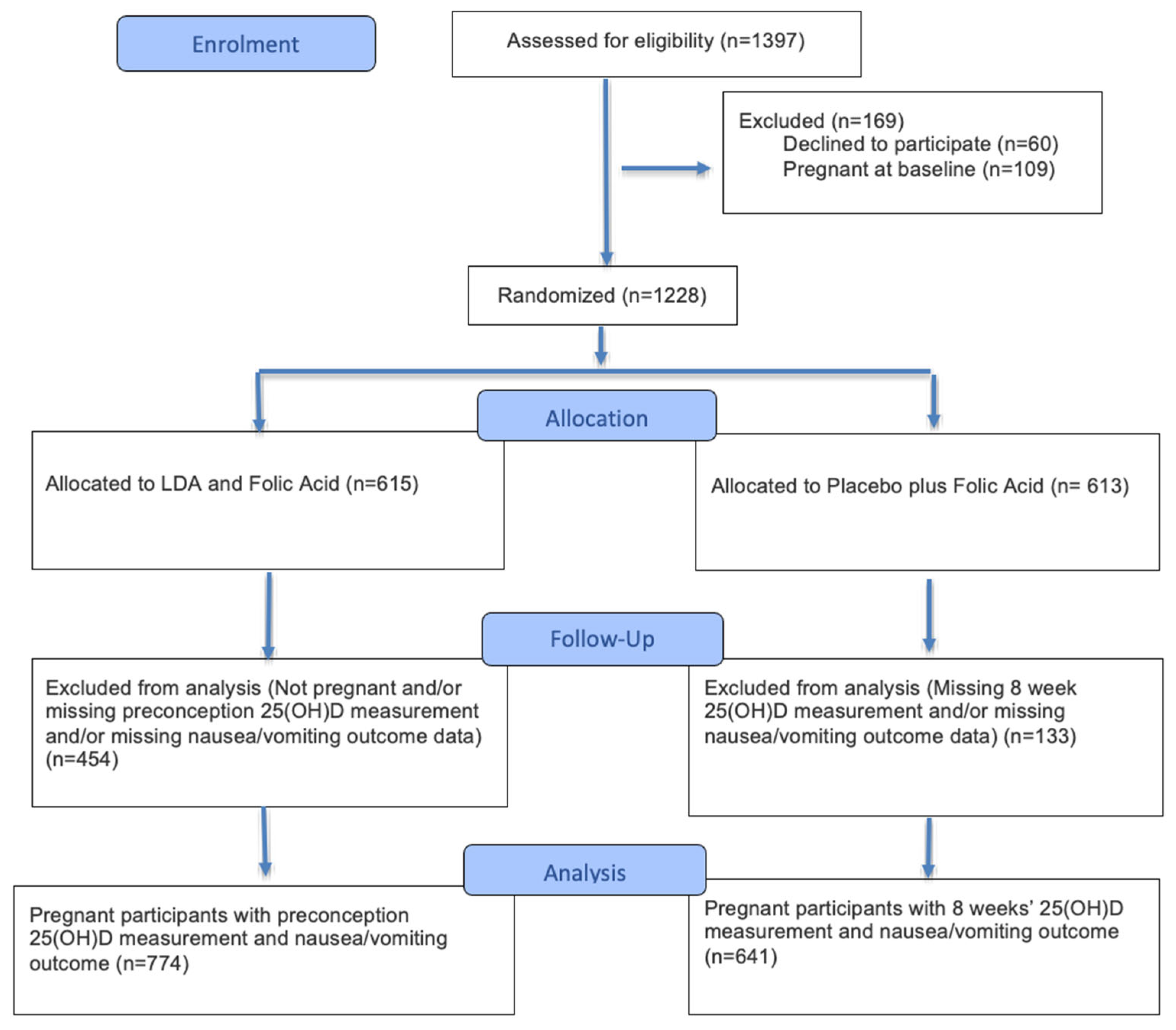
Background/Objectives: Sufficient preconception vitamin D may promote robust implantation and higher human chorionic gonadotropin (hCG) levels, potentially increasing nausea and vomiting in pregnancy. We assessed associations between maternal serum 25-hydroxyvitamin D (25(OH)D) at both preconception and 8 weeks’ gestation with nausea and vomiting during early pregnancy. We hypothesized that women with sufficient vitamin D status or those who improved their levels in early gestation, would have higher odds of nausea and vomiting compared to women who were deficient or insufficient. Methods: This secondary analysis of the randomized EAGeR Trial included women with 1–2 prior pregnancy losses and 25(OH)D measured at preconception (n = 774) and 8 weeks’ gestation (N = 641). Nausea and vomiting were captured via medical records and daily symptom diaries. 25(OH)D was categorized as deficient (≤20 ng/mL), insufficient (21–29 ng/mL), or sufficient (≥30 ng/mL). Logistic regression and generalized estimating equations (GEE) estimated associations. Results: Women who improved from deficient/insufficient preconception to sufficient by 8 weeks had higher odds of nausea and vomiting in early pregnancy compared to those remaining sufficient (aOR: 1.71; 95% CI: 1.12, 2.61). Conversely, those remaining deficient/insufficient (aOR: 0.34; 95% CI: 0.20, 0.60) or declining to deficiency (aOR: 0.44; 95% CI: 0.22, 0.87) had lower odds. In longitudinal models, deficiency was associated with lower odds of daily vomiting (aOR: 0.54; 95% CI: 0.28, 1.04), though estimates were imprecise. Conclusion: Dynamic changes in vitamin D status from preconception to early pregnancy appear to be associated with nausea and vomiting in early pregnancy. Improvement of sufficiency increased emesis odds, while persistent deficiency correlated with fewer symptoms. These findings suggest vitamin D may be associated with nausea and vomiting through hormonal or placental signaling mechanisms in early gestation.
Keywords: pregnancy; vitamin D; preconception; nutrition; pregnancy outcomes pregnancy; vitamin D; preconception; nutrition; pregnancy outcomes