Who Pays for Low-GI Yogurt in China? Moderating Roles of Health Orientation and Consumer Knowledge

Abstract
1. Introduction
2. Conceptual Background and Hypotheses Development
2.1. Labels as Signals Under Information Asymmetry
2.2. Consumer Heterogeneity: Health Orientation as Motivation
2.3. Nutritional Context and Congruence
2.4. Nutrition Knowledge as a “Decoder”
3. Materials and Methods
3.1. Survey Administration and Participants
3.2. Discrete Choice Experiment (DCE): Attributes and Design
3.3. Variable Construction
3.4. Econometric Specification and Model Strategy
3.4.1. Random Utility Framework
3.4.2. Mixed Logit Estimation
3.4.3. Model Sequence
4. Results
4.1. Sample Characteristics and Descriptive Statistics
4.2. General Consumer Preferences: Baseline Results (Model 1)
4.3. Moderating Effects of Context and Individual Characteristics (Models 2 and 3)
4.4. The “Decoder” Role of Knowledge
4.5. Willingness to Pay (WTP) Estimates and Economic Implications
5. Discussion
5.1. General Preference for Low-GI Labeling (Baseline Valuation)
5.2. The Role of Health Motivation
5.3. The Role of Nutritional Context and Knowledge
5.4. Implications for Industry and Policy
5.5. Limitations and Future Research
6. Conclusions
Author Contributions
Funding
Institutional Review Board Statement
Informed Consent Statement
Data Availability Statement
Acknowledgments
Conflicts of Interest
Abbreviations
| FOP | Front-of-pack |
| GI | Glycemic Index |
| WTP | Willingness to Pay |
| DCE | Discrete Choice Experiment |
| RUT | Random Utility Theory |
| MIXL | Mixed Logit |
| ASC | Alternative-Specific Constant |
| CNY | Chinese Yuan |
| AIC | Akaike Information Criterion |
| BIC | Bayesian Information Criterion |
| SD | Standard Deviation |
| SE | Standard Error |
Appendix A

References
- Annunziata, A.; Vecchio, R. Consumer Perception of Functional Foods: A Conjoint Analysis with Probiotics. Food Qual. Prefer. 2013, 28, 348–355. [Google Scholar] [CrossRef] [Scilit]
- Barclay, A.W.; Augustin, L.S.A.; Brighenti, F.; Delport, E.; Henry, C.J.; Sievenpiper, J.L.; Usic, K.; Yuexin, Y.; Zurbau, A.; Wolever, T.M.S.; et al. Dietary Glycaemic Index Labelling: A Global Perspective. Nutrients 2021, 13, 3244. [Google Scholar] [CrossRef] [Scilit]
- Mitchell, H.L. The Glycemic Index Concept in Action. Am. J. Clin. Nutr. 2008, 87, 244S–246S. [Google Scholar] [CrossRef] [Scilit]
- Augustin, L.S.A.; Kendall, C.W.C.; Jenkins, D.J.A.; Willett, W.C.; Astrup, A.; Barclay, A.W.; Björck, I.; Brand-Miller, J.C.; Brighenti, F.; Buyken, A.E.; et al. Glycemic Index, Glycemic Load and Glycemic Response: An International Scientific Consensus Summit from the International Carbohydrate Quality Consortium (ICQC). Nutr. Metab. Cardiovasc. Dis. 2015, 25, 795–815. [Google Scholar] [CrossRef] [Scilit]
- Jenkins, D.J.; Wolever, T.M.; Taylor, R.H.; Barker, H.; Fielden, H.; Baldwin, J.M.; Bowling, A.C.; Newman, H.C.; Jenkins, A.L.; Goff, D.V. Glycemic Index of Foods: A Physiological Basis for Carbohydrate Exchange. Am. J. Clin. Nutr. 1981, 34, 362–366. [Google Scholar] [CrossRef] [Scilit]
- Vlachos, D.; Malisova, S.; Lindberg, F.A.; Karaniki, G. Glycemic Index (GI) or Glycemic Load (GL) and Dietary Interventions for Optimizing Postprandial Hyperglycemia in Patients with T2 Diabetes: A Review. Nutrients 2020, 12, 1561. [Google Scholar] [CrossRef] [Scilit]
- Li, Y.; Teng, D.; Shi, X.; Qin, G.; Qin, Y.; Quan, H.; Shi, B.; Sun, H.; Ba, J.; Chen, B.; et al. Prevalence of Diabetes Recorded in Mainland China Using 2018 Diagnostic Criteria from the American Diabetes Association: National Cross Sectional Study. BMJ 2020, 369, m997. [Google Scholar] [CrossRef] [Scilit] [PubMed]
- Brouns, F.; Bjorck, I.; Frayn, K.N.; Gibbs, A.L.; Lang, V.; Slama, G.; Wolever, T.M.S. Glycaemic Index Methodology. Nutr. Res. Rev. 2005, 18, 145–171. [Google Scholar] [CrossRef] [Scilit]
- Aziz, A.; Dumais, L.; Barber, J. Health Canada’s Evaluation of the Use of Glycemic Index Claims on Food Labels. Am. J. Clin. Nutr. 2013, 98, 269–274. [Google Scholar] [CrossRef] [Scilit] [PubMed]
- Slabber, M. Complexities of Consumer Understanding of the Glycaemic Index Concept and Practical Guidelines for Incorporation in Diets. S. Afr. J. Clin. Nutr. 2005, 18, 252–257. [Google Scholar] [CrossRef] [Scilit]
- Fontanelli, M.D.M.; Batista, L.D.; Martinez-Arroyo, A.; Mozaffarian, D.; Micha, R.; Rogero, M.M.; Fisberg, R.M.; Sarti, F.M. Pragmatic Carbohydrate Quality Metrics in Relation to Glycemic Index, Glycemic Load, and Front-of-Pack Warning Labels in Grain Foods. Foods 2024, 13, 1299. [Google Scholar] [CrossRef] [Scilit] [PubMed]
- Cuong, O.Q.; Connor, M.; Demont, M.; Sander, B.O.; Nelson, K. How Do Rice Consumers Trade off Sustainability and Health Labels? Evidence from Vietnam. Front. Sustain. Food Syst. 2022, 6, 1010161. [Google Scholar] [CrossRef] [Scilit]
- Zanchini, R.; Di Vita, G.; Brun, F. Lifestyle, Psychological and Socio-Demographic Drivers in Functional Food Choice: A Systematic Literature Review Based on Bibliometric and Network Analysis. Int. J. Food Sci. Nutr. 2022, 73, 709–725. [Google Scholar] [CrossRef] [Scilit] [PubMed]
- Grunert, K.G.; Wills, J.M.; Fernández-Celemín, L. Nutrition Knowledge, and Use and Understanding of Nutrition Information on Food Labels among Consumers in the UK. Appetite 2010, 55, 177–189. [Google Scholar] [CrossRef] [Scilit] [PubMed]
- Visschers, V.H.; Hess, R.; Siegrist, M. Health Motivation and Product Design Determine Consumers’ Visual Attention to Nutrition Information on Food Products. Public Health Nutr. 2010, 13, 1099–1106. [Google Scholar] [CrossRef] [Scilit]
- Kliemann, N.; Wardle, J.; Johnson, F.; Croker, H. Reliability and Validity of a Revised Version of the General Nutrition Knowledge Questionnaire. Eur. J. Clin. Nutr. 2016, 70, 1174–1180. [Google Scholar] [CrossRef] [Scilit] [PubMed]
- Talati, Z.; Pettigrew, S.; Neal, B.; Dixon, H.; Hughes, C.; Kelly, B.; Miller, C. Consumers’ Responses to Health Claims in the Context of Other on-Pack Nutrition Information: A Systematic Review. Nutr. Rev. 2017, 75, 260–273. [Google Scholar] [CrossRef] [Scilit]
- Wolever, T.M. Yogurt Is a Low–Glycemic Index Food. J. Nutr. 2017, 147, 1462S–1467S. [Google Scholar] [CrossRef] [Scilit]
- Yang, S.; Bhargava, N.; O’Connor, A.; Gibney, E.R.; Feeney, E.L. Dairy Consumption in Adults in China: A Systematic Review. BMC Nutr. 2023, 9, 116. [Google Scholar] [CrossRef] [Scilit] [PubMed]
- Ares, G.; Giménez, A.; Gámbaro, A. Understanding Consumers’ Perception of Conventional and Functional Yogurts Using Word Association and Hard Laddering. Food Qual. Prefer. 2008, 19, 636–643. [Google Scholar] [CrossRef] [Scilit]
- Vecchio, R.; Van Loo, E.J.; Annunziata, A. Consumers’ Willingness to Pay for Conventional, Organic and Functional Yogurt: Evidence from Experimental Auctions. Int. J. Consum. Stud. 2016, 40, 368–378. [Google Scholar] [CrossRef] [Scilit]
- De Aguiar Freire, C.E.C.; De Souza Moreira, C.; De Souza, V.C.; Massola, G.R.; De Assis, A.A.; Patinho, I.; De Alencar, S.M.; Cesar, A.S.M. Understanding Consumer Perceptions to Guide the Design of Functional Yogurts: Evidence from a Brazilian Online Survey. Food Res. Int. 2026, 223, 117874. [Google Scholar] [CrossRef] [Scilit]
- Bimbo, F.; Bonanno, A.; Nocella, G.; Viscecchia, R.; Nardone, G.; De Devitiis, B.; Carlucci, D. Consumers’ Acceptance and Preferences for Nutrition-Modified and Functional Dairy Products: A Systematic Review. Appetite 2017, 113, 141–154. [Google Scholar] [CrossRef] [Scilit] [PubMed]
- Wadhwa, S.-R.S.; McMahon, A.T.; Neale, E.P. A Cross-Sectional Audit of Nutrition and Health Claims on Dairy Yoghurts in Supermarkets of the Illawarra Region of New South Wales, Australia. Nutrients 2021, 13, 1835. [Google Scholar] [CrossRef] [Scilit] [PubMed]
- Lancsar, E.; Louviere, J. Conducting Discrete Choice Experiments to Inform Healthcare Decision Making: A User’s Guide. PharmacoEconomics 2008, 26, 661–677. [Google Scholar] [CrossRef] [Scilit] [PubMed]
- Louviere, J.J.; Hensher, D.A.; Swait, J.D.; Adamowicz, W. Stated Choice Methods: Analysis and Applications, 1st ed.; Cambridge University Press: Cambridge, UK, 2000. [Google Scholar]
- Train, K.E. Discrete Choice Methods with Simulation, 2nd ed.; Cambridge University Press: Cambridge, UK, 2001. [Google Scholar]
- Sayeed, Z.; Sugino, H.; Sakai, Y.; Yagi, N. Consumer Preferences and Willingness to Pay for Mud Crabs in Southeast Asian Countries: A Discrete Choice Experiment. Foods 2021, 10, 2873. [Google Scholar] [CrossRef] [Scilit] [PubMed]
- Yeh, C.-H.; Hartmann, M.; Langen, N. The Role of Trust in Explaining Food Choice: Combining Choice Experiment and Attribute Best–Worst Scaling. Foods 2020, 9, 45. [Google Scholar] [CrossRef] [Scilit]
- Yeh, C.-H.; Menozzi, D.; Török, Á. Eliciting Egg Consumer Preferences for Organic Labels and Omega 3 Claims in Italy and Hungary. Foods 2020, 9, 1212. [Google Scholar] [CrossRef] [Scilit] [PubMed]
- Croker, H.; Packer, J.; Russell, S.J.; Stansfield, C.; Viner, R.M. Front of Pack Nutritional Labelling Schemes: A Systematic Review and Meta-analysis of Recent Evidence Relating to Objectively Measured Consumption and Purchasing. J. Hum. Nutr. Diet. 2020, 33, 518–537. [Google Scholar] [CrossRef] [Scilit]
- Oostenbach, L.H.; Slits, E.; Robinson, E.; Sacks, G. Systematic Review of the Impact of Nutrition Claims Related to Fat, Sugar and Energy Content on Food Choices and Energy Intake. BMC Public Health 2019, 19, 1296. [Google Scholar] [CrossRef] [Scilit]
- Miller, L.M.S.; Cassady, D.L. The Effects of Nutrition Knowledge on Food Label Use. A Review of the Literature. Appetite 2015, 92, 207–216. [Google Scholar] [CrossRef] [Scilit]
- Custodio, M.C.; Ynion, J.; Demont, M.; De Steur, H. Consumers’ Acceptance and Valuation of Healthier Rice: Implications for Promoting Healthy Diets in the Philippines. Br. Food J. 2025, 127, 52–71. [Google Scholar] [CrossRef] [Scilit]
- Darby, M.R.; Karni, E. Free Competition and the Optimal Amount of Fraud. J. Law Econ. 1973, 16, 67–88. [Google Scholar] [CrossRef] [Scilit]
- Caswell, J.A.; Mojduszka, E.M. Using Informational Labeling to Influence the Market for Quality in Food Products. Am. J. Agric. Econ. 1996, 78, 1248–1253. [Google Scholar] [CrossRef] [Scilit]
- Van Wezemael, L.; Caputo, V.; Nayga, R.M.; Chryssochoidis, G.; Verbeke, W. European Consumer Preferences for Beef with Nutrition and Health Claims: A Multi-Country Investigation Using Discrete Choice Experiments. Food Policy 2014, 44, 167–176. [Google Scholar] [CrossRef] [Scilit]
- Bechtold, K.-B.; Abdulai, A. Combining Attitudinal Statements with Choice Experiments to Analyze Preference Heterogeneity for Functional Dairy Products. Food Policy 2014, 47, 97–106. [Google Scholar] [CrossRef] [Scilit]
- Dutta-Bergman, M.J. Health Attitudes, Health Cognitions, and Health Behaviors among Internet Health Information Seekers: Population-Based Survey. J. Med. Internet Res. 2004, 6, e15. [Google Scholar] [CrossRef] [Scilit]
- Michaelidou, N.; Hassan, L.M. The Role of Health Consciousness, Food Safety Concern and Ethical Identity on Attitudes and Intentions towards Organic Food. Int. J. Consum. Stud. 2008, 32, 163–170. [Google Scholar] [CrossRef] [Scilit]
- Marinangeli, C.P.F.; Castellano, J.; Torrance, P.; Lewis, J.; Gall Casey, C.; Tanuta, J.; Curran, J.; Harding, S.V.; Jenkins, D.J.A.; Sievenpiper, J.L. Positioning the Value of Dietary Carbohydrate, Carbohydrate Quality, Glycemic Index, and GI Labelling to the Canadian Consumer for Improving Dietary Patterns. Nutrients 2019, 11, 457. [Google Scholar] [CrossRef] [Scilit]
- Benson, T.; Lavelle, F.; Bucher, T.; McCloat, A.; Mooney, E.; Egan, B.; Collins, C.E.; Dean, M. The Impact of Nutrition and Health Claims on Consumer Perceptions and Portion Size Selection: Results from a Nationally Representative Survey. Nutrients 2018, 10, 656. [Google Scholar] [CrossRef] [Scilit] [PubMed]
- Kaur, A.; Scarborough, P.; Rayner, M. A Systematic Review, and Meta-Analyses, of the Impact of Health-Related Claims on Dietary Choices. Int. J. Behav. Nutr. Phys. Act. 2017, 14, 93. [Google Scholar] [CrossRef] [Scilit]
- Roe, B.; Levy, A.S.; Derby, B.M. The Impact of Health Claims on Consumer Search and Product Evaluation Outcomes: Results from FDA Experimental Data. J. Public Policy Mark. 1999, 18, 89–105. [Google Scholar] [CrossRef] [Scilit]
- Ford, G.T.; Hastak, M.; Mitra, A.; Ringold, D.J. Can Consumers Interpret Nutrition Information in the Presence of a Health Claim? A Laboratory Investigation. J. Public Policy Mark. 1996, 15, 16–27. [Google Scholar] [CrossRef] [Scilit]
- Garretson, J.A.; Burton, S. Effects of Nutrition Facts Panel Values, Nutrition Claims, and Health Claims on Consumer Attitudes, Perceptions of Disease-Related Risks, and Trust. J. Public Policy Mark. 2000, 19, 213–227. [Google Scholar] [CrossRef] [Scilit]
- Bix, L.; Sundar, R.P.; Bello, N.M.; Peltier, C.; Weatherspoon, L.J.; Becker, M.W. To See or Not to See: Do Front of Pack Nutrition Labels Affect Attention to Overall Nutrition Information? PLoS ONE 2015, 10, e0139732. [Google Scholar] [CrossRef] [Scilit] [PubMed]
- Bialkova, S.; Van Trijp, H. What Determines Consumer Attention to Nutrition Labels? Food Qual. Prefer. 2010, 21, 1042–1051. [Google Scholar] [CrossRef] [Scilit]
- Bonroy, O.; Constantatos, C. On the Economics of Labels: How Their Introduction Affects the Functioning of Markets and the Welfare of All Participants. Am. J. Agric. Econ. 2015, 97, 239–259. [Google Scholar] [CrossRef] [Scilit]
- Van Trijp, H.C.M.; Van Der Lans, I.A. Consumer Perceptions of Nutrition and Health Claims. Appetite 2007, 48, 305–324. [Google Scholar] [CrossRef] [Scilit]
- Alba, J.W.; Hutchinson, J.W. Dimensions of Consumer Expertise. J. Consum. Res. 1987, 13, 411. [Google Scholar] [CrossRef] [Scilit]
- Chen, H.; Li, X.; Gao, J.; Liu, X.; Mao, Y.; Wang, R.; Zheng, P.; Xiao, Q.; Jia, Y.; Fu, H.; et al. Health Belief Model Perspective on the Control of COVID-19 Vaccine Hesitancy and the Promotion of Vaccination in China: Web-Based Cross-Sectional Study. J. Med. Internet Res. 2021, 23, e29329. [Google Scholar] [CrossRef] [Scilit]
- Gao, H.; Hu, R.; Yin, L.; Yuan, X.; Tang, H.; Luo, L.; Chen, M.; Huang, D.; Wang, Y.; Yu, A.; et al. Knowledge, Attitudes and Practices of the Chinese Public with Respect to Coronavirus Disease (COVID-19): An Online Cross-Sectional Survey. BMC Public Health 2020, 20, 1816. [Google Scholar] [CrossRef] [Scilit] [PubMed]
- Qi, X.; Tian, X.; Ploeger, A. Exploring Chinese Consumers’ Online Purchase Intentions toward Certified Food Products during the COVID-19 Pandemic. Foods 2021, 10, 2729. [Google Scholar] [CrossRef] [Scilit] [PubMed]
- Johnson, C.A.; Tran, D.N.; Mwangi, A.; Sosa-Rubí, S.G.; Chivardi, C.; Romero-Martínez, M.; Pastakia, S.; Robinson, E.; Jennings Mayo-Wilson, L.; Galárraga, O. Incorporating Respondent-Driven Sampling into Web-Based Discrete Choice Experiments: Preferences for COVID-19 Mitigation Measures. Health Serv. Outcomes Res. Method 2022, 22, 297–316. [Google Scholar] [CrossRef] [Scilit] [PubMed]
- Richetin, J.; Caputo, V.; Demartini, E.; Conner, M.; Perugini, M. Organic Food Labels Bias Food Healthiness Perceptions: Estimating Healthiness Equivalence Using a Discrete Choice Experiment. Appetite 2022, 172, 105970. [Google Scholar] [CrossRef] [Scilit]
- Li, T.; Dando, R. Impact of Common Food Labels on Consumer Liking in Vanilla Yogurt. Foods 2019, 8, 584. [Google Scholar] [CrossRef] [Scilit]
- Brucks, M. The Effects of Product Class Knowledge on Information Search Behavior. J. Consum. Res. 1985, 12, 1. [Google Scholar] [CrossRef] [Scilit]
- Carlson, J.P.; Vincent, L.H.; Hardesty, D.M.; Bearden, W.O. Objective and Subjective Knowledge Relationships: A Quantitative Analysis of Consumer Research Findings. J. Consum. Res. 2009, 35, 864–876. [Google Scholar] [CrossRef] [Scilit]
- Parmenter, K.; Wardle, J. Development of a General Nutrition Knowledge Questionnaire for Adults. Eur. J. Clin. Nutr. 1999, 53, 298–308. [Google Scholar] [CrossRef] [Scilit] [PubMed]
- Bergkvist, L.; Rossiter, J.R. The Predictive Validity of Multiple-Item versus Single-Item Measures of the Same Constructs. J. Mark. Res. 2007, 44, 175–184. [Google Scholar] [CrossRef] [Scilit]
- Krosnick, J.A. Response Strategies for Coping with the Cognitive Demands of Attitude Measures in Surveys. Appl. Cogn. Psychol. 1991, 5, 213–236. [Google Scholar] [CrossRef] [Scilit]
- Ikonen, I.; Sotgiu, F.; Aydinli, A.; Verlegh, P.W.J. Consumer Effects of Front-of-Package Nutrition Labeling: An Interdisciplinary Meta-Analysis. J. Acad. Mark. Sci. 2020, 48, 360–383. [Google Scholar] [CrossRef] [Scilit]
- Campos, S.; Doxey, J.; Hammond, D. Nutrition Labels on Pre-Packaged Foods: A Systematic Review. Public Health Nutr. 2011, 14, 1496–1506. [Google Scholar] [CrossRef] [Scilit]
- Chang, M.-Y.; Huang, C.-C.; Du, Y.-C.; Chen, H.-S. Choice Experiment Assessment of Consumer Preferences for Yogurt Products Attributes: Evidence from Taiwan. Nutrients 2022, 14, 3523. [Google Scholar] [CrossRef] [Scilit] [PubMed]
- Ballco, P.; de-Magistris, T.; Caputo, V. Consumer Preferences for Nutritional Claims: An Exploration of Attention and Choice Based on an Eye-Tracking Choice Experiment. Food Res. Int. 2019, 116, 37–48. [Google Scholar] [CrossRef] [Scilit] [PubMed]
- Zanchini, R.; Di Vita, G.; Panzone, L.; Brun, F. What Is the Value of a “Mountain Product” Claim? A Ranking Conjoint Experiment on Goat’s Milk Yoghurt. Foods 2023, 12, 2059. [Google Scholar] [CrossRef] [Scilit] [PubMed]
- Ballco, P.; De Magistris, T. Spanish Consumer Purchase Behaviour and Stated Preferences for Yoghurts with Nutritional and Health Claims. Nutrients 2019, 11, 2742. [Google Scholar] [CrossRef] [Scilit]
- Zhang, X.; Grisolía, J.M.; Ortúzar, J.D.D. Understanding the Role of Food Neophobia in the Willingness to Consume Functional Rice. Food Qual. Prefer. 2025, 126, 105392. [Google Scholar] [CrossRef] [Scilit]
- My, N.H.D.; Demont, M.; Van Loo, E.J.; De Guia, A.; Rutsaert, P.; Tuan, T.H.; Verbeke, W. What Is the Value of Sustainably-Produced Rice? Consumer Evidence from Experimental Auctions in Vietnam. Food Policy 2018, 79, 283–296. [Google Scholar] [CrossRef] [Scilit]
- Nazzaro, C.; Uliano, A.; Lerro, M.; Stanco, M. From Claims to Choices: How Health Information Shapes Consumer Decisions in the Functional Food Market. Foods 2025, 14, 699. [Google Scholar] [CrossRef] [Scilit]
- Cabral, D.; Fonseca, S.C.; Rocha, C.; Moura, A.P.; Oliveira, J.C.; Cunha, L.M. Evaluation of the Trade-off between Variety, Processing, and Low-GI Claim in Ready-to-Eat Rice. Food Sci. Technol. Int. 2024. Advance online publication. [Google Scholar] [CrossRef] [Scilit] [PubMed]
- Keller, S.B.; Landry, M.; Olson, J.; Velliquette, A.M.; Burton, S.; Andrews, J.C. The Effects of Nutrition Package Claims, Nutrition Facts Panels, and Motivation to Process Nutrition Information on Consumer Product Evaluations. J. Public Policy Mark. 1997, 16, 256–269. [Google Scholar] [CrossRef] [Scilit]
- Miklavec, K.; Pravst, I.; Grunert, K.G.; Klopčič, M.; Pohar, J. The Influence of Health Claims and Nutritional Composition on Consumers’ Yoghurt Preferences. Food Qual. Prefer. 2015, 43, 26–33. [Google Scholar] [CrossRef] [Scilit]
- Talati, Z.; Pettigrew, S.; Dixon, H.; Neal, B.; Ball, K.; Hughes, C. Do Health Claims and Front-of-Pack Labels Lead to a Positivity Bias in Unhealthy Foods? Nutrients 2016, 8, 787. [Google Scholar] [CrossRef] [Scilit] [PubMed]
- Trichterborn, J.; Harzer, G.; Kunz, C. Nutrient Profiling and Food Label Claims: Evaluation of Dairy Products in Three Major European Countries. Eur. J. Clin. Nutr. 2011, 65, 1032–1038. [Google Scholar] [CrossRef] [Scilit]
- Grunert, K.G.; Scholderer, J.; Rogeaux, M. Determinants of Consumer Understanding of Health Claims. Appetite 2011, 56, 269–277. [Google Scholar] [CrossRef] [Scilit]
- Liu, J.; Kassas, B.; Lai, J.; Fang, D.; Nayga, R.M. Assessing Consumers’ Valuation for Front-of-Package ‘Health’ Labeling under FDA Guidelines. Food Policy 2025, 131, 102804. [Google Scholar] [CrossRef] [Scilit]



| Attribute | Levels | Unit/Description |
|---|---|---|
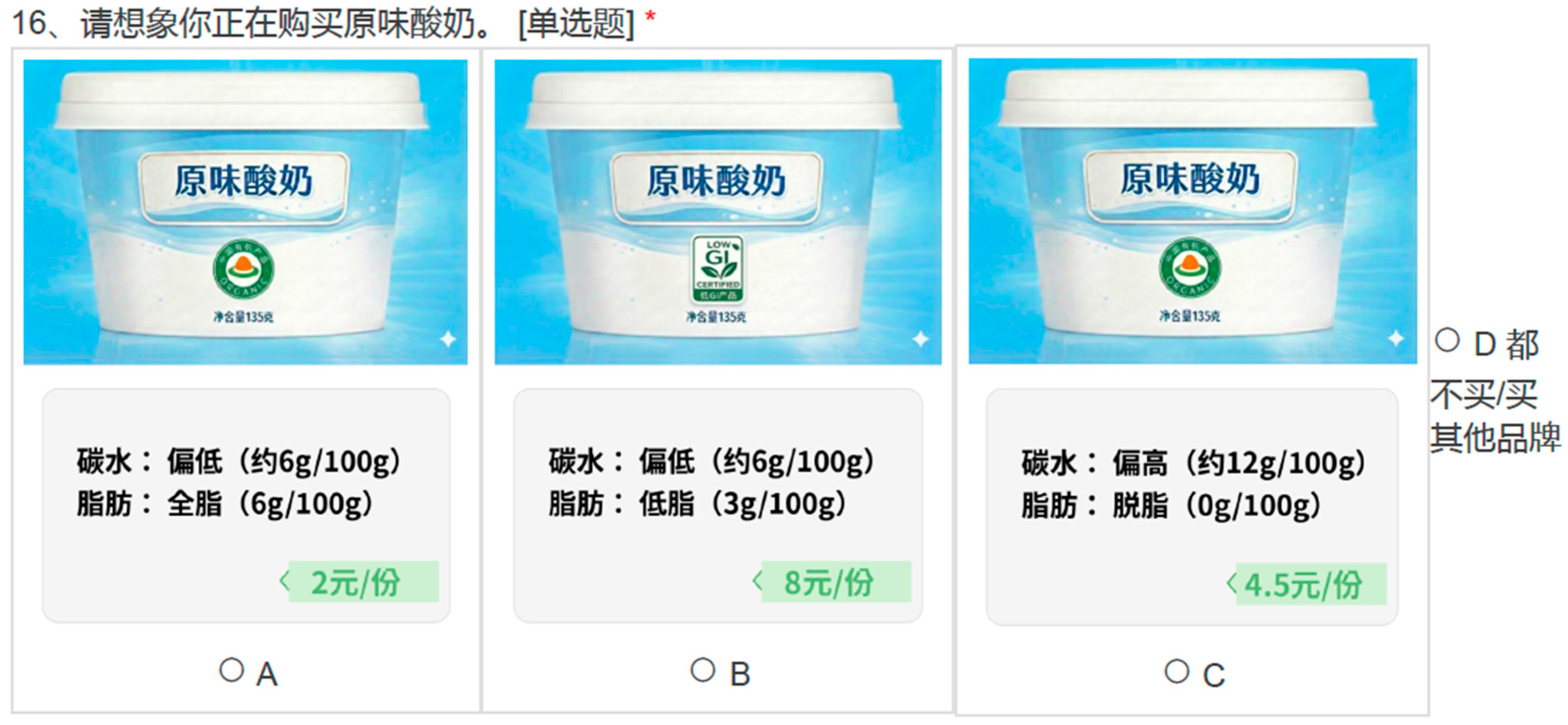
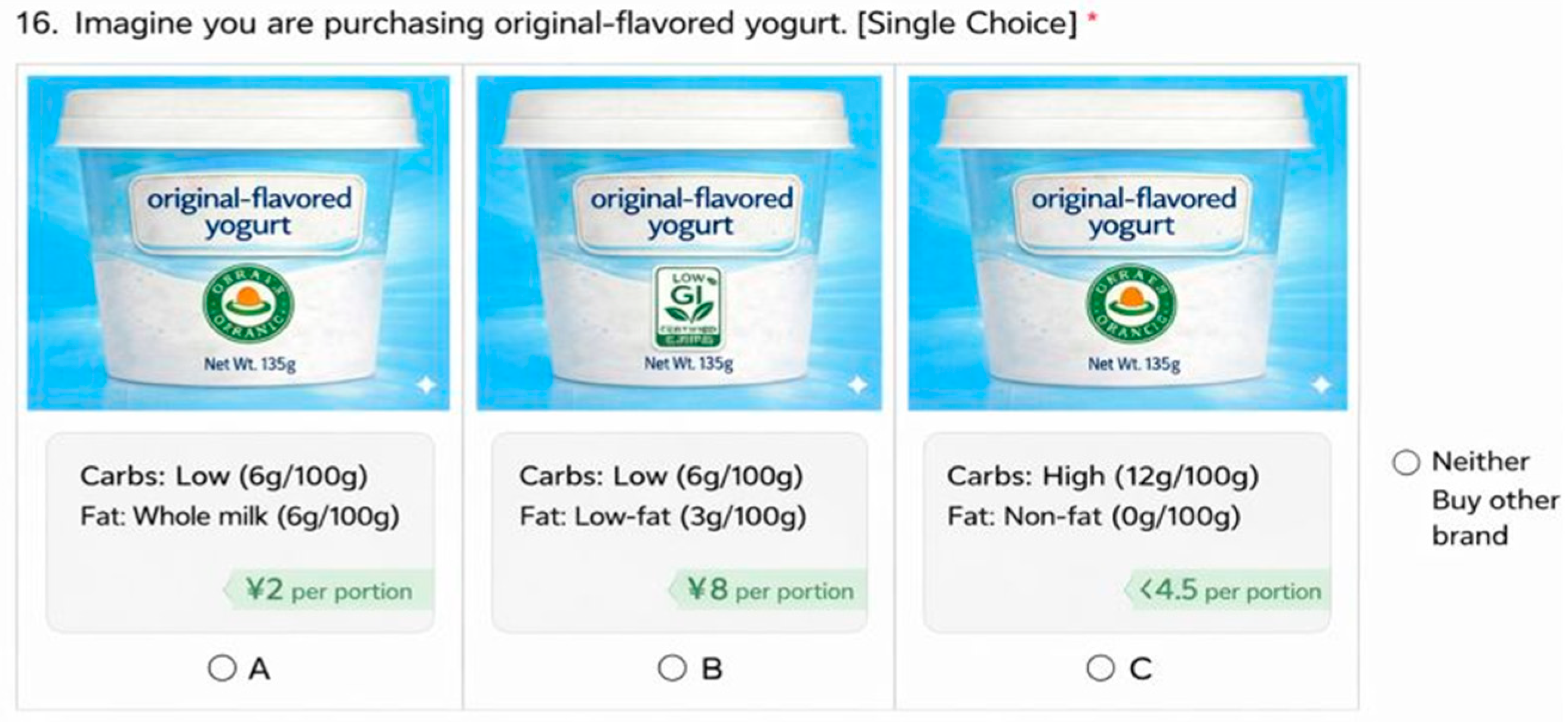
| Low-GI label | Absent; Present | Front-of-pack label shown as an icon. In the questionnaire, the items were presented as follows: Prior to the DCE, respondents were shown the Low-GI logo and informed that it denotes a Low-GI label; no additional information about health benefits was provided. |
| Carbohydrate content | Low; Regular; High | Values per 100 g of yogurt (auxiliary numeric information). |
| Fat content | Skim; Low-fat; Whole-fat | Values per 100 g of yogurt (auxiliary numeric information). |
| Organic label | Absent; Present | Certification label shown as an icon. In the questionnaire, the items were presented as follows: Before the DCE began, we showed respondents this image and informed them that it represents an organic label. |
| Price | 2; 4.5; 8 | CNY per 135 g serving. |
| Characteristic | Category | n | % |
|---|---|---|---|
| Gender | Male | 456 | 50.110 |
| Female | 454 | 49.890 | |
| Age | 18–25 | 267 | 29.341 |
| 26–35 | 197 | 21.648 | |
| 36–45 | 191 | 20.989 | |
| 46–55 | 185 | 20.330 | |
| 56–65 | 29 | 3.187 | |
| >65 | 41 | 4.505 | |
| Education | Middle school or below | 147 | 16.154 |
| High school/Vocational school | 276 | 30.330 | |
| Associate degree | 254 | 27.912 | |
| Bachelor’s degree | 180 | 19.780 | |
| Master’s degree | 24 | 2.637 | |
| Doctoral degree | 13 | 1.429 | |
| Other/Prefer not to say | 16 | 1.758 | |
| Residence | Tier-1 city | 140 | 15.385 |
| New Tier-1 city | 134 | 14.725 | |
| Tier-2 city | 155 | 17.033 | |
| Tier-3 or below/County-level | 164 | 18.022 | |
| Town/Rural area | 162 | 17.802 | |
| Other regions | 155 | 17.033 | |
| Monthly Income (CNY) | <5000 | 488 | 53.626 |
| 5000–9999 | 235 | 25.824 | |
| 10,000–19,999 | 93 | 10.220 | |
| 20,000–29,999 | 34 | 3.736 | |
| 30,000–49,999 | 34 | 3.736 | |
| ≥50,000 | 13 | 1.429 | |
| Prefer not to say | 13 | 1.429 | |
| Purchase Frequency (past month) | Never | 105 | 11.538 |
| Once | 250 | 27.473 | |
| 2–3 times | 471 | 51.758 | |
| ≥4 times | 84 | 9.231 | |
| Objective Low-GI knowledge | Selected the scientifically correct definition: a more gradual blood glucose rise given the same carbohydrate intake (ObjKnow = 1) | 423 | 46.484 |
| Interpreted Low-GI as having lower carbohydrate or sugar content | 256 | 28.132 | |
| Interpreted Low-GI as involving less carbohydrate or sugar absorption by the body | 182 | 20.000 | |
| Reported not knowing the definition | 49 | 5.385 | |
| Mean | SD | ||
| Opt-out behavior | Opt-out rate | 0.074 | 0.134 |
| Health orientation | Index score | 4.201 | 1.510 |
| ObjKnow = 1 | ObjKnow = 1 (correct definition) | 0.465 | 0.499 |
| Variable | Model 1 | Model 2 | Model 3 |
|---|---|---|---|
| Panel A. Mean coefficients | |||
| ASC_buy | 1.859 *** (0.051) | 1.907 *** (0.054) | 1.900 *** (0.054) |
| Price | −0.094 *** (0.004) | −0.094 *** (0.005) | −0.094 *** (0.005) |
| Low-GI label | 0.331 *** (0.028) | 0.192 *** (0.050) | 0.313 *** (0.053) |
| Organic label | 0.152 *** (0.024) | 0.150 *** (0.024) | 0.150 *** (0.024) |
| Fat: skim | −0.193 *** (0.026) | −0.199 *** (0.026) | −0.202 *** (0.026) |
| Fat: whole | −0.324 *** (0.027) | −0.327 *** (0.027) | −0.330 *** (0.027) |
| Carb: low | 0.175 *** (0.034) | 0.035 (0.044) | 0.030 (0.043) |
| Carb: high | −0.034 (0.033) | −0.074 * (0.045) | −0.081 * (0.044) |
| Low-GI × Carb: low | — | 0.271 *** (0.058) | −0.014 (0.070) |
| Low-GI × Carb: high | — | 0.068 (0.058) | −0.064 (0.070) |
| Low-GI × Health orientation | — | 0.075 *** (0.023) | 0.075 *** (0.023) |
| Low-GI × Objective knowledge | — | 0.063 (0.059) | −0.222 *** (0.075) |
| ObjKnow × Low-GI × Carb: low | — | — | 0.617 *** (0.086) |
| ObjKnow × Low-GI × Carb: high | — | — | 0.307 *** (0.085) |
| Panel B. Standard deviations of random parameters | |||
| SD: Low-GI label | 0.181 *** (0.032) | 0.056 (0.045) | 0.066 (0.044) |
| SD: Fat skim | 0.194 *** (0.034) | 0.205 *** (0.034) | 0.199 *** (0.035) |
| SD: Fat whole | 0.208 *** (0.035) | 0.195 *** (0.036) | 0.185 *** (0.037) |
| SD: Organic | 0.265 *** (0.028) | 0.257 *** (0.029) | 0.256 *** (0.029) |
| SD: Carb low | 0.561 *** (0.038) | 0.550 *** (0.038) | 0.473 *** (0.040) |
| SD: Carb high | 0.507 *** (0.038) | 0.495 *** (0.038) | 0.446 *** (0.039) |
| Model fit statistics | |||
| Respondents | 910 | 910 | 910 |
| Choice tasks | 10,920 | 10,920 | 10,920 |
| Observations | 43,680 | 43,680 | 43,680 |
| Log likelihood | −13,539.629 | −13,519.872 | −13,494.501 |
| AIC | 27,137.26 | 27,105.74 | 27,059.00 |
| BIC | 27,389.11 | 27,392.34 | 27,362.96 |
| Carbohydrate Context | ObjKnow = 0 WTP (SE) [95% CI] | ObjKnow = 1 WTP (SE) [95% CI] |
|---|---|---|
| Health orientation = −1 SD | ||
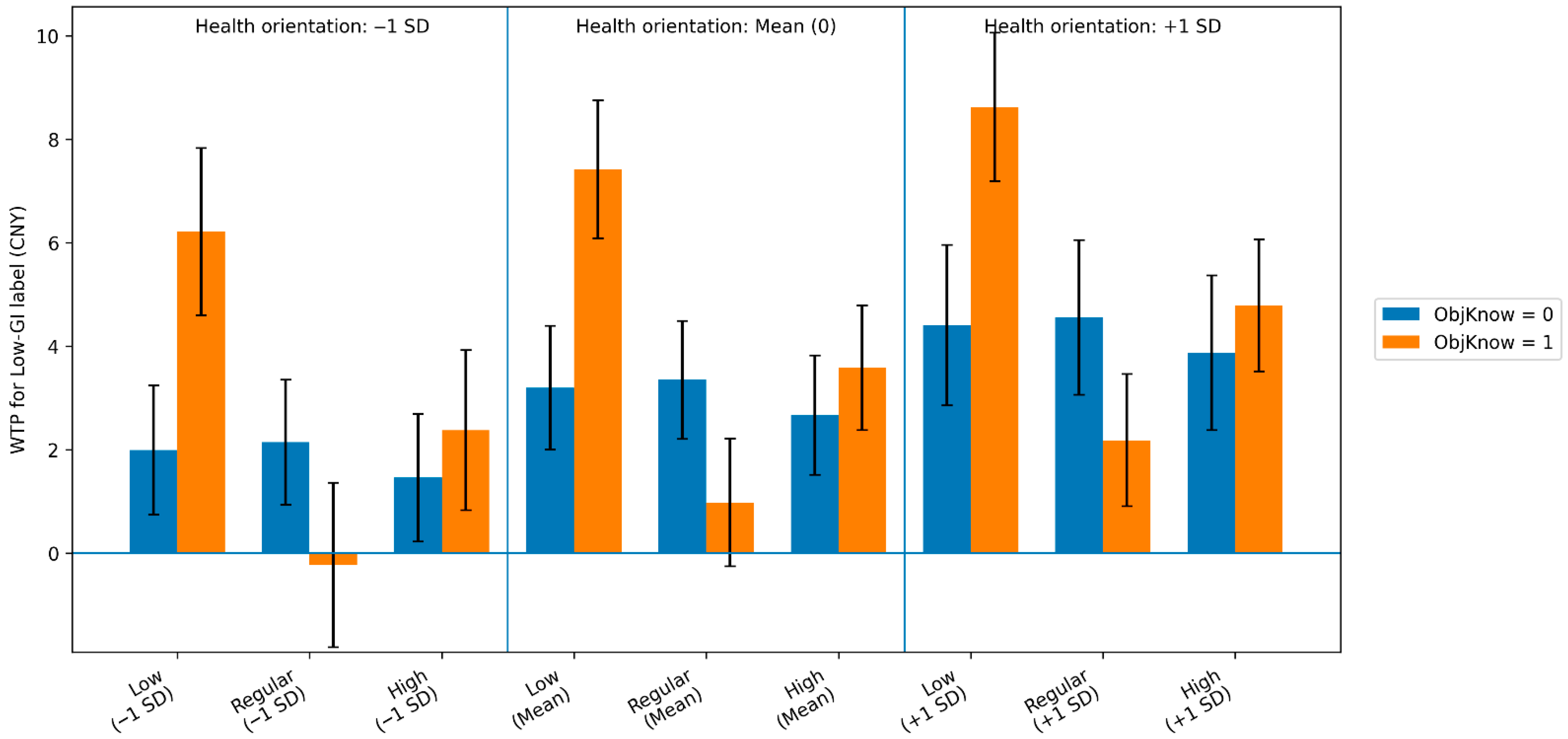
| Regular | 2.140 *** (0.619) [0.927, 3.353] | −0.233 (0.810) [−1.821, 1.356] |
| Low carb | 1.991 *** (0.637) [0.742, 3.240] | 6.212 *** (0.825) [4.596, 7.829] |
| High carb | 1.459 ** (0.630) [0.225, 2.694] | 2.373 *** (0.788) [0.827, 3.918] |
| Health orientation = Mean (0, centered) | ||
| Regular | 3.346 *** (0.583) [2.204, 4.487] | 0.973 (0.630) [−0.262, 2.209] |
| Low carb | 3.197 *** (0.610) [2.001, 4.393] | 7.418 *** (0.682) [6.082, 8.754] |
| High carb | 2.665 *** (0.589) [1.511, 3.819] | 3.579 *** (0.616) [2.372, 4.785] |
| Health orientation = +1 SD | ||
| Regular | 4.552 *** (0.763) [3.056, 6.048] | 2.179 *** (0.652) [0.902, 3.457] |
| Low carb | 4.403 *** (0.791) [2.852, 5.954] | 8.624 *** (0.732) [7.189, 10.059] |
| High carb | 3.871 *** (0.764) [2.375, 5.368] | 4.785 *** (0.651) [3.509, 6.060] |
Disclaimer/Publisher’s Note: The statements, opinions and data contained in all publications are solely those of the individual author(s) and contributor(s) and not of MDPI and/or the editor(s). MDPI and/or the editor(s) disclaim responsibility for any injury to people or property resulting from any ideas, methods, instructions or products referred to in the content. |
© 2026 by the authors. Licensee MDPI, Basel, Switzerland. This article is an open access article distributed under the terms and conditions of the Creative Commons Attribution (CC BY) license.
Share and Cite
Guo, Y.; Wang, L.; Tang, W.; Liu, X. Who Pays for Low-GI Yogurt in China? Moderating Roles of Health Orientation and Consumer Knowledge. Nutrients 2026, 18, 643. https://doi.org/10.3390/nu18040643
Guo Y, Wang L, Tang W, Liu X. Who Pays for Low-GI Yogurt in China? Moderating Roles of Health Orientation and Consumer Knowledge. Nutrients. 2026; 18(4):643. https://doi.org/10.3390/nu18040643
Chicago/Turabian StyleGuo, Yixin, Leyi Wang, Wenxue Tang, and Xiaoou Liu. 2026. "Who Pays for Low-GI Yogurt in China? Moderating Roles of Health Orientation and Consumer Knowledge" Nutrients 18, no. 4: 643. https://doi.org/10.3390/nu18040643
APA StyleGuo, Y., Wang, L., Tang, W., & Liu, X. (2026). Who Pays for Low-GI Yogurt in China? Moderating Roles of Health Orientation and Consumer Knowledge. Nutrients, 18(4), 643. https://doi.org/10.3390/nu18040643