Current Status of Macronutrient and Energy Intake and Metabolism Among High-Altitude Populations: A Systematic Review


Abstract
1. Introduction
1.1. Macronutrients and Human Health
1.2. Nutritional Characteristics and Research Significance of High-Altitude Populations
2. Methods
2.1. Guidelines and Registration
2.2. Information Sources and Search Strategy
- Studies focusing on high-altitude populations;
- Macronutrient and energy intake or metabolism;
- Dietary patterns or nutritional characteristics.
2.3. Inclusion and Exclusion Criteria
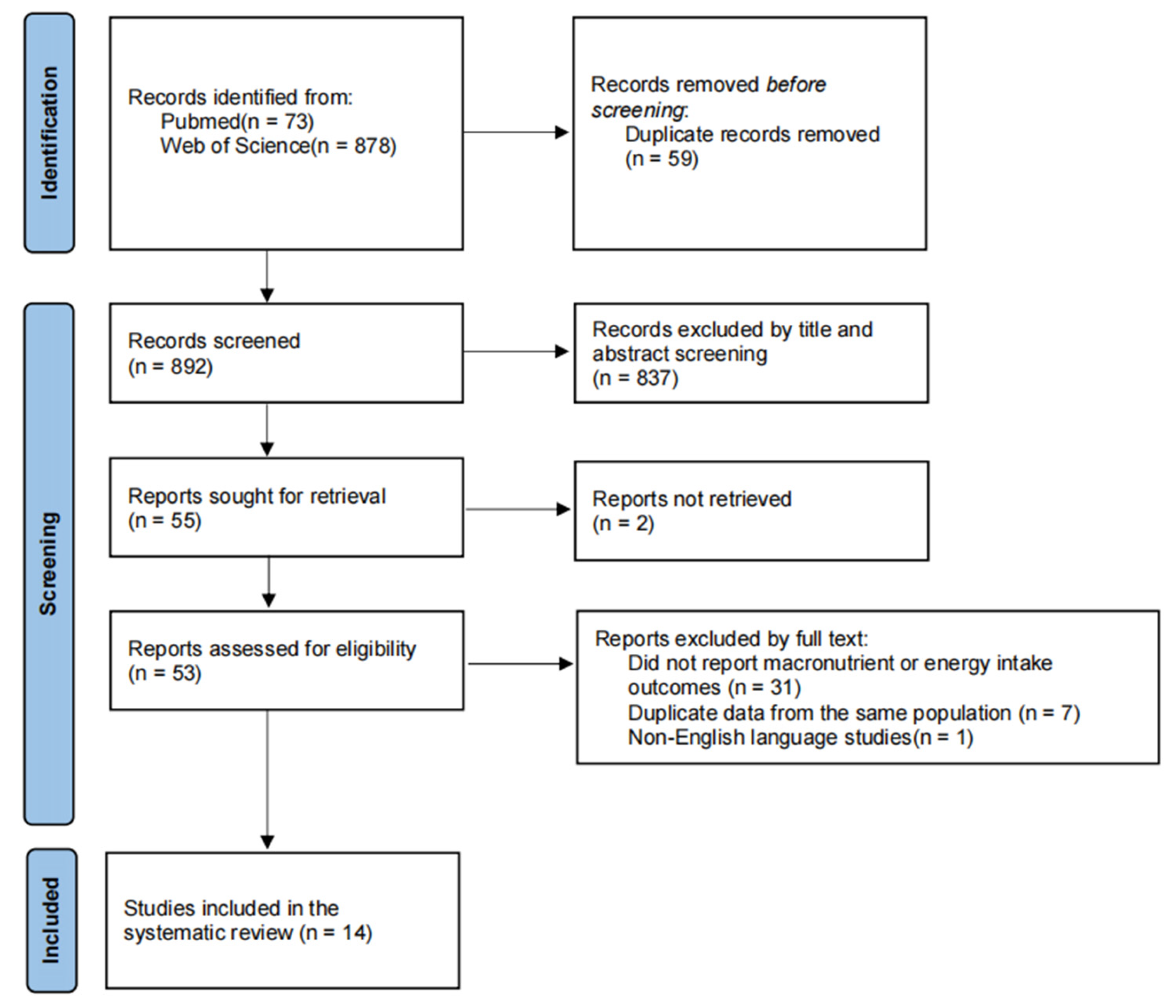
2.4. Study Selection
2.5. Data Extraction
- Author(s) and year of publication;
- Study objectives;
- Study design and methodology;
- Study population;
- Macronutrient intake levels or dietary structure characteristics;
- Nutritional status of the study population.
2.6. Altitude Definition and Classification
2.7. DRI Comparison and Operational Classification
2.8. Quality Assessment
3. Results
3.1. Study Characteristics
3.2. Dietary and Nutrient Intake Characteristics
3.3. Energy and Macronutrient Intake Characteristics
3.4. Comparison with Recommended Dietary Intakes
3.5. Dietary Pattern Analysis

| Author (Year) | Sample | Main Findings: Dietary Patterns | Nutritional Status |
|---|---|---|---|
| Kong, 2022 [9] | Permanent residents (n = 617) | Three patterns: (1) Staple–fruit–vegetable; (2) Staple–meat–dairy; (3) Staple-only (dominant). | Not reported |
| Li, 2023 [32] | Xizang herders, Qinghai (n = 1913) | Modern, Urban, and Pastoral patterns; urbanized, educated groups favor modern diets; high adherence linked to obesity. | The prevalence of central obesity was 51.3% in men and 57.4% in women. |
| Lu, 2023 [36] | Multi-ethnic 18–79 yrs (n = 81,433) | Regional patterns: Sichuan (fish, dairy, produce high); Yunnan–Guizhou (animal oil, salt high); Qinghai–Tibet (coarse grains, tea). | Participants with dietary patterns more closely aligned with the Qinghai–Xizang Plateau diet had a higher mean BMI (24.6 ± 3.6 kg/m2). |
| Peng et al., 2019 [30] | Adults 18–84 yrs (n = 782) | Urban, Western, and Pastoral patterns; 93% consume beef/mutton daily; Western pattern younger demographic. | The prevalence of overweight and obesity was 58.4% and 26.6%, respectively, with the overall proportion of central obesity approaching 60%. |
3.6. Dietary Characteristics Without Quantitative Macronutrient Data
3.7. Energy Metabolism
3.8. Nutritional Status
4. Discussion
4.1. Energy Intake and Metabolic Differences
4.2. Macronutrient Intake Structure and Trends
4.3. Comparison of Macronutrient Intake Between High-Altitude and Lowland Populations
4.4. Staple-Food Structure and Dietary Diversity
4.5. Dietary Patterns and Population Differences
5. Conclusions
Supplementary Materials
Author Contributions
Funding
Data Availability Statement
Conflicts of Interest
Abbreviations
| BMR | Basal Metabolic Rate |
| CHO | Carbohydrate |
| CONSORT | Consolidated Standards of Reporting Trials |
| DRI | Dietary Reference Intake |
| FFQ | Food Frequency Questionnaire |
| HAPC | High-Altitude Polycythemia |
| PRISMA | Preferred Reporting Items for Systematic Reviews and Meta-Analyses |
| RCT | Randomized Controlled Trial |
| STROBE | Strengthening the Reporting of Observational Studies in Epidemiology |
| 24HDR | 24-Hour Dietary Recall |
References
- Li, C.; Kang, B.; Zhang, T.; Gu, H.; Song, P.; Chen, J.; Wang, X.; Xu, B.; Zhao, W.; Zhang, J. Dietary pattern and dietary energy from fat associated with sarcopenia in community-dwelling older Chinese people: A cross-sectional study in three regions of China. Nutrients 2020, 12, 3689. [Google Scholar] [CrossRef] [PubMed]
- Cao, Y.; Chen, C.; Cui, L.; Han, A.; Tu, Q.; Lou, P.; Ding, G.; Qin, Y.; Xiang, Q. A population-based survey for dietary patterns and prediabetes among 7555 Chinese adults in urban and rural areas in Jiangsu Province. Sci. Rep. 2020, 10, 10488. [Google Scholar] [CrossRef] [PubMed]
- Venn, B.J. Macronutrients and human health for the 21st century. Nutrients 2020, 12, 2363. [Google Scholar] [CrossRef] [PubMed]
- Bang, G.; Kristoffersen, T.J. Dental caries and diet in an Alaskan Eskimo population. Scand. J. Dent. Res. 1972, 80, 440–444. [Google Scholar] [CrossRef]
- Crawford, E.M. Death rates from diabetes mellitus in Ireland 1833—1983: A historical commentary. Ulst. Med J. 1987, 56, 109. [Google Scholar]
- Kempner, W.; Peschel, R.L.; Schlayer, C. Effect of rice diet on diabetes mellitus associated with vascular disease. Postgrad. Med. 1958, 24, 359–371. [Google Scholar] [CrossRef]
- Jeznach–Steinhagen, A.; Okręglicka, K.; Nitsch–Osuch, A.; Czerwonogrodzka-Senczyna, A.; Barnaś, M. Nutritional status and dietary patterns in adults with severe obstructive sleep apnea. In Health and Medicine; Springer: Berlin/Heidelberg, Germany, 2020; pp. 71–79. [Google Scholar]
- Oestreicher, J.S.; do Amaral, D.P.; Passos, C.J.S.; Fillion, M.; Mergler, D.; Davidson, R.; Lucotte, M.; Romaña, C.A.; Mertens, F.J.G. Rural development and shifts in household dietary practices from 1999 to 2010 in the Tapajós River region, Brazilian Amazon: Empirical evidence from dietary surveys. Glob. Health 2020, 16, 36. [Google Scholar] [CrossRef]
- Kong, C.; Yang, L.; Gong, H.; Wang, L.; Li, H.; Li, Y.; Wei, B.; Nima, C.; Deji, Y.; Zhao, S.; et al. Dietary and Food Consumption Patterns and Their Associated Factors in the Tibetan Plateau Population: Results from 73 Counties with Agriculture and Animal Husbandry in Tibet, China. Nutrients 2022, 14, 1955. [Google Scholar] [CrossRef]
- Zhang, Y.; Wei, Y.; Tang, D.; Lu, J.; Zhang, N.; Hu, Y.; He, R.; Guan, H.; Xu, J.; Wang, S.; et al. Association of major dietary patterns and different obesity phenotypes in Southwest China: The China Multi-Ethnic Cohort (CMEC) Study. Eur. J. Nutr. 2023, 62, 465–476. [Google Scholar] [CrossRef]
- Netzer, N.; Strohl, K.; Faulhaber, M.; Gatterer, H.; Burtscher, M. Hypoxia-related altitude illnesses. J. Travel Med. 2013, 20, 247–255. [Google Scholar] [CrossRef]
- Cohen, J.E.; Small, C. Hypsographic demography: The distribution of human population by altitude. Proc. Natl. Acad. Sci. USA 1998, 95, 14009–14014. [Google Scholar] [CrossRef] [PubMed]
- Aldashev, A.; Naeije, R. Problems of High Altitude Medicine and Biology; Springer: Berlin/Heidelberg, Germany, 2007. [Google Scholar]
- Hackett, P.H.; Roach, R.C. High-altitude illness. N. Engl. J. Med. 2001, 345, 107–114. [Google Scholar] [CrossRef] [PubMed]
- Purushothaman, J.; Suryakumar, G.; Shukla, D.; Malhotra, A.S.; Kasiganesan, H.; Kumar, R.; Sawhney, R.C.; Chami, A. Modulatory effects of seabuckthorn (Hippophae rhamnoides L.) in hypobaric hypoxia induced cerebral vascular injury. Brain Res. Bull. 2008, 77, 246–252. [Google Scholar] [CrossRef] [PubMed]
- Jefferson, J.A.; Simoni, J.; Escudero, E.; Hurtado, M.-E.; Swenson, E.R.; Wesson, D.E.; Schreiner, G.F.; Schoene, R.B.; Johnson, R.J.; Hurtado, A. Increased oxidative stress following acute and chronic high altitude exposure. High Alt. Med. Biol. 2004, 5, 61–69. [Google Scholar] [CrossRef]
- Zhang, P.; Li, Z.; Yang, F.; Ji, L.; Yang, Y.; Liu, C.; Liu, H.; Ma, J.; Liu, J.; Dang, Z.; et al. Novel insights into plasma biomarker candidates in patients with chronic mountain sickness based on proteomics. Biosci. Rep. 2021, 41, BSR20202219. [Google Scholar] [CrossRef]
- Diamanti-Kandarakis, E.; Papalou, O.; Kandaraki, E.A.; Kassi, G. Mechanisms in endocrinology: Nutrition as a mediator of oxidative stress in metabolic and reproductive disorders in women. Eur. J. Endocrinol. 2017, 176, R79–R99. [Google Scholar] [CrossRef]
- Commoner, B.; Townsend, J.; Pake, G.E. Free radicals in biological materials. Nature 1954, 174, 689–691. [Google Scholar] [CrossRef]
- Halliwell, B. Reactive oxygen species in living systems: Source, biochemistry, and role in human disease. Am. J. Med. 1991, 91, S14–S22. [Google Scholar] [CrossRef]
- Turrens, J.F. Mitochondrial formation of reactive oxygen species. J. Physiol. 2003, 552, 335–344. [Google Scholar] [CrossRef]
- Halliwell, B. Oxidative stress, nutrition and health. Experimental strategies for optimization of nutritional antioxidant intake in humans. Free. Radic. Res. 1996, 25, 57–74. [Google Scholar] [CrossRef]
- Zhen, L.; Cao, S.; Cheng, S.; Xie, G.; Wei, Y.; Liu, X.; Li, F. Arable land requirements based on food consumption patterns: Case study in rural Guyuan District, Western China. Ecol. Econ. 2010, 69, 1443–1453. [Google Scholar] [CrossRef]
- Wang, L.; Xiao, Y.; Ouyang, Z. Food and grain consumption per capita in the qinghai–tibet plateau and implications for conservation. Nutrients 2021, 13, 3742. [Google Scholar] [CrossRef] [PubMed]
- Savioli, G.; Ceresa, I.F.; Gori, G.; Fumoso, F.; Gri, N.; Floris, V.; Varesi, A.; Martuscelli, E.; Marchisio, S.; Longhitano, Y.; et al. Pathophysiology and Therapy of High-Altitude Sickness: Practical Approach in Emergency and Critical Care. J. Clin. Med. 2022, 11, 3937. [Google Scholar] [CrossRef] [PubMed]
- Sirriyeh, R.; Lawton, R.; Gardner, P.; Armitage, G. Reviewing studies with diverse designs: The development and evaluation of a new tool. J. Eval. Clin. Pract. 2012, 18, 746–752. [Google Scholar] [CrossRef]
- Beall, C.M.; Henry, J.; Worthman, C.; Goldstein, M.C. Basal metabolic rate and dietary seasonality among Tibetan nomads. Am. J. Hum. Biol. Off. J. Hum. Biol. Counc. 1996, 8, 361–370. [Google Scholar] [CrossRef]
- Wang, Z.; Dang, S.; Yan, H. Nutrient intakes of rural Tibetan mothers: A cross-sectional survey. BMC Public Health 2010, 10, 801. [Google Scholar] [CrossRef]
- Rossi, M.C.; Bassett, M.N.; Samman, N.C. Dietary nutritional profile and phenolic compounds consumption in school children of highlands of Argentine Northwest. Food Chem. 2018, 238, 111–116. [Google Scholar] [CrossRef]
- Peng, W.; Liu, Y.; Liu, Y.; Zhao, H.; Chen, H. Major dietary patterns and their relationship to obesity among urbanized adult Tibetan pastoralists. Asia Pac. J. Clin. Nutr. 2019, 28, 507–519. [Google Scholar] [CrossRef]
- Cui, J.; Zhaxi, D.; Sun, X.; Teng, N.; Wang, R.; Diao, Y.; Jin, C.; Chen, Y.; Xu, X.; Li, X. Association of dietary pattern and Tibetan featured foods with high-altitude polycythemia in Naqu, Tibet: A 1:2 individual-matched case-control study. Front. Nutr. 2022, 9, 946259. [Google Scholar] [CrossRef]
- Li, K.; Zhang, H.D.; Jian, W.X.; Sun, X.M.; Zhao, L.; Wang, H.J.; Zhuoma, C.Z.M.; Wang, Y.X.; Xu, Z.H.; Wang, Y.F.; et al. Prevalence of obesity and its association with dietary patterns: A cohort study among Tibetan pastoralists in Qinghai Province. Zhonghua Liu Xing Bing Xue Za Zhi 2023, 44, 1257–1263. [Google Scholar] [CrossRef]
- Zhou, C.; Li, M.; Liu, L.; Zhao, F.; Cong, W.; Zhang, F. Food Consumption and Dietary Patterns of Local Adults Living on the Tibetan Plateau: Results from 14 Countries along the Yarlung Tsangpo River. Nutrients 2021, 13, 2444. [Google Scholar] [CrossRef] [PubMed]
- Jia, Y.; Nima, C.; Yang, L.; Wang, L.; Wei, B.; Li, Y.; Li, H.; Deji, Y.; Zhao, S.; Guo, M.; et al. Selenium and Zinc Intakes of Staple Grains and Their Correlation with Urine Selenium and Zinc in the Tibetan Rural Residents along the Yarlung Zangbo River. Nutrients 2023, 15, 2010. [Google Scholar] [CrossRef] [PubMed]
- Dao, X.; Zhang, D.; Wang, L.; Wang, L. Analysis of human milk fatty acid composition and its correlation with diet pattern (A study in Tibetan population gathering area). J. Food Compos. Anal. 2023, 116, 105046. [Google Scholar] [CrossRef]
- Lu, J.; Yang, T.; Tang, D.; Zhang, Y.; Hu, Y.; Dai, S.; Gao, X.; Dejiquzong; Zhang, X.; Zhang, G.; et al. Associations between major dietary patterns and blood pressure among Southwest Chinese: A cross-sectional analysis based on the China Multi-Ethnic Cohort (CMEC) study. Nutr. Metab. Cardiovasc. Dis. 2023, 33, 987–997. [Google Scholar] [CrossRef]
- Ge, K.; Zhai, F.; Wang, Q. Effect of nationality on dietary pattern and meal behavior in China. Am. J. Clin. Nutr. 1997, 65, 1290s–1294s. [Google Scholar] [CrossRef]
- Gupta, A.; Kapil, U.; Ramakrishnan, L.; Pandey, R.M.; Yadav, C.P. Prevalence of Vitamin B12 and Folate Deficiency in School Children Residing at High Altitude Regions in India. Indian J. Pediatr. 2017, 84, 289–293. [Google Scholar] [CrossRef]
- Borusiak, B.; Szymkowiak, A.; Kucharska, B.; Gálová, J.; Mravcová, A. Predictors of intention to reduce meat consumption due to environmental reasons–Results from Poland and Slovakia. Meat Sci. 2022, 184, 108674. [Google Scholar] [CrossRef]
- Rodríguez, D.E.F.; Moraes, M.L.d. Spatial influence on qualitative food consumption in Colombia. Cien. Saude Colet. 2021, 26, 6165–6174. [Google Scholar] [CrossRef]
- Tooby, M.; Morton, V.; Nesbitt, A.; Ciampa, N.; Thomas, M.K. Consumption of high-risk foods in the Canadian population, foodbook study, 2014 to 2015. J. Food Prot. 2021, 84, 1925–1936. [Google Scholar] [CrossRef]
- Schafer, E.A.; Chapman, C.L.; Castellani, J.W.; Looney, D.P. Energy expenditure during physical work in cold environments: Physiology and performance considerations for military service members. J. Appl. Physiol. 2024, 137, 995–1013. [Google Scholar] [CrossRef]
- O’Leary, T.J.; Wardle, S.L.; Greeves, J.P. Energy deficiency in soldiers: The risk of the athlete triad and relative energy deficiency in sport syndromes in the military. Front. Nutr. 2020, 7, 142. [Google Scholar] [CrossRef] [PubMed]
- Goldstein, E.R.; Fukuda, D.H. Connecting energy availability and iron deficiency with bone health: Implications for the female athlete. Strength Cond. J. 2020, 42, 2–11. [Google Scholar] [CrossRef]
- Braun, B.; Mawson, J.T.; Muza, S.R.; Dominick, S.B.; Brooks, G.A.; Horning, M.A.; Rock, P.B.; Moore, L.G.; Mazzeo, R.S.; Ezeji-Okoye, S.C.; et al. Women at altitude: Carbohydrate utilization during exercise at 4,300 m. J. Appl. Physiol. 2000, 88, 246–256. [Google Scholar] [CrossRef] [PubMed]
- Schlesinger, S.; Neuenschwander, M.; Schwedhelm, C.; Hoffmann, G.; Bechthold, A.; Boeing, H.; Schwingshackl, L. Food groups and risk of overweight, obesity, and weight gain: A systematic review and dose-response meta-analysis of prospective studies. Adv. Nutr. Int. Rev. J. 2019, 10, 205–218. [Google Scholar] [CrossRef]
- Wang, Y.; Beydoun, M.A. Meat consumption is associated with obesity and central obesity among US adults. Int. J. Obes. 2009, 33, 621–628. [Google Scholar] [CrossRef]
- Guo, Q.Y.; Zhao, L.Y.; He, Y.N.; Fang, Y.H.; Fang, H.Y.; Xu, X.L.; Jia, F.M.; Yu, D.M. Survey on dietary nutrients intake of Chinese residents between 2010 and 2012. Zhonghua Yu Fang Yi Xue Za Zhi 2017, 51, 519–522. [Google Scholar] [CrossRef]
- McCloskey, M.L.; Tarazona-Meza, C.E.; Jones-Smith, J.C.; Miele, C.H.; Gilman, R.H.; Bernabe-Ortiz, A.; Miranda, J.J.; Checkley, W. Disparities in dietary intake and physical activity patterns across the urbanization divide in the Peruvian Andes. Int. J. Behav. Nutr. Phys. Act. 2017, 14, 90. [Google Scholar] [CrossRef]
- Domingo, N.G.; Balasubramanian, S.; Thakrar, S.K.; Clark, M.A.; Adams, P.J.; Marshall, J.D.; Muller, N.Z.; Pandis, S.N.; Polasky, S.; Robinson, A.L.; et al. Air quality–related health damages of food. Proc. Natl. Acad. Sci. USA 2021, 118, e2013637118. [Google Scholar] [CrossRef]
- Wang, J.; Li, H.; Yang, L.; Li, Y.; Wei, B.; Yu, J.; Feng, F. Distribution and translocation of selenium from soil to highland barley in the Tibetan Plateau Kashin-Beck disease area. Environ. Geochem. Health 2017, 39, 221–229. [Google Scholar] [CrossRef]
- Nepali, S.; Rijal, A.; Olsen, M.H.; McLachlan, C.S.; Kallestrup, P.; Neupane, D. Factors affecting the fruit and vegetable intake in Nepal and its association with history of self-reported major cardiovascular events. BMC Cardiovasc. Disord. 2020, 20, 425. [Google Scholar] [CrossRef]
- Dermience, M.; Mathieu, F.; Li, X.W.; Vandevijvere, S.; Claus, W.; De Maertelaer, V.; Dufourny, G.; Bin, L.; Yangzom, D.; Lognay, G. Minerals and trace elements intakes and food consumption patterns of young children living in rural areas of Tibet autonomous region, PR China: A cross-sectional survey. Healthcare 2017, 5, 12. [Google Scholar] [CrossRef] [PubMed]
- August, G.P.; Caprio, S.; Fennoy, I.; Freemark, M.; Kaufman, F.R.; Lustig, R.H.; Silverstein, J.H.; Speiser, P.W.; Styne, D.M.; Montori, V.M. Prevention and treatment of pediatric obesity: An endocrine society clinical practice guideline based on expert opinion. J. Clin. Endocrinol. Metab. 2008, 93, 4576–4599. [Google Scholar] [CrossRef] [PubMed]
- Yuan, S.; Yu, H.J.; Liu, M.W.; Huang, Y.; Yang, X.H.; Tang, B.W.; Song, Y.; Cao, Z.K.; Wu, H.J.; He, Q.Q.; et al. The association of fruit and vegetable consumption with changes in weight and body mass index in Chinese adults: A cohort study. Public Health 2018, 157, 121–126. [Google Scholar] [CrossRef] [PubMed]
- Gibson, R.S.; Charrondiere, U.R.; Bell, W. Measurement errors in dietary assessment using self-reported 24-hour recalls in low-income countries and strategies for their prevention. Adv. Nutr. Int. Rev. J. 2017, 8, 980–991. [Google Scholar] [CrossRef]
- Shim, J.-S.; Oh, K.; Kim, H.C. Dietary assessment methods in epidemiologic studies. Epidemiol. Health 2014, 36, e2014009. [Google Scholar] [CrossRef]
- El Kinany, K.; Garcia-Larsen, V.; Khalis, M.; Deoula, M.M.S.; Benslimane, A.; Ibrahim, A.; Benjelloun, M.C.; El Rhazi, K. Adaptation and validation of a food frequency questionnaire (FFQ) to assess dietary intake in Moroccan adults. Nutr. J. 2018, 17, 61. [Google Scholar] [CrossRef]
- Liu, X.; Wang, X.; Lin, S.; Song, Q.; Lao, X.; Yu, I.T.-S. Reproducibility and validity of a food frequency questionnaire for assessing dietary consumption via the dietary pattern method in a Chinese rural population. PLoS ONE 2015, 10, e0134627. [Google Scholar] [CrossRef]
- Yuan, C.; Spiegelman, D.; Rimm, E.B.; Rosner, B.A.; Stampfer, M.J.; Barnett, J.B.; Chavarro, J.E.; Subar, A.F.; Sampson, L.K.; Willett, W.C. Validity of a dietary questionnaire assessed by comparison with multiple weighed dietary records or 24-hour recalls. Am. J. Epidemiol. 2017, 185, 570–584. [Google Scholar] [CrossRef]
- Page, M.J.; Moher, D.; Bossuyt, P.M.; Boutron, I.; Hoffmann, T.C.; Mulrow, C.D.; Shamseer, L.; Tetzlaff, J.M.; Akl, E.A.; Brennan, S.E.; et al. PRISMA 2020 explanation and elaboration: Updated guidance and exemplars for reporting systematic reviews. BMJ 2021, 372, n160. [Google Scholar] [CrossRef]
- Page, M.J.; McKenzie, J.E.; Bossuyt, P.M.; Boutron, I.; Hoffmann, T.C.; Mulrow, C.D.; Shamseer, L.; Tetzlaff, J.M.; Akl, E.A.; Brennan, S.E.; et al. The PRISMA 2020 statement: An updated guideline for reporting systematic reviews. BMJ 2021, 372, n71. [Google Scholar] [CrossRef]

| Concept | Search Terms |
|---|---|
| High-altitude populations | “Tibetan Plateau” OR “Qinghai-Tibet Plateau” OR “high-altitude” OR “Tibetans” OR “Energy Expenditure” OR “Caloric Metabolism” |
| Macronutrient and energy intake | “nutrition” OR “nutrient intake” OR “macronutrient intake” OR “energy intake” OR “protein” OR “carbohydrate” OR “fat” OR “macronutrient” OR “caloric intake” OR “energy consumption” |
| Dietary and nutritional aspects | “dietary intake” OR “nutritional status” OR “dietary patterns” |
| Final Boolean search string | (“Tibetan Plateau” OR “Qinghai-Tibet Plateau” OR “Tibet” OR “high-altitude regions” OR “Tibetan”) AND (“nutrition” OR “nutrient intake” OR “macronutrient intake” OR “energy intake” OR “protein” OR “carbohydrate” OR “fat” OR “macronutrient” OR “caloric intake” OR “energy consumption”) AND (“dietary intake” OR “nutritional status” OR “dietary patterns”) |
| Population (P) | Intervention (I) | Comparison (C) | Outcomes (O) | Study Design (S) |
|---|---|---|---|---|
| Residents living at altitudes ≥1500 m; | Habitual dietary intake assessment; FFQ; 24 h dietary recall; Dietary records; Structured interviews | Different altitude levels; Population subgroups; Comparison with DRIs | Energy intake and metabolism; Macronutrient intake; Dietary patterns or structure | Cross-sectional; Cohort; Case–control; Ecological studies |
| Author (Year) | Study Objective | Study Design | Population/Sample (n) | Residential Altitude (m) |
|---|---|---|---|---|
| Rossi et al., 2018 [29] | Evaluate diet and polyphenol intake in Argentine highland schoolchildren. | Cross-sectional study | Children 6–12 years, n = 241 | 1500–3700 |
| L. Wang et al., 2021 [24] | Examine food structure vs. environmental factors in Qinghai–Xizang Plateau. | Ecological study | General residents | >4000 |
| Z. Wang et al., 2010 [28] | Describe diets of Xizang rural mothers and nutrient intake. | Cross-sectional study | Mothers of 0–2 yr children, n = 386 | 3685 |
| Dao et al., 2023 [35] | Analyze maternal nutrition and lactation in traditional high-altitude areas. | Cross-sectional study | Pregnant women (24–30 yr), Hongyuan, n = 62 | ≈3600 |
| Ge et al., 1997 [37] | Compare dietary habits among 20 ethnic groups in China. | Cross-sectional study | Tibetan subgroup within n = 9304 total | N/A |
| Beall et al., 1996 [27] | Examine BMR seasonal variation in Phala nomads at high altitude. | Cohort study | Adult nomads, Tibet, n = 52 | 4850–5450 |
| Cui, 2022 [31] | Study associations between diet, Xizang foods, and high-altitude polycythemia (HAPC). | Case–control | Naqu residents (n = 1171) | >4500 |
| Kong, 2022 [9] | Analyze major dietary patterns and regional variation on Qinghai–Xizang Plateau. | Cross-sectional | Permanent residents (n = 617) | ≈3000–5000 |
| Li, 2023 [32] | Examine links between diet and obesity among Xizang herders. | Cohort | Xizang herders, Qinghai (n = 1913) | >4000 |
| Lu, 2023 [36] | Assess links between diet and blood pressure in SW China. | Cohort | Multi-ethnic 18–79 yrs (n = 81,433) | N/A |
| Peng et al., 2019 [30] | Examine dietary patterns and blood pressure in urbanized Xizang pastoralists. | Cross-sectional | Adults 18–84 yrs (n = 782) | 2800 |
| Gupta et al., 2017 [38] | Assess vitamin B12 and folate deficiency among high-altitude children in Himachal Pradesh, India. | Cross-sectional study | School-aged children (6–18 years), n = 215 | N/A |
| Jia et al., 2023 [34] | Determine Se and Zn intake in staple foods along Yarlung Tsangpo River. | Cross-sectional/ecological | Xizang residents, n = 244 | ≈3000–4500 |
| Zhou et al., 2021 [33] | Explore dietary habits of Xizang adults for targeted nutrition interventions. | Cross-sectional study | Adults along Yarlung Tsangpo River, n = 552 | ≈3000–4500 |
| Author (Year) | Population/Sample (n) | Nutrient or Energy Intake | Relative to DRIs * | Nutritional Status |
|---|---|---|---|---|
| Rossi et al., 2018 [29] | Children 6–12 years, n = 241 | Energy 1547 ± 478 kcal/day; | Energy ✓; CHO —; Protein —; Fat — | Underweight 2.2%; Low weight 12.7%; Overweight 12.7%; Obesity 7.4%; Stunting 4.8% |
| L. Wang et al., 2021 [24] | General residents | Energy 2156 kcal/day; CHO 316 g/day; Protein 73.5 g/day; Fat 66.5 g/day. | Energy ✓; CHO ✓; Protein ✓; Fat ✓ | Not reported |
| Z. Wang et al., 2010 [28] | Mothers of 0–2 year children, n = 386 | Energy 2097 kcal/day; CHO 357 g/day; Protein 58 g/day; Fat 57 g/day. | Energy ✓; CHO ↑; Protein ✓; Fat ✓ | BMI < 18.5 kg/m2: 10.3%; BMI 18.5–24.9 kg/m2: 81.4%; BMI 25–29.9 kg/m2: 8.3% |
| Dao et al., 2023 [35] | Pregnant women (24–30 yr), Hongyuan, n = 62 | Energy 2487 kcal/day; Fat 124 g/day; Protein 92.3 g/day; CHO 311 g/day. | Energy ✓; CHO ✓; Protein ✓; Fat ↑ | Pre-pregnancy BMI 22.1 ± 3.3 kg/m2; 1-month postpartum BMI 24.4 ± 2.7 kg/m2 |
| Ge et al., 1997 [37] | Xizang subgroup within n = 9304 total | Men: 3262 kcal/day, 98 g protein; Women: 2979 kcal/day, 85.5 g protein. | Energy ↑; CHO —; Protein ✓; Fat — | Not reported |
| Cui, 2022 [31] | Naqu residents (n = 1171) | Energy: 1689.00 ± 839.25 kcal/day Protein: 48.11 ± 34.16 g/day Carbohydrate: 203.94 ± 120.32 g/day Fat: 76.14 ± 37.30 g/day | Energy ↓; CHO ↓; Protein ✓; Fat ↑ | Cases: 26.80 ± 5.04 kg/m2; Controls: 26.49 ± 6.51 kg/m2 |
| Author (Year) | Sample | Main Findings: Dietary Patterns | Nutritional Status |
|---|---|---|---|
| Gupta et al., 2017 [38] | School-aged children (6–18 years), n = 215 | 62% consumed animal products weekly; 50% consumed dairy daily; low vegetable intake. | Not reported |
| Jia et al., 2023 [34] | Xizang residents, n = 244 | 99.6% consumed tsampa daily; 53.7% wheat, 72.5% rice daily. | Not reported |
| Zhou et al., 2021 [33] | Adults along Yarlung Tsangpo River, n = 552 | Low intake of most foods except excess meat and soy. | Not reported |
| Author (Year) | Population/Sample (n) | Basal Metabolic Rate (BMR) |
|---|---|---|
| Beall et al., 1996 [27] | Adult nomads, Tibet, n = 52 | Men: 1360 ± 190 kcal/day; Women: 1239 ± 142 kcal/day. |
| Rossi et al., 2018 [29] | Children 6–12 years, n = 241 | BMR 1145 ± 172 kcal/day. |
Disclaimer/Publisher’s Note: The statements, opinions and data contained in all publications are solely those of the individual author(s) and contributor(s) and not of MDPI and/or the editor(s). MDPI and/or the editor(s) disclaim responsibility for any injury to people or property resulting from any ideas, methods, instructions or products referred to in the content. |
© 2026 by the authors. Licensee MDPI, Basel, Switzerland. This article is an open access article distributed under the terms and conditions of the Creative Commons Attribution (CC BY) license.
Share and Cite
Huang, Y.; Li, B.; Wang, L.; Fan, X.; Macairenzhuoma; Zhang, M.; Wang, W.; Huang, X. Current Status of Macronutrient and Energy Intake and Metabolism Among High-Altitude Populations: A Systematic Review. Nutrients 2026, 18, 572. https://doi.org/10.3390/nu18040572
Huang Y, Li B, Wang L, Fan X, Macairenzhuoma, Zhang M, Wang W, Huang X. Current Status of Macronutrient and Energy Intake and Metabolism Among High-Altitude Populations: A Systematic Review. Nutrients. 2026; 18(4):572. https://doi.org/10.3390/nu18040572
Chicago/Turabian StyleHuang, Yiyan, Bin Li, Li Wang, Xueni Fan, Macairenzhuoma, Meng Zhang, Wenfeng Wang, and Xiaodan Huang. 2026. "Current Status of Macronutrient and Energy Intake and Metabolism Among High-Altitude Populations: A Systematic Review" Nutrients 18, no. 4: 572. https://doi.org/10.3390/nu18040572
APA StyleHuang, Y., Li, B., Wang, L., Fan, X., Macairenzhuoma, Zhang, M., Wang, W., & Huang, X. (2026). Current Status of Macronutrient and Energy Intake and Metabolism Among High-Altitude Populations: A Systematic Review. Nutrients, 18(4), 572. https://doi.org/10.3390/nu18040572