Knowledge, Perceived Importance, Current Uptake, and Willingness to Adopt Healthy Sustainable Dietary Actions: A Cross-Sectional Study of UK Adults

Abstract
1. Introduction
2. Materials and Methods
2.1. Design
2.2. Questionnaire
2.2.1. Intake Frequency Estimate
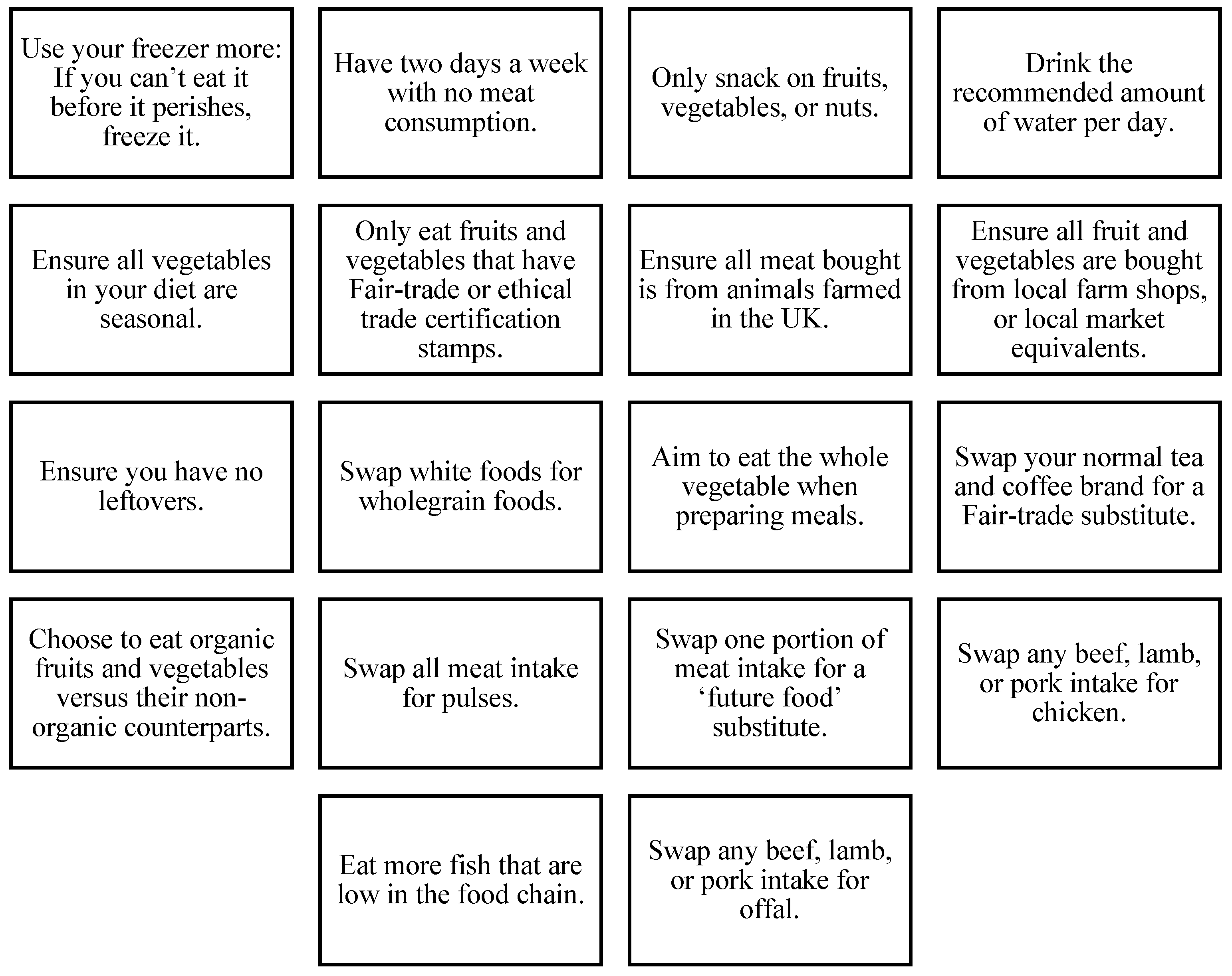
2.2.2. Sustainable Actions
2.2.3. Healthy Sustainable Eating
2.2.4. Demographic and Lifestyle Characteristics
2.3. Questionnaire Administration
2.4. Data Analyses
3. Results
3.1. Study Population
3.2. Knowledge, Perceived Importance, Current Uptake, Willingness, and NCU-W Across Healthy Sustainable Actions
3.2.1. Knowledge of Healthy Sustainable Dietary Actions
3.2.2. Perceived Importance of Healthy Sustainable Dietary Actions
3.2.3. Current Uptake of Healthy Sustainable Dietary Actions
3.2.4. Willingness to Adopt Healthy Sustainable Dietary Actions
3.2.5. NCU-W Score (Not Currently Undertaking but Willing to Do)
4. Discussion
5. Conclusions
Supplementary Materials
Author Contributions
Funding
Institutional Review Board Statement
Informed Consent Statement
Data Availability Statement
Conflicts of Interest
Abbreviations
| FFQ | Food Frequency Questionnaire |
| UK | United Kingdom |
| NCU-W | Not Currently Undertaking but Willing (Composite Score) |
References
- Food and Agriculture Organization of the United Nations. International Scientific Symposium. Biodiversity and Sustainable Diets–United Against Hunger; FAO Headquarters: Rome, Italy, 2010. [Google Scholar]
- Willett, W.; Rockström, J.; Loken, B.; Springmann, M.; Lang, T.; Vermeulen, S.; Murray, C.J. Food in the Anthropocene: The EAT–Lancet Commission on healthy diets from sustainable food systems. Lancet 2019, 393, 447–492. [Google Scholar] [CrossRef] [Scilit]
- Berry, E.M.; Dernini, S.; Burlingame, B.; Meybeck, A.; Conforti, P. Food security and sustainability: Can one exist without the other? Public Health Nutr. 2015, 18, 2293–2302. [Google Scholar] [CrossRef] [Scilit]
- Binns, C.W.; Lee, M.K.; Maycock, B.; Torheim, L.E.; Nanishi, K. Climate change, food supply, and dietary guidelines. Duong DTT. Annu. Rev. Public Health 2021, 42, 233–255. [Google Scholar] [CrossRef] [Scilit]
- Kollmuss, A.; Agyeman, J. Mind the gap: Why do people act environmentally and what are the barriers to pro-environmental behavior? Environ. Educ. Res. 2002, 8, 239–260. [Google Scholar] [CrossRef] [Scilit]
- Gianfredi, V.; Stacchini, L.; Lotti, S.; Sarno, I.; Sofi, F.; Dinu, M. Knowledge, attitude and behaviours towards food sustainability in a group of Italian consumers. A cross-sectional study. Int. J. Food Sci. Nutr. 2024, 75, 463–474. [Google Scholar] [CrossRef] [Scilit]
- Mann, D.; Thornton, L.; Crawford, D.; Ball, K. Australian consumers’ views towards an environmentally sustainable eating pattern. Public Health Nutr. 2018, 21, 2714–2722. [Google Scholar] [CrossRef] [Scilit] [PubMed]
- Whittall, B.; Warwick, S.M.; Guy, D.J.; Appleton, K.M. Public understanding of sustainable diets and changes towards sustainability: A qualitative study in a UK population sample. Appetite 2023, 181, 106388. [Google Scholar] [CrossRef] [Scilit]
- Caminiti, J.; Badiger, A.; Amoafo, O.; Serventi, L. Understanding New Foods: Alternative Protein Sources. In Sustainable Food Innovation; Springer International Publishing: Cham, Switzerland, 2023; pp. 135–146. [Google Scholar]
- Verain, M.; Dagevos, H.; Antonides, G. Flexitarianism: A range of sustainable food styles. In Handbook of Research on Sustainable Consumption; Edward Elgar Publishing: Cheltenham, UK, 2015; pp. 209–223. [Google Scholar]
- Kenny, T.A.; Woodside, J.V.; Perry, I.J.; Harrington, J.M. Consumer attitudes and behaviors toward more sustainable diets: A scoping review. Nutr. Rev. 2023, 81, 1665–1679. [Google Scholar] [CrossRef] [Scilit] [PubMed]
- De Boer, J.; Schösler, H.; Boersema, J.J. Climate change and meat eating: An inconvenient couple? J. Environ. Psychol. 2017, 26, 57–66. [Google Scholar] [CrossRef] [Scilit]
- Macdiarmid, J.I.; Douglas, F.; Campbell, J. Eating like there’s no tomorrow: Public awareness of the environmental impact of food and reluctance to eat less meat as part of a sustainable diet. Appetite 2016, 96, 487–493. [Google Scholar] [CrossRef] [Scilit]
- Whittall, B.; Warwick, S.M.; Jackson, M.; Appleton, K.M. Barriers and facilitators to consuming pulses: A qualitative exploration including effects of trying recipes at home. J. Nutr. Sci. 2024, 13, e6. [Google Scholar] [CrossRef] [Scilit]
- Ajzen, I. The theory of planned behavior. Organ. Behav. Hum. Decis. Process. 1991, 50, 179–211. [Google Scholar] [CrossRef] [Scilit]
- Rosenstock, I.M. Historical origins of the health belief model. Health Educ. Monogr. 1974, 2, 328–335. [Google Scholar] [CrossRef] [Scilit]
- Deci, E.L.; Ryan, R.M. Self-determination theory: A macrotheory of human motivation, development, and health. Can. Psychol./Psychol. Can. 2008, 49, 182. [Google Scholar] [CrossRef] [Scilit]
- Franzon, C.; Dougkas, A.; Memery, J.; Appleton, K.M. A qualitative study to explore and identify reasons for dairy consumption and non-consumption among young adults (18–30 years old) in the UK and France. J. Nutr. Sci. 2024, 13, e90. [Google Scholar] [CrossRef] [Scilit] [PubMed]
- Appleton, K.M. Barriers to and facilitators of the consumption of animal-based protein-rich foods in older adults: Re-analysis with a focus on sustainability. Nutrients 2023, 15, 470. [Google Scholar] [CrossRef] [Scilit]
- Tsofliou, F.; Vlachos, D.; Hughes, C.; Appleton, K.M. Barriers and facilitators associated with the adoption of and adherence to a Mediterranean style diet in adults: A systematic review of published observational and qualitative studies. Nutrients 2022, 14, 4314. [Google Scholar] [CrossRef] [Scilit]
- Zavala, G.A.; Ainscough, T.S.; Jimenez-Moreno, A.C. Barriers to a healthy diet and physical activity in Mexican adults: Results from the Mexican Health and Nutrition Survey. Nutr. Bull. 2022, 47, 298–306. [Google Scholar] [CrossRef] [Scilit]
- Graça, J.; Godinho, C.A.; Truninger, M. Reducing meat consumption and following plant-based diets: Current evidence and future directions to inform integrated transitions. Trends Food Sci. Technol. 2019, 91, 380–390. [Google Scholar] [CrossRef] [Scilit]
- Vermeir, I.; Verbeke, W. Sustainable food consumption: Exploring the consumer “attitude–behavioral intention” gap. J. Agric. Environ. Ethics 2006, 19, 169–194. [Google Scholar] [CrossRef] [Scilit]
- Kwasny, T.; Dobernig, K.; Riefler, P. Towards reduced meat consumption: A systematic literature review of intervention effectiveness, 2001–2019. Appetite 2022, 168, 105739. [Google Scholar] [CrossRef] [Scilit] [PubMed]
- Margetts, B.M.; Thompson, R.L.; Key, T.; Duffy, S.; Nelson, M.; Bingham, S.; Wiseman, M. Development of a scoring system to judge the scientific quality of information from case- control and cohort studies of nutrition and disease. Nutr. Cancer 1995, 24, 231–239. [Google Scholar] [CrossRef] [Scilit] [PubMed]
- Guy, D.J.; Bray, J.; Appleton, K.M. Select dietary changes towards sustainability: Impacts on dietary profiles, environmental footprint, and cost. Appetite 2024, 194, 107194. [Google Scholar] [CrossRef] [Scilit]
- Onwezen, M.C.; Bouwman, E.P.; Reinders, M.J.; Dagevos, H. A systematic review on consumer acceptance of alternative proteins: Pulses, algae, insects, plant-based meat alternatives, and cultured meat. Appetite 2021, 159, 105058. [Google Scholar] [CrossRef] [Scilit]
- Nederhof, A.J. Methods of coping with social desirability bias: A review. Eur. J. Soc. Psychol. 1985, 15, 263–280. [Google Scholar] [CrossRef] [Scilit]
- Office for National Statistics. Education, England and Wales: Census 2021. 2020. Available online: https://www.ons.gov.uk/peoplepopulationandcommunity/educationandchildcare/bulletins/educationenglandandwales/census2021 (accessed on 21 February 2022).
- Office for National Statistics. The National Statistics Socio-Economic Classification (NS-SEC). 2020. Available online: https://www.ons.gov.uk/methodology/classificationsandstandards/otherclassifications/thenationalstatisticssocioeconomicclassificationnssecrebasedonsoc2010 (accessed on 21 February 2022).
- HM Revenue & Customs. Income Tax Rates Personal Allowances, GOV.UK. 2022. Available online: https://www.gov.uk/income-tax-rates (accessed on 21 February 2022).
- Office for National Statistics. Census 2021 Housing and Household Characteristics. Office for National Statistics. 2021. Available online: https://www.ons.gov.uk/peoplepopulationandcommunity/housing (accessed on 21 February 2022).
- Fujihira, K.; Takahashi, M.; Wang, C.; Hayashi, N. Factors explaining seasonal variation in energy intake: A review. Front. Nutr. 2023, 10, 1192223. [Google Scholar] [CrossRef] [Scilit]
- Landis, J.R.; Koch, G.G. An application of hierarchical kappa-type statistics in the assessment of majority agreement among multiple observers. Biometrics 1977, 33, 363–374. [Google Scholar] [CrossRef] [Scilit]
- Cade, J.; Thompson, R.; Burley, V.; Warm, D. Development, validation and utilisation of food-frequency questionnaires–a review. Public Health Nutr. 2002, 5, 567–587. [Google Scholar] [CrossRef] [Scilit]
- Hazley, D.; Kearney, J.M. Consumer perceptions of healthy and sustainable eating. Proc. Nutr. Soc. 2024, 83, 254–262. [Google Scholar] [CrossRef] [Scilit]
- Heard, H.; Bogdan, A. Healthy and Sustainable Diets Consumer Poll; Food Standards Agency: London, UK, 2021. [Google Scholar]
- Siegrist, M.; Hartmann, C. Impact of sustainability perception on consumption of organic meat and meat substitutes. Appetite 2019, 132, 196–202. [Google Scholar] [CrossRef] [Scilit]
- Lea, E.; Worsley, A. Australian consumers’ food-related environmental beliefs and behaviours. Appetite 2008, 50, 207–214. [Google Scholar] [CrossRef] [Scilit] [PubMed]
- Kruger, J.; Dunning, D. Unskilled and unaware of it: How difficulties in recognizing one’s own incompetence lead to inflated self-assessments. J. Personal. Soc. Psychol. 1999, 77, 1121. [Google Scholar] [CrossRef] [PubMed]
- Spronk, I.; Kullen, C.; Burdon, C.; O’Connor, H. Relationship between nutrition knowledge and dietary intake. Br. J. Nutr. 2014, 111, 1713–1726. [Google Scholar] [CrossRef] [Scilit]
- Cleland, E.; McBey, D.; Darlene, V.; McCormick, B.J.; Macdiarmid, J.I. Still eating like there’s no tomorrow? A qualitative study to revisit attitudes and awareness around sustainable diets after 10 years. Appetite 2025, 206, 107799. [Google Scholar] [CrossRef] [Scilit] [PubMed]
- Sheeran, P. Intention—behavior relations: A conceptual and empirical review. Eur. Rev. Soc. Psychol. 2002, 12, 1–36. [Google Scholar] [CrossRef] [Scilit]
- Schäufele, I.; Janssen, M. How and why does the attitude-behavior gap differ between product categories of sustainable food? Analysis of organic food purchases based on household panel data. Front. Psychol. 2021, 12, 595636. [Google Scholar] [CrossRef] [Scilit]
- Van der Linden, S. The social-psychological determinants of climate change risk perceptions: Towards a comprehensive model. J. Environ. Psychol. 2015, 41, 112–124. [Google Scholar] [CrossRef] [Scilit]
- Abrahamse, W.; Steg, L.; Vlek, C.; Rothengatter, T. A review of intervention studies aimed at household energy conservation. J. Environ. Psychol. 2005, 25, 273–291. [Google Scholar] [CrossRef] [Scilit]
- Appleton, K.M. The importance of enjoyment, sensory properties and perceived cooking abilities in legume and pulse consumption: A questionnaire study. Public Health Nutr. 2024, 27, e138. [Google Scholar] [CrossRef] [Scilit]
- Wallnoefer, L.M.; Riefler, P.; Meixner, O. What drives the choice of local seasonal food? Analysis of the importance of different key motives. Foods 2021, 10, 2715. [Google Scholar] [CrossRef] [Scilit]
- Aleksandrowicz, L.; Green, R.; Joy, E.J.; Smith, P.; Haines, A. The impacts of dietary change on greenhouse gas emissions, land use, water use, and health: A systematic review. PLoS ONE 2016, 11, e0165797. [Google Scholar] [CrossRef] [Scilit] [PubMed]
- Springmann, M.; Wiebe, K.; Mason-D’Croz, D.; Sulser, T.B.; Rayner, M.; Scarborough, P. Health and nutritional aspects of sustainable diet strategies and their association with environmental impacts: A global modelling analysis with country-level detail. Lancet Planet. Health 2018, 2, e451–e461. [Google Scholar] [CrossRef] [Scilit] [PubMed]


| Characteristic | Value * |
|---|---|
| Age | |
| 18–24 years old | 129 (20.3%) |
| 25–34 years old | 97 (15.2%) |
| 35–44 years old | 119 (18.7%) |
| 45–54 years old | 104 (16.3%) |
| 55–64 years old | 95 (14.9%) |
| 65+ years old | 91 (14.3%) |
| Gender | |
| Male | 205 (32.8%) |
| Female | 430 (67.5%) |
| Education level | |
| No qualifications | 9 (1.4%) |
| GCSEs, Post 16, or equivalent | 44 (6.9%) |
| A-levels, Post 18, or equivalent | 234 (36.8%) |
| Foundation degree or equivalent | 59 (9.2%) |
| Bachelor’s degree or equivalent | 139 (21.8%) |
| Master’s degree or equivalent | 72 (11.3%) |
| Professional degree or equivalent | 59 (9.2%) |
| Doctorate degree | 19 (2.9%) |
| Employment status | |
| Full-time employed | 206 (32.4%) |
| Part-time employed | 136 (21.4%) |
| Self-employed | 49 (7.7%) |
| Unemployed | 22 (3.3%) |
| Student | 98 (15.4%) |
| Retired | 106 (16.6%) |
| Unable to work | 18 (2.8%) |
| Knowledge | Perceived Importance | Current Uptake | Willingness to Adopt | NCU-W Scores | |
|---|---|---|---|---|---|
| Healthy Sustainable Action | Number of Respondents | Mean (Std. Dev) p (t) | Average Times per Week (Std. Dev) | Mean (Std. Dev) p (t) | Mean (Std. Dev) p (t) |
| Drink the recommended amount of water per day | 459 (72%) | 1.09 (1.14) <0.001 (24.04) | 4.29 (2.59) | 1.37 (0.95) <0.001 (36.08) | 3.65 (2.35) <0.001 (50.66) |
| Ensure you have no leftovers | 368 (57%) | 0.92 (1.17) <0.001 (19.87) | 4.11 (2.67) | 1.34 (0.99) <0.001 (33.68) | 3.29 (2.72) <0.001 (30.46) |
| Use your freezer more: If you can’t eat it before it perishes, freeze it. | 600 (94%) | 1.49 (0.81) <0.001 (46.15) | 4.00 (2.71) | 1.58 (0.81) <0.001 (48.39) | 4.20 (2.09) <0.001 (50.66) |
| Only snack on fruits, vegetables, or nuts. | 497 (78%) | 0.58 (1.02) 0.03 (14.41) | 2.13 (2.27) | 0.93 (1.15) <0.001 (20.19) | 1.95 (2.58) <0.001 (19.02) |
| Swap white foods for wholegrain foods. | 365 (57%) | 0.64 (1.13) <0.001 (14.44) | 2.17 (2.43) | 1.01 (1.17) <0.001 (21.32) | 1.92 (2.86) <0.001 (16.95) |
| Ensure all meat bought is from animals farmed in the UK. | 411 (64%) | 0.97 (1.06) <0.001 (23.11) | 2.04 (2.57) | 0.87 (1.19) <0.001 (17.36) | 1.82 (2.98) <0.001 (15.37) |
| Swap your normal tea and coffee brand for a Fairtrade substitute. | 350 (55%) | 0.44 (1.14) <0.001 (9.78) | 1.97 (2.86) | 0.40 (1.43) <0.001 (6.93) | 0.54 (3.45) <0.001 (3.97) |
| Have two days a week with no meat consumption. | 507 (79%) | 1.04 (1.08) <0.001 (24.25) | 1.86 (2.49) | 0.89 (1.30) <0.001 (16.52) | 1.90 (2.91) <0.001 (16.48) |
| Ensure all vegetables in your diet are seasonal. | 448 (70%) | 0.97 (1.01) <0.001 (24.24) | 1.80 (2.24) | 0.83 (1.11) <0.001 (18.84) | 1.98 (2.74) <0.001 (18.21) |
| Aim to eat the whole vegetable when preparing meals | 361 (56%) | 0.62 (1.10) <0.001 (14.23) | 1.74 (2.39) | 0.49 (1.30) <0.001 (9.54) | 1.07 (3.29) <0.001 (8.23) |
| Only eat fruits and vegetables that have Fairtrade or ethical trade certification stamps. | 419 (65%) | 0.60 (1.10) <0.001 (13.75) | 1.30 (2.02) | 0.40 (1.28) <0.001 (7.91) | 0.78 (3.09) <0.001 (6.35) |
| Swap any beef, lamb, or pork intake for chicken. | 207 (32%) | 0.17 (1.07) <0.001 (4.17) | 1.24 (1.88) | 0.88 (1.21) <0.001 (17.02) | 0.72 (2.86) <0.001 (6.39) |
| Swap all meat intake for pulses | 253 (39%) | 0.23 (1.27) <0.001 (4.61) | 1.21 (2.27) | 0.11 (1.47) 0.06 (1.88) | −0.24 (3.45) 0.07 (−1.79) |
| Ensure all fruit and veg are bought from local farm shops or local market equivalents. | 409 (64%) | 0.74 (0.99) <0.001 (19.02) | 1.07 (1.95) | 0.24 (1.28) <0.001 (4.84) | 0.67 (2.86) <0.001 (5.96) |
| Choose to eat organic fruits and vegetables versus their non-organic counterparts. | 277 (43%) | 0.45 (1.10) <0.001 (10.31) | 0.93 (1.78) | 0.23 (1.29) <0.001 (4.48) | 0.20 (3.06) 0.08 (1.70) |
| Eat more fish that are low in the food chain | 195 (30%) | 0.12 (−1.07) <0.001 (−3.54) | 0.46 (1.18) | 0.03 (1.41) 0.55 (0.50) | −0.59 (2.84) <0.001 (−5.28) |
| Swap one portion of meat intake for a ‘future food’ substitute | 224 (25%) | −0.17 (1.22) <0.001 (−3.54) | 0.18 (0.91) | −0.91 (1.26) <0.001 (−17.10) | −2.61 (2.50) <0.001 (−26.32) |
| Swap any beef, lamb, or pork intake for offal | 42 (6%) | −0.55 (1.03) <0.001 (−13.59) | 0.14 (0.73) | −0.95 (1.27) <0.001 (−17.48) | −2.86 (2.36) <0.001 (−30.53) |
Disclaimer/Publisher’s Note: The statements, opinions and data contained in all publications are solely those of the individual author(s) and contributor(s) and not of MDPI and/or the editor(s). MDPI and/or the editor(s) disclaim responsibility for any injury to people or property resulting from any ideas, methods, instructions or products referred to in the content. |
© 2026 by the authors. Licensee MDPI, Basel, Switzerland. This article is an open access article distributed under the terms and conditions of the Creative Commons Attribution (CC BY) license.
Share and Cite
Guy, D.J.; Bray, J.; Appleton, K.M. Knowledge, Perceived Importance, Current Uptake, and Willingness to Adopt Healthy Sustainable Dietary Actions: A Cross-Sectional Study of UK Adults. Nutrients 2026, 18, 534. https://doi.org/10.3390/nu18030534
Guy DJ, Bray J, Appleton KM. Knowledge, Perceived Importance, Current Uptake, and Willingness to Adopt Healthy Sustainable Dietary Actions: A Cross-Sectional Study of UK Adults. Nutrients. 2026; 18(3):534. https://doi.org/10.3390/nu18030534
Chicago/Turabian StyleGuy, Danielle J., Jeffery Bray, and Katherine M. Appleton. 2026. "Knowledge, Perceived Importance, Current Uptake, and Willingness to Adopt Healthy Sustainable Dietary Actions: A Cross-Sectional Study of UK Adults" Nutrients 18, no. 3: 534. https://doi.org/10.3390/nu18030534
APA StyleGuy, D. J., Bray, J., & Appleton, K. M. (2026). Knowledge, Perceived Importance, Current Uptake, and Willingness to Adopt Healthy Sustainable Dietary Actions: A Cross-Sectional Study of UK Adults. Nutrients, 18(3), 534. https://doi.org/10.3390/nu18030534