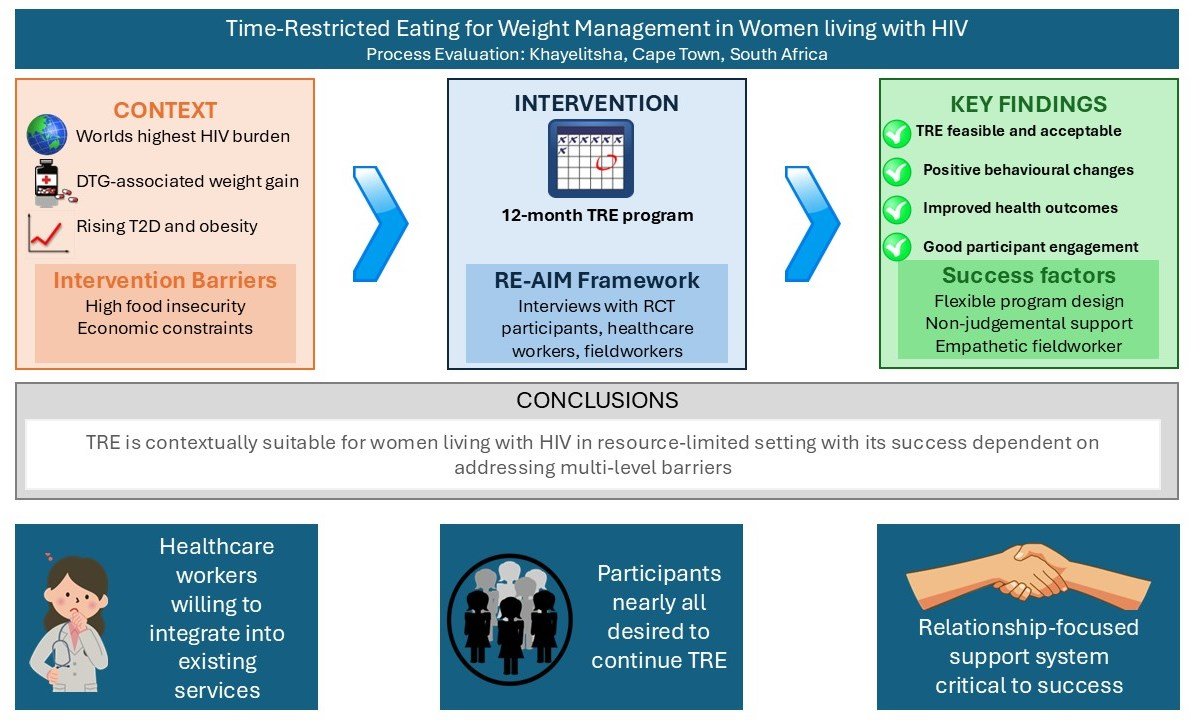
Process Evaluation of a Time-Restricted Eating Intervention for Weight Management in South African Women Living with Overweight/Obesity and HIV on Dolutegravir-Based Antiretroviral Therapy: A Qualitative, RE-AIM-Informed Analysis
 , , , , , and
Abstract
1. Introduction
2. Materials and Methods
2.1. Study Design
2.2. Participants
2.3. Data Collection
2.4. Qualitative Data Analysis
3. Results
3.1. Characteristics of RCT Participants
3.2. Process Evaluation According to RE-AIM
3.2.1. Reach
3.2.2. Effectiveness
3.2.3. Adoption
3.2.4. Implementation
3.2.5. Maintenance
4. Discussion
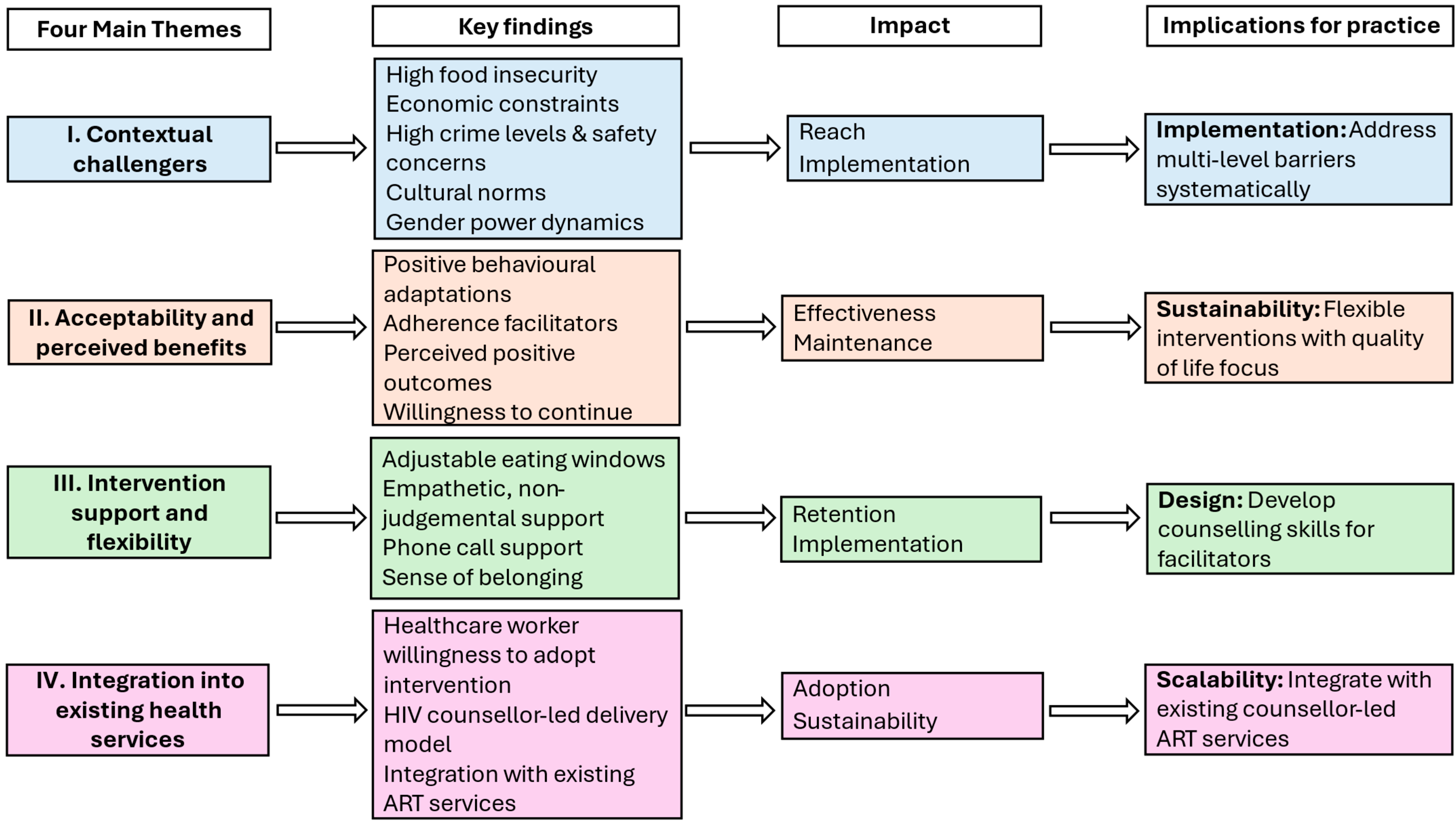
- For program designers: TRE interventions should be designed with built-in flexibility and should incorporate a strong component of training on relational and counselling skills for facilitators;
- For policy makers and implementers: Scaleup is feasible and requires a multi-level approach. TRE education should be provided at an individual level; family engagement strategies should be employed at an interpersonal level; space and capacity constraints should be evaluated and addressed at a clinic level; and the impact of food security and safety must be acknowledged and mitigated;
- For researchers: Future studies should investigate the specific role of facilitator-participant relationships on outcomes and test the effectiveness of TRE when fully led by integrated clinic counsellors rather than research teams, with a focus on longer-term studies.
5. Conclusions
Supplementary Materials
Author Contributions
Funding
Institutional Review Board Statement
Informed Consent Statement
Data Availability Statement
Acknowledgments
Conflicts of Interest
Abbreviations
| T2D | Type 2 Diabetes |
| DTG | Dolutegravir |
| TRE | Time restricted eating |
| ART | Anti-retroviral therapy |
| TESSA | Exploring the effects of Time-restricted eating on body weight and associated cardiometabolic outcomes in South African women (The TESSA Study) |
| RCT | Randomized controlled trial |
| RE-AIM | Reach, Effectiveness, Adoption, Implementation, Maintenance Framework |
| PRISM | Practical, Robust Implementation and Sustainability Model |
| COREQ | Consolidated criteria for Reporting Qualitative Research Checklist |
| REDCap | Research Electronic Data Capture, Vanderbilt University, Nashville, TN, USA |
| IDI | In-depth interview |
| TLD | Tenofovir, Lamivudine, Dolutegravir |
| PID | Participant identity |
| HCW | Healthcare worker |
| FW | Fieldworker |
References
- UNAIDS Joint United Nations Programme on HIV/AIDS. In UNAIDS Data 2023; UNAIDS: Geneva, Switzerland, 2023.
- The International Diabetes Federation (IDF). IDF Diabetes Atlas, 11th ed.; IDF: Brussels, Belgium, 2025. [Google Scholar]
- Statistics South Africa. Mortality and Causes of Death in South Africa: Findings from Death Notification: 2020; Statistics South Africa: Pretoria, South Africa, 2020.
- Venter, W.D.F.; Sokhela, S.; Simmons, B.; Moorhouse, M.; Fairlie, L.; Mashabane, N.; Serenata, C.; Akpomiemie, G.; Masenya, M.; Qavi, A.; et al. Dolutegravir with emtricitabine and tenofovir alafenamide or tenofovir disoproxil fumarate versus efavirenz, emtricitabine, and tenofovir disoproxil fumarate for initial treatment of HIV-1 infection (ADVANCE): Week 96 results from a randomised, phase 3, non-inferiority trial. Lancet HIV 2020, 7, e666–e676. [Google Scholar] [CrossRef] [Scilit]
- Biggs, C.; Spooner, E. Obesity and HIV: A compounding problem. S. Afr. J. Clin. Nutr. 2017, 31, 78–83. [Google Scholar] [CrossRef] [Scilit]
- Mtintsilana, A.; Dlamini, S.N.; Mapanga, W.; Craig, A.; Du Toit, J.; Ware, L.J.; Norris, S.A. Social vulnerability and its association with food insecurity in the South African population: Findings from a National Survey. J. Public Health Policy 2022, 43, 575–592. [Google Scholar] [CrossRef] [Scilit]
- Mendham, A.E.; Goedecke, J.H.; Heckens, L.; Hoosen, F.; Pico, M.L.; Kengne, A.P.; Christensen, D.L.; Olesen, O.F.; Quist, J.S.; Dave, J.; et al. Exploring the effects of time-restricted eating on body weight and associated cardiometabolic outcomes in South African women living with HIV (TESSA): Protocol for a randomised controlled trial. BMJ Open 2024, 14, e086203. [Google Scholar] [CrossRef] [Scilit] [PubMed]
- Hoosen, F.; Pico, M.L.; Goedecke, J.H.; Dave, J.A.; Quist, J.S.; Faerch, K.; Grunnet, L.G.; de Villiers, A.; Aagaard-Hansen, J.; Mendham, A.E. Development and feasibility testing of a time-restricted eating intervention for women living with overweight/obesity and HIV in a resource-limited setting of South Africa. BMC Public Health 2024, 24, 2768. [Google Scholar] [CrossRef] [Scilit]
- Skivington, K.; Matthews, L.; Simpson, S.A.; Craig, P.; Baird, J.; Blazeby, J.M.; Boyd, K.A.; Craig, N.; French, D.P.; McIntosh, E.; et al. A new framework for developing and evaluating complex interventions: Update of Medical Research Council guidance. BMJ 2021, 374, n2061. [Google Scholar] [CrossRef] [Scilit] [PubMed]
- Glasgow, R.E.; Harden, S.M.; Gaglio, B.; Rabin, B.; Smith, M.L.; Porter, G.C.; Ory, M.G.; Estabrooks, P.A. RE-AIM Planning and Evaluation Framework: Adapting to New Science and Practice With a 20-Year Review. Front. Public Health 2019, 7, 64. [Google Scholar] [CrossRef] [Scilit]
- Glasgow, R.E.; Vogt, T.M.; Boles, S.M. Evaluating the public health impact of health promotion interventions: The RE-AIM framework. Am. J. Public Health 1999, 89, 1322–1327. [Google Scholar] [CrossRef] [Scilit]
- Feldstein, A.C.; Glasgow, R.E. A Practical, Robust Implementation and Sustainability Model (PRISM) for Integrating Research Findings into Practice. Jt. Comm. J. Qual. Patient Saf. 2008, 34, 228–243. [Google Scholar] [CrossRef] [Scilit]
- Tong, A.; Sainsbury, P.; Craig, J. Consolidated criteria for reporting qualitative research (COREQ): A 32-item checklist for interviews and focus groups. Int. J. Qual. Health Care 2007, 19, 349–357. [Google Scholar] [CrossRef] [Scilit] [PubMed]
- Smit, W.; de Lannoy, A.; Dover, R.V.; Lambert, E.V.; Levitt, N.; Watson, V. Making unhealthy places: The built environment and non-communicable diseases in Khayelitsha, Cape Town. Health Place 2015, 35, 11–18. [Google Scholar] [CrossRef] [Scilit]
- Harris, P.A.; Taylor, R.; Thielke, R.; Payne, J.; Gonzalez, N.; Conde, J.G. Research electronic data capture (REDCap)—A metadata-driven methodology and workflow process for providing translational research informatics support. J. Biomed. Inform. 2009, 42, 377–381. [Google Scholar] [CrossRef] [Scilit] [PubMed]
- Braun, C.V. Thematic Analysis: A Practical Guide; Sage: London, UK, 2022. [Google Scholar]
- Rasesemola, R.M.; Mmusi-Phetoe, R.M.; Havenga, Y. Social determinants of health in non-communicable diseases prevention policies in South Africa. Curationis 2023, 46, e1–e8. [Google Scholar] [CrossRef] [Scilit] [PubMed]
- Frank, T.; Ng, S.W.; Lowery, C.M.; Thow, A.M.; Swart, E.C. Dietary intake of low-income adults in South Africa: Ultra-processed food consumption a cause for concern. Public Health Nutr. 2024, 27, e41. [Google Scholar] [CrossRef] [Scilit]
- Temple, N.J.; Steyn, N.P. The cost of a healthy diet: A South African perspective. Nutrition 2011, 27, 505–508. [Google Scholar] [CrossRef] [Scilit]
- Chaudhari, N.; Ravi, R.; Gogtay, N.J.; Thatte, U.M. Recruitment and retention of the participants in clinical trials: Challenges and solutions. Perspect. Clin. Res. 2020, 11, 64–69. [Google Scholar] [CrossRef] [Scilit]
- Bjerre, N.; Hempler, N.F.; Veje, N.; Audulv, A.; Faerch, K.; Quist, J.S.; Holm, L. Achieving Weight Loss When Practicing Time-Restricted Eating: A Longitudinal Study of Experiences Among Individuals With Overweight. Nutr. Bull. 2025, 50, 472–485. [Google Scholar] [CrossRef] [Scilit] [PubMed]
- Bjerre, N.; Holm, L.; Quist, J.S.; Faerch, K.; Hempler, N.F. Watching, keeping and squeezing time to lose weight: Implications of time-restricted eating in daily life. Appetite 2021, 161, 105138. [Google Scholar] [CrossRef] [Scilit]
- Bjerre, N.; Holm, L.; Veje, N.; Quist, J.S.; Faerch, K.; Hempler, N.F. What happens after a weight loss intervention? A qualitative study of drivers and challenges of maintaining time-restricted eating among people with overweight at high risk of type 2 diabetes. Appetite 2022, 174, 106034. [Google Scholar] [CrossRef] [Scilit]
- Termannsen, A.D.; Varming, A.; Hansen, G.S.; Bjerre, N.; Persson, F.; Bagger, J.I.; Hansen, D.L.; Ewers, B.; Jorgensen, N.B.; Blond, M.B.; et al. Time-Restricted Eating is a Feasible Dietary Strategy in the Treatment of Complicated Type 2 Diabetes: The RESET2 Pilot Study. J. Nutr. Educ. Behav. 2025, 57, 767–777. [Google Scholar] [CrossRef] [Scilit]
- Micklesfield, L.K.; Lambert, E.V.; Hume, D.J.; Chantler, S.; Pienaar, P.R.; Dickie, K.; Puoane, T.; Goedecke, J.H. Socio-cultural, environmental and behavioural determinants of obesity in black South African women. Cardiovasc. J. Afr. 2013, 24, 369–375. [Google Scholar] [CrossRef] [Scilit]
- Crowne, D.P.; Marlowe, D. A new scale of social desirability independent of psychopathology. J. Consult. Psychol. 1960, 24, 349–354. [Google Scholar] [CrossRef] [Scilit]
- Rosenstock, I.M.; Strecher, V.J.; Becker, M.H. Social learning theory and the Health Belief Model. Health Educ. Q. 1988, 15, 175–183. [Google Scholar] [CrossRef] [Scilit]
- Sones, B.E.; Devlin, B.L. The impact of time-restricted eating on health-related quality of life: A systematic literature review. Nutr. Rev. 2025, 83, 230–248. [Google Scholar] [CrossRef] [Scilit]
- Proctor, E.; Silmere, H.; Raghavan, R.; Hovmand, P.; Aarons, G.; Bunger, A.; Griffey, R.; Hensley, M. Outcomes for implementation research: Conceptual distinctions, measurement challenges, and research agenda. Adm. Policy Ment. Health 2011, 38, 65–76. [Google Scholar] [CrossRef] [Scilit] [PubMed]
- Pereira Gray, D.J.; Sidaway-Lee, K.; White, E.; Thorne, A.; Evans, P.H. Continuity of care with doctors-a matter of life and death? A systematic review of continuity of care and mortality. BMJ Open 2018, 8, e021161. [Google Scholar] [CrossRef] [Scilit] [PubMed]
- Baker, R.; Freeman, G.K.; Haggerty, J.L.; Bankart, M.J.; Nockels, K.H. Primary medical care continuity and patient mortality: A systematic review. Br. J. Gen. Pract. 2020, 70, e600–e611. [Google Scholar] [CrossRef] [Scilit] [PubMed]
- Michie, S.; Ashford, S.; Sniehotta, F.F.; Dombrowski, S.U.; Bishop, A.; French, D.P. A refined taxonomy of behaviour change techniques to help people change their physical activity and healthy eating behaviours: The CALO-RE taxonomy. Psychol. Health 2011, 26, 1479–1498. [Google Scholar] [CrossRef] [Scilit]
- Association, A.P.H. Community Health Workers. 2009. Available online: https://www.apha.org/apha-communities/member-sections/community-health-workers (accessed on 2 September 2025).
- Drisko, J.W. Transferability and generalization in qualitative research. Res. Soc. Work. Pract. 2025, 35, 102–110. [Google Scholar] [CrossRef] [Scilit]


| All Participants (n = 93) | TRE (n = 47) | Control (n = 46) | |
|---|---|---|---|
| Age, years | 38 (9) | 39 (7) | 36 (8) |
| TLD treatment duration, months | 13 ± 4 | 13 ± 4 | 13 ± 5 |
| Ethnicity, n (%) | |||
| Xhosa | 91 (99%) | 45 (98%) | 46 (100%) |
| Sotho | 1 (1%) | 1 (2%) | 0 |
| Education, n (%) | |||
| Grade 1–7 (Primary School) | 3 (3%) | 2 (4%) | 1 (2%) |
| Grade 8–12 (High School) | 79 (86%) | 38 (83%) | 41 (89%) |
| Completed high school or tertiary education | 10 (11%) | 6 (13%) | 4 (9%) |
| Employment status, n (%) | |||
| Employed | 30 (33%) | 13 (28%) | 17 (37%) |
| Unemployed | 62 (67%) | 33 (72%) | 29 (63%) |
| Socioeconomic status | |||
| Formal/Brick house, n (%) | 40 (44%) | 15 (33%) | 25 (54%) |
| Informal/Shack, n (%) | 52 (56%) | 31 (67%) | 21 (46%) |
| Housing density (number of people/room) | 1 (1, 2) | 1 (1, 2) | 1 (1, 2) |
| Asset Index (n/12) | 6 (5, 7) | 6 (5, 7) | 6 (5, 8) |
| Food security | |||
| Food secure | 7 (8%) | 4 (9%) | 3 (7%) |
| Mild food insecurity | 9 (10%) | 3 (6%) | 6 (13%) |
| Moderate food insecurity | 22 (24%) | 7 (15%) | 15 (33%) |
| Severe food insecurity | 55 (59%) | 33 (70%) | 22 (48%) |
Disclaimer/Publisher’s Note: The statements, opinions and data contained in all publications are solely those of the individual author(s) and contributor(s) and not of MDPI and/or the editor(s). MDPI and/or the editor(s) disclaim responsibility for any injury to people or property resulting from any ideas, methods, instructions or products referred to in the content. |
© 2026 by the authors. Licensee MDPI, Basel, Switzerland. This article is an open access article distributed under the terms and conditions of the Creative Commons Attribution (CC BY) license.
Share and Cite
Hoosen, F.; Goedecke, J.H.; Dave, J.A.; Quist, J.S.; Færch, K.; Grunnet, L.G.; Mendham, A.E. Process Evaluation of a Time-Restricted Eating Intervention for Weight Management in South African Women Living with Overweight/Obesity and HIV on Dolutegravir-Based Antiretroviral Therapy: A Qualitative, RE-AIM-Informed Analysis. Nutrients 2026, 18, 474. https://doi.org/10.3390/nu18030474
Hoosen F, Goedecke JH, Dave JA, Quist JS, Færch K, Grunnet LG, Mendham AE. Process Evaluation of a Time-Restricted Eating Intervention for Weight Management in South African Women Living with Overweight/Obesity and HIV on Dolutegravir-Based Antiretroviral Therapy: A Qualitative, RE-AIM-Informed Analysis. Nutrients. 2026; 18(3):474. https://doi.org/10.3390/nu18030474
Chicago/Turabian StyleHoosen, Fatima, Julia H. Goedecke, Joel A. Dave, Jonas S. Quist, Kristine Færch, Louise G. Grunnet, and Amy E. Mendham. 2026. "Process Evaluation of a Time-Restricted Eating Intervention for Weight Management in South African Women Living with Overweight/Obesity and HIV on Dolutegravir-Based Antiretroviral Therapy: A Qualitative, RE-AIM-Informed Analysis" Nutrients 18, no. 3: 474. https://doi.org/10.3390/nu18030474
APA StyleHoosen, F., Goedecke, J. H., Dave, J. A., Quist, J. S., Færch, K., Grunnet, L. G., & Mendham, A. E. (2026). Process Evaluation of a Time-Restricted Eating Intervention for Weight Management in South African Women Living with Overweight/Obesity and HIV on Dolutegravir-Based Antiretroviral Therapy: A Qualitative, RE-AIM-Informed Analysis. Nutrients, 18(3), 474. https://doi.org/10.3390/nu18030474