Article

Process Evaluation of a Time-Restricted Eating Intervention for Weight Management in South African Women Living with Overweight/Obesity and HIV on Dolutegravir-Based Antiretroviral Therapy: A Qualitative, RE-AIM-Informed Analysis

1
Health Through Physical Activity, Lifestyle and Sport Research Centre (HPALS), Division of Physiological Sciences, Department of Human Biology, Faculty of Health Sciences, University of Cape Town, Cape Town 7700, South Africa
2
Biomedical Research and Innovation Platform, South African Medical Research Council, Cape Town 7505, South Africa
3
Division of Endocrinology, Department of Medicine, University of Cape Town, Cape Town 7925, South Africa
4
Copenhagen University Hospital, Steno Diabetes Center Copenhagen, 2730 Herlev, Denmark
5
Department of Biomedical Sciences, University of Copenhagen, 2200 Copenhagen, Denmark
6
School of Psychology, University of Leeds, Leeds LS2 9JT, UK
7
Department of Health Science and Technology, Faculty of Medicine, Aalborg University, 9260 Aalborg East, Denmark
8
Riverland Academy of Clinical Excellence, Riverland Mallee Coorong Local Health Network, Berri 5343, Australia
*
Author to whom correspondence should be addressed.
Nutrients 2026, 18(3), 474; https://doi.org/10.3390/nu18030474
Submission received: 5 November 2025 / Revised: 8 December 2025 / Accepted: 11 December 2025 / Published: 1 February 2026
(This article belongs to the Special Issue Global Nutrition Challenges and Solutions)

Abstract

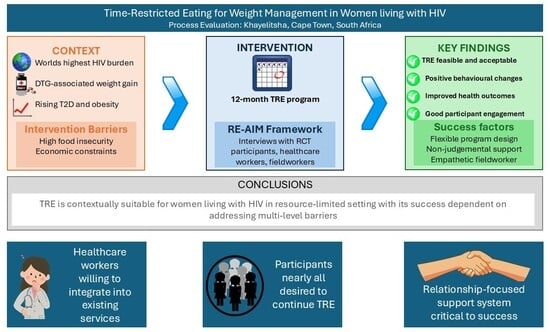
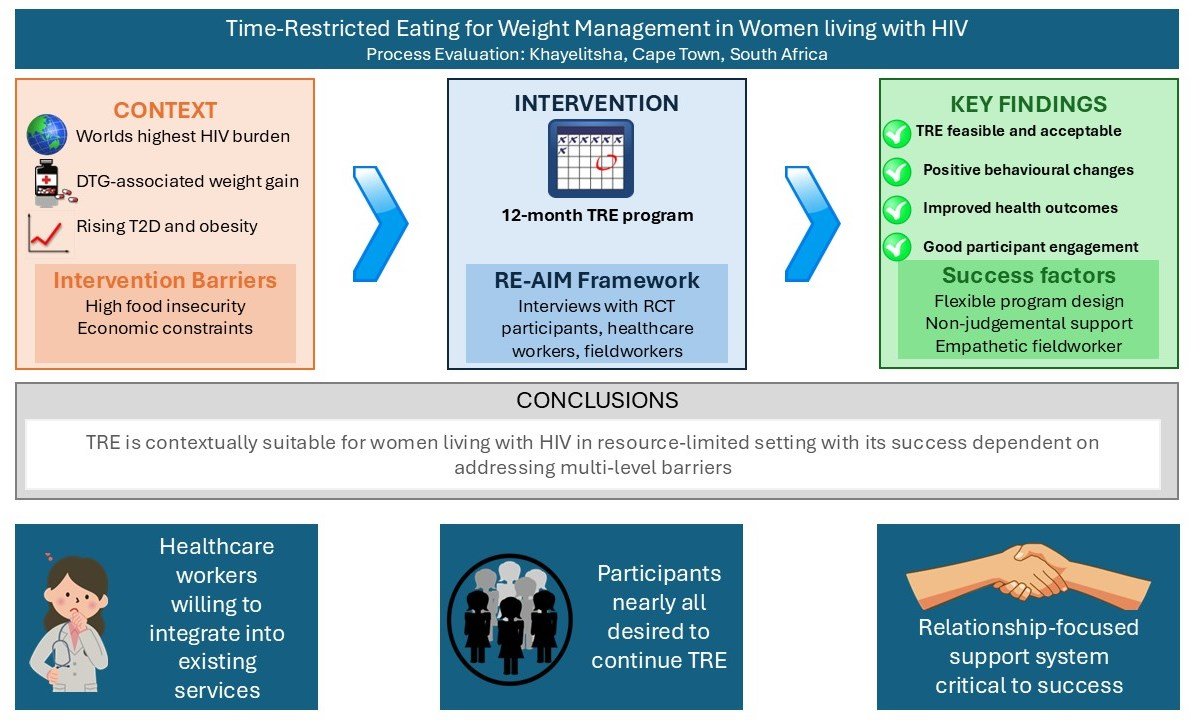
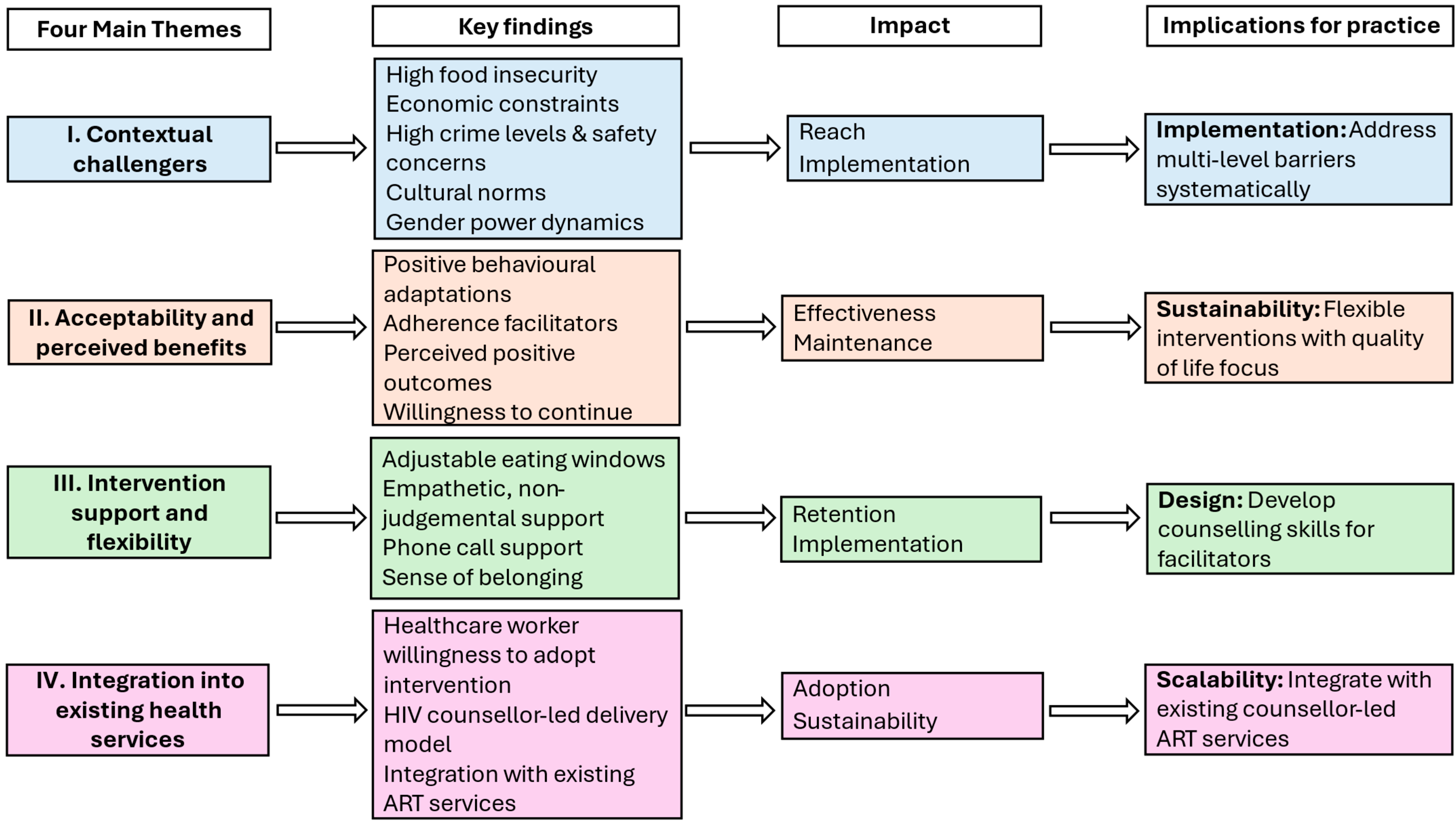
Background: South Africa faces the world’s highest HIV burden, disproportionately affecting women, alongside rising Type 2 Diabetes (T2D). Weight gain associated with preferred dolutegravir (DTG)-based antiretroviral therapy may worsen obesity and T2D risk. This process evaluation explored the implementation of a 12-month time-restricted eating (TRE) intervention for weight management in women with HIV and overweight/obesity in Khayelitsha, Cape Town. Methods: Using the RE-AIM framework, the study investigated the implementation journey. Data were collected from three groups: RCT participants, healthcare workers (n = 21), and fieldworkers (n = 3). Methods included structured informal interviews with TRE participants throughout the intervention and semi-structured in-depth interviews (IDIs) with a subset (n = 19) at 12 months. IDIs and focus group discussions were conducted with healthcare staff. Results: Implementation faced significant contextual challenges, including high food insecurity, economic constraints, and high crime levels. Cultural norms around food hospitality also posed barriers. Despite this, TRE was highly feasible and acceptable. Participants reported positive behavioural changes, establishing eating routines and consuming healthier foods. Perceived health benefits included improved appetite control, wellbeing, sleep, and weight management. Key facilitators were the intervention’s flexibility and, importantly, the non-judgmental, empathetic support from fieldworkers, which drove engagement and retention. Healthcare workers expressed willingness to integrate TRE into existing HIV counsellor-led services, and nearly all participants desired to continue TRE post-intervention. Conclusions: This process evaluation demonstrates that TRE is a contextually suitable and acceptable intervention from an implementation perspective. Its success in practice, however, depends on mitigating complex multi-level barriers through a flexible program design and high-quality, relationship-focused support integrated into existing healthcare infrastructure. Trial registration: PACTR202302484999720, 8 February 2023.
Keywords: time-restricted eating (TRE); weight management; cardiometabolic health; obesity; low-resource setting time-restricted eating (TRE); weight management; cardiometabolic health; obesity; low-resource setting
Graphical Abstract