Trace Element Intake from Dairy-Free Infant Porridges and Its Nutritional and Safety Implications for Infants Aged Six Months and Older

Abstract
1. Introduction
- The adverse effects of inorganic contamination exposure in infants and children may include anemia, nephrotoxicity, developmental and reproductive toxicity, lower intelligence quotient (IQ), and neurotoxic effects. The underlying causes of this situation have been identified as inadequate testing practices, lenient standards, and limited oversight of some of the largest infant food manufacturers. Among the most hazardous of these elements are lead, cadmium, and mercury [16,20,21,22,23,24,25,26].
- Lead has been shown to disrupt iron metabolism by inhibiting the formation of heme, which can result in anemia. Furthermore, evidence suggests that it exhibits developmental neurotoxicity in children. Research has demonstrated that the accumulation of lead during childhood can have a detrimental impact on cognitive abilities in adulthood [27,28,29].
- Cadmium has been observed to primarily accumulate in the kidneys, specifically within the proximal tubule cells, resulting in impaired functionality of these cells. Furthermore, exposure to this element during early childhood has been demonstrated to result in diminished IQ scores and an augmented likelihood of attention deficit hyperactivity disorder (ADHD) [16,29,30,31,32,33,34].
- Mercury has been demonstrated to possess neurotoxic, nephrotoxic, and immunotoxic properties. The substance’s primary accumulation sites are the kidneys and liver. Prenatal exposure to mercury has been linked to abnormal neurological development and reduced IQ [35].
- B. The underdeveloped bodies of infants and young children render them particularly vulnerable to the harmful effects of minimal quantities of noxious substances.
- The physiological processes of infants and young children differ from those of adults. This phenomenon can be attributed to several factors, including incomplete organ development. For instance, the stomach capacity of a six-month-old child is approximately 11 times smaller than that of an adult. Full liver function is not achieved until the age of two, and kidney filtration in young children is only 30–40% developed. Consequently, there is reduced enzyme secretion. The majority of digestive enzymes reach optimal activity by 6–7 months of age, while pancreatic amylase and pepsin only reach optimal activity at around 11–12 months of age. This results in reduced hydrochloric acid production in the stomach. This contributes to particular sensitivity to hazardous substances, including toxic elements [16,18,34,35,36,37,38].
- C. The capacity of elements to form compounds within the body is significant.
- -
- Show a particular affinity for binding to thiol groups of proteins, inhibiting the production of over 200 enzymes in the human body.
- -
- Can affect cells through mimicry. They can attach themselves to physiological sites that are normally reserved for essential elements, thereby disrupting normal biochemical and/or physiological functions
- -
- (1)
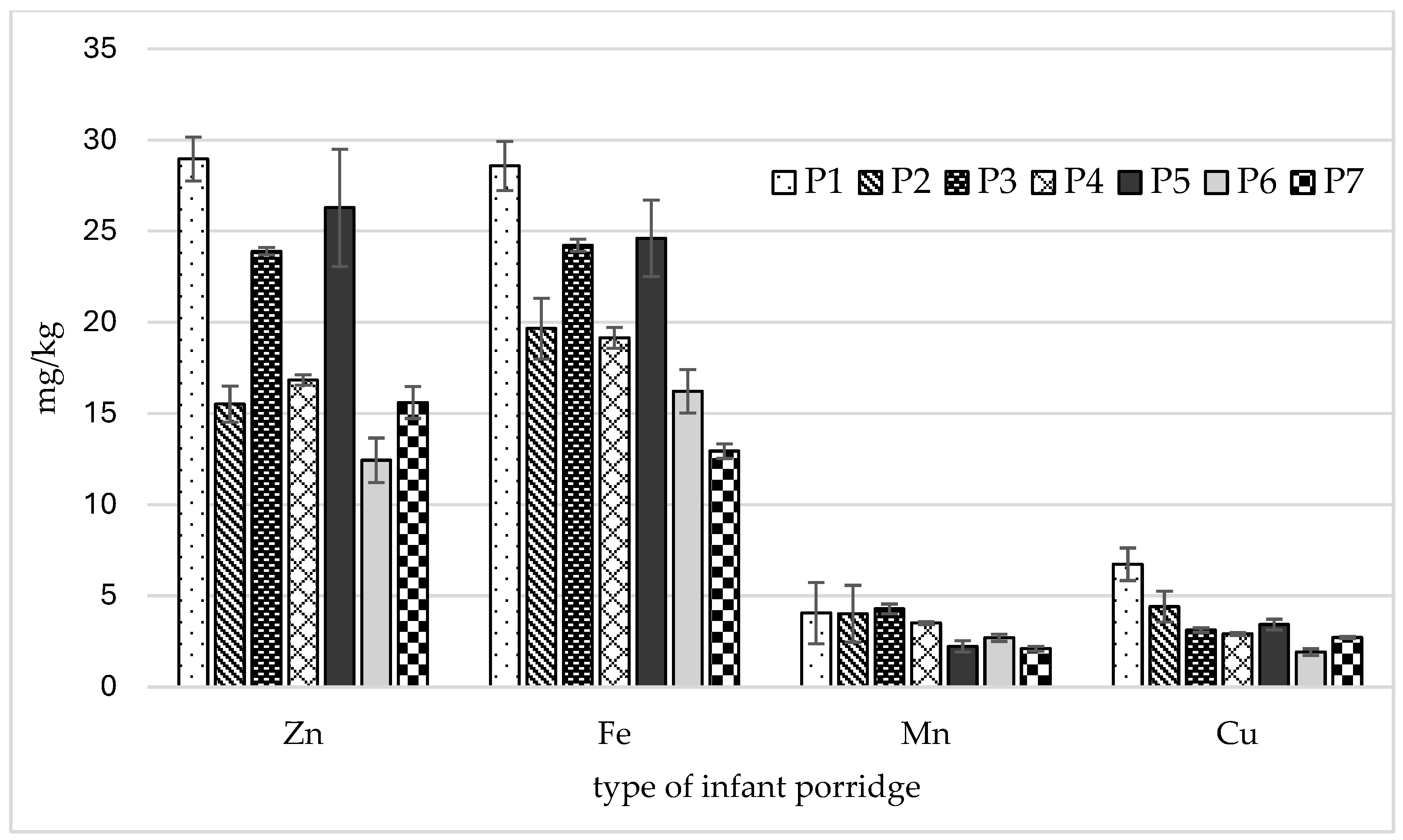
- the content of essential trace elements in dairy-free infant porridges may vary depending on their cereal-based raw material composition;
- (2)
- a single serving of dairy-free infant porridge is expected to contribute to the dietary requirements for selected essential trace elements in infants, while remaining below established tolerable upper intake levels; and
- (3)
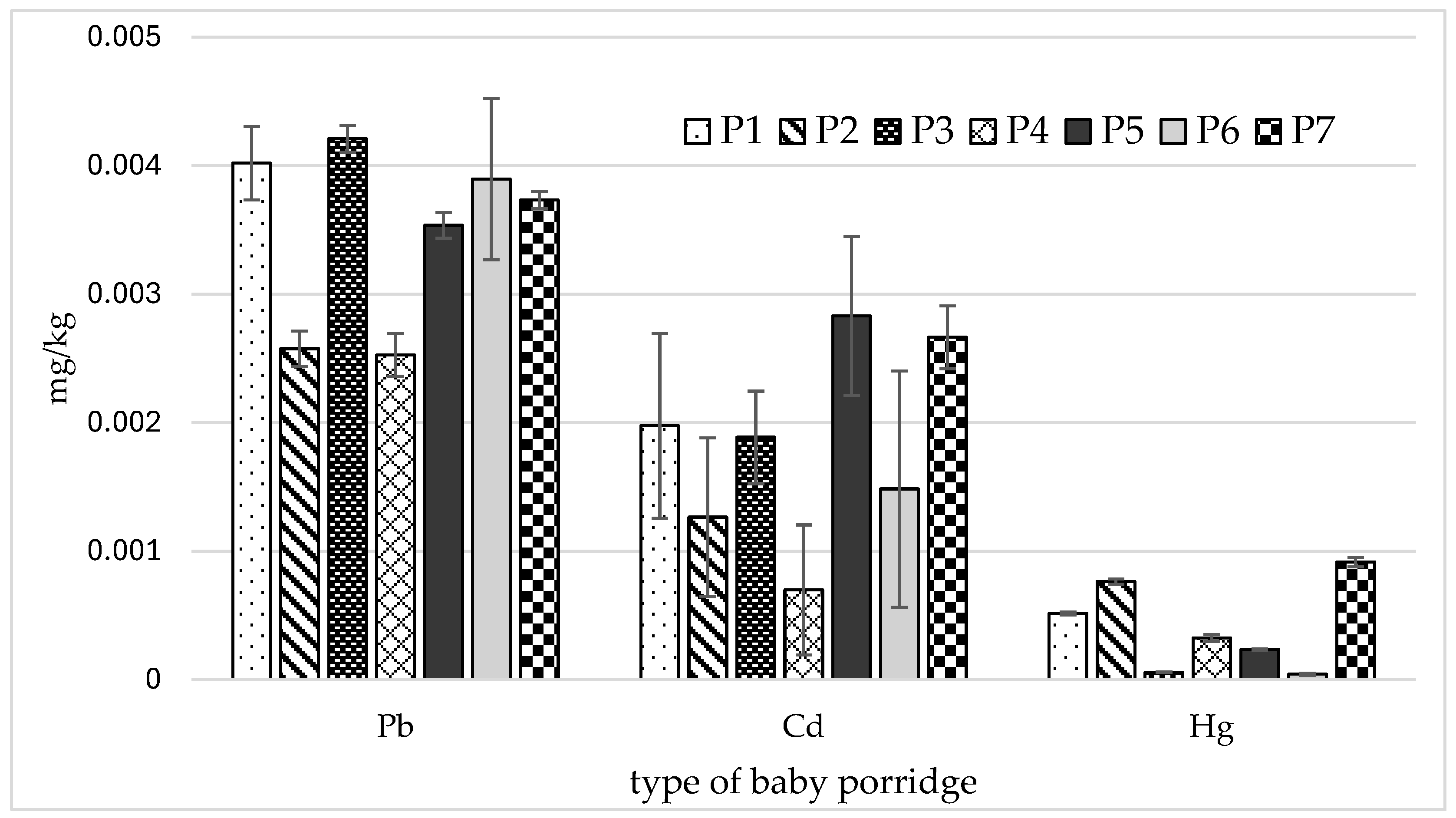
- the concentrations and estimated daily intake of lead, cadmium, and mercury in these products are likely to remain within current European safety limits and are unlikely to pose a significant health risk to infants.
2. Materials and Methods
2.1. Research Material
2.1.1. Criteria for the Selection of Infant Porridges
- -
- commercially available cereal-based porridges intended for infants aged six months and older, as declared by the manufacturer;
- -
- dairy-free formulations, excluding milk proteins and milk-derived ingredients;
- -
- products without added flavorings, sweeteners, fruits, herbs, or other functional additives, to minimize potential confounding sources of trace elements;
- -
- porridges based exclusively on cereal grains or cereal-derived raw materials, including single-grain and multi-cereal compositions;
- -
- products available on the Polish retail market, both in stationary and online stores, at the time of sampling;
- -
- porridges requiring preparation by reconstitution with water, ensuring comparability of serving size and intake estimates.
- -
- porridges with unclear or unspecified age recommendations;
- -
- products containing added milk, infant formula, or protein-rich ingredients;
- -
- porridges enriched with fruit, vegetables, herbs, cocoa, or other non-cereal ingredients that could significantly affect trace element content;
- -
- special-purpose products, including medical foods, therapeutic porridges, or products intended for infants with specific medical conditions;
- -
- products marketed primarily as snacks or instant desserts rather than staple complementary foods.
2.1.2. Sampling Strategy
2.2. Research Methods
2.2.1. Chemical Analyses
2.2.2. Calculating the Coverage of the Recommended Daily Allowance (RDA) and Optimal, i.e., Adequate, Intake (AI) of Elements by a Portion of Porridge
2.2.3. Calculation of the Health Risk Associated with Exposure to the Elements Supplied by a Portion of Porridge
- -
- EDI—estimated daily intake
- -
- ADI—Acceptable Daily Intake [40]
- -
- UL—Tolerable Upper Intake Level [41]
2.2.4. Statistical Analysis
3. Results
3.1. Essential Trace Elements
3.1.1. The Degree to Which Infant Porridge Covers the Daily Requirement (RDA) and the Adequate Intake (AI) of Essential Nutrients
3.1.2. Estimated Health Risks for Infants Associated with the Consumption of Essential Elements from a Serving of Porridge
3.2. Harmful Trace Elements
Estimated Health Risks for Infants Related to the Intake of Harmful Elements
4. Discussion
4.1. Essential Trace Elements
4.2. Harmful Trace Elements
4.3. Study Limitations and Implications for Future Research
5. Conclusions
Author Contributions
Funding
Institutional Review Board Statement
Informed Consent Statement
Data Availability Statement
Conflicts of Interest
Abbreviations
| ICP-AES | Inductively Coupled Plasma Emission Spectrometry |
| Hg-AAS | Mercury-Atomic Absorption Spectrometry |
| RDA | Recommended Daily Allowance |
| AI | Adequate Intake |
References
- Unicef.org. Ensuring a Healthy Start: The First 1000 Days. Available online: https://www.unicef.org/laos/ensuring-healthy-start-first-1000-days-0 (accessed on 13 November 2025).
- Thousanddays.org. Our Story. Available online: https://thousanddays.org/about/our-story/ (accessed on 13 November 2025).
- Aguayo, V.M.; Pia, R.B. The first and next 1000 days: A continuum for child development in early life. Lancet 2024, 404, 10467. [Google Scholar] [CrossRef] [Scilit]
- Metwally, A.M.; Sallam, S.F.; Mawla, M.A.A.; Alian, K.M.; Abdel-Latif, G.A.; Hasanin, H.M.; Kamal, A.N.; Hanna, C.; Shebini, S.M.E.; Ahmed, N.H.; et al. Promoting weaning practices and growth of Egyptian infants by using communication for behavioral development approach. BMC Pediatr. 2022, 22, 689. [Google Scholar] [CrossRef] [Scilit]
- Claro, M.L.; Sousa, A.; Nobre, R.D.S.; Lima, L.H.O. Child development as an intermediate element of food and nutrition in public policies. Rev. Bras. Saúde Matern. Infant. 2022, 22, 715–720. [Google Scholar] [CrossRef] [Scilit]
- Regulation (EU) No 609/2013 of the European Parliament and of the Council of 12 June 2013 on Food Intended for Infants and Young Children, Food for Special Medical Purposes, and Total Diet Replacement for Weight Control and Repealing Council Directive 92/52/EEC, Commission Directives 96/8/EC, 1999/21/EC, 2006/125/EC and 2006/141/EC, Directive 2009/39/EC of the European Parliament and of the Council and Commission Regulations (EC) No 41/2009 and (EC) No 953/2009. Available online: https://eur-lex.europa.eu/legal-content/EN/TXT/PDF/?uri=CELEX:32013R0609 (accessed on 13 November 2025).
- Commission Directive 2006/125/EC of 5 December 2006 on Processed Cereal-Based Foods and Baby Foods for Infants and Young Children. Available online: https://eur-lex.europa.eu/legal-content/EN/TXT/HTML/?uri=CELEX:32006L0125 (accessed on 13 November 2025).
- Zuziak, P.; Ilnicka, N.; Abod, L.; Matyja, D.; Sadlik, M. Intestinal Microbiota and Obesity. J. Educ. Health Sport 2022, 13, 142–148. [Google Scholar] [CrossRef] [Scilit]
- Anbari, K.; Tajabadi, Z.; Baharvand, P.; Bazvand, M.; Khodadadi, B. Evaluating infant complementary feeding pattern and some related factors in health care centers in Khorramabad, 2017 year. Epidemiol. Biostat. Public Health 2022, 15, e12831-1–e12831-8. [Google Scholar] [CrossRef] [Scilit]
- Majewska, K.; Kobylińska, M.; Tchorzewska-Skrobich, M.; Korcz-Iżykowska, M.; Kędzia, A. Modyfikacje bilansu energetycznego w leczeniu otyłości u dzieci. Pielegniarstwo Pol. 2020, 75, 57–63. (In Polish) [Google Scholar] [CrossRef] [Scilit]
- Mania, M.; Wojciechowska-Mazurek, M.; Starska, K.; Rebeniak, M.; Szynal, T.; Strzelecka, A.; Postupolski, J. Toxic elements in commercial infant food, estimated dietary intake, and risk assessment in Poland. Pol. J. Environ. Stud. 2015, 24, 2465–2472. [Google Scholar] [CrossRef] [Scilit]
- Rowan, H.; Lee, M.; Brown, A. Estimated energy and nutrient intake for infants following baby-led and traditional weaning approaches. J. Hum. Nutr. Diet. 2022, 35, 325–336. [Google Scholar] [CrossRef] [Scilit]
- Gomaa, A.; Abdelwahed, A.Y.; Ayed, M.M.A.; Attia, R.S.A.; Sherbeny, E.M.A. Effect of coaching program on mothers’ knowledge regarding micronutrients and their children’s development under five years. Egypt. J. Health Care. 2023, 14, 118–134. [Google Scholar] [CrossRef] [Scilit]
- Kowalski, A.J.; Mayen, V.A.; de Ponce, S.; Lambden, K.B.; Tilton, N.; Villanueva, L.M.; Palacios, A.M.; Reinhart, G.A.; Hurley, K.M.; Black, M.M. The effects of multiple micronutrient fortified beverage and responsive caregiving interventions on early childhood development, hemoglobin, and ferritin among infants in rural Guatemala. Nutrients 2023, 15, 2062. [Google Scholar] [CrossRef] [Scilit]
- Nordberg, G.F.; Fowler, B.A.; Nordberg, M.; Friberg, L. (Eds.) Handbook on the Toxicology of Metals, 4th ed.; Academic Press: Cambridge, MA, USA, 2015. [Google Scholar]
- Bair, E.C. A Narrative Review of Toxic Heavy Metal Content of Infant and Toddler Foods and Evaluation of United States Policy. Front. Nutr. 2022, 9, 919913. [Google Scholar] [CrossRef] [Scilit]
- Kordas, K.; Cantoral, A.; Desai, G.; Halabicky, O.; Signes-Pastor, A.J.; Tellez-Rojo, M.M.; Peterson, K.E.; Karagas, M.R. Dietary Exposure to Toxic Elements and the Health of Young Children: Methodological Considerations and Data Needs. J. Nutr. 2022, 152, 2572–2581. [Google Scholar] [CrossRef] [Scilit]
- Żmudzińska, A.; Puścion-Jakubik, A.; Bielecka, J.; Grabia, M.; Soroczyńska, J.; Mielcarek, K.; Socha, K. Health Safety Assessment of Ready-to-Eat Products Consumed by Children Aged 0.5–3 Years on the Polish Market. Nutrients 2022, 14, 2325. [Google Scholar] [CrossRef] [Scilit]
- Gerônimo, A.C.R.; Melo, E.S.D.P.; Cabanha, R.S.D.C.F.; Ancel, M.A.P.; Nascimento, V.A.d. Essential and Toxic Elements in Cereal-Based Complementary Foods for Children: Concentrations, Intake Estimates, and Health Risk Assessment. Science 2025, 7, 164. [Google Scholar] [CrossRef] [Scilit]
- Rasic Misic, I.D.; Tosic, S.B.; Pavlovic, A.N.; Pecev-Marinkovic, E.T.; Mrmosanin, J.M.; Mitic, S.S.; Stojanovic, G.S. Trace element content in commercial complementary food formulated for infants and toddlers: Health risk assessment. Food Chem. 2022, 378, 132113. [Google Scholar] [CrossRef] [Scilit]
- Heboto, G.F.; Gizachew, M.; Birhanu, T.; Srinivasan, B. Health risk assessment of trace metal concentrations in cereal-based infant foods from Arba Minch Town, Ethiopia. J. Food Compos. Anal. 2024, 135, 106621. [Google Scholar] [CrossRef] [Scilit]
- Houlihan, J.; Brody, C. What’s in My Baby’s Food? 2019. Available online: https://healthybabyfoods.org/sites/healthybabyfoods.org/files/2020-04/BabyFoodReport_ENGLISH_R6.pdf (accessed on 30 December 2025).
- Gardener, H.; Bowen, J.; Callan, S.P. Lead and cadmium contamination in a large sample of United States infant formulas and baby foods. Sci. Total Environ. 2019, 651, 822–827. [Google Scholar] [CrossRef] [Scilit]
- Bashiry, M.; Ahansaz, A.; Bahraminejad, M.; Amiri, B.; Kolahdouz-Nasiri, A. Prevalence of Heavy Metals in Cereal-Based Baby Foods: Protocol of a Systematic Review Study. ResearchGate. 2021. Available online: https://www.researchgate.net/publication/352054992_Prevalence_of_heavy_metals_in_cereal-based_babyfoods_protocol_of_a_systematic-review-study (accessed on 10 December 2025).
- Bayazid, A.; Soum, M.; Boumaza, O.; Toumi, H. Micronutrient supplementation among pregnant women in western Algeria. N. Afr. J. Food Nutr. Res. 2021, 5, 15–22. [Google Scholar] [CrossRef] [Scilit]
- Alharbi, N.S.; Akamsiei, R.M.; Almaiman, L.A.; Al-Samti, M.A.; Al-Mutairi, H.S.; Al-Owais, B.S.; Alkhalaf, M.M.; Bineid, M.A. Occurrence and dietary exposure assessment of heavy metals in baby foods in the Kingdom of Saudi Arabia. Food Sci. Nutr. 2023, 11, 5270–5282. [Google Scholar] [CrossRef] [Scilit]
- Mielech, A.; Puścion-Jakubik, A.; Socha, K. Assessment of the risk of contamination of food for infants and toddlers. Nutrients 2021, 13, 2358. [Google Scholar] [CrossRef] [Scilit]
- Mazumdar, M.; Bellinger, D.C.; Gregas, M.; Abanilla, K.; Bacic, J.; Needleman, H.L. Low-level environmental lead exposure in childhood and adult intellectual function: A follow-up study. Environ. Health 2011, 10, 24. [Google Scholar] [CrossRef] [Scilit]
- Bellinger, D.C. A strategy for comparing the contributions of environmental chemicals and other risk factors to neurodevelopment of children. Environ. Health Perspect. 2012, 120, 501–507. [Google Scholar] [CrossRef] [Scilit]
- Satarug, S.; Cgobe, G.; Avesey, D.; Phelps, K.R. Cadmium and Lead Exposure, Nephrotoxicity, and Mortality. Toxics 2020, 8, 86. [Google Scholar] [CrossRef] [Scilit]
- Sanders, A.P.; Claus Henn, B.; Wright, R.O. Perinatal and childhood exposure to cadmium, manganese, and metal mixtures and effects on cognition and behavior: A review of recent literature. Curr. Environ. Health Rep. 2015, 2, 284–294. [Google Scholar] [CrossRef] [Scilit]
- Lee, M.J.; Chou, M.C.; Chou, W.J.; Huang, C.W.; Kuo, H.C.; Lee, S.Y.; Wang, L.J. Heavy metals’ effect on susceptibility to attention-deficit/hyperactivity disorder: Implication of lead, cadmium, and antimony. Int. J. Environ. Res. Public Health 2018, 15, 1221. [Google Scholar] [CrossRef] [Scilit]
- Jacobson, J.L.; Muckle, G.; Ayotte, P.; Dewailly, É.; Jacobson, S.W. Relation of Prenatal Methylmercury Exposure from Environmental Sources to Childhood IQ. Environ. Health Perspect. 2015, 123, 827–833. [Google Scholar] [CrossRef] [Scilit]
- Signes-Pastor, A.J.; Woodside, J.V.; McMullan, P.; Mullan, K.; Carey, M.; Karagas, M.R.; Meharg, A.A. Levels of infants’ urinary arsenic metabolites related to formula feeding and weaning with rice products exceeding the EU inorganic arsenic standard. PLoS ONE 2017, 12, e0176923. [Google Scholar] [CrossRef] [Scilit]
- de Paiva, E.L.; Morgano, M.A.; Arisseto-Bragotto, A.P. Occurrence and determination of inorganic contaminants in baby food and infant formula. Curr. Opin. Food Sci. 2019, 30, 60–66. [Google Scholar] [CrossRef] [Scilit]
- Keshava, R.D. Heavy Metals in Baby Foods and Cereal Products. Turk. J. Comput. Math. Educ. TURCOMAT 2019, 10, 797–809. [Google Scholar]
- Al Osman, M.; Yang, F.; Massey, I.Y. Exposure routes and health effects of heavy metals on children. Biometals 2019, 32, 563–573. [Google Scholar] [CrossRef] [Scilit]
- Landrigan, P.J.; Fuller, R.; Acosta, N.J.; Adeyi, O.; Arnold, R.; Baldé, A.B.; Bertollini, R.; Bose-O’Reilly, S.; Boufford, J.I.; Breysse, P.N.; et al. The Lancet Commission on pollution and health. Lancet 2018, 391, 462–512. [Google Scholar] [CrossRef] [Scilit]
- Rychlik, E.; Stoś, K.; Woźniak, A.; Mojska, H. Normy Żywienia dla Populacji Polski; Narodowy Instytut Zdrowia Publicznego PZH–Państwowy Instytut Badawczy: Warszawa, Poland, 2024. (In Polish) [Google Scholar]
- Ayanniyi, M.O.; Babalola, A.O.; Olalekan, R.M.; Ganiyu, A.M.; Ajiboye, E.A.; Olorundare, A.T.; Azeez, M.O.; Sanni, O.O.; Sulaimon, A.A.; Olayiwola, M.A. Assessment of heavy metal exposure from infant foods in Nigeria: Health risk perspective. Toxicol. Rep. 2024, 11, 284–293. [Google Scholar]
- Almeida, I.M.C.; Fernandes, T.A.; Silva, J.A.M.; Oliveira, A.P.; Nascimento, M.S.; Milani, R.F.; Cadore, S. Evaluation of essential and toxic elements in baby foods and infant formulas consumed in Brazil by ICP-MS. Biol. Trace Elem. Res. 2022, 200, 2884–2895. [Google Scholar]
- Garuba, O.D.; Anglin, J.C.; Good, S.; Olufemi, S.E.; Oyawoye, O.M.; Ayodotun, S. Evaluation of Heavy Metals in Commercial Baby Foods. Arch. Food Nutr. Sci. 2024, 8, 012–020. [Google Scholar] [CrossRef] [Scilit]
- Akpe, M.; Ubua, P.; Ivara, S. Health Risk Evaluation of Selected Heavy Metals in Infant Nutrition Formula in Cross River State, Nigeria. J. Appl. Sci. Environ. Manag. 2021, 25, 419–423. [Google Scholar] [CrossRef] [Scilit]
- Sinkovič, L.; Tóth, V.; Rakszegi, M.; Pipan, B. Elemental composition and nutritional characteristics of spelt flours and whole meals. J. Elem. 2023, 28, 27–39. [Google Scholar] [CrossRef] [Scilit]
- Pecev-Marinković, E.; Rašić Mišić, I.; Mrmošanin, J.; Petrović, S.; Pavlović, A.; Tošić, S. Quantitative determination of selected elements in infant baby formulae and baby food cereals commercially available in Serbia using the ICP OES method. J. Trace Elem. Med. Biol. 2024, 84, 127457. [Google Scholar] [CrossRef] [Scilit]
- Demir, T.A.; Güler, E.; Küçükgülmez, A.; Uçar, Y.; Çağlayan, M.; Çelik, M.; Yalçın, M. Assessment of essential and toxic elements in baby food samples from Turkish market. Food Addit. Contam. B 2023, 16, 30–38. [Google Scholar]
- Ağaoğlu, S.; Demir, T. Estimated daily intake and health risk assessment of toxic elements in infant formulas. Br. J. Nutr. 2023, 130, 1732–1742. [Google Scholar] [CrossRef] [Scilit]
- Pinzón-Rondón, Á.; Hoyos-Martínez, A.; Parra-Correa, D.; Pedraza-Flechas, A.; Ruiz-Sternberg, Á. Association of nutritional support programs with zinc deficiency in Colombian children: A cross-sectional study. BMC Nutr. 2019, 5, 1. [Google Scholar] [CrossRef] [Scilit]
- Lu, J.; Zhang, H.; Cao, W.; Jiang, S.; Fang, H.; Yu, D.; Yang, L. Study on the Zinc Nutritional Status and Risk Factors of Chinese 6-18-Year-Old Children. Nutrients 2023, 15, 1685. [Google Scholar] [CrossRef] [Scilit] [PubMed]
- Goyena, E.; Maniego, M.; Ducay, A.; Musa, M.; Angeles-Agdeppa, I. Dietary zinc intake and the underlying factors of serum zinc deficiency among preschool children in the Philippines. Philipp. J. Sci. 2021, 150, 799–812. [Google Scholar] [CrossRef] [Scilit]
- Sezer, R.; Ipek, I.; Bozaykut, A.; Bayoğlu, D. Zinc deficiency in acute gastroenteritis and upper respiratory tract infections. ICAN 2011, 3, 49–52. [Google Scholar] [CrossRef] [Scilit]
- Sengupta, S.; Wroblewski, K.; Aronsohn, A.; Reau, N.; Reddy, K.G.; Jensen, D.; Te, H. Screening for zinc deficiency in patients with cirrhosis: When should we start? Dig. Dis. Sci. 2015, 60, 3130–3135. [Google Scholar] [CrossRef] [Scilit]
- Kiio, J.; Ochola, S.; Nduati, R.; Kuria, E.; Mathenge, S.; Okoth, J. Bioequivalence of micronutrient powders to Corn-soy Blend on serum zinc concentration of children (6–36 months) with Moderate Acute Malnutrition in Thika urban slums, Kenya: A cluster-randomized controlled trial. PLoS ONE 2022, 17, e0274870. [Google Scholar] [CrossRef] [Scilit]
- Wongteerasut, A.; Pranweerapaibul, W. Does Serum Zinc Level Affect Severity of Acute Gastroenteritis Among Pre-School Thai Children? Pediatr. Health Med. Ther. 2021, 12, 481–489. [Google Scholar] [CrossRef] [Scilit]
- Christensen, C.; Matthiessen, J.; Fagt, S.; Biltoft-Jensen, A.P. Dietary supplements increase the risk of excessive micronutrient intakes in Danish children. Eur. J. Nutr. 2023, 62, 2449–2462. [Google Scholar] [CrossRef] [Scilit]
- Berhe, K.; Gebrearegay, F.; Gebremariam, H. Prevalence and associated factors of zinc deficiency among pregnant women and children in Ethiopia: A systematic review and meta-analysis. BMC Public Health 2019, 19, 1663. [Google Scholar] [CrossRef] [Scilit]
- Rerksuppaphol, S.; Rerksuppaphol, L. A Randomized Controlled Trial of Zinc Supplementation as Adjuvant Therapy for Dengue Viral Infection in Thai Children. Int. J. Prev. Med. 2018, 9, 88. [Google Scholar] [CrossRef] [Scilit] [PubMed]
- Kiani, A.; Arabameri, M.; Moazzen, M.; Shariatifar, N.; Aeenehvand, S.; Khaniki, G.J.; Abdel-Wahhab, M.; Shahsavari, S. Probabilistic Health Risk Assessment of Trace Elements in Baby Food and Milk Powder Using ICP-OES Method. Biol. Trace Elem. Res. 2022, 200, 2486–2497. [Google Scholar] [CrossRef] [Scilit] [PubMed]
- Dokth, R.S.; Rashwan, M.M.; Abou-Arab, A.A.; Abou-Arab, E.A.; El-Senaity, M.H. Toxic metals contamination and health risk assessment of commercial infant formulas and baby foods in Egypt. Sci. Afr. 2024, 18, e01688.34. [Google Scholar]
- Cai-Jin, Y.; Jing-Ying, S.; Gang-xi, L. Meta-analysis of zinc deficiency and its influence factors in children under 14-year-old in china. J. Fam. Med. 2021, 8, 5. [Google Scholar] [CrossRef] [Scilit]
- Pinkaew, S.; Winichagoon, P.; Hurrell, R.; Wegmüller, R. Extruded rice grains fortified with zinc, iron, and vitamin a increase zinc status of thai school children when incorporated into a school lunch program. J. Nutr. 2013, 143, 362–368. [Google Scholar] [CrossRef] [Scilit]
- Khan, S. Managing Zinc Deficiencies Among Children. In Microbial Biofertilizers and Micronutrient Availability: The Role of Zinc in Agriculture and Human Health; Springer: Berlin/Heidelberg, Germany, 2021; pp. 407–429. [Google Scholar] [CrossRef] [Scilit]
- Rangan, A.; Samman, S. Zinc intake and its dietary sources: Results of the 2007 Australian National Children’s Nutrition and Physical Activity Survey. Nutrients 2012, 4, 611–624. [Google Scholar] [CrossRef] [Scilit]
- Sobeih, A.A.; Elsayed, A.S.; Lotfy, R.S. Iron and Zinc Status in Preschool Children from Rural Areas in Qalyubiya Governorate. Benha Med. J. 2023, 40, 420–431. [Google Scholar] [CrossRef] [Scilit]
- Mousa, S.; Alsamia, E.; Moness, H.; Mohamed, O. The effect of zinc deficiency and iron overload on endocrine and exocrine pancreatic function in children with transfusion-dependent thalassemia: A cross-sectional study. BMC Pediatr. 2021, 21, 468. [Google Scholar] [CrossRef] [Scilit]
- O’Neill, L.; Vasiloglou, M.F.; Salesse, F.; Bailey, R.; Nogueira-de-Almeida, C.A.; Al Dhaheri, A.; Cheikh Ismail, L.; Hwalla, N.; Mak, T.N. Impact of Fortified Whole Grain Infant Cereal on the Nutrient Density of the Diet in Brazil, the UAE, and the USA: A Dietary Modeling Study. Children 2025, 12, 384. [Google Scholar] [CrossRef] [Scilit] [PubMed]
- Abolurin, O.; Oyelami, O.; Oseni, S. A comparative study of the prevalence of zinc deficiency among children with acute diarrhoea in SouthWestern Nigeria. Afr. Health Sci. 2020, 20, 406–412. [Google Scholar] [CrossRef] [Scilit] [PubMed]
- Flora, R.; Fajar, N.A.; Febri, F.; Yuliana, I.; Yuliarti, Y.; Nurlaili, N.; Ikhsan, I.; Slamet, S.; Tanjung, R.; Aguscik, A.; et al. Zinc Intake, Zinc Serum Levels, and Intelligence in School Children in Rural Areas. Open Access Maced. J. Med. Sci. 2021, 25, 394–397. [Google Scholar] [CrossRef] [Scilit]
- Cantoral, A.; Téllez-Rojo, M.; Shamah-Levy, T.; Schnaas, L.; Hernández-Ávila, M.; Peterson, K.E.; Ettinger, A.S. Prediction of Serum Zinc Levels in Mexican Children at 2 Years of Age Using a Food Frequency Questionnaire and Different Zinc Bioavailability Criteria. Food Nutr. Bull. 2015, 36, 111–119. [Google Scholar] [CrossRef] [Scilit] [PubMed]
- Greffeuille, V.; Fortin, S.; Gibson, R.; Rohner, F.; Williams, A.; Young, M.F.; Houghton, L.; Ou, J.; Dijkhuizen, M.A.; Wirth, J.P.; et al. Associations between zinc and hemoglobin concentrations in preschool children and women of reproductive age: An analysis of representative survey data from the biomarkers reflecting inflammation and nutritional determinants of anemia (BRINDA) project. J. Nutr. 2021, 151, 1277–1285. [Google Scholar] [CrossRef] [Scilit] [PubMed]
- Lazzerini, M.; Wanzira, H. Oral zinc for treating diarrhoea in children. Cochrane Database Syst. Rev. 2016, 12, CD005436. [Google Scholar] [CrossRef] [Scilit]
- Kim, B.; Turski, M.; Nose, Y.; Casad, M.; Rockman, H.; Thiele, D. Cardiac copper deficiency activates a systemic signaling mechanism that communicates with the copper acquisition and storage organs. Cell Metab. 2010, 11, 353–363. [Google Scholar] [CrossRef] [Scilit]
- Özden, T.A.; Gökçay, G.; Cantez, M.S.; Durmaz, Ö.; İşsever, H.; Ömer, B.; Saner, G. Copper, zinc and iron levels in infants and their mothers during the first year of life: A prospective study. BMC Pediatr. 2015, 15, 157. [Google Scholar] [CrossRef] [Scilit]
- Dobrzyńska, M.; Drzymała-Czyż, S.; Jakubowski, K.; Kurek, S.; Walkowiak, J.; Przysławski, J. Copper and Zinc Content in Infant Milk Formulae Available on the Polish Market and Contribution to Dietary Intake. Nutrients 2021, 13, 2542. [Google Scholar] [CrossRef] [Scilit]
- Motadi, S.A.; Mbhenyane, X.; Zuma, M.K.; Graves, J.H.F. Effects of Cucurbita Moschata squash (Butternut) seed paste in improving zinc and iron status in children attending Early Childhood Development centres in Limpopo province, South Africa. PLoS ONE 2024, 9, e0300845. [Google Scholar] [CrossRef] [Scilit] [PubMed]
- Liu, Z.; Wu, X.; Zhang, T.; Guo, J.; Gao, X.; Yang, F.; Xing, X. Effects of dietary copper and zinc supplementation on growth performance, tissue mineral retention, antioxidant status, and fur quality in growing-furring blue foxes (Alopex lagopus). Biol. Trace Elem. Res. 2015, 168, 401–410. [Google Scholar] [CrossRef] [Scilit]
- Yang, W.; Wang, J.; Liu, L.; Zhu, X.; Wang, X.; Liu, Z.; Wang, Z.; Yang, L.; Liu, G. Effect of high dietary copper on somatostatin and growth hormone-releasing hormone levels in the hypothalami of growing pigs. Biol. Trace Elem. Res. 2011, 143, 893–900. [Google Scholar] [CrossRef] [Scilit]
- Corkins, M.; Martin, V. Copper levels in cholestatic infants on parenteral nutrition. J. Parenter. Enter. Nutr. 2013, 37, 92–96. [Google Scholar] [CrossRef] [Scilit] [PubMed]
- Gupta, K.; Wang, H.; Amin, S. Copper Supplementation in Premature Infants with Parenteral Nutrition-Associated Cholestasis. Nutr. Clin. Pract. 2018, 33, 718–724. [Google Scholar] [CrossRef] [Scilit]
- Kim, Y.; Shin, H.; Bae, H.; Choi, N.; Cho, E.; Cho, Y.; Kim, H.; Shin, S.; Kim, E.; Kim, H. Copper deficiency and evaluation in infants requiring long-term parenteral nutrition. J. Korean Soc. Health-Syst. Pharm. 2021, 38, 450–461. [Google Scholar] [CrossRef] [Scilit]
- Blackmer, A. Management of copper deficiency in cholestatic infants: Review of the literature and a case series. Nutr. Clin. Pract. 2013, 28, 75–86. [Google Scholar] [CrossRef] [Scilit]
- Kraska, P.; Andruszczak, S.; Kwiecińska-Poppe, E.; Gładyszewska, B.; Wójcik-Gront, E.; Andrejko, D. Elemental composition of grain, flour and bran of selected cereal species cultivated in organic and conventional farming systems. J. Elem. 2020, 25, 845–860. [Google Scholar]
- Neuwirth, L. Cereal and Juice, Lead and Arsenic, Our Children at Risk: A Call for the FDA to Re-Evaluate the Allowable Limits of Lead and Arsenic That Children May Ingest. Int. J. Environ. Res. Public Health 2022, 19, 5788. [Google Scholar] [CrossRef] [Scilit]
- Leroux, I.N.; Ferreira, A.P.S.D.S.; Paniz, F.P.; Pedron, T.; Salles, F.J.; Da Silva, F.F.; Maltez, H.F.; Batista, B.L.; Olympio, K.P.K. Lead, Cadmium, and Arsenic Bioaccessibility of 24 h Duplicate Diet Ingested by Preschool Children Attending Day Care Centers in Brazil. Int. J. Environ. Res. Public Health 2018, 15, 1778. [Google Scholar] [CrossRef] [Scilit] [PubMed]
- McDermott, S.; Wu, J.; Cai, B.; Lawson, A.; Aelion, C. Probability of intellectual disability is associated with soil concentrations of arsenic and lead. Chemosphere 2011, 84, 31–38. [Google Scholar] [CrossRef] [Scilit]
- Kotb, M.A.; Farahat, M.F.; El-Daree, H.; Agamy, N.F.M. Lead and Cadmium Contents of Infant Milk Formulas Sold in Alexandria, Egypt. Canad. J. Clin. Nutr. 2017, 5, 116–128. [Google Scholar] [CrossRef] [Scilit]
- Odhiambo, V.; Wanjau, R.; Odundo, J. Toxic trace elements in different brands of milk infant formulae in Nairobi market, Kenya. Afr. J. Food Sci. 2015, 9, 437–440. [Google Scholar] [CrossRef] [Scilit]
- Gardner, R.M.; Kippler, M.; Tofail, F.; Bottai, M.; Hamadani, J.; Grandér, M.; Nermell, B.; Palm, B.; Rasmussen, K.M.; Vahter, M. Environmental exposure to metals and children’s growth to age 5 years: A prospective cohort study. Am. J. Epidemiol. 2013, 177, 1356–1367. [Google Scholar] [CrossRef] [Scilit]
- Shi, Z.; Carey, M.; Davidson, E.; Meharg, C.; Meharg, A. Avoiding Rice-Based Cadmium and Inorganic Arsenic in Infant Diets Through Selection of Products Low in Concentration of These Contaminants. Expo. Health 2021, 13, 229–235. [Google Scholar] [CrossRef] [Scilit]
- Al-Harbi, H.F.; Al-Mohaimeed, A.M.; El-Tohamy, M.F. Assessment of essential elements and heavy metals in Saudi Arabian rice samples underwent various processing methods. Chem. Pap. 2023, 77, 3881–3892. [Google Scholar] [CrossRef] [Scilit]
- Pilarczyk, R.; Wójcik, J.; Czerniak, P.; Sablik, P.; Pilarczyk, B.; Tomza-Marciniak, A. Concentrations of toxic heavy metals and trace elements in raw milk of Simmental and Holstein-Friesian cows from organic farm. Environ. Monit. Assess. 2013, 185, 8383–8392. [Google Scholar] [CrossRef] [Scilit] [PubMed]
- Shim, Y.; Lewin, M.; Ruíz, P.; Eichner, J.; Mumtaz, M. Prevalence and associated demographic characteristics of exposure to multiple metals and their species in human populations: The United States NHANES, 2007–2012. J. Toxicol. Environ. Health A 2017, 80, 502–512. [Google Scholar] [CrossRef] [Scilit] [PubMed]
- Yasuda, H.; Tsutsui, T.; Suzuki, K. Metallomics Analysis for Assessment of Toxic Metal Burdens in Infants/Children and Their Mothers: Early Assessment and Intervention Are Essential. Biomolecules 2021, 11, 6. [Google Scholar] [CrossRef] [Scilit]
- Arora, M.; Reichenberg, A.; Willfors, C.; Austin, C.; Gennings, C.; Berggren, S.; Lichtenstein, P.; Anckarsäter, H.; Tammimies, K.; Bölte, S. Fetal and postnatal metal dysregulation in autism. Nat. Commun. 2017, 8, 15493. [Google Scholar] [CrossRef] [Scilit]
- Rahbar, M.H.; Samms-Vaughan, M.; Ma, J.; Bressler, J.; Loveland, K.A.; Ardjomand-Hessabi, M.; Dickerson, A.S.; Grove, M.L.; Shakespeare-Pellington, S.; Beecher, C.; et al. Role of Metabolic Genes in Blood Arsenic Concentrations of Jamaican Children with and Without Autism Spectrum Disorder. Int. J. Environ. Res. Public Health 2014, 11, 7874–7895. [Google Scholar] [CrossRef] [Scilit]



| Type of Porridge | Product Composition | Recommended Amount in One Serving | |
|---|---|---|---|
| P1 | ecological millet groats ecological oat groats | 55% 45% | 22 g |
| P2 | whole grain oat flour rice flour antioxidant (ascorbic acid), thiamine | 51% 49% | 22 g |
| P3 | organic peeled buckwheat groats organic peeled barley organic whole grain spelt flour organic whole grain rye flour organic whole grain oat flour | 20.8% 20.8% 20.8% 20.8% 16.8% | 20 g |
| P4 | organic whole grain spelt flour organic heat-treated buckwheat groats organic round grain rice groats | 41.7% 41.7% 16.6% | 20 g |
| P5 | organic, heat-treated buckwheat groats | 100% | 20 g |
| P6 | organic corn flour ecological whole grain oat flour | 58.3%, 41.7% | 20 g |
| P7 | whole grain rice flour corn flour whole grain millet flour thiamine | 70% 20% 10% | 22 g |
| Zn | P1 | P2 | P3 | P4 | P5 | P6 | Fe | P1 | P2 | P3 | P4 | P5 | P6 |
| P2 | 0.00003 | P2 | 0.00007 | ||||||||||
| P3 | 0.00314 | 0.00010 | P3 | 0.00209 | 0.00116 | ||||||||
| P4 | 0.00007 | 0.37639 | 0.00030 | P4 | 0.00004 | 0.65097 | 0.00063 | ||||||
| P5 | 0.07009 | 0.00004 | 0.10202 | 0.00010 | P5 | 0.00312 | 0.00078 | 0.74094 | 0.00042 | ||||
| P6 | 0.00003 | 0.04037 | 0.00004 | 0.00937 | 0.00003 | P6 | 0.00003 | 0.00996 | 0.00007 | 0.01930 | 0.00004 | ||
| P7 | 0.00004 | 0.95222 | 0.00012 | 0.38251 | 0.00007 | 0.04377 | P7 | 0.00003 | 0.00011 | 0.00004 | 0.00017 | 0.00003 | 0.01047 |
| Mn | P1 | P2 | P3 | P4 | P5 | P6 | Cu | P1 | P2 | P3 | P4 | P5 | P6 |
| P2 | 0.84170 | P2 | 0.00018 | ||||||||||
| P3 | 0.25964 | 0.21133 | P3 | 0.00007 | 0.00016 | ||||||||
| P4 | 0.01764 | 0.02086 | 0.00223 | P4 | 0.00004 | 0.00008 | 0.38017 | ||||||
| P5 | 0.00004 | 0.00007 | 0.00003 | 0.00010 | P5 | 0.00009 | 0.00085 | 0.20475 | 0.05099 | ||||
| P6 | 0.00007 | 0.00010 | 0.00004 | 0.00105 | 0.02714 | P6 | 0.00003 | 0.00003 | 0.00025 | 0.00090 | 0.00006 | ||
| P7 | 0.00003 | 0.00004 | 0.00003 | 0.00007 | 0.52651 | 0.00977 | P7 | 0.00003 | 0.00004 | 0.11424 | 0.40262 | 0.01182 | 0.00350 |
| Type of Porridge | Zn | Fe | Cu | Mn |
|---|---|---|---|---|
| RDA = 3 mg/24 h * | RDA = 11 mg/24 h * | RDA = 0.3 mg/24 h * | AI = 0.6 mg/24 h * | |
| % RDA | % RDA | % RDA | % AI | |
| P1 | 21.2 | 5.7 | 49.4 | 14.9 |
| P2 | 11.4 | 3.9 | 32.3 | 14.7 |
| P3 | 15.9 | 4.4 | 20.8 | 14.3 |
| P4 | 11.2 | 3.5 | 19.4 | 11.7 |
| P5 | 17.5 | 4.5 | 22.8 | 7.4 |
| P6 | 8.3 | 2.9 | 12.8 | 9.0 |
| P7 | 11.4 | 2.6 | 19.9 | 7.7 |
| Type of Porridge | EDI [µg/kg bw/Day] | ||||||
|---|---|---|---|---|---|---|---|
| Zn | Fe | Mn | Cu | Pb | Cd | Hg | |
| P1 | 63.7 | 62.9 | 8.92 | 14.81 | 0.009 | 0.004 | 0.001 |
| P2 | 34.1 | 43.3 | 8.83 | 9.69 | 0.006 | 0.003 | 0.002 |
| P3 | 52.6 | 53.3 | 9.42 | 6.86 | 0.009 | 0.004 | <0.001 |
| P4 | 37.0 | 42.1 | 7.73 | 6.41 | 0.006 | 0.002 | 0.001 |
| P5 | 57.8 | 54.1 | 4.90 | 7.53 | 0.008 | 0.006 | 0.001 |
| P6 | 27.4 | 35.7 | 5.95 | 4.21 | 0.009 | 0.003 | <0.001 |
| P7 | 34.3 | 28.5 | 4.63 | 5.98 | 0.008 | 0.006 | 0.002 |
| Pb | P1 | P2 | P3 | P4 | P5 | P6 | Cd | P1 | P2 | P3 | P4 | P5 | P6 |
| P2 | 0.0001 * | P2 | 0.2049 | ||||||||||
| P3 | 0.4216 | 0.0000 | P3 | 0.8585 | 0.2523 | ||||||||
| P4 | 0.0001 | 0.8366 | 0.0000 | P4 | 0.0335 | 0.2721 | 0.0427 | ||||||
| P5 | 0.0694 | 0.0010 | 0.0173 | 0.0009 | P5 | 0.1218 | 0.0125 | 0.0983 | 0.0017 | ||||
| P6 | 0.5981 | 0.0001 | 0.2148 | 0.0001 | 0.1548 | P6 | 0.3614 | 0.6635 | 0.4301 | 0.1532 | 0.0260 | ||
| P7 | 0.2546 | 0.0003 | 0.0745 | 0.0002 | 0.3991 | 0.4887 | P7 | 0.1849 | 0.0214 | 0.1561 | 0.0028 | 0.7418 | 0.0436 |
| Hg | P1 | P2 | P3 | P4 | P5 | P6 | |||||||
| P2 | 0.0002 | ||||||||||||
| P3 | 0.0001 | 0.0000 | |||||||||||
| P4 | 0.0002 | 0.0001 | 0.0001 | ||||||||||
| P5 | 0.0001 | 0.0001 | 0.0002 | 0.0002 | |||||||||
| P6 | 0.0000 | 0.0000 | 0.3382 | 0.0001 | 0.0001 | ||||||||
| P7 | 0.0001 | 0.0002 | 0.0000 | 0.0001 | 0.0000 | 0.0000 |
Disclaimer/Publisher’s Note: The statements, opinions and data contained in all publications are solely those of the individual author(s) and contributor(s) and not of MDPI and/or the editor(s). MDPI and/or the editor(s) disclaim responsibility for any injury to people or property resulting from any ideas, methods, instructions or products referred to in the content. |
© 2026 by the authors. Licensee MDPI, Basel, Switzerland. This article is an open access article distributed under the terms and conditions of the Creative Commons Attribution (CC BY) license.
Share and Cite
Chronchol, Z.; Witczak, A.; Pokorska-Niewiada, K. Trace Element Intake from Dairy-Free Infant Porridges and Its Nutritional and Safety Implications for Infants Aged Six Months and Older. Nutrients 2026, 18, 333. https://doi.org/10.3390/nu18020333
Chronchol Z, Witczak A, Pokorska-Niewiada K. Trace Element Intake from Dairy-Free Infant Porridges and Its Nutritional and Safety Implications for Infants Aged Six Months and Older. Nutrients. 2026; 18(2):333. https://doi.org/10.3390/nu18020333
Chicago/Turabian StyleChronchol, Zuzanna, Agata Witczak, and Kamila Pokorska-Niewiada. 2026. "Trace Element Intake from Dairy-Free Infant Porridges and Its Nutritional and Safety Implications for Infants Aged Six Months and Older" Nutrients 18, no. 2: 333. https://doi.org/10.3390/nu18020333
APA StyleChronchol, Z., Witczak, A., & Pokorska-Niewiada, K. (2026). Trace Element Intake from Dairy-Free Infant Porridges and Its Nutritional and Safety Implications for Infants Aged Six Months and Older. Nutrients, 18(2), 333. https://doi.org/10.3390/nu18020333