The Impact of Enteral Nutrition Type, Volume, and Time of Introduction on the Risk of Growth Failure and Bronchopulmonary Dysplasia in Preterm Infants

 , ,
, ,  , , ,
, , ,
Abstract
1. Introduction
2. Materials and Methods
2.1. Study Design and Participants
2.2. Clinical Data and Outcomes
2.3. Statistical Analysis
3. Results
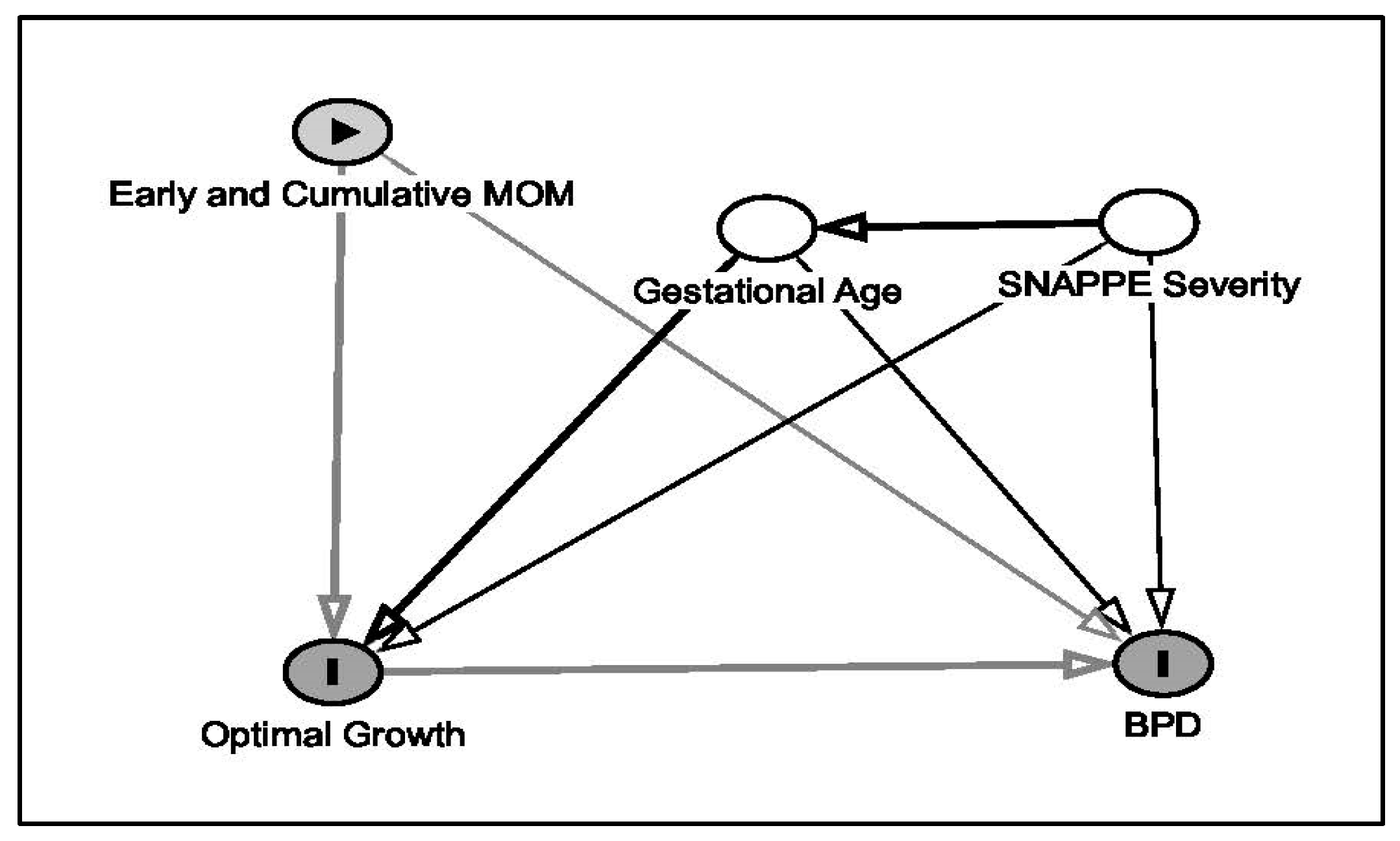
3.1. Covariate Selection with Directed Acyclic Graph Assessment
3.2. Infant Population Characteristics
3.3. Infant Growth Failure and BPD Association
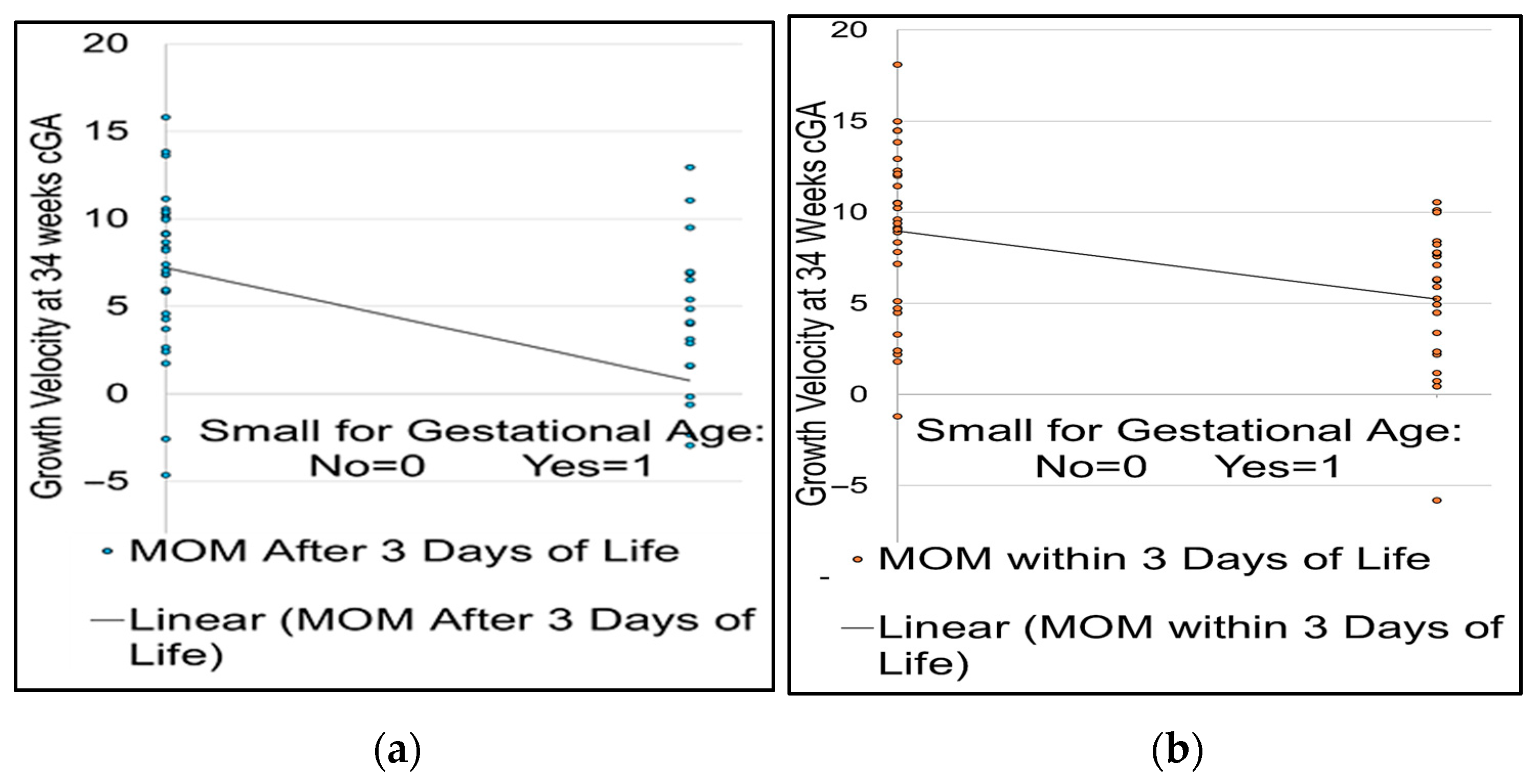
3.4. Influence of MOM and PDHM on Growth Velocity
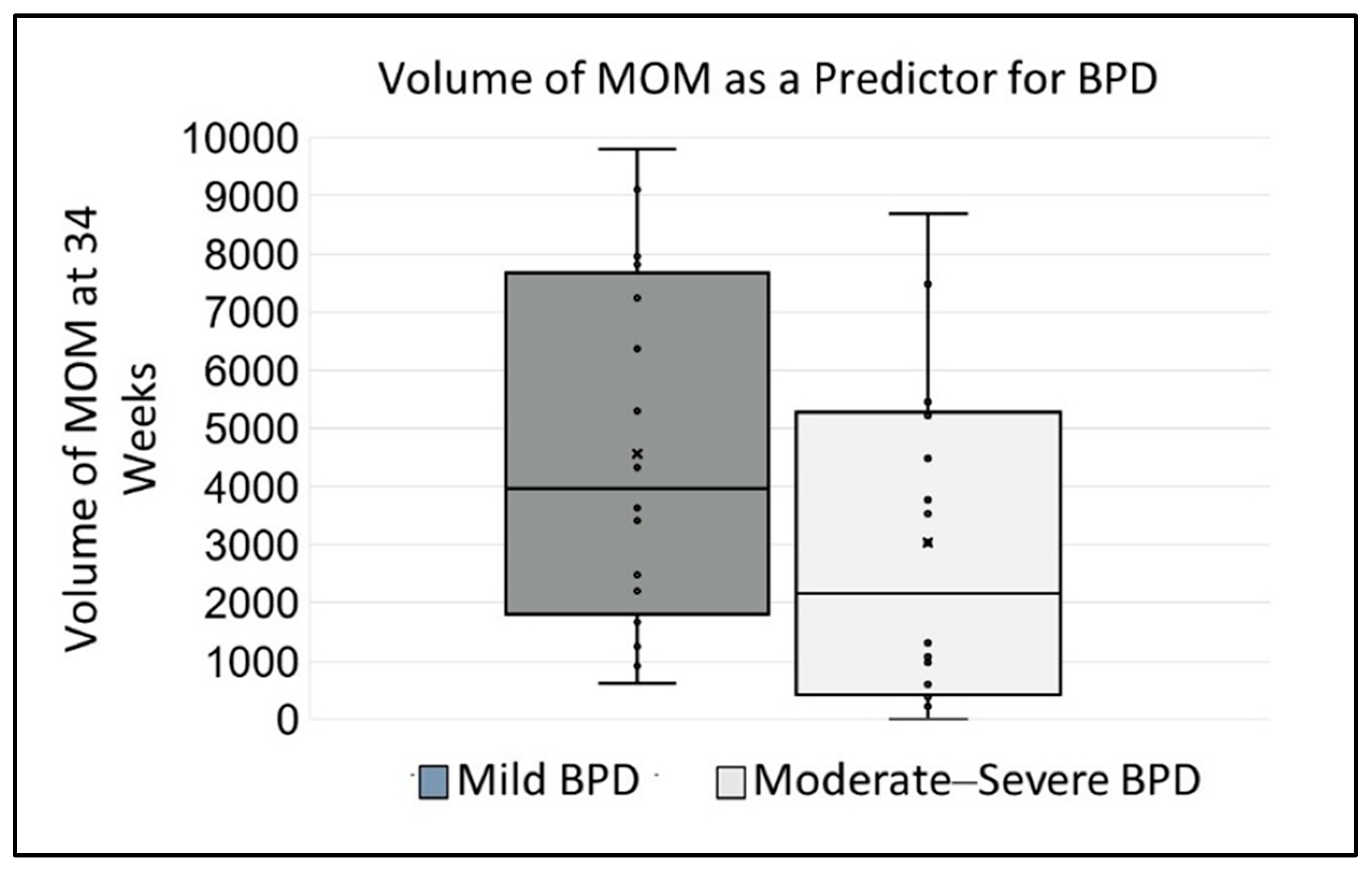
3.5. Influence of Volume of MOM and PDHM on Risk of BPD
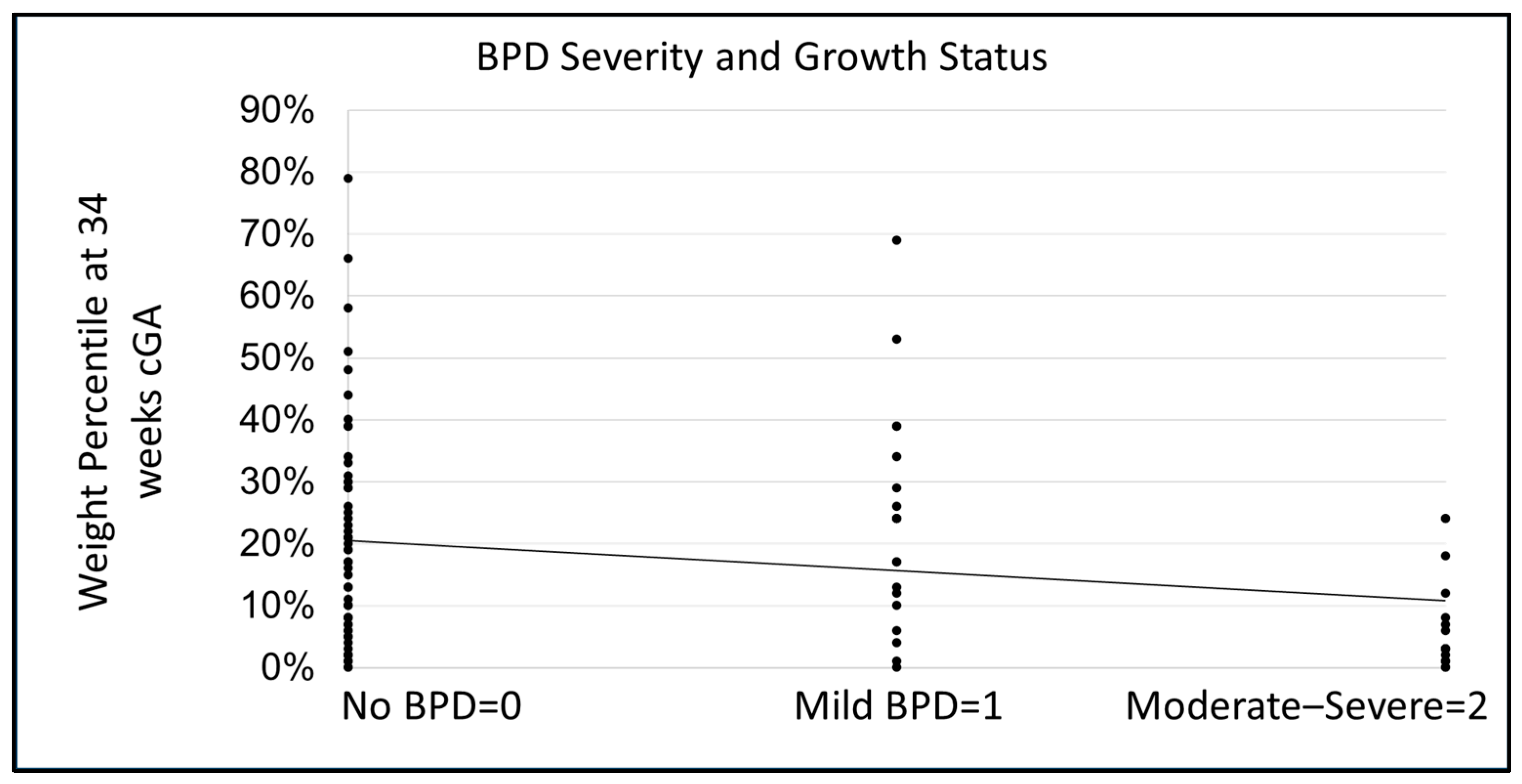
3.6. Association of Growth Failure and Risk of BPD
4. Discussion
5. Conclusions
Author Contributions
Funding
Institutional Review Board Statement
Informed Consent Statement
Data Availability Statement
Acknowledgments
Conflicts of Interest
Abbreviations
| MOM | Mother’s own milk |
| PDHM | Pasteurized Donor Human Milk |
| BPD | Bronchopulmonary dysplasia |
References
- Barfield, W.D. Public Health Implications of Very Preterm Birth. Clin. Perinatol. 2018, 45, 565–577. [Google Scholar] [CrossRef] [PubMed]
- Cooke, R.J.; Ainsworth, S.B.; Fenton, A.C. Postnatal growth retardation: A universal problem in preterm infants. Arch. Dis. Child. Fetal Neonatal Ed. 2004, 89, F428–F430. [Google Scholar] [CrossRef] [PubMed]
- Shah, P.S.; Wong, K.Y.; Merko, S.; Bishara, R.; Dunn, M.; Asztalos, E.; Darling, P.B. Postnatal growth failure in preterm infants: Ascertainment and relation to long-term outcome. J. Perinat. Med. 2006, 34, 484–489. [Google Scholar] [CrossRef]
- Benjamin-Chung, J.; Mertens, A.; Colford, J.M., Jr.; Hubbard, A.E.; van der Laan, M.J.; Coyle, J.; Sofrygin, O.; Cai, W.; Nguyen, A.; Pokpongkiat, N.N.; et al. Early-childhood linear growth faltering in low- and middle-income countries. Nature 2023, 621, 550–557. [Google Scholar] [CrossRef]
- Rocha, G.; Guimaraes, H.; Pereira-da-Silva, L. The Role of Nutrition in the Prevention and Management of Bronchopulmonary Dysplasia: A Literature Review and Clinical Approach. Int. J. Environ. Res. Public Health 2021, 18, 6245. [Google Scholar] [CrossRef] [PubMed]
- Spiegler, J.; Preuß, M.; Gebauer, C.; Bendiks, M.; Herting, E.; Göpel, W.; German Neonatal Network (GNN). Does Breastmilk Influence the Development of Bronchopulmonary Dysplasia? J. Pediatr. 2016, 169, 76–80.e74. [Google Scholar] [CrossRef]
- Villamor-Martinez, E.; Pierro, M.; Cavallaro, G.; Mosca, F.; Kramer, B.W.; Villamor, E. Donor Human Milk Protects against Bronchopulmonary Dysplasia: A Systematic Review and Meta-Analysis. Nutrients 2018, 10, 238. [Google Scholar] [CrossRef]
- Furman, L.; Taylor, G.; Minich, N.; Hack, M. The effect of maternal milk on neonatal morbidity of very low-birth-weight infants. Arch. Pediatr. Adolesc. Med. 2003, 157, 66–71. [Google Scholar] [CrossRef]
- Bancalari, E.; del Moral, T. Bronchopulmonary dysplasia and surfactant. Biol. Neonate 2001, 80, 7–13. [Google Scholar] [CrossRef]
- Jobe, A.H.; Bancalari, E. Bronchopulmonary dysplasia. Am. J. Respir. Crit. Care Med. 2001, 163, 1723–1729. [Google Scholar] [CrossRef]
- Jensen, E.A.; Dysart, K.; Gantz, M.G.; McDonald, S.; Bamat, N.A.; Keszler, M.; Kirpalani, H.; Laughon, M.M.; Poindexter, B.B.; Duncan, A.F.; et al. The Diagnosis of Bronchopulmonary Dysplasia in Very Preterm Infants. An Evidence-based Approach. Am. J. Respir. Crit. Care Med. 2019, 200, 751–759. [Google Scholar] [CrossRef]
- Islam, J.Y.; Keller, R.L.; Aschner, J.L.; Hartert, T.V.; Moore, P.E. Understanding the Short- and Long-Term Respiratory Outcomes of Prematurity and Bronchopulmonary Dysplasia. Am. J. Respir. Crit. Care Med. 2015, 192, 134–156. [Google Scholar] [CrossRef]
- Piersigilli, F.; Bhandari, V. Metabolomics of bronchopulmonary dysplasia. Clin. Chim. Acta 2020, 500, 109–114. [Google Scholar] [CrossRef]
- Higgins, R.D.; Jobe, A.H.; Koso-Thomas, M.; Bancalari, E.; Viscardi, R.M.; Hartert, T.V.; Ryan, R.M.; Kallapur, S.G.; Steinhorn, R.H.; Konduri, G.G.; et al. Bronchopulmonary Dysplasia: Executive Summary of a Workshop. J. Pediatr. 2018, 197, 300–308. [Google Scholar] [CrossRef] [PubMed]
- Hicks, S.D.; Beheshti, R.; Chandran, D.; Warren, K.; Confair, A. Infant consumption of microRNA miR-375 in human milk lipids is associated with protection from atopy. Am. J. Clin. Nutr. 2022, 116, 1654–1662. [Google Scholar] [CrossRef] [PubMed]
- Kho, A.T.; McGeachie, M.J.; Moore, K.G.; Sylvia, J.M.; Weiss, S.T.; Tantisira, K.G. Circulating microRNAs and prediction of asthma exacerbation in childhood asthma. Respir. Res. 2018, 19, 128. [Google Scholar] [CrossRef] [PubMed]
- Fonseca, L.T.; Senna, D.C.; Silveira, R.C.; Procianoy, R.S. Association between Breast Milk and Bronchopulmonary Dysplasia: A Single Center Observational Study. Am. J. Perinatol. 2017, 34, 264–269. [Google Scholar] [CrossRef]
- Merino-Hernandez, A.; Palacios-Bermejo, A.; Ramos-Navarro, C.; Caballero-Martin, S.; Gonzalez-Pacheco, N.; Rodriguez-Corrales, E.; Sanchez-Gomez de Orgaz, M.C.; Sanchez-Luna, M. Effect of Donated Premature Milk in the Prevention of Bronchopulmonary Dysplasia. Nutrients 2024, 16, 859. [Google Scholar] [CrossRef]
- Siddiqui, A.; Voynow, J.; Chahin, N.; Williams, A.; Xu, J.; Chavez, D.; Carroll, L.; Hendricks-Munoz, K.D. Greater and Earlier Exposure of Mother’s Own Milk Compared to Donor Human Milk Moderates Risk and Severity of Bronchopulmonary Dysplasia. Breastfeed. Med. 2025, 20, 111–117. [Google Scholar] [CrossRef]
- Villamor-Martinez, E.; Pierro, M.; Cavallaro, G.; Mosca, F.; Villamor, E. Mother’s Own Milk and Bronchopulmonary Dysplasia: A Systematic Review and Meta-Analysis. Front. Pediatr. 2019, 7, 224. [Google Scholar] [CrossRef]
- Zhu, Y.; Chen, X.; Zhu, J.; Jiang, C.; Yu, Z.; Su, A. Effect of First Mother’s Own Milk Feeding Time on the Risk of Moderate and Severe Bronchopulmonary Dysplasia in Infants with Very Low Birth Weight. Front. Pediatr. 2022, 10, 887028. [Google Scholar] [CrossRef]
- Montjaux-Regis, N.; Cristini, C.; Arnaud, C.; Glorieux, I.; Vanpee, M.; Casper, C. Improved growth of preterm infants receiving mother’s own raw milk compared with pasteurized donor milk. Acta Paediatr. 2011, 100, 1548–1554. [Google Scholar] [CrossRef]
- Colaizy, T.T.; Carlson, S.; Saftlas, A.F.; Morriss, F.H. Growth in VLBW infants fed predominantly fortified maternal and donor human milk diets: A retrospective cohort study. BMC Pediatr. 2012, 12, 124. [Google Scholar] [CrossRef] [PubMed]
- Cerasani, J.; Ceroni, F.; De Cosmi, V.; Mazzocchi, A.; Morniroli, D.; Roggero, P.; Mosca, F.; Agostoni, C.; Gianni, M.L. Human Milk Feeding and Preterm Infants’ Growth and Body Composition: A Literature Review. Nutrients 2020, 12, 1155. [Google Scholar] [CrossRef] [PubMed]
- Lund, A.M.; Lofqvist, C.; Pivodic, A.; Lundgren, P.; Hard, A.L.; Hellstrom, A.; Hansen-Pupp, I. Unpasteurised maternal breast milk is positively associated with growth outcomes in extremely preterm infants. Acta Paediatr. 2020, 109, 1138–1147. [Google Scholar] [CrossRef]
- Picaud, J.C.; Buffin, R. Human Milk-Treatment and Quality of Banked Human Milk. Clin. Perinatol. 2017, 44, 95–119. [Google Scholar] [CrossRef]
- Ong, K.K.; Kennedy, K.; Castaneda-Gutierrez, E.; Forsyth, S.; Godfrey, K.M.; Koletzko, B.; Latulippe, M.E.; Ozanne, S.E.; Rueda, R.; Schoemaker, M.H.; et al. Postnatal growth in preterm infants and later health outcomes: A systematic review. Acta Paediatr. 2015, 104, 974–986. [Google Scholar] [CrossRef]
- Piemontese, P.; Mallardi, D.; Liotto, N.; Tabasso, C.; Menis, C.; Perrone, M.; Roggero, P.; Mosca, F. Macronutrient content of pooled donor human milk before and after Holder pasteurization. BMC Pediatr. 2019, 19, 58. [Google Scholar] [CrossRef] [PubMed]
- Zhang, S.Q.; Sproles, A.; Fu, T.T. Effect of Pasteurization on Ghrelin and Resistin Hormone Concentrations in Human Breast Milk. Breastfeed. Med. 2025, 20, 750–755. [Google Scholar] [CrossRef]
- Conboy-Stephenson, R.; Ross, R.P.; Kelly, A.L.; Stanton, C. Donor human milk: The influence of processing technologies on its nutritional and microbial composition. Front. Nutr. 2024, 11, 1468886. [Google Scholar] [CrossRef]
- Peila, C.; Moro, G.E.; Bertino, E.; Cavallarin, L.; Giribaldi, M.; Giuliani, F.; Cresi, F.; Coscia, A. The Effect of Holder Pasteurization on Nutrients and Biologically-Active Components in Donor Human Milk: A Review. Nutrients 2016, 8, 477. [Google Scholar] [CrossRef]
- Munblit, D.; Treneva, M.; Peroni, D.G.; Colicino, S.; Chow, L.; Dissanayeke, S.; Abrol, P.; Sheth, S.; Pampura, A.; Boner, A.L.; et al. Colostrum and Mature Human Milk of Women from London, Moscow, and Verona: Determinants of Immune Composition. Nutrients 2016, 8, 695. [Google Scholar] [CrossRef]
- Peroni, D.G.; Pescollderungg, L.; Piacentini, G.L.; Rigotti, E.; Maselli, M.; Watschinger, K.; Piazza, M.; Pigozzi, R.; Boner, A.L. Immune regulatory cytokines in the milk of lactating women from farming and urban environments. Pediatr. Allergy Immunol. 2010, 21, 977–982. [Google Scholar] [CrossRef]
- Ustundag, B.; Yilmaz, E.; Dogan, Y.; Akarsu, S.; Canatan, H.; Halifeoglu, I.; Cikim, G.; Aygun, A.D. Levels of cytokines (IL-1beta, IL-2, IL-6, IL-8, TNF-alpha) and trace elements (Zn, Cu) in breast milk from mothers of preterm and term infants. Mediat. Inflamm. 2005, 2005, 331–336. [Google Scholar] [CrossRef]
- Kim, S.Y.; Yi, D.Y. Components of human breast milk: From macronutrient to microbiome and microRNA. Clin. Exp. Pediatr. 2020, 63, 301–309. [Google Scholar] [CrossRef] [PubMed]
- Richardson, D.K.; Corcoran, J.D.; Escobar, G.J.; Lee, S.K. SNAP-II and SNAPPE-II: Simplified newborn illness severity and mortality risk scores. J. Pediatr. 2001, 138, 92–100. [Google Scholar] [CrossRef]
- Fenton, T.R.; Kim, J.H. A systematic review and meta-analysis to revise the Fenton growth chart for preterm infants. BMC Pediatr. 2013, 13, 59. [Google Scholar] [CrossRef]
- Lederer, D.J.; Bell, S.C.; Smyth, A.R.; Chalmers, J.D. Reply: More on Causal Inference Studies. Ann. Am. Thorac. Soc. 2019, 16, 646. [Google Scholar] [CrossRef]
- Lederer, D.J.; Bell, S.C.; Branson, R.D.; Chalmers, J.D.; Marshall, R.; Maslove, D.M.; Ost, D.E.; Punjabi, N.M.; Schatz, M.; Smyth, A.R.; et al. Control of Confounding and Reporting of Results in Causal Inference Studies. Guidance for Authors from Editors of Respiratory, Sleep, and Critical Care Journals. Ann. Am. Thorac. Soc. 2019, 16, 22–28. [Google Scholar] [CrossRef] [PubMed]
- Morales, Y.; Schanler, R.J. Human milk and clinical outcomes in VLBW infants: How compelling is the evidence of benefit? Semin. Perinatol. 2007, 31, 83–88. [Google Scholar] [CrossRef] [PubMed]
- Schanler, R.J. Outcomes of human milk-fed premature infants. Semin. Perinatol. 2011, 35, 29–33. [Google Scholar] [CrossRef]
- Schanler, R.J. Mother’s own milk, donor human milk, and preterm formulas in the feeding of extremely premature infants. J. Pediatr. Gastroenterol. Nutr. 2007, 45, S175–S177. [Google Scholar] [CrossRef]
- Committee on Nutrition; Section on Breastfeeding; Committee on Fetus and Newborn. Donor Human Milk for the High-Risk Infant: Preparation, Safety, and Usage Options in the United States. Pediatrics 2017, 139, e20163440. [Google Scholar] [CrossRef]
- Asbury, M.R.; Butcher, J.; Copeland, J.K.; Unger, S.; Bando, N.; Comelli, E.M.; Forte, V.; Kiss, A.; LeMay-Nedjelski, L.; Sherman, P.M.; et al. Mothers of Preterm Infants Have Individualized Breast Milk Microbiota that Changes Temporally Based on Maternal Characteristics. Cell Host Microbe 2020, 28, 669–682e664. [Google Scholar] [CrossRef] [PubMed]
- Bancalari, E. Changes in the pathogenesis and prevention of chronic lung disease of prematurity. Am. J. Perinatol. 2001, 18, 1–10. [Google Scholar] [CrossRef]
- Maffei, D.; Schanler, R.J. Human milk is the feeding strategy to prevent necrotizing enterocolitis! Semin. Perinatol. 2017, 41, 36–40. [Google Scholar] [CrossRef]
- Putz, E.; Ascherl, R.; Wendt, T.; Thome, U.H.; Gebauer, C.; Genuneit, J.; Siziba, L.P. The association of different types of human milk with bronchopulmonary dysplasia in preterm infants. Front. Nutr. 2024, 11, 1408033. [Google Scholar] [CrossRef] [PubMed]
- Miller, J.; Tonkin, E.; Damarell, R.A.; McPhee, A.J.; Suganuma, M.; Suganuma, H.; Middleton, P.F.; Makrides, M.; Collins, C.T. A Systematic Review and Meta-Analysis of Human Milk Feeding and Morbidity in Very Low Birth Weight Infants. Nutrients 2018, 10, 707. [Google Scholar] [CrossRef] [PubMed]
- Sayed, D.; Abdellatif, M. MicroRNAs in development and disease. Physiol. Rev. 2011, 91, 827–887. [Google Scholar] [CrossRef]
- Underwood, M.A. Missed Opportunities: The Cost of Suboptimal Breast Milk Feeding in the Neonatal Intensive Care Unit. J. Pediatr. 2016, 175, 12–14. [Google Scholar] [CrossRef][Green Version]
- Pineiro-Ramos, J.D.; Parra-Llorca, A.; Ten-Domenech, I.; Gormaz, M.; Ramon-Beltran, A.; Cernada, M.; Quintas, G.; Collado, M.C.; Kuligowski, J.; Vento, M. Effect of donor human milk on host-gut microbiota and metabolic interactions in preterm infants. Clin. Nutr. 2021, 40, 1296–1309. [Google Scholar] [CrossRef] [PubMed]
- Dicky, O.; Ehlinger, V.; Montjaux, N.; Gremmo-Feger, G.; Sizun, J.; Roze, J.C.; Arnaud, C.; Casper, C.; EPIPAGE 2 Nutrition Study Group; EPINUTRI Study Group. Policy of feeding very preterm infants with their mother’s own fresh expressed milk was associated with a reduced risk of bronchopulmonary dysplasia. Acta Paediatr. 2017, 106, 755–762. [Google Scholar] [CrossRef] [PubMed]
- Madore, L.S.; Sen, S. Inconsistencies in Outcomes of Donor Breast Milk for Preterm Infants. Clin. Ther. 2017, 39, 2451–2452. [Google Scholar] [CrossRef] [PubMed]



| Characteristics | |
|---|---|
| Gestational Age (weeks) ± SD | 27.1 ± 1.5 |
| Birthweight (grams) ± SD | 1151 ± 441 |
| Sex—Female n (%) | 55 (55) |
| Sex—Male n (%) | 45 (45) |
| Race and Ethnicity—n (%) | |
| White | 37 (37) |
| Black | 46 (46) |
| Asian/Other | 6 (6) |
| Hispanic | 11(11) |
| Characteristics | No BPD n = 61 | Mild BPD n = 21 | Moderate–Severe BPD n = 18 |
|---|---|---|---|
| Gestational Age (weeks) ± SD | 29.1 ± 1.8 | 26.1 ± 1.9 | 27.1 ± 2.8 |
| Birthweight (grams) ± SD | 1542 ± 323 | 1109 ± 296 | 803 ± 230 |
| Growth Failure <10% tle n (%) | 23 (38) | 4 (19) | 14 (78) |
| Growth Failure <3% tle n (%) | 10 (16) | 2 (10) | 6 (33) |
| Sex—Female n (%) | 30 (50) | 14 (67) | 11 (61) |
| Sex—Male n (%) | 31 (50) | 7 (33) | 7 (39) |
| Race and Ethnicity—n (%) | |||
| White | 29 (47) | 9 (43) | 8 (44) |
| Black | 20 (33) | 10 (48) | 7 (39) |
| Asian/Other/Hispanic | 12 (20) | 2 (9) | 3 (17) |
Disclaimer/Publisher’s Note: The statements, opinions and data contained in all publications are solely those of the individual author(s) and contributor(s) and not of MDPI and/or the editor(s). MDPI and/or the editor(s) disclaim responsibility for any injury to people or property resulting from any ideas, methods, instructions or products referred to in the content. |
© 2026 by the authors. Licensee MDPI, Basel, Switzerland. This article is an open access article distributed under the terms and conditions of the Creative Commons Attribution (CC BY) license.
Share and Cite
Hendricks-Muñoz, K.D.; Yitayew, M.S.; Chahin, N.; Williams, A.; Xu, J.; Abdulkadir, A.; Alemayehu, B.; Voynow, J.A. The Impact of Enteral Nutrition Type, Volume, and Time of Introduction on the Risk of Growth Failure and Bronchopulmonary Dysplasia in Preterm Infants. Nutrients 2026, 18, 283. https://doi.org/10.3390/nu18020283
Hendricks-Muñoz KD, Yitayew MS, Chahin N, Williams A, Xu J, Abdulkadir A, Alemayehu B, Voynow JA. The Impact of Enteral Nutrition Type, Volume, and Time of Introduction on the Risk of Growth Failure and Bronchopulmonary Dysplasia in Preterm Infants. Nutrients. 2026; 18(2):283. https://doi.org/10.3390/nu18020283
Chicago/Turabian StyleHendricks-Muñoz, Karen D., Miheret S. Yitayew, Nayef Chahin, Allison Williams, Jie Xu, Adeola Abdulkadir, Bemnet Alemayehu, and Judith A. Voynow. 2026. "The Impact of Enteral Nutrition Type, Volume, and Time of Introduction on the Risk of Growth Failure and Bronchopulmonary Dysplasia in Preterm Infants" Nutrients 18, no. 2: 283. https://doi.org/10.3390/nu18020283
APA StyleHendricks-Muñoz, K. D., Yitayew, M. S., Chahin, N., Williams, A., Xu, J., Abdulkadir, A., Alemayehu, B., & Voynow, J. A. (2026). The Impact of Enteral Nutrition Type, Volume, and Time of Introduction on the Risk of Growth Failure and Bronchopulmonary Dysplasia in Preterm Infants. Nutrients, 18(2), 283. https://doi.org/10.3390/nu18020283