Nutritional Monitoring and Intervention in Paediatric Inflammatory Bowel Disease

 , , , and
Abstract
1. Introduction
2. Materials and Methods
3. Assessment of Nutritional Status
4. Medical Management and Supportive Nutrition
5. Dietary Treatments
5.1. Exclusive Enteral Nutrition (EEN)
5.2. Crohn’s Disease Exclusion Diet and Partial Enteral Nutrition
5.3. CD TREAT
5.4. Tasty and Healthy
5.5. Specific Carbohydrate Diet
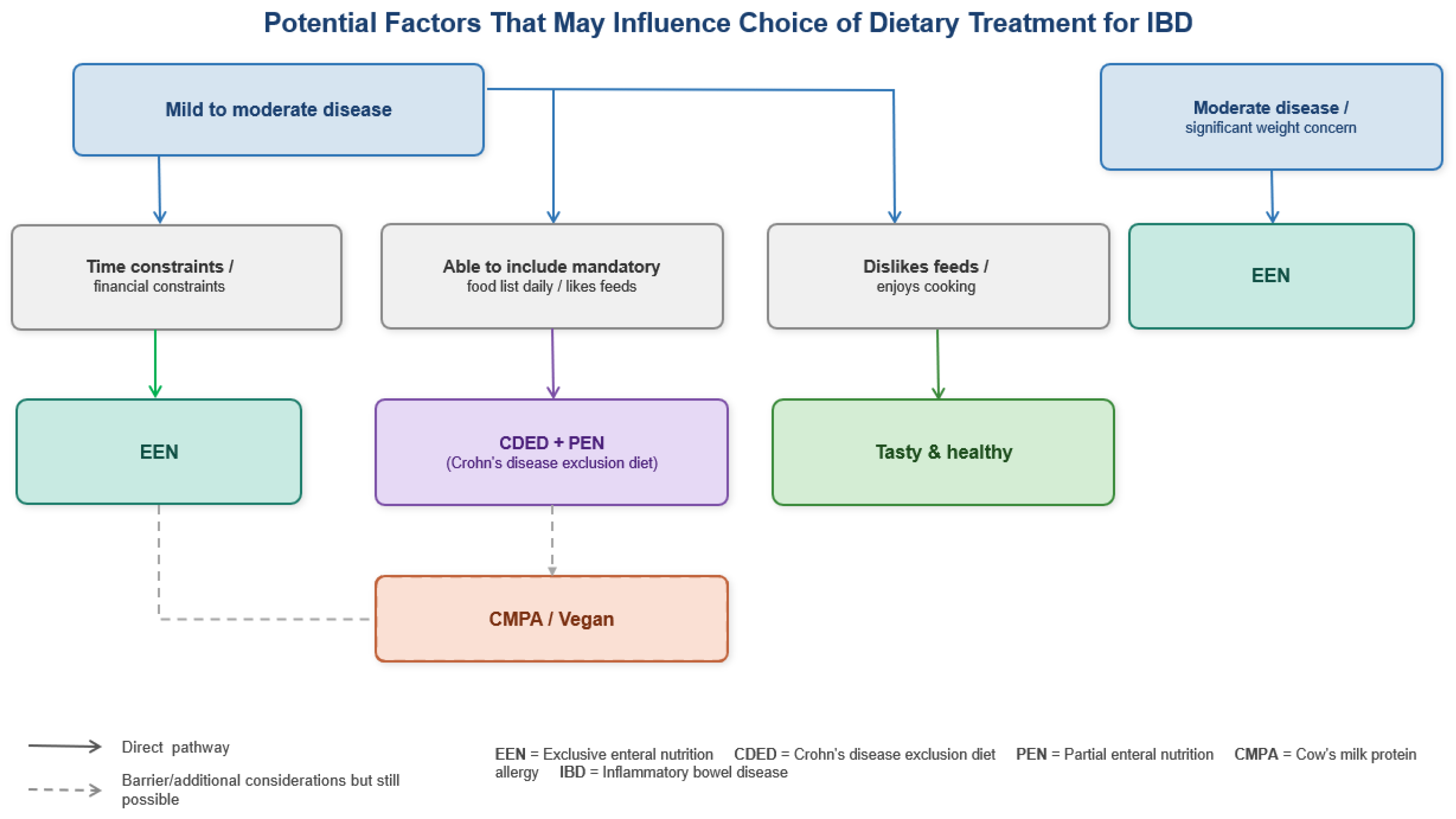
6. Treatment Choice for Crohn’s Disease (Table 2 and Figure 1)
- Patient Traits and Skills for Selecting Dietary Therapy in Crohn’s Disease

| Patient Trait | Exclusive Enteral Nutrition (EEN) | Tasty and Healthy Diet | Crohn’s Disease Exclusion Diet (CDED) |
|---|---|---|---|
| Motivation and mindset | |||
| Readiness | High motivation for rapid remission | Motivated to try new recipes | Motivated to prepare food regularly |
| Discipline | Able to focus on delayed gratification | Has culinary autonomy | Prefers structured flexibility |
| Priority | Accepts short-term social disruption | Prioritises flexibility over rigid rules | Motivated to avoid escalation to EEN |
| Practical and lifestyle factors | |||
| Tolerance | Able to tolerate a fully liquid diet (no solids) | Has good baseline cooking confidence and acceptability to minimally processed foods | Able to follow a detailed, phased meal plan. Able to tolerate mandatory foods |
| Time and resources | Limited cooking time or ability is not a barrier | Has time available for meal preparation | Has strong organisational and planning skills |
| Acceptability | Prefers convenience; avoids recipe planning | Able to afford non-convenience, whole foods | Able to cook and include mandatory foods daily |
| Health literacy | Willing to use an NG tube if oral intake is difficult | Able to read and understand food labels | Comfortable reintroducing foods in stages |
| Family and social support | |||
| Home support | Has caregiver or family support at home | Prioritise typical family meals | Family able to prepare excluded-food meals |
| Social fit | Comfortable with a structured, finite plan | Values typical social eating | Able to cope with social eating structures |
| Clinical fit | |||
| Disease severity | Severe or stricturing disease; growth failure | Mild disease to moderate disease; maintenance phase | Mild to moderate disease; Maintenance phase |
| Key risk to monitor | |||
| Risk | Disengagement from prolonged liquid-only diet | Logistically difficult to provide exclusively home cooked/nil processed foods | Plan fatigue with complex exclusion phases |
| Typical patient profile | |||
| Profile | Highly motivated, structured routine | Independent, socially active | Detail-oriented, family-supported |

7. Maintenance of Remission
8. Quality of Life Considerations
9. Conclusions
Author Contributions
Funding
Institutional Review Board Statement
Informed Consent Statement
Data Availability Statement
Conflicts of Interest
References
- Gerasimidis, K. Nutrition and dietary therapy in paediatric inflammatory bowel disease. Clin. Nutr. ESPEN 2025, 67, 233–241. [Google Scholar] [CrossRef] [Scilit]
- Miele, E.; Shamir, R.; Aloi, M.; Assa, A.; Braegger, C.; Bronsky, J.; de Ridder, L.; Escher, J.C.; Hojsak, I.; Kolaček, S.; et al. Nutrition in Pediatric Inflammatory Bowel Disease: A Position Paper on Behalf of the Porto Inflammatory Bowel Disease Group of the European Society of Pediatric Gastroenterology, Hepatology and Nutrition. J. Pediatr. Gastroenterol. Nutr. 2018, 66, 687–708. [Google Scholar] [CrossRef] [Scilit]
- Gerasimidis, K.; McGrogan, P.; Edwards, C.A. The aetiology and impact of malnutrition in paediatric inflammatory bowel disease. J. Hum. Nutr. Diet. 2011, 24, 313–326. [Google Scholar] [CrossRef] [Scilit]
- Brown, S.C.; Whelan, K.; Frampton, C.; Wall, C.L.; Gearry, R.B.; Day, A.S. Food-Related Quality of Life in Children and Adolescents with Crohn’s Disease. Inflamm. Bowel Dis. 2022, 28, 1838–1843. [Google Scholar] [CrossRef] [Scilit]
- Diederen, K.; Krom, H.; Koole, J.C.D.; Benninga, M.A.; Kindermann, A. Diet and Anthropometrics of Children with Inflammatory Bowel Disease: A Comparison with the General Population. Inflamm. Bowel Dis. 2018, 24, 1632–1640. [Google Scholar] [CrossRef] [Scilit]
- WHO multicentre growth reference study group. WHO child Growth Standards based on length/height, weight and age. Acta Paediatr. 2006, 450, 76–85. [Google Scholar] [CrossRef] [Scilit]
- Ozer, N.T.; Sezgin, G.C.; Ergul, S.S.; Sahin, G.G.; Yurci, M.A.; Guven, K.; Gundogan, K. The Incidence and Risk Factors of Refeeding Syndrome-like Hypophosphatemia in Inflammatory Bowel Disease: A Preliminary Study. J. Gastrointest. Liver Dis. 2024, 33, 323–329. [Google Scholar] [CrossRef] [Scilit]
- Corsello, A.; Trovato, C.M.; Dipasquale, V.; Bolasco, G.; Labriola, F.; Gottrand, F.; Verduci, E.; Diamanti, A.; Romano, C. Refeeding syndrome in pediatric age, an unknown disease: A narrative review. J. Pediatr. Gastroenterol. Nutr. 2023, 77, e75–e83. [Google Scholar] [CrossRef] [Scilit]
- Kersten, H.B.; Goday, P.S.; Abdelhadi, R.; Adolphe, S.; Anania, N.; Bennett, D.S.; Burke, L.W.; Larson-Nath, C.; Lee, T.M.; Leu, M.G.; et al. Clinical Practice Guideline for Diagnosis and Management of Faltering Weight. Pediatrics 2026, 157, e2025075764. [Google Scholar] [CrossRef] [Scilit]
- Gerasimidis, K.; Bronsky, J.; Catchpole, A.; Embleton, N.; Fewtrell, M.; Hojsak, I.; Indrio, F.; Hulst, J.; Köglmeier, J.; de Koning, B.; et al. Assessment and Interpretation of Vitamin and Trace Element Status in Sick Children: A Position Paper from the European Society for Paediatric Gastroenterology Hepatology, and Nutrition Committee on Nutrition. J. Pediatr. Gastroenterol. Nutr. 2020, 70, 873–881. [Google Scholar] [CrossRef] [Scilit]
- Cococcioni, L.; Pensabene, L.; El-Khouly, S.; Chadokufa, S.; McCartney, S.; Saliakellis, E.; Kiparissi, F.; Borrelli, O. Ferric carboxymaltose treatment for iron deficiency anemia in children with inflammatory bowel disease: Efficacy and risk of hypophosphatemia. Dig. Liver Dis. 2021, 53, 830–834. [Google Scholar] [CrossRef] [Scilit]
- Valvano, M.; Capannolo, A.; Cesaro, N.; Stefanelli, G.; Fabiani, S.; Frassino, S.; Monaco, S.; Magistroni, M.; Viscido, A.; Latella, G. Nutrition, Nutritional Status, Micronutrients Deficiency, and Disease Course of Inflammatory Bowel Disease. Nutrients 2023, 15, 3824. [Google Scholar] [CrossRef] [Scilit]
- van Rheenen, P.F.; Aloi, M.; Assa, A.; Bronsky, J.; Escher, J.C.; Fagerberg, U.L.; Gasparetto, M.; Gerasimidis, K.; Griffiths, A.; Henderson, P.; et al. The Medical Management of Paediatric Crohn’s Disease: An ECCO-ESPGHAN Guideline Update. J. Crohn’s Colitis 2020, 15, 171–194. [Google Scholar] [CrossRef] [Scilit]
- Yu, Y.; Chen, J. Exclusive enteral nutrition for treating pediatric Crohn’s disease. World J. Pediatr. 2024, 20, 869–871. [Google Scholar] [CrossRef] [Scilit]
- Dijk, S.; Jarman, M.; Zhang, Z.; Lawley, M.; Ahmad, M.; Suarez, R.; Rossi, L.; Chen, M.; Wu, J.; Carroll, M.W.; et al. Pre-Diagnosis Diet Predicts Response to Exclusive Enteral Nutrition and Correlates with Microbiome in Pediatric Crohn Disease. Nutrients 2024, 16, 1033. [Google Scholar] [CrossRef] [Scilit]
- Gill, S.K.; Rossi, M.; Bajka, B.; Whelan, K. Dietary fibre in gastrointestinal health and disease. Nat. Rev. Gastroenterol. Hepatol. 2021, 18, 101–116. [Google Scholar] [CrossRef] [Scilit]
- Armstrong, H.; Mander, I.; Zhang, Z.; Armstrong, D.; Wine, E. Not All Fibers Are Born Equal; Variable Response to Dietary Fiber Subtypes in IBD. Front. Pediatr. 2021, 8, 620189. [Google Scholar] [CrossRef] [Scilit]
- Armstrong, H.K.; Bording-Jorgensen, M.; Santer, D.M.; Zhang, Z.; Valcheva, R.; Rieger, A.M.; Kim, J.S.-H.; Dijk, S.I.; Mahmood, R.; Ogungbola, O.; et al. Unfermented β-fructan Fibers Fuel Inflammation in Select Inflammatory Bowel Disease Patients. Gastroenterology 2023, 164, 228–240. [Google Scholar] [CrossRef] [Scilit]
- Peters, V.; Dijkstra, G.; Campmans-Kuijpers, M.J.E. Are all dietary fibers equal for patients with inflammatory bowel disease? A systematic review of randomized controlled trials. Nutr. Rev. 2021, 80, 1179–1193. [Google Scholar] [CrossRef] [Scilit]
- Hart, L.; Verburgt, C.M.; Wine, E.; Zachos, M.; Poppen, A.; Chavannes, M.; Van Limbergen, J.; Pai, N. Nutritional Therapies and Their Influence on the Intestinal Microbiome in Pediatric Inflammatory Bowel Disease. Nutrients 2021, 14, 4. [Google Scholar] [CrossRef] [Scilit]
- Logan, M.; Gkikas, K.; Svolos, V.; Nichols, B.; Milling, S.; Gaya, D.R.; Seenan, J.P.; Macdonald, J.; Hansen, R.; Ijaz, U.Z.; et al. Analysis of 61 exclusive enteral nutrition formulas used in the management of active Crohn’s disease-new insights into dietary disease triggers. Aliment. Pharmacol. Ther. 2020, 51, 935–947. [Google Scholar] [CrossRef] [Scilit]
- Bancil, A.; Rossi, M.; Sandall, A.; Cox, S.; Dalrymple, K.; Kelaiditis, C.; Buckley, A.; Burke, S.; Xu, Y.; Smith, L.; et al. DOP097 Emulsifier restriction is an effective therapy for active Crohn’s disease: The ADDapt trial—A multi-centre, randomised, double-blind, placebo-controlled, re-supplementation trial in 154 patients. J. Crohn’s Colitis 2025, 19, i262. [Google Scholar] [CrossRef] [Scilit]
- Fairbrass, K.M.; Costantino, S.J.; Gracie, D.J.; Ford, A.C. Prevalence of irritable bowel syndrome-type symptoms in patients with inflammatory bowel disease in remission: A systematic review and meta-analysis. Lancet Gastroenterol. Hepatol. 2020, 5, 1053–1062. [Google Scholar] [CrossRef] [Scilit]
- Barbara, G.; Cremon, C.; Bellini, M.; Corsetti, M.; Di Nardo, G.; Falangone, F.; Fuccio, L.; Galeazzi, F.; Iovino, P.; Sarnelli, G.; et al. Italian guidelines for the management of irritable bowel syndrome. Dig. Liver Dis. 2023, 55, 187–207. [Google Scholar] [CrossRef] [Scilit]
- Groen, J.; Gordon, M.; Chogle, A.; Benninga, M.; Borlack, R.; Borrelli, O.; Darbari, A.; Dolinsek, J.; Khlevner, J.; Di Lorenzo, C.; et al. ESPGHAN/NASPGHAN guidelines for treatment of irritable bowel syndrome and functional abdominal pain-not otherwise specified in children aged 4–18 years. J. Pediatr. Gastroenterol. Nutr. 2025, 81, 442–471. [Google Scholar] [CrossRef] [Scilit]
- Thomassen, R.A.; Luque, V.; Assa, A.; Borrelli, O.; Broekaert, I.; Dolinsek, J.; Martin-de-Carpi, J.; Mas, E.; Miele, E.; Norsa, L.; et al. An ESPGHAN Position Paper on the Use of Low-FODMAP Diet in Pediatric Gastroenterology. J. Pediatr. Gastroenterol. Nutr. 2022, 75, 356–368. [Google Scholar] [CrossRef] [Scilit]
- Borrelli, O.; Cordischi, L.; Cirulli, M.; Paganelli, M.; Labalestra, V.; Uccini, S.; Russo, P.M.; Cucchiara, S. Polymeric Diet Alone Versus Corticosteroids in the Treatment of Active Pediatric Crohn’s Disease: A Randomized Controlled Open-Label Trial. Clin. Gastroenterol. Hepatol. 2006, 4, 744–753. [Google Scholar] [CrossRef] [Scilit]
- Rheenan, P. The Medical Management of Paediatric Crohn’s Disease: An ECCO-ESPGHAN Guideline Update. J. Crohn’s Colitis 2021, 15, 171–194. [Google Scholar] [CrossRef] [Scilit]
- Jackman, L.; Arpe, L.; O’ Connor, G. Exclusive enteral nutrition practices in the management of Crohn’s disease: A cross sectional survey of specialist paediatric dietitians. Clin. Nutr. ESPEN 2022, 49, 252–255. [Google Scholar] [CrossRef] [Scilit]
- Dawson, R.; Wands, D.I.F.; Logan, M.; Bremner, G.; Efklides, S.; Benn, L.; Henderson, P.; Grant, H.; Meredith, J.; Armstrong, K.; et al. Comparing Effectiveness of a Generic Oral Nutritional Supplement with Specialized Formula in the Treatment of Active Pediatric Crohn’s Disease. Inflamm. Bowel Dis. 2022, 28, 1859–1864. [Google Scholar] [CrossRef] [Scilit]
- Moran, G.W.; Gordon, M.; Sinopoulou, V.; Radford, S.J.; Darie, A.-M.; Vuyyuru, S.K.; Alrubaiy, L.; Arebi, N.; Blackwell, J.; Butler, T.D.; et al. British Society of Gastroenterology guidelines on inflammatory bowel disease in adults: 2025. Gut 2025, 74, s1–s101. [Google Scholar] [CrossRef] [Scilit]
- Heerasing, N.; Thompson, B.; Hendy, P.; Heap, G.A.; Walker, G.; Bethune, R.; Mansfield, S.; Calvert, C.; Kennedy, N.A.; Ahmad, T.; et al. Exclusive enteral nutrition provides an effective bridge to safer interval elective surgery for adults with Crohn’s disease. Aliment. Pharmacol. Ther. 2017, 45, 660–669. [Google Scholar] [CrossRef] [Scilit]
- Levine, A.; Wine, E.; Assa, A.; Boneh, R.S.; Shaoul, R.; Kori, M.; Cohen, S.; Peleg, S.; Shamaly, H.; On, A.; et al. Crohn’s Disease Exclusion Diet Plus Partial Enteral Nutrition Induces Sustained Remission in a Randomized Controlled Trial. Gastroenterology 2019, 157, 440–450.e8. [Google Scholar] [CrossRef] [Scilit]
- Zhu, Z.; Lei, Y.; Lin, Z. Effects of Crohn’s disease exclusion diet on remission: A systematic review. Ther. Adv. Gastroenterol. 2023, 16, 17562848231184056. [Google Scholar] [CrossRef] [Scilit]
- Boneh, R.S.; Navas-López, V.M.; Hussey, S.; Pujol-Muncunill, G.; Lawrence, S.; Rolandsdotter, H.; Otley, A.; Martín-De-Carpi, J.; Abramas, L.; Herrador-López, M.; et al. Modified Crohn’s Disease Exclusion Diet Maintains Remission in Pediatric Crohn’s Disease; Randomized Controlled Trial. Clin. Gastroenterol. Hepatol. 2024, 23, 2001–2011. [Google Scholar] [CrossRef] [Scilit]
- Boneh, R.S.; Shabat, C.S.; Yanai, H.; Chermesh, I.; Ben Avraham, S.; Boaz, M.; Levine, A. Dietary Therapy with the Crohn’s Disease Exclusion Diet is a Successful Strategy for Induction of Remission in Children and Adults Failing Biological Therapy. J. Crohn’s Colitis 2017, 11, 1205–1212. [Google Scholar] [CrossRef] [Scilit]
- Svolos, V.; Hansen, R.; Nichols, B.; Quince, C.; Ijaz, U.Z.; Papadopoulou, R.T.; Edwards, C.A.; Watson, D.; Alghamdi, A.; Brejnrod, A.; et al. Treatment of Active Crohn’s Disease with an Ordinary Food-based Diet That Replicates Exclusive Enteral Nutrition. Gastroenterology 2019, 156, 1354–1367.e6. [Google Scholar] [CrossRef] [Scilit]
- Aharoni-Frutkoff, Y.; Plotkin, L.; Pollak, D.; Livovsky, J.; Focht, G.; Lev-Tzion, R.; Ledder, O.; Assa, A.; Yogev, D.; Orlanski-Meyer, E.; et al. Whole Food Diet Induces Remission in Children and Young Adults with Mild to Moderate Crohn’s Disease and Is More Tolerable Than Exclusive Enteral Nutrition: A Randomized Controlled Trial. Gastroenterology 2025, 169, 1462–1474.e2. [Google Scholar] [CrossRef] [Scilit]
- Lewis, J.D.; Sandler, R.S.; Brotherton, C.; Brensinger, C.; Li, H.; Kappelman, M.D.; Daniel, S.G.; Bittinger, K.; Albenberg, L.; Valentine, J.F.; et al. A Randomized Trial Comparing the Specific Carbohydrate Diet to a Mediterranean Diet in Adults with Crohn’s Disease. Gastroenterology 2021, 161, 837–852.e9. [Google Scholar] [CrossRef] [Scilit]
- Pigneur, B.; Martinez-Vinson, C.; Bourmaud, A.; Dabadie, A.; Duclaux-Loras, R.; Hugot, J.-P.; Roman, C.; Dumant, C.; Spyckerelle, C.; Guinard-Samuel, V.; et al. Cyclic exclusive enteral nutrition versus partial enteral nutrition to maintain long-term drug-free remission in paediatric Crohn’s disease (CD-HOPE): An open-label, endpoint-blinded, randomised controlled trial. Lancet Gastroenterol. Hepatol. 2026, 11, 204–217. [Google Scholar] [CrossRef] [Scilit]
- Jatkowska, A.; White, B.; Gkikas, K.; Seenan, J.P.; MacDonald, J.; Gerasimidis, K. Partial Enteral Nutrition in the Management of Crohn’s Disease: A Systematic Review and Meta-Analysis. J. Crohn’s Colitis 2024, 19, jjae177. [Google Scholar] [CrossRef] [Scilit]
- Mohseni, S.; Tavakoli, A.; Ghazipoor, H.; Pouralimohamadi, N.; Zare, R.; Rampp, T.; Shayesteh, M.; Pasalar, M. Curcumin for the clinical treatment of inflammatory bowel diseases: A systematic review and meta-analysis of placebo-controlled randomized clinical trials. Front. Nutr. 2025, 12, 1494351. [Google Scholar] [CrossRef] [Scilit]
- Afzal, N.A.; Van Der Zaag-Loonen, H.J.; Arnaud-Battandier, F.; Davies, S.; Murch, S.; Derkx, B.; Heuschkel, R.; Fell, J.M. Improvement in quality of life of children with acute Crohn’s disease does not parallel mucosal healing after treatment with exclusive enteral nutrition. Aliment. Pharmacol. Ther. 2004, 20, 167–172. [Google Scholar] [CrossRef] [Scilit]
- Mutsekwa, R.N.; Edwards, J.T.; Angus, R.L. Exclusive enteral nutrition in the management of Crohn’s disease: A qualitative exploration of experiences, challenges and enablers in adult patients. J. Hum. Nutr. Diet. 2020, 34, 440–449. [Google Scholar] [CrossRef] [Scilit]
- Day, A.S.; Vanderstappen, J.; Sandall, A.; Svolos, V.; Shabat, C.S. From Kitchen to Inflammatory Bowel Disease (IBD) Clinic: Transforming the Role of Dietitians in IBD Care. A Narrative Review by Dietitians with Expertise in IBD. JCC Plus 2026, 1, e70007. [Google Scholar] [CrossRef] [Scilit]
| Micronutrient | Effect of Inflammation (High CRP/Low Albumin) | Clinical Interpretation Pitfall | Alternative/Bio-Marker Suggested |
|---|---|---|---|
| Zinc (Zn) |  Decreases sharply Decreases sharply | Plasma levels drop artificially due to redistribution into tissues, leading to a false diagnosis of deficiency. | Intracellular/erythrocyte zinc, or delay testing until inflammation resolves. |
| Selenium (Se) | Decreases | Plasma levels fall as part of the acute-phase response, causing a false-positive deficiency. | Erythrocyte selenium or functional markers like Glutathione Peroxidase activity. |
| Vitamin A (Retinol) | Decreases | Hepatic synthesis of Retinol-Binding Protein (RBP) is down-regulated by inflammation, causing blood levels to plummet despite adequate liver stores. | Retinol-to-RBP ratio, or delay testing. |
| Vitamin B6 (Pyridoxine) | Decreases | Plasma pyridoxal-5′-phosphate (PLP) drops significantly during major inflammation, masking true tissue status. | Erythrocyte AST activation coefficient or intracellular levels. |
| Vitamin C | Decreases | Rapidly consumed due to oxidative stress or cleared from plasma, making plasma levels look critically low. | Leukocyte vitamin C or clinical dietary assessment. |
| Iron/Ferritin |  Ferritin Increases Serum Iron Decreases Ferritin Increases Serum Iron Decreases | Ferritin acts as a positive acute-phase reactant. High inflammation masks a true iron deficiency by keeping ferritin artificially elevated. | Soluble Transferrin Receptor (sTfR) or sTfR-ferritin index. |
| Vitamins B1 & B2 |  Unchanged Unchanged | Erythrocyte measurements of Thiamine and Riboflavin are generally not perturbed by systemic inflammation. | Erythrocyte transketolase (or glutathione reductase activity. |
| Vitamin D | Decreases | Plasma levels fall as part of the acute-phase response, causing a false-positive deficiency | Parathyroid Hormone |
Disclaimer/Publisher’s Note: The statements, opinions and data contained in all publications are solely those of the individual author(s) and contributor(s) and not of MDPI and/or the editor(s). MDPI and/or the editor(s) disclaim responsibility for any injury to people or property resulting from any ideas, methods, instructions or products referred to in the content. |
© 2026 by the authors. Licensee MDPI, Basel, Switzerland. This article is an open access article distributed under the terms and conditions of the Creative Commons Attribution (CC BY) license.
Share and Cite
Arpe, L.; Jackman, L.; Jones, K.; Wells, E.; Kiparissi, F.; Gaynor, E.; Borrelli, O. Nutritional Monitoring and Intervention in Paediatric Inflammatory Bowel Disease. Nutrients 2026, 18, 2786. https://doi.org/10.3390/nu18172786
Arpe L, Jackman L, Jones K, Wells E, Kiparissi F, Gaynor E, Borrelli O. Nutritional Monitoring and Intervention in Paediatric Inflammatory Bowel Disease. Nutrients. 2026; 18(17):2786. https://doi.org/10.3390/nu18172786
Chicago/Turabian StyleArpe, Lauren, Lucy Jackman, Kelsey Jones, Eleanor Wells, Fevronia Kiparissi, Edward Gaynor, and Osvaldo Borrelli. 2026. "Nutritional Monitoring and Intervention in Paediatric Inflammatory Bowel Disease" Nutrients 18, no. 17: 2786. https://doi.org/10.3390/nu18172786
APA StyleArpe, L., Jackman, L., Jones, K., Wells, E., Kiparissi, F., Gaynor, E., & Borrelli, O. (2026). Nutritional Monitoring and Intervention in Paediatric Inflammatory Bowel Disease. Nutrients, 18(17), 2786. https://doi.org/10.3390/nu18172786