Hidden Malnutrition in the GLP-1 Era: Micronutrient Status, Protein Adequacy, and Lean Mass as Emerging Nutritional Considerations—A Narrative Review

 ,
,  ,
,  , and
, and
Abstract
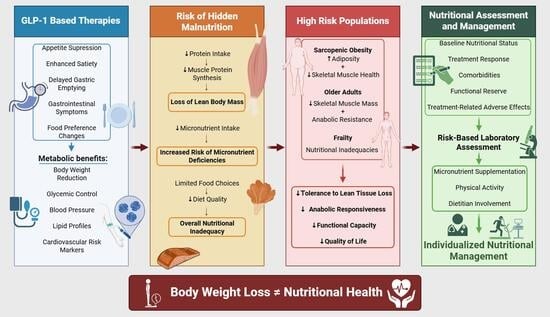
1. Introduction
2. Literature Search and Evidence Synthesis
3. Mechanisms Underlying Nutritional Vulnerability During GLP-1 Therapy
4. Micronutrient Status During GLP-1 Therapy
5. Protein Intake During GLP-1 Therapy
6. Changes in Body Composition During GLP-1 Therapy
7. Sarcopenic Obesity, Frailty, and High-Risk Populations
8. Clinical Assessment and Nutritional Management During GLP-1-Based Therapy
9. Future Research Priorities
9.1. Defining Meaningful Nutritional Outcomes
9.2. Towards More Individualized Nutritional Research
9.3. From Surrogate Outcomes to Patient-Centered Research
9.4. Interventional Trials of Combined Protein Optimization and Resistance Exercise
10. Conclusions
Author Contributions
Funding
Institutional Review Board Statement
Informed Consent Statement
Data Availability Statement
Acknowledgments
Conflicts of Interest
Abbreviations
| GLP-1 | glucagon-like peptide-1 |
| T2D | type 2 diabetes |
| MeSH | Medical Subject Headings |
| GIP/GLP-1 | glucose-dependent insulinotropic polypeptide/glucagon-like peptide-1 |
| DXA | dual-energy X-ray absorptiometry |
References
- Wilding, J.P.H.; Batterham, R.L.; Calanna, S.; Davies, M.; Van Gaal, L.F.; Lingvay, I.; McGowan, B.M.; Rosenstock, J.; Tran, M.T.D.; Wadden, T.A.; et al. Once-Weekly Semaglutide in Adults with Overweight or Obesity. N. Engl. J. Med. 2021, 384, 989–1002. [Google Scholar] [CrossRef] [Scilit] [PubMed]
- Jastreboff, A.M.; Aronne, L.J.; Ahmad, N.N.; Wharton, S.; Connery, L.; Alves, B.; Kiyosue, A.; Zhang, S.; Liu, B.; Bunck, M.C.; et al. Tirzepatide Once Weekly for the Treatment of Obesity. N. Engl. J. Med. 2022, 387, 205–216. [Google Scholar] [CrossRef] [Scilit] [PubMed]
- Alfaris, N.; Waldrop, S.; Johnson, V.; Boaventura, B.; Kendrick, K.; Stanford, F.C. GLP-1 single, dual, and triple receptor agonists for treating type 2 diabetes and obesity: A narrative review. eClinicalMedicine 2024, 75, 102782. [Google Scholar] [CrossRef] [Scilit] [PubMed]
- Rubino, D.M.; Greenway, F.L.; Khalid, U.; O’Neil, P.M.; Rosenstock, J.; Sørrig, R.; Wadden, T.A.; Wizert, A.; Garvey, W.T.; STEP 8 Investigators. Effect of Weekly Subcutaneous Semaglutide vs Daily Liraglutide on Body Weight in Adults with Overweight or Obesity Without Diabetes: The STEP 8 Randomized Clinical Trial. JAMA 2022, 327, 138–150. [Google Scholar] [CrossRef] [Scilit] [PubMed]
- Dubin, R.L.; Heymsfield, S.B.; Ravussin, E.; Greenway, F.L. Glucagon-like peptide-1 receptor agonist-based agents and weight loss composition: Filling the gaps. Diabetes Obes. Metab. 2024, 26, 5503–5518. [Google Scholar] [CrossRef] [Scilit] [PubMed]
- Linge, J.; Birkenfeld, A.L.; Neeland, I.J. Muscle Mass and Glucagon-Like Peptide-1 Receptor Agonists: Adaptive or Maladaptive Response to Weight Loss? Circulation 2024, 150, 1288–1298. [Google Scholar] [CrossRef] [Scilit] [PubMed]
- Ceasovschih, A.; Asaftei, A.; Lupo, M.G.; Kotlyarov, S.; Bartušková, H.; Balta, A.; Sorodoc, V.; Sorodoc, L.; Banach, M. Glucagon-like peptide-1 receptor agonists and muscle mass effects. Pharmacol. Res. 2025, 220, 107927. [Google Scholar] [CrossRef] [Scilit] [PubMed]
- McCarthy, D.; Berg, A. Weight Loss Strategies and the Risk of Skeletal Muscle Mass Loss. Nutrients 2021, 13, 2473. [Google Scholar] [CrossRef] [Scilit] [PubMed]
- Colleluori, G.; Villareal, D.T. Aging, obesity, sarcopenia and the effect of diet and exercise intervention. Exp. Gerontol. 2021, 155, 111561. [Google Scholar] [CrossRef] [Scilit] [PubMed]
- Moiz, A.; Filion, K.B.; Tsoukas, M.A.; Yu, O.H.Y.; Peters, T.M.; Eisenberg, M.J. Mechanisms of GLP-1 Receptor Agonist-Induced Weight Loss: A Review of Central and Peripheral Pathways in Appetite and Energy Regulation. Am. J. Med. 2025, 138, 934–940. [Google Scholar] [CrossRef] [Scilit] [PubMed]
- Ben-Porat, T.; Sherf-Dagan, S.; Côté, M.; Miner, C.J.; Buch, A. Nutritional Challenges of Incretin-Based Obesity Management Medications: Implications for Clinical Practice. Adv. Nutr. 2025, 16, 100522. [Google Scholar] [CrossRef] [Scilit] [PubMed]
- Astrup, A.; Bügel, S. Overfed but undernourished: Recognizing nutritional inadequacies/deficiencies in patients with overweight or obesity. Int. J. Obes. 2019, 43, 219–232. [Google Scholar] [CrossRef] [Scilit] [PubMed]
- Cristancho, C.; Mogensen, K.M.; Robinson, M.K. Malnutrition in patients with obesity: An overview perspective. Nutr. Clin. Pract. 2024, 39, 1300–1316. [Google Scholar] [CrossRef] [Scilit] [PubMed]
- Saini, A.K.; Lakhawat, S.; Shekhawat, P.; Bordia, H.; Joshi, K. Obesity as Malnutrition: Exposing the Hidden Nutrient Deficiency Behind Excess Weight. J. Adv. Food Sci. Technol. 2025, 12, 125–130. [Google Scholar] [CrossRef] [Scilit]
- Cava, E.; Yeat, N.C.; Mittendorfer, B. Preserving Healthy Muscle during Weight Loss. Adv. Nutr. 2017, 8, 511–519. [Google Scholar] [CrossRef] [Scilit] [PubMed]
- Christensen, S.; Robinson, K.; Thomas, S.; Williams, D.R. Dietary intake by patients taking GLP-1 and dual GIP/GLP-1 receptor agonists: A narrative review and discussion of research needs. Obes. Pillars 2024, 11, 100121, Erratum in Obes. Pillars 2024, 12, 100136. https://doi.org/10.1016/j.obpill.2024.100136. [Google Scholar] [CrossRef] [Scilit] [PubMed]
- Batsis, J.A.; Villareal, D.T. Sarcopenic obesity in older adults: Aetiology, epidemiology and treatment strategies. Nat. Rev. Endocrinol. 2018, 14, 513–537. [Google Scholar] [CrossRef] [Scilit] [PubMed]
- Saito, H.; Matsue, Y.; Kamiya, K.; Kagiyama, N.; Maeda, D.; Endo, Y.; Ueno, H.; Yoshioka, K.; Mizukami, A.; Saito, K.; et al. Sarcopenic obesity is associated with impaired physical function and mortality in older patients with heart failure: Insight from FRAGILE-HF. BMC Geriatr. 2022, 22, 556. [Google Scholar] [CrossRef] [Scilit] [PubMed]
- Hirani, V.; Naganathan, V.; Blyth, F.; Le Couteur, D.G.; Seibel, M.J.; Waite, L.M.; Handelsman, D.J.; Cumming, R.G. Longitudinal associations between body composition, sarcopenic obesity and outcomes of frailty, disability, institutionalisation and mortality in community-dwelling older men: The Concord Health and Ageing in Men Project. Age Ageing 2017, 46, 413–420. [Google Scholar] [CrossRef] [Scilit] [PubMed]
- Institute of Medicine. Dietary Reference Intakes: Applications in Dietary Assessment; National Academies Press: Washington, DC, USA, 2000. [Google Scholar]
- Cederholm, T.; Jensen, G.L.; Correia, M.I.T.D.; Gonzalez, M.C.; Fukushima, R.; Higashiguchi, T.; Baptista, G.; Barazzoni, R.; Blaauw, R.; Coats, A.; et al. GLIM criteria for the diagnosis of malnutrition—A consensus report from the global clinical nutrition community. Clin. Nutr. 2019, 38, 1–9. [Google Scholar] [CrossRef] [Scilit] [PubMed]
- Cruz-Jentoft, A.J.; Bahat, G.; Bauer, J.; Boirie, Y.; Bruyère, O.; Cederholm, T.; Cooper, C.; Landi, F.; Rolland, Y.; Sayer, A.A.; et al. Sarcopenia: Revised European consensus on definition and diagnosis. Age Ageing 2019, 48, 16–31, Erratum in Age Ageing 2019, 48, 601. https://doi.org/10.1093/ageing/afz046. [Google Scholar] [CrossRef] [Scilit] [PubMed]
- Morley, J.E.; Vellas, B.; van Kan, G.A.; Anker, S.D.; Bauer, J.M.; Bernabei, R.; Cesari, M.; Chumlea, W.C.; Doehner, W.; Evans, J.; et al. Frailty consensus: A call to action. J. Am. Med. Dir. Assoc. 2013, 14, 392–397. [Google Scholar] [CrossRef] [Scilit] [PubMed]
- Mozaffarian, D.; Agarwal, M.; Aggarwal, M.; Alexander, L.; Apovian, C.M.; Bindlish, S.; Bonnet, J.; Butsch, W.S.; Christensen, S.; Gianos, E.; et al. Nutritional priorities to support GLP-1 therapy for obesity: A joint Advisory from the American College of Lifestyle Medicine, the American Society for Nutrition, the Obesity Medicine Association, and The Obesity Society. Obesity 2025, 33, 1475–1503. [Google Scholar] [CrossRef] [Scilit] [PubMed]
- Sievenpiper, J.L.; Ard, J.; Blüher, M.; Chen, W.; Dixon, J.B.; Fitch, A.; Gigliotti, L.; Khunti, K.; Lecube, A.; Lean, M.E.J.; et al. Nutritional and lifestyle supportive care recommendations for management of obesity with GLP-1—Based therapies: An expert consensus statement using a modified Delphi approach. Obes. Pillars 2025, 17, 100228. [Google Scholar] [CrossRef] [Scilit] [PubMed]
- St-Onge, M.P.; O’Keeffe, M.; Roberts, A.L.; RoyChoudhury, A.; Laferrère, B. Short sleep duration, glucose dysregulation and hormonal regulation of appetite in men and women. Sleep 2012, 35, 1503–1510. [Google Scholar] [CrossRef] [Scilit] [PubMed]
- Tasali, E.; Wroblewski, K.; Kahn, E.; Kilkus, J.; Schoeller, D.A. Effect of Sleep Extension on Objectively Assessed Energy Intake Among Adults with Overweight in Real-life Settings: A Randomized Clinical Trial. JAMA Intern. Med. 2022, 182, 365–374. [Google Scholar] [CrossRef] [Scilit] [PubMed]
- Müller, T.D.; Finan, B.; Bloom, S.R.; D’Alessio, D.; Drucker, D.J.; Flatt, P.R.; Fritsche, A.; Gribble, F.; Grill, H.J.; Habener, J.F.; et al. Glucagon-like peptide 1 (GLP-1). Mol. Metab. 2019, 30, 72–130. [Google Scholar] [CrossRef] [Scilit] [PubMed]
- Drucker, D.J. GLP-1 physiology informs the pharmacotherapy of obesity. Mol. Metab. 2022, 57, 101351. [Google Scholar] [CrossRef] [Scilit] [PubMed]
- Park, J.S.; Kim, K.S.; Choi, H.J. Glucagon-Like Peptide-1 and Hypothalamic Regulation of Satiation: Cognitive and Neural Insights from Human and Animal Studies. Diabetes Metab. J. 2025, 49, 333–347. [Google Scholar] [CrossRef] [Scilit] [PubMed]
- Holst, J.J. The physiology of glucagon-like peptide 1. Physiol. Rev. 2007, 87, 1409–1439. [Google Scholar] [CrossRef] [Scilit] [PubMed]
- Wharton, S.; Calanna, S.; Davies, M.; Dicker, D.; Goldman, B.; Lingvay, I.; Mosenzon, O.; Rubino, D.M.; Thomsen, M.; Wadden, T.A.; et al. Gastrointestinal tolerability of once-weekly semaglutide 2.4 mg in adults with overweight or obesity, and the relationship between gastrointestinal adverse events and weight loss. Diabetes Obes. Metab. 2022, 24, 94–105. [Google Scholar] [CrossRef] [Scilit] [PubMed]
- Johnson, B.; Milstead, M.; Thomas, O.; McGlasson, T.; Green, L.; Kreider, R.; Jones, R. Investigating nutrient intake during use of glucagon-like peptide-1 receptor agonist: A cross-sectional study. Front. Nutr. 2025, 12, 1566498. [Google Scholar] [CrossRef] [Scilit] [PubMed]
- Bettadapura, S.; Dowling, K.; Jablon, K.; Al-Humadi, A.W.; le Roux, C.W. Changes in food preferences and ingestive behaviors after glucagon-like peptide-1 analog treatment: Techniques and opportunities. Int. J. Obes. 2025, 49, 418–426. [Google Scholar] [CrossRef] [Scilit] [PubMed]
- van Bloemendaal, L.; IJzerman, R.G.; Ten Kulve, J.S.; Barkhof, F.; Konrad, R.J.; Drent, M.L.; Veltman, D.J.; Diamant, M. GLP-1 receptor activation modulates appetite- and reward-related brain areas in humans. Diabetes 2014, 63, 4186–4196. [Google Scholar] [CrossRef] [Scilit] [PubMed]
- Kooij, K.L.; Koster, D.I.; Eeltink, E.; Luijendijk, M.; Drost, L.; Ducrocq, F.; Adan, R.A.H. GLP-1 receptor agonist semaglutide reduces appetite while increasing dopamine reward signaling. Neurosci. Appl. 2023, 3, 103925. [Google Scholar] [CrossRef] [Scilit] [PubMed]
- Hara, T.; Fujishima, Y.; Kimura, Y.; Fujii, K.; Kawachi, Y.; Nagao, H.; Obata, Y.; Fukuda, S.; Nagai, N.; Nishizawa, H.; et al. Effects of semaglutide, a GLP-1 receptor agonist, on food preferences in Japanese subjects with type 2 diabetes and visceral fat accumulation. Endocr. J. 2026, 73, 607–619. [Google Scholar] [CrossRef] [Scilit] [PubMed]
- Korus, S.; Cembrowska-Lech, D.; Kłoda, K.; Stachowska, E. Dietary intake patterns and nutritional adequacy among adults with overweight or obesity treated with GLP-1 or dual GIP/GLP-1 receptor agonists—Preliminary study. J. Transl. Med. 2026, 24, 532. [Google Scholar] [CrossRef] [Scilit] [PubMed]
- Chavez, A.M.; Carrasco Barria, R.; León-Sanz, M. Nutrition support whilst on glucagon-like peptide-1 based therapy. Is it necessary? Curr. Opin. Clin. Nutr. Metab. Care 2025, 28, 351–357. [Google Scholar] [CrossRef] [Scilit] [PubMed]
- Bauer, J.; Biolo, G.; Cederholm, T.; Cesari, M.; Cruz-Jentoft, A.J.; Morley, J.E.; Phillips, S.; Sieber, C.; Stehle, P.; Teta, D.; et al. Evidence-based recommendations for optimal dietary protein intake in older people: A position paper from the PROT-AGE Study Group. J. Am. Med. Dir. Assoc. 2013, 14, 542–559. [Google Scholar] [CrossRef] [Scilit] [PubMed]
- Deutz, N.E.; Bauer, J.M.; Barazzoni, R.; Biolo, G.; Boirie, Y.; Bosy-Westphal, A.; Cederholm, T.; Cruz-Jentoft, A.; Krznariç, Z.; Nair, K.S.; et al. Protein intake and exercise for optimal muscle function with aging: Recommendations from the ESPEN Expert Group. Clin. Nutr. 2014, 33, 929–936. [Google Scholar] [CrossRef] [Scilit] [PubMed]
- Donini, L.M.; Busetto, L.; Bischoff, S.C.; Cederholm, T.; Ballesteros-Pomar, M.D.; Batsis, J.A.; Bauer, J.M.; Boirie, Y.; Cruz-Jentoft, A.J.; Dicker, D.; et al. Definition and Diagnostic Criteria for Sarcopenic Obesity: ESPEN and EASO Consensus Statement. Obes. Facts 2022, 15, 321–335. [Google Scholar] [CrossRef] [Scilit] [PubMed]
- Ji, T.; Li, Y.; Ma, L. Sarcopenic Obesity: An Emerging Public Health Problem. Aging Dis. 2022, 13, 379–388. [Google Scholar] [CrossRef] [Scilit] [PubMed]
- Roh, E.; Choi, K.M. Health Consequences of Sarcopenic Obesity: A Narrative Review. Front. Endocrinol. 2020, 11, 332. [Google Scholar] [CrossRef] [Scilit] [PubMed]
- Prado, C.M.; Batsis, J.A.; Donini, L.M.; Gonzalez, M.C.; Siervo, M. Sarcopenic obesity in older adults: A clinical overview. Nat. Rev. Endocrinol. 2024, 20, 261–277. [Google Scholar] [CrossRef] [Scilit] [PubMed]
- Spreckley, M.; Ruggiero, C.F.; Brown, A. Bridging the nutrition guidance gap for GLP-1 receptor agonist therapy assisted weight loss: Lessons from bariatric surgery. Int. J. Obes. 2026, 50, 265–267. [Google Scholar] [CrossRef] [Scilit] [PubMed]
- Sibal, R.; Balamurugan, G.; Langley, J.; Graham, Y.; Mahawar, K. Macronutrient, Micronutrient Supplementation and Monitoring for Patients on GLP-1 Agonists: Can We Learn from Metabolic and Bariatric Surgery? Nutrients 2025, 17, 3659. [Google Scholar] [CrossRef] [Scilit] [PubMed]
- Rubino, D.; Abrahamsson, N.; Davies, M.; Hesse, D.; Greenway, F.L.; Jensen, C.; Lingvay, I.; Mosenzon, O.; Rosenstock, J.; Rubio, M.A.; et al. Effect of Continued Weekly Subcutaneous Semaglutide vs Placebo on Weight Loss Maintenance in Adults with Overweight or Obesity: The STEP 4 Randomized Clinical Trial. JAMA 2021, 325, 1414–1425. [Google Scholar] [CrossRef] [Scilit] [PubMed]
- Davies, M.; Færch, L.; Jeppesen, O.K.; Pakseresht, A.; Pedersen, S.D.; Perreault, L.; Rosenstock, J.; Shimomura, I.; Viljoen, A.; Wadden, T.A.; et al. Semaglutide 2·4 mg once a week in adults with overweight or obesity, and type 2 diabetes (STEP 2): A randomised, double-blind, double-dummy, placebo-controlled, phase 3 trial. Lancet 2021, 397, 971–984. [Google Scholar] [CrossRef] [Scilit] [PubMed]
- Pi-Sunyer, X.; Astrup, A.; Fujioka, K.; Greenway, F.; Halpern, A.; Krempf, M.; Lau, D.C.; le Roux, C.W.; Violante Ortiz, R.; Jensen, C.B.; et al. A Randomized, Controlled Trial of 3.0 mg of Liraglutide in Weight Management. N. Engl. J. Med. 2015, 373, 11–22. [Google Scholar] [CrossRef] [Scilit] [PubMed]
- Lincoff, A.M.; Brown-Frandsen, K.; Colhoun, H.M.; Deanfield, J.; Emerson, S.S.; Esbjerg, S.; Hardt-Lindberg, S.; Hovingh, G.K.; Kahn, S.E.; Kushner, R.F.; et al. Semaglutide and Cardiovascular Outcomes in Obesity without Diabetes. N. Engl. J. Med. 2023, 389, 2221–2232. [Google Scholar] [CrossRef] [Scilit] [PubMed]
- Scott Butsch, W.; Sulo, S.; Chang, A.T.; Kim, J.A.; Kerr, K.W.; Williams, D.R.; Hegazi, R.; Panchalingam, T.; Goates, S.; Heymsfield, S.B. Nutritional deficiencies and muscle loss in adults with type 2 diabetes using GLP-1 receptor agonists: A retrospective observational study. Obes. Pillars 2025, 15, 100186. [Google Scholar] [CrossRef] [Scilit] [PubMed]
- Pereira-Santos, M.; Costa, P.R.; Assis, A.M.; Santos, C.A.; Santos, D.B. Obesity and vitamin D deficiency: A systematic review and meta-analysis. Obes. Rev. 2015, 16, 341–349. [Google Scholar] [CrossRef] [Scilit] [PubMed]
- Fitch, A.; Gigliotti, L.; Bays, H.E. Application of nutrition interventions with GLP-1 based therapies: A narrative review of the challenges and solutions. Obes. Pillars 2025, 16, 100205. [Google Scholar] [CrossRef] [Scilit] [PubMed]
- Kerlikowsky, F.; Krämer, K.; Eggersdorfer, M.; Hahn, A. GLP-1 Receptor Agonists—Good for Body Weight, Bad for Micronutrient Status? Curr. Dev. Nutr. 2025, 9, 107587. [Google Scholar] [CrossRef] [Scilit] [PubMed]
- Urbina, J.; Salinas-Ruiz, L.E.; Valenciano, C.; Clapp, B. Micronutrient and Nutritional Deficiencies Associated With GLP-1 Receptor Agonist Therapy: A Narrative Review. Clin. Obes. 2026, 16, e70070. [Google Scholar] [CrossRef] [Scilit] [PubMed]
- Mavar, M.; Sorić, T.; Bagarić, E.; Sarić, A.; Matek Sarić, M. The Power of Vitamin D: Is the Future in Precision Nutrition through Personalized Supplementation Plans? Nutrients 2024, 16, 1176. [Google Scholar] [CrossRef] [Scilit] [PubMed]
- Sorić, T.; Sarić, A.; Matek Sarić, M. Vitamin D, Public Health, and Personalized Nutrition. In Handbook of Public Health Nutrition: International, National, and Regional Perspectives, 1st ed.; Preedy, V.R., Patel, V.B., Eds.; Springer Nature: Cham, Switzerland, 2025; pp. 1–22. [Google Scholar]
- Bain, S.C.; Carstensen, B.; Hyveled, L.; Seremetis, S.; Flindt Kreiner, F.; Amadid, H.; Clark, A. Glucagon-like peptide-1 receptor agonist use is associated with lower blood ferritin levels in people with type 2 diabetes and hemochromatosis: A nationwide register-based study. BMJ Open Diabetes Res. Care 2023, 11, e003300. [Google Scholar] [CrossRef] [Scilit] [PubMed]
- Camaschella, C. Iron-deficiency anemia. N. Engl. J. Med. 2015, 372, 1832–1843. [Google Scholar] [CrossRef] [Scilit] [PubMed]
- Institute of Medicine (US) Committee to Review Dietary Reference Intakes for Vitamin D and Calcium. Dietary Reference Intakes for Calcium and Vitamin D; Ross, A.C., Taylor, C.L., Yaktine, A.L., Del Valle, H.B., Eds.; National Academies Press (US): Washington, DC, USA, 2011. Available online: https://www.ncbi.nlm.nih.gov/books/NBK56070/ (accessed on 26 May 2026).
- Weaver, C.M.; Alexander, D.D.; Boushey, C.J.; Dawson-Hughes, B.; Lappe, J.M.; LeBoff, M.S.; Liu, S.; Looker, A.C.; Wallace, T.C.; Wang, D.D. Calcium plus vitamin D supplementation and risk of fractures: An updated meta-analysis from the National Osteoporosis Foundation. Osteoporos. Int. 2016, 27, 367–376, Erratum in Osteoporos. Int. 2016, 27, 2643–2646. https://doi.org/10.1007/s00198-016-3699-z. [Google Scholar] [CrossRef] [Scilit] [PubMed]
- Green, R.; Allen, L.; Bjørke-Monsen, A.L.; Brito, A.; Guéant, J.-L.; Miller, J.W.; Molloy, A.M.; Nexo, E.; Stabler, S.; Toh, B.-H.; et al. Vitamin B12 deficiency. Nat. Rev. Dis. Primers 2017, 3, 17040. [Google Scholar] [CrossRef] [Scilit] [PubMed]
- Chapman, L.E.; Darling, A.L.; Brown, J.E. Association between metformin and vitamin B12 deficiency in patients with type 2 diabetes: A systematic review and meta-analysis. Diabetes Metab. 2016, 42, 316–327. [Google Scholar] [CrossRef] [Scilit] [PubMed]
- Lonsdale, D.; Marrs, C. Thiamine Deficiency Disease, Dysautonomia, and High Calorie Malnutrition, 1st ed.; Elsevier: Amsterdam, The Netherlands, 2017. [Google Scholar]
- Patterson, E.; Kurian, M.; Sann, N.; Dan, A.; Lovato, C.; Hinojosa, M.; Sockalingam, S.; Craggs-Dino, L.; Samakar, K.; Duncan, K.; et al. ASMBS literature review & clinical guidelines on prevention, diagnosis, and treatment of Wernicke’s encephalopathy and Wernicke-Korsakoff syndrome. Surg. Obes. Relat. Dis. 2025, 21, 707–718. [Google Scholar] [CrossRef] [Scilit] [PubMed]
- Lev, D.; Leibowitz, A.; Lang, A.; Shlomai, G.; Twig, G.; Eden-Friedman, Y.; Engel, T.; Cukierman-Yaffe, T.; Dankner, R.; Gerstein, H.C.; et al. Glucagon-like peptide-1 receptor agonists and Wernicke encephalopathy: A pharmacovigilance study and literature review. Clin. Nutr. 2026, 57, 106571. [Google Scholar] [CrossRef] [Scilit] [PubMed]
- Bidesie, J.; Oudman, E. Wernicke’s Encephalopathy Following Semaglutide Treatment for Obesity: A Systematic PRISMA Review of Case-Based Evidence. Obesity 2026, 1–6. [Google Scholar] [CrossRef] [Scilit] [PubMed]
- Bailey, L.B.; Stover, P.J.; McNulty, H.; Fenech, M.F.; Gregory, J.F., III; Mills, J.L.; Pfeiffer, C.M.; Fazili, Z.; Zhang, M.; Ueland, P.M.; et al. Biomarkers of Nutrition for Development—Folate Review. J. Nutr. 2015, 145, 1636S–1680S. [Google Scholar] [CrossRef] [Scilit] [PubMed]
- Matek Sarić, M.; Sorić, T.; Juko Kasap, Ž.; Lisica Šikić, N.; Mavar, M.; Andruškienė, J.; Sarić, A. Magnesium: Health Effects, Deficiency Burden, and Future Public Health Directions. Nutrients 2025, 17, 3626. [Google Scholar] [CrossRef] [Scilit] [PubMed]
- Livingstone, C. Zinc: Physiology, deficiency, and parenteral nutrition. Nutr. Clin. Pract. 2015, 30, 371–382. [Google Scholar] [CrossRef] [Scilit] [PubMed]
- King, J.C. Zinc: An essential but elusive nutrient. Am. J. Clin. Nutr. 2011, 94, 679S–684S. [Google Scholar] [CrossRef] [Scilit] [PubMed]
- Kokura, Y.; Ueshima, J.; Saino, Y.; Maeda, K. Enhanced protein intake on maintaining muscle mass, strength, and physical function in adults with overweight/obesity: A systematic review and meta-analysis. Clin. Nutr. ESPEN 2024, 63, 417–426. [Google Scholar] [CrossRef] [Scilit] [PubMed]
- Dekker, I.M.; van Rijssen, N.M.; Verreijen, A.; Weijs, P.J.; de Boer, W.B.E.; Terpstra, D.; Kruizenga, H.M. Calculation of protein requirements; a comparison of calculations based on bodyweight and fat free mass. Clin. Nutr. ESPEN 2022, 48, 378–385. [Google Scholar] [CrossRef] [Scilit] [PubMed]
- Hruby, A.; Jacques, P.F. Protein Intake and Human Health: Implications of Units of Protein Intake. Adv. Nutr. 2021, 12, 71–88. [Google Scholar] [CrossRef] [Scilit] [PubMed]
- Weijs, P.J.M. Protein requirement in obesity. Curr. Opin. Clin. Nutr. Metab. Care 2025, 28, 27–32. [Google Scholar] [CrossRef] [Scilit] [PubMed]
- Handu, D.; Rozga, M.; Steiber, A. Executive Summary of the 2020 Academy of Nutrition and Dietetics and National Kidney Foundation Clinical Practice Guideline for Nutrition in CKD. J. Acad. Nutr. Diet. 2021, 121, 1881–1893. [Google Scholar] [CrossRef] [Scilit] [PubMed]
- Wu, G. Dietary protein intake and human health. Food Funct. 2016, 7, 1251–1265. [Google Scholar] [CrossRef] [Scilit] [PubMed]
- Ikizler, T.A.; Burrowes, J.D.; Byham-Gray, L.D.; Campbell, K.L.; Carrero, J.J.; Chan, W.; Fouque, D.; Friedman, A.N.; Ghaddar, S.; Goldstein-Fuchs, D.J.; et al. KDOQI Clinical Practice Guideline for Nutrition in CKD: 2020 Update. Am. J. Kidney Dis. 2020, 76, S1–S107, Erratum in Am. J. Kidney Dis. 2021, 77, 308. https://doi.org/10.1053/j.ajkd.2020.11.004. [Google Scholar] [CrossRef] [Scilit] [PubMed]
- Madero, M.; Levin, A.; Ahmed, S.B.; Carrero, J.J.; Foster, B.; Francis, A.; Hall, R.K.; Herrington, W.G.; Hill, G.; Inker, L.A.; et al. Evaluation and Management of Chronic Kidney Disease: Synopsis of the Kidney Disease: Improving Global Outcomes 2024 Clinical Practice Guideline. Ann. Intern. Med. 2025, 178, 705–713. [Google Scholar] [CrossRef] [Scilit] [PubMed]
- Burd, N.A.; Beals, J.W.; Martinez, I.G.; Salvador, A.F.; Skinner, S.K. Food-First Approach to Enhance the Regulation of Post-exercise Skeletal Muscle Protein Synthesis and Remodeling. Sports Med. 2019, 49, 59–68. [Google Scholar] [CrossRef] [Scilit] [PubMed]
- Carbone, J.W.; Pasiakos, S.M. Dietary Protein and Muscle Mass: Translating Science to Application and Health Benefit. Nutrients 2019, 11, 1136. [Google Scholar] [CrossRef] [Scilit] [PubMed]
- Memel, Z.; Gold, S.L.; Pearlman, M.; Muratore, A.; Martindale, R. Impact of GLP- 1 Receptor Agonist Therapy in Patients High Risk for Sarcopenia. Curr. Nutr. Rep. 2025, 14, 63. [Google Scholar] [CrossRef] [Scilit] [PubMed]
- De Girolamo, G.; Sangineto, M.; Di Gioia, G.; Bianco, R.; Ciarnelli, M.; Serviddio, G. Muscle health in the modern era of incretin-based therapies. Eur. J. Clin. Investig. 2026, 56, e70155. [Google Scholar] [CrossRef] [Scilit] [PubMed]
- Wilding, J.P.H.; Batterham, R.L.; Calanna, S.; Van Gaal, L.F.; McGowan, B.M.; Rosenstock, J.; Tran, M.T.D.; Wharton, S.; Yokote, K.; Zeuthen, N.; et al. Impact of Semaglutide on Body Composition in Adults with Overweight or Obesity: Exploratory Analysis of the STEP 1 Study. J. Endocr. Soc. 2021, 5, A16–A17. [Google Scholar] [CrossRef] [Scilit]
- Look, M.; Dunn, J.P.; Kushner, R.F.; Cao, D.; Harris, C.; Gibble, T.H.; Stefanski, A.; Griffin, R. Body composition changes during weight reduction with tirzepatide in the SURMOUNT-1 study of adults with obesity or overweight. Diabetes Obes. Metab. 2025, 27, 2720–2729, Erratum in Diabetes Obes. Metab. 2025, 27, 6823. https://doi.org/10.1111/dom.70050. [Google Scholar] [CrossRef] [Scilit] [PubMed]
- Chaston, T.B.; Dixon, J.B.; O’Brien, P.E. Changes in fat-free mass during significant weight loss: A systematic review. Int. J. Obes. 2007, 31, 743–750. [Google Scholar] [CrossRef] [Scilit] [PubMed]
- Weinheimer, E.M.; Sands, L.P.; Campbell, W.W. A systematic review of the separate and combined effects of energy restriction and exercise on fat-free mass in middle-aged and older adults: Implications for sarcopenic obesity. Nutr. Rev. 2010, 68, 375–388. [Google Scholar] [CrossRef] [Scilit] [PubMed]
- Scafoglieri, A.; Clarys, J.P. Dual energy X-ray absorptiometry: Gold standard for muscle mass? J. Cachexia Sarcopenia Muscle 2018, 9, 786–787. [Google Scholar] [CrossRef] [Scilit] [PubMed]
- Baglietto, N.; Vaquero-Cristóbal, R.; Albaladejo-Saura, M.; Mecherques-Carini, M.; Esparza-Ros, F. Assessing skeletal muscle mass and lean body mass: An analysis of the agreement among dual X-ray absorptiometry, anthropometry, and bioelectrical impedance. Front. Nutr. 2024, 11, 1445892. [Google Scholar] [CrossRef] [Scilit] [PubMed]
- Friedl, K.E.; Silva, A.M.; Bergouignan, A.; Yamada, Y.; Potter, A.W. Skeletal muscle mass is not compositionally uniform: The role of fluid compartments in health and performance monitoring. Eur. J. Clin. Nutr. 2026, 1–7. [Google Scholar] [CrossRef] [Scilit] [PubMed]
- Correa-de-Araujo, R.; Addison, O.; Miljkovic, I.; Goodpaster, B.H.; Bergman, B.C.; Clark, R.V.; Elena, J.W.; Esser, K.A.; Ferrucci, L.; Harris-Love, M.O.; et al. Myosteatosis in the Context of Skeletal Muscle Function Deficit: An Interdisciplinary Workshop at the National Institute on Aging. Front. Physiol. 2020, 11, 963. [Google Scholar] [CrossRef] [Scilit] [PubMed]
- Miljkovic, I.; Vella, C.A.; Allison, M. Computed Tomography-Derived Myosteatosis and Metabolic Disorders. Diabetes Metab. J. 2021, 45, 482–491. [Google Scholar] [CrossRef] [Scilit] [PubMed]
- Sattar, N.; Neeland, I.J.; Dahlqvist Leinhard, O.; Fernández Landó, L.; Bray, R.; Linge, J.; Rodriguez, A. Tirzepatide and muscle composition changes in people with type 2 diabetes (SURPASS-3 MRI): A post-hoc analysis of a randomised, open-label, parallel-group, phase 3 trial. Lancet Diabetes Endocrinol. 2025, 13, 482–493. [Google Scholar] [CrossRef] [Scilit] [PubMed]
- Cortes, T.M.; Vasquez, L.; Serra, M.C.; Robbins, R.; Stepanenko, A.; Brown, K.; Barrus, H.; Campos, A.; Espinoza, S.E.; Musi, N. Effect of Semaglutide on Physical Function, Body Composition, and Biomarkers of Aging in Older Adults with Overweight and Insulin Resistance: Protocol for an Open-Labeled Randomized Controlled Trial. JMIR Res. Protoc. 2024, 13, e62667. [Google Scholar] [CrossRef] [Scilit] [PubMed]
- Wei, S.; Nguyen, T.T.; Zhang, Y.; Ryu, D.; Gariani, K. Sarcopenic obesity: Epidemiology, pathophysiology, cardiovascular disease, mortality, and management. Front. Endocrinol. 2023, 14, 1185221. [Google Scholar] [CrossRef] [Scilit] [PubMed]
- Cruz-Jentoft, A.J.; Sayer, A.A. Sarcopenia. Lancet 2019, 393, 2636–2646, Erratum in Lancet 2019, 393, 2590. https://doi.org/10.1016/S0140-6736(19)31465-5. [Google Scholar] [CrossRef] [Scilit] [PubMed]
- Burd, N.A.; McKenna, C.F.; Salvador, A.F.; Paulussen, K.J.M.; Moore, D.R. Dietary Protein Quantity, Quality, and Exercise Are Key to Healthy Living: A Muscle-Centric Perspective Across the Lifespan. Front. Nutr. 2019, 6, 83. [Google Scholar] [CrossRef] [Scilit] [PubMed]
- Moore, D.R.; Churchward-Venne, T.A.; Witard, O.; Breen, L.; Burd, N.A.; Tipton, K.D.; Phillips, S.M. Protein ingestion to stimulate myofibrillar protein synthesis requires greater relative protein intakes in healthy older versus younger men. J. Gerontol. A Biol. Sci. Med. Sci. 2015, 70, 57–62. [Google Scholar] [CrossRef] [Scilit] [PubMed]
- Villareal, D.T.; Chode, S.; Parimi, N.; Sinacore, D.R.; Hilton, T.; Armamento-Villareal, R.; Napoli, N.; Qualls, C.; Shah, K. Weight loss, exercise, or both and physical function in obese older adults. N. Engl. J. Med. 2011, 364, 1218–1229. [Google Scholar] [CrossRef] [Scilit] [PubMed]
- Porter Starr, K.N.; McDonald, S.R.; Bales, C.W. Obesity and physical frailty in older adults: A scoping review of lifestyle intervention trials. J. Am. Med. Dir. Assoc. 2014, 15, 240–250. [Google Scholar] [CrossRef] [Scilit] [PubMed]
- Santulli, G.; Sabatelli, G.; Wang, B.; Savino, M.; Bruno, F.P.; Jankauskas, S.S.; Massaro, A.; Peluso, C.; Vicario, M.; Savino, L.; et al. Interplay between frailty and cardiometabolic disorders: From pathophysiology to clinical implications. Cardiovasc. Diabetol. 2025, 25, 1. [Google Scholar] [CrossRef] [Scilit] [PubMed]
- Roberts, H.C.; Lim, S.E.R.; Cox, N.J.; Ibrahim, K. The Challenge of Managing Undernutrition in Older People with Frailty. Nutrients 2019, 11, 808. [Google Scholar] [CrossRef] [Scilit] [PubMed]
- Via, M. The malnutrition of obesity: Micronutrient deficiencies that promote diabetes. ISRN Endocrinol. 2012, 2012, 103472. [Google Scholar] [CrossRef] [Scilit] [PubMed]
- Kobylińska, M.; Antosik, K.; Decyk, A.; Kurowska, K. Malnutrition in Obesity: Is It Possible? Obes. Facts 2022, 15, 19–25. [Google Scholar] [CrossRef] [Scilit] [PubMed]
- Matek Sarić, M.; Lisica Šikić, N.; Sorić, T.; Sarić, A.; Ivanišin, A.; Brodić, I.; Milić, M. Insulin Resistance as a Systemic Metabolic Risk State for Cancer: Mechanisms, Biomarkers, and Prevention. Int. J. Mol. Sci. 2026, 27, 5495. [Google Scholar] [CrossRef] [Scilit] [PubMed]
- Mwala, N.N.; Borkent, J.W.; van der Meij, B.S.; de van der Schueren, M.A.E. Challenges in identifying malnutrition in obesity; An overview of the state of the art and directions for future research. Nutr. Res. Rev. 2025, 38, 219–228. [Google Scholar] [CrossRef] [Scilit] [PubMed]
- Wilding, J.P.H.; Batterham, R.L.; Davies, M.; Van Gaal, L.F.; Kandler, K.; Konakli, K.; Lingvay, I.; McGowan, B.M.; Oral, T.K.; Rosenstock, J.; et al. Weight regain and cardiometabolic effects after withdrawal of semaglutide: The STEP 1 trial extension. Diabetes Obes. Metab. 2022, 24, 1553–1564. [Google Scholar] [CrossRef] [Scilit] [PubMed]
- Quarenghi, M.; Capelli, S.; Galligani, G.; Giana, A.; Preatoni, G.; Turri Quarenghi, R. Weight Regain After Liraglutide, Semaglutide or Tirzepatide Interruption: A Narrative Review of Randomized Studies. J. Clin. Med. 2025, 14, 3791. [Google Scholar] [CrossRef] [Scilit] [PubMed]
- Budini, B.; Luo, S.; Tam, M.; Stead, I.; Lee, A.; Akrami, A.; Vidal-Puig, A.; Park, A. Trajectory of weight regain after cessation of GLP-1 receptor agonists: A systematic review and nonlinear meta-regression. eClinicalMedicine 2026, 93, 103796. [Google Scholar] [CrossRef] [Scilit] [PubMed]
- Hassapidou, M.; Vlassopoulos, A.; Kalliostra, M.; Govers, E.; Mulrooney, H.; Ells, L.; Salas, X.R.; Muscogiuri, G.; Darleska, T.H.; Busetto, L.; et al. European Association for the Study of Obesity Position Statement on Medical Nutrition Therapy for the Management of Overweight and Obesity in Adults Developed in Collaboration with the European Federation of the Associations of Dietitians. Obes. Facts 2023, 16, 11–28. [Google Scholar] [CrossRef] [Scilit] [PubMed]
- Chao, A.M.; Paul, A.; Hodgkins, J.V.; Wadden, T.A. A Guideline-Directed Approach to Obesity Treatment. Diabetes Spectr. 2024, 37, 281–295. [Google Scholar] [CrossRef] [Scilit] [PubMed]
- Morgan-Bathke, M.; Raynor, H.A.; Baxter, S.D.; Halliday, T.M.; Lynch, A.; Malik, N.; Garay, J.L.; Rozga, M. Medical Nutrition Therapy Interventions Provided by Dietitians for Adult Overweight and Obesity Management: An Academy of Nutrition and Dietetics Evidence-Based Practice Guideline. J. Acad. Nutr. Diet. 2023, 123, 520–545.e10. [Google Scholar] [CrossRef] [Scilit] [PubMed]
- Malmstrom, T.K.; Miller, D.K.; Simonsick, E.M.; Ferrucci, L.; Morley, J.E. SARC-F: A symptom score to predict persons with sarcopenia at risk for poor functional outcomes. J. Cachexia Sarcopenia Muscle 2016, 7, 28–36. [Google Scholar] [CrossRef] [Scilit] [PubMed]
- Jensen, G.L.; Cederholm, T.; Correia, M.I.T.D.; Gonzalez, M.C.; Fukushima, R.; Pisprasert, V.; Blaauw, R.; Braz, D.C.; Carrasco, F.; Cruz Jentoft, A.J.; et al. GLIM consensus approach to diagnosis of malnutrition: A 5-year update. JPEN J. Parenter. Enter. Nutr. 2025, 49, 414–427. [Google Scholar] [CrossRef] [Scilit] [PubMed]
- World Health Organization. WHO Guidelines on Physical Activity and Sedentary Behavior. Available online: https://www.who.int/publications/i/item/9789240015128 (accessed on 12 June 2026).
- Garber, C.E.; Blissmer, B.; Deschenes, M.R.; Franklin, B.A.; Lamonte, M.J.; Lee, I.M.; Nieman, D.C.; Swain, D.P. Quantity and quality of exercise for developing and maintaining cardiorespiratory, musculoskeletal, and neuromotor fitness in apparently healthy adults: Guidance for prescribing exercise. Med. Sci. Sports Exerc. 2011, 43, 1334–1359. [Google Scholar] [CrossRef] [Scilit] [PubMed]
- Currier, B.S.; D’Souza, A.C.; Singh, M.A.F.; Lowisz, C.V.; Rawson, E.S.; Schoenfeld, B.J.; Smith-Ryan, A.E.; Steen, J.P.; Thomas, G.A.; Triplett, N.T.; et al. American College of Sports Medicine Position Stand. Resistance Training Prescription for Muscle Function, Hypertrophy, and Physical Performance in Healthy Adults: An Overview of Reviews. Med. Sci. Sports Exerc. 2026, 58, 851–872. [Google Scholar] [CrossRef] [Scilit] [PubMed]
- Boaventura, B.; Stanford, F.C. Dietitians’ role in obesity care: Insights from the Academy of Nutrition and Dietetics. Hepatobiliary Surg. Nutr. 2025, 14, 159–162. [Google Scholar] [CrossRef] [Scilit] [PubMed]
- Mekonnen, T.; Staniford, L.; Connell, S.; Das-Gupta, Z.; DeSilva, U.; Saoud, Y.; Miller, I.; Mohan, M.; Nienhuijs, S.; Poddar, M.; et al. Development of a core patient-centred outcome set for adults living with obesity: A modified delphi-based international consensus. eClinicalMedicine 2025, 87, 103422. [Google Scholar] [CrossRef] [Scilit] [PubMed]
- Valli, C.; Suñol, R.; Orrego, C.; Niño de Guzmán, E.; Strammiello, V.; Adrion, N.; Immonen, K.; Ninov, L.; van der Gaag, M.; Ballester, M.; et al. The development of a core outcomes set for self-management interventions for patients living with obesity. Clin. Obes. 2022, 12, e12489. [Google Scholar] [CrossRef] [Scilit] [PubMed]
- Rubino, D.; Bjorner, J.B.; Rathor, N.; Sharma, A.M.; von Huth Smith, L.; Wharton, S.; Wadden, T.; Zeuthen, N.; Kolotkin, R.L. Effect of semaglutide 2.4 mg on physical functioning and weight- and health-related quality of life in adults with overweight or obesity: Patient-reported outcomes from the STEP 1-4 trials. Diabetes Obes. Metab. 2024, 26, 2945–2955, Erratum in Diabetes Obes. Metab. 2025, 27, 1631. https://doi.org/10.1111/dom.16205. [Google Scholar] [CrossRef] [Scilit] [PubMed]
- de Vries, C.E.E.; Terwee, C.B.; Al Nawas, M.; van Wagensveld, B.A.; Janssen, I.M.C.; Liem, R.S.L.; Nienhuijs, S.W.; Cohen, R.V.; van Rossum, E.F.C.; Brown, W.A.; et al. Outcomes of the first global multidisciplinary consensus meeting including persons living with obesity to standardize patient-reported outcome measurement in obesity treatment research. Obes. Rev. 2022, 23, e13452. [Google Scholar] [CrossRef] [Scilit] [PubMed]
- Carbone, F.; Després, J.P.; Ioannidis, J.P.A.; Neeland, I.J.; Garruti, G.; Busetto, L.; Liberale, L.; Ministrini, S.; Vilahur, G.; Schindler, T.H.; et al. Bridging the gap in obesity research: A consensus statement from the European Society for Clinical Investigation. Eur. J. Clin. Investig. 2025, 55, e70059. [Google Scholar] [CrossRef] [Scilit] [PubMed]
- Acosta, A.; Camilleri, M.; Abu Dayyeh, B.; Calderon, G.; Gonzalez, D.; McRae, A.; Rossini, W.; Singh, S.; Burton, D.; Clark, M.M. Selection of Antiobesity Medications Based on Phenotypes Enhances Weight Loss: A Pragmatic Trial in an Obesity Clinic. Obesity 2021, 29, 662–671, Erratum in Obesity 2021, 29, 1565–1566. https://doi.org/10.1002/oby.23236. Erratum in Obesity 2022, 30, 1521. https://doi.org/10.1002/oby.23498. [Google Scholar] [CrossRef] [Scilit] [PubMed]
- Voruganti, V.S. Precision Nutrition: Recent Advances in Obesity. Physiology 2023, 38, 42–50. [Google Scholar] [CrossRef] [Scilit] [PubMed]
- Chávez-Manzanera, E.A.; Vera-Zertuche, J.M.; Kaufer-Horwitz, M.; Vázquez-Velázquez, V.; Flores-Lázaro, J.R.; Mireles-Zavala, L.; Calzada-León, R.; Garnica-Cuellar, J.C.; Sánchez-Muñoz, V.; Ramírez-Butanda, E.; et al. Mexican Clinical Practice Guidelines for Adult Overweight and Obesity Management. Curr. Obes. Rep. 2024, 13, 643–666. [Google Scholar] [CrossRef] [Scilit] [PubMed]
- Shoneye, C.L.; Kwasnicka, D.; Mullan, B.; Pollard, C.M.; Boushey, C.J.; Kerr, D.A. Dietary assessment methods used in adult digital weight loss interventions: A systematic literature review. J. Hum. Nutr. Diet. 2023, 36, 997–1010. [Google Scholar] [CrossRef] [Scilit] [PubMed]
- Chotwanvirat, P.; Prachansuwan, A.; Sridonpai, P.; Kriengsinyos, W. Advancements in Using AI for Dietary Assessment Based on Food Images: Scoping Review. J. Med. Internet Res. 2024, 26, e51432. [Google Scholar] [CrossRef] [Scilit] [PubMed]
- Lundgren, J.R.; Janus, C.; Jensen, S.B.K.; Juhl, C.R.; Olsen, L.M.; Christensen, R.M.; Svane, M.S.; Bandholm, T.; Bojsen-Møller, K.N.; Blond, M.B.; et al. Healthy Weight Loss Maintenance with Exercise, Liraglutide, or Both Combined. N. Engl. J. Med. 2021, 384, 1719–1730. [Google Scholar] [CrossRef] [Scilit] [PubMed]
- Mechanick, J.I.; Butsch, W.S.; Christensen, S.M.; Hamdy, O.; Li, Z.; Prado, C.M.; Heymsfield, S.B. Strategies for minimizing muscle loss during use of incretin-mimetic drugs for treatment of obesity. Obes. Rev. 2025, 26, e13841. [Google Scholar] [CrossRef] [Scilit] [PubMed]
- Alawadhi, A.A.; Alroudhan, D.; Alsaeed, D.J.; Almarshad, B.W.; Alshehabi, D.H.; Allahou, B.A.; Mashankar, A.; Al Ozairi, E.; Gray, S. LEAN mass Preservation with Resistance Exercise and Protein during semaglutide and tirzepatide therapy (LEAN-PREP study): A protocol for a randomised controlled trial. BMJ Open 2026, 16, e116911. [Google Scholar] [CrossRef] [Scilit] [PubMed]



| Micronutrient | Evidence Summary and Study Context | Potential Clinical Relevance | Groups at Increased Risk | Monitoring/Management Considerations | References |
|---|---|---|---|---|---|
| Vitamin D | Retrospective claims cohort (n = 461,382): incident coded vitamin D deficiency was documented in 7.5% within 6 months and 13.6% within 12 months after GLP-1RA initiation. Patients with previously coded nutritional deficiencies were excluded, but baseline biochemical 25(OH)D status was unavailable. | Bone health, calcium homeostasis, muscle function, immune regulation | Older adults, individuals with obesity, limited sun exposure, low dietary intake, postmenopausal women | Consider baseline 25(OH)D in at-risk individuals; repeat testing according to risk and clinical context; supplement according to deficiency guidelines | [52,53,55,56,57,58] |
| Iron | Register-based study in individuals with T2D and hemochromatosis: GLP-1RA exposure was associated with lower ferritin levels than SGLT2 inhibitor exposure. Separately, a cross-sectional study of 69 GLP-1RA users reported mean iron intake below DRI values (12.1 mg/day); pre-treatment dietary intake was not assessed. | Iron deficiency, anemia, fatigue, reduced physical performance | Premenopausal women, individuals with heavy menstrual bleeding, vegetarians/vegans, those with low dietary iron intake or pre-existing low iron stores | CBC, ferritin, and transferrin saturation when clinically indicated; supplementation according to confirmed deficiency and clinical context | [33,38,47,56,59,60] |
| Calcium | Cross-sectional dietary assessment of 69 GLP-1RA users: mean calcium intake was below DRI values (863 mg/day); pre-treatment dietary intake was not assessed. | Bone health, muscle contraction, fracture risk in vulnerable groups | Older adults, postmenopausal women, individuals with low dietary calcium intake, lactose intolerance, or vitamin D deficiency | Assess dietary calcium intake; serum calcium has limited value for assessing dietary adequacy; consider bone-health assessment in high-risk patients | [33,47,55,56,61,62] |
| Vitamin B12 | GLP-1-specific prevalence of biochemically confirmed vitamin B12 deficiency has not been established, and available evidence does not clearly distinguish pre-existing from treatment-emergent deficiency. | Megaloblastic anemia, neuropathy, fatigue, cognitive symptoms | Older adults, vegans/vegetarians, metformin users, individuals with a history of bariatric surgery | Serum vitamin B12, with methylmalonic acid and/or homocysteine when clinically indicated; assess concomitant metformin use and other risk factors; supplement when deficiency is confirmed or strongly suspected | [47,56,63,64] |
| Thiamine | Case reports and pharmacovigilance data have described thiamine deficiency and Wernicke encephalopathy during GLP-1-based therapy, most often in the context of persistent gastrointestinal symptoms, markedly reduced intake, or rapid weight loss; population incidence is unknown. | Wernicke encephalopathy, neuropathy, cardiovascular manifestations in severe deficiency | Persistent vomiting, markedly reduced intake, rapid weight loss, alcohol use disorder, history of bariatric surgery | Routine screening is not indicated for all GLP-1 users; promptly assess and treat suspected thiamine deficiency in individuals with persistent vomiting, markedly reduced intake, rapid weight loss, or neurological symptoms. | [47,65,66,67,68] |
| Folate | GLP-1-specific longitudinal data on folate status are limited, and the incidence of treatment-emergent folate deficiency has not been established. | Megaloblastic anemia, elevated homocysteine, pregnancy-related risks | Women of reproductive age, individuals with restrictive diets or low intake of folate-rich foods, and those with pre-existing malabsorption or other established risk factors | Assess dietary folate intake; serum and/or RBC folate when clinically indicated; supplementation according to standard recommendations and individual clinical context | [47,55,56,69] |
| Magnesium | Cross-sectional dietary assessment of 69 GLP-1RA users: mean magnesium intake was below DRI values (266 mg/day); pre-treatment dietary intake was not assessed. GLP-1-specific prevalence of biochemical magnesium deficiency remains unknown. | Neuromuscular function, glucose metabolism, cardiovascular health; deficiency may contribute to muscle cramps and fatigue | Older adults, individuals with T2D, users of diuretics or proton pump inhibitors, and those with low dietary magnesium intake or limited dietary variety | Assess dietary magnesium intake and relevant medications; serum magnesium may not fully reflect total body stores; laboratory evaluation and supplementation when clinically indicated | [33,38,47,56,70] |
| Zinc | Cross-sectional dietary data did not indicate inadequate mean zinc intake relative to DRI values; GLP-1-specific longitudinal data on biochemical zinc status and treatment-emergent deficiency are lacking. | Immune function, wound healing, taste changes, appetite regulation | Vegans/vegetarians, individuals with low protein or low dietary zinc intake, malabsorptive disorders, and other conditions associated with impaired zinc status | Assess dietary zinc intake and clinical risk factors; laboratory evaluation when deficiency is suspected; avoid prolonged high-dose zinc supplementation because of the risk of copper deficiency | [33,47,55,71,72] |
| Clinical Phenotype | Typical Clinical Presentation | Clinical Clues | Primary Clinical Priority | Suggested Clinical Approach | References |
|---|---|---|---|---|---|
| Protein-inadequacy phenotype | Marked appetite suppression with reduced protein intake during weight loss | Rapid weight loss, reduced appetite, declining muscle strength, low dietary protein intake | Preserve skeletal muscle and functional capacity | Assess dietary protein intake; encourage protein-rich foods and resistance exercise; consider protein supplementation when dietary intake remains inadequate | [15,24,33,38] |
| Micronutrient-vulnerability phenotype | Reduced dietary variety and low nutrient density resulting from persistent energy restriction | Monotonous diet, prolonged gastrointestinal symptoms, restrictive eating pattern, pre-existing nutritional deficiencies | Maintain nutritional adequacy and prevent clinically relevant deficiencies | Evaluate dietary quality; perform targeted laboratory assessment when clinically indicated; provide individualized supplementation only when appropriate | [16,47,52,104] |
| Sarcopenic-obesity phenotype | Excess adiposity accompanied by impaired muscle strength and/or physical performance | Difficulty rising from a chair, slow gait, reduced grip strength, physical inactivity | Preserve muscle function and physical independence | Assess muscle strength and physical performance; optimize protein intake; prescribe resistance exercise; individualize weight-loss goals | [42,54,84,94] |
| GI symptom-limited intake phenotype | Persistent gastrointestinal symptoms limiting food intake | Persistent nausea, vomiting, early satiety, food aversion, dehydration | Restore adequate nutritional intake while minimizing symptoms | Review dose escalation; modify meal pattern and food texture; maintain hydration; consider thiamine replacement in patients with prolonged vomiting | [47,54,66] |
| High-risk phenotype | Pre-existing nutritional vulnerability before initiation of GLP-1 therapy | Older age, frailty, previous bariatric surgery, chronic gastrointestinal disease, chronic kidney or liver disease, food insecurity | Early recognition of patients requiring individualized nutritional care | Perform comprehensive baseline nutritional assessment; involve a registered dietitian when appropriate; individualize monitoring and follow-up | [11,42,54,107] |
| Treatment discontinuation phenotype | Weight regain following treatment discontinuation | Rapid weight regain, deterioration in dietary habits, reduced physical activity | Maintain long-term metabolic and functional benefits | Develop a structured discontinuation plan; reinforce healthy dietary habits, physical activity, and long-term obesity management | [108,109,110] |
Disclaimer/Publisher’s Note: The statements, opinions and data contained in all publications are solely those of the individual author(s) and contributor(s) and not of MDPI and/or the editor(s). MDPI and/or the editor(s) disclaim responsibility for any injury to people or property resulting from any ideas, methods, instructions or products referred to in the content. |
© 2026 by the authors. Licensee MDPI, Basel, Switzerland. This article is an open access article distributed under the terms and conditions of the Creative Commons Attribution (CC BY) license.
Share and Cite
Sorić, T.; Sarić, A.; Ivanišin, A.; Lovrić, M.; Milić, M.; Matovinović, M.; Matek Sarić, M. Hidden Malnutrition in the GLP-1 Era: Micronutrient Status, Protein Adequacy, and Lean Mass as Emerging Nutritional Considerations—A Narrative Review. Nutrients 2026, 18, 2757. https://doi.org/10.3390/nu18172757
Sorić T, Sarić A, Ivanišin A, Lovrić M, Milić M, Matovinović M, Matek Sarić M. Hidden Malnutrition in the GLP-1 Era: Micronutrient Status, Protein Adequacy, and Lean Mass as Emerging Nutritional Considerations—A Narrative Review. Nutrients. 2026; 18(17):2757. https://doi.org/10.3390/nu18172757
Chicago/Turabian StyleSorić, Tamara, Ana Sarić, Andrija Ivanišin, Mario Lovrić, Mirta Milić, Martina Matovinović, and Marijana Matek Sarić. 2026. "Hidden Malnutrition in the GLP-1 Era: Micronutrient Status, Protein Adequacy, and Lean Mass as Emerging Nutritional Considerations—A Narrative Review" Nutrients 18, no. 17: 2757. https://doi.org/10.3390/nu18172757
APA StyleSorić, T., Sarić, A., Ivanišin, A., Lovrić, M., Milić, M., Matovinović, M., & Matek Sarić, M. (2026). Hidden Malnutrition in the GLP-1 Era: Micronutrient Status, Protein Adequacy, and Lean Mass as Emerging Nutritional Considerations—A Narrative Review. Nutrients, 18(17), 2757. https://doi.org/10.3390/nu18172757