


A Cognitive Study of Dietary Imbalance Behaviors in Chinese Multigenerational Households Based on the Information–Motivation–Behavioral Skills Model



Abstract
1. Introduction
2. Literature Review and Research Hypotheses
2.1. Information–Motivation–Behavioral Skills Model
2.2. Meanings of the IMB Model Variables in This Study
2.3. False Consensus Effect and Cognitive Dissonance
2.4. Development of Research Hypotheses
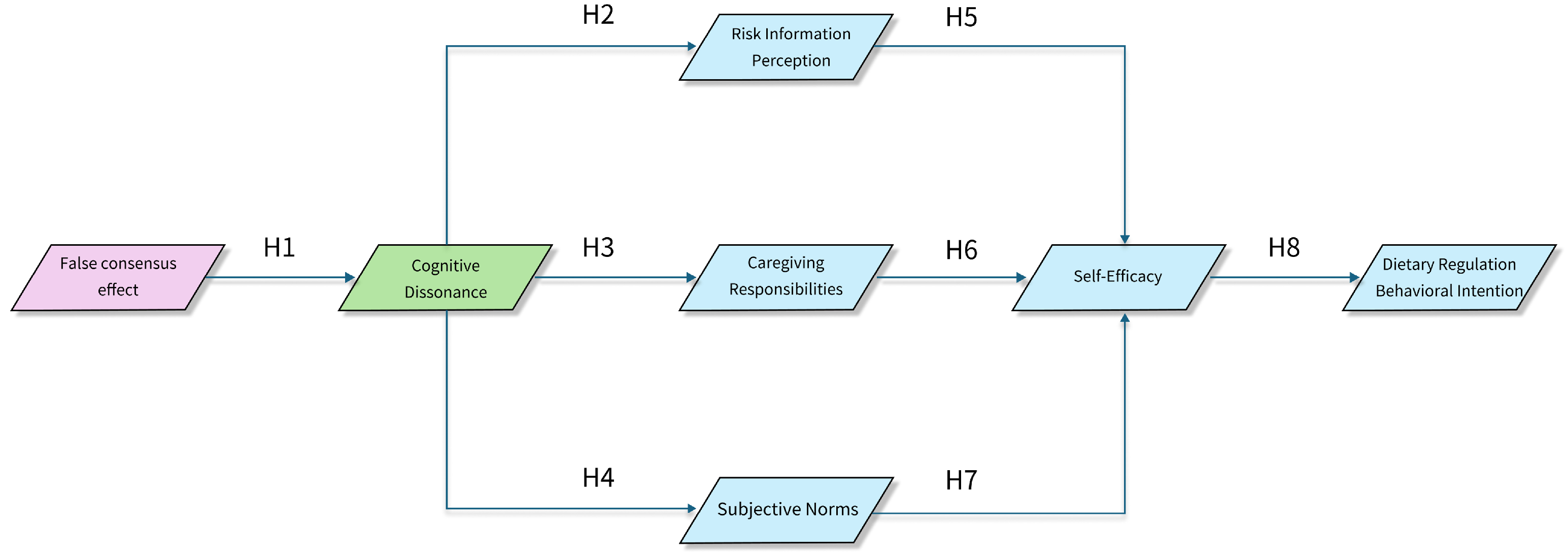
3. Materials and Methods
3.1. Scale Design
3.2. Settings and Participants
3.3. Research Method
4. Results
4.1. Measurement Model Evaluation
4.2. Structural Model Assessment
4.3. Importance-Performance Map Analysis
5. Discussion
5.1. Formation Mechanism of Family Dietary Regulation Behavioral Intention
5.2. IPMA Findings
6. Conclusions
6.1. Research Conclusions
6.2. Theoretical Contributions
6.3. Managerial Importance
6.4. Limitations and Future Research
Author Contributions
Funding
Institutional Review Board Statement
Informed Consent Statement
Data Availability Statement
Conflicts of Interest
References
- Kiosia, A.; Dagbasi, A.; Berkley, J.A.; Wilding, J.P.H.; Prendergast, A.J.; Li, J.V.; Swann, J.; Mathers, J.C.; Kerac, M.; Morrison, D.; et al. The double burden of malnutrition in individuals: Identifying key challenges and re-thinking research focus. Nutr. Bull. 2024, 49, 132–145. [Google Scholar] [CrossRef] [Scilit] [PubMed]
- Muyulema, S.L.; Carpio-Arias, T.V.; Verdezoto, N.; Guanga Lara, V.E.; Manzano, A.S.; Pulgar, H.; Vinueza Veloz, M.F. Worldwide trends in childhood overweight and obesity over the last 20 years. Clin. Nutr. ESPEN 2025, 65, 453–460. [Google Scholar] [CrossRef] [Scilit] [PubMed]
- Yu, X.; Zhang, M.; Wang, Y.; Yu, L.; Zhao, C. Association of diet quality and quantity with the risk of sarcopenia based on the Chinese diet balance index 2022. Front. Nutr. 2025, 12, 1562362. [Google Scholar] [CrossRef] [Scilit] [PubMed]
- Buyinza, T.; Buzigi, E.; Kitimbo, J.; Ssabika, G.; Mbuliro, M.; Kiwanuka, J.; Bukenya, J.; Guwatudde, D.; Ndejjo, R. Socio-ecological factors influencing dietary behaviours among adolescents and young adults in rural Eastern Uganda: A qualitative study. PLoS ONE 2025, 20, e0337797. [Google Scholar] [CrossRef] [Scilit] [PubMed]
- Lin, D.; Liang, D.; Huang, M.; Xu, X.; Bai, Y.; Meng, D. The dyadic effects of family resilience and social support on quality of life among older adults with chronic illness and their primary caregivers in multigenerational families in China: A cross-sectional study. Heliyon 2024, 10, e27351. [Google Scholar] [CrossRef] [Scilit] [PubMed]
- An, R.P.; Xiang, X.; Xu, N.; Shen, J. Influence of Grandparental Child Care on Childhood Obesity: A Systematic Review and Meta-Analysis. Child. Obes. 2020, 16, 141–153. [Google Scholar] [CrossRef] [Scilit] [PubMed]
- Marr, C.; Breeze, P.; Caton, S.J. A comparison between parent and grandparent dietary provision, feeding styles and feeding practices when caring for preschool-aged children. Appetite 2022, 168, 105777. [Google Scholar] [CrossRef] [Scilit] [PubMed]
- Liu, T.T.; Zhu, K.; Wang, S.N.; Wu, Y.F. Grandma always thinks you are hungry: Understanding care-driven food waste in multigenerational households. Resour. Conserv. Recycl. 2026, 224, 108544. [Google Scholar] [CrossRef] [Scilit]
- Duflos, M.; Giraudeau, C. Using the intergenerational solidarity framework to understand the grandparent–grandchild relationship: A scoping review. Eur. J. Ageing 2022, 19, 233–262. [Google Scholar] [CrossRef] [Scilit] [PubMed]
- Fisher, J.D.; Fisher, W.A.; Williams, S.S.; Malloy, T.E. Empirical tests of an information-motivation-behavioral skills model of AIDS-preventive behavior with gay men and heterosexual university students. Health Psychol. 1994, 13, 238–250. [Google Scholar] [CrossRef] [Scilit] [PubMed]
- Kim, S.R.; Kim, H.Y.; Ko, E.; Kang, N.E.; Lee, K.S. Predictive Model of Self-Management and Quality of Life for Patients on Hemodialysis Using Information-Motivation-Behavioral Skills Model: A Cross-Sectional Study. Nurs. Health Sci. 2025, 27, e70035. [Google Scholar] [CrossRef] [Scilit] [PubMed]
- Su, D.N.; Truong, T.M.; Luu, T.T.; Huynh, H.M.T.; O’Mahony, B. Career resilience of the tourism and hospitality workforce in the COVID-19: The protection motivation theory perspective. Tour. Manag. Perspect. 2022, 44, 101039. [Google Scholar] [CrossRef] [Scilit] [PubMed]
- Zhang, H.; Wu, Y.; Pu, J.; Yuan, L.; Tian, X.; Li, Y. Association between recurrence risk perception and health behavior in patients with recurrent ischemic stroke in China: The mediation effect of self-efficacy. Front. Psychol. 2025, 16, 1608552. [Google Scholar] [CrossRef] [Scilit] [PubMed]
- Zhang, J.; Sun, X.; Yan, Z. Blessing or curse: The role of authoritarian filial piety and self-efficacy in caregiver gains among Chinese family caregivers caring for physically impaired older adults. BMC Geriatr. 2024, 24, 163. [Google Scholar] [CrossRef] [Scilit] [PubMed]
- Teng, H.; Tan, Z.; Zhen, M.; Shu, Q. The influence of caregiver preparedness, perceived social support and general self-efficacy on self-contribution among stroke caregivers: A cross-sectional study. Front. Public Health 2025, 13, 1679532. [Google Scholar] [CrossRef] [Scilit] [PubMed]
- Ma, X.; Lee, S.; Hwang, J.Y. Exploring the Role of Intrinsic Motivation in Healthy Eating Intentions: An Extension of the Theory of Planned Behavior in Chinese Adults. Nutrients 2025, 17, 2007. [Google Scholar] [CrossRef] [Scilit] [PubMed]
- Fang, L.; Zhang, Q.; Zhou, N.; Chen, J.; Lou, H. Influencing factors and mechanisms promoting proactive health behavior intention: An integration of the health belief model and the theory of planned behavior. Front. Public Health 2025, 13, 1629046. [Google Scholar] [CrossRef] [Scilit] [PubMed]
- Han, X.; Zhang, S.; Zhang, X.; Liu, Y.; Yang, S.; Kou, X.; Wen, T.; Zhang, S.; Qiao, L.; Chen, Y.; et al. Investigating the mediating role of comprehensive self-efficacy in the relationship between altruistic factors and voluntary non-remunerated blood donation behavior. Front. Public Health 2026, 14, 1795974. [Google Scholar] [CrossRef] [Scilit] [PubMed]
- Wang, M.; Pan, Y.; Hou, L.; Su, X.; Yu, B.; Li, N.; Zhang, L.; Li, X.; Chen, M.; Zhang, L. Determinants of proactive health behaviors in individuals at high risks of stroke: A structural equation model analysis. Front. Public Health 2026, 14, 1759806. [Google Scholar] [CrossRef] [Scilit] [PubMed]
- Welborn, B.L.; Lieberman, M.D. Disconfirmation modulates the neural correlates of the false consensus effect: A parametric modulation approach. Neuropsychologia 2018, 121, 1–10. [Google Scholar] [CrossRef] [Scilit] [PubMed]
- Vu, T.D.; Nguyen, H.V.; Vu, P.T.; Tran, T.H.H.; Vu, V.H. Gen Z Customers’ Continuance Intention in Using Food Delivery Application in an Emerging Market: Empirical Evidence from Vietnam. Sustainability 2023, 15, 14776. [Google Scholar] [CrossRef] [Scilit]
- de Andrés-Sánchez, J.; Puelles-Gallo, M.; Souto-Romero, M.; Arias-Oliva, M. Drivers of genetically modified food acceptance in members of generations Z and Y: Insights from a theory of planned behavior framework. Food Humanit. 2025, 5, 100703. [Google Scholar] [CrossRef] [Scilit]
- Landi, G.; Boccolini, G.; Giovagnoli, S.; Pakenham, K.I.; Grandi, S.; Tossani, E. Validation of the Italian Young Carer of Parents Inventory-Revised (YCOPI-R). Disabil. Rehabil. 2022, 44, 795–806. [Google Scholar] [CrossRef] [Scilit] [PubMed]
- Ha, T.; Różycka-Tran, J.; Jurek, P.; Thu, T.; Hao, L. Vietnamese version of the Dual Filial Piety Scale: Preliminary validation in a student sample. Health Psychol. Rep. 2020, 8, 263–272. [Google Scholar] [CrossRef] [Scilit]
- Romppel, M.; Herrmann-Lingen, C.; Wachter, R.; Edelmann, F.; Düngen, H.-D.; Pieske, B.; Grande, G. A short form of the General Self-Efficacy Scale (GSE-6): Development, psychometric properties and validity in an intercultural non-clinical sample and a sample of patients at risk for heart failure. GMS Psycho-Soc.-Med. 2013, 10, Doc01. [Google Scholar]
- Li, Y.; Shan, B. Exploring the role of health consciousness and environmental awareness in purchase intentions for green-packaged organic foods: An extended TPB model. Front. Nutr. 2025, 12, 1528016. [Google Scholar] [CrossRef] [Scilit] [PubMed]
- Sun, C.; Meijer, E.; Chavannes, N.H.; Dai, H.; Li, X.; Wang, Y.; Wu, L.; Zhang, Q.; Kasteleyn, M.J. eHealth literacy in the general population: A cross-sectional study in China. BMC Public Health 2025, 25, 211. [Google Scholar] [CrossRef] [Scilit] [PubMed]
- So, J.T.H.; Nambiar, S.; Byrne, R.; Gallegos, D.; Baxter, K.A. Dads at Mealtimes: Associations between Food Security, Household and Work Chaos, and Paternal Feeding Practices among Australian Fathers Living with Disadvantage. Nutrients 2024, 16, 205. [Google Scholar] [CrossRef] [Scilit] [PubMed]
- Kuswara, K.; Vidgen, H.; Love, P.; Laws, R.; Campbell, K.J. The contribution of Australian fathers in getting food on the table among families with young children. Public Health Nutr. 2023, 26, 2826–2835. [Google Scholar] [CrossRef] [Scilit] [PubMed]
- Ma, R.; Wang, X.; Gong, Y.Y.; Ensaff, H. The home food environment for children in Northern China. Appetite 2025, 214, 108175. [Google Scholar] [CrossRef] [Scilit] [PubMed]
- Chen, X.; Zhang, X.; Yin, J.; Chen, J.; Lin, H. How Does Perceived Value Influence Functional Snack Consumption Intention? An Empirical Analysis Based on Generational Differences. Foods 2025, 14, 3879. [Google Scholar] [CrossRef] [Scilit] [PubMed]
- Chin, W.W. The partial least squares approach to structural equation modeling. In Modern Methods for Business Research; Psychology Press: East Sussex, UK, 1998; pp. 295–336. [Google Scholar]
- Bagozzi, R.P.; Yi, Y. On the evaluation of structural equation models. J. Acad. Mark. Sci. 1988, 16, 74–94. [Google Scholar] [CrossRef] [Scilit]
- Hair, J.F.; Risher, J.J.; Sarstedt, M.; Ringle, C.M. When to use and how to report the results of PLS-SEM. Eur. Bus. Rev. 2019, 31, 2–24. [Google Scholar] [CrossRef] [Scilit]
- Hauff, S.; Richter, N.F.; Sarstedt, M.; Ringle, C.M. Importance and performance in PLS-SEM and NCA: Introducing the combined importance-performance map analysis (cIPMA). J. Retail. Consum. Serv. 2024, 78, 103723. [Google Scholar] [CrossRef] [Scilit]
- Fisher, J.D.; Fisher, W.A. CHANGING AIDS-RISK BEHAVIOR. Psychol. Bull. 1992, 111, 455–474. [Google Scholar] [CrossRef] [Scilit] [PubMed]
- Wack, M.; Allan, J.; Boatwright, B.; Cranmer, G. Assessing How Fact-Checks Influence Accuracy and Consensus Judgments: Evidence From the Olympics. Risk Anal. 2026, 46, e70293. [Google Scholar] [CrossRef] [Scilit] [PubMed]
- Hillman, J.G.; Fowlie, D.I.; MacDonald, T.K. Social Verification Theory: A New Way to Conceptualize Validation, Dissonance, and Belonging. Personal. Soc. Psychol. Rev. 2023, 27, 309–331. [Google Scholar] [CrossRef] [Scilit] [PubMed]
- Guo, Z.; Chen, Y.; Zhang, Y.; Ding, C.; Li, M.; Xu, L.; Jin, J. Associations among risk perception, health efficacy, and health behaviors for cardiovascular disease: An application of risk perception attitude framework. Front. Cardiovasc. Med. 2023, 10, 1201789. [Google Scholar] [CrossRef] [Scilit] [PubMed]
- Lu, N.; Yan, Y.; Lou, V.W.Q. Resilience and typologies of caregiving experiences among family caregivers of older adults with disabilities in China. Aging Ment. Health 2026, 1–12. [Google Scholar] [CrossRef] [Scilit] [PubMed]
- Oudat, Q.; Miller, E.L.; Couch, S.C.; Lee, R.C.; Bakas, T. Understanding Caregivers’ Influence on Preschoolers’ Eating Behaviors: An Integrative Review Guided by the Theory of Planned Behavior. Children 2025, 12, 163. [Google Scholar] [CrossRef] [Scilit] [PubMed]
- Kong, L.N.; Liu, D.X.; Yang, J.; Yang, L.; Hu, P. Levels of positive aspects of caregiving and associated factors among family caregivers of older adults: A systematic review and meta-analysis. Front. Public Health 2026, 14, 1844907. [Google Scholar] [CrossRef] [Scilit] [PubMed]
- Lockwood, G.; Davey, L.; McFarlane, C.; Gray, N.A.; Wright, H.H. Factors Influencing Meal Provision and Dietary Support Behaviour of Caregivers of People with Chronic Kidney Disease: A Cross-Sectional Study. Nutrients 2024, 16, 3479. [Google Scholar] [CrossRef] [Scilit] [PubMed]
- Eglseer, D.; Bauer, S.; Farzer, E.; Reitbauer, M.; Lampersberger, L. Barriers, facilitators, and needs for supporting healthy diets in community-dwelling older adults and their informal caregivers: A qualitative study. Appetite 2025, 214, 108184. [Google Scholar] [CrossRef] [Scilit] [PubMed]

| Construct | Operational Definition | Items | Source |
|---|---|---|---|
| False consensus effect/FCE | The caregiver’s tendency to infer family members’ dietary needs based on his or her own experience and subjective understanding. | FCE1: I judge what and how much my family members should eat recently based on my own past dietary experience. | [8] |
| FCE2: I care deeply about my family members and cannot help paying attention to them, fearing that they may have dietary problems. | |||
| FCE3: Caring about whether my family members have eaten enough and eaten well makes me feel that I have a better grasp of their current dietary situation. | |||
| Cognitive Dissonance/CD | The psychological tension caregivers experience between the caregiving belief of doing what is good for the family and actual feedback that does not meet expectations. | CD1: I originally do this for my family members’ good, but when the effect is not as expected, I sometimes feel somewhat uneasy about the current dietary arrangements. | [8] |
| CD2: I originally do this for my family members’ good, but when the effect is not as expected, I become somewhat uncertain whether the current dietary arrangements are appropriate. | |||
| CD3: I originally do this for my family members’ good, but when the effect is not as expected, I usually think about whether the current dietary arrangements fully meet their needs. | |||
| CD4: I originally do this for my family members’ good, but when the effect is not as expected, I usually think about whether the current dietary arrangements need to be adjusted. | |||
| Risk Information Perception/RIP | The cognitive judgments and risk concerns caregivers form about possible risks in the family’s current dietary status and its potential health consequences after receiving feedback information related to family diets. | RIP1: I worry that the current dietary status of my family members may be unhealthy. | [21,22] |
| RIP2: I worry that continuing to maintain this dietary status that is not as expected may harm my family members’ health. | |||
| RIP3: I worry that older adults and children are more likely to be adversely affected under this dietary status. | |||
| RIP4: If no intervention is made in the family’s current dietary status, there may be potential risks. | |||
| Caregiving Responsibilities/CR | The internal moral driving force formed by caregivers based on family roles, filial beliefs, and caregiving responsibilities. | CR1: I think I should take care of my other family members to some extent. | [23,24] |
| CR2: I feel that my family members need my care and attention in diet and daily life. | |||
| CR3: I often naturally care about my family members’ dietary status. | |||
| CR4: I often actively communicate with my family members about their dietary status to understand their thoughts and feelings. | |||
| Subjective Norms/SN | The normative expectations caregivers perceive in the family, derived from family roles, intergenerational relationships, and surrounding social beliefs. | SN1: Most of my family members hope that I will help take care of them. | [8] |
| SN2: As a child or parent, I sometimes feel that social beliefs create certain expectations for me to take good care of my family members’ diet and daily life. | |||
| SN3: Most important people around me believe that, as a child or parent, one should take good care of family members’ diet and daily life. | |||
| Self-Efficacy/SE | Caregivers’ behavioral confidence in whether they can effectively conduct family dietary communication, coordination, decision-making, and problem solving when regulating healthy family diets. | SE1: I am confident that I can promote healthier dietary arrangements in my family. | [25] |
| SE2: If I make enough effort, I can usually find ways to promote effective dietary communication among family members. | |||
| SE3: Even when time or energy is limited, I can find ways to adjust the family dietary situation. | |||
| SE4: When I encounter some problems within the family, I can usually make my own judgment. | |||
| Dietary Regulation Behavioral Intention/DRBI | Caregivers’ behavioral willingness in future family dietary contexts to actively communicate about and adjust inappropriate dietary arrangements in the family and to continuously guide family members toward more appropriate dietary patterns. | DRBI1: I am willing to actively communicate with my family members about their healthy dietary needs. | [16,26] |
| DRBI2: I plan to adjust inappropriate dietary arrangements according to the actual situation. | |||
| DRBI3: In the near future, I will consider continuously guiding my family members to form more appropriate dietary patterns. |
| Variable | Group | Frequency | Ratio (%) |
|---|---|---|---|
| Gender | Male | 193 | 41.33% |
| Female | 274 | 58.67% | |
| Age | 20–30 years old | 132 | 28.27% |
| 31–45 years old | 292 | 62.53% | |
| 46 years old and above | 43 | 9.21% | |
| Education | Junior high school or below | 10 | 2.14% |
| High school/technical secondary school | 45 | 9.64% | |
| Bachelor’s degree/junior college | 382 | 81.80% | |
| Graduate degree or above | 30 | 6.42% | |
| Annual household income level | Above the local average | 96 | 20.56% |
| Comparable to the local average | 352 | 75.37% | |
| Below the local average | 19 | 4.07% | |
| Total | 467 | 100% | |
| Construct | Items | Standardized Outer Loadings | Cronbach’s α | Composite Reliability/CR | Average Variance Extracted/AVE |
|---|---|---|---|---|---|
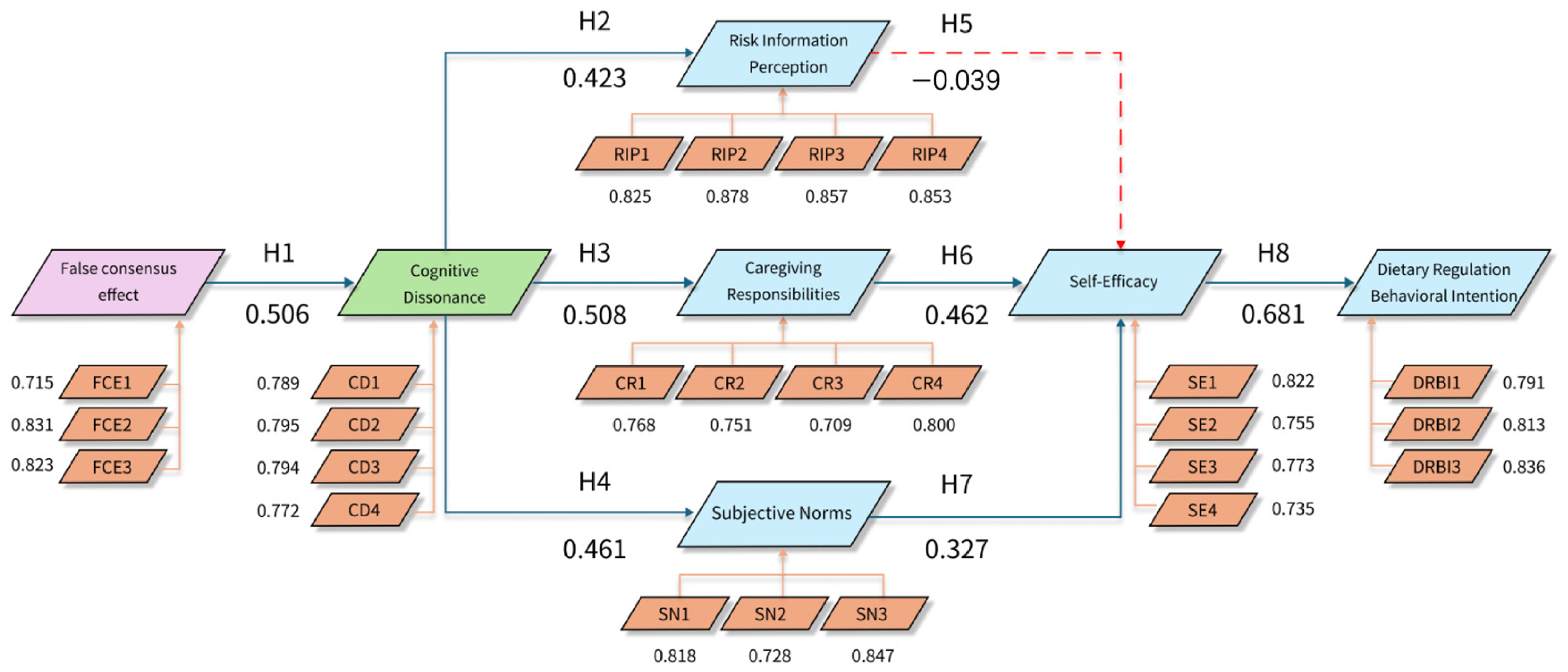
| FCE | FCE1 | 0.715 | 0.700 | 0.833 | 0.626 |
| FCE2 | 0.831 | ||||
| FCE3 | 0.823 | ||||
| CD | CD1 | 0.789 | 0.796 | 0.867 | 0.620 |
| CD2 | 0.795 | ||||
| CD3 | 0.794 | ||||
| CD4 | 0.772 | ||||
| RIP | RIP1 | 0.825 | 0.875 | 0.915 | 0.728 |
| RIP2 | 0.878 | ||||
| RIP3 | 0.857 | ||||
| RIP4 | 0.853 | ||||
| CR | CR1 | 0.768 | 0.752 | 0.843 | 0.574 |
| CR2 | 0.751 | ||||
| CR3 | 0.709 | ||||
| CR4 | 0.800 | ||||
| SN | SN1 | 0.818 | 0.717 | 0.841 | 0.638 |
| SN2 | 0.728 | ||||
| SN3 | 0.847 | ||||
| SE | SE1 | 0.822 | 0.773 | 0.855 | 0.596 |
| SE2 | 0.755 | ||||
| SE3 | 0.773 | ||||
| SE4 | 0.735 | ||||
| DRBI | DRBI1 | 0.791 | 0.745 | 0.855 | 0.662 |
| DRBI2 | 0.813 | ||||
| DRBI3 | 0.836 |
| DRBI | CD | CR | FCE | RIP | SE | |
|---|---|---|---|---|---|---|
| CD | 0.656 | |||||
| CR | 0.896 | 0.654 | ||||
| FCE | 0.786 | 0.676 | 0.828 | |||
| RIP | 0.381 | 0.507 | 0.439 | 0.31 | ||
| SE | 0.894 | 0.577 | 0.868 | 0.795 | 0.276 | |
| SN | 0.755 | 0.603 | 0.895 | 0.797 | 0.384 | 0.823 |
| DRBI | CD | CR | FCE | RIP | SE | SN | |
|---|---|---|---|---|---|---|---|
| DRBI | 0.814 | ||||||
| CD | 0.507 | 0.787 | |||||
| CR | 0.671 | 0.508 | 0.758 | ||||
| FCE | 0.57 | 0.506 | 0.605 | 0.791 | |||
| RIP | 0.309 | 0.423 | 0.357 | 0.245 | 0.853 | ||
| SE | 0.681 | 0.453 | 0.662 | 0.585 | 0.226 | 0.772 | |
| SN | 0.555 | 0.461 | 0.656 | 0.567 | 0.305 | 0.618 | 0.799 |
| Constructs | R2 | Q2 |
|---|---|---|
| Cognitive Dissonance/CD | 0.256 | 0.248 |
| Risk Information Perception/RIP | 0.179 | 0.056 |
| Caregiving Responsibilities/CR | 0.258 | 0.240 |
| Subjective Norms/SN | 0.212 | 0.206 |
| Self-Efficacy/SE | 0.499 | 0.179 |
| Dietary Regulation Behavioral Intention/DRBI | 0.464 | 0.125 |
| Hypothesis | Path | Std Beta | p-Value | VIF | Results |
|---|---|---|---|---|---|
| H1 | FCE → CD | 0.506 | 0.000 | 1.000 | Support |
| H2 | CD → RIP | 0.423 | 0.000 | 1.000 | Support |
| H3 | CD → CR | 0.508 | 0.000 | 1.000 | Support |
| H4 | CD → SN | 0.461 | 0.000 | 1.000 | Support |
| H5 | RIP → SE | −0.039 | 0.297 | 1.158 | No Support |
| H6 | CR → SE | 0.462 | 0.000 | 1.843 | Support |
| H7 | SN → SE | 0.327 | 0.000 | 1.774 | Support |
| H8 | SE → DRBI | 0.681 | 0.000 | 1.000 | Support |
Disclaimer/Publisher’s Note: The statements, opinions and data contained in all publications are solely those of the individual author(s) and contributor(s) and not of MDPI and/or the editor(s). MDPI and/or the editor(s) disclaim responsibility for any injury to people or property resulting from any ideas, methods, instructions or products referred to in the content. |
© 2026 by the authors. Licensee MDPI, Basel, Switzerland. This article is an open access article distributed under the terms and conditions of the Creative Commons Attribution (CC BY) license.
Share and Cite
Ding, Y.; Yang, C.; Deng, R. A Cognitive Study of Dietary Imbalance Behaviors in Chinese Multigenerational Households Based on the Information–Motivation–Behavioral Skills Model. Nutrients 2026, 18, 2687. https://doi.org/10.3390/nu18162687
Ding Y, Yang C, Deng R. A Cognitive Study of Dietary Imbalance Behaviors in Chinese Multigenerational Households Based on the Information–Motivation–Behavioral Skills Model. Nutrients. 2026; 18(16):2687. https://doi.org/10.3390/nu18162687
Chicago/Turabian StyleDing, Yue, Chun Yang, and Rong Deng. 2026. "A Cognitive Study of Dietary Imbalance Behaviors in Chinese Multigenerational Households Based on the Information–Motivation–Behavioral Skills Model" Nutrients 18, no. 16: 2687. https://doi.org/10.3390/nu18162687
APA StyleDing, Y., Yang, C., & Deng, R. (2026). A Cognitive Study of Dietary Imbalance Behaviors in Chinese Multigenerational Households Based on the Information–Motivation–Behavioral Skills Model. Nutrients, 18(16), 2687. https://doi.org/10.3390/nu18162687

