


Food-Derived Omega-3 Fatty Acids and Cognitive Aging: Integrating Nutritional Neuroscience and Geroscience
 , , ,
, , ,  , , , , , ,
Abstract
1. Introduction
1.1. Population Aging and Cognitive Decline
1.2. Nutrition and Brain Aging
1.3. Aim of the Review
2. Methods
3. Biology and Metabolism of Omega-3 Fatty Acids
3.1. Types and Dietary Sources of Omega-3 Fatty Acids
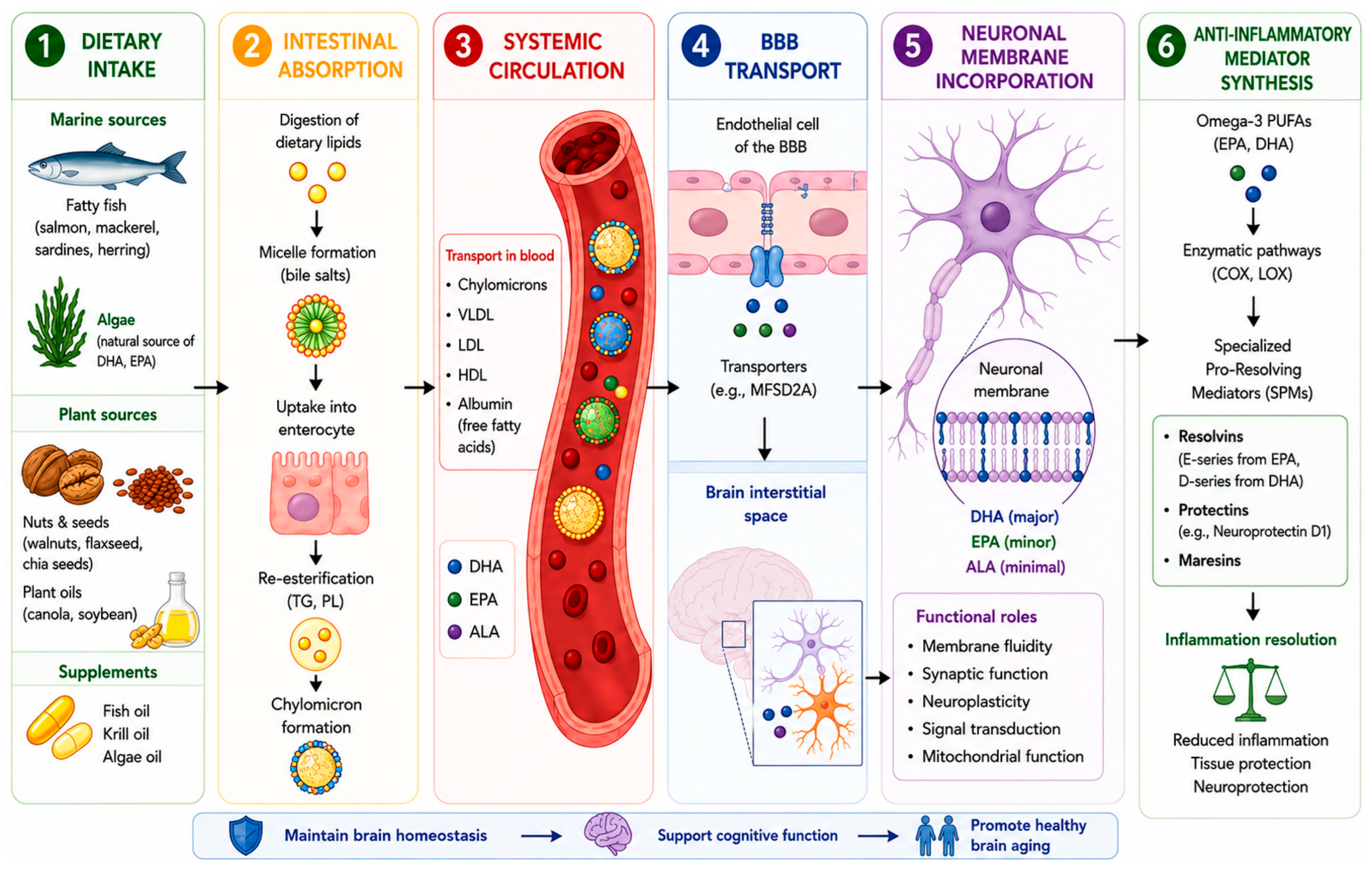
3.2. Absorption, Transport, and Brain Incorporation
3.2.1. Intestinal Digestion and Absorption of Omega-3 Fatty Acids
3.2.2. Systemic Transport and Factors Influencing Bioavailability
3.2.3. Blood–Brain Barrier Transport Mechanisms
3.2.4. Brain Incorporation and Functional Roles of DHA and EPA
3.2.5. Age-Related Changes in Omega-3 Metabolism and Brain Availability
3.3. Specialized Pro-Resolving Mediators
3.3.1. Formation and Biological Significance of Specialized Pro-Resolving Mediators
3.3.2. Resolvins and Regulation of Neuroinflammation
3.3.3. Protectins and the Neuroprotective Role of Neuroprotectin D1
3.3.4. Maresins in Tissue Repair and Brain Homeostasis
3.3.5. Specialized Pro-Resolving Mediators in Aging and Cognitive Decline
4. Mechanisms Linking Omega-3 Fatty Acids to Cognitive Aging
4.1. Neuroinflammation and Inflammaging
4.2. Synaptic Plasticity and Neurotransmission
4.3. Mitochondrial Dysfunction and Oxidative Stress
4.4. Cerebrovascular Aging and Endothelial Function
4.5. Cellular Senescence and Neurodegeneration
4.6. Gut–Brain Axis and Microbiome Interactions
4.7. Specialized Pro-Resolving Mediators and Additional Neuroprotective Mechanisms of Omega-3 Fatty Acids
5. Evidence from Human Studies
5.1. Observational Studies
5.2. Randomized Controlled Trials
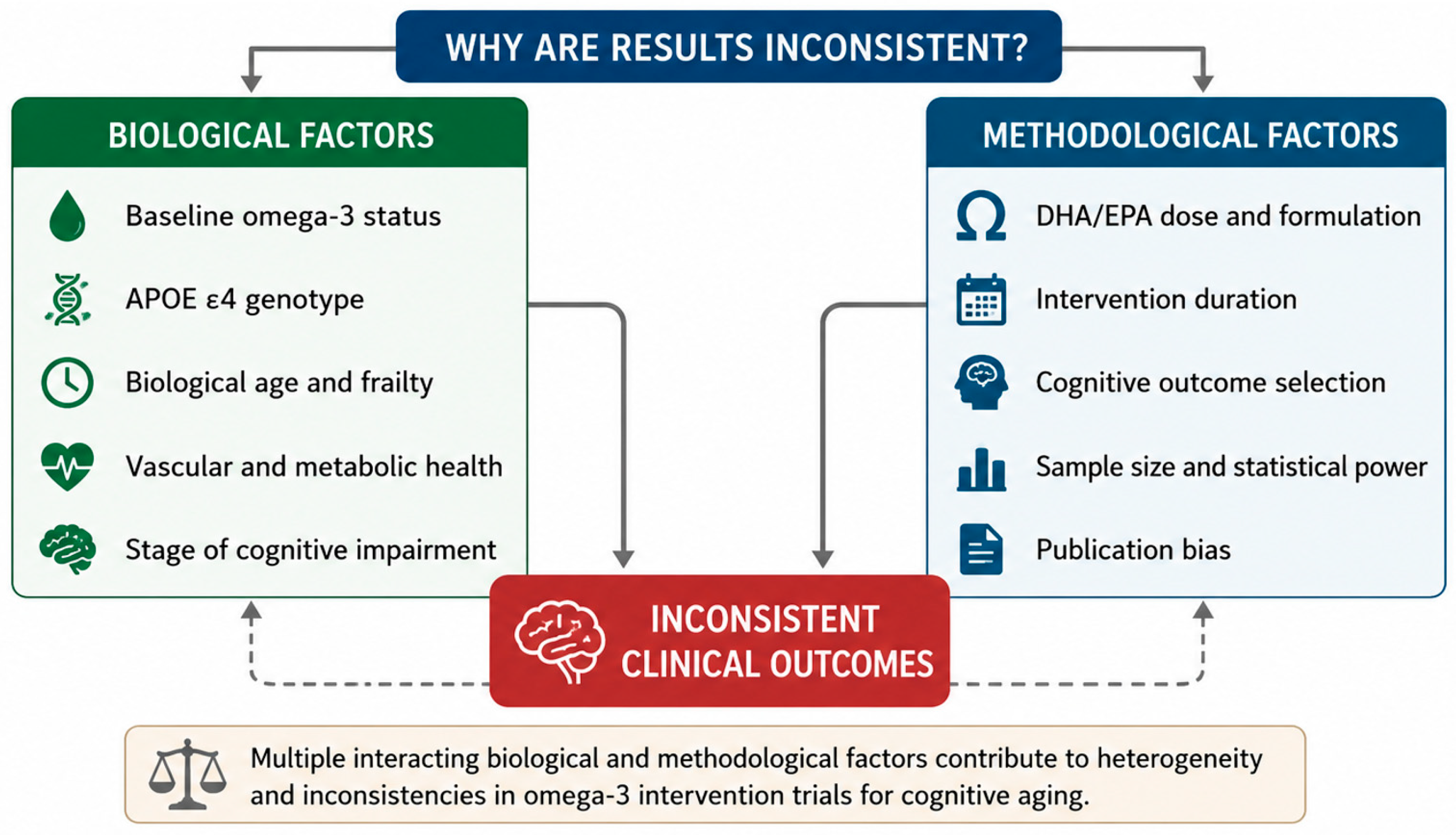
5.3. Why Are Clinical Results Heterogeneous?
6. Omega-3 Fatty Acids Through a Geroscience Lens
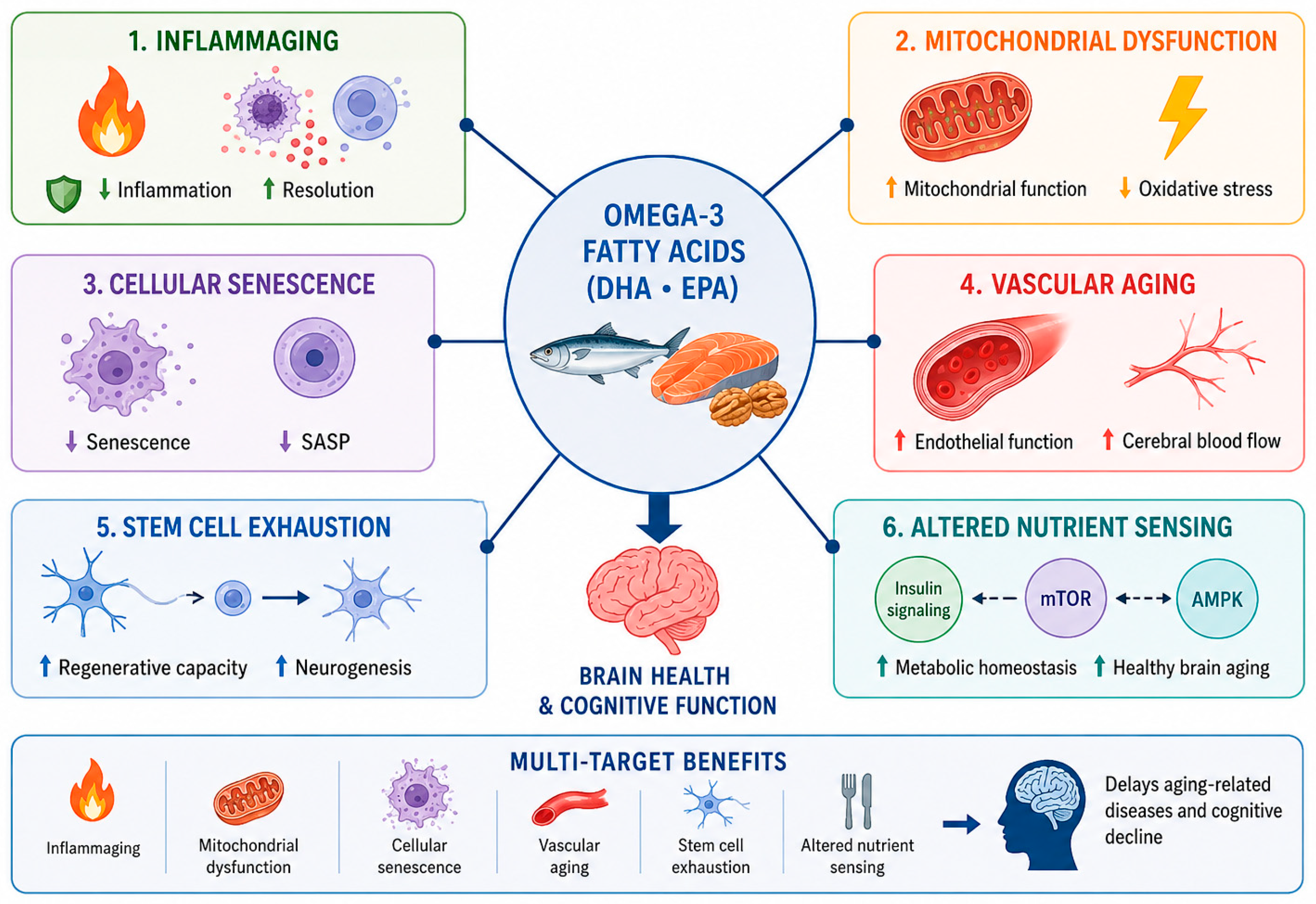
6.1. Linking Omega-3 Fatty Acids to Hallmarks of Aging
6.2. Cognitive Resilience and Healthy Longevity
6.3. Precision Geronutrition
6.3.1. Concept and Rationale of Precision Geronutrition
6.3.2. Biomarkers and Biological Age in Nutritional Geroscience
6.3.3. Genetic Determinants of Nutritional Responses: The Role of APOE
6.3.4. Inflammaging Phenotypes and Personalized Dietary Interventions
6.3.5. Multi-Omics Approaches in Precision Geronutrition
6.3.6. Towards Precision Geronutrition
7. Clinical and Public Health Implications
7.1. Dietary Recommendations and Mediterranean-Type Dietary Patterns
7.2. Fish Consumption and Food-First Approaches
7.3. Supplementation Considerations
7.4. Safety Considerations
7.5. Sustainability and Healthy Aging
8. Limitations of Current Evidence
9. Challenges and Future Directions
10. Conclusions
Supplementary Materials
Author Contributions
Funding
Institutional Review Board Statement
Informed Consent Statement
Data Availability Statement
Acknowledgments
Conflicts of Interest
Abbreviations
| AD | Alzheimer’s Disease |
| APOE | Apolipoprotein E |
| ARA | Arachidonic Acid |
| BBB | Blood–Brain Barrier |
| BDNF | Brain-Derived Neurotrophic Factor |
| CNS | Central Nervous System |
| DHA | Docosahexaenoic Acid |
| EPa | Eicosapentaenoic Acid |
| FADS | Fatty Acid Desaturase |
| IL-6 | Interleukin-6 |
| LC-PUFAs | Long-Chain Polyunsaturated Fatty Acids |
| LCPUFAs | Long-Chain Polyunsaturated Fatty Acids |
| MCI | Mild Cognitive Impairment |
| MRI | Magnetic Resonance Imaging |
| NF-κB | Nuclear Factor Kappa B |
| NIA-AA | National Institute on Aging–Alzheimer’s Association |
| OM3 | Omega-3 Fatty Acids |
| PUFAs | Polyunsaturated Fatty Acids |
| RCT | Randomized Controlled Trial |
| ROS | Reactive Oxygen Species |
| SPMs | Specialized Pro-Resolving Mediators |
| TNF-α | Tumor Necrosis Factor Alpha |
| WHO | World Health Organization |
| DNA | Deoxyribonucleic Acid |
| RNA | Ribonucleic Acid |
| mTOR | Mechanistic Target of Rapamycin |
| AMPK | AMP-Activated Protein Kinase |
| NAD+ | Nicotinamide Adenine Dinucleotide |
| SASP | Senescence-Associated Secretory Phenotype |
| OMICS | Multi-omics Approaches |
| GWAS | Genome-Wide Association Study |
References
- National Academies of Sciences, Engineering, and Medicine; Division of Behavioral and Social Sciences and Education; Committee on Population. Future Directions for the Demography of Aging: Proceedings of a Workshop; Majmundar, M.K., Hayward, M.D., Eds.; National Academies Press: Washington, DC, USA, 2018. [Google Scholar]
- Gonzales, M.M.; Garbarino, V.R.; Pollet, E.; Palavicini, J.P.; Kellogg, D.L., Jr.; Kraig, E.; Orr, M.E. Biological aging processes underlying cognitive decline and neurodegenerative disease. J. Clin. Investig. 2022, 132, e158453. [Google Scholar] [CrossRef] [PubMed]
- Randhawa, S.S.; Varghese, D. Geriatric Evaluation and Treatment of Age-Related Cognitive Decline. In StatPearls; StatPearls Publishing LLC: Treasure Island, FL, USA, 2026. [Google Scholar]
- Röhr, S.; Pabst, A.; Riedel-Heller, S.G.; Jessen, F.; Turana, Y.; Handajani, Y.S.; Brayne, C.; Matthews, F.E.; Stephan, B.C.M.; Lipton, R.B.; et al. Estimating prevalence of subjective cognitive decline in and across international cohort studies of aging: A COSMIC study. Alzheimers Res. Ther. 2020, 12, 167. [Google Scholar] [CrossRef] [PubMed]
- Park, H.L.; O’Connell, J.E.; Thomson, R.G. A systematic review of cognitive decline in the general elderly population. Int. J. Geriatr. Psychiatry 2003, 18, 1121–1134. [Google Scholar] [CrossRef] [PubMed]
- GBD 2019 Dementia Forecasting Collaborators. Estimation of the global prevalence of dementia in 2019 and forecasted prevalence in 2050: An analysis for the Global Burden of Disease Study 2019. Lancet Public Health 2022, 7, e105–e125. [Google Scholar] [CrossRef] [PubMed]
- Major, D.; Dósa, N.; Balázs, P.; Fekete, M.; Pártos, K.; Árva, D.; Mészáros, Á.; Terebessy, A.; Tabák, Á.G.; Fazekas-Pongor, V. Global trends in the incidence and prevalence of Alzheimer’s disease. Adv. Transl. Res. 2026, 1, 21–28. [Google Scholar] [CrossRef]
- Morris, J.C. Mild cognitive impairment and preclinical Alzheimer’s disease. Geriatrics 2005, 60, 9–14. [Google Scholar] [PubMed]
- Petersen, R.C.; Caracciolo, B.; Brayne, C.; Gauthier, S.; Jelic, V.; Fratiglioni, L. Mild cognitive impairment: A concept in evolution. J. Intern. Med. 2014, 275, 214–228. [Google Scholar] [CrossRef] [PubMed]
- Song, W.X.; Wu, W.W.; Zhao, Y.Y.; Xu, H.L.; Chen, G.C.; Jin, S.Y.; Chen, J.; Xian, S.X.; Liang, J.H. Evidence from a meta-analysis and systematic review reveals the global prevalence of mild cognitive impairment. Front. Aging Neurosci. 2023, 15, 1227112. [Google Scholar] [CrossRef] [PubMed]
- Bai, W.; Chen, P.; Cai, H.; Zhang, Q.; Su, Z.; Cheung, T.; Jackson, T.; Sha, S.; Xiang, Y.-T. Worldwide prevalence of mild cognitive impairment among community dwellers aged 50 years and older: A meta-analysis and systematic review of epidemiology studies. Age Ageing 2022, 51, afac173. [Google Scholar] [CrossRef] [PubMed]
- Kelaiditi, E.; Cesari, M.; Canevelli, M.; van Kan, G.A.; Ousset, P.J.; Gillette-Guyonnet, S.; Ritz, P.; Duveau, F.; Soto, M.E.; Provencher, V.; et al. Cognitive frailty: Rational and definition from an (I.A.N.A./I.A.G.G.) international consensus group. J. Nutr. Health Aging 2013, 17, 726–734. [Google Scholar] [CrossRef] [PubMed]
- Sugimoto, T.; Sakurai, T.; Ono, R.; Kimura, A.; Saji, N.; Niida, S.; Toba, K.; Chen, L.K.; Arai, H. Epidemiological and clinical significance of cognitive frailty: A mini review. Ageing Res. Rev. 2018, 44, 1–7. [Google Scholar] [CrossRef] [PubMed]
- Ruan, Q.; Yu, Z.; Chen, M.; Bao, Z.; Li, J.; He, W. Cognitive frailty, a novel target for the prevention of elderly dependency. Ageing Res. Rev. 2015, 20, 1–10. [Google Scholar] [CrossRef] [PubMed]
- Livingston, G.; Huntley, J.; Sommerlad, A.; Ames, D.; Ballard, C.; Banerjee, S.; Brayne, C.; Burns, A.; Cohen-Mansfield, J.; Cooper, C.; et al. Dementia prevention, intervention, and care: 2020 report of the Lancet Commission. Lancet 2020, 396, 413–446. [Google Scholar] [CrossRef] [PubMed]
- Deckers, K.; van Boxtel, M.P.; Schiepers, O.J.; de Vugt, M.; Muñoz Sánchez, J.L.; Anstey, K.J.; Brayne, C.; Dartigues, J.F.; Engedal, K.; Kivipelto, M.; et al. Target risk factors for dementia prevention: A systematic review and Delphi consensus study on the evidence from observational studies. Int. J. Geriatr. Psychiatry 2015, 30, 234–246. [Google Scholar] [CrossRef] [PubMed]
- Lourida, I.; Hannon, E.; Littlejohns, T.J.; Langa, K.M.; Hyppönen, E.; Kuzma, E.; Llewellyn, D.J. Association of Lifestyle and Genetic Risk With Incidence of Dementia. JAMA 2019, 322, 430–437. [Google Scholar] [CrossRef] [PubMed]
- Scarmeas, N.; Anastasiou, C.A.; Yannakoulia, M. Nutrition and prevention of cognitive impairment. Lancet Neurol. 2018, 17, 1006–1015. [Google Scholar] [CrossRef] [PubMed]
- Gómez-Pinilla, F. Brain foods: The effects of nutrients on brain function. Nat. Rev. Neurosci. 2008, 9, 568–578. [Google Scholar] [CrossRef] [PubMed]
- Wahl, D.; Solon-Biet, S.M.; Cogger, V.C.; Fontana, L.; Simpson, S.J.; Le Couteur, D.G.; Ribeiro, R.V. Aging, lifestyle and dementia. Neurobiol. Dis. 2019, 130, 104481. [Google Scholar] [CrossRef] [PubMed]
- Charisis, S.; Yannakoulia, M.; Scarmeas, N. Diets to promote healthy brain ageing. Nat. Rev. Neurol. 2025, 21, 5–16. [Google Scholar] [CrossRef] [PubMed]
- Chaudhari, D.S.; Jain, S.; Yata, V.K.; Mishra, S.P.; Kumar, A.; Fraser, A.; Kociolek, J.; Dangiolo, M.; Smith, A.; Golden, A.; et al. Unique trans-kingdom microbiome structural and functional signatures predict cognitive decline in older adults. GeroScience 2023, 45, 2819–2834. [Google Scholar] [CrossRef] [PubMed]
- Fekete, M.; Lehoczki, A.; Tarantini, S.; Fazekas-Pongor, V.; Csípő, T.; Csizmadia, Z.; Varga, J.T. Improving Cognitive Function with Nutritional Supplements in Aging: A Comprehensive Narrative Review of Clinical Studies Investigating the Effects of Vitamins, Minerals, Antioxidants, and Other Dietary Supplements. Nutrients 2023, 15, 5116. [Google Scholar] [CrossRef] [PubMed]
- Francis, H.; Stevenson, R. The longer-term impacts of Western diet on human cognition and the brain. Appetite 2013, 63, 119–128. [Google Scholar] [CrossRef] [PubMed]
- Tengeler, A.C.; Kozicz, T.; Kiliaan, A.J. Relationship between diet, the gut microbiota, and brain function. Nutr. Rev. 2018, 76, 603–617. [Google Scholar] [CrossRef] [PubMed]
- Arora, S.; Santiago, J.A.; Bernstein, M.; Potashkin, J.A. Diet and lifestyle impact the development and progression of Alzheimer’s dementia. Front. Nutr. 2023, 10, 1213223. [Google Scholar] [CrossRef] [PubMed]
- Lehoczki, A.; Csípő, T.; Lipécz, Á.; Major, D.; Fazekas-Pongor, V.; Csík, B.; Mózes, N.; Fehér, Á.; Dósa, N.; Árva, D.; et al. Western Diet and Cognitive Decline: A Hungarian Perspective-Implications for the Design of the Semmelweis Study. Nutrients 2025, 17, 2446. [Google Scholar] [CrossRef] [PubMed]
- Joseph, J.; Cole, G.; Head, E.; Ingram, D. Nutrition, brain aging, and neurodegeneration. J. Neurosci. 2009, 29, 12795–12801. [Google Scholar] [CrossRef] [PubMed]
- Megur, A.; Baltriukienė, D.; Bukelskienė, V.; Burokas, A. The Microbiota-Gut-Brain Axis and Alzheimer’s Disease: Neuroinflammation Is to Blame? Nutrients 2020, 13, 37. [Google Scholar] [CrossRef] [PubMed]
- Michailidis, M.; Moraitou, D.; Tata, D.A.; Kalinderi, K.; Papamitsou, T.; Papaliagkas, V. Alzheimer’s Disease as Type 3 Diabetes: Common Pathophysiological Mechanisms between Alzheimer’s Disease and Type 2 Diabetes. Int. J. Mol. Sci. 2022, 23, 2687. [Google Scholar] [CrossRef] [PubMed]
- Solch, R.J.; Aigbogun, J.O.; Voyiadjis, A.G.; Talkington, G.M.; Darensbourg, R.M.; O’Connell, S.; Pickett, K.M.; Perez, S.R.; Maraganore, D.M. Mediterranean diet adherence, gut microbiota, and Alzheimer’s or Parkinson’s disease risk: A systematic review. J. Neurol. Sci. 2022, 434, 120166. [Google Scholar] [CrossRef] [PubMed]
- Twarowski, B.; Herbet, M. Inflammatory Processes in Alzheimer’s Disease-Pathomechanism, Diagnosis and Treatment: A Review. Int. J. Mol. Sci. 2023, 24, 6518. [Google Scholar] [CrossRef] [PubMed]
- Kennedy, B.K.; Berger, S.L.; Brunet, A.; Campisi, J.; Cuervo, A.M.; Epel, E.S.; Franceschi, C.; Lithgow, G.J.; Morimoto, R.I.; Pessin, J.E.; et al. Geroscience: Linking aging to chronic disease. Cell 2014, 159, 709–713. [Google Scholar] [CrossRef] [PubMed]
- Varga, P.; Ungvari, A.; Kallai, A.; Ponyai, P.T.; Csik, B.; Feher, A.; Fekete, M.; Lipecz, A.; Tarantini, S.; Yabluchanskiy, A.; et al. Mediterranean diet adherence and microvascular function assessed by laser speckle contrast imaging: Pilot findings from the Semmelweis Study. Adv. Transl. Res. 2026. [Google Scholar] [CrossRef]
- Binti, M.A.N.; Fekete, M.; Varga, J.T. Mediterranean Diet and Physical Exercise for Cardiometabolic Health: A Narrative Review. Nutrients 2026, 18, 2548. [Google Scholar] [CrossRef]
- Nucci, D.; Sommariva, A.; Degoni, L.M.; Gallo, G.; Mancarella, M.; Natarelli, F.; Savoia, A.; Catalini, A.; Ferranti, R.; Pregliasco, F.E.; et al. Association between Mediterranean diet and dementia and Alzheimer disease: A systematic review with meta-analysis. Aging Clin. Exp. Res. 2024, 36, 77. [Google Scholar] [CrossRef] [PubMed]
- Wang, X.; Xin, Z.; Li, X.; Wu, K.; Wang, W.; Guo, L.; Wang, L.; Mo, X.; Liu, X.; Guo, Z.; et al. Mediterranean diet and dementia: MRI marker evidence from meta-analysis. Eur. J. Med. Res. 2025, 30, 32. [Google Scholar] [CrossRef] [PubMed]
- Fekete, M.; Lehoczki, A.; Kryczyk-Poprawa, A.; Zábó, V.; Varga, J.T.; Bálint, M.; Fazekas-Pongor, V.; Csípő, T.; Rząsa-Duran, E.; Varga, P. Functional Foods in Modern Nutrition Science: Mechanisms, Evidence, and Public Health Implications. Nutrients 2025, 17, 2153. [Google Scholar] [CrossRef] [PubMed]
- Luciano, M.; Corley, J.; Cox, S.R.; Valdés Hernández, M.C.; Craig, L.C.; Dickie, D.A.; Karama, S.; McNeill, G.M.; Bastin, M.E.; Wardlaw, J.M.; et al. Mediterranean-type diet and brain structural change from 73 to 76 years in a Scottish cohort. Neurology 2017, 88, 449–455. [Google Scholar] [CrossRef] [PubMed]
- Mózes, N.; Varga, J.T.; Szwajgier, D.; Kryczyk-Poprawa, A.; Zábó, V.; Lehoczki, A.; Lipécz, Á.; Csípő, T.; Fazekas-Pongor, V.; Major, D.; et al. Dietary Polyphenols in Brain Aging: Molecular Mechanisms and Implications for Neurodegeneration. Nutrients 2026, 18, 1470. [Google Scholar] [CrossRef] [PubMed]
- McCleery, J.; Abraham, R.P.; Denton, D.A.; Rutjes, A.W.; Chong, L.Y.; Al-Assaf, A.S.; Griffith, D.J.; Rafeeq, S.; Yaman, H.; Malik, M.A.; et al. Vitamin and mineral supplementation for preventing dementia or delaying cognitive decline in people with mild cognitive impairment. Cochrane Database Syst. Rev. 2018, 11, CD011905. [Google Scholar] [CrossRef] [PubMed]
- Shea, M.K.; Lynch, S.D.; Brinkley, T.E.; Kritchevsky, S.B. Nutrition and Aging Biology: Summary of a Research Centers Collaborative Network Workshop and Research Needs. Curr. Dev. Nutr. 2025, 9, 107485. [Google Scholar] [CrossRef] [PubMed]
- Dyall, S.C. Long-chain omega-3 fatty acids and the brain: A review of the independent and shared effects of EPA, DPA and DHA. Front. Aging Neurosci. 2015, 7, 52. [Google Scholar] [CrossRef] [PubMed]
- Calder, P.C. Omega-3 fatty acids and inflammatory processes: From molecules to man. Biochem. Soc. Trans. 2017, 45, 1105–1115. [Google Scholar] [CrossRef] [PubMed]
- Djuricic, I.; Calder, P.C. Beneficial Outcomes of Omega-6 and Omega-3 Polyunsaturated Fatty Acids on Human Health: An Update for 2021. Nutrients 2021, 13, 2421. [Google Scholar] [CrossRef] [PubMed]
- Thomas, J.; Thomas, C.J.; Radcliffe, J.; Itsiopoulos, C. Omega-3 Fatty Acids in Early Prevention of Inflammatory Neurodegenerative Disease: A Focus on Alzheimer’s Disease. BioMed Res. Int. 2015, 2015, 172801. [Google Scholar] [CrossRef] [PubMed]
- Brenna, J.T.; Salem, N., Jr.; Sinclair, A.J.; Cunnane, S.C. Alpha-Linolenic acid supplementation and conversion to n-3 long-chain polyunsaturated fatty acids in humans. Prostaglandins Leukot. Essent. Fat. Acids 2009, 80, 85–91. [Google Scholar] [CrossRef] [PubMed]
- Ganesan, B.; Brothersen, C.; McMahon, D.J. Fortification of foods with omega-3 polyunsaturated fatty acids. Crit. Rev. Food Sci. Nutr. 2014, 54, 98–114. [Google Scholar] [CrossRef] [PubMed]
- Yuan, Q.; Xie, F.; Huang, W.; Hu, M.; Yan, Q.; Chen, Z.; Zheng, Y.; Liu, L. The review of alpha-linolenic acid: Sources, metabolism, and pharmacology. Phyther. Res. 2022, 36, 164–188. [Google Scholar] [CrossRef] [PubMed]
- Shahidi, F.; Ambigaipalan, P. Omega-3 Polyunsaturated Fatty Acids and Their Health Benefits. Annu. Rev. Food Sci. Technol. 2018, 9, 345–381. [Google Scholar] [CrossRef] [PubMed]
- Mozaffarian, D.; Wu, J.H. Omega-3 fatty acids and cardiovascular disease: Effects on risk factors, molecular pathways, and clinical events. J. Am. Coll. Cardiol. 2011, 58, 2047–2067. [Google Scholar] [CrossRef] [PubMed]
- Din, J.N.; Newby, D.E.; Flapan, A.D. Omega 3 fatty acids and cardiovascular disease--fishing for a natural treatment. BMJ 2004, 328, 30–35. [Google Scholar] [CrossRef] [PubMed]
- Ryckebosch, E.; Bruneel, C.; Muylaert, K.; Foubert, I. Microalgae as an alternative source of omega-3 long chain polyunsaturated fatty acids. Lipid Technol. 2012, 24, 128–130. [Google Scholar] [CrossRef]
- Adarme-Vega, T.C.; Lim, D.K.; Timmins, M.; Vernen, F.; Li, Y.; Schenk, P.M. Microalgal biofactories: A promising approach towards sustainable omega-3 fatty acid production. Microb. Cell Fact. 2012, 11, 96. [Google Scholar] [CrossRef] [PubMed]
- Lane, K.E.; Wilson, M.; Hellon, T.G.; Davies, I.G. Bioavailability and conversion of plant based sources of omega-3 fatty acids—A scoping review to update supplementation options for vegetarians and vegans. Crit. Rev. Food Sci. Nutr. 2022, 62, 4982–4997. [Google Scholar] [CrossRef] [PubMed]
- Barclay, W.; Zeller, S. Nutritional Enhancement of n-3 and n-6 Fatty Acids in Rotifers and Artemia Nauplii by Feeding Spray-dried Schizochytrium sp. J. World Aquac. Soc. 1996, 27, 314–322. [Google Scholar] [CrossRef]
- Burdge, G.C.; Calder, P.C. Conversion of alpha-linolenic acid to longer-chain polyunsaturated fatty acids in human adults. Reprod. Nutr. Dev. 2005, 45, 581–597. [Google Scholar] [CrossRef] [PubMed]
- Arterburn, L.M.; Hall, E.B.; Oken, H. Distribution, interconversion, and dose response of n-3 fatty acids in humans. Am. J. Clin. Nutr. 2006, 83, 1467s–1476s. [Google Scholar] [CrossRef] [PubMed]
- Lauritzen, L.; Brambilla, P.; Mazzocchi, A.; Harsløf, L.B.; Ciappolino, V.; Agostoni, C. DHA Effects in Brain Development and Function. Nutrients 2016, 8, 6. [Google Scholar] [CrossRef] [PubMed]
- Stillwell, W.; Wassall, S.R. Docosahexaenoic acid: Membrane properties of a unique fatty acid. Chem. Phys. Lipids 2003, 126, 1–27. [Google Scholar] [CrossRef] [PubMed]
- Devassy, J.G.; Leng, S.; Gabbs, M.; Monirujjaman, M.; Aukema, H.M. Omega-3 Polyunsaturated Fatty Acids and Oxylipins in Neuroinflammation and Management of Alzheimer Disease. Adv. Nutr. 2016, 7, 905–916. [Google Scholar] [CrossRef] [PubMed]
- Li, M.; Li, Z.; Fan, Y. Omega-3 fatty acids: Multi-target mechanisms and therapeutic applications in neurodevelopmental disorders and epilepsy. Front. Nutr. 2025, 12, 1598588. [Google Scholar] [CrossRef] [PubMed]
- Ramprasath, V.R.; Eyal, I.; Zchut, S.; Jones, P.J. Enhanced increase of omega-3 index in healthy individuals with response to 4-week n-3 fatty acid supplementation from krill oil versus fish oil. Lipids Health Dis. 2013, 12, 178. [Google Scholar] [CrossRef] [PubMed]
- Ruiz-López, N.; Sayanova, O.; Napier, J.A.; Haslam, R.P. Metabolic engineering of the omega-3 long chain polyunsaturated fatty acid biosynthetic pathway into transgenic plants. J. Exp. Bot. 2012, 63, 2397–2410. [Google Scholar] [CrossRef] [PubMed]
- Burckhardt, M.; Herke, M.; Wustmann, T.; Watzke, S.; Langer, G.; Fink, A. Omega-3 fatty acids for the treatment of dementia. Cochrane Database Syst. Rev. 2016, 4, CD009002. [Google Scholar] [CrossRef] [PubMed]
- Abdelhafez, A.; Khabir, Z.; Prestidge, C.A.; Garcia-Bennett, A.; Joyce, P. The impact of formulation design on the oral bioavailability of omega-3 polyunsaturated fatty acids. Food Res. Int. 2025, 208, 116171. [Google Scholar] [CrossRef] [PubMed]
- Gutiérrez, S.; Svahn, S.L.; Johansson, M.E. Effects of Omega-3 Fatty Acids on Immune Cells. Int. J. Mol. Sci. 2019, 20, 5028. [Google Scholar] [CrossRef] [PubMed]
- Cholewski, M.; Tomczykowa, M.; Tomczyk, M. A Comprehensive Review of Chemistry, Sources and Bioavailability of Omega-3 Fatty Acids. Nutrients 2018, 10, 1662. [Google Scholar] [CrossRef] [PubMed]
- Mallick, R.; Bhowmik, P.; Chowdhury, P.; Duttaroy, A.K. Fatty Acids and Their Roles in Cardiac Physiology and Pathology: Mechanistic and Interventional Studies. Nutrients 2026, 18, 1429. [Google Scholar] [CrossRef] [PubMed]
- Nichols, P.D.; McManus, A.; Krail, K.; Sinclair, A.J.; Miller, M. Recent advances in omega-3: Health Benefits, Sources, Products and Bioavailability. Nutrients 2014, 6, 3727–3733. [Google Scholar] [CrossRef] [PubMed]
- Schuchardt, J.P.; Hahn, A. Bioavailability of long-chain omega-3 fatty acids. Prostaglandins Leukot. Essent. Fat. Acids 2013, 89, 1–8. [Google Scholar] [CrossRef] [PubMed]
- Cater, R.J.; Chua, G.L.; Erramilli, S.K.; Keener, J.E.; Choy, B.C.; Tokarz, P.; Chin, C.F.; Quek, D.Q.Y.; Kloss, B.; Pepe, J.G.; et al. Structural basis of omega-3 fatty acid transport across the blood-brain barrier. Nature 2021, 595, 315–319. [Google Scholar] [CrossRef] [PubMed]
- Nguyen, L.N.; Ma, D.; Shui, G.; Wong, P.; Cazenave-Gassiot, A.; Zhang, X.; Wenk, M.R.; Goh, E.L.; Silver, D.L. Mfsd2a is a transporter for the essential omega-3 fatty acid docosahexaenoic acid. Nature 2014, 509, 503–506. [Google Scholar] [CrossRef] [PubMed]
- Bazinet, R.P.; Layé, S. Polyunsaturated fatty acids and their metabolites in brain function and disease. Nat. Rev. Neurosci. 2014, 15, 771–785. [Google Scholar] [CrossRef] [PubMed]
- Layé, S.; Nadjar, A.; Joffre, C.; Bazinet, R.P. Anti-Inflammatory Effects of Omega-3 Fatty Acids in the Brain: Physiological Mechanisms and Relevance to Pharmacology. Pharmacol. Rev. 2018, 70, 12–38. [Google Scholar] [CrossRef] [PubMed]
- Cutuli, D. Functional and Structural Benefits Induced by Omega-3 Polyunsaturated Fatty Acids During Aging. Curr. Neuropharmacol. 2017, 15, 534–542. [Google Scholar] [CrossRef] [PubMed]
- Cunnane, S.C.; Trushina, E.; Morland, C.; Prigione, A.; Casadesus, G.; Andrews, Z.B.; Beal, M.F.; Bergersen, L.H.; Brinton, R.D.; de la Monte, S.; et al. Brain energy rescue: An emerging therapeutic concept for neurodegenerative disorders of ageing. Nat. Rev. Drug Discov. 2020, 19, 609–633. [Google Scholar] [CrossRef] [PubMed]
- Serhan, C.N.; Levy, B.D. Resolvins in inflammation: Emergence of the pro-resolving superfamily of mediators. J. Clin. Investig. 2018, 128, 2657–2669. [Google Scholar] [CrossRef] [PubMed]
- Serhan, C.N.; Chiang, N.; Dalli, J. New pro-resolving n-3 mediators bridge resolution of infectious inflammation to tissue regeneration. Mol. Asp. Med. 2018, 64, 1–17. [Google Scholar] [CrossRef] [PubMed]
- Basil, M.C.; Levy, B.D. Specialized pro-resolving mediators: Endogenous regulators of infection and inflammation. Nat. Rev. Immunol. 2016, 16, 51–67. [Google Scholar] [CrossRef] [PubMed]
- Bazan, N.G. Docosanoids and elovanoids from omega-3 fatty acids are pro-homeostatic modulators of inflammatory responses, cell damage and neuroprotection. Mol. Asp. Med. 2018, 64, 18–33. [Google Scholar] [CrossRef] [PubMed]
- Bazan, N.G. Neuroprotectin D1-mediated anti-inflammatory and survival signaling in stroke, retinal degenerations, and Alzheimer’s disease. J. Lipid Res. 2009, 50, S400–S405. [Google Scholar] [CrossRef] [PubMed]
- Franceschi, C.; Garagnani, P.; Parini, P.; Giuliani, C.; Santoro, A. Inflammaging: A new immune-metabolic viewpoint for age-related diseases. Nat. Rev. Endocrinol. 2018, 14, 576–590. [Google Scholar] [CrossRef] [PubMed]
- Serhan, C.N.; Yang, R.; Martinod, K.; Kasuga, K.; Pillai, P.S.; Porter, T.F.; Oh, S.F.; Spite, M. Maresins: Novel macrophage mediators with potent antiinflammatory and proresolving actions. J. Exp. Med. 2009, 206, 15–23. [Google Scholar] [CrossRef] [PubMed]
- Serhan, C.N.; Chiang, N.; Dalli, J. The resolution code of acute inflammation: Novel pro-resolving lipid mediators in resolution. Semin. Immunol. 2015, 27, 200–215. [Google Scholar] [CrossRef] [PubMed]
- Han, Y.H.; Lee, K.; Saha, A.; Han, J.; Choi, H.; Noh, M.; Lee, Y.H.; Lee, M.O. Specialized Proresolving Mediators for Therapeutic Interventions Targeting Metabolic and Inflammatory Disorders. Biomol. Ther. 2021, 29, 455–464. [Google Scholar] [CrossRef] [PubMed]
- Fullerton, J.N.; Gilroy, D.W. Resolution of inflammation: A new therapeutic frontier. Nat. Rev. Drug Discov. 2016, 15, 551–567. [Google Scholar] [CrossRef] [PubMed]
- Sanada, F.; Taniyama, Y.; Muratsu, J.; Otsu, R.; Shimizu, H.; Rakugi, H.; Morishita, R. Source of Chronic Inflammation in Aging. Front. Cardiovasc. Med. 2018, 5, 12. [Google Scholar] [CrossRef] [PubMed]
- Ferrucci, L.; Fabbri, E. Inflammageing: Chronic inflammation in ageing, cardiovascular disease, and frailty. Nat. Rev. Cardiol. 2018, 15, 505–522. [Google Scholar] [CrossRef] [PubMed]
- Andonian, B.J.; Hippensteel, J.A.; Abuabara, K.; Boyle, E.M.; Colbert, J.F.; Devinney, M.J.; Faye, A.S.; Kochar, B.; Lee, J.; Litke, R.; et al. Inflammation and aging-related disease: A transdisciplinary inflammaging framework. Geroscience 2025, 47, 515–542. [Google Scholar] [CrossRef] [PubMed]
- Leng, F.; Edison, P. Neuroinflammation and microglial activation in Alzheimer disease: Where do we go from here? Nat. Rev. Neurol. 2021, 17, 157–172. [Google Scholar] [CrossRef] [PubMed]
- Deczkowska, A.; Keren-Shaul, H.; Weiner, A.; Colonna, M.; Schwartz, M.; Amit, I. Disease-Associated Microglia: A Universal Immune Sensor of Neurodegeneration. Cell 2018, 173, 1073–1081. [Google Scholar] [CrossRef] [PubMed]
- Hansen, D.V.; Hanson, J.E.; Sheng, M. Microglia in Alzheimer’s disease. J. Cell Biol. 2018, 217, 459–472. [Google Scholar] [CrossRef] [PubMed]
- Hopperton, K.E.; Trépanier, M.O.; Giuliano, V.; Bazinet, R.P. Brain omega-3 polyunsaturated fatty acids modulate microglia cell number and morphology in response to intracerebroventricular amyloid-β 1-40 in mice. J. Neuroinflamm. 2016, 13, 257. [Google Scholar] [CrossRef] [PubMed]
- Chiang, N.; Serhan, C.N. Specialized pro-resolving mediator network: An update on production and actions. Essays Biochem. 2020, 64, 443–462. [Google Scholar] [CrossRef] [PubMed]
- Burke, S.N.; Barnes, C.A. Neural plasticity in the ageing brain. Nat. Rev. Neurosci. 2006, 7, 30–40. [Google Scholar] [CrossRef] [PubMed]
- Burke, S.N.; Ryan, L.; Barnes, C.A. Characterizing cognitive aging of recognition memory and related processes in animal models and in humans. Front. Aging Neurosci. 2012, 4, 15. [Google Scholar] [CrossRef] [PubMed]
- Wu, A.; Ying, Z.; Gomez-Pinilla, F. Dietary omega-3 fatty acids normalize BDNF levels, reduce oxidative damage, and counteract learning disability after traumatic brain injury in rats. J. Neurotrauma 2004, 21, 1457–1467. [Google Scholar] [CrossRef] [PubMed]
- Miranda, M.; Morici, J.F.; Zanoni, M.B.; Bekinschtein, P. Brain-Derived Neurotrophic Factor: A Key Molecule for Memory in the Healthy and the Pathological Brain. Front. Cell Neurosci. 2019, 13, 363. [Google Scholar] [CrossRef] [PubMed]
- Yurko-Mauro, K.; Alexander, D.D.; Van Elswyk, M.E. Docosahexaenoic acid and adult memory: A systematic review and meta-analysis. PLoS ONE 2015, 10, e0120391. [Google Scholar] [CrossRef] [PubMed]
- Boespflug, E.L.; McNamara, R.K.; Eliassen, J.C.; Schidler, M.D.; Krikorian, R. Fish Oil Supplementation Increases Event-Related Posterior Cingulate Activation in Older Adults with Subjective Memory Impairment. J. Nutr. Health Aging 2016, 20, 161–169. [Google Scholar] [CrossRef] [PubMed]
- Fekete, M.; Szarvas, Z.; Fazekas-Pongor, V.; Lehoczki, A.; Tarantini, S.; Varga, J.T. Effects of omega-3 supplementation on quality of life, nutritional status, inflammatory parameters, lipid profile, exercise tolerance and inhaled medications in chronic obstructive pulmonary disease. Ann. Palliat. Med. 2022, 11, 2819–2829. [Google Scholar] [CrossRef] [PubMed]
- Fekete, M.; Szőllősi, G.; Németh, A.N.; Varga, J.T. Clinical value of omega-3 polyunsaturated fatty acid supplementation in chronic obstructive pulmonary disease. Orv. Hetil. 2021, 162, 23–30. [Google Scholar] [CrossRef] [PubMed]
- Kunutsor, S.K.; Jassal, D.S.; Ravandi, A.; Lehoczki, A. Dietary flaxseed: Cardiometabolic benefits and its role in promoting healthy aging. Geroscience 2025, 47, 2895–2923. [Google Scholar] [CrossRef] [PubMed]
- Godos, J.; Caruso, G.; Micek, A.; Dolci, A.; Rodríguez Velasco, C.L.; Frias-Toral, E.; Di Giorgio, J.; Veronese, N.; Lehoczki, A.; Siervo, M.; et al. Fish consumption and cognitive function in aging: A systematic review of observational studies. Geroscience 2026, 48, 4923–4956. [Google Scholar] [CrossRef] [PubMed]
- Ungvari, Z.; Fekete, M.; Varga, P.; Fekete, J.T.; Buda, A.; Szappanos, Á.; Lehoczki, A.; Mózes, N.; Grosso, G.; Menyhart, O. Impact of adherence to the Mediterranean diet on stroke risk. Geroscience 2025, 47, 3565–3581. [Google Scholar] [CrossRef] [PubMed]
- Titova, O.E.; Sjögren, P.; Brooks, S.J.; Kullberg, J.; Ax, E.; Kilander, L.; Riserus, U.; Cederholm, T.; Larsson, E.-M.; Johansson, L.; et al. Dietary intake of eicosapentaenoic and docosahexaenoic acids is linked to gray matter volume and cognitive function in elderly. GeroScience 2013, 35, 1495–1505. [Google Scholar] [CrossRef] [PubMed]
- Chen, L.; Tatewaki, Y.; Thyreau, B.; Uchida, K.; Iki, H.; Nakaji, S.; Maeda, T.; Ono, K.; Noguchi-Shinohara, M.; Mimura, M.; et al. From the plate to the brain: Associations between dietary patterns and reduced dementia prevalence and white matter lesions in older Japanese adults. Geroscience 2026, 48, 2743–2756. [Google Scholar] [CrossRef] [PubMed]
- He, Y.; Huang, S.Y.; Wang, H.F.; Zhang, W.; Deng, Y.T.; Zhang, Y.R.; Dong, Q.; Feng, J.F.; Cheng, W.; Yu, J.T. Circulating polyunsaturated fatty acids, fish oil supplementation, and risk of incident dementia: A prospective cohort study of 440,750 participants. Geroscience 2023, 45, 1997–2009. [Google Scholar] [CrossRef] [PubMed]
- Dobreva, I.; Marston, L.; Mukadam, N. Which components of the Mediterranean diet are associated with dementia? A UK Biobank cohort study. Geroscience 2022, 44, 2541–2554. [Google Scholar] [CrossRef] [PubMed]
- Mengist, B.; Lotfaliany, M.; Pasco, J.A.; Agustini, B.; Berk, M.; Forbes, M.; Marx, W.; Orchard, S.G.; Ryan, J.; Owen, A.J.; et al. Anti-inflammatory diet and mental health outcomes in an aging population: Evidence from a preventive population-based target trial emulation. GeroScience 2026. [Google Scholar] [CrossRef] [PubMed]
- Mikó, E.; Sipos, A.; Tóth, E.; Lehoczki, A.; Fekete, M.; Sebő, É.; Kardos, G.; Bai, P. Guideline for designing microbiome studies in neoplastic diseases. GeroScience 2024, 46, 4037–4057. [Google Scholar] [CrossRef] [PubMed]
- Dai, Z.; Lee, S.Y.; Sharma, S.; Ullah, S.; Tan, E.C.K.; Brodaty, H.; Schutte, A.E.; Sachdev, P.S. A systematic review of diet and medication use among centenarians and near-centenarians worldwide. Geroscience 2024, 46, 6625–6639. [Google Scholar] [CrossRef] [PubMed]
- Madarász, B.; Fazekas-Pongor, V.; Szarvas, Z.; Fekete, M.; Varga, J.T.; Tarantini, S.; Csiszar, A.; Lionetti, V.; Tabák, A.G.; Ungvari, Z. Survival and longevity of European rulers: Geographical influences and exploring potential factors, including the Mediterranean diet—A historical analysis from 1354 to the twentieth century. GeroScience 2024, 46, 3801–3818. [Google Scholar] [PubMed]
- Ungvari, Z.; Fekete, M.; Fekete, J.T.; Grosso, G.; Ungvari, A.; Győrffy, B. Adherence to the Mediterranean diet and its protective effects against colorectal cancer: A meta-analysis of 26 studies with 2,217,404 participants. Geroscience 2025, 47, 1105–1121. [Google Scholar] [PubMed]
- Wang, M.; Jia, X.; Chen, D.; Pei, G.; Song, Z.; Peng, M.; Huang, K.; Liu, X. Dietary patterns and mortality risk in geriatric patients with atherosclerotic cardiovascular disease: An analysis of the National Health and Nutrition Examination Survey. GeroScience 2026, 48, 937–950. [Google Scholar] [CrossRef] [PubMed]
- Dieter, F.; Jacobs, K.; Quentin, A.; Prvulovic, D.; Reif, A.; Pantel, J.; Pilatus, U.; Hattingen, E.; Matura, S.; Eckert, G.P. Mitochondrial dysfunction in peripheral mononuclear blood cells (PBMC) of individuals with mild cognitive impairment. GeroScience 2026, 48, 2887–2901. [Google Scholar] [CrossRef] [PubMed]
- Silaidos, C.V.; Reutzel, M.; Wachter, L.; Dieter, F.; Ludin, N.; Blum, W.F.; Wudy, S.A.; Matura, S.; Pilatus, U.; Hattingen, E.; et al. Age-related changes in energy metabolism in peripheral mononuclear blood cells (PBMCs) and the brains of cognitively healthy seniors. GeroScience 2024, 46, 981–998. [Google Scholar] [CrossRef] [PubMed]
- Swerdlow, R.H. Mitochondria and Mitochondrial Cascades in Alzheimer’s Disease. J. Alzheimers Dis. 2018, 62, 1403–1416. [Google Scholar] [CrossRef] [PubMed]
- Cenini, G.; Voos, W. Mitochondria as Potential Targets in Alzheimer Disease Therapy: An Update. Front. Pharmacol. 2019, 10, 902. [Google Scholar] [CrossRef] [PubMed]
- Wang, W.; Zhao, F.; Ma, X.; Perry, G.; Zhu, X. Mitochondria dysfunction in the pathogenesis of Alzheimer’s disease: Recent advances. Mol. Neurodegener. 2020, 15, 30. [Google Scholar] [CrossRef] [PubMed]
- Valencak, T.G.; Azzu, V. Making heads or tails of mitochondrial membranes in longevity and aging: A role for comparative studies. Longev. Heal. 2014, 3, 3. [Google Scholar] [CrossRef] [PubMed]
- Lepretti, M.; Martucciello, S.; Burgos Aceves, M.A.; Putti, R.; Lionetti, L. Omega-3 Fatty Acids and Insulin Resistance: Focus on the Regulation of Mitochondria and Endoplasmic Reticulum Stress. Nutrients 2018, 10, 350. [Google Scholar] [CrossRef] [PubMed]
- Herbst, E.A.; Paglialunga, S.; Gerling, C.; Whitfield, J.; Mukai, K.; Chabowski, A.; Heigenhauser, G.J.; Spriet, L.L.; Holloway, G.P. Omega-3 supplementation alters mitochondrial membrane composition and respiration kinetics in human skeletal muscle. J. Physiol. 2014, 592, 1341–1352. [Google Scholar] [CrossRef] [PubMed]
- Lalia, A.Z.; Dasari, S.; Robinson, M.M.; Abid, H.; Morse, D.M.; Klaus, K.A.; Lanza, I.R. Influence of omega-3 fatty acids on skeletal muscle protein metabolism and mitochondrial bioenergetics in older adults. Aging 2017, 9, 1096–1129. [Google Scholar] [CrossRef] [PubMed]
- Davinelli, S.; Medoro, A.; Intrieri, M.; Saso, L.; Scapagnini, G.; Kang, J.X. Targeting NRF2–KEAP1 axis by omega-3 fatty acids and their derivatives: Emerging opportunities against aging and diseases. Free Radic. Biol. Med. 2022, 193, 736–750. [Google Scholar] [CrossRef] [PubMed]
- Kerr, J.S.; Adriaanse, B.A.; Greig, N.H.; Mattson, M.P.; Cader, M.Z.; Bohr, V.A.; Fang, E.F. Mitophagy and Alzheimer’s Disease: Cellular and Molecular Mechanisms. Trends Neurosci. 2017, 40, 151–166. [Google Scholar] [CrossRef] [PubMed]
- Iadecola, C. The pathobiology of vascular dementia. Neuron 2013, 80, 844–866. [Google Scholar] [CrossRef] [PubMed]
- Iadecola, C. The Neurovascular Unit Coming of Age: A Journey through Neurovascular Coupling in Health and Disease. Neuron 2017, 96, 17–42. [Google Scholar] [CrossRef] [PubMed]
- Gorelick, P.B.; Scuteri, A.; Black, S.E.; Decarli, C.; Greenberg, S.M.; Iadecola, C.; Launer, L.J.; Laurent, S.; Lopez, O.L.; Nyenhuis, D.; et al. Vascular contributions to cognitive impairment and dementia: A statement for healthcare professionals from the american heart association/american stroke association. Stroke 2011, 42, 2672–2713. [Google Scholar] [CrossRef] [PubMed]
- Donato, A.J.; Machin, D.R.; Lesniewski, L.A. Mechanisms of Dysfunction in the Aging Vasculature and Role in Age-Related Disease. Circ. Res. 2018, 123, 825–848. [Google Scholar] [CrossRef] [PubMed]
- Mitchell, G.F. Arterial stiffness and hypertension: Chicken or egg? Hypertension 2014, 64, 210–214. [Google Scholar] [CrossRef] [PubMed]
- Jefferson, A.L.; Cambronero, F.E.; Liu, D.; Moore, E.E.; Neal, J.E.; Terry, J.G.; Nair, S.; Pechman, K.R.; Rane, S.; Davis, L.T.; et al. Higher Aortic Stiffness Is Related to Lower Cerebral Blood Flow and Preserved Cerebrovascular Reactivity in Older Adults. Circulation 2018, 138, 1951–1962. [Google Scholar] [CrossRef] [PubMed]
- Verheggen, I.C.M.; de Jong, J.J.A.; van Boxtel, M.P.J.; Postma, A.A.; Jansen, J.F.A.; Verhey, F.R.J.; Backes, W.H. Imaging the role of blood-brain barrier disruption in normal cognitive ageing. GeroScience 2020, 42, 1751–1764. [Google Scholar] [CrossRef] [PubMed]
- Sweeney, M.D.; Sagare, A.P.; Zlokovic, B.V. Blood-brain barrier breakdown in Alzheimer disease and other neurodegenerative disorders. Nat. Rev. Neurol. 2018, 14, 133–150. [Google Scholar] [CrossRef] [PubMed]
- Montagne, A.; Nation, D.A.; Pa, J.; Sweeney, M.D.; Toga, A.W.; Zlokovic, B.V. Brain imaging of neurovascular dysfunction in Alzheimer’s disease. Acta Neuropathol. 2016, 131, 687–707. [Google Scholar] [CrossRef] [PubMed]
- Zehr, K.R.; Walker, M.K. Omega-3 polyunsaturated fatty acids improve endothelial function in humans at risk for atherosclerosis: A review. Prostaglandins Other Lipid Mediat. 2018, 134, 131–140. [Google Scholar] [CrossRef] [PubMed]
- Skulas-Ray, A.C.; Wilson, P.W.F.; Harris, W.S.; Brinton, E.A.; Kris-Etherton, P.M.; Richter, C.K.; Jacobson, T.A.; Engler, M.B.; Miller, M.; Robinson, J.G.; et al. Omega-3 Fatty Acids for the Management of Hypertriglyceridemia: A Science Advisory From the American Heart Association. Circulation 2019, 140, e673–e691. [Google Scholar] [CrossRef] [PubMed]
- Denis, I.; Potier, B.; Vancassel, S.; Heberden, C.; Lavialle, M. Omega-3 fatty acids and brain resistance to ageing and stress: Body of evidence and possible mechanisms. Ageing Res. Rev. 2013, 12, 579–594. [Google Scholar] [CrossRef] [PubMed]
- Baker, D.J.; Petersen, R.C. Cellular senescence in brain aging and neurodegenerative diseases: Evidence and perspectives. J. Clin. Investig. 2018, 128, 1208–1216. [Google Scholar] [CrossRef] [PubMed]
- Campisi, J. Cellular senescence: Putting the paradoxes in perspective. Curr. Opin. Genet. Dev. 2011, 21, 107–112. [Google Scholar] [CrossRef] [PubMed]
- Coppé, J.P.; Desprez, P.Y.; Krtolica, A.; Campisi, J. The senescence-associated secretory phenotype: The dark side of tumor suppression. Annu. Rev. Pathol. 2010, 5, 99–118. [Google Scholar] [CrossRef] [PubMed]
- Ohtani, N. The roles and mechanisms of senescence-associated secretory phenotype (SASP): Can it be controlled by senolysis? Inflamm. Regen. 2022, 42, 11. [Google Scholar] [CrossRef] [PubMed]
- Kritsilis, M.; Rizou, S.V.; Koutsoudaki, P.N.; Evangelou, K.; Gorgoulis, V.G.; Papadopoulos, D. Ageing, Cellular Senescence and Neurodegenerative Disease. Int. J. Mol. Sci. 2018, 19, 2937. [Google Scholar] [CrossRef] [PubMed]
- Guerrero, A.; De Strooper, B.; Arancibia-Cárcamo, I.L. Cellular senescence at the crossroads of inflammation and Alzheimer’s disease. Trends Neurosci. 2021, 44, 714–727. [Google Scholar] [CrossRef] [PubMed]
- Bussian, T.J.; Aziz, A.; Meyer, C.F.; Swenson, B.L.; van Deursen, J.M.; Baker, D.J. Clearance of senescent glial cells prevents tau-dependent pathology and cognitive decline. Nature 2018, 562, 578–582. [Google Scholar] [CrossRef] [PubMed]
- Saez-Atienzar, S.; Masliah, E. Cellular senescence and Alzheimer disease: The egg and the chicken scenario. Nat. Rev. Neurosci. 2020, 21, 433–444. [Google Scholar] [CrossRef] [PubMed]
- Chan, J.; Eide, I.A.; Tannæs, T.M.; Waldum-Grevbo, B.; Jenssen, T.; Svensson, M. Marine n-3 Polyunsaturated Fatty Acids and Cellular Senescence Markers in Incident Kidney Transplant Recipients: The Omega-3 Fatty Acids in Renal Transplantation (ORENTRA) Randomized Clinical Trial. Kidney Med. 2021, 3, 1041–1049. [Google Scholar] [CrossRef] [PubMed]
- Cole, G.M.; Ma, Q.L.; Frautschy, S.A. Omega-3 fatty acids and dementia. Prostaglandins Leukot. Essent. Fat. Acids 2009, 81, 213–221. [Google Scholar] [CrossRef] [PubMed]
- Kerdiles, O.; Layé, S.; Calon, F. Omega-3 polyunsaturated fatty acids and brain health: Preclinical evidence for the prevention of neurodegenerative diseases. Trends Food Sci. Technol. 2017, 69, 203–213. [Google Scholar] [CrossRef]
- Mora, I.; Arola, L.; Caimari, A.; Escoté, X.; Puiggròs, F. Structured Long-Chain Omega-3 Fatty Acids for Improvement of Cognitive Function during Aging. Int. J. Mol. Sci. 2022, 23, 3472. [Google Scholar] [CrossRef] [PubMed]
- Cryan, J.F.; O’Riordan, K.J.; Cowan, C.S.M.; Sandhu, K.V.; Bastiaanssen, T.F.S.; Boehme, M.; Codagnone, M.G.; Cussotto, S.; Fulling, C.; Golubeva, A.V.; et al. The Microbiota-Gut-Brain Axis. Physiol. Rev. 2019, 99, 1877–2013. [Google Scholar] [CrossRef] [PubMed]
- Morais, L.H.; Schreiber, H.L.T.; Mazmanian, S.K. The gut microbiota-brain axis in behaviour and brain disorders. Nat. Rev. Microbiol. 2021, 19, 241–255. [Google Scholar] [CrossRef] [PubMed]
- Park, K.J.; Gao, Y. Gut-brain axis and neurodegeneration: Mechanisms and therapeutic potentials. Front. Neurosci. 2024, 18, 1481390. [Google Scholar] [CrossRef] [PubMed]
- Menezes, A.A.; Shah, Z.A. A Review of the Consequences of Gut Microbiota in Neurodegenerative Disorders and Aging. Brain Sci. 2024, 14, 1224. [Google Scholar] [CrossRef] [PubMed]
- Schneider, E.; O’Riordan, K.J.; Clarke, G.; Cryan, J.F. Feeding gut microbes to nourish the brain: Unravelling the diet-microbiota-gut-brain axis. Nat. Metab. 2024, 6, 1454–1478. [Google Scholar] [CrossRef] [PubMed]
- Kossowska, M.; Olejniczak, S.; Karbowiak, M.; Mosiej, W.; Zielińska, D.; Brzezicka, A. The Interplay between Gut Microbiota and Cognitive Functioning in the Healthy Aging Population: A Systematic Review. Nutrients 2024, 16, 852. [Google Scholar] [CrossRef] [PubMed]
- Bosco, N.; Noti, M. The aging gut microbiome and its impact on host immunity. Genes Immun. 2021, 22, 289–303. [Google Scholar] [CrossRef] [PubMed]
- Thevaranjan, N.; Puchta, A.; Schulz, C.; Naidoo, A.; Szamosi, J.C.; Verschoor, C.P.; Loukov, D.; Schenck, L.P.; Jury, J.; Foley, K.P.; et al. Age-Associated Microbial Dysbiosis Promotes Intestinal Permeability, Systemic Inflammation, and Macrophage Dysfunction. Cell Host Microbe 2017, 21, 455–466.e454. [Google Scholar] [CrossRef] [PubMed]
- Dalile, B.; Van Oudenhove, L.; Vervliet, B.; Verbeke, K. The role of short-chain fatty acids in microbiota-gut-brain communication. Nat. Rev. Gastroenterol. Hepatol. 2019, 16, 461–478. [Google Scholar] [CrossRef] [PubMed]
- Parker, A.; Fonseca, S.; Carding, S.R. Gut microbes and metabolites as modulators of blood-brain barrier integrity and brain health. Gut Microbes 2020, 11, 135–157. [Google Scholar] [CrossRef] [PubMed]
- Connell, E.; Le Gall, G.; Pontifex, M.G.; Sami, S.; Cryan, J.F.; Clarke, G.; Müller, M.; Vauzour, D. Microbial-derived metabolites as a risk factor of age-related cognitive decline and dementia. Mol. Neurodegener. 2022, 17, 43. [Google Scholar] [CrossRef] [PubMed]
- Zhang, L.; Wei, J.; Liu, X.; Li, D.; Pang, X.; Chen, F.; Cao, H.; Lei, P. Gut microbiota-astrocyte axis: New insights into age-related cognitive decline. Neural Regen. Res. 2025, 20, 990–1008. [Google Scholar] [CrossRef] [PubMed]
- Kerman, B.E.; Self, W.; Yassine, H.N. Can the gut microbiome inform the effects of omega-3 fatty acid supplementation trials on cognition? Curr. Opin. Clin. Nutr. Metab. Care 2024, 27, 116–124. [Google Scholar] [CrossRef] [PubMed]
- Watson, H.; Mitra, S.; Croden, F.C.; Taylor, M.; Wood, H.M.; Perry, S.L.; Spencer, J.A.; Quirke, P.; Toogood, G.J.; Lawton, C.L.; et al. A randomised trial of the effect of omega-3 polyunsaturated fatty acid supplements on the human intestinal microbiota. Gut 2018, 67, 1974–1983. [Google Scholar] [CrossRef] [PubMed]
- Costantini, L.; Molinari, R.; Farinon, B.; Merendino, N. Impact of Omega-3 Fatty Acids on the Gut Microbiota. Int. J. Mol. Sci. 2017, 18, 2645. [Google Scholar] [CrossRef] [PubMed]
- Robertson, R.C.; Seira Oriach, C.; Murphy, K.; Moloney, G.M.; Cryan, J.F.; Dinan, T.G.; Paul Ross, R.; Stanton, C. Omega-3 polyunsaturated fatty acids critically regulate behaviour and gut microbiota development in adolescence and adulthood. Brain Behav. Immun. 2017, 59, 21–37. [Google Scholar] [CrossRef] [PubMed]
- Franceschi, C.; Garagnani, P.; Vitale, G.; Capri, M.; Salvioli, S. Inflammaging and ‘Garb-aging’. Trends Endocrinol. Metab. 2017, 28, 199–212. [Google Scholar] [CrossRef] [PubMed]
- Serhan, C.N. Pro-resolving lipid mediators are leads for resolution physiology. Nature 2014, 510, 92–101. [Google Scholar] [CrossRef] [PubMed]
- Green, K.N.; Martinez-Coria, H.; Khashwji, H.; Hall, E.B.; Yurko-Mauro, K.A.; Ellis, L.; LaFerla, F.M. Dietary docosahexaenoic acid and docosapentaenoic acid ameliorate amyloid-beta and tau pathology via a mechanism involving presenilin 1 levels. J. Neurosci. 2007, 27, 4385–4395. [Google Scholar] [CrossRef] [PubMed]
- Hjorth, E.; Zhu, M.; Toro, V.C.; Vedin, I.; Palmblad, J.; Cederholm, T.; Freund-Levi, Y.; Faxen-Irving, G.; Wahlund, L.O.; Basun, H.; et al. Omega-3 fatty acids enhance phagocytosis of Alzheimer’s disease-related amyloid-β42 by human microglia and decrease inflammatory markers. J. Alzheimers Dis. 2013, 35, 697–713. [Google Scholar] [CrossRef] [PubMed]
- Lukiw, W.J.; Cui, J.G.; Marcheselli, V.L.; Bodker, M.; Botkjaer, A.; Gotlinger, K.; Serhan, C.N.; Bazan, N.G. A role for docosahexaenoic acid-derived neuroprotectin D1 in neural cell survival and Alzheimer disease. J. Clin. Investig. 2005, 115, 2774–2783. [Google Scholar] [CrossRef] [PubMed]
- Dakterzada, F.; Jové, M.; Huerto, R.; Carnes, A.; Sol, J.; Pamplona, R.; Piñol-Ripoll, G. Cerebrospinal fluid neutral lipids predict progression from mild cognitive impairment to Alzheimer’s disease. GeroScience 2024, 46, 683–696. [Google Scholar] [CrossRef] [PubMed]
- Rangel-Huerta, O.D.; Gil, A. Effect of omega-3 fatty acids on cognition: An updated systematic review of randomized clinical trials. Nutr. Rev. 2018, 76, 1–20. [Google Scholar] [CrossRef] [PubMed]
- Samieri, C.; Morris, M.C.; Bennett, D.A.; Berr, C.; Amouyel, P.; Dartigues, J.F.; Tzourio, C.; Chasman, D.I.; Grodstein, F. Fish Intake, Genetic Predisposition to Alzheimer Disease, and Decline in Global Cognition and Memory in 5 Cohorts of Older Persons. Am. J. Epidemiol. 2018, 187, 933–940. [Google Scholar] [CrossRef] [PubMed]
- Bakre, A.T.; Chen, R.; Khutan, R.; Wei, L.; Smith, T.; Qin, G.; Danat, I.M.; Zhou, W.; Schofield, P.; Clifford, A.; et al. Association between fish consumption and risk of dementia: A new study from China and a systematic literature review and meta-analysis. Public Health Nutr. 2018, 21, 1921–1932. [Google Scholar] [CrossRef] [PubMed]
- Grant, W.B. How follow-up period in prospective cohort studies affects the relationship between baseline fish consumption and risk of Alzheimer’s disease and dementia. J. Alzheimers Dis. Rep. 2025, 9, 25424823251324397. [Google Scholar] [CrossRef] [PubMed]
- Liu, X.; Zhuang, P.; Li, Y.; Wu, F.; Wan, X.; Zhang, Y.; Jiao, J. Association of fish oil supplementation with risk of incident dementia: A prospective study of 215,083 older adults. Clin. Nutr. 2022, 41, 589–598. [Google Scholar] [CrossRef] [PubMed]
- Kalmijn, S.; Launer, L.J.; Ott, A.; Witteman, J.C.; Hofman, A.; Breteler, M.M. Dietary fat intake and the risk of incident dementia in the Rotterdam Study. Ann. Neurol. 1997, 42, 776–782. [Google Scholar] [CrossRef] [PubMed]
- van Gelder, B.M.; Tijhuis, M.; Kalmijn, S.; Kromhout, D. Fish consumption, n-3 fatty acids, and subsequent 5-y cognitive decline in elderly men: The Zutphen Elderly Study. Am. J. Clin. Nutr. 2007, 85, 1142–1147. [Google Scholar] [CrossRef] [PubMed]
- Scarmeas, N.; Stern, Y.; Tang, M.X.; Mayeux, R.; Luchsinger, J.A. Mediterranean diet and risk for Alzheimer’s disease. Ann. Neurol. 2006, 59, 912–921. [Google Scholar] [CrossRef] [PubMed]
- van den Brink, A.C.; Brouwer-Brolsma, E.M.; Berendsen, A.A.M.; van de Rest, O. The Mediterranean, Dietary Approaches to Stop Hypertension (DASH), and Mediterranean-DASH Intervention for Neurodegenerative Delay (MIND) Diets Are Associated with Less Cognitive Decline and a Lower Risk of Alzheimer’s Disease-A Review. Adv. Nutr. 2019, 10, 1040–1065. [Google Scholar] [CrossRef] [PubMed]
- Morris, M.C.; Tangney, C.C.; Wang, Y.; Sacks, F.M.; Bennett, D.A.; Aggarwal, N.T. MIND diet associated with reduced incidence of Alzheimer’s disease. Alzheimers Dement. 2015, 11, 1007–1014. [Google Scholar] [CrossRef] [PubMed]
- Lai, H.T.; de Oliveira Otto, M.C.; Lemaitre, R.N.; McKnight, B.; Song, X.; King, I.B.; Chaves, P.H.; Odden, M.C.; Newman, A.B.; Siscovick, D.S.; et al. Serial circulating omega 3 polyunsaturated fatty acids and healthy ageing among older adults in the Cardiovascular Health Study: Prospective cohort study. BMJ 2018, 363, k4067. [Google Scholar] [CrossRef] [PubMed]
- Tan, Z.S.; Harris, W.S.; Beiser, A.S.; Au, R.; Himali, J.J.; Debette, S.; Pikula, A.; Decarli, C.; Wolf, P.A.; Vasan, R.S.; et al. Red blood cell ω-3 fatty acid levels and markers of accelerated brain aging. Neurology 2012, 78, 658–664. [Google Scholar] [CrossRef] [PubMed]
- Wei, B.Z.; Li, L.; Dong, C.W.; Tan, C.C.; Xu, W. The Relationship of Omega-3 Fatty Acids with Dementia and Cognitive Decline: Evidence from Prospective Cohort Studies of Supplementation, Dietary Intake, and Blood Markers. Am. J. Clin. Nutr. 2023, 117, 1096–1109. [Google Scholar] [CrossRef] [PubMed]
- Thomas, A.; Baillet, M.; Proust-Lima, C.; Féart, C.; Foubert-Samier, A.; Helmer, C.; Catheline, G.; Samieri, C. Blood polyunsaturated omega-3 fatty acids, brain atrophy, cognitive decline, and dementia risk. Alzheimers Dement. 2021, 17, 407–416. [Google Scholar] [CrossRef] [PubMed]
- Schaefer, E.J.; Bongard, V.; Beiser, A.S.; Lamon-Fava, S.; Robins, S.J.; Au, R.; Tucker, K.L.; Kyle, D.J.; Wilson, P.W.; Wolf, P.A. Plasma phosphatidylcholine docosahexaenoic acid content and risk of dementia and Alzheimer disease: The Framingham Heart Study. Arch. Neurol. 2006, 63, 1545–1550. [Google Scholar] [CrossRef] [PubMed]
- Sala-Vila, A.; Tintle, N.; Westra, J.; Harris, W.S. Plasma Omega-3 Fatty Acids and Risk for Incident Dementia in the UK Biobank Study: A Closer Look. Nutrients 2023, 15, 4896. [Google Scholar] [CrossRef] [PubMed]
- Devore, E.E.; Grodstein, F.; van Rooij, F.J.; Hofman, A.; Rosner, B.; Stampfer, M.J.; Witteman, J.C.; Breteler, M.M. Dietary intake of fish and omega-3 fatty acids in relation to long-term dementia risk. Am. J. Clin. Nutr. 2009, 90, 170–176. [Google Scholar] [CrossRef] [PubMed]
- Alex, A.; Abbott, K.A.; McEvoy, M.; Schofield, P.W.; Garg, M.L. Long-chain omega-3 polyunsaturated fatty acids and cognitive decline in non-demented adults: A systematic review and meta-analysis. Nutr. Rev. 2020, 78, 563–578. [Google Scholar] [CrossRef] [PubMed]
- Morris, M.C.; Evans, D.A.; Bienias, J.L.; Tangney, C.C.; Bennett, D.A.; Wilson, R.S.; Aggarwal, N.; Schneider, J. Consumption of fish and n-3 fatty acids and risk of incident Alzheimer disease. Arch. Neurol. 2003, 60, 940–946. [Google Scholar] [CrossRef] [PubMed]
- Barberger-Gateau, P.; Raffaitin, C.; Letenneur, L.; Berr, C.; Tzourio, C.; Dartigues, J.F.; Alpérovitch, A. Dietary patterns and risk of dementia: The Three-City cohort study. Neurology 2007, 69, 1921–1930. [Google Scholar] [CrossRef] [PubMed]
- Samieri, C.; Maillard, P.; Crivello, F.; Proust-Lima, C.; Peuchant, E.; Helmer, C.; Amieva, H.; Allard, M.; Dartigues, J.-F.; Cunnane, S.C.; et al. Plasma long-chain omega-3 fatty acids and atrophy of the medial temporal lobe. Neurology 2012, 79, 642–650. [Google Scholar] [CrossRef] [PubMed]
- Arellanes, I.C.; Choe, N.; Solomon, V.; He, X.; Kavin, B.; Martinez, A.E.; Kono, N.; Buennagel, D.P.; Hazra, N.; Kim, G.; et al. Brain delivery of supplemental docosahexaenoic acid (DHA): A randomized placebo-controlled clinical trial. EBioMedicine 2020, 59, 102883. [Google Scholar] [CrossRef] [PubMed]
- Mengelberg, A.; Leathem, J.; Podd, J.; Hill, S.; Conlon, C. The effects of docosahexaenoic acid supplementation on cognition and well-being in mild cognitive impairment: A 12-month randomised controlled trial. Int. J. Geriatr. Psychiatry 2022, 37, 1–12. [Google Scholar] [CrossRef] [PubMed]
- Lin, P.Y.; Cheng, C.; Satyanarayanan, S.K.; Chiu, L.T.; Chien, Y.C.; Chuu, C.P.; Lan, T.H.; Su, K.P. Omega-3 fatty acids and blood-based biomarkers in Alzheimer’s disease and mild cognitive impairment: A randomized placebo-controlled trial. Brain Behav. Immun. 2022, 99, 289–298. [Google Scholar] [CrossRef] [PubMed]
- Maltais, M.; Lorrain, D.; Léveillé, P.; Viens, I.; Vachon, A.; Houeto, A.; Presse, N.; Plourde, M. Long-chain Omega-3 fatty acids supplementation and cognitive performance throughout adulthood: A 6-month randomized controlled trial. Prostaglandins Leukot. Essent. Fat. Acids 2022, 178, 102415. [Google Scholar] [CrossRef] [PubMed]
- Chang, J.; Liu, M.; Liu, C.; Zhou, S.; Jiao, Y.; Sun, H.; Ji, Y. Effects of vitamins and polyunsaturated fatty acids on cognitive function in older adults with mild cognitive impairment: A meta-analysis of randomized controlled trials. Eur. J. Nutr. 2024, 63, 1003–1022. [Google Scholar] [CrossRef] [PubMed]
- Duan, H.; Yang, T.; Li, C.; Xu, N.; Wang, M.; Zhang, C.; Zhao, J.; Chen, Y.; Yan, J.; Li, W.; et al. Supplementation of medium-chain triglycerides combined with docosahexaenoic acid improves cognitive function in Chinese older adults with mild cognitive impairment: A randomized double-blind, placebo-controlled trial. J. Affect. Disord. 2025, 378, 263–270. [Google Scholar] [CrossRef] [PubMed]
- Shinto, L.H.; Murchison, C.F.; Silbert, L.C.; Dodge, H.H.; Lahna, D.; Rooney, W.; Kaye, J.; Quinn, J.F.; Bowman, G.L. ω-3 PUFA for Secondary Prevention of White Matter Lesions and Neuronal Integrity Breakdown in Older Adults: A Randomized Clinical Trial. JAMA Netw. Open 2024, 7, e2426872. [Google Scholar] [CrossRef] [PubMed]
- Stonehouse, W.; Conlon, C.A.; Podd, J.; Hill, S.R.; Minihane, A.M.; Haskell, C.; Kennedy, D. DHA supplementation improved both memory and reaction time in healthy young adults: A randomized controlled trial. Am. J. Clin. Nutr. 2013, 97, 1134–1143. [Google Scholar] [CrossRef] [PubMed]
- Lee, L.K.; Shahar, S.; Chin, A.V.; Yusoff, N.A. Docosahexaenoic acid-concentrated fish oil supplementation in subjects with mild cognitive impairment (MCI): A 12-month randomised, double-blind, placebo-controlled trial. Psychopharmacology 2013, 225, 605–612. [Google Scholar] [CrossRef] [PubMed]
- Phillips, M.A.; Childs, C.E.; Calder, P.C.; Rogers, P.J. No Effect of Omega-3 Fatty Acid Supplementation on Cognition and Mood in Individuals with Cognitive Impairment and Probable Alzheimer’s Disease: A Randomised Controlled Trial. Int. J. Mol. Sci. 2015, 16, 24600–24613. [Google Scholar] [CrossRef] [PubMed]
- Power, R.; Nolan, J.M.; Prado-Cabrero, A.; Roche, W.; Coen, R.; Power, T.; Mulcahy, R. Omega-3 fatty acid, carotenoid and vitamin E supplementation improves working memory in older adults: A randomised clinical trial. Clin. Nutr. 2022, 41, 405–414. [Google Scholar] [CrossRef] [PubMed]
- Vauzour, D.; Scholey, A.; White, D.J.; Cohen, N.J.; Cassidy, A.; Gillings, R.; Irvine, M.A.; Kay, C.D.; Kim, M.; King, R.; et al. A combined DHA-rich fish oil and cocoa flavanols intervention does not improve cognition or brain structure in older adults with memory complaints: Results from the CANN randomized, controlled parallel-design study. Am. J. Clin. Nutr. 2023, 118, 369–381. [Google Scholar] [CrossRef] [PubMed]
- Andrieu, S.; Guyonnet, S.; Coley, N.; Cantet, C.; Bonnefoy, M.; Bordes, S.; Bories, L.; Cufi, M.N.; Dantoine, T.; Dartigues, J.F.; et al. Effect of long-term omega 3 polyunsaturated fatty acid supplementation with or without multidomain intervention on cognitive function in elderly adults with memory complaints (MAPT): A randomised, placebo-controlled trial. Lancet Neurol. 2017, 16, 377–389. [Google Scholar] [CrossRef] [PubMed]
- van de Rest, O.; Geleijnse, J.M.; Kok, F.J.; van Staveren, W.A.; Dullemeijer, C.; Olderikkert, M.G.; Beekman, A.T.; de Groot, C.P. Effect of fish oil on cognitive performance in older subjects: A randomized, controlled trial. Neurology 2008, 71, 430–438. [Google Scholar] [CrossRef] [PubMed]
- Danthiir, V.; Hosking, D.E.; Nettelbeck, T.; Vincent, A.D.; Wilson, C.; O’Callaghan, N.; Calvaresi, E.; Clifton, P.; Wittert, G.A. An 18-mo randomized, double-blind, placebo-controlled trial of DHA-rich fish oil to prevent age-related cognitive decline in cognitively normal older adults. Am. J. Clin. Nutr. 2018, 107, 754–762. [Google Scholar] [CrossRef] [PubMed]
- Shahinfar, H.; Yazdian, Z.; Avini, N.A.; Torabinasab, K.; Shab-Bidar, S. A systematic review and dose response meta analysis of Omega 3 supplementation on cognitive function. Sci. Rep. 2025, 15, 30610. [Google Scholar] [CrossRef] [PubMed]
- Suh, S.W.; Lim, E.; Burm, S.Y.; Lee, H.; Bae, J.B.; Han, J.W.; Kim, K.W. The influence of n-3 polyunsaturated fatty acids on cognitive function in individuals without dementia: A systematic review and dose-response meta-analysis. BMC Med. 2024, 22, 109. [Google Scholar] [CrossRef] [PubMed]
- Yurko-Mauro, K.; McCarthy, D.; Rom, D.; Nelson, E.B.; Ryan, A.S.; Blackwell, A.; Salem, N., Jr.; Stedman, M. Beneficial effects of docosahexaenoic acid on cognition in age-related cognitive decline. Alzheimers Dement. 2010, 6, 456–464. [Google Scholar] [CrossRef] [PubMed]
- Yassine, H.N.; Carrasco, A.S.; Badie, D.S. Designing Newer Omega-3 Supplementation Trials for Cognitive Outcomes: A Systematic Review Guided Analysis. J. Alzheimers Dis. 2024, 101, S455–S466. [Google Scholar] [CrossRef] [PubMed]
- Justice, J.N.; Kritchevsky, S.B. Putting epigenetic biomarkers to the test for clinical trials. Elife 2020, 9, e58592. [Google Scholar] [CrossRef] [PubMed]
- Kaeberlein, M. How healthy is the healthspan concept? GeroScience 2018, 40, 361–364. [Google Scholar] [CrossRef] [PubMed]
- Kroemer, G.; Maier, A.B.; Cuervo, A.M.; Gladyshev, V.N.; Ferrucci, L.; Gorbunova, V.; Kennedy, B.K.; Rando, T.A.; Seluanov, A.; Sierra, F.; et al. From geroscience to precision geromedicine: Understanding and managing aging. Cell 2025, 188, 2043–2062. [Google Scholar] [CrossRef] [PubMed]
- Nielsen, L.; Marsland, A.L.; Hamlat, E.J.; Epel, E.S. New Directions in Geroscience: Integrating Social and Behavioral Drivers of Biological Aging. Psychosom. Med. 2024, 86, 360–365. [Google Scholar] [CrossRef] [PubMed]
- Frasca, D.; Blomberg, B.B. Inflammaging decreases adaptive and innate immune responses in mice and humans. Biogerontology 2016, 17, 7–19. [Google Scholar] [CrossRef] [PubMed]
- Perazza, L.R.; Gower, A.C.; Brown-Borg, H.M.; Pajevic, P.D.; Thompson, L.V. Protectin DX as a therapeutic strategy against frailty in mice. GeroScience 2023, 45, 2601–2627. [Google Scholar] [CrossRef] [PubMed] [PubMed Central]
- Gonzalez-Bautista, E.; Soto, M.; Abellan van Kan, G.; Delrieu, J. Association between inflammatory biomarkers and the cognitive response to a multidomain intervention: Secondary longitudinal analyses from the MAPT study. GeroScience 2025, 47, 5365–5376. [Google Scholar] [CrossRef] [PubMed] [PubMed Central]
- Fekete, M.; Varga, P.; Ungvari, Z.; Fekete, J.T.; Buda, A.; Szappanos, Á.; Lehoczki, A.; Mózes, N.; Grosso, G.; Godos, J.; et al. The role of the Mediterranean diet in reducing the risk of cognitive impairement, dementia, and Alzheimer’s disease: A meta-analysis. GeroScience 2025, 47, 3111–3130. [Google Scholar] [CrossRef] [PubMed] [PubMed Central]
- Pappalettera, C.; Carrarini, C.; Miraglia, F.; Vecchio, F.; Rossini, P.M. Cognitive resilience/reserve: Myth or reality? A review of definitions and measurement methods. Alzheimers Dement. 2024, 20, 3567–3586. [Google Scholar] [CrossRef] [PubMed]
- Zammit, A.R.; Bennett, D.A.; Buchman, A.S. From theory to practice: Translating the concept of cognitive resilience to novel therapeutic targets that maintain cognition in aging adults. Front. Aging Neurosci. 2024, 15, 1303912. [Google Scholar] [CrossRef] [PubMed]
- Phongpreecha, T.; Godrich, D.; Berson, E.; Espinosa, C.; Kim, Y.; Cholerton, B.; Chang, A.L.; Mataraso, S.; Bukhari, S.A.; Perna, A.; et al. Quantitative estimate of cognitive resilience and its medical and genetic associations. Alzheimers Res. Ther. 2023, 15, 192. [Google Scholar] [CrossRef] [PubMed]
- Rodrigues, E.A.; Moreno, S. Conceptualizing healthy cognitive aging: The role of time and variability. Front. Hum. Neurosci. 2023, 17, 1240630. [Google Scholar] [CrossRef] [PubMed]
- Turrini, S.; Wong, B.; Eldaief, M.; Press, D.Z.; Sinclair, D.A.; Koch, G.; Avenanti, A.; Santarnecchi, E. The multifactorial nature of healthy brain ageing: Brain changes, functional decline and protective factors. Ageing Res. Rev. 2023, 88, 101939. [Google Scholar] [CrossRef] [PubMed]
- Corbo, I.; Marselli, G.; Di Ciero, V.; Casagrande, M. The Protective Role of Cognitive Reserve in Mild Cognitive Impairment: A Systematic Review. J. Clin. Med. 2023, 12, 1759. [Google Scholar] [CrossRef] [PubMed]
- Panico, F.; Sagliano, L.; Magliacano, A.; Santangelo, G.; Trojano, L. The relationship between cognitive reserve and cognition in healthy adults: A systematic review. Curr. Psychol. 2023, 42, 24751–24763. [Google Scholar] [CrossRef]
- Balsamo, F.; Berretta, E.; Meneo, D.; Baglioni, C.; Gelfo, F. The Complex Relationship between Sleep and Cognitive Reserve: A Narrative Review Based on Human Studies. Brain Sci. 2024, 14, 654. [Google Scholar] [CrossRef] [PubMed]
- Park, S.H.; Jung, C.H.; Ahn, J. Precision geronutrition: Personalized nutritional strategies to extend healthy lifespan. BMB Rep. 2026, 59, 51–59. [Google Scholar] [CrossRef] [PubMed]
- Gkouskou, K.; Vlastos, I.; Karkalousos, P.; Chaniotis, D.; Sanoudou, D.; Eliopoulos, A.G. The “Virtual Digital Twins” Concept in Precision Nutrition. Adv. Nutr. 2020, 11, 1405–1413. [Google Scholar] [CrossRef] [PubMed]
- Seals, D.R.; Justice, J.N.; LaRocca, T.J. Physiological geroscience: Targeting function to increase healthspan and achieve optimal longevity. J. Physiol. 2016, 594, 2001–2024. [Google Scholar] [CrossRef] [PubMed]
- Longo, V.D.; Anderson, R.M. Nutrition, longevity and disease: From molecular mechanisms to interventions. Cell 2022, 185, 1455–1470. [Google Scholar] [CrossRef] [PubMed]
- Wagner, K.H.; Cameron-Smith, D.; Wessner, B.; Franzke, B. Biomarkers of Aging: From Function to Molecular Biology. Nutrients 2016, 8, 338. [Google Scholar] [CrossRef] [PubMed]
- Moqri, M.; Herzog, C.; Poganik, J.R.; Justice, J.; Belsky, D.W.; Higgins-Chen, A.; Moskalev, A.; Fuellen, G.; Cohen, A.A.; Bautmans, I.; et al. Biomarkers of aging for the identification and evaluation of longevity interventions. Cell 2023, 186, 3758–3775. [Google Scholar] [CrossRef] [PubMed]
- Levine, M.E.; Lu, A.T.; Quach, A.; Chen, B.H.; Assimes, T.L.; Bandinelli, S.; Hou, L.; Baccarelli, A.A.; Stewart, J.D.; Li, Y.; et al. An epigenetic biomarker of aging for lifespan and healthspan. Aging 2018, 10, 573–591. [Google Scholar] [CrossRef] [PubMed]
- Fenech, M.; El-Sohemy, A.; Cahill, L.; Ferguson, L.R.; French, T.A.; Tai, E.S.; Milner, J.; Koh, W.P.; Xie, L.; Zucker, M.; et al. Nutrigenetics and nutrigenomics: Viewpoints on the current status and applications in nutrition research and practice. J. Nutr. Nutr. 2011, 4, 69–89. [Google Scholar] [CrossRef] [PubMed]
- Belloy, M.E.; Andrews, S.J.; Le Guen, Y.; Cuccaro, M.; Farrer, L.A.; Napolioni, V.; Greicius, M.D. APOE Genotype and Alzheimer Disease Risk Across Age, Sex, and Population Ancestry. JAMA Neurol. 2023, 80, 1284–1294. [Google Scholar] [CrossRef] [PubMed]
- Urich, T.J.; Tsiknia, A.A.; Ali, N.; Park, J.; Mack, W.J.; Cortessis, V.K.; Dinalo, J.E.; Yassine, H.N. APOE ε4 and Dietary Patterns in Relation to Cognitive Function: An Umbrella Review of Systematic Reviews. Nutr. Rev. 2025, 83, e2113–e2126. [Google Scholar] [CrossRef] [PubMed]
- D’Alonzo, Z.J.; Lam, V.; Takechi, R.; Nesbit, M.; Vaccarezza, M.; Mamo, J.C.L. Peripheral metabolism of lipoprotein-amyloid beta as a risk factor for Alzheimer’s disease: Potential interactive effects of APOE genotype with dietary fats. Genes Nutr. 2023, 18, 2. [Google Scholar] [CrossRef] [PubMed]
- Fote, G.M.; Geller, N.R.; Reyes-Ortiz, A.M.; Thompson, L.M.; Steffan, J.S.; Grill, J.D. A Scoping Review of Dietary Factors Conferring Risk or Protection for Cognitive Decline in APOE ε4 Carriers. J. Nutr. Health Aging 2021, 25, 1167–1178. [Google Scholar] [CrossRef] [PubMed]
- Franceschi, C.; Olivieri, F.; Moskalev, A.; Ivanchenko, M.; Santoro, A. Toward precision interventions and metrics of inflammaging. Nat. Aging 2025, 5, 1441–1454. [Google Scholar] [CrossRef] [PubMed]
- Furman, D.; Campisi, J.; Verdin, E.; Carrera-Bastos, P.; Targ, S.; Franceschi, C.; Ferrucci, L.; Gilroy, D.W.; Fasano, A.; Miller, G.W.; et al. Chronic inflammation in the etiology of disease across the life span. Nat. Med. 2019, 25, 1822–1832. [Google Scholar] [CrossRef] [PubMed]
- Fulop, T.; Larbi, A.; Dupuis, G.; Le Page, A.; Frost, E.H.; Cohen, A.A.; Witkowski, J.M.; Franceschi, C. Immunosenescence and Inflamm-Aging As Two Sides of the Same Coin: Friends or Foes? Front. Immunol. 2017, 8, 1960. [Google Scholar] [CrossRef] [PubMed]
- Terekhova, M.; Artyomov, M. Rethinking inflammaging across human diversity. Nat. Aging 2025, 5, 1378–1379. [Google Scholar] [CrossRef] [PubMed]
- Santoro, A.; Bientinesi, E.; Monti, D. Immunosenescence and inflammaging in the aging process: Age-related diseases or longevity? Ageing Res. Rev. 2021, 71, 101422. [Google Scholar] [CrossRef] [PubMed]
- Franceschi, C.; Ostan, R.; Santoro, A. Nutrition and Inflammation: Are Centenarians Similar to Individuals on Calorie-Restricted Diets? Annu Rev. Nutr. 2018, 38, 329–356. [Google Scholar] [CrossRef] [PubMed]
- Sayed, N.; Huang, Y.; Nguyen, K.; Krejciova-Rajaniemi, Z.; Grawe, A.P.; Gao, T.; Tibshirani, R.; Hastie, T.; Alpert, A.; Cui, L.; et al. An inflammatory aging clock (iAge) based on deep learning tracks multimorbidity, immunosenescence, frailty and cardiovascular aging. Nat. Aging 2021, 1, 598–615. [Google Scholar] [CrossRef] [PubMed]
- Hasin, Y.; Seldin, M.; Lusis, A. Multi-omics approaches to disease. Genome Biol. 2017, 18, 83. [Google Scholar] [CrossRef] [PubMed]
- Ahadi, S.; Zhou, W.; Schüssler-Fiorenza Rose, S.M.; Sailani, M.R.; Contrepois, K.; Avina, M.; Ashland, M.; Brunet, A.; Snyder, M. Personal aging markers and ageotypes revealed by deep longitudinal profiling. Nat. Med. 2020, 26, 83–90. [Google Scholar] [CrossRef] [PubMed]
- Wu, L.; Xie, X.; Liang, T.; Ma, J.; Yang, L.; Yang, J.; Li, L.; Xi, Y.; Li, H.; Zhang, J.; et al. Integrated Multi-Omics for Novel Aging Biomarkers and Antiaging Targets. Biomolecules 2021, 12, 39. [Google Scholar] [CrossRef] [PubMed]
- Gonzalez-Freire, M.; Diaz-Ruiz, A.; Hauser, D.; Martinez-Romero, J.; Ferrucci, L.; Bernier, M.; de Cabo, R. The road ahead for health and lifespan interventions. Ageing Res. Rev. 2020, 59, 101037. [Google Scholar] [CrossRef] [PubMed]
- López-Otín, C.; Kroemer, G. Hallmarks of Health. Cell 2021, 184, 33–63. [Google Scholar] [CrossRef] [PubMed]
- von Schacky, C. Omega-3 index and cardiovascular health. Nutrients 2014, 6, 799–814. [Google Scholar] [CrossRef] [PubMed]
- Innes, J.K.; Calder, P.C. Marine Omega-3 (N-3) Fatty Acids for Cardiovascular Health: An Update for 2020. Int. J. Mol. Sci. 2020, 21, 1362. [Google Scholar] [CrossRef] [PubMed]
- Fu, Q.; DeJager, J.; Gardner, E.M. Supplementation and Mitigating Cognitive Decline in Older Adults With or Without Mild Cognitive Impairment or Dementia: A Systematic Review. Nutrients 2024, 16, 3567. [Google Scholar] [CrossRef] [PubMed]
- Torfadottir, J.E.; Ulven, S.M. Fish—A scoping review for Nordic Nutrition Recommendations 2023. Food Nutr. Res. 2024, 68, 10485. [Google Scholar] [CrossRef] [PubMed]
- Deshmukh, G.V.; Niaz, H.; Bai, R.; Kim, D.H.; Kim, J.W.; Asghar, J.; Ramzan, T.; Maqbool, M.; Abushalha, N.B.; Arif, S.; et al. The Role of Omega-3 Fatty Acid Supplementation in Slowing Cognitive Decline Among Elderly Patients With Alzheimer’s Disease: A Systematic Review of Randomized Controlled Trials. Cureus 2024, 16, e73390. [Google Scholar] [CrossRef] [PubMed]
- Sherzai, A.Z.; Sherzai, A.N.; Sherzai, D. A Systematic Review of Omega-3 Consumption and Neuroprotective Cognitive Outcomes. Am. J. Lifestyle Med. 2023, 17, 560–588. [Google Scholar] [CrossRef] [PubMed]
- López-Otín, C.; Blasco, M.A.; Partridge, L.; Serrano, M.; Kroemer, G. The hallmarks of aging. Cell 2013, 153, 1194–1217. [Google Scholar] [CrossRef] [PubMed]
- Fats and Fatty Acids in Human Nutrition. Report of an expert consultation. FAO Food Nutr. Pap. 2010, 91, 1–166. [PubMed]
- Huh, J.H.; Jo, S.H. Omega-3 fatty acids and atrial fibrillation. Korean J. Intern. Med. 2023, 38, 282–289. [Google Scholar] [CrossRef] [PubMed]
- Nicholls, S.J.; Lincoff, A.M.; Garcia, M.; Bash, D.; Ballantyne, C.M.; Barter, P.J.; Davidson, M.H.; Kastelein, J.J.P.; Koenig, W.; McGuire, D.K.; et al. Effect of High-Dose Omega-3 Fatty Acids vs Corn Oil on Major Adverse Cardiovascular Events in Patients at High Cardiovascular Risk: The STRENGTH Randomized Clinical Trial. JAMA 2020, 324, 2268–2280. [Google Scholar] [CrossRef] [PubMed]
- Gouela, M.; Vassilakou, T.; Chaida, A.; Argiriou, A. The impact of sustainable diets οn cognitive function in an ageing society: A mini-review. Maturitas 2024, 184, 107952. [Google Scholar] [CrossRef] [PubMed]
- Volkert, D.; Beck, A.M.; Cederholm, T.; Cruz-Jentoft, A.; Goisser, S.; Hooper, L.; Kiesswetter, E.; Maggio, M.; Raynaud-Simon, A.; Sieber, C.C.; et al. ESPEN guideline on clinical nutrition and hydration in geriatrics. Clin. Nutr. 2019, 38, 10–47. [Google Scholar] [CrossRef] [PubMed]
- Brainard, J.S.; Jimoh, O.F.; Deane, K.H.O.; Biswas, P.; Donaldson, D.; Maas, K.; Abdelhamid, A.S.; Hooper, L. Omega-3, Omega-6, and Polyunsaturated Fat for Cognition: Systematic Review and Meta-analysis of Randomized Trials. J. Am. Med. Dir. Assoc. 2020, 21, 1439–1450.e1421. [Google Scholar] [CrossRef] [PubMed]
- Welty, F.K. Omega-3 fatty acids and cognitive function. Curr. Opin. Lipidol. 2023, 34, 12–21. [Google Scholar] [CrossRef] [PubMed]
- Sydenham, E.; Dangour, A.D.; Lim, W.S. Omega 3 fatty acid for the prevention of cognitive decline and dementia. Cochrane Database Syst. Rev. 2012, 2012, CD005379. [Google Scholar] [CrossRef] [PubMed]
- Furrer, R.; Handschin, C. Biomarkers of aging: From molecules and surrogates to physiology and function. Physiol. Rev. 2025, 105, 1609–1694. [Google Scholar] [CrossRef] [PubMed]
- Mathur, A.; Taurin, S.; Alshammary, S. New insights into methods to measure biological age: A literature review. Front. Aging 2024, 5, 1395649. [Google Scholar] [CrossRef] [PubMed]
- Zábó, V.; Lehoczki, A.; Buda, A.; Varga, P.; Fekete, M.; Fazekas-Pongor, V.; Csípő, T.; Adonicsné-Püski, K.; Giovannetti, G.; Loscalzo, Y.; et al. Promoting healthy aging in occupational settings: Satisfaction with life as a strategic target in the Semmelweis–EUniWell framework. GeroScience 2026. [Google Scholar] [CrossRef] [PubMed]
- Kryczyk-Poprawa, A.; Rząsa-Duran, E.; Varga, J.T.; Lehoczki, A.; Zábó, V.; Fazekas-Pongor, V.; Major, D.; Csípő, T.; Szappanos, Á.; Lipécz, Á.; et al. Gut Microbiota-Targeted Nutrition for Healthy Aging: Mechanistic Roles of Polyphenols and Dietary Fiber in Geroscience. Nutrients 2026, 18, 2478. [Google Scholar] [CrossRef]
- Livingston, G.; Huntley, J.; Liu, K.Y.; Costafreda, S.G.; Selbæk, G.; Alladi, S.; Ames, D.; Banerjee, S.; Burns, A.; Brayne, C.; et al. Dementia prevention, intervention, and care: 2024 report of the Lancet standing Commission. Lancet 2024, 404, 572–628. [Google Scholar] [CrossRef] [PubMed]
- Cayman Chemical. Resolvin D1; Item No. 10012554; Available online: https://www.caymanchem.com/product/10012554/resolvin-d1 (accessed on 27 July 2026).
- Cayman Chemical. Protectin D1 (Neuroprotectin D1, NPD1, PD1); Item No. 10010390; Available online: https://www.caymanchem.com/product/10010390/protectin-d1 (accessed on 27 July 2026).
- Cayman Chemical. Maresin 1 (MaR1); Item No. 10878; Available online: https://www.caymanchem.com/product/10878/maresin-1 (accessed on 27 July 2026).



| Study | Population | Exposure | Outcome | Main Findings | Limitations |
|---|---|---|---|---|---|
| Kalmijn et al., 1997 [179] | Rotterdam Study participants | Dietary fish and fatty acid intake | Incident dementia | Higher fish consumption was associated with a lower risk of dementia. | Dietary assessment may be subject to measurement error; residual confounding cannot be excluded. |
| Morris et al., 2003 [192] | 815 older adults (Chicago Health and Aging Project) | Fish consumption and dietary omega-3 intake | Incident Alzheimer’s disease | Regular fish consumption was associated with a reduced risk of Alzheimer’s disease. | Dietary intake was self-reported; observational design precludes causal inference. |
| Schaefer et al., 2006 [188] | 899 dementia-free participants (Framingham Study) | Plasma phosphatidylcholine DHA concentration | Incident dementia and Alzheimer’s disease | Higher plasma DHA levels were associated with a lower risk of dementia and Alzheimer’s disease. | Single baseline biomarker measurement may not reflect long-term exposure. |
| Barberger-Gateau et al., 2007 [193] | 1416 older adults (PAQUID cohort) | Fish consumption | Incident dementia | Regular fish intake was associated with a lower risk of dementia. | Potential dietary misclassification and lifestyle-related confounding. |
| van Gelder et al., 2007 [180] | 210 elderly men (Zutphen Elderly Study) | Fish consumption and dietary EPA+DHA intake | Five-year cognitive decline | Fish consumption and higher EPA+DHA intake were associated with less cognitive decline during follow-up. | Small, male-only cohort; findings may not be generalisable to women or other populations. |
| Tan et al., 2012 [185] | 1575 older adults (Cardiovascular Health Study) | Red blood cell omega-3 fatty acid levels | Brain MRI markers and cognitive function | Higher DHA levels were associated with larger brain volumes and healthier brain ageing. | Brain imaging markers were used rather than incident dementia outcomes. |
| Samieri et al., 2012 [194] | 1214 older adults (Three-City Study) | Plasma long-chain omega-3 fatty acids | Medial temporal lobe atrophy | Higher plasma EPA levels were associated with less gray matter atrophy in the hippocampal–parahippocampal region and amygdala. | Observational design; associations differed according to individual omega-3 fatty acids, and residual confounding cannot be excluded. |
| Lai et al., 2018 [184] | 2622 older adults (Cardiovascular Health Study) | Serial plasma phospholipid omega-3 PUFA concentrations | Healthy ageing | Higher long-term omega-3 status was associated with an increased likelihood of healthy ageing. | Cognitive outcomes were assessed as part of a broader healthy ageing construct. |
| Thomas et al., 2021 [187] | 1279 participants (Three-City Study) | Blood long-chain omega-3 polyunsaturated fatty acids | Brain atrophy, cognitive decline, and incident dementia | Higher plasma EPA+DHA levels were associated with slower global cognitive decline, less medial temporal lobe atrophy, and a lower risk of incident dementia. | Observational design; residual confounding and reverse causation cannot be completely excluded. |
| Liu et al., 2022 [178] | 215,083 older adults (UK Biobank) | Fish oil supplementation | Incident dementia | Regular fish oil supplementation was associated with a lower risk of incident dementia. | Supplement use was self-reported; healthy-user bias remains possible. |
| He et al., 2023 [109] | 440,750 participants (UK Biobank) | Circulating polyunsaturated fatty acids and fish oil supplementation | Incident dementia | Higher omega-3 status was associated with a lower risk of dementia after multivariable adjustment. | Observed effect sizes were modest after adjustment for potential confounders. |
| Sala-Vila et al., 2023 [189] | 267,312 participants (UK Biobank) | Plasma omega-3 fatty acids | Incident dementia | Higher circulating omega-3 levels were associated with a lower risk of all-cause dementia. | Observational design cannot establish causality. |
| Trial | Sample Size | Population | Intervention | Duration | Cognitive Outcomes | Main Conclusions |
|---|---|---|---|---|---|---|
| Arellanes et al., 2020 (EBioMedicine) [195] | n = 33 | Cognitively unimpaired adults aged ≥55 years with a first-degree family history of dementia and additional dementia risk factors | DHA 2152 mg/day plus vitamin B complex vs. placebo plus vitamin B complex | 6 months | Cognitive performance; CSF DHA concentrations | DHA supplementation increased CSF DHA and EPA levels, but did not significantly improve cognition or brain structural measures. |
| Mengelberg et al., 2022 (Int J Geriatr Psychiatry) [196] | n = 72 | Older adults with mild cognitive impairment (MCI) | DHA 1491 mg/day + EPA 351 mg/day vs. placebo | 12 months | Global cognition, mood, well-being | No significant improvement in global cognition; favorable effects on depressive symptoms, anxiety, and vascular parameters in some subgroups. |
| Lin et al., 2022 (Brain Behav Immun) [197] | n = 57 | Patients with MCI or early Alzheimer’s disease | DHA, EPA, DHA + EPA, or placebo | 6 months | Cognitive function and blood-based biomarkers | Cognitive effects were limited, although favorable changes were observed in selected blood-based biomarkers. |
| Power et al., 2022 (Clin Nutr) [205] | n = 60 | Cognitively healthy older adults | Omega-3 fatty acids + carotenoids + vitamin E vs. placebo | 24 months | Working memory, executive function | Improvements in working memory were observed; contribution of omega-3 alone could not be isolated. |
| Vauzour et al., 2023 (Am. J. Clin. Nutr.) [206] | n = 259 | Older adults with subjective memory complaints | DHA-rich fish oil, cocoa flavanols, their combination, or placebo | 12 months | Global cognition, memory, brain imaging outcomes | Neither intervention alone nor in combination significantly improved cognitive performance or brain structural measures. |
| Shinto et al., 2024 (JAMA Netw Open) [201] | n = 102 | Older adults with low omega-3 status and cerebral white matter lesions | 975 mg EPA + 650 mg DHA/day vs. placebo | 3 years | White matter lesion progression, neuronal integrity biomarkers | No significant overall effect was observed; subgroup analysis suggested less neuronal integrity decline among APOE ε4 carriers. |
| Duan et al., 2025 (J. Affect. Disord.) [200] | n = 280 | Older adults with MCI | DHA 800 mg/day, medium-chain triglycerides, combination therapy, or placebo | 12 months | Global cognition, memory, executive function | Combination of DHA and medium-chain triglycerides produced greater cognitive benefits than either intervention alone. |
| Danthiir et al., 2018 (Am J Clin Nutr) [209] | n = 390 | Cognitively healthy adults aged 65–90 years | DHA-rich fish oil (1720 mg DHA + 600 mg EPA/day) vs. placebo | 18 months | Memory, executive function, processing speed | No significant effects on age-related cognitive decline despite substantial increases in omega-3 status. |
| van de Rest et al., 2008 (Neurology) [208] | n = 302 | Cognitively healthy older adults | Fish oil providing approximately 400 or 1800 mg EPA + DHA/day vs. placebo | 26 weeks | Memory, attention, executive function | Neither dose of EPA+DHA significantly improved cognitive performance compared with placebo. |
| Boespflug et al., 2016 (J Nutr Health Aging) [101] | n = 21 | Older adults with subjective memory impairment | Fish oil providing 1.4 g EPA and 1.0 g DHA/day vs. placebo | 24 weeks | Working memory performance; fMRI activation | Fish oil supplementation improved working memory performance and increased posterior cingulate cortex activation during memory tasks. |
| MAPT Trial Andrieu et al., 2017 [207] | n = 1680 | Community-dwelling adults aged ≥70 years with memory complaints or other indicators of increased cognitive risk | Omega-3 supplementation, multidomain intervention, both interventions, or placebo | 3 years | Composite cognitive decline, memory, executive function, and global cognition | Omega-3 supplementation and the multidomain intervention, alone or combined, did not significantly reduce cognitive decline in the overall population. |
| Stonehouse et al., 2013 * [202] | n = 176 | Healthy adults aged 18–45 years with low habitual DHA intake | DHA 1.16 g/day vs. placebo | 6 months | Episodic and working memory, memory reaction time | DHA improved episodic-memory reaction time; memory accuracy improved in women and working-memory reaction time improved in men. |
| Key Finding | Interpretation |
|---|---|
| Benefits are most consistently observed in individuals with mild cognitive impairment | Early cognitive decline may represent a therapeutic window for intervention |
| Low baseline omega-3 status may predict responsiveness | Targeted approaches may be more effective than universal supplementation |
| APOE ε4 carriers may exhibit differential responses | Genetic factors may influence treatment efficacy |
| Earlier intervention appears more favorable than late-stage treatment | Preventive strategies may offer greater benefits than interventions initiated after established dementia |
| Factor | Potential Impact |
|---|---|
| Intervention timing | Earlier may be better |
| Baseline omega-3 status | Deficient individuals may benefit more |
| APOE genotype | Differential response |
| Dose and formulation | Variable efficacy |
| Intervention duration | Longer follow-up needed |
| Outcome measures | Reduced comparability |
| Biological age | Different responsiveness |
| Ceiling effects | Reduced detectability |
| Hallmark of Aging | Potential Omega-3 Effects | Evidence Level | Human Evidence | Relevance to Cognitive Aging |
|---|---|---|---|---|
| Chronic inflammation (inflammaging) | Reduced IL-6, TNF-α and CRP; generation of specialized pro-resolving mediators (resolvins, protectins, maresins) | Strong | Moderate–strong | Neuroinflammation, cognitive decline |
| Mitochondrial dysfunction | Improved membrane composition, oxidative phosphorylation, reduced ROS production | Moderate | Limited | Neuronal energy metabolism and resilience |
| Cellular senescence | Attenuation of SASP-associated inflammatory signaling and oxidative stress | Moderate | Limited | Chronic neuroinflammation and tissue dysfunction |
| Altered intercellular communication | Modulation of immune signaling, microglial activation and lipid mediators | Strong | Moderate | Synaptic dysfunction and inflammaging |
| Stem cell exhaustion | Support of neurogenesis and neural stem cell survival in experimental models | Limited | Absent | Reduced regenerative capacity |
| Deregulated nutrient sensing | Interactions with AMPK, mTOR and insulin signaling pathways | Moderate | Limited | Metabolic dysfunction and brain aging |
| Loss of proteostasis | Indirect reduction in oxidative stress and support of mitochondrial quality control | Limited | Absent | Protein aggregation and neurodegeneration |
| Disabled macroautophagy | Possible enhancement of autophagy and mitophagy pathways in experimental studies | Limited | Absent | Accumulation of damaged organelles |
| Dysbiosis and gut–brain axis alterations * | Increased microbial diversity and anti-inflammatory metabolites | Moderate | Emerging | Neuroimmune communication |
| Vascular aging and endothelial dysfunction * | Improved endothelial function, nitric oxide bioavailability and cerebral perfusion | Strong | Moderate | Vascular cognitive impairment |
| Clinical Implication | Practical Message |
|---|---|
| Prefer dietary sources | Regular consumption of fatty fish and other omega-3-rich foods remains the preferred strategy for maintaining adequate omega-3 status. |
| Identify individuals with low omega-3 status | Older adults with low dietary intake or low circulating omega-3 levels may derive the greatest benefit from increasing omega-3 exposure. |
| Focus on early stages | Evidence appears strongest in individuals with mild cognitive impairment or early cognitive decline rather than established dementia. |
| Consider precision approaches | Baseline nutritional status, APOE genotype, vascular health, and biological age may influence responsiveness to omega-3 interventions. |
| Use within multidomain prevention | Omega-3 intake should be considered one component of a broader healthy-aging strategy that includes physical activity, vascular risk-factor control, adequate sleep, and cognitive and social engagement. |
Disclaimer/Publisher’s Note: The statements, opinions and data contained in all publications are solely those of the individual author(s) and contributor(s) and not of MDPI and/or the editor(s). MDPI and/or the editor(s) disclaim responsibility for any injury to people or property resulting from any ideas, methods, instructions or products referred to in the content. |
© 2026 by the authors. Licensee MDPI, Basel, Switzerland. This article is an open access article distributed under the terms and conditions of the Creative Commons Attribution (CC BY) license.
Share and Cite
Mózes, N.; Lipécz, Á.; Csípő, T.; Fazekas-Pongor, V.; Major, D.; Hung, W.Y.; Zábó, V.; Csík, B.; Fehér, Á.; Bérczi, B.; et al. Food-Derived Omega-3 Fatty Acids and Cognitive Aging: Integrating Nutritional Neuroscience and Geroscience. Nutrients 2026, 18, 2594. https://doi.org/10.3390/nu18162594
Mózes N, Lipécz Á, Csípő T, Fazekas-Pongor V, Major D, Hung WY, Zábó V, Csík B, Fehér Á, Bérczi B, et al. Food-Derived Omega-3 Fatty Acids and Cognitive Aging: Integrating Nutritional Neuroscience and Geroscience. Nutrients. 2026; 18(16):2594. https://doi.org/10.3390/nu18162594
Chicago/Turabian StyleMózes, Noémi, Ágnes Lipécz, Tamás Csípő, Vince Fazekas-Pongor, Dávid Major, Wei Yi Hung, Virág Zábó, Boglárka Csík, Ágnes Fehér, Bálint Bérczi, and et al. 2026. "Food-Derived Omega-3 Fatty Acids and Cognitive Aging: Integrating Nutritional Neuroscience and Geroscience" Nutrients 18, no. 16: 2594. https://doi.org/10.3390/nu18162594
APA StyleMózes, N., Lipécz, Á., Csípő, T., Fazekas-Pongor, V., Major, D., Hung, W. Y., Zábó, V., Csík, B., Fehér, Á., Bérczi, B., Klesch, L., & Fekete, M. (2026). Food-Derived Omega-3 Fatty Acids and Cognitive Aging: Integrating Nutritional Neuroscience and Geroscience. Nutrients, 18(16), 2594. https://doi.org/10.3390/nu18162594