



Plant-Derived Amino Acid-Based vs. Bovine-Derived Protein Human Milk Fortifiers in Preterm Infants at <34 Weeks’ Gestation: An Open-Label Pilot Randomized Controlled Trial
 , , and
Abstract
1. Introduction
2. Materials and Methods
2.1. Participants
2.2. Intervention (Plant-Derived Amino Acid-Based HMF)
2.3. Comparator (Bovine-Derived Whey Protein-Based HMF)
2.4. Enteral Feeding and Other Care Practices
2.5. Outcomes
- Primary Outcomes
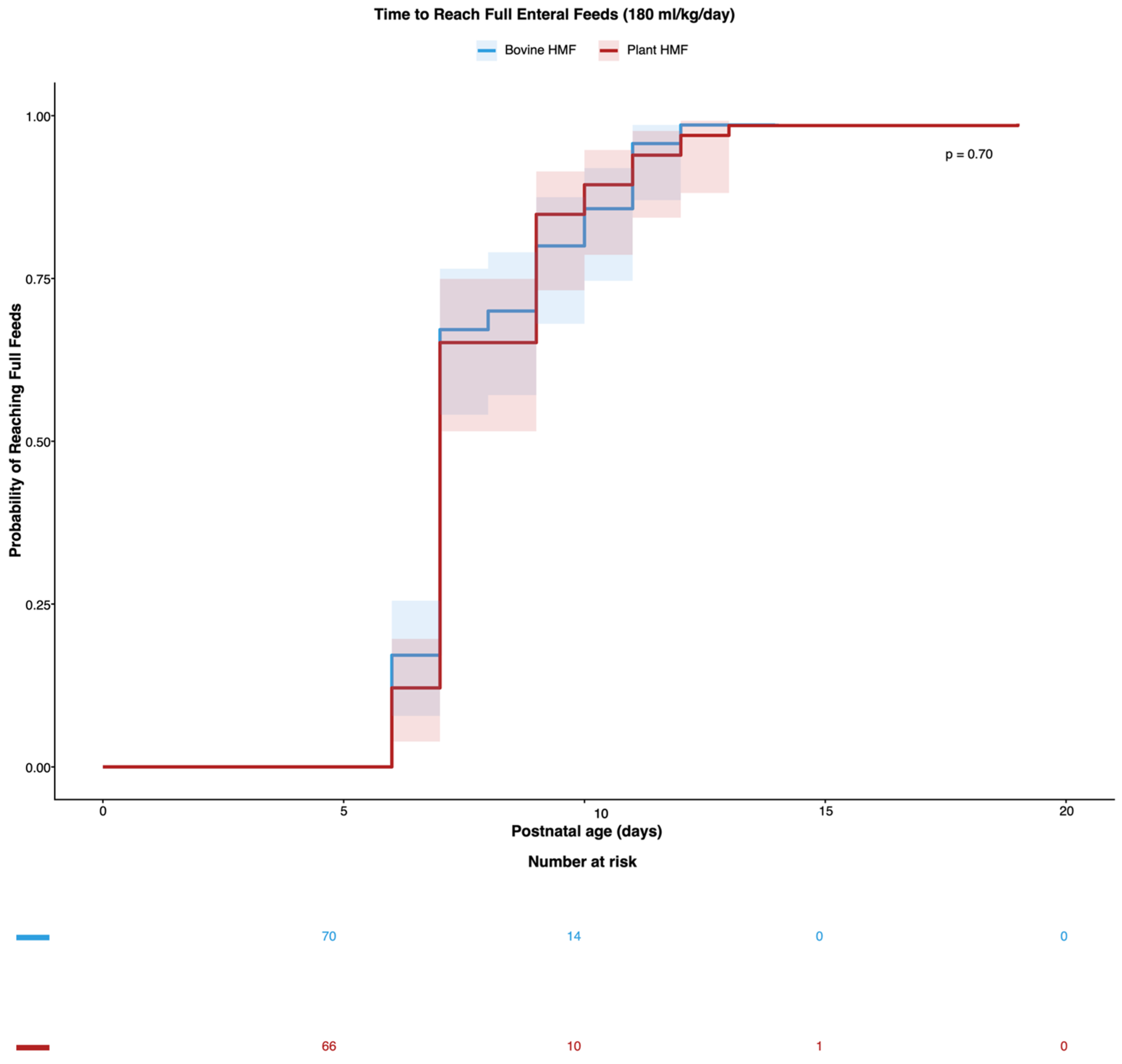
- Time to reach enteral feed volume of 180 mL/kg/d.
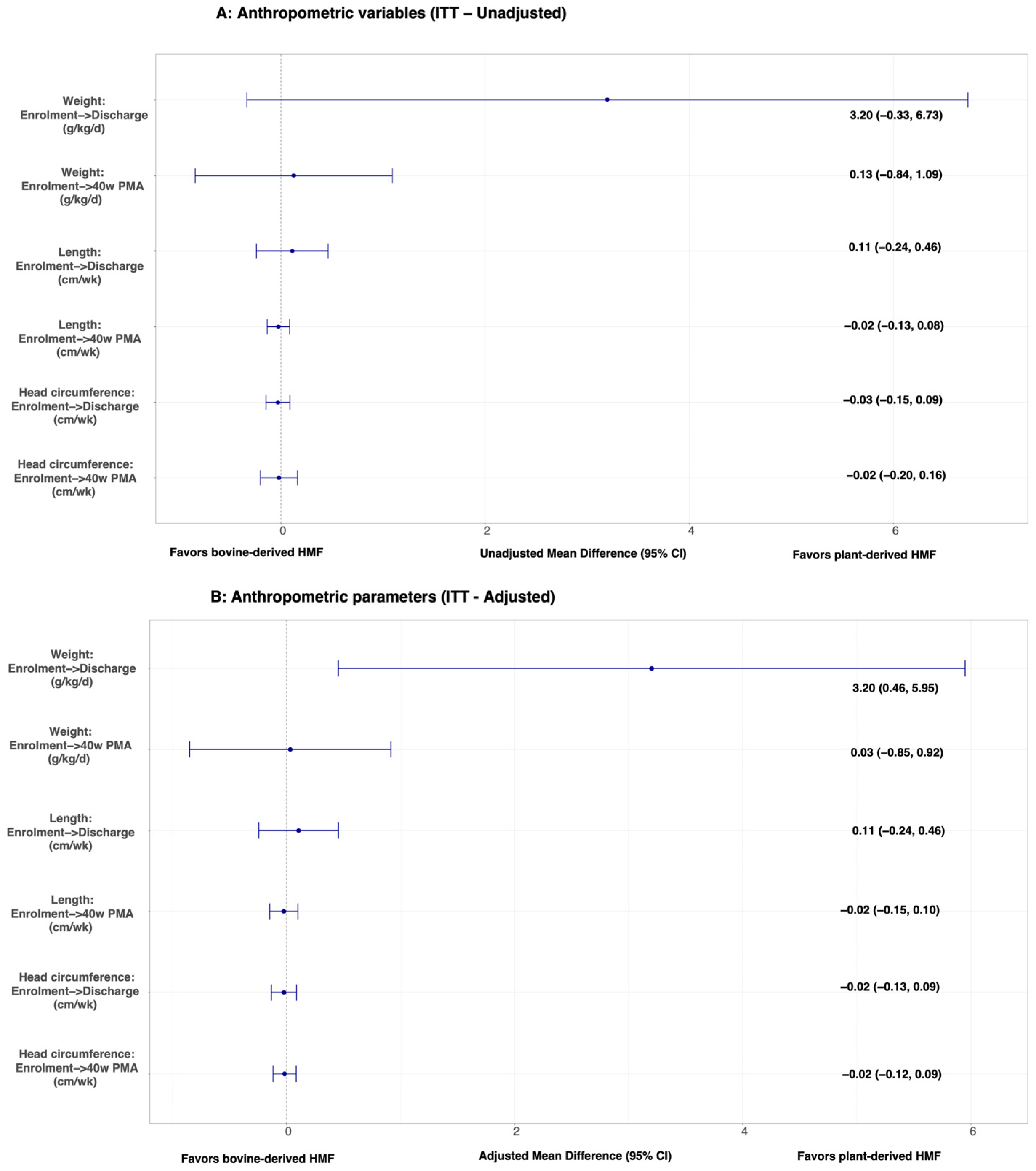
- Weight gain (g/kg/d), head circumference increment (cm/week) and length increment (cm/week) from enrollment until discharge from the hospital and at 40 weeks’ PMA.
- Secondary Outcomes
- Weight gain (g/kg/d) for different time intervals: birth until discharge, birth until 40 weeks’ PMA, from the day of regaining birth weight until 40 weeks’ PMA, and from the day of discharge until 40 weeks PMA (post hoc)
- Days to regain birth weight (post hoc)
- Incidence of feed intolerance (defined as necessity to keep the neonate nil by feeds for at least one day)
- NEC stage ≥ 2 (modified Bell’s staging) [38]
- All-cause mortality
- Late Onset Neonatal Sepsis (LONS) (Blood culture-proven sepsis or probable sepsis (clinical signs or symptoms indicative of sepsis with ≥2 altered biochemical sepsis parameters with the blood culture being negative))
- Requirement of red blood transfusion (post hoc)
- BPD (defined as oxygen requirement or any other form of respiratory support at 36 weeks’ PMA)
- ROP requiring intervention
- Metabolic bone disease
- Extra-uterine growth restriction (EUGR) defined as weight for age of less than the 10th centile at 40 weeks’ PMA
- Duration of hospital stay
2.6. Randomization Process, Allocation Concealment and Blinding
2.7. Sample Size
2.8. Data Collection and Analysis
3. Results
3.1. Primary Outcomes
3.1.1. Time to Reach Enteral Feed Volume of 180 mL/kg/d
3.1.2. Anthropometric Parameters from Enrollment Until Discharge and 40 Weeks’ PMA
3.2. Secondary Outcomes
3.2.1. Sub-Group Analyses (Post Hoc)
3.2.2. Sensitivity Analyses
4. Discussion
5. Conclusions
Supplementary Materials
Author Contributions
Funding
Institutional Review Board Statement
Informed Consent Statement
Data Availability Statement
Conflicts of Interest
References
- Brown, J.V.; Embleton, N.D.; Harding, J.E.; McGuire, W. Multi-Nutrient Fortification of Human Milk for Preterm Infants. Cochrane Database Syst. Rev. 2016, CD000343. [Google Scholar] [PubMed]
- Parker, M.G.; Stellwagen, L.M.; Noble, L.; Kim, J.H.; Poindexter, B.B.; Puopolo, K.M.; Committee on Nutrition. Promoting Human Milk and Breastfeeding for the Very Low Birth Weight Infant. Pediatrics 2021, 148, e2021054272. [Google Scholar] [PubMed]
- Ziegler, E.E. Protein Requirements of Very Low Birth Weight Infants. J. Pediatr. Gastroenterol. Nutr. 2007, 45, S170–S174. [Google Scholar] [CrossRef] [PubMed]
- Horbar, J.D.; Ehrenkranz, R.A.; Badger, G.J.; Edwards, E.M.; Morrow, K.A.; Soll, R.F.; Buzas, J.S.; Bertino, E.; Gagliardi, L.; Zampino, G.; et al. Weight Growth Velocity and Postnatal Growth Failure in Infants 501 to 1500 Grams: 2000–2013. Pediatrics 2015, 136, e84–e92. [Google Scholar] [PubMed]
- Agostoni, C.; Buonocore, G.; Carnielli, V.P.; De Curtis, M.; Darmaun, D.; Decsi, T.; Domellöf, M.; Embleton, N.D.; Fusch, C.; Genzel-Boroviczeny, O.; et al. Enteral Nutrient Supply for Preterm Infants: Commentary from the European Society of Paediatric Gastroenterology, Hepatology and Nutrition Committee on Nutrition. J. Pediatr. Gastroenterol. Nutr. 2010, 50, 85–91. [Google Scholar] [PubMed]
- Embleton, N.D.; Morgan, C.; King, C. Balancing the Risks and Benefits of Parenteral Nutrition for Preterm Infants: Can We Define the Optimal Composition? Arch. Dis. Child. Fetal Neonatal Ed. 2015, 100, F351–F354. [Google Scholar]
- Lucas, A.; Cole, T.J. Breast Milk and Neonatal Necrotising Enterocolitis. Lancet 1990, 336, 1519–1523. [Google Scholar] [PubMed]
- Arslanoglu, S.; Corpeleijn, W.; Moro, G.; Braegger, C.; Campoy, C.; Colomb, V.; Decsi, T.; Domellöf, M.; Fewtrell, M.; Hojsak, I.; et al. Donor Human Milk for Preterm Infants: Current Evidence and Research Directions. J. Pediatr. Gastroenterol. Nutr. 2013, 57, 535–542. [Google Scholar] [PubMed]
- Shah, S.D.; Dereddy, N.; Jones, T.L.; Dhanireddy, R.; Talati, A.J. Early versus Delayed Human Milk Fortification in Very Low Birth Weight Infants—A Randomized Controlled Trial. J. Pediatr. 2016, 174, 126–131.e1. [Google Scholar] [PubMed]
- Rochow, N.; Fusch, G.; Choi, A.; Chessell, L.; Elliott, L.; McDonald, K.; Kuiper, E.; Purcha, M.; Turner, S.; Chan, E.; et al. Target Fortification of Breast Milk with Fat, Protein, and Carbohydrates for Preterm Infants. J. Pediatr. 2013, 163, 1001–1007. [Google Scholar] [PubMed]
- Arslanoglu, S.; Boquien, C.-Y.; King, C.; Lamireau, D.; Tonetto, P.; Barnett, D.; Bertino, E.; Gaya, A.; Gebauer, C.; Grovslien, A.; et al. Fortification of Human Milk for Preterm Infants: Update and Recommendations of the European Milk Bank Association (EMBA) Working Group on Human Milk Fortification. Front. Pediatr. 2019, 7, 76. [Google Scholar] [PubMed]
- Gu, X.; Shi, X.; Zhang, L.; Zhou, Y.; Cai, Y.; Jiang, W.; Zhou, Q. Evidence Summary of Human Milk Fortifier in Preterm Infants. Transl. Pediatr. 2021, 10, 3058–3067. [Google Scholar] [PubMed]
- Li, Y.; Pan, X.; Yuan, S. Human Milk-Based or Bovine Milk-Based Fortifiers for Human Milk-Fed Preterm Infants: A Narrative Review. Front. Pediatr. 2021, 9, 719096. [Google Scholar] [PubMed]
- Demers-Mathieu, V.; Qu, Y.; Underwood, M.A.; Borghese, R.; Dallas, D.C. Premature Infants Have Lower Gastric Digestion Capacity for Human Milk Proteins than Term Infants. J. Pediatr. Gastroenterol. Nutr. 2018, 66, 816–821. [Google Scholar] [PubMed]
- Sağır, H.; Çağan Appak, Y.; Aksoy, B.; Kahveci, S.; Onbaşı Karabağ, Ş.; Gülpınar Aydın, Ö.; Alaca, S.; Baran, M. Impact of Using Cow’s Milk Formula During the First Three Postnatal Days and Other Etiological Factors on the Development of Cow’s Milk Protein Allergy. J. Clin. Med. 2025, 14, 8664. [Google Scholar] [PubMed]
- Abdelhamid, A.E.; Chuang, S.-L.; Hayes, P.; Fell, J.M. Evolution of in Vitro Cow’s Milk Protein-Specific Inflammatory and Regulatory Cytokine Responses in Preterm Infants with Necrotising Enterocolitis. J. Pediatr. Gastroenterol. Nutr. 2013, 56, 5–11. [Google Scholar] [PubMed]
- Basany, L.; Ali, A.; Gandrakota, N.P.G.; Kulkarni, A.B.; Tabassum, M.; Manjunath, H.; Batthula, V. Balancing Nutrition and Osmolality: Risk of Hyperosmolality During Individualized Fortification with Protein Fortifiers in an In Vitro Study. Cureus 2025, 17, e86602. [Google Scholar] [PubMed]
- Tang, Q.; Yin, D.; Jin, Z.; Zhang, L.; Zhou, P. Osmolality of Donor Human Milk Rises Dramatically within Minutes of Fortification with Varied Degrees Depending on the Fortifier Used. Front. Pediatr. 2025, 13, 1596255. [Google Scholar] [PubMed]
- Pearson, F.; Johnson, M.J.; Leaf, A.A. Milk Osmolality: Does It Matter? Arch. Dis. Child. Fetal Neonatal Ed. 2013, 98, F166–F169. [Google Scholar] [PubMed]
- Abrams, S.A.; Schanler, R.J.; Lee, M.L.; Rechtman, D.J. Greater Mortality and Morbidity in Extremely Preterm Infants Fed a Diet Containing Cow Milk Protein Products. Breastfeed. Med. 2014, 9, 281–285. [Google Scholar] [PubMed]
- Sullivan, S.; Schanler, R.J.; Kim, J.H.; Patel, A.L.; Trawöger, R.; Kiechl-Kohlendorfer, U.; Chan, G.M.; Blanco, C.L.; Abrams, S.; Cotten, C.M.; et al. An Exclusively Human Milk-Based Diet Is Associated with a Lower Rate of Necrotizing Enterocolitis than a Diet of Human Milk and Bovine Milk-Based Products. J. Pediatr. 2010, 156, 562–567.e1. [Google Scholar] [PubMed]
- Feng, Y.; Gao, Y.; Gu, Y.; Liu, Y.; Xu, Y.; Li, S. Impact of Three Mammalian Milk-Derived Fortifiers on Morbidity and Mortality in Preterm Infants: A Systematic Review and Network Meta-Analysis. Int. Breastfeed. J. 2025, 21, 9. [Google Scholar] [PubMed]
- Kim, J.H.; Chan, G.; Schanler, R.; Groh-Wargo, S.; Bloom, B.; Dimmit, R.; Williams, L.; Baggs, G.; Barrett-Reis, B. Growth and Tolerance of Preterm Infants Fed a New Extensively Hydrolyzed Liquid Human Milk Fortifier. J. Pediatr. Gastroenterol. Nutr. 2015, 61, 665–671. [Google Scholar] [PubMed]
- O’Connor, D.L.; Kiss, A.; Tomlinson, C.; Bando, N.; Bayliss, A.; Campbell, D.M.; Daneman, A.; Francis, J.; Kotsopoulos, K.; Shah, P.S.; et al. Nutrient Enrichment of Human Milk with Human and Bovine Milk-Based Fortifiers for Infants Born Weighing < 1250 g: A Randomized Clinical Trial. Am. J. Clin. Nutr. 2018, 108, 108–116. [Google Scholar] [PubMed]
- Galis, R.; Trif, P.; Mudura, D.; Pop, L.; Fufezan, O.; Orășan, R. Association of Fortification with Human Milk versus Bovine Milk-Based Fortifiers on Short-Term Outcomes in Preterm Infants—A Meta-Analysis. Nutrients 2024, 16, 910. [Google Scholar] [PubMed]
- Ananthan, A.; Balasubramanian, H.; Rao, S.; Patole, S. Human Milk-Derived Fortifiers Compared with Bovine Milk-Derived Fortifiers in Preterm Infants: A Systematic Review and Meta-Analysis. Adv. Nutr. 2020, 11, 1325–1333. [Google Scholar] [CrossRef] [PubMed]
- Grace, E.; Hilditch, C.; Gomersall, J.; Collins, C.T.; Rumbold, A.; Keir, A.K. Safety and Efficacy of Human Milk-Based Fortifier in Enterally Fed Preterm and/or Low Birthweight Infants: A Systematic Review and Meta-Analysis. Arch. Dis. Child. Fetal Neonatal Ed. 2021, 106, 137–142. [Google Scholar] [CrossRef] [PubMed]
- Huizing, M.J.; Vizzari, G.; Bartoš, F.; Cavallaro, G.; Gianni, M.L.; Villamor, E. Absence of Evidence of Beneficial Effects of Human Milk-Based Fortifier: A Bayesian Model-Averaged Meta-Analysis. Acta Paediatr. 2025, 114, 3309–3316. [Google Scholar] [CrossRef] [PubMed]
- Kumar, M.; Upadhyay, J.; Basu, S. Fortification of Human Milk with Infant Formula for Very Low Birth Weight Preterm Infants: A Systematic Review. Indian Pediatr. 2021, 58, 253–258. [Google Scholar] [CrossRef]
- Vanderhoof, J.; Moore, N.; de Boissieu, D. Evaluation of an Amino Acid-Based Formula in Infants Not Responding to Extensively Hydrolyzed Protein Formula. J. Pediatr. Gastroenterol. Nutr. 2016, 63, 531–533. [Google Scholar] [CrossRef] [PubMed]
- Ikeda, M. Amino Acid Production Processes. In Microbial Production of L-Amino Acids; Springer: Berlin/Heidelberg, Germany, 2003; pp. 1–35. [Google Scholar]
- Bertino, E.; Giribaldi, M.; Cester, E.A.; Coscia, A.; Trapani, B.M.; Peila, C.; Arslanoglu, S.; Moro, G.E.; Cavallarin, L. New Human Milk Fortifiers for the Preterm Infant. J. Pediatr. Neonatal Individ. Med. 2017, 6, e060124. [Google Scholar] [CrossRef]
- Chandra, R.; Singh, P.; Verma, A.; Patel, S.; Sharma, R.; Gupta, N.; Mehta, K.; Joshi, A.; Reddy, S.; Kumar, V.; et al. A Study of Safety and Effectiveness of Amino-Acids Based Multi-Nutrient Fortifier in Premature Infants Admitted in NICU. Int. J. Contemp. Pediatr. 2024, 11, 362–367. [Google Scholar]
- Karotkar, U.; Sharma, M.; Desai, R.; Mehta, D.; Patel, K.; Nair, S.; Iyer, S.; Choudhary, B.; Agarwal, P.; Kapoor, S.; et al. Effects of Amino-Acids Based Fortifier in Preterm Infants. Int. J. Contemp. Health 2025, 3, 52–55. [Google Scholar]
- Eldridge, S.M.; Chan, C.L.; Campbell, M.J.; Bond, C.M.; Hopewell, S.; Thabane, L.; Lancaster, G.A.; PAFS Consensus Group. CONSORT 2010 Statement: Extension to Randomised Pilot and Feasibility Trials. Pilot Feasibility Stud. 2016, 2, 64. [Google Scholar] [CrossRef] [PubMed]
- Embleton, N.D.; Moltu, S.J.; Lapillonne, A.; van den Akker, C.H.P.; Carnielli, V.; Fusch, C.; Gerasimidis, K.; van Goudoever, J.B.; Haiden, N.; Iacobelli, S.; et al. Enteral Nutrition in Preterm Infants (2022): A Position Paper from the ESPGHAN Committee on Nutrition and Invited Experts. J. Pediatr. Gastroenterol. Nutr. 2023, 76, 248–268. [Google Scholar] [PubMed]
- Robinson, D.T.; Calkins, K.L.; Chen, Y.; Cober, M.P.; Falciglia, G.H.; Church, D.D.; Mey, J.; McKeever, L.; Sentongo, T. Guidelines for Parenteral Nutrition in Preterm Infants: The American Society for Parenteral and Enteral Nutrition. J. Parenter. Enter. Nutr. 2023, 47, 830–858. [Google Scholar] [CrossRef] [PubMed]
- Walsh, M.C.; Kliegman, R.M. Necrotizing Enterocolitis: Treatment Based on Staging Criteria. Pediatr. Clin. N. Am. 1986, 33, 179–201. [Google Scholar] [CrossRef] [PubMed]
- Teare, M.D.; Hayman, A.; Dimairo, M.; Shephard, N.; Whitehead, A.; Walters, S.J. Sample Size Requirements for Pilot Randomised Controlled Trials with Continuous Outcomes: A Simulation Study. Trials 2013, 14, P46. [Google Scholar] [CrossRef][Green Version]
- Aguilar-Lopez, M.; Wetzel, C.; MacDonald, A.; Ho, T.T.B.; Donovan, S.M. Human Milk-Based or Bovine Milk-Based Fortifiers Differentially Impact the Development of the Gut Microbiota of Preterm Infants. Front. Pediatr. 2021, 9, 719096. [Google Scholar] [CrossRef] [PubMed]
- Aydemir, O.; Aydemir, Y.; Surmeli Onay, O. How Does Bovine Milk-Based Fortification Alter the Oxidant-Antioxidant Profile of Breast Milk in Preterm Infants? J. Pediatr. Gastroenterol. Nutr. 2025, 80, 861–869. [Google Scholar] [CrossRef] [PubMed]
- Picaud, J.C.; Reynolds, P.R.; Clarke, P.; van den Hooven, E.; van Weissenbruch, M.M.; van Lingen, R.A.; Goedhart, A.; Botma, A.; Boettger, R.; van Westering-Kroon, E.; et al. A Novel Human Milk Fortifier Supports Adequate Growth in Very Low Birth Weight Infants: A Non-Inferiority Randomised Controlled Trial. Arch. Dis. Child. Fetal Neonatal Ed. 2025, 110, 512–519. [Google Scholar] [CrossRef] [PubMed]
- Bhatt, A.N.; Bingham, R.; Gaillard, P.; Stansfield, B.K. Association between Nonacidified Standard and High-Protein Human Milk Fortifiers and Increased Weight Velocity Relative to Acidified Human Milk Fortifiers in Preterm Infants: A Retrospective Cohort Study. J. Parenter. Enter. Nutr. 2026, 50, 48–55. [Google Scholar] [CrossRef] [PubMed]
- Kreissl, A.; Zwiauer, V.; Repa, A.; Binder, C.; Haninger, N.; Jilma, B.; Berger, A.; Haiden, N. Effect of Fortifiers and Additional Protein on the Osmolarity of Human Milk: Is It Still Safe for the Premature Infant? J. Pediatr. Gastroenterol. Nutr. 2013, 57, 432–437. [Google Scholar] [PubMed]
- Kreins, N.; Buffin, R.; Michel-Molnar, D.; Chambon, V.; Pradat, P.; Picaud, J.C. Individualized Fortification Influences the Osmolality of Human Milk. Front. Pediatr. 2018, 6, 322. [Google Scholar] [CrossRef] [PubMed]
- Ehrenkranz, R.A.; Das, A.; Wrage, L.A.; Poindexter, B.B.; Higgins, R.D.; Stoll, B.J.; Oh, W.; Eunice Kennedy Shriver National Institute of Child Health and Human Development Neonatal Research Network. Early Nutrition Mediates the Influence of Severity of Illness on Extremely LBW Infants. Pediatr. Res. 2011, 69, 522–529. [Google Scholar] [CrossRef] [PubMed]
- North, K.; Marx Delaney, M.; Bose, C.; Lee, A.C.C.; Vesel, L.; Adair, L.; Semrau, K. The Effect of Milk Type and Fortification on the Growth of Low-Birthweight Infants: An Umbrella Review of Systematic Reviews and Meta-Analyses. Matern. Child Nutr. 2021, 17, e13176. [Google Scholar] [CrossRef] [PubMed]
- Young, L.; Embleton, N.D.; McCormick, F.M.; McGuire, W. Multinutrient Fortification of Human Breast Milk for Preterm Infants Following Hospital Discharge. Cochrane Database Syst. Rev. 2013, 2, CD004866. [Google Scholar] [CrossRef] [PubMed]
- Wiechers, C.; Bernhard, W.; Goelz, R.; Poets, C.F.; Franz, A.R. Optimizing Early Neonatal Nutrition and Dietary Pattern in Premature Infants. Int. J. Environ. Res. Public Health 2021, 18, 7544. [Google Scholar] [CrossRef] [PubMed]
- Dumville, J.C.; Torgerson, D.J.; Hewitt, C.E. Reporting attrition in randomised controlled trials. BMJ 2006, 332, 969–971. [Google Scholar] [CrossRef] [PubMed]
- Webbe, J.W.H.; Duffy, J.M.N.; Afonso, E.; Al-Muzaffar, I.; Brunton, G.; Greenough, A.; Hall, N.J.; Knight, M.; Latour, J.M.; Lee-Davey, C.; et al. Core outcomes in neonatology: Development of a core outcome set for neonatal research. Arch. Dis. Child.-Fetal Neonatal Ed. 2020, 105, 425–431. [Google Scholar] [CrossRef] [PubMed]
- Damhuis, S.E.; Bloomfield, F.H.; Khalil, A.; Daly, M.; Ganzevoort, W.; Gordijn, S.J. A Core Outcome Set and minimum reporting set for intervention studies in growth restriction in the NEwbOrN: The COSNEON study. Pediatr. Res. 2021, 89, 1380–1385. [Google Scholar] [CrossRef] [PubMed]
- Jerome, M.L.; Valcarce, V.; Lach, L.; Itriago, E.; Salas, A.A. Infant body composition: A comprehensive overview of assessment techniques, nutrition factors, and health outcomes. Nutr. Clin. Pract. 2023, 38, S7–S27. [Google Scholar] [CrossRef] [PubMed]
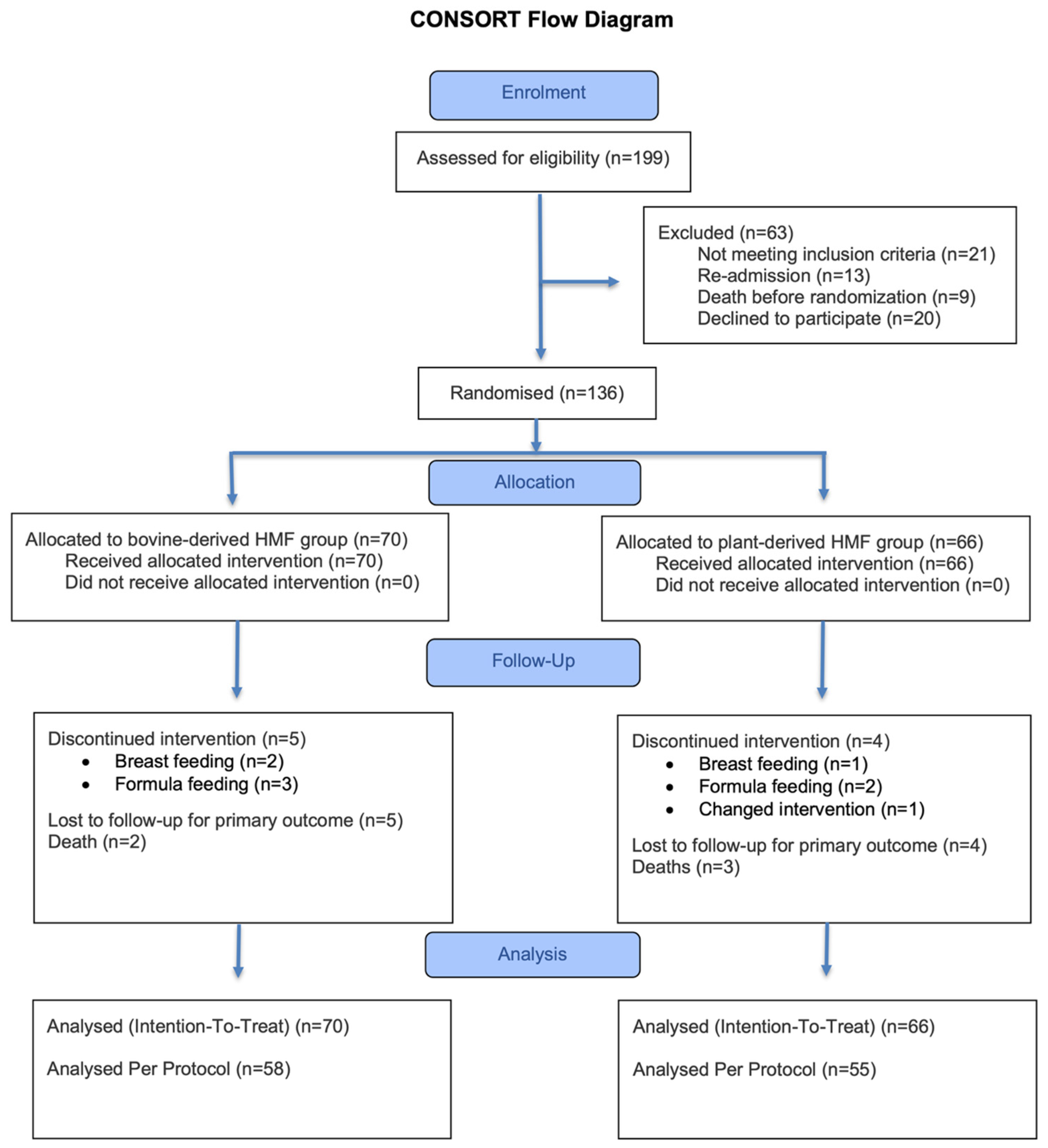

| Variable | Bovine HMF (n = 70) | Plant HMF (n = 66) | p-Value |
|---|---|---|---|
| Gestational age (w) | 31.0 [29.0, 32.0] | 31.0 [30.0, 33.0] | 0.52 |
| Birth weight (g) | 1505 [1192, 1769] | 1565 [1200, 1751] | 0.75 |
| Admission temperature (°C) | 36.5 [36.2, 36.6] | 36.5 [36.4, 36.7] | 0.43 |
| Age at enrollment (h) | 48 [48, 96] | 48 [48, 96] | 0.52 |
| Weight at enrollment (g) | 1472 [1142, 1745] | 1515 [1170, 1720] | 0.73 |
| Length at enrollment (cm) | 40.0 [38.0, 42.0] | 41.0 [38.1, 43.0] | 0.55 |
| Head circumference at enrollment (cm) | 29.0 [27.5, 30.0] | 29.0 [28.0, 30.0] | 0.55 |
| Gestational age category | 0.41 | ||
| <28 w | 7 (10.0%) | 3 (4.5%) | - |
| 28–< 32 w | 32 (45.7%) | 35 (53.0%) | - |
| ≥32 w | 31 (44.3%) | 28 (42.4%) | - |
| Birth weight category | 0.46 | ||
| <1000 g | 10 (14.3%) | 5 (7.6%) | - |
| 1000–1499 g | 23 (32.9%) | 24 (36.4%) | - |
| ≥1500 g | 37 (52.9%) | 37 (56.1%) | - |
| Weight for age | 0.49 | ||
| AGA or LGA | 65 (92.9%) | 58 (87.9%) | - |
| SGA | 5 (7.1%) | 8 (12.1%) | - |
| Multiple gestation | 29 (41.4%) | 22 (33.3%) | 0.42 |
| Gender | 0.93 | ||
| Male | 43 (61.4%) | 40 (60.6%) | - |
| Female | 27 (38.6%) | 26 (39.4%) | - |
| Maternal hypertension | 14 (20.0%) | 17 (25.8%) | 0.55 |
| Maternal diabetes | 8 (11.4%) | 7 (10.6%) | 1.00 |
| Maternal fever | 8 (11.4%) | 7 (10.6%) | 1.00 |
| Umbilical artery doppler changes (A/REDF) | 3 (4.3%) | 9 (13.6%) | 0.10 |
| Antenatal steroids | 0.49 | ||
| Complete | 33 (47.1%) | 34 (51.5%) | - |
| Incomplete | 22 (31.4%) | 23 (34.8%) | - |
| Not Received | 15 (21.4%) | 9 (13.6%) | - |
| Deferred cord clamping ≥ 60 s | 33 (47.1%) | 32 (48.5%) | 1.00 |
| Mode of delivery | 0.26 | ||
| LSCS | 58 (82.9%) | 60 (90.9%) | - |
| VD | 12 (17.1%) | 6 (9.1%) | - |
| Any resuscitation required | 9 (12.9%) | 8 (12.1%) | 1.00 |
| Total parenteral nutrition requirement on day 1 | 16 (22.9%) | 14 (21.2%) | 0.98 |
| Time of initiation of enteral nutrition (h) | 2.0 [2.0, 2.0] | 2.0 [1.0, 2.0] | 0.26 |
| MoM on day 7 (%) | 100 [65, 100] | 100 [80, 100] | 0.35 |
| Anthropometric Parameter | Bovine HMF (n = 70) Imputed Mean (SD) *+ | Plant HMF (n = 66) Imputed Mean (SD) | MD (95% CI) * | p-Value | aMD (95% CI) *+ | p-Value |
|---|---|---|---|---|---|---|
| Weight ++ | ||||||
| Enrollment until discharge | 13.3 (6.8) | 16.5 (7.2) | 3.20 (−0.33, 6.73) | 0.08 | 3.20 (0.46, 5.95) | 0.02 |
| Enrollment until 40 w PMA | 10.6 (3.2) | 10.7 (3.6) | 0.13 (−0.84, 1.09) | 0.80 | 0.03 (−0.85, 0.92) | 0.95 |
| Length ++ | ||||||
| Enrollment until discharge | 0.95 (0.45) | 1.06 (0.52) | 0.11 (−0.24, 0.46) | 0.53 | 0.11 (−0.24, 0.46) | 0.54 |
| Enrollment until 40 w PMA | 0.65 (0.28) | 0.63 (0.30) | −0.02 (−0.13, 0.08) | 0.65 | −0.02 (−0.15, 0.10) | 0.75 |
| HC ++ | ||||||
| Enrollment until discharge | 0.65 (0.22) | 0.62 (0.24) | −0.03 (−0.15, 0.09) | 0.63 | −0.02 (−0.13, 0.09) | 0.72 |
| Enrollment until 40 w PMA | 0.52 (0.18) | 0.50 (0.19) | −0.02 (−0.20, 0.16) | 0.83 | −0.02 (−0.12, 0.09) | 0.71 |
| Outcome Variables | Bovine HMF (n = 70) *+ | Plant HMF (n = 66) *+ | aMD/aRR *+ (95% CI) (Plant HMF vs. Bovine HMF) | aRD (95% CI) *+ (Plant HMF vs. Bovine HMF) | p-Value |
|---|---|---|---|---|---|
| Rate of Weight Gain (g/kg/d) | |||||
| Birth until discharge | 1.59 [−7.10, 8.29] | 2.49 [−1.00, 8.17] | 3.15 (−0.17, 6.48) | NA | 0.06 |
| Birth until 40 w PMA | 10.49 [8.91, 12.09] | 10.32 [8.88, 11.74] | 0.05 (−0.80, 0.90) | NA | 0.91 |
| Day of regaining BW until 40 w PMA | 13.12 [11.39, 14.58] | 12.70 [11.21, 14.97] | −0.24 (−1.58, 1.09) | NA | 0.72 |
| Discharge until 40 w PMA | 12.58 [11.04, 15.04] | 12.25 [10.78, 14.71] | −0.08 (−1.18, 1.02) | NA | 0.89 |
| Days to regain BW | 12.00 [10.00, 14.00] | 13.08 [9.00, 15.98] | 1.40 (−1.30, 4.09) | NA | 0.31 |
| No. of feed intolerance days | 0.00 [0.00, 0.01] | 0.00 [0.00, 0.01] | 0.22 (−0.31, 0.75) | NA | 0.41 |
| Duration of hospital stay (d) | 14.00 [7.00, 28.00] | 14.00 [9.00, 24.00] | −2.61 (−9.11, 3.89) | NA | 0.43 |
| Receipt of RBC transfusion | 11/67 (16.4%) | 10/62 (16.1%) | 1.01 (0.43, 2.36) | 0.17 (−12.61, 12.94) | 0.98 |
| NEC (≥Stage 2) | 2/66 (3.0%) | 3/61 (4.9%) | 1.56 (0.26, 9.56) | 1.63 (−4.97, 8.24) | 0.63 |
| LONS | 21/66 (31.8%) | 19/62 (30.6%) | 0.96 (0.52, 1.78) | −1.33 (−17.41, 14.76) | 0.89 |
| BPD | 5/67 (7.5%) | 7/62 (11.3%) | 1.48 (0.47, 4.71) | 3.50 (−6.34, 13.34) | 0.50 |
| ROP requiring intervention | 13/67 (19.4%) | 8/62 (12.9%) | 0.69 (0.29, 1.66) | −5.87 (−18.64, 6.90) | 0.41 |
| MBD | 12/67 (17.9%) | 14/62 (22.6%) | 1.26 (0.58, 2.74) | 4.64 (−9.12, 18.40) | 0.55 |
| EUGR at 40 w PMA | 9/64 (14.1%) | 11/60 (18.3%) | 1.24 (0.52, 3.00) | 3.32 (−9.23, 15.88) | 0.63 |
| Mortality | 2/70 (2.9%) | 3/65 (4.6%) | 1.59 (0.27, 9.22) | 1.69 (−4.67, 8.05) | 0.67 |
| Mortality or LTFU | 12/70 (17.1%) | 11/66 (16.7%) | 0.97 (0.46, 2.05) | −0.48 (−13.08, 12.13) | 1.00 |
Disclaimer/Publisher’s Note: The statements, opinions and data contained in all publications are solely those of the individual author(s) and contributor(s) and not of MDPI and/or the editor(s). MDPI and/or the editor(s) disclaim responsibility for any injury to people or property resulting from any ideas, methods, instructions or products referred to in the content. |
© 2026 by the authors. Licensee MDPI, Basel, Switzerland. This article is an open access article distributed under the terms and conditions of the Creative Commons Attribution (CC BY) license.
Share and Cite
Mudmal, N.K.; Ramaswamy, V.V.; Shaik, N.B.; Basany, L.; Ali, A.A.H.; Ramya, V.S. Plant-Derived Amino Acid-Based vs. Bovine-Derived Protein Human Milk Fortifiers in Preterm Infants at <34 Weeks’ Gestation: An Open-Label Pilot Randomized Controlled Trial. Nutrients 2026, 18, 2547. https://doi.org/10.3390/nu18152547
Mudmal NK, Ramaswamy VV, Shaik NB, Basany L, Ali AAH, Ramya VS. Plant-Derived Amino Acid-Based vs. Bovine-Derived Protein Human Milk Fortifiers in Preterm Infants at <34 Weeks’ Gestation: An Open-Label Pilot Randomized Controlled Trial. Nutrients. 2026; 18(15):2547. https://doi.org/10.3390/nu18152547
Chicago/Turabian StyleMudmal, Nikhil Kumar, Viraraghavan Vadakkencherry Ramaswamy, Nasreen Banu Shaik, Laxman Basany, Abid Ali Hasan Ali, and V. Sree Ramya. 2026. "Plant-Derived Amino Acid-Based vs. Bovine-Derived Protein Human Milk Fortifiers in Preterm Infants at <34 Weeks’ Gestation: An Open-Label Pilot Randomized Controlled Trial" Nutrients 18, no. 15: 2547. https://doi.org/10.3390/nu18152547
APA StyleMudmal, N. K., Ramaswamy, V. V., Shaik, N. B., Basany, L., Ali, A. A. H., & Ramya, V. S. (2026). Plant-Derived Amino Acid-Based vs. Bovine-Derived Protein Human Milk Fortifiers in Preterm Infants at <34 Weeks’ Gestation: An Open-Label Pilot Randomized Controlled Trial. Nutrients, 18(15), 2547. https://doi.org/10.3390/nu18152547

