Article

Comparative Effects of Low- and High-Volume HIIT Versus Yoga on Psychological Health and Physical Fitness in Female College Students with Binge Eating: An 8-Week Three-Arm Randomized Controlled Trial


1
Beijing Key Laboratory of Sports Performance and Skill Assessment, Beijing Sport University, Beijing 100084, China
2
School of Sports Medicine and Rehabilitation, Beijing Sport University, Beijing 100084, China
3
Key Laboratory for Performance Training and Recovery of General Administration of Sport, Beijing Sport University, Beijing 100084, China
4
School of Psychology, Beijing Sport University, Beijing 100084, China
*
Authors to whom correspondence should be addressed.
These authors contributed equally to this work.
Nutrients 2026, 18(13), 2180; https://doi.org/10.3390/nu18132180 (registering DOI)
Submission received: 30 May 2026 / Revised: 28 June 2026 / Accepted: 2 July 2026 / Published: 4 July 2026
(This article belongs to the Special Issue Research on Eating Disorders, Physical Activity and Body Image)

Abstract

Background: Binge eating (BE) is frequently associated with negative emotional states, obesity, and physical inactivity. Although yoga may improve binge eating and emotional symptoms, its effects on physical fitness remain unclear. In contrast, high-intensity interval training (HIIT) has been demonstrated to effectively enhance physical fitness. This study compared the effects of low-volume HIIT (LV-HIIT), high-volume HIIT (HV-HIIT), and yoga on binge eating, negative emotional states, and physical fitness in female college students with binge eating. Methods: Fifty-five physically inactive female college students with binge eating (BES ≥ 18) were randomly assigned to LV-HIIT (n = 19), HV-HIIT (n = 18), or yoga (n = 18) for 8 weeks. The Binge Eating Scale (BES), Depression Anxiety Stress Scale-21 (DASS-21), body fat percentage, waist circumference, and maximal oxygen uptake (VO2max) were assessed before and after the intervention. Data were analyzed using intention-to-treat linear mixed models, with per-protocol repeated-measures ANOVA as a supplementary analysis. Results: After 8 weeks of intervention, significant improvements over time were observed across all groups in binge eating, negative emotional states, and cardiorespiratory fitness (all p < 0.05). Waist circumference and body fat percentage did not change significantly in the ITT analysis. No significant time × group interaction effects were detected for any outcome (all p > 0.05), indicating that the improvements did not differ significantly among the LV-HIIT, HV-HIIT, and yoga groups. Conclusions: An 8-week intervention of LV-HIIT, HV-HIIT, and yoga was associated with improvements in binge eating behaviors, negative emotional states, and VO2max in inactive young women with binge eating, with no evidence of differential efficacy between interventions. LV-HIIT may be promising because of its shorter duration and higher adherence; however, this requires confirmation in larger trials.

1. Introduction

The global burden of eating disorders continues to rise [1]. Among these, Binge Eating Disorder (BED), which involves repeated loss-of-control eating episodes [2], is estimated to affect 1.5% of women and 0.3% of men globally [3]. Young women represent a high-risk population for BED [4], and the disorder occurs in both normal-weight and overweight/obese individuals [5,6].
In addition to binge eating behaviors, BED is associated with multiple psychological and physical health problems [3,7]. These include obesity-related health risks, body image disturbance, emotional dysregulation, impulsivity, reduced physical activity levels, impaired physical fitness, and elevated cardiometabolic risk [3,7,8,9]. Current first-line treatments, including cognitive behavioral therapy and pharmacotherapy, are effective in reducing binge eating behaviors; however, their effects on broader psychological and physical comorbidities remain limited, and some patients exhibit a suboptimal response or experience adverse effects [7]. These limitations highlight the need for adjunctive interventions capable of simultaneously targeting multiple domains of dysfunction.
In recent years, exercise interventions have received increasing attention as adjunctive strategies for alleviating binge eating (BE) [7,10]. Historically, exercise interventions were often considered unsuitable for individuals with eating disorders, primarily because patients with anorexia nervosa and bulimia nervosa frequently misuse exercise as a compensatory behavior to offset excessive caloric intake [11]. However, binge eating disorder is generally not accompanied by compensatory behaviors [2]. Binge eating episodes are often associated with psychological distress and may serve as maladaptive coping responses to anxiety and depression [12,13]. Research has shown that exercise can not only alleviate anxiety and depressive symptoms in individuals with binge eating, improve emotional regulation [7,14,15,16], and enhance body image perception [17,18] through psychological pathways, but also exert beneficial effects by modulating appetite-related mechanisms and food reward responses [19]. In addition, exercise contributes to improvements in cardiorespiratory fitness, metabolic health, and overall physical health [20].
Yoga has been preliminarily recognized as an adjunctive intervention strategy for eating disorders [21], and our previous study demonstrated greater improvements in binge eating symptoms following yoga compared with usual care [10]. It served as an active comparator, allowing a direct comparison between HIIT and a commonly used mind–body exercise intervention for the management of binge eating behaviors. As a low-intensity mind–body exercise, yoga may reduce binge eating behaviors by enhancing emotional awareness, alleviating negative emotions, and improving body image perception [10,22]. However, findings regarding the effects of yoga on physical fitness remain inconsistent [23,24,25,26,27,28].
High-intensity interval training (HIIT), as a time-efficient and effective form of exercise, has gained increasing attention in recent years [29,30], and a large body of evidence has demonstrated its effectiveness in improving cardiorespiratory fitness [31] and metabolic health [32,33]. Prior research indicates that HIIT can promote spontaneous and unconscious regulation of dietary choices in young individuals, thereby facilitating healthier eating patterns [34]. In addition, some studies suggest that HIIT may influence appetite-related hormone levels [35,36]; however, findings remain inconsistent across studies [37]. Meanwhile, HIIT has been shown to modulate the kynurenine pathway, shifting its metabolism from neurotoxic branches toward more neuroprotective pathways, a change associated with reduced impulsivity [38], which may be relevant to impulse-control aspects of eating behavior [39].
However, research examining the use of HIIT among individuals with binge eating (BE) remains limited. To date, only one study has examined the effects of HIIT among individuals exhibiting BE and reported no significant improvements in binge eating behaviors [10]. Notably, this study did not distinguish between different HIIT training volumes. Given that low-volume high-intensity interval training (LV-HIIT) (≤15 min) [33] and high-volume high-intensity interval training (HV-HIIT) (25–40 min) differ in total exercise volume, perceived exertion and adherence [40], their effects on binge eating behaviors may be different. Therefore, the present study is the first to differentiate HIIT into LV-HIIT and HV-HIIT and compare their effects with those of yoga in individuals with BE.

2. Materials and Methods

2.1. Participants

A total of 137 female college students were recruited through campus posters. Following screening with the Binge Eating Scale (BES), a final sample of 55 participants was enrolled in the study.
Inclusion criteria: (1) females aged 18–30 years; (2) body mass index (BMI) ranging from 18.5 to 28 kg/m2; (3) physically inactive, defined as engaging in no regular exercise for at least 3 months, specifically fewer than three sessions per week of planned moderate-intensity physical activity lasting ≥ 30 min per session; (4) a normal menstrual cycle; and (5) BES ≥ 18, with no history of psychiatric disorders or prior psychological treatment.
Exclusion criteria: (1) pregnancy or planned pregnancy during the study; (2) competitive athletes; (3) severe psychiatric disorders; (4) receipt of cognitive behavioral therapy (CBT) within the past 2 years, or a diagnosis of anorexia nervosa, bulimia nervosa, or other specified eating disorders; (5) dyslipidemia, orthopedic disorders, history of stroke, use of medications affecting exercise performance, or other conditions limiting physical activity; and (6) cardiovascular, metabolic, or renal diseases, or related clinical symptoms.
Sample size was estimated using G*Power 3.1 for a two-way repeated-measures ANOVA (within–between interaction). With a medium effect size (f = 0.25), α = 0.05, power = 0.80, 3 groups, and 2 measurement points, the required total sample size was 42. To account for ~20% attrition, 55 participants were recruited, exceeding the minimum requirement.
Ethical approval for this study was obtained from the Ethics Committee of the Exercise Science Laboratory at Beijing Sport University (BSU2024116H). Written informed consent was obtained from all participants before enrollment. In addition, the trial was registered in the Chinese Clinical Trial Registry (ChiCTR2600122300).

2.2. Randomization and Blinding

After completion of baseline assessments, participants were randomly assigned to the LV-HIIT (n = 19), HV-HIIT (n = 18), or yoga group (n = 18) using a computer-generated randomization sequence created by an independent researcher with SPSS (version 27.0). Group allocation was implemented by personnel not involved in participant recruitment, assessment, or intervention delivery. Allocation concealment was maintained throughout the enrollment process, and intervention staff were blinded to group assignments prior to participant allocation.

2.3. Intervention

Participants in the LV-HIIT and HV-HIIT groups completed two cycle ergometer training sessions per week (Technogym, Cesena, Italy), whereas participants in the yoga group attended two structured yoga sessions per week. All sessions were separated by at least 1 day, and the intervention lasted 8 weeks (16 sessions in total).

2.3.1. LV-HIIT

The LV-HIIT protocol followed a 5 × 1 min interval model, consisting of a 3-min warm-up at 50 W, five 1-min high-intensity intervals at 85–95% maximum heart rate (HRmax) interspersed with 1-min active recovery at 76% HRmax, and a 3-min cool-down at 50 W. Each session lasted approximately 15 min. Exercise intensity progressed from 85–90% HRmax during weeks 1–4 to 90–95% HRmax during weeks 5–8 [41].
Predicted HRmax was calculated using the age-based equation proposed by Gellish et al.: HRmax = 208 − 0.7 × age [42].

2.3.2. HV-HIIT

The HV-HIIT protocol followed a classic 4 × 4 min interval model, consisting of a 3-min warm-up at 50 W, four 4-min high-intensity intervals at 85–95% HRmax interspersed with 3-min active recovery at 70–75% HRmax, and a 3-min cool-down at 50 W. Each session lasted approximately 30–35 min. Exercise intensity progressed from 85–90% HRmax during weeks 1–4 to 90–95% HRmax during weeks 5–8 [41].
Heart rate (HR) was continuously monitored during each HIIT session to ensure that participants reached the prescribed target intensity zone.

2.3.3. Yoga

The yoga intervention consisted of 5 min of breathing exercises, 45 min of Hatha yoga practice, and 10 min of deep relaxation. The instructor had completed at least 200 h of certified yoga training and received additional training from the research team. All sessions were conducted at the Sports Rehabilitation Medical Center. The 45-min asana practice was composed of sequences selected from a standardized pool of postures (e.g., standing, balancing, seated, kneeling, prone, supine, and transitional poses), with the instructor selecting postures according to the principles of mindfulness and breath-synchronized movement to ensure each session included a balanced representation of forward folds, backbends, twists, side bends, and hip-openers. To ensure progression, foundational postures were emphasized in the first two weeks, with more challenging variations and faster transitions introduced progressively from weeks 3 to 8. Intensity was monitored using the Borg Rating of Perceived Exertion (RPE) (6–20 scale), with participants asked to maintain an RPE of 12–14 during practice. The estimated energy expenditure for each yoga session was approximately 192 kcal. The yoga intervention protocol was developed based on previously published studies [10].

2.4. Outcomes

Outcome measures included: (1) binge eating behaviors assessed using the BES; (2) negative emotional states assessed using the Depression Anxiety Stress Scales-21 (DASS-21); and (3) physical fitness indicators, including body composition (body fat percentage and waist circumference) and cardiorespiratory fitness (maximal oxygen uptake, VO2max).

2.4.1. BES

The BES was used to assess the severity of binge eating behaviors [43]. Total scores range from 0 to 46, with higher scores indicating greater symptom severity. A score of ≥18 was considered indicative of clinically significant binge eating behaviors. In the present study, the 16-item scale demonstrated good internal consistency (Cronbach’s α = 0.84). Additional details are presented in Table 1.

2.4.2. DASS-21

The scale was used to assess symptoms of depression, anxiety, and stress [44]. Higher scores indicate greater symptom severity. In the present study, Cronbach’s α coefficients for the depression, anxiety, and stress subscales were 0.89, 0.80, and 0.85, respectively, indicating good internal consistency. Detailed scoring criteria are provided in Table 1.

2.4.3. Physical Fitness Indicators

Body composition and waist circumference: Body fat percentage was assessed by bioelectrical impedance analysis with an InBody 770 device (InBody Co., Ltd., Seoul, Republic of Korea). Body composition was measured under standardized conditions, with participants instructed to avoid exercise and large meals prior to testing. Waist circumference was recorded using a non-elastic tape measure (AKTION, Zhejiang, China) at the midpoint between the lowest rib and the iliac crest following standardized anthropometric procedures [45].
Cardiorespiratory fitness: Cardiorespiratory fitness was assessed using a symptom-limited graded exercise test on a cycle ergometer. After a 1-min warm-up at 10 W, workload began at 50 W and increased by 20 W at each stage while participants maintained a cadence of 50 ± 5 rpm. Oxygen uptake was continuously measured using a portable metabolic gas analysis system (COSMED, Rome, Italy), and VO2max was defined as the highest oxygen uptake value attained during the test. Heart rate was continuously monitored using a chest-strap monitor (Polar, Kempele, Finland), and RPE was recorded during the final minute of each stage. The test was terminated upon volitional exhaustion or when predefined termination criteria were met, including RER ≥ 1.10, RPE ≥ 19, participant request, or clinical signs and symptoms indicating exercise intolerance. Peak heart rate achieved during the test was used as an estimate of HRmax [46].

2.5. Statistical Analysis

IBM SPSS Statistics version 27.0 was used for data analysis. Baseline variables were compared among groups using one-way ANOVA when parametric assumptions were satisfied; otherwise, equivalent nonparametric analyses were performed.
The intention-to-treat (ITT) analysis was conducted using linear mixed models (LMM) with all 55 randomized participants, utilizing all available data under MAR without imputation. The per-protocol (PP) analysis was performed as a supplement using two-way repeated-measures ANOVA on completers (n = 50).
Adherence rates (defined as completed vs. non-completed participation) were compared among groups using Pearson’s chi-square test. The number of training sessions attended was analyzed using one-way ANOVA. Heart rate data were reported descriptively and were not subjected to inferential statistical testing.
Mean changes were expressed as 95% confidence intervals (CIs), calculated as the mean ± 1.96 × standard errors (SEs), assuming a normal distribution.
To account for multiple testing, Benjamini–Hochberg FDR correction was applied to the Time effects in the ITT analysis (q < 0.05). Statistical significance was set at p < 0.05 for all other tests.

3. Results

3.1. Participant Flow and Baseline Characteristics

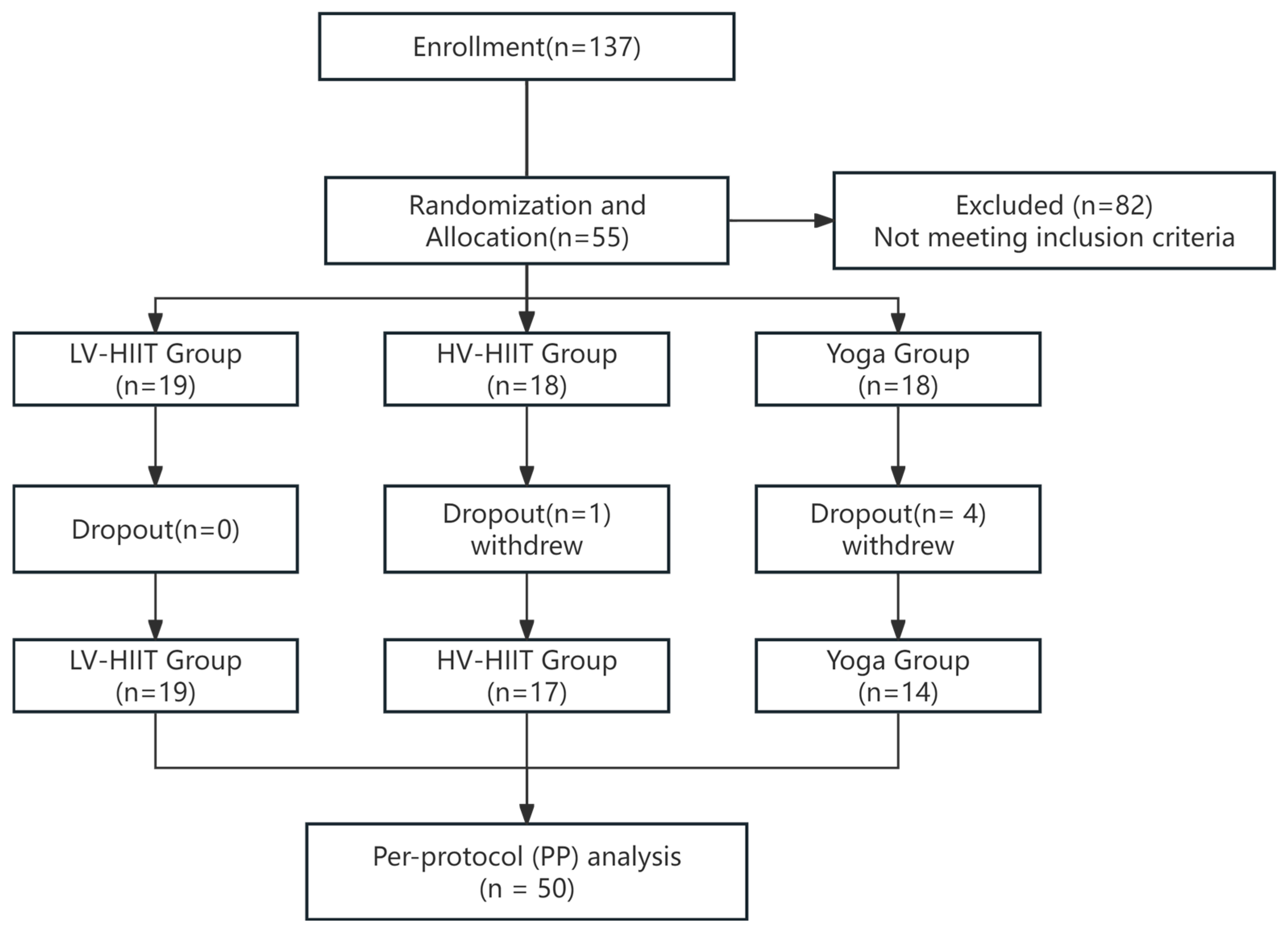
A total of 55 participants were randomly assigned to the LV-HIIT group (n = 19), HV-HIIT group (n = 18), and yoga group (n = 18). Baseline characteristics, including age, height, BMI, International Physical Activity Questionnaire (IPAQ), BES, DASS-21 and its subscales (DASS-D, DASS-A, DASS-S), waist circumference, body fat percentage, and VO2max, are presented in Table 2. No significant between-group differences were observed at baseline (all p > 0.05).
The intention-to-treat (ITT) analysis included all 55 randomized participants, and linear mixed models were applied to all available data under the assumption of missing at random, with no imputation for missing values. The per-protocol (PP) analysis, in contrast, included participants who completed at least 12 out of the 16 training sessions. According to this criterion, all 19 participants in the LV-HIIT group were eligible; one participant in the HV-HIIT group was excluded (n = 17); and four participants in the yoga group were excluded (n = 14). Ultimately, 50 participants (LV-HIIT group: n = 19; HV-HIIT group: n = 17; yoga group: n = 14) were included in the PP analysis.
No serious adverse events occurred during the intervention in any group.
Further details are illustrated in Figure 1.

3.2. Binge Eating Outcomes (BES)

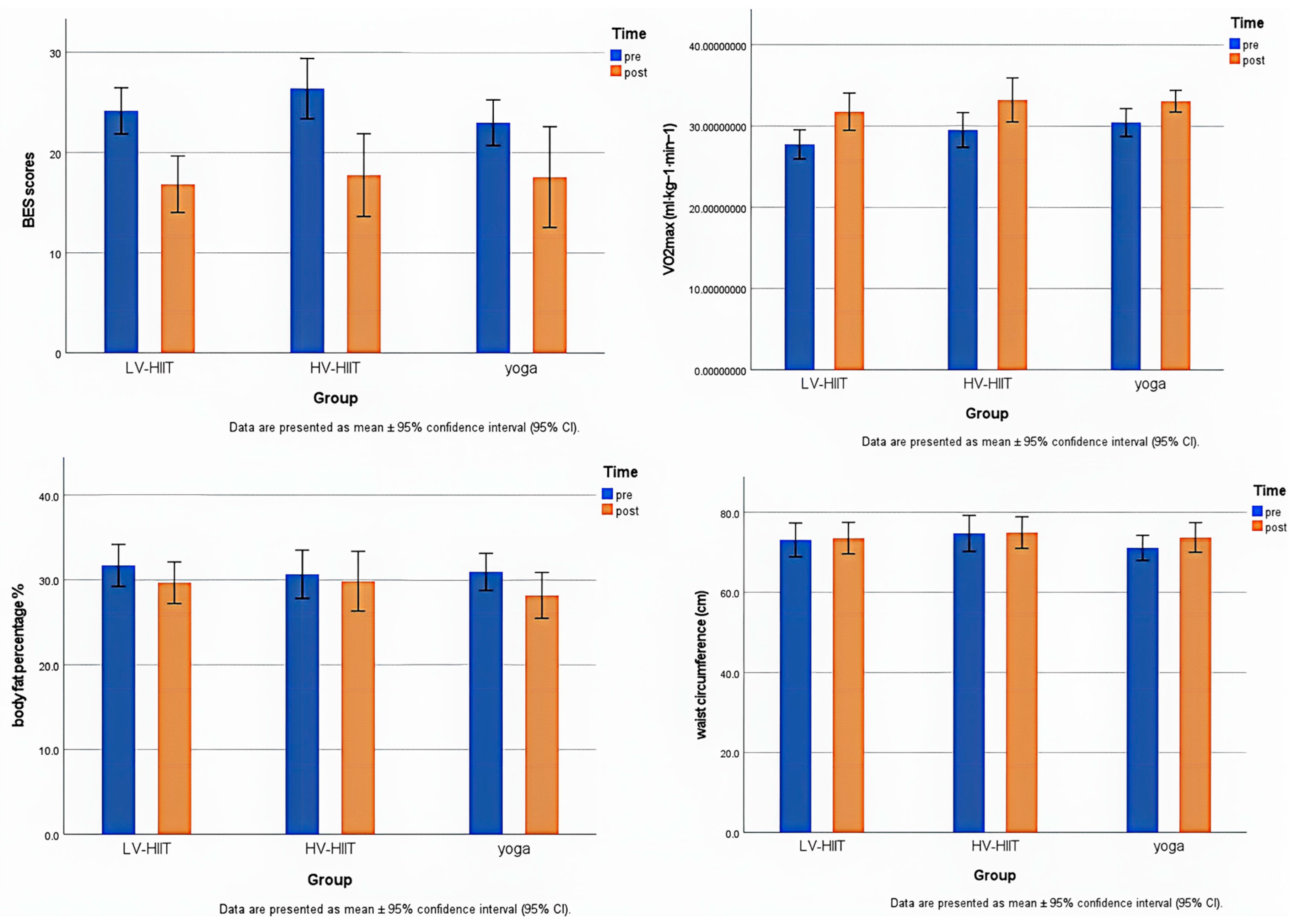
The linear mixed-model results with BES as the dependent variable revealed a significant main effect of Time (F (1, 99) = 32.43, p < 0.001, partial η2 = 0.25), with binge-eating symptoms decreasing significantly across all three groups post-intervention (estimated marginal means: 24.51 vs. 17.36) (Figure 2). Neither the main effect of Group (F (2, 99) = 0.81, p = 0.447, partial η2 = 0.02) nor the Group × Time interaction effect (F (2, 99) = 0.52, p = 0.594, partial η2 = 0.01) reached statistical significance.
Supplemental description of the per-protocol (PP) analysis: Mean changes in BES were −7.32 ± 6.16 (95% CI −10.09 to −4.55) in the LV-HIIT group, −8.94 ± 7.57 (95% CI −12.55 to −5.33) in the HV-HIIT group, and −5.79 ± 8.15 (95% CI −10.06 to −1.52) in the yoga group.

3.3. Negative Emotional States (DASS-21)

3.3.1. Total DASS-21 Score

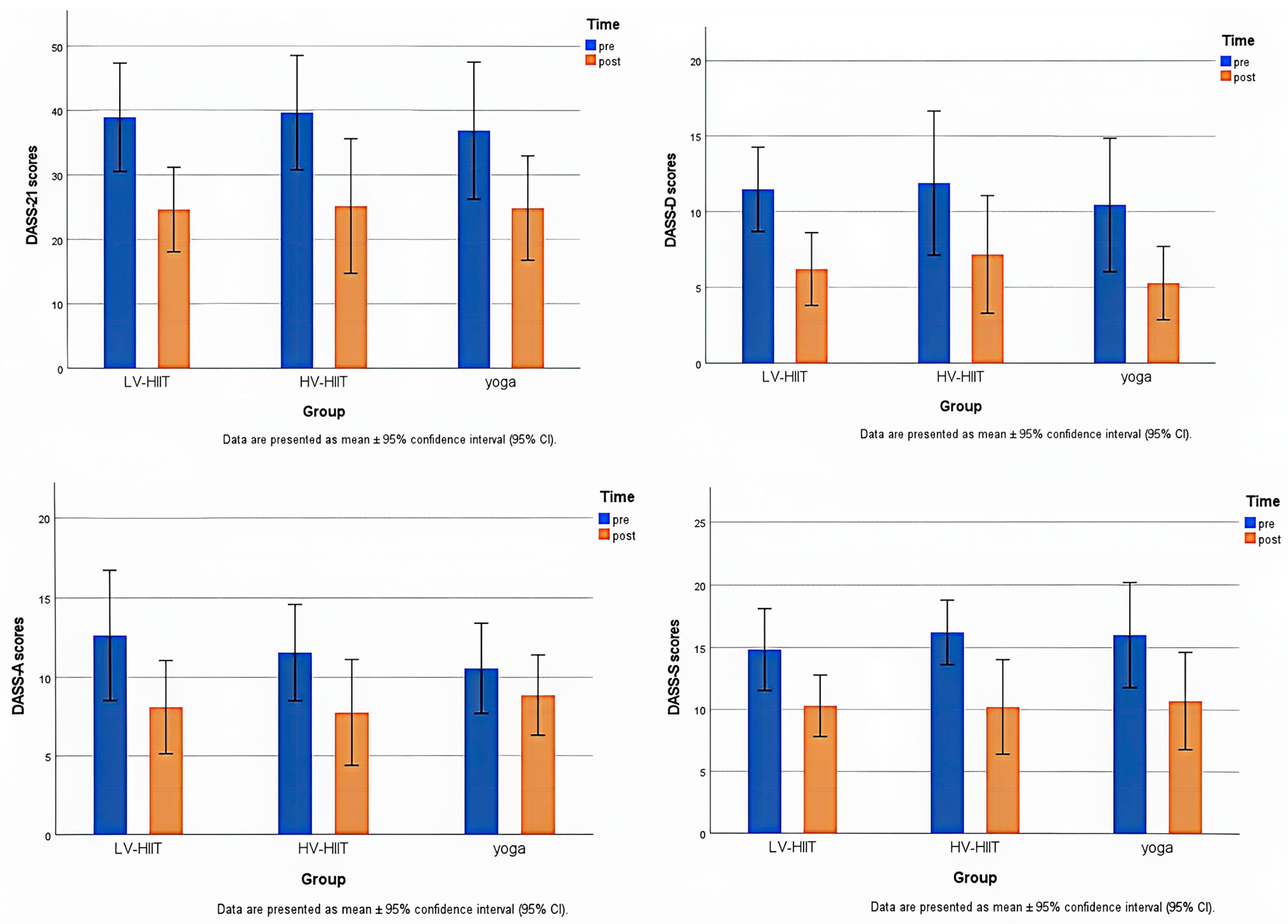
The linear mixed-model results with the DASS-21 total score as the dependent variable revealed a significant main effect of Time (F (1, 99) = 15.29, p < 0.001, partial η2 = 0.13), with overall psychological distress levels decreasing significantly across all three groups post-intervention (estimated marginal means: 38.51 vs. 24.88) (Figure 3). Neither the main effect of Group (F (2, 99) = 0.06, p = 0.938, partial η2 = 0.001) nor the Group × Time interaction effect (F (2, 99) = 0.05, p = 0.952, partial η2 = 0.001) reached statistical significance.
Supplemental description of the per-protocol (PP) analysis: Mean changes were −14.32 ± 12.76 (95% CI −20.34 to −8.30) in the LV-HIIT group, −14.24 ± 14.28 (95% CI −21.44 to −7.04) in the HV-HIIT group, and −14.86 ± 18.07 (95% CI −25.30 to −4.42) in the yoga group.

3.3.2. Depression (DASS-D)

The linear mixed-model results with depression as the dependent variable revealed a significant main effect of Time (F (1, 99) = 12.89, p = 0.001, partial η2 = 0.12), with depression scores decreasing significantly across all three groups post-intervention (estimated marginal means: 11.27 vs. 6.28) (Figure 3). Neither the main effect of Group (F (2, 99) = 0.45, p = 0.638, partial η2 = 0.01) nor the Group × Time interaction effect (F (2, 99) = 0.02, p = 0.985, partial η2 < 0.001) reached statistical significance.
Supplemental description of the per-protocol (PP) analysis: Mean changes were −5.26 ± 3.90 (95% CI −7.12 to −3.40) in the LV-HIIT group, −4.71 ± 4.84 (95% CI −7.19 to −2.23) in the HV-HIIT group, and −6.29 ± 8.41 (95% CI −10.89 to −1.69) in the yoga group.

3.3.3. Anxiety (DASS-A)

The linear mixed-model results with anxiety as the dependent variable revealed a significant main effect of Time (F (1, 99) = 6.95, p = 0.010, partial η2 = 0.07), with anxiety scores decreasing significantly across all three groups post-intervention (estimated marginal means: 11.60 vs. 8.20) (Figure 3). Neither the main effect of Group (F (2, 99) = 0.14, p = 0.872, partial η2 = 0.003) nor the Group × Time interaction effect (F (2, 99) = 0.43, p = 0.649, partial η2 = 0.01) reached statistical significance.
Supplemental description of the per-protocol (PP) analysis: Mean changes were −4.53 ± 5.33 (95% CI −7.08 to −1.98) in the LV-HIIT group, −3.88 ± 4.97 (95% CI −6.40 to −1.36) in the HV-HIIT group, and −2.57 ± 4.67 (95% CI −5.32 to 0.18) in the yoga group.

3.3.4. Stress (DASS-S)

The linear mixed-model results with stress as the dependent variable revealed a significant main effect of Time (F (1, 99) = 15.97, p < 0.001, partial η2 = 0.14), with stress scores decreasing significantly across all three groups post-intervention (estimated marginal means: 15.67 vs. 10.40) (Figure 3). Neither the main effect of Group (F (2, 99) = 0.14, p = 0.871, partial η2 = 0.003) nor the Group × Time interaction effect (F (2, 99) = 0.11, p = 0.898, partial η2 = 0.002) reached statistical significance.
Supplemental description of the per-protocol (PP) analysis: Mean changes were −4.53 ± 5.88 (95% CI −7.18 to −1.87) in the LV-HIIT group, −5.65 ± 7.32 (95% CI −8.81 to −2.49) in the HV-HIIT group, and −6.00 ± 6.47 (95% CI −9.40 to −2.60) in the yoga group.

3.4. Physical Fitness Outcomes

3.4.1. Body Fat Percentage

The linear mixed-model results with body fat percentage as the dependent variable revealed that neither the main effect of Time (F (1, 99) = 3.16, p = 0.079, partial η2 = 0.03) (Figure 2), nor the main effect of Group (F (2, 99) = 0.38, p = 0.686, partial η2 = 0.01), nor the Group × Time interaction effect (F (2, 99) = 0.28, p = 0.754, partial η2 = 0.01) reached statistical significance.
The per-protocol (PP) analysis further revealed a significant main effect of Time (F(1, 47) = 5.76, p = 0.020, partial η2 = 0.11), with changes in body fat percentage being −2.04 ± 1.85 (95% CI: −2.92, −1.16) for the LV-HIIT group, −1.11 ± 9.05 (95% CI: −5.55, 3.33) for the HV-HIIT group, and −2.54 ± 2.35 (95% CI: −3.93, −1.15) for the yoga group.

3.4.2. Waist Circumference

The linear mixed-model results with waist circumference as the dependent variable revealed that neither the main effect of Time (F(1, 99) = 0.49, p = 0.486, partial η2 = 0.005) (Figure 2), nor the main effect of Group (F(2, 99) = 0.80, p = 0.452, partial η2 = 0.02), nor the Group × Time interaction effect (F(2, 99) = 0.23, p = 0.793, partial η2 = 0.005) reached statistical significance.

3.4.3. Cardiorespiratory Fitness (VO2max)

The linear mixed-model results with VO2max as the dependent variable revealed a significant main effect of Time (F (1, 99) = 18.20, p < 0.001, partial η2 = 0.16), with cardiorespiratory fitness improving significantly across all three groups post-intervention (estimated marginal means: 29.22 vs. 32.64 mL/kg/min) (Figure 2). Neither the main effect of Group (F (2, 99) = 2.41, p = 0.095, partial η2 = 0.05) nor the Group × Time interaction effect (F (2, 99) = 0.26, p = 0.770, partial η2 = 0.005) reached statistical significance.
Supplemental description of the per-protocol (PP) analysis: Mean changes were 4.03 ± 3.54 (95% CI 2.44 to 5.62) in the LV-HIIT group, 3.84 ± 3.49 (95% CI 2.18 to 5.50) in the HV-HIIT group, and 3.00 ± 3.84 (95% CI 0.99 to 5.01) in the yoga group.
After Benjamini–Hochberg correction for multiple comparisons, all significant findings from the ITT analysis (BES, DASS-21 total score and subscales, and VO2max) remained significant (all q < 0.05), whereas body fat percentage (q = 0.120) and waist circumference (q = 0.486) remained non-significant. Notably, however, body fat percentage showed a significant reduction in the PP analysis (p = 0.020), a discrepancy addressed in the Discussion.
Detailed results are presented in Table 3. For the results of the per-protocol (PP) analysis, please refer to Appendix A Table A1.

3.5. Training Adherence and Exercise Intensity

Adherence rates were 100% (19/19) in the LV-HIIT group, 94.4% (17/18) in the HV-HIIT group, and 77.8% (14/18) in the yoga group. Although a decreasing trend in adherence was observed across groups, the between-group difference was not statistically significant (χ2 = 5.93, df = 2, p = 0.052).
A one-way ANOVA revealed a significant difference in the number of completed training sessions among the three groups (F = 3.524, p = 0.037). Post hoc comparisons using Tukey’s test indicated that the LV-HIIT group (13.11 ± 1.76 sessions) completed significantly more training sessions than the yoga group (10.39 ± 3.27 sessions), with a mean difference of 2.72 sessions (p = 0.012). No significant differences were observed between the LV-HIIT and HV-HIIT groups (11.78 ± 3.95 sessions; p = 0.405), or between the HV-HIIT and yoga groups (p = 0.492). The assumption of homogeneity of variances was satisfied as assessed by Levene’s test (p = 0.228).
During the 8-week intervention, peak heart rates (HRmax) recorded during training in the LV-HIIT and HV-HIIT groups were 163.94 ± 11.62 bpm and 162.83 ± 7.64 bpm, respectively, corresponding to 76–96% of individual HRmax, indicating vigorous-intensity physical activity.
Detailed results are presented in Table 4.

3.6. Exercise Time Efficiency

LV-HIIT required approximately 15 min per session, compared with 31 min for HV-HIIT and 60 min for the yoga intervention. Consequently, LV-HIIT was the most time-efficient intervention, requiring only approximately 48% of the session duration of HV-HIIT and 25% of that of yoga.

4. Discussion

This study is the first to compare the effects of LV-HIIT, HV-HIIT, and yoga on binge eating behaviors, negative emotional states, and physical fitness in young female college students.
The present study found that eight weeks of LV-HIIT, HV-HIIT, and yoga all improved binge eating behaviors and negative emotional states, with no significant between-group differences.
Regarding physical fitness, all three interventions significantly improved cardiorespiratory fitness (VO2max). However, no significant changes were observed in body fat percentage or waist circumference in the ITT analysis.

4.1. Yoga

The study further suggests that yoga may serve as a potential adjunctive intervention for binge eating problems. This finding is broadly consistent with previous studies on binge eating or emotional eating [10,47,48].
Previous studies have demonstrated a close association between binge eating behaviors and negative emotional states [49,50]. Individuals with BE may engage in binge eating behaviors to alleviate or escape from aversive emotional states [12,13,51]. Therefore, the reduction in negative affect is considered an important target in BED interventions [52,53]. In addition, multiple studies have also identified negative emotions as a prognostic indicator of eating disorders [11,22,54]. Richards et al. found that yoga practice may help reduce emotional eating and loss-of-control binge eating behaviors, an effect that may be associated with reduced perceived stress levels [47]. The present study similarly observed that yoga improved negative emotional states, consistent with previous findings [55,56]. In addition, yoga has been suggested to exert beneficial psychological regulatory effects in a range of mental health-related conditions [57,58,59]. As an integrative mind–body exercise, yoga emphasizes body awareness, mindful experience, and nonjudgmental self-acceptance [60,61]. Previous studies have suggested that yoga may alleviate stress responses and emotional dysregulation by improving autonomic nervous system function, reducing hyperactivation of the hypothalamic–pituitary–adrenal (HPA) axis, and enhancing vagal tone [62,63]. Overall, yoga may improve binge eating behaviors through the psychological pathways described above.
The present study found that yoga did not improve body composition in young female college students with binge eating based on the ITT analysis. This finding is inconsistent with some previous studies [64,65,66]. However, it should be noted that those studies primarily targeted overweight or obese populations [64,65,66]. Existing studies and meta-analyses have shown that the beneficial effects of yoga on body composition are primarily observed in overweight or obese individuals, while the effects are limited or not significant in individuals with normal body weight [25,67]. Although the mean BMI of the present study sample was within the normal range, both normal-weight and overweight/obese participants were included, with a relatively large standard deviation indicating substantial inter-individual variability. This sample composition may limit direct comparability with previous studies that primarily focused on populations with a single body weight characteristic.
However, previous studies have confirmed an association between binge eating disorder and obesity [68,69], and more than 65% of individuals with BED are obese [70]. Obesity has been associated with weight-related psychological distress [66,71,72], which may negatively affect both physical and mental health [73]. Therefore, future studies should conduct stratified analyses across different weight categories and further explore the relationship between binge eating behaviors and body composition. In addition, eating behaviors and energy intake should be monitored to determine whether these factors also influence body composition in individuals with binge eating behaviors.
Regarding cardiorespiratory fitness, the present study found that yoga can improve VO2max; however, findings from previous studies remain inconsistent [24,74]. This discrepancy may be primarily attributed to heterogeneity in intervention protocols, exercise intensity, and study populations [75]. Due to the diversity of yoga styles, considerable variations exist among studies regarding the forms of yoga and training intensities employed [75]. The present study implemented moderate-intensity yoga, whereas several studies that failed to observe positive effects of yoga on cardiorespiratory endurance primarily utilized low-intensity yoga interventions [27,74].

4.2. LV-HIIT and HV-HIIT

Although LV-HIIT consisted of substantially lower training volume than HV-HIIT (5 × 1 vs. 4 × 4 structure), both protocols elicited comparable improvements in binge eating behaviors and negative emotional states. Previous studies, such as those conducted by Blundell and colleagues, have suggested that higher exercise volumes may induce compensatory increases in food intake; therefore, HV-HIIT may theoretically be more likely to increase energy intake [76]. However, this phenomenon was not observed in female college students with binge eating in the present study. These findings suggest that exercise-induced changes in eating behavior among individuals with BE should not be explained solely from the perspective of energy compensation. The beneficial effects of HIIT on binge eating behaviors may also be related to improvements in negative emotions, enhanced inhibitory control, and regulation of neuropsychological mechanisms associated with impulsive eating behaviors [38,39]. Previous studies have shown that HIIT can alleviate negative emotional states by modulating monoamine neurotransmitters, improving hypothalamic–pituitary–adrenal (HPA) axis function, and reducing inflammatory responses [77]. In addition, HIIT may enhance prefrontal cortex–related inhibitory control and attentional regulation, thereby reducing reward responsiveness to high-calorie food cues and impulsive eating tendencies [39,78].
The following studies further support this perspective: A randomized controlled trial by Martins et al. in individuals with obesity found that, under equivalent energy expenditure, HIIT did not significantly increase appetite or food reward responses compared with moderate-intensity continuous exercise [37]. In addition, although only one study has specifically investigated the effects of HIIT in individuals with binge eating behaviors [10], evidence from different populations suggests that HIIT can reduce preference for high-calorie foods and improve eating behavior regulation without increasing the risk of compensatory eating [37,39].
HIIT and yoga are two distinct types of exercise interventions that may improve binge eating behaviors through partially different underlying mechanisms. Current evidence remains limited, and existing literature suggests that HIIT may primarily reduce impulsive eating behaviors by enhancing inhibitory control [39,78], whereas yoga may act through mind–body integrative processes to improve negative emotions, enhance body awareness, and further alleviate emotional eating behaviors [21,22,48,79]. However, there is still a lack of studies directly comparing or validating the differential mechanistic pathways of these two exercise interventions in populations with binge eating behaviors.
Overall, the proposed mechanisms should be interpreted as theoretical explanations that require confirmation in future studies incorporating direct physiological and neuropsychological measurements.
Regarding cardiorespiratory fitness, HV-HIIT and LV-HIIT demonstrated similar improvements in VO2max. In HIIT training, improvements in cardiorespiratory fitness are primarily driven by exercise intensity rather than the number of repetitions or total training duration [33]. In the present study, both HIIT protocols were performed at comparable intensities, which may explain the similar outcomes observed. Furthermore, LV-HIIT, characterized by short bouts of high-intensity effort interspersed with sufficient recovery, may be analogous to “cluster set” training in resistance exercise [80]. This structure may help maintain higher peak power output during each sprint, thereby enhancing the quality of each high-intensity stimulus while optimizing movement performance. Therefore, LV-HIIT can still effectively improve cardiorespiratory fitness despite a lower total training volume [81], which may be attributable to higher-quality exercise output per bout and more appropriately structured recovery intervals [82]. Future studies may further optimize the structural design of HV-HIIT by implementing protocols characterized by shorter durations of each high-intensity bout combined with a greater number of training sets, thereby increasing overall training volume while maintaining high-quality exercise output and further clarifying the potential role of training volume in improving cardiorespiratory fitness.
Similar to the findings for yoga, the present study also found that neither LV-HIIT nor HV-HIIT improved body composition. This is also inconsistent with some previous studies [31,83,84]. Given that energy intake and dietary behaviors were not objectively assessed in the present study, it is currently difficult to determine whether the absence of changes in body composition is related to the specific characteristics of individuals with binge eating behaviors.
The present findings suggest that LV-HIIT may represent a more time-efficient and feasible exercise intervention for individuals with binge eating. Although no statistically significant differences in adherence were observed among the three groups, LV-HIIT demonstrated a significantly greater number of completed training sessions compared with yoga, suggesting potential differences in real-world implementation across exercise modalities. In addition, each LV-HIIT session required only 15 min, compared with 31 min for HV-HIIT and 60 min for yoga, indicating superior time efficiency. Globally, approximately 23.3% of adults do not meet recommended physical activity levels, with insufficient time cited as one of the main obstacles to regular exercise [85,86,87]. In this context, the short duration, high efficiency, and superior adherence associated with LV-HIIT may make it a feasible exercise intervention strategy for individuals with binge eating.

Limitations

This study has certain limitations. First, the relatively small sample size in the present study may have reduced statistical power, limiting the ability to detect potential differences between intervention groups. Therefore, although no significant between-group differences were observed in binge eating behaviors, negative emotional states, and cardiorespiratory fitness, these findings should not be interpreted as evidence of equivalence among the three exercise interventions. Future studies with larger sample sizes are warranted to further confirm these findings.
Second, participants were screened based on BES rather than a formal clinical diagnosis of binge eating disorder (BED), and all binge eating and psychological outcomes were assessed using self-report measures. These factors may introduce reporting bias and limit the diagnostic accuracy of participant classification. Therefore, the generalizability of the present findings to clinically diagnosed BED populations should be interpreted with caution. Future studies should incorporate structured clinical interviews and objective assessment methods to strengthen the validity of the findings.
Third, the study did not systematically monitor dietary intake, sleep quality, daily physical activity, or academic stress, all of which may have influenced the observed outcomes. Furthermore, body fat percentage was assessed using bioelectrical impedance analysis, a method that is sensitive to hydration status and measurement conditions. Although participants were assessed under standardized procedures, uncontrolled variations in fluid balance, recent food and beverage intake, and other pre-assessment factors may have affected the accuracy of body composition measurements. In addition, menstrual cycle phase was not controlled, which may have introduced further variability in body composition estimates. Future research should incorporate comprehensive monitoring of these factors.

5. Conclusions

An 8-week intervention of LV-HIIT, HV-HIIT, and yoga was associated with significant improvements in binge eating behaviors and negative emotional states in young female college students with binge eating. All three interventions also improved cardiorespiratory fitness, but none resulted in improvements in body composition. However, no evidence of differential effects was observed among the three exercise interventions. Given its shorter duration and higher adherence rate, LV-HIIT may represent a promising exercise option. This potential practical advantage should be confirmed in larger randomized controlled trials.

Author Contributions

C.T. and M.L. were involved in study design, data acquisition, intervention delivery, statistical analysis, and interpretation of the findings. C.T. prepared the initial manuscript and completed the final revision. S.M. and L.Z. contributed to the study design and administrative support. C.T., Y.Y., Y.L. and S.M. contributed to manuscript revision. L.G. provided guidance on data analysis. S.M. and L.Z. provided administrative support. All authors contributed to the drafting and revision of the manuscript. All authors have read and agreed to the published version of the manuscript.

Funding

This work was supported by Chinese Universities Scientific Fund (2024JNPD001) and the National Key R&D Program of China (2022YFC3600201).

Institutional Review Board Statement

The study was conducted in accordance with the Declaration of Helsinki. Ethical approval for this study was obtained from the Ethics Committee of the Exercise Science Laboratory at Beijing Sport University (Approval No. BSU2024116H; approved on 15 April 2024). In addition, the trial was registered in the Chinese Clinical Trial Registry (ChiCTR2600122300; 11 April 2026).

Informed Consent Statement

Informed consent was obtained from all subjects involved in the study.

Data Availability Statement

The datasets generated and/or analyzed during the current study are available from the corresponding authors upon reasonable request. The data are not publicly available due to privacy.

Conflicts of Interest

The authors declare no conflicts of interest.

Appendix A

Table A1. Pre- and post-intervention outcomes based on per-protocol analysis (n = 50).
OutcomesGroupPrePostΔPre–PostGroup
p-Value
Time
p-Value
BH-Adjusted q-ValueInteraction
p-Value
M ± SDM ± SDM ± SD
BESLV-HIIT24.16 ± 4.7816.84 ± 5.84−7.32 ± 6.160.553<0.001<0.0010.486
HV-HIIT26.71 ± 6.0717.76 ± 8.04−8.94 ± 7.57
Yoga23.36 ± 4.7217.57 ± 8.71−5.79 ± 8.15
DASS-21LV-HIIT38.95 ± 17.4424.63 ± 13.60−14.32 ± 12.760.994<0.001<0.0010.992
HV-HIIT39.41 ± 18.3525.18 ± 20.31−14.24 ± 14.28
Yoga39.71 ± 23.0824.86 ± 14.00−14.86 ± 18.07
DASS-DLV-HIIT11.47 ± 5.776.21 ± 4.98−5.26 ± 3.900.896<0.001<0.0010.748
HV-HIIT11.88 ± 9.867.18 ± 7.55−4.71 ± 4.84
Yoga11.57 ± 9.585.29 ± 4.20−6.29 ± 8.41
DASS-ALV-HIIT12.63 ± 8.518.11 ± 6.16−4.53 ± 5.330.945<0.001<0.0010.616
HV-HIIT11.65 ± 6.297.76 ± 6.55−3.88 ± 4.97
Yoga11.43 ± 5.468.86 ± 4.42−2.57 ± 4.67
DASS-SLV-HIIT14.84 ± 6.8110.32 ± 5.17−4.53 ± 5.880.865<0.001<0.0010.791
HV-HIIT15.88 ± 5.1210.24 ± 7.44−5.65 ± 7.32
Yoga16.71 ± 9.3710.71 ± 6.77−6.00 ± 6.47
WC (cm)LV-HIIT73.11 ± 8.7373.55 ± 8.20/0.5540.4970.4970.569
HV-HIIT75.49 ± 8.7274.94 ± 7.70/
Yoga71.46 ± 6.5973.74 ± 6.43/
BF (%)LV-HIIT31.70 ± 5.1429.66 ± 5.09−2.04 ± 1.850.7460.020.0230.762
HV-HIIT30.95 ± 5.7629.84 ± 6.85−1.11 ± 9.05
Yoga30.71 ± 4.6728.17 ± 4.68−2.54 ± 2.35
VO2max (mL·kg−1·min−1)LV-HIIT27.74 ± 3.7231.77 ± 4.764.03 ± 3.540.255<0.001<0.0010.394
HV-HIIT29.40 ± 4.3733.23 ± 5.263.84 ± 3.49
Yoga30.66 ± 3.7733.09 ± 2.313.00 ± 3.84
Note: Data are presented as the mean ± SD. LV-HIIT, low-volume high-intensity interval training group; HV-HIIT, high-volume high-intensity interval training group; BES, Binge Eating Scale; DASS-21, Depression Anxiety Stress Scale-21; DASS-D, depression subscale of the DASS-21; DASS-A, anxiety subscale of the DASS-21; DASS-S, stress subscale of the DASS-21; WC, waist circumference; BF, body fat percentage; VO2max, maximal oxygen uptake. Data were analyzed using a per-protocol (PP) approach including participants who completed the intervention. Benjamini–Hochberg false discovery rate correction was applied across the eight outcome-specific time effects.

References

  1. Liu, K.; Gao, R.; Kuang, H.; Zhang, C.; Guo, X. Global, Regional, and National Burdens of Eating Disorder in Adolescents and Young Adults Aged 10–24 Years from 1990 to 2021: A Trend Analysis. J. Affect. Disord. 2025, 388, 119596. [Google Scholar] [CrossRef] [PubMed]
  2. Ágh, T.; Kovács, G.; Pawaskar, M.; Supina, D.; Inotai, A.; Vokó, Z. Epidemiology, Health-Related Quality of Life and Economic Burden of Binge Eating Disorder: A Systematic Literature Review. Eat. Weight Disord. 2015, 20, 1–12. [Google Scholar] [CrossRef] [PubMed]
  3. Keski-Rahkonen, A. Epidemiology of Binge Eating Disorder: Prevalence, Course, Comorbidity, and Risk Factors. Curr. Opin. Psychiatry 2021, 34, 525–531. [Google Scholar] [CrossRef] [PubMed]
  4. Mustelin, L.; Raevuori, A.; Hoek, H.W.; Kaprio, J.; Keski-Rahkonen, A. Incidence and Weight Trajectories of Binge Eating Disorder among Young Women in the Community. Int. J. Eat. Disord. 2015, 48, 1106–1112. [Google Scholar] [CrossRef] [PubMed]
  5. Kells, M.; Kelly-Weeder, S. Binge Eating Behavior among a Cohort of Normal Weight College Women. J. Am. Assoc. Nurse Pract. 2019, 31, 741–746. [Google Scholar] [CrossRef] [PubMed]
  6. Melville, H.; Lister, N.B.; Libesman, S.; Seidler, A.L.; Cheng, H.Y.; Kwan, Y.L.; Garnett, S.P.; Baur, L.A.; Jebeile, H. The Prevalence of Eating Disorders and Disordered Eating in Adults Seeking Obesity Treatment: A Systematic Review With Meta-Analyses. Int. J. Eat. Disord. 2025, 58, 1644–1661. [Google Scholar] [CrossRef] [PubMed]
  7. Blanchet, C.; Mathieu, M.-È.; St-Laurent, A.; Fecteau, S.; St-Amour, N.; Drapeau, V. A Systematic Review of Physical Activity Interventions in Individuals with Binge Eating Disorders. Curr. Obes. Rep. 2018, 7, 76–88. [Google Scholar] [CrossRef] [PubMed]
  8. Succurro, E.; Segura-Garcia, C.; Ruffo, M.; Caroleo, M.; Rania, M.; Aloi, M.; De Fazio, P.; Sesti, G.; Arturi, F. Obese Patients With a Binge Eating Disorder Have an Unfavorable Metabolic and Inflammatory Profile. Medicine 2015, 94, e2098. [Google Scholar] [CrossRef] [PubMed]
  9. Wassenaar, E.; Friedman, J.; Mehler, P.S. Medical Complications of Binge Eating Disorder. Psychiatr. Clin. N. Am. 2019, 42, 275–286. [Google Scholar] [CrossRef] [PubMed]
  10. Li, H.-M.; Liu, C.-J.; Shen, Y.-H.; Zhao, L.; Yin, C.-Q.; Yu, J.-G.; Mao, S.-S. High-Intensity Interval Training vs. Yoga in Improving Binge Eating and Physical Fitness in Inactive Young Females. Sci. Rep. 2024, 14, 22912. [Google Scholar] [CrossRef] [PubMed]
  11. Mathisen, T.F.; Rosenvinge, J.H.; Friborg, O.; Vrabel, K.; Bratland-Sanda, S.; Pettersen, G.; Sundgot-Borgen, J. Is Physical Exercise and Dietary Therapy a Feasible Alternative to Cognitive Behavior Therapy in Treatment of Eating Disorders? A Randomized Controlled Trial of Two Group Therapies. Int. J. Eat. Disord. 2020, 53, 574–585. [Google Scholar] [CrossRef] [PubMed]
  12. Leehr, E.J.; Krohmer, K.; Schag, K.; Dresler, T.; Zipfel, S.; Giel, K.E. Emotion Regulation Model in Binge Eating Disorder and Obesity--a Systematic Review. Neurosci. Biobehav. Rev. 2015, 49, 125–134. [Google Scholar] [CrossRef] [PubMed]
  13. Haedt-Matt, A.A.; Keel, P.K. Revisiting the Affect Regulation Model of Binge Eating: A Meta-Analysis of Studies Using Ecological Momentary Assessment. Psychol. Bull. 2011, 137, 660–681. [Google Scholar] [CrossRef] [PubMed]
  14. Deboer, L.B.; Tart, C.D.; Presnell, K.E.; Powers, M.B.; Baldwin, A.S.; Smits, J.A.J. Physical Activity as a Moderator of the Association Between Anxiety Sensitivity and Binge Eating. Eat. Behav. 2012, 13, 194–201. [Google Scholar] [CrossRef] [PubMed]
  15. Raisi, A.; Zerbini, V.; Piva, T.; Murri, M.B.; Menegatti, E.; Caruso, L.; Masotti, S.; Grazzi, G.; Mazzoni, G.; Mandini, S. Treating Binge Eating Disorder with Physical Exercise: A Systematic Review and Meta-Analysis. J. Nutr. Educ. Behav. 2023, 55, 523–530. [Google Scholar] [CrossRef] [PubMed]
  16. Helmich, I.; Latini, A.; Sigwalt, A.; Carta, M.G.; Machado, S.; Velasques, B.; Ribeiro, P.; Budde, H. Neurobiological Alterations Induced by Exercise and Their Impact on Depressive Disorders. Clin. Pract. Epidemiol. Ment. Health 2010, 6, 115–125. [Google Scholar] [CrossRef] [PubMed]
  17. Gualdi-Russo, E.; Rinaldo, N.; Zaccagni, L. Physical Activity and Body Image Perception in Adolescents: A Systematic Review. Int. J. Environ. Res. Public Health 2022, 19, 13190. [Google Scholar] [CrossRef] [PubMed]
  18. Campbell, A.; Hausenblas, H.A. Effects of Exercise Interventions on Body Image: A Meta-Analysis. J. Health Psychol. 2009, 14, 780–793. [Google Scholar] [CrossRef] [PubMed]
  19. Drenowatz, C.; Evensen, L.H.; Ernstsen, L.; Blundell, J.E.; Hand, G.A.; Shook, R.P.; Hébert, J.R.; Burgess, S.; Blair, S.N. Cross-Sectional and Longitudinal Associations between Different Exercise Types and Food Cravings in Free-Living Healthy Young Adults. Appetite 2017, 118, 82–89. [Google Scholar] [CrossRef] [PubMed]
  20. Garber, C.E.; Blissmer, B.; Deschenes, M.R.; Franklin, B.A.; Lamonte, M.J.; Lee, I.-M.; Nieman, D.C.; Swain, D.P. American College of Sports Medicine American College of Sports Medicine Position Stand. Quantity and Quality of Exercise for Developing and Maintaining Cardiorespiratory, Musculoskeletal, and Neuromotor Fitness in Apparently Healthy Adults: Guidance for Prescribing Exercise. Med. Sci. Sports Exerc. 2011, 43, 1334–1359. [Google Scholar] [CrossRef] [PubMed]
  21. Ostermann, T.; Vogel, H.; Boehm, K.; Cramer, H. Effects of Yoga on Eating Disorders—A Systematic Review. Complement. Ther. Med. 2019, 46, 73–80. [Google Scholar] [CrossRef] [PubMed]
  22. Carei, T.R.; Fyfe-Johnson, A.L.; Breuner, C.C.; Brown, M.A. Randomized Controlled Clinical Trial of Yoga in the Treatment of Eating Disorders. J. Adolesc. Health 2010, 46, 346–351. [Google Scholar] [CrossRef] [PubMed]
  23. Bera, T.K.; Rajapurkar, M.V. Body Composition, Cardiovascular Endurance and Anaerobic Power of Yogic Practitioner. Indian J. Physiol. Pharmacol. 1993, 37, 225–228. Available online: https://ijpp.com/IJPP%20archives/1993_37_3/225-228.pdf (accessed on 30 May 2026). [PubMed]
  24. Hewett, Z.L.; Cheema, B.S.; Pumpa, K.L.; Smith, C.A. The Effects of Bikram Yoga on Health: Critical Review and Clinical Trial Recommendations. Evid. Based Complement. Altern. Med. 2015, 2015, 428427. [Google Scholar] [CrossRef] [PubMed]
  25. Lauche, R.; Langhorst, J.; Lee, M.S.; Dobos, G.; Cramer, H. A Systematic Review and Meta-Analysis on the Effects of Yoga on Weight-Related Outcomes. Prev. Med. 2016, 87, 213–232. [Google Scholar] [CrossRef] [PubMed]
  26. Prajapati, P.; Kaliramana, P.; Jamil, F.; Agarwal, R.; Agarwal, P.; Bhandari, B. Exploring the Effects of Yoga on the Resting Metabolic Rate and Fat-to-Muscle Ratio of Medical Students: A Six-Week Interventional Study. Cureus 2025, 17, e85314. [Google Scholar] [CrossRef] [PubMed]
  27. Tracy, B.L.; Hart, C.E.F. Bikram Yoga Training and Physical Fitness in Healthy Young Adults. J. Strength Cond. Res. 2013, 27, 822–830. [Google Scholar] [CrossRef] [PubMed]
  28. Tran, M.D.; Holly, R.G.; Lashbrook, J.; Amsterdam, E.A. Effects of Hatha Yoga Practice on the Health-Related Aspects of Physical Fitness. Prev. Cardiol. 2001, 4, 165–170. [Google Scholar] [CrossRef] [PubMed]
  29. Patten, R.K.; Bourke, M.; McIlvenna, L.C.; Moreno-Asso, A.; Woessner, M.N.; Stepto, N.K.; Parker, A. Longitudinal Affective Response to High-Intensity Interval Training and Moderate-Intensity Continuous Training in Overweight Women with Polycystic Ovary Syndrome: A Randomised Trial. Psychol. Sport Exerc. 2023, 64, 102325. [Google Scholar] [CrossRef] [PubMed]
  30. Collins, B.E.G.; Hartmann, T.E.; Marino, F.E.; Skein, M. A Comparison of Acute High- and Moderate-Intensity Exercise on Cardio-Metabolic Function and Sleep Among Shift Workers. J. Sci. Sport Exerc. 2024, 6, 35–43. [Google Scholar] [CrossRef]
  31. Sultana, R.N.; Sabag, A.; Keating, S.E.; Johnson, N.A. The Effect of Low-Volume High-Intensity Interval Training on Body Composition and Cardiorespiratory Fitness: A Systematic Review and Meta-Analysis. Sports Med. 2019, 49, 1687–1721. [Google Scholar] [CrossRef] [PubMed]
  32. Zhu, L.; An, J.; Luu, T.; Reyna, S.M.; Tantiwong, P.; Sriwijitkamol, A.; Musi, N.; Stafford, J.M. Short-Term HIIT Impacts HDL Function Differently in Lean, Obese, and Diabetic Subjects. Front. Physiol. 2024, 15, 1423989. [Google Scholar] [CrossRef] [PubMed]
  33. Yin, M.; Li, H.; Bai, M.; Liu, H.; Chen, Z.; Deng, J.; Deng, S.; Meng, C.; Vollaard, N.B.J.; Little, J.P.; et al. Is Low-Volume High-Intensity Interval Training a Time-Efficient Strategy to Improve Cardiometabolic Health and Body Composition? A Meta-Analysis. Appl. Physiol. Nutr. Metab. 2024, 49, 273–292. [Google Scholar] [CrossRef] [PubMed]
  34. Donati Zeppa, S.; Sisti, D.; Amatori, S.; Gervasi, M.; Agostini, D.; Piccoli, G.; Bertuccioli, A.; Rocchi, M.B.L.; Stocchi, V.; Sestili, P. High-Intensity Interval Training Promotes the Shift to a Health-Supporting Dietary Pattern in Young Adults. Nutrients 2020, 12, 843. [Google Scholar] [CrossRef] [PubMed]
  35. Douglas, J.A.; King, J.A.; Clayton, D.J.; Jackson, A.P.; Sargeant, J.A.; Thackray, A.E.; Davies, M.J.; Stensel, D.J. Acute Effects of Exercise on Appetite, Ad Libitum Energy Intake and Appetite-Regulatory Hormones in Lean and Overweight/Obese Men and Women. Int. J. Obes. 2017, 41, 1737–1744. [Google Scholar] [CrossRef] [PubMed]
  36. Hu, M.; Kong, Z.; Shi, Q.; Nie, J. Acute Effect of High-Intensity Interval Training versus Moderate-Intensity Continuous Training on Appetite-Regulating Gut Hormones in Healthy Adults: A Systematic Review and Meta-Analysis. Heliyon 2023, 9, e13129. [Google Scholar] [CrossRef] [PubMed]
  37. Martins, C.; Aschehoug, I.; Ludviksen, M.; Holst, J.; Finlayson, G.; Wisloff, U.; Morgan, L.; King, N.; Kulseng, B. High-Intensity Interval Training, Appetite, and Reward Value of Food in the Obese. Med. Sci. Sports Exerc. 2017, 49, 1851–1858. [Google Scholar] [CrossRef] [PubMed]
  38. Javelle, F.; Bloch, W.; Knoop, A.; Guillemin, G.J.; Zimmer, P. Toward a Neuroprotective Shift: Eight Weeks of High Intensity Interval Training Reduces the Neurotoxic Kynurenine Activity Concurrently to Impulsivity in Emotionally Impulsive Humans—A Randomized Controlled Trial. Brain Behav. Immun. 2021, 96, 7–17. [Google Scholar] [CrossRef] [PubMed]
  39. Sardjoe, M.; Aldred, S.; Adam, T.; Plasqui, G.; Brunstrom, J.M.; Dourish, C.T.; Higgs, S. Inhibitory Control Mediates the Effect of High Intensity Interval Exercise on Food Choice. Appetite 2024, 200, 107499. [Google Scholar] [CrossRef] [PubMed]
  40. Metcalfe, R.S.; Williams, S.; Fernandes, G.S.; Astorino, T.A.; Stork, M.J.; Phillips, S.M.; Niven, A.; Vollaard, N.B.J. Affecting Effects on Affect: The Impact of Protocol Permutations on Affective Responses to Sprint Interval Exercise; A Systematic Review and Meta-Analysis of Pooled Individual Participant Data. Front. Sports Act. Living 2022, 4, 815555. [Google Scholar] [CrossRef] [PubMed]
  41. Farias-Junior, L.F.; Macêdo, G.A.D.; Browne, R.A.V.; Freire, Y.A.; Oliveira-Dantas, F.F.; Schwade, D.; Mortatti, A.L.; Santos, T.M.; Costa, E.C. Physiological and Psychological Responses during Low-Volume High-Intensity Interval Training Sessions with Different Work-Recovery Durations. J. Sports Sci. Med. 2019, 18, 181–190. [Google Scholar] [PubMed]
  42. Gellish, R.L.; Goslin, B.R.; Olson, R.E.; McDonald, A.; Russi, G.D.; Moudgil, V.K. Longitudinal Modeling of the Relationship Between Age and Maximal Heart Rate. Med. Sci. Sports Exerc. 2007, 39, 822–829. [Google Scholar] [CrossRef] [PubMed]
  43. Gormally, J.; Black, S.; Daston, S.; Rardin, D. The Assessment of Binge Eating Severity Among Obese Persons. Addict. Behav. 1982, 7, 47–55. [Google Scholar] [CrossRef] [PubMed]
  44. Lee, J.; Lee, E.-H.; Moon, S.H. Systematic Review of the Measurement Properties of the Depression Anxiety Stress Scales—21 by Applying Updated COSMIN Methodology. Qual. Life Res. 2019, 28, 2325–2339. [Google Scholar] [CrossRef] [PubMed]
  45. Wang, J.; Thornton, J.C.; Bari, S.; Williamson, B.; Gallagher, D.; Heymsfield, S.B.; Horlick, M.; Kotler, D.; Laferrère, B.; Mayer, L.; et al. Comparisons of Waist Circumferences Measured at 4 Sites. Am. J. Clin. Nutr. 2003, 77, 379–384. [Google Scholar] [CrossRef] [PubMed]
  46. Glaab, T.; Taube, C. Practical Guide to Cardiopulmonary Exercise Testing in Adults. Respir. Res. 2022, 23, 9. [Google Scholar] [CrossRef] [PubMed]
  47. Richards, A.L.; Johnson, R. Reduction in Emotional and Uncontrolled Eating Scores with Yoga Compared to Stretching: A Randomized Trial. Altern. Ther. Health Med. 2025, 31, 32–39. [Google Scholar] [PubMed]
  48. McIver, S.; O’Halloran, P.; McGartland, M. Yoga as a Treatment for Binge Eating Disorder: A Preliminary Study. Complement. Ther. Med. 2009, 17, 196–202. [Google Scholar] [CrossRef] [PubMed]
  49. Smyth, J.M.; Wonderlich, S.A.; Heron, K.E.; Sliwinski, M.J.; Crosby, R.D.; Mitchell, J.E.; Engel, S.G. Daily and Momentary Mood and Stress Are Associated with Binge Eating and Vomiting in Bulimia Nervosa Patients in the Natural Environment. J. Consult. Clin. Psychol. 2007, 75, 629–638. [Google Scholar] [CrossRef] [PubMed]
  50. Marmorstein, N.R.; von Ranson, K.M.; Iacono, W.G.; Malone, S.M. Prospective Associations Between Depressive Symptoms and Eating Disorder Symptoms Among Adolescent Girls. Int. J. Eat. Disord. 2008, 41, 118–123. [Google Scholar] [CrossRef] [PubMed]
  51. Heatherton, T.F.; Baumeister, R.F. Binge Eating as Escape from Self-Awareness. Psychol. Bull. 1991, 110, 86–108. [Google Scholar] [CrossRef] [PubMed]
  52. Hay, P.P.; Bacaltchuk, J.; Stefano, S.; Kashyap, P. Psychological Treatments for Bulimia Nervosa and Binging. Cochrane Database Syst. Rev. 2009, 2009, CD000562. [Google Scholar] [CrossRef] [PubMed]
  53. Wilson, G.T. Treatment of Binge Eating Disorder. Psychiatr. Clin. N. Am. 2011, 34, 773–783. [Google Scholar] [CrossRef] [PubMed]
  54. Vancampfort, D.; Vanderlinden, J.; De Hert, M.; Soundy, A.; Adámkova, M.; Skjaerven, L.H.; Catalán-Matamoros, D.; Lundvik Gyllensten, A.; Gómez-Conesa, A.; Probst, M. A Systematic Review of Physical Therapy Interventions for Patients with Anorexia and Bulemia Nervosa. Disabil. Rehabil. 2014, 36, 628–634. [Google Scholar] [CrossRef] [PubMed]
  55. Brennan, M.A.; Whelton, W.J.; Sharpe, D. Benefits of Yoga in the Treatment of Eating Disorders: Results of a Randomized Controlled Trial. Eat. Disord. 2020, 28, 438–457. [Google Scholar] [CrossRef] [PubMed]
  56. Vancampfort, D.; Vanderlinden, J.; De Hert, M.; Adámkova, M.; Skjaerven, L.H.; Catalán-Matamoros, D.; Lundvik-Gyllensten, A.; Gómez-Conesa, A.; Ijntema, R.; Probst, M. A Systematic Review on Physical Therapy Interventions for Patients with Binge Eating Disorder. Disabil. Rehabil. 2013, 35, 2191–2196. [Google Scholar] [CrossRef] [PubMed]
  57. Cramer, H.; Lauche, R.; Langhorst, J.; Dobos, G. Yoga for Depression: A Systematic Review and Meta-Analysis. Depress. Anxiety 2013, 30, 1068–1083. [Google Scholar] [CrossRef] [PubMed]
  58. Pascoe, M.C.; Bauer, I.E. A Systematic Review of Randomised Control Trials on the Effects of Yoga on Stress Measures and Mood. J. Psychiatr. Res. 2015, 68, 270–282. [Google Scholar] [CrossRef] [PubMed]
  59. Hendriks, T.; de Jong, J.; Cramer, H. The Effects of Yoga on Positive Mental Health Among Healthy Adults: A Systematic Review and Meta-Analysis. J. Altern. Complement. Med. 2017, 23, 505–517. [Google Scholar] [CrossRef] [PubMed]
  60. Mahlo, L.; Tiggemann, M. Yoga and Positive Body Image: A Test of the Embodiment Model. Body Image 2016, 18, 135–142. [Google Scholar] [CrossRef] [PubMed]
  61. Cadieux, E.G.; Gemme, C.; Dupuis, G. Effects of Yoga Interventions on Psychological Health and Performance of Competitive Athletes: A Systematic Review. J. Sci. Sport Exerc. 2021, 3, 158–166. [Google Scholar] [CrossRef]
  62. Streeter, C.C.; Gerbarg, P.L.; Saper, R.B.; Ciraulo, D.A.; Brown, R.P. Effects of Yoga on the Autonomic Nervous System, Gamma-Aminobutyric-Acid, and Allostasis in Epilepsy, Depression, and Post-Traumatic Stress Disorder. Med. Hypotheses 2012, 78, 571–579. [Google Scholar] [CrossRef] [PubMed]
  63. Brown, R.P.; Gerbarg, P.L. Sudarshan Kriya Yogic Breathing in the Treatment of Stress, Anxiety, and Depression: Part I—Neurophysiologic Model. J. Altern. Complement. Med. 2005, 11, 189–201. [Google Scholar] [CrossRef] [PubMed]
  64. Cramer, H.; Thoms, M.S.; Anheyer, D.; Lauche, R.; Dobos, G. Yoga in Women with Abdominal Obesity: A Randomized Controlled Trial. Dtsch. Arztebl. Int. 2016, 113, 645–652. [Google Scholar] [CrossRef] [PubMed]
  65. Rshikesan, P.B.; Subramanya, P. Effect of Integrated Approach of Yoga Therapy on Male Obesity and Psychological Parameters—A Randomised Controlled Trial. J. Clin. Diagn. Res. 2016, 10, KC01–KC06. [Google Scholar] [CrossRef] [PubMed]
  66. Rshikesan, P.B.; Subramanya, P.; Nidhi, R. Yoga Practice for Reducing the Male Obesity and Weight Related Psychological Difficulties-A Randomized Controlled Trial. J. Clin. Diagn. Res. 2016, 10, OC22–OC28. [Google Scholar] [CrossRef] [PubMed]
  67. Caner, N.; Yüce, G.E. The Impact of Yoga Practices on Body Composition and Vital Signs in Children and Adolescents with Obesity: A Systematic Review and Meta-Analysis. Obes. Rev. 2025, 26, e13947. [Google Scholar] [CrossRef] [PubMed]
  68. Duncan, A.E.; Ziobrowski, H.N.; Nicol, G. The Prevalence of Past 12-Month and Lifetime DSM-IV Eating Disorders by BMI Category in US Men and Women. Eur. Eat. Disord. Rev. 2017, 25, 165–171. [Google Scholar] [CrossRef] [PubMed]
  69. Mustelin, L.; Bulik, C.M.; Kaprio, J.; Keski-Rahkonen, A. Prevalence and Correlates of Binge Eating Disorder Related Features in the Community. Appetite 2017, 109, 165–171. [Google Scholar] [CrossRef] [PubMed]
  70. Yager, J. Binge Eating Disorder: The Search for Better Treatments. Am. J. Psychiatry 2008, 165, 4–6. [Google Scholar] [CrossRef] [PubMed]
  71. Alimoradi, Z.; Golboni, F.; Griffiths, M.D.; Broström, A.; Lin, C.-Y.; Pakpour, A.H. Weight-Related Stigma and Psychological Distress: A Systematic Review and Meta-Analysis. Clin. Nutr. 2020, 39, 2001–2013. [Google Scholar] [CrossRef] [PubMed]
  72. Myers, A.; Rosen, J.C. Obesity Stigmatization and Coping: Relation to Mental Health Symptoms, Body Image, and Self-Esteem. Int. J. Obes. Relat. Metab. Disord. 1999, 23, 221–230. [Google Scholar] [CrossRef] [PubMed]
  73. Hunger, J.M.; Major, B. Weight Stigma Mediates the Association Between BMI and Self-Reported Health. Health Psychol. 2015, 34, 172–175. [Google Scholar] [CrossRef] [PubMed]
  74. Ha, M.-S.; Baek, Y.-H.; Kim, J.-W.; Kim, D.-Y. Effects of Yoga Exercise on Maximum Oxygen Uptake, Cortisol Level, and Creatine Kinase Myocardial Bond Activity in Female Patients with Skeletal Muscle Pain Syndrome. J. Phys. Ther. Sci. 2015, 27, 1451–1453. [Google Scholar] [CrossRef] [PubMed]
  75. Larson-Meyer, D.E. A Systematic Review of the Energy Cost and Metabolic Intensity of Yoga. Med. Sci. Sports Exerc. 2016, 48, 1558–1569. [Google Scholar] [CrossRef] [PubMed]
  76. Blundell, J.E.; Gibbons, C.; Caudwell, P.; Finlayson, G.; Hopkins, M. Appetite Control and Energy Balance: Impact of Exercise. Obes. Rev. 2015, 16, 67–76. [Google Scholar] [CrossRef] [PubMed]
  77. Xu, Y.; Li, Y.; Wang, C.; Han, T.; Wu, Y.; Wang, S.; Wei, J. Clinical Value and Mechanistic Analysis of HIIT on Modulating Risk and Symptoms of Depression: A Systematic Review. Int. J. Clin. Health Psychol. 2024, 24, 100433. [Google Scholar] [CrossRef] [PubMed]
  78. Shao, X.; He, L.; Liu, Y.; Fu, Y. The Effect of Acute High-Intensity Interval Training and Tabata Training on Inhibitory Control and Cortical Activation in Young Adults. Front. Neurosci. 2023, 17, 1229307. [Google Scholar] [CrossRef] [PubMed]
  79. Flaherty, M. Influence of Yoga on Body Image Satisfaction in Men. Percept. Mot. Ski. 2014, 119, 203–214. [Google Scholar] [CrossRef] [PubMed]
  80. Ortega-Becerra, M.; Sánchez-Moreno, M.; Pareja-Blanco, F. Effects of Cluster Set Configuration on Mechanical Performance and Neuromuscular Activity. J. Strength Cond. Res. 2021, 35, 310–317. [Google Scholar] [CrossRef] [PubMed]
  81. Gibala, M.J.; Little, J.P.; MacDonald, M.J.; Hawley, J.A. Physiological Adaptations to Low-Volume, High-Intensity Interval Training in Health and Disease. J. Physiol. 2012, 590, 1077–1084. [Google Scholar] [CrossRef] [PubMed]
  82. Rotarius, T.R.; Lauver, J.D.; Scheuermann, B.C.; Scheuermann, B.W. Effect of Intermittent Recovery Periods on the Magnitude of the VO2 Slow Component During Heavy Intensity Exercise. J. Sci. Sport Exerc. 2026, 8, 41–53. [Google Scholar] [CrossRef]
  83. Khodadadi, F.; Bagheri, R.; Negaresh, R.; Moradi, S.; Nordvall, M.; Camera, D.M.; Wong, A.; Suzuki, K. The Effect of High-Intensity Interval Training Type on Body Fat Percentage, Fat and Fat-Free Mass: A Systematic Review and Meta-Analysis of Randomized Clinical Trials. J. Clin. Med. 2023, 12, 2291. [Google Scholar] [CrossRef] [PubMed]
  84. D’Amuri, A.; Sanz, J.M.; Capatti, E.; Di Vece, F.; Vaccari, F.; Lazzer, S.; Zuliani, G.; Dalla Nora, E.; Passaro, A. Effectiveness of High-Intensity Interval Training for Weight Loss in Adults with Obesity: A Randomised Controlled Non-Inferiority Trial. BMJ Open Sport Exerc. Med. 2021, 7, e001021. [Google Scholar] [CrossRef] [PubMed]
  85. Garne-Dalgaard, A.; Mann, S.; Bredahl, T.V.G.; Stochkendahl, M.J. Implementation Strategies, and Barriers and Facilitators for Implementation of Physical Activity at Work: A Scoping Review. Chiropr. Man. Ther. 2019, 27, 48. [Google Scholar] [CrossRef] [PubMed]
  86. Kimm, S.Y.S.; Glynn, N.W.; McMahon, R.P.; Voorhees, C.C.; Striegel-Moore, R.H.; Daniels, S.R. Self-Perceived Barriers to Activity Participation Among Sedentary Adolescent Girls. Med. Sci. Sports Exerc. 2006, 38, 534–540. [Google Scholar] [CrossRef] [PubMed]
  87. Sallis, J.F.; Bull, F.; Guthold, R.; Heath, G.W.; Inoue, S.; Kelly, P.; Oyeyemi, A.L.; Perez, L.G.; Richards, J.; Hallal, P.C.; et al. Progress in Physical Activity over the Olympic Quadrennium. Lancet 2016, 388, 1325–1336. [Google Scholar] [CrossRef] [PubMed]
Figure 1. Flow chart of the experiment.
Nutrients 18 02180 g001
Figure 2. Changes in BES, VO2max, body fat percentage and waist across baseline and post-intervention among the three groups. BES, Binge Eating Scale; VO2max, maximal oxygen uptake.
Nutrients 18 02180 g002
Figure 3. Changes in DASS-21, DASS-A, DASS-D and DASS-S scores across baseline and post-intervention among the three groups. DASS-21, Depression Anxiety Stress Scale-21; DASS-D, depression subscale of the DASS-21; DASS-A, anxiety subscale of the DASS-21; DASS-S, stress subscale of the DASS-21.
Nutrients 18 02180 g003
Table 1. Severity levels of the assessed scales.
SubscaleNormalMildModerateSevereExtremely Severe
BES0–1718–26≥28/
DASS-D0–910–1314–2021–27≥28
DASS-A0–78–910–1415–19≥20
DASS-S0–1415–1819–2526–33≥34
Abbreviations: BES, Binge Eating Scale; DASS-D, depression subscale of the DASS-21; DASS-A, anxiety subscale of the DASS-21; DASS-S, stress subscale of the DASS-21.
Table 2. Baseline characteristics of participants before intervention (n = 55).
CharacteristicsLV-HIIT
(n = 19)
HV-HIIT
(n = 18)
Yoga
(n = 18)
p-Value
Age (years)21.53 ± 2.0421.89 ± 2.86721.22 ± 2.2110.706
Height (cm)163.11 ± 4.14167.08 ± 7.86163.12 ± 4.820.068
BMI (kg/m2)22.32 ± 2.7523.36 ± 2.5721.99 ± 2.800.292
IPAQ (MET min/w)151.48 ± 6.24150.78 ± 25.26152.18 ± 7.490.159
BES24.16 ± 4.77626.39 ± 6.04023.00 ± 4.5890.145
DASS-2138.95 ± 17.44039.67 ± 17.83936.89 ± 21.4010.901
DASS-D11.47 ± 5.76711.89 ± 9.56610.44 ± 8.8530.862
DASS-A12.63 ± 8.51311.56 ± 6.11910.56 ± 5.7310.663
DASS-S14.84 ± 6.80916.22 ± 5.17416.00 ± 8.4300.809
BF%31.70 ± 5.13830.66 ± 5.72730.94 ± 4.3980.813
WC (CM)73.11 ± 8.73374.74 ± 9.03471.13 ± 6.3000.417
VO2max (mL·kg−1·min−1)27.74 ± 3.7229.54 ± 4.2830.46 ± 3.4470.09
Note: Data are presented as the mean ± SD. LV-HIIT, low-volume high-intensity interval training group; HV-HIIT, high-volume high-intensity interval training group; IPAQ, International Physical Activity Questionnaire; BMI, body mass index; BES, Binge Eating Scale; DASS-21, Depression Anxiety Stress Scale-21; DASS-D, depression subscale of the DASS-21; DASS-A, anxiety subscale of the DASS-21; DASS-S, stress subscale of the DASS-21; WC, waist circumference; BF, body fat percentage; VO2max, maximal oxygen uptake.
Table 3. Intention-to-treat analysis of outcomes across time points (n = 55).
OutcomesGroupnPrePostGroup
p-Value
Time
p-Value
BH-Adjusted q-ValueInteraction
p-Value
Pre/PostM (95% CI)M (95% CI)
BESLV-HIIT19/1924.16 (21.26, 27.06)16.84 (13.94, 19.74)0.447<0.001<0.0010.594
HV-HIIT18/1726.39 (23.41, 29.37)17.77 (14.70, 20.83)
Yoga18/1423.00 (20.02, 25.98)17.57 (14.19, 20.95)
DASS-21LV-HIIT19/1938.95 (30.87, 47.02)24.63 (16.56, 32.71)0.938<0.001<0.0010.952
HV-HIIT18/1739.67 (31.37, 47.96)25.18 (16.64, 33.71)
Yoga18/1436.89 (28.59, 45.19)24.86 (15.45, 34.26)
DASS-DLV-HIIT19/1911.47 (8.21, 14.73)6.21 (2.95, 9.47)0.6380.0010.0030.985
HV-HIIT18/1711.89 (8.54, 15.24)7.18 (3.73, 10.62)
Yoga18/1410.44 (7.10, 13.79)5.29 (1.49, 9.08)
DASS-ALV-HIIT19/1912.63 (9.69, 15.57)8.11 (5.17, 11.04)0.8720.010.0170.649
HV-HIIT18/1711.56 (8.54, 14.57)7.77 (4.66, 10.87)
Yoga18/1410.56 (7.54, 13.57)8.86 (5.44, 12.28)
DASS-SLV-HIIT19/1914.84 (11.79, 17.90)10.32 (7.26, 13.37)0.871<0.001<0.0010.898
HV-HIIT18/1716.22 (13.08, 19.36)10.24 (7.00, 13.47)
Yoga18/1416.00 (12.86, 19.14)10.71 (7.15, 14.28)
WC (cm)LV-HIIT19/1973.11 (69.52, 76.69)73.55 (69.97, 77.13)0.4520.4860.4860.793
HV-HIIT18/1774.74 (71.06, 78.42)74.94 (71.15, 78.72)
Yoga18/1471.13 (67.45, 74.81)73.74 (69.56, 77.91)
BF (%)LV-HIIT19/1931.70 (29.25, 34.15)29.66 (27.21, 32.11)0.6860.0790.1200.754
HV-HIIT18/1730.66 (28.14, 33.17)29.84 (27.25, 32.43)
Yoga18/1430.94 (28.42, 33.45)28.17 (25.32, 31.02)
VO2max (mL·kg−1·min−1)LV-HIIT19/1927.74 (25.87, 29.62)31.77 (29.90, 33.65)0.095<0.001<0.0010.770
HV-HIIT18/1729.54 (27.61, 31.47)33.23 (31.25, 35.22)
Yoga18/1430.46 (28.53, 32.39)33.09 (30.91, 35.28)
Note: Data are presented as the mean ± SD. LV-HIIT, low-volume high-intensity interval training group; HV-HIIT, high-volume high-intensity interval training group; BES, Binge Eating Scale; DASS-21, Depression Anxiety Stress Scale-21; DASS-D, depression subscale of the DASS-21; DASS-A, anxiety subscale of the DASS-21; DASS-S, stress subscale of the DASS-21; WC, waist circumference; BF, body fat percentage; VO2max, maximal oxygen uptake. Benjamini–Hochberg false discovery rate correction was applied across the eight outcome-specific time effects.
Table 4. Subject training data, compliance, and acceptance status.
VariableLV-HIIT (n = 19)HV-HIIT (n = 18)Yoga (n = 18)Statistics
Total number of completions13.11 ± 1.7611.78 ± 3.9510.39 ± 3.27F = 3.524, p = 0.037
Adherence rate (%)10094.477.8χ2 = 5.93, df = 2, p = 0.052
Maximum heart rate during exercise (HRmax)163.94 ± 11.62162.83 ± 7.64/
Total training time (min)153160
Disclaimer/Publisher’s Note: The statements, opinions and data contained in all publications are solely those of the individual author(s) and contributor(s) and not of MDPI and/or the editor(s). MDPI and/or the editor(s) disclaim responsibility for any injury to people or property resulting from any ideas, methods, instructions or products referred to in the content.