Trans Fatty Acids Content in Breast Milk as a Marker of Their Short-Term Intake Within the Breastfeeding Mother’s Diet: A Single-Participant Pilot Study



Abstract
1. Introduction
2. Materials and Methods
2.1. Study Design
2.2. Food Consumption Records
- -
- For commercial products and beverages: characteristics of products and beverages consumed—their commercial name, name of the product brand and manufacturer, the weight and/or volume of the product’s commercial package, place of purchase, fat content (if applicable), e.g., 3.2% milk, 18% cream, etc., the size of the commercial product serving consumed in grams or millilitres, and a photograph of the label (if applicable).
- -
- For soups: soup ingredients and the size of the soup serving consumed in grams.
- -
- For dishes: dish ingredients and the size of the dish ingredient serving consumed in grams, e.g., boiled potatoes, rice, pork frikadelle, chicken breast.
- -
- For beverages other than commercial beverages (beverages prepared at home, e.g., white coffee): characteristics of commercial products used to prepare that beverage—their commercial name, name of the product brand and manufacturer, the weight and/or volume of the product’s commercial package, fat content (if applicable), e.g., 3.2% milk, 18% coffee creamer, etc., the size of the commercial product serving used to prepare the beverages in grams or millilitres, and a photograph of the label (if applicable).
2.3. Breast Milk Sample Collection
2.4. Reconstruction of Daily Food Rations
2.5. Determination of Nutrients and Fatty Acids Content, Including Trans Fatty Acids
2.5.1. Determination of Nutrient Content in Reconstructed Daily Food Rations
- (1)
- The total carbohydrate content was calculated (g/100 g):
- (2)
- The available carbohydrate content was calculated (g/100 g):
- (3)
- The energy value per 100 g of reconstructed daily food rations was calculated:
- E_fat—energy from fat.
- E_protein—energy from protein.
- E_ available carbohydrates—energy from available carbohydrates.
- E_fibre—energy from dietary fibre.
- (4)
- The energy of reconstructed daily food rations was calculated:
2.5.2. Determination of Fatty Acids Content, Including TFAs in Reconstructed Daily Food Rations by Gas Chromatography–Mass Spectrometry (GC-MS)
2.5.3. Determination of Nutrient Content in Breast Milk
2.5.4. Determination of Fatty Acids Content, Including TFAs, in Breast Milk by Gas Chromatography–Mass Spectrometry (GC-MS)
2.6. Statistical Analysis
3. Results
3.1. Nutrient and Fatty Acids Content, Including TFAs, in Reconstructed Daily Food Rations
3.2. Determination of Nutrients and Fatty Acids Content, Including TFAs, in Breast Milk
3.3. Association Between TFAs Content of Mother’s Diet and TFAs Content in Breast Milk
4. Discussion
5. Limitations
6. Conclusions
Author Contributions
Funding
Institutional Review Board Statement
Informed Consent Statement
Data Availability Statement
Conflicts of Interest
Abbreviations
| TFAs | trans fatty acids |
| i-TFAs | industrially produced trans fatty acids |
| r-TFAs | ruminant trans fatty acids |
| SFAs | saturated fatty acids |
| MUFAs | monounsaturated fatty acids |
| PUFAs | polyunsaturated fatty acids |
| LC-PUFAs n-6 | long chain n-6 polyunsaturated fatty acids |
| LC-PUFAs n-3 | long chain n-3 polyunsaturated fatty acids |
| ALA | α-linolenic acid |
| EPA | eicosapentaenoic acid |
| DHA | docosahexaenoic acid |
| LA | linoleic acid |
| ARA | arachidonic acid |
| PHOs | partially hydrogenated oils |
| WHO | World Health Organization |
| EFSA | European Food Safety Authority |
References
- World Health Organization (WHO). WHO Recommendations on Newborn Health: Guidelines Approved by the WHO Guidelines Review Committee; World Health Organization: Geneva, Switzerland, 2017; Available online: https://iris.who.int/server/api/core/bitstreams/e3ae29ae-a7f2-47f8-b1ce-bed3e3b2a971/content (accessed on 6 March 2026).
- Lyons, K.E.; Ryan, C.A.; Dempsey, E.M.; Ross, R.P.; Stanton, C. Breast Milk, a Source of Beneficial Microbes and Associated Benefits for Infant Health. Nutrients 2020, 12, 1039. [Google Scholar] [CrossRef] [PubMed]
- Zhang, Z.; Wang, Y.; Yang, X.; Cheng, Y.; Zhang, H.; Xu, X.; Zhou, J.; Chen, H.; Su, M.; Yang, Y.; et al. Human Milk Lipid Profiles around the World: A Systematic Review and Meta-Analysis. Adv. Nutr. 2022, 13, 2519–2536. [Google Scholar] [CrossRef] [PubMed]
- European Union (EU). Regulation (EU) No 1169/2011 of the European Parliament and of the Council of 25 October 2011 on the provision of food information to consumers, amending Regulations (EC) No 1924/2006 and (EC) No 1925/2006 of the European Parliament and of the Council, and repealing Commission Directive 87/250/EEC, Council Directive 90/496/EEC, Commission Directive 1999/10/EC, Directive 2000/13/EC of the European Parliament and of the Council, Commission Directives 2002/67/EC and 2008/5/EC and Commission Regulation (EC) No 608/2004 Text with EEA relevance. Off. J. Eur. Union 2011, 304, 18–63. [Google Scholar]
- European Food Safety Authority (EFSA). Scientific and technical assistance on trans fatty acids. EFSA Support. Publ. 2018, 15, EN-1433. [Google Scholar] [CrossRef]
- Reynolds, A.; Hodson, L.; de Souza, R.; Tran Diep Pham, H.; Vlietstra, L.; Mann, J. Saturated Fat and Trans-Fat Intakes and Their Replacement with Other Macronutrients. A Systematic Review and Meta-Analysis of Prospective Observational Studies; World Health Organization: Geneva, Switzerland, 2022; Available online: https://iris.who.int/server/api/core/bitstreams/a21e2dfc-2980-429f-a1ea-ad92055b377f/content (accessed on 5 March 2026).
- Kim, Y.; Je, Y.; Giovannucci, E.L. Association between dietary fat intake and mortality from all-causes, cardiovascular disease, and cancer: A systematic review and meta-analysis of prospective cohort studies. Clin. Nutr. 2021, 40, 1060–1070. [Google Scholar] [CrossRef] [PubMed]
- Wendeu-Foyet, G.; Bellicha, A.; Chajès, V.; Huybrechts, I.; Bard, J.M.; Debras, C.; Srour, B.; Sellem, L.; Fezeu, L.K.; Julia, C.; et al. Different Types of Industry-Produced and Ruminant Trans Fatty Acid Intake and Risk of Type 2 Diabetes: Findings From the NutriNet-Santé Prospective Cohort. Diabetes Care 2023, 46, 321–330. [Google Scholar] [CrossRef] [PubMed]
- Mohit, M.; Mousavinezhad, H.; Karami, E.; Masoumi, S.J. The Effect of Different Types of Dietary Fatty Acids on Body Fat: A Review. Int. J. Nutr. Sci. 2022, 7, 125–130. [Google Scholar] [CrossRef]
- Kao, C.-C.; Yang, Z.-Y.; Chen, W.-L. Exploring the relationship between trans fatty acids and body fat distribution. Pol. Arch. Intern. Med. 2022, 132, 16174. [Google Scholar] [CrossRef] [PubMed]
- Emamat, H.; Yari, Z.; Farhadnejad, H.; Mirmiran, P. Differential Effects of Dietary Fatty Acids on Body Composition and Adiposity. Curr. Nutr. Food Sci. 2020, 16, 142–154. [Google Scholar] [CrossRef]
- Li, Q.; Zhan, L.; Li, Q.; Zhu, S.; Liu, S.; Jiang, H.; Cheng, J.; Li, L. Association between trans-palmitoleic acid and metabolic dysfunction-associated steatotic liver disease-related hepatocellular carcinoma: NHANES 1999–2018. Front. Nutr. 2025, 12, 1606482. [Google Scholar] [CrossRef] [PubMed]
- Salemi, F.; Beigrezaei, S.; Arabi, V.; Zahir, S.T.; Salehi-Abargouei, A. Dietary trans fatty acids and risk of colorectal cancer: A systematic review and meta-analysis of observational studies. Eur. J. Nutr. 2023, 62, 563–572. [Google Scholar] [CrossRef] [PubMed]
- Michels, N.; Specht, I.O.; Heitmann, B.L.; Chajes, V.; Huybrechts, I. Dietary trans-fatty acid intake in relation to cancer risk: A systematic review and meta-analysis. Nutr. Rev. 2021, 79, 758–776. [Google Scholar] [CrossRef] [PubMed]
- Barnard, N.D.; Bunner, A.E.; Agarwal, U. Saturated and trans fats and dementia: A systematic review. Neurobiol. Aging 2014, 35, S65–S73. [Google Scholar] [CrossRef] [PubMed]
- Morris, M.C.; Evans, D.A.; Tangney, C.C.; Bienias, J.L.; Schneider, J.A.; Wilson, R.S.; Scherr, P.A. Dietary copper and high saturated and trans fat intakes associated with cognitive decline. Arch. Neurol. 2006, 63, 1085–1088. [Google Scholar] [CrossRef] [PubMed]
- Łakoma, K.; Kukharuk, O.; Śliż, D. The Influence of Metabolic Factors and Diet on Fertility. Nutrients 2023, 15, 1180. [Google Scholar] [CrossRef] [PubMed]
- Çekici, H.; Akdevelioğlu, Y. The association between trans fatty acids, infertility and fetal life: A review. Hum. Fertil. 2019, 22, 154–163. [Google Scholar] [CrossRef] [PubMed]
- Ren, X.; Vilhjálmsdóttir, B.L.; Rohde, J.F.; Walker, K.C.; Runstedt, S.E.; Lauritzen, L.; Heitmann, B.L.; Specht, I.O. Systematic Literature Review and Meta-Analysis of the Relationship Between Polyunsaturated and Trans Fatty Acids During Pregnancy and Offspring Weight Development. Front. Nutr. 2021, 8, 625596. [Google Scholar] [CrossRef] [PubMed]
- Hatem, O.; Kaçar, Ö.F.; Kaçar, H.K.; Szentpéteri, J.L.; Marosvölgyi, T.; Szabó, É. Trans isomeric fatty acids in human milk and their role in infant health and development. Front. Nutr. 2024, 11, 1379772. [Google Scholar] [CrossRef] [PubMed]
- Rosenthal, M.D.; Doloresco, M.A. The effects of trans fatty acids on fatty acid Δ5 desaturation by human skin fibroblasts. Lipids 1984, 19, 869–874. [Google Scholar] [PubMed]
- Decsi, T.; Campoy, C.; Demmelmair, H.; Szabo, E.; Marosvolgyi, T.; Escolano, M.; Marchal, G.; Krauss-Etschmann, S.; Cruz, M.; Koletzko, B. Inverse association between trans isomeric and long-chain polyunsaturated fatty acids in pregnant women and their newborns: Data from three European countries. Ann. Nutr. Metab. 2011, 59, 107–116. [Google Scholar] [CrossRef] [PubMed]
- Oliveira, O.R.; Santana, M.G.; Santos, F.S.; Conceição, F.D.; Sardinha, F.L.; Veiga, G.V.; Tavares do Carmo, M.G. Composition of fatty acids in the maternal and umbilical cord plasma of adolescent and adult mothers: Relationship with anthropometric parameters of newborn. Lipids Health Dis. 2012, 11, 157. [Google Scholar] [CrossRef] [PubMed] [PubMed Central]
- Schlörmann, W.; Kramer, R.; Lochner, A.; Rohrer, C.; Schleussner, E.; Jahreis, G.; Kuhnt, K. Foetal cord blood contains higher portions of n-3 and n-6 long-chain PUFA but lower portions of trans C18:1 isomers than maternal blood. Food Nutr. Res. 2015, 59, 29348. [Google Scholar] [CrossRef] [PubMed]
- Bousset-Alféres, C.M.; Chávez-Servín, J.L.; Vázquez-Landaverde, P.A.; Betancourt-López, C.A.; Caamaño, M.D.C.; Ferriz-Martínez, R.A.; Chávez-Alabat, E.F.; Lovatón-Cabrera, M.G.; de la Torre-Carbot, K. Content of industrially produced trans fatty acids in breast milk: An observational study. Food Sci. Nutr. 2022, 10, 2568–2581. [Google Scholar] [CrossRef] [PubMed]
- Szabó, É.; Boehm, G.; Beermann, C.; Weyermann, M.; Brenner, H.; Rothenbacher, D.; Decsi, T. trans Octadecenoic acid and trans octadecadienoic acid are inversely related to long-chain polyunsaturates in human milk: Results of a large birth cohort study. Am. J. Clin. Nutr. 2007, 85, 1320–1326. [Google Scholar] [CrossRef] [PubMed]
- Bahreynian, M.; Feizi, A.; Kelishadi, R. Is fatty acid composition of breast milk different in various populations? A systematic review and meta-analysis. Int. J. Food Sci. Nutr. 2020, 71, 909–920. [Google Scholar] [CrossRef] [PubMed]
- Martysiak-Żurowska, D.; Żóralska, K.; Zagierski, M.; Szlagatys-Sidorkiewicz, A. Skład i zawartość kwasów tłuszczowych w mleku kobiet z Gdańska i okolic w różnych okresach laktacji. Med. Wieku Rozwoj. 2011, 15, 2. [Google Scholar]
- Mojska, H.; Socha, P.; Socha, J.; Soplińska, E.; Jaroszewska-Balicka, W.; Szponar, L. Trans fatty acids in human milk in Poland and their association with breastfeeding mothers’ diets. Acta Paediatr. 2003, 92, 1381–1387. [Google Scholar] [CrossRef]
- Purkiewicz, A.; Pietrzak-Fiećko, R. Changes in the Fatty Acid Profile of Lactating Women Living in Poland—A Comparison with the Fatty Acid Profile of Selected Infant Formulas. Nutrients 2024, 16, 2411. [Google Scholar] [CrossRef] [PubMed]
- Francois, C.A.; Connor, S.L.; Wander, R.C.; Connor, W.E. Acute effects of dietary fatty acids on the fatty acids of human milk. Am. J. Clin. Nutr. 1998, 67, 301–308. [Google Scholar] [CrossRef] [PubMed]
- Aitchison, J.M.; Dunkley, W.L.; Canolty, N.L.; Smith, L.M. Influence of diet on trans fatty acids in human milk. Am. J. Clin. Nutr. 1977, 30, 2006–2015. [Google Scholar] [CrossRef] [PubMed]
- Samur, G.; Topcu, A.; Turan, S. Trans Fatty Acids and Fatty Acid Composition of Mature Breast Milk in Turkish Women and Their Association with Maternal Diet’s. Lipids 2009, 44, 405–413. [Google Scholar] [CrossRef] [PubMed]
- Daud, A.Z.; Mohd-Esa, N.; Azlan, A.; Chan, Y.M. The trans fatty acid content in human milk and its association with maternal diet among lactating mothers in Malaysia. Asia Pac. J. Clin. Nutr. 2013, 22, 431–442. [Google Scholar] [CrossRef] [PubMed]
- Bobiński, R.; Mikulska, M.; Mojska, H.; Ulman-Włodarz, I.; Sodowska, P. Pregnant women’s diet composition and transitional milk fatty acids: Factor analysis. Ginekol. Pol. 2015, 86, 113–118. [Google Scholar] [CrossRef] [PubMed]
- Butts, C.A.; Hedderley, D.I.; Herath, T.D.; Paturi, G.; Glyn-Jones, S.; Wiens, F.; Stahl, B.; Gopal, P. Human Milk composition and dietary intakes of Breastfeeding women of different ethnicity from the Manawatu-Wanganui region of New Zealand. Nutrients 2018, 10, 1231. [Google Scholar] [CrossRef] [PubMed]
- Aumeistere, L.; Ciprovica, I.; Zavadska, D.; Andersons, J.; Volkovs, V.; Celmalniece, K. Impact of maternal diet on human Milk composition among lactating women in Latvia. Medicina 2019, 55, 173. [Google Scholar] [CrossRef] [PubMed]
- Aumeistere, L.; Belusko, A.; Ciprovica, I.; Zavadska, D. Trans fatty acids in human Milk in Latvia: Association with dietary habits during the lactation period. Nutrients 2021, 13, 2967. [Google Scholar] [CrossRef] [PubMed]
- Zielinska-Pukos, M.A.; Bryś, J.; Hamulka, J. Maternal adiposity moderates associations between dietary, serum, and human milk n-3 and n-6 PUFA. Sci. Rep. 2025, 15, 16489. [Google Scholar] [CrossRef] [PubMed]
- Finley, D.A.; Lönnerdal, B.; Dewey, K.G.; Grivetti, L.E. Breast milk composition: Fat content and fatty acid composition in vegetarians and non-vegetarians. Am. J. Clin. Nutr. 1985, 41, 787–800. [Google Scholar] [CrossRef] [PubMed]
- Hayat, L.; Al-Sughayer, M.A.; Afzal, M. Fatty acid composition of human milk in Kuwaiti mothers. Comp. Biochem. Physiol. Part B Biochem. Mol. Biol. 1999, 124, 261–267. [Google Scholar] [CrossRef] [PubMed]
- Li, J.; Fan, Y.; Zhang, Z.; Yu, H.; An, Y.; Kramer, J.K.; Deng, Z. Evaluating the trans fatty acid, CLA, PUFA and erucic acid diversity in human milk from five regions in China. Lipids 2009, 44, 257–271. [Google Scholar] [CrossRef] [PubMed]
- Mueller, A.; Thijs, C.; Rist, L.; Simoes-Wust, A.P.; Huber, M.; Steinhart, H. Trans Fatty Acids in Human Milk are an Indicator of Different Maternal Dietary Sources Containing Trans Fatty Acids. Lipids 2010, 45, 245–251. [Google Scholar] [CrossRef] [PubMed]
- Gómez-Cortés, P.; de la Fuente, M.A. Classification of Human Milks Based on Their Trans 18:1 Fatty Acid Profile and Effect of Maternal Diet. Breastfeed. Med. 2017, 12, 238–243. [Google Scholar] [CrossRef] [PubMed]
- Perrin, M.T.; Pawlak, R.; Dean, L.L.; Christis, A.; Friend, L. A cross-sectional study of fatty acids and brain-derived neurotrophic factor (BDNF) in human milk from lactating women following vegan, vegetarian, and omnivore diets. Eur. J. Nutr. 2019, 58, 2401–2410. [Google Scholar] [CrossRef] [PubMed]
- Ratnayake, W.N.; Swist, E.; Zoka, R.; Gagnon, C.; Lillycrop, W.; Pantazapoulos, P. Mandatory trans fat labeling regulations and nationwide product reformulations to reduce trans fatty acid content in foods contributed to lowered concentrations of trans fat in Canadian women’s breast milk samples collected in 2009–2011. Am. J. Clin. Nutr. 2014, 100, 1036–1040. [Google Scholar] [CrossRef] [PubMed]
- Innis, S.M.; King, D.J. trans Fatty acids in human milk are inversely associated with concentrations of essential all-cis n−6 and n−3 fatty acids and determine trans, but not n−6 and n−3, fatty acids in plasma lipids of breast-fed infants. Am. J. Clin. Nutr. 1999, 70, 383–390. [Google Scholar] [CrossRef] [PubMed]
- Craig-Schmidt, M.C.; Weete, J.D.; Faircloth, S.A.; Wickwire, M.A.; Livant, E.J. The effect of hydrogenated fat in the diet of nursing mothers on the lipid composition and prostaglandin content of human milk. Am. J. Clin. Nutr. 1984, 39, 778–786. [Google Scholar] [CrossRef] [PubMed]
- Stender, S.; Astrup, A.; Dyerberg, J. Ruminant and industrially produced trans fatty acids: Health aspects. Food Nutr. Res. 2008, 52, 1651. [Google Scholar] [CrossRef] [PubMed]
- Marakis, G.; Kotopoulou, S.; Proestos, C.; Skoulika, S.; Boukouvalas, G.; Papaioannou, A.; Mousia, Z.; Papadimitriou, D.; Katri, E.M.; Naska, A.; et al. Changes of trans and saturated fatty acid content in savory baked goods from 2015 to 2021 and their effect on consumers’ intake using substitution models: A study conducted in Greece. Am. J. Clin. Nutr. 2023, 118, 1010–1019. [Google Scholar] [CrossRef] [PubMed]
- Li, C.; Cobb, L.K.; Vesper, H.W.; Asma, S. Global Surveillance of trans-Fatty Acids. Prev. Chronic Dis. 2019, 16, 190121. [Google Scholar] [CrossRef] [PubMed]
- Zuchowska-Grzywacz, M.; Kowalska, M. Trans fatty acids in food—Current legal regulations as protections for consumers and food manufacturers. Acta Aliment. 2019, 48, 105–114. [Google Scholar] [CrossRef]
- Downs, S.M.; Bloem, M.Z.; Zheng, M.; Catterall, E.; Thomas, B.; Veerman, L.; Wu, J. The impact of policies to reduce trans fat consumption: A systematic review of the evidence. FASEB J. 2017, 31, 302.4. [Google Scholar] [CrossRef]
- Friesen, R.; Innis, S. Trans Fatty Acids in Human Milk in Canada Declined with the Introduction of Trans Fat Food Labeling. J. Nutr. 2006, 136, 2558–2561. [Google Scholar] [CrossRef] [PubMed]
- Jasińska-Melon, E.; Mojska, H.; Przygoda, B.; Stoś, K. Trans Fatty Acids Content in Whole-Day Diets Intended for Pregnant and Breastfeeding Women in Gynaecological and Obstetric Wards: Findings from the Study under the “Mum’s Diet” Pilot Program in Poland. Nutrients 2022, 14, 3360. [Google Scholar] [CrossRef] [PubMed]
- Folch, J.; Lees, M.; Sloane, G.H.; Stanley, G.H. A simple method for isolation and purification of total lipids from animal tissues. J. Biol. 1957, 226, 497–509. [Google Scholar] [CrossRef]
- World Health Organization (WHO). Saturated Fatty Acid and Trans-Fatty Acid Intake for Adults and Children: WHO Guideline; World Health Organization: Geneva, Switzerland, 2023; Available online: https://iris.who.int/server/api/core/bitstreams/463fa93e-6c17-4e5b-a4d7-928354ea34c3/content (accessed on 6 March 2026).
- Jarosz, M.; Rychlik, E.; Stoś, K.; Charzewska, J. Normy Żywienia dla Populacji Polski i ich Zastosowanie; NIZP-PZH: Warszawa, Poland, 2020; ISBN 978-83-65870-28-5.
- Krupa-Kotara, K.H.; Helisz, P.; Gwioździk, W.; Kujawińska, M.; Grajek, M.K.; Działach, E.; Markowski, J. Satisfaction with women’s body image after childbirth and its relation to eating disorders: A cross-sectional study in Silesia Province, Poland. Psychiatr. Pol. 2025, 59, 89–103. [Google Scholar] [CrossRef] [PubMed]
- Carretero-Krug, A.; Montero-Bravo, A.; Morais-Moreno, C.; Puga, A.M.; Samaniego-Vaesken, M.L.; Partearroyo, T.; Varela-Moreiras, G. Nutritional Status of Breastfeeding Mothers and Impact of Diet and Dietary Supplementation: A Narrative Review. Nutrients 2024, 16, 301. [Google Scholar] [CrossRef] [PubMed]
- Ziemlański, Ś.; Budzyńska-Topolowska, J. Rola izomerów trans kwasów tłuszczowych w metabolizmie lipidów ze szczególnym uwzględnieniem układu krążenia. Czyn. Ryz. 1995, 3, 5–18. [Google Scholar]
- Barylko-Pikielna, N.; Jacorzynski, B.; Mielniczuk, E.; Pawlicka, M.; Daniewski, M.; Kostyra, E. Dzienne spożycie izomerów trans w polskiej racji pokarmowej. Żywienie Człow. Metabol. 1998, 25, 28–46. [Google Scholar]
- Daniewski, M.; Mielniczuk, E.; Jacórzyński, B.; Pawlicka, M.; Filipek, A.; Cierpikowska, M.; Balas, J. Oszacowanie dziennego spożycia kwasów tłuszczowych w przeciętnej polskiej racji pokarmowej. Żywienie Człow. Metabol. 1999, 26, 23–33. [Google Scholar]
- Bzikowska, A.; Czerwonogrodzka-Senczyna, A.; Weker, H.; Wesołowska, A. Correlation between human milk composition and maternal nutritional status. Ann. Natl. Inst. Hyg. 2018, 69, 363–367. [Google Scholar] [CrossRef] [PubMed]
- Bzikowska-Jura, A.; Czerwonogrodzka-Senczyna, A.; Olędzka, G.; Szostak-Węgierek, D.; Weker, H.; Wesołowska, A. Maternal nutrition and body composition during breastfeeding: Association with human milk composition. Nutrients 2018, 10, 1379. [Google Scholar] [CrossRef] [PubMed]
- Wszołek, K.; Pięt, M.; Więckowska Pająk, A.; Meissner, W.; Mazela, J.; Rybicka, K.; Wilczak, M. Blood-Stained Colostrum: A Rare Phenomenon at an Early Lactation Stage. Children 2022, 9, 213. [Google Scholar] [CrossRef] [PubMed]
- Dombrowska-Pali, A.; Chrustek, A.; Olszewska-Słonina, D.; Socha, M.W. Composition and Antioxidant Status of Human Milk of Women Living in Bydgoszcz (Poland). Nutrients 2024, 16, 3396. [Google Scholar] [CrossRef] [PubMed]
- Kulesza-Brończyk, B.; Bzikowska-Jura, A.; Bień, A.; Mołas, A.; Wesołowska, A.; Molcan, T.; Gutkowska-Kawka, D.; Kaczmarek, M. Analysis of Human Milk Leptin and Ghrelin in Relation to Maternal Factors and Infant Weight Gain Within Six Months. Pol. J. Food Nutr. Sci. 2026, 76, 92–105. [Google Scholar] [CrossRef]
- Chrustek, A.; Sinkiewicz-Darol, E.; Łubiech, K.; Olszewska-Słonina, D.; Dombrowska-Pali, A. Variability in the Composition and Antioxidant Status of Milk of Polish Women Breastfeeding up to 2 Years. Nutrients 2026, 18, 314. [Google Scholar] [CrossRef] [PubMed]
- Martin, M.A.; Lassek, W.D.; Gaulin, S.J.C.; Evans, R.W.; Woo, J.G.; Geraghty, S.R.; Davidson, B.S.; Morrow, A.L.; Kaplan, H.S.; Gurven, M.D. Fatty acid composition in the mature milk of Bolivian forager-horticulturalists: Controlled comparisons with a US sample. Matern. Child Nutr. 2012, 8, 404–418. [Google Scholar] [CrossRef] [PubMed]
- Leghi, G.E.; Netting, M.J.; Middleton, P.F.; Wlodek, M.E.; Geddes, D.T.; Muhlhausler, B.S. The impact of maternal obesity on human milk macronutrient coposition: A systemic review and meta-analysis. Nutrients 2020, 12, 934. [Google Scholar] [CrossRef] [PubMed]
- Skowron, K.; Lichocki, I.; Godziszewski, F.; Orczyk-Pawiłowicz, M. From Mind to Milk: The Influence of Psychological Factors on the Composition of Human Breast Milk. Nutrients 2025, 17, 1093. [Google Scholar] [CrossRef] [PubMed]
- Khelouf, N.; Haoud, K.; Meziani, S.; Fizir, M.; Ghomari, F.N.; Khaled, M.B.; Kadi, N. Effect of infant’s gender on the mineral breast milk composition of Algerian breastfeeding women during lactation periods. J. Food Compos. Anal. 2023, 115, 104889. [Google Scholar] [CrossRef]
- Lithoxopoulou, M.; Karastogiannidou, C.; Karagkiozi, A.; Zafeiriadou, I.E.; Pilati, E.; Diamanti, E.; Kalogiannis, S.; Vassilopoulou, E. From Mother-Fetus Dyad to Mother-Milk-Infant Triad: Sex Differences in Macronutrient Composition of Breast Milk. Nutrients 2025, 17, 1422. [Google Scholar] [CrossRef] [PubMed] [PubMed Central]
- Fumeaux, C.J.F.; Garcia-Rodenas, C.L.; De Castro, C.A.; Courtet-Compondu, M.-C.; Thakkar, S.K.; Beauport, L.; Tolsa, J.-F.; Affolter, M. Longitudinal analysis of macronutrient composition in preterm and term human milk: A prospective cohort study. Nutrients 2019, 11, 1525. [Google Scholar] [CrossRef]
- Thakkar, S.K.; Giuffrida, F.; Cristina, C.H.; De Castro, C.A.; Mukherjee, R.; Tran, L.A.; Steenhout, P.; Lee, L.Y.; Destaillats, F. Dynamics of human milk nutrient composition of women from Singapore with a special focus on lipids. Am. J. Hum. Biol. 2013, 25, 770–779. [Google Scholar] [CrossRef] [PubMed]
- Bzikowska-Jura, A.; Sobieraj, P.; Szostak-Węgierek, D.; Wesołowska, A. Impact of Infant and Maternal Factors on Energy and Macronutrient Composition of Human Milk. Nutrients 2020, 12, 2591. [Google Scholar] [CrossRef] [PubMed]
- Fujita, M.; Roth, E.; Lo, Y.-J.; Hurst, C.; Vollner, J.; Kendell, A. In poor families, mothers’ milk is richer for daughters than sons: A test of Trivers–Willard hypothesis in agropastoral settlements in Northern Kenya. Am. J. Phys. Anthropol. 2012, 149, 52–59. [Google Scholar] [CrossRef] [PubMed]
- De Luca, A.; Hankard, R.; Alexandre-Gouabau, M.-C.; Ferchaud-Roucher, V.; Darmaun, D.; Boquien, C.-Y. Higher concentrations of branched-chain amino acids in breast milk of obese mothers. Nutrition 2016, 32, 1295–1298. [Google Scholar] [CrossRef] [PubMed]
- Gridneva, Z.; Tie, W.; Rea, A.; Lai, C.; Ward, L.; Murray, K.; Hartmann, P.; Geddes, D. Human milk casein and whey protein and infant body composition over the first 12 months of lactation. Nutrients 2018, 10, 1332. [Google Scholar] [CrossRef] [PubMed]
- Grunewald, M.; Hellmuth, C.; Kirchberg, F.F.; Mearin, M.L.; Auricchio, R.; Castillejo, G.; Korponay-Szabo, I.R.; Polanco, I.; Roca, M.; Vriezinga, S.L.; et al. Variation and interdependencies of human milk macronutrients, fatty acids, adiponectin, insulin, and IGF-II in the European PreventCD cohort. Nutrients 2019, 11, 2034. [Google Scholar] [CrossRef] [PubMed]
- Nommsen, L.A.; Lovelady, C.A.; Heinig, M.J.; Lönnerdal, B.; Dewey, K.G. Determinants of energy, protein, lipid, and lactose concentrations in human milk during the first 12 mo of lactation: The DARLING Study. Am. J. Clin. Nutr. 1991, 53, 457–465. [Google Scholar] [CrossRef] [PubMed]
- Dewey, K.G.; Finley, D.A.; Lonerdal, B. Breast milk volume and composition during late lactation (7–20 Months). J. Ped. Gastr. Nutr. 1984, 3, 713–720. [Google Scholar] [CrossRef]
- Hahn, W.-H.; Song, J.-H.; Song, S.; Kang, N. Do gender and birth height of infant affect calorie of human milk? An association study between human milk macronutrient and various birth factors. J. Matern. Fetal Neonatal Med. 2017, 30, 1608–1612. [Google Scholar] [PubMed]
- Cinar, N.; Karakaya Suzan, Ö.; Aktaç, Ş.; Öztürkler, S.; Aslan, M.M.; Yuvacı, H.U.; Cevrioğlu, A.S. Macronutrient Composition of Breast Milk in Tandem and Singular Breastfeeding: A Case-Control Study. Adv. Neonatal Care 2026, 26, 100–111. [Google Scholar] [CrossRef] [PubMed]
- Shenker, N.S.; Perdones-Montero, A.; Burke, A.; Stickland, S.; McDonald, J.A.K.; Cameron, S.J.S. Human Milk from Tandem Feeding Dyads Does Not Differ in Metabolite and Metataxonomic Features When Compared to Single Nursling Dyads under Six Months of Age. Metabolites 2022, 12, 1069. [Google Scholar] [CrossRef] [PubMed]
- Sinkiewicz-Darol, E.; Bernatowicz-Łojko, U.; Łubiech, K.; Adamczyk, I.; Twarużek, M.; Baranowska, B.; Skowron, K.; Spatz, D.L. Tandem Breastfeeding: A Descriptive Analysis of the Nutritional Value of Milk When Feeding a Younger and Older Child. Nutrients 2021, 13, 277. [Google Scholar] [CrossRef] [PubMed]
- Rosenberg, G.; Mangel, L.; Mandel, D.; Marom, R.; Lubetzky, R. Tandem Breastfeeding and Human Milk Macronutrients: A Prospective Observational Study. J. Hum. Lact. 2021, 37, 723–729. [Google Scholar] [CrossRef] [PubMed]
- Craig-Schmidt, M.C. Worldwide consumption of trans-fatty acids. Atheroscler. Suppl. 2006, 7, 1–4. [Google Scholar] [PubMed]
- Enig, M.G.; Atal, S.; Keeney, M.; Sampugna, J. Isomeric trans fatty acids in the US diet. J. Am. Coll. Nutr. 1990, 9, 471–486. [Google Scholar] [CrossRef] [PubMed]
- Carlson, S.E.; Clandinin, M.T.; Cook, H.W.; Emken, E.A.; Filer, L.J., Jr. trans Fatty acids: Infant and fetal development. Am. J. Clin. Nutr. 1997, 66, 717S–736S. [Google Scholar] [CrossRef] [PubMed]
- European Union (EU). Commission Regulation (EU) 2019/649 of 24 April 2019 amending Annex III to Regulation (EC) No 1925/2006 of the European Parliament and of the Council as regards trans fat, other than trans fat naturally occurring in fat of animal origin. Off. J. Eur. Union 2019, 110, 17–20. [Google Scholar]
- Xu, Y.; Dugan, M.E.R.; Mapiye, C.; Vahmani, P. Health effects of ruminant trans fatty acids with emphasis on type 2 diabetes. Front. Anim. Sci. 2023, 4, 1278966. [Google Scholar] [CrossRef]
- Moore, C.A.; Dhopeshwarfar, G.A. Placental transport of trans fatty acid in rat. J. Am. Oil Chem. Soc. 1980, 57, 1023–1028. [Google Scholar]
- Risé, P.; Eligini, S.; Ghezzi, S.; Colli, S.; Galli, C. Fatty acid composition of plasma, blood cells and whole blood: Relevance for the assessment of the fatty acid status in humans. Prostaglandins Leukot. Essent. Fat. Acids 2007, 76, 363–369. [Google Scholar] [CrossRef]
- Yang, T.; Zhang, Y.; Ning, Y.; You, L.; Ma, D.; Zheng, Y.; Yang, X.; Li, W.; Wang, J.; Wang, P. Breast milk macronutrient composition and the associated factors in urban Chinese mothers. Chin. Med. J. 2014, 127, 1721–1725. [Google Scholar] [CrossRef]
- Mavlanov, U.; Czaja, P.T.; Nuriddinov, S.; Dalimova, D.; Dragsted, L.O.; Engelsen, S.; Khakimov, B. The effects of industrial processing and home cooking practices on trans-fatty acid profiles of vegetable oils. Food Chem. 2025, 469, 142571. [Google Scholar] [CrossRef] [PubMed]
- Manzoor, S.; Masoodi, F.A.; Rashid, R. Influence of food type, oil type and frying frequency on the formation of trans-fatty acids during repetitive deep-frying. Food Control 2023, 147, 109557. [Google Scholar] [CrossRef]
- Wanders, A.J.; Zock, P.L.; Brouwer, I.A. Trans Fat Intake and Its Dietary Sources in General Populations Worldwide: A Systematic Review. Nutrients 2017, 9, 840. [Google Scholar] [CrossRef] [PubMed]
- World Health Organization (WHO). Countdown to 2023: Progress of Selected International Food and Beverage Companies Towards Eliminating Industrially Produced Trans-Fatty Acids from the Global Food Supply; World Health Organization: Geneva, Switzerland, 2023; Available online: https://iris.who.int/server/api/core/bitstreams/d237d860-676f-4251-9e00-9368105cecdf/content (accessed on 5 March 2026).
- World Health Organization (WHO). Countdown to 2023: WHO 5-Year Milestone Report on Global Trans Fat Elimination 2023; World Health Organization: Geneva, Switzerland, 2024; Available online: https://iris.who.int/server/api/core/bitstreams/ddf6c5ec-165e-47cb-b234-8d7c4935acae/content (accessed on 4 March 2026).
- Marhol, P.; Dlouhý, P.; Rambousková, J.; Pokorný, R.; Wiererová, O.; Hrncírová, D.; Procházka, B.; Andel, M. Higher content of C18:1 trans fatty acids in early human milk fat of Roma breast-feeding women. Ann. Nutr. Metab. 2007, 51, 461–467. [Google Scholar] [CrossRef] [PubMed]
- Kresić, G.; Dujmović, M.; Mandić, M.L.; Delaš, I. Dietary and Breast Milk Trans Fatty Acids Seen in Croatian Breastfeeding Women from Adriatic Region. J. Food Nutr. Res. 2013, 52, 156–163. [Google Scholar]
- Pérez-Farinós, N.; Dal Re Saavedra, M.Á.; Villar Villalba, C.; Robledo de Dios, T. Trans-fatty acid content of food products in Spain in 2015. Gac. Sanit. 2016, 30, 379–382. [Google Scholar] [CrossRef] [PubMed]
- Narodowe Centrum Edukacji Żywieniowej (NCEŻ). Dieta w Trakcie Laktacji—Zalecenia Żywieniowe; Narodowe Centrum Edukacji Żywieniowej: Warsaw, Poland, 2024. Available online: https://ncez.pzh.gov.pl/ciaza-i-macierzynstwo/karmienie/laktacja-zalecenia-zywieniowe/ (accessed on 25 March 2026).
- European Commission (EC). Food-Based Dietary Guidelines Recommendations for Milk and Dairy Products; Last Updated: 7 November 2025; European Commission: Luxembourg, 2025; Available online: https://knowledge4policy.ec.europa.eu/health-promotion-knowledge-gateway/food-based-dietary-guidelines-europe-table-7_en (accessed on 25 March 2026).
- De Souza Santos da Costa, R.; Da Silva Santos, F.; De Barros Mucci, D.; De Souza, T.V.; de Carvalho Sardinha, F.L.; de Miranda, M.; Chaves, C.R.; das Graças Tavares do Carmo, M. Trans fatty acids in colostrum, mature milk and diet of lactating adolescents. Lipids 2016, 51, 1363–1373. [Google Scholar] [CrossRef] [PubMed]
- Zupanič, N.; Hribar, M.; Hristov, H.; Lavriša, Ž.; Kušar, A.; Gregorič, M.; Blaznik, U.; Koroušić Seljak, B.; Golja, P.; Vidrih, R.; et al. Dietary Intake of trans Fatty Acids in the Slovenian Population. Nutrients 2021, 13, 207. [Google Scholar] [CrossRef] [PubMed]
- Martysiak-Żurowska, D.; Kiełbratowska, B.; Szlagatys-Sidorkiewicz, A. The content of conjugated linoleic acid and vaccenic acid in the breast milk of women from Gdansk and the surrounding district, as well as in, infant formulas and follow-up formulas. nutritional recommendation for nursing women. J. Mother Child 2018, 22, 128–134. [Google Scholar] [CrossRef] [PubMed]


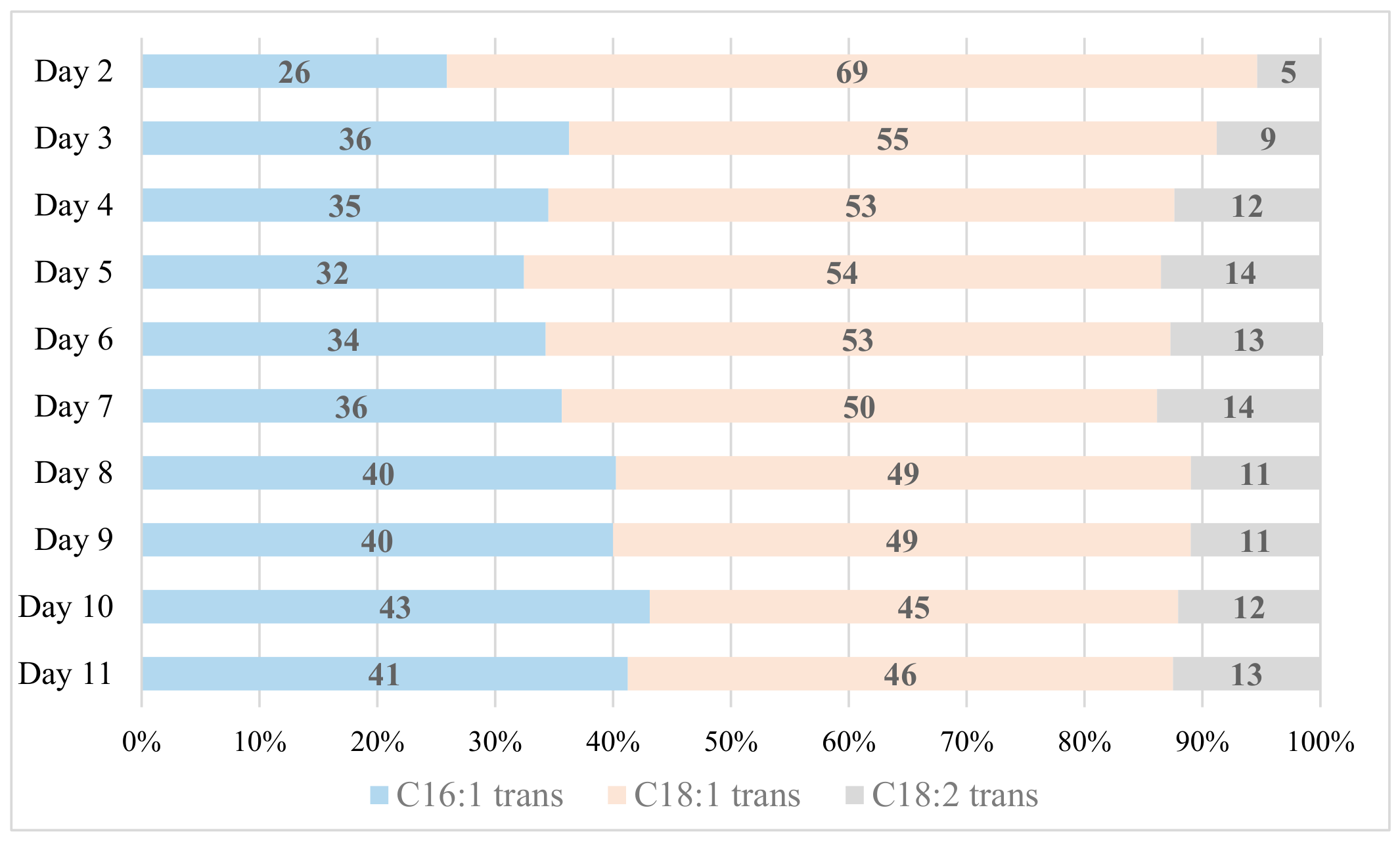
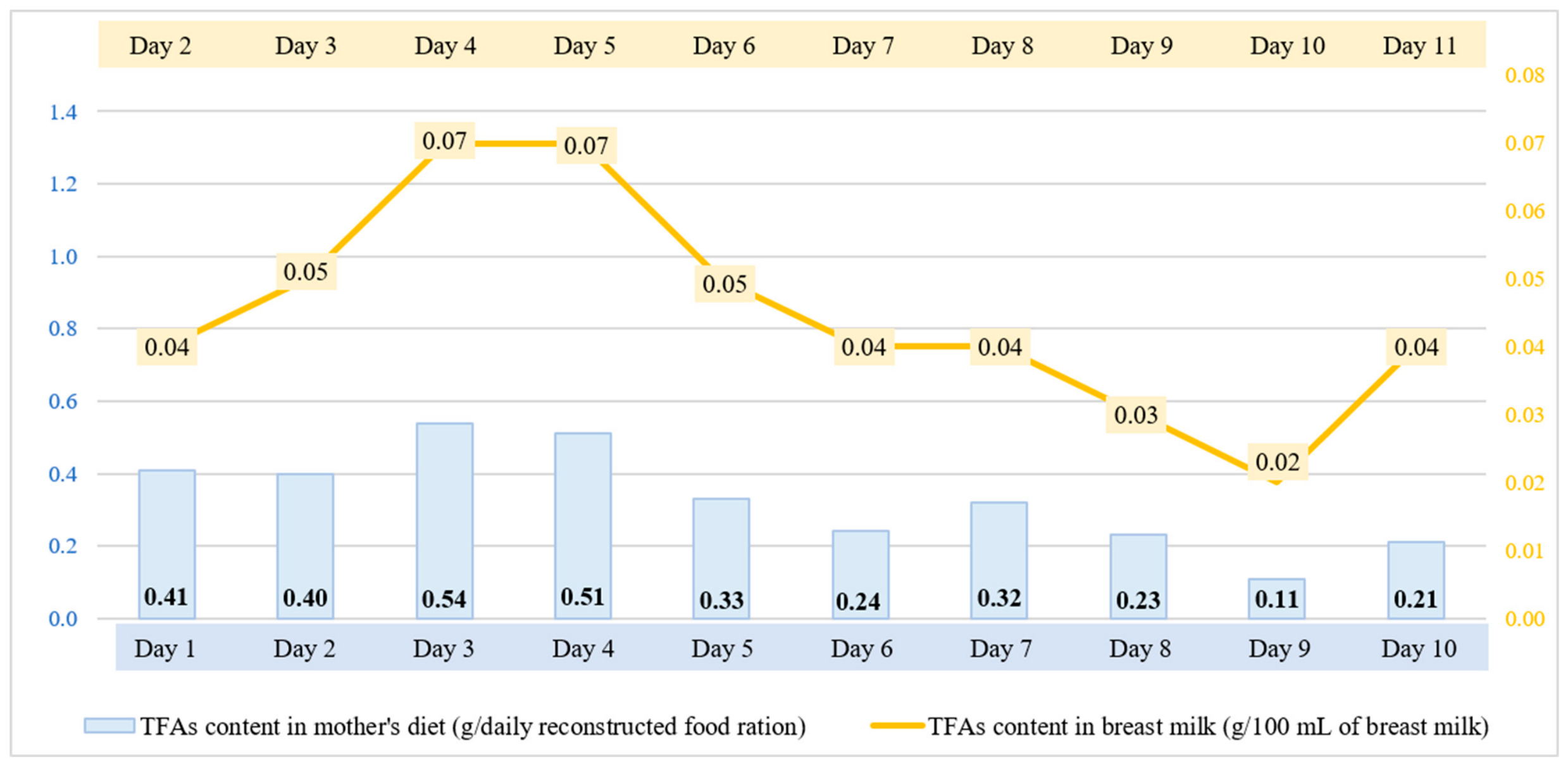


| Parameter | Day 1 | Day 2 | Day 3 | Day 4 | Day 5 | Day 6 | Day 7 | Day 8 | Day 9 | Day 10 | Days 1–10 Median (Min–Max) |
|---|---|---|---|---|---|---|---|---|---|---|---|
| Reconstructed daily food ration weight (g) | 2262.0 | 2355.0 | 1834.2 | 1734.0 | 1682.2 | 800.0 | 922.0 | 1098.0 | 638.0 | 1646.5 | 1664.4 (638.0–2355.0) |
| Fat content in the reconstructed daily food ration (g/reconstructed daily food ration) | 79.2 | 30.6 | 34.8 | 52.0 | 28.6 | 36.8 | 47.9 | 24.2 | 5.1 | 42.8 | 35.8 (5.1–79.2) |
| Protein content in the reconstructed daily food ration (g/reconstructed daily food ration) | 73.7 | 43.1 | 40.0 | 40.7 | 28.4 | 46.4 | 31.7 | 23.2 | 12.2 | 45.8 | 40.4 (12.2–73.7) |
| Carbohydrates content in the reconstructed daily food ration (g/reconstructed daily food ration) | 244.3 | 103.4 | 133.5 | 178.9 | 68.8 | 115.3 | 129.4 | 92.0 | 26.2 | 123.3 | 119.3 (26.2–244.3) |
| Fibre content in the reconstructed daily food ration (g/reconstructed daily food ration) | 20.4 | 9.4 | 11.0 | 24.3 | 2.5 | 9.6 | 11.1 | 4.4 | 1.0 | 8.2 | 9.5 (1.0–24.3) |
| Energy of reconstructed daily food ration (kcal/reconstructed daily food ration) | 1944 | 843 | 986 | 1298 | 641 | 959 | 1054 | 669 | 198 | 1045 | 972 (198–1944) |
| Fatty Acids | Day 1 | Day 2 | Day 3 | Day 4 | Day 5 | Day 6 | Day 7 | Day 8 | Day 9 | Day 10 | Days 1–10 Median (Min–Max) |
|---|---|---|---|---|---|---|---|---|---|---|---|
| Total Saturated Fatty Acids (SFAs) [% wt/wt] | |||||||||||
| C14:0 (Myristic Acid) | 3.02 | 8.36 | 10.01 | 4.38 | 7.53 | 3.87 | 5.19 | 9.06 | 10.60 | 5.89 | 6.71 (3.02–10.60) |
| C16:0 (Palmitic Acid) | 23.54 | 29.77 | 31.93 | 25.81 | 27.20 | 23.42 | 29.93 | 24.72 | 32.36 | 23.91 | 26.51 (23.42–32.36) |
| C18:0 (Stearic Acid) | 13.63 | 11.34 | 10.25 | 8.82 | 9.04 | 12.37 | 9.88 | 11.31 | 13.03 | 10.61 | 10.96 (8.82–13.63) |
| Total SFAs | 42.98 | 56.25 | 62.16 | 42.67 | 50.76 | 42.98 | 53.04 | 60.45 | 65.47 | 50.31 | 51.90 (42.67–65.47) |
| cis-Monounsaturated Fatty Acids (MUFAs) [% wt/wt] | |||||||||||
| C16:1 cis (cis-Palmitoleic Acid) | 1.49 | 1.79 | 1.40 | 1.41 | 3.58 | 1.69 | 0.93 | 0.95 | 1.90 | 1.06 | 1.45 (0.93–3.58) |
| C18:1 cis (cis-Oleic Acid) | 41.80 | 31.64 | 27.88 | 39.60 | 30.25 | 39.18 | 35.03 | 28.32 | 25.70 | 36.33 | 33.34 (25.70–41.80) |
| Total MUFAs | 43.89 | 34.58 | 30.32 | 41.65 | 34.98 | 41.96 | 36.59 | 30.14 | 29.15 | 38.14 | 35.79 (29.15–43.89) |
| cis-Polyunsaturated Fatty Acids (PUFAs) [% wt/wt] | |||||||||||
| C18:3 n-3 (α-Linolenic Acid, ALA) | 1.15 | 0.82 | 0.51 | 0.88 | 0.49 | 1.92 | 0.71 | 1.01 | 0.24 | 1.58 | 0.85 (0.24–1.92) |
| C20:5 n-3 (Eicosapentaenoic Acid, EPA) | <LOQ ** | <LOQ ** | <LOQ ** | <LOQ ** | <LOQ ** | <LOQ ** | <LOQ ** | <LOQ ** | <LOQ ** | <LOQ ** | 0.01 (<LOQ **–0.01) |
| C22:6 n-3 (Docosahexaenoic Acid, DHA) | 0.05 | <LOQ ** | <LOQ ** | 0.06 | <LOQ ** | <LOQ ** | <LOQ ** | 0.01 | 0.03 | 0.01 | 0.01 (<LOQ **–0.06) |
| Total LC-PUFAs n-3 | 1.22 | 0.83 | 0.51 | 1.01 | 0.50 | 1.99 | 0.87 | 1.03 | 0.29 | 1.62 | 0.94 (0.29–1.99) |
| C18:2 n-6 (Linoleic Acid, LA) | 11.02 | 6.80 | 5.36 | 13.13 | 12.18 | 11.95 | 8.75 | 7.30 | 2.56 | 9.19 | 8.97 (2.56–13.13) |
| C20:4 n-6 (Arachidonic Acid, ARA) | 0.26 | 0.10 | 0.02 | 0.40 | 0.26 | 0.18 | 0.05 | 0.07 | 0.23 | 0.17 | 0.18 (0.02–0.40) |
| Total LC-PUFAs n-6 | 11.32 | 6.97 | 5.45 | 13.59 | 12.56 | 12.19 | 8.83 | 7.41 | 2.92 | 9.40 | 9.12 (2.92–13.59) |
| Total PUFAs | 12.58 | 7.82 | 5.98 | 14.65 | 13.10 | 14.34 | 9.72 | 8.45 | 3.25 | 11.06 | 10.39 (3.25–14.65) |
| Ratio LC-PUFAs n-6/LC-PUFAs n-3 | 9.3 | 8.4 | 10.7 | 13.5 | 25.1 | 6.1 | 10.1 | 7.2 | 10.1 | 5.8 | 9.7 (5.8–25.1) |
| Trans Fatty Acids (TFAs) [% wt/wt] | |||||||||||
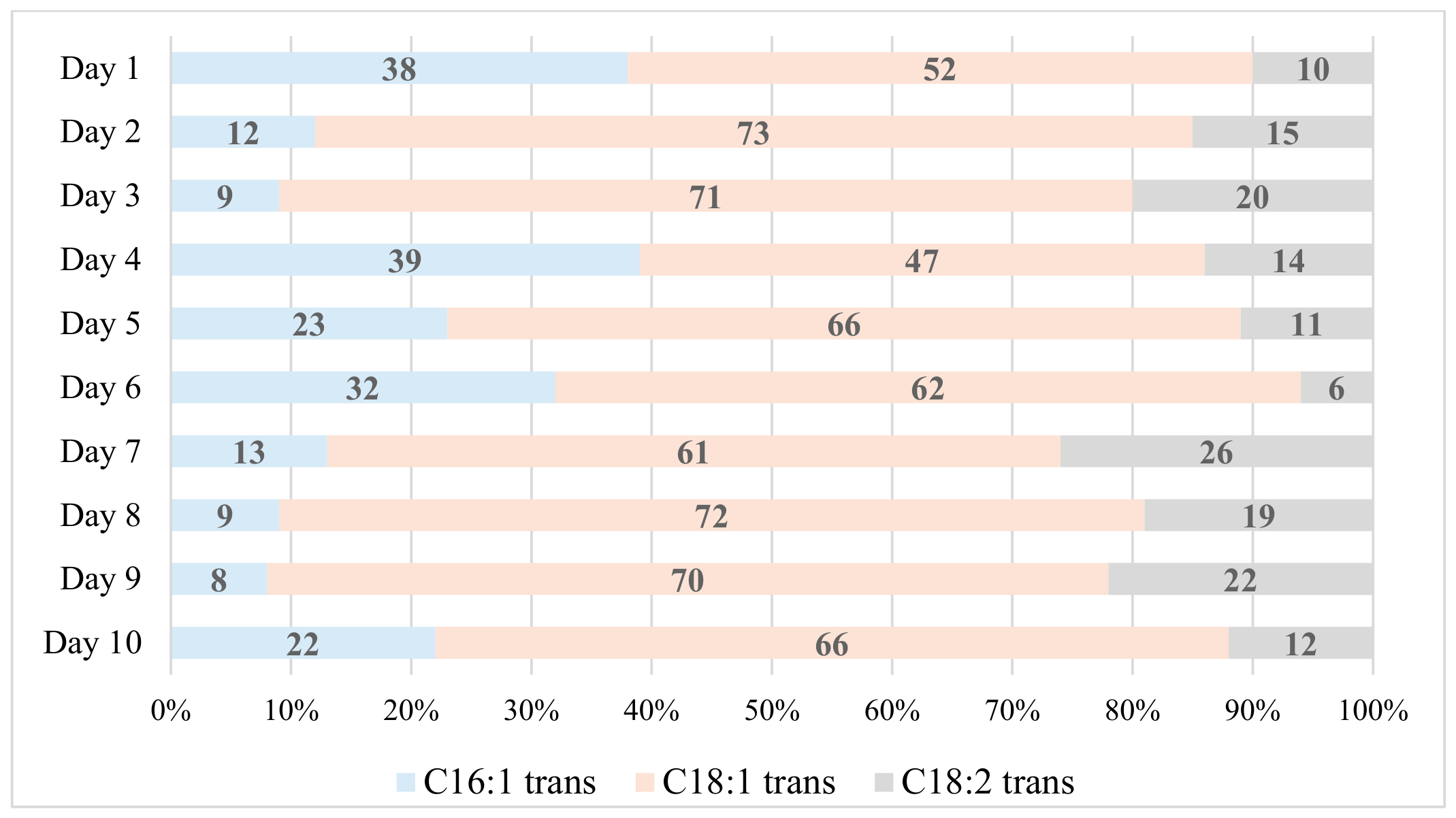
| C16:1 trans (trans-Palmitoleic Acid) | 0.20 | 0.16 | 0.14 | 0.39 | 0.26 | 0.21 | 0.09 | 0.09 | 0.18 | 0.11 | 0.17 (0.09–0.39) |
| C18:1 trans (trans-Oleic Acid) | 0.27 | 0.96 | 1.09 | 0.46 | 0.76 | 0.40 | 0.40 | 0.69 | 1.47 | 0.33 | 0.58 (0.27–1.47) |
| C18:2 trans (Linolelaidic Acid) | 0.05 | 0.20 | 0.31 | 0.14 | 0.13 | 0.04 | 0.17 | 0.18 | 0.46 | 0.06 | 0.16 (0.04–0.46) |
| Total TFAs | 0.52 | 1.32 | 1.54 | 0.99 | 1.15 | 0.65 | 0.66 | 0.96 | 2.11 | 0.50 | 0.98 (0.50–2.11) |
| Parameter | Day 2 | Day 3 | Day 4 | Day 5 | Day 6 | Day 7 | Day 8 | Day 9 | Day 10 | Day 11 | Days 2–11 Median (Min–Max) |
|---|---|---|---|---|---|---|---|---|---|---|---|
| Fat content in breast milk (g/100 mL of breast milk) | 4.0 | 5.6 | 6.4 | 6.0 | 4.5 | 4.4 | 5.4 | 4.4 | 3.1 | 5.3 | 4.9 (3.1–6.4) |
| Total protein content in breast milk (g/100 mL of breast milk) | 4.1 | 5.2 | 5.1 | 4.5 | 3.7 | 5.4 | 5.5 | 5.0 | 2.0 | 4.6 | 4.8 (2.0–5.5) |
| True protein content in breast milk (g/100 mL of breast milk) | 3.3 | 4.1 | 4.1 | 3.6 | 2.9 | 4.3 | 4.4 | 4.0 | 1.6 | 3.7 | 3.9 (1.6–4.4) |
| Carbohydrate (lactose) content in breast milk (g/100 mL of breast milk) | 2.3 | 2.4 | 1.6 | 3.4 | 3.4 | 4.7 | 5.1 | 4.6 | 4.1 | 5.6 | 3.8 (1.6–5.6) |
| Dry matter content in breast milk (g/100 mL of breast milk) | 10.7 | 13.3 | 13.3 | 14.1 | 11.8 | 14.7 | 16.2 | 14.3 | 9.4 | 15.7 | 13.7 (9.4–16.2) |
| Energy value of breast milk (kcal/100 mL of breast milk) | 64 | 84 | 88 | 89 | 71 | 83 | 95 | 81 | 54 | 92 | 84 (54–95) |
| Fatty Acids | Day 2 | Day 3 | Day 4 | Day 5 | Day 6 | Day 7 | Day 8 | Day 9 | Day 10 | Day 11 | Days 2–11 Median (Min–Max) |
|---|---|---|---|---|---|---|---|---|---|---|---|
| Total Saturated Fatty Acids (SFAs) [% wt/wt] | |||||||||||
| C14:0 (Myristic Acid) | 7.10 | 7.18 | 7.56 | 7.64 | 6.93 | 7.46 | 7.12 | 6.32 | 6.53 | 6.62 | 7.11 (6.32–7.64) |
| C16:0 (Palmitic Acid) | 23.85 | 22.84 | 22.78 | 23.23 | 22.86 | 23.66 | 22.97 | 22.76 | 22.45 | 23.74 | 22.92 (22.45–23.85) |
| C18:0 (Stearic Acid) | 7.68 | 8.13 | 8.79 | 8.72 | 8.45 | 8.62 | 7.99 | 7.55 | 7.03 | 7.65 | 8.06 (7.03–8.79) |
| Total SFAs | 43.69 | 43.43 | 44.68 | 45.24 | 43.50 | 44.89 | 43.02 | 41.28 | 40.50 | 43.20 | 43.47 (40.50–45.24) |
| cis-Monounsaturated Fatty Acids (MUFAs) [% wt/wt] | |||||||||||
| C16:1 cis (cis-Palmitoleic Acid) | 1.71 | 1.78 | 1.91 | 2.03 | 2.04 | 2.08 | 2.04 | 1.89 | 1.74 | 2.26 | 1.97 (1.71–2.26) |
| C18:1 cis (cis-Oleic Acid) | 35.66 | 35.62 | 36.80 | 37.58 | 37.53 | 37.89 | 37.27 | 36.31 | 33.49 | 39.40 | 37.04 (33.49–39.40) |
| Total MUFAs | 38.33 | 38.47 | 39.92 | 40.85 | 40.76 | 41.05 | 40.51 | 39.23 | 36.23 | 42.75 | 40.22 (36.23–42.75) |
| cis-Polyunsaturated Fatty Acids (PUFAs) [% wt/wt] | |||||||||||
| C18:3 n-3 (α-Linolenic Acid, ALA) | 0.53 | 0.60 | 0.68 | 0.67 | 0.66 | 0.60 | 0.56 | 0.51 | 0.40 | 0.59 | 0.60 (0.40–0.68) |
| C20:5 n-3 (Eicosapentaenoic Acid, EPA) | 0.03 | 0.04 | 0.05 | 0.05 | 0.06 | 0.06 | 0.05 | 0.04 | 0.04 | 0.04 | 0.05 (0.03–0.06) |
| C22:6 n-3 (Docosahexaenoic Acid, DHA) | 0.83 | 0.64 | 0.61 | 0.68 | 0.62 | 0.79 | 0.90 | 0.85 | 1.12 | 0.79 | 0.79 (0.61–1.12) |
| Total LC-PUFAs n-3 | 1.44 | 1.35 | 1.44 | 1.81 | 1.87 | 2.20 | 2.37 | 2.25 | 2.53 | 1.91 | 1.89 (1.35–2.53) |
| C18:2 n-6 (Linoleic Acid, LA) | 7.77 | 7.76 | 8.22 | 8.27 | 8.30 | 8.12 | 7.81 | 7.46 | 6.71 | 8.21 | 7.96 (6.71–8.30) |
| C20:4 n-6 (Arachidonic Acid, ARA) | 0.29 | 0.37 | 0.41 | 0.41 | 0.42 | 0.41 | 0.39 | 0.36 | 0.31 | 0.37 | 0.38 (0.29–0.42) |
| Total LC-PUFAs n-6 | 8.22 | 8.30 | 8.84 | 8.89 | 8.93 | 8.70 | 8.35 | 7.95 | 7.12 | 8.72 | 8.53 (7.12–8.93) |
| Total PUFAs | 9.76 | 9.81 | 10.47 | 10.89 | 10.99 | 11.06 | 10.88 | 10.33 | 9.74 | 10.79 | 10.63 (9.74–11.06) |
| Ratio LC-PUFAs n-6/LC-PUFAs n-3 | 5.7 | 6.1 | 6.1 | 4.9 | 4.8 | 4.0 | 3.5 | 3.5 | 2.8 | 4.6 | 4.7 (2.8–6.1) |
| Trans Fatty Acids (TFAs) [% wt/wt] | |||||||||||
| C16:1 trans (trans-Palmitoleic Acid) | 0.29 | 0.33 | 0.39 | 0.36 | 0.36 | 0.36 | 0.33 | 0.30 | 0.25 | 0.33 | 0.33 (0.25–0.39) |
| C18:1 trans (trans-Oleic Acid) | 0.77 | 0.50 | 0.60 | 0.60 | 0.55 | 0.51 | 0.40 | 0.36 | 0.26 | 0.37 | 0.51 (0.26–0.77) |
| C18:2 trans (Linolelaidic Acid) | 0.06 | 0.08 | 0.14 | 0.15 | 0.14 | 0.14 | 0.09 | 0.08 | 0.07 | 0.10 | 0.10 (0.06–0.15) |
| Total TFAs | 1.12 | 0.91 | 1.13 | 1.11 | 1.05 | 1.01 | 0.82 | 0.74 | 0.58 | 0.80 | 0.96 (0.58–1.13) |
| Trans Fatty Acids Content in Mother’s Diet | Trans Fatty Acids Content in Breast Milk | ||||
|---|---|---|---|---|---|
| C16:1 trans (% wt/wt) | C18:1 trans (% wt/wt) | C18:2 trans (% wt/wt) | TFAs (% wt/wt) | TFAs (g/100 mL) | |
| C16:1 trans (% wt/wt) | 0.2699 p = 0.451 | 0.4725 p = 0.168 | 0.5526 p = 0.098 | 0.5335 p = 0.112 | 0.4972 p = 0.144 |
| 0.3178 p = 0.371 | 0.5671 p = 0.087 | 0.4044 p = 0.246 | 0.4924 p = 0.148 | 0.4072 p = 0.243 | |
| C16:1 trans (g/reconstructed daily food ration) | 0.2505 p = 0.485 | 0.7766 p = 0.008 | 0.3125 p = 0.379 | 0.7266 p = 0.017 | 0.5408 p = 0.106 |
| 0.5281 p = 0.117 | 0.9179 p = 0.001 | 0.4801 p = 0.160 | 0.8545 p = 0.002 | 0.6608 p = 0.038 | |
| C18:1 trans (% wt/wt) | −0.2430 p = 0.499 | −0.3975 p = 0.255 | −0.1090 p = 0.764 | −0.3878 p = 0.268 | −0.1215 p = 0.738 |
| 0.1122 p = 0.758 | −0.2622 p = 0.464 | 0.0370 p = 0.919 | −0.1398 p = 0.700 | 0.1263 p = 0.728 | |
| C18:1 trans (g/reconstructed daily food ration) | 0.6801 p = 0.030 | 0.6032 p = 0.065 | 0.3701 p = 0.292 | 0.6938 p = 0.026 | 0.8420 p = 0.002 |
| 0.5778 p = 0.0802 | 0.6991 p = 0.025 | 0.3447 p = 0.329 | 0.7576 p = 0.011 | 0.8748 p = 0.001 | |
| C18:2 trans (% wt/wt) | −0.3409 p = 0.335 | −0.4687 p = 0.172 | −0.1917 p = 0.596 | −0.4806 p = 0.160 | −0.1576 p = 0.664 |
| −0.1553 p = 0.668 | −0.3951 p = 0.258 | −0.2216 p = 0.538 | −0.2848 p = 0.425 | −0.0189 p = 0.959 | |
| C18:2 trans (g/reconstructed daily food ration) | 0.4764 p = 0.164 | 0.2309 p = 0.521 | 0.2264 p = 0.529 | 0.3282 p = 0.355 | 0.6568 p = 0.039 |
| 0.3293 p = 0.353 | 0.3465 p = 0.327 | 0.1846 p = 0.610 | 0.4182 p = 0.229 | 0.5790 p = 0.079 | |
| TFAs (% wt/wt) | −0.2237 p = 0.534 | −0.3379 p = 0.340 | −0.0332 p = 0.928 | −0.3226 p = 0.363 | −0.0440 p = 0.904 |
| 0.1180 p = 0.745 | −0.1094 p = 0.763 | 0.0369 p = 0.919 | −0.0061 p = 0.987 | 0.2203 p = 0.541 | |
| TFAs (g/100 g reconstructed daily food ration) | 0.4807 p = 0.160 | 0.2923 p = 0.412 | 0.5073 p = 0.135 | 0.4288 p = 0.216 | 0.4685 p = 0.172 |
| 0.5770 p = 0.081 | 0.4032 p = 0.248 | 0.5307 p = 0.114 | 0.4623 p = 0.179 | 0.4175 p = 0.230 | |
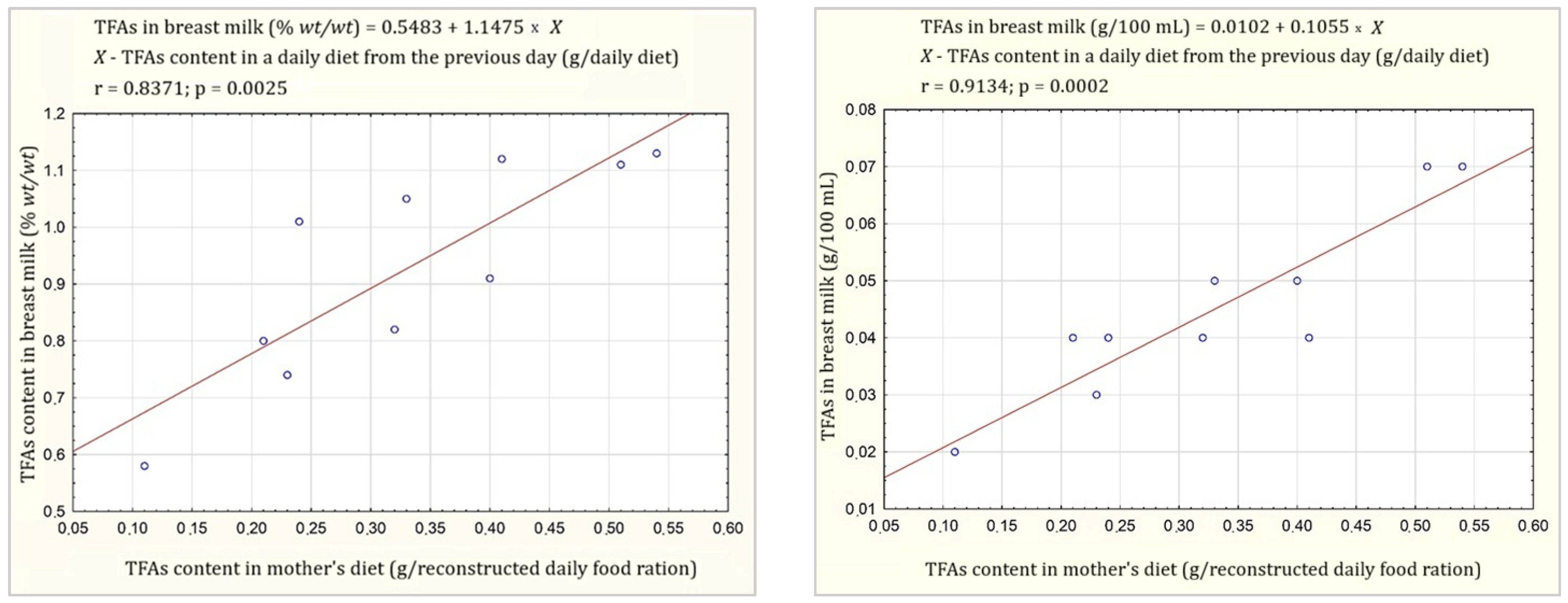
| TFAs (g/reconstructed daily food ration) | 0.6456 p = 0.044 | 0.7809 p = 0.008 | 0.4262 p = 0.219 | 0.8371 p = 0.003 | 0.9134 p = 0.000 |
| 0.5654 p = 0.089 | 0.8875 p = 0.001 | 0.3631 p = 0.302 | 0.9152 p = 0.000 | 0.8560 p = 0.002 | |
Disclaimer/Publisher’s Note: The statements, opinions and data contained in all publications are solely those of the individual author(s) and contributor(s) and not of MDPI and/or the editor(s). MDPI and/or the editor(s) disclaim responsibility for any injury to people or property resulting from any ideas, methods, instructions or products referred to in the content. |
© 2026 by the authors. Licensee MDPI, Basel, Switzerland. This article is an open access article distributed under the terms and conditions of the Creative Commons Attribution (CC BY) license.
Share and Cite
Jasińska-Melon, E.; Mojska, H.; Bzikowska-Jura, A. Trans Fatty Acids Content in Breast Milk as a Marker of Their Short-Term Intake Within the Breastfeeding Mother’s Diet: A Single-Participant Pilot Study. Nutrients 2026, 18, 2177. https://doi.org/10.3390/nu18132177
Jasińska-Melon E, Mojska H, Bzikowska-Jura A. Trans Fatty Acids Content in Breast Milk as a Marker of Their Short-Term Intake Within the Breastfeeding Mother’s Diet: A Single-Participant Pilot Study. Nutrients. 2026; 18(13):2177. https://doi.org/10.3390/nu18132177
Chicago/Turabian StyleJasińska-Melon, Edyta, Hanna Mojska, and Agnieszka Bzikowska-Jura. 2026. "Trans Fatty Acids Content in Breast Milk as a Marker of Their Short-Term Intake Within the Breastfeeding Mother’s Diet: A Single-Participant Pilot Study" Nutrients 18, no. 13: 2177. https://doi.org/10.3390/nu18132177
APA StyleJasińska-Melon, E., Mojska, H., & Bzikowska-Jura, A. (2026). Trans Fatty Acids Content in Breast Milk as a Marker of Their Short-Term Intake Within the Breastfeeding Mother’s Diet: A Single-Participant Pilot Study. Nutrients, 18(13), 2177. https://doi.org/10.3390/nu18132177