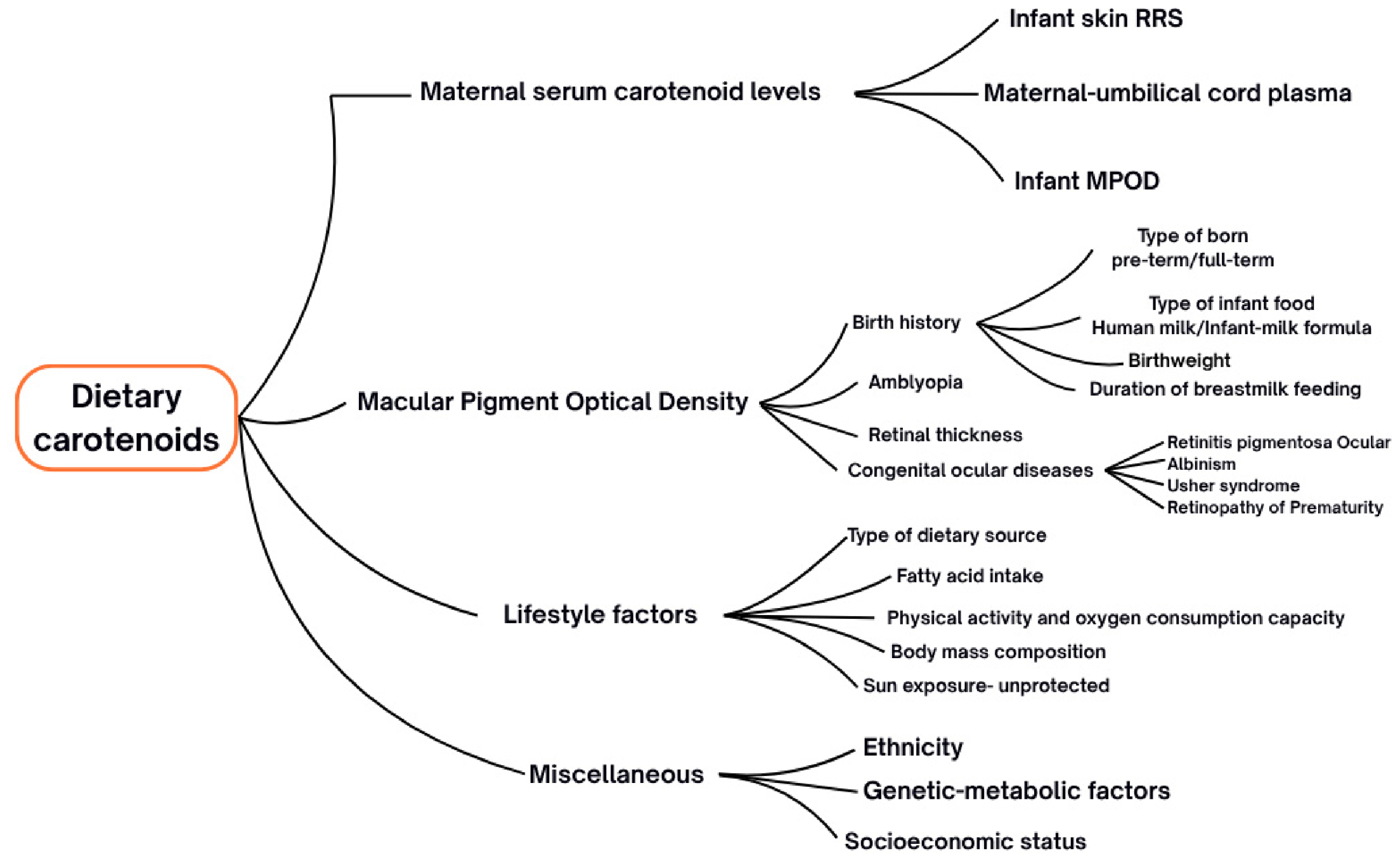
Associations Between Carotenoid Status, Visual Outcomes and Cognitive Metrics in Children: A Scoping Review

Abstract
1. Introduction
2. Materials and Methods
- Child
- 2.
- Carotenoids source
- 3.
- Vision outcome
- 4.
- Cognitive outcome
2.1. Eligibility Criteria
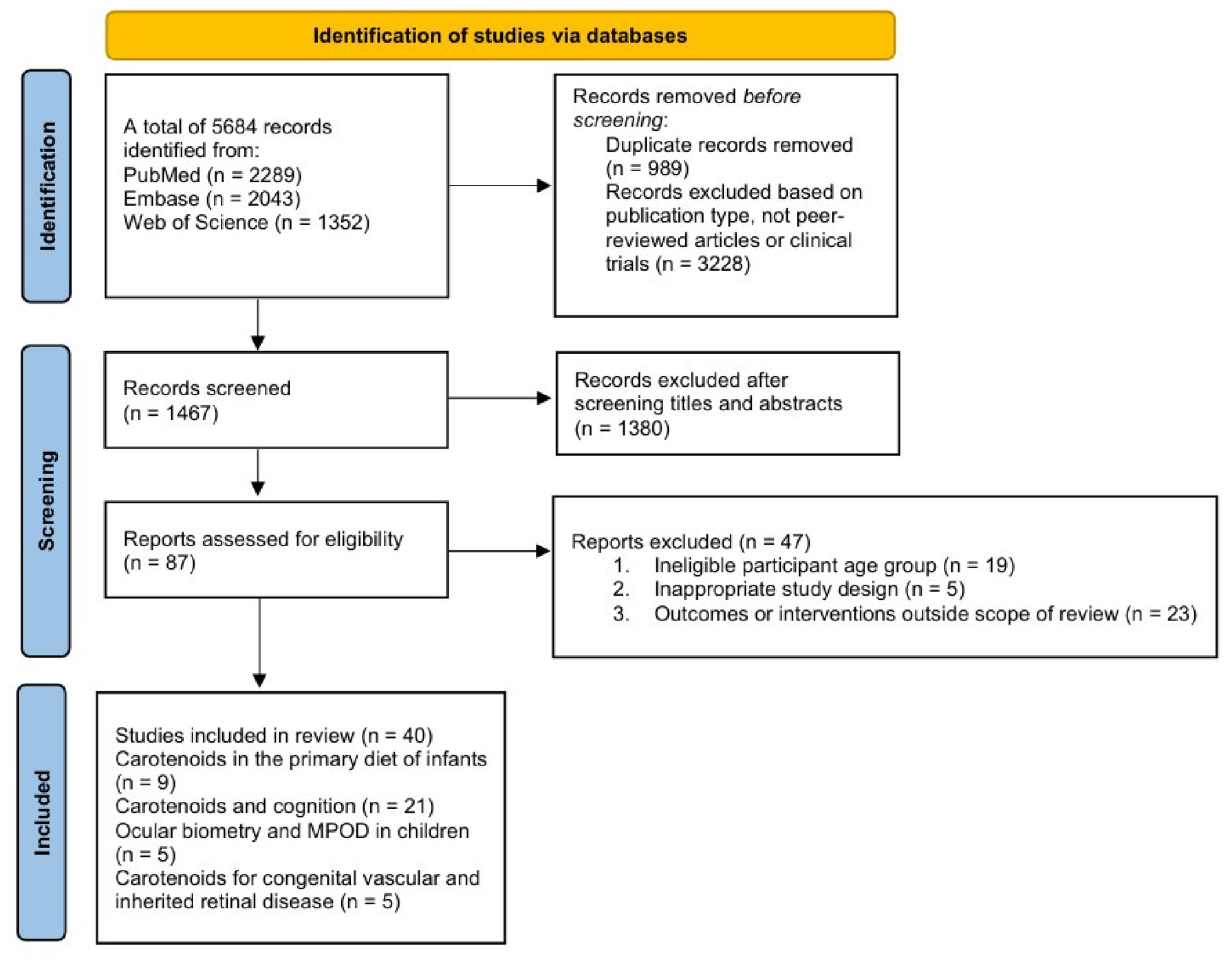
- Investigated the association between carotenoids and visual and cognitive outcomes in children;
- Assessed relevant biomarkers or retinal outcomes;
- Were original research articles (interventional, observational, or experimental).
2.2. Study Selection
3. Carotenoids in the Primary Diet of Infants
3.1. Carotenoids and Preterm Infants
3.2. Human Milk Versus Carotenoid-Fortified Milk Formula
3.3. Role of Early Exposure to Carotenoids in Cognition and Visual Function in Later Life
4. Carotenoids and Cognition

| Study Author, Year | Age | Cognitive Function Test Battery | Assessed Carotenoid Components | Study Outcomes | |||
|---|---|---|---|---|---|---|---|
| MPOD | Serum Carotenoids | Skin Carotenoids | Dietary Intake | ||||
| Cheatham and Sheppard, 2015 [64] ★★ (USA) | Infants, 6 months (n = 55) | Recognition memory: ERP and eye movements | - | - | - | Human milk Lutein levels | Human milk lutein levels were significantly associated with recognition memory (p < 0.05). |
| Zielinska, 2019 [65] ★★ (Poland) | Infants, 6 months (n = 39) | Psychomotor development: Children’s Development Scale (DSR) | - | - | - | Human milk carotenoid contents were assessed | Human milk β-carotene content related to psychomotor development among infants (β = 0.348 *). |
| Rosok, 2024 [75] ★ (USA) | 12–18 months (n = 45) | BSID-IV: Cognitive, language, and motor skills MMN with an auditory oddball task, VEPs with a pattern reversal task | - | - | Veggie Meter | - | Skin carotenoids were only associated with cognitive skills (β = 0.24 *). MMN and VEPs outcomes were not associated with skin carotenoid scores. |
| Lai, 2020 [66] ★★ (Singapore) | Age: 2 and 4.5 years (n = 419) | BSID-III test tasks for 2 years, KBIT-II test tasks for 4.5 years at follow-up visit | - | Maternal plasma α, β-carotene, and β-cryptoxanthin levels at delivery | - | - | Postnatal maternal plasma β-cryptoxanthin levels are associated with offspring cognitive and motor skills at 2 years of age (β = 0.18 **, β = 0.16 **), but unrelated to cognitive performance on KBIT-II tasks at age 4.5 years. |
| Kadam, 2024 [76] ★★ (USA) | 2 years of age (n = 38) | Bayley-III Test, Toddler Development™ Screening Test-III, Placental gene expression measurement, Children’s salivary cortisol measurement | - | Maternal plasma lutein: 60.5 ± 8.5 ng/mL Cord plasma lutein: 44.4 ± 5.1 ng/mL | - | Three-day dietary records, Maternal L/Z dietary intake: 1.8 ± 1.8 mg | Maternal lutein and zeaxanthin intake during pregnancy was associated with improved cognitive β = 0.003 **) and language scoring (β = 0.002 *) in children at the age of 2. |
| Mulder, 2014 [69] ★ (Canada) | Age: 5–6 years (n = 160) | KABC-II-IQ tasks, TONI test PPVT-IV: Peabody Picture Vocabulary Test-4, simultaneous processing, mental processing, learning ability | - | Plasma lutein levels: 0.26 ± 0.11 (0.11–0.53) | - | Dietary FFQ, 24 h dietary records mean dietary intake: 2130 (±2125) mcg/dL | Plasma lutein was associated with dietary intake of lutein (r = 0.479 ***) but was not related to assessed cognitive tasks. Participants’ history of human milk consumption for more than 3 months showed a significant difference with PPVT tasks (p = 0·037) and the simultaneous processing scale (p = 0·034). |
| Mahmassani, 2022 [67] ★★ (USA) | Age: 3–11 years (n = 1378) | In 3–6 years: PPVT-III, WRAVMA: Visual Motor Abilities; For 6–11 years, (KBIT), WRAVMA drawing subset: memory and learning, BRIEF, Strengths and Difficulties Questionnaire. | - | - | - | Child’s dietary intake of lutein and zeaxanthin using FFQ: 1.0 (0.4) mg | Higher lutein and zeaxanthin intake is associated with receptive vocabulary on PPVT-III tasks and executive functions. No association was observed between lutein and zeaxanthin intake and any other cognitive or behavioral testing. |
| Parekh R, 2024 [74] ★★★ (India) | 5–12 years (n = 60) | Serum BDNF levels, Cognitive Function Assessment: CFF, VAS, CSHQ-A, Creyo Health Cognitive tests—attention, focus, episodic memory, learning, visuospatial working memory, and processing speed | HFP (Macular Metrics, LLC) | Serum lutein and zeaxanthin | - | - | Mean MPOD improved by 25% on supplementation for 6 months. Improvement in serum lutein and zeaxanthin and BDNF levels, Visual Processing Speed (CFF testing), Visual function, eye strain, and MPOD upon the 6 months LZ (10 + 2 mg) supplementation compared to placebo groups (p < 0.05). |
| Saint, 2018 [71] ★ (USA) | 7–13 years (n = 51) | Woodcock–Johnson III test | HFP (Mean MPOD: 0.48 (0.17) [0.19–0.82]) | - | - | - | MPOD is weakly related to brief intellectual ability (r = 0.268 *), executive processes (r= 0.288 *), spatial relations(r = 0.299 *), and visual/auditory learning (r = 0.236, p ≤ 0.1). |
| Barnett, 2018 [77] ★ (USA) | 8–9 years (n = 56) | IQ assessment: Woodcock–Johnson test Academic Performance assessment: KTEA-II test | cHFP (Mean MPOD: 0.64 ± 0.03) | - | - | Child’s dietary intake (3-day dietary record) Mean LZ intake: 806.6 ± 63.0 | MPOD was positively associated with academic achievement (r = 0.4 **). Children’s dietary lutein and zeaxanthin intake were associated with written language performance (r = 0.53 **). Academic achievement was significantly associated with VO2max (r = 0.26 **), fat-free massVO2max (r = 0.26 *), Intelligence Quotient (r = 0.62 **), and BMI (r = −0.37 **). |
| Walk, 2017 [70] ★ (USA) | 8–10 years (n = 49) | KTEA-II—Academic achievement, Modified flanker task with EEG recording | cHFP (Mean MPOD: 0.61 ± 0.03) | - | - | - | The cognitive processing P3 component in ERP during the modified flanker test for incongruent task was inversely associated with higher MPOD (r= −0.30 *). There were no significant differences in KTEA-II scores between the high and low MPOD quartile groups. |
| Hassevoort, 2017 [72] ★ (USA) | 8–11 (8.8 ± 0.11) (n = 40) | IQ test: Woodcock–Johnson (WJ) brief intelligence assessment standard score, computerized spatial reconstruction task for hippocampal relational memory | cHFP Mean MPOD: 0.66 ± 0.03 | - | - | - | MPOD was negatively associated with relational memory error metrics (r= −0.388 **). Bivariate correlations show adiposity was inversely related to IQ (r = −0.460 **) and positively related to relational memory measures misplacement r =0.272 *, edge resizing r =0.281 * and swaps r = 0.329 *. |
| Rosok, 2025 [78] ★ (USA) | 7–13 years (n = 47) | Brain structural and activity assessed using MRI and fMRI at rest and during relational memory tasks | cHFP | - | Veggie Meter | Seven-day diet records: lutein and zeaxanthin intake = 0.72 ± 0.54 mg/d | MPOD was inversely related to the volume of optic chiasms (β = −0.34 **), while skin carotenoid levels were positively associated with inferior temporal white matter volume (β = 0.23 **). MPOD and skin carotenoids were not associated with resting-state global functional connectivity network measures. Dietary lutein and zeaxanthin intake were positively associated with skin carotenoids but not with MPOD. |
| Rosok, 2022 [73] ★ (USA) | 7–12 years (n = 106) | Woodcock–Johnson IV | - | - | Veggie Meter | Block Food Frequency Questionnaire | Skin carotenoid was positively related to quantitates reasoning and broad math skills (applied problems, calculation, math facts, fluency) (r = 0.24 *; r = 0.225 *). Skin carotenoids were positively associated with dietary carotenoids and inversely correlated with body fat%. |
| Yen, 2022 [68] ★ (USA) | 4–5 years (n = 51) | WJ—ECADT-IV for Early Cognitive Academic Development Test | - | - | Veggie Meter | Dietary Intake (7-day record- HEI Index) | Skin carotenoid levels were associated with general intellectual ability, expressive language, and academic skills. |
| Liu, 2021 [61] ★ (USA) | 7–12 years (n = 81) | - | cHFP Mean MPOD: 0.56 ± 0.2 | - | Veggie Meter | Seven-day dietary records Mean total carotenoid intake 6.5 ± 0.4 mg, Mean lutein and zeaxanthin intake- 0.8 ± 0.07 mg | Total carotenoid intake was positively associated with skin carotenoid scores (r = 0.25 *) and negatively associated with weight status (BMI percentile, %FAT, VAT) (r = −0.4 **). Children with a history of breastfeeding for <5 months showed lower skin carotenoid scores than those breastfed for ≥5 months. |
| Aguila, 2014 [79] ★ (USA) | 5–7 years (n = 45) | - | - | Carotenoid serum level: 0.59 ± 0.05 | Bio photonic Scanner | 24 h recalls FFQ Mean total carotenoid intake:1.9 ± 0.21 mg | Multivariate regression model showed total carotenoids measured by resonance Raman spectroscopy were positively associated with total carotenoid intake (R2 = 0.25 **). Serum carotenoid levels were correlated with skin carotenoid measured by resonance Raman spectroscopy (R2 = 0.62 ***). |
| Liu, 2021 [60] ★ (USA) | 7–9 years (n = 134) | - | cHFP Mean MPOD: 0.57 ± 0.23 | - | - | Three-day dietary records Mean LZ intake: 1.17 ± 2.15 (0.07 to 19.2 mg) | MPOD was associated with genetic confounders identified from saliva samples, BCO1-T allele, and CD36-T, C allele. MPOD was not associated with weight status and dietary intake. |
| Cannavale, 2023 [80] ★ (USA) | 7–12 years (n = 37) | - | cHFP Mean MPOD: 0.56 ± 0.23 | - | - | Seven-day dietary record, mean LZ intake: 146.9–2596.6 (752.7 ± 508.0) | MPOD showed a negative association with serum C-reactive protein levels in children. |
| Cannavale, 2023 [81] ★ (USA) | 7–13 years (n = 181) | - | cHFP, mean MPOD: 0.56 ± 0.22 | - | Veggie Meter | Mean Carotenoids Intake: 5.03 mg/1000 kcal Mean LZ Intake: 0.81 mg/1000 kcal | Skin carotenoid score was associated with total carotenoid intake and BMI%. Lutein and zeaxanthin intake were associated with MPOD (stdβ = 0.27 **). No association observed between skin carotenoid and MPOD. |
| Marta-C, 2024 [82] ★ (Spain) | 7–13 years (n = 27) | - | HFP, Mean MPOD: 0.45 ± 0.14 (0.19–0.91) | - | - | Dietary Intake: KIDMED Questionnaire | MPOD levels were positively associated with daily fruit or fruit juice consumption in children (p = 0.034), but not with total KIDMED dietary questionnaire scores, age, BMI, and LED screen exposure of more than five hours per day. |
5. Ocular Biometry and Macular Pigment Optical Density
Refractive Error, Its Progression and Macular Pigment Distribution
| Author, Year, Country (MPOD Technique) | Age and Sample Size, Refractive Error Range | Mean MPOD | Study Results |
|---|---|---|---|
| Zheng, 2013 [87] China (cHFP; Macular Metrics II Densitometer) | 6–12 years (n = 94) Spherical equivalent range: −5.5 to +4.37 D | 0.56 ± 0.25 | MPOD showed no significant association with age, BMI, IOP, refractive error, MFT, or CFT. MPOD was inversely correlated to axial length. In the myopia refractive group, there was a negative relationship between MPOD and MFT (R = −0.66, p = 0.028) and a positive association between MPOD and CFT (R = 0.67, p = 0.025). |
| Liu, 2022 [88] China (Visucam 224) | 6–14 years (n = 902) Spherical equivalent range: −1.26 ± 1.02 D | 0.28 ± 0.08 | MPOD was not associated with ocular biometric parameters (i.e., axial length, refractive error, corneal curvature) and age. Axial length, corneal curvature, and refractive error effectively increase with age. |
| Wang, 2022 [94], China. (Visucam-200) | 6–10 years (n = 40) | Hyperopic Anisometropic amblyopia: 0.12 ± 0.03 d.u. Fellow eye: 0.13 ± 0.04 d.u | Hyperopic anisometropic amblyopic eyes reported marginally low mean MPOD compared to fellow eyes. |
| Erkan Turan, 2018 [95], China. (MPS II) Mean age: | 9 years (n = 54 Healthy + 41 Strabismus) | Healthy eyes: 0.23 ± 0.25 non-preferred eye of strabismic children: 0.25 ± 0.27 Preferred eye of strabismic children: 0.43 ± 0.34 | Preferred eye of strabismic children tends to have more macular pigment deposition compared to non-fixating eye and healthy children. |
6. Carotenoids for Congenital Vascular and Inherited Retinal Disease
6.1. Carotenoids and Retinopathy of Prematurity
6.2. Role of Carotenoids in Pediatric-Onset Inherited Retinal Degenerative Diseases
7. Conclusions
Supplementary Materials
Author Contributions
Funding
Institutional Review Board Statement
Informed Consent Statement
Data Availability Statement
Acknowledgments
Conflicts of Interest
References
- Saini, R.K.; Prasad, P.; Lokesh, V.; Shang, X.; Shin, J.; Keum, Y.-S.; Lee, J.-H. Carotenoids: Dietary sources, extraction, encapsulation, bioavailability, and health benefits—A review of recent advancements. Antioxidants 2022, 11, 795. [Google Scholar] [CrossRef] [PubMed]
- Masri, A.; Armanazi, M.; Inouye, K.; Geierhart, D.L.; Davey, P.G.; Vasudevan, B. Macular Pigment Optical Density as a Measurable Modifiable Clinical Biomarker. Nutrients 2024, 16, 3273. [Google Scholar] [CrossRef] [PubMed]
- Sauer, L.; Andersen, K.M.; Li, B.; Gensure, R.H.; Hammer, M.; Bernstein, P.S. Fluorescence Lifetime Imaging Ophthalmoscopy (FLIO) of Macular Pigment. Investig. Ophthalmol. Vis. Sci. 2018, 59, 3094–3103. [Google Scholar] [CrossRef] [PubMed]
- Davey, P.G.; Rosen, R.B.; Park, J.J.; Spors, F.; Gierhart, D.L. Evaluation of a Portable Handheld Heterochromatic Flicker Photometer in Measuring Macular Pigment Optical Density. Diagnostics 2025, 15, 431. [Google Scholar] [CrossRef] [PubMed]
- von Lintig, J.; Bandara, S. The Absorption, Storage, and Transport of Ocular Carotenoids and Retinoids. Annu. Rev. Vis. Sci. 2024, 10, 323–346. [Google Scholar] [CrossRef] [PubMed]
- Bone, R.A.; Davey, P.G.; Roman, B.O.; Evans, D.W. Efficacy of Commercially Available Nutritional Supplements: Analysis of Serum Uptake, Macular Pigment Optical Density and Visual Functional Response. Nutrients 2020, 12, 1321. [Google Scholar] [CrossRef] [PubMed]
- Richer, S.; Novil, S.; Gullett, T.; Dervishi, A.; Nassiri, S.; Duong, C.; Davis, R.; Davey, P.G. Night Vision and Carotenoids (NVC): A randomized placebo controlled clinical trial on effects of carotenoid supplementation on night vision in older adults. Nutrients 2021, 13, 3191. [Google Scholar] [CrossRef] [PubMed]
- Dai, X.; Yin, H.; Zhang, J.; Tian, F.; Cai, X.; Mao, Y.; Sun, H.; Wang, H.; Li, X.; Zhu, H.-L.; et al. Carotenoid Profile in Maternal/Cord Plasma and Changes in Breast Milk Along Lactation and Its Association with Dietary Intake: A Longitudinal Study in a Coastal City in Southern China. Nutrients 2022, 14, 1989. [Google Scholar] [CrossRef] [PubMed]
- Zaidi, Y.; Stroh, R.; Moran, N.E. Systematic review of carotenoid concentrations in human milk and infant blood. Nutr. Rev. 2022, 80, 2029–2050. [Google Scholar] [CrossRef] [PubMed]
- Johnson, E.J.; Vishwanathan, R.; Johnson, M.A.; Hausman, D.B.; Davey, A.; Scott, T.M.; Green, R.C.; Miller, L.S.; Gearing, M.; Woodard, J.; et al. Relationship Between Serum and Brain Carotenoids, α-Tocopherol, and Retinol Concentrations and Cognitive Performance in the Oldest Old from the Georgia Centenarian Study. J. Aging Res. 2013, 2013, 951786. [Google Scholar] [CrossRef] [PubMed]
- Vishwanathan, R.; Schalch, W.; Johnson, E.J. Macular pigment carotenoids in the retina and occipital cortex are related in humans. Nutr. Neurosci. 2016, 19, 95–101. [Google Scholar] [CrossRef] [PubMed]
- Vishwanathan, R.; Goodrow-Kotyla, E.F.; Wooten, B.R.; Wilson, T.A.; Nicolosi, R.J. Consumption of 2 and 4 egg yolks/d for 5 wk increases macular pigment concentrations in older adults with low macular pigment taking cholesterol-lowering statins. Am. J. Clin. Nutr. 2009, 90, 1272–1279. [Google Scholar] [CrossRef] [PubMed]
- Wilson, L.M.; Tharmarajah, S.; Jia, Y.; Semba, R.D.; Schaumberg, D.A.; Robinson, K.A. The Effect of Lutein/Zeaxanthin Intake on Human Macular Pigment Optical Density: A Systematic Review and Meta-Analysis. Adv. Nutr. 2021, 12, 2244–2254. [Google Scholar] [CrossRef] [PubMed]
- Duitsman, P.K.; Cook, L.R.; Tanumihardjo, S.A.; Olson, J.A. Vitamin A inadequacy in socioeconomically disadvantaged pregnant Iowan women as assessed by the modified relative dose response (MRDR) test. Nutr. Res. 1995, 15, 1263–1276. [Google Scholar] [CrossRef]
- Hanson, C.; Lyden, E.; Abresch, C.; Anderson-Berry, A. Serum Retinol Concentrations, Race, and Socioeconomic Status in of Women of Childbearing Age in the United States. Nutrients 2016, 8, 508. [Google Scholar] [CrossRef] [PubMed]
- Connor, S.L.; Connor, W.E.; Bezzerides, E.A.; Wang, Y. The maternal transfer of lutein and zeaxanthin into the fetus during pregnancy. FASEB J. 2008, 22, 451.4. [Google Scholar] [CrossRef]
- Zielińska, M.A.; Wesołowska, A.; Pawlus, B.; Hamułka, J. Health Effects of Carotenoids During Pregnancy and Lactation. Nutrients 2017, 9, 838. [Google Scholar] [CrossRef] [PubMed]
- Baker, P.; Santos, T.; Neves, P.A.; Machado, P.; Smith, J.; Piwoz, E.; Barros, A.J.D.; Victora, C.G.; McCoy, D. First-food systems transformations and the ultra-processing of infant and young child diets: The determinants, dynamics and consequences of the global rise in commercial milk formula consumption. Matern. Child Nutr. 2021, 17, e13097. [Google Scholar] [CrossRef] [PubMed]
- Rollins, N.; Piwoz, E.; Baker, P.; Kingston, G.; Mabaso, K.M.; McCoy, D.; Ribeiro Neves, P.A.; Pérez-Escamilla, R.; Richter, L.; Russ, K.; et al. Marketing of commercial milk formula: A system to capture parents, communities, science, and policy. Lancet 2023, 401, 486–502. [Google Scholar] [CrossRef] [PubMed]
- Baby Formula Marketing ‘Pervasive, Misleading and Aggressive’—UN Report|UN News. Available online: https://news.un.org/en/story/2022/02/1112452 (accessed on 3 February 2025).
- Cheung, K.Y.; Petrou, L.; Helfer, B.; Porubayeva, E.; Dolgikh, E.; Ali, S.; Ali, I.; Archibald-Durham, L.; Brockway, M.M.; Bugaeva, P.; et al. Health and nutrition claims for infant formula: International cross sectional survey. BMJ 2023, 380, e071075. [Google Scholar] [CrossRef] [PubMed]
- European Food Safety Authority. Safety, bioavailability and suitability of lutein for the particular nutritional use by infants and young children—Scientific Opinion of the Panel on Dietetic Products, Nutrition and Allergies. EFSA J. 2008, 6, 823. [Google Scholar] [CrossRef]
- Ros, G.; Aly, E.; Ali Darwish, A.; López Nicolás, R.; Frontela Saseta, C. Bioactive Components of Human Milk: Similarities and Differences Between Human Milk and Infant Formula. In Selected Topics in Breastfeeding; Barría, R.M., Ed.; IntechOpen: London, UK, 2018. [Google Scholar]
- Jeon, S.; Neuringer, M.; Kuchan, M.J.; Erdman, J.W. Relationships of carotenoid-related gene expression and serum cholesterol and lipoprotein levels to retina and brain lutein deposition in infant rhesus macaques following 6 months of breastfeeding or formula feeding. Arch. Biochem. Biophys. 2018, 654, 97–104. [Google Scholar] [CrossRef] [PubMed]
- Jeon, S.; Ranard, K.M.; Neuringer, M.; Johnson, E.E.; Renner, L.; Kuchan, M.J.; Pereira, S.L.; Johnson, E.J.; Erdman, J.W. Lutein Is Differentially Deposited across Brain Regions following Formula or Breast Feeding of Infant Rhesus Macaques. J. Nutr. 2018, 148, 31–39. [Google Scholar] [CrossRef] [PubMed]
- Jia, Y.-P.; Sun, L.; Yu, H.-S.; Liang, L.-P.; Li, W.; Ding, H.; Song, X.-B.; Zhang, L.-J. The Pharmacological Effects of Lutein and Zeaxanthin on Visual Disorders and Cognition Diseases. Molecules 2017, 22, 610. [Google Scholar] [CrossRef] [PubMed]
- Morissette, R.; Mihalov, J.; Carlson, S.J.; Kaneko, K.J. Trends in ingredients added to infant formula: FDA’s experiences in the GRAS notification program. Food Chem. Toxicol. 2023, 178, 113876. [Google Scholar] [CrossRef] [PubMed]
- Gazzolo, D.; Picone, S.; Gaiero, A.; Bellettato, M.; Montrone, G.; Riccobene, F.; Lista, G.; Pellegrini, G. Early Pediatric Benefit of Lutein for Maturing Eyes and Brain—An Overview. Nutrients 2021, 13, 3239. [Google Scholar] [CrossRef] [PubMed]
- Louzada, M.L.; Martins, A.P.; Canella, D.S.; Baraldi, L.G.; Levy, R.B.; Claro, R.M.; Moubarac, J.C.; Cannon, G.; Monteiro, C.A. Impact of ultra-processed foods on micronutrient content in the Brazilian diet. Rev. Saude Publica 2015, 49, 45. [Google Scholar] [CrossRef] [PubMed]
- Capelli, B.; Bagchi, D.; Cysewski, G.R. Synthetic astaxanthin is significantly inferior to algal-based astaxanthin as an antioxidant and may not be suitable as a human nutraceutical supplement. Nutrafoods 2013, 12, 145–152. [Google Scholar] [CrossRef]
- Aruldass, C.A.; Dufossé, L.; Ahmad, W.A. Current perspective of yellowish-orange pigments from microorganisms—A review. J. Clean. Prod. 2018, 180, 168–182. [Google Scholar]
- Grosso, G.; Mateo, A.; Rangelov, N.; Buzeti, T.; Birt, C.; on behalf of the Food and Nutrition Section of the European Public Health Association. Nutrition in the context of the Sustainable Development Goals. Eur. J. Public Health 2020, 30, i19–i23. [Google Scholar] [CrossRef] [PubMed]
- Food Fortification. Available online: https://www.who.int/health-topics/food-fortification#tab=tab_1 (accessed on 3 February 2025).
- Thoene, M.K.; Van Ormer, M.C.; Lyden, E.R.; Thompson, M.K.; Yuil-Valdes, A.G.; Natarajan, S.K.; Mukherjee, M.S.; Nordgren, T.M.; Furtado, J.D.; Anderson-Berry, A.L.; et al. Concentrations of fat-soluble nutrients and blood inflammatory compounds in mother−infant dyads at birth. Pediatr. Res. 2021, 90, 436–443. [Google Scholar] [CrossRef] [PubMed]
- Hughes, D.A. Dietary carotenoids and human immune function. Nutrition 2001, 17, 823–827. [Google Scholar] [CrossRef] [PubMed]
- Panova, I.G.; Yakovleva, M.A.; Tatikolov, A.S.; Kononikhin, A.S.; Feldman, T.B.; Poltavtseva, R.A.; Nikolaev, E.N.; Sukhikh, G.T.; Ostrovsky, M.A. Lutein and its oxidized forms in eye structures throughout prenatal human development. Exp. Eye Res. 2017, 160, 31–37. [Google Scholar] [CrossRef] [PubMed]
- Balaratnasingam, C.; Chae, B.; Remmer, M.H.; Gomez, E.; Suzuki, M.; Engelbert, M.; Spaide, R.F. The Spatial Profile of Macular Pigments Is Related to the Topological Characteristics of the Foveal Avascular Zone. Investig. Ophthalmol. Vis. Sci. 2015, 56, 7859–7865. [Google Scholar] [CrossRef] [PubMed]
- Henriksen, B.S.; Chan, G.; Hoffman, R.O.; Sharifzadeh, M.; Ermakov, I.V.; Gellermann, W.; Bernstein, P.S. Interrelationships Between Maternal Carotenoid Status and Newborn Infant Macular Pigment Optical Density and Carotenoid Status. Investig. Ophthalmol. Vis. Sci. 2013, 54, 5568–5578. [Google Scholar] [CrossRef] [PubMed]
- Bernstein, P.S.; Sharifzadeh, M.; Liu, A.; Ermakov, I.; Nelson, K.; Sheng, X.; Panish, C.; Carlstrom, B.; Hoffman, R.O.; Gellermann, W. Blue-Light Reflectance Imaging of Macular Pigment in Infants and Children. Investig. Ophthalmol. Vis. Sci. 2013, 54, 4034–4040. [Google Scholar] [CrossRef] [PubMed]
- Sasano, H.; Obana, A.; Sharifzadeh, M.; Bernstein, P.S.; Okazaki, S.; Gohto, Y.; Seto, T.; Gellermann, W. Optical Detection of Macular Pigment Formation in Premature Infants. Transl. Vis. Sci. Technol. 2018, 7, 3. [Google Scholar] [CrossRef] [PubMed]
- Addo, E.K.; Gorka, J.E.; Allman, S.J.; Harrison, D.Y.; Sharifzadeh, M.; Hoffman, R.O.; Hartnett, M.E.; Varner, M.W.; Bernstein, P.S. Ocular Effects of Prenatal Carotenoid Supplementation in the Mother and Her Child: The Lutein and Zeaxanthin in Pregnancy (L-ZIP) Randomized Trial—Report Number 2. Ophthalmol. Sci. 2024, 4, 100537. [Google Scholar] [CrossRef] [PubMed]
- Addo, E.K.; Allman, S.J.; Arunkumar, R.; Gorka, J.E.; Harrison, D.Y.; Varner, M.W.; Bernstein, P.S. Systemic Effects of Prenatal Carotenoid Supplementation in the Mother and her Child: The Lutein and Zeaxanthin in Pregnancy (L-ZIP) Randomized Trial-Report Number 1. J. Nutr. 2023, 153, 2205–2215. [Google Scholar] [CrossRef] [PubMed]
- Xavier, A.A.O.; Díaz-Salido, E.; Arenilla-Vélez, I.; Aguayo-Maldonado, J.; Garrido-Fernández, J.; Fontecha, J.; Sánchez-García, A.; Pérez-Gálvez, A. Carotenoid Content in Human Colostrum is Associated to Preterm/Full-Term Birth Condition. Nutrients 2018, 10, 1654. [Google Scholar] [CrossRef] [PubMed]
- Redeuil, K.; Lévêques, A.; Oberson, J.M.; Bénet, S.; Tissot, E.; Longet, K.; de Castro, A.; Romagny, C.; Beauport, L.; Fischer Fumeaux, C.J.; et al. Vitamins and carotenoids in human milk delivering preterm and term infants: Implications for preterm nutrient requirements and human milk fortification strategies. Clin. Nutr. 2021, 40, 222–228. [Google Scholar] [CrossRef] [PubMed]
- Yeum, K.-J.; Ferland, G.; Patry, J.; Russell, R.M. Relationship of Plasma Carotenoids, Retinol and Tocopherols in Mothers and Newborn Infants. J. Am. Coll. Nutr. 1998, 17, 442–447. [Google Scholar] [CrossRef] [PubMed]
- Bettler, J.; Zimmer, J.P.; Neuringer, M.; DeRusso, P.A. Serum lutein concentrations in healthy term infants fed human milk or infant formula with lutein. Eur. J. Nutr. 2010, 49, 45–51. [Google Scholar] [CrossRef] [PubMed]
- Sommerburg, O.; Meissner, K.; Nelle, M.; Lenhartz, H.; Leichsenring, M. Carotenoid supply in breast-fed and formula-fed neonates. Eur. J. Pediatr. 2000, 159, 86–90. [Google Scholar] [CrossRef] [PubMed]
- Wang, Y.; He, X.; Ding, D.; Kan, J.; Du, M.; Cai, T.; Chen, K. Comparative Study of Human Milk and Infant Formulas at Different Stages Based on Dynamic In Vitro Infant Gastrointestinal Digestion: The Effect of Polar Lipids on Lutein Digestion. J. Agric. Food Chem. 2025, 73, 4877–4886. [Google Scholar] [CrossRef] [PubMed]
- Lipkie, T.E.; Banavara, D.; Shah, B.; Morrow, A.L.; McMahon, R.J.; Jouni, Z.E.; Ferruzzi, M.G. Caco-2 accumulation of lutein is greater from human milk than from infant formula despite similar bioaccessibility. Mol. Nutr. Food Res. 2014, 58, 2014–2022. [Google Scholar] [CrossRef] [PubMed]
- Xavier, A.A.O.; Garrido-López, J.E.; Aguayo-Maldonado, J.; Garrido-Fernández, J.; Fontecha, J.; Pérez-Gálvez, A. In Vitro Digestion of Human Milk: Influence of the Lactation Stage on the Micellar Carotenoids Content. Antioxidants 2019, 8, 291. [Google Scholar] [CrossRef] [PubMed]
- Wang, Y.; He, X.; Chen, Y.; Kan, J.; Du, M.; Takács, K.; Zalán, Z.; Cai, T.; Chen, K. Colostrum-specific amino acids and lipids elevating lutein bioaccessibility at the micellization stage relative to mature milk and infant formula. Food Res. Int. 2026, 229, 118470. [Google Scholar] [CrossRef] [PubMed]
- Rubin, L.P.; Chan, G.M.; Barrett-Reis, B.M.; Fulton, A.B.; Hansen, R.M.; Ashmeade, T.L.; Oliver, J.S.; Mackey, A.D.; Dimmit, R.A.; Hartmann, E.E.; et al. Effect of carotenoid supplementation on plasma carotenoids, inflammation and visual development in preterm infants. J. Perinatol. 2012, 32, 418–424. [Google Scholar] [CrossRef] [PubMed]
- Miranda-Dominguez, O.; Ramirez, J.S.B.; Mitchell, A.J.; Perrone, A.; Earl, E.; Carpenter, S.; Feczko, E.; Graham, A.; Jeon, S.; Cohen, N.J.; et al. Carotenoids improve the development of cerebral cortical networks in formula-fed infant macaques. Sci. Rep. 2022, 12, 15220. [Google Scholar] [CrossRef] [PubMed]
- Sanabria, J.C.; Bass, J.; Spors, F.; Gierhart, D.L.; Davey, P.G. Measurement of Carotenoids in Perifovea Using the Macular Pigment Reflectometer. J. Vis. Exp. 2020, 155, e60429. [Google Scholar] [CrossRef] [PubMed]
- Davey, P.G.; Rosen, R.B.; Gierhart, D.L. Macular Pigment Reflectometry: Developing Clinical Protocols, Comparison with Heterochromatic Flicker Photometry and Individual Carotenoid Levels. Nutrients 2021, 13, 2553. [Google Scholar] [CrossRef] [PubMed]
- Lem, D.W.; Davey, P.G.; Gierhart, D.L.; Rosen, R.B. A Systematic Review of Carotenoids in the Management of Age-Related Macular Degeneration. Antioxidants 2021, 10, 1255. [Google Scholar] [CrossRef] [PubMed]
- Rock, C.L.; Thornquist, M.D.; Neuhouser, M.L.; Kristal, A.R.; Neumark-Sztainer, D.; Cooper, D.A.; Patterson, R.E.; Cheskin, L.J. Diet and Lifestyle Correlates of Lutein in the Blood and Diet. J. Nutr. 2002, 132, 525S–530S. [Google Scholar] [CrossRef] [PubMed]
- Davey, P.G.; Lievens, C.; Ammono-Monney, S. Differences in macular pigment optical density across four ethnicities: A comparative study. Ther. Adv. Ophthalmol. 2020, 12, 2515841420924167. [Google Scholar] [CrossRef] [PubMed]
- Meyers, K.J.; Johnson, E.J.; Bernstein, P.S.; Iyengar, S.K.; Engelman, C.D.; Karki, C.K.; Liu, Z.; Igo, R.P.; Truitt, B.; Klein, M.L.; et al. Genetic determinants of macular pigments in women of the Carotenoids in Age-Related Eye Disease Study. Investig. Ophthalmol. Vis. Sci. 2013, 54, 2333–2345. [Google Scholar] [CrossRef]
- Liu, R.; Hannon, B.A.; Robinson, K.N.; Raine, L.B.; Hammond, B.R.; Renzi-Hammond, L.M.; Cohen, N.J.; Kramer, A.F.; Hillman, C.H.; Teran-Garcia, M. Single nucleotide polymorphisms in CD36 are associated with macular pigment among children. J. Nutr. 2021, 151, 2533–2540. [Google Scholar] [CrossRef] [PubMed]
- Liu, R.; Edwards, C.G.; Cannavale, C.N.; Flemming, I.R.; Chojnacki, M.R.; Reeser, G.E.; Iwinski, S.J.; Renzi-Hammond, L.M.; Khan, N.A. Weight Status and Visceral Adiposity Mediate the Relation Between Exclusive Breastfeeding Duration and Skin Carotenoids in Later Childhood. Curr. Dev. Nutr. 2021, 5, nzab010. [Google Scholar] [CrossRef] [PubMed]
- Ponce-García, V.; Bautista-Llamas, M.J.; García-Romera, M.C. Characterization of visual function parameters in relation to macular pigment optical density in a pediatric population. Graefes Arch. Clin. Exp. Ophthalmol. 2025, 263, 3529–3535. [Google Scholar] [CrossRef] [PubMed]
- Liu, Z.; Lawler, T.; Blodi, B.A.; Domalpally, A.; Smith, C.; Perry-Raymond, J.; Mares, J.A. Relationship of Early Life Dietary Carotenoids to Macular Pigment Optical Density, Vision and Retinal Integrity in Middle-Aged Men and Women. Investig. Ophthalmol. Vis. Sci. 2024, 65, 1273. [Google Scholar]
- Cheatham, C.L.; Sheppard, K.W. Synergistic Effects of Human Milk Nutrients in the Support of Infant Recognition Memory: An Observational Study. Nutrients 2015, 7, 9079–9095. [Google Scholar] [CrossRef] [PubMed]
- Zielinska, M.A.; Hamulka, J.; Grabowicz-Chądrzyńska, I.; Bryś, J.; Wesolowska, A. Association Between Breastmilk LC PUFA, Carotenoids and Psychomotor Development of Exclusively Breastfed Infants. Int. J. Environ. Res. Public Health 2019, 16, 1144. [Google Scholar] [CrossRef] [PubMed]
- Lai, J.S.; Cai, S.; Lee, B.L.; Godfrey, K.M.; Gluckman, P.D.; Shek, L.P.; Yap, F.; Tan, K.H.; Chong, Y.S.; Ong, C.N.; et al. Higher maternal plasma β-cryptoxanthin concentration is associated with better cognitive and motor development in offspring at 2 years of age. Eur. J. Nutr. 2021, 60, 703–714. [Google Scholar] [CrossRef] [PubMed]
- Mahmassani, H.A.; Switkowski, K.M.; Johnson, E.J.; Scott, T.M.; Rifas-Shiman, S.L.; Oken, E.; Jacques, P.F. Early Childhood Lutein and Zeaxanthin Intake Is Positively Associated with Early Childhood Receptive Vocabulary and Mid-Childhood Executive Function But No Other Cognitive or Behavioral Outcomes in Project Viva. J. Nutr. 2022, 152, 2555–2564. [Google Scholar] [CrossRef] [PubMed]
- Yen, T.; McMath, A.; Keye, S.; Iwinski, S.; Cannavale, C.; Walk, A.; Khan, N. Skin Carotenoids and Diet Quality Are Associated with Intellectual Ability Among Preschool-Aged Children. Curr. Dev. Nutr. 2022, 6, 68. [Google Scholar] [CrossRef]
- Mulder, K.A.; Innis, S.M.; Rasmussen, B.F.; Wu, B.T.; Richardson, K.J.; Hasman, D. Plasma lutein concentrations are related to dietary intake, but unrelated to dietary saturated fat or cognition in young children. J. Nutr. Sci. 2014, 3, e11. [Google Scholar] [CrossRef] [PubMed]
- Walk, A.M.; Khan, N.A.; Barnett, S.M.; Raine, L.B.; Kramer, A.F.; Cohen, N.J.; Moulton, C.J.; Renzi-Hammond, L.M.; Hammond, B.R.; Hillman, C.H. From neuro-pigments to neural efficiency: The relationship between retinal carotenoids and behavioral and neuroelectric indices of cognitive control in childhood. Int. J. Psychophysiol. 2017, 118, 1–8. [Google Scholar] [CrossRef] [PubMed]
- Saint, S.E.; Renzi-Hammond, L.M.; Khan, N.A.; Hillman, C.H.; Frick, J.E.; Hammond, B.R. The Macular Carotenoids are Associated with Cognitive Function in Preadolescent Children. Nutrients 2018, 10, 193. [Google Scholar] [CrossRef] [PubMed]
- Hassevoort, K.M.; Khazoum, S.E.; Walker, J.A.; Barnett, S.M.; Raine, L.B.; Hammond, B.R.; Renzi-Hammond, L.M.; Kramer, A.F.; Khan, N.A.; Hillman, C.H.; et al. Macular Carotenoids, Aerobic Fitness, and Central Adiposity Are Associated Differentially with Hippocampal-Dependent Relational Memory in Preadolescent Children. J. Pediatr. 2017, 183, 108–114.e1. [Google Scholar] [CrossRef] [PubMed]
- Rosok, L.; Cannavale, C.; Keye, S.; Edwards, C.; Khan, N. Skin Carotenoids and Relations to Intellectual Abilities and Academic Achievement Among School-Aged Children. Curr. Dev. Nutr. 2022, 6, 66. [Google Scholar] [CrossRef]
- Parekh, R.; Hammond, B.R., Jr.; Chandradhara, D. Lutein and Zeaxanthin Supplementation Improves Dynamic Visual and Cognitive Performance in Children: A Randomized, Double-Blind, Parallel, Placebo-Controlled Study. Adv. Ther. 2024, 41, 1496–1511. [Google Scholar] [CrossRef] [PubMed]
- Rosok, L.M.; Fifield, L.M.; Sarma, R.; Keye, S.A.; Walk, A.M.; Khan, N.A. Skin Carotenoids Are Related to Cognitive Abilities Among Toddlers. J. Nutr. 2024, 154, 3485–3494. [Google Scholar] [CrossRef] [PubMed]
- Kadam, I.; Nebie, C.; Dalloul, M.; Hittelman, J.; Fordjour, L.; Hoepner, L.; Futterman, I.D.; Minkoff, H.; Jiang, X. Maternal Lutein Intake during Pregnancies with or without Gestational Diabetes Mellitus and Cognitive Development of Children at 2 Years of Age: A Prospective Observational Study. Nutrients 2024, 16, 328. [Google Scholar] [CrossRef] [PubMed]
- Barnett, S.M.; Khan, N.A.; Walk, A.M.; Raine, L.B.; Moulton, C.; Cohen, N.J.; Kramer, A.F.; Hammond, B.R., Jr.; Renzi-Hammond, L.; Hillman, C.H. Macular pigment optical density is positively associated with academic performance among preadolescent children. Nutr. Neurosci. 2018, 21, 632–640. [Google Scholar] [CrossRef] [PubMed]
- Rosok, L.M.; Cannavale, C.N.; Kim, J.; Pascual-Abreu, M.; Román, C.K.; Kinder, C.J.; Keye, S.A.; Renzi-Hammond, L.; Schwarb, H.; Sutton, B.P.; et al. Skin and Macular Carotenoids in Relation to Brain Structure and Function in School-Aged Children. J. Nutr. 2025, 155, 4209–4221. [Google Scholar] [CrossRef] [PubMed]
- Aguilar, S.S.; Wengreen, H.J.; Lefevre, M.; Madden, G.J.; Gast, J. Skin carotenoids: A biomarker of fruit and vegetable intake in children. J. Acad. Nutr. Diet. 2014, 114, 1174–1180. [Google Scholar] [CrossRef] [PubMed]
- Cannavale, C.N.; Edwards, C.G.; Liu, R.; Keye, S.A.; Iwinski, S.J.; Holscher, H.D.; Renzi-Hammond, L.; Khan, N.A. Macular pigment is inversely related to circulating C-reactive protein concentrations in school-aged children. Nutr. Res. 2023, 114, 13–19. [Google Scholar] [CrossRef] [PubMed]
- Cannavale, C.N.; Keye, S.A.; Rosok, L.M.; Martell, S.G.; Holthaus, T.A.; Raine, L.R.; Mullen, S.P.; Holscher, H.D.; Hillman, C.H.; Kramer, A.F.; et al. Macular Pigment Optical Density and Skin Carotenoids in a Childhood Sample. J. Nutr. 2023, 153, 3144–3151. [Google Scholar] [CrossRef] [PubMed]
- Marta-C, G.-R.; Úrsula, T.-P.; Victor, P.-G. Effect of Mediterranean diet and blue light exposition on macular pigment optical density values in a Spanish childhood population. Heliyon 2024, 10, e23361. [Google Scholar] [CrossRef] [PubMed]
- Csader, S.; Korhonen, S.; Kaarniranta, K.; Schwab, U. The Effect of Dietary Supplementations on Delaying the Progression of Age-Related Macular Degeneration: A Systematic Review and Meta-Analysis. Nutrients 2022, 14, 4273. [Google Scholar] [CrossRef] [PubMed]
- Lem, D.W.; Gierhart, D.L.; Davey, P.G. A Systematic Review of Carotenoids in the Management of Diabetic Retinopathy. Nutrients 2021, 13, 2441. [Google Scholar] [CrossRef] [PubMed]
- Lem, D.W.; Gierhart, D.L.; Davey, P.G. Carotenoids in the Management of Glaucoma: A Systematic Review of the Evidence. Nutrients 2021, 13, 1949. [Google Scholar] [CrossRef] [PubMed]
- Bullimore, M.A.; Lee, S.S.-Y.; Schmid, K.L.; Rozema, J.J.; Leveziel, N.; Mallen, E.A.H.; Jacobsen, N.; Iribarren, R.; Verkicharla, P.K.; Polling, J.R.; et al. IMI—Onset and Progression of Myopia in Young Adults. Investig. Ophthalmol. Vis. Sci. 2023, 64, 2. [Google Scholar] [CrossRef] [PubMed]
- Zheng, W.; Zhang, Z.; Jiang, K.; Zhu, J.; He, G.; Ke, B. Macular pigment optical density and its relationship with refractive status and foveal thickness in Chinese school-aged children. Curr. Eye Res. 2013, 38, 168–173. [Google Scholar] [CrossRef] [PubMed]
- Liu, W.; Liu, W.; Wang, C. Ocular biometric parameters of mild hyperopia to mild myopia children aged 6–14 years from Wenzhou optometry center: A cross-sectional study. Front. Med. 2022, 9, 992587. [Google Scholar] [CrossRef] [PubMed]
- Li, T.; Li, J.; Deng, C.; Yang, F.; Ran, J.; Wang, E.; Qin, W.; Yang, M.; Li, X.; Li, L.; et al. Effect of Lutein Ester Supplement on Choroidal Thickness in Children: A Randomized Controlled Trial. Transl. Vis. Sci. Technol. 2025, 14, 7. [Google Scholar] [CrossRef] [PubMed]
- Nagai, N.; Asato, T.; Minami, S.; Suzuki, M.; Shinoda, H.; Kurihara, T.; Sonobe, H.; Watanabe, K.; Uchida, A.; Ban, N.; et al. Correlation Between Macular Pigment Optical Density and Neural Thickness and Volume of the Retina. Nutrients 2020, 12, 888. [Google Scholar] [CrossRef] [PubMed]
- Benoudis, L.; Ingrand, P.; Jeau, J.; Lichtwitz, O.; Boissonnot, M.; Leveziel, N. Relationships between macular pigment optical density and lacquer cracks in high myopia. J. Fr. Ophtalmol. 2016, 39, 615–621. [Google Scholar] [CrossRef] [PubMed]
- Zhang, Y.; Hao, J.; Cao, K.; Qi, Y.; Wang, N.; Han, S. Macular pigment optical density responses to different levels of zeaxanthin in patients with high myopia. Graefe’s Arch. Clin. Exp. Ophthalmol. 2022, 260, 2329–2337. [Google Scholar] [CrossRef] [PubMed]
- Lee, S.-W.; Choi, S.-M.; Shim, H.-S. Changes in Macular Pigment Optical Density and Visual Acuity after Lutein Supplementation in Adults in Their 20s. J. Korean Ophthalmic Opt. Soc. 2020, 25, 175–185. [Google Scholar] [CrossRef]
- Wang, C.; Yu, J.; Pan, M.; Ye, X.; Song, E. Macular pigment optical density of hyperopic anisometropic amblyopic patients measured by fundus reflectometry. Front. Med. 2022, 9, 991423. [Google Scholar] [CrossRef] [PubMed]
- Erkan Turan, K.; Cankaya, A.B.; Taylan Sekeroglu, H.; Inam, O.; Karahan, S. Is macular pigment optical density really involved in fixation preference? Eur. J. Ophthalmol. 2018, 28, 454–458. [Google Scholar] [CrossRef] [PubMed]
- Czepita, M.; Karczewicz, D.; Safranow, K.; Czepita, D. Macular Pigment Optical Density and Ocular Pulse Amplitude in Subjects with Different Axial Lengths and Refractive Errors. Med. Sci. Monit. 2015, 21, 1716–1720. [Google Scholar] [CrossRef] [PubMed][Green Version]
- Kaya, M.; Ozturk, T.; Ayhan, Z.; Atas, F.; Akbulut Yagci, B. Evaluation of Macular Pigment Optical Density in Eyes with Hyperopic Anisometropic Amblyopia Using Fundus Reflectometry. Beyoglu Eye J. 2023, 8, 177–183. [Google Scholar] [CrossRef] [PubMed]
- Smith, E.L.; Hung, L.-F.; Arumugam, B.; Wensveen, J.M.; Chino, Y.M.; Harwerth, R.S. Observations on the relationship between anisometropia, amblyopia and strabismus. Vis. Res. 2017, 134, 26–42. [Google Scholar] [CrossRef] [PubMed]
- Guo, L.; Tao, J.; Xia, F.; Yang, Z.; Ma, X.; Hua, R. In vivo optical imaging of amblyopia: Digital subtraction autofluorescence and split-spectrum amplitude-decorrelation angiography. Lasers Surg. Med. 2016, 48, 660–667. [Google Scholar] [PubMed]
- Jalali, S.; Anand, R.; Rani, P.K.; Balakrishnan, D. Impact of the day-30 screening strategy on the disease presentation and outcome of retinopathy of prematurity. The Indian twin cities retinopathy of prematurity report number 3. Indian J. Ophthalmol. 2014, 62, 610–614. [Google Scholar] [CrossRef] [PubMed]
- Christiansen, S.P.; Dobson, V.; Quinn, G.E.; Good, W.V.; Tung, B.; Hardy, R.J.; Baker, J.D.; Hoffman, R.O.; Reynolds, J.D.; Rychwalski, P.J.; et al. Progression of type 2 to type 1 retinopathy of prematurity in the Early Treatment for Retinopathy of Prematurity Study. Arch. Ophthalmol. 2010, 128, 461–465. [Google Scholar] [CrossRef] [PubMed][Green Version]
- Fetus and Newborn Committee, Canadian Paediatric Society. Retinopathy of prematurity: A systematic review of the literature. Paediatr. Child Health 1998, 3, 173–180. [Google Scholar] [CrossRef] [PubMed] [PubMed Central][Green Version]
- Sun, L.; Yan, W.; Huang, L.; Li, S.; Liu, J.; Lu, Y.; Su, M.; Li, Z.; Ding, X. ROP-like retinopathy in full/near-term newborns: A etiology, risk factors, clinical and genetic characteristics, prognosis and management. Front. Med. 2022, 9, 914207. [Google Scholar] [CrossRef] [PubMed]
- Uretzky, A.; Mandel, D.; Schwartz, A.; Kaganov, K.; Mezad-Koursh, D.; Mangel, L.; Lubetzky, R. Longitudinal analysis of carotenoid content in preterm human milk. Eur. J. Pediatr. 2024, 183, 2671–2682. [Google Scholar] [CrossRef] [PubMed]
- Romagnoli, C.; Giannantonio, C.; Cota, F.; Papacci, P.; Vento, G.; Valente, E.; Purcaro, V.; Costa, S. A prospective, randomized, double blind study comparing lutein to placebo for reducing occurrence and severity of retinopathy of prematurity. J. Matern.-Fetal Neonatal Med. 2011, 24, 147–150. [Google Scholar] [CrossRef] [PubMed]
- Dani, C.; Lori, I.; Favelli, F.; Frosini, S.; Messner, H.; Wanker, P.; De Marini, S.; Oretti, C.; Boldrini, A.; Massimiliano, C.; et al. Lutein and zeaxanthin supplementation in preterm infants to prevent retinopathy of prematurity: A randomized controlled study. J. Matern.-Fetal Neonatal Med. 2012, 25, 523–527. [Google Scholar] [CrossRef] [PubMed]
- Manzoni, P.; Guardione, R.; Bonetti, P.; Priolo, C.; Maestri, A.; Mansoldo, C.; Mostert, M.; Anselmetti, G.; Sardei, D.; Bellettato, M.; et al. Lutein and zeaxanthin supplementation in preterm very low-birth-weight neonates in neonatal intensive care units: A multicenter randomized controlled trial. Am. J. Perinatol. 2013, 30, 25–32. [Google Scholar] [PubMed]
- McAtee, H.; Zhang, Y.; Tan, L. Effect of supplementation with macular carotenoids on retinopathy of prematurity: A systematic review. J. Agric. Food Res. 2023, 14, 100905. [Google Scholar] [CrossRef]
- Fu, Z.; Meng, S.S.; Burnim, S.B.; Smith, L.E.H.; Lo, A.C.Y. Lutein facilitates physiological revascularization in a mouse model of retinopathy of prematurity. Clin. Exp. Ophthalmol. 2017, 45, 529–538. [Google Scholar] [PubMed]
- Ryu, J. New Aspects on the Treatment of Retinopathy of Prematurity: Currently Available Therapies and Emerging Novel Therapeutics. Int. J. Mol. Sci. 2022, 23, 8529. [Google Scholar] [CrossRef] [PubMed]
- Arunkumar, R.; Li, B.; Addo, E.K.; Hartnett, M.E.; Bernstein, P.S. Prenatal carotenoid supplementation with lutein or zeaxanthin ameliorates oxygen-induced retinopathy (OIR) in Bco2−/− macular pigment mice. Investig. Ophthalmol. Vis. Sci. 2023, 64, 9. [Google Scholar] [CrossRef]
- Bone, R.A.; Landrum, J.T.; Fernandez, L.; Tarsis, S.L. Analysis of the macular pigment by HPLC: Retinal distribution and age study. Investig. Ophthalmol. Vis. Sci. 1988, 29, 843–849. [Google Scholar]
- Campbell, D.A.; Tonks, E.L. Biochemical Findings in Human Retinitis Pigmentosa with Particular Relation to Vitamin A Deficiency. Br. J. Ophthalmol. 1962, 46, 151–164. [Google Scholar] [CrossRef] [PubMed][Green Version]
- Berson, E.L. Nutrition and Retinal Degenerations. Int. Ophthalmol. Clin. 2000, 40, 93–111. [Google Scholar] [CrossRef] [PubMed]
- Berson, E.L.; Rosner, B.; Sandberg, M.A.; Weigel-DiFranco, C.; Brockhurst, R.J.; Hayes, K.C.; Johnson, E.J.; Anderson, E.J.; Johnson, C.A.; Gaudio, A.R.; et al. Clinical trial of lutein in patients with retinitis pigmentosa receiving vitamin A. Arch. Ophthalmol. 2010, 128, 403. [Google Scholar] [CrossRef] [PubMed]
- Berson, E.L.; Weigel-DiFranco, C.; Rosner, B.; Gaudio, A.R.; Sandberg, M.A. Association of Vitamin A Supplementation with Disease Course in Children with Retinitis Pigmentosa. JAMA Ophthalmol. 2018, 136, 490–495. [Google Scholar] [CrossRef] [PubMed]
- Sher, I.; Tzameret, A.; Peri-Chen, S.; Edelshtain, V.; Ioffe, M.; Sayer, A.; Buzhansky, L.; Gazit, E.; Rotenstreich, Y. Synthetic 9-cis-beta-carotene inhibits photoreceptor degeneration in cultures of eye cups from rpe65rd12 mouse model of retinoid cycle defect. Sci. Rep. 2018, 8, 6130. [Google Scholar] [CrossRef] [PubMed]
- Rotenstreich, Y.; Belkin, M.; Sadetzki, S.; Chetrit, A.; Ferman-Attar, G.; Sher, I.; Harari, A.; Shaish, A.; Harats, D. Treatment with 9-cis β-carotene-rich powder in patients with retinitis pigmentosa: A randomized crossover trial. JAMA Ophthalmol. 2013, 131, 985–992. [Google Scholar] [CrossRef] [PubMed]
- Hussain, R.M.; Gregori, N.Z.; Ciulla, T.A.; Lam, B.L. Pharmacotherapy of retinal disease with visual cycle modulators. Expert Opin. Pharmacother. 2018, 19, 471–481. [Google Scholar] [CrossRef] [PubMed]
- Teussink, M.M.; Lee, M.D.; Smith, R.T.; van Huet, R.A.C.; Klaver, C.C.; Klevering, B.J.; Theelen, T.; Hoyng, C.B. The Effect of Light Deprivation in Patients with Stargardt Disease. Am. J. Ophthalmol. 2015, 159, 964–972.e962. [Google Scholar] [CrossRef] [PubMed]
- Aleman, T.S.; Duncan, J.L.; Bieber, M.L.; de Castro, E.; Marks, D.A.; Gardner, L.M.; Steinberg, J.D.; Cideciyan, A.V.; Maguire, M.G.; Jacobson, S.G. Macular Pigment and Lutein Supplementation in Retinitis Pigmentosa and Usher Syndrome. Investig. Ophthalmol. Vis. Sci. 2001, 42, 1873–1881. [Google Scholar]
- Zhao, D.-Y.; Wintch, S.W.; Ermakov, I.V.; Gellermann, W.; Bernstein, P.S. Resonance Raman Measurement of Macular Carotenoids in Retinal, Choroidal, and Macular Dystrophies. Arch. Ophthalmol. 2003, 121, 967–972. [Google Scholar] [CrossRef] [PubMed]
- Aleman, T.S.; Cideciyan, A.V.; Windsor, E.A.M.; Schwartz, S.B.; Swider, M.; Chico, J.D.; Sumaroka, A.; Pantelyat, A.Y.; Duncan, K.G.; Gardner, L.M.; et al. Macular Pigment and Lutein Supplementation in ABCA4-Associated Retinal Degenerations. Investig. Ophthalmol. Vis. Sci. 2007, 48, 1319–1329. [Google Scholar] [CrossRef] [PubMed]

Disclaimer/Publisher’s Note: The statements, opinions and data contained in all publications are solely those of the individual author(s) and contributor(s) and not of MDPI and/or the editor(s). MDPI and/or the editor(s) disclaim responsibility for any injury to people or property resulting from any ideas, methods, instructions or products referred to in the content. |
© 2026 by the authors. Licensee MDPI, Basel, Switzerland. This article is an open access article distributed under the terms and conditions of the Creative Commons Attribution (CC BY) license.
Share and Cite
Sangani, P.; Davey, P.G. Associations Between Carotenoid Status, Visual Outcomes and Cognitive Metrics in Children: A Scoping Review. Nutrients 2026, 18, 2147. https://doi.org/10.3390/nu18132147
Sangani P, Davey PG. Associations Between Carotenoid Status, Visual Outcomes and Cognitive Metrics in Children: A Scoping Review. Nutrients. 2026; 18(13):2147. https://doi.org/10.3390/nu18132147
Chicago/Turabian StyleSangani, Payal, and Pinakin Gunvant Davey. 2026. "Associations Between Carotenoid Status, Visual Outcomes and Cognitive Metrics in Children: A Scoping Review" Nutrients 18, no. 13: 2147. https://doi.org/10.3390/nu18132147
APA StyleSangani, P., & Davey, P. G. (2026). Associations Between Carotenoid Status, Visual Outcomes and Cognitive Metrics in Children: A Scoping Review. Nutrients, 18(13), 2147. https://doi.org/10.3390/nu18132147