Nutritional Imbalance and Oral Functional Limitation Jointly Associated with Depressive Symptoms in Adults Living Alone: A Nationally Representative Cross-Sectional Study


Abstract
1. Introduction
2. Materials and Methods
2.1. Study Design and Data Source
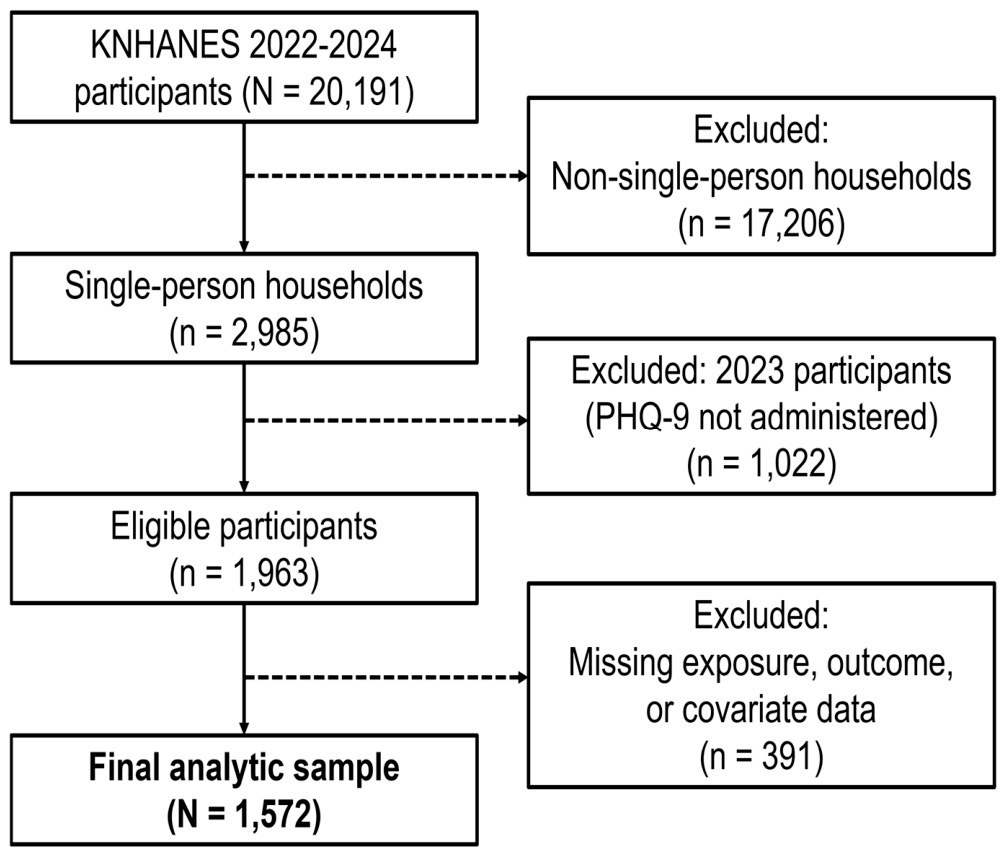
2.2. Study Participants
2.3. Nutritional Imbalance
2.4. Oral Functional Limitation
2.5. Metabolic Syndrome
2.6. Depressive Symptoms
2.7. Covariates
2.8. Statistical Analysis
3. Results
3.1. Sample Characteristics
3.2. Exploratory Indirect-Effect Analysis
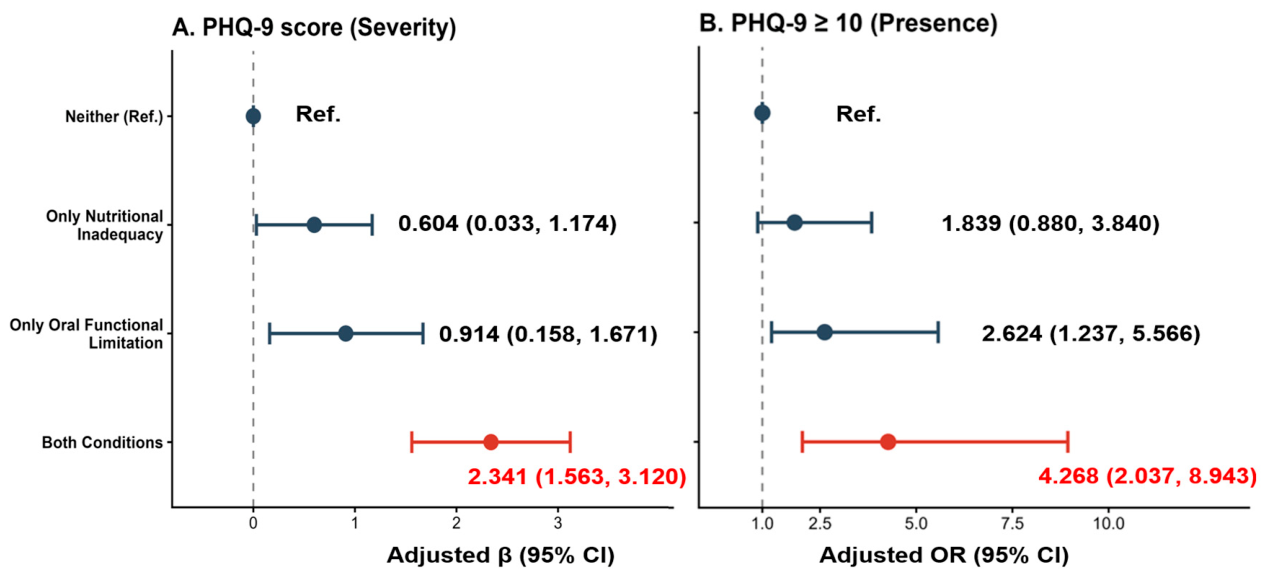
3.3. Joint Exposure Analysis
4. Discussion
5. Conclusions
Supplementary Materials
Author Contributions
Funding
Institutional Review Board Statement
Informed Consent Statement
Data Availability Statement
Conflicts of Interest
Abbreviations
| KNHANES | Korea National Health and Nutrition Examination Survey |
| PHQ-9 | Patient Health Questionnaire-9 |
| EAR | Estimated Average Requirement |
| CI | Confidence Interval |
| OR | Odds Ratio |
References
- Statistics Korea. 2023 Population and Housing Census; Statistics Korea: Daejeon, Republic of Korea, 2024. [Google Scholar]
- Kimura, Y.; Wada, T.; Ishine, M.; Ishimoto, Y.; Kasahara, Y.; Konno, A.; Nakatsuka, M.; Sakamoto, R.; Okumiya, K.; Fujisawa, M.; et al. Food Diversity Is Closely Associated with Activities of Daily Living, Depression, and Quality of Life in Community-Dwelling Elderly People. J. Am. Geriatr. Soc. 2009, 57, 922–924. [Google Scholar] [CrossRef] [PubMed]
- Lee, H.; Kim, S.-J.; Kang, M. Comparative Study on Eating Habits and Health of Single-Person and Multi-Person Households. PLoS ONE 2025, 20, e0327763. [Google Scholar] [CrossRef] [PubMed]
- Steptoe, A.; Shankar, A.; Demakakos, P.; Wardle, J. Social Isolation, Loneliness, and All-Cause Mortality in Older Men and Women. Proc. Natl. Acad. Sci. USA 2013, 110, 5797–5801. [Google Scholar] [CrossRef] [PubMed]
- GBD 2019 Mental Disorders Collaborators. Global, Regional, and National Burden of 12 Mental Disorders in 204 Countries and Territories, 1990–2019: A Systematic Analysis for the Global Burden of Disease Study 2019. Lancet Psychiatry 2022, 9, 137–150. [CrossRef] [PubMed]
- Kim, J.-M.; Lee, E. Association between Healthy Eating Index and Mental Health in Middle-Aged Adults Based on Household Size in Korea. Int. J. Environ. Res. Public Health 2022, 19, 4692. [Google Scholar] [CrossRef] [PubMed]
- Kim, S.-A.; Choi, S.K. Regional Disparities in Food Security and Depression among Single-Person Households in the Republic of Korea. BMC Public Health 2023, 23, 2047. [Google Scholar] [CrossRef] [PubMed]
- Jacka, F.N.; O’Neil, A.; Opie, R.; Itsiopoulos, C.; Cotton, S.; Mohebbi, M.; Castle, D.; Dash, S.; Mihalopoulos, C.; Chatterton, M.L.; et al. A Randomised Controlled Trial of Dietary Improvement for Adults with Major Depression (the ‘SMILES’ Trial). BMC Med. 2017, 15, 23. [Google Scholar] [CrossRef] [PubMed]
- Lassale, C.; Batty, G.D.; Baghdadli, A.; Jacka, F.; Sánchez-Villegas, A.; Kivimäki, M.; Akbaraly, T. Healthy Dietary Indices and Risk of Depressive Outcomes: A Systematic Review and Meta-Analysis of Observational Studies. Mol. Psychiatry 2019, 24, 965–986. [Google Scholar] [PubMed]
- Sheiham, A.; Steele, J. Does the Condition of the Mouth and Teeth Affect the Ability to Eat Certain Foods, Nutrient and Dietary Intake and Nutritional Status amongst Older People? Public Health Nutr. 2001, 4, 797–803. [Google Scholar] [CrossRef] [PubMed]
- Chun, H.; Doo, M. Factors Related to Depression Associated with Chewing Problems in the Korean Elderly Population. Int. J. Environ. Res. Public Health 2021, 18, 6158. [Google Scholar] [CrossRef] [PubMed]
- Kusama, T.; Kiuchi, S.; Umehara, N.; Kondo, K.; Osaka, K.; Aida, J. The Deterioration of Oral Function and Orofacial Appearance Mediated the Relationship between Tooth Loss and Depression among Community-Dwelling Older Adults: A JAGES Cohort Study Using Causal Mediation Analysis. J. Affect. Disord. 2021, 286, 174–179. [Google Scholar] [CrossRef] [PubMed]
- Zwick, L.; Schmitz, N.; Shojaa, M. Oral Health-Related Quality of Life and Depressive Symptoms in Adults: Longitudinal Associations of the English Longitudinal Study of Ageing (ELSA). BMC Oral Health 2023, 23, 1029. [Google Scholar] [CrossRef] [PubMed]
- Karimi, P.; Zojaji, S.; Fard, A.A.; Nateghi, M.N.; Mansouri, Z.; Zojaji, R. The Impact of Oral Health on Depression: A Systematic Review. Spec. Care Dent. 2025, 45, e13079. [Google Scholar] [CrossRef] [PubMed]
- Pan, A.; Keum, N.; Okereke, O.I.; Sun, Q.; Kivimaki, M.; Rubin, R.R.; Hu, F.B. Bidirectional Association between Depression and Metabolic Syndrome: A Systematic Review and Meta-Analysis of Epidemiological Studies. Diabetes Care 2012, 35, 1171–1180. [Google Scholar] [CrossRef] [PubMed]
- Lee, J.; Hyun, M.; Suh, Y.; Kim, D.; Hong, S. Eating Alone and Metabolic Syndrome: A Population-Based Korean National Health and Nutrition Examination Survey 2017–2019. Korean J. Health Promot. 2022, 22, 123–130. [Google Scholar] [CrossRef]
- Kweon, S.; Kim, Y.; Jang, M.; Kim, Y.; Kim, K.; Choi, S.; Chun, C.; Khang, Y.-H.; Oh, K. Data Resource Profile: The Korea National Health and Nutrition Examination Survey (KNHANES). Int. J. Epidemiol. 2014, 43, 69–77. [Google Scholar] [CrossRef] [PubMed]
- Kim, M.; Jung, S.; Park, J.E.; Sohn, J.H.; Seong, S.J.; Kim, B.-S.; Chang, S.M.; Hong, J.P.; Hahm, B.-J.; Yeom, C.-W. Validation of the Patient Health Questionnaire–9 and Patient Health Questionnaire–2 in the General Korean Population. Psychiatry Investig. 2023, 20, 853. [Google Scholar] [CrossRef] [PubMed]
- Coppen, A.; Bolander-Gouaille, C. Treatment of Depression: Time to Consider Folic Acid and Vitamin B12. J. Psychopharmacol. 2005, 19, 59–65. [Google Scholar] [CrossRef] [PubMed]
- Anglin, R.E.; Samaan, Z.; Walter, S.D.; McDonald, S.D. Vitamin D Deficiency and Depression in Adults: Systematic Review and Meta-Analysis. Br. J. Psychiatry 2013, 202, 100–107. [Google Scholar] [CrossRef] [PubMed]
- Beard, J.L. Iron Biology in Immune Function, Muscle Metabolism and Neuronal Functioning. J. Nutr. 2001, 131, 568S–580S. [Google Scholar] [CrossRef] [PubMed]



| Variable | Total | No Depressive Symptoms | Depressive Symptoms | p-Value |
|---|---|---|---|---|
| (PHQ-9 < 10) | (PHQ-9 ≥ 10) | |||
| n = 1572 | n = 1468 | n = 104 | ||
| Age, years | 50.5 (19.4) | 50.7 (19.5) | 48.1 (18.6) | 0.232 |
| Age group | 0.374 | |||
| 19–29 | 238 (20.8%) | 220 (20.6%) | 18 (24.2%) | |
| 30–49 | 283 (26.0%) | 262 (25.8%) | 21 (29.4%) | |
| 50–64 | 362 (22.7%) | 332 (22.5%) | 30 (24.9%) | |
| ≥65 | 689 (30.5%) | 654 (31.2%) | 35 (21.5%) | |
| Sex | >0.900 | |||
| Men | 632 (51.0%) | 589 (51.0%) | 43 (51.5%) | |
| Women | 940 (49.0%) | 879 (49.0%) | 61 (48.5%) | |
| Education level | >0.900 | |||
| Elementary or lower | 497 (22.0%) | 464 (22.1%) | 33 (21.3%) | |
| Middle school | 173 (9.2%) | 160 (9.1%) | 13 (10.4%) | |
| High school | 428 (29.9%) | 399 (29.9%) | 29 (30.8%) | |
| College or higher | 474 (38.9%) | 445 (39.0%) | 29 (37.6%) | |
| Household income | <0.001 | |||
| Lowest | 585 (37.2%) | 523 (35.3%) | 62 (62.8%) | |
| Lower-middle | 386 (23.1%) | 367 (23.6%) | 19 (16.4%) | |
| Middle | 277 (17.3%) | 267 (17.9%) | 10 (9.3%) | |
| Upper-middle | 179 (11.9%) | 171 (12.1%) | 8 (8.7%) | |
| Highest | 145 (10.5%) | 140 (11.1%) | 5 (2.8%) | |
| Marital status | 0.213 | |||
| Married/partnered | 1016 (52.1%) | 954 (52.6%) | 62 (45.3%) | |
| Single/separated/widowed | 556 (47.9%) | 514 (47.4%) | 42 (54.7%) | |
| Employment status | 0.12 | |||
| Employed | 920 (64.8%) | 873 (65.4%) | 47 (56.7%) | |
| Not employed | 652 (35.2%) | 595 (34.6%) | 57 (43.3%) | |
| Smoking status | 0.009 | |||
| Non/former smoker | 1262 (76.3%) | 1193 (77.2%) | 69 (64.3%) | |
| Current smoker | 310 (23.7%) | 275 (22.8%) | 35 (35.7%) | |
| Alcohol consumption | >0.900 | |||
| Non-drinker | 793 (45.2%) | 738 (45.0%) | 55 (47.5%) | |
| Infrequent drinker | 651 (45.4%) | 612 (45.6%) | 39 (43.4%) | |
| Drinker | 128 (9.4%) | 118 (9.4%) | 10 (9.1%) | |
| Aerobic physical activity | 0.060 | |||
| Did not meet guidelines | 859 (48.0%) | 810 (48.7%) | 49 (38.0%) | |
| Met guidelines | 713 (52.0%) | 658 (51.3%) | 55 (62.0%) | |
| Total energy intake, kcal/day | 1879.7 (911.2) | 1881.4 (894.9) | 1856.9 (1118.3) | 0.850 |
| Nutritional imbalance score (0–8) | 4.3 (2.4) | 4.3 (2.4) | 4.9 (2.5) | 0.031 |
| Oral functional limitation | <0.001 | |||
| No | 1156 (77.4%) | 1100 (78.5%) | 56 (61.7%) | |
| Yes | 416 (22.6%) | 368 (21.5%) | 48 (38.3%) | |
| Metabolic syndrome | 0.757 | |||
| No | 837 (58.1%) | 786 (58.2%) | 51 (56.4%) | |
| Yes | 735 (41.9%) | 682 (41.8%) | 53 (43.6%) | |
| PHQ-9 score | 2.8 (4.0) | 2.0 (2.3) | 14.3 (4.1) | <0.001 |
| Association | Metric | Estimate | 95% CI | p-Value |
|---|---|---|---|---|
| Nutritional imbalance → Oral functional limitation | OR | 1.050 | (0.974, 1.131) | 0.201 |
| Nutritional imbalance → Metabolic syndrome score | β | 0.034 | (−0.012, 0.080) | 0.151 |
| Oral functional limitation → PHQ-9 score | β | 1.278 | (0.739, 1.816) | <0.001 |
| Metabolic syndrome score → PHQ-9 score | β | 0.156 | (0.006, 0.306) | 0.041 |
| Total association | β | 0.216 | (0.098, 0.335) | <0.001 |
| Direct association | β | 0.200 | (0.084, 0.316) | <0.001 |
| Indirect effect (oral functional limitation) | β | 0.058 | (−0.043, 0.192) | — † |
| Indirect effect (metabolic syndrome) | β | 0.005 | (−0.002, 0.016) | — † |
| Joint Exposure Group | PHQ-9 Score | PHQ-9 ≥ 10 |
|---|---|---|
| β (95% CI) | OR (95% CI) | |
| Low nutritional imbalance + No oral limitation | Ref | Ref |
| High nutritional imbalance only | 0.604 (0.033, 1.174) | 1.839 (0.880, 3.840) |
| Oral limitation only | 0.914 (0.158, 1.671) | 2.624 (1.237, 5.566) |
| Both high nutritional imbalance and oral limitation | 2.341 (1.562, 3.120) | 4.268 (2.037, 8.943) |
Disclaimer/Publisher’s Note: The statements, opinions and data contained in all publications are solely those of the individual author(s) and contributor(s) and not of MDPI and/or the editor(s). MDPI and/or the editor(s) disclaim responsibility for any injury to people or property resulting from any ideas, methods, instructions or products referred to in the content. |
© 2026 by the authors. Licensee MDPI, Basel, Switzerland. This article is an open access article distributed under the terms and conditions of the Creative Commons Attribution (CC BY) license.
Share and Cite
Jung, Y.-S.; Joo, H. Nutritional Imbalance and Oral Functional Limitation Jointly Associated with Depressive Symptoms in Adults Living Alone: A Nationally Representative Cross-Sectional Study. Nutrients 2026, 18, 2055. https://doi.org/10.3390/nu18132055
Jung Y-S, Joo H. Nutritional Imbalance and Oral Functional Limitation Jointly Associated with Depressive Symptoms in Adults Living Alone: A Nationally Representative Cross-Sectional Study. Nutrients. 2026; 18(13):2055. https://doi.org/10.3390/nu18132055
Chicago/Turabian StyleJung, Young-Suk, and Hyunjoo Joo. 2026. "Nutritional Imbalance and Oral Functional Limitation Jointly Associated with Depressive Symptoms in Adults Living Alone: A Nationally Representative Cross-Sectional Study" Nutrients 18, no. 13: 2055. https://doi.org/10.3390/nu18132055
APA StyleJung, Y.-S., & Joo, H. (2026). Nutritional Imbalance and Oral Functional Limitation Jointly Associated with Depressive Symptoms in Adults Living Alone: A Nationally Representative Cross-Sectional Study. Nutrients, 18(13), 2055. https://doi.org/10.3390/nu18132055