Establishing Murine Intestinal Organoids to Study Nutrient- and Tastant-Evoked Gut Signaling


Abstract
1. Introduction
2. Materials and Methods
3. Results
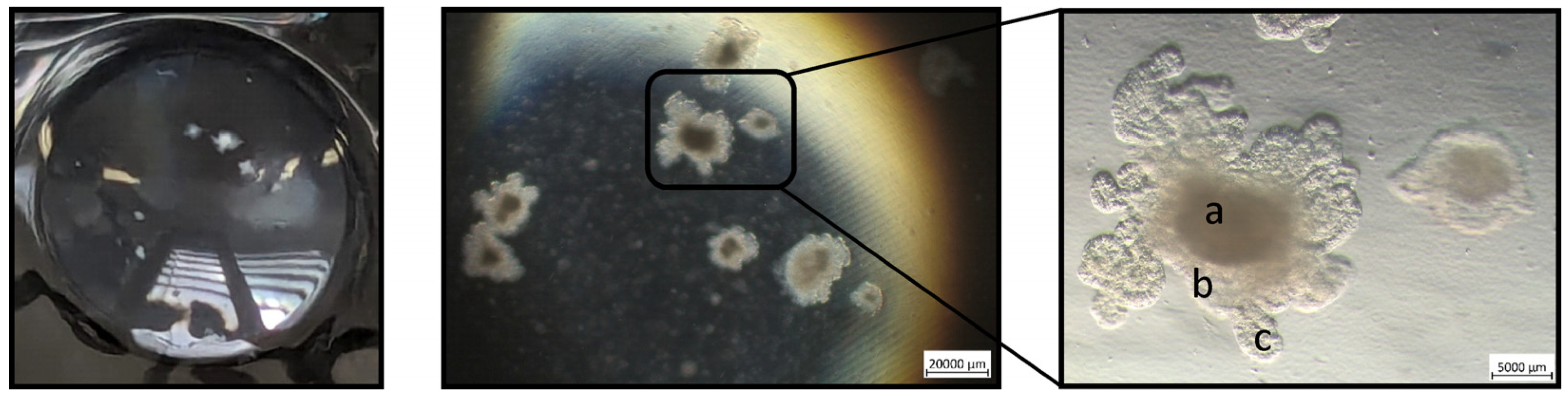
3.1. Establishment of MIO Culture
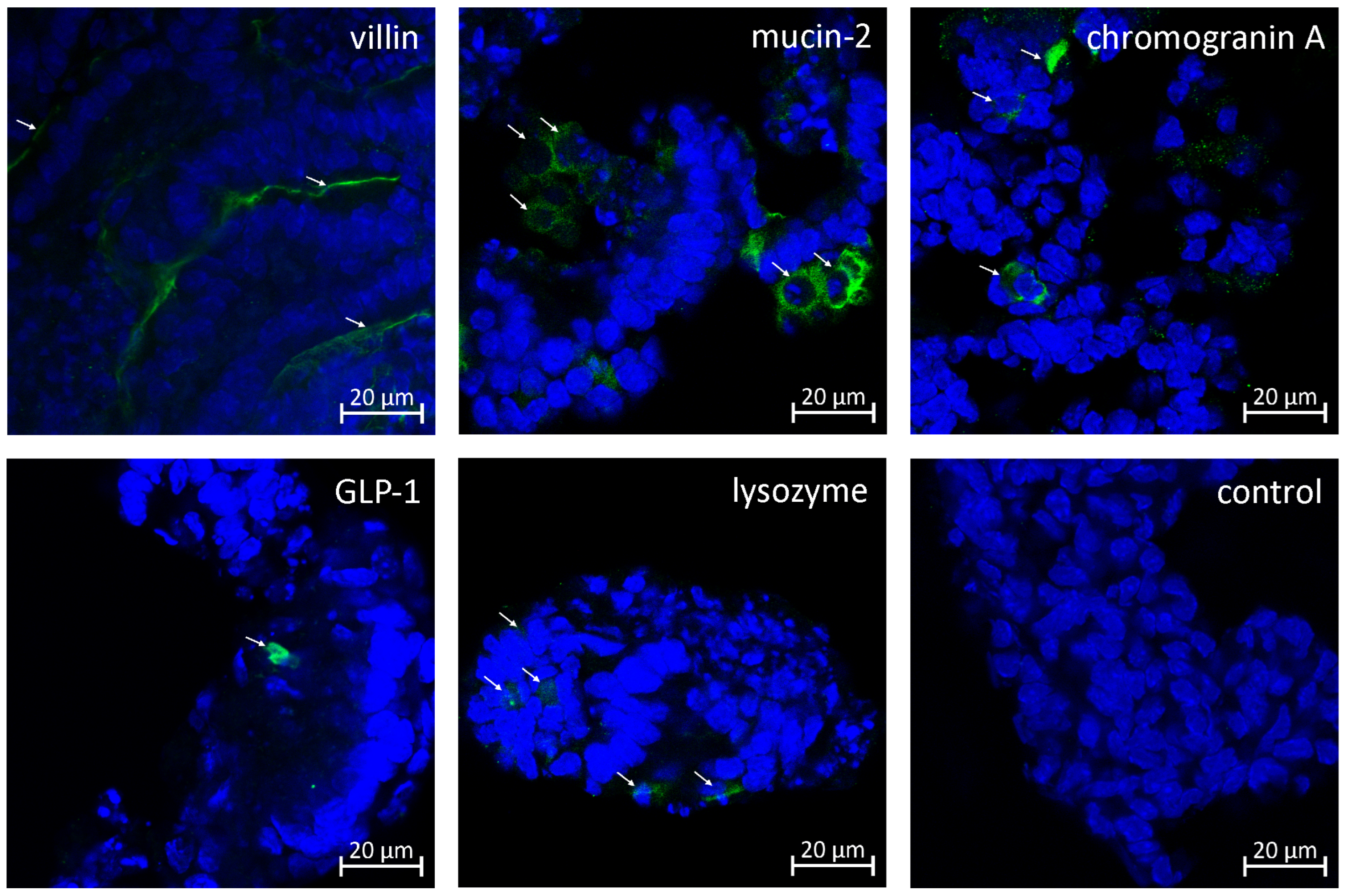
3.2. Differentiation of MIO in All Cell Types
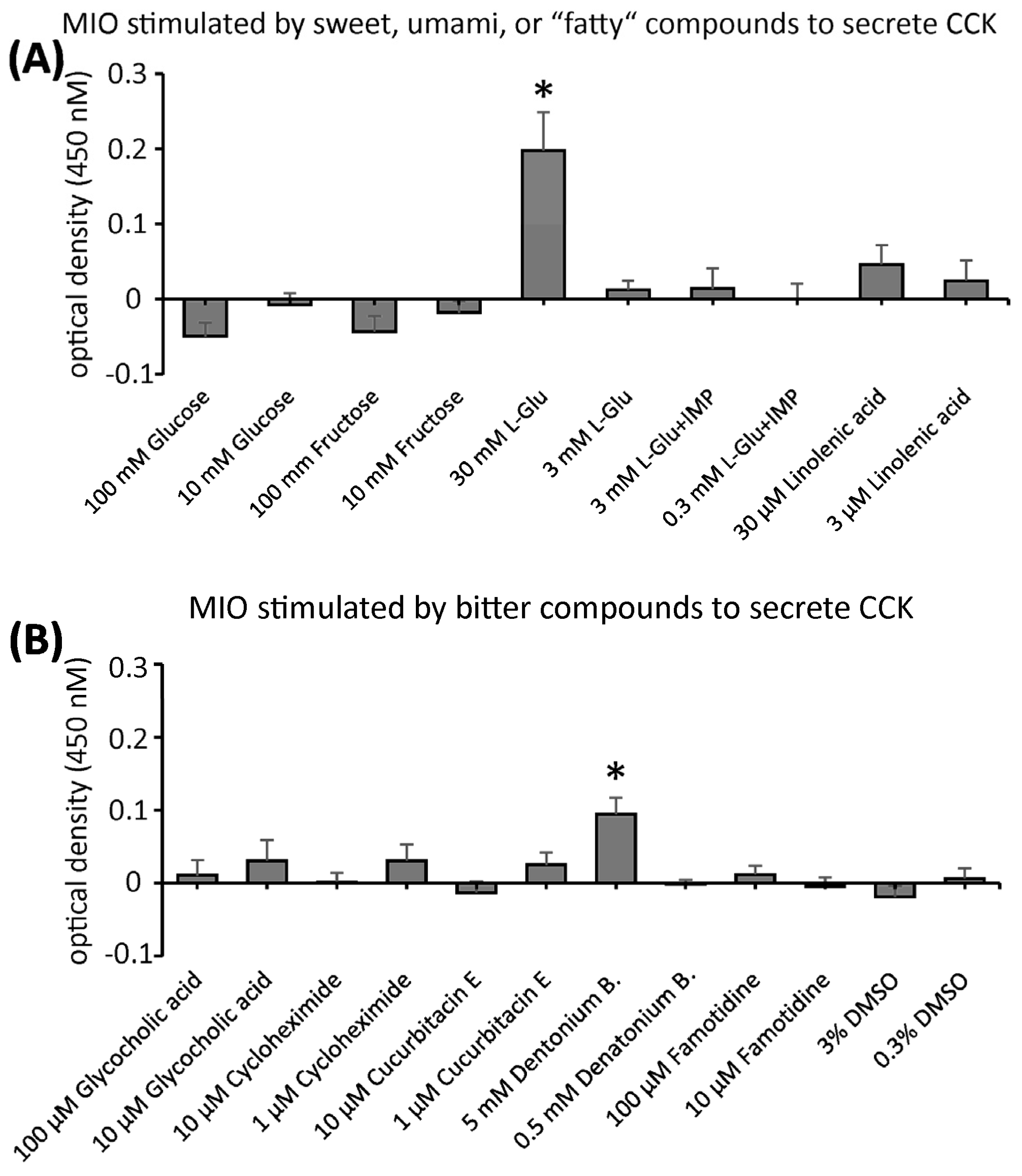
3.3. MIO Secretion of CCK upon Stimulation with Tastants Attests to the Function of Differentiated Organoids
4. Discussion
5. Conclusions
Author Contributions
Funding
Institutional Review Board Statement
Informed Consent Statement
Data Availability Statement
Acknowledgments
Conflicts of Interest
Abbreviations
| CCK | Cholecystokinin |
| DAPI | 4′,6-Diamidino-2-phenylindole dihydrochloride |
| DMEM | Dulbecco’s modified Eagle medium |
| EGF | Epidermal growth factor |
| ELISA | Enzyme-linked immunosorbent assay |
| GLP-1 | Glucagon-like peptide-1 |
| HEPES | 4-(2-hydroxyethyl)-1-piperazineethanesulfonic acid |
| HRP | Horseradish peroxidase |
| IMP | Inosine 5′-monophosphate |
| MIO | Mouse intestinal organoid |
| PBS | Phosphate-buffered saline |
| PFA | Paraformaldehyde |
| PYY | Peptide YY |
| SEM | Standard error of the mean |
| Tas2r/TAS2R | Taste 2 receptor |
References
- Drewnowski, A.; Gomez-Carneros, C. Bitter taste, phytonutrients, and the consumer: A review. Am. J. Clin. Nutr. 2000, 72, 1424–1435. [Google Scholar] [CrossRef] [PubMed]
- Wooding, S.P.; Ramirez, V.A.; Behrens, M. Bitter taste receptors: Genes, evolution and health. Evol. Med. Public Health 2021, 9, 431–447. [Google Scholar] [CrossRef] [PubMed]
- Reed, D.R.; Tanaka, T.; McDaniel, A.H. Diverse tastes: Genetics of sweet and bitter perception. Physiol. Behav. 2006, 88, 215–226. [Google Scholar] [CrossRef] [PubMed]
- Adler, E.; Hoon, M.A.; Mueller, K.L.; Chandrashekar, J.; Ryba, N.J.; Zuker, C.S. A novel family of mammalian taste receptors. Cell 2000, 100, 693–702. [Google Scholar] [CrossRef] [PubMed]
- Chandrashekar, J.; Mueller, K.L.; Hoon, M.A.; Adler, E.; Feng, L.; Guo, W.; Zuker, C.S.; Ryba, N.J. T2Rs function as bitter taste receptors. Cell 2000, 100, 703–711. [Google Scholar] [CrossRef] [PubMed]
- Matsunami, H.; Montmayeur, J.P.; Buck, L.B. A family of candidate taste receptors in human and mouse. Nature 2000, 404, 601–604. [Google Scholar] [CrossRef] [PubMed]
- Behrens, M.; Foerster, S.; Staehler, F.; Raguse, J.D.; Meyerhof, W. Gustatory expression pattern of the human TAS2R bitter receptor gene family reveals a heterogenous population of bitter responsive taste receptor cells. J. Neurosci. 2007, 27, 12630–12640. [Google Scholar] [CrossRef] [PubMed]
- Lossow, K.; Hübner, S.; Roudnitzky, N.; Slack, J.P.; Pollastro, F.; Behrens, M.; Meyerhof, W. Comprehensive Analysis of Mouse Bitter Taste Receptors Reveals Different Molecular Receptive Ranges for Orthologous Receptors in Mice and Humans. J. Biol. Chem. 2016, 291, 15358–15377. [Google Scholar] [CrossRef] [PubMed]
- Prandi, S.; Bromke, M.; Hübner, S.; Voigt, A.; Boehm, U.; Meyerhof, W.; Behrens, M. A subset of mouse colonic goblet cells expresses the bitter taste receptor Tas2r131. PLoS ONE 2013, 8, e82820. [Google Scholar] [CrossRef] [PubMed]
- Prandi, S.; Voigt, A.; Meyerhof, W.; Behrens, M. Expression profiling of Tas2r genes reveals a complex pattern along the mouse GI tract and the presence of Tas2r131 in a subset of intestinal Paneth cells. Cell. Mol. Life Sci. 2018, 75, 49–65. [Google Scholar] [CrossRef] [PubMed]
- Kok, B.P.; Galmozzi, A.; Littlejohn, N.K.; Albert, V.; Godio, C.; Kim, W.; Kim, S.M.; Bland, J.S.; Grayson, N.; Fang, M.; et al. Intestinal bitter taste receptor activation alters hormone secretion and imparts metabolic benefits. Mol. Metab. 2018, 16, 76–87. [Google Scholar] [CrossRef] [PubMed]
- Latorre, R.; Huynh, J.; Mazzoni, M.; Gupta, A.; Bonora, E.; Clavenzani, P.; Chang, L.; Mayer, E.A.; De Giorgio, R.; Sternini, C. Expression of the Bitter Taste Receptor, T2R38, in Enteroendocrine Cells of the Colonic Mucosa of Overweight/Obese vs. Lean Subjects. PLoS ONE 2016, 11, e0147468. [Google Scholar] [CrossRef] [PubMed]
- Liu, S.; Lu, S.; Xu, R.; Atzberger, A.; Günther, S.; Wettschureck, N.; Offermanns, S. Members of Bitter Taste Receptor Cluster Tas2r143/Tas2r135/Tas2r126 Are Expressed in the Epithelium of Murine Airways and Other Non-gustatory Tissues. Front. Physiol. 2017, 8, 849. [Google Scholar] [CrossRef] [PubMed]
- Liszt, K.I.; Wang, Q.; Farhadipour, M.; Segers, A.; Thijs, T.; Nys, L.; Deleus, E.; Van der Schueren, B.; Gerner, C.; Neuditschko, B.; et al. Human intestinal bitter taste receptors regulate innate immune responses and metabolic regulators in obesity. J. Clin. Investig. 2022, 132, e144828. [Google Scholar] [CrossRef] [PubMed]
- Bellono, N.W.; Bayrer, J.R.; Leitch, D.B.; Castro, J.; Zhang, C.; O’Donnell, T.A.; Brierley, S.M.; Ingraham, H.A.; Julius, D. Enterochromaffin Cells Are Gut Chemosensors that Couple to Sensory Neural Pathways. Cell 2017, 170, 185–198.e116. [Google Scholar] [CrossRef] [PubMed]
- Habib, A.M.; Richards, P.; Rogers, G.J.; Reimann, F.; Gribble, F.M. Co-localisation and secretion of glucagon-like peptide 1 and peptide YY from primary cultured human L cells. Diabetologia 2013, 56, 1413–1416. [Google Scholar] [CrossRef] [PubMed]
- Desai, A.J.; Dong, M.; Harikumar, K.G.; Miller, L.J. Cholecystokinin-induced satiety, a key gut servomechanism that is affected by the membrane microenvironment of this receptor. Int. J. Obes. Suppl. 2016, 6, S22–S27. [Google Scholar] [CrossRef] [PubMed]
- Ding, Y.; Zhang, H.; Liao, Y.Y.; Chen, L.N.; Ji, S.Y.; Qin, J.; Mao, C.; Shen, D.D.; Lin, L.; Wang, H.; et al. Structural insights into human brain-gut peptide cholecystokinin receptors. Cell Discov. 2022, 8, 55. [Google Scholar] [CrossRef] [PubMed]
- Zeng, Q.; Ou, L.; Wang, W.; Guo, D.Y. Gastrin, Cholecystokinin, Signaling, and Biological Activities in Cellular Processes. Front. Endocrinol. 2020, 11, 112. [Google Scholar] [CrossRef] [PubMed]
- Cummings, D.E.; Overduin, J. Gastrointestinal regulation of food intake. J. Clin. Investig. 2007, 117, 13–23. [Google Scholar] [CrossRef] [PubMed]
- Zietek, T.; Rath, E.; Haller, D.; Daniel, H. Intestinal organoids for assessing nutrient transport, sensing and incretin secretion. Sci. Rep. 2015, 5, 16831. [Google Scholar] [CrossRef] [PubMed]
- Barker, N.; van de Wetering, M.; Clevers, H. The intestinal stem cell. Genes Dev. 2008, 22, 1856–1864. [Google Scholar] [CrossRef] [PubMed]
- Barker, N.; van Es, J.H.; Kuipers, J.; Kujala, P.; van den Born, M.; Cozijnsen, M.; Haegebarth, A.; Korving, J.; Begthel, H.; Peters, P.J.; et al. Identification of stem cells in small intestine and colon by marker gene Lgr5. Nature 2007, 449, 1003–1007. [Google Scholar] [CrossRef] [PubMed]
- Galindo, M.M.; Voigt, N.; Stein, J.; van Lengerich, J.; Raguse, J.D.; Hofmann, T.; Meyerhof, W.; Behrens, M. G protein-coupled receptors in human fat taste perception. Chem. Senses 2012, 37, 123–139. [Google Scholar] [CrossRef] [PubMed]
- Li, X.; Staszewski, L.; Xu, H.; Durick, K.; Zoller, M.; Adler, E. Human receptors for sweet and umami taste. Proc. Natl. Acad. Sci. USA 2002, 99, 4692–4696. [Google Scholar] [CrossRef] [PubMed]
- Ziegler, F.; Steuer, A.; Di Pizio, A.; Behrens, M. Physiological activation of human and mouse bitter taste receptors by bile acids. Commun. Biol. 2023, 6, 612. [Google Scholar] [CrossRef] [PubMed]
- Haber, A.L.; Biton, M.; Rogel, N.; Herbst, R.H.; Shekhar, K.; Smillie, C.; Burgin, G.; Delorey, T.M.; Howitt, M.R.; Katz, Y.; et al. A single-cell survey of the small intestinal epithelium. Nature 2017, 551, 333–339. [Google Scholar] [CrossRef] [PubMed]
- Li, J.; Liu, Y.; Kim, E.; March, J.C.; Bentley, W.E.; Payne, G.F. Electrochemical reverse engineering: A systems-level tool to probe the redox-based molecular communication of biology. Free. Radic. Biol. Med. 2017, 105, 110–131. [Google Scholar] [CrossRef] [PubMed]
- Rath, E.; Zietek, T. Intestinal organoids: A model for biomedical and nutritional research. In Organoids and Mini-Organs; Elsevier: Amsterdam, The Netherlands, 2018; pp. 195–214. [Google Scholar]
- Zindl, C.L.; Wilson, C.G.; Chadha, A.S.; Duck, L.W.; Cai, B.; Harbour, S.N.; Nagaoka-Kamata, Y.; Hatton, R.D.; Gao, M.; Figge, D.A.; et al. Distal colonocytes targeted by C. rodentium recruit T-cell help for barrier defence. Nature 2024, 629, 669–678. [Google Scholar] [CrossRef] [PubMed]
- Hunt, J.E.; Holst, J.J.; Jepsen, S.L. Glucose- and Bile Acid-Stimulated Secretion of Gut Hormones in the Isolated Perfused Intestine Is Not Impaired in Diet-Induced Obese Mice. Front. Endocrinol. 2022, 13, 884501. [Google Scholar] [CrossRef] [PubMed]
- Teysseire, F.; Bordier, V.; Budzinska, A.; Weltens, N.; Rehfeld, J.F.; Holst, J.J.; Hartmann, B.; Beglinger, C.; Van Oudenhove, L.; Wölnerhanssen, B.K.; et al. The Role of D-allulose and Erythritol on the Activity of the Gut Sweet Taste Receptor and Gastrointestinal Satiation Hormone Release in Humans: A Randomized, Controlled Trial. J. Nutr. 2022, 152, 1228–1238. [Google Scholar] [CrossRef] [PubMed]
- Kuhre, R.E.; Gribble, F.M.; Hartmann, B.; Reimann, F.; Windeløv, J.A.; Rehfeld, J.F.; Holst, J.J. Fructose stimulates GLP-1 but not GIP secretion in mice, rats, and humans. Am. J. Physiol. Gastrointest. Liver Physiol. 2014, 306, G622–G630. [Google Scholar] [CrossRef] [PubMed]
- Hartley, I.E.; Liem, D.G.; Keast, R. Umami as an ‘Alimentary’ Taste. A New Perspective on Taste Classification. Nutrients 2019, 11, 182. [Google Scholar] [CrossRef] [PubMed]
- Yang, J.; Liao, J.; Dong, H.; Huang, G.; Bai, W.; Tu, J.; Zeng, X. Synergistic Effect of Kokumi-Active γ-Glutamyl Peptides and l-Glutamate on Enhancing Umami Sensation and Stimulating Cholecystokinin Secretion via T1R1/T1R3 Activation in STC-1 Cells. J. Agric. Food Chem. 2022, 70, 14395–14402. [Google Scholar] [CrossRef] [PubMed]
- Smith, N.K.; Hackett, T.A.; Galli, A.; Flynn, C.R. GLP-1: Molecular mechanisms and outcomes of a complex signaling system. Neurochem. Int. 2019, 128, 94–105. [Google Scholar] [CrossRef] [PubMed]
- Symonds, E.L.; Peiris, M.; Page, A.J.; Chia, B.; Dogra, H.; Masding, A.; Galanakis, V.; Atiba, M.; Bulmer, D.; Young, R.L.; et al. Mechanisms of activation of mouse and human enteroendocrine cells by nutrients. Gut 2015, 64, 618–626. [Google Scholar] [CrossRef] [PubMed]
- Lund, M.L.; Sorrentino, G.; Egerod, K.L.; Kroone, C.; Mortensen, B.; Knop, F.K.; Reimann, F.; Gribble, F.M.; Drucker, D.J.; de Koning, E.J.P.; et al. L-Cell Differentiation Is Induced by Bile Acids Through GPBAR1 and Paracrine GLP-1 and Serotonin Signaling. Diabetes 2020, 69, 614–623. [Google Scholar] [CrossRef] [PubMed]
- Miedzybrodzka, E. Characterisation of Human Enteroendocrine Cells in Organoid Models. Ph.D. Thesis, University of Cambridge, Cambridge, UK, 2022. [Google Scholar]
- Rafferty, E.P.; Wylie, A.R.; Hand, K.H.; Elliott, C.E.; Grieve, D.J.; Green, B.D. Investigating the effects of physiological bile acids on GLP-1 secretion and glucose tolerance in normal and GLP-1R-/- mice. Biol. Chem. 2011, 392, 539–546. [Google Scholar] [CrossRef] [PubMed]
- Sugimoto, S.; Sato, T. Organoid vs In Vivo Mouse Model: Which is Better Research Tool to Understand the Biologic Mechanisms of Intestinal Epithelium? Cell. Mol. Gastroenterol. Hepatol. 2022, 13, 195–197. [Google Scholar] [CrossRef] [PubMed]
- Taelman, J.; Diaz, M.; Guiu, J. Human Intestinal Organoids: Promise and Challenge. Front. Cell Dev. Biol. 2022, 10, 854740. [Google Scholar] [CrossRef] [PubMed]
- Boonekamp, K.E.; Dayton, T.L.; Clevers, H. Intestinal organoids as tools for enriching and studying specific and rare cell types: Advances and future directions. J. Mol. Cell Biol. 2020, 12, 562–568. [Google Scholar] [CrossRef] [PubMed]
- Liu, L.; Zhang, L.; Li, C.; Qiu, Z.; Kuang, T.; Wu, Z.; Deng, W. Effects of hormones on intestinal stem cells. Stem Cell Res. Ther. 2023, 14, 105. [Google Scholar] [CrossRef] [PubMed]
- Noya-Leal, F.; van der Wielen, N.; Behrens, M.; Rouschop, S.; van Arkel, J.; Jongsma, M.; Witkamp, R.; Mes, J.J.; Bastiaan-Net, S.; Meijerink, J. Rebaudioside A from Stevia rebaudiana stimulates GLP-1 release by enteroendocrine cells via bitter taste signalling pathways. Food Funct. 2023, 14, 6914–6928. [Google Scholar] [CrossRef] [PubMed]
- Desimone, J.A.; Phan, T.H.; Ren, Z.; Mummalaneni, S.; Lyall, V. Changes in taste receptor cell [Ca2+]i modulate chorda tympani responses to bitter, sweet, and umami taste stimuli. J. Neurophysiol. 2012, 108, 3221–3232. [Google Scholar] [CrossRef] [PubMed]
- Miyata, M.; Kurogi, M.; Oda, M.; Saitoh, O. Effect of five taste ligands on the release of CCK from an enteroendocrine cell line, STC-1. Biomed. Res. 2014, 35, 171–176. [Google Scholar] [CrossRef] [PubMed]
- Shah, B.P.; Liu, P.; Yu, T.; Hansen, D.R.; Gilbertson, T.A. TRPM5 is critical for linoleic acid-induced CCK secretion from the enteroendocrine cell line, STC-1. Am. J. Physiol. Cell Physiol. 2012, 302, C210–C219. [Google Scholar] [CrossRef] [PubMed]
- Snutch, T.P.; Peloquin, J.; Mathews, E.; McRory, J.E. Molecular properties of voltage-gated calcium channels. In Voltage-Gated Calcium Channels; Springer: Berlin/Heidelberg, Germany, 2005; pp. 61–94. [Google Scholar]
- Crowe, M.S.; Wang, H.; Blakeney, B.A.; Mahavadi, S.; Singh, K.; Murthy, K.S.; Grider, J.R. Expression and function of umami receptors T1R1/T1R3 in gastric smooth muscle. Neurogastroenterol. Motil. 2020, 32, e13737. [Google Scholar] [CrossRef] [PubMed]
- Kumar, P.; Behrens, M. Influence of Sodium Chloride on Human Bitter Taste Receptor Responses. J. Agric. Food Chem. 2024, 72, 10531–10536. [Google Scholar] [CrossRef] [PubMed]
- Sakurai, T.; Misaka, T.; Nagai, T.; Ishimaru, Y.; Matsuo, S.; Asakura, T.; Abe, K. pH-Dependent inhibition of the human bitter taste receptor hTAS2R16 by a variety of acidic substances. J. Agric. Food Chem. 2009, 57, 2508–2514. [Google Scholar] [CrossRef] [PubMed]
- Nelson, G.; Chandrashekar, J.; Hoon, M.A.; Feng, L.; Zhao, G.; Ryba, N.J.; Zuker, C.S. An amino-acid taste receptor. Nature 2002, 416, 199–202. [Google Scholar] [CrossRef] [PubMed]
- San Gabriel, A.; Uneyama, H.; Yoshie, S.; Torii, K. Cloning and characterization of a novel mGluR1 variant from vallate papillae that functions as a receptor for L-glutamate stimuli. Chem. Senses 2005, 30, i25–i26. [Google Scholar] [CrossRef] [PubMed]
- Chaudhari, N.; Landin, A.M.; Roper, S.D. A metabotropic glutamate receptor variant functions as a taste receptor. Nat. Neurosci. 2000, 3, 113–119. [Google Scholar] [CrossRef] [PubMed]
- San Gabriel, A.M.; Maekawa, T.; Uneyama, H.; Yoshie, S.; Torii, K. mGluR1 in the fundic glands of rat stomach. FEBS Lett. 2007, 581, 1119–1123. [Google Scholar] [CrossRef] [PubMed]
- Chen, S.; Xia, Y.; Zhu, G.; Yan, J.; Tan, C.; Deng, B.; Deng, J.; Yin, Y.; Ren, W. Glutamine supplementation improves intestinal cell proliferation and stem cell differentiation in weanling mice. Food. Nutr. Res. 2018, 62, 1439. [Google Scholar] [CrossRef] [PubMed]
- Kim, K.S.; Egan, J.M.; Jang, H.J. Denatonium induces secretion of glucagon-like peptide-1 through activation of bitter taste receptor pathways. Diabetologia 2014, 57, 2117–2125. [Google Scholar] [CrossRef] [PubMed]



| Epitope/Conjugated Group | Species/Type | Blocking Peptide | Product Numbers | Dilution |
|---|---|---|---|---|
| GLP-1 | goat/polyclonal IgG | Yes | Santa Cruz (Heidelberg, Germany) (sc-7782) | 1:1000 |
| mucin-2 | rabbit/polyclonal IgG | No | Santa Cruz (sc-15334) | 1:50 |
| chromogranin A | rabbit/polyclonal IgG | No | Immunostar (2BScientific GmbH, Haag an der Amper, Germany) (20086) | 1:1000 |
| villin | goat/polyclonal IgG | Yes | Santa Cruz (sc-7672) | 1:200 |
| lysozyme C | goat/polyclonal IgG | Yes | Santa Cruz (sc-27958) | 1:1000 |
| rabbit IgG/AlexaFluor 488 | goat/IgG | No | Molecular Probes (Thermo Fisher Scientific, Waltham, MA, USA) (A11034) | 1:2000 |
| goat IgG/AlexaFluor 488 | mouse/IgG | No | Molecular Probes (A10680) | 1:2000 |
| GI Cell Type | Marker |
|---|---|
| Enterocyte | Villin |
| Goblet cell | Mucin-2 |
| Enteroendocrine cell | Chromogranin A |
| Enteroendocrine L-cell | GLP-1 |
| Paneth cell | Lysozyme |
| Tas2r | Employed Bitter Agonist (Threshold Conc. (µM)) | Confirmed Expression in Mouse Small Intestine | Ratio (Stimulus Conc./Threshold (Fold)) |
|---|---|---|---|
| Tas2r105 | Cycloheximide (0.01) cucurbitacin E (10) denatonium benzoate (100) glycocholic acid (300) | ||
| Tas2r108 | glycocholic acid (100) | Yes | 0.1–1× |
| Tas2r114 | cucurbitacin E (3) | ||
| Tas2r117 | glycocholic acid (3) | ||
| Tas2r123 | denatonium benzoate (300) glycocholic acid (30) | ||
| Tas2r126 | glycocholic acid (100) | Yes | 0.1–1× |
| Tas2r135 | denatonium benzoate (100) | Yes | 5–50× |
| Tas2r140 | denatonium benzoate (300) | ||
| Tas2r144 | denatonium benzoate (3000) glycocholic acid (100) |
Disclaimer/Publisher’s Note: The statements, opinions and data contained in all publications are solely those of the individual author(s) and contributor(s) and not of MDPI and/or the editor(s). MDPI and/or the editor(s) disclaim responsibility for any injury to people or property resulting from any ideas, methods, instructions or products referred to in the content. |
© 2026 by the authors. Licensee MDPI, Basel, Switzerland. This article is an open access article distributed under the terms and conditions of the Creative Commons Attribution (CC BY) license.
Share and Cite
Kumar, P.; Ziegler, F.; Behrens, M. Establishing Murine Intestinal Organoids to Study Nutrient- and Tastant-Evoked Gut Signaling. Nutrients 2026, 18, 1995. https://doi.org/10.3390/nu18121995
Kumar P, Ziegler F, Behrens M. Establishing Murine Intestinal Organoids to Study Nutrient- and Tastant-Evoked Gut Signaling. Nutrients. 2026; 18(12):1995. https://doi.org/10.3390/nu18121995
Chicago/Turabian StyleKumar, Praveen, Florian Ziegler, and Maik Behrens. 2026. "Establishing Murine Intestinal Organoids to Study Nutrient- and Tastant-Evoked Gut Signaling" Nutrients 18, no. 12: 1995. https://doi.org/10.3390/nu18121995
APA StyleKumar, P., Ziegler, F., & Behrens, M. (2026). Establishing Murine Intestinal Organoids to Study Nutrient- and Tastant-Evoked Gut Signaling. Nutrients, 18(12), 1995. https://doi.org/10.3390/nu18121995