Enterocutaneous Fistulas: Current Management


Abstract
1. Introduction
Classification
2. Principles of Management
2.1. Initial Stabilization and Fluid Resuscitation
2.2. Sepsis and Source Control
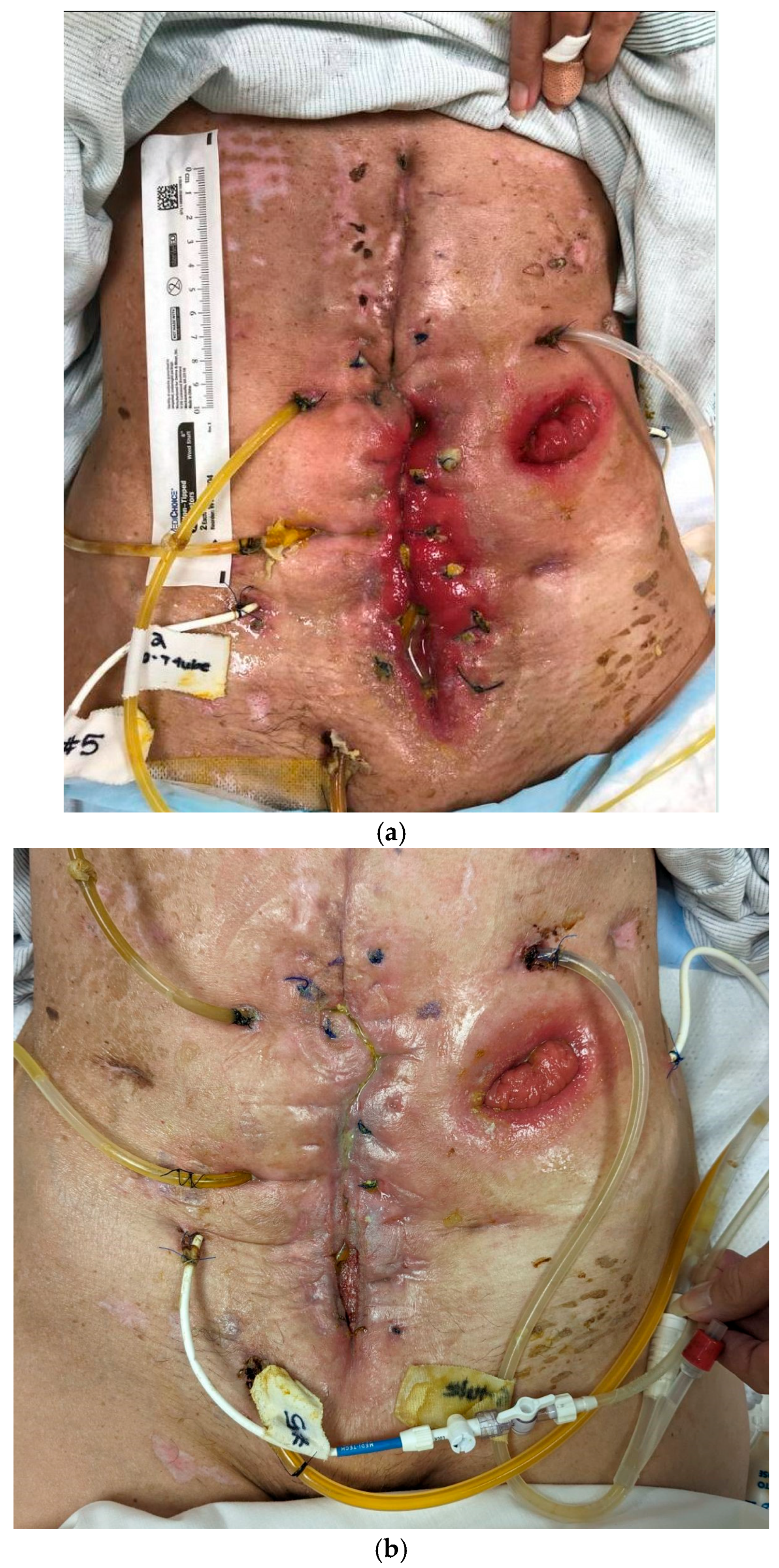
2.3. Skin and Wound Management
3. Optimization of Nutrition Status
3.1. Energy/Protein Prescription
3.2. Enteral vs. Parenteral Nutrition
3.3. Fistuloclysis and Chyme Reinfusion
3.4. Pharmacological and Novel Agents in the Management of Intestinal Failure and ECFs
4. Non-Surgical and Surgical Interventions
4.1. Percutaneous Management of ECFs
4.2. Endoscopic Management of ECFs
4.3. Surgical Intervention
5. Outcomes
6. Future Directions
7. Conclusions
Author Contributions
Funding
Institutional Review Board Statement
Informed Consent Statement
Data Availability Statement
Conflicts of Interest
Abbreviations
| ECF | Enterocutaneous fistula |
| EAF | Enteroatmospheric fistula |
| PICS | Persistent inflammation–immunosuppression catabolic syndrome |
| LOS | Length of stay |
| IF | Intestinal failure |
| ESPEN | European Society for Clinical Nutrition and Metabolism |
| IBD | Inflammatory bowel disease |
| IR | Interventional radiology/radiologist |
| NPWT | Negative pressure wound therapy |
| VAC | Vacuum-assisted closure |
| ASPEN | American Society for Parenteral and Enteral Nutrition |
| FELANPE | Federacion Latinoamericana de Terapia Nutricional, Nutricion Clinica y Metabolismo |
| EN | Enteral nutrition |
| PN | Parenteral nutrition |
| AAT | Acetaminophen absorption test |
| GI | Gastrointestinal |
| REE | Resting energy expenditure |
| TPN | Total parenteral nutrition |
| NPO | Nil per os |
| IFALD | Intestinal failure-associated liver disease |
| PNALD | Parenteral nutrition-associated liver disease |
| GLP | Glucagon-like peptide |
| SBS | Short bowel syndrome |
| NCBA | N-butyl cyanoacrylate |
| TTSC | Through-the-scope clips |
| OTSC | Over-the-scope clips |
| ICG | Indocyanine green |
| TAR | Transversus abdominis release |
References
- Hatchimonji, J.S.; Passman, J.; Kaufman, E.J.; Sharoky, C.E.; Ma, L.W.; Scantling, D.; Xiong, R.; Holena, D.N. Enterocutaneous fistula after emergency general surgery: Mortality, readmission, and financial burden. J. Trauma Acute Care Surg. 2020, 89, 167–172. [Google Scholar] [CrossRef] [PubMed]
- Majercik, S.; Kinikini, M.; White, T. Enteroatmospheric fistula: From soup to nuts. Nutr. Clin. Pract. 2012, 27, 507–512. [Google Scholar] [CrossRef]
- Teixeira, P.G.; Inaba, K.; Dubose, J.; Salim, A.; Brown, C.; Rhee, P.; Browder, T.; Demetriades, D. Enterocutaneous fistula complicating trauma laparotomy: A major resource burden. Am. Surg. 2009, 75, 30–32. [Google Scholar] [CrossRef] [PubMed]
- Dubose, J.J.; Lundy, J.B. Enterocutaneous fistulas in the setting of trauma and critical illness. Clin. Colon Rectal Surg. 2010, 23, 182–189. [Google Scholar] [CrossRef] [PubMed]
- Christensen, M.A.; Gaitanidis, A.; Parks, J.; Mendoza, A.; Saillant, N.; Kaafarani, H.M.A.; Fagenholz, P.; Velmahos, G.; Fawley, J. Thirty-day outcomes in the operative management of intestinal-cutaneous fistulas: A NSQIP analysis. Am. J. Surg. 2021, 221, 1050–1055. [Google Scholar] [CrossRef]
- Hu, D.; Ren, J.; Wang, G.; Gu, G.; Chen, J.; Zhou, B.; Liu, S.; Wu, X.; Li, J. Persistent inflammation-immunosuppression catabolism syndrome, a common manifestation of patients with enterocutaneous fistula in intensive care unit. J. Trauma Acute Care Surg. 2014, 76, 725–729. [Google Scholar] [CrossRef]
- Aguirre, A.; Fischer, J.E.; Welch, C.E. The role of surgery and hyperalimentation in therapy of gastrointestinal-cutaneous fistulae. Ann. Surg. 1974, 180, 393–401. [Google Scholar] [CrossRef] [PubMed]
- Gribovskaja-Rupp, I.; Melton, G.B. Enterocutaneous Fistula: Proven Strategies and Updates. Clin. Colon Rectal Surg. 2016, 29, 130–137. [Google Scholar] [CrossRef]
- Brenner, M.; Clayton, J.L.; Tillou, A.; Hiatt, J.R.; Cryer, H.G. Risk factors for recurrence after repair of enterocutaneous fistula. Arch. Surg. 2009, 144, 500–505. [Google Scholar] [CrossRef]
- Datta, V.; Engledow, A.; Chan, S.; Forbes, A.; Cohen, C.R.; Windsor, A. The management of enterocutaneous fistula in a regional unit in the United kingdom: A prospective study. Dis. Colon Rectum 2010, 53, 192–199. [Google Scholar] [CrossRef]
- Visschers, R.G.; Olde Damink, S.W.; van Bekkum, M.; Winkens, B.; Soeters, P.B.; van Gemert, W.G. Health-related quality of life in patients treated for enterocutaneous fistula. Br. J. Surg. 2008, 95, 1280–1286. [Google Scholar] [CrossRef]
- Gefen, R.; Garoufalia, Z.; Zhou, P.; Watson, K.; Emile, S.H.; Wexner, S.D. Treatment of enterocutaneous fistula: A systematic review and meta-analysis. Tech. Coloproctol. 2022, 26, 863–874. [Google Scholar] [CrossRef] [PubMed]
- Di Saverio, S.; Tarasconi, A.; Walczak, D.A.; Cirocchi, R.; Mandrioli, M.; Birindelli, A.; Tugnoli, G. Classification, prevention and management of entero-atmospheric fistula: A state-of-the-art review. Langenbecks Arch. Surg. 2016, 401, 1–13. [Google Scholar] [CrossRef] [PubMed]
- Pironi, L.; Arends, J.; Baxter, J.; Bozzetti, F.; Pelaez, R.B.; Cuerda, C.; Forbes, A.; Gabe, S.; Gillanders, L.; Holst, M.; et al. ESPEN endorsed recommendations. Definition and classification of intestinal failure in adults. Clin. Nutr. 2015, 34, 171–180. [Google Scholar] [CrossRef] [PubMed]
- Martinez, J.L.; Luque-de-Leon, E.; Mier, J.; Blanco-Benavides, R.; Robledo, F. Systematic management of postoperative enterocutaneous fistulas: Factors related to outcomes. World J. Surg. 2008, 32, 436–443; discussion 444. [Google Scholar] [CrossRef]
- Li, J.; Ren, J.; Zhu, W.; Yin, L.; Han, J. Management of enterocutaneous fistulas: 30-year clinical experience. Chin. Med. J. 2003, 116, 171–175. [Google Scholar]
- Campos, A.C.; Andrade, D.F.; Campos, G.M.; Matias, J.E.; Coelho, J.C. A multivariate model to determine prognostic factors in gastrointestinal fistulas. J. Am. Coll. Surg. 1999, 188, 483–490. [Google Scholar] [CrossRef]
- Hollington, P.; Mawdsley, J.; Lim, W.; Gabe, S.M.; Forbes, A.; Windsor, A.J. An 11-year experience of enterocutaneous fistula. Br. J. Surg. 2004, 91, 1646–1651. [Google Scholar] [CrossRef]
- Draus, J.M., Jr.; Huss, S.A.; Harty, N.J.; Cheadle, W.G.; Larson, G.M. Enterocutaneous fistula: Are treatments improving? Surgery 2006, 140, 570–576; discussion 576–578. [Google Scholar] [CrossRef]
- Reber, H.A.; Roberts, C.; Way, L.W.; Dunphy, J.E. Management of external gastrointestinal fistulas. Ann. Surg. 1978, 188, 460–467. [Google Scholar] [CrossRef]
- Osborn, C.; Fischer, J.E. How I do it: Gastrointestinal cutaneous fistulas. J. Gastrointest. Surg. 2009, 13, 2068–2073. [Google Scholar] [CrossRef]
- Rose, D.; Yarborough, M.F.; Canizaro, P.C.; Lowry, S.F. One hundred and fourteen fistulas of the gastrointestinal tract treated with total parenteral nutrition. Surg. Gynecol. Obstet. 1986, 163, 345–350. [Google Scholar]
- Visschers, R.G.; van Gemert, W.G.; Winkens, B.; Soeters, P.B.; Olde Damink, S.W. Guided treatment improves outcome of patients with enterocutaneous fistulas. World J. Surg. 2012, 36, 2341–2348. [Google Scholar] [CrossRef]
- Lloyd, D.A.; Gabe, S.M.; Windsor, A.C. Nutrition and management of enterocutaneous fistula. Br. J. Surg. 2006, 93, 1045–1055. [Google Scholar] [CrossRef]
- Evenson, A.R.; Fischer, J.E. Current management of enterocutaneous fistula. J. Gastrointest. Surg. 2006, 10, 455–464. [Google Scholar] [CrossRef]
- Schecter, W.P. Management of enterocutaneous fistulas. Surg. Clin. N. Am. 2011, 91, 481–491. [Google Scholar] [CrossRef]
- Fischer, P.E.; Fabian, T.C.; Magnotti, L.J.; Schroeppel, T.J.; Bee, T.K.; Maish, G.O., 3rd; Savage, S.A.; Laing, A.E.; Barker, A.B.; Croce, M.A. A ten-year review of enterocutaneous fistulas after laparotomy for trauma. J. Trauma 2009, 67, 924–928. [Google Scholar] [CrossRef] [PubMed]
- Lynch, A.C.; Delaney, C.P.; Senagore, A.J.; Connor, J.T.; Remzi, F.H.; Fazio, V.W. Clinical outcome and factors predictive of recurrence after enterocutaneous fistula surgery. Ann. Surg. 2004, 240, 825–831. [Google Scholar] [CrossRef] [PubMed]
- Ortiz, L.A.; Zhang, B.; McCarthy, M.W.; Kaafarani, H.M.A.; Fagenholz, P.; King, D.R.; De Moya, M.; Velmahos, G.; Yeh, D.D. Treatment of Enterocutaneous Fistulas, Then and Now. Nutr. Clin. Pract. 2017, 32, 508–515. [Google Scholar] [CrossRef] [PubMed]
- Owen, R.M.; Love, T.P.; Perez, S.D.; Srinivasan, J.K.; Sharma, J.; Pollock, J.D.; Haack, C.I.; Sweeney, J.F.; Galloway, J.R. Definitive surgical treatment of enterocutaneous fistula: Outcomes of a 23-year experience. JAMA Surg. 2013, 148, 118–126. [Google Scholar] [CrossRef] [PubMed]
- Rahbour, G.; Gabe, S.M.; Ullah, M.R.; Thomas, G.P.; Al-Hassi, H.O.; Yassin, N.A.; Tozer, P.J.; Warusavitarne, J.; Vaizey, C.J. Seven-year experience of enterocutaneous fistula with univariate and multivariate analysis of factors associated with healing: Development of a validated scoring system. Color. Dis. 2013, 15, 1162–1170. [Google Scholar] [CrossRef] [PubMed]
- Runstrom, B.; Hallbook, O.; Nystrom, P.O.; Sjodahl, R.; Olaison, G. Outcome of 132 consecutive reconstructive operations for intestinal fistula–staged operation without primary anastomosis improved outcome in retrospective analysis. Scand. J. Surg. 2013, 102, 152–157. [Google Scholar] [CrossRef] [PubMed]
- Kaushal, M.; Carlson, G.L. Management of enterocutaneous fistulas. Clin. Colon Rectal Surg. 2004, 17, 79–88. [Google Scholar] [CrossRef]
- Slade, D.A.; Carlson, G.L. Takedown of enterocutaneous fistula and complex abdominal wall reconstruction. Surg. Clin. N. Am. 2013, 93, 1163–1183. [Google Scholar] [CrossRef]
- Moore, L.; Entelisano, T.; McKean, J.; Vanzant, E.; Rosenthal, M. Protocolized Gastrointestinal Fistula Management is Superior to Historic Data and National Averages: A Retrospective Review of an Enterocutaneous Fistula Registry. Am. Surg. 2026, 92, 716–721. [Google Scholar] [CrossRef]
- Visschers, R.G.; Olde Damink, S.W.; Winkens, B.; Soeters, P.B.; van Gemert, W.G. Treatment strategies in 135 consecutive patients with enterocutaneous fistulas. World J. Surg. 2008, 32, 445–453. [Google Scholar] [CrossRef] [PubMed]
- Fischer, J.E. A cautionary note: The use of vacuum-assisted closure systems in the treatment of gastrointestinal cutaneous fistula may be associated with higher mortality from subsequent fistula development. Am. J. Surg. 2008, 196, 1–2. [Google Scholar] [CrossRef]
- Rao, M.; Burke, D.; Finan, P.J.; Sagar, P.M. The use of vacuum-assisted closure of abdominal wounds: A word of caution. Color. Dis. 2007, 9, 266–268. [Google Scholar] [CrossRef]
- Wainstein, D.E.; Fernandez, E.; Gonzalez, D.; Chara, O.; Berkowski, D. Treatment of high-output enterocutaneous fistulas with a vacuum-compaction device. A ten-year experience. World J. Surg. 2008, 32, 430–435. [Google Scholar] [CrossRef]
- Goverman, J.; Yelon, J.A.; Platz, J.J.; Singson, R.C.; Turcinovic, M. The “Fistula VAC,” a technique for management of enterocutaneous fistulae arising within the open abdomen: Report of 5 cases. J. Trauma 2006, 60, 428–431; discussion 431. [Google Scholar] [CrossRef]
- Alvarez, A.A.; Maxwell, G.L.; Rodriguez, G.C. Vacuum-assisted closure for cutaneous gastrointestinal fistula management. Gynecol. Oncol. 2001, 80, 413–416. [Google Scholar] [CrossRef] [PubMed]
- Bobkiewicz, A.; Walczak, D.; Smolinski, S.; Kasprzyk, T.; Studniarek, A.; Borejsza-Wysocki, M.; Ratajczak, A.; Marciniak, R.; Drews, M.; Banasiewicz, T. Management of enteroatmospheric fistula with negative pressure wound therapy in open abdomen treatment: A multicentre observational study. Int. Wound J. 2017, 14, 255–264. [Google Scholar] [CrossRef]
- Boulanger, K.; Lemaire, V.; Jacquemin, D. Vacuum-assisted closure of enterocutaneous fistula. Acta Chir. Belg. 2007, 107, 703–705. [Google Scholar] [CrossRef] [PubMed]
- Cro, C.; George, K.J.; Donnelly, J.; Irwin, S.T.; Gardiner, K.R. Vacuum assisted closure system in the management of enterocutaneous fistulae. Postgrad. Med. J. 2002, 78, 364–365. [Google Scholar] [CrossRef]
- D’Hondt, M.; Devriendt, D.; Van Rooy, F.; Vansteenkiste, F.; D’Hoore, A.; Penninckx, F.; Miserez, M. Treatment of small-bowel fistulae in the open abdomen with topical negative-pressure therapy. Am. J. Surg. 2011, 202, e20–e24. [Google Scholar] [CrossRef]
- Gunn, L.A.; Follmar, K.E.; Wong, M.S.; Lettieri, S.C.; Levin, L.S.; Erdmann, D. Management of enterocutaneous fistulas using negative-pressure dressings. Ann. Plast. Surg. 2006, 57, 621–625. [Google Scholar] [CrossRef]
- Pepe, G.; Magalini, S.; Callari, C.; Persiani, R.; Lodoli, C.; Gui, D. Vacuum Assisted Closure (VAC) therapyTM as a swiss knife multi-tool for enteric fistula closure: Tips and tricks: A pilot study. Eur. Rev. Med. Pharmacol. Sci. 2014, 18, 2527–2532. [Google Scholar]
- Seternes, A.; Rekstad, L.C.; Lossius, W.; Wasmuth, H.H. A method for treatment of deep and superficial enteroatmospheric fistulas in an open abdomen, ChimneyVAC: Ten years experience. World J. Surg. 2024, 48, 1066–1074. [Google Scholar] [CrossRef]
- Suter, K.J.L.; Fairweather, L.; Al-Habbal, Y.; Houli, N.; Jacobs, R.; Bui, H.T. How to isolate a high output enteroatmospheric fistula in the open abdomen with negative pressure therapy: An institution’s step by step guide to the VAC donut. ANZ J. Surg. 2023, 93, 682–686. [Google Scholar] [CrossRef]
- Kumpf, V.J.; Yeh, D.D. Use of parenteral nutrition in the management of enterocutaneous fistula. Nutr. Clin. Pract. 2025, 40, 64–75. [Google Scholar] [CrossRef] [PubMed]
- Hummell, A.C.; Cummings, M. Role of the nutrition-focused physical examination in identifying malnutrition and its effectiveness. Nutr. Clin. Pract. 2022, 37, 41–49. [Google Scholar] [CrossRef]
- Evans, D.C.; Corkins, M.R.; Malone, A.; Miller, S.; Mogensen, K.M.; Guenter, P.; Jensen, G.L.; Committee, A.M. The Use of Visceral Proteins as Nutrition Markers: An ASPEN Position Paper. Nutr. Clin. Pract. 2021, 36, 22–28. [Google Scholar] [CrossRef]
- Amasene, M.; Besga, A.; Medrano, M.; Urquiza, M.; Rodriguez-Larrad, A.; Tobalina, I.; Barroso, J.; Irazusta, J.; Labayen, I. Nutritional status and physical performance using handgrip and SPPB tests in hospitalized older adults. Clin. Nutr. 2021, 40, 5547–5555. [Google Scholar] [CrossRef] [PubMed]
- Kumpf, V.J.; de Aguilar-Nascimento, J.E.; Diaz-Pizarro Graf, J.I.; Hall, A.M.; McKeever, L.; Steiger, E.; Winkler, M.F.; Compher, C.W. ASPEN-FELANPE Clinical Guidelines: Nutrition Support of Adult Patients with Enterocutaneous Fistula. J. Parenter. Enter. Nutr. 2017, 41, 104–112. [Google Scholar] [CrossRef]
- Clements, J.A.; Heading, R.C.; Nimmo, W.S.; Prescott, L.F. Kinetics of acetaminophen absorption and gastric emptying in man. Clin. Pharmacol. Ther. 1978, 24, 420–431. [Google Scholar] [CrossRef]
- Harasawa, S.; Tani, N.; Suzuki, S.; Miwa, M.; Sakita, R.; Nomiyama, T.; Miwa, T. Gastric emptying in normal subjects and patients with peptic ulcer: A study using the acetaminophen method. Gastroenterol. Jpn. 1979, 14, 1–10. [Google Scholar] [CrossRef]
- Couper, C.; Doriot, A.; Siddiqui, M.T.R.; Steiger, E. Nutrition Management of the High-Output Fistulae. Nutr. Clin. Pract. 2021, 36, 282–296. [Google Scholar] [CrossRef] [PubMed]
- Dickerson, R. Using Nitrogen Balance in Clinical Practice. Hosp. Pharm. 2005, 40, 1081–1087. [Google Scholar] [CrossRef]
- Tang, Q.Q.; Hong, Z.W.; Ren, H.J.; Wu, L.; Wang, G.F.; Gu, G.S.; Chen, J.; Zheng, T.; Wu, X.W.; Ren, J.A.; et al. Nutritional Management of Patients with Enterocutaneous Fistulas: Practice and Progression. Front. Nutr. 2020, 7, 564379. [Google Scholar] [CrossRef]
- Sitges-Serra, A.; Jaurrieta, E.; Sitges-Creus, A. Management of postoperative enterocutaneous fistulas: The roles of parenteral nutrition and surgery. Br. J. Surg. 1982, 69, 147–150. [Google Scholar] [CrossRef]
- Soeters, P.B.; Ebeid, A.M.; Fischer, J.E. Review of 404 patients with gastrointestinal fistulas. Impact of parenteral nutrition. Ann. Surg. 1979, 190, 189–202. [Google Scholar] [CrossRef]
- Melendez, M.; Yeh, D.D. Exploring the long-term risk factors associated with intestinal failure-associated liver disease in pediatric and adult patients: The role of lipid injectable emulsions in the development of liver disease. Nutr. Clin. Pract. 2022, 37, 1142–1151. [Google Scholar] [CrossRef]
- Wang, G.F.; Ren, J.A.; Jiang, J.; Fan, C.G.; Wang, X.B.; Li, J.S. Catheter-related infection in gastrointestinal fistula patients. World J. Gastroenterol. 2004, 10, 1345–1348. [Google Scholar] [CrossRef]
- Ekelund, K.M.; Ekblad, E. Structural, neuronal, and functional adaptive changes in atrophic rat ileum. Gut 1999, 45, 236–245. [Google Scholar] [CrossRef] [PubMed]
- Williams, L.; Armstrong, M.J.; Finan, P.; Sagar, P.; Burke, D. The effect of faecal diversion on human ileum. Gut 2007, 56, 796–801. [Google Scholar] [CrossRef]
- Abrisqueta, J.; Abellan, I.; Lujan, J.; Hernandez, Q.; Parrilla, P. Stimulation of the efferent limb before ileostomy closure: A randomized clinical trial. Dis. Colon Rectum 2014, 57, 1391–1396. [Google Scholar] [CrossRef]
- Duan, M.; Cao, L.; Gao, L.; Gong, J.; Li, Y.; Zhu, W. Chyme Reinfusion Is Associated with Lower Rate of Postoperative Ileus in Crohn’s Disease Patients After Stoma Closure. Dig. Dis. Sci. 2020, 65, 243–249. [Google Scholar] [CrossRef]
- Garfinkle, R.; Demian, M.; Sabboobeh, S.; Moon, J.; Hulme-Moir, M.; Liberman, A.S.; Feinberg, S.; Hayden, D.M.; Chadi, S.A.; Demyttenaere, S.; et al. Bowel stimulation before loop ileostomy closure to reduce postoperative ileus: A multicenter, single-blinded, randomized controlled trial. Surg. Endosc. 2023, 37, 3934–3943. [Google Scholar] [CrossRef] [PubMed]
- Liu, Z.; Fang, L.; Lv, L.; Niu, Z.; Hou, L.; Chen, D.; Zhou, Y.; Guo, D. Self-administered succus entericus reinfusion before ileostomy closure improves short-term outcomes. BMC Surg. 2021, 21, 440. [Google Scholar] [CrossRef]
- Cawich, S.O.; McFarlane, M.; Mitchell, D. Fistuloclysis: A Novel Approach to the Management of Enterocutaneous Fistulae. Internet J. Surg. 2006, 9. [Google Scholar]
- Ham, M.; Horton, K.; Kaunitz, J. Fistuloclysis: Case report and literature review. Nutr. Clin. Pract. 2007, 22, 553–557. [Google Scholar] [CrossRef] [PubMed]
- Peer, S.; Moodley, M.S.; Cassimjee, H.M.; Singh, B. Fistuloclysis—A valuable option for a difficult problem. S. Afr. J. Surg. 2008, 46, 56–57. [Google Scholar] [PubMed]
- Willcutts, K. The Art of Fistuloclysis: Nutritional Management of Enterocutaneous Fistulas. Pract. Gastroenterol. 2010, 34, 47–56. [Google Scholar]
- Willcutts, K.; Mercer, D.; Ziegler, J. Fistuloclysis: An Interprofessional Approach to Nourishing the Fistula Patient. J. Wound Ostomy Cont. Nurs. 2015, 42, 549–553. [Google Scholar] [CrossRef]
- Bissett, I.P. Succus entericus reinfusion to treat postoperative small-bowel fistula. Arch. Surg. 2002, 137, 1446–1447. [Google Scholar] [CrossRef]
- Pataki, I.; Szabo, J.; Varga, P.; Berkes, A.; Nagy, A.; Murphy, F.; Morabito, A.; Rakoczy, G.; Cserni, T. Recycling of bowel content: The importance of the right timing. J. Pediatr. Surg. 2013, 48, 579–584. [Google Scholar] [CrossRef] [PubMed]
- Schafer, K.; Schledt, A.; Linderkamp, O.; Gfrorer, S.; Roth, H. Decrease of cholestasis under “continuous extracorporeal stool transport (CEST)” in prematures and neonates with stomas. Eur. J. Pediatr. Surg. 2000, 10, 224–227. [Google Scholar] [CrossRef]
- Bhat, S.; Sharma, P.; Cameron, N.R.; Bissett, I.P.; O’Grady, G. Chyme Reinfusion for Small Bowel Double Enterostomies and Enteroatmospheric Fistulas in Adult Patients: A Systematic Review. Nutr. Clin. Pract. 2020, 35, 254–264. [Google Scholar] [CrossRef]
- Pflug, A.M.; Utiyama, E.M.; Fontes, B.; Faro, M.; Rasslan, S. Continuous reinfusion of succus entericus associated with fistuloclysis in the management of a complex jejunal fistula on the abdominal wall. Int. J. Surg. Case Rep. 2013, 4, 716–718. [Google Scholar] [CrossRef]
- Coetzee, E.; Rahim, Z.; Boutall, A.; Goldberg, P. Refeeding enteroclysis as an alternative to parenteral nutrition for enteric fistula. Color. Dis. 2014, 16, 823–830. [Google Scholar] [CrossRef]
- Farrer, K.; Kopczynska, M.; Barrett, M.; Harrison, S.; Teubner, A.; Abraham, A.; McWhirter, D.; Epstein, J.; Lal, S.; Carlson, G.L. Chyme reinfusion therapy in adults with severe acute intestinal failure: A descriptive cohort study. JPEN J. Parenter. Enter. Nutr. 2025, 49, 85–93. [Google Scholar] [CrossRef]
- Picot, D.; Layec, S.; Dussaulx, L.; Trivin, F.; Thibault, R. Chyme reinfusion in patients with intestinal failure due to temporary double enterostomy: A 15-year prospective cohort in a referral centre. Clin. Nutr. 2017, 36, 593–600. [Google Scholar] [CrossRef]
- Rinsema, W.; Gouma, D.J.; von Meyenfeldt, M.F.; Soeters, P.B. Reinfusion of secretions from high-output proximal stomas or fistulas. Surg. Gynecol. Obstet. 1988, 167, 372–376. [Google Scholar] [PubMed]
- Teubner, A.; Morrison, K.; Ravishankar, H.R.; Anderson, I.D.; Scott, N.A.; Carlson, G.L. Fistuloclysis can successfully replace parenteral feeding in the nutritional support of patients with enterocutaneous fistula. Br. J. Surg. 2004, 91, 625–631. [Google Scholar] [CrossRef] [PubMed]
- Wu, Y.; Ren, J.; Wang, G.; Zhou, B.; Ding, C.; Gu, G.; Chen, J.; Liu, S.; Li, J. Fistuloclysis improves liver function and nutritional status in patients with high-output upper enteric fistula. Gastroenterol. Res. Pract. 2014, 2014, 941514. [Google Scholar] [CrossRef] [PubMed]
- Clain, J.E.; Go, V.L.; Malagelada, J.R. Inhibitory role of the distal small intestine on the gastric secretory response to meals in man. Gastroenterology 1978, 74, 704–707. [Google Scholar] [CrossRef]
- Glatzle, J.; Kalogeris, T.J.; Zittel, T.T.; Guerrini, S.; Tso, P.; Raybould, H.E. Chylomicron components mediate intestinal lipid-induced inhibition of gastric motor function. Am. J. Physiol. Gastrointest. Liver Physiol. 2002, 282, G86–G91. [Google Scholar] [CrossRef]
- Glatzle, J.; Wang, Y.; Adelson, D.W.; Kalogeris, T.J.; Zittel, T.T.; Tso, P.; Wei, J.Y.; Raybould, H.E. Chylomicron components activate duodenal vagal afferents via a cholecystokinin A receptor-mediated pathway to inhibit gastric motor function in the rat. J. Physiol. 2003, 550, 657–664. [Google Scholar] [CrossRef]
- Jain, N.K.; Boivin, M.; Zinsmeister, A.R.; Brown, M.L.; Malagelada, J.R.; DiMagno, E.P. Effect of ileal perfusion of carbohydrates and amylase inhibitor on gastrointestinal hormones and emptying. Gastroenterology 1989, 96, 377–387. [Google Scholar] [CrossRef]
- Levy, E.; Palmer, D.L.; Frileux, P.; Parc, R.; Huguet, C.; Loygue, J. Inhibition of upper gastrointestinal secretions by reinfusion of succus entericus into the distal small bowel. A clinical study of 30 patients with peritonitis and temporary enterostomy. Ann. Surg. 1983, 198, 596–600. [Google Scholar] [CrossRef]
- Van Citters, G.W.; Lin, H.C. Ileal brake: Neuropeptidergic control of intestinal transit. Curr. Gastroenterol. Rep. 2006, 8, 367–373. [Google Scholar] [CrossRef]
- Koelfat, K.V.K.; Picot, D.; Chang, X.; Desille-Dugast, M.; van Eijk, H.M.; van Kuijk, S.M.J.; Lenicek, M.; Layec, S.; Carsin, M.; Dussaulx, L.; et al. Chyme Reinfusion Restores the Regulatory Bile Salt-FGF19 Axis in Patients with Intestinal Failure. Hepatology 2021, 74, 2670–2683. [Google Scholar] [CrossRef]
- Liao, Y.; Tao, S.; Yao, Z.; Tian, W.; Xu, X.; Zhao, R.; Zhao, Y.; Huang, Q. Chyme reinfusion improved outcomes after definitive surgery for small-intestinal enteroatmospheric fistula in patients with enteral nutrition. Nutr. Clin. Pract. 2022, 37, 634–644. [Google Scholar] [CrossRef]
- Ribeiro-Junior, M.A.F.; Yeh, D.D.; Augusto, S.S.; Elias, Y.G.B.; Neder, P.R.; Costa, C.T.K.; Mauricio, A.D.; Saverio, S.D. The Role of Fistuloclysis in the Treatment of Patients with Enteroatmospheric Fistulas. Arq. Bras. Cir. Dig. 2021, 34, e1605. [Google Scholar] [CrossRef]
- Thibault, R.; Picot, D. Chyme reinfusion or enteroclysis in nutrition of patients with temporary double enterostomy or enterocutaneous fistula. Curr. Opin. Clin. Nutr. Metab. Care 2016, 19, 382–387. [Google Scholar] [CrossRef]
- Niu, D.G.; Yang, F.; Tian, W.L.; Zhao, Y.Z.; Li, C.; Ding, L.A.; Fang, H.C.; Huang, Q. A technique to establish fistuloclysis for high-output jejunocutaneous fistula through percutaneous enterostomy: A case report. Medicine 2019, 98, e14653. [Google Scholar] [CrossRef]
- de Vries, F.E.E.; Reeskamp, L.F.; van Ruler, O.; van Arum, I.; Kuin, W.; Dijksta, G.; Haveman, J.W.; Boermeester, M.A.; Serlie, M.J. Systematic review: Pharmacotherapy for high-output enterostomies or enteral fistulas. Aliment. Pharmacol. Ther. 2017, 46, 266–273. [Google Scholar] [CrossRef]
- Parli, S.E.; Pfeifer, C.; Oyler, D.R.; Magnuson, B.; Procter, L.D. Redefining “bowel regimen”: Pharmacologic strategies and nutritional considerations in the management of small bowel fistulas. Am. J. Surg. 2018, 216, 351–358. [Google Scholar] [CrossRef]
- Nubiola-Calonge, P.; Badia, J.M.; Sancho, J.; Gil, M.J.; Segura, M.; Sitges-Serra, A. Blind evaluation of the effect of octreotide (SMS 201-995), a somatostatin analogue, on small-bowel fistula output. Lancet 1987, 2, 672–674. [Google Scholar] [CrossRef]
- Rahbour, G.; Siddiqui, M.R.; Ullah, M.R.; Gabe, S.M.; Warusavitarne, J.; Vaizey, C.J. A meta-analysis of outcomes following use of somatostatin and its analogues for the management of enterocutaneous fistulas. Ann. Surg. 2012, 256, 946–954. [Google Scholar] [CrossRef]
- Sancho, J.J.; di Costanzo, J.; Nubiola, P.; Larrad, A.; Beguiristain, A.; Roqueta, F.; Franch, G.; Oliva, A.; Gubern, J.M.; Sitges-Serra, A. Randomized double-blind placebo-controlled trial of early octreotide in patients with postoperative enterocutaneous fistula. Br. J. Surg. 1995, 82, 638–641. [Google Scholar] [CrossRef]
- Scott, N.A.; Finnegan, S.; Irving, M.H. Octreotide and postoperative enterocutaneous fistulae: A controlled prospective study. Acta Gastro-Enterol. Belg. 1993, 56, 266–270. [Google Scholar]
- Alvarez, C.; McFadden, D.W.; Reber, H.A. Complicated enterocutaneous fistulas: Failure of octreotide to improve healing. World J. Surg. 2000, 24, 533–537; discussion 538. [Google Scholar] [CrossRef]
- Ukleja, A.; To, C.; Alvarez, A.; Lara, L.F. Long-Term Therapy with Teduglutide in Parenteral Support-Dependent Patients with Short Bowel Syndrome: A Case Series. JPEN J. Parenter. Enter. Nutr. 2018, 42, 821–825. [Google Scholar] [CrossRef]
- Londong, W.; Angerer, M.; Kutz, K.; Landgraf, R.; Londong, V. Diminishing efficacy of octreotide (SMS 201-995) on gastric functions of healthy subjects during one-week administration. Gastroenterology 1989, 96, 713–722. [Google Scholar] [CrossRef]
- Waddell, B.E.; Calton, W.C., Jr.; Steinberg, S.R.; Martindale, R.G. The adverse effects of octreotide on wound healing in rats. Am. Surg. 1997, 63, 446–449. [Google Scholar]
- Thompson, J.S. Somatostatin analogue predisposes enterocytes to apoptosis. J. Gastrointest. Surg. 1998, 2, 167–173. [Google Scholar] [CrossRef]
- Thompson, J.S.; Nguyen, B.L.; Harty, R.F. Somatostatin analogue inhibits intestinal regeneration. Arch. Surg. 1993, 128, 385–389. [Google Scholar] [CrossRef]
- Jeppesen, P.B.; Pertkiewicz, M.; Messing, B.; Iyer, K.; Seidner, D.L.; O’Keefe, S.J.; Forbes, A.; Heinze, H.; Joelsson, B. Teduglutide reduces need for parenteral support among patients with short bowel syndrome with intestinal failure. Gastroenterology 2012, 143, 1473–1481 e3. [Google Scholar] [CrossRef]
- Jeppesen, P.B. Teduglutide, a novel glucagon-like peptide 2 analog, in the treatment of patients with short bowel syndrome. Ther. Adv. Gastroenterol. 2012, 5, 159–171. [Google Scholar] [CrossRef]
- Guan, X.; Karpen, H.E.; Stephens, J.; Bukowski, J.T.; Niu, S.; Zhang, G.; Stoll, B.; Finegold, M.J.; Holst, J.J.; Hadsell, D.; et al. GLP-2 receptor localizes to enteric neurons and endocrine cells expressing vasoactive peptides and mediates increased blood flow. Gastroenterology 2006, 130, 150–164. [Google Scholar] [CrossRef] [PubMed]
- Yeh, D.D.; Vasileiou, G.; Abdul Jawad, K.; Pust, G.D.; Byers, P.M. Teduglutide for the treatment of low-output enterocutaneous fistula—A pilot randomized controlled study. Clin. Nutr. ESPEN 2022, 50, 49–55. [Google Scholar] [CrossRef]
- Tripathi, T.; Mohan, S.; Alfaifi, H.A.; Farasani, A.; Roopashree, R.; Sharma, P.; Sharma, A.; Koul, A.; Prasad, G.V.S.; Rustagi, S.; et al. Efficacy and safety of stem cell therapy for fistula management: An overview of existing systematic reviews. Int. J. Surg. 2024, 110, 7573–7584. [Google Scholar] [CrossRef] [PubMed]
- D’Harcour, J.B.; Boverie, J.H.; Dondelinger, R.F. Percutaneous management of enterocutaneous fistulas. AJR Am. J. Roentgenol. 1996, 167, 33–38. [Google Scholar] [CrossRef]
- Ballard, D.H.; Erickson, A.E.M.; Ahuja, C.; Vea, R.; Sangster, G.P.; D’Agostino, H.B. Percutaneous management of enterocutaneous fistulae and abscess-fistula complexes. Dig. Dis. Interv. 2018, 2, 131–140. [Google Scholar] [CrossRef]
- Lopez, J.; Rodriguez, K.; Targarona, E.M.; Guzman, H.; Corral, I.; Gameros, R.; Reyes, A. Systematic review of cyanoacrylate embolization for refractory gastrointestinal fistulae: A promising therapy. Surg. Innov. 2015, 22, 88–96. [Google Scholar] [CrossRef]
- Avalos-Gonzalez, J.; Portilla-deBuen, E.; Leal-Cortes, C.A.; Orozco-Mosqueda, A.; Estrada-Aguilar Mdel, C.; Velazquez-Ramirez, G.A.; Ambriz-Gonzalez, G.; Fuentes-Orozco, C.; Guzman-Gurrola, A.E.; Gonzalez-Ojeda, A. Reduction of the closure time of postoperative enterocutaneous fistulas with fibrin sealant. World J. Gastroenterol. 2010, 16, 2793–2800. [Google Scholar] [CrossRef]
- de Moura, D.T.H.; Sachdev, A.H.; Thompson, C.C. Endoscopic Full-Thickness Defects and Closure Techniques. Curr. Treat. Options Gastroenterol. 2018, 16, 386–405. [Google Scholar] [CrossRef] [PubMed]
- Kumar, N.; Larsen, M.C.; Thompson, C.C. Endoscopic Management of Gastrointestinal Fistulae. Gastroenterol. Hepatol. 2014, 10, 452–495. [Google Scholar]
- Rogalski, P.; Daniluk, J.; Baniukiewicz, A.; Wroblewski, E.; Dabrowski, A. Endoscopic management of gastrointestinal perforations, leaks and fistulas. World J. Gastroenterol. 2015, 21, 10542–10552. [Google Scholar] [CrossRef]
- Okazaki, O.; Bernardo, W.M.; Brunaldi, V.O.; Junior, C.C.C.; Minata, M.K.; de Moura, D.T.H.; de Souza, T.F.; Campos, J.M.; Santo, M.A.; de Moura, E.G.H. Efficacy and Safety of Stents in the Treatment of Fistula After Bariatric Surgery: A Systematic Review and Meta-analysis. Obes. Surg. 2018, 28, 1788–1796. [Google Scholar] [CrossRef]
- Haito-Chavez, Y.; Law, J.K.; Kratt, T.; Arezzo, A.; Verra, M.; Morino, M.; Sharaiha, R.Z.; Poley, J.W.; Kahaleh, M.; Thompson, C.C.; et al. International multicenter experience with an over-the-scope clipping device for endoscopic management of GI defects (with video). Gastrointest. Endosc. 2014, 80, 610–622. [Google Scholar] [CrossRef]
- Weiland, T.; Fehlker, M.; Gottwald, T.; Schurr, M.O. Performance of the OTSC System in the endoscopic closure of gastrointestinal fistulae—A meta-analysis. Minim. Invasive Ther. Allied Technol. 2012, 21, 249–258. [Google Scholar] [CrossRef]
- Coppola, F.; Boccuzzi, G.; Rossi, G.; Gaia, S.; Cosimato, M.; Recchia, S. Cardiac septal umbrella for closure of a tracheoesophageal fistula. Endoscopy 2010, 42, E318–E319. [Google Scholar] [CrossRef]
- Lee, H.J.; Jung, E.S.; Park, M.S.; Chung, H.S.; Choi, J.Y.; Lee, K.J.; Lee, J.S.; Kil, H.K.; Lee, Y.C. Closure of a gastrotracheal fistula using a cardiac septal occluder device. Endoscopy 2011, 43, E53–E54. [Google Scholar] [CrossRef]
- Kumbhari, V.; Storm, A.C.; Saxena, P.; Okolo, P.I., 3rd. Closure of a persistent gastric leak using a cardiac septal occluder. Endoscopy 2014, 46, E147–E148. [Google Scholar] [CrossRef] [PubMed]
- Melmed, G.Y.; Kar, S.; Geft, I.; Lo, S.K. A new method for endoscopic closure of gastrocolonic fistula: Novel application of a cardiac septal defect closure device (with video). Gastrointest. Endosc. 2009, 70, 542–545. [Google Scholar] [CrossRef] [PubMed]
- Toussaint, E.; Eisendrath, P.; Kwan, V.; Dugardeyn, S.; Deviere, J.; Le Moine, O. Endoscopic treatment of postoperative enterocutaneous fistulas after bariatric surgery with the use of a fistula plug: Report of five cases. Endoscopy 2009, 41, 560–563. [Google Scholar] [CrossRef] [PubMed]
- Abidi, W.M.; Thompson, C.C. Endoscopic treatment of a chronic fistula by resection and sutured closure. Gastrointest. Endosc. 2016, 83, 1031–1032. [Google Scholar] [CrossRef]
- Armengol-Miro, J.R.; Dot, J.; Abu-Suboh Abadia, M.; Masachs, M.; Salord, J.C.; Armengol Bertroli, J.; Benages, A.; Kantsevoy, S.V. New endoscopic suturing device for closure of chronic gastrocutaneous fistula in an immunocompromised patient. Endoscopy 2011, 43, E403–E404. [Google Scholar] [CrossRef]
- Ge, P.S.; Thompson, C.C. The Use of the Overstitch to Close Perforations and Fistulas. Gastrointest. Endosc. Clin. N. Am. 2020, 30, 147–161. [Google Scholar] [CrossRef]
- Kantsevoy, S.V.; Thuluvath, P.J. Successful closure of a chronic refractory gastrocutaneous fistula with a new endoscopic suturing device (with video). Gastrointest. Endosc. 2012, 75, 688–690. [Google Scholar] [CrossRef]
- Mukewar, S.; Kumar, N.; Catalano, M.; Thompson, C.; Abidi, W.; Harmsen, W.; Enders, F.; Gostout, C. Safety and efficacy of fistula closure by endoscopic suturing: A multi-center study. Endoscopy 2016, 48, 1023–1028. [Google Scholar] [CrossRef]
- Sharaiha, R.Z.; Kumta, N.A.; DeFilippis, E.M.; Dimaio, C.J.; Gonzalez, S.; Gonda, T.; Rogart, J.; Siddiqui, A.; Berg, P.S.; Samuels, P.; et al. A Large Multicenter Experience with Endoscopic Suturing for Management of Gastrointestinal Defects and Stent Anchorage in 122 Patients: A Retrospective Review. J. Clin. Gastroenterol. 2016, 50, 388–392. [Google Scholar] [CrossRef]
- Wu, E.; Garberoglio, R.; Scharf, K. Endoluminal closure of gastrogastric fistula. Surg. Obes. Relat. Dis. 2016, 12, 705–706. [Google Scholar] [CrossRef]
- Pross, M.; Manger, T.; Reinheckel, T.; Mirow, L.; Kunz, D.; Lippert, H. Endoscopic treatment of clinically symptomatic leaks of thoracic esophageal anastomoses. Gastrointest. Endosc. 2000, 51, 73–76. [Google Scholar] [CrossRef] [PubMed]
- Arezzo, A.; Verra, M.; Passera, R.; Bullano, A.; Rapetti, L.; Morino, M. Long-term efficacy of endoscopic vacuum therapy for the treatment of colorectal anastomotic leaks. Dig. Liver Dis. 2015, 47, 342–345. [Google Scholar] [CrossRef]
- Babor, R.; Talbot, M.; Tyndal, A. Treatment of upper gastrointestinal leaks with a removable, covered, self-expanding metallic stent. Surg. Laparosc. Endosc. Percutan. Tech. 2009, 19, e1–e4. [Google Scholar] [CrossRef]
- Blackmon, S.H.; Santora, R.; Schwarz, P.; Barroso, A.; Dunkin, B.J. Utility of removable esophageal covered self-expanding metal stents for leak and fistula management. Ann. Thorac. Surg. 2010, 89, 931–936; discussion 936–937. [Google Scholar] [CrossRef]
- Hunerbein, M.; Stroszczynski, C.; Moesta, K.T.; Schlag, P.M. Treatment of thoracic anastomotic leaks after esophagectomy with self-expanding plastic stents. Ann. Surg. 2004, 240, 801–807. [Google Scholar] [CrossRef] [PubMed]
- Kauer, W.K.; Stein, H.J.; Dittler, H.J.; Siewert, J.R. Stent implantation as a treatment option in patients with thoracic anastomotic leaks after esophagectomy. Surg. Endosc. 2008, 22, 50–53. [Google Scholar] [CrossRef]
- Langer, F.B.; Wenzl, E.; Prager, G.; Salat, A.; Miholic, J.; Mang, T.; Zacherl, J. Management of postoperative esophageal leaks with the Polyflex self-expanding covered plastic stent. Ann. Thorac. Surg. 2005, 79, 398–403; discussion 404. [Google Scholar] [CrossRef]
- Dasari, B.V.; Neely, D.; Kennedy, A.; Spence, G.; Rice, P.; Mackle, E.; Epanomeritakis, E. The role of esophageal stents in the management of esophageal anastomotic leaks and benign esophageal perforations. Ann. Surg. 2014, 259, 852–860. [Google Scholar] [CrossRef]
- Leers, J.M.; Vivaldi, C.; Schafer, H.; Bludau, M.; Brabender, J.; Lurje, G.; Herbold, T.; Holscher, A.H.; Metzger, R. Endoscopic therapy for esophageal perforation or anastomotic leak with a self-expandable metallic stent. Surg. Endosc. 2009, 23, 2258–2262. [Google Scholar] [CrossRef]
- Choi, C.W.; Kang, D.H.; Kim, H.W.; Park, S.B.; Kim, S.J.; Hwang, S.H.; Lee, S.H. Full covered self-expandable metal stents for the treatment of anastomotic leak using a silk thread. Medicine 2017, 96, e7439. [Google Scholar] [CrossRef] [PubMed]
- Dallal, R.M.; Datta, T.; Trang, A. Repair of acute gastroesophageal leak after laparoscopic gastric bypass using a covered stent. Surg. Obes. Relat. Dis. 2007, 3, 652–653. [Google Scholar] [CrossRef]
- Edwards, C.A.; Bui, T.P.; Astudillo, J.A.; de la Torre, R.A.; Miedema, B.W.; Ramaswamy, A.; Fearing, N.M.; Ramshaw, B.J.; Thaler, K.; Scott, J.S. Management of anastomotic leaks after Roux-en-Y bypass using self-expanding polyester stents. Surg. Obes. Relat. Dis. 2008, 4, 594–599; discussion 599–600. [Google Scholar] [CrossRef]
- Eisendrath, P.; Cremer, M.; Himpens, J.; Cadiere, G.B.; Le Moine, O.; Deviere, J. Endotherapy including temporary stenting of fistulas of the upper gastrointestinal tract after laparoscopic bariatric surgery. Endoscopy 2007, 39, 625–630. [Google Scholar] [CrossRef] [PubMed]
- Kriwanek, S.; Ott, N.; Ali-Abdullah, S.; Pulgram, T.; Tscherney, R.; Reiter, M.; Roka, R. Treatment of gastro-jejunal leakage and fistulization after gastric bypass with coated self-expanding stents. Obes. Surg. 2006, 16, 1669–1674. [Google Scholar] [CrossRef]
- Martin-Malagon, A.; Arteaga-Gonzalez, I.; Rodriguez-Ballester, L.; Diaz-Romero, F. Gastroesophageal junction leak with serious sepsis after gastric bypass: Successful treatment with endoscopy-assisted intraluminal esophageal drainage and self-expandable covered metal stent. Obes. Surg. 2010, 20, 240–243. [Google Scholar] [CrossRef]
- Thaler, K. Treatment of leaks and other bariatric complications with endoluminal stents. J. Gastrointest. Surg. 2009, 13, 1567–1569. [Google Scholar] [CrossRef]
- Fukumoto, R.; Orlina, J.; McGinty, J.; Teixeira, J. Use of Polyflex stents in treatment of acute esophageal and gastric leaks after bariatric surgery. Surg. Obes. Relat. Dis. 2007, 3, 68–71; discussion 71–72. [Google Scholar] [CrossRef] [PubMed]
- Murino, A.; Arvanitakis, M.; Le Moine, O.; Blero, D.; Deviere, J.; Eisendrath, P. Effectiveness of Endoscopic Management Using Self-Expandable Metal Stents in a Large Cohort of Patients with Post-bariatric Leaks. Obes. Surg. 2015, 25, 1569–1576. [Google Scholar] [CrossRef]
- Puli, S.R.; Spofford, I.S.; Thompson, C.C. Use of self-expandable stents in the treatment of bariatric surgery leaks: A systematic review and meta-analysis. Gastrointest. Endosc. 2012, 75, 287–293. [Google Scholar] [CrossRef]
- Serra, C.; Baltasar, A.; Andreo, L.; Perez, N.; Bou, R.; Bengochea, M.; Chisbert, J.J. Treatment of gastric leaks with coated self-expanding stents after sleeve gastrectomy. Obes. Surg. 2007, 17, 866–872. [Google Scholar] [CrossRef] [PubMed]
- Willingham, F.F.; Buscaglia, J.M. Endoscopic Management of Gastrointestinal Leaks and Fistulae. Clin. Gastroenterol. Hepatol. 2015, 13, 1714–1721. [Google Scholar] [CrossRef]
- Freedman, J.; Jonas, E.; Naslund, E.; Nilsson, H.; Marsk, R.; Stockeld, D. Treatment of leaking gastrojejunostomy after gastric bypass surgery with special emphasis on stenting. Surg. Obes. Relat. Dis. 2013, 9, 554–558. [Google Scholar] [CrossRef]
- Fujii, L.L.; Bonin, E.A.; Baron, T.H.; Gostout, C.J.; Wong Kee Song, L.M. Utility of an endoscopic suturing system for prevention of covered luminal stent migration in the upper GI tract. Gastrointest. Endosc. 2013, 78, 787–793. [Google Scholar] [CrossRef]
- Rieder, E.; Dunst, C.M.; Martinec, D.V.; Cassera, M.A.; Swanstrom, L.L. Endoscopic suture fixation of gastrointestinal stents: Proof of biomechanical principles and early clinical experience. Endoscopy 2012, 44, 1121–1126. [Google Scholar] [CrossRef]
- Wilcox, V.T.; Huang, A.Y.; Tariq, N.; Dunkin, B.J. Endoscopic suture fixation of self-expanding metallic stents with and without submucosal injection. Surg. Endosc. 2015, 29, 24–29. [Google Scholar] [CrossRef] [PubMed]
- Tuebergen, D.; Rijcken, E.; Mennigen, R.; Hopkins, A.M.; Senninger, N.; Bruewer, M. Treatment of thoracic esophageal anastomotic leaks and esophageal perforations with endoluminal stents: Efficacy and current limitations. J. Gastrointest. Surg. 2008, 12, 1168–1176. [Google Scholar] [CrossRef]
- Hwang, J.J.; Jeong, Y.S.; Park, Y.S.; Yoon, H.; Shin, C.M.; Kim, N.; Lee, D.H. Comparison of Endoscopic Vacuum Therapy and Endoscopic Stent Implantation with Self-Expandable Metal Stent in Treating Postsurgical Gastroesophageal Leakage. Medicine 2016, 95, e3416. [Google Scholar] [CrossRef]
- Bhurwal, A.; Mutneja, H.; Tawadross, A.; Pioppo, L.; Brahmbhatt, B. Gastrointestinal fistula endoscopic closure techniques. Ann. Gastroenterol. 2020, 33, 554–562. [Google Scholar] [CrossRef]
- Mercky, P.; Gonzalez, J.M.; Aimore Bonin, E.; Emungania, O.; Brunet, J.; Grimaud, J.C.; Barthet, M. Usefulness of over-the-scope clipping system for closing digestive fistulas. Dig. Endosc. 2015, 27, 18–24. [Google Scholar] [CrossRef]
- Voermans, R.P.; van Berge Henegouwen, M.I.; Bemelman, W.A.; Fockens, P. Novel over-the-scope-clip system for gastrotomy closure in natural orifice transluminal endoscopic surgery (NOTES): An ex vivo comparison study. Endoscopy 2009, 41, 1052–1055. [Google Scholar] [CrossRef]
- von Renteln, D.; Schmidt, A.; Vassiliou, M.C.; Gieselmann, M.; Caca, K. Natural orifice transluminal endoscopic surgery gastrotomy closure with an over-the-endoscope clip: A randomized, controlled porcine study (with videos). Gastrointest. Endosc. 2009, 70, 732–739. [Google Scholar] [CrossRef]
- Law, R.; Wong Kee Song, L.M.; Irani, S.; Baron, T.H. Immediate technical and delayed clinical outcome of fistula closure using an over-the-scope clip device. Surg. Endosc. 2015, 29, 1781–1786. [Google Scholar] [CrossRef]
- Mennigen, R.; Colombo-Benkmann, M.; Senninger, N.; Laukoetter, M. Endoscopic closure of postoperative gastrointestinal leakages and fistulas with the Over-the-Scope Clip (OTSC). J. Gastrointest. Surg. 2013, 17, 1058–1065. [Google Scholar] [CrossRef]
- von Renteln, D.; Denzer, U.W.; Schachschal, G.; Anders, M.; Groth, S.; Rosch, T. Endoscopic closure of GI fistulae by using an over-the-scope clip (with videos). Gastrointest. Endosc. 2010, 72, 1289–1296. [Google Scholar] [CrossRef]
- Brangewitz, M.; Voigtlander, T.; Helfritz, F.A.; Lankisch, T.O.; Winkler, M.; Klempnauer, J.; Manns, M.P.; Schneider, A.S.; Wedemeyer, J. Endoscopic closure of esophageal intrathoracic leaks: Stent versus endoscopic vacuum-assisted closure, a retrospective analysis. Endoscopy 2013, 45, 433–438. [Google Scholar] [CrossRef]
- Kuehn, F.; Schiffmann, L.; Janisch, F.; Schwandner, F.; Alsfasser, G.; Gock, M.; Klar, E. Surgical Endoscopic Vacuum Therapy for Defects of the Upper Gastrointestinal Tract. J. Gastrointest. Surg. 2016, 20, 237–243. [Google Scholar] [CrossRef]
- Rausa, E.; Asti, E.; Aiolfi, A.; Bianco, F.; Bonitta, G.; Bonavina, L. Comparison of endoscopic vacuum therapy versus endoscopic stenting for esophageal leaks: Systematic review and meta-analysis. Dis. Esophagus 2018, 31, doy060. [Google Scholar] [CrossRef] [PubMed]
- Smallwood, N.R.; Fleshman, J.W.; Leeds, S.G.; Burdick, J.S. The use of endoluminal vacuum (E-Vac) therapy in the management of upper gastrointestinal leaks and perforations. Surg. Endosc. 2016, 30, 2473–2480. [Google Scholar] [CrossRef]
- Wedemeyer, J.; Brangewitz, M.; Kubicka, S.; Jackobs, S.; Winkler, M.; Neipp, M.; Klempnauer, J.; Manns, M.P.; Schneider, A.S. Management of major postsurgical gastroesophageal intrathoracic leaks with an endoscopic vacuum-assisted closure system. Gastrointest. Endosc. 2010, 71, 382–386. [Google Scholar] [CrossRef]
- Wedemeyer, J.; Schneider, A.; Manns, M.P.; Jackobs, S. Endoscopic vacuum-assisted closure of upper intestinal anastomotic leaks. Gastrointest. Endosc. 2008, 67, 708–711. [Google Scholar] [CrossRef]
- Bludau, M.; Fuchs, H.F.; Herbold, T.; Maus, M.K.H.; Alakus, H.; Popp, F.; Leers, J.M.; Bruns, C.J.; Holscher, A.H.; Schroder, W.; et al. Results of endoscopic vacuum-assisted closure device for treatment of upper GI leaks. Surg. Endosc. 2018, 32, 1906–1914. [Google Scholar] [CrossRef]
- Glitsch, A.; von Bernstorff, W.; Seltrecht, U.; Partecke, I.; Paul, H.; Heidecke, C.D. Endoscopic transanal vacuum-assisted rectal drainage (ETVARD): An optimized therapy for major leaks from extraperitoneal rectal anastomoses. Endoscopy 2008, 40, 192–199. [Google Scholar] [CrossRef]
- Kuehn, F.; Janisch, F.; Schwandner, F.; Alsfasser, G.; Schiffmann, L.; Gock, M.; Klar, E. Endoscopic Vacuum Therapy in Colorectal Surgery. J. Gastrointest. Surg. 2016, 20, 328–334. [Google Scholar] [CrossRef]
- van Koperen, P.J.; van Berge Henegouwen, M.I.; Rosman, C.; Bakker, C.M.; Heres, P.; Slors, J.F.; Bemelman, W.A. The Dutch multicenter experience of the endo-sponge treatment for anastomotic leakage after colorectal surgery. Surg. Endosc. 2009, 23, 1379–1383. [Google Scholar] [CrossRef]
- Weidenhagen, R.; Gruetzner, K.U.; Wiecken, T.; Spelsberg, F.; Jauch, K.W. Endoscopic vacuum-assisted closure of anastomotic leakage following anterior resection of the rectum: A new method. Surg. Endosc. 2008, 22, 1818–1825. [Google Scholar] [CrossRef]
- Leeds, S.G.; Mencio, M.; Ontiveros, E.; Ward, M.A. Endoluminal Vacuum Therapy: How I Do It. J. Gastrointest. Surg. 2019, 23, 1037–1043. [Google Scholar] [CrossRef]
- Bonanomi, G.; Prince, J.M.; McSteen, F.; Schauer, P.R.; Hamad, G.G. Sealing effect of fibrin glue on the healing of gastrointestinal anastomoses: Implications for the endoscopic treatment of leaks. Surg. Endosc. 2004, 18, 1620–1624. [Google Scholar] [CrossRef]
- Brady, A.P.; Malone, D.E.; Tam, P.; McGrath, F.P. Closure of a duodenal fistula with fibrin sealant. J. Vasc. Interv. Radiol. 1993, 4, 525–527; discussion 527–529. [Google Scholar] [CrossRef]
- Murakami, M.; Tono, T.; Okada, K.; Yano, H.; Monden, T. Fibrin glue injection method with diluted thrombin for refractory postoperative digestive fistula. Am. J. Surg. 2009, 198, 715–719. [Google Scholar] [CrossRef] [PubMed]
- Araujo-Miguez, A.; Sobrino-Rodriguez, S.; Avila-Carpio, A.D.; Bozada-Garcia, J.M.; Lopez-Ruiz, T.; Caballero-Garcia, J.; Marquez-Galan, J.L. Successful endoscopic treatment using biological fibrin glue (Tissucol) for an enterocutaneous fistula occurring after cephalic duodenopancreatectomy. Endoscopy 2015, 47, E191. [Google Scholar] [CrossRef]
- Brolin, R.E.; Lin, J.M. Treatment of gastric leaks after Roux-en-Y gastric bypass: A paradigm shift. Surg. Obes. Relat. Dis. 2013, 9, 229–233. [Google Scholar] [CrossRef] [PubMed]
- Bohm, G.; Mossdorf, A.; Klink, C.; Klinge, U.; Jansen, M.; Schumpelick, V.; Truong, S. Treatment algorithm for postoperative upper gastrointestinal fistulas and leaks using combined vicryl plug and fibrin glue. Endoscopy 2010, 42, 599–602. [Google Scholar] [CrossRef] [PubMed]
- Garcia-Caballero, M.; Carbajo, M.; Martinez-Moreno, J.M.; Sarria, M.; Osorio, D.; Carmona, J.A. Drain erosion and gastro-jejunal fistula after one-anastomosis gastric bypass: Endoscopic occlusion by fibrin sealant. Obes. Surg. 2005, 15, 719–722. [Google Scholar] [CrossRef]
- Kowalski, C.; Kastuar, S.; Mehta, V.; Brolin, R.E. Endoscopic injection of fibrin sealant in repair of gastrojejunostomy leak after laparoscopic Roux-en-Y gastric bypass. Surg. Obes. Relat. Dis. 2007, 3, 438–442. [Google Scholar] [CrossRef]
- Papavramidis, S.T.; Eleftheriadis, E.E.; Apostolidis, D.N.; Kotzampassi, K.E. Endoscopic fibrin sealing of high-output non-healing gastrocutaneous fistulas after vertical gastroplasty in morbidly obese patients. Obes. Surg. 2001, 11, 766–769. [Google Scholar] [CrossRef]
- Papavramidis, T.S.; Kotzampassi, K.; Kotidis, E.; Eleftheriadis, E.E.; Papavramidis, S.T. Endoscopic fibrin sealing of gastrocutaneous fistulas after sleeve gastrectomy and biliopancreatic diversion with duodenal switch. J. Gastroenterol. Hepatol. 2008, 23, 1802–1805. [Google Scholar] [CrossRef]
- Kotzampassi, K.; Eleftheriadis, E. Tissue sealants in endoscopic applications for anastomotic leakage during a 25-year period. Surgery 2015, 157, 79–86. [Google Scholar] [CrossRef]
- Victorzon, M.; Victorzon, S.; Peromaa-Haavisto, P. Fibrin glue and stents in the treatment of gastrojejunal leaks after laparoscopic gastric bypass: A case series and review of the literature. Obes. Surg. 2013, 23, 1692–1697. [Google Scholar] [CrossRef]
- Truong, S.; Bohm, G.; Klinge, U.; Stumpf, M.; Schumpelick, V. Results after endoscopic treatment of postoperative upper gastrointestinal fistulas and leaks using combined Vicryl plug and fibrin glue. Surg. Endosc. 2004, 18, 1105–1108. [Google Scholar] [CrossRef]
- Valli, P.V.; Mertens, J.C.; Kroger, A.; Gubler, C.; Gutschow, C.; Schneider, P.M.; Bauerfeind, P. Stent-over-sponge (SOS): A novel technique complementing endosponge therapy for foregut leaks and perforations. Endoscopy 2018, 50, 148–153. [Google Scholar] [CrossRef]
- Fazio, V.W.; Coutsoftides, T.; Steiger, E. Factors influencing the outcome of treatment of small bowel cutaneous fistula. World J. Surg. 1983, 7, 481–488. [Google Scholar] [CrossRef]
- Pastier, C.; Collard, M.K.; Challine, A.; Chafai, N.; O’Connell, L.V.; Voron, T.; Lefevre, J.H.; Parc, Y. Timing of Curative Surgery in Postoperative Enterocutaneous Fistulas: A Retrospective Cohort Study of 200 Patients. Ann. Surg. 2025, 282, 772–781. [Google Scholar] [CrossRef] [PubMed]
- Trastulli, S.; Munzi, G.; Desiderio, J.; Cirocchi, R.; Rossi, M.; Parisi, A. Indocyanine green fluorescence angiography versus standard intraoperative methods for prevention of anastomotic leak in colorectal surgery: Meta-analysis. Br. J. Surg. 2021, 108, 359–372. [Google Scholar] [CrossRef] [PubMed]
- Latifi, R.; Gustafson, M. Abdominal wall reconstruction in patients with enterocutaneous fistulas. Eur. J. Trauma Emerg. Surg. 2011, 37, 241–250. [Google Scholar] [CrossRef] [PubMed]
- Slater, N.J.; Bokkerink, W.J.; Konijn, V.; Bleichrodt, R.P.; van Goor, H. Safety and durability of one-stage repair of abdominal wall defects with enteric fistulas. Ann. Surg. 2015, 261, 553–557. [Google Scholar] [CrossRef]
- Wind, J.; van Koperen, P.J.; Slors, J.F.; Bemelman, W.A. Single-stage closure of enterocutaneous fistula and stomas in the presence of large abdominal wall defects using the components separation technique. Am. J. Surg. 2009, 197, 24–29. [Google Scholar] [CrossRef] [PubMed]
- Krpata, D.M.; Stein, S.L.; Eston, M.; Ermlich, B.; Blatnik, J.A.; Novitsky, Y.W.; Rosen, M.J. Outcomes of simultaneous large complex abdominal wall reconstruction and enterocutaneous fistula takedown. Am. J. Surg. 2013, 205, 354–358; discussion 358–359. [Google Scholar] [CrossRef]
- Carbonell, A.M.; Criss, C.N.; Cobb, W.S.; Novitsky, Y.W.; Rosen, M.J. Outcomes of synthetic mesh in contaminated ventral hernia repairs. J. Am. Coll. Surg. 2013, 217, 991–998. [Google Scholar] [CrossRef]
- Rosen, M.J.; Krpata, D.M.; Petro, C.C.; Carbonell, A.; Warren, J.; Poulose, B.K.; Costanzo, A.; Tu, C.; Blatnik, J.; Prabhu, A.S. Biologic vs Synthetic Mesh for Single-stage Repair of Contaminated Ventral Hernias: A Randomized Clinical Trial. JAMA Surg. 2022, 157, 293–301. [Google Scholar] [CrossRef]
- McNicol, E.D.; Ferguson, M.C.; Hudcova, J. Patient controlled opioid analgesia versus non-patient controlled opioid analgesia for postoperative pain. Cochrane Database Syst. Rev. 2015, 2015, CD003348. [Google Scholar] [CrossRef]
- Martinez, J.L.; Luque-de-Leon, E.; Ballinas-Oseguera, G.; Mendez, J.D.; Juarez-Oropeza, M.A.; Roman-Ramos, R. Factors predictive of recurrence and mortality after surgical repair of enterocutaneous fistula. J. Gastrointest. Surg. 2012, 16, 156–163; discussion 163–164. [Google Scholar] [CrossRef]
- Harle, K.; Myrelid, P.; Landerholm, K.; Borjeson, S.; Thylen, I.; Hallbook, O. A population-based study of incidence, aetiology, treatment and outcome of enterocutaneous fistula. Color. Dis. 2024, 26, 1971–1982. [Google Scholar] [CrossRef]
- Pagotto, V.P.F.; Camargo, C.P.; Caceres, P.V.; Altran, S.C.; Gemperli, R. Adipose tissue-derived stem cells as a therapeutic strategy for enterocutaneous fistula: An experimental model study. Acta Cir. Bras. 2023, 38, e384523. [Google Scholar] [CrossRef]
- Kim, J.; Keum, H.; Albadawi, H.; Altinbasak, I.; Yavuz, F.; Graf, E.H.; Mishra, N.; Oklu, R. Ionic Liquid-Reinforced Multifunctional Hydrogel for the Treatment of Enterocutaneous Fistula. Adv. Mater. 2025, 37, e2503179. [Google Scholar] [CrossRef] [PubMed]
- Chang, J.; Guyton, K. A Pathologic Microbiome Impacts Post-Operative Anastomotic Healing. Surg. Infect. 2023, 24, 238–244. [Google Scholar] [CrossRef] [PubMed]
- Gaines, S.; Shao, C.; Hyman, N.; Alverdy, J.C. Gut microbiome influences on anastomotic leak and recurrence rates following colorectal cancer surgery. Br. J. Surg. 2018, 105, e131–e141. [Google Scholar] [CrossRef]
- Hajjar, R.; Gonzalez, E.; Fragoso, G.; Oliero, M.; Alaoui, A.A.; Calve, A.; Vennin Rendos, H.; Djediai, S.; Cuisiniere, T.; Laplante, P.; et al. Gut microbiota influence anastomotic healing in colorectal cancer surgery through modulation of mucosal proinflammatory cytokines. Gut 2023, 72, 1143–1154. [Google Scholar] [CrossRef]
- Hajjar, R.; Santos, M.M.; Dagbert, F.; Richard, C.S. Current evidence on the relation between gut microbiota and intestinal anastomotic leak in colorectal surgery. Am. J. Surg. 2019, 218, 1000–1007. [Google Scholar] [CrossRef] [PubMed]
- Alverdy, J.C. The role of dietary prehabilitation on anastomotic healing. Curr. Opin. Clin. Nutr. Metab. Care 2023, 26, 470–475. [Google Scholar] [CrossRef] [PubMed]
- Hajjar, R.; Oliero, M.; Cuisiniere, T.; Fragoso, G.; Calve, A.; Djediai, S.; Annabi, B.; Richard, C.S.; Santos, M.M. Improvement of colonic healing and surgical recovery with perioperative supplementation of inulin and galacto-oligosaccharides. Clin. Nutr. 2021, 40, 3842–3851. [Google Scholar] [CrossRef]
- Hyoju, S.K.; Adriaansens, C.; Wienholts, K.; Sharma, A.; Keskey, R.; Arnold, W.; van Dalen, D.; Gottel, N.; Hyman, N.; Zaborin, A.; et al. Low-fat/high-fibre diet prehabilitation improves anastomotic healing via the microbiome: An experimental model. Br. J. Surg. 2020, 107, 743–755. [Google Scholar] [CrossRef] [PubMed]


Disclaimer/Publisher’s Note: The statements, opinions and data contained in all publications are solely those of the individual author(s) and contributor(s) and not of MDPI and/or the editor(s). MDPI and/or the editor(s) disclaim responsibility for any injury to people or property resulting from any ideas, methods, instructions or products referred to in the content. |
© 2026 by the authors. Licensee MDPI, Basel, Switzerland. This article is an open access article distributed under the terms and conditions of the Creative Commons Attribution (CC BY) license.
Share and Cite
Rashed, A.M.; Mendoza, A.; Yeh, D.D. Enterocutaneous Fistulas: Current Management. Nutrients 2026, 18, 1926. https://doi.org/10.3390/nu18121926
Rashed AM, Mendoza A, Yeh DD. Enterocutaneous Fistulas: Current Management. Nutrients. 2026; 18(12):1926. https://doi.org/10.3390/nu18121926
Chicago/Turabian StyleRashed, Amier Mohamed, April Mendoza, and D. Dante Yeh. 2026. "Enterocutaneous Fistulas: Current Management" Nutrients 18, no. 12: 1926. https://doi.org/10.3390/nu18121926
APA StyleRashed, A. M., Mendoza, A., & Yeh, D. D. (2026). Enterocutaneous Fistulas: Current Management. Nutrients, 18(12), 1926. https://doi.org/10.3390/nu18121926