1. Introduction
Pulmonary rehabilitation improves exercise capacity, symptoms, and health-related quality of life in patients with chronic respiratory diseases and is recommended as a core component of comprehensive respiratory care [
1,
2,
3]. However, short-term functional response after rehabilitation is heterogeneous, and some patients show limited improvement despite completing a structured outpatient program [
4,
5]. Identifying baseline characteristics associated with less favorable follow-up performance is therefore clinically relevant for risk stratification and rehabilitation planning.
The 6 min walk test (6MWT) is widely used in pulmonary rehabilitation because it reflects integrated cardiopulmonary, muscular, and functional exercise performance [
6,
7]. The Short Physical Performance Battery (SPPB) provides complementary information on lower-extremity function through balance, gait speed, and chair-rise performance [
8,
9]. Together, these measures capture related but distinct aspects of functional status after rehabilitation, and their responsiveness may differ across patient populations and outcome domains [
5,
7,
10].
Although several clinical and physiologic factors have been associated with rehabilitation outcomes, prediction of functional response remains challenging [
4,
11]. Baseline respiratory impairment alone may not fully explain rehabilitation-related outcome variability, particularly in chronic respiratory diseases with systemic manifestations [
4,
12,
13]. Previous studies have highlighted the relevance of multidimensional clinical profiling, physical performance, nutritional status, inflammatory burden, and comorbidity-related factors, but routinely available multidomain indices for short-term functional outcomes after outpatient pulmonary rehabilitation remain insufficiently established.
Cardiac filling pressure, nutritional risk, systemic inflammation, and oxygen requirement may represent clinically relevant but different aspects of baseline vulnerability [
14,
15,
16,
17]. Higher E/e′ may reflect impaired filling reserve, lower Geriatric Nutritional Risk Index may indicate poorer nutritional and muscle reserve, higher neutrophil-to-lymphocyte ratio may reflect systemic inflammatory burden, and higher resting oxygen requirement may indicate greater cardiopulmonary limitation at rehabilitation entry [
17,
18,
19,
20]. In routine practice, these factors are often considered separately rather than as a unified baseline profile.
Against this background, the present study was designed as a retrospective derivation study to examine whether a study-derived cardio-nutrition-inflammation-oxygen index integrating E/e′, Geriatric Nutritional Risk Index, ln(neutrophil-to-lymphocyte ratio), and resting oxygen requirement was associated with 3-month functional outcomes after outpatient pulmonary rehabilitation in a mixed cohort of chronic obstructive pulmonary disease, interstitial lung disease, and bronchiectasis. We hypothesized that a higher, less favorable CNIO score would be independently associated with lower 3-month 6MWT distance after adjustment for baseline function and key clinical covariates, and we additionally explored whether a similar association was observed for 3-month SPPB performance.
2. Methods
2.1. Study Design
This single-center retrospective cohort study used data from an outpatient pulmonary rehabilitation program at Kyung Hee University Hospital at Gangdong. Baseline pulmonary rehabilitation assessments were conducted between March 2022 and October 2025, and 3-month outcome assessments were obtained within a predefined follow-up window of 90 ± 14 days. The last routine-care follow-up assessment included in the retrospective dataset was completed in February 2026, and data extraction and analysis for the present study were performed after institutional review board approval.
2.2. Participants
Adults aged 19 years or older with bronchiectasis, interstitial lung disease, or chronic obstructive pulmonary disease who were enrolled in twice-weekly outpatient pulmonary rehabilitation were screened for eligibility. Inclusion required completion of the planned program, baseline and follow-up 6MWT and SPPB data within 90 ± 14 days after baseline, echocardiographic E/e′ within 1 month of baseline, laboratory data for GNRI and NLR calculation within 1 month of baseline, and a recorded baseline resting oxygen flow rate.
Patients were excluded for acute coronary syndrome or acute decompensated heart failure during the first three months of rehabilitation, hospitalization for acute respiratory exacerbation during follow-up, severe orthopedic or neurologic gait impairment preventing 6MWT completion, or missing key exposure or outcome data. Because patients who discontinued rehabilitation or experienced exacerbation-related hospitalization were excluded by design, the findings apply only to a selected subgroup of rehabilitation completers without major intercurrent events.
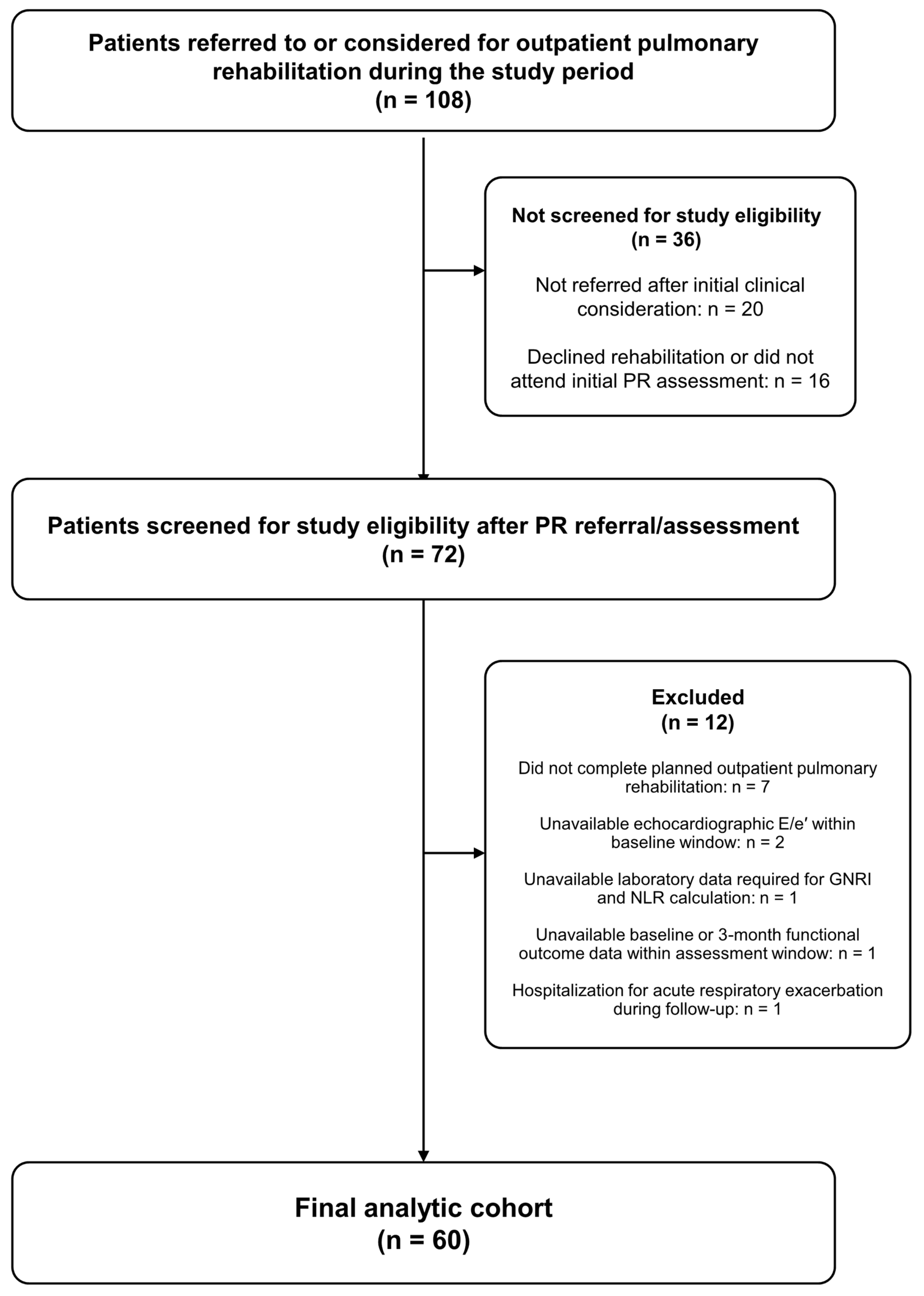
During the study period, 108 patients were referred to or clinically considered for outpatient pulmonary rehabilitation. Of these, 36 patients were not screened for study eligibility, including 20 who were not referred after initial clinical consideration and 16 who declined rehabilitation or did not attend the initial pulmonary rehabilitation assessment. The remaining 72 patients were screened for study eligibility after pulmonary rehabilitation referral or assessment. Twelve patients were excluded after screening, including 7 who did not complete the planned outpatient pulmonary rehabilitation program, 2 who had unavailable echocardiographic E/e′ data within the prespecified baseline window, 1 who had unavailable laboratory data required for GNRI and NLR calculation, 1 who had unavailable baseline or 3-month functional outcome data within the prespecified assessment window, and 1 who was hospitalized for acute respiratory exacerbation during follow-up. The final analytic cohort included 60 patients. Accordingly, the analytic cohort represents a selected subgroup of patients who were referred to or assessed for outpatient pulmonary rehabilitation, completed the planned program, and had complete baseline and follow-up data.
A total of 108 patients were referred to or clinically considered for outpatient pulmonary rehabilitation during the study period. Thirty-six patients were not screened for study eligibility, including 20 who were not referred after initial clinical consideration and 16 who declined rehabilitation or did not attend the initial pulmonary rehabilitation assessment. Seventy-two patients were screened for study eligibility after pulmonary rehabilitation referral or assessment. Twelve patients were excluded after screening, including 7 who did not complete the planned outpatient pulmonary rehabilitation program, 2 who lacked echocardiographic E/e′ data within the predefined baseline window, 1 who lacked laboratory data required for GNRI and NLR calculation, 1 who lacked baseline or 3-month functional outcome data within the predefined assessment window, and 1 who was hospitalized for acute respiratory exacerbation during follow-up. The final analytic cohort included 60 patients. The cohort assembly process and reasons for exclusion are shown in
Figure 1.
The study protocol was reviewed and approved by the Institutional Review Board of Kyung Hee University Hospital at Gangdong (IRB No. 2026-03-039). The requirement for informed consent was waived due to the retrospective nature of the study, in accordance with applicable institutional requirements and the Declaration of Helsinki.
2.3. Data Collection and Variables
Clinical data were retrospectively obtained from electronic medical records and pulmonary rehabilitation assessment records. The baseline demographic and anthropometric variables included age, sex, body mass index (BMI), and diagnosis category (COPD, ILD, or bronchiectasis). Age was recorded in years, and BMI was recorded in kg/m2.
The outpatient pulmonary rehabilitation program consisted of supervised twice-weekly sessions for 12 weeks. It included breathing retraining, aerobic exercise, resistance training for major muscle groups, and education on energy conservation and symptom management [
1,
2]. Exercise prescriptions were individualized according to baseline function and clinical status and were adjusted during follow-up.
Four baseline domains, echocardiographic filling pressure, nutritional status, inflammatory burden, and oxygen requirement, deemed clinically relevant to functional status at pulmonary rehabilitation admission were included in the study [
9,
19,
21]. The echocardiographic variable of interest, E/e′, was derived from transthoracic echocardiography conducted within one month of the baseline pulmonary rehabilitation assessment [
14,
18]. GNRI and NLR were calculated using laboratory data collected within one month of baseline. GNRI was calculated using a standard published formula based on serum albumin, actual body weight, and ideal body weight, and NLR was calculated as the absolute neutrophil count divided by the absolute lymphocyte count [
19,
21]. Because NLR was expected to have a right-skewed distribution, a natural logarithmic transformation was applied, and ln(NLR) was used in the regression and composite score analyses. Resting oxygen requirement was defined as the prescribed oxygen flow rate recorded at rest at the baseline assessment and was analyzed as a continuous variable in L/min [
17].
To assess whether the association between CNIO and 3-month outcomes persisted after adjustment for baseline lung function, FEV1 % predicted was included in planned sensitivity analyses. Because the cohort included COPD, ILD, and bronchiectasis, this was intended as a pragmatic adjustment for spirometric status rather than a diagnosis-equivalent measure of disease severity across all groups.
2.4. Outcome Measures
The primary outcome was 3-month 6MWT distance in meters. Baseline 6MWT was also recorded, and the change from baseline was summarized descriptively.
The exploratory secondary outcome was 3-month SPPB score on the conventional 0 to 12 scale [
8,
9]. Baseline SPPB was also recorded, and the change from baseline was summarized descriptively.
With a window of 90 ± 14 days, the follow-up outcome assessment was scheduled to take place approximately three months after baseline. An analysis of covariance (ANCOVA) framework was used to model 3-month outcome values in the primary analyses while accounting for relevant baseline values.
2.5. Exposure/Predictor Measures
The study-derived CNIO index, which combines four routinely available baseline domains into a single composite indicating a less favorable functional profile at pulmonary rehabilitation admission, was the primary exposure of interest. The CNIO index was first calculated as the sum of four cohort-standardized baseline components: z(E/e′) + z(ln[NLR]) + z(resting oxygen flow rate) + z(−GNRI). The negative GNRI term was used so that lower nutritional status contributed to a higher, less favorable CNIO value. In the present cohort, the means and standard deviations used for standardization were 11.65 ± 2.71 for E/e′, 0.78 ± 0.49 for ln(NLR), 2.01 ± 0.93 L/min for resting oxygen flow rate, and 99.03 ± 6.24 for GNRI. Thus, the unstandardized summed composite can be expressed as [(E/e′ − 11.65)/2.71] + [(ln[NLR] − 0.78)/0.49] + [(resting O2 L/min − 2.01)/0.93] − [(GNRI − 99.03)/6.24]. The observed SD of this summed composite was 2.53 in the analytic cohort; therefore, the summed composite was divided by 2.53 for the regression analyses so that the reported CNIO coefficient represented the association per 1-SD increase in this cohort-specific composite. This cohort-specific standardization limits direct transportability to other populations unless the same standardization parameters are applied. The equal-weighted formulation was chosen on clinical grounds to create a transparent derivation construct and was not statistically optimized for outcome prediction; other weighting schemes might yield different results. Accordingly, CNIO should be interpreted as a provisional, study-derived exposure rather than as a validated prognostic tool.
The four CNIO components, E/e′, GNRI, ln(NLR), and resting oxygen flow rate, were concurrently included in pre-specified interpretability models in addition to the composite index analysis to investigate the relationship between each component and the 3-month outcomes following adjustment for the same clinical covariates used in the primary models. Because the cohort size was modest relative to the number of simultaneously modeled components and covariates, these component-level analyses were interpreted as exploratory and were not intended to support definitive inference regarding the independent effect of any single component.
2.6. Statistical Analysis
Baseline characteristics and functional outcomes were summarized descriptively. Categorical variables were presented as counts and percentages, and continuous variables were presented as mean ± standard deviation or median (interquartile range), as appropriate.
Using multivariable ANCOVA, the main analysis examined the relationship between the CNIO index and the 3-month 6MWT. The primary model is specified as follows:
The exploratory secondary analysis examined 3-month SPPB using ordinal logistic regression because SPPB is a bounded ordinal scale. The model included CNIO, baseline SPPB, age, sex, BMI, and diagnosis.
The proportional-odds coefficient was exponentiated and presented as an odds ratio for being in a higher 3-month SPPB category. The proportional-odds assumption was evaluated using threshold-specific binary logistic regression diagnostics as a Brant-type assessment; because some SPPB thresholds were sparse, this diagnostic was interpreted descriptively rather than as a definitive model-selection test.
The reference group for diagnosis was bronchiectasis, and diagnosis category was added as a categorical covariate. In the 6MWT ANCOVA model, the regression coefficient for CNIO was interpreted as the change in 3-month 6MWT distance per 1-SD increase in the standardized CNIO index. In the SPPB ordinal logistic regression model, the exponentiated CNIO coefficient was interpreted as the proportional odds ratio for being in a higher 3-month SPPB category per 1-SD increase in the standardized CNIO index. p-values, 95% confidence intervals (CIs), and model fit indices were presented as appropriate for each model.
Planned component models were fitted for each outcome by simultaneously entering the four CNIO components rather than the composite score to enhance interpretability. For the 6MWT, the component model was as follows:
For SPPB, the component model was as follows:
The multivariable ANCOVA model for 3-month 6MWT was defined as the primary analysis, and the ordinal logistic regression model for 3-month SPPB was defined as an exploratory secondary analysis. Linear ANCOVA for SPPB, component models, FEV1-adjusted models, and leave-one-diagnosis-out analyses were intended as supportive exploratory or sensitivity analyses to assess interpretability and pattern consistency rather than to support definitive inference regarding individual components or diagnosis-specific heterogeneity. Because these exploratory analyses were intended to assess pattern consistency rather than to provide confirmatory inference, no formal multiplicity correction was applied; therefore, p-values from component models and sensitivity analyses were interpreted as descriptive only, with emphasis placed on effect-size direction, confidence intervals, and consistency with the main analysis.
Because this was a retrospective derivation study including all consecutively eligible patients, no formal a priori sample-size calculation was performed. For the primary 6MWT model, 60 participants were analyzed with seven modeled predictors, corresponding to approximately 8.6 observations per predictor. The modest sample size increased the risk of model instability and overfitting; therefore, the analyses were interpreted with emphasis on effect-size direction, confidence intervals, and internal stability rather than on definitive prediction performance.
To examine internal stability and possible overfitting in the primary 6MWT model, bootstrap resampling with 1000 resamples was performed for the CNIO coefficient and model R2, and percentile bootstrap confidence intervals were reported. Multicollinearity was assessed using variance inflation factors. Because SPPB is a bounded ordinal scale, ordinal logistic regression was specified as an exploratory secondary analysis for 3-month SPPB, while the linear ANCOVA model for SPPB was retained as a sensitivity analysis.
No imputation was performed, and all analyses were conducted in the complete-case analytic cohort. All statistical tests were two-sided. A p-value < 0.05 was considered statistically significant for the primary 6MWT analysis, whereas p-values from exploratory secondary, component, and sensitivity analyses were interpreted descriptively. Analyses were performed using R software (version 4.2.3; R Foundation for Statistical Computing, Vienna, Austria), including the stats package for linear models, the car package for variance inflation factors, the MASS package for ordinal logistic regression, and the boot package for bootstrap resampling.
4. Discussion
In this single-center retrospective derivation cohort, a higher standardized CNIO index was associated with lower 3-month functional outcomes after outpatient pulmonary rehabilitation, with a more consistent association for 6MWT than for SPPB. The primary finding was that a less favorable multidomain baseline profile remained associated with lower follow-up walking capacity after adjustment for baseline performance and selected clinical covariates. The exploratory SPPB finding, evaluated using ordinal logistic regression, was directionally consistent but weaker and should be interpreted more cautiously. Because the CNIO construct was study-derived and evaluated in the same cohort, these findings should be interpreted as hypothesis-generating rather than as validation of a clinical prediction tool.
The association with 6MWT is consistent with previous observations that response to pulmonary rehabilitation is heterogeneous and is not fully explained by spirometric impairment alone. Prior studies have emphasized the importance of multidimensional clinical profiling, physical performance measures, nutritional status, and systemic inflammation in chronic respiratory disease. The present study extends this concept by examining a simple study-derived composite that integrates cardiac filling pressure, nutritional risk, inflammatory burden, and oxygen requirement. However, unlike validated prognostic models, CNIO was derived and tested within the same cohort, and therefore its apparent association with follow-up function should be considered preliminary.
The 6MWT finding is clinically plausible because the CNIO construct integrates domains that may collectively reflect physiologic vulnerability at rehabilitation entry [
14,
17,
25]. Higher E/e′ may indicate reduced filling reserve, lower GNRI may reflect poorer nutritional and muscle reserve, higher ln(NLR) may reflect inflammatory burden, and greater resting oxygen requirement may indicate more advanced cardiopulmonary limitation [
14,
17,
19,
25]. The pathophysiological interpretation of CNIO should be cautious. Although the combination of cardiac filling pressure, nutritional status, inflammatory burden, and oxygen requirement is biologically plausible, the present data do not demonstrate that these domains act synergistically or causally in determining rehabilitation outcomes. Rather, CNIO may function mainly as a marker of overall disease burden or global physiologic vulnerability rather than as evidence of a specific multidomain mechanism associated with rehabilitation response. This interpretation is supported by the attenuation of the association after excluding patients with ILD and by the persistence of a diagnosis effect for ILD in the 6MWT model. This possibility is particularly relevant because the ILD subgroup had a less favorable baseline profile and because FEV1 % predicted may not capture disease burden equivalently across COPD, ILD, and bronchiectasis. The diagnosis coefficient for ILD also deserves comment. ILD remained associated with lower 3-month 6MWT distance after adjustment for CNIO and other clinical covariates, suggesting that CNIO did not fully explain diagnosis-related differences in follow-up walking capacity. Residual disease-specific factors not captured by CNIO, such as diffusion limitation, exertional desaturation, radiologic extent, or fibrosis-related progression, may have contributed to this association. In exploratory, underpowered component models, GNRI showed the most consistent individual association with 3-month 6MWT. However, this finding is not robust and should not be interpreted as evidence that GNRI is the dominant driver of the composite association, because the component model included multiple related domains and clinical covariates in a modest sample. In this setting, null findings for the remaining components may reflect collinearity and model instability as much as true absence of contribution. However, because the CNIO index was specified and evaluated within the same cohort, the present findings should not be interpreted as evidence that this weighting scheme is optimal or transportable to other clinical populations.
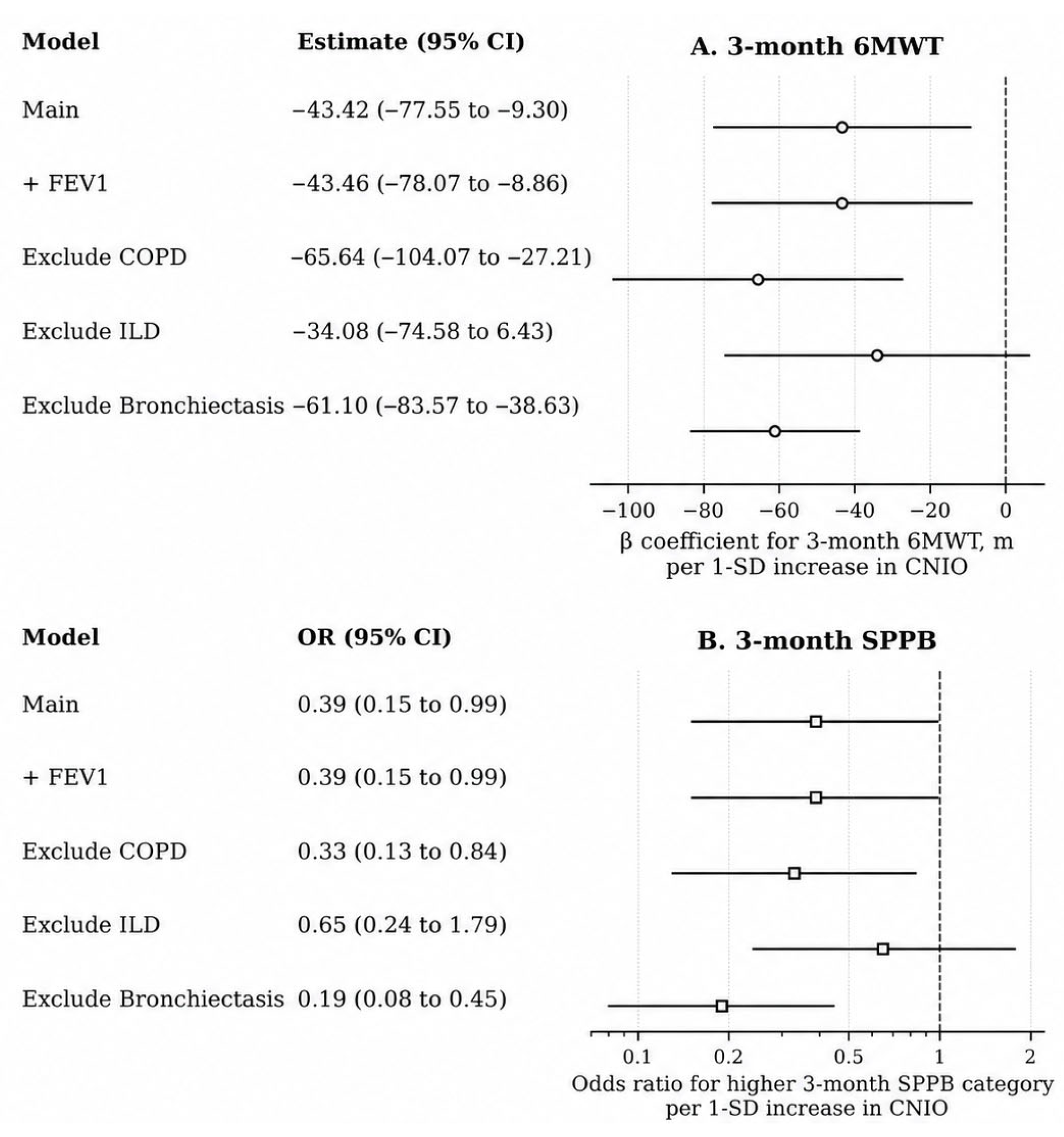
The exploratory secondary SPPB analysis was less robust than the 6MWT analysis. Although the ordinal logistic regression model showed that higher CNIO was associated with lower odds of being in a higher 3-month SPPB category, the confidence interval was close to the null, and group-level SPPB change was minimal over follow-up. The linear ANCOVA sensitivity analysis showed a consistent inverse direction, but it should be interpreted cautiously because SPPB is a bounded ordinal scale. Together, these results suggest that SPPB may have been less responsive than 6MWT for detecting short-term functional variation in this outpatient rehabilitation cohort [
5,
10]. The mean 6MWT change deserves clinical caution. Although the direction of change suggested improvement, the group-level mean increase of 27.7 m was close to but below the commonly cited 25–35 m minimal important difference range, and individual responses were heterogeneous. Therefore, the present findings should be interpreted as associations with follow-up functional status rather than as evidence of clinically meaningful improvement for the cohort as a whole.
Sensitivity analyses suggested that the observed associations were not fully uniform across diagnostic subsets. In particular, the CNIO association with both 3-month 6MWT and 3-month SPPB was attenuated after exclusion of ILD, which raises the possibility that the overall signal may have been influenced in part by the ILD subgroup. However, these reduced models involved substantially smaller sample sizes and wider uncertainty, so the findings should not be interpreted as evidence of true diagnosis-specific effect modification. In addition, the FEV1 % predicted sensitivity analysis should be interpreted cautiously because spirometric severity may not reflect disease burden equivalently across COPD, ILD, and bronchiectasis. These subset findings are therefore best regarded as exploratory. The potential clinical utility of CNIO remains provisional. At present, CNIO should not be used to guide rehabilitation prescriptions, clinical treatment decisions, or patient selection. If externally validated in larger prospective cohorts, a refined version of CNIO might eventually help identify patients who require closer monitoring during pulmonary rehabilitation. However, such use would require validation in diagnostically stratified cohorts and assessment of whether CNIO adds prognostic information beyond disease-specific severity measures. Selection of rehabilitation completers is an important limitation. By restricting the analytic cohort to patients who completed the planned rehabilitation program and had complete follow-up data, the study may have selected a healthier and more adherent subgroup than the broader real-world pulmonary rehabilitation population. Therefore, the findings should not be generalized to patients who discontinue rehabilitation, experience exacerbation-related hospitalization, or lack complete baseline and follow-up testing.
This study has several strengths, including clinically relevant outcomes, a structured outpatient pulmonary rehabilitation setting, adjustment for baseline outcome values, and multiple sensitivity analyses. However, several limitations should be considered. The retrospective single-center design limits causal inference and generalizability. The study period overlapped with the post-acute phase of the COVID-19 pandemic, and changes in rehabilitation delivery, referral patterns, infection-related morbidity, or patient adherence during this period may have influenced outcomes. The modest sample size increases the possibility of model instability, particularly in the component models and diagnosis-specific subset analyses, where the number of estimated parameters was high relative to the available sample size. Although bootstrap resampling was used to examine internal stability of the primary 6MWT model, no independent internal split-sample validation or external validation cohort was available. In addition, the study was not powered a priori, and the modest sample size limited the reliability of exploratory component-level, ordinal, and diagnosis-subset analyses. Selection bias is a major limitation because the analytic cohort was restricted to patients who completed the planned outpatient rehabilitation program and had complete baseline and follow-up data. The findings may therefore not be generalizable to patients who discontinue rehabilitation early, experience exacerbation-related hospitalization, have greater clinical instability, or lack complete baseline testing. This completer-based design may also introduce immortal time or survivor bias because patients had to remain alive, clinically stable, and assessable through the 3-month follow-up window. Residual confounding by comorbidity burden, medication changes, corticosteroid exposure, nutritional interventions, oxygen-prescription changes, and rehabilitation adherence remains possible. Medication use, including beta-blockers and systemic or inhaled corticosteroids, may have influenced exercise tolerance or inflammatory markers such as NLR, but these factors could not be fully incorporated into the models. E/e′ is a noninvasive surrogate of left ventricular filling pressure rather than a direct invasive measurement and may be less reliable in certain clinical settings, such as atrial fibrillation or significant mitral valve disease, which were not fully characterized in this dataset. Inter-rater or inter-reader reliability for echocardiographic E/e′ measurement was not assessed. Adjustment for FEV1 % predicted also has limitations because FEV1 is not an equivalent severity measure across COPD, ILD, and bronchiectasis; DLCO or ILD-specific indices such as the GAP index may have been more informative but were not consistently available. Finally, the CNIO index was study-derived and evaluated in the same cohort in which it was specified; accordingly, the present findings should be viewed as associative and hypothesis-generating rather than as validation of a clinical prediction tool. External validation in an independent cohort will be necessary before any broader prognostic or stratification use can be considered.