Associations of Physical Activity, Muscle Mass and Protein-Rich Food Consumption with Functional Fitness in Individuals with Multiple Sclerosis

Abstract
1. Introduction
2. Materials and Methods
2.1. Population
2.2. Anthropometric Measurements and Body Composition Assessment
2.3. Sarcopenia Assessment
2.4. HGS Measurement
2.5. Manual Dexterity Assessment
2.6. Assessment of Motor Functions of the Lower Limbs
2.7. Physical Activity Measurement
2.8. Assessment of the Consumption Frequency of Protein-Rich Products
2.9. Statistical Analysis
2.10. Ethical Aspects
3. Results
4. Discussion
4.1. Low Muscle Mass and MS
4.2. Physical Activity and MS
4.3. Intake of Dietary Protein-Rich Foods and MS
4.4. Limitations and Strengths
5. Conclusions
Author Contributions
Funding
Institutional Review Board Statement
Informed Consent Statement
Data Availability Statement
Acknowledgments
Conflicts of Interest
Abbreviations
| MS | Multiple Sclerosis |
| ASMI | Appendicular Skeletal Muscle Index |
| BMI | Body Mass Index |
| EDSS | Expanded Disability Status Scale |
| FatM | Fat Mass |
| FFM | Fat-Free Mass |
| GS | Gait Speed |
| HGS | Handgrip Strength |
| IQR | Interquartile Range |
| MVPA | Moderate-to-Vigorous Physical Activity |
| Me | Median |
| N | Number of Patients |
| PA | Physical Activity |
| PMM | Predictive Muscle Mass |
| RRMS | Relapsing–Remitting Multiple Sclerosis |
| SB | Sedentary Behaviour |
| SD | Standard Deviation |
| T25FW | Timed 25-Foot Walking Test |
| T | Tertile |
| X | Mean |
| 9-HPT | 9-Hole Peg Test |
References
- Conradsson, D.; Ytterberg, C.; von Koch, L.; Johansson, S. Changes in Disability in People with Multiple Sclerosis: A 10-Year Prospective Study. J. Neurol. 2018, 265, 119–126. [Google Scholar] [CrossRef] [PubMed]
- Feys, P.; Lamers, I.; Francis, G.; Benedict, R.; Phillips, G.; LaRocca, N.; Hudson, L.D.; Rudick, R. Multiple Sclerosis Outcome Assessments Consortium The Nine-Hole Peg Test as a Manual Dexterity Performance Measure for Multiple Sclerosis. Mult. Scler. J. 2017, 23, 711–720. [Google Scholar] [CrossRef]
- Kister, I.; Bacon, T.E.; Chamot, E.; Salter, A.R.; Cutter, G.R.; Kalina, J.T.; Herbert, J. Natural History of Multiple Sclerosis Symptoms. Int. J. MS Care 2013, 15, 146–158. [Google Scholar] [CrossRef]
- Proschinger, S.; Kuhwand, P.; Rademacher, A.; Walzik, D.; Warnke, C.; Zimmer, P.; Joisten, N. Fitness, Physical Activity, and Exercise in Multiple Sclerosis: A Systematic Review on Current Evidence for Interactions with Disease Activity and Progression. J. Neurol. 2022, 269, 2922–2940. [Google Scholar] [CrossRef]
- Latimer-Cheung, A.E.; Pilutti, L.A.; Hicks, A.L.; Martin Ginis, K.A.; Fenuta, A.M.; MacKibbon, K.A.; Motl, R.W. Effects of Exercise Training on Fitness, Mobility, Fatigue, and Health-Related Quality of Life among Adults with Multiple Sclerosis: A Systematic Review to Inform Guideline Development. Arch. Phys. Med. Rehabil. 2013, 94, 1800–1828.e3. [Google Scholar] [CrossRef]
- Kalb, R.; Brown, T.R.; Coote, S.; Costello, K.; Dalgas, U.; Garmon, E.; Giesser, B.; Halper, J.; Karpatkin, H.; Keller, J.; et al. Exercise and Lifestyle Physical Activity Recommendations for People with Multiple Sclerosis throughout the Disease Course. Mult. Scler. J. 2020, 26, 1459–1469. [Google Scholar] [CrossRef]
- Motl, R.W.; Sandroff, B.M.; Kwakkel, G.; Dalgas, U.; Feinstein, A.; Heesen, C.; Feys, P.; Thompson, A.J. Exercise in Patients with Multiple Sclerosis. Lancet Neurol. 2017, 16, 848–856. [Google Scholar] [CrossRef]
- White, L.J.; Castellano, V. Exercise and Brain Health—Implications for Multiple Sclerosis: Part 1—Neuronal Growth Factors. Sports Med. 2008, 38, 91–100. [Google Scholar] [CrossRef]
- Haider, L.; Chung, K.K.; Mangesius, S.; Furtner, J.; Ciccarelli, O.; Chard, D.T.; Barkhof, F. The Relation of Sarcopenia and Disability in Multiple Sclerosis. Mult. Scler. Relat. Disord. 2023, 77, 104855. [Google Scholar] [CrossRef] [PubMed]
- Amato, A.; Proia, P.; Alioto, A.; Rossi, C.; Pagliaro, A.; Ragonese, P.; Schirò, G.; Salemi, G.; Caldarella, R.; Vasto, S.; et al. High-intensity interval training improves bone remodeling, lipid profile, and physical function in multiple sclerosis patients. Sci. Rep. 2024, 14, 16195. [Google Scholar] [CrossRef]
- Amato, A.; Messina, G.; Feka, K.; Genua, D.; Ragonese, P.; Kostrzewa-Nowak, D.; Fischetti, F.; Iovane, A.; Proia, P. Taopatch® combined with home-based training protocol to prevent sedentary lifestyle and biochemical changes in MS patients during COVID-19 pandemic. Eur. J. Transl. Myol. 2021, 31, 9877. [Google Scholar] [CrossRef]
- Arntzen, E.C.; Bidhendi-Yarandi, R.; Sivertsen, M.; Knutsen, K.; Dahl, S.S.H.; Hartvedt, M.G.; Normann, B.; Behboudi-Gandevani, S. The Effect of Exercise and Physical Activity-Interventions on Step Count and Intensity Level in Individuals with Multiple Sclerosis: A Systematic Review and Meta-Analysis of Randomized Controlled Trials. Front. Sports Act. Living 2023, 5, 1162278. [Google Scholar] [CrossRef]
- Cruz-Jentoft, A.J.; Bahat, G.; Bauer, J.; Boirie, Y.; Bruyère, O.; Cederholm, T.; Cooper, C.; Landi, F.; Rolland, Y.; Sayer, A.A.; et al. Sarcopenia: Revised European Consensus on Definition and Diagnosis. Age Ageing 2019, 48, 16–31. [Google Scholar] [CrossRef]
- Yuksel, H.; Balaban, M.; Tan, O.O.; Mungan, S. Sarcopenia in Patients with Multiple Sclerosis. Mult. Scler. Relat. Disord. 2022, 58, 103471. [Google Scholar] [CrossRef] [PubMed]
- Allen, M.D.; Thompson, A.; Clark, B.C.; Schumacher, F.; Zhang, Y. Multiple Sclerosis and Sarcopenia: Analysis of Population-Level Prevalence and Key Risk Factors from the UK Biobank. Mult. Scler. Relat. Disord. 2025, 102, 106629. [Google Scholar] [CrossRef] [PubMed]
- Gaemelke, T.; Pedersen, I.S.; Dalgas, U.; Hvid, L.G. Sarcopenia in Older People with Multiple Sclerosis: A Cross-Sectional Study. Mult. Scler. Relat. Disord. 2025, 93, 106190. [Google Scholar] [CrossRef]
- Stagsted, R.A.W.; Ramari, C.; Skjerbaek, A.G.; Thrue, C.; Dalgas, U.; Hvid, L.G. Lower Extremity Muscle Power—A Critical Determinant of Physical Function in Aging and Multiple Sclerosis. Exp. Gerontol. 2021, 150, 111347. [Google Scholar] [CrossRef]
- Jeng, B.; Motl, R.W. No Association between Body Composition and Walking Outcomes in Multiple Sclerosis. Mult. Scler. Relat. Disord. 2022, 68, 104242. [Google Scholar] [CrossRef]
- Carvalho, B.M.d.; Silva, R.S.C.; Lima, V.V.M.d.; Almondes, K.G.d.S.; Rodrigues, F.N.S.; D’Almeida, J.A.C.; Melo, M.L.P.d. Excess Weight Increases the Risk of Sarcopenia in Patients with Multiple Sclerosis. Mult. Scler. Relat. Disord. 2023, 79, 105049. [Google Scholar] [CrossRef]
- Ganapathy, A.; Nieves, J.W. Nutrition and Sarcopenia—What Do We Know? Nutrients 2020, 12, 1755. [Google Scholar] [CrossRef]
- Thompson, A.J.; Banwell, B.L.; Barkhof, F.; Carroll, W.M.; Coetzee, T.; Comi, G.; Correale, J.; Fazekas, F.; Filippi, M.; Freedman, M.S.; et al. Diagnosis of Multiple Sclerosis: 2017 Revisions of the McDonald Criteria. Lancet Neurol. 2018, 17, 162–173. [Google Scholar] [CrossRef] [PubMed]
- Meyer-Moock, S.; Feng, Y.-S.; Maeurer, M.; Dippel, F.-W.; Kohlmann, T. Systematic Literature Review and Validity Evaluation of the Expanded Disability Status Scale (EDSS) and the Multiple Sclerosis Functional Composite (MSFC) in Patients with Multiple Sclerosis. BMC Neurol. 2014, 14, 58. [Google Scholar] [CrossRef]
- Roberts, H.C.; Denison, H.J.; Martin, H.J.; Patel, H.P.; Syddall, H.; Cooper, C.; Sayer, A.A. A review of the measurement of grip strength in clinical and epidemiological studies: Towards a standardised approach. Age Ageing 2011, 40, 423–429. [Google Scholar] [CrossRef] [PubMed]
- Motl, R.W.; Cohen, J.A.; Benedict, R.; Phillips, G.; LaRocca, N.; Hudson, L.D.; Rudick, R. Multiple Sclerosis Outcome Assessments Consortium Validity of the Timed 25-Foot Walk as an Ambulatory Performance Outcome Measure for Multiple Sclerosis. Mult. Scler. J. 2017, 23, 704–710. [Google Scholar] [CrossRef]
- Kos, D.; Nagels, G.; D’Hooghe, M.B.; Duquet, W.; Ilsbroukx, S.; Delbeke, S.; Kerckhofs, E. Measuring activity patterns using actigraphy in multiple sclerosis. Chronobiol. Int. 2007, 24, 345–356. [Google Scholar] [CrossRef]
- Jeżewska-Zychowicz, M.; Gawęcki, J.; Wądołowska, L.; Czarnocińska, J.; Galiński, G.; Kołłajtis-Dołowy, A.; Roszkowski, W.; Wawrzyniak, A.; Przybyłowicz, K.; Stasiewicz, B. KomPAN® Questionnaire for the Assessment of Eating Habits and Attitudes for Persons Aged 16 to 65 Years, Version 1.2—Questionnaire to be Filled In by the Respondent. In The KomPAN® Questionnaire for the Assesssment of Eating Habits and Attitudes and the Data Analysis Procedure; Gawęcki, J., Ed.; Polish Academy of Sciences: Warsaw, Poland, 2020; pp. 4–21. [Google Scholar]
- Li, L.; Xia, Z.; Zeng, X.; Tang, A.; Wang, L.; Su, Y. The Agreement of Different Techniques for Muscle Measurement in Diagnosing Sarcopenia: A Systematic Review and Meta-Analysis. Quant. Imaging Med. Surg. 2024, 14, 2177–2192. [Google Scholar] [CrossRef]
- Pilutti, L.A.; Motl, R.W. Body Composition and Disability in People with Multiple Sclerosis: A Dual-Energy x-Ray Absorptiometry Study. Mult. Scler. Relat. Disord. 2019, 29, 41–47. [Google Scholar] [CrossRef] [PubMed]
- Kidwell-Chandler, A.; Jackson, J.; Jeng, B.; Silveira, S.L.; Pilutti, L.A.; Hibbing, P.R.; Motl, R.W. Body Composition and Its Outcomes and Management in Multiple Sclerosis: Narrative Review. Nutrients 2025, 17, 1021. [Google Scholar] [CrossRef]
- Ingram, L.A.; Butler, A.A.; Brodie, M.A.; Hoang, P.; Gandevia, S.C.; Lord, S.R. Quantifying Upper-Limb Motor Impairment in People with Multiple Sclerosis: A Physiological Profiling Approach. Ann. Phys. Rehabil. Med. 2022, 65, 101625. [Google Scholar] [CrossRef]
- Suliga, E.; Cieśla, E.; Jasińska, E.; Gołuch, K.; Głuszek, S. Lifestyle and Health of Individuals with Multiple Sclerosis According to Body Mass Index: Initial Results. Med. Stud. 2022, 38, 140–151. [Google Scholar] [CrossRef]
- Willingham, T.B.; McCully, K.; Backus, D. Skeletal Muscle Dysfunction in People With Multiple Sclerosis: A Physiological Target for Improving Physical Function and Mobility. Arch. Phys. Med. Rehabil. 2023, 104, 694–706. [Google Scholar] [CrossRef]
- Strandkvist, V.; Larsson, A.; Pauelsen, M.; Nyberg, L.; Vikman, I.; Lindberg, A.; Gustafsson, T.; Röijezon, U. Hand Grip Strength Is Strongly Associated with Lower Limb Strength but Only Weakly with Postural Control in Community-Dwelling Older Adults. Arch. Gerontol. Geriatr. 2021, 94, 104345. [Google Scholar] [CrossRef]
- Seferoğlu, M.; Aksoy, M.K.; Tunç, A. Hand Grip Strength as a Predictive Tool for Upper Extremity Functionality, Balance, and Quality of Life in People With Multiple Sclerosis. Int. J. MS Care 2024, 26, 134–139. [Google Scholar] [CrossRef]
- Baird, J.F.; Cederberg, K.L.J.; Sikes, E.M.; Silveira, S.L.; Jeng, B.; Sasaki, J.E.; Sandroff, B.M.; Motl, R.W. Physical Activity and Walking Performance across the Lifespan among Adults with Multiple Sclerosis. Mult. Scler. Relat. Disord. 2019, 35, 36–41. [Google Scholar] [CrossRef]
- Motl, R.W.; Pilutti, L.; Sandroff, B.M.; Dlugonski, D.; Sosnoff, J.J.; Pula, J.H. Accelerometry as a Measure of Walking Behavior in Multiple Sclerosis. Acta Neurol. Scand. 2013, 127, 384–390. [Google Scholar] [CrossRef]
- Engelhard, M.M.; Patek, S.D.; Lach, J.C.; Goldman, M.D. Real-World Walking in Multiple Sclerosis: Separating Capacity from Behavior. Gait Posture 2018, 59, 211–216. [Google Scholar] [CrossRef]
- Feasel, C.D.; Sandroff, B.M.; Motl, R.W. Cardiopulmonary Exercise Testing Using the Modified Balke Protocol in Fully Ambulatory People With Multiple Sclerosis. Cardiopulm. Phys. Ther. J. 2021, 32, 57–65. [Google Scholar] [CrossRef]
- Abasiyanik, Z.; Baba, C.; Yigit, P.; Samadzade, U.; Kahraman, T. Tracking Walking Capacity in People with Multiple Sclerosis Without Disability: 3-Year Follow-up of Objective and Subjective Gait Measures. J. Mult. Scler. Res. 2025, 5, 13–17. [Google Scholar] [CrossRef]
- McManaman, C.; Novak, B.; Paul, L.; Rooney, S. Changes in Walking Speed Following Resistance Training in People with Multiple Sclerosis: A Systematic Review and Meta-Analysis. PM R 2025, 17, 222–237. [Google Scholar] [CrossRef]
- Pau, M.; Leban, B.; Deidda, M.; Porta, M.; Coghe, G.; Cattaneo, D.; Cocco, E. Use of Wrist-Worn Accelerometers to Quantify Bilateral Upper Limb Activity and Asymmetry under Free-Living Conditions in People with Multiple Sclerosis. Mult. Scler. Relat. Disord. 2021, 53, 103081. [Google Scholar] [CrossRef]
- Lamers, I.; Kerkhofs, L.; Raats, J.; Kos, D.; Van Wijmeersch, B.; Feys, P. Perceived and Actual Arm Performance in Multiple Sclerosis: Relationship with Clinical Tests According to Hand Dominance. Mult. Scler. J. 2013, 19, 1341–1348. [Google Scholar] [CrossRef]
- Filippatou, A.G.; Mowry, E.M. Sensors in Multiple Sclerosis. Curr. Neurol. Neurosci. Rep. 2025, 25, 76. [Google Scholar] [CrossRef]
- Mandigout, S.; Lacroix, J.; Perrochon, A.; Svoboda, Z.; Aubourg, T.; Vuillerme, N. Comparison of Step Count Assessed Using Wrist- and Hip-Worn Actigraph GT3X in Free-Living Conditions in Young and Older Adults. Front. Med. 2019, 6, 252. [Google Scholar] [CrossRef]
- Weikert, M.; Suh, Y.; Lane, A.; Sandroff, B.; Dlugonski, D.; Fernhall, B.; Motl, R.W. Accelerometry Is Associated with Walking Mobility, Not Physical Activity, in Persons with Multiple Sclerosis. Med. Eng. Phys. 2012, 34, 590–597. [Google Scholar] [CrossRef]
- Woelfle, T.; Bourguignon, L.; Lorscheider, J.; Kappos, L.; Naegelin, Y.; Jutzeler, C.R. Wearable Sensor Technologies to Assess Motor Functions in People With Multiple Sclerosis: Systematic Scoping Review and Perspective. J. Med. Internet Res. 2023, 25, e44428. [Google Scholar] [CrossRef]
- Prakash, R.S.; Snook, E.M.; Motl, R.W.; Kramer, A.F. Aerobic Fitness Is Associated with Gray Matter Volume and White Matter Integrity in Multiple Sclerosis. Brain Res. 2010, 1341, 41–51. [Google Scholar] [CrossRef]
- Bonzano, L.; Tacchino, A.; Brichetto, G.; Roccatagliata, L.; Dessypris, A.; Feraco, P.; Lopes De Carvalho, M.L.; Battaglia, M.A.; Mancardi, G.L.; Bove, M. Upper Limb Motor Rehabilitation Impacts White Matter Microstructure in Multiple Sclerosis. NeuroImage 2014, 90, 107–116. [Google Scholar] [CrossRef]
- Wachowski, M.R.; Majos, M.; Milewska-Jędrzejczak, M.; Głąbiński, A.; Majos, A. Brain Neuroplasticity in Multiple Sclerosis Patients in Functional Magnetic Resonance Imaging Studies. Part 2: Effect of Aerobic Training. Pol. J. Radiol. 2024, 89, e328–e335. [Google Scholar] [CrossRef]
- Klaren, R.E.; Hubbard, E.A.; Motl, R.W.; Pilutti, L.A.; Wetter, N.C.; Sutton, B.P. Objectively Measured Physical Activity Is Associated with Brain Volumetric Measurements in Multiple Sclerosis. Behav. Neurol. 2015, 2015, 482536. [Google Scholar] [CrossRef]
- Motl, R.W.; Pilutti, L.A.; Hubbard, E.A.; Wetter, N.C.; Sosnoff, J.J.; Sutton, B.P. Cardiorespiratory Fitness and Its Association with Thalamic, Hippocampal, and Basal Ganglia Volumes in Multiple Sclerosis. Neuroimage Clin. 2015, 7, 661–666. [Google Scholar] [CrossRef]
- Hvid, L.G.; Langeskov-Christensen, M.; Stenager, E.; Dalgas, U. Exercise Training and Neuroprotection in Multiple Sclerosis. Lancet Neurol. 2022, 21, 681–682. [Google Scholar] [CrossRef]
- Cruickshank, T.M.; Reyes, A.R.; Ziman, M.R. A Systematic Review and Meta-Analysis of Strength Training in Individuals with Multiple Sclerosis or Parkinson Disease. Medicine 2015, 94, e411. [Google Scholar] [CrossRef]
- Alifarsangi, A.; Khaksari, M.; Rajizadeh, M.A.; Zadeh, N.A.; Rafie, F. Exercise-Induced Exerkines in Multiple Sclerosis: Emphasizing the Pivotal Role of Myokines. Brain Res. Bull. 2025, 231, 111565. [Google Scholar] [CrossRef]
- Du, Y.; Oh, C.; No, J. Advantage of Dairy for Improving Aging Muscle. J. Obes. Metab. Syndr. 2019, 28, 167–174. [Google Scholar] [CrossRef]
- Granic, A.; Hurst, C.; Dismore, L.; Aspray, T.; Stevenson, E.; Witham, M.D.; Sayer, A.A.; Robinson, S. Milk for Skeletal Muscle Health and Sarcopenia in Older Adults: A Narrative Review. Clin. Interv. Aging 2020, 15, 695–714. [Google Scholar] [CrossRef]
- Dougkas, A.; Reynolds, C.K.; Givens, I.D.; Elwood, P.C.; Minihane, A.M. Associations between Dairy Consumption and Body Weight: A Review of the Evidence and Underlying Mechanisms. Nutr. Res. Rev. 2011, 24, 72–95. [Google Scholar] [CrossRef]
- Mazahery, H.; Daly, A.; Pham, N.M.; Stephens, M.; Dunlop, E.; Ponsonby, A.-L.; Group, A.I.; Black, L.J. Higher Mediterranean Diet Score Is Associated with Longer Time between Relapses in Australian Females with Multiple Sclerosis. arXiv 2023, arXiv:2311.01042. [Google Scholar] [CrossRef]
- Black, L.J.; Baker, K.; Ponsonby, A.-L.; van der Mei, I.; Lucas, R.M.; Pereira, G.; Ausimmune Investigator Group. A Higher Mediterranean Diet Score, Including Unprocessed Red Meat, Is Associated with Reduced Risk of Central Nervous System Demyelination in a Case-Control Study of Australian Adults. J. Nutr. 2019, 149, 1385–1392. [Google Scholar] [CrossRef]
- Sintzel, M.B.; Rametta, M.; Reder, A.T. Vitamin D and Multiple Sclerosis: A Comprehensive Review. Neurol. Ther. 2018, 7, 59–85. [Google Scholar] [CrossRef]
- Pretorius, B.; Schönfeldt, H.C.; Hall, N. Total and Haem Iron Content Lean Meat Cuts and the Contribution to the Diet. Food Chem. 2016, 193, 97–101. [Google Scholar] [CrossRef]
- Ramirez-Ramirez, V.; Macias-Islas, M.A.; Ortiz, G.G.; Pacheco-Moises, F.; Torres-Sanchez, E.D.; Sorto-Gomez, T.E.; Cruz-Ramos, J.A.; Orozco-Aviña, G.; Celis de la Rosa, A.J. Efficacy of Fish Oil on Serum of TNF α, IL-1 β, and IL-6 Oxidative Stress Markers in Multiple Sclerosis Treated with Interferon Beta-1b. Oxid. Med. Cell Longev. 2013, 2013, 709493. [Google Scholar] [CrossRef]
- Nemazannikova, N.; Mikkelsen, K.; Stojanovska, L.; Blatch, G.L.; Apostolopoulos, V. Is There a Link between Vitamin B and Multiple Sclerosis? Med. Chem. 2018, 14, 170–180. [Google Scholar] [CrossRef]
- Hadgkiss, E.J.; Jelinek, G.A.; Weiland, T.J.; Pereira, N.G.; Marck, C.H.; van der Meer, D.M. The Association of Diet with Quality of Life, Disability, and Relapse Rate in an International Sample of People with Multiple Sclerosis. Nutr. Neurosci. 2015, 18, 125–136. [Google Scholar] [CrossRef]
- Fitzgerald, K.C.; Tyry, T.; Salter, A.; Cofield, S.S.; Cutter, G.; Fox, R.; Marrie, R.A. Diet Quality Is Associated with Disability and Symptom Severity in Multiple Sclerosis. Neurology 2018, 90, e1–e11. [Google Scholar] [CrossRef]
- Hanach, N.I.; McCullough, F.; Avery, A. The Impact of Dairy Protein Intake on Muscle Mass, Muscle Strength, and Physical Performance in Middle-Aged to Older Adults with or without Existing Sarcopenia: A Systematic Review and Meta-Analysis. Adv. Nutr. 2019, 10, 59–69. [Google Scholar] [CrossRef]
- Mazza, E.; Ferro, Y.; Maurotti, S.; Micale, F.; Boragina, G.; Russo, R.; Lascala, L.; Sciacqua, A.; Gazzaruso, C.; Montalcini, T.; et al. Association of Dietary Patterns with Sarcopenia in Adults Aged 50 Years and Older. Eur. J. Nutr. 2024, 63, 1651–1662. [Google Scholar] [CrossRef]
- Morin, C.R.; Baeva, M.-E.; Hollenberg, M.D.; Brain, M.C. Milk and Multiple Sclerosis: A Possible Link? Mult. Scler. Relat. Disord. 2024, 83, 105477. [Google Scholar] [CrossRef]
- Simpson-Yap, S.; Nag, N.; Probst, Y.; Jelinek, G.; Neate, S. Higher-Quality Diet and Non-Consumption of Meat Are Associated with Less Self-Determined Disability Progression in People with Multiple Sclerosis: A Longitudinal Cohort Study. Eur. J. Neurol. 2022, 29, 225–236. [Google Scholar] [CrossRef]
- Koch, M.W.; Mostert, J.P.; Wolinsky, J.S.; Lublin, F.D.; Uitdehaag, B.; Cutter, G.R. Comparison of the EDSS, Timed 25-Foot Walk, and the 9-Hole Peg Test as Clinical Trial Outcomes in Relapsing-Remitting Multiple Sclerosis. Neurology 2021, 97, e1560–e1570. [Google Scholar] [CrossRef]
- Sikes, E.M.; Cederberg, K.L.; Sandroff, B.M.; Bartolucci, A.; Motl, R.W. Quantitative Synthesis of Timed 25-Foot Walk Performance in Multiple Sclerosis. Arch. Phys. Med. Rehabil. 2020, 101, 524–534. [Google Scholar] [CrossRef]
- Casey, B.; Coote, S.; Galvin, R.; Donnelly, A. Objective Physical Activity Levels in People with Multiple Sclerosis: Meta-Analysis. Scand. J. Med. Sci. Sports 2018, 28, 1960–1969. [Google Scholar] [CrossRef]



| Normal ASMI (N = 81) | Low ASMI (N = 25) | ||||
|---|---|---|---|---|---|
| X (SD) | Me (IQR) | X (SD) | Me (IQR) | ||
| Sex | |||||
| Woman N (%) | 73 (90.12) | 10 (40.00) | 0.001 A | ||
| Men | 8 (9.88) | 15 (60.00) | |||
| Type of SM | |||||
| Relapsing–remitting | 71 (87.65) | 22 (88.00) | 0.978 A | ||
| Primary progressive | 4 (4.94) | 1 (4.00) | |||
| Secondary progressive | 6 (7.41) | 2 (8.00) | |||
| Age (years) | 43.51 (11.09) | 44.0 (14.00) | 39.72 (12.31) | 41.00 (20.00) | 0.192 B |
| MS duration | 10.38 (8.82) | 8.0 (12.0) | 9.85 (10.12) | 8.0 (8.00) | 0.459 B |
| EDSS | 2.66 (1.46) | 2.50 (2.00) | 2.32 (1.73) | 2.00 (1.50) | 0.093 B |
| EDSS > 3.5 N (%) | 71 (87.65) | 22 (88.00) | 0.963 A | ||
| ≤3.5 | 10 (12.35) | 3 (12.00) | |||
| Socio-economic situation | |||||
| Very good | 21 (26.25) | 5 (20.00) | 0.505 A | ||
| Good | 7 (8.75) | 3 (12.00) | |||
| Satisfactory | 5 (6.25) | 0 (0.00) | |||
| Poor | 47 (58.75) | 17 (68.00) | |||
| Physical activity and sedentary behaviour | |||||
| % in SB | 61.85 (6.96) | 62.10 (8.88) | 62.55 (6.28) | 61.16 (4.59) | 0.656 C |
| % in light PA | 22.78 (3.80) | 22.34 (3.81) | 22.03 (3.30) | 22.59 (4.07) | 0.589 B |
| % in MVPA | 15.31 (5.43) | 14.49 (6.43) | 15.42 (4.95) | 15.38 (6.12) | 0.853 B |
| Fitness (or functional fitness) | |||||
| T25FW (s) | 5.89 (3.15) | 4.95 (1.76) | 7.83 (8.37) | 4.72 (1.48) | 0.836 B |
| 9-HPT, dominant hand | 21.42 (6.33) | 19.95 (4.51) | 21.50 (5.65) | 20.94 (4.36) | 0.836 B |
| 9-HPT, non-dominant hand | 22.65 (7.19) | 21.00 (4.44) | 22.30 (4.61) | 21.17 (6.28) | 0.756 B |
| HGS, dominant hand (kg) | 30.06 (9.45) | 28.80 (11.60) | 23.40 (7.27) | 23.75 (8.00) | 0.001 B |
| HGS, non-dominant hand (kg) | 27.40 (9.70) | 26.10 (13.30) | 22.08 (6.08) | 20.60 (6.80) | 0.006 B |
| Protein-rich products | 3.12 (1.40) | 2.95 (1.70) | 2.90 (1.37) | 3.08 (2.38) | 0.820 B |
| Body components | |||||
| BMI | 25.55 (4.69) | 24.80 (6.20) | 22.10 (4.38) | 22.20 (3.60) | 0.001 B |
| BMI < 25 kg/m2 N (%) | 41 (50.62) | 22 (88.00) | 0.001 A | ||
| ≥25kg/m2 N (%) | 40 (49.38) | 3 (22.00) | |||
| FatM | 20.84 (10.10) | 19.30 (10.70) | 17.05 (8.00) | 15.20 (6.10) | 0.044 B |
| FatP | 27.20 (8.76) | 28.30 (9.40) | 28.11 (7.69) | 26.90 (6.20) | 0.642 C |
| PMM | 49.95 (8.76) | 47.50 (12.60) | 40.29 (5.20) | 39.80 (6.20) | 0.001 B |
| Arms PMM | 5.19 (1.47) | 4.70 (2.10) | 3.76 (0.60) | 3.80 (0.80) | 0.001 B |
| Legs PMM | 16.07 (3.33) | 15.00 (4.90) | 12.81 (1.49) | 12.70 (2.10) | 0.001 B |
| Trunk PMM | 28.70 (4.08) | 27.80 (5.70) | 23.72 (3.20) | 23.50 (3.90) | 0.001 C |
| FFM | 52.60 (9.19) | 50.00 (13.30) | 42.45 (5.47) | 41.90 (6.50) | 0.001 B |
| Arms FFM | 5.46 (1.57) | 4.90 (2.30) | 3.96 (0.60) | 4.00 (0.80) | 0.001 B |
| Legs FFM | 16.54 (3.41) | 15.50 (4.90) | 13.19 (1.53) | 13.10 (2.20) | 0.001 B |
| Trunk FFM | 30.13 (4.25) | 29.30 (6.00) | 24.92 (3.37) | 24.60 (4.10) | 0.001 C |
| Predictors | Categories | T25FT | |||
|---|---|---|---|---|---|
| B | 95% CI | SE | p | ||
| ASMI | - | 0.14 | −0.43; 0.02 | 0.14 | 0.299 |
| % in MVPA Ref. T1 | T2 | −0.04 | −0.43; 0.44 | 0.20 | 0.822 |
| T3 | 0.06 | −0.45; 0.43 | 0.20 | 0.751 | |
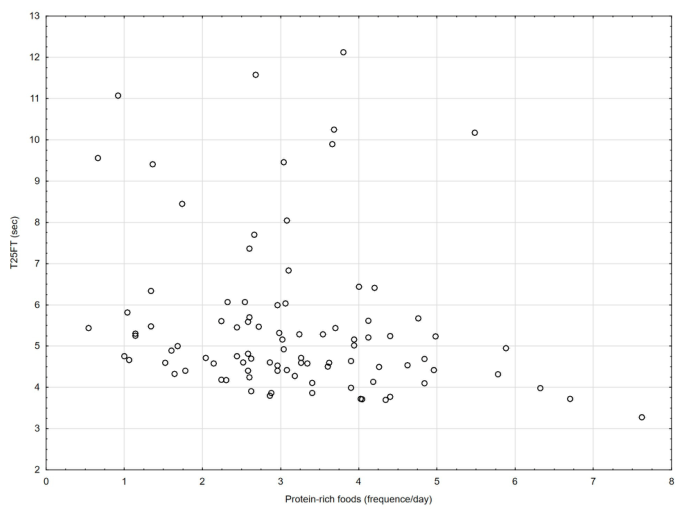
| Protein consumption (frequency/day) | - | −0.22 | −0.43; −0.02 | 0.10 | 0.033 |
| Dominant HGS | |||||
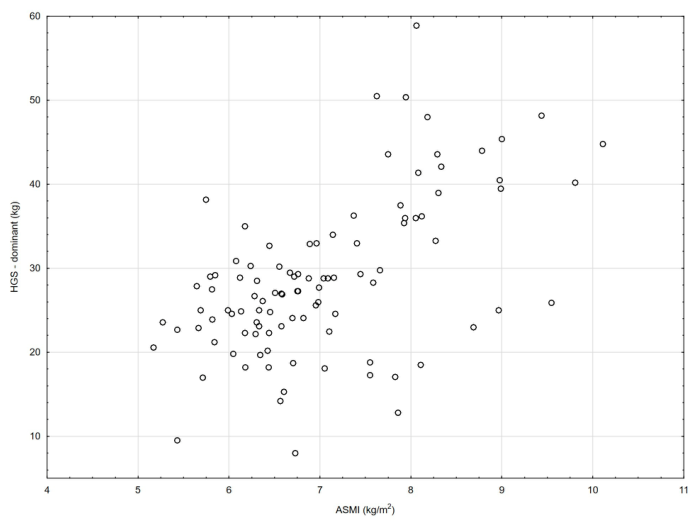
| ASMI | - | 4.57 | 3.25; 5.90 | 0.68 | 0.001 |
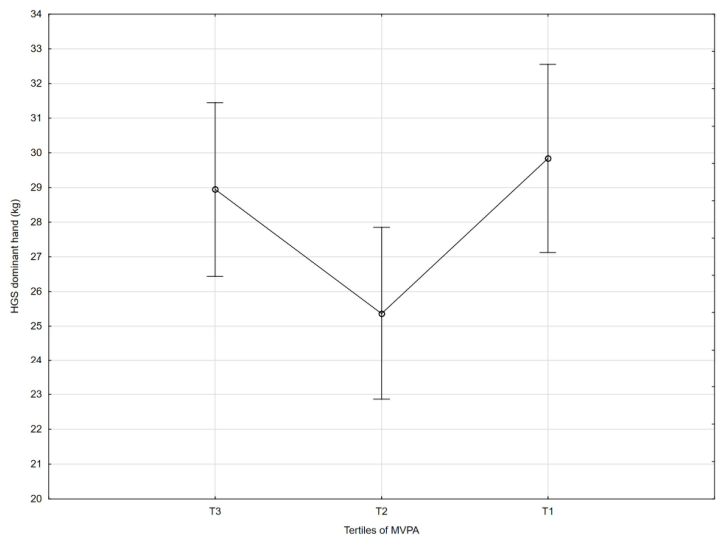
| % in MVPA Ref. T1 | T2 | −2.13 | −4.12; −0.13 | 1.02 | 0.037 |
| T3 | 0.63 | −1.39; 2.66 | 1.03 | 0.540 | |
| Protein consumption (frequency/day) | −0.06 | −1.08; 0.96 | 0.52 | 0.909 | |
| Non-dominant HGS | |||||
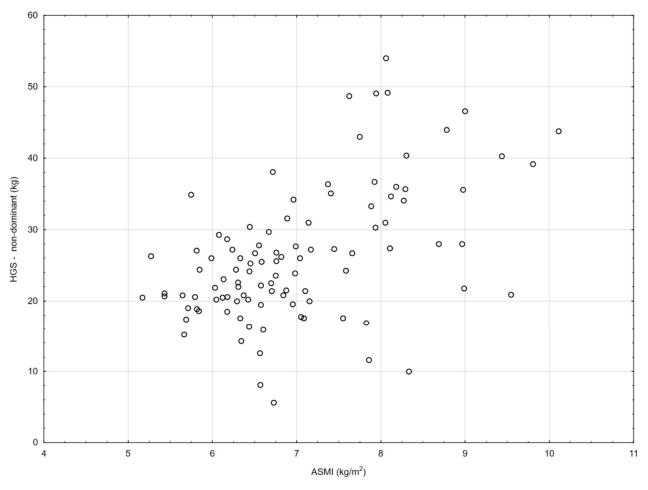
| ASMI | - | 3.88 | 2.59; 5.16 | 0.66 | 0.001 |
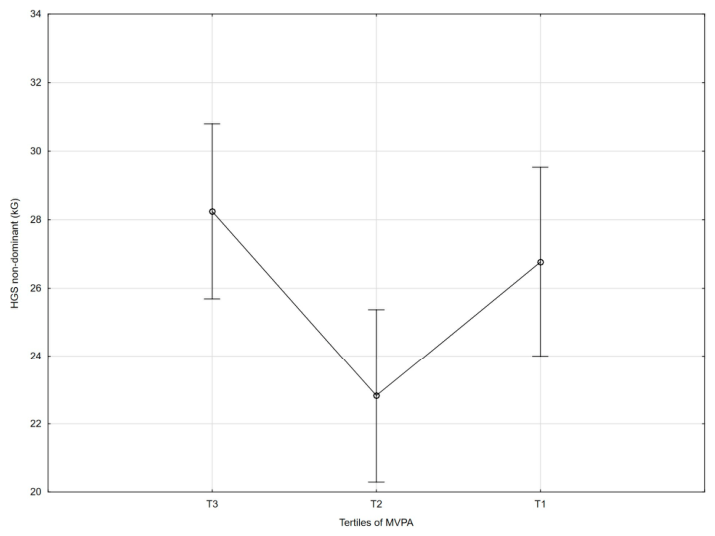
| % in MVPA Ref. T1 | T2 | −3.11 | −5.08; −1.16 | 1.00 | 0.015 |
| T3 | 2.30 | 0.33; 4.26 | 1.00 | 0.022 | |
| Protein consumption (frequency/day) | - | −0.30 | −1.31; 0.70 | 0.51 | 0.551 |
| 9-HPT non-dominant hand | |||||
| ASMI | - | 0.17 | −0.70; 1.05 | 0.45 | 0.696 |
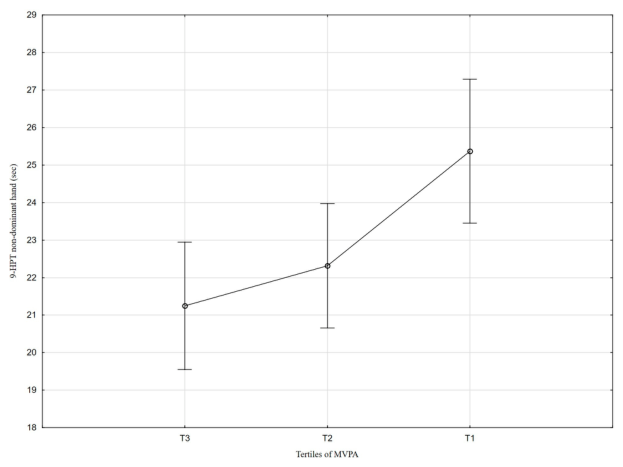
| % in MVPA Ref. T1 | T2 | −0.66 | −1.96; 0.64 | 0.66 | 0.318 |
| T3 | −1.73 | −3.05; −0.40 | 0.67 | 0.010 | |
| Protein consumption (frequency/day) | - | 0.19 | −0.48; 0.85 | 0.34 | 0.577 |
| 9-HPT dominant hand | |||||
| ASMI | - | 0.21 | −0.57; 1.10 | 0.65 | 0.532 |
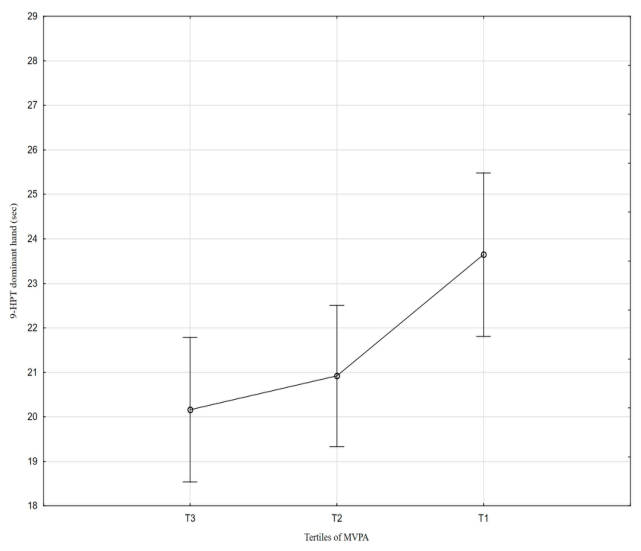
| % in MVPA Ref. T1 | T2 | −0.66 | −1.90; 0.59 | 0.63 | 0.301 |
| T3 | −1.41 | −2.68; −0.15 | 0.65 | 0.029 | |
| Protein consumption (frequency/day) | - | 0.04 | −0.60; 0.67 | 0.32 | 0.902 |
Disclaimer/Publisher’s Note: The statements, opinions and data contained in all publications are solely those of the individual author(s) and contributor(s) and not of MDPI and/or the editor(s). MDPI and/or the editor(s) disclaim responsibility for any injury to people or property resulting from any ideas, methods, instructions or products referred to in the content. |
© 2026 by the authors. Licensee MDPI, Basel, Switzerland. This article is an open access article distributed under the terms and conditions of the Creative Commons Attribution (CC BY) license.
Share and Cite
Cieśla, E.; Jasińska, E.; Suliga, E. Associations of Physical Activity, Muscle Mass and Protein-Rich Food Consumption with Functional Fitness in Individuals with Multiple Sclerosis. Nutrients 2026, 18, 1548. https://doi.org/10.3390/nu18101548
Cieśla E, Jasińska E, Suliga E. Associations of Physical Activity, Muscle Mass and Protein-Rich Food Consumption with Functional Fitness in Individuals with Multiple Sclerosis. Nutrients. 2026; 18(10):1548. https://doi.org/10.3390/nu18101548
Chicago/Turabian StyleCieśla, Elżbieta, Elżbieta Jasińska, and Edyta Suliga. 2026. "Associations of Physical Activity, Muscle Mass and Protein-Rich Food Consumption with Functional Fitness in Individuals with Multiple Sclerosis" Nutrients 18, no. 10: 1548. https://doi.org/10.3390/nu18101548
APA StyleCieśla, E., Jasińska, E., & Suliga, E. (2026). Associations of Physical Activity, Muscle Mass and Protein-Rich Food Consumption with Functional Fitness in Individuals with Multiple Sclerosis. Nutrients, 18(10), 1548. https://doi.org/10.3390/nu18101548