


Human Milk as a Biomonitor of Toxic Metal Exposure: Sources, Transfer Mechanisms, and Implications for Infant Health—A Review

Abstract
1. Introduction
2. Materials and Methods
3. Heavy Metals Relevant to Human Milk: Sources, Maternal Exposure, and Infant Transfer
3.1. Arsenic (As)
3.2. Cadmium (Cd)
3.3. Lead (Pb)
3.4. Chromium (Cr)
3.5. Mercury (Hg)
3.6. Aluminum (Al)
4. Heavy Metals in Human Milk (HM)
4.1. Maternal–Infant Exposure to Heavy Metals via Human Milk
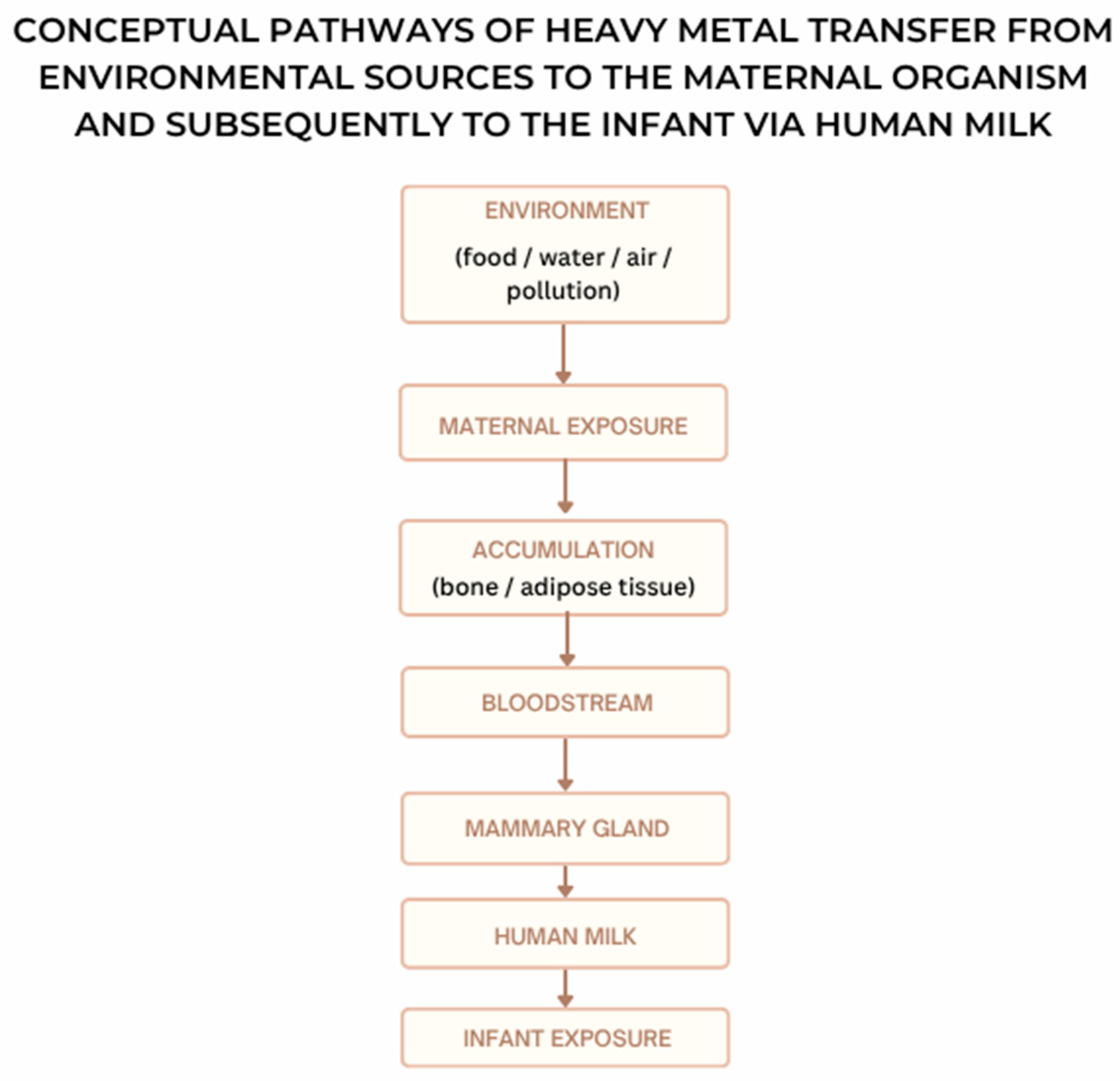
4.1.1. Pathways of Heavy Metal Transfer from the Maternal Organism to the Infant—Revised
4.1.2. The Role of Human Milk as an Indicator of Environmental Exposure—Subtle Correction
4.1.3. Increased Susceptibility of Infants to Toxic Elements
4.2. Sources of Heavy Metals in Human Milk
4.2.1. Endogenous Sources
4.2.2. Environmental Sources
4.3. Occurrence of Heavy Metals in Human Milk
4.3.1. Most Commonly Analyzed Metals
4.3.2. Concentration Ranges Reported in Studies
4.3.3. Findings from Different Regions of the World
4.4. Geographical Variability of Heavy Metal Levels
4.4.1. Differences Between Industrialized and Agricultural Regions
4.4.2. Comparisons Between Urban and Rural Populations
4.4.3. Influence of Local Environmental Conditions
4.5. Factors Influencing Heavy Metal Concentrations in Human Milk and Their Changes During Lactation
4.5.1. Dietary Factors
4.5.2. Lifestyle-Related Factors
4.5.3. Biological Factors
4.5.4. Other Sources of Exposure
4.5.5. Changes in Element Concentrations During Lactation
4.6. Analytical Methods Used to Determine Heavy Metals in Human Milk
4.6.1. Methods Used in Laboratory Analyses (ICP-MS, AAS, GFAAS, CV-AAS)
4.6.2. Importance of Methods for the Determination of Trace Elements at Low Concentrations
5. Public Health Implications
6. Conclusions
Author Contributions
Funding
Institutional Review Board Statement
Informed Consent Statement
Data Availability Statement
Conflicts of Interest
References
- Tsopmo, A. Phytochemicals in Human Milk and Their Potential Antioxidative Protection. Antioxidants 2018, 7, 32. [Google Scholar] [CrossRef]
- WHO. Infant and Young Child Feeding Model Chapter for Textbooks for Medical Students and Allied Health Professionals; World Health Organization (WHO) Press: Geneva, Switzerland, 2009; ISBN 9789241597494. [Google Scholar]
- American Academy of Pediatrics. Newborn and Infant Breastfeeding. 2024. Available online: https://www.aap.org/en/patient-care/newborn-infant-and-early-childhood-nutrition/newborn-and-infant-breastfeeding/ (accessed on 24 March 2026).
- ESPGHAN Committee on Nutrition; Agostoni, C.; Braegger, C.; Decsi, T.; Kolacek, S.; Koletzko, B.; Michaelsen, K.F.; Mihatsch, W.; Moreno, L.A.; Puntis, J.; et al. Breast-feeding: A commentary by the ESPGHAN Committee on Nutrition. J. Pediatr. Gastroenterol. Nutr. 2009, 49, 112–125. [Google Scholar] [CrossRef] [PubMed]
- Gagné, F. A Research Journal Dedicated to the Effects of Xenobiotics in Organisms. J. Xenobiotics 2020, 10, 11–13. [Google Scholar] [CrossRef]
- Marcoccia, D.; Pellegrini, M.; Fiocchetti, M.; Lorenzetti, S.; Marino, M. Food components and contaminants as (anti)androgenic molecules. Genes Nutr. 2017, 12, 6. [Google Scholar] [CrossRef] [PubMed]
- Gupta, N.; Yadav, K.K.; Kumar, V.; Kumar, S.; Chadd, R.P.; Kumar, A. Trace elements in soil–vegetables interface: Translocation, bioaccumulation, toxicity and amelioration—A review. Sci. Total Environ. 2019, 651, 2927–2942. [Google Scholar] [CrossRef]
- Papadopoulou, E.; Haug, L.S.; Sakhi, A.K.; Andrusaityte, S.; Basagaña, X.; Brantsaeter, A.L.; Casas, M.; Fernández-Barrés, S.; Grazuleviciene, R.; Knutsen, H.K.; et al. Diet as a source of exposure to environmental contaminants for pregnant women and children from six European countries. Environ. Health Perspect. 2019, 127, 107005. [Google Scholar] [CrossRef]
- Ferramosca, A.; Lorenzetti, S.; Di Giacomo, M.; Murrieri, F.; Coppola, L.; Zara, V. Herbicides glyphosate and glufosinate ammonium negatively affect human sperm mitochondria respiration efficiency. Reprod. Toxicol. 2021, 99, 48–55. [Google Scholar] [CrossRef]
- Lehnen, H.; Zechner, U.; Haaf, T. Epigenetics of gestational diabetes mellitus and offspring health: The time for action is in early stages of life. Mol. Hum. Reprod. 2013, 19, 415–422. [Google Scholar] [CrossRef] [PubMed]
- Hanson, M.A.; Gluckman, P.D. Early developmental conditioning of later health and disease: Physiology or pathophysiology? Physiol. Rev. 2014, 94, 1027–1076. [Google Scholar] [CrossRef]
- Almeida, D.L.; Pavanello, A.; Saavedra, L.P.; Pereira, T.S.; Castro-Prado, M.A.A.; Mathias, P.C.F. Environmental monitoring and the developmental origins of health and disease. J. Dev. Orig. Health Dis. 2019, 10, 608–615. [Google Scholar] [CrossRef]
- Picó, C.; Reis, F.; Egas, C.; Mathias, P.; Matafome, P. Lactation as a programming window for metabolic syndrome. Eur. J. Clin. Investig. 2021, 51, e13482. [Google Scholar] [CrossRef]
- Andreas, N.J.; Kampmann, B.; Le-Doare, K.M. Human breast milk: A review on its composition and bioactivity. Early Hum. Dev. 2015, 91, 629–635. [Google Scholar] [CrossRef]
- Erick, M. Breast milk is conditionally perfect. Med. Hypotheses 2018, 111, 82–89. [Google Scholar] [CrossRef] [PubMed]
- Mead, M.N. Contaminants in human milk: Weighing the risks against the benefits of breastfeeding. Environ. Health Perspect. 2008, 116, A426–A434. [Google Scholar] [CrossRef] [PubMed] [PubMed Central]
- Giri, A.; Sushila, S.; Balda, A.; Balhara, N.; Aarushi, A. Literature review and health risks assessment of heavy metal contamination in human milk. Discov. Miner. 2024, 1, 2. [Google Scholar] [CrossRef]
- Dórea, J.G. Environmental exposure to low-level lead (Pb) co-occurring with other neurotoxicants in early life and neurodevelopment of children. Environ. Res. 2019, 177, 108641. [Google Scholar] [CrossRef] [PubMed]
- Omwene, P.I.; Öncel, M.S.; Çelen, M.; Kobya, M. Heavy metal pollution and spatial distribution in surface sediments of Mustafakemalpaşa stream located in the world’s largest borate basin (Turkey). Chemosphere 2018, 208, 782–792. [Google Scholar] [CrossRef] [PubMed]
- Xia, F.; Qu, L.; Wang, T.; Luo, L.; Chen, H.; Dahlgren, R.A.; Zhang, M.; Mei, K.; Huang, H. Distribution and source analysis of heavy metal pollutants in sediments of a rapidly developing urban river system. Chemosphere 2018, 207, 218–228. [Google Scholar] [CrossRef]
- Walaszek, M.; Bois, P.; Laurent, J.; Lenormand, E.; Wanko, A. Urban stormwater treatment by a constructed wetland: Seasonality impacts on hydraulic efficiency, physico-chemical behavior and heavy metal occurrence. Sci. Total Environ. 2018, 637–638, 443–454. [Google Scholar] [CrossRef]
- Dias-Ferreira, C.; Pato, R.L.; Varejão, J.M.T.B.; Tavares, A.O.; Ferreira, A.D. Heavy metal and PCB spatial distribution pattern in sediments within an urban catchment—Contribution of historical pollution sources. J. Soils Sediments 2016, 16, 2664–2675. [Google Scholar] [CrossRef]
- Ferreira, A.D.; Soares, D.B.; Serrano, L.; Walsh, R.P.D.; Dias-Ferreira, C.; Ferreira, C. Roads as sources of heavy metals in urban areas: The Coves catchment experiment, Coimbra, Portugal. J. Soils Sediments 2016, 16, 2620–2632. [Google Scholar] [CrossRef]
- Silveira, A.; Pereira, J.A.; Poleto, C.; Pedroso de Lima, J.L.M.; Gonçalves, F.; Alvarenga, L.A.; Isidoro, J.M.G.P. Assessment of loose and adhered urban street sediments and trace metals: A study in the city of Poços de Caldas, Brazil. J. Soils Sediments 2016, 16, 2593–2605. [Google Scholar] [CrossRef]
- Epstein, E. Mineral Nutrition of Plants: Principles and Perspectives; John Wiley & Sons: Hoboken, NJ, USA, 1972. [Google Scholar]
- White, P.J.; Broadley, M.R. Biofortification of crops with seven mineral elements often lacking in human diets—Iron, zinc, copper, calcium, magnesium, selenium and iodine. New Phytol. 2009, 182, 49–84. [Google Scholar] [CrossRef]
- Ghanati, F.; Morita, A.; Yokota, H. Effects of aluminum on the growth of tea plant and activation of antioxidant system. Plant Soil 2005, 276, 133–141. [Google Scholar] [CrossRef]
- McGrath, S.P.; Zhao, F.-J.; Lombi, E. Phytoremediation of metals, metalloids, and radionuclides. Adv. Agron. 2002, 75, 1–56. [Google Scholar] [CrossRef]
- Baker, A.J.M.; McGrath, S.P.; Reeves, R.D.; Smith, J.A.C. Metal hyperaccumulator plants: A review of the ecology and physiology of a biochemical resource for phytoremediation of metal-polluted soils. In Phytoremediation of Contaminated Soil and Water; Terry, N., Banuelos, G., Eds.; CRC Press: Boca Raton, FL, USA, 2000; pp. 85–107. [Google Scholar]
- Gardea-Torresdey, J.L.; Peralta-Videa, J.; de la Rosa, G.; Parsons, J.G. Phytoremediation of heavy metals and study of the metal coordination by X-ray absorption spectroscopy. Coord. Chem. Rev. 2005, 249, 1797–1810. [Google Scholar] [CrossRef]
- Aldrich, M.V.; Gardea-Torresdey, J.L.; Peralta-Videa, J.R.; Parsons, J.G. Uptake and reduction of Cr(VI) to Cr(III) by mesquite (Prosopis spp.): Chromate-plant interaction in hydroponics and solid media studied using XAS. Environ. Sci. Technol. 2003, 37, 1859–1864. [Google Scholar] [CrossRef]
- de la Rosa, G.; Peralta-Videa, J.R.; Montes, M.; Parsons, J.G.; Cano-Aguilera, I.; Gardea-Torresdey, J.L. Cadmium uptake and translocation in tumbleweed (Salsola kali), a potential Cd-hyperaccumulator desert plant species: ICP/OES and XAS studies. Chemosphere 2004, 55, 1159–1168. [Google Scholar] [CrossRef]
- Yu, H.; Wang, J.; Fang, W.; Yuan, J.; Yang, Z. Cadmium accumulation in different rice cultivars and screening for pollution-safe cultivars of rice. Sci. Total Environ. 2006, 370, 302–309. [Google Scholar] [CrossRef]
- Dudka, S.; Piotrowska, M.; Terelak, H. Transfer of cadmium, lead, and zinc from industrially contaminated soil to crop plants: A field study. Environ. Pollut. 1996, 94, 181–188. [Google Scholar] [CrossRef] [PubMed]
- Uddin, M.M.; Zakeel, M.C.M.; Zavahir, J.S.; Marikar, F.M.M.T.; Jahan, I. Heavy metal accumulation in rice and aquatic plants used as human food: A general review. Toxics 2021, 9, 360. [Google Scholar] [CrossRef] [PubMed]
- Luong, J.H.T.; Majid, E.; Male, K.B. Analytical tools for monitoring arsenic in the environment. Open Anal. Chem. J. 2007, 1, 7–14. [Google Scholar] [CrossRef]
- Aldrich, M.V.; Peralta-Videa, J.R.; Parsons, J.G.; Gardea-Torresdey, J.L. Examination of arsenic(III) and (V) uptake by the desert plant species mesquite (Prosopis spp.) using X-ray absorption spectroscopy. Sci. Total Environ. 2007, 379, 249–255. [Google Scholar] [CrossRef]
- Environmental Protection Agency (EPA). National Primary Drinking Water Regulations; Arsenic and Clarifications to Compliance and New Source Contaminants Monitoring; 66 FR 6976; Federal Register: Washington, DC, USA, 2001; pp. 6976–7066.
- Fayiga, A.O.; Ma, L.Q.; Zhou, Q. Effects of plant arsenic uptake and heavy metals on arsenic distribution in an arsenic-contaminated soil. Environ. Pollut. 2007, 147, 737–742. [Google Scholar] [CrossRef]
- Zavala, Y.J.; Duxbury, J.M. Arsenic in rice: I. Estimating normal levels of total arsenic in rice grain. Environ. Sci. Technol. 2008, 42, 3856–3860. [Google Scholar] [CrossRef]
- Tripathi, R.D.; Srivastava, S.; Mishra, S.; Singh, N.; Tuli, R.; Gupta, D.K.; Maathuis, F.J.M. Arsenic hazards: Strategies for tolerance and remediation by plants. Trends Biotechnol. 2007, 25, 158–165. [Google Scholar] [CrossRef]
- World Health Organization (WHO). Arsenic in Drinking-Water: Background Document for Development of WHO Guidelines for Drinking-Water Quality; WHO/SDE/WSH/03.04/75; World Health Organization: Geneva, Switzerland, 2003. [Google Scholar]
- Ma, J.F.; Yamaji, N.; Mitani, N.; Xu, X.-Y.; Su, Y.-H.; McGrath, S.P.; Zhao, F.-J. Transporters of arsenite in rice and their role in arsenic accumulation in rice grain. Proc. Natl. Acad. Sci. USA 2008, 105, 9931–9935. [Google Scholar] [CrossRef]
- Cheraghi, M.; Shahbazi, K.; Marzi, M.; Yeganeh, M.; Hasheminasab, K.S.; Fathi-Gerdelidani, A.; Rezaei, M.; Bazargan, K. Geochemistry of arsenic in paddy soils and its accumulation in rice grains: An updated analysis with human health perspectives. Ecotoxicol. Environ. Saf. 2025, 302, 118667. [Google Scholar] [CrossRef]
- Roychowdhury, T. Impact of sedimentary arsenic through irrigated groundwater on soil, plant, crops and human continuum from Bengal delta: Special reference to raw and cooked rice. Food Chem. Toxicol. 2008, 46, 2856–2864. [Google Scholar] [CrossRef] [PubMed]
- Meharg, A.A.; Lombi, E.; Williams, P.N.; Scheckel, K.G.; Feldmann, J.; Raab, A.; Zhu, Y.; Islam, R. Speciation and localization of arsenic in white and brown rice grains. Environ. Sci. Technol. 2008, 42, 1051–1057. [Google Scholar] [CrossRef]
- Zhu, Y.-G.; Williams, P.N.; Meharg, A.A. Exposure to inorganic arsenic from rice: A global health issue? Environ. Pollut. 2008, 154, 169–171. [Google Scholar] [CrossRef]
- Del Razo, L.M.; Garcia-Vargas, G.G.; Garcia-Salcedo, J.; Sanmiguel, M.F.; Rivera, M.; Hernandez, M.C.; Cebrian, M.E. Arsenic levels in cooked food and assessment of adult dietary intake of arsenic in the Region Lagunera, Mexico. Food Chem. Toxicol. 2002, 40, 1423–1431. [Google Scholar] [CrossRef] [PubMed]
- Schoof, R.A.; Yost, L.J.; Eickhoff, J.; Crecelius, E.A.; Cragin, D.W.; Meacher, D.M.; Menzel, D.B. A market basket survey of inorganic arsenic in food. Food Chem. Toxicol. 1999, 37, 839–846. [Google Scholar] [CrossRef]
- Borak, J.; Hosgood, H.D. Seafood arsenic: Implications for human risk assessment. Regul. Toxicol. Pharmacol. 2007, 47, 204–212. [Google Scholar] [CrossRef]
- Díaz, O.P.; Leyton, I.; Muñoz, O.; Núñez, N.; Devesa, V.; Súñer, M.A.; Vélez, D.; Montoro, R. Contribution of water, bread, and vegetables (raw and cooked) to dietary intake of inorganic arsenic in a rural village of northern Chile. J. Agric. Food Chem. 2004, 52, 1773–1779. [Google Scholar] [CrossRef] [PubMed]
- Vahidnia, A.; van der Voet, G.B.; de Wolff, F.A. Arsenic neurotoxicity—A review. Hum. Exp. Toxicol. 2007, 26, 823–832. [Google Scholar] [CrossRef] [PubMed]
- Singh, N.; Kumar, D.; Raisuddin, S.; Sahu, A.P. Genotoxic effects of arsenic: Prevention by functional food-jaggery. Cancer Lett. 2008, 268, 325–330. [Google Scholar] [CrossRef]
- Kabata-Pendias, A. Soil–plant transfer of trace elements—An environmental issue. Geoderma 2004, 122, 143–149. [Google Scholar] [CrossRef]
- Chen, W.; Chang, A.C.; Wu, L. Assessing long-term environmental risks of trace elements in phosphate fertilizers. Ecotoxicol. Environ. Saf. 2007, 67, 48–58. [Google Scholar] [CrossRef]
- Sridhara Chary, N.; Kamala, C.T.; Suman Raj, D.S. Assessing risk of heavy metals from consuming food grown on sewage irrigated soils and food chain transfer. Ecotoxicol. Environ. Saf. 2008, 69, 513–524. [Google Scholar] [CrossRef]
- Chien, L.-C.; Hung, T.-C.; Choang, K.-Y.; Yeh, C.-Y.; Meng, P.-J.; Shieh, M.-J.; Ha, B.-C. Daily intake of TBT, Cu, Zn, Cd and As for fishermen in Taiwan. Sci. Total Environ. 2002, 285, 177–185. [Google Scholar] [CrossRef] [PubMed]
- Zheng, N.; Wang, Q.; Zheng, D. Health risk of Hg, Pb, Cd, Zn, and Cu to the inhabitants around Huludao Zinc Plant in China via consumption of vegetables. Sci. Total Environ. 2007, 383, 81–89. [Google Scholar] [CrossRef]
- Yang, Q.-W.; Lan, C.Y.; Wang, H.B.; Zhuang, P.; Shu, W.-S. Cadmium in soil–rice system and health risk associated with the use of untreated mining wastewater for irrigation in Lechang, China. Agric. Water Manag. 2006, 84, 147–152. [Google Scholar] [CrossRef]
- Millis, P.R.; Ramsey, M.H.; John, E.A. Heterogeneity of cadmium concentration in soil as a source of uncertainty in plant uptake and its implications for human health risk assessment. Sci. Total Environ. 2004, 326, 49–53. [Google Scholar] [CrossRef]
- Antonious, G.F.; Kochhar, T.S. Mobility of heavy metals from soil into hot pepper fruits: A field study. Bull. Environ. Contam. Toxicol. 2009, 82, 59–63. [Google Scholar] [CrossRef]
- Rosenfeld, C.E.; Chaney, R.L.; Martínez, C.E. Soil geochemical factors regulate Cd accumulation by metal hyperaccumulating Noccaea caerulescens (J. Presl & C. Presl) F.K. Mey in field-contaminated soils. Sci. Total Environ. 2018, 616–617, 279–287. [Google Scholar] [CrossRef]
- Chaney, R.L.; Reeves, P.G.; Ryan, J.A.; Simmons, R.W.; Welch, R.M.; Angle, J.S. An improved understanding of soil Cd risk to humans and low cost methods to phytoextract Cd from contaminated soils to prevent soil Cd risks. Biometals 2004, 17, 549–553. [Google Scholar] [CrossRef] [PubMed]
- Khan, S.; Cao, Q.; Zheng, Y.M.; Huang, Y.Z.; Zhu, Y.G. Health risks of heavy metals in contaminated soils and food crops irrigated with wastewater in Beijing, China. Environ. Pollut. 2008, 152, 686–692. [Google Scholar] [CrossRef]
- Kobayashi, E.; Okubo, Y.; Suwazono, Y.; Kido, T.; Nishijo, M.; Nakagawa, H.; Nogawa, K. Association between total cadmium intake calculated from the cadmium concentration in household rice and mortality among inhabitants of the cadmium-polluted Jinzu River basin of Japan. Toxicol. Lett. 2002, 129, 85–91. [Google Scholar] [CrossRef] [PubMed]
- Cooke, J.A. Cadmium in Small Mammals. In Environmental Contaminants in Biota; CRC Press: Boca Raton, FL, USA, 2011; pp. 315–334. [Google Scholar] [CrossRef]
- Pokorny, B.; Ribaric-Lasnik, C. Lead, cadmium, and zinc in tissues of roe deer (Capreolus capreolus) near the lead smelter in the Koroska region (northern Slovenia). Bull. Environ. Contam. Toxicol. 2000, 64, 20–26. [Google Scholar] [CrossRef]
- Kan, C.A.; Meijer, G.A.L. The risk of contamination of food with toxic substances present in animal feed. Anim. Feed Sci. Technol. 2007, 133, 84–108. [Google Scholar] [CrossRef]
- Caussy, D.; Gochfeld, M.; Gurzau, E.; Neagu, C.; Ruedel, H. Lessons from case studies of metals: Investigating exposure, bioavailability, and risk. Ecotoxicol. Environ. Saf. 2003, 56, 45–51. [Google Scholar] [CrossRef]
- Marchiol, L.; Assolari, S.; Sacco, P.; Zerbi, G. Phytoextraction of heavy metals by canola (Brassica napus) and radish (Raphanus sativus) grown on multicontaminated soil. Environ. Pollut. 2004, 132, 21–27. [Google Scholar] [CrossRef]
- Babu, S.M.O.F.; Hossain, M.B.; Rahman, M.S.; Rahman, M.; Ahmed, A.S.S.; Hasan, M.M.; Rakib, A.; Emran, T.B.; Xiao, J.; Simal-Gandara, J. Phytoremediation of Toxic Metals: A Sustainable Green Solution for Clean Environment. Appl. Sci. 2021, 11, 10348. [Google Scholar] [CrossRef]
- Laskowski, R.; Hopkin, S.P. Accumulation of Zn, Cu, Pb and Cd in the garden snail (Helix aspersa): Implications for predators. Environ. Pollut. 1996, 91, 289–297. [Google Scholar] [CrossRef]
- Milton, A.; Johnson, M.S.; Cook, J.A. Lead within ecosystems on metalliferous mine tailings in Wales and Ireland. Sci. Total Environ. 2002, 299, 177–190. [Google Scholar] [CrossRef] [PubMed]
- Babula, P.; Adam, V.; Opatrilova, R.; Zehnalek, J. Uncommon Heavy Metals, Metalloids and Their Plant Toxicity: A Review. Environ. Chem. Lett. 2008, 6, 189–213. [Google Scholar] [CrossRef]
- Sharma, P.; Dubey, R.S. Lead Toxicity in Plants. Braz. J. Plant Physiol. 2005, 17, 35–52. [Google Scholar] [CrossRef]
- Wierzbicka, M. Comparison of lead tolerance in Allium cepa with other plant species. Environ. Pollut. 1999, 104, 41–52. [Google Scholar] [CrossRef]
- Begonia, M.T.; Begonia, G.B.; Miller, G.S.; Gilliard, D. Effects of chelate application time on the phytoextraction of lead-contaminated soils. Bull. Environ. Contam. Toxicol. 2004, 73, 1033–1040. [Google Scholar] [CrossRef] [PubMed]
- Law, R.J. Metals in Marine Mammals. In Environmental Contaminants in Wildlife. Interpreting Tissue Concentrations; Beyer, W.N., Heinz, G.H., Redmon-Norwood, A.W., Eds.; Lewis Publishers: Stockport, UK; CRC Press: Boca Raton, FL, USA, 1996; pp. 357–365. [Google Scholar]
- Capdevila, F.; Nadal, M.; Schuhmacher, M.; Domingo, J.L. Intake of lead and cadmium from edible vegetables cultivated in Tarragona Province, Spain. Trace Elem. Electrolytes 2003, 20, 256–261. [Google Scholar] [CrossRef]
- Anders, E.; Dietz, D.D.; Bagnell, C.R.; Gaynor, J.; Krigman, M.R.; Ross, D.W.; Leander, J.D.; Mushak, P. Morphological, pharmacokinetic, and hematological studies of lead-exposed pigeons. Environ. Res. 1982, 28, 344–363. [Google Scholar] [CrossRef] [PubMed]
- Solenkova, N.V.; Newman, J.D.; Berger, J.S.; Thurston, G.; Hochman, J.S.; Lamas, G.A. Metal pollutants and cardiovascular disease: Mechanisms and consequences of exposure. Am. Heart J. 2014, 168, 812–822. [Google Scholar] [CrossRef]
- Bluskov, S.; Arocena, J.M.; Omotoso, O.O.; Young, J.P. Uptake, distribution, and speciation of chromium in Brassica juncea. Int. J. Phytoremediat. 2005, 7, 153–165. [Google Scholar] [CrossRef] [PubMed]
- Kotaś, J.; Stasicka, Z. Chromium occurrence in the environment and methods of its speciation. Environ. Pollut. 2000, 107, 263–283. [Google Scholar] [CrossRef]
- Zayed, A.; Terry, N. Chromium in the Environment: Factors Affecting Biological Remediation. Plant Soil 2003, 249, 139–156. [Google Scholar] [CrossRef]
- Dube, B.K.; Tewari, K.; Chatterjee, J.; Chatterjee, C. Excess chromium alters uptake and translocation of certain nutrients in Citrullus. Chemosphere 2003, 53, 1147–1153. [Google Scholar] [CrossRef] [PubMed]
- Ali, S.; Mir, R.A.; Tyagi, A.; Manzar, N.; Kashyap, A.S.; Mushtaq, M.; Raina, A.; Park, S.; Sharma, S.; Mir, Z.A.; et al. Chromium Toxicity in Plants: Signaling, Mitigation, and Future Perspectives. Plants 2023, 12, 1502. [Google Scholar] [CrossRef]
- Martello, L.; Fuchsman, P.; Sorensen, M.; Magar, V.; Wenning, R.J. Chromium geochemistry and bioaccumulation in sediments from the lower Hackensack River, New Jersey. Arch. Environ. Contam. Toxicol. 2007, 53, 337–350. [Google Scholar] [CrossRef]
- Flores-Tena, F.J.; Martínez-Tabchet, L. The Effect of Chromium on the Hemoglobin Concentration of Limnodrilus hoffmeisteri (Oligochaeta: Tubificidae). Ecotoxicol. Environ. Saf. 2001, 50, 196–202. [Google Scholar] [CrossRef]
- Coeurdassier, M.; de Vaufleury, A.; Crini, N.; Scheifler, R.; Badot, P.-M. Assessment of whole effluent toxicity on aquatic snails: Bioaccumulation of Cr, Zn, and Fe, and individual effects in bioassays. Environ. Toxicol. Chem. 2005, 24, 198–204. [Google Scholar] [CrossRef] [PubMed]
- Marchese, M.; Gagneten, A.M.; Parma, M.J.; Pavé, P.J. Accumulation and elimination of chromium by freshwater species exposed to spiked sediments. Arch. Environ. Contam. Toxicol. 2008, 55, 603–609. [Google Scholar] [CrossRef]
- Krzysik, M.; Grajeta, H.; Prescha, A. Chromium content in selected convenience and fast foods in Poland. Food Chem. 2008, 107, 208–212. [Google Scholar] [CrossRef]
- Urberg, M.; Zemel, M.B. Evidence for synergism between chromium and nicotinic acid in the control of glucose tolerance in elderly humans. Metabolism 1987, 36, 896–899. [Google Scholar] [CrossRef]
- Costa, M.; Klein, C.B. Toxicity and carcinogenicity of chromium compounds in humans. Crit. Rev. Toxicol. 2006, 36, 155–163. [Google Scholar] [CrossRef]
- Nóvoa-Muñoz, J.C.; Pontevedra-Pombal, X.; Martínez-Cortizas, A.; García-Rodeja Gayoso, E. Mercury accumulation in upland acid forest ecosystems nearby a coal-fired power-plant in Southwest Europe (Galicia, NW Spain). Sci. Total Environ. 2008, 394, 303–312. [Google Scholar] [CrossRef]
- Baron, L.A.; Sample, B.E.; Suter, G.W. Ecological risk assessment in a large river-reservoir: 5. Aerial insectivorous wildlife. Environ. Toxicol. Chem. 1999, 18, 621–627. [Google Scholar] [CrossRef]
- Van, C.T.; Schofield, C.L.; Munson, R.; Holsapple, J. The mercury cycle and fish in the Adirondack lakes. Environ. Sci. Technol. 1994, 28, 136A–143A. [Google Scholar] [CrossRef]
- Hanisch, C. Where is mercury deposition coming from? Environ. Sci. Technol. 1998, 32, 176A–179A. [Google Scholar] [CrossRef] [PubMed]
- Doty, S.L. Enhancing phytoremediation through the use of transgenics and endophytes. New Phytol. 2008, 179, 318–333. [Google Scholar] [CrossRef]
- Alexander, M. Biodegradation and Bioremediation, 2nd ed.; Academic Press: Cambridge, MA, USA, 1999. [Google Scholar]
- Guzzi, G.; La Porta, C.A.M. Molecular mechanisms triggered by mercury. Toxicology 2008, 244, 1–12. [Google Scholar] [CrossRef] [PubMed]
- Genchi, G.; Sinicropi, M.S.; Carocci, A.; Lauria, G.; Catalano, A. Mercury Exposure and Heart Diseases. Int. J. Environ. Res. Public Health 2017, 14, 74. [Google Scholar] [CrossRef]
- Bojórquez-Quintal, E.; Escalante-Magaña, C.; Echevarría-Machado, I.; Martínez-Estévez, M. Aluminum, a Friend or Foe of Higher Plants in Acid Soils. Front. Plant Sci. 2017, 8, 1767. [Google Scholar] [CrossRef]
- Delhaize, E.; Ryan, P.R. Aluminum Toxicity and Tolerance in Plants. Plant Physiol. 1995, 107, 315–321. [Google Scholar] [CrossRef]
- von Uexküll, H.R.; Mutert, E. Global extent, development and economic impact of acid soils. Plant Soil 1995, 171, 1–15. [Google Scholar] [CrossRef]
- Exley, C. Human exposure to aluminium. Environ. Sci. Process. Impacts 2013, 15, 1807–1816. [Google Scholar] [CrossRef]
- Igbokwe, I.O.; Igwenagu, E.; Igbokwe, N.A. Aluminium toxicosis: A review of toxic actions and effects. Interdiscip. Toxicol. 2019, 12, 45–70. [Google Scholar] [CrossRef]
- Darbre, P.D. Aluminium and the human breast. Morphologie 2016, 100, 65–74. [Google Scholar] [CrossRef] [PubMed]
- Ebrahim, G.J. Mother and Child Nutrition in the Tropics and Subtropics; Book Aid International: London, UK, 2006; pp. 127–147. [Google Scholar]
- Krewski, D.; Yokel, R.A.; Nieboer, E.; Borchelt, D.; Cohen, J.; Harry, J.; Kacew, S.; Lindsay, J.; Mahfouz, A.M.; Rondeau, V. Human health risk assessment for aluminium, aluminium oxide, and aluminium hydroxide. J. Toxicol. Environ. Health Part B Crit. Rev. 2007, 10, 1–269. [Google Scholar] [CrossRef] [PubMed]
- Kawahara, M.; Kato-Negishi, M. Link between Aluminum and the Pathogenesis of Alzheimer’s Disease: The Integration of the Aluminum and Amyloid Cascade Hypotheses. Int. J. Alzheimer’s Dis. 2011, 2011, 276393. [Google Scholar] [CrossRef]
- Yasui, M.; Kihira, T.; Ota, K. Calcium, magnesium and aluminum concentrations in Parkinson’s disease. Neurotoxicology 1992, 13, 593–600. [Google Scholar] [PubMed]
- Darbre, P.D. Underarm cosmetics are a cause of breast cancer. Eur. J. Cancer Prev. 2001, 10, 389–393. [Google Scholar] [CrossRef]
- McGrath, K.G. An earlier age of breast cancer diagnosis related to more frequent use of antiperspirants/deodorants and underarm shaving. Eur. J. Cancer Prev. 2003, 12, 479–485. [Google Scholar] [CrossRef]
- D’Haese, P.C.; Douglas, G.; Verhulst, A.; Neven, E.; Behets, G.J.; Vervaet, B.A.; Finsterle, K.; Lürling, M.; Spears, B. Human health risk associated with the management of phosphorus in freshwaters using lanthanum and aluminium. Chemosphere 2019, 220, 286–299. [Google Scholar] [CrossRef]
- Li, H.; Xue, X.; Li, Z.; Pan, B.; Hao, Y.; Niu, Q. Aluminium-induced synaptic plasticity injury via the PHF8-H3K9me2-BDNF signalling pathway. Chemosphere 2020, 244, 125445. [Google Scholar] [CrossRef]
- Crisponi, G.; Fanni, D.; Gerosa, C.; Nemolato, S.; Nurchi, V.M.; Crespo-Alonso, M.; Lachowicz, J.I.; Faa, G. The meaning of aluminium exposure on human health and aluminium-related diseases. Biomol. Concepts 2013, 4, 77–87. [Google Scholar] [CrossRef]
- Zhang, Y.; Shi, B.; Zhao, Y.; Yan, M.; Lytle, D.A.; Wang, D. Deposition behavior of residual aluminum in drinking water distribution system: Effect of aluminum speciation. J. Environ. Sci. 2016, 42, 142–151. [Google Scholar] [CrossRef]
- Frommell, D.M.; Feld, C.M.; Snoeyink, V.L.; Melcher, B.; Feizoulouf, C. Aluminum residual control using orthophosphate. J. Am. Water Work. Assoc. 2004, 96, 99–109. [Google Scholar] [CrossRef]
- Abdollahi, A.; Tadayon, F.; Amirkavei, M. Evaluation and determination of heavy metals (mercury, lead and cadmium) in human breast milk. E3S Web Conf. 2013, 1, 41037. [Google Scholar] [CrossRef]
- Aisyiah; Rahfiludin, M.Z.; Agushybana, F.; Sutiningsih, D. Heavy metal content in breast milk and contributing environmental and maternal factors: A systematic review. J. Bidan Cerdas 2025, 7, 212–222. [Google Scholar] [CrossRef]
- Mohammadi, S.; Rezaeian, M.; Shafiee, M.; Faraji, S.N.; Ghaffarian-Bahraman, A. Contamination of breast milk with lead, mercury, arsenic, and cadmium in Iran: A systematic review and meta-analysis. Biometals 2022, 35, 711–728. [Google Scholar] [CrossRef]
- Yurdakök, K. Lead, mercury, and cadmium in breast milk. J. Pediatr. Neonatal Individ. Med. 2015, 4, e040223. [Google Scholar] [CrossRef]
- Bustami, N.A.; Lee, Y.Z.; Tan, C.K.; Phuna, Z.X.; Zaman, R.; Ho, Y.B.; Gaurav, A.; Tan, E.S.S. Assessment of health risks from heavy metal contamination in breast milk of urban mothers in Malaysia. Discov. Public Health 2025, 22, 640. [Google Scholar] [CrossRef]
- Gundacker, C.; Hengstschläger, M. The role of the placenta in fetal exposure to heavy metals. Wien. Med. Wochenschr. 2012, 162, 201–206. [Google Scholar] [CrossRef]
- Örün, E.; Yalçın, S.S.; Aykut, O.; Orhan, G.; Koç Morgil, G.; Yurdakök, K.; Uzun, R. Breast milk lead and cadmium levels from suburban areas of Ankara. Sci. Total Environ. 2011, 409, 2467–2472. [Google Scholar] [CrossRef]
- Al-Saleh, I. Health risk assessment of trace metals through breast milk consumption in Saudi Arabia. Biol. Trace Elem. Res. 2021, 199, 4535–4545. [Google Scholar] [CrossRef]
- Świdniak, A.; Kopeć, K.; Bartoszek, A.; Adamiuk, J.; Marut, A.; Biskup, M.; Misiuk, J.; Skuba, A.; Załuska, K.; Nykiel, S. Penetration of heavy metals into breast milk and their impact on infant health—Research analysis and literature review. Qual. Sport 2025, 42, 58787. [Google Scholar] [CrossRef]
- Abadin, H.G.; Hibbs, B.F.; Pohl, H.R. Breast-feeding exposure of infants to cadmium, lead, and mercury: A public health viewpoint. Toxicol. Ind. Health 1997, 13, 495–517. [Google Scholar] [CrossRef]
- Koyashiki, G.A.K.; Paoliello, M.M.B.; Tchounwou, P.B. Lead levels in human milk and children’s health risk: A systematic review. Rev. Environ. Health 2010, 25, 243–253. [Google Scholar] [CrossRef]
- Marques, R.C.; Abreu, L.; Bernardi, J.V.E.; Dórea, J.G. Traditional living in the Amazon: Extended breastfeeding, fish consumption, mercury exposure, and neurodevelopment. Ann. Hum. Biol. 2016, 43, 360–370. [Google Scholar] [CrossRef]
- Rebelo, F.M.; Caldas, E.D. Arsenic, lead, mercury and cadmium: Toxicity, levels in breast milk and the risks for breastfed infants. Environ. Res. 2016, 151, 671–688. [Google Scholar] [CrossRef]
- Örün, E.; Yalçın, S.S.; Aykut, O. Lead, mercury, and cadmium levels in breast milk and infant hair in the late period of lactation in Ankara, Turkey. Int. J. Environ. Health Res. 2021, 32, 1950–1961. [Google Scholar] [CrossRef]
- Nieder, R.; Benbi, D.K. Integrated review of the nexus between toxic elements in the environment and human health. AIMS Public Health 2022, 9, 758–789. [Google Scholar] [CrossRef]
- Canale, S.; Blute, N.; Xia, T.; Thomas, M.; Gee, M.; Chang, C.H. Arsenic, cadmium, lead, and mercury in lactation foods and prenatal vitamins: Potentially avoidable exposure for breastfeeding mothers and infants. Breastfeed. Med. 2021, 16, 558–563. [Google Scholar] [CrossRef]
- Carignan, C.C.; Karagas, M.R.; Punshon, T.; Gilbert-Diamond, D.; Cottingham, K.L. Contribution of breast milk and formula to arsenic exposure during the first year of life in a US prospective cohort. J. Expo. Sci. Environ. Epidemiol. 2015, 26, 452–457. [Google Scholar] [CrossRef]
- Pajewska-Szmyt, M.; Sinkiewicz-Darol, E.; Gadzała-Kopciuch, R. The impact of environmental pollution on the quality of mother’s milk. Environ. Sci. Pollut. Res. 2019, 26, 7405–7427. [Google Scholar] [CrossRef] [PubMed]
- Martín-Carrasco, I.; Carbonero-Aguilar, P.; Dahiri, B.; Moreno, I.M.; Hinojosa, M. Comparison between pollutants found in breast milk and infant formula in the last decade: A review. Sci. Total Environ. 2023, 875, 162461. [Google Scholar] [CrossRef]
- Sharafi, K.; Nakhaee, S.; Azadi, N.A.; Mansouri, B.; Miri Kermanshahi, S.; Paknahad, M.; Habibi, Y. Human health risk assessment of potentially toxic elements in the breast milk consumed by infants in Western Iran. Sci. Rep. 2023, 13, 6656. [Google Scholar] [CrossRef]
- Venturelli, F.; Marchesi, I.; Filippini, T.; Casali, M.E.; Ferrari, A.; Righi, E.; Paduano, S.; Bargellini, A. Risk assessment of trace elements in human breastmilk in a Northern Italy population. J. Trace Elem. Med. Biol. 2025, 89, 127641. [Google Scholar] [CrossRef]
- Aumeistere, L.; Beluško, A.; Ciproviča, I. Assessment of heavy metals and trace elements in the human milk of women living in Latvia and an evaluation of influencing factors. Nutrients 2024, 16, 1568. [Google Scholar] [CrossRef]
- Nakhaee, S.; Khosravi Shadmani, F.; Sharafi, K.; Kiani, A.; Azadi, N.A.; Mansouri, B.; Karamimatin, B.; Farnia, V. Evaluation of some toxic metals in breast milk samples with dietary and sociodemographic characteristics: A case study of Kermanshah, Western Iran. Environ. Sci. Pollut. Res. 2023, 30, 4502–4509. [Google Scholar] [CrossRef] [PubMed]
- Olujimi, O.; Steiner, O.; Ajakore, S.; Goessler, W.; Abuganloye, D.; Towolawi, T.; Arowolo, T. Levels of toxic and trace metals in the breast milk of lactating mothers in Abeokuta, Ogun State, Nigeria. Toxicol. Rep. 2023, 11, 168–174. [Google Scholar] [CrossRef] [PubMed]
- Cardoso, O.O.; Julião, F.C.; Alves, R.I.S.; Baena, A.R.; Díez, I.G.; Suzuki, M.N.; Celere, B.S.; Nadal, M.; Domingo, J.L.; Segura-Muñoz, S.I. Concentration profiles of metals in breast milk, drinking water, and soil: Relationship between matrices. Biol. Trace Elem. Res. 2014, 160, 116–122. [Google Scholar] [CrossRef]
- Clewell, R.A.; Gearhart, J.M. Pharmacokinetics of toxic chemicals in breast milk: Use of PBPK models to predict infant exposure. Environ. Health Perspect. 2002, 110, A333–A337. [Google Scholar] [CrossRef] [PubMed]
- Prema, K.; Shali, G.S.; Karthikeswari; Shaini, G.S.; Baskaran, N.; Jayavani, J.; Niranjani, S.; Aswini, K.; Asvini, M. Microplastics in breastmilk—An overview. Vasc. Endovasc. Rev. 2025, 8, 104–110. [Google Scholar]
- Motas, M.; Jiménez, S.; Oliva, J.; Cámara, M.Á.; Pérez-Cárceles, M.D. Heavy metals and trace elements in human breast milk from industrial/mining and agricultural zones of Southeastern Spain. Int. J. Environ. Res. Public Health 2021, 18, 9289. [Google Scholar] [CrossRef]
- Oliveira, M.M.; Trevilato, T.M.B.; Segura-Muñoz, S.I.; Aragon, D.C.; Alves, L.G.; Nadal, M.; Marquès, M.; Domingo, J.L.; Sierra, J.; Camelo, J.S. Essential and toxic elements in human milk concentrate with human milk lyophilizate: A preclinical study. Environ. Res. 2020, 118, 109733. [Google Scholar] [CrossRef]
- Samiee, F.; Vahidinia, A.; Taravati Javad, M.; Leili, M. Exposure to heavy metals released to the environment through breastfeeding: A probabilistic risk estimation. Sci. Total Environ. 2019, 650, 3075–3083. [Google Scholar] [CrossRef]
- Grzunov Letinić, J.; Matek Sarić, M.; Piasek, M.; Jurasović, J.; Varnai, V.M.; Sulimanec Grgec, A.; Orct, T. Use of human milk in the assessment of toxic metals exposure and essential element status in breastfeeding women and their infants in coastal Croatia. J. Trace Elem. Med. Biol. 2016, 38, 117–125. [Google Scholar] [CrossRef]
- Mansouri, B.; Azadi, N.A.; Sharafi, K.; Nakhaee, S. The effects of active and passive smoking on selected trace element levels in human milk. Sci. Rep. 2023, 13, 20756. [Google Scholar] [CrossRef]
- Philip-Slaboh, T.P.; Eleke, C.; Ezejiofor, A.N. Comparison of toxic heavy metals in the breast milk of diabetic and non-diabetic postpartum mothers in Yenagoa, Nigeria. PLoS ONE 2023, 18, e0264658. [Google Scholar] [CrossRef]
- Bernasconi, S.; Street, M.E.; Iughetti, L.; Predieri, B. Chemical contaminants in breast milk: A brief critical overview. Glob. Pediatr. 2022, 2, 100017. [Google Scholar] [CrossRef]
- Serreau, R.; Terbeche, Y.; Rigourd, V. Pollutants in breast milk: A scoping review of the most recent data in 2024. Healthcare 2024, 12, 680. [Google Scholar] [CrossRef]
- Onyena, A.P.; Bede-Ojimadu, O.; Abaate, T.J.; Amachree, D.; Frazzoli, C.; Folorunso, O.M.; Bocca, B.; Orisakwe, O.E. Lactational exposure of human infants to metal(loid)s in Sub-Saharan Africa and Mediterranean Europe: A systematic review and meta-analysis. Curr. Res. Toxicol. 2024, 7, 100201. [Google Scholar] [CrossRef]
- Ekeanyanwu, C.L.; Alisi, C.S.; Ekeanyanwu, R.C. Levels of aflatoxin M1 and selected heavy metals (Pb, Cd, Cr, Cu, Zn, Fe, As, and Hg) in the breast milk of lactating mothers in South Eastern, Nigeria. Food Control 2020, 112, 107150. [Google Scholar] [CrossRef]
- Kunter, İ.; Hürer, N.; Gülcan, H.O.; Öztürk, B.; Doğan, İ.; Şahin, G. Assessment of aflatoxin M1 and heavy metal levels in mothers breast milk in Famagusta, Cyprus. Biol. Trace Elem. Res. 2016, 172, 109–115. [Google Scholar] [CrossRef]
- Kılıç Altun, S.; Dinç, H.; Temamoğulları, F.K.; Paksoy, N. Analyses of essential elements and heavy metals by using ICP-MS in maternal breast milk from Şanlıurfa, Turkey. Int. J. Anal. Chem. 2018, 2018, 1784073. [Google Scholar] [CrossRef]
- Bzikowska-Jura, A.; Wesołowska, A.; Sobieraj, P.; Nawrocka, A.; Filipek, A.; Durkalec, M.; Katryńska, D.; Jedziniak, P. Essential and non-essential element concentrations in human milk samples and the assessment of infants’ exposure. Sci. Rep. 2024, 14, 8140. [Google Scholar] [CrossRef] [PubMed]
- Olowoyo, J.O.; Macheka, L.R.; Mametja, P.M. Health risk assessments of selected trace elements and factors associated with their levels in human breast milk from Pretoria, South Africa. Int. J. Environ. Res. Public Health 2021, 18, 9754. [Google Scholar] [CrossRef] [PubMed]
- Cinar, N.; Ozdemir, S.; Yucel, O.; Ucar, F. In which regions is breast-feeding safer from the impact of toxic elements from the environment? Bosn. J. Basic Med. Sci. 2011, 11, 234–239. [Google Scholar] [CrossRef]
- Chao, H.-H.; Guo, C.-H.; Huang, C.-B.; Li, H.-C.; Hsiung, D.-Y.; Chou, Y.-K. Arsenic, cadmium, lead, and aluminium concentrations in human milk at early stages of lactation. Pediatr. Neonatol. 2014, 55, 127–134. [Google Scholar] [CrossRef] [PubMed]
- Khanjani, N.; Jafari, M.; Ahmadi Mousavi, E. Breast milk contamination with lead and cadmium and its related factors in Kerman, Iran. J. Environ. Health Sci. Eng. 2018, 16, 323–335. [Google Scholar] [CrossRef]
- Naspolini, N.F.; Vanzele, P.A.R.; Tótolo, P.; Schüroff, P.A.; Fatori, D.; Vicentini Neto, S.A.; Barata-Silva, C.; dos Santos, L.M.G.; Fujita, A.; Passos-Bueno, M.R.; et al. Lead contamination in human milk affects infants’ language trajectory: Results from a prospective cohort study. Front. Public Health 2024, 12, 1450570. [Google Scholar] [CrossRef]
- Moon, N.; Heo, S.J.; Park, S.; Im, H.; Kim, J.H. The association between maternal dietary intake and the risk of heavy metals in human breast milk in Korea. Toxics 2025, 13, 381. [Google Scholar] [CrossRef]
- Coni, E.; Bocca, B.; Galoppi, B.; Alimonti, A.; Caroli, S. Identification of chemical species of some trace and minor elements in mature breast milk. Microchem. J. 2000, 67, 187–194. [Google Scholar] [CrossRef]
- Vollset, M.; Iszatt, N.; Enger, Ø.; Gjengedal, E.L.F.; Eggesbø, M. Concentration of mercury, cadmium, and lead in breast milk from Norwegian mothers: Association with dietary habits, amalgam and other factors. Sci. Total Environ. 2019, 677, 466–473. [Google Scholar] [CrossRef]
- Bansa, D.K.; Awua, A.K.; Boatin, R.; Adom, T.; Brown-Appiah, E.C.; Amewosina, K.K.; Diaba, A.; Datoghe, D.; Okwabi, W. Cross-sectional assessment of infants’ exposure to toxic metals through breast milk in a prospective cohort study of mining communities in Ghana. BMC Public Health 2017, 17, 505. [Google Scholar] [CrossRef]
- Fatima, A.; Afzal, U.; Aslam, M.; Rafi, Z.; Ahmad, N.; Baig, M.A. Analysis of heavy metal concentrations in breast milk by neutrosophic method in the locale of Lahore, Pakistan. npj Women’s Health 2024, 2, 21. [Google Scholar] [CrossRef]
- Pierezan, M.D.; Dalla Nora, F.M.; Verruck, S. Correlation between As, Cd, Hg, Pb and Sn concentration in human milk and breastfeeding mothers’ food consumption: A systematic review and infants’ health risk assessment. Crit. Rev. Food Sci. Nutr. 2022, 62, 8261–8274. [Google Scholar] [CrossRef] [PubMed]
- Bassil, M.; Daou, F.; Hassan, H.; Yamani, O.; Abi Kharma, J.; Attieh, Z.; Elaridi, J. Lead, cadmium and arsenic in human milk and their socio-demographic and lifestyle determinants in Lebanon. Chemosphere 2017, 191, 911–921. [Google Scholar] [CrossRef] [PubMed]
- Boussadia, M.I.; Boudebbouz, A.; Zebsa, R.; Boudalia, S.; Kerdoun, M.A.; Bensakhri, Z.; Sadek, A. Health risk assessment of lead and cadmium contamination in raw cow’s milk from eastern Algeria. Environ. Res. Commun. 2025, 7, 015017. [Google Scholar] [CrossRef]
- Collado-López, S.; Rodríguez Hernández, M.F.; Mariscal-Moreno, R.M.; Téllez-Rojo, M.M.; Betanzos-Robledo Preciado, L.; Reyes Luna, M.; Cantoral, A. Concentrations of heavy metals in processed baby foods and infant formulas worldwide: A scoping review. Nutr. Rev. 2025, 84, 448–461. [Google Scholar] [CrossRef]
- Kumar, A.; Agarwal, R.; Kumar, K.; Chayal, N.K.; Ali, M.; Srivastava, A.; Kumar, M.; Niraj, P.K.; Aryal, S.; Kumar, D.; et al. High arsenic contamination in the breast milk of mothers inhabiting the Gangetic plains of Bihar: A major health risk to infants. Environ. Health 2024, 23, 77. [Google Scholar] [CrossRef] [PubMed]
- Lorenzetti, S.; Plösch, T.; Teller, I.C. Antioxidative molecules in human milk and environmental contaminants. Antioxidants 2021, 10, 550. [Google Scholar] [CrossRef] [PubMed]
- Ecsedi-Angyal, M.; Tatár, E.; Óvári, M.; Kurin-Csörgei, K.; Záray, G.; Mihucz, V.G. Determination of low-level arsenic, lead, cadmium and mercury concentration in breast milk of Hungarian women. Int. J. Environ. Anal. Chem. 2020, 100, 549–566. [Google Scholar] [CrossRef]
- Młodawska, M.; Młodawski, J.; Świercz, A.; Świercz, G. Heavy metals in human milk: Literature review. Health Probl. Civiliz. 2024, 18, 55–61. [Google Scholar] [CrossRef]
- Mansour, N.A.; Hassan, N.M.; Abd El Aal, S.A.; Ebrahem, M.H. Quantitative analysis of lead, cadmium, heavy metals and other toxic elements in some human breast milk samples. Asian J. Chem. 2015, 27, 4443–4448. [Google Scholar] [CrossRef]
- Forcada, S.; Menéndez-Miranda, M.; Boente, C.; Rodríguez Gallego, J.L.; Costa-Fernández, J.M.; Royo, L.J.; Soldado, A. Impact of potentially toxic compounds in cow milk: How industrial activities affect animal primary productions. Foods 2023, 12, 1718. [Google Scholar] [CrossRef]
- Winiarska-Mieczan, A. Cadmium, lead, copper and zinc in breast milk in Poland. Biol. Trace Elem. Res. 2014, 157, 36–44. [Google Scholar] [CrossRef]
- Tahboub, Y.R.; Massadeh, A.M.; Al-Sheyab, N.A.; El Shrafat, D.; Nsserat, I.A. Levels of trace elements in human breast milk in Jordan: A comparison with infant formula milk powder. Biol. Trace Elem. Res. 2021, 199, 4066–4073. [Google Scholar] [CrossRef]
- Basaran, B. Occurrence of potentially toxic metals detected in milk and dairy products in Türkiye: An assessment in terms of human exposure and health risks. Foods 2025, 14, 2561. [Google Scholar] [CrossRef] [PubMed]
- Demir, T.; Ağaoğlu, S. Estimated daily intake and health risk assessment of toxic elements in infant formulas. Br. J. Nutr. 2023, 130, 1732–1742. [Google Scholar] [CrossRef] [PubMed]
- Ibrahim, A.S.; Awaad, S.S.; Shehta, H.A.; Hegab, O.W. Dietary exposure and health risk assessment of selected toxic and essential metals in various flavored dairy products. Biol. Trace Elem. Res. 2025, 204, 218–238. [Google Scholar] [CrossRef]
- Ljung Björklund, K.; Vahter, M.; Palm, B.; Grandér, M.; Lignell, S.; Berglund, M. Metals and trace element concentrations in breast milk of first-time healthy mothers: A biological monitoring study. Environ. Health 2012, 11, 92. [Google Scholar] [CrossRef] [PubMed]
- Leotsinidis, M.; Alexopoulos, A.; Kostopoulou-Farri, E. Toxic and essential trace elements in human milk from Greek lactating women: Association with dietary habits and other factors. Chemosphere 2005, 61, 238–247. [Google Scholar] [CrossRef]
- Mandiá, N.; Bermejo-Barrera, P.; Herbello, P.; López-Suárez, O.; Fraga, J.M.; Fernández-Pérez, C.; Couce, M.L. Human milk concentrations of minerals, essential and toxic trace elements and association with selective medical, social, demographic and environmental factors. Nutrients 2021, 13, 1885. [Google Scholar] [CrossRef]
- Rahimi, A.; Talebi Ghane, E.; Mehri, F. Concentration of potentially toxic elements (PTEs) in milk and its product: A systematic review and meta-analysis and health risk assessment study. Int. J. Environ. Anal. Chem. 2021, 103, 7736–7750. [Google Scholar] [CrossRef]
- Castro, F.; Harari, F.; Llanos, M.; Vahter, M.; Ronco, A.M. Maternal–child transfer of essential and toxic elements through breast milk in a mine-waste polluted area. Am. J. Perinatol. 2014, 31, 993–1002. [Google Scholar] [CrossRef]
- Klein, L.D.; Breakey, A.A.; Scelza, B.; Valeggia, C.; Jasienska, G.; Hinde, K. Concentrations of trace elements in human milk: Comparisons among women in Argentina, Namibia, Poland, and the United States. PLoS ONE 2017, 12, e0183367. [Google Scholar] [CrossRef]
- O’Connor, L.E.; Uffelman, C.N.; Thoerig, R.C.; Balalian, A.A.; Trivedi, R.; Bosse, T.; Foster, M.J.; Holland, K.M.; Dewey, K.G.; Fisher, M.M.; et al. Arsenic, cadmium, lead, mercury, and PFAS exposure during pregnancy or lactation and respective concentrations in human milk: Systematic review. Environ. Res. 2026, 290, 123433. [Google Scholar] [CrossRef]
- Wang, R.; Yu, J.; Chen, D.; Li, J.; Qi, K.; Ma, L.; Lyu, B.; Shang, X.; Zhao, Y. Occurrences of heavy metal in breast milk in China: Results of the third national breast milk survey. J. Hazard. Mater. 2025, 486, 137104. [Google Scholar] [CrossRef] [PubMed]
- Qi, L.; Chiang, V.S.-C.; Lu, Q.-Y.; Wen, J.-Y.; Xu, R. Metal concentrations in breastmilk of Fuzhou nursing mothers associated with dietary and lifestyle factors. medRxiv 2021. [Google Scholar] [CrossRef]
- Wongsasuluk, P.; Sematong, S.; Robson, M.; Siriwong, W. Heavy metals levels in breast milk of lactating mothers working in heavy metals contaminated factories. EnvironmentAsia 2020, 13, 99–105. [Google Scholar] [CrossRef]
- Wu, A.W.; Mercedes, J.; Markowitz, M. Individualized support for breastfeeding in a case of elevated blood lead levels: A case report. Toxicol. Rep. 2024, 13, 101761. [Google Scholar] [CrossRef]
- Djebrani-Oussedik, N.; Gütter, L.; Soares Barbosa, C.; Foucambert-Millerioux, H.; Labat, L.; Poupon, J.; Rigourd, V. Trace elements status in human breast milk of mothers from Île-de-France region. J. Trace Elem. Med. Biol. 2023, 80, 127317. [Google Scholar] [CrossRef]
- Levi, M.; Hjelm, C.; Harari, F.; Vahter, M. ICP-MS measurement of toxic and essential elements in human breast milk: A comparison of alkali dilution and acid digestion sample preparation methods. Clin. Biochem. 2018, 53, 81–87. [Google Scholar] [CrossRef]
- Zainuddin, N.; Shamsul, N.R.; Ahmad Nasri, D.M.; Ismail, H.; Faudzi, F.; Tuan Anuar, S.; Chinglenthoiba, C.; Ezraneti, R. Optimizing hexane, KOH, and H2O2 methods for lipid removal and organic matter digestion in microplastic analysis of human milk. Toxicol. Environ. Health Sci. 2026, 18, 125–133. [Google Scholar] [CrossRef]
- Souto, M.R.S.; Pimenta, A.M.; Catarino, R.I.L.; Leal, M.F.C.; Simões, E.T.R. Heavy metals in milk and dairy products: Safety and analysis. Pollutants 2025, 5, 29. [Google Scholar] [CrossRef]
- Vlad, I.A.; Bartha, S.; Goji, G.; Tăut, I.; Rebrean, F.A.; Burescu, L.I.N.; Pășcuț, C.G.; Moțiu, P.T.; Tunduc, A.; Bunea, C.I.; et al. Comprehensive assessment of potentially toxic element (PTE) contamination in honey from a historically polluted agro-industrial landscape: Implications for agricultural sustainability and food safety. Agriculture 2025, 15, 1176. [Google Scholar] [CrossRef]
- Olmedo, P.; Pla, A.; Hernández, A.F.; Barbier, F.; Ayouni, L.; Gil, F. Determination of toxic elements (mercury, cadmium, lead, tin and arsenic) in fish and shellfish samples: Risk assessment for the consumers. Environ. Int. 2013, 59, 63–72. [Google Scholar] [CrossRef] [PubMed]

| Region/Country | Metal(s) Analyzed | Key Findings and Exposure Implications | Study Context | Analytical Method | Reference |
|---|---|---|---|---|---|
| Nigeria | Pb, Cd, Zn, Fe, As, Hg | Elevated levels of toxic and trace metals indicating increased environmental exposure | Local population study | AAS/ICP-based methods | Olujimi et al., 2023 [142] |
| Nigeria | Pb, Cd, Cr, Cu, Zn, Fe, As, Hg | Distinct exposure profiles associated with industrial and agricultural environments | Postpartum mothers | ICP-MS | Ekeanyanwu et al., 2020 [155] |
| Iran | Multiple metals | Infant exposure influenced by combined environmental and physiological factors | Exposure modeling study | Modeling approach | Samiee et al., 2019 [148] |
| Spain (Murcia) | Pb, As, Hg, Ni, Zn | Human milk reflects maternal and infant exposure burden | Environmental exposure | ICP-MS | Motas et al., 2021 [146] |
| Brazil | Multiple metals | Correlation between milk, soil, and water contamination | Environmental study | AAS/ICP | Cardoso et al., 2014 [143] |
| Croatia | Pb, Cd, Hg, others | Human milk serves as a biomonitoring matrix of maternal and infant exposure | Population-based study | ICP-MS | Grzunov Letinić et al., 2016 [149] |
| Turkey | Multiple metals | Regional biomonitoring confirms the presence of multiple exposure pathways | Local population study | ICP-MS | Kılıç Altun et al., 2018 [157] |
| Cyprus | Pb, Cd, others | Environmental contamination contributes to detectable metal burden in human milk | Regional study | AAS | Kunter et al., 2016 [156] |
| Poland | Essential and toxic elements | Human milk as an indicator of infant exposure burden | Biomonitoring study | ICP-MS | Bzikowska-Jura et al., 2024 [158] |
| Global | Multiple metals | Integrated evidence of multifactorial infant exposure pathways | Review study | - | Onyena et al., 2024 [154] |
| Global | Multiple contaminants | Recent evidence highlighting widespread environmental contamination patterns | Review study | - | Serreau et al., 2024 [153] |
| Global | Multiple contaminants | Broad evidence supporting the biomonitoring role of human milk | Review study | - | Bernasconi et al., 2022 [152] |
| Nigeria | Multiple metals | Maternal health status may influence contaminant burden in human milk | Clinical study | ICP-MS/AAS | Philip-Slaboh et al., 2023 [151] |
| Iran | Trace elements | Lifestyle-related factors contribute to variability in metal concentrations | Lifestyle-related study | ICP-MS | Mansouri et al., 2023 [150] |
| Brazil | Essential and toxic elements | Processing and sample characteristics may influence contaminant assessment | Preclinical study | ICP-MS | Oliveira et al., 2020 [147] |
| Region/Country | Exposure Context | Metal(s) Analyzed | Reported Concentration Range (µg/L) | Key Observation | References |
|---|---|---|---|---|---|
| Global (reported background levels) | General population | Pb, Hg, Cd | Pb: 2–5; Hg: 1.4–1.7; Cd: <1 | Typical background exposure levels in non-contaminated populations | [123,128,132,143,156,167] |
| Turkey (Ankara) | Urban/mixed exposure | Pb | Median: 20.6; max: 1515 | Extremely high outlier values; majority of samples exceeded safety threshold | [125,175] |
| India | Environmental contamination | As | up to 149 | Very high arsenic levels indicating severe environmental exposure | [131,132,152,173,175,177] |
| Iran (national/urban) | Urban/traffic-related | Pb | Mean: 41.9; up to 53.6 | Elevated Pb linked to urban pollution and traffic emissions | [148,173] |
| China (Nanjing) | Industrial | Pb | Mean: 40.6 | High levels associated with industrial activity | [143,170,175] |
| Ghana (mining areas) | Mining | Hg, As, Pb | Hg: 7.61; As: 26.7; Pb: 13.83 | Strong influence of mining activity on exposure levels | [154,167] |
| Nigeria | Urban/environmental | Pb, Cd | Pb: ~38; Cd: ~29 | High levels in urban populations | [154,155] |
| Spain (Murcia—industrial) | Industrial/mining | Pb, Zn, As, Hg, Ni | Pb: 5.2; Zn: 1402.6 | Elevated multi-metal exposure in industrial regions | [120,146,153,154] |
| Spain (Murcia—agricultural) | Agricultural | Mn, Cr, Fe | Not numerically specified | Dominance of agriculturally derived elements | [120,146,153,154] |
| Brazil (Amazon) | High fish consumption/mining | Hg | Mean: 59.41; max: 104.1 | Very high Hg due to dietary intake (fish) | [130,131] |
| Brazil (urban areas) | Urban | Pb | Low (not specified) | Lower Pb levels in less contaminated areas | [143] |
| Scandinavia (Norway, Sweden) | Low pollution | Hg, Cd | Hg: ~0.2 µg/kg; Cd: ~0.06 µg/kg | Lowest reported levels due to strict environmental regulations | [166,184,187] |
| Jordan | Drinking water contamination | As | Mean: 31.7 | Direct link with contaminated groundwater | [180] |
| Bangladesh/India (rural) | Groundwater exposure | As | Median: 1.8–17 | Chronic exposure via contaminated water | [127,131,167] |
Disclaimer/Publisher’s Note: The statements, opinions and data contained in all publications are solely those of the individual author(s) and contributor(s) and not of MDPI and/or the editor(s). MDPI and/or the editor(s) disclaim responsibility for any injury to people or property resulting from any ideas, methods, instructions or products referred to in the content. |
© 2026 by the authors. Licensee MDPI, Basel, Switzerland. This article is an open access article distributed under the terms and conditions of the Creative Commons Attribution (CC BY) license.
Share and Cite
Katryńska, D.; Bzikowska-Jura, A.; Goc, Z.; Kogut, Ł. Human Milk as a Biomonitor of Toxic Metal Exposure: Sources, Transfer Mechanisms, and Implications for Infant Health—A Review. Nutrients 2026, 18, 1527. https://doi.org/10.3390/nu18101527
Katryńska D, Bzikowska-Jura A, Goc Z, Kogut Ł. Human Milk as a Biomonitor of Toxic Metal Exposure: Sources, Transfer Mechanisms, and Implications for Infant Health—A Review. Nutrients. 2026; 18(10):1527. https://doi.org/10.3390/nu18101527
Chicago/Turabian StyleKatryńska, Danuta, Agnieszka Bzikowska-Jura, Zofia Goc, and Łukasz Kogut. 2026. "Human Milk as a Biomonitor of Toxic Metal Exposure: Sources, Transfer Mechanisms, and Implications for Infant Health—A Review" Nutrients 18, no. 10: 1527. https://doi.org/10.3390/nu18101527
APA StyleKatryńska, D., Bzikowska-Jura, A., Goc, Z., & Kogut, Ł. (2026). Human Milk as a Biomonitor of Toxic Metal Exposure: Sources, Transfer Mechanisms, and Implications for Infant Health—A Review. Nutrients, 18(10), 1527. https://doi.org/10.3390/nu18101527

