This is an early access version, the complete PDF, HTML, and XML versions will be available soon.
Review

Curcumin Rewires the Tumor Metabolic Landscape: Mechanisms and Clinical Prospects

1
Department of Pharmacology, Xiangya School of Pharmaceutical Sciences, Central South University, Changsha 410017, China
2
Department of Pharmaceutical Engineering, College of Chemistry and Chemical Engineering, Central South University, Changsha 410017, China
3
Hunan Provincial Key Laboratory of the Research and Development of Novel Pharmaceutical Preparations, College of Pharmacy, Changsha Medical University, Changsha 410017, China
*
Authors to whom correspondence should be addressed.
These authors contributed equally to this work.
Nutrients 2026, 18(1), 53; https://doi.org/10.3390/nu18010053
Submission received: 16 November 2025 / Revised: 19 December 2025 / Accepted: 22 December 2025 / Published: 23 December 2025
(This article belongs to the Section Phytochemicals and Human Health)

Abstract

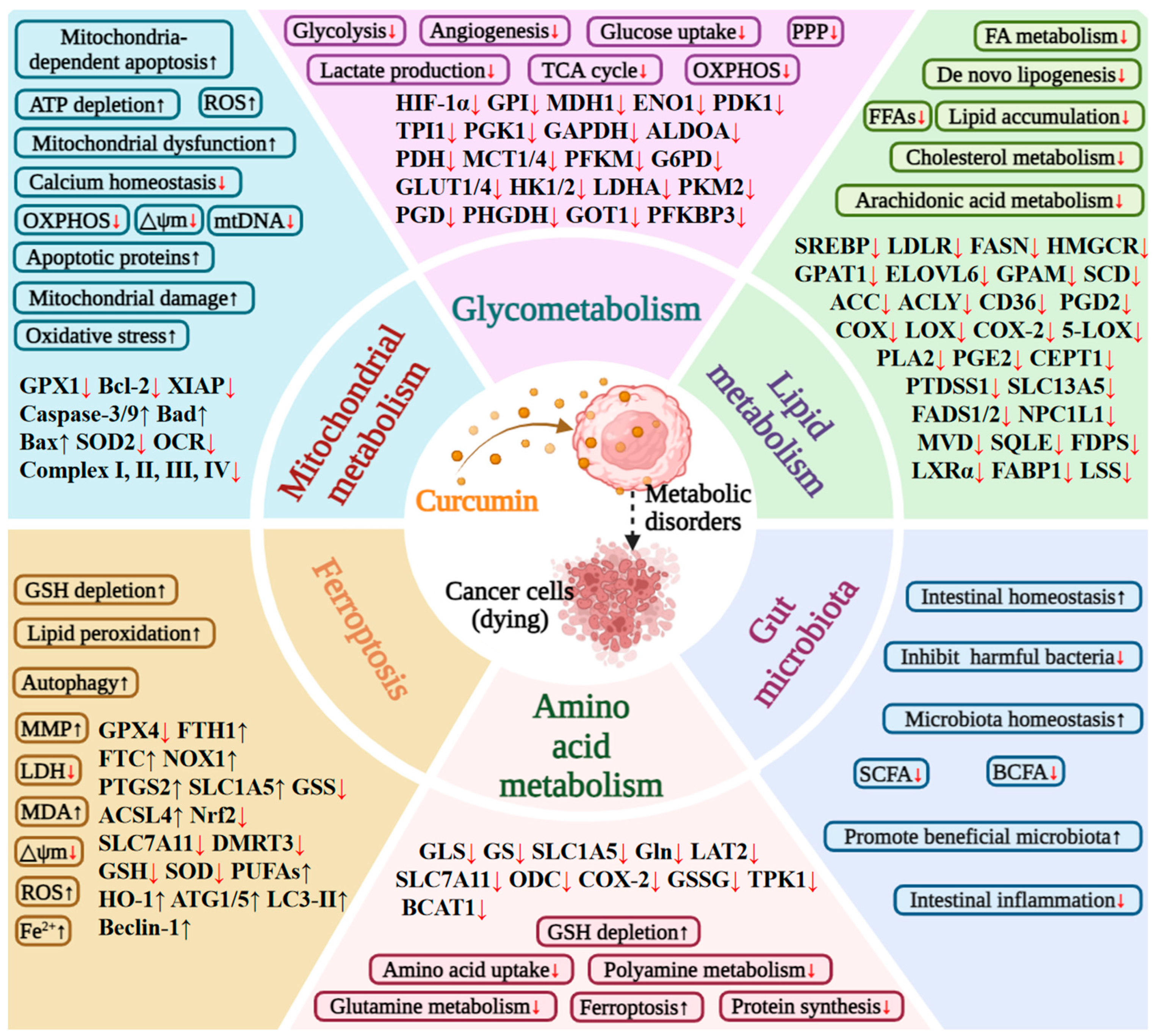
Metabolic reprogramming is a fundamental hallmark and a key driver of malignant tumors. By reshaping glucose, lipid, and amino acid metabolism, as well as mitochondrial function, it sustains the abnormal proliferation and survival of tumor cells, making it a crucial target for anti-tumor therapy. Curcumin, a natural multi-target compound, exhibits unique advantages in intervening in tumor metabolic reprogramming due to its low toxicity and broad-spectrum regulatory properties. In various tumor models, it can directly modulate the activity of key glycolytic enzymes, such as hexokinase 2, lactate dehydrogenase A, and pyruvate kinase M2, as well as transporters like glucose transporter 1. Furthermore, it inhibits the expression of proteins related to lipid metabolism, including fatty acid synthase and stearoyl-CoA desaturase 1, while also intervening in amino acid metabolic networks, such as glutaminase and branched-chain amino acid transaminase. Additionally, curcumin targets mitochondrial function and reactive oxygen species balance, creating multi-dimensional intervention effects through various pathways, including the induction of ferroptosis by regulating the SLC7A11/GPX4 axis and modulating gut microbiota metabolism. Its mechanism of action involves the synergistic regulation of key signaling pathways, including phosphoinositide 3-kinase/Akt, NF-κB, AMP-activated protein kinase, and hypoxia-inducible factor-1alpha. Furthermore, its specific effect profile demonstrates significant dependency on cell type and tumor model. This article systematically reviews the regulatory effects of curcumin on these critical metabolic processes and pathways in tumor metabolic reprogramming, revealing its molecular mechanisms in disrupting tumor growth and progression by targeting energy and biosynthetic metabolism. These findings provide a significant theoretical foundation and a preclinical research perspective for the development of natural antitumor drugs based on metabolic regulation, as well as for optimizing combination therapy strategies.
Keywords: curcumin; cancer metabolism; glucose and lipid metabolism; amino acid metabolism; mitochondrial energy metabolism curcumin; cancer metabolism; glucose and lipid metabolism; amino acid metabolism; mitochondrial energy metabolism