Nutritional Adequacy and Dietary Assessment Approaches in Institutionalised Older Adults Living in Long-Term Care Settings: A Systematic Review (2004–2024)
 , , and
Abstract
1. Introduction
2. Materials and Methods
2.1. Design and Methodological Approach
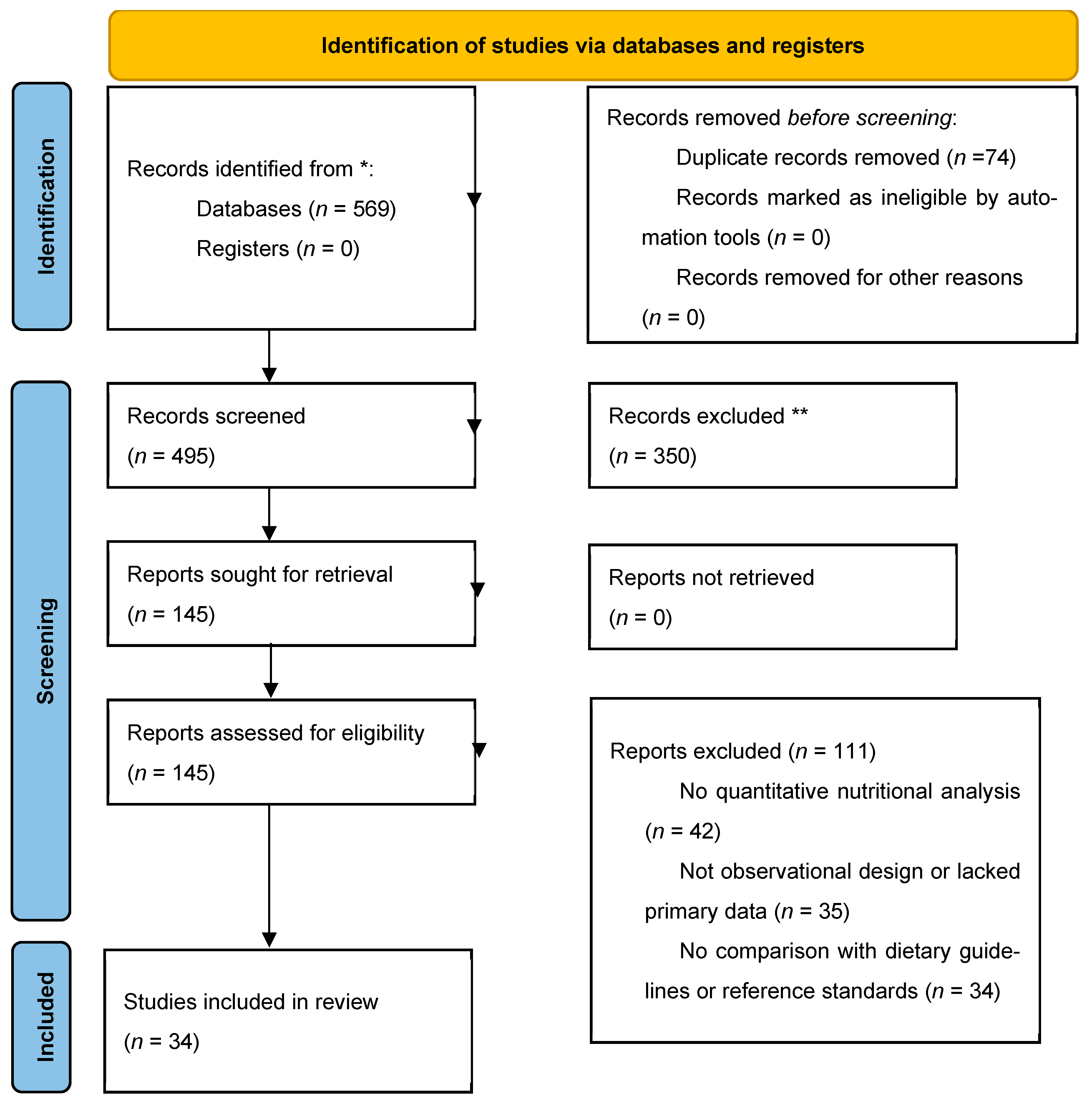
2.2. Study Search and Selection Strategy
2.3. Inclusion and Exclusion Criteria
2.4. Extraction and Synthesis of Data
2.5. Methodological Quality Assessment
3. Results
3.1. Study Characteristics
3.2. Methodological Quality
3.3. Dietary Assessment Methods
3.4. Comparison with Dietary Guidelines/References
3.5. Nutritional Adequacy
4. Discussion
4.1. Overview of Nutritional Adequacy in Long-Term Care
4.2. Energy, Protein and Micronutrient Adequacy in LTC Residents: Comparison with Previous Evidence
4.3. Implications for Menu Design, Micronutrient Density and Nutritional Monitoring in LTC
4.4. Methodological Considerations and Limitations of the Evidence
4.5. Future Research Priorities in LTC Nutrition
5. Conclusions
Supplementary Materials
Author Contributions
Funding
Data Availability Statement
Acknowledgments
Conflicts of Interest
References
- Beck, A.M.; Hansen, K.S. Meals Served in Danish Nursing Homes and to Meals-on-Wheels Clients May Not Offer Nutritionally Adequate Choices. J. Nutr. Elder. 2010, 29, 100–109. [Google Scholar] [CrossRef] [PubMed]
- Heffels, J.C.; Oosterloo, M.; de Boer, B.; Roos, R.A.; Schols, J.M.; Everink, I.H. Quality of Care through the Eyes of Residents with Huntington’s Disease Living in a Nursing Home: A Qualitative Explorative Study. J. Huntingt. Dis. 2024, 13, 523–533. [Google Scholar] [CrossRef] [PubMed]
- Rijnaard, M.D.; van Hoof, J.; Janssen, B.M.; Verbeek, H.; Pocornie, W.; Eijkelenboom, A.; Beerens, H.C.; Molony, S.L.; Wouters, E.J.M. The Factors Influencing the Sense of Home in Nursing Homes: A Systematic Review from the Perspective of Residents. J. Aging Res. 2016, 2016, 6143645. [Google Scholar] [CrossRef]
- Watkins, R.; Goodwin, V.A.; Abbott, R.A.; Backhouse, A.; Moore, D.; Tarrant, M. Attitudes, Perceptions and Experiences of Mealtimes among Residents and Staff in Care Homes for Older Adults: A Systematic Review of the Qualitative Literature. Geriatr. Nurs. 2017, 38, 325–333. [Google Scholar] [CrossRef] [PubMed]
- Divert, C.; Laghmaoui, R.; Crema, C.; Issanchou, S.; Van Wymelbeke, V.; Sulmont-Rossé, C. Improving Meal Context in Nursing Homes: Impact of Four Strategies on Food Intake and Meal Pleasure. Appetite 2015, 84, 139–147. [Google Scholar] [CrossRef]
- Rodríguez-Sánchez, B.; Aranda-Reneo, I.; Mora, T. Effects of a Nutrition Education Intervention on Food-Provision Managerial Decisions in Catalan Old Age Nursing Homes. PLoS ONE 2024, 19, e0310856. [Google Scholar] [CrossRef]
- Rodríguez-Rejón, A.I.; Ruiz-López, M.D.; Artacho, R. Dietary Intake and Associated Factors in Long-Term Care Homes in Southeast Spain. Nutrients 2019, 11, 266. [Google Scholar] [CrossRef]
- Munn, Z.; Aromataris, E.; Tufanaru, C.; Stern, C.; Porritt, K.; Farrow, J.; Lockwood, C.; Stephenson, M.; Moola, S.; Lizarondo, L.; et al. The Development of Software to Support Multiple Systematic Review Types: The Joanna Briggs Institute System for the Unified Management, Assessment and Review of Information (JBI SUMARI). Int. J. Evid. Based Healthc. 2019, 17, 36–43. [Google Scholar] [CrossRef]
- Page, M.J.; McKenzie, J.E.; Bossuyt, P.M.; Boutron, I.; Hoffmann, T.C.; Mulrow, C.D.; Shamseer, L.; Tetzlaff, J.M.; Akl, E.A.; Brennan, S.E.; et al. The PRISMA 2020 statement: An updated guideline for reporting systematic reviews. BMJ 2021, 372, n71. [Google Scholar] [CrossRef]
- Jyväkorpi, S.K.; Suominen, M.H.; Strandberg, T.E.; Salminen, K.; Niskanen, R.T.; Roitto, H.; Saarela, R.K.T.; Pitkälä, K.H. Dietary Fat Intake and Quality in Long-Term Care Residents in Two Cohorts Assessed 10 Years Apart. BMC Nutr. 2022, 8, 31. [Google Scholar] [CrossRef]
- Otten, J.J.; Hellwig, J.P.; Meyers, L.D. (Eds.) Dietary Reference Intakes: The Essential Guide to Nutrient Requirements, 1st ed.; National Academies Press: Washington, DC, USA, 2006. [Google Scholar] [CrossRef]
- Grieger, J.A.; Nowson, C.A. Nutrient Intake and Plate Waste from an Australian Residential Care Facility. Eur. J. Clin. Nutr. 2007, 61, 655–663. [Google Scholar] [CrossRef]
- Aghdassi, E.; McArthur, M.; Liu, B.; McGeer, A.; Simor, A.; Allard, J.P. Dietary Intake of Elderly Living in Toronto Long-Term Care Facilities: Comparison to the Dietary Reference Intake. Rejuvenation Res. 2007, 10, 3. [Google Scholar] [CrossRef]
- Lengyel, C.O.; Smith, J.T.; Whiting, S.J.; Zello, G.A. A Questionnaire to Examine Food-Service Satisfaction of Elderly Residents in Long-Term Care Facilities. J. Nutr. Elder. 2004, 24, 5–18. [Google Scholar] [CrossRef]
- Woods, J.L.; Walker, K.Z.; Iuliano-Burns, S.; Strauss, B.J. Malnutrition on the Menu: Nutritional Status of Institutionalised Elderly Australians in Low-Level Care. J. Nutr. Health Aging 2009, 13, 693–698. [Google Scholar] [CrossRef] [PubMed]
- Massoulard, A.; Bonnabau, H.; Gindre-Poulvelarie, L.; Baptistev, A.; Preux, P.M.; Villemonteix, C.; Javerliat, V.; Fraysse, J.L.; Desport, J.C. Analysis of the food consumption of 87 elderly nursing home residents, depending on food texture. J. Nutr. Health Aging 2011, 15, 192–195. [Google Scholar] [CrossRef]
- Rumbak, I.; Satalić, Ž.; Keser, I.; Krbavčić, I.P.; Giljević, Z.; Zadro, Z.; Barić, I.C. Diet quality in elderly nursing home residents evaluated by Diet Quality Index Revised (DQI-R). Coll. Antropol. 2010, 34, 577–585. [Google Scholar] [PubMed]
- Wright-Thompson, A.; Piché, L. Nutritional Analysis of a Long-Term Care Menu: Before and After an Increase in the Raw Food Cost Allowance. Can. J. Diet. Pract. Res. 2011, 72, 141–145. [Google Scholar] [CrossRef] [PubMed]
- Vikstedt, T.; Suominen, M.H.; Joki, A.; Muurinen, S.; Soini, H.; Pitkälä, K.H. Nutritional Status, Energy, Protein, and Micronutrient Intake of Older Service House Residents. J. Am. Med. Dir. Assoc. 2011, 12, 302–307. [Google Scholar] [CrossRef]
- López-Contreras, M.; Torralba, C.; Zamora, S.; Pérez-Llamas, F. Nutrition and Prevalence of Undernutrition Assessed by Different Diagnostic Criteria in Nursing Homes for Elderly People. J. Hum. Nutr. Diet. 2012, 25, 239–246. [Google Scholar] [CrossRef]
- Milà, R.; Abellana, R.; Padró, L.; Basulto, J.; Farran, A. High Consumption Foods and Their Influence on Energy and Protein Intake in Institutionalized Older Adults. J. Nutr. Health Aging 2012, 16, 115–122. [Google Scholar] [CrossRef]
- Viveky, N.; Billinsky, J.; Thorpe, L.; Alcorn, J.; Hadjistavropoulos, T.; Whiting, S.J. Challenges in Planning Long-Term Care Menus That Meet Dietary Recommendations. Can. J. Diet. Pract. Res. 2013, 74, 84–87. [Google Scholar] [CrossRef]
- Lam, I.T.; Keller, H.H.; Duizer, L.; Stark, K. Micronutrients on the Menu: Enhancing the Quality of Food in Long-Term Care for Regular, Nontherapeutic Menus. Can. J. Diet. Pract. Res. 2015, 76, 86–92. [Google Scholar] [CrossRef]
- Ongan, D.; Rakıcıoğlu, N. Nutritional Status and Dietary Intake of Institutionalized Elderly in Turkey: A Cross-Sectional, Multi-Center, Country Representative Study. Arch. Gerontol. Geriatr. 2015, 61, 271–276. [Google Scholar] [CrossRef] [PubMed]
- Engelheart, S.; Akner, G. Dietary Intake of Energy, Nutrients and Water in Elderly People Living at Home or in Nursing Home. J. Nutr. Health Aging 2015, 19, 265–272. [Google Scholar] [CrossRef] [PubMed]
- Rodríguez-Rejón, A.I.; Ruiz López, M.D.; Malafarina, V.; Puerta, A.; Zuñiga, A.; Artacho, R. Menus Offered in Long-Term Care Homes: Quality of Meal Service and Nutritional Analysis. Nutr. Hosp. 2017, 34, 584–592. [Google Scholar] [CrossRef] [PubMed]
- Keller, H.H.; Carrier, N.; Slaughter, S.E.; Lengyel, C.; Steele, C.M.; Duizer, L.; Morrison, J.; Brown, K.S.; Chaudhury, H.; Yoon, M.N.; et al. Prevalence and Determinants of Poor Food Intake of Residents Living in Long-Term Care. J. Am. Med. Dir. Assoc. 2017, 18, 941–947. [Google Scholar] [CrossRef]
- Vucea, V.; Keller, H.H.; Morrison, J.M.; Duncan, A.M.; Duizer, L.M.; Carrier, N.; Lengyel, C.O.; Slaughter, S.E. Nutritional Quality of Regular and Pureed Menus in Canadian Long-Term Care Homes: An Analysis of the Making the Most of Mealtimes (M3) Project. BMC Nutr. 2017, 3, 80. [Google Scholar] [CrossRef]
- Buckinx, F.; Allepaerts, S.; Paquot, N.; Reginster, J.Y.; de Cock, C.; Petermans, J.; Bruyère, O. Energy and Nutrient Content of Food Served and Consumed by Nursing Home Residents. J. Nutr. Health Aging 2017, 21, 727–732. [Google Scholar] [CrossRef]
- Assis, B.S.; Jairza, J.M.B.; Lopes, J.A.; Roriz, A.K.C.; Melo, A.L.; Previdell, A.; Aquino, R.D.C.; Ramos, L.B. Micronutrient Intake in Elderly Living in Nursing Homes. Nutr. Hosp. 2018, 35, 59–64. [Google Scholar] [CrossRef]
- Nanayakkara, W.S.; Skidmore, P.; O’Brien, L.; Wilkinson, T.; Frampton, C.; Gearry, R. From Menu to Mouth: The Decay Pathway of Nutrient Intake from Planned Menu to Consumed and Characteristics of Residents in an Aged Care Facility with Greater Nutrient Decay Rates: A Cross-Sectional Study. BMJ Open 2019, 9, e024044. [Google Scholar] [CrossRef]
- Buckinx, F.; Paquot, N.; Fadeur, M.; Bacus, L.; Reginster, J.; Allepaerts, S.; Petermans, J.; Biquet, S.; Bruyère, O. Assessment of the Energy Expenditure of Belgian Nursing Home Residents Using Indirect Calorimetry. Nutrition 2019, 57, 12–16. [Google Scholar] [CrossRef]
- Carrier, N.; Villalon, L.; Lengyel, C.; Slaughter, S.E.; Duizer, L.; Morrison-Koechl, J.; Keller, H. Diet Quality Is Associated with Malnutrition and Low Calf Circumference in Canadian Long-Term Care Residents. BMC Nutr. 2019, 5, 57. [Google Scholar] [CrossRef]
- Bogacka, A.; Heberlej, A.; Usarek, A.; Okoniewska, J. Diet and Nutritional Status of Elderly People Depending on Their Place of Residence. Rocz. Panstw. Zakl. Hig. 2019, 70, 185–193. [Google Scholar] [CrossRef]
- Sossen, L.; Bonham, M.; Porter, J. An Investigation of Recommended Serve Food Portions and Attaining Energy and Protein Requirements in Older Adults Living in Residential Care. J. Hum. Nutr. Diet. 2021, 34, 374–383. [Google Scholar] [CrossRef]
- Grajek, M.; Krupa-Kotara, K.; Kobza, J.; Yanakieva, A. Pre-Pandemic Dietary Assessment of Elderly Persons Residing in Nursing Homes—Silesia (Poland). Healthcare 2022, 10, 765. [Google Scholar] [CrossRef] [PubMed]
- Keller, H.H.; Carrier, N.; Slaughter, S.; Lengyel, C.; Steele, C.M.; Duizer, L.; Brown, K.S.; Chaudhury, H.; Yoon, M.N.; Duncan, A.M.; et al. Making the Most of Mealtimes (M3): Protocol of a Multi-Centre Cross-Sectional Study of Food Intake and its Determinants in Older Adults Living in Long-Term Care Homes. BMC Geriatr. 2017, 17, 15. [Google Scholar] [CrossRef] [PubMed]
- Farapti, F.; Wangi, M.P.; Adiningsih, S. The Assessment of Daily Menus in Nursing Home Residents for Improving Intake and Nutritional Status in Elderly. Amerta Nutr. 2023, 7, 262–266. [Google Scholar] [CrossRef]
- Lavriša, Ž.; Pravst, I.; Krušič, S.; Hren, N.; Gregorič, N.; Hren, I.; Koroušić Seljak, B.; Hristov, H. Nutrition among Nursing Home Residents: Results from the NutriCare Study. Front. Nutr. 2024, 11, 1423658. [Google Scholar] [CrossRef]
- Farapti, F.; Elkarima, E.; Sari, D.W.; Winarno, D.D. Food Waste and Food-Service Satisfaction among Older Adults in Nursing Homes. Media Gizi Indones. 2023, 18, 244–250. [Google Scholar] [CrossRef]
- Li, L.Y.; Poon, S.; Robbins, J.; Iuliano, S. Food Provision in Australian Aged Care Homes Does Not Meet Protein Needs of Residents: A Call for Reform. Nutr. Diet. 2024, 81, 425–435. [Google Scholar] [CrossRef]
- Piedrafita-Páez, N.; Silveira, J.; Pinto, E.; Franco, L.; Romero-Rodríguez, M.Á.; Vázquez-Odériz, M.L. Dietary Adequacy in Older Adult Nursing Home Residents of the Northern Iberian Peninsula. Nutrients 2024, 16, 798. [Google Scholar] [CrossRef]
- Agencia Española de Seguridad Alimentaria y Nutrición (AESAN) Scientific Committee. Informe del Comité Científico de la AESANsobre Ingestas Nutricionales de Referencia para la población española (INR). Rev. Del Com. Científico De La AESAN 2019, 29, 1–26. [Google Scholar]
- European Food Safety Authority. Dietary Reference Values for Nutrients: Summary Report. Available online: https://www.efsa.europa.eu/es/supporting/pub/e15121 (accessed on 13 October 2025).
- Christensen, J.J.; Arnesen, E.K.; Andersen, R.; Eneroth, H.; Erkkola, M.; Høyer, A.; Lemming, E.W.; Meltzer, H.M.; Halldórsson, Þ.I.; Þórsdóttir, I.; et al. The Nordic Nutrition Recommendations 2022—Principles and Methodologies. Food Nutr. Res. 2020, 64, 1–15. [Google Scholar] [CrossRef]
- National Health and Medical Research Council; New Zealand Ministry of Health. Nutrient Reference Values for Australia and New Zealand. 2006. Available online: https://www.nhmrc.gov.au/about-us/publications/nutrient-reference-values-australia-and-new-zealand-including-recommended-dietary-intakes (accessed on 4 February 2025).
- World Health Organization; Food and Agriculture Organization of the United Nations. Vitamin and Mineral Requirements in Human Nutrition, 2nd ed.; World Health Organization: Geneva, Switzerland, 2004. [Google Scholar]
- Volkert, D.; Beck, A.M.; Cederholm, T.; Cruz-Jentoft, A.; Goisser, S.; Hooper, L.; Kiesswetter, E.; Maggio, M.; Raynaud-Simon, A.; Sieber, C.C.; et al. ESPEN guideline on clinical nutrition and hydration in geriatrics. Clin. Nutr. 2019, 38, 10–47. [Google Scholar] [CrossRef]
- Bauer, J.; Biolo, G.; Cederholm, T.; Cesari, M.; Cruz-Jentoft, A.J.; Morley, J.E.; Phillips, S.; Sieber, C.; Stehle, P.; Teta, D.; et al. Evidence-Based Recommendations for Optimal Dietary Protein Intake in Older People: A Position Paper from the PROT-AGE Study Group. J. Am. Med. Dir. Assoc. 2013, 14, 542–559. [Google Scholar] [CrossRef] [PubMed]
- Stehle, P. Dissemination of Nutritional Knowledge in Germany—Nutrition Circle, 3D Food Pyramid and 10 Nutrition Guidelines. Ann. Nutr. Metab. 2007, 51, 21–25. [Google Scholar] [CrossRef]
- EFSA Panel on Dietetic Products, Nutrition Allergies (NDA). Scientific opinion on dietary reference values for protein. Eur. Food Saf. Auth. 2012, 10, 2557. [Google Scholar] [CrossRef]
- Wang, D.; Everett, B.; Brunero, S.; Northall, T.; Villarosa, A.R.; Salamonson, Y. Perspectives of Residents and Staff Regarding Food Choice in Residential Aged Care: A Qualitative Study. J. Clin. Nurs. 2020, 29, 626–637. [Google Scholar] [CrossRef] [PubMed]
- Ocke, M.C. Evaluation of methodologies for assessing the overall diet: Dietary quality scores and dietary pattern analysis. Proc. Nutr. Soc. 2013, 72, 191–199. [Google Scholar] [CrossRef]
- Hernández-Ruiz, Á.; López-Trigo, J.A.; Muñoz-Ruiz, M.A.; Ruiz-Canela, M.; Molina-Montes, E.; López-Mongil, R. Descripción de un Indicador de Calidad de la Dieta para su Aplicación en Residencias de Ancianos: Quality Index for Nutrition in Nursing Homes—QUINN. Rev. Esp. Nutr. Hum. Diet. 2022, 26, 156–161. [Google Scholar] [CrossRef]


| Category | Inclusion | Exclusion |
|---|---|---|
| Population | Institutionalised older adults (≥60 years) living in LTC facilities, including nursing homes, long-term care homes and comparable residential/service housing settings with 24 h care and on-site meal provision. | People in hospitals, clinics, community dwellings, assisted-living arrangements without on-site catering, or other non-comparable settings. |
| Concept | Studies evaluating the nutritional adequacy or nutritional quality of food provision in LTC (planned menus, food served and/or residents’ actual intake). | Studies without quantitative nutritional analysis, or focused solely on satisfaction, perception, organisational processes or mealtime experience without energy/nutrient data |
| Study design | Observational quantitative studies (cross-sectional or longitudinal) reporting primary data with dietary/nutritional analysis. | Non-systematic reviews, commentaries, editorials, duplicate publications, and intervention trials without baseline or outcome data on menu or intake adequacy. |
| Methodology | Studies using a clearly described dietary assessment method (e.g., weighed food records, plate-waste assessment, menu analysis, food diaries, 24 h recalls or FFQs) allowing quantitative estimation of energy and/or nutrient intake. | Studies with insufficient data or without a clear description of the dietary assessment method. |
| Comparator | Comparison with official dietary guidelines or nutrient reference values (e.g., DRIs, EFSA DRVs, NNR, ESPEN, or national dietary guidelines). | Studies with no reference to official nutritional recommendations or nutrient reference frameworks. |
| Source | Studies published in indexed peer-reviewed journals. | Non-peer-reviewed literature, reports, theses or other grey literature. |
| Language | English or Spanish. | Other languages. |
| Year of publication | From 2004 to 2024 | Studies prior to 2004 or after 2024. |
| Study (First Author; Year; Country; Setting; n [Ref]) | Dietary Assessment Method and Level (Days) | Nutritional Adequacy (Summary Codes) | Comparator Framework(s) | JBI/8 |
|---|---|---|---|---|
| Grieger et al., 2007, Australia; NH (n = 169) [12] | Visual plate-waste assessment (served and consumed; 3 d) | Mic ↓: Ca, Zn, Fol, vit E, vit B6 | ANZ NRVs; DRIs (IOM) | 6 |
| Aghdassi et al., 2007, Canada; NH (n = 407) [13] | Weighed food record (consumed; 3 d) | E ↓; PRO ↓; Mic ↓: Ca, Mg, Zn, Fol | DRIs (IOM) | 6 |
| Lengyel et al., 2008, Canada; LTC centres (n = 48; 5 centres) [14] | Weighed food record (consumed; 3 d) | E ↓; PRO ↓; Mic ↓: vit D, Ca; fibre ↓ | DRIs (IOM) | 6 |
| Woods et al., 2009, Australia; NH (14 homes; n = 103) [15] | Weighed food record (consumed; 3 d) | E ↓; PRO ↓; fibre ↓; SFA ↑; Mic ↓: Ca, Mg, Fol, Zn | DRIs (IOM) | 7 |
| Massourlard et al., 2010, France; NH (4 homes; n = 87) [16] | Weighed food record (consumed; 1 d) | E ↓ | National guidelines (France) | 6 |
| Beck et al., 2010, Denmark; institutional kitchens (n = 4 kitchens) [1] | Weighed food record (planned menus; days NR) | E ↓; PRO ↓ | National guidelines (Denmark) | 6 |
| Rumbak et al., 2010, Croatia; NH (n = 339) [17] | 24 h dietary recall (consumed; 1 d) | Mic ↓: Ca | DRIs (IOM) | 6 |
| Wright-Thompson et al., 2011, Canada; NH (n = 250) [18] | Documentary menu assessment (planned menus; cycle NR) | Mic ↓: vit D, Ca | CFG (Canada); DRIs (IOM) | 5 |
| Vikstedt et al., 2011, Finland; service housing (n = 375) [19] | Food diary (consumed; days NR) | E ↓ (46% < 1570 kcal/d); PRO ↓ (47% < 60 g/d); Mic ↓: vit D, vit E, Fol, fibre | NNR | 6 |
| López-Contreras et al., 2012, Spain; NH (7 homes; n = 213) [20] | Weighed food record (consumed; 4 d) | E ↓ (42% < ref) | DRIs (IOM) | 6 |
| Milà et al., 2012, Spain; NH (4 homes; n = 62) [21] | Weighed food record (consumed; 21 d) | E ↓ (44% < 30 kcal/kg/d); PRO ↓ (10–13% < 0.8 g/kg/d) | National guidelines (Spain) | 6 |
| Viveky et al., 2013, Canada; LTC menus (7 d cycle) [22] | Documentary menu assessment (planned menus; 7 d) | Mic ↓: vit D, vit E; Na ↑ | CFG (Canada); DRIs (IOM) | 6 |
| Lam et al., 2015, Canada; NH (5 homes; menus) [23] | Documentary menu assessment (planned menus; 7 d) | Mic ↓: vit D, vit E, Fol, Mg, K | CFG (Canada); DRIs (IOM) | 6 |
| Ongan et al., 2015, Türkiye; NH (25 homes; n = 554) [24] | 24 h dietary recall (consumed; 1 d) | E ↓; Mic ↓: Ca, Mg, vit A, B1, B2, B6, C, Fol; Fe ↓; Zn ↓ | DRIs (IOM) | 6 |
| Engelheart et al., 2015, Sweden; NH (n = 127) [25] | Weighed food record (consumed; 5 d) | E ↓ (16% < 20 kcal/kg/d); Mic ↓: vit D, Fe | NNR | 6 |
| Rodríguez-Rejón et al., 2017, Spain; NH (3 homes; 518 dishes) [26] | Weighed food record (served dishes; 14 d) | Mic ↓: fibre, K, Mg, I, vit D, vit E, Fol | DRIs (IOM) | 6 |
| Keller et al., 2017, Canada; NH (32 homes; n = 639) [27] | Weighed food record (consumed; 3 d) | E ↓; PRO ↓; Mic ↓: fibre, Ca, Mg, vit D, vit E, Fol | DRIs (IOM) | 8 |
| Vucea et al., 2017, Canada; NH/LTC menus (7 d cycle) [28] | Documentary menu assessment (planned menus; 7 d) | Mic ↓: vit D, vit E, Ca, Fol | DRIs (IOM) | 8 |
| Buckinx et al., 2017, Belgium; NH (2 homes; n = 74) [29] | Weighed food record (consumed; 5 d) | E ↓; PRO ↓ | National guidelines (Belgium) | 8 |
| Assis et al., 2018, Brazil; NH (29 homes; n = 216) [30] | Weighed food record (consumed; 2 d) | E ↓ (30–35 kcal/kg/d); Mic ↓: vit E, Fol, Ca | DRIs (IOM) | 6 |
| Nanayakkara et al., 2019, New Zealand; NH (n = 54) [31] | Weighed food record (consumed; 3 d) | E ↓ (73% of planned energy); PRO ↓ (69% of planned protein); Mic ↓: vit C, vit B12, Fol | ANZ NRVs; DRIs (IOM) | 8 |
| Rodríguez-Rejón et al., 2019, Spain; NH (3 homes; n = 249) [7] | Weighed food record (consumed; 7 d) | PRO ↓ (56% < 1.0 g/kg/d; 100% < 25 g/meal) | DRIs (IOM); ESPEN/PROT-AGE | 8 |
| Buckinx et al., 2019, Belgium; NH (n = 25) [32] | Weighed food record (consumed; 3 d) | E ↓ (52% deficit) | EFSA DRVs; WHO | 6 |
| Carrier et al., 2019, Canada; NH (32 homes; n = 619) [33] | Weighed food record (consumed; 3 d) | E ↓; PRO ↓; Mic ↓: vit D, vit E, Fol, Ca, Mg | DRIs (IOM) | 8 |
| Bogacka et al., 2019, Poland; NH/LTC institutions (79 facilities) [34] | Documentary menu assessment (planned menus; 10 d) + 24 h dietary recall (consumed; 1 d) | Mic ↓: Ca, Mg, vit D; Na ↑; P ↑ | EFSA/DRVs; WHO | 5 |
| Sossen et al., 2021, Australia; NH (n = 420) [35] | Weighed food record (consumed; days NR) | E ↓; PRO ↓ (62–64% of served energy and protein) | ESPEN; ADG; ANZ NRVs | 8 |
| Grajek et al., 2022, Poland; NH (58 homes; 4640 menus) [36] | Weighed food record (planned menus; days NR) | E ↓; PRO ↓; Mic ↓: vit D, vit A, vit E, Ca, K; refined CHO ↑ | DRIs (IOM); WHO | 6 |
| Jyväkorpi et al., 2022, Finland; LTC facilities (service housing/NH; 2 cohorts; n = 860) [10] | Food diary (consumed; 1–2 d) | E ↑; fat quality ↑ (MUFA/PUFA) | NNR | 8 |
| Pfisterer et al., 2023, Canada; NH/LTC facilities (n = 634) [37] | Weighed food record (consumed; 3 d) | E ↓; fibre ↓ (12.7 g/d) | CFG (Canada) | 6 |
| Farapti et al., 2023, Indonesia; NH (n = 65) [38] | Visual plate-waste assessment (served and consumed; days NR) | E ↓ (1300 kcal/d); PRO ↓ (50 g/d); fibre ↓; K ↓; Na ↑ | National guidelines (Indonesia RDA) | 6 |
| Lavriša et al., 2024, Slovenia; NH (20 homes; n = 317) [39] | 24 h dietary recall + FFQ (consumed; 1 d) | PRO ↓ (subset); fibre ↓; SFA ↑ (30–34 g/d) | DGE; EFSA DRVs | 6 |
| Farapti et al., 2023, Indonesia; NH (menus; 5 d cycle; n = 61 residents) [40] | Direct menu observation (planned menus; 5 d) | E ↓ (69% RDA); PRO ↓ (66% RDA); Ca ↓; fibre ↓; Na ↑ | DRIs (IOM) | 6 |
| Li et al., 2024, Australia; NH (60 homes; n = 572) [41] | Visual plate-waste assessment (served and consumed; days NR) | PRO ↓ (0.78–0.85 g/kg/d; 20% meals ≥ 25 g protein) | DRIs (IOM) | 8 |
| Piedrafita et al., 2024, Spain/Portugal; NH (n = 186) [42] | Weighed food record (consumed; 7 d) | E ↓ (>50% residents); PRO ↓ (0.97 g/kg/d, Portugal); CHO 56–61%E | EFSA DRVs; WHO | 6 |
Disclaimer/Publisher’s Note: The statements, opinions and data contained in all publications are solely those of the individual author(s) and contributor(s) and not of MDPI and/or the editor(s). MDPI and/or the editor(s) disclaim responsibility for any injury to people or property resulting from any ideas, methods, instructions or products referred to in the content. |
© 2025 by the authors. Licensee MDPI, Basel, Switzerland. This article is an open access article distributed under the terms and conditions of the Creative Commons Attribution (CC BY) license.
Share and Cite
Piedrafita-Páez, N.; Romero-Rodríguez, M.A.; Vázquez-Odériz, M.L.; NUTRIAGE Study Researchers. Nutritional Adequacy and Dietary Assessment Approaches in Institutionalised Older Adults Living in Long-Term Care Settings: A Systematic Review (2004–2024). Nutrients 2026, 18, 54. https://doi.org/10.3390/nu18010054
Piedrafita-Páez N, Romero-Rodríguez MA, Vázquez-Odériz ML, NUTRIAGE Study Researchers. Nutritional Adequacy and Dietary Assessment Approaches in Institutionalised Older Adults Living in Long-Term Care Settings: A Systematic Review (2004–2024). Nutrients. 2026; 18(1):54. https://doi.org/10.3390/nu18010054
Chicago/Turabian StylePiedrafita-Páez, Nicolás, Mª Angeles Romero-Rodríguez, Mª Lourdes Vázquez-Odériz, and NUTRIAGE Study Researchers. 2026. "Nutritional Adequacy and Dietary Assessment Approaches in Institutionalised Older Adults Living in Long-Term Care Settings: A Systematic Review (2004–2024)" Nutrients 18, no. 1: 54. https://doi.org/10.3390/nu18010054
APA StylePiedrafita-Páez, N., Romero-Rodríguez, M. A., Vázquez-Odériz, M. L., & NUTRIAGE Study Researchers. (2026). Nutritional Adequacy and Dietary Assessment Approaches in Institutionalised Older Adults Living in Long-Term Care Settings: A Systematic Review (2004–2024). Nutrients, 18(1), 54. https://doi.org/10.3390/nu18010054