Nutritional Supplementation for Myopia Prevention and Control: A Systematic Review of Randomized Controlled Trials


Abstract
1. Introduction
2. Materials and Methods
2.1. Research Question and PICOS Framework
2.2. Eligibility Criteria
2.3. Information Sources
2.4. Search Methods for Identification of Studies
2.5. Data Extraction and Data Items
2.6. Methodological Quality and Risk of Bias Assessment
2.7. Data Synthesis
3. Results
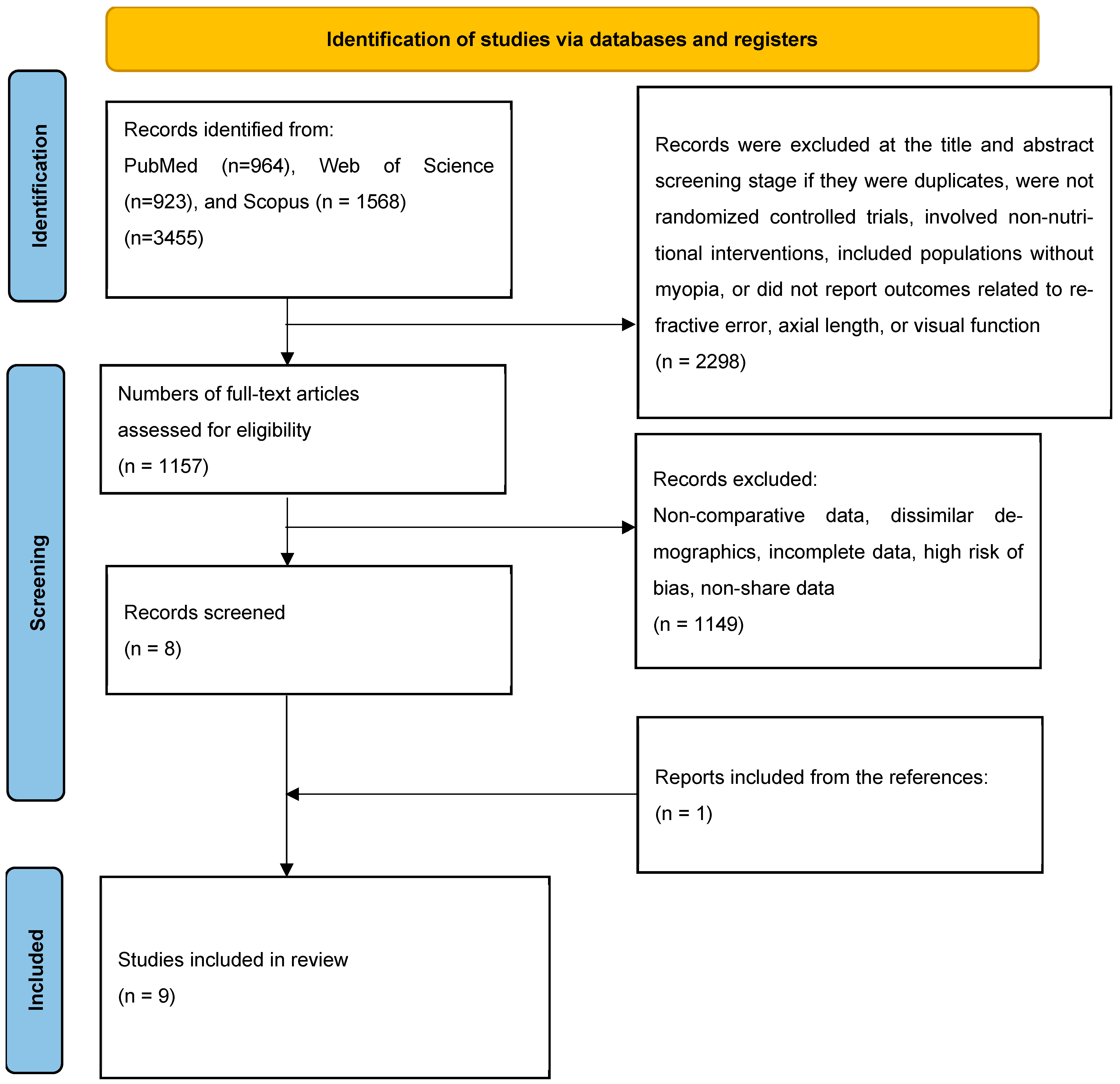
3.1. Study Selection
3.2. Study Characteristics
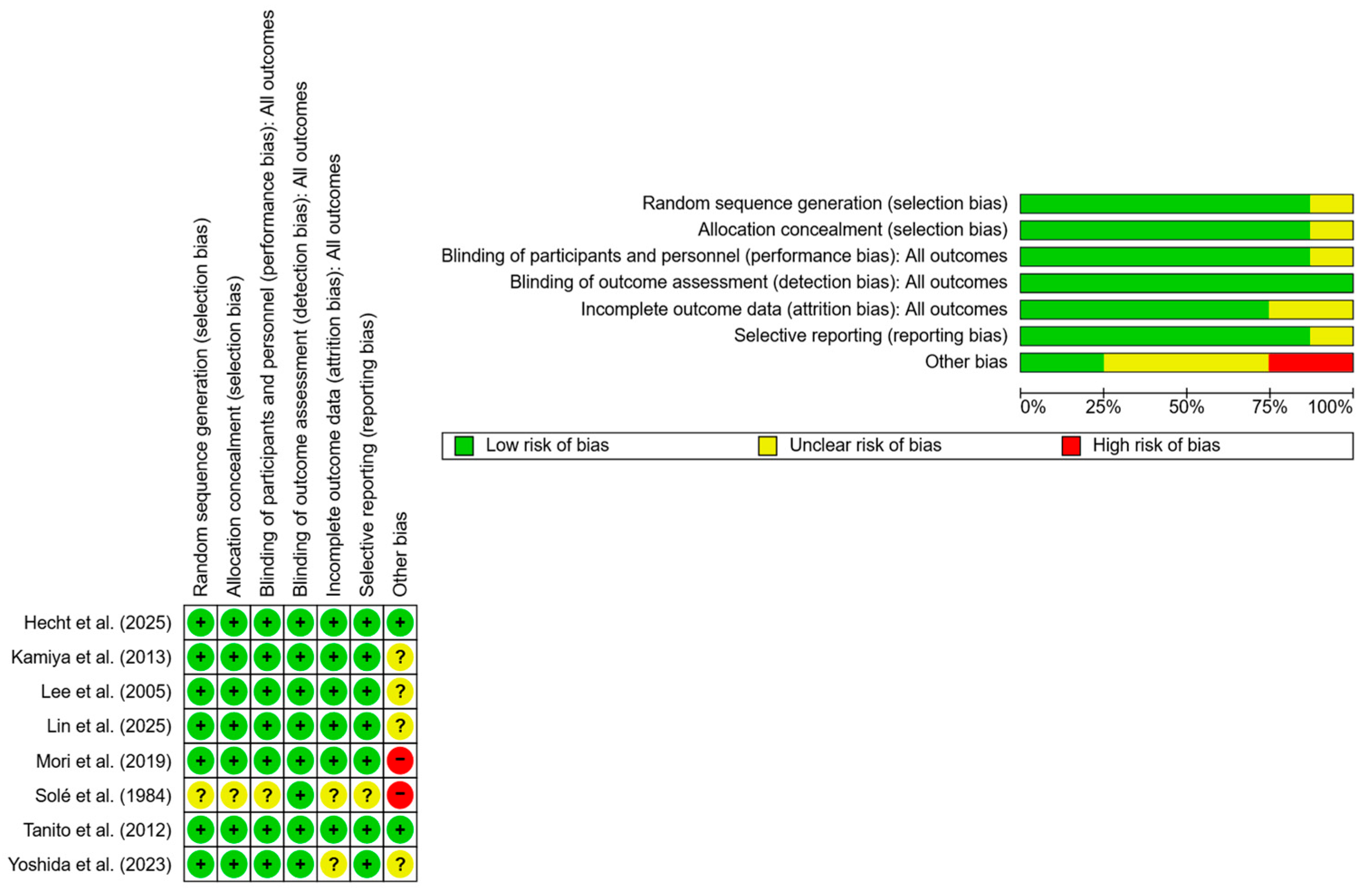
3.3. Risk of Bias Assessment
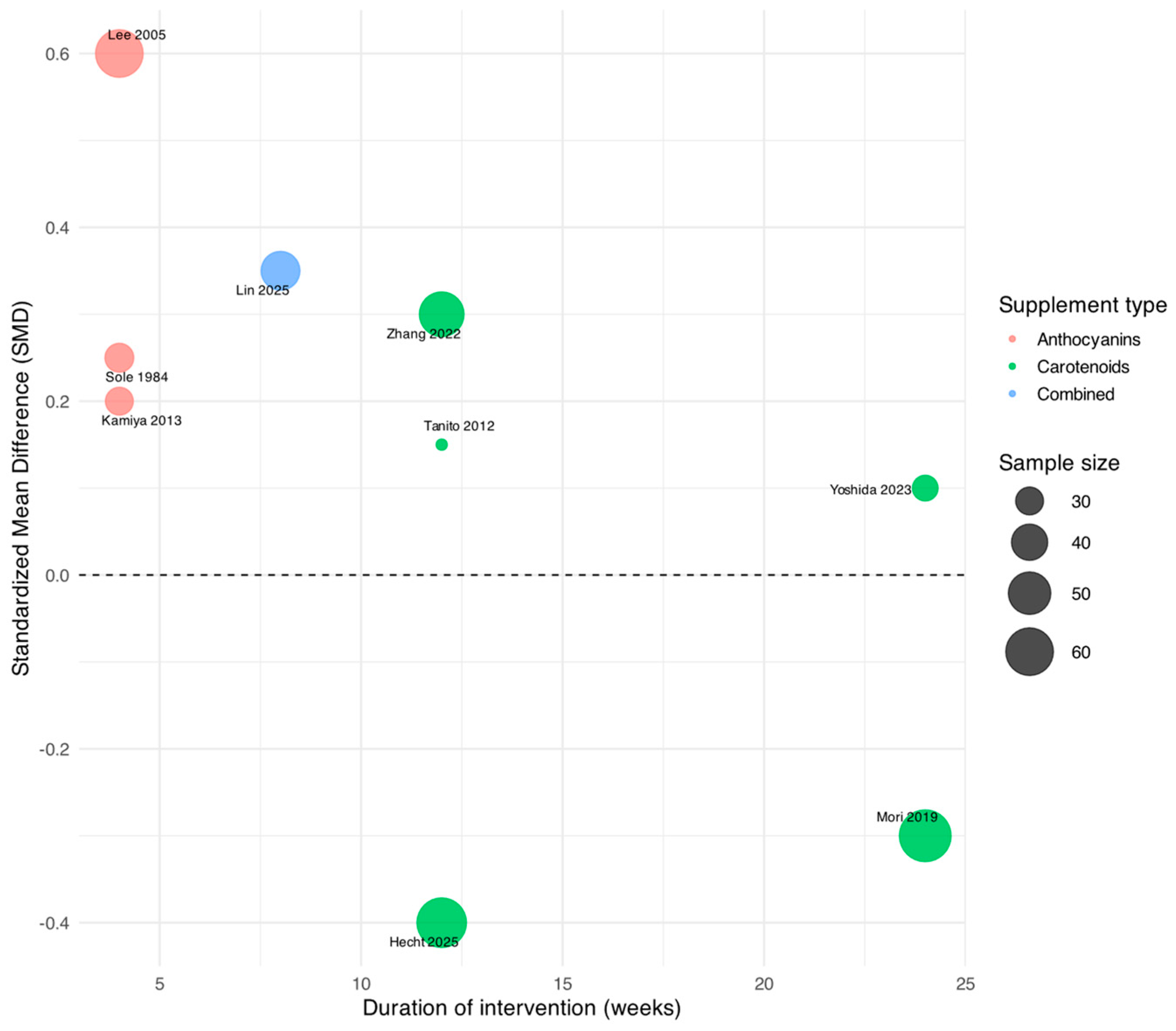
3.4. Outcomes
3.4.1. Effects of Carotenoids
3.4.2. Effects of Anthocyanins and Bilberry Derivatives
3.4.3. Effects of Combined Formulations
4. Discussion
5. Conclusions
Supplementary Materials
Author Contributions
Funding
Institutional Review Board Statement
Informed Consent Statement
Data Availability Statement
Conflicts of Interest
References
- Holden, B.A.; Fricke, T.R.; Wilson, D.A.; Jong, M.; Naidoo, K.S.; Sankaridurg, P.; Wong, T.Y.; Naduvilath, T.J.; Resnikoff, S. Global prevalence of myopia and high myopia and temporal trends from 2000 through 2050. Ophthalmology 2016, 123, 1036–1042. [Google Scholar] [CrossRef]
- Ohno-Matsui, K.; Wu, P.C.; Yamashiro, K.; Vutipongsatorn, K.; Fang, Y.; Cheung, C.M.G.; Lai, T.Y.Y.; Ikuno, Y.; Cohen, S.Y.; Gaudric, A.; et al. IMI Pathologic Myopia. Invest. Ophthalmol. Vis. Sci. 2021, 62, 5. [Google Scholar] [CrossRef]
- Wildsoet, C.F.; Chia, A.; Cho, P.; Guggenheim, J.A.; Polling, J.R.; Read, S.; Sankaridurg, P.; Saw, S.M.; Trier, K.; Walline, J.J.; et al. IMI—Interventions Myopia Institute: Interventions for controlling myopia onset and progression report. Investig. Ophthalmol. Vis. Sci. 2019, 60, M106–M131. [Google Scholar] [CrossRef]
- Pan, C.W.; Qian, D.J.; Saw, S.M. Time outdoors, blood vitamin D status and myopia: A review. Photochem. Photobiol. Sci. 2017, 16, 426–432. [Google Scholar] [CrossRef]
- SanGiovanni, J.P.; Chew, E.Y. The role of omega-3 long-chain polyunsaturated fatty acids in health and disease of the retina. Prog. Retin. Eye Res. 2005, 24, 87–138. [Google Scholar] [CrossRef]
- Sanlier, N.; Yildiz, E.; Ozler, E. An overview on the effects of some carotenoids on health: Lutein and zeaxanthin. Curr. Nutr. Rep. 2024, 13, 828–844. [Google Scholar] [CrossRef]
- Edwards, J. Zeaxanthin: Review of toxicological data and acceptable daily intake. J. Ophthalmol. 2016, 2016, 3690140. [Google Scholar] [CrossRef] [PubMed]
- Mares, J. Lutein and zeaxanthin isomers in eye health and disease. Annu. Rev. Nutr. 2016, 36, 571–602. [Google Scholar] [CrossRef] [PubMed]
- Snodderly, D.; Auran, J.; Delori, F. The macular pigment. II. Spatial distribution in primate retinas. Investig. Ophthalmol. Vis. Sci. 1984, 25, 674–685. [Google Scholar]
- Mikoluc, B.; Sawicka-Powierza, J.; Berk, K.; Maciejczyk, M.; Powierza, K.; Zalewska, A.; Szulimowska, J.; MacDonald, J.; Koput, A.; Karpinska, J.; et al. Reduced retinol (vitamin A) and α-tocopherol (vitamin E) blood levels and increased myeloperoxidase (MPO) activity in children with high myopia. Sci. Rep. 2024, 14, 21231. [Google Scholar] [CrossRef] [PubMed]
- Xu, X.; Liu, N.; Yu, W. No evidence of an association between genetic factors affecting response to vitamin A supplementation and myopia: A Mendelian randomization study and meta-analysis. Nutrients 2024, 16, 1933. [Google Scholar] [CrossRef] [PubMed]
- Jiao, S.; Reinach, P.S.; Huang, C.; Yu, L.; Zhuang, H.; Ran, H.; Zhao, F.; Srinivasalu, N.; Qu, J.; Zhou, X. Calcipotriol attenuates form deprivation myopia through a signaling pathway parallel to TGF-β2-induced increases in collagen expression. Investig. Ophthalmol. Vis. Sci. 2023, 64, 2. [Google Scholar] [CrossRef]
- Crawford, M.A.; Bazinet, R.P.; Sinclair, A.J. Fat intake and CNS functioning: Ageing and disease. Ann. Nutr. Metab. 2009, 55, 202–228. [Google Scholar] [CrossRef]
- Pan, M.; Zhao, F.; Xie, B.; Wu, H.; Zhang, S.; Ye, C.; Guan, Z.; Kang, L.; Zhang, Y.; Zhou, X.; et al. Dietary ω-3 polyunsaturated fatty acids are protective for myopia. Proc. Natl. Acad. Sci. USA 2021, 118, e2104689118. [Google Scholar] [CrossRef] [PubMed]
- Xue, C.C.; Li, H.; Dong, X.-X.; Yu, M.; Soh, Z.D.; Chong, C.C.Y.; Jiang, C.; Choquet, H.; Zebardast, N.; Zekavat, S.M.; et al. Omega-3 polyunsaturated fatty acids as a protective factor for myopia. Am. J. Ophthalmol. 2024, 268, 368–377. [Google Scholar] [CrossRef]
- Mori, K.; Kuroha, S.; Hou, J.; Jeong, H.; Ogawa, M.; Ikeda, S.; Kang, J.X.; Negishi, K.; Torii, H.; Arita, M.; et al. Lipidomic analysis revealed n-3 polyunsaturated fatty acids suppressed choroidal thinning and myopia progression in mice. FASEB J. 2022, 36, e22312. [Google Scholar] [CrossRef]
- Du, B.; Jin, N.; Zhu, X.; Lu, D.; Jin, C.; Li, Z.; Han, C.; Zhang, Y.; Lai, D.; Liu, K.; et al. A prospective study of serum metabolomic and lipidomic changes in myopic children and adolescents. Exp. Eye Res. 2020, 199, 108182. [Google Scholar] [CrossRef]
- Chong, R.S.; Li, H.; Cheong, A.J.Y.; Fan, Q.; Koh, V.; Raghavan, L.; Nongpiur, M.E.; Cheng, C.-Y. Mendelian randomization implicates bidirectional association between myopia and primary open-angle glaucoma or intraocular pressure. Ophthalmology 2023, 130, 394–403. [Google Scholar] [CrossRef]
- Lim, L.; Gazzard, G.; Low, Y.-L.; Choo, R.; Tan, D.; Tong, L.; Wong, T.-Y.; Saw, S.-M. Dietary factors, myopia, and axial dimensions in children. Ophthalmology 2010, 117, 993–1003. [Google Scholar] [CrossRef] [PubMed]
- Edwards, M.H.; Leung, S.S.F.; Lee, W.T.K. Do variations in normal nutrition play a role in the development of myopia? Optom. Vis. Sci. 1996, 73, 638–643. [Google Scholar] [CrossRef]
- You, Q.S.; Wu, L.; Duan, J.; Luo, Y.; Liu, L.; Li, X.; Gao, Q.; Wang, W.; Xu, L.; Jonas, J.; et al. Factors associated with myopia in school children in China: The Beijing Childhood Eye Study. PLoS ONE 2012, 7, e52668. [Google Scholar] [CrossRef] [PubMed]
- Page, M.J.; McKenzie, J.E.; Bossuyt, P.M.; Boutron, I.; Hoffmann, T.C.; Mulrow, C.D.; Shamseer, L.; Tetzlaff, J.M.; Akl, E.A.; Brennan, S.E.; et al. The PRISMA 2020 statement: An updated guideline for reporting systematic reviews. BMJ 2021, 372, n71. [Google Scholar] [CrossRef] [PubMed]
- Shea, B.J.; Reeves, B.C.; Wells, G.; Thuku, M.; Hamel, C.; Moran, J.; Moher, D.; Tugwell, P.; Welch, V.; Kristjansson, E.; et al. AMSTAR 2: A critical appraisal tool for systematic reviews that include randomised or non-randomised studies of healthcare interventions. BMJ 2017, 358, j4008. [Google Scholar] [CrossRef]
- Hecht, K.A.; Marwah, M.; Wood, V.; Nishida, Y.; Bach, A.E.; Gerson, J.; Hom, M.M.; Schnackenberg, J.; Raote, S.; Srivastava, S.; et al. Astaxanthin (AstaReal®) improved acute and chronic digital eye strain in children: A randomized double-blind placebo-controlled trial. Adv. Ther. 2025, 42, 1811–1833. [Google Scholar] [CrossRef] [PubMed]
- Kamiya, K.; Kobashi, H.; Fujiwara, K.; Ando, W.; Shimizu, K. Effect of fermented bilberry extracts on visual outcomes in eyes with myopia: A randomized, placebo-controlled study. J. Ocul. Pharmacol. Ther. 2013, 29, 356–359. [Google Scholar] [CrossRef]
- Lee, J.; Lee, H.K.; Kim, C.Y.; Hong, Y.J.; Choe, C.M.; You, T.W.; Seong, G.J. Purified high-dose anthocyanoside oligomer administration improves nocturnal vision and clinical symptoms in myopia subjects. Br. J. Nutr. 2005, 93, 895–899. [Google Scholar] [CrossRef]
- Lin, E.C.; Wang, P.H.; Liou, J.C.; Wu, J.L.; Lin, Y.H.; Chang, Y.Z.; Chen, B.Y. Potential role of sublingual-buccal absorption supplementation for binocular function improvement in myopia: A randomized, double-blind, placebo-controlled clinical trial. J. Funct. Foods 2025, 130, 106931. [Google Scholar] [CrossRef]
- Mori, K.; Torii, H.; Fujimoto, S.; Jiang, X.; Ikeda, S.I.; Yotsukura, E.; Koh, S.; Kurihara, T.; Nishida, K.; Tsubota, K. The effect of dietary supplementation of crocetin for myopia control in children: A randomized clinical trial. J. Clin. Med. 2019, 8, 1179. [Google Scholar] [CrossRef]
- Solé, P.; Rigal, D.; Peyresblanques, J. Effects of cyaninoside chloride and heleniene on mesopic and scotopic vision in myopia and night blindness. J. Fr. Ophtalmol. 1984, 7, 35–39. [Google Scholar]
- Tanito, M.; Obana, A.; Gohto, Y.; Okazaki, S.; Gellermann, W.; Ohira, A. Macular pigment density changes in Japanese individuals supplemented with lutein or zeaxanthin. Jpn. J. Ophthalmol. 2012, 56, 488–496. [Google Scholar] [CrossRef]
- Yoshida, T.; Takagi, Y.; Igarashi-Yokoi, T.; Ohno-Matsui, K. Efficacy of lutein supplements on macular pigment optical density in highly myopic individuals: A randomized controlled trial. Medicine 2023, 102, e33280. [Google Scholar] [CrossRef] [PubMed]
- Zhang, Y.; Hao, J.; Cao, K.; Qi, Y.; Wang, N.; Han, S. Macular pigment optical density responses to different levels of zeaxanthin in patients with high myopia. Graefe’s Arch. Clin. Exp. Ophthalmol. 2022, 260, 2329–2337. [Google Scholar] [CrossRef]
- Sorriento, D.; De Luca, N.; Trimarco, B.; Iaccarino, G. The antioxidant therapy: New insights in the treatment of hypertension. Front. Physiol. 2018, 9, 258. [Google Scholar] [CrossRef]
- Navarro-Yepes, J.; Burns, M.; Anandhan, A.; Khalimonchuk, O.; Del Razo, L.M.; Quintanilla-Vega, B.; Pappa, A.; Panayiotidis, M.I.; Franco, R. Oxidative stress, redox signaling, and autophagy: Cell death versus survival. Antioxid. Redox Signal. 2014, 21, 66–85. [Google Scholar] [CrossRef]
- Rymer, J.; Wildsoet, C.F. The role of the retinal pigment epithelium in eye growth regulation and myopia: A review. Vis. Neurosci. 2005, 22, 251–261. [Google Scholar] [CrossRef]
- Torii, H.; Kurihara, T.; Seko, Y.; Negishi, K.; Ohnuma, K.; Inaba, T.; Kawashima, M.; Jiang, X.; Kondo, S.; Miyauchi, M.; et al. Violet light exposure can be a preventive strategy against myopia progression. EBioMedicine 2017, 15, 210–219. [Google Scholar] [CrossRef]
- Böhm, E.W.; Buonfiglio, F.; Voigt, A.M.; Bachmann, P.; Safi, T.; Pfeiffer, N.; Gericke, A. Oxidative stress in the eye and its role in the pathophysiology of ocular diseases. Redox Biol. 2023, 68, 102967. [Google Scholar] [CrossRef]
- Liang, R.; Shi, W.; Li, T.; Gao, H.; Wan, T.; Li, B.; Zhou, X. Effect of exogenous calcitriol on myopia development and axial length in guinea pigs with form deprivation myopia. Sci. Rep. 2024, 14, 11382. [Google Scholar] [CrossRef] [PubMed]
- Yazar, S.; Hewitt, A.W.; Black, L.J.; McKnight, C.M.; Mountain, J.A.; Sherwin, J.C.; Oddy, W.H.; Coroneo, M.T.; Lucas, R.M.; Mackey, D.A. Myopia is associated with lower vitamin D status in young adults. Investig. Ophthalmol. Vis. Sci. 2014, 55, 4552–4559. [Google Scholar] [CrossRef]
- Harb, E.N.; Wildsoet, C.F. Nutritional factors and myopia: An analysis of National Health and Nutrition Examination Survey data. Optom. Vis. Sci. 2021, 98, 458–468. [Google Scholar] [CrossRef] [PubMed]
- Chen, K.; Pi, L.; Xiong, H. Association of nutritional intake with myopia and astigmatism. Sci. Rep. 2025, 15, 27151. [Google Scholar] [CrossRef] [PubMed]
- Chua, S.Y.L.; Sabanayagam, C.; Tan, C.S.; Lim, L.S.; Toh, J.Y.; Chong, Y.S.; Gluckman, P.D.; Yap, F.; Cheng, C.Y.; Ngo, C.S.; et al. Diet and risk of myopia in three-year-old Singapore children: The GUSTO cohort. Clin. Exp. Optom. 2018, 101, 692–699. [Google Scholar] [CrossRef] [PubMed]
- Burke, N.; Butler, J.S.; Flitcroft, I.; McCartney, D.; Loughman, J. Association of total zinc intake with myopia in U.S. children and adolescents. Optom. Vis. Sci. 2019, 96, 647–654. [Google Scholar] [CrossRef]
- Lu, Y.; Xu, Z.; Wang, Y.; Wen, S.; Shi, Y.; Qu, J.; Lu, F.; Hu, L. Association between omega-3 polyunsaturated fatty acids and myopia: Two-sample and multi-tissue Mendelian randomization study and KNHANES. Food Sci. Nutr. 2025, 13, e70552. [Google Scholar] [CrossRef]
- Zhang, S.; Liang, J.; Feng, Y.; Hong, X.; Zhao, Y.; Chen, L.; Lin, P. Causal relationship between multiple types of food intake and myopia: A Mendelian randomization study. Int. J. Ophthalmol. 2025, 9, 1718–1729. [Google Scholar] [CrossRef] [PubMed]



| Component | Description |
|---|---|
| Population | Individuals with myopia or at risk of developing myopia (children and adults) |
| Intervention | Nutritional supplementation (carotenoids, vitamins, anthocyanins, polyunsaturated fatty acids, and combined formulations) |
| Comparator | Placebo or alternative nutritional formulations |
| Outcomes | Primary: refractive error, axial length, macular pigment optical density. Secondary: visual acuity, contrast sensitivity, accommodative function, visual fatigue |
| Study design | Randomized controlled trials |
| Author (Year) | Country | Study Design | Sample Size | Mean Age (Years) | Primary Outcome | Treatment/Modality | Follow-Up | Measurement Method | COI |
|---|---|---|---|---|---|---|---|---|---|
| Hecht et al. (2025) [24] | India (multicenter) | RCT | 64 (32 astaxanthin, 32 placebo) | 11.7 ± 1.3 (range 10–14) | Change in computer vision syndrome symptoms and visual fatigue (CVS-Q and Visual Fatigue Likert Scale scores) | Astaxanthin 4 mg/day (AstaReal®, (Osaka, Japan) vs. placebo (84 days) | 14, 28, 56, and 84 days | CVS-Q, Visual Fatigue Likert Scale (VFLS), stereopsis (TNO test), Schirmer I test, pupil size, VA, refraction, NPA, near exophoria, blinking | No |
| Kamiya et al. (2013) [25] | Japan | RCT | 30 eyes of 30 myopic adults | 39.5 ± 7.2 (range 31–53) | Change in mesopic contrast sensitivity and accommodative function | Fermented bilberry extract 400 mg/day (Ajinomoto Co., Inc.; Chūō, Tokio) vs. placebo, oral, 4 weeks | 4 weeks treatment, 4 weeks washout, 4 weeks cross-over | Visual acuity (logMAR), refraction, pupil constriction (TrilRIS), amplitude of accommodation (D’ACOMO accommodometer; Milan, Italy)), mesopic contrast sensitivity (VCTS-6500, AULCSF) | No |
| Lee et al. (2005) [26] | South Korea | RCT | 60 (30 anthocyanoside, 30 placebo) | Anthocyanoside: 41.1 ± 13.1; Placebo: 36.0 ± 12.6 (range 18–65) | Change in subjective asthenopia symptoms and mesopic contrast sensitivity | Purified high-dose anthocyanoside oligomer (Eyezone®, 100 mg tablet, 85% anthocyanosides) twice daily for 4 weeks vs. placebo | 4 weeks | Symptom questionnaire (asthenopia), mesopic contrast sensitivity with morphoscopic CS (Visual Capacity Analyzer, ACV) | Yes |
| Lin et al. (2025) [27] | Taiwan | RCT | 44 (24 intervention, 20 placebo) | 21.8 ± 1.6 (intervention), 22.4 ± 2.1 (placebo) | Change in binocular accommodative facility | Chewable tablet (sublingual-buccal absorption): blackcurrant, red grape, lutein, β-carotene, zeaxanthin; 2 tablets/day for 8 weeks | Baseline and 8 weeks | Binocular accommodative facility (flipper ±2.00 D), amplitude of accommodation (RAF ruler) | Yes |
| Mori et al. (2019) [28] | Japan | RCT | 69 (39 crocetin, 30 placebo, 67 completed) | 10.2 ± 1.3 (range 6–12) | Change in axial length (primary) and cycloplegic spherical equivalent refraction | Crocetin 7.5 mg/day vs. placebo, oral capsules | 24 weeks (baseline, 4, 12, 24 weeks) | Cycloplegic spherical equivalent refraction (auto-refractometer, NIDEK ARK-730A), axial length (IOLMaster 700), OCT for choroidal thickness | No |
| Solé et al. (1984) [29] | France | RCT | 31 outpatients (myopia and night blindness) | NR | Change in mesopic and scotopic visual function (visual acuity and electrophysiological adaptation responses) | Cyaninoside chloride vs. Heleniene vs. control | NR (short-term; duration not specified) | Photopic & mesopic visual acuity, electro-oculography, adapto-electroretinography | No |
| Tanito et al. (2012) [30] | Japan | RCT | 22 (11 lutein, 11 zeaxanthin) | 39.6 ± 2.1 (lutein), 38.3 ± 3.2 (zeaxanthin) | Change in macular pigment optical density (MPOD) | Lutein 10 mg/day vs. Zeaxanthin 10 mg/day (3 months) | 1, 2, and 3 months | Resonance Raman spectrophotometry (RRS), autofluorescence imaging (AFI) | No |
| Yoshida et al. (2023) [31] | Japan | RCT | 28 eyes (15 lutein, 13 placebo, originally 44 enrolled) | Lutein: 46.5 ± 3.5; Control: 42.8 ± 6.6 | Change in macular pigment optical density (MPOD) | Lutein 20 mg/day (oral) vs. placebo for 6 months | Baseline, 3, 6 months | MPOD (heterochromatic flicker photometry), BCVA (logMAR, Nidek SC-1600), contrast sensitivity (CSV-1000E, 3–18 cpd), full-field ERG | No |
| Zhang et al. (2022) [32] | China | RCT | 96 eyes of 54 patients (categories 1–3 high myopia) | 46.3 ± 12.3 (range 22–72) | Change in macular pigment optical density (MPOD) | Low-dose Lycium barbarum (10 g; 10 mg zeaxanthin + 1 mg lutein); high-dose Lycium barbarum (20 g; 20 mg zeaxanthin + 2 mg lutein); matched lutein controls (1 mg or 2 mg); blank control | 3 months | MPOD by heterochromatic flicker photometry (MPSII®), BCVA (logMAR), AL, IOP, OCT | No |
Disclaimer/Publisher’s Note: The statements, opinions and data contained in all publications are solely those of the individual author(s) and contributor(s) and not of MDPI and/or the editor(s). MDPI and/or the editor(s) disclaim responsibility for any injury to people or property resulting from any ideas, methods, instructions or products referred to in the content. |
© 2025 by the authors. Licensee MDPI, Basel, Switzerland. This article is an open access article distributed under the terms and conditions of the Creative Commons Attribution (CC BY) license.
Share and Cite
Martinez-Perez, C.; Oliveira, A.P. Nutritional Supplementation for Myopia Prevention and Control: A Systematic Review of Randomized Controlled Trials. Nutrients 2026, 18, 4. https://doi.org/10.3390/nu18010004
Martinez-Perez C, Oliveira AP. Nutritional Supplementation for Myopia Prevention and Control: A Systematic Review of Randomized Controlled Trials. Nutrients. 2026; 18(1):4. https://doi.org/10.3390/nu18010004
Chicago/Turabian StyleMartinez-Perez, Clara, and Ana Paula Oliveira. 2026. "Nutritional Supplementation for Myopia Prevention and Control: A Systematic Review of Randomized Controlled Trials" Nutrients 18, no. 1: 4. https://doi.org/10.3390/nu18010004
APA StyleMartinez-Perez, C., & Oliveira, A. P. (2026). Nutritional Supplementation for Myopia Prevention and Control: A Systematic Review of Randomized Controlled Trials. Nutrients, 18(1), 4. https://doi.org/10.3390/nu18010004