
The Effect of Decision Fatigue on Food Choices: A Narrative Review


Abstract
1. Introduction
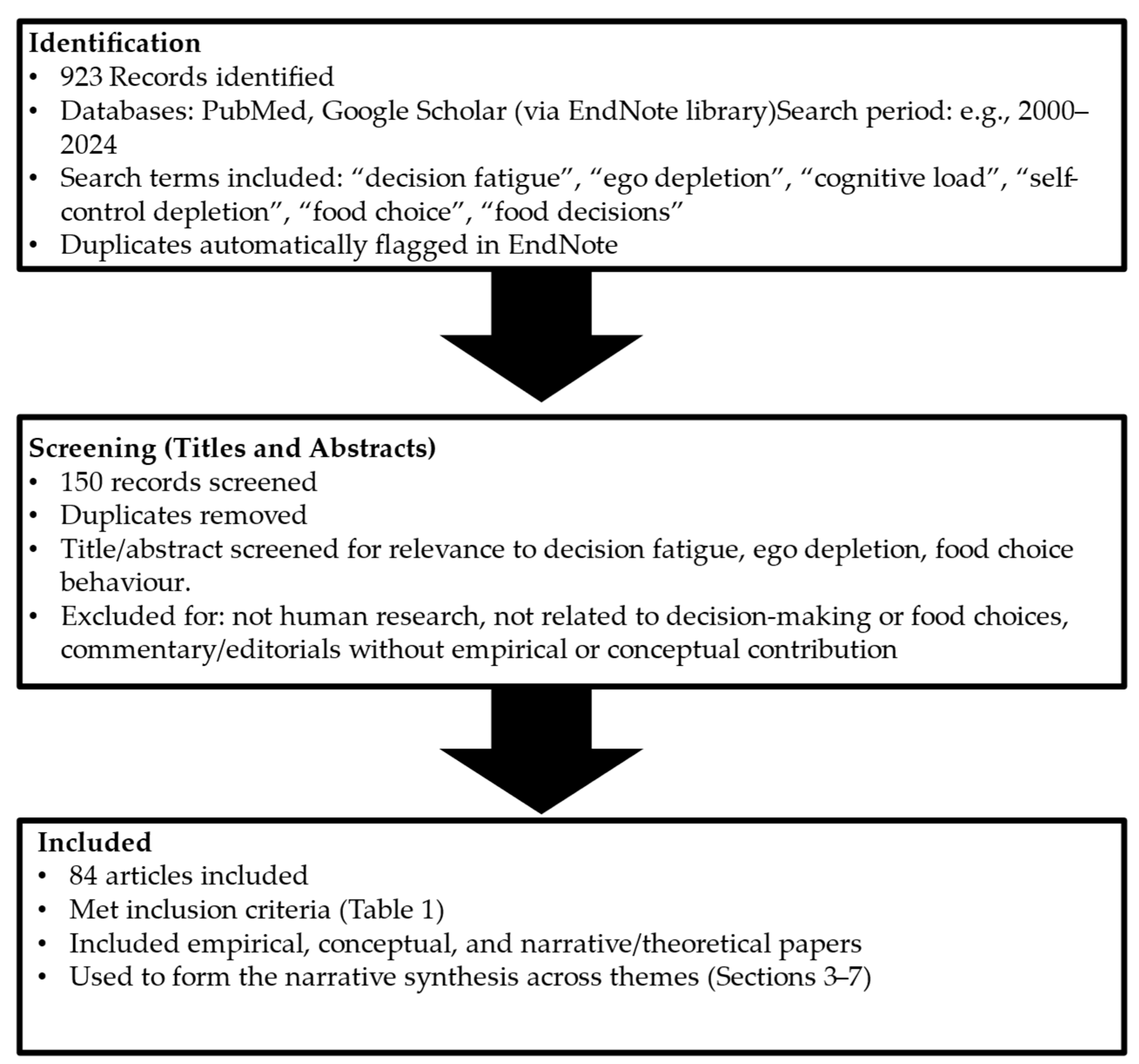
2. Methods
2.1. Review Approach and Rationale
2.2. Search Strategy
2.3. Eligibility Criteria
2.4. Screening Process
2.5. Quality Appraisal
2.6. Synthesis of Evidence
3. Results
3.1. Food Choices
3.2. Decision Fatigue and Ego Depletion
3.3. Measures and Scales of Decision Fatigue
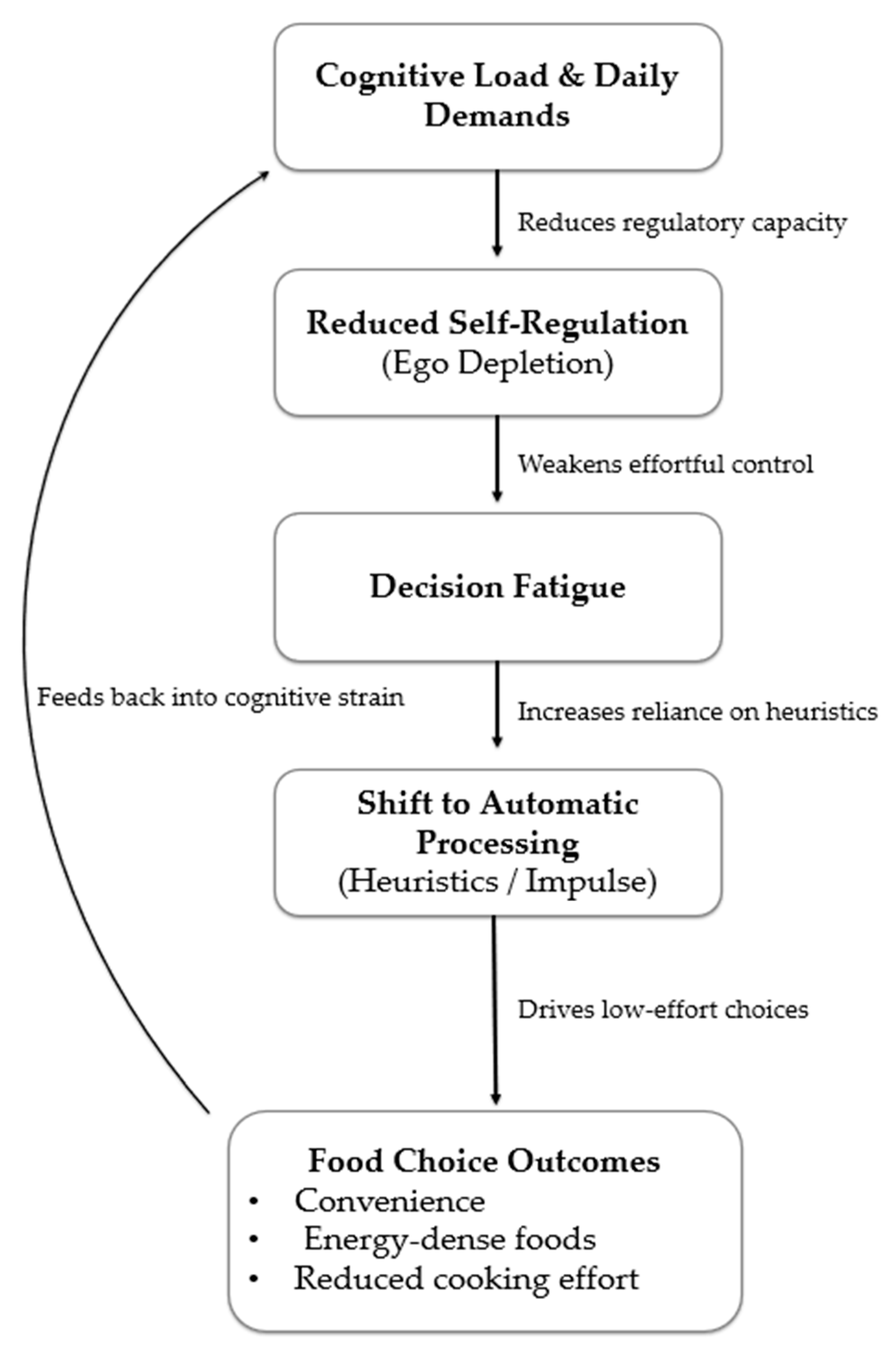
3.4. How Can Decision Fatigue Influence Food Choices?
3.5. Discussion
4. Strengths and Limitations
5. Conclusions
Author Contributions
Funding
Informed Consent Statement
Data Availability Statement
Conflicts of Interest
References
- Wansink, B. Mindless Eating: Why We Eat More Than We Think; Random House Digital, Inc.: New York, NY, USA, 2010. [Google Scholar]
- Fabio, R.A. Relationship Between Automatic and Controlled Processes of Attention and Leading to Complex Thinking; Nova Science Publishers, Inc.: Hauppauge, NY, USA, 2009. [Google Scholar]
- Baumeister, R.F. Ego depletion and self-control failure: An energy model of the self’s executive function. Self Identity 2002, 1, 129–136. [Google Scholar] [CrossRef]
- Baumeister, R.F. Self-regulation, ego depletion, and inhibition. Neuropsychologia 2014, 65, 313–319. [Google Scholar] [CrossRef]
- Birch, L.L.; Fisher, J.O. Mothers’ child-feeding practices influence daughters’ eating and weight. Am. J. Clin. Nutr. 2000, 71, 1054–1061. [Google Scholar] [CrossRef]
- Chandon, P.; Wansink, B. When are stockpiled products consumed faster? A convenience–salience framework of postpurchase consumption incidence and quantity. J. Mark. Res. 2002, 39, 321–335. [Google Scholar] [CrossRef]
- Kahn, B.E.; Wansink, B. The influence of assortment structure on perceived variety and consumption quantities. J. Consum. Res. 2004, 30, 519–533. [Google Scholar] [CrossRef]
- Pulker, C.; Trapp, G.; Scott, J.; Pollard, C. What are the position and power of supermarkets in the Australian food system, and the implications for public health? A systematic scoping review. Obes. Rev. 2018, 19, 198–218. [Google Scholar] [CrossRef]
- Baumeister, R.F.; Bratslavsky, E.; Muraven, M.; Tice, D.M. Ego depletion: Is the active self a limited resource? J. Personal. Soc. Psychol. 1998, 74, 1252. [Google Scholar] [CrossRef] [PubMed]
- Mani, A.; Mullainathan, S.; Shafir, E.; Zhao, J. Poverty impedes cognitive function. Science 2013, 341, 976–980. [Google Scholar] [CrossRef] [PubMed]
- Mullainathan, S.; Shafir, E. Scarcity: Why Having too Little Means so Much; Macmillan: London, UK, 2013. [Google Scholar]
- Vohs, K.D.; Faber, R.J. Spent resources: Self-regulatory resource availability affects impulse buying. J. Consum. Res. 2007, 33, 537–547. [Google Scholar] [CrossRef]
- Danziger, S.; Levav, J.; Avnaim-Pesso, L. Extraneous factors in judicial decisions. Proc. Natl. Acad. Sci. USA 2011, 108, 6889–6892. [Google Scholar] [CrossRef]
- Hemrajani, R.; Hobert, T., Jr. The Effects of Decision Fatigue on Judicial Behavior: A Study of Arkansas Traffic Court Outcomes. J. Law Court. 2024, 12, 435–443. [Google Scholar] [CrossRef]
- Rachlinski, J.J.; Wistrich, A.J. Judging the judiciary by the numbers: Empirical research on judges. Annu. Rev. Law Soc. Sci. 2017, 13, 203–229. [Google Scholar] [CrossRef]
- Shroff, R.; Vamvourellis, K. Pretrial release judgments and decision fatigue. Judgm. Decis. Mak. 2022, 17, 1176–1207. [Google Scholar] [CrossRef]
- Torres, L.C.; Williams, J.H. Tired judges? An examination of the effect of decision fatigue in bail proceedings. Crim. Justice Behav. 2022, 49, 1233–1251. [Google Scholar] [CrossRef]
- Hawkes, C. Sales promotions and food consumption. Nutr. Rev. 2009, 67, 333–342. [Google Scholar] [CrossRef]
- Sobal, J.; Bisogni, C.A. Constructing food choice decisions. Ann. Behav. Med. 2009, 38, s37–s46. [Google Scholar] [CrossRef] [PubMed]
- Furst, T.; Connors, M.; Bisogni, C.A.; Sobal, J.; Falk, L.W. Food choice: A conceptual model of the process. Appetite 1996, 26, 247–266. [Google Scholar] [CrossRef]
- Symmank, C.; Mai, R.; Hoffmann, S.; Stok, F.M.; Renner, B.; Lien, N.; Rohm, H. Predictors of food decision making: A systematic interdisciplinary mapping (SIM) review. Appetite 2017, 110, 25–35. [Google Scholar] [CrossRef]
- Brunner, T.A.; Van der Horst, K.; Siegrist, M. Convenience food products. Drivers for consumption. Appetite 2010, 55, 498–506. [Google Scholar] [CrossRef]
- Wilson, A.L.; Buckley, E.; Buckley, J.D.; Bogomolova, S. Nudging healthier food and beverage choices through salience and priming. Evidence from a systematic review. Food Qual. Prefer. 2016, 51, 47–64. [Google Scholar] [CrossRef]
- Kilanowski, J.F. Breadth of the socio-ecological model. J. Agromed. 2017, 22, 295–297. [Google Scholar] [CrossRef] [PubMed]
- Morgan, M.J.; Stratford, E.; Harpur, S.; Rowbotham, S. A systems thinking approach for community health and wellbeing. Syst. Pract. Action Res. 2024, 37, 161–183. [Google Scholar] [CrossRef]
- Robinson, T. Applying the socio-ecological model to improving fruit and vegetable intake among low-income African Americans. J. Community Health 2008, 33, 395–406. [Google Scholar] [CrossRef]
- Caperon, L.; Saville, F.; Ahern, S. Developing a socio-ecological model for community engagement in a health programme in an underserved urban area. PLoS ONE 2022, 17, e0275092. [Google Scholar] [CrossRef]
- McKeon, G.; Mastrogiovanni, C.; Weber, D.; Le Compte, E.; Némorin, S.; Teasdale, S.; Fatima, R.; Bahadurmia, S.; Rosenbaum, S. Exploring barriers and facilitators to physical activity participation and food security among the Rohingya community living in Australia: A socio-ecological perspective. BMC Public Health 2025, 25, 1839. [Google Scholar] [CrossRef]
- Townsend, N.; Foster, C. Developing and applying a socio-ecological model to the promotion of healthy eating in the school. Public Health Nutr. 2013, 16, 1101–1108. [Google Scholar] [CrossRef] [PubMed]
- Constantinides, S.V.; Turner, C.; Frongillo, E.A.; Bhandari, S.; Reyes, L.I.; Blake, C.E. Using a global food environment framework to understand relationships with food choice in diverse low-and middle-income countries. Glob. Food Secur. 2021, 29, 100511. [Google Scholar] [CrossRef]
- Skjerdal, T.; Gefferth, A.; Spajic, M.; Estanga, E.G.; De Cesare, A.; Vitali, S.; Pasquali, F.; Bovo, F.; Manfreda, G.; Mancusi, R.; et al. The STARTEC Decision Support Tool for Better Tradeoffs between Food Safety, Quality, Nutrition, and Costs in Production of Advanced Ready-to-Eat Foods. Biomed Res. Int. 2017, 2017, 6353510, Corrigendum in Biomed Res. Int. 2018, 2018, 5189346. https://doi.org/10.1155/2018/5189346. [Google Scholar] [CrossRef]
- Belasco, W. Meals to Come: A History of the Future of Food; University of California Press: Oakland, CA, USA, 2006; Volume 16. [Google Scholar]
- Grew, R. Food in Global History; Routledge: London, UK, 2018. [Google Scholar]
- Devine, C.M. A life course perspective: Understanding food choices in time, social location, and history. J. Nutr. Educ. Behav. 2005, 37, 121–128. [Google Scholar] [CrossRef]
- Jastran, M.M.; Bisogni, C.A.; Sobal, J.; Blake, C.; Devine, C.M. Eating routines. Embedded, value based, modifiable, and reflective. Appetite 2009, 52, 127–136. [Google Scholar] [CrossRef]
- Bisogni, C.A.; Falk, L.W.; Madore, E.; Blake, C.E.; Jastran, M.; Sobal, J.; Devine, C.M. Dimensions of everyday eating and drinking episodes. Appetite 2007, 48, 218–231. [Google Scholar] [CrossRef] [PubMed]
- Scheibehenne, B.; Miesler, L.; Todd, P.M. Fast and frugal food choices: Uncovering individual decision heuristics. Appetite 2007, 49, 578–589. [Google Scholar] [CrossRef] [PubMed]
- Connors, M.; Bisogni, C.A.; Sobal, J.; Devine, C.M. Managing values in personal food systems. Appetite 2001, 36, 189–200. [Google Scholar] [CrossRef]
- Strack, F.; Deutsch, R. Reflective and impulsive determinants of social behavior. Personal. Soc. Psychol. Rev. 2004, 8, 220–247. [Google Scholar] [CrossRef]
- Prestwich, A.; Hurling, R.; Baker, S. Implicit shopping: Attitudinal determinants of the purchasing of healthy and unhealthy foods. Psychol. Health 2011, 26, 875–885. [Google Scholar] [CrossRef]
- Tierney, J. Do you suffer from decision fatigue. New York Times, 17 August 2011; p. 17. [Google Scholar]
- Ainsworth, S.E.; Baumeister, R.F.; Vohs, K.D.; Ariely, D. Ego depletion decreases trust in economic decision making. J. Exp. Soc. Psychol. 2014, 54, 40–49. [Google Scholar] [CrossRef]
- Vohs, K.D. Self-regulatory resources power the reflective system: Evidence from five domains. J. Consum. Psychol. 2006, 16, 217–223. [Google Scholar] [CrossRef]
- Schmeichel, B.J.; Vohs, K.D.; Baumeister, R.F. Intellectual performance and ego depletion: Role of the self in logical reasoning and other information processing. J. Personal. Soc. Psychol. 2003, 85, 33. [Google Scholar] [CrossRef]
- Vohs, K.D.; Heatherton, T.F. Self-regulatory failure: A resource-depletion approach. Psychol. Sci. 2000, 11, 249–254. [Google Scholar] [CrossRef]
- Vohs, K.D.; Baumeister, R.F.; Ciarocco, N.J. Self-regulation and self-presentation: Regulatory resource depletion impairs impression management and effortful self-presentation depletes regulatory resources. J. Personal. Soc. Psychol. 2005, 88, 632. [Google Scholar] [CrossRef]
- Gailliot, M.T.; Baumeister, R.F. Self-regulation and sexual restraint: Dispositionally and temporarily poor self-regulatory abilities contribute to failures at restraining sexual behavior. Personal. Soc. Psychol. Bull. 2007, 33, 173–186. [Google Scholar] [CrossRef]
- Garmann, S. Election frequency, choice fatigue, and voter turnout. Eur. J. Political Econ. 2017, 47, 19–35. [Google Scholar] [CrossRef]
- Liu, R.H. Health-promoting components of fruits and vegetables in the diet. Adv. Nutr. 2013, 4, 384S–392S. [Google Scholar] [CrossRef]
- Iyengar, S.S.; Lepper, M.R. When choice is demotivating: Can one desire too much of a good thing? J. Personal. Soc. Psychol. 2000, 79, 995. [Google Scholar] [CrossRef] [PubMed]
- Baumeister, R.F.; Vohs, K.D. Strength model of self-regulation as limited resource: Assessment, controversies, update. In Advances in Experimental Social Psychology; Elsevier: Amsterdam, The Netherlands, 2016; Volume 54, pp. 67–127. [Google Scholar]
- Pignatiello, G.A.; Martin, R.J.; Hickman Jr, R.L. Decision fatigue: A conceptual analysis. J. Health Psychol. 2020, 25, 123–135. [Google Scholar] [CrossRef]
- Wansink, B.; Sobal, J. Mindless eating: The 200 daily food decisions we overlook. Environ. Behav. 2007, 39, 106–123. [Google Scholar] [CrossRef]
- Baumeister, R.F.; Vohs, K.D. Self-Regulation, ego depletion, and motivation. Soc. Personal. Psychol. Compass 2007, 1, 115–128. [Google Scholar] [CrossRef]
- Hickman Jr, R.L.; Pignatiello, G.A.; Tahir, S. Evaluation of the decisional fatigue scale among surrogate decision makers of the critically ill. West. J. Nurs. Res. 2018, 40, 191–208. [Google Scholar] [CrossRef]
- Michielsen, H.J.; De Vries, J.; Van Heck, G.L. Psychometric qualities of a brief self-rated fatigue measure: The Fatigue Assessment Scale. J. Psychosom. Res. 2003, 54, 345–352. [Google Scholar] [CrossRef]
- Smets, E.; Garssen, B.; Bonke, B.D.; De Haes, J. The Multidimensional Fatigue Inventory (MFI) psychometric qualities of an instrument to assess fatigue. J. Psychosom. Res. 1995, 39, 315–325. [Google Scholar] [CrossRef] [PubMed]
- Krupp, L.B.; LaRocca, N.G.; Muir-Nash, J.; Steinberg, A.D. The fatigue severity scale: Application to patients with multiple sclerosis and systemic lupus erythematosus. Arch. Neurol. 1989, 46, 1121–1123. [Google Scholar] [CrossRef] [PubMed]
- Glynn, N.W.; Santanasto, A.J.; Simonsick, E.M.; Boudreau, R.M.; Beach, S.R.; Schulz, R.; Newman, A.B. The Pittsburgh Fatigability scale for older adults: Development and validation. J. Am. Geriatr. Soc. 2015, 63, 130–135. [Google Scholar] [CrossRef]
- Wintermann, G.-B.; Rosendahl, J.; Weidner, K.; Strauß, B.; Hinz, A.; Petrowski, K. Fatigue in chronically critically ill patients following intensive care-reliability and validity of the multidimensional fatigue inventory (MFI-20). Health Qual. Life Outcomes 2018, 16, 37. [Google Scholar] [CrossRef] [PubMed]
- Hinz, A.; Benzing, C.; Brähler, E.; Zenger, M.; Herzberg, P.Y.; Finck, C.; Schmalbach, B.; Petrowski, K. Psychometric properties of the multidimensional fatigue inventory (MFI-20), derived from seven samples. J. Pain Symptom Manag. 2020, 59, 717–723. [Google Scholar] [CrossRef]
- Bargh, J.; Gollwitzer, P. Integrative Views of Motivation, Cognition and Emotion; The Nebraska Symposium on Motivation; University of Nebraska Press: Lincoln, NE, USA, 1994; pp. 71–124. [Google Scholar]
- Saunders, B.; Inzlicht, M. Vigour and fatigue: How variation in affect underlies effective self-control. In Motivation and Cognitive Control; Routledge: London, UK, 2015; pp. 211–234. [Google Scholar]
- Bossuyt, S.; Vermeir, I.; Slabbinck, H.; De Bock, T.; Van Kenhove, P. The compelling urge to misbehave: Do impulse purchases instigate unethical consumer behavior? J. Econ. Psychol. 2017, 58, 60–76. [Google Scholar] [CrossRef]
- Hansen, P.G.; Jespersen, A.M. Nudge and the manipulation of choice: A framework for the responsible use of the nudge approach to behaviour change in public policy. Eur. J. Risk Regul. 2013, 4, 3–28. [Google Scholar] [CrossRef]
- Haselhoff, V.; Faupel, U.; Holzmüller, H.H. Strategies of children and parents during shopping for groceries. Young Consum. 2014, 15, 17–36. [Google Scholar] [CrossRef]
- Haynes, A.; Kemps, E.; Moffitt, R. Too Depleted to Try? Testing the Process Model of Ego Depletion in the Context of Unhealthy Snack Consumption. Appl. Psychol. Health Well Being 2016, 8, 386–404. [Google Scholar] [CrossRef]
- Wang, Y.; Zhu, J.; Hu, Y.; Fang, Y.; Wang, G.; Cui, X.; Wang, L. The effect of implicit preferences on food consumption: Moderating role of ego depletion and impulsivity. Front. Psychol. 2016, 7, 1699. [Google Scholar] [CrossRef]
- Salmon, S.J.; Fennis, B.M.; de Ridder, D.T.; Adriaanse, M.A.; de Vet, E. Health on impulse: When low self-control promotes healthy food choices. Health Psychol. 2014, 33, 103–109. [Google Scholar] [CrossRef]
- Olsen, S.B.; Meyerhoff, J.; Mørkbak, M.R.; Bonnichsen, O. The influence of time of day on decision fatigue in online food choice experiments. Br. Food J. 2017, 119, 497–510. [Google Scholar] [CrossRef]
- Musher-Eizenman, D.R.; Young, K.M.; Laurene, K.; Galliger, C.; Hauser, J.; Wagner Oehlhof, M. Children’s sensitivity to external food cues: How distance to serving bowl influences children’s consumption. Health Educ. Behav. 2010, 37, 186–192. [Google Scholar] [CrossRef]
- Maas, J.; de Ridder, D.T.; de Vet, E.; De Wit, J.B. Do distant foods decrease intake? The effect of food accessibility on consumption. Psychol. Health 2012, 27, 59–73. [Google Scholar] [CrossRef]
- Brasington, N.; Beckett, E.L.; Akanbi, T.O.; Pristijono, P. Health Professionals’ Knowledge and Views on the Use of Convenience Cooking Products: An Australian Cross-Sectional Study. Nutrients 2025, 17, 1156. [Google Scholar] [CrossRef]
- Thaler, R.H.; Sunstein, C.R. Nudge: Improving Decisions About Health, Wealth, and Happiness; Penguin: London, UK, 2009. [Google Scholar]
- Vogel, C.; Crozier, S.; Dhuria, P.; Shand, C.; Lawrence, W.; Cade, J.; Moon, G.; Lord, J.; Ball, K.; Cooper, C.; et al. Protocol of a natural experiment to evaluate a supermarket intervention to improve food purchasing and dietary behaviours of women (WRAPPED study) in England: A prospective matched controlled cluster design. BMJ Open 2020, 10, e036758. [Google Scholar] [CrossRef]
- Delaney, T.; Yoong, S.L.; Lamont, H.; Lecathelinais, C.; Wolfenden, L.; Clinton-McHarg, T.; Sutherland, R.; Wyse, R. The efficacy of a multi-strategy choice architecture intervention on improving the nutritional quality of high school students’ lunch purchases from online canteens (Click & Crunch High Schools): A cluster randomized controlled trial. Int. J. Behav. Nutr. Phys. Act. 2022, 19, 120. [Google Scholar] [CrossRef]
- Bernstein, I. Flavor aversion. In Smell and Taste Health and Disease; Raven Press: New York, NY, USA, 1991; pp. 417–428. [Google Scholar]
- Garcia, J.; Ervin, F.R.; Koelling, R.A. Learning with prolonged delay of reinforcement. Psychon. Sci. 1966, 5, 121–122. [Google Scholar] [CrossRef]
- Garcia, J.; Hankins, W.G.; Rusiniak, K.W. Behavioral Regulation of the Milieu Interne in Man and Rat: Food preferences set by delayed visceral effects facilitate memory research and predator control. Science 1974, 185, 824–831. [Google Scholar] [CrossRef] [PubMed]
- Garb, J.L.; Stunkard, A.J. Taste aversions in man. Am. J. Psychiatry 1974, 131, 1204–1207. [Google Scholar] [CrossRef] [PubMed]
- Brasington, N.; Bucher, T.; Beckett, E.L. Frequency of convenience cooking product use is associated with cooking confidence, creativity, and markers of vegetable intake. Nutrients 2023, 15, 966. [Google Scholar] [CrossRef] [PubMed]
- Brasington, N.; Jones, P.; Bucher, T.; Beckett, E.L. Correlations between self-reported cooking confidence and creativity and use of convenience cooking products in an Australian cohort. Nutrients 2021, 13, 1724. [Google Scholar] [CrossRef] [PubMed]


| Criteria | Defined |
|---|---|
| Inclusion | Studies exploring decision fatigue, ego depletion, or choice overload; studies exploring food choice, dietary decisions, eating behaviour, systems linking cognitive load to food-related outcomes, and human research; and studies written in English. |
| Exclusion | Studies focused only on physical fatigue, clinical fatigue conditions, metabolic/biological outcomes, taste aversion, animal studies, or unrelated nutrition physiology and non-English publications. |
| Filters | Literature published within the past 20–25 years, and the inclusion of seminal theoretical papers when they are foundational to decision fatigue mechanisms. |
| Reference | Focus/Exposure Type | Population/Context | Key Insight |
|---|---|---|---|
| Furst et al., 1996 [20] | Food choice process model | General population | Identifies food choice as a dynamic, multi-stage process shaped by personal, social, and contextual factors. |
| Sobal & Bisogni, 2009 [19] | Food decision construction | Adults | Shows how food choices are constructed through values, identity, and routines. |
| Symmank et al., 2017 [21] | Mapping predictors of food decisions | Multidisciplinary review | Summarises individual, situational, and environmental influences on food decisions relevant to cognitive load. |
| Brunner et al., 2010 [22] | Convenience food consumption drivers | Adults | Shows time pressure, convenience needs, and effort reduction strongly shape modern food choices. |
| Wilson et al., 2016 [23] | Salience/priming nudges | Retail environments | Simple environmental prompts influence purchasing with minimal cognitive effort. |
| Reference | Design/Exposure | Population | Outcome | Key Insight |
|---|---|---|---|---|
| Baumeister et al., 1998 [9] | Sequential self-control tasks | Students | Self-control performance | Evidence that self-control operates as a limited resource. |
| Vohs & Faber, 2007 [12] | Ego depletion and consumer spending | Adult consumers | Impulse buying | Depleted individuals spend more and resist temptations less. |
| Schmeichel et al., 2003 [44] | Cognitive self-control task | Students | Logical reasoning | Depletion impairs higher-order cognition. |
| Vohs & Heatherton, 2000 [45] | Emotion regulation and eating | Restrained eaters | Ice cream consumption | Depleted individuals overeat, especially restrained eaters. |
| Pignatiello et al., 2020 [52] | Conceptual analysis | Review | Framework definition | Clarifies components of decision fatigue (cognitive, emotional, and behavioural). |
| Danziger et al., 2011 [13] | Time-of-day decision fatigue | Judges | Parole decisions | Decision quality drops over time, and default options increase. |
| Torres & Williams, 2022 [17] | Case-sequence fatigue | Judges | Bail decisions | Later decisions are more conservative/harsh. |
| Ainsworth et al., 2014 [42] | Ego depletion and trust | Adults | Economic trust | Depletion reduces trust and prosocial decision-making. |
| Scale | Purpose/Population | Dimensions | No. of Items | Response Format | Strengths | Limitations |
|---|---|---|---|---|---|---|
| Fatigue Assessment Scale (FAS) [56] | General fatigue in the working population: validated in sarcoidosis. | Unidimensional: physical and mental fatigue. | 10 | 5-point Likert | Simple, quick, and reliable | Not decision fatigue specific |
| Multidimensional Fatigue Inventory (MFI) [57] | Severity of fatigue in various populations: cancer, military, and students. | 5 dimensions: general, physical, cognitive, reduced motivation, and reduced activity. | 20 | 5-point Likert | Broad scope, multidimensional | Structure questions, and less reliable in “motivation” |
| Fatigue Severity Scale (FSS) [58] | Fatigue has an impact on neurological disorders, such as multiple sclerosis and systemic lupus erythematosus. | Unidimensional. | 9 | 7-point Likert | Widely used, simple | Disease-specific, not tailored to cognitive decision fatigue |
| Pittsburgh Fatigability Scale (PFS) [59] | Fatigability (physical and mental) across activities. | 2 dimensions. | 10 | Activity ratings (0–50) | Distinguishes physical versus mental fatigue | Developed for older adults, not decision-specific |
| Decision Fatigue Scale (DFS) [55] | Decision fatigue in surrogate healthcare decision-makers. | Emotional distress, mental exhaustion, and impulsivity. | 10 | 4-point Likert | Tailored to decision-making and good readability | Limited use outside medical settings |
| Reference | Exposure/Manipulation | Population | Food-Related Outcome | Key Insight |
|---|---|---|---|---|
| Vohs & Heatherton, 2000 [45] | Emotion regulation and depletion | Restrained eaters | Ice cream consumption | Depleted individuals consume more high-calorie foods. |
| Haynes et al., 2016 [67] | Ego depletion (lab task) | Adults | Unhealthy snack intake | Depletion increases unhealthy eating for those high in depletion sensitivity. |
| Wang et al., 2016 [68] | Depletion task | Adults | Unhealthy food preference | Depleted participants select more indulgent foods. |
| Salmon et al., 2014 [69] | Self-control depletion | Adults | Unhealthy snack purchases | Depletion predicts a higher likelihood of unhealthy purchasing. |
| Olsen et al., 2017 [70] | Time of day as proxy for DF | Adults in an online food choice task | Food choice behaviour | Later-in-day choices show patterns consistent with fatigue, which lead to default/unhealthy choices. |
| Musher-Eizenman et al., 2010 [71] | Food distance/accessibility | Children | Snack intake | Lower-effort options are chosen more, aligning with fatigue-driven decision simplification. |
| Maas et al., 2012 [72] | Accessibility manipulation | Adults | Snack consumption | Increased physical effort reduces consumption consistently with cognitive conservation. |
| Brasington et al., 2025 [73] | Convenience cooking products | Health professionals | Perceived impact of DF on food decisions | Professionals report DF as a driver of convenience food use; conceptual real-world relevance. |
Disclaimer/Publisher’s Note: The statements, opinions and data contained in all publications are solely those of the individual author(s) and contributor(s) and not of MDPI and/or the editor(s). MDPI and/or the editor(s) disclaim responsibility for any injury to people or property resulting from any ideas, methods, instructions or products referred to in the content. |
© 2025 by the authors. Licensee MDPI, Basel, Switzerland. This article is an open access article distributed under the terms and conditions of the Creative Commons Attribution (CC BY) license (https://creativecommons.org/licenses/by/4.0/).
Share and Cite
Brasington, N.; Beckett, E.L.; Pristijono, P.; Akanbi, T.O. The Effect of Decision Fatigue on Food Choices: A Narrative Review. Nutrients 2025, 17, 3901. https://doi.org/10.3390/nu17243901
Brasington N, Beckett EL, Pristijono P, Akanbi TO. The Effect of Decision Fatigue on Food Choices: A Narrative Review. Nutrients. 2025; 17(24):3901. https://doi.org/10.3390/nu17243901
Chicago/Turabian StyleBrasington, Natasha, Emma L. Beckett, Penta Pristijono, and Taiwo O. Akanbi. 2025. "The Effect of Decision Fatigue on Food Choices: A Narrative Review" Nutrients 17, no. 24: 3901. https://doi.org/10.3390/nu17243901
APA StyleBrasington, N., Beckett, E. L., Pristijono, P., & Akanbi, T. O. (2025). The Effect of Decision Fatigue on Food Choices: A Narrative Review. Nutrients, 17(24), 3901. https://doi.org/10.3390/nu17243901