A Longitudinal Study on Dental Caries Focusing on Long-Term Breastfed Children in Japan

 , , ,
, , ,  ,
,
Abstract
1. Introduction
2. Materials and Methods
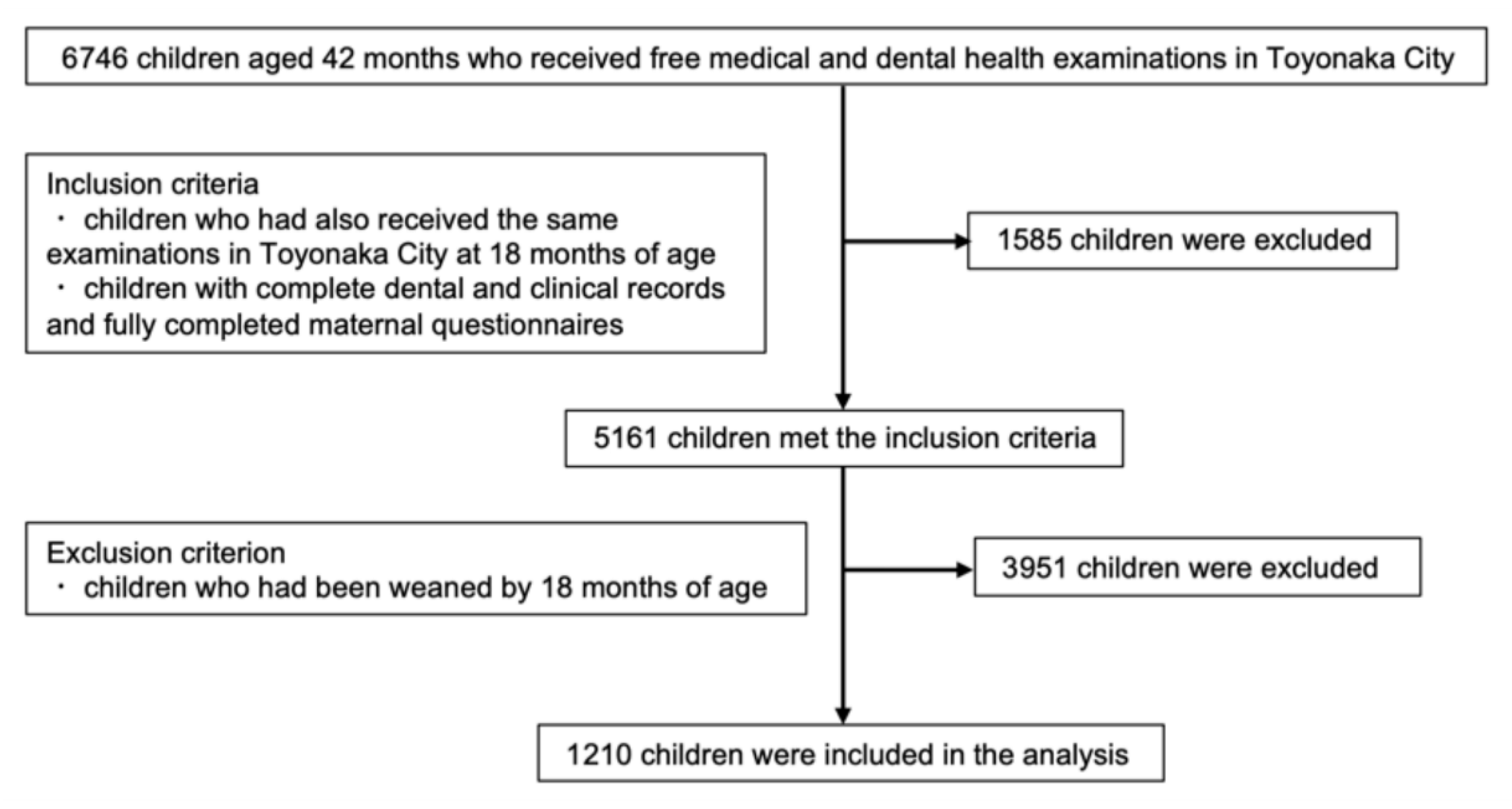
2.1. Study Participants
2.2. Clinical Examination
2.3. Bacteriological Assessment
2.4. Questionnaire
2.5. Statistical Analyses
3. Results
3.1. Characteristics of the Participants
3.2. Univariate Analysis
3.3. Logistic Regression Analyses
4. Discussion
5. Conclusions
Author Contributions
Funding
Institutional Review Board Statement
Informed Consent Statement
Data Availability Statement
Acknowledgments
Conflicts of Interest
Abbreviations
| BMI | body mass index |
| CI | confidence interval |
| ECC | early childhood caries |
| OR | odds ratio |
| VIF | variance inflation factor |
| WHO | World Health Organization |
References
- World Health Organization. Breastfeeding. Overview. Available online: https://www.who.int/health-topics/breastfeeding#tab=tab_1 (accessed on 16 October 2025).
- Victora, C.G.; Bahl, R.; Barros, A.J.D.; França, G.V.A.; Horton, S.; Krasevec, J.; Murch, S.; Sankar, M.J.; Walker, N.; Rollins, N.C.; et al. Breastfeeding in the 21st century: Epidemiology, mechanisms, and lifelong effect. Lancet 2016, 387, 475–490. [Google Scholar] [CrossRef] [PubMed]
- Horta, B.L.; Vivtora, C.G.; World Health Organization. Long-Term Effects of Breastfeeding: A Systematic Review; World Health Organization: Geneva, Switzerland, 2013; Available online: https://iris.who.int/handle/10665/79198 (accessed on 16 October 2025).
- Patnode, C.D.; Henrikson, N.B.; Webber, E.M.; Blasi, P.R.; Senger, C.A.; Guirguis-Blake, J.M. Breastfeeding and health outcomes for infants and children: A systematic review. Pediatrics 2025, 156, e2025071516. [Google Scholar] [CrossRef] [PubMed]
- Tschiderer, L.; Seekircher, L.; Kunutsor, S.K.; Peters, S.A.E.; O’Keeffe, L.M.; Willeit, P. Breastfeeding is associated with a reduced maternal cardiovascular risk: Systematic review and meta-analysis involving data from 8 studies and 1192700 parous women. J. Am. Heart Assoc. 2022, 11, e022746. [Google Scholar] [CrossRef] [PubMed]
- Chowdhury, R.; Sinha, B.; Sankar, M.J.; Taneja, S.; Bhandari, N.; Rollins, N.; Bahl, R.; Martines, J. Breastfeeding and maternal health outcomes: A systematic review and meta-analysis. Acta Pediatr. 2015, 104, 96–113. [Google Scholar] [CrossRef]
- World Health Organization. Breastfeeding. Recommendations. Available online: https://www.who.int/health-topics/breastfeeding#tab=tab_2 (accessed on 16 October 2025).
- Panchanadikar, N.T.; Abirami, S.; Muthu, M.S.; Selvakumar, H.; Jayakumar, P.; Agarwal, A. Breastfeeding and its association with early childhood caries-An umbrella review. J. Clin. Pediatr. Dent. 2022, 46, 75–85. [Google Scholar] [CrossRef]
- Abanto, J.; Maruyama, J.M.; Pinheiro, E.; Matijasevich, A.; Antunes, J.L.F.; Bönecker, M.; Cardoso, M.A. Prolonged breastfeeding, sugar consumption and dental caries at 2 years of age: A birth cohort study. Community Dent. Oral Epidemiol. 2023, 51, 575–582. [Google Scholar] [CrossRef]
- Lustosa, K.; Rodrigues, L.R.S.; Rocha, R.M.; Prudente, T.P.; Mezaiko, E.; Silva, F.P.Y.; Silva, B.S.F. Risk of early childhood dental caries associated with prolonged breastfeeding: A systematic review and meta-analysis. Int. J. Paediatr. Dent. 2025, 35, 964–985. [Google Scholar] [CrossRef]
- International Association of Pediatric Dentistry. Management of Early Childhood Caries: Foundational Articles and Recommendations. 2022. Available online: https://iapdworld.org/wp-content/uploads/2022/08/2022_10_management-of-early-childhood-caries.pdf (accessed on 16 October 2025).
- Sritangsirikul, S.; Kitsahawong, K.; Matangkasombut, O.; Seminario, A.L.; Pitiphat, W. A longitudinal study on the impact of breastfeeding with or without formula milk on dental caries. Sci. Rep. 2024, 14, 10384. [Google Scholar] [CrossRef]
- Yang, R.; Rashwan, N.; Jallad, N.A.; Wu, Y.; Lu, X.; Wu, T.; Xiao, J. Maternal and infant oral health benefits from mothers receiving prenatal total oral rehabilitation: A pilot prospective birth cohort study. Front. Oral Health 2024, 5, 1443337. [Google Scholar] [CrossRef]
- George, A.; Sousa, M.S.; Kong, A.C.; Blinkhorn, A.; Norrie, T.P.; Foster, J.; Dahlen, H.G.; Ajwani, S.; Johnson, M. Effectiveness of preventive dental programs offered to mothers by non-dental professionals to control early childhood dental caries: A review. BMC Oral Health 2019, 19, 172. [Google Scholar] [CrossRef]
- Masterson, E.E.; Sabbah, W. Maternal allostatic load, caretaking behaviors, and child dental caries experience: A cross-sectional evaluation of linked mother-child data from the third national health and nutrition examination survey. Am. J. Public Health 2015, 105, 2306–2311. [Google Scholar] [CrossRef]
- World Health Organization. Oral Health Surveys: Basic Method, 5th ed.; World Health Organization: Geneva, Switzerland, 2013; Available online: https://www.who.int/publications/i/item/9789241548649 (accessed on 16 October 2025).
- Otsugu, M.; Mikasa, Y.; Kadono, M.; Matsuoka, T.; Matsunami, K.; Nakamura, M.; Ohno, Y.; Kato, T.; Nakano, K. The number of erupted teeth as a risk factor for dental caries in eighteen-month-old children: A cross-sectional study. BMC Oral Health 2023, 23, 671. [Google Scholar] [CrossRef] [PubMed]
- Ansai, T.; Yamashita, Y.; Shibata, Y.; Katoh, Y.; Sakao, S.; Takamatsu, N.; Miyazaki, H.; Takehara, T. Relationship between dental caries experience of a group of Japanese kindergarten children and the results of two caries activity tests conducted on their saliva and dental plaque. Int. J. Paediatr. Dent. 1994, 4, 13–17. [Google Scholar] [CrossRef] [PubMed]
- Nakayama, Y.; Ohnishi, H. Risk factors for early childhood caries in three-year-old Japanese children: A prospective cohort study. Pediatr. Dent. 2022, 44, 346–354. [Google Scholar] [PubMed]
- Huang, Z.; Kawamura, K.; Kitayama, T.; Li, Q.; Yang, S.; Miyake, T. GIS-based study of dental accessibility and caries in 3-year-old Japanese children. Int. Dent. J. 2023, 73, 550–557. [Google Scholar] [CrossRef]
- Utsunomiya, H.; Tanaka, K.; Okubo, H.; Nagata, C.; Miyake, Y. Association between dairy product intake and prevalence of dental caries in 3-year-old Japanese children. J. Pediatr. Gastroenterol. Nutr. 2025, 80, 714–722. [Google Scholar] [CrossRef]
- Devenish, G.; Mukhtar, A.; Begley, A.; Spencer, A.J.; Thomson, W.M.; Ha, D.; Do, L.; Scott, J.A. Early childhood feeding practices and dental caries among Australian preschoolers. Am. J. Clin. Nutr. 2020, 111, 821–828. [Google Scholar] [CrossRef]
- Julihn, A.; Soares, F.C.; Hammarfjord, U.; Hjern, A.; Dahllof, G. Birth order is associated with caries development in young children: A register-based cohort study. BMC Public Health 2020, 20, 218. [Google Scholar] [CrossRef]
- Chen, H.; Tanaka, S.; Arai, K.; Yoshida, S.; Kawakami, K. Insufficient sleep and incidence of dental caries in deciduous teeth among children in Japan: A population-based cohort study. J. Pediatr. 2018, 198, 279–286. [Google Scholar] [CrossRef]
- Sardana, D.; Galland, B.; Wheeler, B.J.; Yiu, C.K.Y.; Ekambaram, M. Effect of sleep on development of early childhood caries: A systematic review. Eur. Arch. Paediatr. Dent. 2022, 24, 1–14. [Google Scholar] [CrossRef]
- Nakagawa, M.; Ohta, H.; Shimabukuro, R.; Asaka, Y.; Nakazawa, T.; Oishi, Y.; Hirata, M.; Ando, A.; Ikeda, T.; Yoshimura, Y.; et al. Daytime nap and nighttime breastfeeding are associated with toddlers’ nighttime sleep. Sci. Rep. 2021, 11, 3028. [Google Scholar] [CrossRef]
- Abdul Jafar, N.K.; Tham, E.K.H.; Pang, W.W.; Fok, D.; Chua, M.C.; Teoh, O.H.; Goh, D.Y.T.; Shek, L.P.; Yap, F.; Tan, K.H.; et al. Association between breastfeeding and sleep patterns in infants and preschool children. Am. J. Clin. Nutr. 2021, 114, 1986–1996. [Google Scholar] [CrossRef]
- Astbury, L.; Bennett, C.; Pinnington, D.M.; Bei, B. Does breastfeeding influence sleep? A longitudinal study across the first two postpartum years. Birth 2022, 49, 540–548. [Google Scholar] [CrossRef]
- Groer, M.; Davis, M.; Steele, K. Associations between human milk SIgA and maternal immune, infectious, endocrine, and stress variables. J. Hum. Lact. 2004, 20, 153–158. [Google Scholar] [CrossRef]
- Hassiotou, F.; Geddes, D.T.; Hartmann, P.E. Cells in human milk: State of the science. J. Hum. Lact. 2013, 29, 171–183. [Google Scholar] [CrossRef] [PubMed]
- Mikolajczak, M.; Brianda, M.E.; Avalosse, H.; Roskam, I. Consequences of parental burnout: Its specific effect on child neglect and violence. Child Abus. Negl. 2018, 80, 134–145. [Google Scholar] [CrossRef]
- Lally, C.; Maliq, N.N.; Schreiber, M.; Wilson, A.; Tiwari, T. Association of parental social support and dental caries in Hispanic children. Front. Oral Health 2023, 4, 1261111. [Google Scholar] [CrossRef]


| Variable | Caries-Free (n = 916) | Caries-Experienced (n = 294) | p |
|---|---|---|---|
| Number of erupted teeth (18 mo) | 14.5 ± 2.3 | 14.4 ± 2.5 | 0.545 |
| dmft (18 mo) | 0.0 | 0.4 ± 1.3 | <0.001 |
| BMI (18 mo) | 15.9 ± 1.8 | 16.0 ± 1.8 | 0.874 |
| Cariostat score (18 mo) | 1.1 ± 0.5 | 1.3 ± 0.6 | <0.001 |
| dmft (42 mo) | 0.0 | 3.3 ± 2.6 | <0.001 |
| Variables | Category | Caries Prevalence n (%) | p |
|---|---|---|---|
| Caries (42 mo) | 294/1210 (24.3) | ||
| Caries (18 mo) | 31/1210 (2.6) | ||
| Sex | Female | 142/596 (23.8) | |
| Male | 152/614 (24.8) | 0.706 | |
| Body mass index (18 mo) | Underweight | 88/377 (23.3) | 0.424 |
| Ideal | 133/518 (25.7) | ||
| Overweight | 73/315 (23.2) | 0.417 | |
| Number of erupted teeth (18 mo) | ≤12 | 64/262 (24.4) | 0.875 |
| 13–16 | 224/935 (24.0) | ||
| ≥17 | 6/13 (46.2) | 0.075 | |
| Cariostat score (18 mo) | − | 7/45 (15.6) | 0.322 |
| + | 212/972 (21.8) | ||
| ++ | 56/158 (35.4) | <0.001 | |
| +++ | 19/35 (54.3) | <0.001 | |
| Birth order | First | 84/405 (20.7) | |
| Second | 140/506 (27.7) | <0.001 | |
| Third or later | 70/199 (35.2) | <0.001 | |
| Nursery (18 mo) | No | 209/817 (25.6) | |
| Yes | 85/393 (21.6) | 0.134 | |
| Bottle-feeding (18 mo) | Weaned | 275/1143 (24.1) | |
| Ongoing | 19/67 (28.4) | 0.426 | |
| Snacking (18 mo) | No | 193/899 (21.5) | |
| Once or twice | 57/170 (33.5) | <0.001 | |
| ≥3 times | 44/141 (31.2) | 0.011 | |
| Eating before bed (18 mo) | No | 166/726 (22.9) | |
| Weekly | 45/162 (27.8) | 0.185 | |
| Daily | 83/322 (25.8) | 0.307 | |
| Wake-up time (18 mo) | Before 7:00 | 63/368 (17.1) | <0.001 |
| 7:00–8:00 | 152/547 (27.8) | ||
| After 8:00 | 51/189 (27.0) | 0.831 | |
| Unsettled | 28/106 (26.4) | 0.772 | |
| Bedtime (18 mo) | Before 21:00 | 45/262 (17.2) | 0.008 |
| 21:00–22:00 | 173/683 (25.3) | ||
| After 22:00 | 53/186 (28.5) | 0.383 | |
| Unsettled | 23/78 (29.5) | 0.427 | |
| Topical Fluoride Application (18 mo) | No | 268/1067 (25.1) | |
| Yes | 26/143 (18.2) | 0.071 | |
| Fluoride-containing toothpaste (18 mo) | No | 172/643 (26.7) | |
| Yes | 122/567 (21.5) | 0.034 |
| Variables | Category | Caries Prevalence n (%) | p |
|---|---|---|---|
| Exhausting with parenting (18 mo) | No | 231/1000 (23.1) | |
| Yes | 63/210 (30.0) | 0.035 | |
| Enjoying parenting (18 mo) | No | 2/12 (16.7) | |
| Yes | 292/1198 (24.4) | 0.539 | |
| Anxiety (18 mo) | No | 251/986 (25.5) | |
| Yes | 43/224 (19.2) | 0.049 | |
| Physical condition (18 mo) | Healthy | 252/1073 (23.5) | |
| Unhealthy | 42/137 (30.7) | 0.066 | |
| Participation in prenatal class | No | 276/1111 (24.8) | |
| Yes | 18/99 (18.2) | 0.141 | |
| Participation in postnatal oral health class | No | 254/938 (27.1) | |
| Yes | 40/272 (14.7) | <0.001 |
| Variables | Category | Adjusted Odds Ratio (95% CI) | p | VIF |
|---|---|---|---|---|
| Cariostat score (18 mo) | + | Ref. | 1.013 | |
| − | 0.68 (0.29–1.58) | 0.373 | ||
| ++ | 1.93 (1.32–2.82) | <0.001 | ||
| +++ | 5.09 (2.41–10.75) | <0.001 | ||
| Birth order | First | Ref. | 1.115 | |
| Second | 1.80 (1.29–2.53) | <0.001 | ||
| Third or later | 2.29 (1.51–3.45) | <0.001 | ||
| Snacking (18 mo) | No | Ref. | 1.089 | |
| Once or twice | 1.52 (1.02–2.25) | 0.038 | ||
| ≥3 times | 1.27 (0.83–1.96) | 0.273 | ||
| Wake-up time (18 mo) | 7:00–8:00 | Ref. | 1.052 | |
| Before 7:00 | 0.63 (0.43–0.91) | 0.015 | ||
| After 8:00 | 0.98 (0.65–1.49) | 0.930 | ||
| Unsettled | 0.95 (0.57–1.59) | 0.850 | ||
| Exhausting with parenting (18 mo) | No | Ref. | 1.238 | |
| Yes | 1.51 (1.02–2.25) | 0.041 | ||
| Participation in postnatal oral health class | No | Ref. | 1.135 | |
| Yes | 0.56 (0.37–0.84) | 0.005 |
Disclaimer/Publisher’s Note: The statements, opinions and data contained in all publications are solely those of the individual author(s) and contributor(s) and not of MDPI and/or the editor(s). MDPI and/or the editor(s) disclaim responsibility for any injury to people or property resulting from any ideas, methods, instructions or products referred to in the content. |
© 2025 by the authors. Licensee MDPI, Basel, Switzerland. This article is an open access article distributed under the terms and conditions of the Creative Commons Attribution (CC BY) license (https://creativecommons.org/licenses/by/4.0/).
Share and Cite
Otsugu, M.; Mikasa, Y.; Kadono, M.; Matsunami, K.; Nakamura, M.; Ohno, Y.; Kato, T.; Nakano, K. A Longitudinal Study on Dental Caries Focusing on Long-Term Breastfed Children in Japan. Nutrients 2025, 17, 3846. https://doi.org/10.3390/nu17243846
Otsugu M, Mikasa Y, Kadono M, Matsunami K, Nakamura M, Ohno Y, Kato T, Nakano K. A Longitudinal Study on Dental Caries Focusing on Long-Term Breastfed Children in Japan. Nutrients. 2025; 17(24):3846. https://doi.org/10.3390/nu17243846
Chicago/Turabian StyleOtsugu, Masatoshi, Yusuke Mikasa, Maika Kadono, Katsura Matsunami, Motomi Nakamura, Yuko Ohno, Takafumi Kato, and Kazuhiko Nakano. 2025. "A Longitudinal Study on Dental Caries Focusing on Long-Term Breastfed Children in Japan" Nutrients 17, no. 24: 3846. https://doi.org/10.3390/nu17243846
APA StyleOtsugu, M., Mikasa, Y., Kadono, M., Matsunami, K., Nakamura, M., Ohno, Y., Kato, T., & Nakano, K. (2025). A Longitudinal Study on Dental Caries Focusing on Long-Term Breastfed Children in Japan. Nutrients, 17(24), 3846. https://doi.org/10.3390/nu17243846