Anthocyanin-Rich Blackcurrant Pomace Mitigates Oxidative Stress and Affects Steroid Metabolism in the Testes of Rats Exposed to Silver Nanoparticles

 ,
,  ,
,  ,
,  and
and
Abstract
1. Introduction
2. Materials and Methods
2.1. Materials
2.2. Characterisation of Silver Nanoparticles
2.3. Animals
2.4. Plasma and Liver Biochemical Indices of the Physiological Status of Animals
2.5. Assessment of the Reproductive Hormone Concentrations
2.6. Protein Levels of Oestrogen (ESR1 and ESR2), Androgen Receptors (AR), and Aromatase (Aro) in the Testis
2.7. Gonadal Steroidogenesis Gene Expression Analysis
2.8. Oxidative Stress Parameters in Testes
2.9. Statistical Analysis
3. Results
3.1. Rats’ Weight Gain, Testis Weight, Gonadosomatic Index, and Food Intake
3.2. Plasma and Liver Alanine and Aspartate Aminotransferases Activities
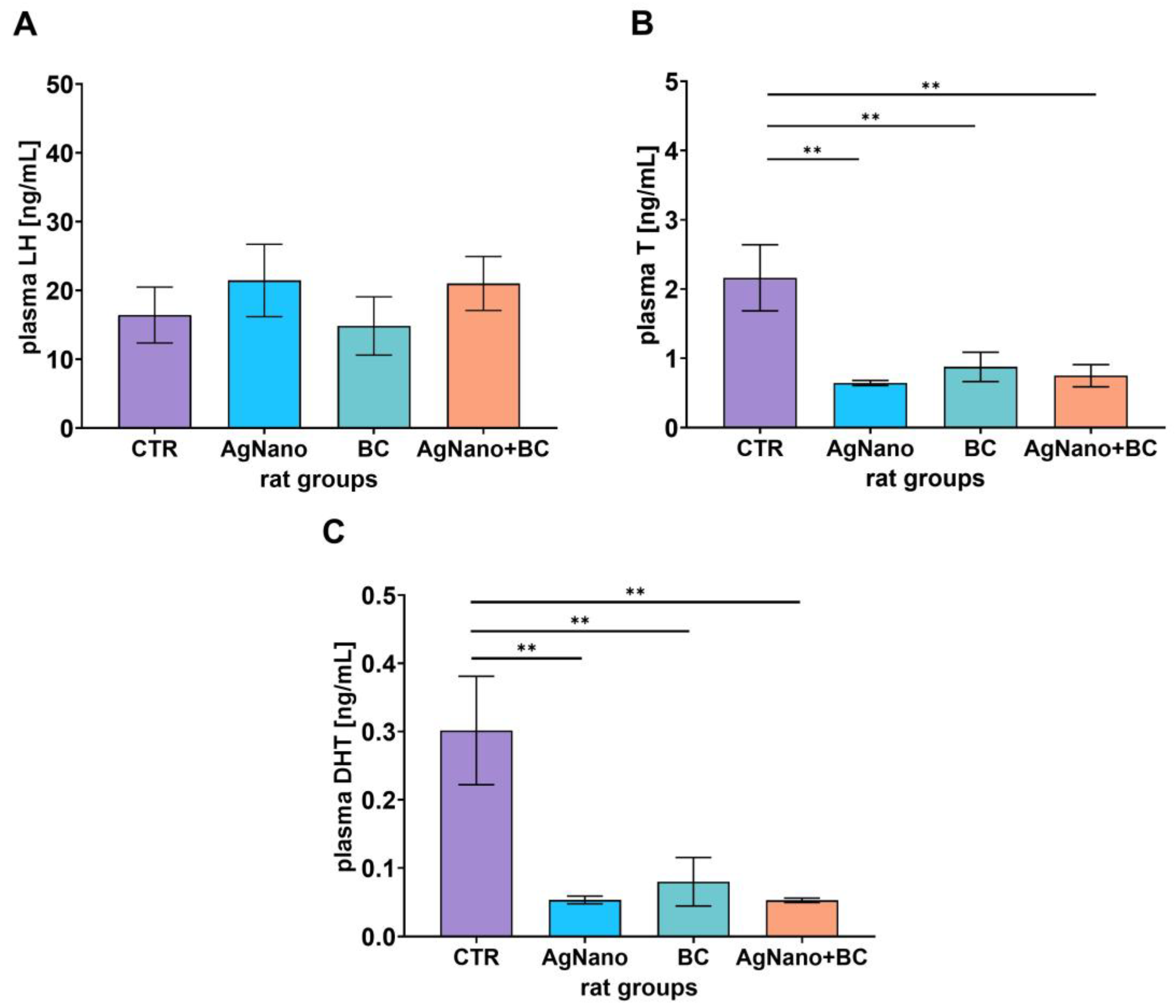
3.3. Plasma Hormone Concentrations
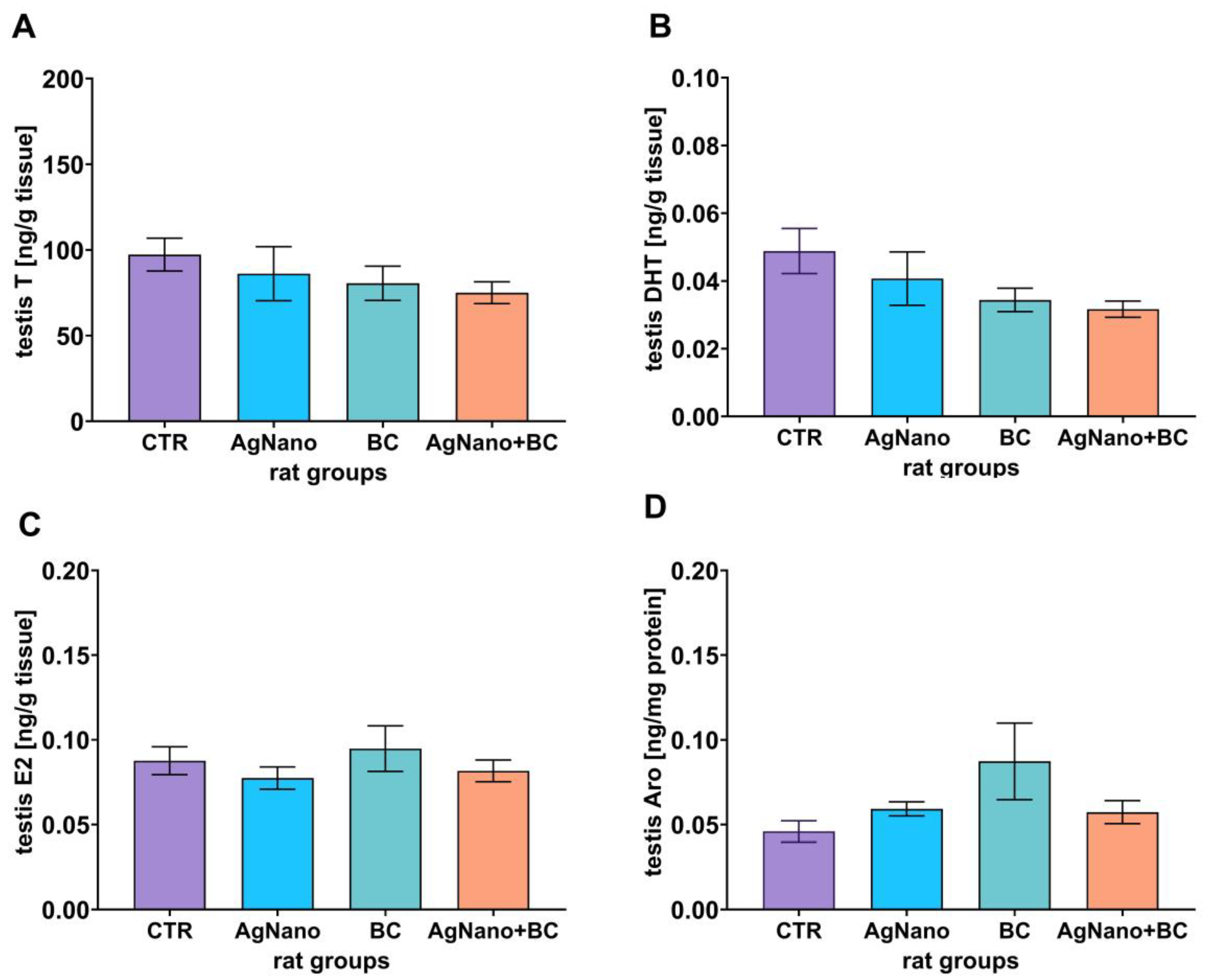
3.4. Steroid Hormones and Aromatase Levels in the Testes
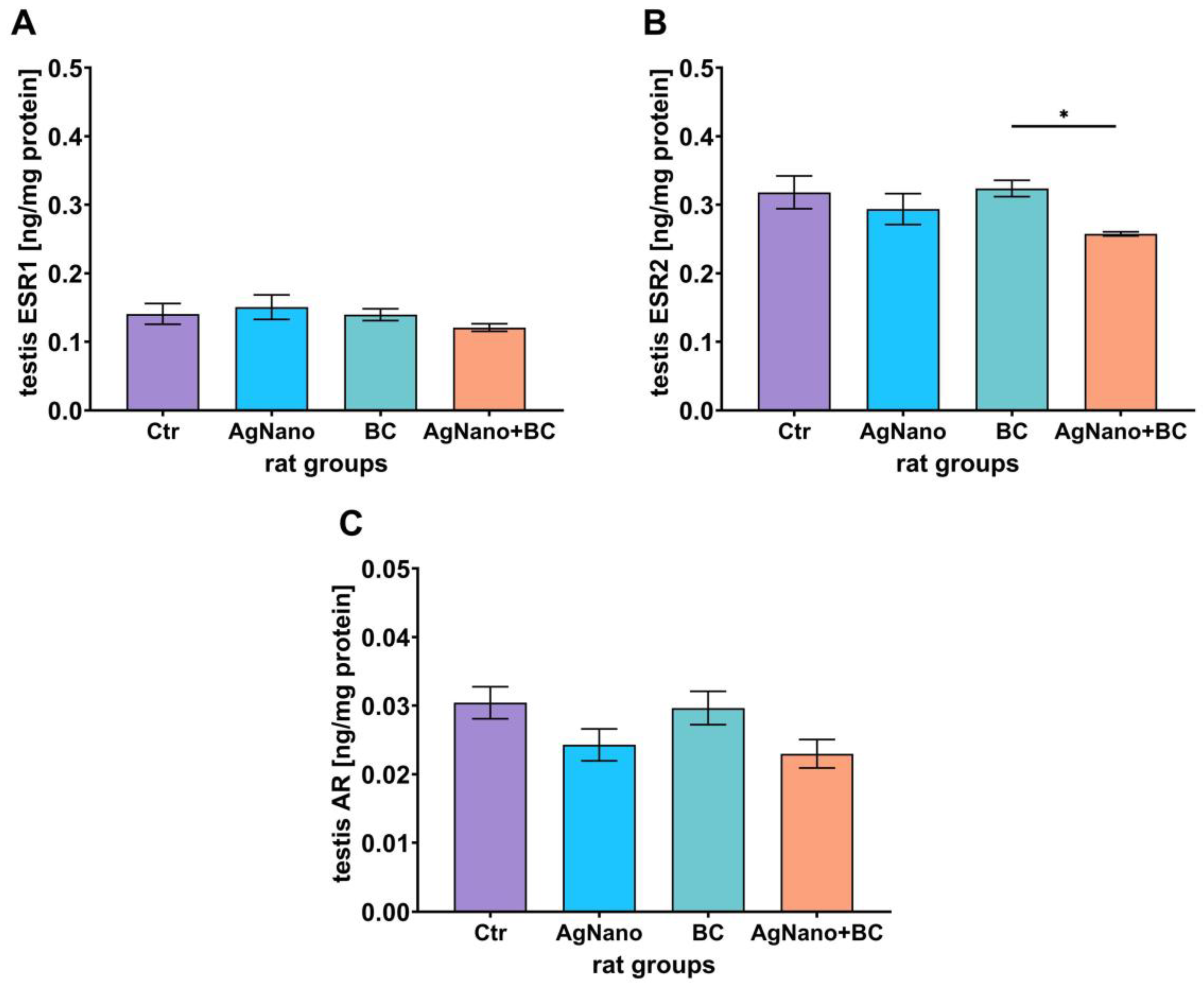
3.5. Oestrogen and Androgen Receptor Protein Levels in the Testes
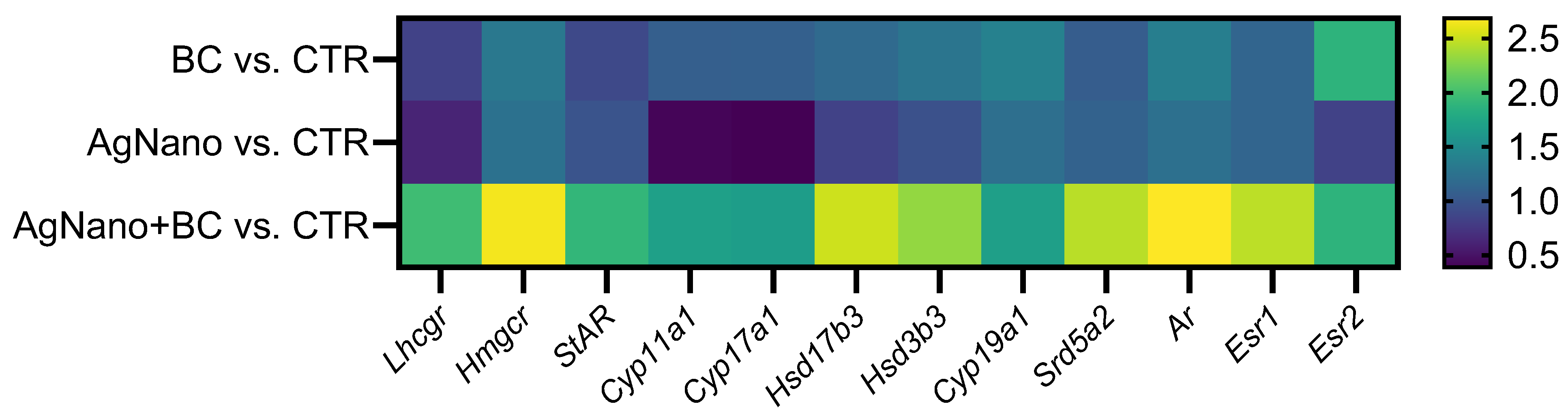
3.6. Analysis of Gene Expression in the Testis
3.7. Oxidative Stress in the Testes
4. Discussion
5. Conclusions
Supplementary Materials
Author Contributions
Funding
Institutional Review Board Statement
Informed Consent Statement
Data Availability Statement
Acknowledgments
Conflicts of Interest
Abbreviations
| AAPH | 2,2′-azobis(2-amidinopropane)-dihydrochloride |
| Ag+ | silver ion/ions |
| AgNPs | nanosilver/silver nanoparticles |
| ALT | alanine aminotransferase activity |
| ANOVA | one-way analysis of variance |
| AR/Ar | androgen receptor/androgen receptor gene |
| Aro | aromatase |
| AST | aspartate aminotransferase activity |
| BC | blackcurrant pomace |
| BSA | bovine serum albumin |
| Cyp11a1 | cytochrome P450, family 11, subfamily a, gene |
| Cyp17a1 | cytochrome P450, family 17, subfamily a, gene |
| Cyp19a1 | P450 aromatase gene |
| DHT | dihydrotestosterone |
| E2 | 17β-estradiol |
| ELISA | enzyme-linked immunosorbent assay |
| ENPs | engineered nanoparticles |
| ESR1 | oestrogen receptor type 1/α |
| ESR2 | oestrogen receptor type 2/β |
| ESRs | oestrogen receptors |
| GIT | gastrointestinal tract |
| GSI | gonadosomatic index |
| Hmgcr | 3-hydroxy-3-methylglutaryl-CoA reductase gene |
| HPG | hypothalamic-pituitary-gonadal axis |
| Hsd3b3 | 3 beta-hydroxysteroid dehydrogenase/delta5-4 isomerase type 3 gene |
| Hsd17b3 | hydroxysteroid (17-beta) dehydrogenase 3 gene |
| i.g. | intragastrically |
| LCs | Leydig cells |
| LH | luteinizing hormone |
| Lhcgr/LHCGR | luteinizing hormone/choriogonadotropin receptor gene/protein |
| NPs | nanoparticles |
| NMs | nanomaterials |
| Srd5a1 | steroid-5-alpha-reductase, alpha polypeptide 1 (3-oxo-5 alpha-steroid delta 4-dehydrogenase alpha 1) gene |
| PBS | phosphate-buffered saline |
| PVP-AgNPs | polyvinyl-pyrrolidone-coated silver nanoparticles |
| qPCR | quantitative polymerase chain reaction |
| StAR/StAR | steroidogenic acute regulatory protein gene/protein |
| T | testosterone |
References
- Eisenberg, M.L.; Esteves, S.C.; Lamb, D.J.; Hotaling, J.M.; Giwercman, A.; Hwang, K.; Cheng, Y.S. Male Infertility. Nat. Rev. Dis. Primers 2023, 9, 49. [Google Scholar] [CrossRef]
- Huang, B.; Wang, Z.; Kong, Y.; Jin, M.; Ma, L. Global, Regional and National Burden of Male Infertility in 204 Countries and Territories between 1990 and 2019: An Analysis of Global Burden of Disease Study. BMC Public Health 2023, 23, 2195. [Google Scholar] [CrossRef]
- Skoracka, K.; Eder, P.; Łykowska-Szuber, L.; Dobrowolska, A.; Krela-Kaźmierczak, I. Diet and Nutritional Factors in Male (In)Fertility-Underestimated Factors. J. Clin. Med. 2020, 9, 1400. [Google Scholar] [CrossRef]
- Rotimi, D.E.; Singh, S.K. Implications of Lifestyle Factors on Male Reproductive Health. JBRA Assist. Reprod. 2024, 28, 320–330. [Google Scholar] [CrossRef]
- Sciorio, R.; De Paola, L.; Notari, T.; Ganduscio, S.; Amato, P.; Crifasi, L.; Marotto, D.; Billone, V.; Cucinella, G.; Perino, A.; et al. Decoding the Puzzle of Male Infertility: The Role of Infection, Inflammation, and Autoimmunity. Diagnostics 2025, 15, 547. [Google Scholar] [CrossRef]
- Selvaraju, V.; Baskaran, S.; Agarwal, A.; Henkel, R. Environmental Contaminants and Male Infertility: Effects and Mechanisms. Andrologia 2021, 53, e13646. [Google Scholar] [CrossRef]
- Moline, J.M.; Golden, A.L.; Bar-Chama, N.; Smith, E.; Rauch, M.E.; Chapin, R.E.; Perreault, S.D.; Schrader, S.M.; Suk, W.A.; Landrigan, P.J. Exposure to Hazardous Substances and Male Reproductive Health: A Research Framework. Environ. Health Perspect. 2000, 108, 803–813. [Google Scholar] [CrossRef] [PubMed]
- Radwan, M.; Jurewicz, J.; Polańska, K.; Sobala, W.; Radwan, P.; Bochenek, M.; Hanke, W. Exposure to Ambient Air Pollution-Does It Affect Semen Quality and the Level of Reproductive Hormones? Ann. Hum. Biol. 2016, 43, 50–56. [Google Scholar] [CrossRef] [PubMed]
- Choudhary, A.; Singh, S.; Ravichandiran, V. Toxicity, Preparation Methods and Applications of Silver Nanoparticles: An Update. Toxicol. Mech. Methods 2022, 32, 650–661. [Google Scholar] [CrossRef] [PubMed]
- Kumar, S.; Basumatary, I.B.; Sudhani, H.P.K.; Bajpai, V.K.; Chen, L.; Shukla, S.; Mukherjee, A. Plant Extract Mediated Silver Nanoparticles and Their Applications as Antimicrobials and in Sustainable Food Packaging: A State-of-the-Art Review. Trends Food Sci. Technol. 2021, 112, 651–666. [Google Scholar] [CrossRef]
- Nie, P.; Zhao, Y.; Xu, H. Synthesis, Applications, Toxicity and Toxicity Mechanisms of Silver Nanoparticles: A Review. Ecotoxicol. Environ. Saf. 2023, 253, 114636. [Google Scholar] [CrossRef]
- Wang, E.; Huang, Y.; Du, Q.; Sun, Y. Silver Nanoparticle Induced Toxicity to Human Sperm by Increasing ROS(Reactive Oxygen Species) Production and DNA Damage. Environ. Toxicol. Pharmacol. 2017, 52, 193–199. [Google Scholar] [CrossRef]
- Poon, W.L.; Lee, J.C.Y.; Leung, K.S.; Alenius, H.; El-Nezami, H.; Karisola, P. Nanosized Silver, but Not Titanium Dioxide or Zinc Oxide, Enhances Oxidative Stress and Inflammatory Response by Inducing 5-HETE Activation in THP-1 Cells. Nanotoxicology 2020, 14, 453–467. [Google Scholar] [CrossRef] [PubMed]
- Orbea, A.; González-Soto, N.; Lacave, J.M.; Barrio, I.; Cajaraville, M.P. Developmental and Reproductive Toxicity of PVP/PEI-Coated Silver Nanoparticles to Zebrafish. Comp. Biochem. Physiol. C Toxicol. Pharmacol. 2017, 199, 59–68. [Google Scholar] [CrossRef] [PubMed]
- Ray, A.; Nath, D. Dose Dependent Intra-Testicular Accumulation of Silver Nanoparticles Triggers Morphometric Changes in Seminiferous Tubules and Leydig Cells and Changes the Structural Integrity of Spermatozoa Chromatin. Theriogenology 2022, 192, 122–131. [Google Scholar] [CrossRef] [PubMed]
- Flores-López, L.Z.; Espinoza-Gómez, H.; Somanathan, R. Silver Nanoparticles: Electron Transfer, Reactive Oxygen Species, Oxidative Stress, Beneficial and Toxicological Effects. Mini Review. J. Appl. Toxicol. 2019, 39, 16–26. [Google Scholar] [CrossRef]
- Deledda, A.; Annunziata, G.; Tenore, G.C.; Palmas, V.; Manzin, A.; Velluzzi, F. Diet-Derived Antioxidants and Their Role in Inflammation, Obesity and Gut Microbiota Modulation. Antioxidants 2021, 10, 708. [Google Scholar] [CrossRef]
- Abarikwu, S.O.; Onuah, C.L.; Singh, S.K. Plants in the Management of Male Infertility. Andrologia 2020, 52, e13509. [Google Scholar] [CrossRef]
- Zhang, Y.; Lin, H.; Liu, C.; Huang, J.; Liu, Z. A Review for Physiological Activities of EGCG and the Role in Improving Fertility in Humans/Mammals. Biomed. Pharmacother. 2020, 127, 110186. [Google Scholar] [CrossRef]
- Raczkowska, E.; Serek, P. Health-Promoting Properties and the Use of Fruit Pomace in the Food Industry—A Review. Nutrients 2024, 16, 2757. [Google Scholar] [CrossRef]
- Sójka, M.; Król, B. Composition of Industrial Seedless Black Currant Pomace. Eur. Food Res. Technol. 2009, 228, 597–605. [Google Scholar] [CrossRef]
- Nanashima, N.; Horie, K.; Maeda, H. Phytoestrogenic Activity of Blackcurrant Anthocyanins Is Partially Mediated through Estrogen Receptor Beta. Molecules 2017, 23, 74. [Google Scholar] [CrossRef] [PubMed]
- Adthapanyawanich, K.; Aitsarangkun Na Ayutthaya, K.; Kreungnium, S.; Mark, P.J.; Nakata, H.; Chen, W.; Chinda, K.; Amatyakul, P.; Tongpob, Y. Molecular Mechanisms and Therapeutic Potential of Mulberry Fruit Extract in High-Fat Diet-Induced Male Reproductive Dysfunction: A Comprehensive Review. Nutrients 2025, 17, 273. [Google Scholar] [CrossRef]
- Dong, M.; Lu, J.; Xue, H.; Lou, Y.; Li, S.; Liu, T.; Ding, Z.; Chen, X. Anthocyanins from Lycium Ruthenicum Murray Mitigate Cadmium-Induced Oxidative Stress and Testicular Toxicity by Activating the Keap1/Nrf2 Signaling Pathway. Pharmaceuticals 2024, 17, 322. [Google Scholar] [CrossRef]
- Kim, Y.S.; Kim, J.S.; Cho, H.S.; Rha, D.S.; Kim, J.M.; Park, J.D.; Choi, B.S.; Lim, R.; Chang, H.K.; Chung, Y.H.; et al. Twenty-Eight-Day Oral Toxicity, Genotoxicity, and Gender-Related Tissue Distribution of Silver Nanoparticles in Sprague-Dawley Rats. Inhal. Toxicol. 2008, 20, 575–583. [Google Scholar] [CrossRef]
- Kim, Y.S.; Song, M.Y.; Park, J.D.; Song, K.S.; Ryu, H.R.; Chung, Y.H.; Chang, H.K.; Lee, J.H.; Oh, K.H.; Kelman, B.J.; et al. Subchronic Oral Toxicity of Silver Nanoparticles. Part. Fibre Toxicol. 2010, 7, 20. [Google Scholar] [CrossRef] [PubMed]
- Nair, A.; Morsy, M.A.; Jacob, S. Dose Translation between Laboratory Animals and Human in Preclinical and Clinical Phases of Drug Development. Drug Dev. Res. 2018, 79, 373–382. [Google Scholar] [CrossRef] [PubMed]
- Nile, S.H.; Baskar, V.; Selvaraj, D.; Nile, A.; Xiao, J.; Kai, G. Nanotechnologies in Food Science: Applications, Recent Trends, and Future Perspectives. Nano-Micro Lett. 2020, 12, 45. [Google Scholar] [CrossRef]
- Lankoff, A.; Sandberg, W.J.; Wegierek-Ciuk, A.; Lisowska, H.; Refsnes, M.; Sartowska, B.; Schwarze, P.E.; Meczynska-Wielgosz, S.; Wojewodzka, M.; Kruszewski, M. The Effect of Agglomeration State of Silver and Titanium Dioxide Nanoparticles on Cellular Response of HepG2, A549 and THP-1 Cells. Toxicol. Lett. 2012, 208, 197–213. [Google Scholar] [CrossRef]
- Dziendzikowska, K.; Gromadzka-Ostrowska, J.; Lankoff, A.; Oczkowski, M.; Krawczyńska, A.; Chwastowska, J.; Sadowska-Bratek, M.; Chajduk, E.; Wojewódzka, M.; Dušinská, M.; et al. Time-Dependent Biodistribution and Excretion of Silver Nanoparticles in Male Wistar Rats. J. Appl. Toxicol. 2012, 32, 920–928. [Google Scholar] [CrossRef]
- Meczyńska-Wielgosz, S.; Wojewódzka, M.; Matysiak-Kucharek, M.; Czajka, M.; Jodlowska-Jedrych, B.; Kruszewski, M.; Kapka-Skrzypczak, L. Susceptibility of HepG2 Cells to Silver Nanoparticles in Combination with Other Metal/Metal Oxide Nanoparticles. Materials 2020, 13, 2221. [Google Scholar] [CrossRef] [PubMed]
- Reeves, P.G. Components of the AIN-93 Diets as Improvements in the AIN-76A Diet. J. Nutr. 1997, 127, 838S–841S. [Google Scholar] [CrossRef]
- Oczkowski, M.; Wilczak, J.; Dziendzikowska, K.; Øvrevik, J.; Myhre, O.; Lankoff, A.; Kruszewski, M.; Gromadzka-Ostrowska, J. Dietary Intervention with Blackcurrant Pomace Protects Rats from Testicular Oxidative Stress Induced by Exposition to Biodiesel Exhaust. Antioxidants 2022, 11, 1562. [Google Scholar] [CrossRef]
- Dell, R.B.; Holleran, S.; Ramakrishnan, R. Sample Size Determination. ILAR J. 2002, 43, 207–213. [Google Scholar] [CrossRef]
- Dziendzikowska, K.; Krawczyńska, A.; Oczkowski, M.; Królikowski, T.; Brzóska, K.; Lankoff, A.; Dziendzikowski, M.; Stępkowski, T.; Kruszewski, M.; Gromadzka-Ostrowska, J. Progressive Effects of Silver Nanoparticles on Hormonal Regulation of Reproduction in Male Rats. Toxicol. Appl. Pharmacol. 2016, 313, 35–46. [Google Scholar] [CrossRef]
- Lekki-Porębski, S.A.; Rakowski, M.; Grzelak, A. Free Zinc Ions, as a Major Factor of ZnONP Toxicity, Disrupts Free Radical Homeostasis in CCRF-CEM Cells. Biochim. Biophys. Acta Gen. Subj. 2023, 1867, 130447. [Google Scholar] [CrossRef]
- Silva, R.L.d.O.; Silva, M.D.; Ferreira Neto, J.R.C.; de Nardi, C.H.; Chabregas, S.M.; Burnquist, W.L.; Kahl, G.; Benko-Iseppon, A.M.; Kido, E.A. Validation of Novel Reference Genes for Reverse Transcription Quantitative Real-Time PCR in Drought-Stressed Sugarcane. Sci. World J. 2014, 2014, 357052. [Google Scholar] [CrossRef]
- Pfaffl, M.W.; Horgan, G.W.; Dempfle, L. Relative Expression Software Tool (REST©) for Group-Wise Comparison and Statistical Analysis of Relative Expression Results in Real-Time PCR. Nucleic Acids Res. 2002, 30, e36. [Google Scholar] [CrossRef]
- REST 2009 Software—Greater Certainty in Expression Studies. Available online: https://www.gene-quantification.de/rest-2009.html (accessed on 18 November 2025).
- Zhang, J.; Wang, F.; Yalamarty, S.S.K.; Filipczak, N.; Jin, Y.; Li, X. Nano Silver-Induced Toxicity and Associated Mechanisms. Int. J. Nanomed. 2022, 17, 1851–1864. [Google Scholar] [CrossRef] [PubMed]
- Cameron, S.J.; Hosseinian, F.; Willmore, W.G. A Current Overview of the Biological and Cellular Effects of Nanosilver. Int. J. Mol. Sci. 2018, 19, 2030. [Google Scholar] [CrossRef] [PubMed]
- Oczkowski, M.; Dziendzikowska, K.; Gromadzka-Ostrowska, J.; Kruszewski, M.; Grzelak, A. Intragastric Exposure of Rats to Silver Nanoparticles Modulates the Redox Balance and Expression of Steroid Receptors in Testes. Food Chem. Toxicol. 2024, 191, 114841. [Google Scholar] [CrossRef]
- Fröhlich, E.E.; Fröhlich, E. Cytotoxicity of Nanoparticles Contained in Food on Intestinal Cells and the Gut Microbiota. Int. J. Mol. Sci. 2016, 17, 509. [Google Scholar] [CrossRef] [PubMed]
- Gómez-Llorente, H.; Hervás, P.; Pérez-Esteve, É.; Barat, J.M.; Fernández-Segovia, I. Nanotechnology in the Agri-Food Sector: Consumer Perceptions. NanoImpact 2022, 26, 100399. [Google Scholar] [CrossRef]
- Verleysen, E.; Van Doren, E.; Waegeneers, N.; De Temmerman, P.J.; Abi Daoud Francisco, M.; Mast, J. TEM and SP-ICP-MS Analysis of the Release of Silver Nanoparticles from Decoration of Pastry. J. Agric. Food Chem. 2015, 63, 3570–3578. [Google Scholar] [CrossRef]
- Mat Lazim, Z.; Salmiati, S.; Marpongahtun, M.; Arman, N.Z.; Mohd Haniffah, M.R.; Azman, S.; Yong, E.L.; Salim, M.R. Distribution of Silver (Ag) and Silver Nanoparticles (AgNPs) in Aquatic Environment. Water 2023, 15, 1349. [Google Scholar] [CrossRef]
- Grasso, A.; Ferrante, M.; Arena, G.; Salemi, R.; Zuccarello, P.; Fiore, M.; Copat, C. Chemical Characterization and Quantification of Silver Nanoparticles (Ag-NPs) and Dissolved Ag in Seafood by Single Particle ICP-MS: Assessment of Dietary Exposure. Int. J. Environ. Res. Publth Health 2021, 18, 4076. [Google Scholar] [CrossRef] [PubMed]
- Taboada-López, M.V.; Alonso-Seijo, N.; Herbello-Hermelo, P.; Bermejo-Barrera, P.; Moreda-Piñeiro, A. Determination and Characterization of Silver Nanoparticles in Bivalve Molluscs by Ultrasound Assisted Enzymatic Hydrolysis and Sp-ICP-MS. Microchem. J. 2019, 148, 652–660. [Google Scholar] [CrossRef]
- Falandysz, J.; Treu, R.; Meloni, D. Distribution and Bioconcentration of Some Elements in the Edible Mushroom Leccinum Scabrum from Locations in Poland. J. Environ. Sci. Health Part B 2021, 56, 396–414. [Google Scholar] [CrossRef]
- Bahcelioglu, E.; Unalan, H.E.; Erguder, T.H. Silver-Based Nanomaterials: A Critical Review on Factors Affecting Water Disinfection Performance and Silver Release. Crit. Rev. Environ. Sci. Technol. 2021, 51, 2389–2423. [Google Scholar] [CrossRef]
- Addo Ntim, S.; Goodwin, D.G.; Sung, L.; Thomas, T.A.; Noonan, G.O. Long-Term Wear Effects on Nanosilver Release from Commercially Available Food Contact Materials. Food Addit. Contam. Part A Chem. Anal. Control Expo. Risk Assess. 2019, 36, 1757–1768. [Google Scholar] [CrossRef]
- Hadrup, N.; Lam, H.R. Oral Toxicity of Silver Ions, Silver Nanoparticles and Colloidal Silver—A Review. Regul. Toxicol. Pharmacol. 2014, 68, 1–7. [Google Scholar] [CrossRef]
- Tiwari, R.; Singh, R.D.; Khan, H.; Gangopadhyay, S.; Mittal, S.; Singh, V.; Arjaria, N.; Shankar, J.; Roy, S.K.; Singh, D.; et al. Oral Subchronic Exposure to Silver Nanoparticles Causes Renal Damage through Apoptotic Impairment and Necrotic Cell Death. Nanotoxicology 2017, 11, 671–686. [Google Scholar] [CrossRef]
- Sousa, A.; Bradshaw, T.D.; Ribeiro, D.; Fernandes, E.; Freitas, M. Pro-Inflammatory Effects of Silver Nanoparticles in the Intestine. Arch. Toxicol. 2022, 96, 1551–1571. [Google Scholar] [CrossRef]
- Saeki, Y.; Higashisaka, K.; Izutani, R.; Seo, J.; Miyaji, K.; Haga, Y.; Tsutsumi, Y. Orally Administered Silver Nanoparticles are Absorbed and Migrate to Testes in Mice. ACS Nanosci. Au 2024, 4, 317–321. [Google Scholar] [CrossRef]
- Lee, G.H.; Hoang, T.H.; Jung, E.S.; Jung, S.J.; Han, S.K.; Chung, M.J.; Chae, S.W.; Chae, H.J. Anthocyanins Attenuate Endothelial Dysfunction through Regulation of Uncoupling of Nitric Oxide Synthase in Aged Rats. Aging Cell 2020, 19, e13279. [Google Scholar] [CrossRef]
- Grodzicki, W.; Dziendzikowska, K.; Gromadzka-Ostrowska, J.; Wilczak, J.; Oczkowski, M.; Kopiasz, Ł.; Sapierzyński, R.; Kruszewski, M.; Grzelak, A. In Vivo Pro-Inflammatory Effects of Silver Nanoparticles on the Colon Depend on Time and Route of Exposure. Int. J. Mol. Sci. 2024, 25, 4879. [Google Scholar] [CrossRef]
- Tony, S.K.; Hassan, M.S.; Ismail, H.A.; El-Naem, G.F.A.; Gazwi, H.S.S. Effect of Anthocyanin-Rich Blackberry Juice on Endoplasmic Reticulum Stress in Streptozotocin-Induced Diabetic Rats. Environ. Sci. Pollut. Res. Int. 2023, 30, 79067–79081. [Google Scholar] [CrossRef]
- Nauroze, T.; Ali, S.; Kanwal, L.; Ara, C.; Akbar Mughal, T.; Andleeb, S. Ameliorative Effect of Nigella Sativa Conjugated Silver Nanoparticles against Chromium-Induced Hepatotoxicity and Renal Toxicity in Mice. Saudi J. Biol. Sci. 2023, 30, 103571. [Google Scholar] [CrossRef] [PubMed]
- Kim, H.; Simbo, S.Y.; Fang, C.; McAlister, L.; Roque, A.; Banerjee, N.; Talcott, S.T.; Zhao, H.; Kreider, R.B.; Mertens-Talcott, S.U. Açaí (Euterpe oleracea Mart.) Beverage Consumption Improves Biomarkers for Inflammation but Not Glucose- or Lipid-Metabolism in Individuals with Metabolic Syndrome in a Randomized, Double-Blinded, Placebo-Controlled Clinical Trial. Food Funct. 2018, 9, 3097–3103. [Google Scholar] [CrossRef] [PubMed]
- Cremonini, E.; Daveri, E.; Iglesias, D.E.; Kang, J.; Wang, Z.; Gray, R.; Mastaloudis, A.; Kay, C.D.; Hester, S.N.; Wood, S.M.; et al. A Randomized Placebo-Controlled Cross-over Study on the Effects of Anthocyanins on Inflammatory and Metabolic Responses to a High-Fat Meal in Healthy Subjects. Redox Biol. 2022, 51, 102273. [Google Scholar] [CrossRef] [PubMed]
- Fedorova, M.; Bollineni, R.C.; Hoffmann, R. Protein Carbonylation as a Major Hallmark of Oxidative Damage: Update of Analytical Strategies. Mass. Spectrom. Rev. 2014, 33, 79–97. [Google Scholar] [CrossRef] [PubMed]
- Sahoo, D.K.; Roy, A.; Chainy, G.B.N. Protective Effects of Vitamin E and Curcumin on L-Thyroxine-Induced Rat Testicular Oxidative Stress. Chem. Biol. Interact. 2008, 176, 121–128. [Google Scholar] [CrossRef] [PubMed]
- Oduwole, O.O.; Huhtaniemi, I.T.; Misrahi, M. The Roles of Luteinizing Hormone, Follicle-Stimulating Hormone and Testosterone in Spermatogenesis and Folliculogenesis Revisited. Int. J. Mol. Sci. 2021, 22, 12735. [Google Scholar] [CrossRef]
- Wang, E.; Huang, Y.; Du, Q.; Sun, Y. Alterations in Reproductive Parameters and Gene Expression in Balb/c Mice Testes after Exposure to Silver Nanoparticles. Andrologia 2021, 53, e13841. [Google Scholar] [CrossRef]
- Shehata, A.M.; Salem, F.M.S.; El-Saied, E.M.; Abd El-Rahman, S.S.; Mahmoud, M.Y.; Noshy, P.A. Zinc Nanoparticles Ameliorate the Reproductive Toxicity Induced by Silver Nanoparticles in Male Rats. Int. J. Nanomed. 2021, 16, 2555–2568. [Google Scholar] [CrossRef]
- Li, X.; Lu, J.L.; Sun, J.X.; Jiang, X.W.; Li, X.S.; Li, Y.; Jiao, R.; Tian, L.M.; Bai, W. Bin Cyanidin-3-O-Glucoside Promotes Progesterone Secretion by Improving Cells Viability and Mitochondrial Function in Cadmium-Sulfate-Damaged R2C Cells. Food Chem. Toxicol. 2019, 128, 97–105. [Google Scholar] [CrossRef]
- Loeschner, K.; Hadrup, N.; Qvortrup, K.; Larsen, A.; Gao, X.; Vogel, U.; Mortensen, A.; Lam, H.R.; Larsen, E.H. Distribution of Silver in Rats Following 28 Days of Repeated Oral Exposure to Silver Nanoparticles or Silver Acetate. Part. Fibre Toxicol. 2011, 8, 18. [Google Scholar] [CrossRef]
- Qin, G.; Tang, S.; Li, S.; Lu, H.; Wang, Y.; Zhao, P.; Li, B.; Zhang, J.; Peng, L. Toxicological Evaluation of Silver Nanoparticles and Silver Nitrate in Rats Following 28 Days of Repeated Oral Exposure. Environ. Toxicol. 2017, 32, 609–618. [Google Scholar] [CrossRef]
- Gao, G.; Ze, Y.; Li, B.; Zhao, X.; Zhang, T.; Sheng, L.; Hu, R.; Gui, S.; Sang, X.; Sun, Q.; et al. Ovarian Dysfunction and Gene-Expressed Characteristics of Female Mice Caused by Long-Term Exposure to Titanium Dioxide Nanoparticles. J. Hazard. Mater. 2012, 243, 19–27. [Google Scholar] [CrossRef]
- Hammond, G.L. Plasma Steroid-Binding Proteins: Primary Gatekeepers of Steroid Hormone Action. J. Endocrinol. 2016, 230, R13–R25. [Google Scholar] [CrossRef] [PubMed]
- Scalisi, E.M.; Pecoraro, R.; Salvaggio, A.; Capparucci, F.; Fortuna, C.G.; Zimbone, M.; Impellizzeri, G.; Brundo, M.V. Titanium Dioxide Nanoparticles: Effects on Development and Male Reproductive System. Nanomaterials 2023, 13, 1783. [Google Scholar] [CrossRef] [PubMed]
- Rovira-Llopis, S.; Bañuls, C.; de Marañon, A.M.; Diaz-Morales, N.; Jover, A.; Garzon, S.; Rocha, M.; Victor, V.M.; Hernandez-Mijares, A. Low Testosterone Levels Are Related to Oxidative Stress, Mitochondrial Dysfunction and Altered Subclinical Atherosclerotic Markers in Type 2 Diabetic Male Patients. Free Radic. Biol. Med. 2017, 108, 155–162. [Google Scholar] [CrossRef] [PubMed]
- Hu, J.; Li, X.; Wu, N.; Zhu, C.; Jiang, X.; Yuan, K.; Li, Y.; Sun, J.; Bai, W. Anthocyanins Prevent AAPH-Induced Steroidogenesis Disorder in Leydig Cells by Counteracting Oxidative Stress and StAR Abnormal Expression in a Structure-Dependent Manner. Antioxidants 2023, 12, 508. [Google Scholar] [CrossRef]
- Oczkowski, M.; Dziendzikowska, K.; Gromadzka-Ostrowska, J.; Rakowski, M.; Kruszewski, M. Does Nanosilver Exposure Modulate Steroid Metabolism in the Testes?—A Possible Role of Redox Balance Disruption. Biomedicines 2023, 12, 73. [Google Scholar] [CrossRef]
- Farshid, M.A.; Fazeli, M.; Shomali, T.; Nazifi, S.; Namazi, F. Protective Effect of Black Mulberry (Morus nigra L.) Fruit Hydroalcoholic Extract against Testosterone-Induced Benign Prostatic Hyperplasia in Rats. Rev. Int. Androl. 2021, 19, 53–61. [Google Scholar] [CrossRef]
- Tabandeh, M.R.; Samie, K.A.; Mobarakeh, E.S.; Khadem, M.D.; Jozaie, S. Silver Nanoparticles Induce Oxidative Stress, Apoptosis and Impaired Steroidogenesis in Ovarian Granulosa Cells of Cattle. Anim. Reprod. Sci. 2022, 236, 106908. [Google Scholar] [CrossRef]
- Garcia, T.X.; Costa, G.M.J.; França, L.R.; Hofmann, M.C. Sub-Acute Intravenous Administration of Silver Nanoparticles in Male Mice Alters Leydig Cell Function and Testosterone Levels. Reprod. Toxicol. 2014, 45, 59–70. [Google Scholar] [CrossRef]
- Wen, L.; Jiang, X.; Sun, J.; Li, X.; Li, X.; Tian, L.; Li, Y.; Bai, W. Cyanidin-3-O-Glucoside Promotes the Biosynthesis of Progesterone through the Protection of Mitochondrial Function in Pb-Exposed Rat Leydig Cells. Food Chem. Toxicol. 2018, 112, 427–434. [Google Scholar] [CrossRef]
- Sun, J.; Li, M.; Zou, F.; Bai, S.; Jiang, X.; Tian, L.; Ou, S.; Jiao, R.; Bai, W. Protection of Cyanidin-3-O-Glucoside against Acrylamide- and Glycidamide-Induced Reproductive Toxicity in Leydig Cells. Food Chem. Toxicol. 2018, 119, 268–274. [Google Scholar] [CrossRef] [PubMed]
- Li, X.; Guo, J.; Jiang, X.; Sun, J.; Tian, L.; Jiao, R.; Tang, Y.; Bai, W. Cyanidin-3-O-Glucoside Protects against Cadmium-Induced Dysfunction of Sex Hormone Secretion via the Regulation of Hypothalamus-Pituitary-Gonadal Axis in Male Pubertal Mice. Food Chem. Toxicol. 2019, 129, 13–21. [Google Scholar] [CrossRef]
- Kose, O.; Mantecca, P.; Costa, A.; Carrière, M. Putative Adverse Outcome Pathways for Silver Nanoparticle Toxicity on Mammalian Male Reproductive System: A Literature Review. Part. Fibre Toxicol. 2023, 20, 1. [Google Scholar] [CrossRef] [PubMed]
- Chien, Y.; Rosal, K.; Chung, B. Function of CYP11A1 in the Mitochondria. Mol. Cell Endocrinol. 2017, 441, 55–61. [Google Scholar] [CrossRef]
- Zhang, X.-F.; Choi, Y.-J.; Han, J.W.; Kim, E.; Park, J.H.; Gurunathan, S.; Kim, J.-H. Differential Nanoreprotoxicity of Silver Nanoparticles in Male Somatic Cells and Spermatogonial Stem Cells. Int. J. Nanomed. 2015, 10, 1335–1357. [Google Scholar] [CrossRef] [PubMed]
- Bendokas, V.; Stanys, V.; Mažeikienė, I.; Trumbeckaite, S.; Baniene, R.; Liobikas, J. Anthocyanins: From the Field to the Antioxidants in the Body. Antioxidants 2020, 9, 819. [Google Scholar] [CrossRef] [PubMed]
- Thoppil, R.J.; Bhatia, D.; Barnes, K.F.; Haznagy-Radnai, E.; Hohmann, J.; Darvesh, A.S.; Bishayee, A. Black Currant Anthocyanins Abrogate Oxidative Stress through Nrf2- Mediated Antioxidant Mechanisms in a Rat Model of Hepatocellular Carcinoma. Curr. Cancer Drug Targets 2012, 12, 1244–1257. [Google Scholar] [CrossRef]
- Xiao, Y.; Xu, B.; Bordiga, M.; Li, H.; Travaglia, F.; Bai, S.; Chen, J.; Bai, W. Cyanidin-3-O-Glucoside Supplement Improves Sperm Quality and Spermatogenesis in a Mice Model of Ulcerative Colitis. Nutrients 2022, 14, 984. [Google Scholar] [CrossRef]
- Tian, M.; Liu, F.; Liu, H.; Zhang, Q.; Li, L.; Hou, X.; Zhao, J.; Li, S.; Chang, X.; Sun, Y. Grape Seed Procyanidins Extract Attenuates Cisplatin-Induced Oxidative Stress and Testosterone Synthase Inhibition in Rat Testes. Syst. Biol. Reprod. Med. 2018, 64, 246–259. [Google Scholar] [CrossRef]
- Kim, J.; An, J.; Song, Y.; Jang, M.; Kong, H.; Kim, S. Effect of Elderberry (Sambucus nigra L.) Extract Intake on Normalizing Testosterone Concentration in Testosterone Deficiency Syndrome Rat Model Through Regulation of 17β-HSD, 5α-Reductase, and CYP19A1 Expression. Nutrients 2024, 16, 4169. [Google Scholar] [CrossRef]
- Boudreau, M.D.; Imam, M.S.; Paredes, A.M.; Bryant, M.S.; Cunningham, C.K.; Felton, R.P.; Jones, M.Y.; Davis, K.J.; Olson, G.R. Differential Effects of Silver Nanoparticles and Silver Ions on Tissue Accumulation, Distribution, and Toxicity in the Sprague Dawley Rat Following Daily Oral Gavage Administration for 13 Weeks. Toxicol. Sci. 2016, 150, 131–160. [Google Scholar] [CrossRef]
- Tohamy, H.G.; Lebda, M.A.; Sadek, K.M.; Elfeky, M.S.; El-Sayed, Y.S.; Samak, D.H.; Hamed, H.S.; Abouzed, T.K. Biochemical, Molecular and Cytological Impacts of Alpha-Lipoic Acid and Ginkgo Biloba in Ameliorating Testicular Dysfunctions Induced by Silver Nanoparticles in Rats. Environ. Sci. Pollut. Res. 2022, 29, 38198–38211. [Google Scholar] [CrossRef]
- Lopes, I.M.D.; De Oliveira, I.M.; Bargi-Souza, P.; Cavallin, M.D.; Kolc, C.S.M.H.; Khalil, N.M.; Quináia, S.P.; Romano, M.A.; Romano, R.M. Effects of Silver Nanoparticle Exposure to the Testicular Antioxidant System during the Prepubertal Rat Stage. Chem. Res. Toxicol. 2019, 32, 986–994. [Google Scholar] [CrossRef]
- Wilbourne, J.; Jia, S.; Fogarty, A.; Takaku, M.; Zhao, F. Crucial Roles of the Mesenchymal Androgen Receptor in Wolffian Duct Development. Endocrinology 2023, 165, bqad193. [Google Scholar] [CrossRef] [PubMed]
- Sheng, J.A.; Tan, S.M.L.; Hale, T.M.; Handa, R.J. Androgens and Their Role in Regulating Sex Differences in the Hypothalamic/Pituitary/Adrenal Axis Stress Response and Stress-Related Behaviors. Androgens 2021, 2, 261–274. [Google Scholar] [CrossRef] [PubMed]
- Arisha, A.H.; Ahmed, M.M.; Kamel, M.A.; Attia, Y.A.; Hussein, M.M.A. Morin Ameliorates the Testicular Apoptosis, Oxidative Stress, and Impact on Blood–Testis Barrier Induced by Photo-Extracellularly Synthesized Silver Nanoparticles. Environ. Sci. Pollut. Res. Int. 2019, 26, 28749–28762. [Google Scholar] [CrossRef] [PubMed]
- Dumasia, K.; Kumar, A.; Deshpande, S.; Sonawane, S.; Balasinor, N.H. Differential Roles of Estrogen Receptors, ESR1 and ESR2, In Adult Rat Spermatogenesis. Mol. Cell Endocrinol. 2016, 428, 89–100. [Google Scholar] [CrossRef]
- Hallmann, E.; Kazimierczak, R.; Marszałek, K.; Drela, N.; Kiernozek, E.; Toomik, P.; Matt, D.; Luik, A.; Rembiałkowska, E. The Nutritive Value of Organic and Conventional White Cabbage (Brassica oleracea L. Var. Capitata) and Anti-Apoptotic Activity in Gastric Adenocarcinoma Cells of Sauerkraut Juice Produced Therof. J. Agric. Food Chem. 2017, 65, 8171–8183. [Google Scholar] [CrossRef]
- Dóka, O.; Ficzek, G.; Bicanic, D.; Spruijt, R.; Luterotti, S.; Tóth, M.; Buijnsters, J.G.; Végvári, G. Direct Photothermal Techniques for Rapid Quantification of Total Anthocyanin Content in Sour Cherry Cultivars. Talanta 2011, 84, 341–346. [Google Scholar] [CrossRef]



| Parameter | BSA-Coated AgNPs |
|---|---|
| Nominal size of AgNPs [nm] | 20 ± 5 # |
| Size by dynamic light scattering [nm] | 197.4 ± 2.7 # |
| Polydispersity index | 0.295 ± 4.2 # |
| Zeta potential (mV) | −33.6 ± 3.5 # |
| BET (Brunauer, Emmett, and Teller) surface area (m2/g) | 2.2419 |
| Micropore volume (cm3/g) | 0.0076 |
| Adsorption average pore width (nm) | 13.6698 |
| Desorption average pore width (nm) | 23.8934 |
| Experimental Factors: | Groups of Rats | |||
|---|---|---|---|---|
| CTR (n = 7) | AgNano (n = 7) | BC (n = 7) | AgNano + BC (n = 7) | |
| rats treated with AgNPs | No | Yes | No | Yes |
| dietary intervention with BC (2% m/m added to standard animal feed) | No | No | Yes | Yes |
| Gene | Forward Primer (5′-3′) | Reverse Primer (5′-3′) | Accession No. | Product Size (pb) |
|---|---|---|---|---|
| Lhcgr | TATATGCCCATCCCTGTTGG | ACCAAGACTGATCGCTCTGC | NM_013134.2 | 132 |
| Hmgcr | AATGCCTTTGACAACCTCCTC | GGTTCGGATGCCTGTGTTAC | NM_012978.1 | 138 |
| StAR | CGTCGGAGCTCTCTACTTGG | TTTCCTTCTTCCAGCCTTCC | NM_031558.3 | 139 |
| Cyp11a1 | TTGCCTTTGAGTCCATCACC | AGTCTGGAGGCATGTTGAGC | NM_017286.2 | 147 |
| Cyp17a1 | CCCAGATGGTGACTCAAAGC | CTCCAGTTTCTGGCCATCC | NM_012753.2 | 137 |
| Hsd17b3 | GGCTTTACCAGGGTCTTTCC | ACCTGTAGCTTTTCCAGTGTCC | NM_054007.1 | 150 |
| Hsd3b3 | TCAATCTGAAAGGTACCCAGAAC | TCATGATGCTCTTCCTCACG | NM_054007.1 | 145 |
| Cyp19a1 | CGTCATGTTGCTTCTCATCG | TACCGCAGGCTCTCGTTAAT | NM_017085.2 | 150 |
| Srd5a1 | GGATGGGAATCAACATCCAC | CAATAATCTCGCCCAGGAAA | NM_022711.4 | 132 |
| Ar | GCGGAAGGGAAACAGAAGTA | CCCAGAGTCATCCCTGCTT | NM_012502.1 | 122 |
| Esr1 | AAAGAGAGTGCCAGGCTTTG | GCAAGTTAGGAGCAAACAGGA | NM_012689.1 | 143 |
| Esr2 | GTGCGTAGAAGGGATTCTGG | AGCCAAGGGGTACATACTGG | NM_012754.1 | 139 |
| Actb | CTAAGGCCAACCGTGAAAAG | TCTCCGGAGTCCATCACAAT | NM_031144.3 | 136 |
| Gapdh | GAGGACCAGGTTGTCTCCTG | ATGTAGGCCATGAGGTCCAC | NM_017008.4 | 161 |
| Parameters | Rat Groups | ||||
|---|---|---|---|---|---|
| CTR (n = 7) | AgNano (n = 7) | BC (n = 7) | AgNano + BC (n = 7) | ANOVA: p-Value; Effect Size (ηp2) | |
| Food intake [g/day] | 17.1 A ± 0.3 B (16.3–17.9) C | 16.9 ± 0.2 (16.3–17.4) | 16.3 ± 0.3 (15.6–17.0) | 16.3 ± 0.3 (15.6–17.1) | p = 0.174; ηp2 = 0.183 |
| Final body weight [g] | 328.5 ± 9.3 (305.8–351.2) | 323.5 ± 5.3 (310.6–336.3) | 314.0 ± 8.1 (294.2–333.8) | 316.9 ± 4.1 (306.8–327.0) | p = 0.470; ηp2 = 0.098 |
| Total body weight gains [g] | 24.7 ± 3.6 (15.9–33.4) | 27.6 ± 8.8 (6.1–49.0) | 20.2 ± 5.9 (5.7–34.7) | 23.2 ± 2.3 (17.6–28.9) | p = 0.834; ηp2 = 0.035 |
| GSI [%] | 0.95 ± 0.02 b (0.899–0.999) | 0.95 ± 0.01 b (0.939–0.967) | 1.01 ± 0.02 a (0.967–1.049) | 0.98 ± 0.01 (0.941–1.012) | p = 0.043; ηp2 = 0.283 |
| Parameters | Rat Groups | ||||
|---|---|---|---|---|---|
| CTR (n = 7) | AgNano (n = 7) | BC (n = 7) | AgNano + BC (n = 7) | ANOVA: p-Value; Effect Size (ηp2) | |
| plasma ALT activity [U/mg protein] | 0.46 A ± 0.06 B (0.301–0.624) C | 0.56 ± 0.06 (0.411–0.704) | 0.64 ± 0.07 (0.448–0.833) | 0.50 ± 0.04 (0.391–0.619) | p = 0.252 ηp2 = 0.181 |
| plasma AST activity [U/mg protein] | 0.24 ± 0.05 (0.105–0.372) | 0.20 ± 0.04 (0.109–0.299) | 0.22 ± 0.04 (0.110–0.336) | 0.28 ± 0.06 (0.122–0.445) | p = 0.699 ηp2 = 0.067 |
| ALT activity in the liver [U/mg protein] | 3.77 ± 0.82 (1.67–5.87) | 3.08 ± 0.22 (2.52–3.65) | 2.36 ± 0.20 (1.86–2.86) | 3.06 ± 0.82 (0.94–5.18) | p = 0.385 ηp2 = 0.127 |
| AST activity in the liver [U/mg protein] | 7.71 ± 1.42 (4.24–11.20) | 7.00 ± 0.72 (5.23–8.76) | 5.39 ± 0.58 (3.97–6.81) | 5.16 ± 0.90 (2.86–7.47) | p = 0.209 ηp2 = 0.176 |
Disclaimer/Publisher’s Note: The statements, opinions and data contained in all publications are solely those of the individual author(s) and contributor(s) and not of MDPI and/or the editor(s). MDPI and/or the editor(s) disclaim responsibility for any injury to people or property resulting from any ideas, methods, instructions or products referred to in the content. |
© 2025 by the authors. Licensee MDPI, Basel, Switzerland. This article is an open access article distributed under the terms and conditions of the Creative Commons Attribution (CC BY) license (https://creativecommons.org/licenses/by/4.0/).
Share and Cite
Oczkowski, M.; Dziendzikowska, K.; Kruszewski, M.; Gromadzka-Ostrowska, J.; Grzelak, A. Anthocyanin-Rich Blackcurrant Pomace Mitigates Oxidative Stress and Affects Steroid Metabolism in the Testes of Rats Exposed to Silver Nanoparticles. Nutrients 2025, 17, 3809. https://doi.org/10.3390/nu17243809
Oczkowski M, Dziendzikowska K, Kruszewski M, Gromadzka-Ostrowska J, Grzelak A. Anthocyanin-Rich Blackcurrant Pomace Mitigates Oxidative Stress and Affects Steroid Metabolism in the Testes of Rats Exposed to Silver Nanoparticles. Nutrients. 2025; 17(24):3809. https://doi.org/10.3390/nu17243809
Chicago/Turabian StyleOczkowski, Michał, Katarzyna Dziendzikowska, Marcin Kruszewski, Joanna Gromadzka-Ostrowska, and Agnieszka Grzelak. 2025. "Anthocyanin-Rich Blackcurrant Pomace Mitigates Oxidative Stress and Affects Steroid Metabolism in the Testes of Rats Exposed to Silver Nanoparticles" Nutrients 17, no. 24: 3809. https://doi.org/10.3390/nu17243809
APA StyleOczkowski, M., Dziendzikowska, K., Kruszewski, M., Gromadzka-Ostrowska, J., & Grzelak, A. (2025). Anthocyanin-Rich Blackcurrant Pomace Mitigates Oxidative Stress and Affects Steroid Metabolism in the Testes of Rats Exposed to Silver Nanoparticles. Nutrients, 17(24), 3809. https://doi.org/10.3390/nu17243809