Meatless Momentum: Food-Related Lifestyle Drivers of Plant-Based Meat Alternative Adoption

Abstract
1. Introduction
2. Materials and Methods
2.1. Participants
2.2. Questionnaire Structure and Measures
2.2.1. Food-Related Lifestyle Measurement Instrument
2.2.2. Characterising Variables
2.3. Data Analysis
2.4. Characteristics of the Sample
3. Results
3.1. Results of Factor Analysis on FRL
3.2. Segment Description

| Characteristics | N | (%) | Cluster 1 | Cluster 2 | Cluster 3 | Cluster 4 |
|---|---|---|---|---|---|---|
| 1200 | 100 | N = 222 | N = 295 | N = 465 | N = 218 | |
| Gender | ||||||
| Male | 547 | 45.6 | (110) 49.5% | (183) 62.0% | (252) 54.2% | (108) 49.5% |
| Female | 653 | 54.4 | (112) 50.5% | (112) 38.0% | (213) 45.8% | (110) 50.5% |
| Age | ||||||
| Up to 24 | 147 | 12.3 | (23) 10.4% | (47) 15.9% | (46) 9.9% | (31) 14.2% |
| 25–34 | 222 | 18.5 | (29) 13.1% | (57) 19.3% | (74) 15.9% | (62) 28.4% |
| 35–49 | 283 | 23.6 | (37) 16.7% | (85) 28.8% | (109) 23.4% | (52) 23.9% |
| Above 50 | 548 | 45.7 | (133) 59.9% | (106) 35.9% | (236) 50.8% | (73) 33.5% |
| Education | ||||||
| Primary | 42 | 3.5 | (8) 3.6% | (13) 4.4% | (11) 2.4% | (10) 4.6% |
| Vocational | 82 | 6.8 | (23) 10.4% | (25) 8.5% | (27) 5.8% | (7) 3.2% |
| Secondary | 575 | 47.9 | (108) 48.6% | (136) 46.1% | (220) 47.3% | (111) 50.9% |
| Higher | 501 | 41.8 | (83) 37.4% | (121) 41.0% | (207) 44.5% | (90) 41.3% |
| Place of residence | ||||||
| Village/rural | 467 | 38.9 | (92) 41.4% | (120) 40.7% | (179) 38.5% | (76) 34.9% |
| Town up to 20k | 120 | 10.0 | (21) 9.5% | (23) 7.8% | (53) 11.4% | (23) 10.6% |
| City 20–99k | 250 | 20.8 | (50) 22.5% | (51) 17.3% | (106) 22.8% | (43) 19.7% |
| City 100–199k | 101 | 8.4 | (19) 8.6% | (32) 10.8% | (30) 6.5% | (20) 9.2% |
| City 200–499k | 112 | 9.3 | (20) 9.0% | (22) 7.5% | (47) 10.1% | (23) 10.6% |
| City over 500k | 148 | 12.3 | (20) 9.0% | (45) 15.3% | (50) 10.8% | (33) 15.1% |
| Occupation | ||||||
| Employed (permanent job) | 629 | 54.2 | (95) 42.8% | (171) 58.0% | (233) 54.8% | (130) 59.6% |
| Company co-owner | 8 | 0.7 | (2) 0.9% | (3) 1.0% | (3) 0.7% | (0) 0.0% |
| Self-employed/own business | 54 | 4.7 | (7) 3.2% | (17) 5.8% | (17) 4.0% | (13) 6.0% |
| Student | 70 | 6.0 | (11) 5.0% | (18) 6.1% | (19) 4.5% | (22) 10.1% |
| Casual/odd jobs | 66 | 5.7 | (11) 5.0% | (23) 7.8% | (20) 4.7% | (12) 5.5% |
| On maternity/parental leave | 12 | 1 | (0) 0.0% | (4) 1.4% | (4) 0.9% | (4) 1.8% |
| Retired/on pension | 263 | 22.7 | (79) 35.6% | (46) 15.6% | (116) 27.3% | (22) 10.1% |
| Unemployed | 48 | 4.1 | (5) 2.3% | (16) 5.4% | (21) 4.9% | (6) 2.8% |
| Farm owner/operator | 12 | 1.0 | (2) 0.9% | (3) 1.0% | (7) 1.6% | (0) 0.0% |
| Not working, homemaker | 53 | 4.6 | (9) 4.1% | (12) 4.1% | (25) 5.9% | (7) 3.2% |
| Other situation | 6 | 0.5 | (1) 0.5% | (2) 0.7% | (2) 0.5% | (1) 0.5% |
| Assessment of the financial situation | ||||||
| We live very poorly—insufficient even for basic needs | 12 | 1 | (1) 0.5% | (3) 1.0% | (7) 1.5% | (1) 0.5% |
| We live modestly—we must economise a lot every day | 172 | 14.3 | (38) 17.1% | (48) 16.3% | (62) 13.3% | (24) 11.0% |
| We live average—enough for daily needs, we must save for bigger purchases | 688 | 57.3 | (134) 60.4% | (145) 49.2% | (291) 62.6% | (118) 54.1% |
| We live well—plenty without special saving | 304 | 25.3 | (47) 21.2% | (91) 30.8% | (98) 21.1% | (68) 31.2% |
| We live very well—we can afford some luxury | 18 | 1.5 | (2) 0.9% | (2) 0.7% | (7) 1.5% | (7) 3.2% |
| Diet | ||||||
| I do not follow any particular diet | 1090 | 90.8 | (205) 92.3% | (253) 85.8% | (426) 91.6% | (206) 94.5% |
| Vegetarian/Vegan | 47 | 3.9 | (7) 3.2% | (22) 7.5% | (13) 2.8% | (5) 2.3% |
| Other | 63 | 5.3 | (10) 4.5% | (20) 6.8% | (26) 5.6% | (7) 3.2% |
3.3. Food-Related Lifestyle Dimensions Across Consumer Segments
3.4. Frequency of Purchasing and Consuming PBMA
3.5. Perceptions of Plant-Based Meat Alternatives Across Consumer Segments
3.6. Cluster-Specific Beliefs, and Behaviours Regarding Plant-Based Meat Alternatives Versus Meat
3.7. Sustainable and Ethical Food Consumption Behaviours Across Consumer Segments
4. Discussion
4.1. Consumer Segment Profiles and Lifestyle Differentiation
4.2. Interpreting Consumer Segments Through the COM-B Model of Behaviour Change
4.3. Managerial and Policy Implications
4.4. Limitations and Directions for Future Research
5. Conclusions
Funding
Institutional Review Board Statement
Informed Consent Statement
Data Availability Statement
Acknowledgments
Conflicts of Interest
References
- Sans, P.; Combris, P. World Meat Consumption Patterns: An Overview of the Last Fifty Years (1961–2011). Meat Sci. 2015, 109, 106–111. [Google Scholar] [CrossRef]
- Binnie, M.A.; Barlow, K.; Johnson, V.; Harrison, C. Red Meats: Time for a Paradigm Shift in Dietary Advice. Meat Sci. 2014, 98, 445–451. [Google Scholar] [CrossRef]
- de Boer, J.; Aiking, H. Pursuing a Low Meat Diet to Improve Both Health and Sustainability: How Can We Use the Frames That Shape Our Meals? Ecol. Econ. 2017, 142, 238–248. [Google Scholar] [CrossRef]
- González, N.; Marquès, M.; Nadal, M.; Domingo, J.L. Meat Consumption: Which Are the Current Global Risks? A Review of Recent (2010–2020) Evidences. Food Res. Int. 2020, 137, 109341. [Google Scholar] [CrossRef] [PubMed]
- de Boer, J.; Aiking, H. Strategies towards Healthy and Sustainable Protein Consumption: A Transition Framework at the Levels of Diets, Dishes, and Dish Ingredients. Food Qual. Prefer. 2019, 73, 171–181. [Google Scholar] [CrossRef]
- Pronk, K.; Etter, B.; Michel, F.; Siegrist, M. Consumer Acceptance of Different Protein Sources for Meat Alternatives: A Multinational Study. Appetite 2025, 215, 108246. [Google Scholar] [CrossRef] [PubMed]
- Begho, T.; Zhu, Y. Where Are We Now with Meat Alternatives? Global Insights and Strategic Lessons for UK’s Net-Zero Goals through Agri-Food System Transition. Clean. Food Syst. 2025, 1, 100001. [Google Scholar] [CrossRef]
- Ketelings, L.; Benerink, E.; Havermans, R.C.; Kremers, S.P.J.; de Boer, A. Fake Meat or Meat with Benefits? How Dutch Consumers Perceive Health and Nutritional Value of Plant-Based Meat Alternatives. Appetite 2023, 188, 106616. [Google Scholar] [CrossRef]
- Ketelings, L.; Havermans, R.C.; Kremers, S.P.J.; Houben, K.; Boer, A. De What ’ s in a Name? Examining the Confusion of Meat-like Terminology on Meat Imitating Plant-Based Products. Appetite 2025, 209, 107965. [Google Scholar] [CrossRef]
- Wassmann, B.; Siegrist, M.; Hartmann, C. Measuring the Rejection of Meat Alternatives: Development and Validation of a New Scale. Food Qual. Prefer. 2025, 125, 105352. [Google Scholar] [CrossRef]
- Tso, R.; Lim, A.J.; Forde, C.G. A Critical Appraisal of the Evidence Supporting Consumer Motivations for Alternative Proteins. Foods 2021, 10, 24. [Google Scholar] [CrossRef]
- Apostolidis, C.; McLeay, F. Should We Stop Meating like This? Reducing Meat Consumption through Substitution. Food Policy 2016, 65, 74–89. [Google Scholar] [CrossRef]
- Khanashyam, A.C.; Mundanat, A.S.; Sajith Babu, K.; Thorakkattu, P.; Krishnan, R.; Abdullah, S.; Bekhit, A.E.-D.A.; McClements, D.J.; Santivarangkna, C.; Nirmal, N.P. Emerging Alternative Food Protein Sources: Production Process, Quality Parameters, and Safety Point of View. Crit. Rev. Biotechnol. 2024, 45, 1–22. [Google Scholar] [CrossRef] [PubMed]
- Thornton, P.; Gurney-Smith, H.; Wollenberg, E. Alternative Sources of Protein for Food and Feed. Curr. Opin. Environ. Sustain. 2023, 62, 101277. [Google Scholar] [CrossRef]
- Banach, J.L.; van der Berg, J.P.; Kleter, G.; van Bokhorst-van de Veen, H.; Bastiaan-Net, S.; Pouvreau, L.; van Asselt, E.D. Alternative Proteins for Meat and Dairy Replacers: Food Safety and Future Trends. Crit. Rev. Food Sci. Nutr. 2022, 63, 11063–11080. [Google Scholar] [CrossRef]
- Scherer, L.; Rueda, O.; Smetana, S. Environmental Impacts of Meat and Meat Replacements; Woodhead Publishing: Cambridge, UK, 2022; ISBN 9780323858380. [Google Scholar]
- Gómez-Luciano, C.A.; de Aguiar, L.K.; Vriesekoop, F.; Urbano, B. Consumers’ Willingness to Purchase Three Alternatives to Meat Proteins in the United Kingdom, Spain, Brazil and the Dominican Republic. Food Qual. Prefer. 2019, 78, 103732. [Google Scholar] [CrossRef]
- Melendrez-Ruiz, J.; Chambaron, S.; Buatois, Q.; Monnery-Patris, S.; Arvisenet, G. A Central Place for Meat, but What about Pulses? Studying French Consumers’ Representations of Main Dish Structure, Using an Indirect Approach. Food Res. Int. 2019, 123, 790–800. [Google Scholar] [CrossRef]
- Vural, Y.; Ferriday, D.; Rogers, P.J. Consumers’ Attitudes towards Alternatives to Conventional Meat Products: Expectations about Taste and Satisfaction, and the Role of Disgust. Appetite 2023, 181, 106394. [Google Scholar] [CrossRef] [PubMed]
- da Fonseca, M.J.S.; Rodrigues, H.S.; Sousa, B.B.; Ribeiro, M.P. From Values to Intentions: Drivers and Barriers of Plant-Based Food Consumption in a Cross-Border Context. Adm. Sci. 2025, 15, 280. [Google Scholar] [CrossRef]
- Rosenfeld, D.L. Psychometric Properties of the Dietarian Identity Questionnaire among Vegetarians. Food Qual. Prefer. 2019, 74, 135–141. [Google Scholar] [CrossRef]
- Ramos Diaz, J.M.; Kantanen, K.; Edelmann, J.M.; Suhonen, H.; Sontag-Strohm, T.; Jouppila, K.; Piironen, V. Fibrous Meat Analogues Containing Oat Fiber Concentrate and Pea Protein Isolate: Mechanical and Physicochemical Characterization. Innov. Food Sci. Emerg. Technol. 2022, 77, 102954. [Google Scholar] [CrossRef]
- van der Weele, C.; Feindt, P.; Jan van der Goot, A.; van Mierlo, B.; van Boekel, M. Meat Alternatives: An Integrative Comparison. Trends Food Sci. Technol. 2019, 88, 505–512. [Google Scholar] [CrossRef]
- Messina, M.; Sievenpiper, J.L.; Williamson, P.; Kiel, J.; Erdman, J.W. Perspective: Soy-Based Meat and Dairy Alternatives, Despite Classification as Ultra-Processed Foods, Deliver High-Quality Nutrition on Par with Unprocessed or Minimally Processed Animal-Based Counterparts. Adv. Nutr. 2022, 13, 726–738. [Google Scholar] [CrossRef]
- Detzel, A.; Krüger, M.; Busch, M.; Blanco-Gutiérrez, I.; Varela, C.; Manners, R.; Bez, J.; Zannini, E. Life Cycle Assessment of Animal-Based Foods and Plant-Based Protein-Rich Alternatives: An Environmental Perspective. J. Sci. Food Agric. 2022, 102, 5098–5110. [Google Scholar] [CrossRef] [PubMed]
- Desiderio, E.; Shanmugam, K.; Östergren, K. Plant Based Meat Alternative, from Cradle to Company-Gate: A Case Study Uncovering the Environmental Impact of the Swedish Pea Protein Value Chain. J. Clean. Prod. 2023, 418, 138173. [Google Scholar] [CrossRef]
- Shanmugam, K.; Bryngelsson, S.; Östergren, K.; Hallström, E. Climate Impact of Plant-Based Meat Analogues: A Review of Life Cycle Assessments. Sustain. Prod. Consum. 2023, 36, 328–337. [Google Scholar] [CrossRef]
- Giezenaar, C.; Orr, R.E.; Godfrey, A.J.R.; Maggs, R.; Foster, M.; Hort, J. Profiling the Novel Plant-Based Meat Alternative Category: Consumer Affective and Sensory Response in the Context of Perceived Similarity to Meat. Food Res. Int. 2024, 188, 114465. [Google Scholar] [CrossRef]
- Sendhil, R.; Bhuvana, C.R.; Yadav, S.; Gayathry, G.; Ragupathy, R.; Pouchepparadjou, A.; Ramasundaram, P. Consumer Perception and Preference toward Plant-Based Meat Alternatives—Bibliometric Trends and Policy Implications. Food Humanit. 2024, 2, 100229. [Google Scholar] [CrossRef]
- Russell, P.S.; Knott, G. Encouraging Sustainable Insect-Based Diets: The Role of Disgust, Social Influence, and Moral Concern in Insect Consumption. Food Qual. Prefer. 2021, 92, 104187. [Google Scholar] [CrossRef]
- Appiani, M.; Cattaneo, C.; Laureati, M. Sensory Properties and Consumer Acceptance of Plant-Based Meat, Dairy, Fish and Eggs Analogs: A Systematic Review. Front. Sustain. Food Syst. 2023, 7, 1268068. [Google Scholar] [CrossRef]
- Denver, S.; Nordström, J.; Christensen, T. Plant-Based Food—Purchasing Intentions, Barriers and Drivers among Different Organic Consumer Groups in Denmark. J. Clean. Prod. 2023, 419, 138256. [Google Scholar] [CrossRef]
- Onwezen, M.C.; Bouwman, E.P.; Reinders, M.J.; Dagevos, H. A Systematic Review on Consumer Acceptance of Alternative Proteins: Pulses, Algae, Insects, Plant-Based Meat Alternatives, and Cultured Meat. Appetite 2021, 159, 105058. [Google Scholar] [CrossRef] [PubMed]
- Verain, M.C.D.; Dagevos, H.; Antonides, G. Sustainable Food Consumption. Product Choice or Curtailment? Appetite 2015, 91, 375–384. [Google Scholar] [CrossRef]
- Röös, E.; Patel, M.; Spångberg, J.; Carlsson, G.; Rydhmer, L. Limiting Livestock Production to Pasture and By-Products in a Search for Sustainable Diets. Food Policy 2016, 58, 1–13. [Google Scholar] [CrossRef]
- Hartmann, C.; Siegrist, M. Consumer Perception and Behaviour Regarding Sustainable Protein Consumption: A Systematic Review. Trends Food Sci. Technol. 2017, 61, 11–25. [Google Scholar] [CrossRef]
- Knaapila, A.; Michel, F.; Jouppila, K.; Sontag-Strohm, T.; Piironen, V. Millennials’ Consumption of and Attitudes toward Meat and Plant-Based Meat Alternatives by Consumer Segment in Finland. Foods 2022, 11, 456. [Google Scholar] [CrossRef]
- Heijnk, V.; Espey, A.; Schuenemann, F. A Comparison of Influencing Factors on Attitudes towards Plant-Based, Insect-Based and Cultured Meat Alternatives in Germany. Food Qual. Prefer. 2023, 110, 104966. [Google Scholar] [CrossRef]
- Kim, A.; Öström, Å.; Mihnea, M.; Niimi, J. Consumers’ Attachment to Meat: Association between Sensory Properties and Preferences for Plant-Based Meat Alternatives. Food Qual. Prefer. 2024, 116, 105134. [Google Scholar] [CrossRef]
- Kosicka-Gębska, M.; Gutkowska, K.; Sajdakowska, M.; Jerzy, G. Polish Consumers’ Attachment to Meat: Food and Plant-Based Meat Alternative Choices. Nutrients 2025, 17, 1332. [Google Scholar] [CrossRef]
- Bates, Z.L.; Mesler, R.M.; Chernishenko, J.; MacInnis, C. Open to Experiencing…meat Alternatives? The HEXACO Personality Model and Willingness to Try, Buy, and Pay among Omnivores. Food Qual. Prefer. 2023, 107, 104830. [Google Scholar] [CrossRef]
- Wang, O.; Perez-Cueto, F.J.A.; Scarpa, R.; Scrimgeour, F. The Influence of Innovation-Adoption Characteristics on Consumers’ Trust and Purchase Intentions of Innovative Alternative Proteins: A Comparison between Plant-Based Food, Cultured Food, and Insect-Based Food. Food Qual. Prefer. 2024, 113, 105072. [Google Scholar] [CrossRef]
- Pohlmann, A. Lowering Barriers to Plant-Based Diets: The Effect of Human and Non-Human Animal Self-Similarity on Meat Avoidance Intent and Sensory Food Satisfaction. Food Qual. Prefer. 2021, 93, 104272. [Google Scholar] [CrossRef]
- Spendrup, S.; Hovmalm, H.P. Consumer Attitudes and Beliefs towards Plant-Based Food in Different Degrees of Processing—The Case of Sweden. Food Qual. Prefer. 2022, 102, 104673. [Google Scholar] [CrossRef]
- Perez-Cueto, F.J.A.; Rini, L.; Faber, I.; Rasmussen, M.A.; Bechtold, K.B.; Schouteten, J.J.; De Steur, H. How Barriers towards Plant-Based Food Consumption Differ According to Dietary Lifestyle: Findings from a Consumer Survey in 10 EU Countries. Int. J. Gastron. Food Sci. 2022, 29, 100587. [Google Scholar] [CrossRef]
- Jeżewska-Zychowicz, M.; Sajdakowska, M.; Gębski, J.; Kosicka-Gębska, M.; Gutkowska, K. The Importance of Self-Identities and Habitual Behavior for Eating More Plant Foods. Nutrients 2024, 16, 4063. [Google Scholar] [CrossRef]
- Jeżewska-Zychowicz, M.; Sajdakowska, M.; Gębski, J.; Kosicka-Gębska, M.; Gutkowska, K.; Zielińska, E.; Zieliński, D.; Wang, O.; Scrimgeour, F. Predictors of Eating Less Meat and More Plant-Based Food in the Polish Sample. Nutrients 2024, 16, 1646. [Google Scholar] [CrossRef] [PubMed]
- Jeżewska-Zychowicz, M.; Sajdakowska, M.; Gębski, J.; Kosicka-Gębska, M.; Gutkowska, K. Diet Quality and Past Changes in Food Consumption as Determinants of Intentions to Eat Less Meat and More Plant-Based Foods. Foods 2024, 13, 3767. [Google Scholar] [CrossRef] [PubMed]
- Verneau, F.; La Barbera, F.; Amato, M.; Riverso, R.; Grunert, K.G. Assessing the Role of Food Related Lifestyle in Predicting Intention towards Edible Insects. Insects 2020, 11, 660. [Google Scholar] [CrossRef]
- Brunsø, K.; Birch, D.; Memery, J.; Temesi, Á.; Lakner, Z.; Lang, M.; Dean, D.; Grunert, K.G. Core Dimensions of Food-Related Lifestyle: A New Instrument for Measuring Food Involvement, Innovativeness and Responsibility. Food Qual. Prefer. 2021, 91, 104192. [Google Scholar] [CrossRef]
- Stancu, V.; Brunsø, K.; Krystallis, A.; Guerrero, L.; Santa Cruz, E.; Peral, I. European Consumer Segments with a High Potential for Accepting New Innovative Fish Products Based on Their Food-Related Lifestyle. Food Qual. Prefer. 2022, 99, 104560. [Google Scholar] [CrossRef]
- Van der Stricht, H.; Hung, Y.; Fischer, A.R.H.; Verbeke, W. Consumer Segments Less or More Willing to Adopt Foods with Microalgae Proteins. Food Qual. Prefer. 2024, 113, 105047. [Google Scholar] [CrossRef]
- International Chamber of Commerce (ICC); European Society for Opinion and Marketing Research (ESOMAR). ICC/ESOMAR International Code on Market, Opinion and Social Research and Data Analytics; ICC: Paris, France; ESOMAR: Amsterdam, The Netherlands, 2016; Available online: https://iccwbo.org/news-publications/policies-reports/iccesomar-international-code-market-opinion-social-research-data-analytics/ (accessed on 17 November 2025).
- Regulation (EU) 2016/679 of the European Parliament and of the Council of 27 April 2016 on the Protection of Natural Persons with Regard to the Processing of Personal Data and on the Free Movement of Such Data, and Repealing Directive 95/46/EC (General Data Protection Regulation). Off. J. Eur. Union 2016, L 119, 1–88. Available online: https://eur-lex.europa.eu/eli/reg/2016/679/oj (accessed on 17 November 2025).
- Lakens, D. Sample Size Justification. Collabra Psychol. 2022, 8, 33267. [Google Scholar] [CrossRef]
- Grunert, K.G.; Perrea, T.; Zhou, Y.; Huang, G.; Sørensen, B.T.; Krystallis, A. Is Food-Related Lifestyle (FRL) Able to Reveal Food Consumption Patterns in Non-Western Cultural Environments? Its Adaptation and Application in Urban China. Appetite 2011, 56, 357–367. [Google Scholar] [CrossRef]
- Szakály, Z.; Szente, V.; Kövér, G.; Polereczki, Z.; Szigeti, O. The Influence of Lifestyle on Health Behavior and Preference for Functional Foods. Appetite 2012, 58, 406–413. [Google Scholar] [CrossRef]
- Grunert, K.G. International Segmentation in the Food Domain: Issues and Approaches. Food Res. Int. 2019, 115, 311–318. [Google Scholar] [CrossRef] [PubMed]
- Grunert, K.G.; Brunso, K.; Bisp, S. Food-Related Life Style. Development of a Cross-Culturally Valid Instrument for Market Surveillance. In Values, Lifestyles, and Psychographics; Psychology Press: Oxfordshire, UK, 2014. [Google Scholar]
- Szlachciuk, J.; Żakowska-Biemans, S. Breaking the Taboo: Understanding the Relationship between Perception, Beliefs, Willingness to Eat Insects, and Food Neophobia among Polish Adults. Foods 2024, 13, 944. [Google Scholar] [CrossRef]
- Michel, F.; Hartmann, C.; Siegrist, M. Consumers’ Associations, Perceptions and Acceptance of Meat and Plant-Based Meat Alternatives. Food Qual. Prefer. 2021, 87, 104063. [Google Scholar] [CrossRef]
- Żakowska-Biemans, S.; Pieniak, Z.; Kostyra, E.; Gutkowska, K. Searching for a Measure Integrating Sustainable and Healthy Eating Behaviors. Nutrients 2019, 11, 95. [Google Scholar] [CrossRef]
- Pieniak, Z.; Żakowska-Biemans, S.; Kostyra, E.; Raats, M. Sustainable Healthy Eating Behaviour of Young Adults: Towards a Novel Methodological Approach. BMC Public Health 2016, 16, 577. [Google Scholar] [CrossRef] [PubMed]
- Torán-Pereg, P.; Mora, M.; Thomsen, M.; Palkova, Z.; Novoa, S.; Vázquez-Araújo, L. Understanding Food Sustainability from a Consumer Perspective: A Cross Cultural Exploration. Int. J. Gastron. Food Sci. 2023, 31, 100646. [Google Scholar] [CrossRef]
- Zidan, S.; Hilary, S.; Platat, C. Cross-Cultural Variations in Motives and Barriers for Organic Food Consumption: A Narrative Review. Front. Sustain. Food Syst. 2025, 9, 1493325. [Google Scholar] [CrossRef]
- Issock Issock, P.B.; Mpinganjira, M.; Roberts-Lombard, M. Beyond Sustainable Consumption Practices: Linking Organic Food Consumption to Hedonic and Eudaimonic Well-Being. Appetite 2023, 188, 106633. [Google Scholar] [CrossRef]
- Kuosmanen, S.; Niva, M.; Pajari, A.M.; Korhonen, K.; Muilu, T.; Konttinen, H. Barriers Associated with Pulse and Plant-Based Meat Alternative Consumption across Sociodemographic Groups: A Capability, Opportunity, Motivation, Behaviour Model Approach. Front. Nutr. 2023, 10, 1186165. [Google Scholar] [CrossRef] [PubMed]
- Szenderák, J.; Fróna, D.; Rákos, M. Consumer Acceptance of Plant-Based Meat Substitutes: A Narrative Review. Foods 2022, 11, 1274. [Google Scholar] [CrossRef]
- Kim, B.F.; Flint, M.; Bowles, S.; Paxman, J.R. Bridging the “Chasm”: Identifying Factors to Accelerate the Adoption of Plant-Based Meat Alternative Products. Front. Sustain. Food Syst. 2025, 9, 1637567. [Google Scholar] [CrossRef]
- Starowicz, M.; Kubara Poznar, K.; Zieliński, H. What Are the Main Sensory Attributes That Determine the Acceptance of Meat Alternatives? Curr. Opin. Food Sci. 2022, 48, 100924. [Google Scholar] [CrossRef]
- Giacalone, D.; Clausen, M.P.; Jaeger, S.R. Understanding Barriers to Consumption of Plant-Based Foods and Beverages: Insights from Sensory and Consumer Science. Curr. Opin. Food Sci. 2022, 48, 100919. [Google Scholar] [CrossRef]
- Pointke, M.; Ohlau, M.; Risius, A.; Pawelzik, E. Plant-Based Only: Investigating Consumers’ Sensory Perception, Motivation, and Knowledge of Different Plant-Based Alternative Products on the Market. Foods 2022, 11, 2339. [Google Scholar] [CrossRef]
- Akinmeye, F.; Chriki, S.; Liu, C.; Zhao, J.; Ghnimi, S. What Factors Influence Consumer Attitudes towards Alternative Proteins? Food Humanit. 2024, 3, 100349. [Google Scholar] [CrossRef]
- Jahn, S.; Furchheim, P.; Strässner, A.M. Plant-Based Meat Alternatives: Motivational Adoption Barriers and Solutions. Sustain. 2021, 13, 13271. [Google Scholar] [CrossRef]
- Tan, N.P.; Hopwood, C.J. Familiarity and Satisfaction with Plant-Based Meat Alternatives around the World. Future Foods 2025, 11, 100597. [Google Scholar] [CrossRef]
- Mustapa, M.A.C.; Kallas, Z.; Silande, C.; Gagnaire, V.; Jan, G.; López-Mas, L.; Aguiló-Aguayo, I. From Taste to Purchase: Understanding the Influence of Sensory Perceptions and Informed Tasting on Plant-Based Product Purchases—An Extension of the Theory of Planned Behavior. J. Agric. Food Res. 2024, 16, 101188. [Google Scholar] [CrossRef]
- Fechner, D.; Isbanner, S. Understanding the Intention-Behaviour Gap in Meat Reduction: The Role of Cognitive Dissonance in Dietary Change. Appetite 2025, 214, 108204. [Google Scholar] [CrossRef] [PubMed]
- Graves, C.; Roelich, K. Psychological Barriers to Pro-Environmental Behaviour Change: A Review of Meat Consumption Behaviours. Sustainability 2021, 13, 11582. [Google Scholar] [CrossRef]
- Majcher, S. Consumers’ Perspective of Plant-Based Meat Alternatives—A Systematic Literature Review and Future Research Agenda. Int. J. Consum. Stud. 2025, 49, e70036. [Google Scholar] [CrossRef]
- Glenisson, L.; Hallez, L.; Smits, T. “Thought for Food”: A Systematic Review of How Psychological State Factors Affect Sustainable Food Outcomes. Sustain. Prod. Consum. 2025, 57, 277–291. [Google Scholar] [CrossRef]
- Berti, C.; Baglioni, M.; La Vecchia, A.; D’Oria, V.; Bettocchi, S.; Agostoni, C. Climate Change and Consumers’ Food Choices towards Sustainability: A Narrative Review. Nutr. Rev. 2025, nuaf151. [Google Scholar] [CrossRef]
- Voinea, L.; Badea, A.M.; Dina, R.; Popescu, D.V.; Bucur, M.; Negrea, T.M. Perspectives in the Scientific Literature on the Barriers and Benefits of the Transition to a Plant-Based Diet: A Bibliometric Analysis. Foods 2025, 14, 2942. [Google Scholar] [CrossRef] [PubMed]
- Navarré, A.; Musto, L.; Nazareth, T. Beyond Meat Substitution: A Multifaceted Review of Plant-Based and Alternative Proteins, from Environmental Impact to Analytical Technologies. Foods 2025, 14, 2312. [Google Scholar] [CrossRef]
- Erfanian, S.; Qin, S.; Waseem, L.A.; Dayo, M.A. Cultivating a Greener Plate: Understanding Consumer Choices in the Plant-Based Meat Revolution for Sustainable Diets. Front. Sustain. Food Syst. 2023, 7, 1315448. [Google Scholar] [CrossRef]
- Lee, S.Y. Future Perspectives: Current Trends and Controversies of Meat Alternatives Classified as Ultra-Processed Foods. J. Food Sci. 2024, 89, 7022–7033. [Google Scholar] [CrossRef]
- Granato, G.; Wassmann, B. To Imitate or Not to Imitate? How Consumers Perceive Animal Origin Products and Plant-Based Alternatives Imitating Minimally Processed vs Ultra-Processed Food. J. Clean. Prod. 2024, 472, 143447. [Google Scholar] [CrossRef]
- Schanes, K.; Dobernig, K.; Gözet, B. Food Waste Matters—A Systematic Review of Household Food Waste Practices and Their Policy Implications. J. Clean. Prod. 2018, 182, 978–991. [Google Scholar] [CrossRef]
- Thøgersen, J.; Zhang, T. Spillover from General and Specific Pro-Environmental Behavior to Climate-Friendly Choices and Policy Acceptance: The Mediating Role of Psychological Engagement. J. Environ. Psychol. 2025, 106, 102718. [Google Scholar] [CrossRef]
- Casonato, C.; García-Herrero, L.; Caldeira, C.; Sala, S. What a Waste! Evidence of Consumer Food Waste Prevention and Its Effectiveness. Sustain. Prod. Consum. 2023, 41, 305–319. [Google Scholar] [CrossRef]
- Russell, S.V.; Young, C.W.; Unsworth, K.L.; Robinson, C. Bringing Habits and Emotions into Food Waste Behaviour. Resour. Conserv. Recycl. 2017, 125, 107–114. [Google Scholar] [CrossRef]
- Götze, F.; Brunner, T.A. A Consumer Segmentation Study for Meat and Meat Alternatives in Switzerland. Foods 2021, 10, 1273. [Google Scholar] [CrossRef]
- Barnés-Calle, C.; Bermúdez, A.; Lazo, O.; Guerrero, L.; Claret, A.; Fulladosa, E. Impact of Implicit Biases on Consumer Behavioural Intention towards Meat Alternative Proteins. Food Res. Int. 2025, 221, 117372. [Google Scholar] [CrossRef]
- Luong, R.H.; Winham, D.M.; Shelley, M.C.; Glick, A.A. Plant-Based Meat Alternatives Predicted by Theory of Planned Behavior Among Midwest Undergraduates. Foods 2024, 13, 3801. [Google Scholar] [CrossRef] [PubMed]
- Moussaoui, D.; Banovic, M.; Tarrega, A.; Chaya, C. Understanding Young Consumers’ Attitudes towards Plant-Based Products: A Structural Equation Modelling Analysis Approach. Food Qual. Prefer. 2026, 135, 105702. [Google Scholar] [CrossRef]
- Michie, S.; van Stralen, M.M.; West, R. The Behaviour Change Wheel: A New Method for Characterising and Designing Behaviour Change Interventions. Implement. Sci. 2011, 6, 42. [Google Scholar] [CrossRef] [PubMed]
- Michie, S.; Richardson, M.; Johnston, M.; Abraham, C.; Francis, J.; Hardeman, W.; Eccles, M.P.; Cane, J.; Wood, C.E. The Behavior Change Technique Taxonomy (v1) of 93 Hierarchically Clustered Techniques: Building an International Consensus for the Reporting of Behavior Change Interventions. Ann. Behav. Med. 2013, 46, 81–95. [Google Scholar] [CrossRef] [PubMed]

| Core Dimensions of Food Related Lifestyle | Involvement | Innovativeness | Responsibility |
|---|---|---|---|
| I just love good food | 0.779 | ||
| Eating and drinking are a continuous source of joy for me. | 0.812 | ||
| Decisions on what to eat and drink are very important to me. | 0.595 | ||
| Food and drink is an important part of my life. | 0.840 | ||
| Eating and food is an important part of my social life. | 0.715 | ||
| I like to try new foods that I have never tasted before. | 0.818 | ||
| I love to try recipes from different countries. | 0.831 | ||
| Recipes and articles on food from other culinary traditions encourage me to experiment in the kitchen. | 0.827 | ||
| I like to try out new recipes. | 0.852 | ||
| I look for ways to prepare unusual meals. | 0.697 | ||
| I try to choose food produced with minimal impact on the environment. | 0.829 | ||
| I am concerned about the conditions under which the food I buy is produced. | 0.703 | ||
| It is important to understand the environmental impact of our eating habits. | 0.755 | ||
| I try to choose food that is produced in a sustainable way. | 0.882 | ||
| I try to buy organically produced foods if possible. | 0.746 |
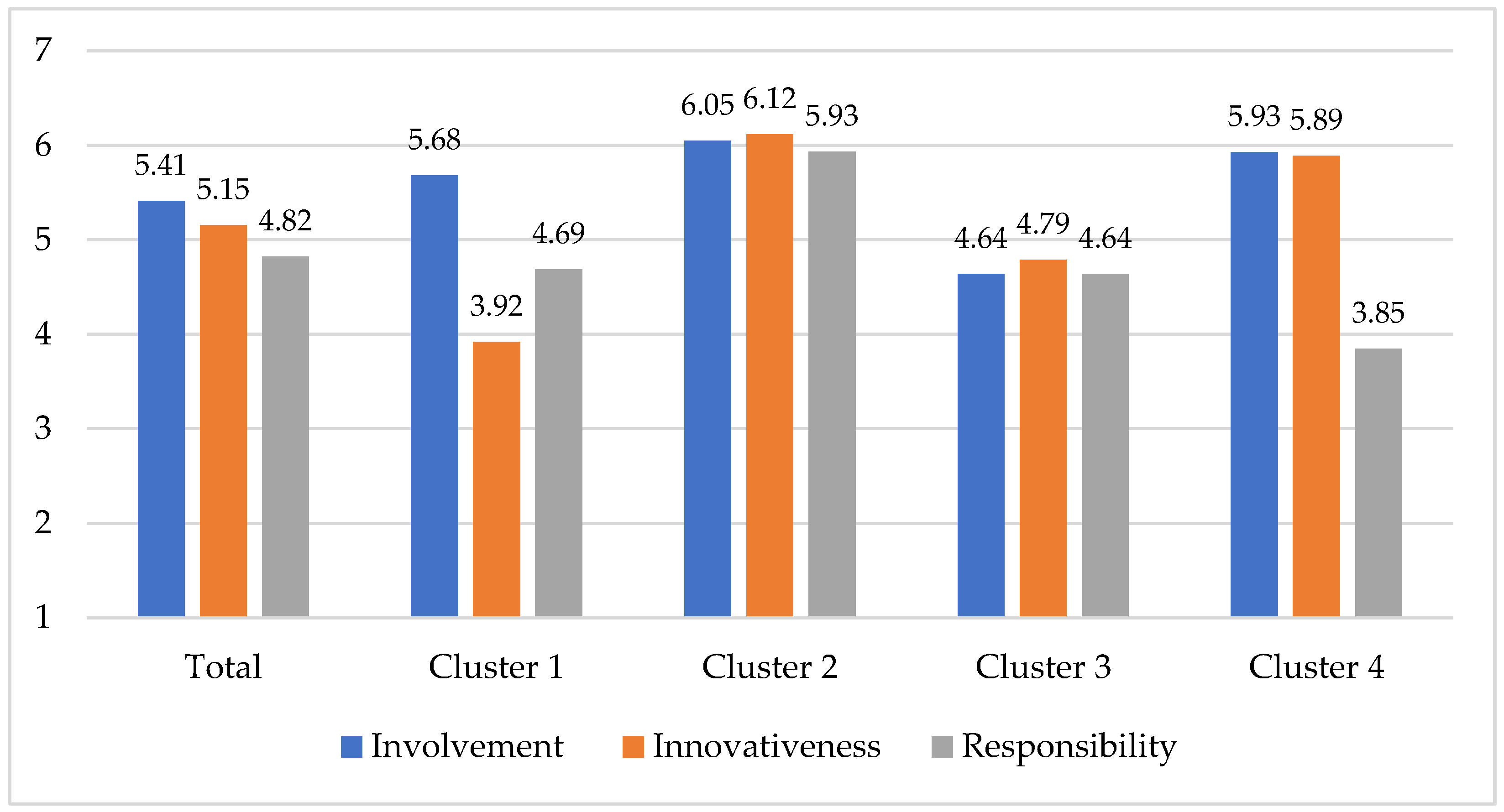
| Items Representing the Core Dimension of the Food-Related Lifestyle | Total | Cluster 1 | Cluster 2 | Cluster 3 | Cluster 4 | F-Value (3, 1196) |
|---|---|---|---|---|---|---|
| I just love good food | 5.64 | 5.86 b | 6.21 c | 4.83 a | 6.36 c | 224.414 *** |
| Eating and drinking are a continuous source of joy for me | 5.28 | 5.57 b | 5.95 c | 4.43 a | 5.91 c | 209.72 *** |
| Decisions on what to eat and drink are very important to me | 5.59 | 5.86 b | 6.26 c | 5.01 a | 5.68 b | 145.525 *** |
| Food and drink is an important part of my life | 5.50 | 5.96 b | 6.04 b | 4.65 a | 6.13 b | 228.874 *** |
| Eating and food is an important part of my social life | 5.04 | 5.16 b | 5.78 c | 4.28 a | 5.56 c | 135.177 *** |
| I like to try new foods that I have never tasted before | 5.32 | 4.04 a | 6.15 c | 4.97 b | 6.22 c | 246.838 *** |
| I love to try recipes from different countries | 5.00 | 3.56 a | 6.07 c | 4.62 b | 5.86 c | 285.101 *** |
| Recipes and articles on food from other culinary traditions encourage me to experiment in the kitchen | 4.98 | 3.58 a | 6.03 d | 4.63 b | 5.71 c | 268.588 *** |
| I like to try out new recipes | 5.36 | 4.14 a | 6.27 c | 5.02 b | 6.07 c | 250.789 *** |
| I look for ways to prepare unusual meals | 5.12 | 4.28 a | 6.05 d | 4.70 b | 5.60 c | 177.91 *** |
| I try to choose food produced with minimal impact on the environment | 4.79 | 4.60 b | 5.99 c | 4.57 b | 3.75 a | 209.989 *** |
| I am concerned about the conditions under which the food I buy is produced | 4.77 | 4.73 b | 5.79 c | 4.60 b | 3.78 a | 128.064 *** |
| It is important to understand the environmental impact of our eating habits | 5.16 | 5.17 b | 6.18 c | 4.92 b | 4.29 a | 140.776 *** |
| I try to choose food that is produced in a sustainable way | 4.96 | 4.83 b | 6.06 c | 4.74 b | 4.06 a | 176.981 *** |
| I try to buy organically produced foods if possible | 4.43 | 4.05 b | 5.64 d | 4.36 c | 3.34 a | 152.282 *** |
| Purchase Frequency | Total | Cluster 1 | Cluster 2 | Cluster 3 | Cluster 4 |
|---|---|---|---|---|---|
| Once a week or more often | (172) 14.3% | (22) 9.9% | (78) 26.4% | (40) 8.6% | (32) 14.7% |
| Two to three times a month | (241) 20.1% | (25) 11.3% | (84) 28.5% | (86) 18.5% | (46) 21.1% |
| Once a month | (207) 17.2% | (30) 13.5% | (46) 15.6% | (103) 22.2% | (28) 12.8% |
| Once every 2–3 months | (125) 10.4% | (23) 10.4% | (24) 8.1% | (55) 11.8% | (23) 10.6% |
| About once every three months | (165) 13.8% | (37) 16.7% | (29) 9.8% | (78) 16.8% | (21) 9.6% |
| I do not buy them at all | (290) 24.2% | (85) 38.3% | (34) 11.5% | (103) 22.2% | (68) 31.2% |
| Attribute | Total | Cluster 1 | Cluster 2 | Cluster 3 | Cluster 4 | F-Value (3, 1196) |
|---|---|---|---|---|---|---|
| Unhealthful—Healthful | 5.00 | 4.96 a | 5.48 b | 4.82 a | 4.79 a | 10.646 *** |
| Harmful for the environment—Beneficial | 5.26 | 5.21 a | 5.70 b | 5.16 a | 4.91 a | 12.867 *** |
| Cheap—Expensive | 4.65 | 4.81 ab | 4.44 b | 4.54 b | 5.02 a | 6.708 *** |
| Low nutritional value—High | 4.44 | 4.06 a | 5.02 c | 4.48 b | 3.95 a | 24.067 *** |
| Special meal—Every day | 4.45 | 4.35 a | 4.66 a | 4.41 a | 4.33 a | 6.405 |
| Low availability—High | 4.37 | 4.34 ab | 4.73 b | 4.30 a | 4.10 a | 6.697 *** |
| Difficult to prepare—Easy | 4.37 | 4.23 a | 4.73 b | 4.32 a | 4.15 a | 2.636 * |
| Not tasty—Tasty | 3.55 | 3.96 ab | 5.07 c | 4.35 b | 3.79 a | 28.52 *** |
| Incomplete protein—Complete | 4.59 | 4.48 ab | 5.03 c | 4.59 b | 4.13 a | 12.545 *** |
| Item Description | Total | Cluster 1 | Cluster 2 | Cluster 3 | Cluster 4 | F-Value (3, 1196) |
|---|---|---|---|---|---|---|
| Plant-based meat substitutes should taste like meat | 4.48 | 4.63 ab | 4.84 a | 4.31 bc | 4.22 c | 11.851 *** |
| Information about the negative environmental impact of eating meat is exaggerated | 4.28 | 4.50 b | 3.91 a | 4.12 a | 4.90 b | 21.616 *** |
| Reducing my meat consumption would not positively impact the environment | 4.16 | 4.32 bc | 3.85 a | 4.03 ab | 4.72 c | 15.684 *** |
| I try to eat as many plant-protein products as possible (e.g., pulses) | 4.16 | 3.82 bc | 5.03 a | 4.09 b | 3.48 c | 61.204 *** |
| I try to eat as many plant-based meat substitutes as possible to reduce my meat intake | 3.59 | 3.08 b | 4.59 d | 3.66 c | 2.59 a | 81.579 *** |
| Plant-based meat substitutes replace meat in my kitchen | 3.31 | 2.71 a | 4.31 c | 3.38 b | 2.42 a | 77.548 *** |
| Item Description | Total | Cluster 1 | Cluster 2 | Cluster 3 | Cluster 4 | F-Value (3, 1196) |
|---|---|---|---|---|---|---|
| I try not to throw away food | 6.16 | 6.25 b | 6.32 b | 5.97 a | 6.23 ab | 6.989 *** |
| I do not waste food | 6.00 | 5.99 ab | 6.19 b | 5.85 a | 6.10 ab | 4.947 ** |
| I try to use leftovers to make new meals or snacks | 5.50 | 5.32 a | 5.85 b | 5.37 a | 5.47 a | 7.866 *** |
| I choose free-range eggs | 5.49 | 5.44 c | 6.13 c | 5.33 b | 5.03 a | 24.698 *** |
| I avoid purchasing eggs from caged hens | 4.99 | 4.83 b | 5.65 c | 4.96 b | 4.33 a | 22.886 *** |
| I choose locally produced food products | 4.88 | 4.75 b | 5.58 c | 4.77 b | 4.30 a | 40.521 *** |
| I choose foods produced in an environmentally friendly way | 4.77 | 4.58 b | 5.74 c | 4.67 b | 3.88 a | 91.162 *** |
| Whenever possible, I buy fish from sustainable fisheries | 4.47 | 4.23 ab | 5.32 c | 4.32 b | 3.86 a | 40.433 *** |
| I limit my meat consumption | 3.97 | 3.49 b | 4.87 d | 4.21 c | 2.71 a | 68.614 *** |
| Dimension | Cluster 1—Traditionalists (18.5%) | Cluster 2—Conscious Food Enthusiasts (24.6%) | Cluster 3—Moderates (38.8%) | Cluster 4—Careless Food Lovers (18.2%) |
|---|---|---|---|---|
| FRL profile | High food involvement but very low innovativeness. | Very high food involvement and innovativeness; highly engaged “foodies”. | Moderate food involvement and openness, striking a balance between tradition and novelty. | High involvement and innovativeness; hedonistic, driven by enjoyment and novelty. Lowest responsibility. |
| Perception of PBMAs | Rather sceptical about PBMAs’ sensory and nutritional qualities. | Most positive perceptions; PBMAs’ highest ratings for taste, nutritional value, protein completeness and environmental benefits. | Neutral to moderately positive views; ratings close to the total mean for most attributes; neither particularly enthusiastic nor strongly critical. | Negative or indifferent; critical of taste, nutritional value and environmental benefits; highest scepticism regarding the environmental advantages of meat reduction. |
| PBMA purchasing behaviour | The highest share of non-purchases. | Most frequent buyers. | Rather occasional buyers. | About one-third buy occasionally; 31% never purchase. |
| Sustainability attitudes | Lower involvement in animal welfare and environmentally oriented purchasing, with moderate responsibility overall. | Highest overall engagement: strong preference for animal welfare, support for local and environmentally friendly production; the highest tendency to limit meat consumption. | Moderate engagement in most sustainability-related practices. | High commitment to avoiding food waste, but consistently lowest scores for animal welfare, environmentally friendly food choices and meat reduction. |
Disclaimer/Publisher’s Note: The statements, opinions and data contained in all publications are solely those of the individual author(s) and contributor(s) and not of MDPI and/or the editor(s). MDPI and/or the editor(s) disclaim responsibility for any injury to people or property resulting from any ideas, methods, instructions or products referred to in the content. |
© 2025 by the author. Licensee MDPI, Basel, Switzerland. This article is an open access article distributed under the terms and conditions of the Creative Commons Attribution (CC BY) license (https://creativecommons.org/licenses/by/4.0/).
Share and Cite
Żakowska-Biemans, S. Meatless Momentum: Food-Related Lifestyle Drivers of Plant-Based Meat Alternative Adoption. Nutrients 2025, 17, 3628. https://doi.org/10.3390/nu17223628
Żakowska-Biemans S. Meatless Momentum: Food-Related Lifestyle Drivers of Plant-Based Meat Alternative Adoption. Nutrients. 2025; 17(22):3628. https://doi.org/10.3390/nu17223628
Chicago/Turabian StyleŻakowska-Biemans, Sylwia. 2025. "Meatless Momentum: Food-Related Lifestyle Drivers of Plant-Based Meat Alternative Adoption" Nutrients 17, no. 22: 3628. https://doi.org/10.3390/nu17223628
APA StyleŻakowska-Biemans, S. (2025). Meatless Momentum: Food-Related Lifestyle Drivers of Plant-Based Meat Alternative Adoption. Nutrients, 17(22), 3628. https://doi.org/10.3390/nu17223628