Salvia miltiorrhiza Root Extract for Men with Lower Urinary Tract Symptoms: A Multicenter, Randomized, Double-Blind, Placebo-Controlled Trial

 , , , and
 Highlights
- Improvement in International Prostate Symptom Score (IPSS): Salvia miltiorrhiza root extract (SAGX) significantly improved IPSS in men with lower urinary tract symptoms (LUTSs). Both 400 mg and 800 mg doses alleviated symptoms such as frequency, urgency, weak stream, and nocturia, while enhancing quality-of-life scores compared to the placebo group.
- Enhancement in International Index of Erectile Function (IIEF): SAGX showed significant improvements in IIEF scores, particularly in the 400 mg group, highlighting its dual benefits in managing LUTSs and improving male sexual health.
- Safety and Tolerability: SAGX was well-tolerated with no serious adverse events reported. Unlike conventional LUTS treatments, which often have side effects like hypotension, dizziness, or decreased libido, SAGX offers a safer alternative for symptom relief and quality-of-life enhancement.
Abstract
1. Introduction
2. Materials and Methods
2.1. Salvia miltiorrhiza Root Extract (SAGX)
2.2. Inclusion Criteria
2.3. Exclusion Criteria
2.4. Outcome Measurements
2.5. Data Analysis
2.6. Reasons for Setting the Intake Amount
3. Results
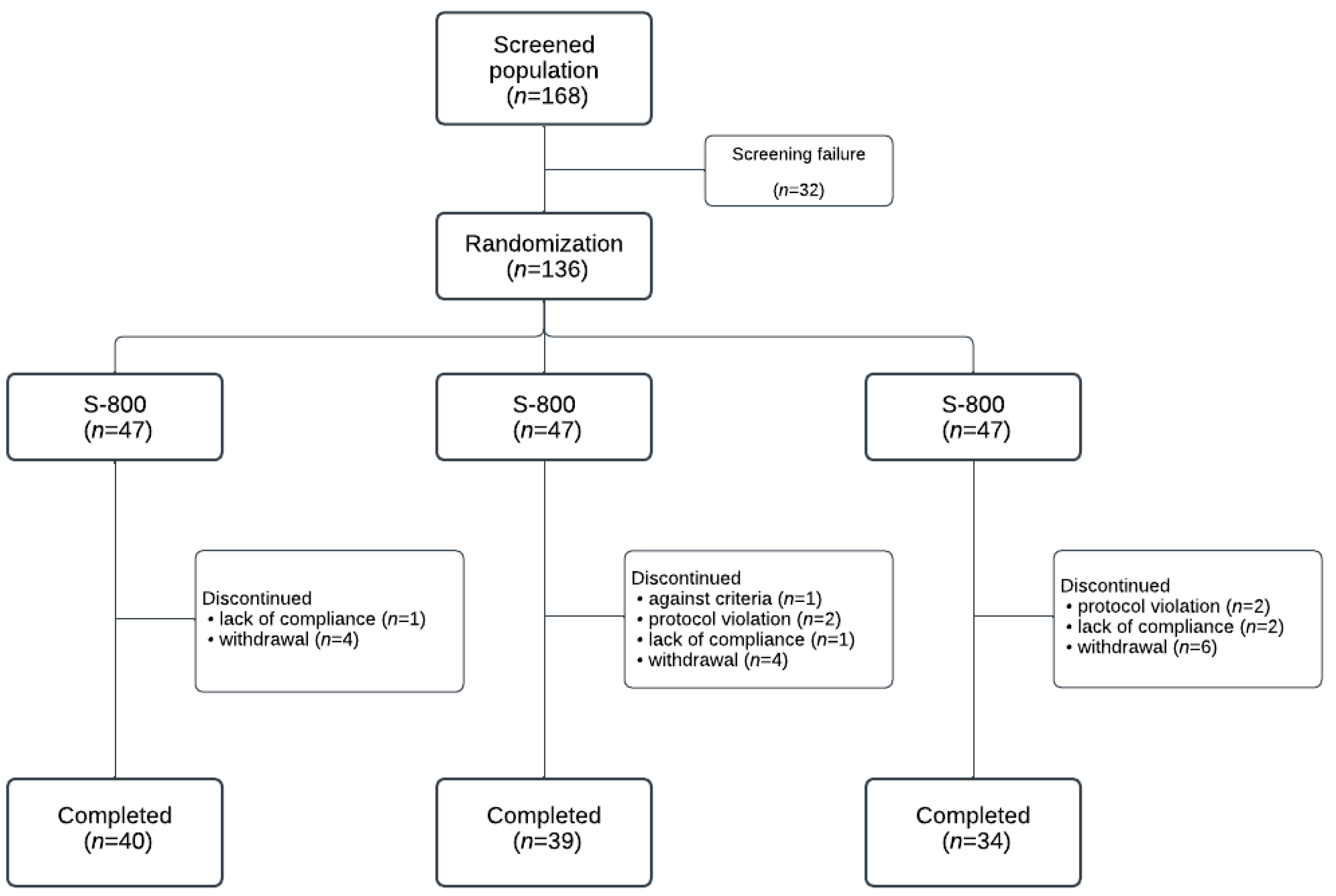
3.1. Baseline Characteristics and Participant Distribution
3.2. Primary Endpoints
3.2.1. IPSS Total Score
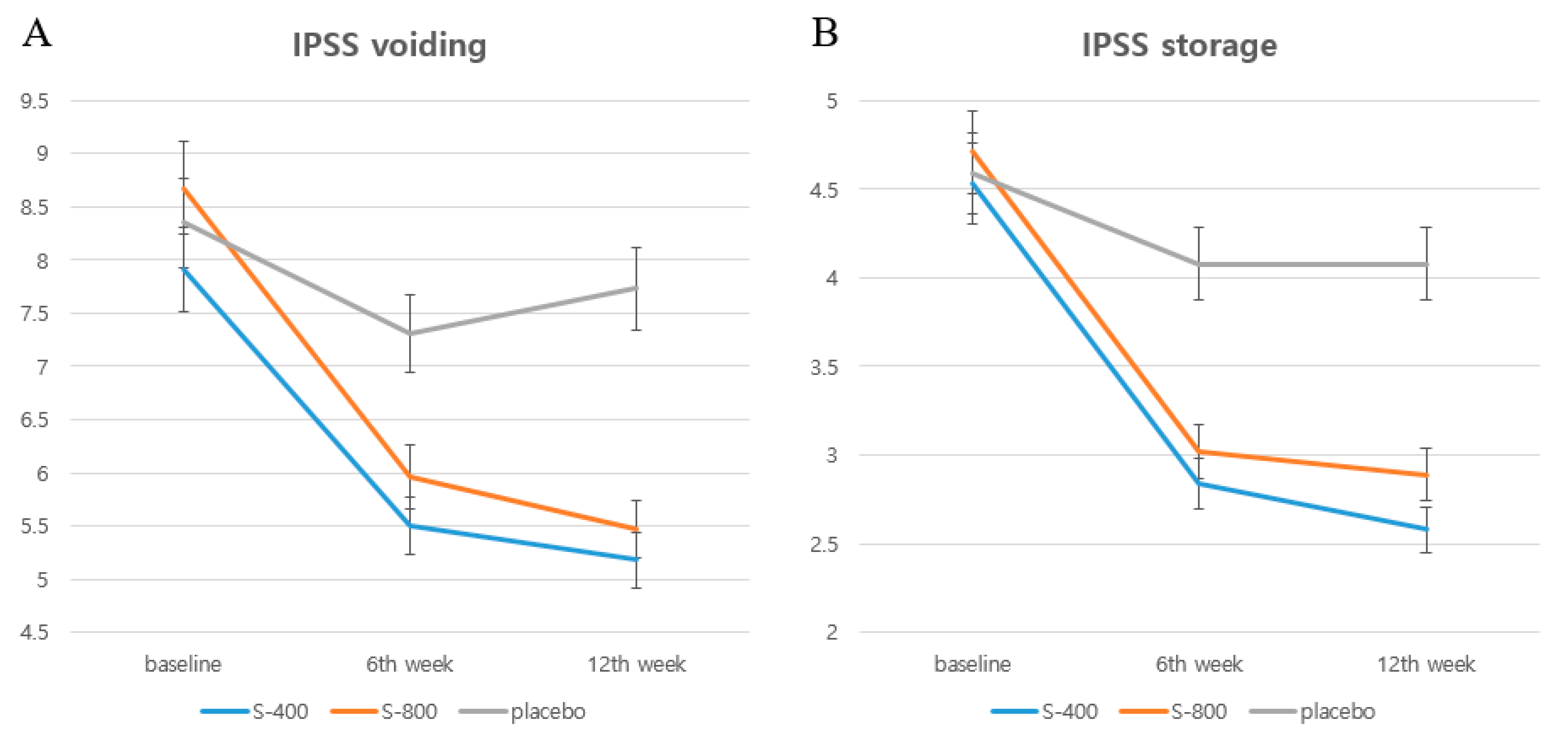
3.2.2. IPSS Subscores
3.3. Secondary Endpoints
3.3.1. International Index of Erectile Function Scores
3.3.2. PSA, Total Testosterone, DHT, Qmax, and PVR
3.4. Safety Assessments
4. Discussion
5. Conclusions
Supplementary Materials
Author Contributions
Funding
Institutional Review Board Statement
Informed Consent Statement
Data Availability Statement
Conflicts of Interest
References
- Malde, S.; Umbach, R.; Wheeler, J.R.; Lytvyn, L.; Cornu, J.-N.; Gacci, M.; Gratzke, C.; Herrmann, T.R.W.; Mamoulakis, C.; Rieken, M.; et al. A systematic review of patients’ values, preferences, and expectations for the diagnosis and treatment of male lower urinary tract symptoms. Eur. Urol. 2021, 79, 796–809. [Google Scholar] [CrossRef]
- Shin, D.; Yoon, B.I.; Kim, S.; Piao, J.; Jeon, K.-H.; Kwon, Y.; Park, S.-H.; Koo, Y.T.; Kim, J.-S.; Lee, D.S.; et al. Cervi Parvum Cornu complex for men with lower urinary tract symptoms: A multicenter, randomized, double-blind, placebo-controlled trial. Prostate Int. 2023, 11, 222–227. [Google Scholar] [CrossRef] [PubMed]
- Shin, D.; Yoon, B.I.; Bang, S.; Bae, W.J.; Ha, U.-S.; Kim, S.; Piao, J.; Kim, J.H.; Koo, G.-B.; Jeon, K.-H.; et al. Safety and Efficacy Assessment of Red Ginseng Oil (RXGIN) in Men with Lower Urinary Tract Symptoms in a Randomized, Double-Blind, Placebo-Controlled Trial. World J. Mens Health 2024, 42, 229–236. [Google Scholar] [CrossRef]
- Chen, X.; Guo, J.; Bao, J.; Lu, J.; Wang, Y. The anticancer properties of Salvia miltiorrhiza Bunge (Danshen): A systematic review. Med. Res. Rev. 2014, 34, 768–794. [Google Scholar] [CrossRef] [PubMed]
- Bae, W.J.; Choi, J.B.; Kim, K.S.; Ha, U.S.; Hong, S.H.; Lee, J.Y.; Hwang, T.-K.; Hwang, S.Y.; Wang, Z.-P.; Kim, S.W. Inhibition of Proliferation of Prostate Cancer Cell Line DU-145 in vitro and in vivo Using Salvia miltiorrhiza Bunge. Chin. J. Integr. Med. 2020, 26, 533–538. [Google Scholar] [CrossRef] [PubMed]
- Choi, Y.-J.; Wedamulla, N.E.; Kim, S.-H.; Oh, M.; Seo, K.S.; Han, J.S.; Lee, E.J.; Park, Y.H.; Park, Y.J.; Kim, E.-K. Salvia miltiorrhiza Bunge Ameliorates Benign Prostatic Hyperplasia through Regulation of Oxidative Stress via Nrf-2/HO-1 Activation. J. Microbiol. Biotechnol. 2024, 34, 1059–1072. [Google Scholar] [CrossRef]
- Yuan, J.-Q.; Mao, C.; Wong, S.Y.-S.; Yang, Z.-Y.; Fu, X.-H.; Dai, X.-Y.; Tang, J.-L. Comparative effectiveness and safety of monodrug therapies for lower urinary tract symptoms associated with benign prostatic hyperplasia: A network meta-analysis. Medicine 2015, 94, e974. [Google Scholar] [CrossRef] [PubMed]
- Gwon, Y.N.; Park, J.J.; Yang, W.J.; Doo, S.W.; Kim, J.H.; Kim, D.K. Comparing effects of alpha-blocker management on acute urinary retention secondary to benign prostatic hyperplasia: A systematic review and network meta-analysis. Prostate Int. 2023, 11, 91–99. [Google Scholar] [CrossRef] [PubMed]
- Pande, S.; Hazra, A.; Kundu, A.K. Evaluation of silodosin in comparison to tamsulosin in benign prostatic hyperplasia: A randomized controlled trial. Indian J. Pharmacol. 2014, 46, 601–607. [Google Scholar] [PubMed]
- Hutchison, A.; Farmer, R.; Verhamme, K.; Berges, R.; Navarrete, R.V. The efficacy of drugs for the treatment of LUTS/BPH, a study in 6 European countries. Eur. Urol. 2007, 51, 207–216. [Google Scholar] [CrossRef] [PubMed]
- Hirshburg, J.M.; Kelsey, P.A.; Therrien, C.A.; Gavino, A.C.; Reichenberg, J.S. Adverse effects and safety of 5-alpha reductase inhibitors (finasteride, dutasteride): A systematic review. J. Clin. Aesthet. Dermatol. 2016, 9, 56–62. [Google Scholar] [PubMed]
- Bhatt, N.R.; Davis, N.F.; Witjes, W.P.; Bjartell, A.; Caris, C.; Patel, A.; de la Taille, A.; Speakman, M.; Martínez-Piñeiro, L.; Tubaro, A. Contemporary use of phytotherapy in patients with lower urinary tract symptoms due to benign prostatic hyperplasia: Results from the EVOLUTION European registry. World J. Urol. 2021, 39, 2661–2667. [Google Scholar] [CrossRef]
- Zhang, K.; Guo, R.Q.; Chen, S.W.; Chen, B.; Xue, X.B.; Chen, S.; Huang, J.; Liu, M.; Tian, Y.; Zuo, L.; et al. The efficacy and safety of Serenoa repens extract for the treatment of patients with chronic prostatitis/chronic pelvic pain syndrome: A multicenter, randomized, double-blind, placebo-controlled trial. World J. Urol. 2021, 39, 3489–3495. [Google Scholar] [CrossRef] [PubMed]
- Theil, G.; Richter, M.; Schulze, M.; Köttig, T.; Patz, B.; Heim, S.; Krauß, Y.; Markov, M.; Fornara, P. Extract from Cucurbita pepo improves BPH symptoms without affecting sexual function: A 24-month noninterventional study. World J. Urol. 2022, 40, 1769–1775. [Google Scholar] [CrossRef]
- Rosen, R.C.; Riley, A.; Wagner, G.; Osterloh, I.H.; Kirkpatrick, J.; Mishra, A. The international index of erectile function (IIEF): A multidimensional scale for assessment of erectile dysfunction. Urology 1997, 49, 822–830. [Google Scholar] [CrossRef] [PubMed]



| S-400 (N = 40) | S-800 (N = 39) | Placebo (P) (N = 34) | p-Value * | ||
|---|---|---|---|---|---|
| S-400 vs. P W | S-800 vs. P W | ||||
| IPSS total B | 12.43 ± 2.88 | 13.41 ± 3.45 | 12.94 ± 2.93 | 0.4229 | |
| Δ6wk | −3.70 ± 2.90 | −4.41 ± 3.21 | −1.65 ± 3.45 | 0.0065 | 0.0009 |
| Δ12wk | −4.40 ± 3.14 | −5.03 ± 4.15 | −1.06 ± 3.40 | <0.0001 | <0.0001 |
| Incomplete emptying B | 1.93 ± 1.05 | 2.38 ± 1.29 | 2.12 ± 1.17 | 0.4184 | |
| Δ6wk | −0.70 ± 0.94 | −0.95 ± 1.10 | −0.15 ± 1.02 | 0.001 | 0.0017 |
| Δ12wk | −0.70 ± 1.16 | −1.13 ± 1.42 | −0.12 ± 1.15 | 0.0026 | 0.001 |
| Frequency B | 1.68 ± 1.02 | 1.51 ± 1.25 | 1.56 ± 1.28 | 0.6697 | |
| Δ6wk | −0.38 ± 0.90 | −0.59 ± 1.02 | −0.35 ± 0.77 | 0.9033 | 0.1302 |
| Δ12wk | −0.68 ± 0.97 | −0.72 ± 1.21 | −0.24 ± 0.96 | 0.0473 | 0.0135 |
| Intermittency B | 2.05 ± 1.13 | 2.41 ± 1.41 | 2.15 ± 1.42 | 0.5514 | |
| Δ6wk | −0.73 ± 0.82 | −0.82 ± 1.32 | −0.24 ± 1.07 | 0.0066 | 0.0514 |
| Δ12wk | −0.75 ± 1.17 | −1.00 ± 1.30 | −0.18 ± 1.06 | 0.0017 | 0.0017 |
| Urgency B | 0.85 ± 0.80 | 1.28 ± 1.23 | 0.91 ± 1.16 | 0.2396 | |
| Δ6wk | −0.08 ± 0.69 | −0.46 ± 0.82 | 0.06 ± 0.85 | 0.3878 | 0.0263 |
| Δ12wk | −0.20 ± 0.76 | −0.38 ± 1.18 | 0.03 ± 0.94 | 0.1619 | 0.2917 |
| Weak stream B | 2.63 ± 1.19 | 2.56 ± 1.10 | 2.79 ± 1.20 | 0.4045 | |
| Δ6wk | −0.68 ± 1.07 | −0.41 ± 0.97 | −0.18 ± 1.42 | 0.0305 | 0.1481 |
| Δ12wk | −0.65 ± 1.10 | −0.44 ± 1.10 | 0.00 ± 1.35 | 0.001 | 0.006 |
| Straining B | 1.30 ± 1.11 | 1.33 ± 0.98 | 1.29 ± 1.12 | 0.9394 | |
| Δ6wk | −0.30 ± 0.97 | −0.54 ± 0.82 | −0.47 ± 1.16 | 0.3818 | 0.8045 |
| Δ12wk | −0.63 ± 0.90 | −0.64 ± 0.90 | −0.32 ± 0.81 | 0.0711 | 0.0866 |
| Nocturia B | 2.00 ± 1.13 | 1.92 ± 0.93 | 2.12 ± 0.88 | 0.5925 | |
| Δ6wk | −0.85 ± 0.86 | −0.64 ± 0.87 | −0.32 ± 0.91 | 0.0021 | 0.0146 |
| Δ12wk | −0.80 ± 0.85 | −0.72 ± 0.86 | −0.24 ± 0.70 | 0.0002 | 0.001 |
| Quality of life B | 3.70 ± 0.69 | 3.59 ± 0.99 | 3.79 ± 0.54 | 0.9149 | |
| Δ6wk | −0.75 ± 0.90 | −0.56 ± 1.05 | −0.38 ± 0.95 | 0.037 | 0.0962 |
| Δ12wk | −1.10 ± 0.87 | −0.79 ± 1.00 | −0.32 ± 0.84 | <0.0001 | 0.0026 |
| S-400 (N = 40) | S-800 (N = 39) | Placebo (P) (N = 34) | p-Value * | ||
|---|---|---|---|---|---|
| S-400 vs. P W | S-800 vs. P W | ||||
| IIEF total B | 31.80 ± 20.18 | 34.92 ± 19.02 | 30.44 ± 19.22 | 0.8176 | |
| Δ6wk | 3.50 ± 13.83 | 3.31 ± 18.47 | 1.15 ± 12.25 | 0.4159 | 0.3620 |
| Δ12wk | 9.35 ± 13.64 | 1.56 ± 17.44 | −3.35 ± 19.96 | 0.0006 | 0.1139 |
| Erectile function B | 12.00 ± 10.14 | 14.10 ± 9.56 | 11.82 ± 9.83 | 0.8877 | |
| Δ6wk | 2.68 ± 7.47 | 1.21 ± 10.03 | 0.53 ± 5.90 | 0.1736 | 0.4806 |
| Δ12wk | 5.20 ± 7.50 | 0.49 ± 9.51 | −1.56 ± 10.89 | 0.0010 | 0.1842 |
| Orgasmic function B | 3.85 ± 3.99 | 4.44 ± 3.73 | 3.47 ± 3.65 | 0.5844 | |
| Δ6wk | 0.48 ± 2.86 | 0.41 ± 3.97 | 0.38 ± 2.72 | 0.7910 | 0.6700 |
| Δ12wk | 1.70 ± 3.05 | −0.05 ± 3.70 | −0.47 ± 4.05 | 0.0032 | 0.3123 |
| Sexual desire B | 6.30 ± 1.68 | 6.10 ± 1.77 | 6.09 ± 1.60 | 0.7935 | |
| Δ6wk | −0.23 ± 1.27 | 0.72 ± 1.32 | −0.12 ± 1.15 | 0.7281 | 0.0031 |
| Δ12wk | 0.38 ± 1.66 | 0.59 ± 1.60 | −0.35 ± 1.39 | 0.0168 | 0.0031 |
| Intercourse satisfaction B | 4.08 ± 4.23 | 5.08 ± 4.11 | 3.88 ± 3.96 | 0.5749 | |
| Δ6wk | 0.60 ± 2.70 | 0.33 ± 3.85 | 0.35 ± 2.63 | 0.6479 | 0.7149 |
| Δ12wk | 1.50 ± 2.86 | −0.31 ± 3.68 | −0.82 ± 4.27 | 0.0018 | 0.2288 |
| Overall satisfaction B | 5.58 ± 1.66 | 5.21 ± 1.44 | 5.18 ± 1.73 | 0.5328 | |
| Δ6wk | −0.03 ± 1.42 | 0.64 ± 1.16 | 0.00 ± 1.63 | 0.7307 | 0.0361 |
| Δ12wk | 0.58 ± 1.26 | 0.85 ± 1.27 | −0.15 ± 1.42 | 0.0029 | 0.0012 |
| S-400 (N = 40) | S-800 (N = 39) | Placebo (P) (N = 34) | p-Value * | |
|---|---|---|---|---|
| PSA B (ng/mL) | 1.15 ± 0.73 | 1.74 ± 3.00 | 1.08 ± 0.54 | 0.7171 |
| Δ12wk | 0.03 ± 0.44 | −0.26 ± 2.13 | 0.09 ± 0.49 | 0.8607 |
| Total T B (ng/mL) | 3.93 ± 1.39 | 4.63 ± 2.12 | 4.34 ± 1.76 | 0.5692 |
| Δ12wk | 0.59 ± 1.42 | 0.64 ± 1.99 | 0.49 ± 1.56 | 0.9115 |
| DHT B (ng/mL) | 277.62 ± 96.23 | 335.65 ± 127.08 | 308.82 ± 107.04 | 0.1288 |
| Δ12wk | 25.95 ± 91.78 | 9.57 ± 102.68 | −1.10 ± 64.27 | 0.4178 |
| Qmax B (mL/s) | 13.30 ± 7.25 | 15.11 ± 7.41 | 12.45 ± 5.99 | 0.2064 |
| Δ12wk | 0.45 ± 5.28 | −0.40 ± 7.28 | 0.00 ± 6.66 | 0.8421 |
| PVR B (mL) | 20.88 ± 30.14 | 15.41 ± 16.97 | 19.68 ± 23.64 | 0.9227 |
| Δ12wk | 4.75 ± 36.93 | 6.46 ± 23.17 | 1.15 ± 24.94 | 0.6637 |
Disclaimer/Publisher’s Note: The statements, opinions and data contained in all publications are solely those of the individual author(s) and contributor(s) and not of MDPI and/or the editor(s). MDPI and/or the editor(s) disclaim responsibility for any injury to people or property resulting from any ideas, methods, instructions or products referred to in the content. |
© 2024 by the authors. Licensee MDPI, Basel, Switzerland. This article is an open access article distributed under the terms and conditions of the Creative Commons Attribution (CC BY) license (https://creativecommons.org/licenses/by/4.0/).
Share and Cite
Shin, D.; Moon, H.W.; Bae, W.J.; Ha, U.-S.; Park, Y.H.; Lee, E.J.; Moon, D.G.; Kim, S.W. Salvia miltiorrhiza Root Extract for Men with Lower Urinary Tract Symptoms: A Multicenter, Randomized, Double-Blind, Placebo-Controlled Trial. Nutrients 2025, 17, 24. https://doi.org/10.3390/nu17010024
Shin D, Moon HW, Bae WJ, Ha U-S, Park YH, Lee EJ, Moon DG, Kim SW. Salvia miltiorrhiza Root Extract for Men with Lower Urinary Tract Symptoms: A Multicenter, Randomized, Double-Blind, Placebo-Controlled Trial. Nutrients. 2025; 17(1):24. https://doi.org/10.3390/nu17010024
Chicago/Turabian StyleShin, Dongho, Hyong Woo Moon, Woong Jin Bae, U-Syn Ha, Young Ho Park, Eun Joo Lee, Du Geon Moon, and Sae Woong Kim. 2025. "Salvia miltiorrhiza Root Extract for Men with Lower Urinary Tract Symptoms: A Multicenter, Randomized, Double-Blind, Placebo-Controlled Trial" Nutrients 17, no. 1: 24. https://doi.org/10.3390/nu17010024
APA StyleShin, D., Moon, H. W., Bae, W. J., Ha, U.-S., Park, Y. H., Lee, E. J., Moon, D. G., & Kim, S. W. (2025). Salvia miltiorrhiza Root Extract for Men with Lower Urinary Tract Symptoms: A Multicenter, Randomized, Double-Blind, Placebo-Controlled Trial. Nutrients, 17(1), 24. https://doi.org/10.3390/nu17010024