Article

Iron Status in Elderly Women Impacts Myostatin, Adiponectin and Osteocalcin Levels Induced by Nordic Walking Training


1
Department of Sport, Gdansk University of Physical Education and Sport, 80-336 Gdansk, Poland
2
Department of Athletics, Strength and Conditioning, Poznan University of Physical Education, 61-871 Poznan, Poland
3
Seventh Navy Hospital, 80-305 Gdansk, Poland
4
Department of Anatomy and Anthropology, Gdansk University of Physical Education and Sport, 80-336 Gdansk, Poland
5
Department of Physiology and Pharmacology, Gdansk University of Physical Education and Sport, 80-336 Gdansk, Poland
6
Department of Bioenergetics and Physiology of Exercise, Medical University of Gdansk, 80-210 Gdansk, Poland
*
Authors to whom correspondence should be addressed.
Nutrients 2020, 12(4), 1129; https://doi.org/10.3390/nu12041129
Submission received: 10 March 2020 / Revised: 9 April 2020 / Accepted: 15 April 2020 / Published: 17 April 2020
(This article belongs to the Special Issue Dietary Iron, Iron Deficiency and Human Health )

Abstract

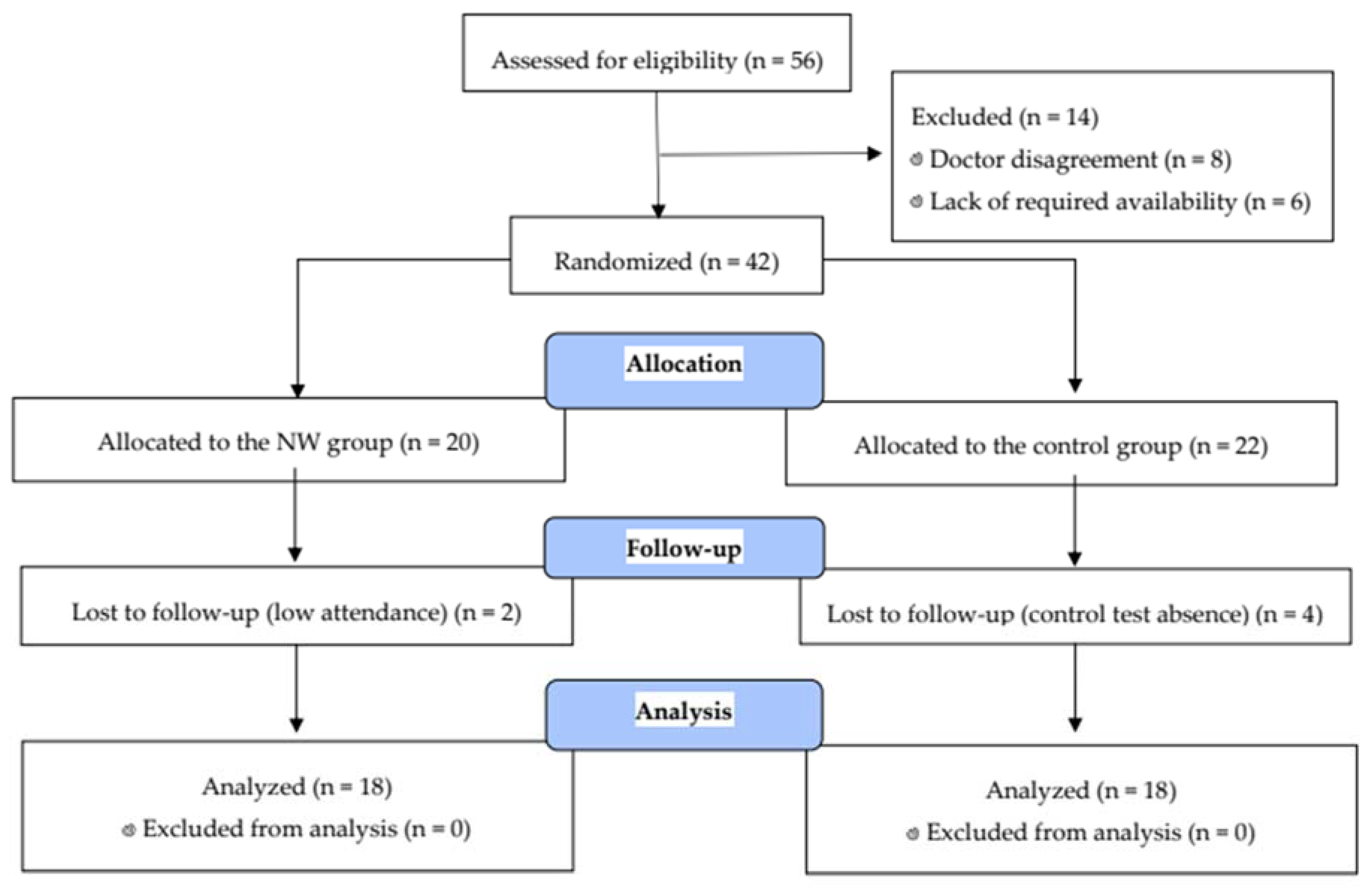
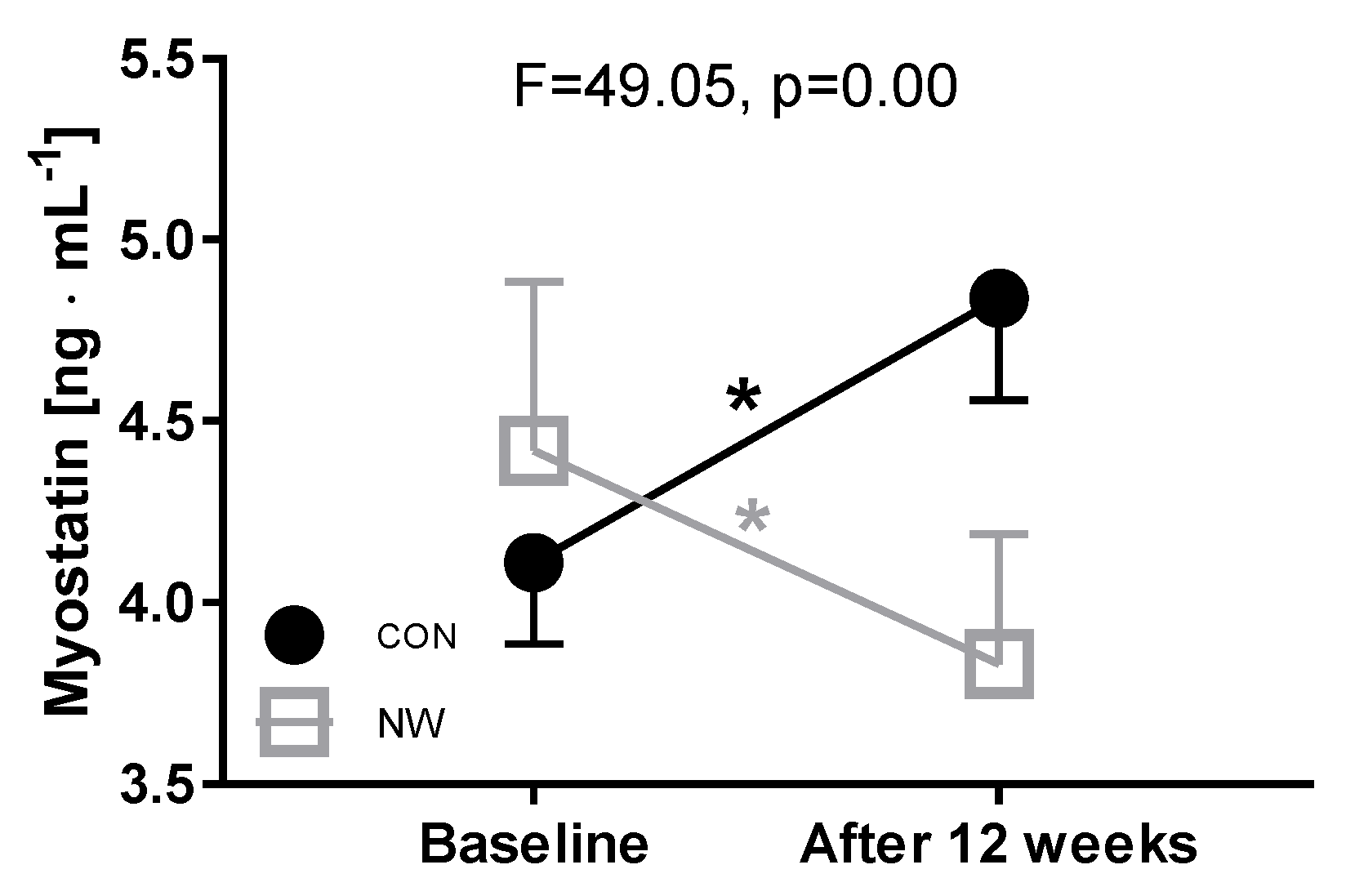
Impaired iron metabolism is associated with increased risk of many morbidities. Exercise was shown to have a beneficial role; however, the mechanism is not well understood. The purpose of this study was to assess the relationship between exerkines and iron metabolism in elderly women before and after 12 weeks of Nordic Walking (NW) training. Exerkines like myostatin, adiponectin, and osteocalcin have been shown to have several positive effects on metabolism. Thirty-six post-menopausal women (66 ± 5 years old, mean ± SD) were randomly assigned to a NW intervention group (n = 18; body mass, 68.8 ± 11.37 kg; fat, 23.43 ± 7.5 kg; free fat mass, 45.37 ± 5.92 kg) or a control group (n = 18; body mass, 68.34 ± 11.81 kg; fat, 23.61 ± 10.03 kg; free fat mass, 44.73 ± 3.9 kg). The training was performed three times a week for 12 weeks, with the intensity adjusted to 70% of the individual maximum ability. Before and one day after the 12-weeks intervention, performance indices were assessed using a senior fitness test. Blood samples (5 mL) were obtained from the participants between 7 and 8 AM, following an overnight fast, at baseline and one day immediately after the 12-week training program. A significant and large time × group interaction was observed for iron (NW: 98.6 ± 26.68 to 76.1 ± 15.31; CON: 100.6 ± 25.37 to 99.1 ± 27.2; p = 0.01; η p 2 = 0.21), myostatin (NW: 4.42 ± 1.97 to 3.83 ± 1.52; CON: 4.11 ± 0.95 to 4.84 ± 1.19; p = 0.00; η p 2 = 0.62), adiponectin (NW: 12.0 ± 9.46 to 14.6 ± 10.64; CON: 12.8 ± 8.99 to 11.9 ± 8.53; p = 0.00; η p 2 = 0.58), and osteocalcin (NW: 38.9 ± 26.04 to 41.6 ± 25.09; CON: 37.1 ± 33.2 to 37.2 ± 32.29; p = 0.03; η p 2 = 0.13). Furthermore, we have observed the correlations: basal ferritin levels were inversely correlated with changes in myostatin (r = −0.51, p = 0.05), change in adiponectin, and change in serum iron (r = −0.45, p = 0.05), basal iron, and osteocalcin after training (r = -0.55, p = 0.04). These findings indicate that iron modulates NW training-induced changes in exerkine levels.
Keywords: ferritin; serum iron; training adaptation; aging ferritin; serum iron; training adaptation; aging